UK’s Sizewell nuclear project remains unfinanced
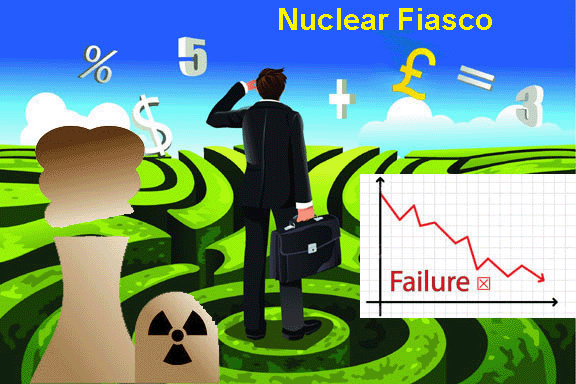
Alistair Osborne: The wind of change with no direction. Sizewell all at C.
Sometimes the brackets do a lot of work: “The government will continue to
secure the UK’s energy security through delivering new nuclear power,
including Sizewell C (subject to final agreement)”.
How far away is that deal? Maybe an unbuilt nuke on a Suffolk flood plain really can attract an
investor fan club. But, as yet, this £20 billion to £30 billion project
— the top end, natch, knowing nuclear — remains unfinanced.
France’s EDF only wants about 20 per cent of the project, with the taxpayer possibly
taking a fifth. And the only money pledged to date is the £700 million
from Boris Johnson on his way out of No 10. Final agreement may prove some
way off.
Times 18th Nov 2022
https://www.thetimes.co.uk/article/alistair-osborne-the-wind-of-change-with-no-direction-w8kcq5l9b
Strange Rolls Royce plan for Large complex of Large Small Nuclear Reactors for Bradwell

Rolls Royce announced on 9 November that it is eying up Bradwell as a potential site for the deployment of four to six so-called (and currently non-existent) Small Nuclear Reactors (SMRs).
Professor Andy Blowers, the Chair of the Blackwater Against New Nuclear Group (BANNG), commented:
‘This proposal, if it ever came about, would place up to six nuclear reactors on the Bradwell site. And they are hardly ‘small’ since each reactor would be close to the size of the old Bradwell A station. Together
these reactors would comprise a nuclear complex larger than the massive, proposed Bradwell B currently under consideration for development by the Chinese company, CGN.
‘It is hard to state how utterly inappropriate such a development, which would include long-term storage of highly radioactive nuclear wastes, would be on the low- lying Bradwell site, threatened by the impacts of Climate Change and Sea Level Rise.
BANNG finds it extremely odd that Rolls Royce is proposing the Bradwell site for SMRs. Only two days
before the announcement BANNG, at a meeting of the Department of Business, Energy and Industrial Strategy (BEIS) NGO Nuclear Forum, asked if CGN had withdrawn from the Bradwell B project. BANNG was told that there was no change to the proposals for Bradwell B but that further discussion was not
possible because of ‘commercial confidentiality’.
The Bradwell site is owned by the French company, EDF, which is also a minor partner in the
Bradwell B project. Rolls Royce agree that its proposal ‘requires agreement with CGN and EDF energy’.
Perhaps the Rolls Royce announcementunravels the mystery as to why CGN has not quit its operations at Bradwell altogether, claiming they are paused indefinitely. Could this be paving the way for Rolls Royce and also explain why BEIS invoked commercial confidentiality?
Blackwater Against New Nuclear Group 17th Nov 2022
Sizewell C nuclear plant in Suffolk to go ahead, Chancellor Jeremy Hunt confirms
A spokesman for the group Stop Sizewell C said: “If the chancellor is
looking for cheap, reliable, energy independence, he is backing the wrong
project, as Sizewell C’s ultimate cost and technical reliability are very
uncertain and building it is reliant on French state-owned EDF.
“Greenlighting Sizewell C also loads more tax onto struggling households,
who would be forced to pay a nuclear levy on bills for a decade before they
could light a single lightbulb. “Despite the chancellor’s statement,
Sizewell C still needs financing, and with at least a year before it’s
decided whether it will finally go ahead, we’ll keep fighting this huge
black hole for taxpayers’ money, when there are cheaper, quicker ways to
get to net zero.”
ITV 17th Nov 2022
https://www.itv.com/news/anglia/2022-11-17/sizewell-c-nuclear-plant-to-go-ahead-chancellor-confirms
Nuclear energy is unsafe, unreliable and leaves a long and toxic legacy,
according to the Scottish Greens. This comes as the Chancellor, Jeremy
Hunt, has confirmed plans for the Sizewell C nuclear plant.
Scottish Greens 17th Nov 2022
https://greens.scot/news/nuclear-is-unsafe-unreliable-and-will-leave-long-and-toxic-legacy
PERVERSE PRIORITIES UK : CUT PUBLIC SPENDING, KEEP NUCLEAR ARMS AND WARPLANES
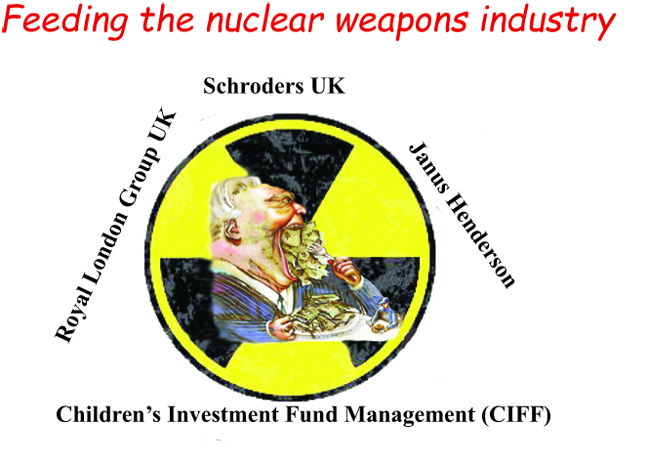
Chancellor Jeremy Hunt is considering billions worth of cuts in public spending while the Ministry of Defence, with Labour’s support, plans to spend vast sums on just two hugely expensive military projects.
RICHARD NORTON-TAYLOR Declassified UK, 14 NOVEMBER 2022,
We are in the midst of an extraordinary, indeed perverse, new round of austerity cuts.
The chancellor, Jeremy Hunt, is reported to be looking for £35 billion across government in cuts. While vital services will continue to be deprived of urgently-needed resources, the government seems set to give the military a budget rise in cash terms from £47.9bn this year to £48bn in 2023 and £48.6bn in 2024.
Liz Truss, backed by defence secretary Ben Wallace, wanted to award the armed forces even more – an increase close to £200bn by 2030, the biggest rise in the military budget since the start of the Cold War. By then UK military spending would have doubled to £100bn a year.
Rishi Sunak and Hunt have realised that such increases would be so unjustified and extravagant that they are reportedly ditching promises in the Conservatives 2019 manifesto and will actually cut the defence budget in real terms, that is with inflation taken into account.
However, the government’s spending on the military means that it will still be wasting vast resources on weapons systems that are unuseable in any foreseeable conflict.
Its planned public spending cuts are a small percentage of the amount the Ministry of Defence will be spending, with Labour’s enthusiastic support, on just two hugely expensive projects – the renewal of the Trident nuclear weapons arsenal and a fleet of 48 American F35B fighter jets for the navy’s two large aircraft carriers.
‘Persistent engagement overseas’
The government had set out Britain’s role and military posture in an ‘Integrated Review of Security, Defence, Development, and Foreign Policy’ and a report called ‘Defence in a Competitive Age’.
The documents are full of platitudes, vague promises and hollow claims. The review says Britain will be a “force for good”, “defending human rights”, avoiding any reference to Britain’s biggest market for arms sales – the Gulf states that are among the world’s worst abusers of human rights.
The refusal of the government to account to parliament about arms exports was sharply criticised by a cross-party Commons committee.
The defence report states that Britain will conduct “persistent engagement overseas”, including “further investment in Oman” demonstrating Britain’s “long-term commitment to the Gulf’s stability and prosperity, in addition to our presence in the British Indian Ocean Territory”.
This is an unstated reference to the US bomber base on Diego Garcia on the Chagos archipelago whose entire indigenous population was expelled by Britain.
The report refers to Britain’s “long standing relationships with Saudi Arabia…in support of shared security and prosperity objectives”. Saudi Arabia recently demonstrated its own priorities by siding with Vladimir Putin at the expense of consumers in the west by capping oil production.
‘Soft power superpower’
Ironically, the “integrated review” emphasises Britain’s potential role as a “soft power superpower” referring to the BBC and development aid, both of which are the victims of government cuts.
It emphasises the importance of the need to defend British interests against cyber attacks and to invest in unmanned drones. Yet the potential threat posed by cyber warfare and the opportunities presented by unmanned drones were ignored for many years by the Ministry of Defence.
The defence paper promises more investment in “autonomous platforms including swarming drones”, and says “Special Forces are at the heart of our approach to modernisation”. …………………………………..
Wasted billions
The lack of effective scrutiny of the armed forces and their expenditure has allowed the Ministry of Defence to waste tens of billions of pounds of public money on extravagant weapons systems irrelevant to modern conflict………………………………..
The figures below do not take into account the hidden costs of a skilled workforce diverted from military projects to more sustainable and useful products that benefit civil society. Nor do they take into account direct government support for arms exports and exporters – or bribery.
The MOD’s £300bn wasteful spending
| Trident renewal | £200bn |
| *Cost of delays/overruns in new projects, including frigates, Eurofighter/Typhoon aircraft, Bowman radios, A400M military transport aircraft | £18+bn |
| F-35s for aircraft carriers | £18.8bn |
| Aircraft carriers | £6.2bn |
| *Nimrod aircraft (subsequently destroyed) | £4bn |
| *Rental costs of privatised housing previously owned by MOD | £4bn |
| *Ajax armoured vehicle | at least £3.5bn |
| Military operations in Afghanistan and Iraq | £48.5bn |
(* Source: National Audit Office) https://declassifieduk.org/perverse-priorities-cut-public-spending-keep-nuclear-arms-and-warplanes/
Nuclear Free Local Authorities welcome energy efficiency plans, but deplore costly Sizewell C nuclear build at the public’s expense
Whilst the Nuclear Free Local Authorities welcome the Chancellor’s
commitment to invest billions more in home energy-efficiency, albeit too
slowly, his backing for Sizewell C is a blow.
In today’s Autumn
Statement, Chancellor Jeremy Hunt announced a further £6 billion for home
insulation from 2025 and has given the green light to the go ahead at
Sizewell C saying that contracts will be signed with partner French state
owned operator EDF Energy ‘in weeks’.
The NFLA has previously, and
severally, called on Government ministers, from successive Prime Ministers
on down, to provide serious investment for an emergency programme to
retrofit insulation to Britain’s cold and damp homes to improve comfort
whilst lowering bills for customers and the carbon footprint of the
nation’s housing stock.
Most unwelcome is the Chancellor’s backing for
Sizewell C. Jeremy Hunt has described the costly project as ‘Britain’s
first state backed nuclear power station for 30 years’, but much of the
backing will be at the expense of Britain’s already hard-pressed
electricity customers.
Hinkley Point C in Somerset, currently being built,
is already almost a decade late and way over budget, and her sister,
Sizewell C, will most likely cost upwards of £30 billion and be subject to
significant delays with customers expected to pick up the tag through the
imposition of an additional ‘nuclear tax’ on their bills to pay for it.
The NFLA wrote recently to the Chancellor urging him to scrap the scheme
and divert the money saved into renewables.
NFLA 17th Nov 2022
UK government to dump European Union nuclear safety laws – a deregulated race to the safety bottom?
Revealed: Fears over Brexit threat to nuclear safety laws, Herald 13th November,
UK GOVERNMENT plans threatening nuclear and radiation safety laws in a “Brexit bonfire” have provoked resistance from regulators and trade unionists, opposition from Scottish ministers, and alarm from campaigners.
The Cabinet Office has published a list of more than 2,400 European Union (EU) laws which are under review as part of the Government’s bid to scrap them. They include 10 key regulations designed to protect the public and workers from nuclear accidents and radiation leaks.
The UK Office for Nuclear Regulation (ORN), which oversees safety at civil and military nuclear sites, told The Ferret it was trying “to preserve the legislative framework” to meet the “highest international standards”.
The trade union Prospect, which represents scientists and engineers in the nuclear industry, accused UK ministers of “trying to weaken or dismantle a regulatory framework that has served the UK well over many decades”.
The Scottish Government attacked Westminster for “rolling back 47 years of protections in a rush to impose a deregulated race to the bottom”.
Campaigners are worried by the dangers of “watering down” nuclear safety law, and demand tougher legal protections.
A bill to remove “retained EU law” was introduced to the UK Parliament by the former business minister, Jacob Rees-Mogg, in September. It contains a “sunset” clause requiring all remaining EU law to be repealed or assimilated by the end of 2023, though this can be extended to 2026.
Among the laws under threat is the 2019 Radiation (Emergency Preparedness and Public Information) Regulations which compel councils and companies to draw up emergency plans to deal with nuclear accidents. According to UK Government guidance in 2015, the regulations are “key” to ensuring that the public is “properly protected”.
Three sets of regulations aimed at protecting workers and the public from the hazards of radiation are also up for review. One “lays down basic safety standards for protection against the dangers arising from exposure to ionising radiation”, the Government said.
Other laws on the UK Government list cover “maximum permitted levels” of radioactivity in food after a nuclear emergency; imports of radioactively contaminated food following the Fukushima nuclear accident in 2011 and the Chernobyl disaster in 1986; and the safety of decommissioning nuclear plants.
The ORN, which regulates the Faslane nuclear base and six other sites in Scotland, is understood to be taking the threat to nuclear safety laws “very seriously”. The six other sites are Chapelcross in Dumfries and Galloway; Dounreay in Caithness; Hunterston A and Hunterston B, both in North Ayrshire, Rosyth in Fife; and Torness in East Lothian
An ONR spokesperson told The Ferret: “We are in discussions with the Government to preserve the legislative framework that allows us to hold the nuclear sector to account consistent with the highest international standards.”
According to the veteran nuclear critic Pete Roche, this meant that the ONR was resisting the UK Government’s plans. “Reading between the lines, it looks as though the ONR is planning to fight any proposals to make drastic changes to nuclear regulation,” he said.
“In recent meetings I have been involved in, ONR representatives have stressed the need to uphold the highest international standards. I can only hope I am not being overly optimistic and that they stick to their guns.”
Prospect argued that the existing regulatory framework worked well at protecting workers and communities. This was vital as old nuclear plants were being decommissioned and new ones built, it said.
“Perhaps the Government should focus on ensuring that existing regulators are properly resourced to do this important work rather than trying to weaken or dismantle a regulatory framework that has served the UK well over many decades,” said Prospect’s senior deputy general secretary, Sue Ferns.
Ferns.
“Tearing up existing regulations for the sake of purportedly ‘taking back control’ does nothing but introduce uncertainty,” she added. “Nuclear is an international industry, there is no value in seeking to craft UK specific legislative variants just for the sake of it.”
The Scottish Government has urged the Scottish Parliament to withhold consent for the “Brexit bonfire” bill. “Ministers fundamentally oppose the Retained EU Law Bill,” said a spokesperson. “This bill puts at risk the high standards people have come to expect from EU membership, rolling back 47 years of protections in a rush to impose a deregulated race to the bottom.”
The 50-strong group of Nuclear Free Local Authorities was “gravely concerned” about the “threat to water down legislation which provides the public or our environment with protection from the operational or legacy risks posed by civil nuclear power”.
The group’s chairman David Blackburn, a Green councillor from Leeds, said: “If European regulations providing protection are to be removed, we will press Government ministers to instead enact equivalent, or preferably stronger, laws into UK domestic legislation.”
The environmental campaigner and former director of Friends of the Earth Scotland, Dr Richard Dixon, thought that the EU gave the public and workers “vital protections” against radiation risks.
“No backsliding at all can be allowed,” he said.
“This has never been more important with the prospect of damage to nuclear reactors or even the use of nuclear weapons in Ukraine.
“Protection of the same strength or better needs to be put in place.”
The UK Department for Business, Energy and Industrial Strategy did not respond to requests for comment. …………. https://www.heraldscotland.com/news/23121029.revealed-fears-brexit-threat-nuclear-safety-laws/
Concern over radioactive particles on Dounreay shoreline – poor monitoring of the nuclear clean-up
Letter Tor Justad: I refer to recent press reports referring to new high
numbers of “harmful” radioactive particles found on the Dounreay
shoreline and Sandside beach which suggested they were related to leaks
between 1958 and 1984, with 73% of the particles described as
“significant”, and 15 particles found between February and March 2022.
Dounreay Site Restoration Ltd (DSRL), responsible for decommissioning the
site, said it was closely monitoring the situation and Sepa (Scottish
Environment Protection Agency) stated “we are content that the monitoring
and retrieval programme in place continues to provide appropriate
protection for the public”. DSRL stated “the foreshore is not used by
the general public”
– this is not a reassurance as nuclear radiation
has no boundaries. Highlands Against Nuclear Transport (Hant) is
represented on the Dounreay Stakeholder Group (DSG) and has regularly asked
for information about the monitoring being carried out and the results –
and has been told that information will be made available when the
monitoring report is provided by an independent body.
Neither the DSG meeting on March 22 nor the Site Restoration Sub Group meeting on October
19 were informed of these findings of concern. Given that this information
has only been made available through press reports to date, Hant would want
the following to be implemented:
i) Regular up-to-date reports provided to
the DSG and by press releases to the local press on the monitoring results,
so that the DSG can provide this information to organisations represented
by members and the general public will be informed by the local press.
Assuming that the results of the monitoring can demonstrate that there is
no danger to the public this will provide reassurance to everyone living in
the area around Dounreay;
ii) That the Dounreay “clean up” reports
provided by DSRL to the Particles Retrieval Advisory Group Dounreay (Prag)
be provided to the DSG and local press – an online search resulted in the
latest information from the Prag online being from 2016 and this is totally
unacceptable;
iii) That a presentation be made to the DSG by the outside
body carrying out the monitoring to describe its methodology and how
regularly it is carried out – to provide local reassurance. Hant looks
forward to the immediate implementation of these proposals and will be
monitoring this issue closely over the next months.
Press & Journal 11th Nov 2022
Sizewell C – proposed coastal area is not suitable for nuclear reactors
Letter: Your leader on Sizewell C ignores a couple of factors that are key
to our local objections. First, the coastline on which Sizewell A and B are
built and Sizewell C is proposed is disintegrating at an increasingly
alarming rate – just two weeks’ ago a building at nearby Thorpeness had
to be demolished due to collapse of the cliffs.
Second, there is insufficient water in Suffolk to build and operate Sizewell C, which was
one of the main reasons the government’s own planning inspectorate
advised against it recently. Water is planned to be found through the
construction of desalination plants – these require huge amounts of
energy, but more importantly the waste salt and other minerals from the
extraction process will be put back into the sea, poisoning the waters
around for miles.
There are other reasons why this is a disastrous
location: it is a site of special scientific interest and an area of
outstanding natural beauty and the prototype for this type of reactor has
yet to be proved at Flamanville – still not operational, years over
schedule and way over budget. Nuclear has moved on since the design of
these reactors. The government should think again.
Observer 13th Nov 2022
Closed Dounreay nuclear site records its highest number of radioactive particles in nearly two decades
. Fifteen radioactive particles have been discovered at a
nuclear site in Scotland that is currently being decommissioned, marking
the highest reported number in nearly two decades.
The particles contained niobium 94, which has a half life of 20,300 years, Americium-241, which has
a half life of 432.2 years, caesium 137, which has a half life of 30 years,
and cobalt 60, which has a half life of around 5.3 years. Eleven of the
finds were categorised as “significant”, which is the highest hazard
level used.
ENDS 9th Nov 2022
‘Clear case for inquiry into treatment of men in Britain’s nuclear test programme’
Mirror 10th Nov 2022, https://www.mirror.co.uk/news/politics/clear-case-inquiry-treatment-men-28463111
These brave men were exposed to levels of radiation subsequently linked to higher-than-average rates of cancer and birth defects
There is now a clear case for a public inquiry into the scandalous treatment of the men who took part Britain’s Cold War nuclear test programme.
Throughout our long campaign to win them justice, the Ministry of Defence has sought to confuse the issue and obstruct any inquiries.
These brave men were exposed to levels of radiation subsequently linked to higher-than-average rates of cancer and birth defects.
They have received no recognition, no medals and no compensation.
The MoD allegedly knew full well the dangers and sought to cover them up.
Nuclear test vet heroes denied truth as government ‘committed crimes against own servicemen’
Some documents which would reveal the truth have been withdrawn from the public record. Medical records have reportedly been falsified, withheld or destroyed.
An inquiry must examine not just the test programme but also the culture of secrecy which has added to families’ distress.
The poppy to be worn by Rishi Sunak at the Cenotaph this weekend is meant to be tribute to those who served the nation. If he really wants to support military personnel past and present he will act now
Welsh Affairs Committee to hear from proponents of nuclear power, on funding plans for Sizewell C project
On 16th Nov, the Welsh Affairs Committee will quiz experts on whether
funding models are adequate to meet the UK Government’s targets to
generate 24GW of nuclear power by 2050. MPs will hear from Aviva Investors,
Sizewell C and the Nuclear Industry Association on the financing of new
nuclear projects covering the Regulated Asset Base model of funding, green
taxonomy and private investment.
They will also be discussing the
importance of the UK Government’s commitment to the nuclear sector and
public funding. The evidence session comes amid reports that the UK
Government is hoping to finalise a deal shortly on the funding of the
Sizewell C nuclear power plant.
Welsh Affairs Select Committee 10th Nov 2022
TODAY. The Times got it right about 5 reasons for hope on climate action, but very wrong on one

I wonder why journalists do this? Presumably, this Times writer is not ignorant, not stupid. And yet, slipped in amongst some genuine factors about clean energy sources and energy efficiency, – we come to his uncritical admiration for nuclear fusion and small nuclear reactors.
The writer does mention the “prototype nuclear fusion” planned for 2040. A fat lot of good that would be – we need action now – not promises for the nebulous far-off future!
As always – I am stunned at the corporate journalists’ complacency – in trotting out the military-industrial-corporate-government line on matters nuclear.
The connection here is that small nuclear reactors have only one genuine use – to assist and promote the nuclear weapons industry
Six reasons to be cheerful about the climate’s future. Times 9th Nov 2022
Growth in emissions is slowing, clean energy is cheaper and electric cars are denting oil, Adam
Vaughan writes.
Between warnings from the Cop27 climate conference in Egypt
that the world is on a “highway to climate hell” and “the planet has
become a world of suffering”, it can be easy to think that no absolutely
no progress has been made on curbing global warming.
It is certainly true
that the world is falling wildly short of its 1.5C climate goal target. But
it is simultaneously true that great strides are being made in the world of
science, business and technology, as the following six examples show.
(1) Global carbon emissions growth has slowed; The emissions from humanity’s
cars, factories and power stations are still going up, when scientists say
they need to have fallen 45 per cent by the end of this decade if the world
is to rein in warming to 1.5C. The silver lining is there are signs that
emissions are hitting a plateau.
(2) Renewable energy is rapidly getting
cheaper. Most authorities, including the International Energy Agency (IEA)
and leading scientists, think that wind and solar power will be the two key
technologies for decarbonising the world’s electricity supplies. Between
2010 and 2019, the costs for solar energy fell by 85 per cent. Wind energy
fell costs fell by 55 per cent. Investment is pouring into renewable energy
at a record rate, with $226 billion invested in the first half of 2022
according to Bloomberg New Energy Finance, which tracks clean energy
spending.
Global energy demand growth will now “almost entirely be met by
renewables, the IEA said recently. In the UK, the cost of offshore wind and
solar has fallen by 80 to 90 per cent over the past decade. “Wind and
solar are now the cheapest way to generate electricity in most of the world
and, in the UK, we get as much electricity from renewables as we do from
gas,” said Evans. In July, five new offshore wind farms due online from
2026 won a government auction to deliver power to consumers at £37.35 per
megawatt hour, a fraction of the cost of gas-fired power plants now.
(3) High gas prices have made cutting emissions cheaper. The UK’s Climate
Change Committee, an independent body which advises the government on how
to meet its carbon targets, said in June that soaring gas prices meant that
meeting net zero would flip from a 0.5 per cent cost to GDP by 2035, to a
0.5 per cent saving by 2035.
(4) Technology can be seen as a breath of
fresh air. Energy efficiency improvements have delivered huge gains, with
better appliances and LED bulbs saving the average UK household £290 a year
between 2008 and 2017. Typical household energy bills today would have been
£40 a year lower if David Cameron hadn’t cut insulation programmes in 2013.
(5) Other countries are passing climate laws: President Biden came to Cop26
in Glasgow with a promise of halving his country’s emissions by 2030, but
no domestic plan to deliver the cuts. This time John Kerry, his special
climate envoy, can boast that America recently passed legislation that
commits the country to spending £318 billion on clean energy. The package,
which largely consists of incentives for key technologies such as wind and
solar power, electric cars and hydrogen, is expected to deliver a 40 per
cent emissions cut by 2030, not far off Biden’s target.
(6) Innovative new
technology is gaining traction: Previously far-off ideas are nearing
commercial reality, and the UK is pioneering many of them. The UK is
planning to build the world’s first prototype nuclear fusion power station
by 2040. A new generation of new nuclear power stations backed by
Rolls-Royce, much smaller and hopefully easier to build than conventional
ones, are working their way through the UK’s nuclear regulatory approval
process. Giant electrolysers are being built next to an offshore wind farm
in northeast England to split water and produce a clean supply of hydrogen.
The UK government is even taking seriously the prospect of space-based
solar power, where solar panels in Earth’s orbit beam a steady stream of
electricity back to the planet’s surface.
https://www.thetimes.co.uk/article/six-reasons-to-be-cheerful-about-the-climate-s-future-9s0wgddkq
Ever the optimists… Rolls-Royce chooses four sites for reactor that’s yet to be built

https://www.nuclearpolicy.info/news/ever-the-optimistsrolls-royce-chooses-four-sites-for-reactor-thats-yet-to-be-built/ 9 Nov 22, Rolls Royce SMR, the company behind the development of so-called Small Modular Reactors, has today announced its ambitious plans to deploy new reactors at four sites in England and North Wales by the early 2030’s, but there is a fly in the ointment – it is a reactor that has yet to be built.
Rolls-Royce has been visiting sites in recent months and number-crunching existing data to identify their preferred locations for any future SMRs, and Wylfa and Trawsfynydd in North Wales; Sellafield in West Cumbria; and Oldbury in Gloucestershire have been selected based on ‘existing geotechnical data, adequate grid connection and because each site is large enough to deploy multiple SMRs’.
But the announcement leapfrogs several crucial challenges Roll-Royce will first need to overcome before their SMR vision becomes reality.
Councillor David Blackburn, Chair of the UK/Ireland Nuclear Free Local Authorities, explained: “Rolls-Royce may sound optimistic, but the history of British civil nuclear power is littered with projects delivered late, over budget, whilst compromising safety, or with sub-standard power output. And the SMR concept has its own set of problems.
“For one the design has not even received regulatory approval from the Office of Nuclear Regulation, and it may not, and this is a process expected to take until at least mid-2024.
“It is also conceived to be prefabricated and assembled on site, but factories still have to be built to fabricate the parts; the process of fabrication has to be mastered; all the necessary approvals and permits will have to secured to build on each site, possibly in the teeth of significant public opposition; and the assembly of pre-fabricated reactors on site is still not a perfected art – just think of the challenge of building an IKEA furniture set and multiply that a million fold.”

The NFLA also has real concerns about the radioactive waste future SMRs will bring, with a recent study by the University of Stanford and British Columbia identifying that fission in these smaller reactor types could produce between two and thirty times as much radioactive waste as that produced by a ‘conventional’ larger reactor per unit of electricity generated.[1]
Added Councillor Blackburn: “That is an awful lot of radioactive waste to add to the stockpile Britain has already accumulated from almost seventy years of civil nuclear power generation; toxic waste that must be managed safely at vast public expense and for which a long-term totally safe storage solution has yet to be found. Do we really want to produce more when we can generate our electricity safely and more cheaply using renewables?”
A disaster waiting to happen’: British nuclear-armed sub resurfaces after fire onboard
https://cnduk.org/a-disaster-waiting-to-happen-british-nuclear-armed-sub-resurfaces-after-fire-onboard/?fbclid=IwAR3t-FcdURBZY22Nmf7daG7zZm1F4OTGwxQEQ8hvq0X6RMAt6N9X6OdUgsE A Royal Navy nuclear-armed submarine had to abandon its mission and resurface, after a fire broke out onboard following an electrical fault.
The Ministry of Defence said the incident on HMS Victorious happened six weeks ago. The blaze broke out in an electrical component in one of the submarine’s systems but carbon dioxide injectors built into the module extinguished it. However, all crew were scrambled to tackle the fire and look for others and the sub’s commander had to surface the vessel in the North Atlantic. After the fire was contained, Victorious returned to port at Faslane in Scotland.
Victorious is one of Britain’s four Vanguard-class nuclear-armed submarines with one vessel constantly on patrol ready to launch a nuclear strike. The MoD said the sub wasn’t on patrol during the time of the fire and was en route to the US for wargames.
News of the incident comes after it was revealed in September that another vessel, HMS Vanguard, would remain in dry-dock for the foreseeable future after more technical issues were discovered. Vanguard has been in deep maintenance since 2015 at a cost of £500 million. The delay has compounded problems for the Royal Navy – whose so-called “Continuous at-Sea Deterrence” is reportedly operating at half capacity.
Meanwhile, a whistleblower told STV that staff working at Royal Naval Armaments Depot (RNAD) Coulport – the base where Britain’s nuclear weapons are stored – had to be evacuated due to a “serious radiation breach.”
CND General Secretary Kate Hudson said: “The revelations about HMS Victorious further underline the risks that these weapons present – a disaster waiting to happen. The fact that the sub had to surface and expose itself illustrates both how fallible the technology is and how baseless the myth of ‘invisibility’. The news from Coulport reinforces these concerns. Meanwhile, billions of pounds are being pumped into maintaining these vessels and warheads and billions more in developing news ones. It’s time to stop this irresponsible waste before a real tragedy occurs.”
Campaigners seek early end to Chinese involvement at Bradwell nuclear project

https://www.nuclearpolicy.info/news/campaigners-seek-early-end-to-chinese-involvement-at-bradwell/ 7 Nov 22 Three campaign groups have written to influential parliamentarians asking them to seek an early end to plans by Chinese-state owned CGN to develop a new nuclear power plant at Bradwell in Essex.
In their letter to Conservative MPs, Alicia Kearns and Sir Iain Duncan Smith, the Nuclear Free Local Authorities, the Blackwater Against New Nuclear Group (BANNG), and the Bradwell B Action Network (BAN) have urged them ‘to make urgent representations to government to terminate CGN’s involvement at the Bradwell B site as soon as possible’.
Ms Kearns and Sir Iain are both prominent members of the China Research Group, whose stated position is that ‘Chinese involvement in our nuclear industry is now seen as an unacceptable national security risk’. The three campaign groups are opposed to any new nuclear projects at Bradwell as they believe the site does not meet any of the required national criteria to be suitable for the location of a power plant, however they have especial concerns about a Chinese-led project.
T
n their letter, they state that ‘the construction of a nuclear power plant by a Chinese-state owned entity, using Chinese-designed reactors that are not yet operational anywhere in the world, at a location relatively close to large urban populations, military installations, and other strategic assets and infrastructure, must represent a potentially substantial safety and security risk to the UK’.
Recent pronouncements by the Bradwell project team have contained mixed messages. In a circular to residents, they stated that boreholes dug on site to take soil samples would be filled in; that the site compound would soon be dismantled; and that a second phase of testing would be delayed beyond 2023. However, in a response to the media after the NFLA described this as ‘beating a retreat’, CGN insisted they are going to proceed with further feasibility studies.
This optimism seems ill-judged given the many statements by government ministers that they are hostile to Chinese investment in major British infrastructure projects, including at Sizewell C and Bradwell B. The government has enacted the National Security and Investment Act to allows ministers to restrict or prevent foreign investment in infrastructure projects that could compromise national security. Given the political backdrop, the three campaign groups cannot see how the British government could give the CGN-led Bradwell B development its endorsement
Professor Andrew Blowers OBE, Chair of BANNG, said: ‘For the past fourteen years, we have opposed any nuclear development on the grounds that the site is not in any way ‘potentially suitable’ for a new nuclear power station. We believe the Chinese project will be withdrawn owing to sustained local opposition and security concerns. We are asking politicians to confirm that this is the case.’
Councillor David Blackburn, Chair of the NFLA, added: ‘The Bradwell situation appears to be one in which life imitates art. The Bradwell B team are insisting, like the shopkeeper in the famous Monty Python parrot sketch, that their nuclear power project is ‘not dead, it’s merely resting’, whereas it is highly unlikely that it will ever go forward at a time when parliament believes the Chinese Government is not to be trusted. The NFLA believes it would be best if the government made plain that this is going nowhere to end the uncertainty for staff and the people in the communities surrounding the Bradwell B site.’
1 This Month

of the week – Shut Down Drone Warfare!


Tell the Ukrainian Government to Drop Prosecution of Peace Activist Yurii Sheliazhenko

Petition to revoke the licensing of the Near Surface Nuclear Disposal Facility (NSDF) at Chalk River. https://www.ourcommons.ca/petitions/en/Petition/Details?Petition=e-7247
To see nuclear-related stories in greater depth and intensity – go to https://nuclearinformation.wordpress.com
-
Archives
- April 2026 (114)
- March 2026 (251)
- February 2026 (268)
- January 2026 (308)
- December 2025 (358)
- November 2025 (359)
- October 2025 (376)
- September 2025 (257)
- August 2025 (319)
- July 2025 (230)
- June 2025 (348)
- May 2025 (261)
-
Categories
- 1
- 1 NUCLEAR ISSUES
- business and costs
- climate change
- culture and arts
- ENERGY
- environment
- health
- history
- indigenous issues
- Legal
- marketing of nuclear
- media
- opposition to nuclear
- PERSONAL STORIES
- politics
- politics international
- Religion and ethics
- safety
- secrets,lies and civil liberties
- spinbuster
- technology
- Uranium
- wastes
- weapons and war
- Women
- 2 WORLD
- ACTION
- AFRICA
- Atrocities
- AUSTRALIA
- Christina's notes
- Christina's themes
- culture and arts
- Events
- Fuk 2022
- Fuk 2023
- Fukushima 2017
- Fukushima 2018
- fukushima 2019
- Fukushima 2020
- Fukushima 2021
- general
- global warming
- Humour (God we need it)
- Nuclear
- RARE EARTHS
- Reference
- resources – print
- Resources -audiovicual
- Weekly Newsletter
- World
- World Nuclear
- YouTube
-
RSS
Entries RSS
Comments RSS
 nuclear-news