Sizewll C nuclear white elephant could cost up to £43 billion
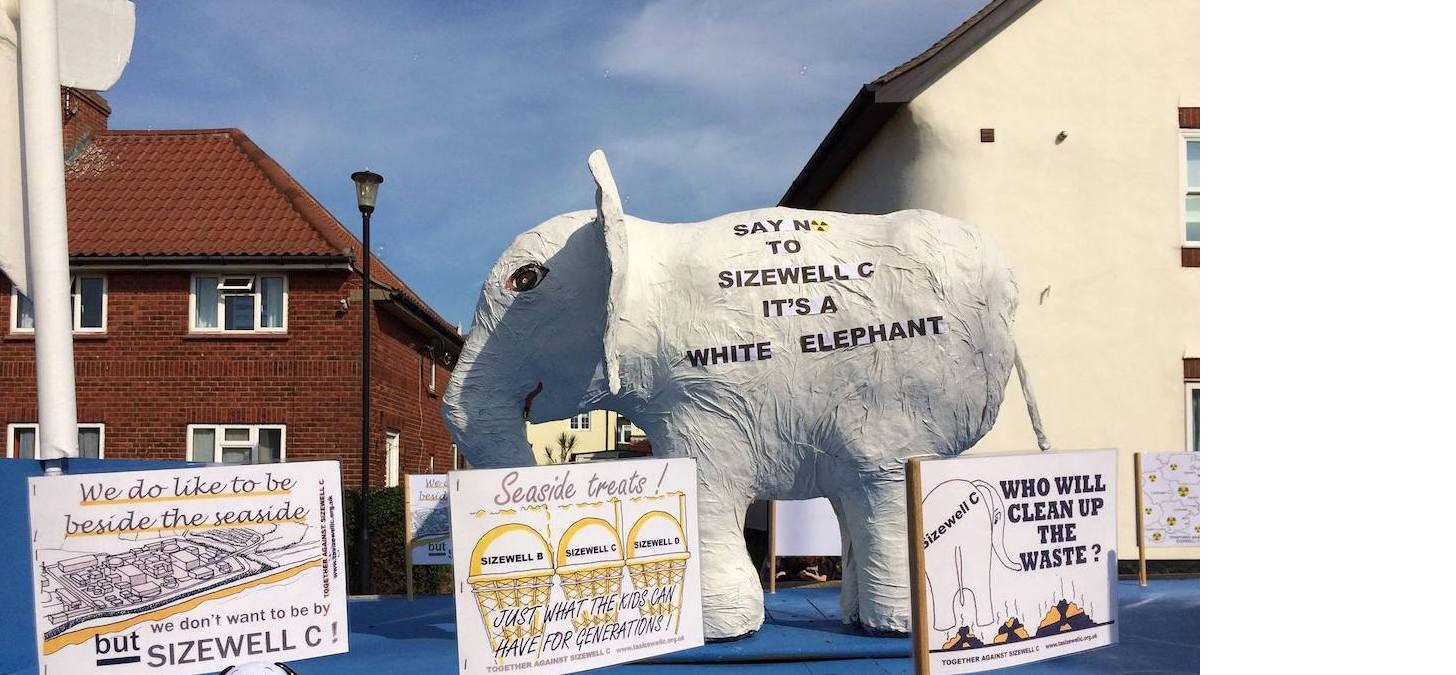
Grant Shapps follows Johnson and Kwarteng’s example by purposefully
avoiding any discussion or interaction with those directly affected by the
proposed Sizewell nuclear development during his recent visit to Sizewell
while reconfirming the government’s commitment to the £700m investment by
way of joining EDF in a 50:50 partnership in the Sizewell C White Elephant
financial sink hole on Suffolk’s eroding coast.
Jenny Kirtley, Chair of Together Against Sizewell C, said today, ‘There is nothing new in terms of
funding – this announcement still doesn’t go beyond the £700m already
promised, followed by a lot of sticking plasters to protect the government
from the criticism of doing nothing for years to drive down electricity on
the demand side. A pathetic response from a delusional government that is
long past its sell-by date.
The government’s own risk assessment forecasts
that Sizewell C may cost up to £43 billion –
yet another example of this government’s willingness to squander £billions of public money on a project
that may never operate as it still requires the resolution of EDF’s inability to secure a permanent and reliable supply of a potable water.
TASC 29th Nov 2022
UK govt goes ahead, seeks financial backing for Sizewell nuclear project, despite strong objections on environmental grounds, especially about water use.

It bears noting that EDF was refused planning consent from Suffolk County Council and the Planning
Inspectorate in 2020 on the grounds that insufficient information was provided about the project’s impacts on local communities and nature.
Particular concerns included procuring water and potential impacts on the local nature reserve.
The UK Government has confirmed approval for the Sizewell C nuclear power
plant after Chancellor Jeremy Hunt moved to back proceeding with the
development at this month’s Autumn Statement. The Department for Business,
Energy and Industrial Strategy (BEIS) has stated that the Government will
take a £679m stake in the 3.2GW project and will urge China General Nuclear
to end its involvement.
It will allocate a multi-million-pound package to
cover buy-out costs, commercial arrangements and tax. This is a significant
increase from the £100m option fee contribution for Sizewell C which the
Government confirmed back in January. It will see the Government becoming a
50% shareholder in the project’s development phase. BEIS has stated that
EDF, which is developing the power plant, will “provide additional
investment to match the Government’s stake”.
But with the total project
cost sitting around £20bn, it is clear that additional backers will need to
be found. Sizewell C will be the UK’s first project to use a new funding
model for nuclear, the Regulated Asset Base (RAB) model. This model
provides investors with regular returns before a plant begins generating
power. It has replaced the previous Contracts for Difference (CfD) approach
to nuclear funding due to the passage of the Nuclear Energy (Financing)
Bill earlier this year, when Kwasi Kwarteng was in the top job at BEIS.
Some local community groups and major environmental groups have argued that
BEIS rushed the decision on Sizewell C without accounting for key
information on impacts such as water extraction and disrupting wildlife.
On the former point, Sizewell B uses about 800,000 litres of potable water
each day. Friends of the Earth moved in August to launch a legal challenge
to BEIS over the Sizewell C approval decision. It bears noting that EDF was
refused planning consent from Suffolk County Council and the Planning
Inspectorate in 2020 on the grounds that insufficient information was
provided about the project’s impacts on local communities and nature.
Particular concerns included procuring water and potential impacts on the
local nature reserve.
The Planning Inspectorate stated that “unless the
outstanding water supply strategy can be resolved and sufficient
information provided to enable the secretary of state to carry out his
obligations under the Habitats Regulations, the case for an order granting
development consent for the application is not made out”.
Friends of the Earth argued that, when it launched its challenge, no more information had
been provided or considered about Sizewell C’s nature and water footprint.
Edie 29th Nov 2022
UK government desperate for investors in its Sizewell C nuclear project, as it pays out the Chinese company previously involved
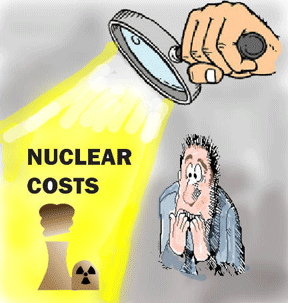
Construction will not begin in earnest until the consortium has raised close to £20bn of equity and debt from private investors. That fundraising could take at least a year and has no guarantee of success.
The UK government is to pay Chinese state-owned power group CGN over £100mn to exit Britain’s £20bn Sizewell C nuclear energy project in a bid to reduce Beijing’s involvement in the country’s infrastructure. The payment to CGN for its 20 per cent stake in the proposed nuclear plant in Suffolk is part of a £679mn UK state investment in Sizewell first announced by former prime minister Boris Johnson in September and finalised on Tuesday.
Construction will not begin in earnest until the consortium has raised close to £20bn of equity and debt from private investors. That fundraising could take at least a year and has no guarantee of success. UK government officials said that the departure of CGN would clear the way for US investors to put money into Sizewell C, since the Chinese company has been put under US sanctions.
CGN remains a minority 33 per cent investor in Britain’s giant Hinkley Point C nuclear power station in Somerset, another
EDF led project. Although this has already been delayed by several years, it is intended to be the first of a new generation of nuclear power stations. The Chinese group also controls a site at Bradwell-on-Sea in Essex, where it hopes to be the lead investor in a new generator.
CGN’s planned use of its own reactor technology at Bradwell received former approval from Britain’s nuclear regulator in February. But ministers think that ultimately it will not be allowed to build at the site, which they expect to change hands in due course.
FT 29th Nov 2022
https://www.ft.com/content/a9a34ea3-649f-4a47-a4c8-ee269e07eccc
Taxpayers to hand China millions of pounds to quit Sizewell nuclear plant
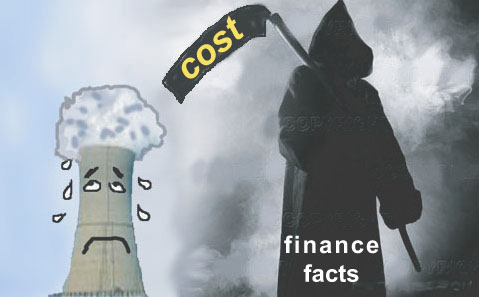
Taxpayers will hand China millions of pounds to quit its nuclear power
venture in Suffolk as part of a £700m deal as the “golden era” of
UK-China relations comes to an end. The Government is spending an initial
£679m to help get the £20bn Sizewell C nuclear power plant project off the
ground and has confirmed part of this will go to state-owned China General
Nuclear (CGN) under an exit deal.
It has not disclosed what proportion will
go to CGN but a Government spokesman said the payment “covers the value
of their shareholding, their contribution to the project’s development and
a commercial return reflecting their work to date”. He added: “The
value of their 20pc stake in the project is commercially confidential.
“CGN has decided to exit the project at this stage in its development,
following constructive commercial negotiations.”
Telegraph 29th Nov 2022
UK GOVERNMENT DEPLOYED 15 STAFF ON SECRET OPERATION TO SEIZE JULIAN ASSANGE
New information raises further concerns about the politicisation of the WikiLeaks founder’s legal case.
https://declassifieduk.org/uk-government-deployed-15-staff-on-secret-operation-to-seize-julian-assange/ MATT KENNARD, 28 NOVEMBER 2022
- Assange had been granted asylum by a friendly country to avoid persecution by the US government for his journalistic activities
- But Home Office had eight staff, and the Cabinet Office had seven, working on secret police operation to arrest Assange
- Ministry of Justice, which controls England’s courts and prisons, refuses to say if its staff were involved in operation
- Foreign Office refuses to say if its premises were used
The British government assigned at least 15 people to the secret operation to seize Julian Assange from the Ecuadorian embassy in London, new information shows.
The WikiLeaks founder was given political asylum by Ecuador in 2012, but was never allowed safe passage out of Britain to avoid persecution by the US government.
The Australian journalist has been in Belmarsh maximum security prison for the past three and a half years and faces a potential 175-year sentence after the UK High Court greenlighted his extradition to the US in December 2021.
‘Pelican’ was the secret Metropolitan Police operation to seize Assange from his asylum, which eventually occurred in April 2019. Asylum is a right enshrined in the Universal Declaration of Human Rights.
The operation’s existence was only revealed in the memoirs of former foreign minister Sir Alan Duncan which were published last year. The UK government routinely blocks, or obfuscates its answers to, information requests about the Assange case.
But the Cabinet Office recently told parliament it had seven officials working on Operation Pelican. The department’s role is to “support the Prime Minister and ensure the effective running of government”, but it also has national security and intelligence functions.
It is not immediately clear why the Cabinet Office would have so many personnel working on a police operation of this kind. Asked about their role, the Cabinet Office said these seven officials “liaised” with the Metropolitan Police on the operation.
The Home Office, meanwhile, told parliament it had eight officials working on Pelican. The Home Office oversees MI5 and the head of the department has to sign off extraditions to most foreign countries. Then home secretary Priti Patel ordered Assange’s extradition to the US in June.
‘Disproportionate cost’
Other government ministries refused to say if they had staff working on Pelican, including the Ministry of Justice (MoJ).
The MoJ is in charge of courts in England and Wales, where Assange’s extradition case is currently deciding whether to hear an appeal. It is also in control of its prisons, including Belmarsh maximum security jail where Assange is incarcerated.
When asked if any of its staff were assigned to Pelican, the MoJ claimed: “The information requested could only be obtained at disproportionate cost.”
It is unclear why the Home Office, a bigger department with more staff, could answer such a question, but the MoJ could not. There is no obvious reason why the MoJ would have staff assigned to Pelican, so revelations that it did would cause embarrassment for the government.
Meanwhile, the Foreign Office told parliament it had no staff “directly assigned” to Pelican, but refused to say if people working on the operation were located on its premises.
‘Julian Assange’s Special Brexit Team’
Sir Alan Duncan, foreign minister for the Americas from 2016-19, was the key UK official in the diplomatic negotiations between the UK and Ecuador to get Assange out of the embassy. In his memoirs he wrote that he watched a live-feed of Assange’s arrest from the Operations Room at the top of the Foreign Office alongside Pelican personnel.
After Assange had been imprisoned in Belmarsh, Duncan had a drinks party at his office for the Pelican team. “I gave them each a signed photo which we took in the Ops Room on the day, with a caption saying ‘Julian Assange’s Special Brexit Team 11th April 2019’”, he wrote.
Ecuador’s president from 2007-17, Rafael Correa, recently told Declassified he granted Assange asylum because the Australian journalist “didn’t have any possibility of a fair legal process in the United States.”
He added that the UK government “tried to deal with us like a subordinate country.”
In September 2021, 30 former US officials went on the record to reveal a CIA plot to “kill or kidnap” Assange in London. In case of Assange leaving the embassy, the article noted, “US officials asked their British counterparts to do the shooting if gunfire was required, and the British agreed, according to a former senior administration official.”
These assurances most likely came from the Home Office.
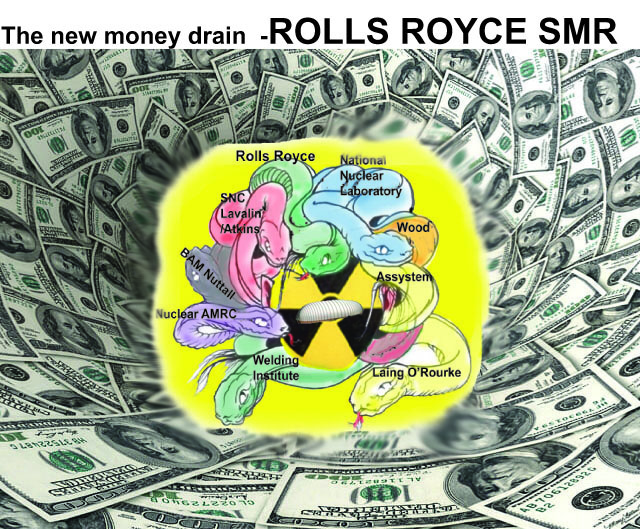
Ineos corporation to join Rolls Royce’s messy consortium, to push for Small Nuclear Reactors in the Great British Nuclear Swindle

Rolls-Royce is in talks with Ineos to build a mini nuclear reactor to power the chemicals group’s Grangemouth refinery.

Rolls is heading a government-backed consortium to develop between 20 and 30 small modular nuclear reactors but is in need of customers to help to reduce the risk of the venture.
Ministers are finalising plans to support SMRs through a body called Great British Nuclear, which will be responsible for getting
planning permission and undertaking the preparation work on the new sites. Rolls’ talks with Ineos, first reported by The Sunday Telegraph, are understood to be at an early stage. Ineos’s Grangemouth refinery in Scotland is a joint venture with PetroChina and refines crude oil and produces chemicals.
Times 28th Nov 2022
UK government PR exercise “Great British Nuclear” headed for financial failure.
Letter Steve Thomas: Six months after it was announced, it is clear that
Great British Nuclear was no more than a government PR exercise. You report
that it “could prevent a repeat of the Wylfa and Cumbria farragoes”.
That would be remarkable.
The Cumbria project failed because the reactor
supplier, Westinghouse, went bankrupt; Wylfa failed because, although the
government offered to take a 30 per cent stake, no other investors came
forward.
he problem with nuclear is not that we don’t have the
organisation quite right. It’s that nuclear is far too expensive and
economically risky and takes much too long to build to be any use.
Times 25th Sept 2022
https://www.thetimes.co.uk/article/admit-it-nuclears-going-nowhere-tclmnr89f
Middle East investors and French developers for Sizewell C nuclear station to be paid by “an extra tax” on UK public’s bills ?

Alison Downes of campaign group Stop Sizewell C criticised the idea of foreign investors paid with money from ‘an extra nuclear tax on our bills’. She added: ‘The promise of UK energy independence looks pretty hollow if Sizewell C turns out to be French-built and Middle East-funded.’
UAE wealth fund may invest in Sizewell C – Mubadala one of main names in frame to back £20bn nuclear plant. Emirati sovereign wealth fund Mubadala has been tipped as a potential investor in Sizewell C. Sources said the investment group, whose board includes the owner of Manchester City FC, is one of the main names in the frame to back the £20billion nuclear plant.
They suggested talks with the fund may already have taken place. Mubadala is chaired by UAE president Sheikh Mohamed bin Zayed Al Nahyan. Its vice-chairman Sheikh Mansour bin Zayed Al Nahyan bought Manchester City in 2008.
The Government is expected to give the go-ahead to Sizewell C within days with a ‘general investment decision’ that will formalise taxpayer support. The Government and French energy firm EDF, which is developing the power station, are each taking a 20 per cent stake. They are racing to recruit investors to fill a 60 per cent funding gap.
Ministers have put in place a new funding model, the ‘regulated asset base’, which lets investors receive cash back during construction. This is intended to attract pension funds and institutional investors. But they are also said to be approaching potential supporters in the Middle East, Australia and North America.
Alison Downes of campaign group Stop Sizewell C criticised the idea of foreign investors paid with money from ‘an extra nuclear tax on our bills’. She added: ‘The promise of UK energy independence looks pretty hollow if Sizewell C turns out to be French-built and Middle East-funded.’
A BusinessDepartment spokesman said it would ‘not be appropriate to comment on potential investors’.
Mail on Sunday 26th Nov 2022
https://www.thisismoney.co.uk/money/markets/article-11472637/UAE-wealth-fund-invest-Sizewell-C.html
Legal challenge to UK nuclear plan by groups Stop Sizewell C and Together Against Sizewell C (TASC), and others

Campaigners against Sizewell C say they will not give up their fight to stop the nuclear power project and now have a date for a High Court case in London. The next stage of the legal challenge against the plans for the £25billion power station is set to take place with an oral hearing before a judge.
Campaign groups, including Stop Sizewell C and Together Against Sizewell C (TASC), have pledged to fight despite chancellor Jeremy Hunt announcing in his Autumn Budget that the Government would continue to provide £700m towards the cost of the project.
Chris Wilson, legal liaison officer with TASC, said the oral hearing would be held on December 14, during which the campaigners’ barrister will be able to present their arguments against the project before a High Court judge. If the judge deems there’s a case, the next stage will be a formal judicial review hearing
before the High Court, which could result in the development consent for the nuclear power station, granted by the Government in July, being overturned.
Even if the legal challenge is rejected at the oral hearing, the campaigners will still have the option of going to appeal. A first stage review of the legal appeal by the High Court initially recommended refusal, but the next stage, the oral hearing, will determine whether the challenge goes to a formal judicial review hearing.
East Anglian Daily Times 27th Nov 2022
https://www.eadt.co.uk/news/23151541.sizewell-campaigners-not-giving-up-despite-budget-decision/
The Blackwater Against New Nuclear Group (BANNG) strongly opposes new Bradwell nuclear proposal.

Rolls Royce interest in Bradwell for nuclear reactors, https://www.maldonandburnhamstandard.co.uk/news/23138663.rolls-royce-interest-bradwell-nuclear-reactors/ By Millie Emmett @millieemmett Reporter, 26th November
FRESH proposals to develop nuclear reactors in the Maldon district have been branded “outrageous”.
Rolls Royce announced that it is looking at the Bradwell site, owned by EDF, as a potential base for four to six small modular reactors (SMRs).
The Blackwater Against New Nuclear Group (BANNG) has strongly opposed any plans as it believes it would be larger than the proposed Bradwell B, which is under consideration by Chinese company CGN.
Professor Andy Blowers,chair of the Blackwater Against New Nuclear Group, said: “This proposal, if it ever came about, would place up to six nuclear reactors on the Bradwell site.
“And they are hardly ‘small’ since each reactor would be close to the size of the old Bradwell A station.
“Together these reactors would comprise a nuclear complex larger than the massive proposed Bradwell B currently under consideration for development by the Chinese company, CGN.
“It is hard to state how utterly inappropriate such a development, which would include long-term storage of highly radioactive nuclear wastes, would be on the low-lying Bradwell site, threatened by the impacts of climate change and sea level rise.
“It is an outrageous proposal which must be nipped in the bud before it gets anywhere near off the ground”
The group attended a meeting for the Department of Business, Energy and Industrial Strategy (BEIS) NGO nuclear forum and asked if CGN had withdrawn from the Bradwell B project.
The group was told “there was no change to the proposals for Bradwell B but that further discussion was not possible because of commercial confidentiality”.
BANNG has written to the Government to urge it to declare that the Bradwell site is unsuitable and to remove it from any further consideration by Rolls Royce or any other nuclear developer.
The anti-nuclear group has been campaigning to protect the people and the environment of the River Blackwater estuary for years.
Its aim is to raise awareness of the consequences of new nuclear development and to challenge any proposals for future nuclear power at the Bradwell site.
The projected cost of new nuclear power has risen by fourfold since 2008 – and it is still rising
The projected cost of new nuclear power has risen by almost fourfold since
the UK Government made estimates in 2008, and the cost is still rising.
Nuclear analysts warn that the cost to consumers of funding Sizewell C
through the so-called ‘Regulatory Asset Base’ (RAB) model will be much
higher than has been projected by the Government.
In 2008 as the Government argued for more nuclear power stations to be built, the Government, in a
White Paper on nuclear costs, said that each 1.6 GWe EPR reactor would cost
around 2.8 billion. But the most recently released (by EDF) cost of the
Hinkley C EPR double reactor is £25.5 billion (in 2015 prices) and assumes
the plant will be completed by 2027.
This equates to £12.75 billion per
each 1.6 GWe reactor, as reported by World Nuclear News. This is nearly
four times the estimate made by the UK Government in 2008 after inflation
is taken into account.
100% Renewables 25th Nov 2022
UK government underestimated the cost to the public of Regulated Asset Base financing of nuclear power
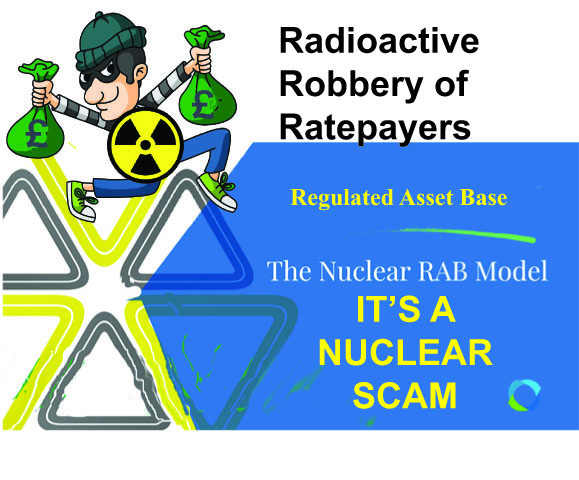
The government has been accused of under-estimating the cost to customers
of its new financing support mechanism for nuclear power, which could add
£100 onto annual bills if ex-prime minister Boris Johnson’s pledge to
roll out a new fleet of the plants is honoured.
At a meeting of the
All-Party Parliamentary Group on Energy Costs, held at the House of Commons
on Wednesday (23 November), University of Greenwich emeritus professor of
energy Steve Thomas criticised the use of the Regulated Asset Base (RAB)
for nuclear projects.
Utility Week 24th Nov 2022
Rolls-Royce calls for formal funding talks over small nuclear plants
Ft.com Nathalie Thomas in Edinburgh and Sylvia Pfeifer in London, 23 Nov 22
Rolls-Royce has urged the UK government to enter formal negotiations over the funding for small nuclear reactors, which it hopes to build in England or Wales by the early part of next decade.
Tom Samson, head of the company’s small modular reactor business, told a committee of MPs on Wednesday that Britain would face an electricity crisis next decade if it did not push ahead with building more “baseload” power stations that offer a reliable [?] source of generation when weather-dependent renewables including wind and solar are not producing.
Rolls-Royce is leading a consortium that has designed a 470-megawatt [that’s LARGE !] small modular nuclear reactor, which could produce enough power for a city the size of Leeds and would be built in factories before being deployed at existing nuclear sites in England and Wales.
It wants the government to enter formal talks over potential funding models and how the technology could be deployed so it can start building factories. The first Rolls-Royce-designed SMR would cost £2.5bn, although the UK engineering company has argued the cost of each plant will drop to £2bn once it has a pipeline of orders.
……….. the first Rolls-Royce SMR would probably need a funding model underpinned by the government or bill payers.
The company has previously talked about models such as “contracts for difference”, which are used for technologies such as offshore wind and guarantee developers a set price for their output.
Alternatively, it has said it may consider a “regulated asset base” mechanism, whereby a surcharge is added to consumer energy bills long before any plant is operating to help finance schemes.
Samson warned the government it did not have the luxury of spending another two to three years talking about whether to build more nuclear capacity……………
Former prime minister Boris Johnson said while in office that he wanted up to 24 gigawatts of nuclear capacity by 2050 — up from just 5.9GW at present — but chancellor Jeremy Hunt’s recent Autumn Statement referred only to the 3.2GW Sizewell C nuclear project in Suffolk, about which the government is in negotiations with French state-backed energy group EDF. Opponents of nuclear argue that is expensive compared with other technologies.
……………. “The government is investing in these new technologies through the £385mn Advanced Nuclear Fund including £210mn towards the Rolls-Royce SMR programme,” a BEIS spokesperson said. https://www.ft.com/content/21a54a90-1b51-4561-ba9e-c1677e0262ed
—
UK recognises veterans of nuclear weapons tests with medals
Aljazeera, 22 Nov 22
The honour comes 70 years after Britain detonated a nuclear bomb in the Indian Ocean.
Seventy years after Britain detonated a nuclear bomb in the Indian Ocean, troops who took part – sometimes unknowingly – in the country’s atomic weapons tests are being recognised with a medal.
The UK government’s announcement on Monday of the Nuclear Test Medal is a victory for veterans and their families, who have campaigned for years for recognition.
Now, many want recognition of the health problems they believe they suffered as a result of exposure to radiation.
……….. Sunak attended the first-ever ceremony for the nuclear veterans at the National Memorial Arboretum in central England, marking the 70th anniversary of the United Kingdom’s first atmospheric atomic test on October 3, 1952.
Operation Hurricane
The detonation of a plutonium implosion device aboard a Royal Navy ship in the Montebello Islands off Western Australia, dubbed Operation Hurricane, made Britain the world’s third nuclear-armed nation, after the United States and Russia…….
The UK set off further nuclear explosions in Australia and ocean territories, including on Christmas Island, over the following years.
Veterans groups say about 22,000 UK military personnel were involved in British and American tests in the 1950s and 60s, many of them conscripts doing postwar national service.
Veterans, scientists and civil servants from Australia, New Zealand, Fiji and Kiribati who served under British command during the tests between 1952 and 1967 will also be eligible for the UK medal.
Many veterans and their families are convinced there is a link between the tests and health problems they have suffered, and are pressing the UK to hold a public inquiry into the tests.
Some allege they were deliberately exposed to radiation to see how their bodies would react, and claim their medical records were later suppressed.
‘The end of the world’
John Morris, who saw nuclear blasts on Christmas Island as a young conscript in the 1950s, told the BBC earlier this year that “I felt like I had seen the end of the world.”
“I saw right through my hands as the light was so intense,” he said. “It felt like my blood was boiling. The palm trees – which had been 20 miles [32km] away – were scorched.”
Numerous studies over the decades have probed allegations of high cancer rates among the test veterans, and of birth defects in their children, but have failed to establish an ironclad connection with the nuclear tests.
Successive British governments have denied troops were exposed to unsafe levels of radiation.
Alan Owen, founder of the Labrats International charity for atomic test survivors, welcomed the government’s recognition, but said “we want more”………………………………………https://www.aljazeera.com/news/2022/11/21/uk-recognises-veterans-of-nuclear-weapons-tests-with-medals
Nuclear Industry Liability under the Paris Convention
The Paris Convention on Third Party Liability in the Field of Nuclear
Energy and the Brussels Convention supplementary to the Paris Convention
established a special legal regime in relation to the compensation payable
in the event of an accident involving a civil nuclear power installation or
the transportation of nuclear substances to and from that installation.
Unlike general tort law, which is based on fault or negligence, under the
convention, the plant operator or party involved in the transportation is
exclusively liable for damages in the event of an accident and is always
deemed to be liable, regardless of whether fault can be established.
These two conventions were amended by agreement between the contracting powers,
including the United Kingdom, on 17 December 2021. After 1 January 2022,
nuclear plant operators became liable to pay compensation of up to €700
million in the event of an accident.
This level of liability will be increased by €100 million in each of the next five years leading to an
ultimate maximum liability of €1.2 billion towards claims involving
‘personal injury or loss of life, economic loss, the cost of preventive
measures and of measures of reinstatement of impaired environment’.
NFLA 21st Nov 2022
1 This Month

of the week – Shut Down Drone Warfare!


Tell the Ukrainian Government to Drop Prosecution of Peace Activist Yurii Sheliazhenko

Petition to revoke the licensing of the Near Surface Nuclear Disposal Facility (NSDF) at Chalk River. https://www.ourcommons.ca/petitions/en/Petition/Details?Petition=e-7247
To see nuclear-related stories in greater depth and intensity – go to https://nuclearinformation.wordpress.com
-
Archives
- April 2026 (114)
- March 2026 (251)
- February 2026 (268)
- January 2026 (308)
- December 2025 (358)
- November 2025 (359)
- October 2025 (376)
- September 2025 (257)
- August 2025 (319)
- July 2025 (230)
- June 2025 (348)
- May 2025 (261)
-
Categories
- 1
- 1 NUCLEAR ISSUES
- business and costs
- climate change
- culture and arts
- ENERGY
- environment
- health
- history
- indigenous issues
- Legal
- marketing of nuclear
- media
- opposition to nuclear
- PERSONAL STORIES
- politics
- politics international
- Religion and ethics
- safety
- secrets,lies and civil liberties
- spinbuster
- technology
- Uranium
- wastes
- weapons and war
- Women
- 2 WORLD
- ACTION
- AFRICA
- Atrocities
- AUSTRALIA
- Christina's notes
- Christina's themes
- culture and arts
- Events
- Fuk 2022
- Fuk 2023
- Fukushima 2017
- Fukushima 2018
- fukushima 2019
- Fukushima 2020
- Fukushima 2021
- general
- global warming
- Humour (God we need it)
- Nuclear
- RARE EARTHS
- Reference
- resources – print
- Resources -audiovicual
- Weekly Newsletter
- World
- World Nuclear
- YouTube
-
RSS
Entries RSS
Comments RSS
 nuclear-news