Russia runs pro nuclear workshop in Vietnam
 Workshop promotes nuclear power A workshop to enhance the understanding of nuclear power among people and media alike was held on May 19 in Hanoi. The event, part of activities of the “2016 Nuclear Science Day in Hanoi ,” was jointly organised by Russia ‘s State Nuclear Energy Corporation (ROSATOM), the Vietnam Atomic Energy Agency under the Ministry of Science and Technology, the Information Center on Nuclear Energy (ICONE) and the Hanoi University of Technology.
Speaking at the event, Andrey Stankevich from ROSATOM Vietnam attached significance to publicity work to promote the development of nuclear energy…….
Communication work is crucial to raise public awareness of the development of the nuclear sector and get people’s approval of nuclear power, said Deputy Director of the Agency Nguyen Thi Thu Trang
According to the representative from ROSATOM Asia, the press and media need to be a reliable source of basic information on radiation, nuclear science and the safety of nuclear power plants.
They should also promote the benefits of the sector in terms of socio-economic development, health care, agriculture and industry.
Numerous activities will also take place during the “2016 Nuclear Science Day in Hanoi” programme, which runs until May 20, including a lecture by a professor from the Russia National Research Nuclear University (MEPhI) and an awards presentation for the recent Physics Olympiad winners. http://english.vietnamnet.vn/fms/science-it/156747/workshop-promotes-nuclear-power.html
Russia looks to nuclear colonise Africa
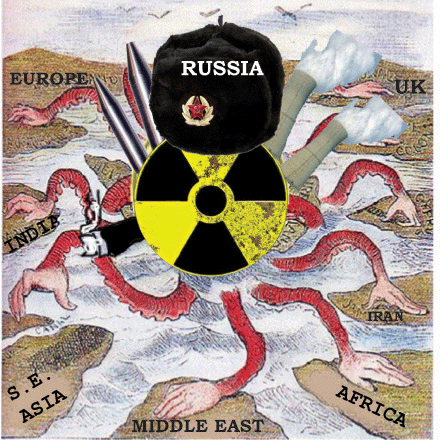 Russia’s Rosatom seeks cooperation agreements for African nuclear expansion By Wendell Roelf CAPE TOWN (Reuters) 20 May 16, – Russia’s state nuclear agency Rosatom plans to sign cooperation agreements with Kenya, Uganda and Zambia to lay the groundwork for an expanded presence in Sub-Saharan Africa beyond its planned bid to build nuclear power plants in South Africa.
Rosatom has voiced confidence in its ability to see off competition from China, France and South Korea in a planned South African tender to build a 9,600 megawatts (MW) nuclear power fleet in the continent’s most industrialised country. It sees scope, however, for more deals across the region, from the building of plants to supplying reactor fuel……
Victor Polikarpov, Rosatom’s regional vice-president for Sub-Saharan Africa, said on Thursday.
“We want South Africa to become our springboard for the rest of Africa. We want to create a nuclear cluster, a group of companies here that can operate with us in Africa.”
President Jacob Zuma’s government was checking the financial and commercial impact of its nuclear ambitions before it issues a tender.
South Africa’s 1,800 MW Koeberg station near Cape Town is the continent’s only commercial nuclear power plant at present, though Rosatom is building a nuclear plant in Egypt that is expected to be completed by 2022.
Meanwhile, South Africa’s nuclear energy corporation Necsa is being encouraged by government to revive nuclear enrichment and conversion facilities to reduce dependence on imported reactor fuels……
Rosatom’s Polikarpov, however, said it might not be viable for South Africa to restart enrichment facilities dismantled before white minority rule ended in 1994.
“Another solution is just to have fuel supplied from Russia. We can guarantee supply of fuel non-stop for the duration of operation of all power plants,” he said.
Nigeria, however, looks a more distant prospect as its economy contracts amid the global plunge in oil prices.
“Given the extremely bad economic situation in Nigeria today, it might take a bit longer. But the government and the new president are still determined to go nuclear,” Polikarpov said.
(Editing by James Macharia and David Goodman) http://af.reuters.com/article/investingNews/idAFKCN0YA1CH
Russia plans for Africa to be its nuclear colony, starting with south Africa
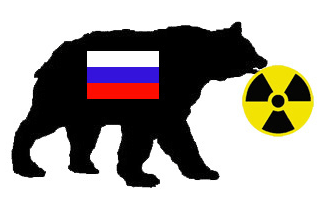
 How Russia Is Expanding Its Vast Nuclear Empire Into Africa, AFK Insider By Dana Sanchez May 19, 2016, Russia’s government-owned nuclear agency Rosatom hopes to use South Africa as a springboard into the rest Africa as it seeks to expand its influence on the continent by building nuclear power plants.
Rosatom plans to sign framework cooperation agreements with Kenya, Uganda and Zambia, adding to those already made with South Africa, Nigeria and Ghana, Reuters reported.
Right now, South Africa may be the best prospect. Nigeria looks less likely as its economy contracts in the global oil price plunge.
“Given the extremely bad economic situation in Nigeria today, it might take a bit longer. But the government and the new president are still determined to go nuclear,” said Viktor Polikarpov, Rosatom’s vice-president of sub-Saharan Africa.
South Africa in 2015 approved a plan to develop up to 600 megawatts of nuclear capacity by 2030 as part of a bigger plan to build 9,600 megawatts of nuclear power at up to nine new nuclear reactors……
Environmental activist group Greenpeace warned the ANC in 2015 to abandon nuclear build plans or face massive resistance, NuclearNews reported.
“The ANC needs to know that if it does go for the nuclear option as part of the (energy) mix, then they are on a collision course with the broader spectrum of the South African civil society,” said Greenpeace Director Kumi Naidoo said on Monday that the ANC should “take nuclear off the table.
Russia has competition to do the nuclear build from China, France and South Korea, Reuters reported. It’s already planning to seek more deals across the region that range from building power plants to supplying reactor fuel.
“What we are targeting is to build South Africa as a nuclear cluster of nuclear industries so that we can use our partners and our partnership for our expansion into Africa,” Polikarpov said in an interview Tuesday in Cape Town.
Rosatom can offer financing options, Polikarpov said, according to Bloomberg. These include a contract with a state-export credit offered to the government of South Africa, a buyer-owner operator agreement, a public-private partnership, or a combination of them…….
The allure of the turnkey nuclear power plant, built, owned and operated by Rosatom, allows governments across the world to embrace such projects. But for Russia they are much more than a major economic export. They are another geopolitical tool, allowing the Kremlin to tie up strategic governments into long-term cooperation. http://afkinsider.com/126032/how-russia-is-expanding-its-vast-nuclear-empire-into-africa/
Egypt goes into $25 billion nuclear debt to Russia
 Egypt gets $25 billion loan from Russia for nuclear plant http://www.theprovince.com/business/egypt+gets+billion+loan+from+russia+nuclear+plant/11930248/story.html BY THE ASSOCIATED PRESS MAY 19, 2016 CAIRO – Egypt has announced a $25 billion loan from Russia for the building of a nuclear power plant.
Thursday’s announcement came in a decree by President Abdel-Fattah el-Sissi. The Russian loan will cover 85 per cent of the expenses of the plant’s construction.
Egypt, which will cover the other 15 per cent, is to repay the loan over a 22-year period, starting in 2029, with a 3 per cent annual interest rate.
Egypt and Russia agreed in February 2015 to build the plant together and signed a memorandum of understanding on the project. But the relations between the two nations were badly impacted after the horrific Russian passenger plane crash in Sinai last October, when all 224 people on board were killed.
Egypt’s economy has plummeted amid a slump in the tourism sector.
Russia joins the throng desperate to sell nuclear radioactive trash to Britain
 Russia’s state-owned nuclear group keen to break into UK market Rosatom understood to be hoping to revive plans to build reactors in Britain if EDF proposals for Hinkley Point C fail, Guardian, Terry Macalister, 14 May 16, A Russian nuclear group is hoping that the potential meltdown of French plans to build new European pressurised reactors at Hinkley Point could offer an opportunity to break into the British nuclear market.
Deeper concerns about the future of the Somerset scheme were raised by the French energy minister, Ségolène Royal, who warned of the “colossal” cost, which EDF admitted could be £18bn or even £21bn.
Recent talks have been held between state-owned Russian nuclear group Rosatom and the UK’s Nuclear Decommissioning Authority (NDA) despite the chilly political relations between London and Moscow over Ukraine, Moscow sources claimed.
These discussions centred on whether Russia could help Britain with removal of uranium from old reactors – but Rosatom is understood to have a wider agenda of trying to resuscitate earlier plans to build its own reactors in Britain.
“There is still an appetite to enter the UK market,” said a senior Russian nuclear industry source who claimed Rosatom’s London-based representatives still maintained contacts with the Department ofEnergy and Climate Change…….
The Russians accept that sanctions and other political considerations make it difficult for such a plan to progress, but they point out that Rosatom still supplies uranium to UK and US nuclear plants.
The NuDA confirmed that it had held a series of talks with Rosatom. “We have met with them. We are a recognised global authority and we meet with a lot of organisations,” said a spokesman……..
China wants to use Britain as a showcase for its Hualong technology and agreed to take a third share in EDF’s Hinkley scheme in return for being allowed to proceed with Chinese-owned technology at Bradwell……..
Those worries were given extra weight with Royal’s comments in an interview with the Financial Times in which she said: “I am wondering if we should go ahead with the project. The sums involved are colossal.”
And they added to fears about the future of the Somerset project earlier this week when the company’s management was pilloried by shareholders at its annual general meeting and credit agency Moody’s downgraded EDF debt.
John Sauven, Greenpeace’s executive director, said the downgrading was just “a long line of massive red flag warnings” the UK government had received over the Hinkley nuclear project. He added: “Hinkley power station must not become ‘too big to fail’ because of politicians’ egos that are too big to back down.” http://www.theguardian.com/uk-news/2016/may/13/russias-state-owned-nuclear-group-keen-to-break-into-uk-market
USA’s missile defense site in Romania provokes Russian anger
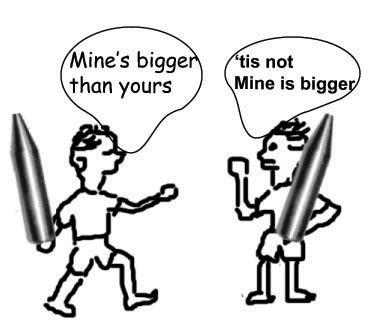 U.S. activates Romanian missile defense site, angering Russia, Reuters DEVESELU, ROMANIA | BY ROBIN EMMOTT , 12 May 15, The United States switched on an $800 million missile shield in Romania on Thursday that it sees as vital to defend itself and Europe from so-called rogue states but the Kremlin says is aimed at blunting its own nuclear arsenal.
To the music of military bands at the remote Deveselu air base, senior U.S. and NATO officials declared operational the ballistic missile defense site, which is capable of shooting down rockets from countries such as Iran that Washington says could one day reach major European cities……..
When complete, the defensive umbrella will stretch from Greenland to the Azores. On Friday, the United States will break ground on a final site in Poland due to be ready by late 2018, completing the defense line first proposed almost a decade ago.
The full shield also includes ships and radars across Europe. It will be handed over to NATO in July, with command and control run from a U.S. air base in Germany.
Russia is incensed at such of show of force by its Cold War rival in formerly communist-ruled eastern Europe. Moscow says the U.S.-led alliance is trying to encircle it close to the strategically important Black Sea, home to a Russian naval fleet and where NATO is also considering increasing patrols……
Joe Cirincione, an American nuclear expert who is president of Ploughshares Fund, a global security organization, told reporters in Geneva that the shield should be scrapped.
“It was designed to protect Europe from a missile from, well, the only country we were afraid of was Iran. The system was designed to protect against an Iranian nuclear missile. There is not going to be an Iranian nuclear missile for at least 20 years. There is no reason to continue with that program.”…..
Douglas Lute, the United States’ envoy to NATO, said NATO would press ahead with NATO’s biggest modernization since the Cold War. “We are deploying at sea, on the ground and in the air across the eastern flanks of the alliance … to deter any aggressor,” Lute said.
At a cost of billions of dollars, the missile defense umbrella relies on radars to detect a ballistic missile launch into space. Sensors then measure the rocket’s trajectory and destroy it in space before it re-enters the earth’s atmosphere. The interceptors can be fired from ships or ground sites.
The Romanian shield, which is modeled on the United States’ so-called Aegis ships, was first assembled in New Jersey and then transferred to the Deveselu base in containers…….http://www.reuters.com/article/us-nato-shield-idUSKCN0Y30JX
Russia’s new more powerful nuclear missiles
 Russia Developing New Nuclear Missiles Capable of Penetrating US Defenses
Russia wants to modernize 70 percent of its intercontinental ballistic missile arsenal by 2018, The Diplomat, By Franz-Stefan Gady May 11, 2016 Russia is developing new intercontinental ballistic missiles (ICBM) specifically designed to penetrate U.S. missile defense systems, Russian Commander of Strategic Missile Forces Colonel-General Sergei Karakayev told Russian state-owned news agency TASS on Tuesday.
“This is conditioned by the fact that the United States is not stopping after what it has achieved and continues improving its missile defense system, including the deployment of its elements in Europe. That is why special attention in the development of new missile complexes is paid to the issue of overcoming the missile shield,” Karakayev said.
As I reported previously, Russia announced in January that it would conduct a total of 16 ICBM test launches in 2016 with 14 dedicated to testing new missiles and warheads (See: “Russia to Launch 16 Intercontinental Ballistic Missiles in 2016”). The Strategic Missile Forces are also holding more than 100 command and staff, tactical and special exercises throughout the year.
According to Karakayev, the Russian military is introducing new types of warheads with a difficult to predict flight path in order to overcome U.S. missile defenses. “This is achieved both through the ICBM’s shorter acceleration phase and new types of warheads with a hard-to-predict flight trajectory and new means of overcoming the missile shield,” he said.
Russia has been testing a new hypersonic glide vehicle (HGV), the YU-71, a warhead capable of accelerating to up to ten times the speed of sound descending from the atmosphere on an erratic flight path without following a predictable ballistic trajectory. (The YU-71 performs evasive maneuvers making it very difficult for conventional missile defense systems to intercept.)
By 2021, the Strategic Missile Forces (SMF) plan to have an equal number of stationary and mobile ICBM systems. “Considering the ratios of stationary and mobile groupings of the Strategic Missile Forces, it can be noted that at the turn of 2021, the quantitative indicators of these groupings will come to equal each other. However, the capabilities of the stationary grouping will continue to be higher due to the availability of heavy missiles,” Karakayev noted…….
As I noted in a previous piece (“Russia to Add 40 New ICBMs: Should the West Be Worried?”):
Russia is in the middle of modernizing its strategic and nonstrategic nuclear warheads. According to the Bulletin of the Atomic Scientists, Moscow has currently 4,500 nuclear warheads, of which roughly 1,780 strategic warheads are deployed on missiles and at bomber bases. An additional 700 strategic warheads are kept in storage along with approximately 2,000 nonstrategic warheads. “Russia deploys an estimated 311 ICBMs that can carry approximately 1,050 warheads,” the Bulletin of the Atomic Scientists further notes.
The SMF’s most powerful future weapon will be the RS-28 Sarmat, Russia’s newest super heavy liquid-propelled ICBM, currently under development with first test-launches scheduled for later in the year. “The development of the Sarmat silo-based missile system with a heavy missile is nearing completion,” Karakayev said.
“The performance of the stationary grouping of the heavy ICBM (of the Voyevoda or Sarmat class) will four times surpass that of the stationary grouping of the light-class ICBM (Topol-M, Yars) by all the RVSN grouping tactical effectiveness parameters,” he added. The Sarmat purportedly can carry ten heavy or 15 lighter warheads and is expected to become operational by 2020.
A YU-71 HGV warhead mounted on a Sarmat ICBM could be one of the deadliest nuclear weapons fielded since the end of the Cold War. Sputnik News bombastically claims that the Sarmat ICBM can wipe out an area the size of Texas or France, while “its higher speed performance will enable it to speed past every missile defense system in existence.” http://thediplomat.com/2016/05/russia-developing-new-nuclear-missiles-capable-of-penetrating-us-defenses/
USA Defence Secretary accuses Russia of sabre-rattling
US accuses Russia of nuclear sabre-rattling, amid Nato tensions US Defence Secretary Ash Carter has accused Russia of “nuclear sabre-rattling” and of being intent on eroding international order.BBC News, 3 May 16
He said he regretted strained relations with Moscow but said the US had to “prioritise deterrence” on Nato’s eastern flank.
US-Russian ties have been strained by the Ukraine crisis and recent military encounters in the Baltic Sea.
Russia has accused Nato of threatening its national security……http://www.bbc.com/news/world-europe-36197856
Russian nuclear submarine fires CRUISE MISSILE in Arctic
Russian nuclear sub fires CRUISE MISSILE in chilling footage of Arctic military drill, Mirror, BY JONATHAN SHARMAN, 30 APR 16 The 120-metre Severodvinsk submarine can be seen sinking slowly below the surface before its Kalibr missile erupts from the wave… [INCL VIDEO]…..
The Russian military said the cruise missile struck its target, in the Arkhangelsk region, “with high accuracy”.
A statement added: “A strike group of the flotilla has conducted firing drills using naval practice targets and hit them successfully.”
The Kalibr missile, which can carry nuclear or conventional payloads, travels at speeds up to Mach 2.9 – the same as a space shuttle during launch. The land-attack weapon has a range of up to 1,500 miles……..http://www.mirror.co.uk/news/world-news/russian-nuclear-sub-fires-cruise-7866647
New kinds of nuclear dangers, with China’s plan for floating reactors
Fukushima at sea? China wants a fleet of floating nuclear power plants, CNN, By Tony Roulstone, 29 Apr 16
- China has ambitious plans to build a fleet of 20 floating nuclear reactors
- Russia is already building a floating nuclear power plant
- But storms, waves, maintenance all pose safety concerns<
CNN)China is planning to build nuclear reactors that will take to the sea to provide power in remote locations, possibly including the controversial man-made islands in the contested waters of the South China Sea.
These small power plants will be built in Chinese shipyards, mounted on large sea-going barges, towed to a remote place where power is needed and connected to the local power grid, or perhaps oil rig…….The plans have raised eyebrows and many are asking: Why are they being planned? Will they be safe? Will they be economic?
Seven floating nuclear power plants are planned by Russia. The first, the Akademik Lomonosov, should be completed this year at the high cost of $740m, according to World Nuclear News.
French and Russian nuclear utilities to work together, on decommissiong, and more
 French and Russian nuclear utilities extend collaboration, World Nuclear News, 26 April 2016
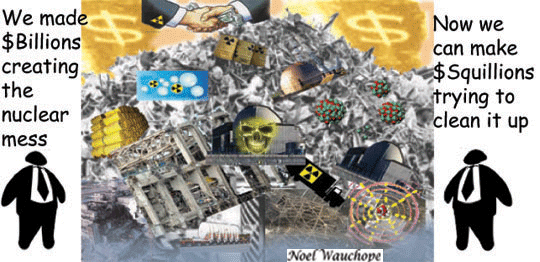
French utility EDF has signed an agreement to extend its cooperation with Rosenergoatom, the operator of Russia’s civil nuclear power plants. The companies will cooperate in reactor operations, decommissioning and waste management…..
Through the agreement, EDF and Rosenergoatom intend to develop cooperation in areas such as the maintenance, modernization and operating period extension of nuclear power plants, as well as decommissioning and radioactive waste management http://www.world-nuclear-news.org/C-French-and-Russian-nuclear-utilities-extend-collaboration-2604164.html
Nuclear safety is beyond politics. Ukraine and Russia must c o-operate on this
CHERNOBYL: FALLOUT 30 (SPECIAL PROJECT)
Chernobyl NPP CEO Igor Gramotkin shared his thoughts on the plant’s future in an interview with the Ukrainian newspaper Zerkalo Nedeli published on Friday.
“Russia and Ukraine are going through difficult times, but we must now figure out how to build the relationship in the future, and why not start restoring it by jointly looking for solutions to a common problem, namely, eliminating the consequences of the Chernobyl catastrophe,” Gramotkin said.
He stressed that “nuclear radiation safety is an area that is beyond politics.”……https://www.rt.com/news/340741-chernobyl-nuclear-disaster-cooperation/
Russia keenly promoting ?unaffordable nuclear power to Hungary, South Africa
RUSSIA COULD SCORE BIG IN SA, HUNGARY’S NUCLEAR EXPANSION PLANS, EyeWitness News, 22 Apr 16 Lobbyists are challenging the legality of SA’s proposed 9,600 megawatt nuclear build programme. Rahima Essop BUDAPEST – Russia could benefit in both South Africa and Hungary’s nuclear expansion plans, but there are procurement and legal hurdles.
Environmental lobbyists are challenging the legality of South Africa’s proposed 9,600 megawatt nuclear build programme before government opens the tender process.
At the same time, the European Commission is probing whether Hungary’s decision to award a contract to Russia to build two new nuclear reactors was in line with its procurement regulations.
Eighty percent of the financing for the Hungarian project would be covered by a loan from Russia, to be paid off over 21 years at a stepped interest rate…….
In South Africa, opposition politicians are concerned government’s nuclear build programme is not affordable and will plunge the country deeper into debt.
Russian atomic energy company, Rosatom has said it’s open to help finance the project, if it’s selected as the preferred bidder.
However, it’s unclear when Energy Minister Tina Joemat-Pettersson will call for quotes for the tender.
Rosatom has sponsored a press trip to Hungary to showcase its capacity to build power plants across the globe…….http://ewn.co.za/2016/04/22/Russia-could-score-big-in-SA-Hungarian-nuclear-deal-plans
Russian nuclear corporation Rosatom to “educate” South Africans on benefits of nuclear power
ROSATOM TO GROW PUBLIC AWARENESS ON NUCLEAR ENERGY, Eyewitness News, The Russian atomic energy company faces strong resistance from environmental lobbyists in SA. Rahima Essop 21 Apr 16 CAPE TOWN – Rosatom says it has to ‘gradually grow public awareness and acceptance’ about nuclear energy as the Russian atomic energy company faces strong resistance from environmental lobbyists and opposition politicians in South Africa.
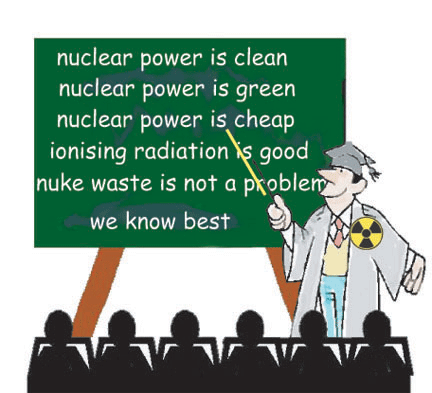
Two organisations have challenged the legality of government’s proposed 9,600 MW nuclear build programme in court before Energy Minister Tina Joemat-Pettersson calls for quotes for the tender.
Rosatom is said to be on the inside track for the contract.
The Democratic Alliance (DA), meanwhile, is pushing for the project to be abandoned on the basis that it’s unaffordable and shrouded in secrecy.
Rosatom has billed nuclear as a cheap source of energy and a job-creating solution for the country.
The company, which is building 34 reactors across the globe, is hoping to influence South African perceptions about nuclear…….Rosatom has sponsored a press trip to Hungary. http://ewn.co.za/2016/04/21/Rosatom-to-gradually-grow-public-awareness-on-nuclear-energy
Russia marketing nuclear power stations to Laos: Russia will build and operate them
Russia and Laos plan nuclear cooperation, World Nuclear News, 15 April 2016
A memorandum of cooperation in the field of nuclear energy for peaceful purposes has been signed by Russian state nuclear corporation Rosatom and the ministry of energy and mines of Laos……
In August 2015, it was reported that Rosatom and Laos were in negotiations to set up the Southeast Asian country’s first nuclear power plant. The talks concerned Russia building two 1000 MWe nuclear power reactors in Laos on a build-operate-transfer basis. http://www.world-nuclear-news.org/NP-Russia-and-Laos-plan-nuclear-cooperation-1504164.html
1 This Month

of the week–London Campaign for Nuclear Disarmament

Tell the Ukrainian Government to Drop Prosecution of Peace Activist Yurii Sheliazhenko
To see nuclear-related stories in greater depth and intensity – go to https://nuclearinformation.wordpress.com
-
Archives
- April 2026 (114)
- March 2026 (251)
- February 2026 (268)
- January 2026 (308)
- December 2025 (358)
- November 2025 (359)
- October 2025 (376)
- September 2025 (257)
- August 2025 (319)
- July 2025 (230)
- June 2025 (348)
- May 2025 (261)
-
Categories
- 1
- 1 NUCLEAR ISSUES
- business and costs
- climate change
- culture and arts
- ENERGY
- environment
- health
- history
- indigenous issues
- Legal
- marketing of nuclear
- media
- opposition to nuclear
- PERSONAL STORIES
- politics
- politics international
- Religion and ethics
- safety
- secrets,lies and civil liberties
- spinbuster
- technology
- Uranium
- wastes
- weapons and war
- Women
- 2 WORLD
- ACTION
- AFRICA
- Atrocities
- AUSTRALIA
- Christina's notes
- Christina's themes
- culture and arts
- Events
- Fuk 2022
- Fuk 2023
- Fukushima 2017
- Fukushima 2018
- fukushima 2019
- Fukushima 2020
- Fukushima 2021
- general
- global warming
- Humour (God we need it)
- Nuclear
- RARE EARTHS
- Reference
- resources – print
- Resources -audiovicual
- Weekly Newsletter
- World
- World Nuclear
- YouTube
-
RSS
Entries RSS
Comments RSS
 nuclear-news