World’s climate endangered by Russia’s wildfires
Russian wildfires put key climate change resource at risk, Japan Times, 22 July 16 AFP-JIJI, REUTERS JUL 22, 2016 MOSCOW – Russia’s practice of leaving massive wildfires to burn out of control in sprawling stretches of Siberia puts at risk a key global resource for absorbing climate-warming emissions: its trees.
The blazes are consuming millions of hectares of pristine Boreal forests in Russia, which are second only to the world’s tropical jungles in capturing planet-warming carbon emissions.
At the same time, the drier and harsher conditions associated with a warmer climate — June was the hottest ever recorded — are contributing to the fires becoming ever bigger and more common.
The World Meteorological Organization said Thursday that not only is the Earth on track for its hottest year on record, it is warming at a faster rate than expected.
Temperatures for the first six months of the year, coupled with an early and fast Arctic sea ice melt and “new highs” in heat-trapping carbon dioxide levels, point to quickening climate change, it said.
Russia’s forests annually absorb a net 500 million tons of carbon from the atmosphere, said Anatoly Shvidenko, who spent decades in the Soviet forestry system and served as an expert for the U.N.’s Intergovernmental Panel for Climate Change (IPCC).
That figure is the equivalent to the emissions put off over a year by 534 coal-burning power plants.
With expected climate change and current levels of forest protection in Russia, “forest fire danger and carbon emissions will double or triple by the end of the century,” added Shvidenko, saying authorities pay less attention to the problem now than in the 1990s or the Soviet era.
The thinning forests are most evident in northern Siberia, where fires can ravage plant life and shallow roots, making it impossible for trees to regrow for centuries.
Russian forest scientists call the process “green desertification,” said Shvidenko……
Scientists have been sounding the alarm over the fate of the planet’s boreal forests, also called taiga, which wrap around the northern hemisphere covering vast areas mainly in Canada and Russia, where they constitute 90 percent of all forest cover.
Wildfires in Canada this year have already amounted to the costliest disaster in the country’s history by causing $2.75 billion in damage, displacing about 100,000 people and sweeping through more than a million acres (405,000 hectares) of forest.
In Russia, 43 million hectares of forest managed by the national forest agency was lost between 2000 and 2011, mostly in the Far North, Shvidenko said, an area almost the size of Iraq.
This, combined with growing wildfires, could alter the role of Russia’s forests as a carbon sink, currently second only to the world’s tropical forests…….http://www.japantimes.co.jp/news/2016/07/22/world/science-health-world/russian-wildfires-put-key-climate-change-resource-risk/#.V5LjXdJ97Gi
The deadly secret of Russia’s secret nuclear radioactive city Ozersk, codenamed City 40
the pact has had deadly consequences. For years, the Soviet Union’s political and scientific leadership withheld the effects of extreme exposure to radiation on the health of the city’s inhabitants, and their future offspring.
From the late 1940s, people here started to get sick and die: the victims of long-term exposure to radiation.
While accurate data is not available thanks to the authorities’ extreme secrecy and frequent denials, the gravestones of many young residents in Ozersk’s cemetery bear witness to the secret the Soviets tried to bury alongside victims of the Mayak plant.
It is difficult for outsiders to comprehend how the residents of City 40 can continue to live in a place they know is slowly killing them.
Hot Docs 2016 Trailers: CITY 40
 The graveyard of the Earth’: inside City 40, Russia’s deadly nuclear secret https://www.theguardian.com/cities/2016/jul/20/graveyard-earth-inside-city-40-ozersk-russia-deadly-secret-nuclear
Ozersk, codenamed City 40, was the birthplace of the Soviet nuclear weapons programme. Now it is one of the most contaminated places on the planet – so why do so many residents still view it as a fenced-inparadise? Samira Goetsche Continue reading
Russian, USA, Japanese nuclear salesmen move their Indian nuclear plans to Andhra Pradesh
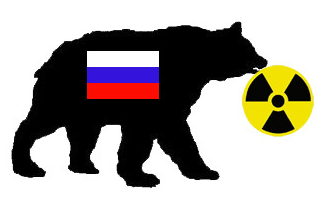 A.P. set to be country’s nuclear power hub http://www.thehindu.com/
 news/national/andhra-pradesh/ap-set-to-be-countrys-nuclear-power-hub/article8876943.ece SUHASINI HAIDAR
Govt. is pinning its mega plans for generating the ‘clean’ energy on coastal Andhra Pradesh.
Weeks after the government announced that U.S. company Westinghouse’s Nuclear Power Project (NPP), planned in Gujarat’s Mithi Virdi, is being moved to Andhra Pradesh, sources confirmed to The Hindu that Russian-owned Rosatom will build its next phase of six reactors in Andhra Pradesh as well.
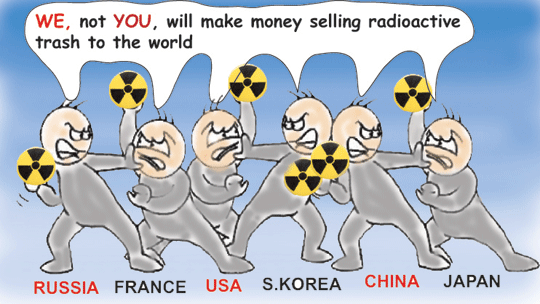
With other States like Gujarat, Tamil Nadu, West Bengal and Maharashtra facing local protests over NPPs, the government is now pinning its mega plans for generating the ‘clean’ energy on coastal Andhra Pradesh. In fact, if all the projects under consideration from Russia, the U.S. and NPCIL were to actually go through, NPPs in Andhra could account for more than 30,000 MW of the Modi government’s goal of 63,000 MW installed capacity by 2031. The site for the next set of six Russian reactors was discussed during A.P. Chief Minister Chandrababu Naidu’s recent visit to Russia, where he met Russian PM Dmitry Medvedev.
Sources told The Hindu the project site identified, believed to be Kavali in Nellore district, could be announced during President Vladimir Putin’s visit to India in October. “It’s huge,” said Commerce Minister Nirmala Sitharaman, who had led the delegation to Russia. “In Andhra Pradesh, six nuclear centres are going to be created, totalling thousands of megawatts in capacity. Of course, Andhra Pradesh will have both American and Russian participation in nuclear energy generation, but the Russians will be the first to “Make in India” in the nuclear sphere in Andhra,” Ms. Sitharaman told The Hindu.
The “American participation” referred to is the plan for Toshiba-Westinghouse to set up 6 AP1000 reactors of 1,100 megawatts each, a proposal that had run into trouble in Gujarat due to “stiff protests from farmers” during the land acquisition process for 777 hectares, a senior official in the Gujarat government said.
“In addition, Tata, Adani and Essar, which are the largest power producers in the State, were never comfortable with another giant plant being set up in the State,” the official said. During Prime Minister Narendra Modi’s visit to Washington in June 2016, NPCIL and Westinghouse had announced the move to Andhra Pradesh, with a commitment to complete the commercial agreement for 6 reactors by June 2017.
Meanwhile, another Russian project that has been hanging fire for years, to build 6 ‘VVER’ (Water-Water Energy) Reactors of 1000 MWe in West Bengal’s Haripur may also be moved to Andhra Pradesh due to local protests. “We are looking for a site in some coastal area of Andhra Pradesh where a similar reactor, which was meant for Haripur, will come up,” Dr. Sekhar Basu, now Chairman of the Atomic Energy Commission, had told reporters last September, although West Bengal officials told The Hindua final decision has not been taken.
State officials hope Tamil Nadu, Gujarat and West Bengal’s loss will soon be Andhra Pradesh’s gain, and the State already has the Kovvada nuclear park project for 6 1000MW reactors in Srikakulam under way. However, the coast isn’t completely clear. Kovvada has seen some protests of the kind seen at Kudankulam, Mithi Virdi and Haripur. While many local residents are unwilling to part with land, others have concerns over environmental hazards, especially given that some of the sites identified for nuclear projects are in a seismically sensitive zone, and have seen tremors in the past.
Confirming that several projects are only in “preliminary stages”, the Andhra Pradesh government’s media adviser Parkala Prabhakar told The Hindu: “The Central government has asked some more sites for other plants. We have asked the Collectors of Prakasam and Nellore to spot the sites. Once those sites are identified, the NPCIL will come for inspection to check the compatibility,” indicating that while Andhra’s nuclear power-hub dreams are in sight, they may take a while to come to fruition. (With Appaji Reddem in Vijayawada & Mahesh Langa in Ahmedabad)
Russia marketing Nuclear Aircraft Carrier to India
 Russia Offers India Nuclear Aircraft Carrier Vivek Raghuvanshi, Defense July 11, 2016 NEW DELHI — Russia has offered its nuclear aircraft carrier, dubbed “Storm,” to India for purchase, a senior Indian Navy official said. The offer comes as India and the US discuss the transfer of technology for India’s future nuclear aircraft carrier, the INS Vishal.
A diplomat with the Russian Embassy confirmed that a Russian team visiting India last week made the offer.
Krylov State Research Center (KSRC), a Russian shipbuilding research and development institute, is designing the carrier, also known as Shtorm or Project 23000E…….http://www.defensenews.com/story/defense/naval/navy/2016/07/11/russia-india-nuclear-aircraft-carrier-storm/86937106/
Russia paying for setting up nuclear power plant in Vietnam
 Work on Russian-assisted nuclear power plant in Vietnam to begin in 2023 https://rbth.com/news/2016/07/15/work-on-russian-assisted-nuclear-power-plant-in-vietnam-to-begin-in-2023_611821 TASS
“The schedule is still set for 2028,” Tuan said. Construction will begin in 2022 or 2023, he added.
Such a timeframe is indicated in the revised master plan of Vietnam’s energy sector development, the official said.
Russia’s Rosatom is acting as a partner in the Ninh Thuan 1 nuclear power plant in Vietnam.
A nuclear-armed space plane for Russia?

 Russia Is Building a Nuclear Space Bomber, The Daily Beast, DAVID AXE, 14 JULY 16 Kremlin claims about a spacecraft that could fire weapons anywhere on Earth within two hours may have just kick-started a nuclear arms race in space. The Russian military claims it’s making progress on a space plane similar to the U.S. Air Force’s secretive X-37B robotic mini-shuttle.
That in itself isn’t terribly surprising or even, for the United States, particularly worrisome. Lots of governments and even private companies are working on space planesthat can launch from rockets or runways, boost into orbit for a period of time then return to Earth for quick refurbishment and re-use.
The tech is pretty basic. But alone among space-plane developers, the Kremlin is proposing to arm its space plane. With nukes. That’s not only a gross violation of international law, it represents a fairly profound act of hypocrisy on Russia’s part. It wasn’t long ago that the Russian government accused the United States of weaponizing space by sending aloft the nimble, versatile X-37B, basically a quarter-size, remote-controlled version of the Space Shuttle that could, in theory, carry weapons—but does not.

To be clear, a nuclear-armed space plane would be dangerously destabilizing, as it would totally upset the current, tenuous balance of power between the United States and Russia. The Pentagon could respond to a Russian orbital nuke bomber by quickly deploying a space bomber of its own. In other words, an atomic arms race… in space—a development no one should welcome.
Lt. Col. Aleksei Solodovnikov, a rocketry instructor at the Russian Strategic Missile Forces Academy in St. Petersburg who is overseeing the space plane’s development, said the orbital bomber would be flight-ready by 2020. It’s unclear how much money the Kremlin is investing in the project, and how serious senior officers are about actually deploying the space plane, if and when Solodovnikov and his team finish it.
In any event, the military space plane could give Russia a potentially history-altering nuclear first-strike capability.
“The idea is that the bomber will take off from a normal home airfield to patrol Russian airspace,” Solodovnikov said, according to Sputnik, a government-owned news site. “Upon command, it will ascend into outer space, strike a target with nuclear warheads and then return to its home base.”
Thanks to its orbital capability, the bomber would be able to nuke any target on Earth no longer than two hours after taking off, Solodovnikov claimed.
The Russian craft could be closer to Virgin’s family of reusable space planes—the experimental SpaceShipOne and the larger SpaceShipTwo, which is designed to carry paying tourists to the edge of space……..
In 1967, the United States and Russia and 102 other countries signed the Outer Space Treaty, which bans the explicit militarization of space. “States parties to the treaty undertake not to place in orbit around the Earth any objects carrying nuclear weapons or any other kinds of weapons of mass destruction, install such weapons on celestial bodies or station such weapons in outer space in any other manner,” the treaty reads.
Forty-nine years later, the United States, Russia, and China between them operate hundreds of military satellites. A few have inherently aggressive design features, such as the ability to maneuver close to other spacecraft and potentially disable them by way of extendable claw arms.
But none are solely and strictly offensive weapons. And certainly none pack city-destroying nuclear weapons that can rain down just an hour or so after the command is given. Earth’s surface teems with weaponry, but the world has, so far, managed to keep Earth’s orbit pretty much arms-free.
After the U.S. Air Force launched the X-37B—for scientific purposes, officials claimed—for the first time in April 2010, Russian experts accused the Americans of possibly sneaking a weapon into orbit. The X-37B could “strike global blows on surface targets,” warned Konstantin Sivkov from the Academy for Geopolitical Problems.…….
But the Kremlin’s space-bomber would be a weapon—unambiguously so—and would shatter a half-century of mostly-peaceful space exploration, undoubtedly sparking a terrible diplomatic row and potentially driving the United States and Russia closer to open conflict… on Earth’s surface. http://www.thedailybeast.com/articles/2016/07/14/russia-is-building-a-nuclear-space-bomber.html
Nuclear weapons should be returned to the countries that own them – call from Russian diplomat
 Russian diplomat calls for returning nuclear weapons to producer countries http://tass.ru/en/politics/887597 July 11, 20:16 Barack Obama plans to use his final six months in office for putting forward a number of nuclear arms control initiatives, possibly offering Russia to extend the New Start Treaty for another 5 years MOSCOW, July 11 /TASS/. Return of all nuclear weapons to the territories of countries where they have been produced would be a vital contribution to world security, Russia’s Permanent Representative to NATO Alexander Grushko said in an interview aired by the Rossiya 24 television news channel on Monday.
“It would be a contribution to international security if all nuclear charges were returned to the territories of countries, which possess them. This is exactly what Russia did,” Grushko said commenting the US authorities’ intention to offer Russia to extend the Strategic Arms Reduction Treaty (START) for another five years.
“It is necessary to bear in mind that as major nuclear players, including Russia and the United States, the role of nuclear potentials possessed by other countries will increase. Therefore, the approach will be totally different: it should be an integrated approach,” Grushko said.
According to the Washington Post electronic version, US President Barack Obama plans to use his final six months in office for putting forward a number of nuclear arms control initiatives, including, possibly, to offer Russia to extend the New Start Treaty for another five years. The publication said that the US National Security Council had discussed the topic at its meetings twice over the past two weeks.
Russia’s nuclear marketing: the ambitions and the reality
 Russia’s nuclear energy expansion – a geopolitical footprint?, New Eastern Europe News, , 28 June 2016 “…….As the low oil and gas prices globally have squeezed Russia’s fossil fuel export revenues, an integral part of the country’s income, the nuclear industry has been looking for a worldwide expansion. Rosatom, Russia’s state-owned nuclear champion, has in the recent years set an ambitious course to deliver Russian nuclear power generating technology to both traditional partner countries as well as to new “developing“ economies…….
Nuclear ambitions
Over the past decade state-owned nuclear corporation Rosatom and its network of subsidiaries have made direct or indirect commitments to build nuclear power plants in a number of countries around the world. As stated by a Rosatom official in a recent interview, Russia has signed intergovernmental agreements for the possible construction of 36 nuclear reactors overseas and is holding “active and consistent” tendering negotiations about 21 others. It is apparent that Russia seems to be looking away from Europe and its traditional markets in search of new business opportunities for its nuclear industry.
During the Russia – ASEAN (Association of Southeast Asian Nations) summit held on 19 and 20 May in Sochi, Russia’s president Vladimir Putin said his country is ready to provide a Generation III nuclear reactor technology to countries in Southeast Asia. Another Rosatom official called forAfrica to invest in nuclear energy during an annual energy forum in Johannesburg in February 2016.
The reality
The overall expansion agenda seems really impressive, but in fact only some of the projects are in an active construction phase – such as those in Belarus, China, Finland, India, and Slovakia. The projects in Egypt, Hungary, Iran and Vietnam are also likely to get the go-ahead in the near future. As for the rest, the picture has not been so rosy.
Turkey’s Akkuyu project is becoming increasingly bogged down after the relationship between Moscow and Ankara embittered last November. Ukraine has denounced an agreement with Russia on the construction of two units at the Khmelnitsky site as the two countries have become increasingly hostile due to the looming Donbas and Crimea crises. China appears to have taken over the project for the expansion of the Atucha plant in Argentina. And nuclear development on the African continent (except for South Africa and Egypt) is nowhere closer to reality in the near future.
Looking back at Europe, both Finland’s Hanhikivi and Hungary’s Paks 2 nuclear new build projects have come under scrutiny of the authorities. In the Finnish case, the main condition set by Helsinki to allow the project was for 60 per cent of the ownership of Fennovoima, the company building Hanhikivi, to be held by investors from the EU. This meant Rosatom could only be a minority owner with its 34 per cent. As with Hungary, the European Commission (EC) has launched two procedures against the government in Budapest looking into the legality of the state aid and public procurement conditions around the Paks 2 project. The EC has expressed its doubts on whether the deal with Russia fully meets EU regulations and has been concluded on market terms. The EC said it would assess if a private investor would have financed the project on similar terms or whether Hungary’s investment constitutes state aid.
Economics and geopolitics
From an economic point of view, nuclear projects are specific with their high upfront capital costs. This fact often creates major hurdles for countries or companies looking to build nuclear capacities………
Apart from the initial investment, which is undoubtedly good business for Rosatom, even more attractive is the possibility for nuclear fuel supplies the Russian-designed reactors will be using over their operational lifetime. As this is on average 30-50 years, it is a brilliant opportunity for continued revenue over a very long period of time. ……
Forced to play by the common rules, Russia has to accommodate to open competition on EU terms. Therefore, it is looking for an ambitious expansion of its nuclear exports around the world, striving to “conquer” market shares as a first mover, while major nuclear industries in Europe and Japan are plagued by shrinking business opportunities, financial problems, and negative public opinions. The real contenders to Russia’s nuclear expansion in the short and medium term will become China and the US. It only remains to be seen where the business ends and geopolitics begins. http://www.neweasterneurope.eu/articles-and-commentary/2040-russia-s-nuclear-energy-expansion-a-geopolitical-footprint
Russia’s spurious nuclear marketing deals
Experts say some deals Rosatom boasts about are not contracts, just a “memorandum of understanding” or “framework agreement.” Many of these are with countries that will not be ready for nuclear for years, if not decades, such as Algeria, Argentina, Bolivia and Nigeria.
whether any new plants ever get built, Rosatom is likely to keep signing new deals around the globe.
“Rosatom likes to sign MOUs everywhere, they like one every few months, for the photo opportunity,”
Rosatom’s Global Nuclear Ambition Cramped by Kremlin Politics, Fortune by Reuters JUNE 26, 2016 The problem is that Russia wants to parlay Rosatom’s success into political leverage.
The $100 billion overseas order book of Russia’s nuclear power plant builder Rosatom—bigger than all its Western competitors combined—makes it look like the giant in its field.
But if the company—formed in 2007 from the Russian Atomic Energy Ministry and tasked with turning nuclear power into a major export industry—is ever to reach its potential as a global industrial giant, it will have to shed Russia’s reputation for using energy policy as a means to political ends.
Deal after deal has collapsed in Europe, where individual countries and the European Union as a whole consider it a priority to reduce dependency on Russian energy, and relations have deteriorated over Moscow’s intervention in Ukraine.
A project in fast-growing, energy-hungry Turkey—possibly the ideal market on paper—has been stalled because of a collapse in relations between the two countries supporting opposite sides in the Syrian civil war.
And an array of deals announced in poorer developing countries like Egypt, Jordan and Bangladesh seem unlikely to reach fruition any time soon because of the countries’ lack of experience with nuclear power, shortage of capital and grids that are unsuitable.
“Rosatom is pretty good at announcing $100 billion euros of orders in 25 countries, but not an awful lot of these are firm contracts, they are just bits of paper,” said Steve Kidd at East Cliff Consulting. Continue reading
Russia’s massive nuclear-powered icebreaker to seek oil reserves in Arctic
Arktika is just one icebreaker in a class known as Project 22220. The other two — Sibir, which was laid down in May 2015, and Ural — are also planned. If completed, Sibir will reportedly have the propulsion power of 110 MW, almost twice as powerful as Arktika. Both ships are part of a $1.2 billion contract that Baltic Shipyards signed in 2014 with Rosatom State Nuclear Energy Corp.
Why would Russia need nuclear-powered icebreakers in the first place? Obviously, for defense. Icebreakers can clear a path for military ships, allowing for increased mobility and range for the Russian naval fleet.
NUCLEAR-capable ballistic missiles for Russia – placed in Europe
Russia to deploy NUCLEAR-capable ballistic missiles in the heart of EUROPE, Express, UK 23 June 16 RUSSIA plans to station advanced nuclear-capable missiles deep inside Europe – putting vast swathes of the continent in the crosshairs of Moscow’s short-range ballistic missile programme. By TOM BATCHELOR, Jun 23, 2016 Kremlin insiders say the Russian enclave of Kaliningrad – on the Baltic Sea wedged between Poland and Lithuania – will host the Iskander missile – dubbed the Stone by Nato.
Crimea, which was annexed from the Ukraine in 2014, could also host a second Iskander missile base, Russian defence sources claim.
Russia has been accused of blatant acts of aggression in eastern Europe and the Baltics, with land grabs, military exercises and close fly-bys of its fighter jets.
The move is in defiance of a US-backed Nato missile shield that was erected in Romania last month, with a second planned for Poland in 2018.
With a range of roughly 300 miles, the Iskander missile could hit targets as far away as eastern Germany, the entire Baltic region and Poland, as well as parts of Sweden.
But experts say the targets it will cover can be struck by longer-range Russian missiles anyway.
Relations between Russia and the West have plunged to their lowest point since the Cold War in recent months.
Both sides have ramped up their defence spending, missile programmes and defensive shields as Europe enters what many observers believe is a new Cold War…….http://www.express.co.uk/news/world/682701/Russia-station-Iskander-nuclear-missiles-Kaliningrad-Cold-War-tensions
Call for Britain to have Russia build UK’s new nuclear stations
 UK government needs a nuclear plan B, says Tim Yeo, Guardian, Terry Macalister, 19 June 16, “…….. Tim Yeo, a former chair of the energy and climate change committee, said the government should also consider whether the Russian state operator, Rosatom, or the British state could build new atomic plants.
The Hinkley project in Somerset has been hit by a series of delays, with its developer, EDF, recently postponing a final investment decision until September.
Yeo said continuing opposition from EDF unions to spending huge sums of money in Britain and political uncertainty ahead of the French elections next spring could hold up the project further……..
Yeo said the Russian political situation made it harder for the UK government, but Russian nuclear sources have previously said Rosatom would like to talk.
In 2014, a senior Decc officialconfirmed that there had been serious contact between the two sides……
The pro-nuclear campaigner said the total cost of any new reactor to energy billpayers could be reduced if the British government became directly involved, as some City analysts have claimed…….https://www.theguardian.com/uk-news/2016/jun/19/uk-government-should-have-a-nuclear-plan-b-tim-yeo-hinkley-point-bradwell-scheme
Russia’s powerful new nuclear icebreaker
Russia unveils ‘world’s biggest’ nuclear icebreaker, Yahoo News June 17, 2016, Moscow (AFP) – Russia on Thursday floated out a new nuclear-powered icebreaker, said to be the world’s biggest and most powerful, to be used for hauling liquefied natural gas from its Arctic terminal.
Arktika, ordered by Russia’s Rosatom state nuclear agency, was built at the Baltic Shipyard in Saint Petersburg, and will be ready to use by the end of next year.
“There are no icebreakers like it in the world,” said Rosatom chief Sergei Kiriyenko at the ceremony, according to a company statement. “The Arktika icebreaker presents truly new opportunities for our country.”…….It can cut through ice of up to 2.8 metres (nine feet) thick. https://au.news.yahoo.com/world/a/31854163/russia-unveils-worlds-biggest-nuclear-icebreaker/#page1
Bulgaria must pay Russia over cancelled nuclear project, says court.
Court orders Bulgaria to pay Russia over cancelled nuclear project: minister http://uk.reuters.com/article/uk-bulgaria-russia-arbitration-idUKKCN0Z213A , Jun 16, 2016
An arbitration court has ruled that Bulgarian state energy firm NEK should pay nearly 550 million euros (437.70 million pound) in compensation to Russia‘s Atomstroyexport for a cancelled nuclear power project, Bulgaria’s energy minister said on Thursday.
“NEK received the court’s decision late last night. It is still not handed down officially. In the next days, NEK will approach Atomstroyexport over the decision,” Energy Minister Temenuzhka Petkova told reporters.
Atomstroyexport had sought more than 1 billion euros at the Paris-based International Court of Arbitration against NEK over the cancellation of the Belene nuclear power plant it had been contracted to build.
NEK teamed up with Atomstroyexport to build two 1,000 megawatt reactors at Belene, on the Danube River at the border with Romania, in 2006.
Sofia abandoned the project in 2012, after it failed to attract investors for the 10 billion euros ($11 billion) scheme and also came under pressure from its Western allies about its energy dependence on Moscow.
Petkova said the court has ruled that NEK should cover the funds the Russian state company had spent to produce equipment for the project, but has rejected claims for additional works and damages from lost profits.
Bulgaria is currently extending the lifespan of its two 1,000 Soviet-made reactors at its Kozloduy nuclear power plant and is looking for an investor to build one more reactor at the same site.
Russia pushing United Arab Emirates to buy nuclear technology
Nuclear power key for UAE energy security, Khaleej Times Sarakshi Rai/moscow June 5, 2016 Nuclear power is the best way for the world and the UAE to meet its energy demands, according to top nuclear energy professionals at the recently concluded Rosatom Atomexpo 2016.
Atomexpo is the largest exhibition venue for meetings and negotiations between world leaders in the nuclear power sector. This year’s exhibition and conference focused on new players entering the nuclear energy sector.
Mohamed Shaker, minister of electricity and mineral resources, Egypt; Hassan Mahmoud Hassanein, first deputy minister of electricity and mineral resources, Egypt; Khaled Toukan, chairman of Jordan Atomic Energy Commission; and Hashem Yamani, president of King Abdullah City for Atomic and Renewable Energy, Saudi Arabia; featured in day two of the conference at a panel discussion highlighting the future of nuclear power and new players…….
1 This Month



26 September – International Day for the Total Elimination of Nuclear Weapons


PLEASE OPPOSE HR 8255 AND S.3639 – bills would accelerate satellite deployment, with no environmental review or safeguards – https://ncstd5li.quorum.us/campaign/169331/
To see nuclear-related stories in greater depth and intensity – go to https://nuclearinformation.wordpress.com
-
Archives
- September 2026 (219)
- August 2026 (330)
- July 2026 (355)
- June 2026 (287)
- May 2026 (306)
- April 2026 (356)
- March 2026 (251)
- February 2026 (267)
- January 2026 (308)
- December 2025 (358)
- November 2025 (359)
- October 2025 (375)
-
Categories
- 1
- 1 NUCLEAR ISSUES
- business and costs
- climate change
- culture and arts
- ENERGY
- environment
- health
- history
- indigenous issues
- Legal
- marketing of nuclear
- media
- opposition to nuclear
- PERSONAL STORIES
- politics
- politics international
- Religion and ethics
- safety
- secrets,lies and civil liberties
- spinbuster
- technology
- Uranium
- wastes
- weapons and war
- Women
- 2 WORLD
- ACTION
- AFRICA
- Atrocities
- AUSTRALIA
- Christina's notes
- Christina's themes
- culture and arts
- Events
- Fuk 2022
- Fuk 2023
- Fukushima 2017
- Fukushima 2018
- fukushima 2019
- Fukushima 2020
- Fukushima 2021
- general
- global warming
- Humour (God we need it)
- Nuclear
- RARE EARTHS
- Reference
- resources – print
- Resources -audiovicual
- Weekly Newsletter
- World
- World Nuclear
- YouTube
-
RSS
Entries RSS
Comments RSS
 nuclear-news