Russia says it prevented a Ukrainian drone attack on the Smolensk nuclear power plant.
Russia’s Federal Security Service (FSB) said that it had prevented a
Ukrainian drone attack on the Smolensk nuclear power plant in western
Russia on Sunday. The Soviet-era Smolensk nuclear power station, about 330
km (200 miles) southwest of Moscow near the border with Belarus, has three
RBMK reactors – the same basic design as the reactors at the Chernobyl
nuclear power station. The FSB, the main successor to the Soviet-era KGB,
said that Russian radio-electronic warfare systems intercepted a Ukrainian
drone over the territory of the Smolensk nuclear power station.
Reuters 17th Aug 2025, https://www.reuters.com/world/europe/russia-says-it-prevented-ukrainian-drone-attack-smolensk-nuclear-power-plant-2025-08-17/
Trump on Summit with Putin: We Made Great Progress Today.

Russian President Vladimir Putin concluded the summit by inviting Trump to Moscow
by Kyle Anzalone | August 15, 2025 https://news.antiwar.com/2025/08/15/trump-on-summit-with-putin-we-made-great-progress-today/
Following a three-hour meeting between Russian President Vladimir Putin and President Donald Trump, the leaders delivered brief statements at a press conference, stating that the talks were productive and constructive.
Putin spoke first, telling the press that the talks were in a “constructive atmosphere of mutual respect. We had very thorough negotiations.” He added that he hoped European governments and Ukraine would receive the agreements made with Trump “constructively” and that they would not interfere with the progress.
The Russian leader also blamed former US President Joe Biden for starting the war in Ukraine and argued that the invasion would not have happened if Trump had been the president. Trump has often claimed the conflict in Ukraine was Biden’s war, and he could have prevented the war from breaking out.
Putin noted that before the start of the war in 2022, Moscow sent Washington a proposal that would have stopped the Russian invasion of Ukraine. A core issue for the Kremlin was the growing ties between NATO and Ukraine. However, the Biden administration refused to negotiate on this point, and Putin ordered the invasion.
The Russian President said that during the Biden administration, US and Russian relations hit a post-Cold War low point. Putin expressed hope that the summit would be the start of the process to repair the ties and resolve the Ukrainian crisis.
“I believe we had a very productive meeting. There were many, many points we agreed on, I would say most of them,” Trump said. “A couple of big ones we haven’t quite gotten there, but we made some headway.”
Trump explained that no final agreement was made. “So there’s no deal until there’s a deal,” he added. He went on to say he would call European leaders and Ukrainian President Zelensky. He added that it was ultimately up to the Ukrainians to accept any agreement.
The President did not specify what issues were left unresolved, but later in his statement, he mentioned that the “most significant” issue remains unsettled.
At the end of the press conference, Putin extended an invitation to Trump to attend a summit in Moscow. “That is an interesting one. I will get a little heat on that one. But I can see it possibly happening,” Trump replied.
Friday’s meeting in Alaska also included Secretary of State Marco Rubio, envoy Steve Witkoff, Foreign Minister Sergei Lavrov, and aide Yury Ushakov.
Kyle Anzalone is the opinion editor of Antiwar.com and news editor of the Libertarian Institute. He hosts The Kyle Anzalone Show and is co-host of Conflicts of Interest with Connor Freeman.
Trump meets with Putin: the non-event that was sold as history.
16 August 2025 Michael Taylor, https://theaimn.net/trump-meets-with-putin-the-non-event-that-was-sold-as-history/
The buildup was epic. For weeks, the Trump administration talked up the meeting with Vladimir Putin as if the world was about to witness a defining moment in history. Media speculation was feverish – would there be a grand bargain on Ukraine, arms control, or even global security itself? Some even hinted it might mark the beginning of a “new era” in U.S.–Russia relations.
And then it happened.
The meeting was less “historic breakthrough” and more “awkward photo-op.” No landmark agreements were reached, no peace deals signed, no strategies unveiled. Just vague talk about “respect,” “better relations,” and “future discussions.” In other words: business as usual, wrapped in hype.
Trump will, of course, try to frame it as a personal victory – that’s his style. He even claimed afterward that Putin praised him for what he’d done for America. Maybe he did, maybe he didn’t – but given Trump’s track record of exaggerating praise, it’s hard to take the claim at face value. What we do know is that there was little of substance for anyone to point to. America’s allies were left wondering why so much diplomatic capital was spent for so little return, while adversaries quietly enjoyed the spectacle.
Putin, for his part, looked calm and unruffled. He gave away nothing, promised little, and let Trump carry the theatrics. In the end, he walked away looking like the steady hand, while Trump appeared desperate for validation.
This wasn’t the dawn of a new era. It was a reminder that in international politics, theatrics without substance are just that – theatrics. And the more often the world sees this pattern repeat, the less seriously America’s leadership is taken on the global stage.
Russia makes battlefield breakthrough in urgent push for land.
Telegraph, Kieran Kelly. Fermin Torrano in Ukraine, 12 Aug 25
With Trump talks looming, Russia’s army punches through exposed Ukrainian defences.
Russia is racing to seize as much Ukrainian territory as possible ahead of peace talks with Donald Trump on Friday.
In what may prove to be a major breakthrough for Vladimir Putin, Russian sabotage and reconnaissance units punched through exposed defences in eastern Ukraine, slipping as far as six miles behind the front line in just 48 hours, according to battlefield reports.
Kyiv has diverted special forces units to confront the insurgents on the ground in an attempt to prevent any more of Ukraine falling under Russia’s control before the summit in Alaska.
The location, near Dobropillya in Donetsk, is strategically significant. If Moscow’s forces are able to establish a foothold, the breach could allow Russia to cut off the city of Kramatorsk, one of the most vital strongholds in the Donbas still under Kyiv’s control.
If the city falls, it would give Putin almost full control over the Donbas and strengthen his negotiating power when bargaining over Ukraine’s fate with the Trump administration……………………………………… https://www.telegraph.co.uk/world-news/2025/08/12/russia-battleground-breakthrough-exposes-putin-push-land/
Mystery grows around state of Russian nuclear submarine base that is just 75 miles from epicentre of 8.8-magnitude megaquake
A colossal 8.8-magnitude earthquake rocked Russia’s far eastern Kamchatka
Peninsula early yesterday morning – raising serious questions about the
condition of Russia’s key nuclear submarine bases, located alarmingly close
to the epicentre. The quake, tied for the sixth strongest in recorded
history, struck just 75 miles from Avacha Bay, where some of the Russian
Navy’s most strategic nuclear assets, including Borei and Delta-class
ballistic missile submarines, are based. Though Russian authorities are
insisting the situation is under control, with ‘no reported fatalities or
serious injuries’, military analysts and international observers are
sounding the alarm over the potential impact on these high-security naval
installations.
Mail 31st July 2025, https://www.dailymail.co.uk/news/article-14956551/Russian-nuclear-submarine-base-earthquake.html
Russia is staying quiet on Trump’s nuclear move
BBC, Steve Rosenberg, Russia editor in Moscow, 2 Aug 25
Could this be the first time in history a social media spat triggers nuclear escalation?
President Donald Trump, offended by posts by former Russian President Dmitry Medvedev, says he’s ordered two nuclear submarines to move closer to Russia.
So, how will Moscow respond? Are we on a path to a nuclear standoff between America and Russia? An internet-age version of the 1962 Cuban Missile Crisis?
I doubt it, judging by initial reaction in Russia.
Russian news outlets have been rather dismissive of Trump’s announcement.
Speaking to the Moskovsky Komsomolets newspaper, a military commentator concluded that Trump was “throwing a temper tantrum”.
A retired lieutenant-general told Kommersant that the US president’s talk of submarines was “meaningless blather. It’s how he gets his kicks”.
“I’m sure Trump didn’t really give any orders [about submarines],” a Russian security expert suggested to the same paper.
Kommersant also mentions that in 2017, Trump said that he’d despatched two nuclear submarines to the Korean peninsula as a warning to North Korea.
Yet not long after, Trump held a meeting with North Korean leader Kim Jong Un.
So, bizarrely, might Donald Trump’s latest submarine deployment be a precursor to a US-Russia summit?
I wouldn’t go that far.
But the reaction from the Russian authorities has been interesting.
At time of writing, there hasn’t been any.
Not from the Kremlin. Not from the Russian foreign ministry. Nor the defence ministry.
And I’ve seen no announcement about Russian nuclear submarines being positioned closer to America.
Which suggests that either Moscow is still studying the situation and working out what to do, or that Moscow doesn’t feel the need to react.
The Russian press reaction I mentioned earlier suggests it’s the latter……………………………. https://www.bbc.com/news/articles/cly4kgv9238o
Russian nuclear submarine base hit by tsunami.
Waves triggered by 8.8 magnitude earthquake damaged base that houses Pacific Fleet
Russia’s far east nuclear submarine base appears to have been damaged by
the tsunami that swept the country’s Pacific coast on Wednesday,
according to satellite imagery obtained by The Telegraph. The waves,
triggered by an 8.8 magnitude earthquake, hit the Rybachiy base in
Kamchatka peninsula, which houses most of the nuclear submarines in
Russia’s Pacific Fleet. A section of one pier has bent away from its
original position, possibly indicating that it was detached from its
moorings, images taken by the Umbra Space satellite on Thursday morning
have revealed.
It does not appear that a submarine was moored alongside at
the time of impact and experts said damage to the structure alone would
have little military significance. However, questions were raised about
whether the tsunami caused any further harm to the base, which was thought
to have been hit within 15 minutes of the earthquake.
Telegraph 1st Aug 2025, https://www.telegraph.co.uk/world-news/2025/08/01/russian-nuclear-submarine-base-earthquake-satellite/
The Kyshtym disaster: Russia’s hidden nuclear crisis

The Kyshtym disaster in 1957 was the Soviet Union’s biggest nuclear crisis until Chernobyl. So, why did the Soviets keep quiet about the former for decades?
28 July 25, https://www.history.co.uk/articles/kyshtym-disaster-russia-hidden-nuclear-crisis
What would be considered the worst nuclear disaster in history? Many scholars would say Chernobyl, when an explosion at a nuclear power plant in northern Ukraine released dangerous levels of radiation.
This was on 26th April 1986, when Ukraine was still part of the Soviet Union. Was Chernobyl inevitable? Many historians do believe that Soviet authorities failed to learn lessons from an earlier nuclear crisis on their own soil. Below, we at Sky HISTORY look back at the 1957 Kyshtym disaster — and how the Soviets kept it under wraps for decades.
Was there really a nuclear plant in Kyshtym?
The nuclear plant at the heart of the Kyshtym disaster was not actually in the Russian town of that name. Instead, it was in a secretive ‘closed city’ nearby, called Chelyabinsk-40. Today, it is called Ozyorsk. (Both Kyshtym and Ozyorsk are in Russia’s Chelyabinsk Oblast.)
In the 1940s, the Soviets realised that they were trailing the United States in the development of nuclear weapons. To help themselves catch up, they hastily built what is now commonly known as the Mayak nuclear plant.
This facility, which still stands today, was tasked with processing plutonium needed to make nuclear weapons. However, because the plant was assembled in a rush, many safety risks of the project were not considered sufficiently.
The Kyshtym explosion and its immediate aftermath
Before the Kyshtym disaster, it was routine for Mayak workers to deposit radioactive waste into the Techa River. This bode ill (literally) for villagers along the river who used it as a source of drinking water.
So, Mayak staff later decided to store such waste in an underground storage compartment of the plant itself. This space comprised 14 stainless steel containers attached to a concrete base.
However, in the 1950s, the cooling system in one of these tanks started to malfunction. This led the waste in the container to heat up and eventually, on 29th September 1957, explode. The force sent 20 curies of radioactive material flying a kilometre into the air.
The wind blew the radioactive particles over an area of about 20,000 square kilometres inhabited by approximately 270,000 people. This was generally to the northeast, away from Chelyabinsk-40, which lay upwind from the Mayak plant.
How did authorities initially react?
Residents of nearby areas were not initially notified of what had happened. This was largely due to the Soviet Union’s strong culture of secrecy during the Cold War. The national government didn’t want to let slip that Mayak even existed, let alone that a nuclear explosion had happened there.
It was also around the same time that the Soviet Union launched its Sputnik satellite, a big PR coup. Admitting responsibility for what was the world’s biggest nuclear disaster to date would have been more than an inconvenient fly in the ointment.
Still, the Soviets also knew that doing what they could to limit the radioactive contamination would go some way towards keeping everyone in the dark. So, while about 10,000 local residents were evacuated over the next two years, they weren’t told exactly why.
A cover-up lasting for decades
Almost 17,000 hectares of the contaminated area was turned into East Ural Nature Reserve in 1968. Members of the public were barred from entry, which remains the case to this day. Scientists have studied the reserve to monitor the long-term effects of nuclear radiation on its ecology.
The Kyshtym disaster was kept secret from the public until 1976, when Soviet dissident Zhores Medvedev reported about it in New Scientist magazine. However, the Soviet government still did not openly acknowledge the Kyshtym disaster before accidentally revealing it to the United Nations in the late 1980s.
It is estimated that thousands of cancer cases may have resulted from exposure to radiation caused by the nuclear explosion way back in 1957.
How does Kyshtym compare to Chernobyl?
On the International Nuclear and Radiological Event Scale (INES), Kyshtym is classified as Level 6. Chernobyl, an even bigger catastrophe, is ranked just one level higher (Level 7) on the INES. Kyshtym released about 40% as much radioactivity as Chernobyl.
Chernobyl is thought to have affected a larger population, too, as 335,000 people were evacuated in the wake of the 1986 disaster. Also, while Chernobyl quickly claimed 31 lives, none were lost in the immediate aftermath of Kyshtym.
Putin urges Iran to accept ‘zero enrichment’ nuclear deal with US – Axios
Russian President Vladimir Putin has urged Iranian officials to accept a
nuclear agreement that would ban uranium enrichment, a key US demand in any
future talks, Axios reported Saturday citing multiple sources. Putin
conveyed his position to both President Donald Trump and Iranian leaders in
recent weeks, encouraging Tehran to move toward a deal that would help
restart negotiations with Washington.
Iran International 12th July 2025,
https://www.iranintl.com/en/202507120964
Nuclear waste to nuclear reactor: The case of Russia in Kazakhstan
Ayushi Saini, 11 Jul 2025 https://www.lowyinstitute.org/the-interpreter/nuclear-waste-nuclear-reactor-case-russia-kazakhstan
Facing energy deficits, Kazakhstan turns to Russia’s Rosatom for nuclear
power despite a history of environmental and dependency concerns.
After shutting down its last Soviet-era reactor in 1999, Kazakhstan is now on the cusp of returning to nuclear energy. Long reliant on non-renewables and electricity imports, the country faces rising energy demands and an urgent need to diversify its energy sources.
In October 2024, a national referendum strongly backed the construction of a nuclear power plant, with Russia’s Rosatom ultimately selected to lead the project. The decision marks a major shift in the country’s energy strategy and reaffirms Russia’s enduring influence in Central Asia’s high-stakes infrastructure sector.
However, the decision raises several concerns, including environmental risks, increased energy dependence on Russia, and the revival of unsettling memories of Soviet-era nuclear contamination in Kazakhstan. Understanding why Kazakhstan is turning back to nuclear power and why it chose Russia for its first Nuclear Power Plant (NPP)merits a closer look at the strategic and geopolitical factors behind this move.
Nuclear past, nuclear future
Kazakhstan’s journey with nuclear technology is fraught and painful. As a Soviet republic, it served as a major testing ground, most notably at the Semipalatinsk Test Site, where more than 450 atmospheric and underground nuclear detonations took place. This placed a heavy toll on the environment of Kazakhstan, without the nuclear waste having been taken care of by the Soviet Union.
From 1979 to 1999, Kazakhstan hosted a high-neutron Soviet nuclear power plant. After independence in 1991, Kazakhstan dismantled its arsenal and embraced nuclear non-proliferation with the Semipalatinsk test site closing in the same year.
Now, facing power deficits, it is returning to nuclear power for civilian use. The new plant will be built near the village of Ulken by Lake Balkhash – a site chosen for its geographical viability, including proximity to water access. However, environmental concerns persist. Kazakhstan lacks the domestic capacity to manage nuclear waste and must rely on external actors. Despite its past role in Kazakhstan’s nuclear contamination, Russia has reemerged as a key partner in the country’s nuclear revival.
Illusion of a consortium
Astana designated Rosatom to lead the construction of its first NPPafter a competitive bidding process involving China’s China National Nuclear Commission (CNNC), France’s Electricité de France (EDF), and Korea Hydro & Nuclear Power. While authorities claim the formation of an international consortium, Rosatom remains the undisputed leader, reflecting both its technological edge and Moscow’s strategic weight in Astana. Kazakhstan claims that it is the exclusive owner, operator, and supplier of uranium fuel, with complete control over the technological processes of its upcoming nuclear power plant.
Meanwhile, China has been selected to lead the second nuclear power plant, with feasibility studies underway. Kazakhstani officials argue that China is best suited to cooperate with Russia, given their regional rapport. Though framed as multinational, the consortium appears largely symbolic, aimed at balancing ties with major powers. Rosatom’s financing offer further tightens Russia’s grip on Kazakhstan’s energy future.
Why Russia?
Kazakhstan’s decision to shift to nuclear power comes amid a growing electricity production deficit. The country faces a projected shortfall of over 6 GW by 2030, making energy security urgent. The selection of Rosatom to carry out the construction is officially justified by Kazakhstani authorities, given Russia’s global leadership in nuclear technology and its advanced VVER 3+ generation reactors, which are already in operation across several domestic and international sites. Rosatom was deemed to have submitted “the most optimal and advantageous proposal.”
This outcome is not surprising. Talks between Kazakhstan and Russia on nuclear cooperation began in 2011, leading to a feasibility study and a series of agreements. In 2014, an MoU was signed for constructing a VVER-based plant with a capacity of up to 1200 MWe. Kazakhstan also holds a 25% stake in parts of Russia’s nuclear energy sector, and Rosatom’s subsidiary, Uranium One, is already active in Kazakhstan’s uranium mining. Additionally, Russia was Kazakhstan’s top electricity supplier in 2024, exporting 4.6 billion kWh.
Kazakhstan’s alignment with Russia reflects shared Soviet-era technical standards, institutional continuity, and a workforce fluent in the Russian system. Rosatom’s reactors are cost-effective, geographically proximate, and supported by uranium supply and tech transfer offers. Russian remains a common language among elites, and Rosatom’s regional presence, including in Uzbekistan, adds further appeal.
As Kazakhstan’s oil and gas sector is dominated by Western companies (such as ENI, Shell and Chevron, and Russian Lukoil only having 13% stakes in Kashagan Oil Field), choosing Russia for nuclear energy helps Astana maintain a strategic balance and avoid overdependence on any one bloc, without triggering Western sanctions, as Rosatom remains unsanctioned.
Balancing act
Kazakhstan’s decision to pursue nuclear power under Rosatom’s leadership marks a turning point in both its energy strategy and ties with Russia. While the project aims to ease electricity shortages and boost Kazakhstan’s global energy profile, it also deepens reliance on Russia, whose regional influence had waned after the Ukraine crisis.
Although Kazakhstan seeks diverse partnerships – “middle power” diplomacy being a recent fous – geographic and historical ties continue to draw it toward Moscow. The inclusion of other countries in the proposed consortium reflects Astana’s multi-vector foreign policy, an attempt to maintain geopolitical flexibility while meeting infrastructure needs. As the consortium’s lead, Rosatom reinforces its influence over the region’s energy and political landscape. Yet, Kazakhstan’s visible effort to balance Russia and China suggests it won’t sideline either in its strategically vital energy sector.
“More nuclear-powered weapons testing coming up in the Arctic”.
Russia is spending vast sums of money on the war against Ukraine, but nevertheless continues its expensive nuclear weapons development program. “We can expect more weapon testing this summer and fall,” says Barents Observer Editor Thomas Nilsen.
Atle Staalesen, 3 July 2025,https://www.thebarentsobserver.com/security/more-nuclearpowered-weapons-testing-coming-up-in-the-arctic/432549
In the studio is Thomas Nilsen, Editor of the Barents Observer and expert on nuclear weapons in the Arctic. In the podcast, Thomas explains how Russia is making big efforts on the development of nuclear-powered weapons, including the Burevestnik cruise missile and the Poseidon underwater drone. He also outlines Russia’s ongoing activities at the nuclear test sites in Novaya Zemlya and the continued construction of nuclear submarines.
Nilsen says that Ukraine’s recent Operation Spider Web was a game-changing attack which ultimately could make Russia move parts of its nuclear weapons from the Air Force to the Navy.
He argues that the nuclear weapon powers should return to the table to negotiate arms reduction and arms control treaties. Nevertheless, he believes that there is no immanent danger of Russia actually using nuclear weapons. It is more about the Kremlin trying to scare the world, he says.
“The fear of nuclear weapons is a weapon in itself.”
Over several years, you have written stories about the Kola Peninsula and the situation in the region. And you have used satellite maps that shows how Russia is developing its nuclear arsenals in the north. How is Russia developing nuclear weapons in the region?
Well, what we see on satellite images is that there has been a quite extensive rebuilding of the facilities at the northern test site at Novaya Zemlya over the last two, maybe three year period.
The northern test site is the active one. It’s where Russia conducted underground nuclear testings up to 1990. But we don’t know exactly what is happening on the ground. We see the buildings. This could be also a renewing of the quite run-down Soviet facilities that they had. In a kind of the same way as we have seen at other military sites in the Russian Arctic, where the Soviet buildings at Severnaya Zemlya, Franz Josef Land and so on, has been abandoned and they have built new buildings. So it is an area quite close to the Matochin Strait. It’s called the Severnaya base, the northern base, where a lot of new buildings has appeared over the last few years.
Do you think there is a possibility that Russia will resume actual testing in Novaya Zemlya?
Well, the northern test site at Novaya Zemlya is the only place where Russia actually can conduct full-scale nuclear tests if they want. And they are capable of it. They do have tunnels that are made ready. So it is actually a political question. And two years ago, Vladimir Putin withdrew Russia from the comprehensive test ban treaty in the way that they un-ratified it. That is a political sign. It is maybe not as dramatic as it sounds. It doesn’t mean that Russia will make nuclear tests at Novaya Zemlya, but they are in a way showing the United States that they are ready to do so if needed. And this comprehensive test ban treaty that were signed back in 1996 was actually never ratified by the United States itself. So in many ways, Russia is now on the same level as the United States that they have not ratified it. And by that, they can conduct nuclear weapon tests at Novaya Zemlya if needed.
Russia has all the time since the breakup of the Soviet Union maintained a few tunnels and another test site. And in two of those tunnels, we know that they are conducting so-called subcritical tests, which is using a small portion of either uranium or plutonium and test it with conventional explosives. And then they simulate a nuclear test. This is done both for maintaining the safety of existing nuclear weapons, but also we can presume that it’s some kind of new development of computer technologies and the warheads capabilities and so on. This test site is maybe two, three kilometers from the Severnaya main settlement on the northern test site. But what is most interesting is that they are also maintaining a couple of other tunnels that we believe are designed for real nuclear weapon tests. And there has been activities at these tunnels over the last few years. We saw it also last spring and last summer.
If Vladimir Putin decides to escalate the situation, conducting nuclear tests could be one way of showing such political disagreements with the United States. But historically, Russia has not been the country that have pushed the trigger first. So I think it is unlikely, but we can no longer exclude it.
Novaya Zemlya is important for Russia. And we know that the weapons designers of Rosatom are in the process of developing new weapons. Tell us a bit about this.
Yes, that is also a special location at Novaya Zemlya. It’s a test site called Pankovo, where we have seen on satellite images over the last few years that they have expanded the activities up there, especially after 2020. The Pankovo test site is a place where they are launching the so-called Burevestnik missile, or by NATO, named the Skyfall. This is a cruise missile that is powered by a small nuclear reactor. It has a scramjet to push it up in the air, and when it is airborne, they start the reactor. And according to Russian weapon designers and according to Vladimir Putin himself, when he is talking or bragging about this weapon, this cruise missile, the Burevestnik, has unlimited range. And it is also possible to navigate it midair, meaning that it can potentially avoid anti-missile systems. This weapon is kind of interesting to follow because it’s not deployed yet, but they are doing tests. And with a small nuclear reactor up in the air, it also has some releases of radioactivity that goes directly out behind the cruise missile as it is flying.
Very little is known about how successful these tests are. We know that a couple of them have crashed in the Barents Sea. They have been lifted from the seabed and brought safely ashore again. But it is very interesting to follow the Pankovo nuclear test site. That is one of several cruise missile test sites where we believe parts or the entire combat of the Burevestnik missile is tested. Another place that we have seen, and we published articles on that in the Barents Observer, is the Nenoksa site on the coast to the White Sea. And we quite recently published brand new photos, satellite photos, that show that it has been really a lot of construction work at that site modernised over the last two years.
So let’s stick a little bit with this Nenoksa test site, which is located very close to Arkhangelsk in the Russian north. And you’ve written, as you said, a story about this, and it can be read by everyone on the Barents Observer. So tell us what is special about this Nenoksa testing site.
Nenoksa made big headlines worldwide back in July 2019. Or it was actually early August 2019, when during work of recovering one of the missiles that were launched from that area, the radioactive component of the missile exploded. And it led to a release of radioactivity. So isotopes were blowing towards the city of Severodvinsk, which is some 30 kilometres to the east of Nenoksa. And it was not very high levels, but it lasted for about half an hour, with several isotopes measured in the town of Severodvinsk. And we learned after a few days that five of the experts in the Rosatom Development Division of the Burevestnik missile and the reactor were killed of radioactive sicknesses in that explosion. So it is a very serious area. And the big difference here between Nenoksa and Pankovo site on the Novaya Zemlya is that Nenoksa is close to densely populated areas. Severodvinsk with more than 200,000 inhabitants, and not far away is also the city of Arkhangelsk with 300,000 people. So there is actually more than half a million people living in an area where Russia conducts testing of reactor-powered weapons that both have experienced accidents and are releasing radioactivity as they are testing it. And these new satellite images are a sign that Russia plans to resume the Burevestnik testing at Nenoksa, and that is worrying. First of all for the population of northern Russia, but also for Russia’s neighbors in the north, Finland and us in Norway.
Nuclear-powered cruise missile is indeed a scary thought, but there are also other weapons under development. And you have also written a story about the Poseidon, which is an underwater drone capable of carrying nuclear weapons. Tell us about the Poseidon, please.
The Poseidon is a weapon we know much less about than the Burevestnik, quite naturally because it’s tested and developed for underwater warfare. But it’s also one of the weapons that were bragged about by Vladimir Putin when he showed Russia’s plans for new nuclear weapon delivery systems in his annual speech to the public a few years ago.
The Poseidon in basic is also powered by a small nuclear reactor that is giving it a quite long range. We don’t know how long, but potentially this drone that is more than 20 meters long and can navigate across the Atlantic. So it’s an intercontinental underwater weapon. And the idea with the weapon is to dive deeper than normal submarines can sail, which means also that it’s much more difficult for the enemy, in this case NATO, to stop the weapon as it is launched. So it is a deterrence weapon for Russia. In case Russia is taken out in a nuclear war, they will always have this weapon to retaliate on Europe or the United States.
The weapon is carried by a submarine that is called Belgorod. It is a redesigned former Oscar-class submarine, and this submarine brings the torpedo or underwater drone, the Poseidon, out in open water from where it is launched. We don’t know where this is happening. We see that the submarine is sailing out of Severodvinsk. We can see that on social media channels and photos and videos that are published in this town. But we know it’s sailing north. If the testing takes place in the White Sea area, the areas where other weapons are tested, submarine weapons are tested, or if it takes place in the eastern part of the Barents Sea or even in the more shallow southern part of the Kara Sea. We don’t know. But we know that they are testing it, and they haven’t yet deployed the weapon. They have developed a special class of submarines that one day will carry this weapon. It’s called the Khabarovsk submarines.
They started building them back in 2014, according to Russian sources. But these submarines are not yet put on the water, and they are not even rolled out of the ship hulls at the Sevmash yard in Severodvinsk. So we don’t know how far they have come in developing the Poseidon nuclear drone, but they are working on it, and that is a concern. It’s a kind of both a concern, of course, because it’s a very terrifying weapon, but it is also a concern because it will cause releases of radioactivity to the marine environment during development and testing.
Talking about submarines, which is indeed a very important part of Russian armed forces, and they are based – many of them at least – in the Kola Peninsula, not so many kilometers away from where we are sitting here today. But Russia is spending tremendous resources now on the war in Ukraine. Does really Russia have the capacity to follow up Vladimir Putin’s ambitions to build more nuclear submarines?
This is a key question when analyzing Russia’s military structures nowadays, and the short answer is yes, they are giving priority to building new submarines and new surface warships. But to focus on the submarines, they have the new fourth-generation submarines, both of the multipurpose class, the Yasen class, and the strategic submarines, the ballistic missile submarines of the Borey-A class. And, well, they are delayed according to the original plans, but they are rolling out approximately one of each every year, one Borey-A class ballistic missile submarine and one Yasen class submarines. And these are tremendously expensive weapons. They are high-tech technology, and they are kind of the best submarines that Soviet Union and Russia have ever built. They are sailing quietly, and they are armed with what we could call post-Soviet developed cruise missiles and ballistic missiles. The Borey class with the Bulava missiles, and the Yasen class with the Kalibr missile, the Tsirkon missile, and probably the Tsirkon missile is the one we should keep a special eye on because this is a missile that in case it is needed can be armed with a nuclear warhead. And it is also a missile that has a very long range. And the worrying part here is that this missile, when it has been tested, it has been launched from sea, flying over land and hitting targets in the sea. So the Yasen class nuclear-powered submarines actually have weapons that can be launched from Russia’s home waters in the Barents Sea and flying over northern Scandinavia and hitting targets in the North Atlantic, mainly the northern part of the Norwegian Sea. And that is Russia’s planning for expanding a kind of the buffer zone in case they need to protect the ballistic missile submarines. And for now, there are three Yasen class submarines based with the Northern Fleet, all of them in Zapadnaya Litsa, which is 65 kilometers from the border with Norway on the coast to the Barents Sea. And Russia has two Borei-A class submarines with the Northern Fleet based in Gadzhievo. And those are, of course, the ones that really are armed with nuclear warheads, four to six warheads on each of the 16 missiles in each of those submarines.
Can we expect testing of these weapons this summer, this fall? It’s quite expensive as well to do testing, isn’t it?
Testing is expensive, but it is highly needed. And Russia, like most other navies, before commissioning a warship, either it’s a submarine or a surface warship, they have to prove that the weapon systems on board actually work. And both for the latest Borei-A class submarine, the K555 Knyaz-Pozharsky, and for the latest Yasen class submarine, the Arkhangelsk, they need to conduct more testing of the weapons. The Borei-A class, we believed it was out over the last year and trying to test the Bulava, but we haven’t seen any actual reports of successful testings. And before transferring this vessel from the naval yard in Sevmash, Severodvinsk, to the Northern Fleet where it’s going to be based, they need to do a test. And this test, I’m pretty sure, will come during summer or autumn 2025. For the Yasen class submarine, Putin has been bragging about the options of launching a Tsirkon missile, that this submarine is specially designed to carry the Tsirkon missile. And when the chief, the dictator himself, says that it works, well, then the Navy and the weapon designers have to prove that it actually does. So we will see also tests of the Tsirkon missile in the near future in our northern maritime areas, either that is the White Sea or the Barents Sea.
So we see that Russia is building new submarines, building more submarines able to carry nuclear weapons. Does that mean that we will see more also nuclear weapons deployed in the Russian Navy and also in the Russian North?
We don’t know. There are different scenarios here. First of all, it is important to underline that although there hasn’t been any inspections by the United States to see if Russia fulfills the limits, the maximum limits that are set in the new START treaty on the amount of nuclear weapons on ballistic missile submarines, all intelligence reports that we see in Europe and in the United States tells that Russia is not basing more nuclear weapons than those 1,750 warheads that are in the triad, that’s not only submarines, it’s also the Air Force and on silo-based ballistic missiles. So we don’t think that Russia has more weapons than the limits in the START agreement. But on the other side, and this is the big question we don’t have insight to, that is how many tactical nuclear weapons are on storage at the naval bases in the Russian North and how many tactical nuclear weapons are potentially already on board the multipurpose submarines of the Yasen class. We know that they can carry it, but we don’t know actually if they are armed when they are on board or if they at all are placed on board the ships or if they are just at the naval bases in storages ready to be placed on board. And this is one of the big problems with the new START treaty is that it does not cover tactical nuclear weapon, it only focuses on the ballistic missile submarines and the strategic nuclear weapons.
The START treaty obviously is important both for Russia and for the United States. It expires, as you said, next year. But what about other countries? What is their role in this picture?
Nuclear weapons are making headlines worldwide nowadays. We were a bit scared when we saw the news about India and Pakistan and the near war situation up in Kashmir that could have triggered a war between two nuclear weapon states. Luckily, it did not. But one of the main points for the United States when they are now talking about the new START treaty and an option to prolong it or to renew it or to replace it with another treaty on strategic nuclear weapons.
And here the United States has a very good point, is that this is a bilateral treaty between Russia and the United States. And the United States says that they need to include China in this treaty as well. And up till quite recently, China was a nuclear weapon power state, but it did not have that many warheads, maybe only two, three hundred warheads, which is comparable with what the United Kingdom and France have. It’s a scary many, but it’s not on the same level as Russia and the United States. But in recent years, Beijing has expanded its nuclear arsenal and is building new silos and also the number of nuclear warheads is increasing. So China is a country to take a closer look at. And if there should be a new arms treaty regulating the number of warheads in each country, it is a very good idea to also include China into this treaty. But so far that has not happened.
I think the main focus now will be to maybe expand the time horizon for the existing START treaty, maybe with one year, maybe with two years, until a new, more global posture on arms reduction treaties can be signed. Meanwhile, nuclear weapons are also in discussions in Europe. It was up and at debate on the NATO summit in Hague last week. And the United Kingdom has announced that they will buy F-35 fighter jets that are capable of carrying tactical nuclear weapons. We know that France is very relying on their ballistic missile submarines and so on. So I think really it is important to bring back the nuclear weapon powers to the table, just like it was in the end of the Cold War, you know, when Mikhail Gorbachev and Ronald Reagan met in 1986 in Reykjavik and so on. Because the worst case scenario now is that in February next year, we don’t have one single arms reduction treaty or arms control treaty that limits the number of nuclear weapons in the world, except, of course, the non-proliferation agreement. But that one is also challenged by countries like Iran, North Korea, etc.
Talking about Russia, it’s not getting easier to follow developments in the country. How do we actually manage to keep an eye on what Russia is doing with its weapons, with its nuclear weapons, with the submarines? How can we get a glimpse at least of what’s going on?
I think based on the experiences we in the Barents Observer and we as journalists have, I think it is very important to not only focus on what Russia says, but to keep a very close eye on what Russia does. And in the north, we saw it in February 2022, when the full scale invasion of Ukraine happened. It was very quiet on the strategical nuclear forces in the Russian north. They did not deploy more ballistic missile submarines to the sea and also at the storage that they have five, six of in the Kola Peninsula area or Murmansk region. It was also very, very quiet. And this is important because we are today facing a political situation in the Kremlin where the Kremlin itself is not loudly talking about its nuclear weapon arsenal. But there are proxy players like Dmitry Medvedev, the Security Council, and not least to talk about the propaganda people in different Russian TV channels that are loudly talking about using nuclear weapons. Either it is tactical nuclear weapons against some Ukrainian cities or maybe if the situation escalates that they want to use it against Europe. But this is, of course, not in Russia’s interest at all because they know that they should not trigger the first use of nuclear weapons. So it’s rhetorics. Meanwhile, we in the media will focus on what we see actually is happening. And on that side, it is nothing deeply to worry about currently.
We have talked about a lot already, but are there any other things with regard to Russia’s nuclear capabilities in the north that we should keep an eye on?
Absolutely, absolutely. And the Ukrainian spectacular attack against the Olenya Air Base on the Kola Peninsula on June 1st, and not only the Olenya Air Base, but several air bases in Russia. Here in the north it is important also to remember that the Olenya is not only an air base that is home to strategic bombers flying and launching cruise missiles against Ukraine. It is also a very important air base for Russia’s nuclear deterrence. It’s the northernmost air base they have with strategical bombers that can carry nuclear weapons in case of an escalating conflict between east and west. And this is actually first time in the world history that it has been such a massive attack and destroying strategical bombers on an air base that is important for the nuclear deterrence of the United States and Russia. So I think we can expect that there will be changes in regards to how many nuclear weapons Russia have available for the air force, the strategic bombers, and maybe that it will be an increased number of nuclear weapons on the Navy instead. That means in the north, submarines. But this remains to be seen. But absolutely, the Ukrainian drone attacks on Russia’s air forces and the bases is changing the game in many ways. One of Russia’s largest storages, central storages for nuclear weapons warheads are in the mountains not far from the Olenya Air Base. And those are the weapons that Russia might deploy if they want to escalate the situation and bring it out to the naval bases and maybe even put it on submarines that are sailing the Barents Sea. So keeping an eye on what happens in the Russian north is key to understanding Russia’s nuclear weapon thinking and doing.
These are lots of scary stuff. Do people in Europe, in the Nordic region have reason to be afraid?
I don’t think so. I think that we should keep calm. I think that the biggest threat by nuclear weapons as we see it right now is actually the scaring of people with it. Russia always having people that are making statements that, oh, if you cross the red line now, we will trigger nuclear weapons and so on. And the fear of nuclear weapons is a weapon in itself. But the use of nuclear weapon, I think, is very unrealistic and it’s suicide for any nation that tries to use it.
Rosatom: A company at war
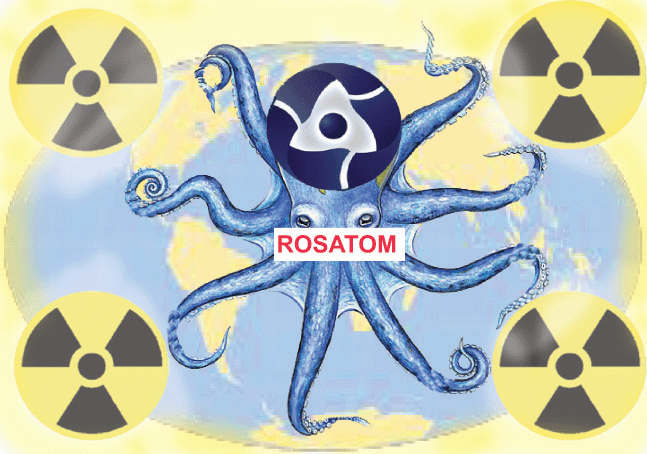
by beyondnuclearinternational, https://beyondnuclearinternational.org/2025/06/15/rosatom-a-company-at-war/
Nuclear state entity is on the ground in Ukraine and smoothing the way for new atomic tests, writes Charles Digges
If Russia’s state nuclear corporation Rosatom is to be believed, 2024 was a banner year.
It is expanding its footprint in new markets in Africa, Asia and the Middle East, as well as in Central Asian post-Soviet states. It is running an expansive development program along the Northern Sea Route, the 6,000-kilometer Arctic shipping corridor uniting Europe and Asia, and is responsible for everything from nuclear icebreaker construction to port infrastructure along its reach. It is powering the mining of rare earth minerals essential for renewable energy and electronics in operations from the Kola Peninsula to Siberia. It is acquiring domestic energy firms and making forays into transport, housing and utilities. And, of course, it is building nuclear power plants in foreign markets — including in some NATO members — at a pace unmatched by any other country or corporation.
But the slick commercial rhetoric belies the fact that Rosatom is a company that is literally at war.
As one of the Kremlin’s prize state industries, Rosatom has reoriented its practices to align with Moscow’s war economy as the invasion of Ukraine drags on. For this, it receives lavish state support and is overseen by members of President Vladimir Putin’s inner circle. Yet, unlike other energy producers in Russia’s oil and gas sectors, Rosatom has thus far managed to sidestep any serious sanctions from the West, attesting to the dependence it has fostered on the international nuclear market.
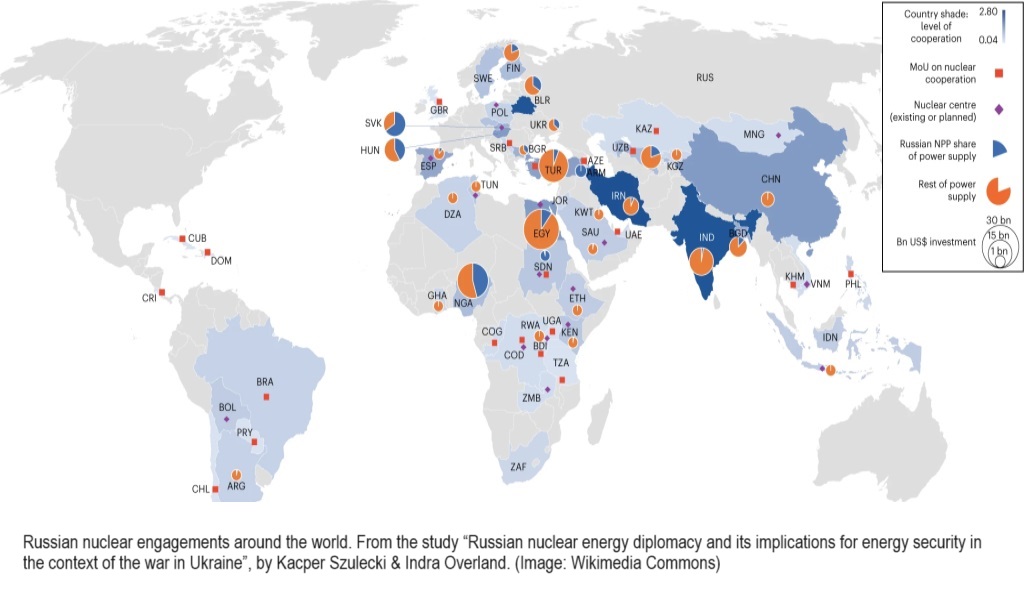
Recently, Western markets have begun to challenge Rosatom’s dominance as they attempt to shift their dependence away from Russian-produced nuclear fuels and other technologies. But our new report suggests that Rosatom is preparing for such shortfalls by changing customers and expanding its operations into industries beyond the nuclear — including further enmeshing itself in Moscow’s war as an active military participant. These are the corporate achievements that are less likely to appear in the company’s glossy public relations materials.
Rosatom at war
For instance, the putatively civilian corporation is helping Russian arms makers sidestep bans on Western-produced components for weapons used on the Ukrainian front. It has also developed technology for the Oreshnik line of ballistic missiles, producing a warhead tip so durable that the company brags it can withstand temperatures as hot as the surface of the Sun.
The corporation also seems to be smoothing the way for various weapons tests, including nuclear tests, on Novaya Zemlya, an Arctic archipelago used by the Soviets as an atomic bomb testing range. Most recently, it has been the site of trials for the Burevestnik nuclear-powered cruise missile developed by Rosatom technicians.
Russia’s recent withdrawal from its ratification of the Comprehensive Nuclear Test Ban Treaty and its abandonment of other arms agreements with the West coincides with a hive of activity on this frozen strip of land, suggesting Russia may be moving back toward testing nuclear weapons. Rosatom, the steward of Russia’s nuclear arsenal, will surely be at the center of it.
Rosatom likewise continues to tighten its grip on the Zaporizhzhia nuclear power plant in Ukraine — Europe’s largest atomic energy station — which the Russian military seized in the opening days of its invasion in 2022. It is widely assumed from the Kremlin’s official statements that Rosatom intends to absorb the plant, making it the 12th nuclear power plant in its purview — and marking one of the most breathtaking seizures of war booty in modern warfare.
What the corporation is ignoring
Alongside these endeavors stands the fact, which Rosatom is loath to mention in its brochures, that Rosatom’s domestic fleet of 36 reactors is aging. Most need to be replaced by 2065, but the funds for this are severely lacking. The company’s current plans to extend runtimes at several aged Chernobyl-style reactors suggest that this is a problem the corporation will not be able to solve anytime soon.
Rosatom has also snuffed out its past efforts to clean up Russia’s Soviet nuclear legacy, retooling many of the constituent enterprises that were responsible for that to handling non-nuclear hazardous waste. These moves turn away from more than two decades of effort with the international community and mark the corporation’s increasing efforts to shut itself off both from the West and from scrutiny at home.
The war in Ukraine and accompanying stifling of civil society organizations — including my employer, Bellona — that once held Rosatom to account has fueled that opacity.
In fact, such organizations once formed Rosatom’s Public Council, which kept the corporation in conversation with environmentalists and the public it purported to serve. While the Public Council still exists, it is staffed by Putin’s cronies, including one from his intramural hockey team.
Nor is there anything left of the robust network of strident Russian-grown, anti-nuclear NGOs that for years fought to keep Rosatom’s activities in the public eye. Their disappearance has left Rosatom to its own secretive devices, the organizations themselves hounded out of existence by the Kremlin’s war bureaucracy.
Rosatom helps Moscow divide the world
All of this taken together — both what the corporation will and will not tell us — paints a picture of Rosatom as primarily a formidable political tool. This allows it to couple a broad mandate at home with a campaign of influence abroad. By offering its reactor customers enormous state-backed loans to build nuclear plants that Rosatom will service, fuel and, in many cases, even staff for decades to come, the corporation is vital to creating regimes that are friendly to — and dependent on — Moscow around the world.
While the war in Ukraine has perhaps cost Rosatom some of its former markets in the West, the company has, as our report shows, survived these geopolitical shifts and remained a powerful vector of Russian influence. As a result, the company will continue to help cleave away many of the world’s nations to Moscow’s geopolitical cause.
Charles Digges is an environmental journalist and researcher who edits the website of the Norway-based NGO Bellona.
Russia said on Wednesday it stood ready to remove highly enriched uranium from Iran.
Russia said on Wednesday it stood ready to remove highly enriched uranium
from Iran and convert it into civilian reactor fuel as a potential way to
help narrow U.S.-Iranian differences over the Islamic Republic’s nuclear
programme. Tehran says it has the right to peaceful nuclear power, but its
swiftly-advancing uranium enrichment programme has raised fears in the
wider West and across the Gulf that it wants to develop a nuclear weapon.
Reuters 11th June 2025, https://www.reuters.com/world/europe/russia-says-it-is-ready-remove-excess-nuclear-materials-iran-2025-06-11/
Zelensky’s spectacular Operation Spiderweb has backfired spectacularly
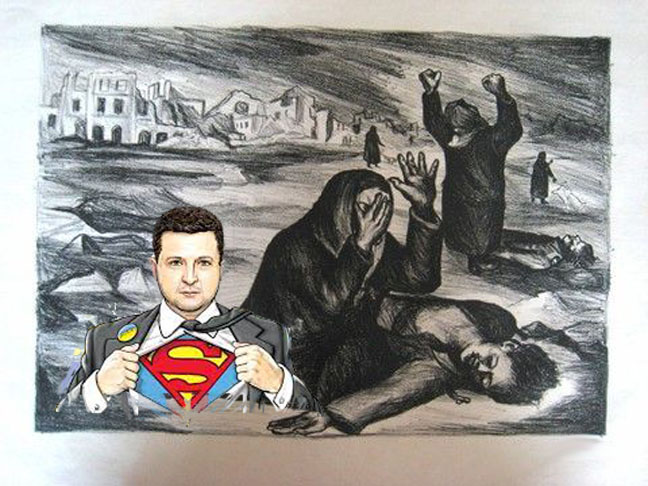
Walt Zlotow, West Suburban Peace Coalition, Glen Ellyn IL , 11 June 25
The June 1 Ukraine drone attack on air bases deep in Russia was spectacular only insofar as it galvanized the Ukraine war dead enders to proclaim Ukraine can prevail in the war Ukraine lost on Day One.
The attack was strategically insignificant for Ukraine. Russia, as expected, launched devastating retaliatory attacks that will dramatically weaken Ukraine’s ability to keep fighting.
What was Ukraine President Zelensky thinking in allowing an attack that had no strategic importance but guaranteed to bring a strategically devastating response?
A likely explanation is Zelensky’s hope that the Russian retaliation might shame Trump into expanding his military aid to Ukraine rather than reduce or even end it. That desperate gambit will likely fail. Trump is determined to end the war so he can continue the process of withdrawing from European defense. Trump prefers expanding the US military Asia pivot to counter China’s growing regional dominance there. Trump also needs his highly stretched military resources for possible war with Iran. If that’s the worst possible reason for ending the war, so be it.
Zelensky has been on a reckless suicide mission with Russia virtually guaranteeing a Ukraine military collapse ahead of Ukraine’s descent into a weakened rump state.
Zelensky has been pursuing this self destructive policy for all 1,200 days of this war. And every time he attacks deep into Russia, he’s guaranteeing Russia will expand the buffer zone they’re creating in Ukraine to prevent such attacks.
Zelensky has been Ukraine’ worst enemy thruout this senseless war. Filled with delusions of grandeur, he keeps fighting to win back all 45,000 square miles of lost territory he could have avoided by signing the Istanbul Agreement 3 years ago. He even demands return of Crimea lost in 2014 after a US inspired coup disposed Russian friendly Ukraine President Yanukovych. That madness is not only destroying Ukraine, its keeping the world in fear this now escalating war could possibly go nuclear.
To save the remainder of Ukraine, Zelensky must be pushed out, replaced by sensible leaders willing to make peace on the best terms possible, none of which are recognized by Zelensky.
And Trump must stop waffling and withdraw all US military support that squandered nearly $200 billion of US treasure on a lost war.
If both happen, not only will the war end, the three and a half year threat of nuclear war over Ukraine will end as well.
We must never abandon that hope.
Securing the nuclear nation, (Russia)
Cambridge University Press: Kate Brown 20 November 2018, https://www.cambridge.org/core/journals/nationalities-papers/article/abs/securing-the-nuclear-nation/9D92C7AA447CC337F56999FC8C03C4D4
Abstract
In 1946, in the Southern Urals, construction of the Union of Soviet Socialist Republics first plutonium plant fell to the GULAG-Narodnyi Komissariat Vnutrennikh Del (NKVD). The chief officers in charge of the program – Lavrentii Beria, Sergei Kruglov, and Ivan Tkachenko – had been pivotal figures in the deportation and political and ethnic cleansing of territories retaken from Axis forces during WWII.
These men were charged with building a nuclear weapons complex to defend the Soviet Union from the American nuclear monopoly. In part thanks to the criminalization and deportation of ethnic minorities, Gulag territories grew crowded with foreign nationals and ethnic minorities in the postwar years. The NKVD generals were appalled to find that masses of forced laborers employed at the plutonium construction site were members of enemy nations. Beria issued orders to cleanse the ranks of foreign enemies, but construction managers could not spare a single healthy body as they raced to complete their deadlines.
To solve this problem, they created two zones: an interior, affluent zone for plutonium workers made up almost exclusively of Russians; and anterior zones of prisoners, soldiers, ex-cons, and local farmers, many of whom were non-Russian. The selective quality of Soviet “nuclearity” meant that many people who were exposed to the plant’s secret plutonium disasters were ethnic minorities, people whose exposures went unrecorded or under-recorded because of their invisibility and low social value.
1 This Month

of the week – Shut Down Drone Warfare!


Tell the Ukrainian Government to Drop Prosecution of Peace Activist Yurii Sheliazhenko

Petition to revoke the licensing of the Near Surface Nuclear Disposal Facility (NSDF) at Chalk River. https://www.ourcommons.ca/petitions/en/Petition/Details?Petition=e-7247
To see nuclear-related stories in greater depth and intensity – go to https://nuclearinformation.wordpress.com
-
Archives
- April 2026 (44)
- March 2026 (251)
- February 2026 (268)
- January 2026 (308)
- December 2025 (358)
- November 2025 (359)
- October 2025 (376)
- September 2025 (257)
- August 2025 (319)
- July 2025 (230)
- June 2025 (348)
- May 2025 (261)
-
Categories
- 1
- 1 NUCLEAR ISSUES
- business and costs
- climate change
- culture and arts
- ENERGY
- environment
- health
- history
- indigenous issues
- Legal
- marketing of nuclear
- media
- opposition to nuclear
- PERSONAL STORIES
- politics
- politics international
- Religion and ethics
- safety
- secrets,lies and civil liberties
- spinbuster
- technology
- Uranium
- wastes
- weapons and war
- Women
- 2 WORLD
- ACTION
- AFRICA
- Atrocities
- AUSTRALIA
- Christina's notes
- Christina's themes
- culture and arts
- Events
- Fuk 2022
- Fuk 2023
- Fukushima 2017
- Fukushima 2018
- fukushima 2019
- Fukushima 2020
- Fukushima 2021
- general
- global warming
- Humour (God we need it)
- Nuclear
- RARE EARTHS
- Reference
- resources – print
- Resources -audiovicual
- Weekly Newsletter
- World
- World Nuclear
- YouTube
-
RSS
Entries RSS
Comments RSS
 nuclear-news