Russia challenges US compliance with nuclear arms treaty
MOSCOW https://www.kwtx.com/content/news/Russia-challenges-US-compliance-with-nuclear-arms-treaty-495949041.html?ref=041 (AP) 8 Oct 18— Russia on Monday challenged the U.S. claim that it has fulfilled its obligations under a pivotal nuclear arms deal, a new argument that could further fuel tensions between Moscow and Washington.
The Russian Foreign Ministry said it “can’t confirm” the latest U.S. State Department data indicating that the U.S. has complied with the thresholds set by the 2010 New START treaty. It limits each country to no more than 1,550 deployed nuclear warheads and 700 deployed missiles and bombers.
The ministry said the U.S. removed 56 Trident II submarine-launched intercontinental ballistic missiles and 41 B-52H strategic bombers from its count of nuclear arsenals after re-equipping them to carry conventional weapons.
But it argued that the U.S. had failed to let Russia verify the move in line with the treaty, and failed to list four land-based missile silos converted for training purposes — a move Russia said didn’t conform to the treaty.
The ministry said the perceived U.S. breach of the treaty’s limits was “unacceptable,” adding that it expects Washington to “show a constructive approach to settling that acute issue.”
The tough statement marked the first time Russia raised the issue of the alleged U.S. non-compliance with the pact signed by President Barack Obama and then-Russian President Dmitry Medvedev amid a brief thaw in Russia-U.S. ties. The New Start came into effect in 2011 and is to expire in 2021 unless the two countries extend it.
Officials in both Russia and the U.S. have given mixed signals about the pact’s future.
Russia-U.S. ties have sunk to their lowest levels since the Cold war times over the Ukrainian crisis, the war in Syria, the allegations of Russian meddling in the 2016 U.S. presidential election and alleged Russian hacking of world anti-doping bodies, athletes, plane investigations and chemical weapons probes, among other disputes.
In the arms control sphere, Moscow and Washington also have been at loggerheads over another arms control treaty — the 1987 Intermediate-range Nuclear Forces Treaty.
The U.S. has accused Russia of deploying a new type of missile in violation of the pact that bans an entire class of weapons — all nuclear and conventional ground-launched ballistic and cruise missiles of intermediate range. Russia has rejected the accusations.
Dubious claim from Russia, about bacteria “neutralising nuclear waste”
Russian Scientists Discover Bacteria That Neutralizes Nuclear Waste https://sputniknews.com/science/201810081068701682-nuclear-waste-neutralizing-bacteria/ The unique bacteria, discovered in a nuclear waste storage site in Siberia, shows promise as a tool for the creation of a natural barrier to the spread of radionuclides.
Researchers from the Moscow-based Frumkin Institute of Physical Chemistry and the Russian Academy of Sciences’ Federal Research Center for Biotechnology have been able to isolate microorganisms which can be used to safeguard the surrounding environment from liquid radioactive waste.
Scientists made the discovery while conducting microbiological studies of the groundwater at the Seversky deep radiation burial site in Seversk, Tomsk region, Siberia, where liquid radioactive waste from the Siberian Chemical Combine, which supplies and reprocesses low enriched uranium for nuclear fuel, is stored.
Their research, recently published in Radioactive Waste, a Russian scientific journal, suggests that the bacteria is capable of converting radionuclide ions, including those found in uranium and plutonium, into sedentary forms, thereby preventing the spread of dangerous radiation into the surrounding environment. Through lab experimentation, the scientists were able to fine tune the conditions necessary for the bacteria to carry out its useful work.
The researchers say their findings are a first step in creation a biogeochemical barrier for radionuclides for use in deep burial sites containing liquid radioactive waste.
Research into microbiological tools to limit the effects of nuclear waste have been conducted since the 1980s, with scientists from around the world saying microbial processes must be taken into account in projects to bury and store nuclear waste which can otherwise decay over a period of millions or even billions of years.
The dangers and unknown challenges of Russia’s plan for floating nuclear power plants in Northeast Asia
 Floating Nuclear Power Plants in Northeast Asia? A Daunting Prospect. Weak multilateral architecture, territorial disputes, and natural disaster vulnerability compound the unknowns of Russia’s new energy platform. The Diplomat, By Tom Corben October 05, 2018 Given the controversy of all things nuclear power in the post-Fukushima era, it was no surprise that the April launch of Russia’s first floating nuclear power plant (FNPP), the Akademik Lomonosov, drew polarizing responses immediately (in spite of the fact that its nuclear fuel was only loaded earlier this week). Russia’s state-owned nuclear utility Rosatom, claimed that the Akademik Lomonosov’s safety precautions exceed “all possible threats,” granting it “invincibility against natural disasters,” and highlighted the enhancements to economic development efforts in Russia’s far-flung territories. Conversely, environmental organizations like Greenpeace labeled the Akademik Lomonosov a “nuclear titanic” or “Chernobyl on ice,” a serious risk to the global environmental and human security. Observers ought to regard warily the sensationalist claims of advocates and opponents of FNPPs alike. Even so, it is difficult not to view Rosatom’s “invincibility” claim without incredulity.
USA and Russia argue, threat to Abandon a Key Nuclear Treaty
What Happened
In a speech on Oct. 2 in Brussels, U.S. Ambassador to NATO Kay Bailey Hutchison demanded that Russia return to complying with the Intermediate-Range Nuclear Forces (INF) Treaty or else the United States would be forced to develop its own non-INF-compliant weapons to match Russian capabilities. In response, Russian Foreign Ministry spokeswoman Maria Zakharova said that “It seems that people who make such statements do not realize the level of their responsibility and the danger of aggressive rhetoric.”
Some Background on the INF
The INF Treaty is a key arms control pact between the United States and Russia that halted a destabilizing buildup of intermediate-range nuclear missiles in Europe during the 1980s. The pact served as a cornerstone in efforts to end the Cold War. Recently, however, the United States has accused Russia of developing, testing and deploying a type of cruise missile that violates the limits set by the INF, and Moscow in turn has accused Washington of deploying drones and missile launchers that violate the terms of the treaty.
Over the past year, the United States has tried various tactics to get Russia to comply with the treaty. Washington has sanctioned Russian officials and tried to pressure Moscow by deploying tactical nuclear weapons aboard its submarine-launched ballistic missiles. The U.S. Congress has also passed legislation that would pave the way for the development of a missile that, if fielded, would violate the INF treaty. None of these measures appear to have worked yet; the United States and its NATO allies insist that the Russians are still in violation of the treaty.
Why It Matters
Hutchinson’s statements show that the White House is clearly determined to follow Congress’ lead in considering the deployment of U.S. missiles that violate the INF. The first open INF violations from both the United States and Russia will likely lead to many more violations that could kill the already fragile treaty. The demise of the INF would further catalyze a budding and potentially highly destabilizing arms race between the United States and peer competitors Russia and China. It would also be deeply alarming to Washington’s European allies, who would once again sit between Russian and U.S. intermediate range nuclear missile arsenals, just as they did during the Cold War.
An additional concern is that an ugly fight over the status of the INF could spill over into negotiations for the renewal of the other big global nuclear arms control treaty: the New START treaty, which limits the number of U.S. and Russian deployed strategic nuclear weapons and launchers. Unlike the INF, New START is nominally on much surer ground, as Russia and the United States both already have so many strategic nuclear weapons that there are few major incentives to violate it. However, mistrust from the demise of the INF could potentially erode New START anyway. This outcome, although unlikely for now, would lead to a far more serious arms race than is currently taking place.
USA threat about “taking out” Russian missiles
US threatens to ‘take out’ Russian missiles if Moscow keeps violating nuclear treaty By Ryan Browne and Frederik Pleitgen, CNN October 2, 2018 CNN)The United States Permanent Representative to NATO, Amb. Kay Bailey Hutchison, warned Tuesday that the US could “take out” Russian missiles that are perceived to be in violation of the Intermediate-Range Nuclear Forces Treaty should Moscow continue to violate the agreement…..
US indicts seven Russians for hacking nuclear power firm Westinghouse
Westinghouse, which is located outside of Pittsburgh, provides fuel, services and plant design to customers, including Ukraine.
Three of the seven Russian military officers indicted on Thursday were charged in a separate case brought by Special Counsel Robert Mueller’s office for their role in hacking activities designed to influence the 2016 presidential election……..
In the indictment, prosecutors alleged that one of the Russian officers, Ivan Sergeyevich Yermakov, performed “technical reconnaissance” of the company as early as Nov. 20, 2014, and got access to IP addresses, domains and network ports. The hackers also researched Westinghouse to learn about the company’s employees and their backgrounds in nuclear energy research.
In December, the Justice Department said, Yermakov and his co-conspirators registered a fake domain and website designed to mimic the company’s website and sent phishing emails to at least five employees. Once people clicked on the spoofed domain and provided their log-ins, they were rerouted to the original network.
On other occasions, according to the indictment, the conspirators also sent spearphishing emails to the personal emails of employees at Westinghouse. Two account users clicked on the malicious links.
The indictment does not clearly explain why Westinghouse was targeted or whether the hackers succeeded, and Justice Department officials declined to comment beyond the indictment.
Westinghouse did not immediately respond to a request for comment. https://www.france24.com/en/20181004-us-indicts-russians-hacking-nuclear-company-westinghouse
Russia’s campaign for power globally via its nuclear reactor exports
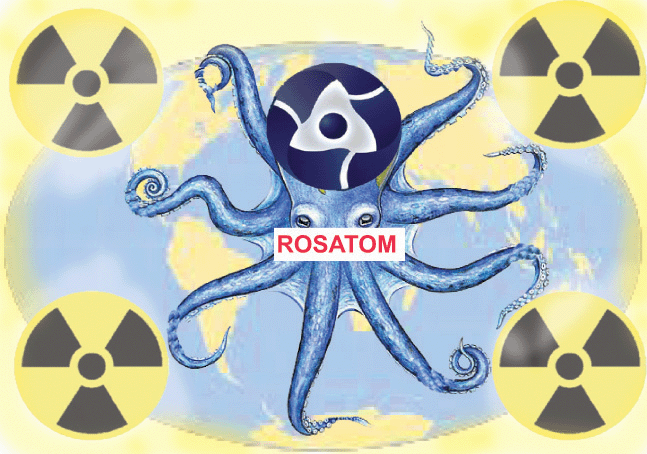 Is the global nuclear industry Russia’s latest power play? , Telegraph UK 4 Oct 18 “…….Amid the financial fallout of the West’s attempts at a new nuclear dawn, Russia is quietly building an army of nuclear reactors across the world in an increasingly important power play for a country that has traditionally been powered by fossil fuels.
Kirill Komarov, the first deputy chief executive of Russia’s Rosatom, is also the head of the World Nuclear Association. It is a fitting role for man helping to lead Russia’s global nuclear expansion.
“We are the ultimate leader in the majority of nuclear sectors,” he says, and it is hard to disagree. “In the last 11 years we have commissioned 13 new nuclear plants, which is probably the biggest number in the world even compared to the increase from our Chinese friends.”………
“We are a unique company in that we have activities in all areas of the nuclear business; starting with mining of natural uranium, enrichment fuel fabrication, developing our own nuclear equipment, the construction of nuclear power plants, the decommissioning, waste management… everything,” says Komarov…..
says Tim Yeo, a former Tory MP and the leader of New Nuclear Watch, an industry-backed lobby group.
“They back this up with helpful vendor financing packages, which the Russian government is ready to support where necessary,”………https://www.telegraph.co.uk/business/2018/10/04/global-nuclear-industry-russias-latest-power-play/
Russia and USA will talk about extending New START nuclear weapons treaty
US and Russia to discuss nuclear weapons treaty extension in October https://www.ft.com/content/b26d62fe-c0a1-11e8-95b1-d36dfef1b89a, Henry Foy in Moscow
Russia and the US will hold talks on a potential extension to the New START nuclear weapons treaty in Geneva in October, a Russian official said on Tuesday. The future of bilateral treaties that govern the use of nuclear weapons and ballistic missiles is one of the most critical issues in US-Russia relations. Experts have warned that the recent breakdown in relations between Washington and Moscow could jeopardise longstanding agreements on so-called ‘strategic stability’ that were designed to prevent nuclear armageddon.
New START, a 2010 agreement that limits the number of nuclear warheads held by both countries, expires in February 2021. Separately, both capitals have accused the other of breaching the 1987 INF Treaty, which limits the use of long-range missiles. “It is absolutely realistic to reach an agreement on an extension [to New START], if there is political will on the part of the American side. There are readiness from the Russian side,” said Vladimir Yermakov, director of the department of non-proliferation and arms control at the Russian foreign ministry. “We have given suggestions on how to do this, and in a couple of weeks we will meet in Geneva within the framework of a bilateral advisory commission,” he added, in comments reported by local newswires.
The US and Russia possess 13,300 nuclear warheads between them, according to the Stockholm International Peace Research Institute, 92 per cent of the world’s stockpile. New START’s terms allow for a five-year extension, and experts have suggested that writing a whole new agreement would not be possible before its expiry. Regarding the INF Treaty, Mr Yermakov said Russia was “ready to discuss any issues relating to the treaty with our American partners, in any format.” Mr Yermakov added that there was “not a very big possibility” of Russian signing any brand new arms control agreements in the next few years.
Russia’s nuclear wastes, and the clean-up of Andreeva Bay
 What is the situation at Russia’s biggest dump site for spent nuclear fuel?

Three shiploads with spent nuclear fuel are to be sent from site this year and the whole cleanup is to be completed in year 2024, representatives of nuclear power company Rosatom said in this week’s meeting in the Joint Russian-Norwegian Commission Nuclear Safety.
The cleanup of the Andreeva Bay is one of the biggest ongoing bilateral cooperation projects between Norway and Russia and Norwegian tax payers have over the years covered project expenses worth hundreds of millions of kroner.
The nuclear waste storage, which is located only about 55 km from the border to Norway, holds about 22,000 spent nuclear fuel elements, and was long considered a ticking environmental bomb.
Shipments to Mayak
The cooperation on site marked a milestone in late June 2017, when the first batch with 470 spent fuel elements left Andreeva Bay. Present were a number of dignitaries, among them Norway’s then foreign minister Berge Brende. They all waved as special purpose vessel «Rossita» set course for Murmansk, where the deadly materials will be reloaded onto special trains and sent to reprocessing plant Mayak.
«It is a big day for the environment, for Russian-Norwegian cooperation, for people in Finnmark and the Kola Peninsula and all the ones who care about the Barents Sea,» Brende told the Barents Observer at a press briefing following the event.
However, far from everything is smooth and easy in cooperation over the complex and highly sensitive nuclear wastes. Access to site by independent controllers is strictly regulated and information sparse. The Norwegian journalists that have been invited to take part in official visits have not been allowed to bring cameras.
Growing concern
The situation might have become ever more complicated this week, after two leading Norwegian officials on nuclear safety were held back on the Russian border.
One of the two people is Per-Einar Fiskebeck, the long-serving special adviser at the Finnmark County Governor’s office, who for decades have closely followed up the Andreeva Bay project.
The Norwegian Ministry of Foreign Affairs describes the incident as «serious» and confirms that it is concerned about the situation.
«It is worrying if this would affect the further progress in the nuclear safety cooperation, which otherwise has been a success story in the Norwegian-Russian relationship in the north,» a comment from the ministry reads. Continue reading
USA and Russia – in 20th Century -devised hideously elaborate ways of blowing each other up
 Top-secret ‘doomsday machine’ documents reveal terrifying nuclear apocalypse plans https://metro.co.uk/2018/09/04/top-secret-doomsday-machine-documents-reveal-terrifying-nuclear-apocalypse-plans-7911916/ Jasper Hamill 4 Sep 2018 It’s no secret that the US and Russia spent much of the 20th century devising hideously elaborate ways of blowing each other up. Now declassified documents written in 1964 have revealed the true extent of the apocalyptic atomic broadside Washington planned to unleash against its greatest enemy. A pair of top-secret memos written by top military chiefs shows the US was intending to implement an ‘overkill’ strategy which would have flattened Russian cities and killed tens of millions of people.
They demonstrate how generals were considering the possibility of unleashing thousands of nukes in a bid to cause ‘95% damage’ to targets such as military facilities and ‘urban-industrial centres’ including major cities. The files also document plans to blow up 30% of all the people living in 30 Chinese cities, saying this outcome would be ‘desirable’. The secret files were unearthed by George Washington University’s National Security Archive and shed light on a secret nuclear strategy called the Single Integrated Operational Plan (SIOP), which is often referred to as a ‘doomsday machine’ and has never been declassified. Researchers are only able to learn about this highly disturbing scheme by reading other documents which discuss it, meaning the release of the two memorandums is a major step forward in understanding the grim fate which would have befallen the world if a nuclear war erupted.
‘US nuclear war plans [made] during the Johnson administration included the option of a retaliatory strike against nuclear, conventional military, and urban-industrial targets with the purpose of removing the Soviet Union “from the category of a major industrial power” and destroying it as a “viable” society,’ wrote the National Security Archive in a statement. ‘The document, the Joint Staff’s review of SIOP guidance in June 1964, showed continued acceptance by policymakers of the cataclysmic nuclear strike options that had been integral to the plan since its inception. Accordingly, the SIOP set high damage requirements – 95% for the top priority nuclear targets – ensuring that it remained an “overkill” plan, referring to its massively destructive effects. ‘Prepared and continually updated by the Joint Strategic Target Planning Staff, the SIOP has been characterized by some as a “doomsday machine”.’ The latest declassified document is a review of SIOP conducted by the Joint Staff, a group of senior military leaders.
It lays out plans for retaliatory and preemptive strikes against Russia or China which range in severity from an assault aimed at knocking out nuclear weapons facilities to a blitzkrieg designed to ‘destroy the will and ability of the Sino-Soviet bloc to wage, remove the enemy from the category of a major industrial power and assure a post-war balance of power favourable to the United States’. The plans also expose a scheme to use ‘population loss as the primary yardstick for effectiveness in destroying the enemy society with only collateral attention to industrial damage’, the National Security Archive added. What this means is that the US was willing to bomb Russia back to the Stone Age and viewed the destruction of its population as a valid strategy of war…. https://metro.co.uk/2018/09/04/top-secret-doomsday-machine-documents-reveal-terrifying-nuclear-apocalypse-plans-7911916/?ito=cbshare
Despite Putin’s boasts, loss at sea, and test failures in ‘invulnerable’ nuclear-powered missile

 Putin lost his supposedly ‘invulnerable’ nuclear-powered missile at sea — now he has to go find it https://www.businessinsider.co.za/russia-to-search-for-nuclear-powered-cruise-missile-lost-at-sea-2018-8, Ryan Pickrell , Business Insider US Aug 26, 2018
Scepticism, even among pro-nukers, about Russia’s much boasted floating nuclear power plant
The Nuclear Power Plant of the Future May Be Floating Near Russia, NYT 26 Aug 26 18 “………some environmental groups — even those open to a role for nuclear power as a substitute for traditional power plants — are skeptical.
For one, they are not convinced by Rosatom’s assurances of safety. Critics worry that during a tsunami, the 21,000-ton steel structure might not ride out the wave. In a worst-case scenario, they say, it would instead be torn from its moorings and sent barreling inland, plowing through buildings until it landed, steaming and dented and with two active reactors on board, well away from its source of coolant.
In such a case, Rosatom says, a backup power source and coolant on board would prevent the reactors from melting down, at least for the first 24 hours. “During this time we would consider what to do,” said Dmitri Alekseyenko, the deputy director for Rosatom’s floating reactor program. Regulators in the United States, however, require on-land reactors to operate for 72 hours in an emergency shutdown without external water supplies.
And the fact that the technology is well tested in Russian ships gives critics little solace, given a long history of spills and accidents involving nuclear-powered submarines and icebreakers operated by the Soviet and Russian navies.
In the 1960s and 1970s, the Soviet Union dumped reactors in the Kara Sea, in the Arctic Ocean north of Kola Bay. Russian nuclear submarines sank in 1989 and 2000, while one Russian nuclear icebreaker caught fire in 2011 and the reactor on another leaked radiation that year, according to Bellona, a Norwegian environmental group.
“The question is, would clients of Russia be comfortable with something like this being parked right at a pier in a major city?” Matthew McKinzie, director of the nuclear program at the Natural Resources Defense Council in Washington, said in a telephone interview.
A Greenpeace sailboat tailed the Akademik Lomonosov on its maiden voyage from a shipyard in St. Petersburg to Murmansk, where it will be fueled, flying a banner in English saying: “Floating Nuclear Reactor? Srsly?” ….
Russian official threatens use of nuclear weapons in Syria
Among such measures, the official said the deployment of Russian tactical nukes in countries such as Syria, the use of gold-linked cryptocurrencies for Russian arms exports and the suspension of a number of treaties with the US – such as non-proliferation of missile technologies.
Mr Gutenev said: “I believe that now Russia has to draw its own ‘red lines.’ “The time has come to ponder on variants of asymmetric response to the US, which are now being suggested by experts and are intended not only to offset their sanctions but also to do some retaliatory damage.
Among such measures, the official said the deployment of Russian tactical nukes in countries such as Syria, the use of gold-linked cryptocurrencies for Russian arms exports and the suspension of a number of treaties with the US – such as non-proliferation of missile technologies.
Mr Gutenev said: “I believe that now Russia has to draw its own ‘red lines.’
“It’s no secret that serious pressure is being put on Russia, and it will only get worse.
“It is intended to deal a blow to defence cooperation, including defence exports.”
The minister added that Russia should follow the advice of “experts” and follow the US’ example of deploying nuclear weapons in other countries.
He added: “We should follow the advice of certain experts, who say that Russia should possibly suspend the implementation of treaties on non-proliferation of missile technologies, and also follow the US example and start deploying our tactical nuclear weapons in foreign countries.
“It is possible that Syria, where we have a well-protected airbase, may become one of those countries.”……….https://www.express.co.uk/news/world/1008474/world-war-3-russia-nuclear-weapon-syria-us-sanctions
Russia -Iran negotiations on building new nuclear power plant
Iran resumes talks with Russia to build new nuclear power plant Reuters Staff (Reuters) 26 Aug 18 – Iran has resumed talks with Russia to build a new nuclear power plant capable of generating up to 3,000 megawatts of electricity, energy minister Reza Ardakanian said Saturday, according to the Tasnim news agency.
The Islamic Republic currently has the capacity to produce 1,000 megawatts of nuclear electricity, Tasnim reported.
Iran already runs one Russian-built nuclear reactor at Bushehr, its first. Russia signed a deal with Iran in 2014 to build up to eight more reactors in the country.
The United States in May pulled out of a deal between Tehran and major powers to limit Iran’s nuclear ambitions, and Washington imposed new sanctions on Tehran in August.
Reporting By Babak Dehghanpisheh in Geneva; Editing by Ros Russell
A failed test leaves Russia’s ultimate doomsday weapon lost in the Barents Sea
 Russia Seems to Have Lost the Ultimate Doomsday Weapon: A Nuclear-Powered Cruise Missile https://nationalinterest.org/blog/buzz/russia-seems-have-lost-ultimate-doomsday-weapon-nuclear-powered-cruise-missile-29632
Here’s what we know.
– Citing an unnamed U.S. intelligence official, CNBC reports that that Russian military lost one of the four cruise missiles used during tests conducted over the Barents Sea between last November and February, all of which ended in failure.
– While it’s currently unclear which launch resulted in the lost missile, U.S. Air Force nuclear-sniffing WC-135 ‘Constant Phoenix’ aircraft were active in the Barents Sea and Baltic Sea from March to August of this year, with a Russian fighter intercepting one of the aircraft over the Baltic Sea on August 8.
– This missile, one of many doomsday devices touted by Russian President Vladimir Putin’s government during Moscow’s last showcase of new military capabilities, is purportedly capable of loitering as an unmanned second-strike platform that can remain in the air for an extended period of time over a virtually unlimited range.
Frankly, a nuclear-powered cruise missile is a 1950s dream that goes against all logic in a world with hundreds of ICBMs tipped with multiple independently-targetable reentry vehicles, all of which can kill a city.
This article by Brad Howard originally appeared at Task & Purpose. Follow Task & Purpose on Twitter .
1 This Month

of the week – Shut Down Drone Warfare!


Tell the Ukrainian Government to Drop Prosecution of Peace Activist Yurii Sheliazhenko

Petition to revoke the licensing of the Near Surface Nuclear Disposal Facility (NSDF) at Chalk River. https://www.ourcommons.ca/petitions/en/Petition/Details?Petition=e-7247
To see nuclear-related stories in greater depth and intensity – go to https://nuclearinformation.wordpress.com
-
Archives
- April 2026 (103)
- March 2026 (251)
- February 2026 (268)
- January 2026 (308)
- December 2025 (358)
- November 2025 (359)
- October 2025 (376)
- September 2025 (257)
- August 2025 (319)
- July 2025 (230)
- June 2025 (348)
- May 2025 (261)
-
Categories
- 1
- 1 NUCLEAR ISSUES
- business and costs
- climate change
- culture and arts
- ENERGY
- environment
- health
- history
- indigenous issues
- Legal
- marketing of nuclear
- media
- opposition to nuclear
- PERSONAL STORIES
- politics
- politics international
- Religion and ethics
- safety
- secrets,lies and civil liberties
- spinbuster
- technology
- Uranium
- wastes
- weapons and war
- Women
- 2 WORLD
- ACTION
- AFRICA
- Atrocities
- AUSTRALIA
- Christina's notes
- Christina's themes
- culture and arts
- Events
- Fuk 2022
- Fuk 2023
- Fukushima 2017
- Fukushima 2018
- fukushima 2019
- Fukushima 2020
- Fukushima 2021
- general
- global warming
- Humour (God we need it)
- Nuclear
- RARE EARTHS
- Reference
- resources – print
- Resources -audiovicual
- Weekly Newsletter
- World
- World Nuclear
- YouTube
-
RSS
Entries RSS
Comments RSS
 nuclear-news