Russia’s Nuclear Power Exports are Booming, Moscow Times, 10 May 19,
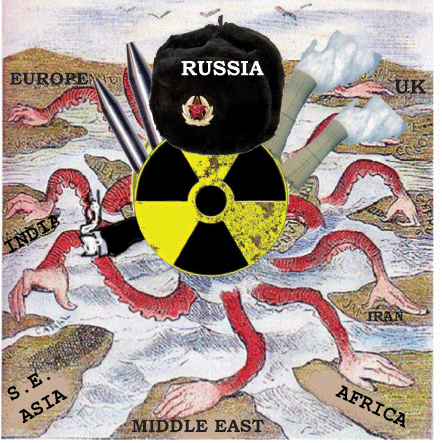
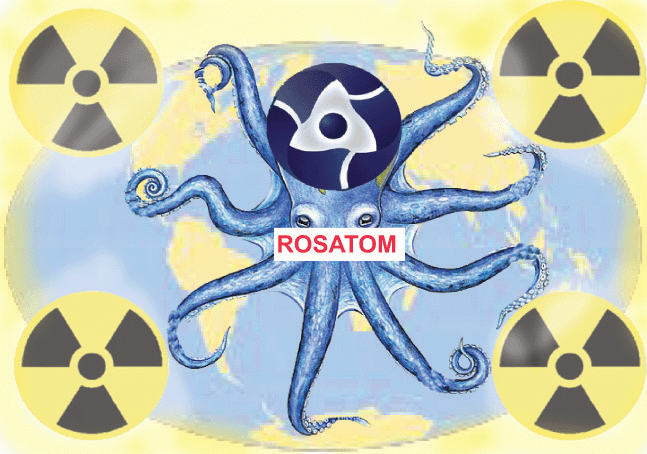
Rosatom has been using nuclear power plants as a way of cementing ties with its fellow emerging markets.Russia’s state-owned agency Rosatom is on a tear. The company operates 35 nuclear power stations in Russia that produce 28 gigawatts (GW) of power, and it is actively exporting its nuclear technology to countries around the world.
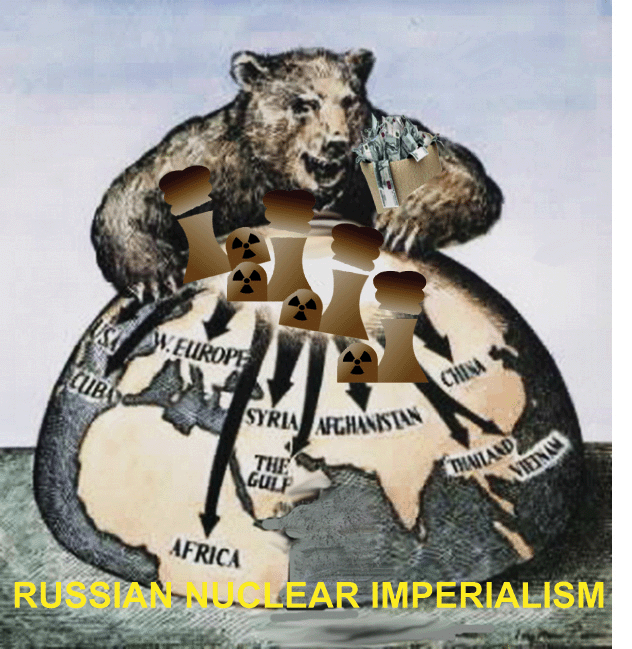
Russia has been using nuclear power plants as a way of cementing ties with its fellow emerging markets with no nuclear power tradition and the BRICS countries, a group that started as a marketing tool for Goldman Sachs to sell equity but has increasingly turned into a real geopolitical alliance amongst the leading emerging market governments.
In recent years Rosatom has completed the construction of six nuclear power reactors in India, Iran and China and it has another nine reactors under construction in Turkey, Belarus, India, Bangladesh and China. Rosatom confirmed to bne IntelliNews that it has a total of 19 more “firmly planned” projects and an additional 14 “proposed” projects, almost all in emerging markets around the world.
Rosatom has become the world’s largest nuclear reactor builder as the financial problems of the two big Western firms Westinghouse Areva have crimped their ability to develop nuclear plants abroad . as the financial problems of the two big Western firms Westinghouse Areva have crimped their ability to develop nuclear plants abroad. Westinghouse and Areva, now owned by EDF, have for years negotiated deals to build reactors in India but have made little progress, partly because Indian nuclear liability legislation gives reactor manufacturers less protection against claims for damages in case of accidents.
The sales drive was organised by former Prime Minister Sergei Kiriyenko, who presided over Russia during the 1998 financial crisis but was given the job of running Rosatom after leaving office and tasked with selling 40 nuclear power plants internationally.
…… Part of Rosatom’s appeal is not only Russia’s lower prices and state-of-the-art technology, but the fact that company usually provides most of the financing for the typically $10 billion price tag.
Last year the Russian firm said it had an order book worth $134 billion and contracts to build 22 nuclear reactors in nine countries over the next decade, including Belarus, Bangladesh, China, India, Turkey, Finland, Hungary, Egypt and Iran. The size of the order book puts nuclear power station exports on a par with Russia’s booming arms export business.
But underpinning the business is politics. Russia has long used energy as the sweetener when offering a package of trade deal to its international partners. Like gas pipelines, nuclear power stations are a way of binding countries to Russia, as nuclear power stations come with 60-year long maintenance deals and uranium supply contracts.
……. Iran Bushehr
One of the most controversial nuclear power stations built by Moscow was Iran’s Bushehr that was completed in 2013 over strong U.S. objections.
…….Russia has been producing new parts for the second nuclear power plant to be built at Bushehr on the Persian Gulf and now Russia is preparing to push ahead with the construction of the second unit. ……
Trump, Putin discuss nuclear weapons and Venezuela in phone call, Aljazeera, 3 May 19,
US President Donald Trump tweets he ‘had a long and very good’ phone call with Russian President Vladimir Putin. US President Donald Trump and Russian President Vladimir Putin spoke for more than an hour on Friday, discussing the possibility of a new nuclear accord, North Korean denuclearisation, Ukraine and the political situation in Venezuela, the White House said.
“Had a long and very good conversation with President Putin of Russia,” Trump said in a post on Twitter, noting they had discussed trade, Venezuela, Ukraine, North Korea, nuclear arms and Special Counsel Robert Mueller‘s investigation of Russian meddling in the 2016 US presidential campaign.
White House spokeswoman Sarah Sanders told reporters that the call was an “overall positive conversation”…….
Putin told Trump that any external interference in Venezuela’s internal business undermines the prospects of a political end to the crisis, the Kremlin said.
Russian Foreign Minister Sergey Lavrov told US Secretary of State Mike Pompeo by phone on Wednesday that further “aggressive steps” in Venezuela would be fraught with the gravest consequences, the Russian ministry said…….
New START treaty
Sanders told reporters Trump and Putin talked about the possibility of a new multilateral nuclear accord between the US, Russia and China, or an extension of the current US-Russia strategic nuclear treaty.
She did not say which arms control agreement Trump and Putin discussed, but the Russian state news agency Tass reported that they talked about the New START treaty, the last major arms-control treaty remaining between the US and Russia.
The 2011 New START treaty expires in February 2021 but can be extended for five years if both sides agree. Without the agreement, it could be harder to gauge each other’s intentions, arms control advocates say.
The New START treaty required the US and Russia to cut their deployed strategic nuclear warheads to no more than 1,550, the lowest level in decades, and limit delivery systems – land- and submarine-based missiles and nuclear-capable bombers.
It also includes extensive transparency measures requiring each side to allow the other to carry out 10 inspections of strategic nuclear bases each year; give 48 hours notice before new missiles covered by the treaty leave their factories; and provide notifications before ballistic missile launches.
Trump has called the New START treaty a “bad deal” and “one-sided”.
“They discussed a nuclear agreement, both new and extended, and the possibility of having conversations with China on that as well,” Sanders said.
The Kremlin said the two sides confirmed they intended to “activate dialogue in various spheres, including strategic security”.
Trump earlier pulled the plug on a decades-old nuclear arms treaty with Russia. Trump accused Moscow of violating the 1987 Intermediate-Range Nuclear Forces Treaty (INF) with “impunity” by deploying missiles banned by the pact. Moscow denies violating it and has accused Washington of being in non-compliance……
North Korea
Trump also raised with Putin the issue of getting North Korea to dismantle its nuclear weapons and ballistic missile programmes. Trump has met twice with North Korean leader Kim Jong Un but Kim has yet to agree to a disarmament deal.
Sanders said Trump mentioned several times “the need and importance of Russia stepping up and continuing to put pressure on North Korea to denuclearize.” The Kremlin said both leaders highlighted the need to pursue denuclearisation of the region.
His comments, and those out of the foreign ministry, were relatively upbeat. Kremlin spokesman Dmitry Peskov, however, was a lot less hopeful, saying that he doesn’t think Trump’s proposal was at all serious, and that Russia and China had already talked on the matter.
There is hope on all three sides for a deal that could cut the increasingly exorbitant cost of nuclear arms modernization, while ensuring that all sides retain a deterrent force that makes nuclear exchanges unlikely. At the same time, Trump has long talks of arms races as though he was eager for them, so his sudden suggestion of talks is being viewed with more than a little suspicion.Jason DitzApril 28, 2019
Trump’s talk of three-way nuclear deals emerged last week, and Ushakov says Russia will definitely take part, if-talks ever emerge. At the same time, he said that existing nuclear deals should be more closely respected.
His comments, and those out of the foreign ministry, were relatively upbeat. Kremlin spokesman Dmitry Peskov, however, was a lot less hopeful, saying that he doesn’t think Trump’s proposal was at all serious, and that Russia and China had already talked on the matter.
There is hope on all three sides for a deal that could cut the increasingly exorbitant cost of nuclear arms modernization, while ensuring that all sides retain a deterrent force that makes nuclear exchanges unlikely. At the same time, Trump has long talks of arms races as though he was eager for them, so his sudden suggestion of talks is being viewed with more than a little suspicion.
US and Moscow are at loggerheads on nuclear weapons after Trump announced in February that he’s pulling out of a landmark Cold War-era treaty banning short- and medium-range missiles
Olga Tanas | Bloomberg April 27, 2019Russia is interested in the details of a potential U.S. plan to push for new arms-control agreements, Dmitry Peskov, spokesman for Russian President Vladimir Putin, told reporters Saturday in Beijing.
US President Donald Trump has questioned the cost of maintaining a nuclear arsenal and has asked administration officials to prepare options for potential new arms-control agreements with Russia and China, the Washington Post reported April 25, citing an unidentified senior administration official.
Peskov said while it would be ideal to rid the world of nuclear weapons, such a move would also remove the “restraining parity” that guarantees that no nuclear power makes a “monstrous mistake.” There had been no contacts with Russian experts on the issue, he said.
The US and Moscow are at loggerheads on nuclear weapons after Trump announced in February that he’s pulling out of a landmark Cold War-era treaty banning short- and medium-range missiles. The U.S. withdrawal from the 1987 Intermediate-Range Nuclear Forces treaty, after accusing Russia of violating the pact, has raised the threat of a renewed missile build-up in Europe.
Russia has warned that time is also running out to begin talks on extending the other key nuclear weapons accord between Russia and the U.S., the New START treaty, before it expires in 2021.
Russia ready to discuss nuclear treaty with China, US,https://nypost.com/2019/04/26/russia-ready-to-discuss-nuclear-treaty-with-china-us/ By Associated Press, April 26, 2019 , MOSCOW — A top Russian diplomat says Russia is willing to negotiate a new nuclear weapons treaty with the United States and China.Deputy Foreign Minister Sergei Ryabkov told reporters on Friday Moscow is closely following reports in the United States that the U.S. would like to reach a nuclear weapons deal with both Russia and China, and is “willing” to negotiate.
The story was reported by CNN earlier Friday.
Ryabkov also said that Russia “would like to convince” the U.S. to adopt a joint statement that would condemn any use of nuclear weapons.
Ryabkov’s comments come just months after the U.S. withdrew from the Intermediate-Range Nuclear Forces Treaty, a cornerstone of the post-Cold War security, and Russia followed suit.
After Meeting Kim Jong-un, Putin Supports North Korea on Nuclear Disarmament, NYT, By Andrew E. Kramer and Choe Sang-Hun, April 25, 2019, MOSCOW — President Vladimir V. Putin of Russia made a public show of support for North Korea on nuclear disarmament, seeming to undermine President Trump’s approach to nuclear diplomacy, as Mr. Putin and Kim Jong-un on Thursday wrapped up their first summit meeting.
Russian officials have long insisted they wanted to support Mr. Trump’s efforts at one-on-one nuclear negotiations with Mr. Kim, the North Korean leader. But speaking to reporters after the meeting in Vladivostok, on Russia’s Pacific Ocean coast, Mr. Putin said that North Korea needs security guarantees from more nations than just the United States before abandoning its nuclear arsenal.
Mr. Putin also reiterated Russian backing for a gradual process of trading disarmament for sanctions relief. “If we take one step forward and two backward, then we would fail to achieve the desired result,” Mr. Putin said. “But it will eventually be possible to achieve this goal, if we move forward gradually and if we respect each other’s interests.”
At talks in February in the Vietnamese capital, Hanoi, Mr. Trump had proposed a “big deal” to lift punishing economic sanctions in return for a quick and complete elimination of North Korea’s nuclear weapons program. Mr. Kim offered, instead, only a partial dismantling of nuclear facilities — while keeping his arsenal of nuclear warheads and missiles — in exchange for relief from the most harmful sanctions.
With each side calling the other’s plan unacceptable the talks collapsed — in sharp contrast to the rosy picture both leaders painted of their first meeting in Singapore in June.
After the breakdown in talks in Hanoi, North Korea vented its frustration with a weapons test and accusations that Mr. Trump’s national security adviser, John R. Bolton, and secretary of state, Mike Pompeo, were sabotaging negotiations.
In his first trip abroad since the talks in Vietnam, Mr. Kim sought to stress his friendly relations with the Kremlin as a counterweight to the hard-line tactics of the Trump administration.
…….. Mr. Putin suggested Russia might welcome a revival of multilateral talks on North Korea, known as the six-party negotiations, which have been dormant for a decade and were previously derided by Mr. Trump
…….. “The most important thing, as we have discussed today during the talks, is to restore the rule of international law and revert to the position where global developments were regulated by international law instead of the rule of the fist,” Mr. Putin said. “If this happens, this would be the first and critical step toward resolving challenging situations such as the one on the Korean Peninsula.”
….. Before they collapsed in 2009, the six-party talks among China, Japan, North Korea, South Korea, the United States and Russia had produced agreements to halt North Korea’s nuclear program, but the North later abrogated them.
Any Russian attempt to revive them now is bad news for Mr. Trump, who has repeatedly cited them as the prime example of the failed tactics of previous administrations. He has claimed that his own leader-to-leader diplomacy with Mr. Kim stood a far better chance of bringing about the North’s denuclearization.
Russian foreign policy has a different starting point. “In Moscow’s thinking, Kim Jong-un has learned from the fates of Iraq’s Saddam Hussein and Libya’s Col. Muammar el-Qaddafi that for an authoritarian regime, the only safeguard against U.S. military intervention is the possession of nuclear weapons capable of hitting the American mainland,” Aleksandr Gabuev, a fellow at the Moscow Carnegie Center, wrote……… https://www.nytimes.com/2019/04/25/world/europe/summit-kim-putin-trump-nuclear-north-korea.html
North Korean leader Kim Jong Un arrived in the Russian city of Vladivostok on Wednesday for a summit he is likely to use to seek support from Russian President Vladimir Putin while Pyongyang’s nuclear talks with Washington are in limbo.
“There are no other efficient international mechanisms at the moment,” Kremlin spokesman Dmitry Peskov said.
“But, on the other hand, efforts are being made by other countries. Here all efforts merit support as long as they really aim at de-nuclearisation and resolving the problem of the two Koreas,” he told reporters.
What Russia thinks about North Korea’s nuclear weapons, Bulletin of the Atomic Scientists, By Anastasia Barannikova, April 24, 2019, North Korean leader Kim Jong Un arrived in Russia today for a meeting with President Vladimir Putin….. Despite Russia’s past vote in favor of sanctions on Kim’s regime, Moscow has many reasons not to lean too hard on Kim over nuclear disarmament…………
Russia wants a stable North more than a non-nuclear North. Although, Russia continues to officially oppose North Korea’s nuclear status on the basis of its strict interpretation of the NPT, experts already speak about “nuclear emancipation” for the North, meaning recognition of its status as a lesser nuclear state. These ideas coincide with an idea some Chinese scholars have developed whereby North Korea would reduce its nuclear arsenal but keep some weapons as a deterrent. From Russia’s perspective, nuclear weapons now guarantee the security of the North Korean regime. The weapons can prevent attempts at violent regime change by external force. Through them, North Korean leadership has the independence to make changes within its borders. That’s good for Russia.
Many Russian analysts consider North Korea’s nuclear program to be defensive. Looking at the North’s nuclear doctrine, it seems likely the country wouldn’t use its nuclear weapons against a country that isn’t planning an attack. While little is known about Russia’s military planning beyond its publicly available doctrines, the specifics of the bilateral relations it holds with the North may guarantee that Russia has no plans to attack its neighbor.
……….The security of Kim’s regime, in turn, guarantees stability near Russia’s eastern borders. For Russia, a stable North Korean regime guarantees the absence of refugees flows, a normal feature of conflict zones, but also prevents US troops from deploying in a potentially disintegrating North. And with its nuclear weapons as diplomatic leverage, North Korea can maintain some independence from China. Thus, Moscow views Kim’s stability as providing something of a buffer between Russia and China.
Do North Korean nuclear weapons pose a threat to Russia? From Moscow’s perspective, the Korean Peninsula and Northeast Asia are relatively stable and don’t pose any immediate threats to security. Relations between Russia and North Korea are neutral, if not friendly. North Korean leadership appreciates Russia’s cautious, slow approach to the relationship, in contrast to China’s activist take on issues on the Korean Peninsula. Russia’s emphasis on the need to respect state sovereignty as a fundamental principle of international relations further lubricates the bilateral relationship: Russia avoids any attempt to interfere in the internal affairs of the North, so Pyongyang does not consider Russia as an external threat.
Many Russian analysts consider North Korea’s nuclear program to be defensive. Looking at the North’s nuclear doctrine, it seems likely the country wouldn’t use its nuclear weapons against a country that isn’t planning an attack. While little is known about Russia’s military planning beyond its publicly available doctrines, the specifics of the bilateral relations it holds with the North may guarantee that Russia has no plans to attack its neighbor.
But there is one scenario whereby North Korea’s nuclear weapons could threaten Russia. If Kim launches missiles against the United States, experts say they’ll fly over Russian territory. A US anti-missile response could, thus, risk a war between Russia and the United States. But Russian experts don’t believe that North Korea would ever attack the United States; they consider Kim Jong Un too rational for that. ………https://thebulletin.org/2019/04/what-russia-thinks-about-north-koreas-nuclear-weapons/
Putin reveals world’s longest submarine packed with nuclear torpedoes capable of destroying an entire city The super sub’s weapons can dodge Nato’s underwater defences to hit cities, naval bases or aircraft carriers anywhere in Europe or on America’s eastern coast The Irish Sun, By Patrick Knox 21st April 2019, A GIANT Russian submarine which measures a staggering 604ft is due to be moved out of its secret construction shed as it nears completion.
The 14,700-ton Belgorod, which is twice the size of the Royal Navy’s Astute-class attack submarines, bristles with nuclear-tipped underwater drone torpedoes which are guided by artificial intelligence.
Russia’s president Vladimir Putin has boasted these “Poseidon” drones can completely destroy coastal targets 6,000 miles away.
They are specifically designed to thwart Nato underwater defences as it heads to targets in cities, naval bases or aircraft carriers anywhere in Europe or on America’s eastern coast.
The Belgorod has been built at a secretive shipyard in the city of Severodvinsk, which is in Russia’s far north west and foreigners are forbidden from entering.
Rosatom forges more links with nuclear newcomers,17 April 2019 Rosatom and its subsidiaries have this week signed a number of agreements with countries planning to introduce nuclear power to their energy mix, including Azerbaijan, Congo, Cuba, Ethiopia, Serbia and Uzbekistan. The documents were signed during the XI International Forum Atomexpo 2019 that the Russian state nuclear corporation is holding in Sochi. It also signed an agreement with established nuclear power country China. ………http://www.world-nuclear-news.org/Articles/Rosatom-forges-more-links-with-nuclear-newcomers
“……….. General Secretary Mikhail Gorbachev was informed that there had been an explosion and fire at the plant but that the reactor itself had not been seriously damaged. No one wanted to be the bearer of catastrophic news. When the occasional official raised the question of whether to warn civilians and evacuate the city of Pripyat, which had been built to house workers from the Chernobyl plant, he was admonished to wait for higher-ups to make a decision and for a committee to be formed. Panic and embarrassment were of greater concern than public safety. The KGB cut Pripyat’s intercity telephone lines and prevented residents from leaving, as part of the effort to keep news of the disaster from spreading. Some locals were savvy enough to try to leave on their own. But with no public warning, many didn’t take even the minimal precaution of staying indoors with the windows shut. One man was happily sunbathing the next morning, pleased by the speed with which he was tanning. He was soon in the hospital.
Moscow officials eventually realized that the reactor had exploded, and that there was an imminent risk of another, much larger explosion. More than thirty-six hours after the initial meltdown, Pripyat was evacuated. Columns of Kiev city buses had been sent to wait for evacuees on the outskirts of the city, absorbing radiation while plans were debated. These radioactive buses deposited their radioactive passengers in villages chosen to house the refugees, then returned to their regular routes in Kiev. Over the next two weeks, another 75,000 people were resettled from the thirty-kilometer area around Pripyat, which was to become known as the “Exclusion Zone,” and which remains almost uninhabited to this day.
The Soviet system began to marshal its vast human resources to “liquidate” the disaster. Many efforts to stop the fire in the reactor only made matters worse by triggering new reactions or creating toxic smoke, but doing nothing was not an option. Pilots, soldiers, firefighters, and scientists volunteered, exposing themselves to huge doses of radiation. (Many others fled from the scene.) They were rewarded with cash bonuses, cars, and apartments, and some were made “Hero of the Soviet Union” or “Hero of Ukraine,” but many became invalids or didn’t live to see their new homes. The radiation levels were so high that they made the electronics in robots fail, so “biorobots”—people in makeshift lead protective gear—did the work of clearing the area.
On April 28, a radioactive cloud reached Scandinavia. After attempts at denial, the Soviet government conceded that there had been an accident. Western journalists soon began reporting alarming estimates of Chernobyl casualties. To maintain the illusion that the accident was already under control, Moscow ordered Ukrainians to continue with the planned May Day parade in Kiev, about eighty miles away, thus exposing huge numbers of people—including many children—to radioactive fallout.
Thanks to word of mouth and to their well-honed skill at reading between the lines of official declarations, however, Kiev residents were already fleeing. By early May, the exodus had grown so large that it became almost impossible to buy a plane, train, or bus ticket out of the city. Tens of thousands of residents left even before the official order to evacuate children was issued, far too late, on May 15. Thousands of people were treated for radiation exposure in Soviet hospitals by the end of the summer of 1986, but the Soviet press was allowed to report only on the hospitalizations of the Chernobyl firemen and plant operators.
A few decades later, it seemed to many that the world’s worst nuclear disaster had caused surprisingly little long-term damage. The official toll is now between thirty-one and fifty-four deaths from acute radiation poisoning (among plant workers and firefighters), doubled leukemia rates among those exposed to exceptionally high radiation levels during the disaster response, and several thousand cases of thyroid cancer—highly treatable, very rarely fatal—among children. Pripyat became a spooky tourist site. In the Exclusion Zone, one could soon see wolves, elk, lynx, brown bears, and birds of prey that had almost disappeared from the area before Chernobyl; some visitors described it as a kind of radioactive Eden, proof of nature’s resiliency. But striking differences in new books about Chernobyl by Kate Brown, Adam Higginbotham, and Serhii Plokhy show that there are still many ways to tell this story, and that the lessons of Chernobyl remain unresolved.
Both Plokhy and Higginbotham devote their first sections to dramatic reconstructions of the disaster at the plant. Sketches of loving family life or youthful ambition introduce the central figures, making us queasy with dread. The two authors’ minute-by-minute descriptions of the reactor meltdown and its aftermath are as gripping as any thriller and employ similar techniques: the moments of horrified realization, the heroic races against time. The prescient 1979 film The China Syndrome, about a barely averted disaster at a nuclear plant and its cover-up, is mentioned in both books. The movie’s title comes from a former Manhattan Project scientist’s hypothetical discussion of a reactor meltdown in North America causing fuel to burn its way through the globe to China. Though that specific scenario was clearly impossible, “China syndrome” became shorthand for anxieties about nuclear material burning through the foundations of the Chernobyl plant and entering the water table, the Dnieper River Basin, and then the Black Sea.
Plokhy, a historian of Ukraine, provides a masterful account of how the USSR’s bureaucratic dysfunction, censorship, and impossible economic targets produced the disaster and hindered the response to it. Though the Soviets held a show trial to pin responsibility on three plant employees, Plokhy makes plain the absurdity of holding individuals accountable for what was clearly a systemic failure…….
For Plokhy, the greatest lesson of Chernobyl is the danger of authoritarianism. The secretive Soviet Union’s need to look invincible led it to conceal the many nuclear accidents that preceded Chernobyl, instead of using studies of them to improve safety. …. Once the reactor exploded, Soviet censorship kept citizens in the dark about the disaster, preventing them from taking measures to protect themselves.
But cover-ups and bureaucratic buck-passing don’t happen only in authoritarian governments. ………
we should be alarmed about the ongoing consequences of nuclear leaks and the risk of new nuclear disasters. Higginbotham points out that the United States now operates a hundred nuclear power reactors, including the one at Three Mile Island that suffered a serious accident in 1979, just twelve days after the release of The China Syndrome. France generates 75 percent of its electricity from nuclear power plants, and China operates thirty-nine nuclear power plants and is building twenty more. Some people see nuclear power plants, which do not emit any carbon dioxide, as the most feasible way of limiting climate change, and new reactor models promise to be safer, more efficient, and less poisonous. But what if something goes wrong?
And what about nuclear waste? There are hundreds of nuclear waste sites in the US alone. In February the Environmental Protection Agency ordered the excavation of a landfill near St. Louis containing nuclear waste, dumped illegally, that dated back to the Manhattan Project. For years, an underground fire has been burning a few thousand feet from the dump. It took the federal government twenty-seven years to reach a decision about how to deal with this nuclear waste dump near a major metropolitan area, yet we fault the Soviet government for its inadequate response to a nuclear meltdown that unfolded in a matter of minutes. US failure to adequately address longstanding hazards—not to mention the slow-motion catastrophe of climate change—is yet another indication that poor disaster response is hardly unique to authoritarian regimes.
Then there is the renewed threat of nuclear war. One of Gorbachev’s biggest achievements was the Intermediate-Range Nuclear Forces Treaty, which eliminated US and Soviet land-based intermediate nuclear weapon systems. This February the US withdrew from the treaty, with President Trump citing Russian noncompliance. His administration recently called for the expansion of the US “low-yield” nuclear force, which includes weapons the size of those dropped on Hiroshima and Nagasaki. Analysts have pointed out that a greater diversity of nuclear weapons makes it harder for a target to know whether it is facing a limited or existential threat—and therefore raises the risk that the target will overreact…………https://www.nybooks.com/articles/2019/04/04/chernobyl-syndrome/?fbclid=IwAR3t_0OOHrEx58i85ELla1otEQ8_vIOTpxhDaI0Lw7iWIpfP-4mT5aVLKtU
Pompeo: Russia complying with nuclear treaty that’s up for renewal , The Hill 10 Apr 19, Secretary of State Mike Pompeo said Wednesday that Russia is largely in compliance with the New START nuclear arms control treaty with the United States, but indicated the Trump administration is looking at expanding the scope of the pact as renewal talks begin.“There are some arguments on the edges each, but largely they have been compliant,” Pompeo told the Senate Foreign Relations Committee. “Both the Russians and the United States have been compliant. We’re at the very beginning of conversations about renewing that. If we can get the deal right, if we can make sure it fits 2021 and beyond, President Trump has made very clear that if we can get a good solid arms control agreement, we ought to get one.”
The New START Treaty caps the number of nuclear warheads the United States and Russia can deploy at 1,550 each. There are also limits on the number of deployed intercontinental ballistic missiles (ICBM), submarine-launched ballistic missiles and heavy bombers equipped for nuclear warheads, as well as the number of deployed and nondeployed launchers.
The Obama-era treaty expires in 2021, but there is an option to extend it another five years.
Arms control advocates are worried Trump will let New START expire after he withdrew from a separate arms control treaty with Russia. Advocates warn that for the first time in decades the two biggest nuclear powers might not have limits on their nuclear arsenals.
The other treaty, known as the Intermediate-Range Nuclear Forces (INF) Treaty, banned the United States and Russia from having nuclear and conventional ground-launched ballistic and cruise missiles with ranges between 300 and 3,400 miles.
Trump announced in February he was starting the six-month process to withdraw from the INF Treaty after years of Russian violations.
Current and former officials broadly agree Russia is in violation of the INF agreement, but there have been no similar accusations regarding New START.
Still, in 2017, Trump called New START a “one-sided deal” that was “just another bad deal” made by former President Obama.
Putin Offers Russian Help To Build Kazakh Nuclear Plant, April 06, 2019 Radio Free Europe, By Bruce Pannier ,
There is once again talk in Kazakhstan of constructing a nuclear power plant (NPP) — a proposal that’s been debated on and off since the late 1990s. This time, the idea seems to have quickly picked up momentum.
President Vladimir Putin proposed Russian help to build such a plant when he met with Kazakhstan’s new president, Qasym-Zhomart Toqaev, in Moscow on April 3.
A day later, Deputy Kazakh Energy Minister Magzum Mirzagaliev said there was no “concrete decision” to construct a nuclear power plant in Kazakhstan, but he also revealed that officials have already chosen a site for such a project near the town of Ulken, in the southeastern Almaty Province.
Both Russia and Kazakhstan have agreements with many nations about cooperation in civilian atomic-energy use, but the Kazakh-Russian nuclear relationship is probably the most complicated of all.
Putin’s overture to Toqaev was far from the first time Moscow has offered help building a nuclear plant in Kazakhstan, though it was interesting that Putin decided to publicly repeat the proposal to Toqaev, who only became Kazakhstan’s president on March 20 and was making his first official visit abroad in that capacity.
It is also far from the first time the issue of nuclear power has been raised in Kazakhstan. It is a difficult sell in a land that has seen more nuclear tests than virtually any place on the planet. Between 1949 and 1989, when Kazakhstan was part of the Soviet Union, 340 underground and 116 atmospheric tests were conducted in the Semipalatinsk region of northeastern Kazakhstan. Health problems continue to plague residents of the area.
No wonder Kazakhstan’s Energy Ministry released a public statement on April 4 assuring the public would be consulted about building any such plant until “after public hearings and consent from local executive bodies on the territory where construction of an [nuclear power plant] is possibly planned.”
‘Russian Technology’
On April 3, Russian media carried the headline Putin Offers Toqaev The Construction Of An NPP In Kazakhstan Using Russian Technology. Putin was quoted as saying the two countries would be moving to a new form of cooperation.
By “Russian technology,” Putin presumably means Rosatom, Russia’s state nuclear company.
China has pushed its Belt and Road Initiative global trade network forward by extending huge loans and sending Chinese companies and workers to some of the world’s poorer countries. The loans, and the reliance on Chinese companies for training, spare parts, repairs, and such, promise to keep these countries dependent on China for decades to come, simultaneously increasing Beijing’s influence around the globe.
Rosatom does the same thing. The company boasts a $100 billion portfolio, and its website says it has 36 nuclear reactor projects in 12 countries — in places like Bangladesh, Egypt, India, Belarus, Iran, Turkey, Hungary, and China. Rosatom submits bids for every nuclear-power-plant contract worldwide. And Rosatom also has nuclear cooperation agreements with countries in South America, Africa, Asia, and Europe.
The cost of a nuclear power plant starts at around $8 billion, and that is in cases where there is only one reactor, such as Rosatom’s VVER-1000. During Putin’s visit to India in October, Rosatom signed a contract to construct six VVER reactors at a new site in India, in addition to the four other reactors Rosatom is already contracted to build at India’s Kudankulum site. Two VVER reactors are already in operation there.
Russian financial institutions usually loan most, or nearly all, of the money to those countries for the construction of such plants, and Russian nuclear-fuel provider TVEL frequently receives the contract for fuel supplies.
Different Sort Of Customer
Kazakhstan would be a different sort of customer for Rosatom. It has been the world’s leading uranium producer and exporter since 2009. And Kazakhstan does more than just extract uranium. State company Kazatomprom has worked for years, and is now able to take uranium through all the cycles, from raw uranium to nuclear fuel. From 2007 to 2017, Kazatomprom owned a 10-percent stake in Westinghouse.
So Kazakhstan has a large domestic source of uranium and can produce its own nuclear fuel; and Kazatomprom has nuclear technicians trained mostly by Russia but also some trained in Japan, France, and other countries.
Russia and Kazakhstan cooperate to mine uranium in Kazakhstan. Putin mentioned “six Russian-Kazakh enterprises for extracting and enriching uranium.”
Kazatomprom exported nearly 15,290 tons of uranium in 2018, and about 17 percent of that went to Russia.
Kazakhstan and Russia established the International Uranium Enrichment Center in Angarsk in 2007. As its name suggests, the center will provide low-enriched uranium (LEU) to interested parties. The center has been internationally hailed as ensuring a steady supply of uranium for nuclear reactors while not transferring the technology to enrich uranium.
The International Atomic Energy Agency (IAEA) and Kazakhstan’s government also established an LEU bank at Kazakhstan’s Ulba Metallurgical Plant in Oskemen, “a physical reserve of up to 90 metric tons of low enriched uranium suitable to make fuel for a typical light water reactor.”
The IAEA and Russia have an agreement on transporting the uranium to the LEU bank in Oskemen.
The April 4 statement from Kazakhstan’s Energy Ministry said nuclear-power-plant technologies from five countries, “including Rosatom,” were being studied. But the ministry also said other projects were being reviewed, such as more gas-fired plants, hydropower projects, and coal-fired thermal plants.
Proposed Locations
Russian news agency Interfax noted in its report that Russian Ambassador to Kazakhstan Aleksei Boroodavkin said in February, “We are hopeful that a decision will be taken soon for the construction of an atomic power station that we hope Rosatom will construct.”………. https://www.rferl.org/a/kazakhstan-putin-offers-russian-nuclear-plant-help/29865177.html
The demise of the only U.S.-Russia arms control pact limiting deployed nuclear weapons would make it harder for each to gauge the other’s intentions, giving both incentives to expand their arsenals, according to a study to be released on Monday.
The expiration of the New START accord also may undermine faith in the Nuclear Non-Proliferation Treaty, which calls on nuclear states such as the United States and Russia to work toward nuclear disarmament, as well as influence China’s nuclear posture, historically one of restraint.
The study, produced by the CNA Corp non-profit research group and seen by Reuters, is the most comprehensive public examination to date of the consequences of New START’s demise. It argues for extending the 2011 treaty, which expires in February 2021 but can be extended for five years if both sides agree.
The Trump administration is deliberating whether to extend the pact, which President Donald Trump has reviled as a bad deal and his national security adviser, John Bolton, has long opposed. Russia has said it is prepared to extend New START but wants to discuss what it regards as U.S. violations first.
The State Department did not immediately respond to a request for comment on the administration’s deliberations.
Trump has said Washington will withdraw from another arms pact, the 1987 Intermediate-range Nuclear Forces Treaty, this summer unless Moscow ends its alleged violations, compounding tense ties. Russia denies violating the INF treaty.
The New START treaty required the United States and Russia to cut their deployed strategic nuclear warheads to no more than 1,550, the lowest level in decades, and limit delivery systems – land- and submarine-based missiles and nuclear-capable bombers.
It also includes extensive transparency measures requiring each side to allow the other to carry out 10 inspections of strategic nuclear bases each year; give 48 hours notice before new missiles covered by the treaty leave their factories; and provide notifications before ballistic missile launches.
Both sides must also exchange data declaring their deployed strategic nuclear warheads, delivery vehicles and launchers, as well as breakdowns of how many of each are located at individual bases.
All of that would end if the treaty expires.
“Neither country would have the same degree of confidence in its ability to assess the other’s precise warhead levels,” CNA’s Vince Manzo wrote in the study. “Worst-case planning is also more likely as a result.
“Increased opacity between U.S. and Russian strategic nuclear forces would unfold within the broader context of growing mistrust and diverging perceptions about strategy, intentions, and perceptions,” he added.
Without the data, the United States would have to reassign its overworked satellites, possibly devoting more surveillance to Russia and less to China, Iran and North Korea.
Another casualty of the treaty’s expiration could be global nonproliferation, making non-nuclear states doubt the United States and Russia will keep working toward nuclear disarmament under the NPT, the study said.
While it was impossible to predict how China – estimated to have about 280 nuclear warheads – would react to New START’s expiry, the study cites factors that could make Beijing expand its capability.
Without a treaty limiting U.S. and Russian nuclear forces, China could overestimate their arsenals. Unconstrained U.S. and Russian forces could also strengthen voices in China that view a large arsenal as symbolically important, as well as those already advocating for more nuclear weapons.
The study recommends steps for the United States and Russia to mitigate the risks from the treaty’s expiration, including voluntarily sticking to its limits and continuing to exchange data. It also recommends Washington propose annual exchanges of nuclear weapons information and dialogue with Beijing.
Nuclear ‘cruise control’ can stop a spiraling new arms race, The Hill, BY ANDREW C. WEBER, 03/11/19 The genius of the mortally wounded Intermediate-Range Nuclear Forces (INF) Treaty was that it sharply reduced the risk of nuclear war. It made Europe more secure by eliminating an entire class of surprise-attack nuclear weapons designed for use on its territory. We are now on a glide path to repeat the existential nightmare that such weapons created.Russia and the United States once again are investing heavily in sea-, air- and ground-launched nuclear cruise missiles, and talking cavalierly about using them in “limited,” “low-yield” nuclear attacks. What makes this type of nuclear weapon so dangerous is that it can be launched without warning in decapitating sneak attacks.
These cruise missiles also can be armed with conventional explosives, and there is no way to distinguish nuclear from non-nuclear ones when they are in flight. Such ambiguity erases the line between conventional and nuclear weapons, and increases the likelihood of accidental Armageddon. This is precisely why, in 1987, Ronald Reagan and Mikhail Gorbachev urgently made progress in eliminating them.
We can, and must, seek to repeat their historic achievement today. We need to remember that arms control is not a pollyannaish exercise, but rather a potent tool of hard national security……….
Recently, Russia’s top arms control diplomat said Russia stands ready for talks on a possible successor to the INF Treaty. “We are ready for dialogue,” said Deputy Foreign Minister Sergei Ryabkov. “If the U.S. is interested, it should spell out its proposal.”
Since it appears nobody has done so, let’s spell it out. Our next agreement should focus less on overall numbers and, instead, seek to cap and eliminate the single most dangerous and destabilizing class of nuclear weapons: all nuclear-tipped cruise missiles of any range. We should start “cruise control” negotiations bilaterally between the United States and Russia, and leave room for other countries that have not yet deployed such systems — including China, India and Pakistan — to join now or later.
For three years, my colleagues and I have been laying the groundwork for such an ambitious global effort to cap and eliminate nuclear cruise missiles. In private talks with current and former senior officials from the United Kingdom, Russia, China, Germany, Japan and other key countries, we have found broad support and enthusiasm for this approach. ……… https://thehill.com/opinion/national-security/433075-nuclear-cruise-control-can-stop-a-spiraling-new-arms-race









 nuclear-news