U.S. and Russian negotiators try tosalvage arms control pact
their nuclear warhead stockpiles in a bid to salvage their last remaining
arms control pact before it expires next year, a source has said.
https://www.thenational.scot/news/18785398.us-russia-agree-freeze-nuke-stockpile/
Russia’s nuclear giant Rosatom moving into renewable energy, energy storage, grid development
The state-owned company will manufacture module type lithium-ion traction batteries for electric vehicles, as well as energy storage systems for emergency power supplies, renewable energy resources, and the smoothing of load demand. PV Magazine , OCTOBER 9, 2020 EMILIANO BELLINI Rosatom State Nuclear Energy Corp. (Rosatom) is entering the energy storage business through its TVEL Fuel Company (TVEL) unit, which has set up a dedicated subsidiary, Renera.The new company will produce module type lithium-ion traction batteries for electric vehicles, as well as energy storage systems for emergency power supplies, renewable energy resources, and the smoothing of load demand, TVEL stated……
Rosatom is already operating in the renewable energy sector via its NovaWind unit, which mostly focuses on the wind power business.
“We have an R&D center which is capable to develop energy storage solutions as for grids and substations, as well as for renewable energy sources, including both wind and solar,” the spokesperson said.,,,,,,,,https://www.pv-magazine.com/2020/10/09/russian-nuclear-giant-rosatom-enters-storage-business/
Daunting task of removal of Russia’s spent nuclear fuel rods from Andreeva Bay
One-third of all nuclear waste removed from Cold War dump site https://thebarentsobserver.com/en/nuclear-safety/2020/10/one-third-all-nuclear-waste-removed-cold-war-dump-site
Another 12 special design casks with spent nuclear fuel from Cold War submarines are soon to be shipped out of Andreeva Bay on Russia’s Arctic Barents Sea coast. ByThomas Nilsen October 02, 2020
About 35% of the 21,000 spent uranium fuel elements originally stored in three rundown tanks is so far lifted out, repacked and sent to Russia’s reprocessing plant at Mayak in the South-Urals, informs Aleksandr Krasnoshchekov, director of the SevRAO’s branch in Andreeva Bay. SevRAO is the federal enterprise for handling radioactive waste in the northwestern region.
The company has a staff of 100 in Andreeva Bay in the Litsa fjord, a closed-for-civilians fjord near the border to Norway where the Northern Fleet has two basing points for nuclear submarines.
Here, the navy started to store casks with highly radioactive spent uranium fuel from its first nuclear-powered in the 1960s. First in rusty containers outdoor, later in a pool-building that broke down. In the 1980s, the elements were moved over to three concrete tanks in very poor conditions.
After nearly 20 years of improving the infrastructure, securing the site from leakages and building a new crane at the port, the first shipment with nuclear waste left Andreeva Bay in 2017.
Neighboring Norway has spent more than €30 million to support the cleanup of the nuclear dump located only about 50 km from its border.
Also Sweden, Great Britain, Italy and the European Commission have contributed. Italy, as an example, paid for building the “Rossita”, a special purpose ship sailing in shuttle from Andreeva Bay to Atomflot in Murmansk where the containers are reloaded to rail wagons. According to director Krasnoshchekov, the ongoing work is done based on contracts with these countries, he says in an interview with Vesti Murman.
Most of the work done so far concerns the elements easy to lift out.
Way more challenging times are ahead, as the damaged elements in the third tank, 3A, are to be secured and lifted out.
Take a closer look at the photo below to understand the scoop of the challenge. Some of these rusty, partly destroyed steel pipes contain fuel rods where the uranium will fall out if lifted straight up.
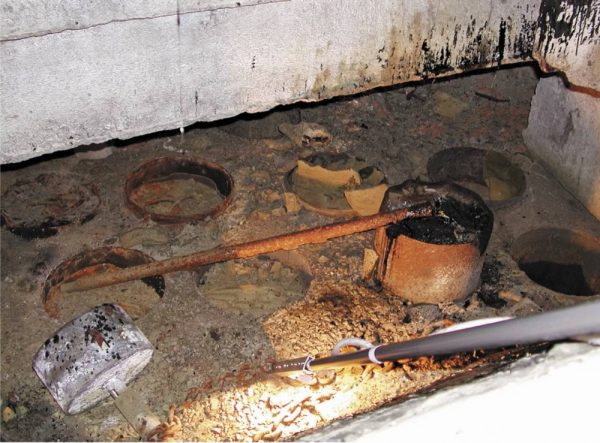
The work on tank 3A is scheduled to start in 2023, after tank 2A and 2B is completed. The experts are don’t want to start the most risky work before as much as possible of the other waste elements are removed. A criticality accident in Andreeva Bay is worst-case scenario.
As previously reported by The Barents Observer, the total radionuclide inventory in the three tanks is estimated to be equal to the remains of Rector No. 4 inside the Chernobyl sarcophagus in Ukraine. This according to a study by the British nuclear engineering company Nuvia.
The original 22,000 spent fuel elements dumped in Andreeva Bay are coming from 90-100 reactor cores powering the Soviet Union’s Cold War submarines sailing out from the naval bases along the coast of the Kola Peninsula from the late 1950s to 1982.
The first reactor cores of the November class submarines were reloaded in the early 1960s.
Additional to the spent fuel elements, some 10,000 cubic meters of solid radioactive waste from Andreeva Bay are shipped to the regional handling and storage facility in Saida Bay, a few hours sailing to the east on the Kola Peninsula. Huge piles of solid radioactive waste were stored outdoor summer and winter in the same area. Now, a building is erected to protect the boxes from rain and snow, before being repacked and shipped to the Saida Bay.
Russia’s nuclear-powered ice-breakers lead towards military domination of the Arctic
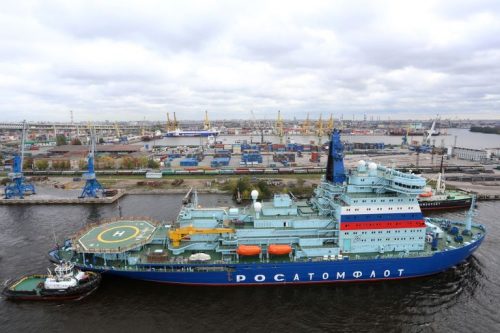
Russia’s Nuclear-Powered Icebreaker Is a Step Toward Military Domination
The country is fast becoming an icebreaking superpower. BY KYLE MIZOKAMI, SEP 24, 2020 Russia’s newest icebreaker, the  nuclear-powered Arktika, is headed to its new homeport in St. Petersburg, Russia. The ship, painted in the colors of the Russian state flag, will operate north of the Arctic Circle in anticipation of a year-round shipping route across the icy far north. Arktika is part of Moscow’s emerging policy of exploiting a warming arctic region—and protecting its stake in the region from competitors.
- Russia’s first new nuclear-powered icebreaker in decades, Arktika, is joining the country’s large fleet of icebreaking ships.
- Arktika is capable of smashing through ice that’s nearly 10 feet thick.<
- Millions of Russians live above the Arctic Circle, and warming ocean temperatures could create ice-free shortcuts between Asia and Europe.Russia’s newest icebreaker, the nuclear-powered Arktika, is headed to its new homeport in St. Petersburg, Russia. The ship, painted in the colors of the Russian state flag, will operate north of the Arctic Circle in anticipation of a year-round shipping route across the icy far north. Arktika is part of Moscow’s emerging policy of exploiting a warming arctic region—and protecting its stake in the region from competitors.
<Arktika is the first of a new class of nuclear-powered icebreakers. Construction began at the Baltic Shipyards in St. Petersburg in 2012 with a scheduled launch in 2017, but delays pushed the completion back to 2020. This past February, a short circuit damaged one of the ship’s three 300-ton electric motors, disabling one of the three propellers. Russian authorities ordered the ship to continue, however, and the ship is currently moving on just two propellers.
In 2019, Russian President Vladimir Putin announced the country would ultimately have a fleet of 13 icebreakers, the majority of them nuclear-powered. …………..
Iceabreakers like Arktika could also allow Russia to militarily dominate the Northern Sea Route, smashing a route for Russian warships and transports full of Russian Marines. Warming temperatures will mean other countries, such as Canada and the U.S., will likely move to unlock natural resources previously trapped under sheets of sea ice, and Russia will be in a position to threaten oil, gas, and mineral exploration and exploitation…………. https://www.popularmechanics.com/military/navy-ships/a34128219/russia-nuclear-powered-icebreaker-arktika/
Importing of increased amounts of uranium hexafluoride to Russia – illegal and dangerous
 Moscow Times 23rd Sept 2020, A series of toxic radioactive waste shipments to Russia from Germany is likely importing more waste than officially declared, Greenpeace Russia said Tuesday. European enrichment firm Urenco resumed exports of uranium
hexafluoride, a waste product known as “tails,” last year after a 10-year pause initiated by Russia’s state nuclear agency Rosatom due to storage safety concerns. The shipments have sparked outcry from environmental activists, who say importing nuclear waste is illegal and threatens human and environmental safety.
Power hungry Russia foisting nuclear power on Egypt – Africa – where it is not needed
|
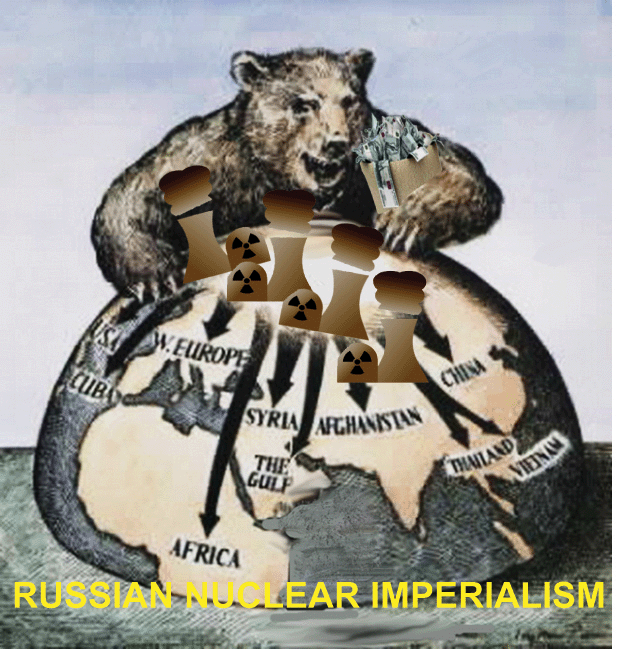
Why Russia Is Pushing Unneeded Nuclear Power Plants On Egypt, Oil Price, By Haley Zaremba – Sep 22, 2020, In recent years, Russia and China have been facing off to spread their nuclear power dominion to a new, huge, and vastly untapped market: Africa. The two nuclear power giants have been in competition to corner the market, with Russia aiming to grow its position in a sector that China has historically dominated. Earlier this summer, German media company DW News reported on a new Russian-funded and -controlled nuclear center being developed in Kigali: “The Center of Nuclear Science and Technologies, planned for completion by 2024, will include nuclear research labs as well as a small research reactor with up to 10 MW capacity.” And the Rwandan plant is just the beginning. “Ethiopia, Nigeria and Zambia have signed similar deals with Rosatom, while countries such as Ghana, Uganda, Sudan, and DRC have less expansive cooperation agreements.”Now, there is a new forum for nuclear takeover in Africa: Egypt. As reported by AllAfrica this week, “Egypt’s venture into nuclear power has been planned from the top-down, with environmental groups and rights organizations expressing reservations, energy analysts questioning the need for the country’s first nuclear plant, and many details of agreements with Russia remaining murky.” ……….. The main issue at play here is water. In Egypt, most areas receive less than eighty millimeters of precipitation per year. Water, therefore, is an especially precious commodity. The top complaint, therefore, is about the massive quantities of water needed to keep nuclear reactors cool to avoid meltdown. Any concerns about public health due to radiation and high costs of construction are secondary to the issue of water usage.
Another common complaint is that nuclear is not really needed in Egypt, where considerable deposits of natural gas have been discovered off the coast – enough to account for an energy surplus. This raises questions about the purpose of the project – is it really to create more and greener energy, or is it ultimately about power relations and geopolitical attachments between the infamously opaque Egyptian Nuclear and Radiological Regulatory Authority and the infamously power-hungry Russian government? https://oilprice.com/Energy/Energy-General/Why-Russia-Is-Pushing-Unneeded-Nuclear-Power-Plants-On-Egypt.html |
|
Russia rejects USA’ s terms for extending the New START arms control treaty
|
Russia rejects US terms for nuclear pact, Bunbury Mail, Gabrielle Tetrault-Farber , 21 Sept 20, Russia sees minimal chances of extending the New START treaty with the United States – their last major nuclear arms pact – as it does not accept conditions set out by Washington, Deputy Foreign Minister Sergei Ryabkov says. He spoke on Monday after Marshall Billingslea, the US Special Presidential Envoy for Arms Control, told a Russian newspaper that Moscow must accept a joint agreement with Washington on extending the treaty before the US presidential election in November. “I suspect that after President Trump wins re-election, if Russia has not taken up our offer, that the price of admission, as we would say in the US, goes up,” Billingslea told Kommersant newspaper in an interview.
Ryabkov said that position constituted an ultimatum and lowered the chances of reaching any kind of agreement to extend the deal, which expires in February next year. “We cannot talk in this manner,” TASS news agency quoted Ryabkov as saying. Another news agency, RIA, quoted him as saying the chances of a treaty extension were “minimal”…….. https://www.bunburymail.com.au/story/6935377/russia-rejects-us-terms-for-nuclear-pact/?cs=5461
|
|
Global heating is disrupting the ground in Siberia
|
Bizarre Bumps come up in Siberia, The tundra climate of Siberia and Russia have been the victim of climate change and the bumps on the grounds bear its scars https://www.outlookindia.com/outlooktraveller/travelnews/story/70633/siberias-ground-bumps, Trinetra Paul, September 20 , 2020 Over the past few decades, climate change and global warming has had a string of adverse effects on the planet. And the signs of damage are increasing day by day. Siberia has been facing the wrath of this global phenomenon over the years. Now, the ground bears the scars of climate change. The Siberian permafrost (or frozen organic ground) is slowly thawing and this is resulting in huge, bizarre bumps on the ground. Many of the craters formed in between these bumps have been filled with melting water and have transformed into small lakes. The alarming rate at which the ground is thawing is a cause for major concern. The permafrost has frozen grass and shrubs and is a reservoir of greenhouse gases. When the layer thaws, these gases are directly emitted into the atmosphere. The Siberian city of Yakutsk has been standing on a permafrost, the depletion of which will not only be a hazard for the city but also for Siberian climate and weather. Siberia, and most parts of Russia, has witnessed a huge rise in temperatures, heat waves and an early summer with temperatures reaching almost 35 degrees. A large part of it is due to global warming, oil spills, factory leakages as well as increase in eco-tourism. Yes, even friendlier modes of tourism and travel too play a pivotal role in increasing the temperature. The COVID-19 pandemic too has had its share in this. With lack of proper maintenance, devastating Siberian wildfires in May proved to be deadly due to reduced workforce, and gave out large volumes of greenhouse gases. Though eco-tourism is beneficial in creating awareness about indiginous culture, and in creating employment among locals, it also leads to modernisation and artificial (often damaging) development of a place. Nature-based adventures, trails and extreme offbeat destinations are often held accountable for destruction of untramelled areas. Experts says that there must be conscious efforts in de-escalating these ventures. Such tourism must be curtailed, and introduced with buffers like controlling daily visitor numbers, maintaining a tab over timings, and consulting environmental organisations about the best measures to protect the vulnerable areas. Sometimes that may mean not allowing any tourists at all. |
|
Russia developing a nuclear-powered missile that can ”attack from unexpected directions”
Russia’s nuclear missile with global reach is capable of attacking from ‘unexpected directions’ https://www.wionews.com/world/russias-nuclear-missile-with-global-reach-is-capable-of-attacking-from-unexpected-directions-327492
|
WION Web Team New Delhi, India Sep 14, 2020 Russia is developing a nuclear-powered missile that can fly around the atmosphere for years on end ready to strike at any moment.
This does mark the first time this missile has made the headlines. Last year, this so-called missile was involved with a mysterious explosion in Russia, which reportedly left at least 5 scientists dead. This explosion had also led to a major spike in the radiation levels in the area. Now British intelligence claims that Russia is “pushing the boundaries of science, and international treaties” in developing novel weapons. So what do we know about this cruise missile? Russia calls the missile “Burevestnik” or “Storm Petrel”, while the NATO calls it “Skyfall” Putin first unveiled the Burevestnik on March 1, 2018, claiming that it was invincible. Essentially, it is a cruise missile that features a small nuclear-powered engine. This is the first of its kind, for it can fly long distances for hours or even days. The missile can also exploit loopholes in enemy defence networks. Russian president Vladimir Putin had earlier said that the testing of Burevestnik was going on successfully. The British chief of defence said the missile had global reach and could “attack from unexpected directions”. The mention of this missile came up during the Five Eyes intelligence hub including experts from the UK, US, Australia, New Zealand and Canada. |
|
The threatening presence of highly radioactive material in Russia’s sunken nuclear submarines
Do Russia’s Sunken Nuclear Submarines Pose Environmental Danger? There’s radioactive fuel hanging at the bottom of the sea. https://www.popularmechanics.com/military/navy-ships/a33902569/russia-sunken-nuclear-submarines/ BY KYLE MIZOKAMI, SEP 4, 2020
- Two ex-Soviet nuclear submarines, K-27 and K-159, lie at the bottom of the Barents Sea.
- The wrecked ships still have their radioactive fuel sources aboard, which experts worry could leak into the environment.
- The Russian government has vowed to clean up the wrecks, but the work is not a priority.
Governments and environmental groups are worried a rupture of nuclear fuel supplies could cause a nuclear catastrophe, impacting local fishing areas. The Russian government is working to solve the problem, which some experts are calling a potential “Chernobyl in slow motion on the seabed.
A legacy of the Cold War threatens Russia’s people and environment, potentially irradiating a large portion of the Barents Sea and closing it to commercial fishing. Two Soviet nuclear-powered submarines are sitting on the bottom of the ocean and could unleash their radioactive fuels into the surrounding waters.
The Soviet Union built four hundred nuclear-powered submarines during the Cold War. The vast majority were either scrapped, or still serve with the Russian Navy today. A few subs, however, are trapped in precarious circumstances, lying on the seabed floor with their uranium fuel supplies still intact. The BBC reports on efforts to render two such ships, K-27 and K-159, safe.
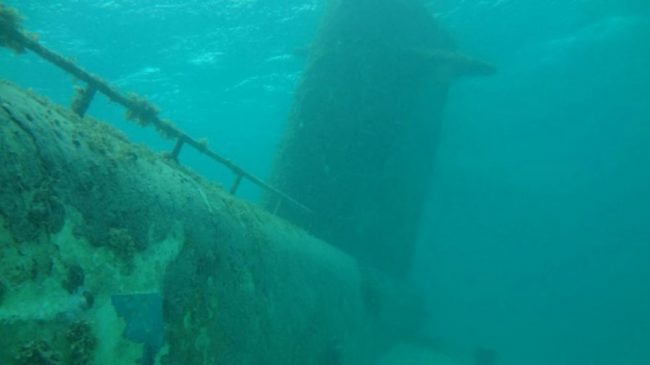 The first ship, K-27, was a Soviet Navy submarine prototype equipped with a new liquid metal reactor. In 1968, the six-year-old sub suffered a reactor accident so serious, nine Soviet sailors received fatal doses of radiation. The submarine was scuttled off the Russian island of Novaya Zemlya in 1982 with its reactor still on board.
The second ship, K-159 (shown above before sinking, on original), was a November-class submarine that served a fairly typical career with the Soviet Northern Fleet before retirement in 1989. In 2003, however, the K-159 sank while in the process of being dismantled, killing nine sailors. The ship still resides where it was lost, again with its reactor on board.
Environmentalists in Norway and Russia are concerned that eventually the reactors on both submarines will break down, releasing huge amounts of radiation.
The effects of these leaks could range from increasing local background radiation to declaring local fish and animals off limits, particularly Barents Sea fishing stocks of cod and haddock, costing local fishermen an estimated $1.5 billion a year.
While Russia’s state nuclear agency, Rosatom, has been tasked with cleaning up the ships, the effort is underfunded, resulting in a race against time (and saltwater corrosion).
THe Arctic’s slow-moving underwater nuclear disaster – Russia’s radioactive trash

 Russia’s ‘slow-motion Chernobyl’ at sea, BBC By Alec Luhn2nd September 2020, ”…………………………. Beneath some of the world’s busiest fisheries, radioactive submarines from the Soviet era lie disintegrating on the seafloor. Decades later, Russia is preparing to retrieve them………. Russia’s ‘slow-motion Chernobyl’ at sea, BBC By Alec Luhn2nd September 2020, ”…………………………. Beneath some of the world’s busiest fisheries, radioactive submarines from the Soviet era lie disintegrating on the seafloor. Decades later, Russia is preparing to retrieve them……….With a draft decree published in March, President Vladimir Putin set in motion an initiative to lift two Soviet nuclear submarines and four reactor compartments from the silty bottom, reducing the amount of radioactive material in the Arctic Ocean by 90%. First on the list is Lappa’s K-159.
|
|

Russia facing huge problem to recover radioactive sunken nuclear reactors, but Putin still plans new ones in the Arctic
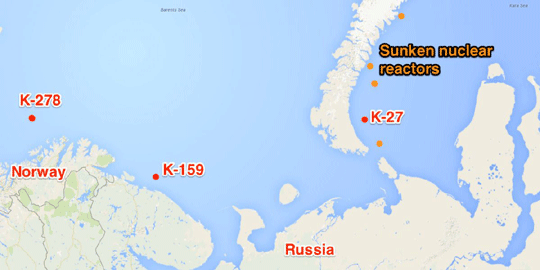
Russia’s ‘slow-motion Chernobyl’ at sea, FUTURE PLANET | OCEANS By Alec Luhn, 2nd September 2020 ……….
Minimising risk
Russia, Norway and other countries whose fishing boats ply the bountiful waters of the Barents Sea have now found themselves with a sword of Damocles hanging over their heads. Although a 2014 Russian-Norwegian expedition to the K-159 wreck that tested the water, seafloor and animals like a sea centipede did not find radiation above background levels, an expert from Moscow’s Kurchatov Institute said at the time that a reactor containment failure “could happen within 30 years of sinking in the best case and within 10 years at the worst”. That would release radioactive caesium-137 and strontium-90, among other isotopes.
While the vast size of the oceans quickly dilutes radiation, even very small levels can become concentrated in animals at the top of the food chain through “bioaccumulation” – and then be ingested by humans. But economic consequences for the Barents Sea fishing industry, which provides the vast majority of cod and haddock at British fish and chip shops, “may perhaps be worse than the environmental consequences”, says Hilde Elise Heldal, a scientist at Norway’s Institute of Marine Research.
According to her studies, if all the radioactive material from the K-159’s reactors were to be released in a single “pulse discharge”, it would increase Cesium-137 levels in the muscles of cod in the eastern Barents Sea at least 100 times. (As would a leak from the Komsomolets, another sunken Soviet submarine near Norway that is not slated for lifting.) That would still be below limits set by the Norwegian government after the Chernobyl accident, but it could be enough to scare off consumers. More than 20 countries continue to ban Japanese seafood, for instance, even though studies have failed to find dangerous concentrations of radioactive isotopes in Pacific predatory fishes following the Fukushima nuclear power plant release in 2011. Any ban on fishing in the Barents and Kara seas could cost the Russian and Norwegian economies €120m ($140m; £110m) a month, according to a European Commission feasibility study about the lifting project.
There is no ship in the world capable of lifting the K-159, so a special salvage vessel would have to be built
But an accident while raising the submarine, on the other hand, could suddenly jar the reactor, potentially mixing fuel elements and starting an uncontrolled chain reaction and explosion. That could boost radiation levels in fish 1,000 times normal or, if it occurred on the surface, irradiate terrestrial animals and humans, another Norwegian study found. Norway would be forced to stop sales of products from the Arctic such as fish and reindeer meat for a year or more. The study estimated that more radiation could be released than in the 1985 Chazhma Bay incident, when an uncontrolled chain reaction during refuelling of a Soviet submarine near Vladivostok killed 10 sailors.
Amundsen argued that the risk of such a criticality excursion with the K-159 or K-27 was low and could be minimised with proper planning, as it was during the removal of high-risk spent fuel from Andreyev Bay.
“In that case we do not leave the problem for future generations to solve, generations where the knowledge of handling such legacy waste may be very limited,” he says.
The safety and transparency of Russia’s nuclear industry has often been questioned, though, most recently when Dutch authorities concluded that radioactive iodine-131 detected over northern Europe in June originated in western Russia. The Mayak reprocessing facility that received the spent fuel from Andreyev Bay by train has a troubled history going back to the world’s then-worst nuclear disaster in 1957. Rosatom continues to deny the findings of international experts that the facility was the source of a radioactive cloud of ruthenium-106 registered over Europe in 2017.
While the K-159 and K-27 need to be raised, Rashid Alimov of Greenpeace Russia has reservations. “We are worried about the monitoring of this work, public participation and the transport [of spent fuel] to Mayak,” he says.
Custom mission
Raising a submarine is a rare feat of engineering. The United States spent $800m (£610m) in an attempt to lift another Soviet submarine, the diesel-powered K-129 that carried several nuclear missiles, from 16,400ft (5,000m) in the Pacific Ocean, under the guise of a seabed mining operation. In the end, they only managed to bring a third of the submarine to the surface, leaving the CIA with little usable intelligence.
That was the deepest raise in history. The heaviest was the Kursk. To bring the latter 17,000-tonne missile submarine up from 350ft (108m) below the Barents Sea, the Dutch companies Mammoet and Smit International installed 26 hydraulically cushioned lifting jacks on a giant barge and cut 26 holes in the submarine’s rubber-coated steel hull with a water jet operated by scuba divers. On 8 October 2001, rushing to beat the winter storm season after four months of nerve-wracking work and delays, steel grippers fitted in the 26 holes lifted the Kursk from the seabed in 14 hours, after which the barge was towed to a dry dock in Murmansk.
At less than 5,000 tonnes, the K-159 is smaller than the Kursk, but even before it sank its outer hull was “as weak as foil”, according to Bellona. It has since been embedded in 17 years’ worth of silt. A hole in the bow would seem to rule out pumping it full of air and raising it with balloons, as has been previously suggested. At a conference of European Bank of Reconstruction and Development donors in December, a Rosatom representative said there was no ship in the world capable of lifting it, so a special salvage vessel would have to be built.
That will increase the estimated cost of €278m ($330m; £250m) to raise the six most radioactive objects. Donors are discussing Russia’s request to help finance the project, said Balthasar Lindauer, director of nuclear safety at EBRD.
“There’s consensus something needs to be done there,” he says. Any such custom-built vessel would likely need a bevy of specialised technologies such as bow and aft thrusters to keep it positioned precisely over the wreck.
But in August, Grigoriev told a Rosatom-funded website that one plan the company was considering would involve a pair of barges fitted with hydraulic cable jacks and secured to deep-sea moorings. Instead of steel grippers like the ones inserted into the holes in the Kursk, giant curved pincers would grab the entire hull and lift it up between the barges. A partially submersible scow would be positioned underneath, then brought to the surface along with the submarine and finally towed to port. The K-27 and K-159 could both be recovered this way, he said.
One of three engineering firms working on proposals for Rosatom is the military design bureau Malachite, which drafted a project to raise the K-159 in 2007 that “was never realised due to a lack of money”, according to its lead designer. This year the bureau has begun updating this plan, an employee tells Future Planet in the lobby of Malachite’s headquarters in St Petersburg. Many questions remain, however.
“What condition is the hull in? How much of force can it handle? How much silt has built up? We need to survey the conditions there,” the employee says, before the head of security arrives to break up our conversation.
Nuclear paradox
Removing the six radioactive objects fits in with an image Putin as crafted as a defender of the fragile Arctic environment. In 2017, he inspected the results of an operation to remove 42,000 tonnes of scrap metal from the Franz Josef Land archipelago as part of a “general clean-up of the Arctic”. He has spoken about environmental preservation at an annual conference for Arctic nations. And on the same day in March 2020 that he issued his draft decree about the sunken objects, he signed an Arctic policy that lists “protecting the Arctic environment and the native lands and traditional livelihood of indigenous peoples” as one of six national interests in the region.
“For Putin, the Arctic is part of his historic legacy. It should be well-protected, bring real benefits and be clean,” said Dmitry Trenin, head of the think tank Carnegie Centre Moscow.
Yet while pursuing a “clean” Arctic, the Kremlin has also been backing Arctic oil and gas development, which accounts for the majority of shipping on the Northern Sea Route. State-owned Gazprom built one of two growing oil and gas clusters on the Yamal peninsula, and this year the government cut taxes on new Arctic liquified natural gas projects to 0% to tap into some of the trillions of dollars of fossil fuel and mineral wealth in the region.
And even as Putin cleans up the Soviet nuclear legacy in the far north, he is building a nuclear legacy of his own. A steady march of new nuclear icebreakers and, in 2019, the world’s only floating nuclear power plant has again made the Arctic the most nuclear waters on the planet.
Meanwhile, the Northern Fleet is building at least eight submarines and has plans to construct several more, as well as eight missile destroyers and an aircraft carrier, all of them nuclear-powered. It has also been testing a nuclear-powered underwater drone and cruise missile. In total, there could be as many as 114 nuclear reactors in operation in the Arctic by 2035, almost twice as many as today, a 2019 Barents Observer study found.
This growth has not gone without incident. In July 2019, a fire on a nuclear deep-sea submersible near Murmansk almost caused a “catastrophe of a global scale,” an officer reportedly said at the funeral of the 14 sailors killed. The next month, a “liquid-fuel reactive propulsion system” exploded during a test on a floating platform in the White Sea, killing two of those involved and briefly spiking radiation levels in the nearby city of Severodvinsk.
“The joint efforts of the international community including Norway and Russia after breakup of the Soviet Union, using taxpayer money to clean up nuclear waste, was a good investment in our fisheries,” says The Barents Observer’s Nilsen. “But today there are more and more politicians in Norway and Europe who think it’s a really big paradox that the international community is giving aid to secure the Cold War legacy while it seems Russia is giving priority to building a new Cold War.”
As long as the civilian agency Rosatom is tasked with clean-up, the Russian military has little incentive to slow down this nuclear spree, Nilsen notes.
“Who is going to pay for the clean-up of those reactors when they are not in use anymore?” he asks. “That is the challenge with today’s Russia, that the military don’t have to think what to do with the very, very expensive decommissioning of all this.”
So while the coming nuclear clean-up is set to be the largest of its kind in history, it may turn out to be just a prelude to what’s needed to deal with the next wave of nuclear power in the Arctic…………….https://www.bbc.com/future/article/20200901-the-radioactive-risk-of-sunken-nuclear-soviet-submarines
Russia releases previously classified film of “Tsar Bomba” the most powerful nuclear bomb blast E\eve
Russia Releases “Tsar Bomba” Test Footage Of The Most Powerful Nuclear Bomb Blast Ever This previously classified film provides a new and fascinating glimpse into the 50-megaton Cold War nuclear test that occurred nearly six decades ago. The Drive BY THOMAS NEWDICK, AUGUST 24, 2020 The nuclear bomb, codenamed “Ivan,” that was dropped by the Soviet Union over Novaya Zemlya in the Arctic Ocean on October 30, 1961, was the largest device of its kind ever detonated. The monstrous weapon had a yield of around 50 megatons — equivalent to 50 million tons of TNT. Until now, the available imagery of that test has been strictly limited, consisting of short, grainy clips and poor-quality stills.
for “dozens of kilometers” in every direction, the earth has been scorched, most of the snow vaporized, and the few structures that existed above the surface have been obliterated.
Court actions over delays in delivering Russia’s giant nuclear icebreaker line
|
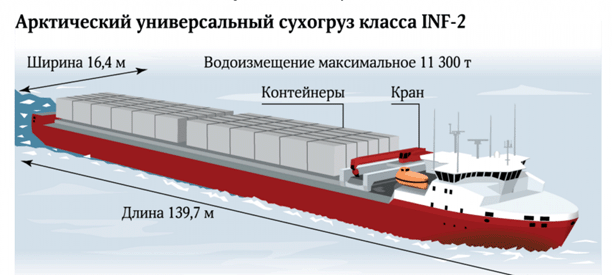
Delays in delivering Russia’s giant nuclear icebreaker line sparks lawsuitsDelays plaguing the launch of the Arktika nuclear icebreaker, billed to be Russia’s largest to date, have prompted a number of lawsuits against the ship’s builder as frustrations mount over a series of technical faults thwarting the vessel’s scheduled release. Bellona , August 21, 2020 by Charles Digges
According to the Barents Observer, which cites industry news portals, Atomflot, Russia’s nuclear icebreaker headquarters, has filed three multi-million dollar lawsuits against the Baltic Shipyard, the St Petersburg-based shipbuilder that has forged most of the country’s icebreaking muscle. Details of the lawsuits are sketchy. But the Barents Observer reports that the suits seek nearly $13.5 million in damages over faulty ship systems and overdue part deliveries, all of which have caused the icebreaker project to overshoot its 2017 deadline. The latest of these mishaps involves a 300-ton electric propulsion engine that failed during the Arktika’s sea trials in February, crippling one of the vessel’s three propeller systems. While the breakdown is not related to the Arktika’s nuclear propulsion system, it was nonetheless an embarrassing setback that will ultimately require the engine to be entirely replaced. Russian media now suggest that the Arktika won’t be repaired before 2021. A new series of upgraded nuclear icebreakers are central component of a Kremlin strategy to keep Arctic sea routes open on a year-round basis. Russia has since Soviet times maintained the world’s largest stable of these vessels. But many have been decommissioned in recent years, and Moscow has embarked on renewing the fleet. The target of this effort is the Northern Sea Route, a 5,600-kilometer sea artery joining Europe to Asia, whose frozen shores are laden with fossil fuels and mineral deposits. To stimulate its development, President Vladimir Putin ordered in 2017 that cargo volumes along the passage reach 80 million tons by the middle of this decade – more than double current volumes. The Arktika, and two other icebreakers in its class – the Ural and the Sibir – are meant to lead the way. Each vessel measures up to 173 meters in length and all are powered by twin RITM-200 nuclear reactors, which deliver a combined 175 megawatts of power – making them the most powerful civilian vessels in the world. Atomflot has filed its suits against the Baltic Shipyard in Moscow’s Arbitration court, the Barents Observer reports. In turn, the shipyard is suing one of its own suppliers – the giant Kirov Plant in St Petersburg, which manufactures heavy machinery. The Arktika’s rollout has face previous delays. In March of 2017, turbines produced by a Ukraine-based manufacturer were held up by military tensions between Moscow and Kiev. https://bellona.org/news/nuclear-issues/2020-08-%EF%BB%BF%EF%BB%BFdelays-in-delivering-russias-giant-nuclear-icebreaker-line-sparks-lawsuits |
|
Fuel finally removed from Russia’s most radioactive ship
|
Dismantlement of Russia’s most radioactive ship reaches milestone https://bellona.org/news/nuclear-issues/2020-08-dismantlement-of-russias-most-radioactive-ship-reaches-milestone
The Lepse nuclear service ship, long one of the most dangerous Soviet era radiation hazards in Northwest Russia, has finally been emptied of the aged spent nuclear fuel in its holds, marking a major milestone in an international cleanup effort that Bellona helped bring to the fore. August 12, 2020 by Charles Digges The Lepse nuclear service ship, long one of the most dangerous Soviet era radiation hazards in Northwest Russia, has finally been emptied of the aged spent nuclear fuel in its holds, marking a major milestone in an international cleanup effort that Bellona helped bring to the fore. The new developments came in late July, when the European Bank of Reconstruction and Development, which is funding the project, announced that the last of hundreds of spent nuclear fuel assemblies had been removed from the ship’s hull and sent away for reprocessing. The fuel removal effort has been one of the most technically demanding nuclear legacy cleanup operations in modern history, representing decades of preparation and the coordination of numerous international partners in often troubled political circumstances. “This has been a technically complex and challenging task given the uncertainties associated with both the conditions of the old storage facility and spent nuclear fuel,” says Balthasar Lindauer, the EBRD’s director for nuclear safety. “Its successful completion advances nuclear and radiological safety in the region, addressing a serious danger to the people and the environment of the Barents Sea region.” The news also marks another giant step toward cleaning up the Cold War’s naval and civilian nuclear debris in Northwest Russia. Early last month, officials at Andreyeva Bay, near the Norwegian border, announced they were just a year from removing some of that site’s most complex spent nuclear fuel assemblies. The Lepse, which was used to unload spent nuclear fuel from Soviet nuclear icebreakers, spent more than two decades languishing at the Atomflot icebreaker port in Murmansk, just four kilometers from the city’s population of 300,000. Its irradiated holds contained 639 spent nuclear fuel assemblies, many of which were damaged when the vessel refueled the Lenin Icebreaker in 1965 and 1967, and defied removal by conventional means. The boat was finally towed from Atomflot to the Nerpa naval shipyard in September 2012, after more than a decade of strenuous and often tedious negotiations among Bellona, the Russian government and financial institutions – most notably the EBRD – geared toward ensuring its disposal. Now, all the spent fuel assemblies from the Lepse have been transported from Nerpa back to Atomflot, from where they will be sent by rail for reprocessing at the Mayak Production Association, Russia’s nuclear fuel processing center in the Ural Mountains. The vessel and its dangers caught Bellona’s eye in 1994, and the organization mobilized to lobby the European Union to allocated funding for its removal from Murmansk harbor and its safe dismantlement. In 2001, Bellona built a dormitory for Lepse’s cleanup technicians, who had before that lived amid the radiation aboard the ship itself. Bellona’s connection to the Lepse runs even deeper. Andrei Zolotkov, the head of its Murmansk office, once worked in the vessel’s radiation safety service back in 1974. “It was there that I worked with the technological water in the cooling tanks, where radiation levels approached some 1 Curie per kilogram,” says Zolotkov. “These are pretty serious radioactivity levels that spoke to the unsatisfactory condition of [the Lepse’s] spent fuel assemblies.” He adds that it took more than a quarter of a century to fully address those dangerous conditions – and countless discussions and seminars. But Zolotkov now says that “the end of the project has become visible.” The Lepse’s dismantlement has been supported by the Northern Dimension Environmental Partnership of the EBRD, whose Nuclear Window program has drawn together funds to address radioactive relics of the Cold War. Aside from the Lepse and Andreyeva Bay, the EBRD manages the Chernobyl Shelter Fund. Funding for Nuclear the Window program have been contributed by Norway, Belgium, Canada, the United Kingdom, Finland, France, Germany and the Netherlands, as well as by the European Union. |
|
1 This Month

of the week – Shut Down Drone Warfare!


Tell the Ukrainian Government to Drop Prosecution of Peace Activist Yurii Sheliazhenko

Petition to revoke the licensing of the Near Surface Nuclear Disposal Facility (NSDF) at Chalk River. https://www.ourcommons.ca/petitions/en/Petition/Details?Petition=e-7247
To see nuclear-related stories in greater depth and intensity – go to https://nuclearinformation.wordpress.com
-
Archives
- April 2026 (57)
- March 2026 (251)
- February 2026 (268)
- January 2026 (308)
- December 2025 (358)
- November 2025 (359)
- October 2025 (376)
- September 2025 (257)
- August 2025 (319)
- July 2025 (230)
- June 2025 (348)
- May 2025 (261)
-
Categories
- 1
- 1 NUCLEAR ISSUES
- business and costs
- climate change
- culture and arts
- ENERGY
- environment
- health
- history
- indigenous issues
- Legal
- marketing of nuclear
- media
- opposition to nuclear
- PERSONAL STORIES
- politics
- politics international
- Religion and ethics
- safety
- secrets,lies and civil liberties
- spinbuster
- technology
- Uranium
- wastes
- weapons and war
- Women
- 2 WORLD
- ACTION
- AFRICA
- Atrocities
- AUSTRALIA
- Christina's notes
- Christina's themes
- culture and arts
- Events
- Fuk 2022
- Fuk 2023
- Fukushima 2017
- Fukushima 2018
- fukushima 2019
- Fukushima 2020
- Fukushima 2021
- general
- global warming
- Humour (God we need it)
- Nuclear
- RARE EARTHS
- Reference
- resources – print
- Resources -audiovicual
- Weekly Newsletter
- World
- World Nuclear
- YouTube
-
RSS
Entries RSS
Comments RSS
 nuclear-news