Putin set to hold nuclear evacuation drill; moved family to Siberia: Reports
Hindustan Times, 20 Mar 22, ……… Not much is known about Putin’s family members, but since the Russia-Ukraine war started, reports claimed Putin moved unidentified members of his immediate family to a hi-tech underground bunker, which is a whole underground city, in the Altai Mountains of Siberia.
Putin’s Doomsday plan
Kremlin has a Doomsday plan ready and it is no secret. For a nuclear conflict, if any, Russia has Doomsday planes that would be used by Putin and his closes allies to stay above the war. A sky bunker was also under the Doomsday plan but is believed to be not ready yet. All these have been reported by the Russian press earlier and the veracity remains questionable……… https://www.hindustantimes.com/world-news/putin-set-to-hold-nuclear-evacuation-drill-moved-family-to-siberia-reports-101647744184485.html
Russia’s disinformation machine, (and Trump’s, in USA)

Russia’s Disinformation Machine Runs So Deep, Some Don’t Know War Is Happening, William Rivers Pitt, Truthout , March 7, 2022
Imagine that you, as a refugee from extreme violence in Ukraine, called your family across the border for help — and were flatly told they did not believe you, that there was no war. You’ve witnessed the indiscriminate shelling of your city, including your own apartment building. You have been hiding in a train station with a thousand others as the crash and smash of an artillery bombardment shakes the rubble from the cracked ceiling. You’ve seen dead people, soldiers and civilians, left in the street. If this is not real, “real” does not exist. How can your relatives in Russia not know this is happening?
The Washington Post explains:
As Ukrainians deal with the devastation of the Russian attacks in their homeland, many are also encountering a confounding and almost surreal backlash from family members in Russia, who refuse to believe that Russian soldiers could bomb innocent people, or even that a war is taking place at all.
These relatives have essentially bought into the official Kremlin position: that President Vladimir V. Putin’s army is conducting a limited “special military operation” with the honorable mission of “de-Nazifying” Ukraine. Mr. Putin has referred to the Ukrainian president, Volodymyr Zelensky, a native Russian speaker with a Jewish background, as a “drug-addled Nazi” in his attempts to justify the invasion.
Those narratives are emerging amid a wave of disinformation emanating from the Russian state as the Kremlin moves to clamp down on independent news reporting while shaping the messages most Russians are receiving.
It is estimated that there are approximately 11 million people in Russia with relatives in Ukraine. It would be an act of stupendous hubris for Russian President Vladimir Putin to believe he could keep so many in the dark about the reality of Ukraine, but this is exactly what he has endeavored to do. Most of what passed for an independent press in Russia has been swept away, and overwhelmingly, the information being provided comes from Russian state media. There is no war, they preach, no mass civilian displacement. This is a limited act of liberation to free Ukraine from Nazi control by way of precision strikes on military targets only, they say, with Russian soldiers bringing food and warm clothes to all affected civilians.
It is an absolute wonder, however thoroughly horrifying, that Putin is attempting to pull off a gaslighting of such magnitude. ………….
However, Russia’s disinformation campaign should not look entirely unfamiliar to us in the United States. Let us not forget that, not so long ago, we were led into a long and bloody war under the false pretenses of “weapons of mass destruction,” which reverberated across mainstream media. In certain media sectors, those official lies echo strongly to this day.
And then, there is the lie-based future Donald Trump and his allies have been striving to construct for the U.S. for the last seven years. Any story not in praise of Trumpism is immediately labeled false, backed by an anti-logic that mangles civic discourse beyond recognition. Even trying to deconstruct a Trumpist’s “fake news” charge is a victory for the one leveling it, because it means you have accepted the premise that it could be fake news, thus giving partisans just enough of a peg to hang their hat on.
With a tight enough media bubble, reinforced by the long-espoused idea that other viewpoints stem from evil sources and must be shunned as a moral imperative, a segment of any population can be manipulated and even controlled in ways that leave those outside looking in astonished and stunned. While Trump likely would not have been able to hide a whole war with a neighbor, he has painted a masterwork of disinformation about COVID-19, masks, vaccines and basic safety measures. Tens of millions have bought what he is peddling, to the ongoing detriment of the COVID fight, leaving the country badly fractured and unable to escape the gravity well of the pandemic.
Yet, we in the U.S. independent media know well that state attempts to manipulate public opinion cannot easily quell grassroots movements. Where there is war and repression, there is resistance, and the same is true in Russia in this moment. More than 13,000 antiwar protesters have been arrested in Russia, and still they come.
And resistance to the tyranny of the outside invaders is a touchstone of the Ukrainian ethos. They will not surrender it lightly.
Meanwhile, those of us in the United States, confronting Putin’s disinformation machine, must not assume that it can be torn down by sanctions, our own military and state mechanisms of information warfare. Rather, we must take note of the fact that if many thousands of Russians are protesting in the face of massive state repression, grassroots channels of information are being used and new ones created. We must work our hardest to amplify our own channels for truth, particularly those that lift up grassroots resistance movements. As Khury Petersen-Smith writes in Truthout, “Our challenge is to build protest across borders that stands in solidarity with those facing the violence of war, and is independent — and defiant of — the governments where we reside.” https://truthout.org/articles/russias-disinformation-machine-runs-so-deep-some-dont-know-war-is-happening/?eType=EmailBlastContent&eId=fcdefd4d-3561-4da4-9d86-8e4a6ec8a93a
Russia prepared to stop war, if Ukraine agrees to conditions, including independence of Donbass areas

Russia will stop ‘in a moment’ if Ukraine meets terms – Kremlin, https://www.swissinfo.ch/eng/russia-will-stop–in-a-moment–if-ukraine-meets-terms—kremlin/47409340 Mon, March 7, By Catherine Belton, LONDON (Reuters) -Russia has told Ukraine it is ready to halt military operations “in a moment” if Kyiv meets a list of conditions, the Kremlin spokesman said on Monday.
Dmitry Peskov said Moscow was demanding that Ukraine cease military action, change its constitution to enshrine neutrality, acknowledge Crimea as Russian territory, and recognise the separatist republics of Donetsk and Lugansk as independent states.
It was the most explicit Russian statement so far of the terms it wants to impose on Ukraine to halt what it calls its “special military operation”, now in its 12th day.
Peskov told Reuters in a telephone interview that Ukraine was aware of the conditions. “And they were told that all this can be stopped in a moment.”
There was no immediate reaction from the Ukrainian side.
Russia has attacked Ukraine from the north, east and south, pounding cities including Kyiv, Kharkiv and the port of Mariupol. The invasion launched on Feb. 24, has caused the worst refugee crisis in Europe since World War Two, provoked outrage across the world, and led to heavy sanctions on Moscow.
But the Kremlin spokesman insisted Russia was not seeking to make any further territorial claims on Ukraine and said it was “not true” that it was demanding Kyiv be handed over.
“We really are finishing the demilitarisation of Ukraine. We will finish it. But the main thing is that Ukraine ceases its military action. They should stop their military action and then no one will shoot,” he said.
On the issue of neutrality, Peskov said: “They should make amendments to the constitution according to which Ukraine would reject any aims to enter any bloc.”
He added: “We have also spoken about how they should recognise that Crimea is Russian territory and that they need to recognise that Donetsk and Lugansk are independent states. And that’s it. It will stop in a moment.”
NEW TALKS
The outlining of Russia’s demands came as delegations from Russia and Ukraine prepared to meet on Monday for a third round of talks aimed at ending Russia’s war against Ukraine.
It began soon after Putin recognised two breakaway regions of eastern Ukraine, where Russian-backed separatists have been fighting Ukrainian government forces since 2014, as independent – an action denounced as illegal by the West.
“This is not us seizing Lugansk and Donetsk from Ukraine. Donetsk and Lugansk don’t want to be part of Ukraine. But it doesn’t mean they should be destroyed as a result,” Peskov said.
“For the rest. Ukraine is an independent state that will live as it wants, but under conditions of neutrality.”
He said all the demands have been formulated and handed over during the first two rounds of talks between Russian and Ukrainian delegations, which took place last week.
“We hope that all this will go OK and they will react in a suitable way,” Peskov said.
Russia had been forced into taking decisive actions to force the demilitarisation of Ukraine, he said, rather than just recognising the independence of the breakaway regions.
This was in order to protect the 3 million Russian-speaking population in these republics, who he said were being threatened by 100,000 Ukrainian troops.
“We couldn’t just recognise them. What were we going to do with the 100,000 army that was standing at the border of Donetsk and Lugansk that could attack at any moment. They were being brought U.S. and British weapons all the time,” he said.
In the run-up to the Russian invasion, Ukraine repeatedly and emphatically denied Moscow’s assertions that it was about to mount an offensive to take back the separatist regions by force.
Peskov said the situation in Ukraine had posed a much greater threat to Russia’s security than it had in 2014, when Russia had also amassed 150,000 troops at its border with Ukraine, prompting fears of a Russian invasion, but had limited its action to the annexation of Crimea.
“Since then the situation has worsened for us. In 2014, they began supplying weapons to Ukraine and preparing the army for NATO, bringing it in line with NATO standards,” he said.
“In the end what tipped the balance was the lives of these 3 million people in Donbass. We understood they would be attacked.”
Peskov said Russia had also had to act in the face of the threat it perceived from NATO, saying it was “only a matter of time” before the alliance placed missiles in Ukraine as it had in Poland and Romania.
“We just understood we could not put up with this any more. We had to act,” he said.
(Reporting by Catherine Belton, editing by Mark Trevelyan, Gareth Jones and Angus MacSwan)
Rosatom’s woes before and beyond the war: implications of Russia’s embattled nuclear industry
Pinar Demircan: Rosatom’s woes before and beyond the war: implications of Russia’s embattled nuclear industry.
Russia had a nuclear waste recycling agreement with Ukraine. According to this arrangement, Ukraine
would send the waste from its 15 nuclear reactors operating within its borders to Russia at the cost of 200 million dollars every year.
However, in 2005, Ukraine’s then Minister of Energy, Yuriy Nedashkovsky concluded a new agreement with the US-based company Holtec to establish a storage facility promising 100 years of protection in the Chernobyl plant site for 250 million dollars, thus, bringing to an end the earlier deal with Russia.
The dry-storage facility, built by Holtec with the financial loan support of the US-based Development Finance Corporation (DFC), which committed to offering protection for a maximum of 100 years, was to be put into operation on November 6, 2021, with trial tests at the end of 16 years.
Although there are currently 4,000 cubic meters of waste, this warehouse is now the key facility where nuclear waste from 15 nuclear reactors, which produce 51 percent of Ukraine’s energy needs, will be stored. Thus, Ukraine was spared from paying $200 million every year to Russia for the
removal of nuclear waste, and had to bear only a one-time expense of 250 million dollars under the new agreement. In other words, with theconstruction of this warehouse by the US corporate, Russia had lost both the supply of nuclear waste for nuclear fuel production and an income of
200 million dollars per year.
Moreover, the Russian-origin nuclear fuelcompany TVEL, which has been operating since 1991, had invested hundreds ofmillions of dollars to produce fuel from nuclear waste and had even starteda new facility in Moscow.
DiaNuke 6th March 2022
Russian Foreign Minister Lavrov warns that a third world war would be nuclear
Russia’s Lavrov: A third world war would be nuclear, destructive
Moscow put its strategic nuclear forces on alert last week amid the war in Ukraine, causing ripples across the globe. Aljazeera, 2 Mar 22,
Russian Foreign Minister Sergey Lavrov has warned that if a third world war were to occur, it would involve nuclear weapons and be destructive, according to Russian media.
The comments reported by the RIA news agency on Wednesday came a day after he told a Geneva disarmament meeting via video link that neighbouring Ukraine, which Russian invaded last week, had been seeking nuclear weapons.
He did not provide evidence other than saying “Ukraine still has Soviet nuclear technologies and the means of delivery of such weapons.”
Lavrov has also said that Russia would have faced a “real danger” if Ukraine acquired nuclear weapons.
Nuclear forces on high alert
Russian forces attacked Ukraine by land, air and sea, the biggest attack by one state against another in Europe since World War II.
The move has been countered by the West with harsh economic sanctions on Russia as well as deliveries of arms and humanitarian aid to Ukraine.
The US government on Tuesday announced a ban on Russian flights in its airspace, following similar moves by the European Union and Canada.
On Sunday, Russian President Vladimir Putin put his strategic nuclear forces on alert, causing ripples across the globe and raising the threat the tensions could lead to the use of nuclear weapons. ………….. https://www.aljazeera.com/news/2022/3/2/russias-lavrov-says-a-ww-iii-would-be-nuclear-and-destructive
Russia President Vladimir Putin puts his nuclear forces on alert

Putin’s alert raises two types of risks that the conflict might escalate into a nuclear conflict: deliberate and inadvertent.
Much depends on whether Russia is alerting its strategic nuclear forces, which would focus on protecting the regime from attack on Russian soil, or its theater forces, which would be oriented toward influencing the military and political situation on the continent.
In the fog of war, countries may shoot first and ask questions later.
The Ukraine crisis is now a nuclear crisis https://www.washingtonpost.com/politics/2022/02/27/ukraine-crisis-is-now-nuclear-crisis/ Russian President Vladimir Putin just put his nuclear forces on alert, By Caitlin Talmadge 27 Feb 22
Russia’s publicly announced nuclear alert has turned the Ukraine war from a crisis involving nuclear powers to an actual nuclear crisis.
With the caveat that we do not have many details about what the Russian alert entails, it is nevertheless a clear sign that President Vladimir Putin does not believe that the conventional military campaign in Ukraine is achieving the political outcomes he wants.
Putin has turned to nuclear weapons because they offer another way to increase pressure on both Ukraine and its international backers to come to the settlement that Russia wants regarding Ukraine’s status. Yet his decision raises serious risks of both deliberate and inadvertent nuclear escalation.
This is a scary moment, but it’s not unprecedented or that surprising. Here is why.
Nuclear signals like this are not new
Putin has explicitly signaled from the beginning of the Ukraine war that he might turn to Russia’s nuclear arsenal if outside powers interfered with his campaign or were perceived to be threatening Russia itself.
In fact, Putin’s initial nuclear threat likely was intended as a shield to keep the West out of Russia’s conventional operations. This highlights what international relations scholars call the stability-instability paradox. The danger of nuclear war may keep nuclear powers from fighting all-out because they fear it would escalate. However, precisely because all-out war would be so mutually damaging, the likelihood of conventional war or even limited nuclear use can increase.
Amid reports of Russia’s lagging conventional invasion, Putin may now believe that climbing up to the next rung on the so-called escalation ladder is the only way to achieve the coercive effect he wants.
Such a move fits with his decision to announce the alert so publicly — rather than keeping it secret, as nuclear matters usually are — to ensure that the world gets the message and other nations have to respond.
Putin’s approach is not new. Countries often rely on their nuclear arsenals to compensate for inferiority with conventional weapons as shown by Pakistan, North Korea, and NATO’s threats to escalate during the Cold War. The idea is to deter conventional attack or prevent conventional defeat through threats of nuclear first use. The The world has even seen episodes of explicit signals that nuclear weapons could be used, as Putin has done, by states losing conventional battles in the past: Pakistan versus India in 2001-2002, for example, and Israel versus the Arab coalition in 1973.
There are real escalation risks — both intentional and unintentional
Putin’s alert raises two types of risks that the conflict might escalate into a nuclear conflict: deliberate and inadvertent.
First, the deliberate nuclear escalation risk comes from the possibility that Putin might actually use nuclear weapons, particularly tactical (short-range) nuclear weapons, to achieve his military objectives in Ukraine. Again, this is a major reason countries develop such weapons in the first place — to achieve what they think conventional forces cannot.
It is the same reason that the odds of Russian attacks against civilians have increased in the last day or two. From Putin’s standpoint, nuclear threats are likely just another escalatory lever to force the political outcome Russia wants.
Putin might also turn to medium-range nuclear weapons to coerce neighbors in Europe who are seeking to support Ukraine militarily, diplomatically, or politically. Of course, doing the latter against any NATO ally would be extremely escalatory and invoke U.S. commitments to defend its NATO allies under Article V of NATO’s founding treaty.
Second, raising the alert status of nuclear weapons inherently raises the likelihood of their use — and this is what generates inadvertent nuclear escalation risk. Details are sparse, but we could expect the readiness of Russia’s nuclear forces to now be heightened, and the command and control arrangements governing use of nuclear weapons to possibly be loosened, meaning they could be launched more easily.
Whether Russia has actually practiced these operations and how safely they can be conducted remain unclear. Risks of accidents and unauthorized use could increase. Countries sometimes undertake dangerous measures to signal their readiness to use nuclear weapons, as China did in 1969 when it fueled its rudimentary nuclear weapons in a lengthy border crisis versus the Soviets.
Furthermore, Russia’s alert could prompt counter-reactions in the United States, France and Britain. If they alert their forces as well, the chances of misperception — including Russian misperception of an impending nuclear attack — heighten further.
Much depends on whether Russia is alerting its strategic nuclear forces, which would focus on protecting the regime from attack on Russian soil, or its theater forces, which would be oriented toward influencing the military and political situation on the continent.
Worryingly, this is happening in a time of deep distrust and mutual suspicion, in which ambiguous signals from one country are likely to be viewed in the worst possible light by its opponents. This is precisely the sort of environment in which inadvertent nuclear escalation becomes most likely.
In the fog of war, countries may shoot first and ask questions later. This is how the Soviets ended up mistakenly shooting down a Korean civilian airliner in 1983 during a period of heightened nuclear tension with the United States, and why the Iranians did the same thing in the aftermath of the U.S. strike on Maj. Gen. Qasem Soleimani in early 2020.
Putin is a personalist dictator — and that has its own risks
Adding to both the deliberate and inadvertent escalation dangers is Putin’s status as a personalist dictator. As Jessica L.P. Weeks and Jeff D. Colgan explained here at TMC, these autocrats have few constraints on decision-making authority and are very unlikely to get candid information from advisers. utin, an aging leader by Russian standards, likely views the current crisis as threatening not only his foreign policy goals but also his domestic political prospects at home, including his personal survival and freedom.
Putin may also want the world to worry that he is just enough of a madman to lash out when his back is against the wall. Again, this is a tactic leaders have tried before, including Khrushchev in the Berlin Crises of 1958 and 1961, and President Richard Nixon when he attempted to pressure the Soviets over Vietnam in 1969. This approach did not work well for these leaders — but they were all far more constrained than Putin.
This institutional and personal context may make Putin more risk-acceptant — that is, more willing to gamble on dangerous nuclear threats to save his regime — than other leaders. It also likely makes him more paranoid. These tendencies again reinforce the escalatory dangers stemming from Putin’s recent decision.
Caitlin Talmadge (@ProfTalmadge) is associate professor of security studies in the School of Foreign Service at Georgetown University. She is the author of “The Dictator’s Army: Battlefield Effectiveness in Authoritarian Regimes” (Cornell University Press, 2015).
Russian Foreign Minister Lavrov informs UN chief about Russia’s talks with NATO on security guarantees
 | |||
Lavrov informs UN chief about Russia’s talks with NATO on security guarantees https://tass.com/world/1403199
Russian Foreign Minister drew the attention of Antonio Guterres to the problems the Russian mission to the organization is facing in the United States due to the US side’s non-implementation of its commitments
MOSCOW, February 14. /TASS/. Russian Foreign Minister Sergey Lavrov informed United Nations Secretary General Antonio Guterres about Russia’s ongoing negotiations with NATO and OSCE member countries on security guarantees, the Russian foreign ministry said on Monday after their online talks.
“The sides exchanged views on a range of current international topics (Syria, Libya, the activities of the UN mission in Kosovo), including in the context of Russia’s presidency of the United Nations Security Council in February. Lavrov informed the United Nations secretary general in detail about the ongoing talks with on security guarantees to Russia with NATO and OSCE member states,” the ministry said.
Apart from that, Lavrov drew the attention of the UN chief to the problems the Russian mission to the organization is facing in the United States due to the US side’s non-implementation of its commitments. “Lavrov drew special attention to the problems Russia’s permanent mission to the United States is facing due to the United States’ failure to implement its liabilities under the agreement regarding the UN headquarters in what concerns the return the mission’s official premises blocked by the Americans and the issuance of visas to its employees and members of Russian delegations taking part in the work of the General Assembly and its committees,” the ministry said.
The sides stressed the importance of further efforts “to strengthen the United Nations’ central coordinating role in global politics” and reiterated their commitment to the cooperation between Russia and the United Nations.
Earlier on Monday, Russian President Vladimir Putin discussed with Lavrov the United States’ and NATO’s responses to Russia’s proposals on long-term legally binding guarantees of its security. Lavrov informed the president about these responses, noting that NATO and the US gave a negative answer on Russia’s key concerns. He stressed that Moscow cannot be satisfied with these responses. However, in his words, some of the responses are quite constructive. These are concrete measures concerning shorter-and medium-range missiles and a series of proposals on reducing military risks, building up trust and military transparency
On January 26, the US and NATO handed over written responses to Russia on Moscow’s security guarantees that it was demanding from Washington and Brussels. The American side requested that the documents not be made public, although US Secretary of State Antony Blinken and NATO Secretary General Jens Stoltenberg enumerated their basic provisions. According to these statements, the West did not make concessions to Russia considered to be critical, but did indicate directions for further negotiations.
The goal of Russia is to destroy NATO by exposing its impotence.

By 2008 NATO had become a bloated edifice largely unrecognizable from the organization that had been created at its founding, in 1949. Its appetite for expansion knew no bounds, with membership offers being dangled before two former Soviet Republics, Georgia and Ukraine, and military engagements being initiated in North Africa and the Persian Gulf.
Once NATO began expanding, both in terms of membership composition and scope and scale of its non-European military commitments, it was obvious to any observer exercising a modicum of intellectual curiosity that NATO existed for the sole benefit of the United States.
Exposing NATO
By militarizing the Ukraine crisis, Russia has exposed the absolute military impotence of NATO. First and foremost, after dangling the bait of NATO membership before Ukraine for the past fourteen years, NATO was compelled to confess that it would not be able to come to the defense of Ukraine in case of any Russian military invasion because Article 5 only allowed collective defense to be invoked for NATO members, which Ukraine is not.
Germany, Biden was saying, is little more than a colony of the United States.
The Ultimate End of NATO, Russia’s goal is not to destroy Ukraine—this could be accomplished at any time. Rather, the goal of Russia is to destroy NATO by exposing its impotence, writes Scott Ritter. Consortium News 11 Feb 22,
” …………………………………………. A Messy History.
Students of history might be experiencing what Yogi Berra once famously called “Déjà vu all over again” when examining the frenetic activities undertaken by the North Atlantic Treaty Organization (NATO) today, as it responds to what it alleges is a provocative Russian military buildup along the Russian-Ukrainian border.
The Trans-Atlantic alliance is a strange amalgam of political, economic, and military belief systems cloaking a mass of 30 nations who manage the day-to-day activities of their organization through a consensus-based, collective decision-making process that is as unwieldy as it is inefficient.
Originally formed as a collective of 12 nations united by the desire, as the first secretary-general of NATO, Lord Ismay, once quipped, “to keep the Russians out, the Americans in, and the Germans down”, the Trans-Atlantic alliance was, first and foremost, a club comprised of nations which had two things in common—a shared belief in the primacy of democratic governance, and a desire to be protected under the umbrella of American military power.
Early on the alliance witnessed a period of expansion, as it grew to 16 nations following the admittance of Turkey, Greece, Spain, and Portugal. These 16 nations served as the foundation of NATO throughout the Cold War, united in their determination to stand up to any potential Soviet aggression targeting the territory of western Europe.
NATO was always, from a political standpoint, a mess. Strong pro-communist movements in France and Italy led to the unseemly situation where the intelligence services of an allied nation, the United States, were engaged in manipulating the domestic political affairs of two ostensible allies to keep the communists out of power.
West Germany carried out its own unilateral Ostpolitik, seeking better relations with Soviet-occupied East Germany, much to the consternation of the United States. France, offended by what it (rightly) believed to be the dominance of the United States in the military command structure of the alliance, withdrew its military from NATO command authority. And Turkey and Greece were engaged in their own regional Cold War which, in 1974, went hot over the island of Cyprus.
The glue that held the alliance together was the collective defense provisions of Article 5 of the NATO Charter, which provides that if a NATO Ally is the victim of an armed attack, each and every other member of the Alliance will consider this act of violence as an armed attack against all members and will take the actions it deems necessary to assist the Ally attacked.
For much of the Cold War, the NATO alliance was configured militarily so that there was little doubt as to what actions would be taken, with a standing NATO army deployed in West Germany in constant combat readiness, prepared to repel any attack by the Soviet Army and its Warsaw Pact allies. Likewise, NATO maintained significant air and naval forces deployed in the Mediterranean Sea ready to confront any Soviet aggression there. These forces were anchored by a massive standing U.S. military presence comprising hundreds of thousands of troops, tens of thousands of armored vehicles, thousands of combat aircraft, and hundreds of naval vessels.
This full-time presence of concentrated combat-ready military power, prepared as it was to fight at the drop of a hat, gave the Article 5 obligation far more gravitas than it perhaps deserved. The reality of Article 5 is such that, upon its invocation, Allies can provide any form of assistance they deem necessary to respond to a situation based upon the circumstances.
While this assistance is taken forward in concert with other Allies, it is not necessarily military in nature and depends on the material resources of each country. In short, Article 5 leaves to the judgement of each individual member country to determine how and what it would contribute in the case of its invocation.
With the end of the Cold War in 1990-91 came the dismantlement of this full-time combat-ready military force. The unified nature of the NATO military component that existed in the 1980’s ceased to exist barely ten years later, with each member state carrying out its own demobilization and restructuring based upon domestic political requirements, and not the requirements of the alliance.
NATO Goes on Offense
During this time NATO also watched its long-held mantra of being a purely defensive alliance fall to the side as it engaged in offensive military operations on the soil of the former Republic of Yugoslavia, and non-member, and a offensive bombing campaign against Serbia, despite Serbia not having attacked any NATO member.
This deconstruction of NATO’s military capabilities and status as an exclusively defensive organization took place hand in glove with a decision by NATO to expand its membership to include the former members of the Warsaw Pact, beginning with the accession of Poland, Hungary, and the Czech Republic in 1999. The enlargement of NATO was seen as achieving two objectives—from the NATO perspective, it brought most of Europe together into a single collective of allied parties who, because of their membership, would contribute to the overall stability of Europe.
But there was another perspective at play, that being that of the U.S.. While NATO responded to the U.S. invoking of Article 5 after the 9/11 attacks, providing airborne surveillance aircraft for North American patrols and naval forces in the Mediterranean Sea, several core members, led by Germany and France, balked at becoming involved in the post-9/11 military misadventures of the U.S. in Afghanistan and Iraq.
This prompted then-Secretary of Defense Donald Rumsfeld to make a quip denigrating “Old Europe” at the expense of “New Europe.” The continued expansion of NATO eastwards, absorbing all of the former nations of the Warsaw Pact along with three former Soviet Republics in the Baltics not only pushed NATO’s geopolitical center of gravity further east, but also put NATO on a collision course with Russia, whose opinion most NATO members had conditioned themselves to ignore.
NATO went on to provide military and police training support to Iraq in 2004, following that nation’s defeat at the hands of a military coalition which included the U.S., U.K., and Poland providing combat troops, and Spain, Portugal, and the Netherlands providing political support.
Likewise, NATO contributed significant military forces to reconstruction efforts in Afghanistan. These troops operated under Article 4 authorities after the U.S. brought the Afghan situation post-9/11 to the attention of the general membership, which voted to authorize member states to deploy to Afghanistan in support of U.S. reconstruction and nation-building operations.
In 2011, NATO engaged in offensive military operations in Libya, part of a larger political campaign to remove the Libyan leader, Muammar Qaddafi, from power.
A US Adjunct
By 2008 NATO had become a bloated edifice largely unrecognizable from the organization that had been created at its founding, in 1949. Its appetite for expansion knew no bounds, with membership offers being dangled before two former Soviet Republics, Georgia and Ukraine, and military engagements being initiated in North Africa and the Persian Gulf.
While the bloated organizational structure of NATO looked impressive on paper, there were two realities that no amount of puffing and posturing could obviate. First and foremost was the absolute dearth of real military power on the part of the non-U.S. NATO components.
To support and sustain their respective military commitments to Afghanistan, the major NATO nations involved—Canada, the Netherlands, the United Kingdom, France, and Italy—were forced to cannibalize their overall military capability to surge their respective military components forward. Even then, none of these nations could accomplish their Afghan mission without the logistical support provided by the United States.
This over-reliance upon U.S. military capacity only underscored the inconvenient reality that NATO had become little more than an adjunct of U.S. foreign and national security policy. The U.S. had always played an oversized role in NATO. If this was singularly focused on preserving European security, the non-U.S. members of NATO could deceive themselves into believing that they were co-equal partners in a defensive-oriented Trans-Atlantic arrangement.
Once NATO began expanding, both in terms of membership composition and scope and scale of its non-European military commitments, it was obvious to any observer exercising a modicum of intellectual curiosity that NATO existed for the sole benefit of the United States.
Nothing drove this point home more than the humiliation NATO suffered at the hands of the U.S. when it came to the abandonment of the Afghan reconstruction mission. The decision to withdraw from Afghanistan was made unilaterally by the United States, without consultation. NATO, faced with a fait accompli, had no choice but to do as ordered, and leave Afghanistan with its tail between its legs.
The ultimate humiliation was yet to come. Nothing takes place in a vacuum, and the expansion of NATO, combined with its offensive re-orientation, drew the ire of Russia, which took extreme umbrage over the encroachment of a military alliance no longer bound by the constraints of collective self-defense, but rather imbued with a post-Cold War posture built around the notion of containing and constraining a Russia which was recovering from its post-Soviet collapse malaise and, under the leadership of Vladimir Putin, was actively restoring it position as a regional and global power.
NATO Fissures
Russia had, since 2001, been sounding a claxon call about NATO expansion and the threat it posed to Russian security interests. These calls were ignored by NATO and its U.S. masters, largely because they believed Russia to be too weak both militarily and economically.
While NATO chased post-9/11 ghosts in the Middle East and Afghanistan at the behest of its American overseer, Russia worked to reform its economy and military. In 2008 Russia defeated Georgia in a short but violent war precipitated by a Georgian military assault on the breakaway territory of South Ossetia. In 2014, Russia responded to the U.S.-orchestrated Maidan coup that ousted the democratically-elected president of Ukraine, Victor Yanukovich, by annexing Crimea and throwing its support behind pro-Russian separatists in the Donbass region of Ukraine.
The important thing to note about the current crisis in Ukraine is that while the underlying issues are solely the byproduct of NATO overreach, the timing of the crisis is based upon a Russian timetable defined by purely Russian goals and objectives. The goal of Russia is not to destroy Ukraine—this could be accomplished at any time. Rather, the goal of Russia is to destroy NATO.
This will not be accomplished through the direct use of military force, but rather the indirect threat of military action which forces NATO to react in a way which exposes the impotence of an organization which long ago lost its raison d-etre, collective defense, and instead flounders under the weight of a mission—the containment of Russia—it cannot achieve, and which its membership is not united in pursuing.
Here are a few statements of fact—the Russian military would defeat any force NATO can assemble in a stand-up conventional fight. The entire notion of collective self-defense is predicated on the ability to deter any potential adversary from considering military action against a NATO member because the outcome—the total defeat of the attacking party—was never in dispute.
While a truly defensive alliance would have the moral authority to call out the build-up of Russian military power around Ukraine as un-duly provocative, NATO has long since lost the ability to apply that label to itself with any degree of seriousness. From the standpoint of Russia, when the same “defensive” alliance which bombed its ally Belgrade and worked to overthrow the leader of Libya puts its sights on acquiring Ukraine and Georgia as members, such actions can only be viewed as aggressive, offensively oriented-measures that function as part of a broader anti-Russian campaign.
Exposing NATO
By militarizing the Ukraine crisis, Russia has exposed the absolute military impotence of NATO. First and foremost, after dangling the bait of NATO membership before Ukraine for the past fourteen years, NATO was compelled to confess that it would not be able to come to the defense of Ukraine in case of any Russian military invasion because Article 5 only allowed collective defense to be invoked for NATO members, which Ukraine is not.
Moreover, the “massive” economic sanctions that NATO has promised to unleash in lieu of a military response have turned out to be as impotent as NATO’s military power. Despite what the political leadership of NATO and the United States may say to the contrary, there is no unity of purpose when it comes to imposing sanctions on Russia in the event of a military incursion into Ukraine.
In short, any sanction package that targets Russian energy and/or access to banking institutions will hurt Europe far more than Russia. While the United States continues to push for Europe, and in particular Germany, to wean itself off Russian energy supplies, the fact is there is no viable alternative to Russian energy and, moreover, Europe is increasingly recognizing that the U.S. position has less to do with European security and more to do with a play by the U.S. to grab the European market for itself.
Under normal conditions, the U.S. cannot compete with Russia in terms of price and volume when it comes to natural gas deliveries. If, through sanctions, the U.S. can cut off Europe from Russia, then the U.S. will be able to impose its own energy products on Europe at prices that otherwise would be uncompetitive.
NATO’s Realization
The individual members of NATO are beginning to awaken to the reality that their organization is little more than an impotent tool of American global hegemony. Hungary has cut its own gas deal with Russia, in defiance of U.S. directives to pull back. Croatia and Bulgaria have made it clear that they will not be deploying troops in support of NATO posturing on Ukraine.
Turkey has stated that it views the Ukraine crisis as little more than a thinly disguised effort by NATO and the U.S. to weaken Turkey by forcing it to fight Russia in the Black Sea. But perhaps the most telling moments came when the two European powerhouses of NATO, Germany, and France, were compelled to come face to face with the reality of their subservient role vis-à-vis the U.S..
When French President Emmanual Macron flew to Russia to try and negotiate a settlement to the Ukraine crisis, he was confronted with the reality that Russia won’t negotiate with France without the U.S. first expressing support for the positions being put forward by the French President. The U.S. matters; France does not.
Likewise, the German chancellor was forced to stand mutely during his visit to the White House while U.S. President Joe Biden “promised” that he would unilaterally shut down the NordStream 2 pipeline project, even though the U.S. had no role to play in the construction and administration of the pipeline. Germany, Biden was saying, is little more than a colony of the United States.
The final nail in the NATO coffin came on Feb. 4, when the Russian president met with Chinese President Xi Jinping at the opening of the Winter Olympics in Beijing. The two leaders issued a 5,000-plus word joint statement in which China threw its weight behind Russia’s objection to NATO expansion into Ukraine.
The Sino-Russian joint statement was a de facto declaration that neither Russia nor China would allow the U.S.-led “rules based international order” being promulgated by the Biden administration to go forward unchallenged. Instead, the two nations announced that they will be pursuing a “law based international order” which draws on the United Nations Charter for its authority, in contrast to unilateral rules which only serve the interests of the U.S. and small blocs of allied nations.
A Different World
The world has fundamentally changed. NATO literally has no relevance. Its last gesture of defiance lays in the deployment of forces into eastern Europe to bolster the defensive capabilities of that region in accordance with Article 5. The forces deployed—a few thousand American paratroopers, and a smattering of other contingents from other NATO nations—not only cannot defeat a Russian adversary, but doesn’t even provide a modicum of deterrence value should Russia be inclined to shift its sights away from Ukraine toward Poland and the Baltics.
What NATO doesn’t realize is that Russia has no intention of invading either Ukraine or eastern Europe. All Russia has done is demonstrate the empty shell that NATO has become by underscoring just how empty the Article 5 promise of collective defense truly is.
In this regard, one should view NATO’s current round of muscle flexing as the modern-day equivalent of Picket’s Charge, the high-water mark of the Trans-Atlantic alliance. In the weeks and moths to come, NATO will be faced with the reality that Russia is not invading anyone, and that the muscle flexing it is currently engaged in is not only not needed, but worse, unsustainable.
The fractures exposed in NATO’s membership when it comes to Ukraine will only grow larger over time. It may take years for NATO to go away, but let no one be fooled by what is happening—NATO is finished as an alliance.
Scott Ritter is a former U.S. Marine Corps intelligence officer who served in the former Soviet Union implementing arms control treaties, in the Persian Gulf during Operation Desert Storm, and in Iraq overseeing the disarmament of WMD. https://consortiumnews.com/2022/02/11/the-ultimate-end-of-nato/
Russian Congress of Intellectuals: An Open Letter to the Russian Leadership
Russian Congress of Intellectuals..An Open Letter to the Russian Leadership. https://johnmenadue.com/russian-congress-of-intellectuals-an-open-letter-to-the-russian-leadership-february-4-2022/ February 4, 2022, By John Menadue, (letter, signed by a large number of individuals)
Our position is simple: Russia does not need a war with Ukraine and the West. Such a war is devoid of legitimacy and has no moral basis.
There is an ever-increasing flow of alarming news about a possible Russian invasion of Ukraine. Reports are emerging about stepped-up recruitment of mercenaries within Russia and the transfer of fuel and military equipment to Ukraine’s Donetsk and Luhansk regions. In response, Ukraine is arming itself and NATO is sending additional forces into Eastern Europe. The tension is not abating, but rather mounting.
Russian citizens are becoming de facto hostages of a reckless adventurism that has come to typify Russia’s foreign policy. Not only must Russians live with the uncertainty of whether a large-scale war will begin, but they are also experiencing a sharp rise in prices and a devaluation of their currency. Is this the sort of policy Russians need? Do they want war—and are they ready to bear the brunt of it? Have they authorized the authorities to play with their lives in this way?
But no one asks Russian citizens for their opinion. There is no public debate. State television presents only a single viewpoint—that of the warmongers. Direct military threats, aggression and hatred are aimed at Ukraine, the US, and the West. But the most dangerous thing is that the war is being depicted not only as permissible, but as inevitable. This is an attempt to deceive the population, to impose upon them the idea of waging a crusade against the West, rather than investing in the country’s development and improving living standards. The cost of the conflict is never discussed, but the price—the huge, bloody price—will be paid by the common Russian people.
We, responsible citizens and patriots of Russia, appeal to Russia’s political leadership. We openly and publicly call out the Party of War that has been formed within the government.
We represent the viewpoint of those in Russian society who reject war, who consider unlawful the use of military threats and the deployment of a blackmailing style in foreign policy.
We reject war, whereas you, the Party of War, consider it acceptable. We stand for peace and prosperity for all Russian citizens, whereas you put our lives on the line for the sake of political games. You deceive and manipulate people, whereas we tell them the truth. You do not speak in the name of the Russian population—we do. For decades, the Russian people, who lost millions of lives in past wars, have lived by the saying: “if only there were no war.” Have you forgotten this?
Our position is quite simple. Russia does not need a war with Ukraine and the West. No one is threatening us, no one is attacking us. Policies based on the idea of such a war are immoral and irresponsible and must not be conducted in the name of the Russian people. Such a war is devoid of legitimacy and has no moral basis. Russian diplomacy should take no other position than a categorical rejection of such a war.
Not only does such a war not reflect Russia’s interests, but it also threatens the country’s very existence. The senseless actions of the country’s political leadership, which is pushing us in this direction, will inevitably lead to a mass anti-war movement in Russia. Each of us will naturally play a part in it.
We will do everything in our power to prevent this war, and if it begins, to stop it.
Signed,
Continue readingRussia, China call on nuclear powers to abandon Cold War mentality
Russia, China call on nuclear powers to abandon Cold War mentality — statement,
Russia and China “oppose further enlargement of NATO and call on the alliance to abandon its ideologized approaches, to respect the sovereignty, security and interests of other countries and the diversity of their civilizational, cultural and historical backgrounds.
BEIJING, February 4. /TASS/. Russia and China call on nuclear powers to abandon the Cold War mentality, reduce the role of nuclear weapons in their policies and restrict the development of anti-ballistic missile defense systems, both countries said in a joint statement on Friday.
“The sides welcome the Joint Statement of the Leaders of the Five Nuclear-Weapons States on Preventing Nuclear War and Avoiding Arms Races and believe that all nuclear-weapons States should abandon the cold war mentality and zero-sum games, reduce the role of nuclear weapons in their national security policies, withdraw nuclear weapons deployed abroad, eliminate the unrestricted development of global anti-ballistic missile defense (ABM) system, and take effective steps to reduce the risks of nuclear wars and any armed conflicts between countries with military nuclear capabilities,” says the Russia-China joint statement on the international relations entering a new era and the global sustainable development………………. https://tass.com/politics/1398067
Russia calls for USA to remove its nuclear weapons from European countries
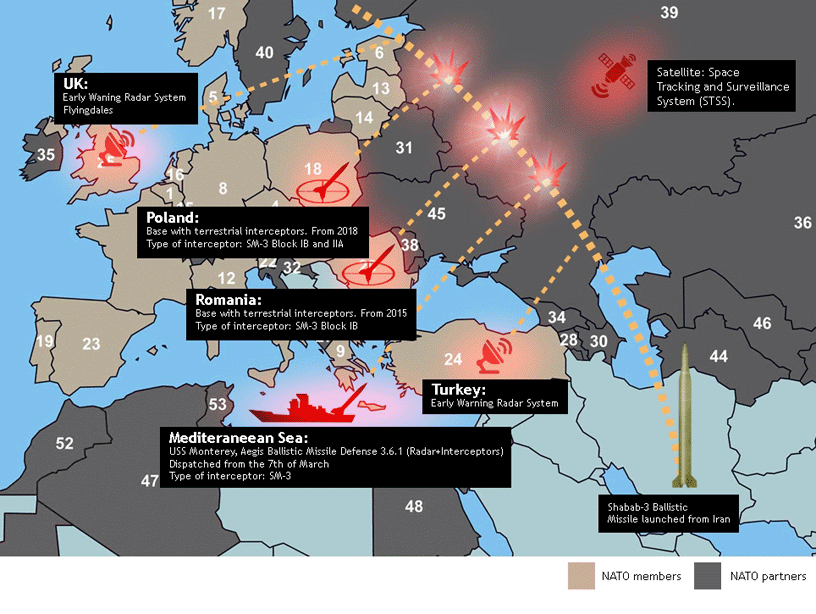
Russia proposes US returns American nuclear weapons from NATO countries stateside https://tass.com/politics/1394065, 28 Jan 22,
According to Vladimir Yermakov, “currently there are about 200 American nuclear air bombs of the B61 family” in five non-nuclear NATO countries
MOSCOW, January 27. /TASS/. Moscow proposed to Washington to return all American nuclear weapons from NATO countries to US territory in the context of reviewing security guarantees, Director of the Russian Foreign Ministry’s Department for Nonproliferation and Arms Control Vladimir Yermakov said in an interview with TASS.
We insist that NATO’s ‘joint nuclear missions’ should be stopped immediately, all the American nuclear weapons be returned to US national territory and the infrastructure that allows their rapid deployment should be eliminated. This aspect is one of the elements of the package of measures proposed by us to Washington in the context of considering the issues of security guarantees,” he said.
According to the diplomat, “currently there are about 200 American nuclear air bombs of the B61 family” in five non-nuclear NATO countries. Thus, the alliance is capable of rapidly deploying nuclear weapons able to reach strategic targets on Russian territory. “[NATO countries] also retain the infrastructure ensuring rapid deployment of these [nuclear] weapons capable of reaching Russian territory and striking a wide range of targets, including strategic ones,” he pointed out.
On December 17, 2021, the Russian Foreign Ministry published draft agreements between Moscow and Washington on security guarantees and the measures of ensuring the security of Russia and NATO member states. The proposed measures include guarantees that NATO will not advance eastward, including the accession of Ukraine and other countries into the alliance, as well as the non-deployment of serious offensive weapons, including nuclear ones. On January 26, the US and NATO submitted to Russia their written response to Moscow’s proposal on security guarantees.
U.S. and Russian Threats Over Ukraine—What They’re About

“It’s a noble principle, just not one the United States abides by. The United States has exercised a sphere of influence in its own hemisphere for almost 200 years, since President James Monroe declared that the United States ‘should consider any attempt’ by foreign powers ‘to extend their system to any portion of this hemisphere as dangerous to our peace and safety’.”.
Blinken wants a one-way street where spheres of influence are concerned. The U.S., for him, has the right to wield influence everywhere, while others don’t.
STRIPPING AWAY THE BULLS**T: U.S. and Russian Threats Over Ukraine—What They’re About and Who’s the Aggressor, Covert Action Magazine By Dee Knight – January 25, 2022 Threats and counter-threats flying between Washington and Moscow over Ukraine have caused a flurry of fear and confusion that escalates and expands daily. Is the world on the brink of war? What is it about, who is the aggressor and who is to blame?
The dangerous standoff has lasted for most of a year. Each side accuses the other of threatening war—in a way reminiscent of the Cuban missile crisis of 1962.
During a week of intense diplomatic meetings in three European capitals, which appeared to reach a dead end, President Joe Biden seemed to “blink” midweek, on January 19, telling reporters in Washington he had indicated to Russian President Putin that “we can work out something.”
New York Times senior reporter David Sanger jumped on it: “Mr. President, it sounds like you’re offering some way out here, some off-ramp—an informal assurance that NATO is not going to take in Ukraine… and we would never put nuclear weapons there.” Sanger went on to say Russia “wants us to move all of our nuclear weapons out of Europe and not have troops rotating through the old Soviet bloc.” Biden quickly said “No, there’s not space for that.”
Biden’s blink was a break in the warlike atmosphere that has prevailed endlessly. Katrina van den Heuvel wrote the day before in The Washington Post that “Hotheads [were] having a field day. A White House task force that includes the CIA [was] reportedly contemplating U.S. support for a guerrilla war if Russia seizes Ukraine; Russian hawks talk of a military deployment to Cuba and Venezuela.” Biden had “installed a team of national security managers from the ‘Blob,’ marinated in successive debacles in Iraq, Libya, Syria, Yemen and more.”
Guns and sanctions are the U.S. empire’s preferred options, van den Heuvel said: “with about 800 military bases outside the United States,” the U.S. has “more bases than diplomatic missions. (Russia’s only military bases outside the former Soviet Union are in Syria.)” She added that Secretary of State Blinken and the Blob “talk about a rules-based international order but respect it only if we make the rules, often exempting ourselves from their application.”
Spheres of influence?
“When will the U.S. stop lying to itself about global politics?” asked CUNY Professor Peter Beinart, writing in the New York Times on January 13. He took issue with Secretary of State Antony Blinken, who pontificated last month that “One country does not have the right to dictate the policies of another or to tell that country with whom it may associate; one country does not have the right to exert a sphere of influence. That notion should be relegated to the dustbin of history.”
Beinart commented: “It’s a noble principle, just not one the United States abides by. The United States has exercised a sphere of influence in its own hemisphere for almost 200 years, since President James Monroe declared that the United States ‘should consider any attempt’ by foreign powers ‘to extend their system to any portion of this hemisphere as dangerous to our peace and safety’.”………….
Blinken wants a one-way street where spheres of influence are concerned. The U.S., for him, has the right to wield influence everywhere, while others don’t.
The same day Biden blinked, French President Macron weighed in saying war would be the “most tragic thing of all.” Speaking in the European Union’s capital of Strasbourg, as new interim EU chair, Macron said he hoped to revitalize the four-way “Normandy format” talks between Russia, Germany, France and Ukraine to find a solution to the Ukraine crisis. “It is vital that Europe has its own dialogue with Russia,” Macron said. The EU had no part in the talks last week between Russia, the U.S., NATO and the Organization for Security and Cooperation in Europe (OSCD).
The Normandy format has been a vehicle for implementing the 2015 Minsk agreements designed to end the separatist war in Ukraine’s Donbas region. This solution has already been proposed and accepted in principle, according to Anatol Lieven, who wrote in The Nation that the Minsk II agreement was already adopted by France, Germany, Russia and Ukraine in 2015, and endorsed unanimously by the UN Security Council.
Key elements of the Minsk II deal are full autonomy for Ukraine’s eastern regions in the context of decentralization of power in Ukraine, demilitarization, and restoration of Ukrainian sovereignty. Despite agreement by all parties, political analyst Anatol Lieven says “because of the refusal of Ukrainian governments to implement the solution and refusal of the United States to put pressure on them to do so,” the settlement is a kind of “zombie policy.”
The issue of NATO expansion is another “zombie policy” as the U.S. refuses to acknowledge Russia’s legitimate opposition to it.
After the first of three negotiating sessions between the U.S. and Russia during the week of January 10, Russian Deputy Foreign Minister Sergei Ryabkov had declared it “absolutely mandatory” that Ukraine “never, never, ever” become a NATO member. In response, U.S. Deputy Secretary of State Wendy Sherman said: “we will not allow anyone to slam closed NATO’s open-door policy.”……………………..
US Undersecretary of State Victoria Nuland helped orchestrate the 2014 coup in Kyiv, the Ukrainian capital, that toppled a government friendly to Russia. The new far-rightist government ended language rights for Russian speakers who are the majority in the Ukraine’s eastern provinces. Donetsk and Lugansk voted to separate, as did Crimea. Russia then annexed Crimea, to protect Russian speakers there and secure its Black Sea naval base. Russia provided humanitarian aid and trade to Donetsk and Lugansk, and stationed troops on their eastern border for protection.
“Pro-Democracy Protests” or a Fascist Coup?
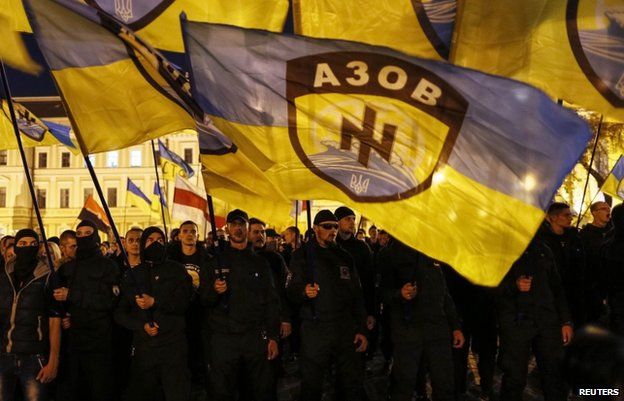
A New York Times report on January 6 said “Russia intervened militarily in Ukraine in 2014 after pro-democracy protests erupted there.” [Emphasis added.] The coup was actually carried out by fascist gangs, according to a May 2, 2018, report in The Nation by Stephen Cohen.
The gangs, including self-declared neo-Nazis, were encouraged by Nuland, Biden and other prominent U.S. politicians. The neo-Nazis were integrated into Ukraine’s official military which, since 2014, has been trained, armed and reorganized by the U.S., Britain, Canada and other NATO countries.
Stephen Cohen wrote that “the pogrom-like burning to death of ethnic Russians and others in Odessa later in 2014 reawakened memories of Nazi extermination squads in Ukraine during World War II.” These horrors have been all but deleted from the American mainstream narrative, despite being well-documented.
Cohen added that “stormtroop-like assaults on gays, Jews, elderly ethnic Russians, and other ‘impure’ citizens are widespread throughout Kyiv-ruled Ukraine, along with torchlight marches reminiscent of those that eventually inflamed Germany in the late 1920s and 1930s… The police and official legal authorities do virtually nothing to prevent these neo-fascist acts or to prosecute them. On the contrary, Kyiv has officially encouraged them by systematically rehabilitating and even memorializing Ukrainian collaborators with Nazi German extermination pogroms and their leaders during World War II, renaming streets in their honor, building monuments to them, rewriting history to glorify them, and more.”
The people of the self-declared people’s republics of Donetsk and Lugansk in eastern Ukraine suffer under a complete economic blockade by Ukraine and its Western allies. Historically known as the Donbass region, eastern Ukraine is a mining and industrial center. Donbass miners played a crucial and heroic role in the defeat of the German invasion of the Soviet Union in World War II. Many Russians revere the Donbass as “the heart of Russia.”
All of Ukraine east of the Dnieper river is predominantly Russian-speaking. U.S. claims of a “Russian invasion” are reminiscent of claims of North Vietnamese invasion of South Vietnam after the artificial separation of Vietnam in 1954. The entire U.S. narrative about Ukraine is a cynical fabrication designed to justify aggression.
Russian Security Proposals
In mid-December Russia took a diplomatic initiative and presented a list of security proposals to the United States. According to the Wall Street Journal, they include ending NATO’s expansion further eastward to include Ukraine, a promise for each side to refrain from hostile activities, and an end to NATO military activities in all of Eastern Europe, Transcaucasia and Central Asia……….
Among the “severe consequences” threatened by the U.S. against Russia, the Financial Times has said sanctioning Russia’s Nord Stream 2 gas pipeline to Germany was “top of the list.” Western Europe is already facing an energy crunch, with skyrocketing prices for natural gas.
Europeans need energy security and are wary of war. They want the Nord Stream 2 pipeline as soon as possible, while the Biden administration calls it a “bad deal” and claims that it makes Europe vulnerable to Russian “treachery.” Texas Senator Ted Cruz has pressed hard against the pipeline, which offsets opportunities for U.S. energy companies to supply gas to the European market. U.S. foreign adventures have often constricted Europe’s energy sources.
A 2021 survey by the European Council on Foreign Affairs found that most Europeans want to remain neutral in any U.S. war against Russia or China. But new NATO member-states align with the U.S. against Russia. They have installed terminals to receive U.S. liquid natural gas deliveries, to reduce dependence on Russian gas.
Despite all the diplomatic efforts, powerful institutional and economic forces in the U.S.—the military industrial complex and big energy companies among others—are eager for a new Cold War with Russia, which would provide them with boundless opportunities for profitable deals. “The U.S. military-industrial complex needs enemies like human lungs need oxygen,” the saying goes. “When there are no enemies, they must be invented.”
The demonization of Vladimir Putin and Russia by the U.S. media is part of this policy of inventing enemies. There is a long list of foreign leaders and nations whose attempts to defy the dictates of Washington and pursue an independent foreign policy have brought down upon them the wrath of the U.S. Capitalist Empire.https://covertactionmagazine.com/2022/01/25/stripping-away-the-bullst-u-s-and-russian-threats-over-ukraine-what-theyre-about-and-whos-the-aggressor/
Russia’s nuclear powered container ship is sailing into thick ice.
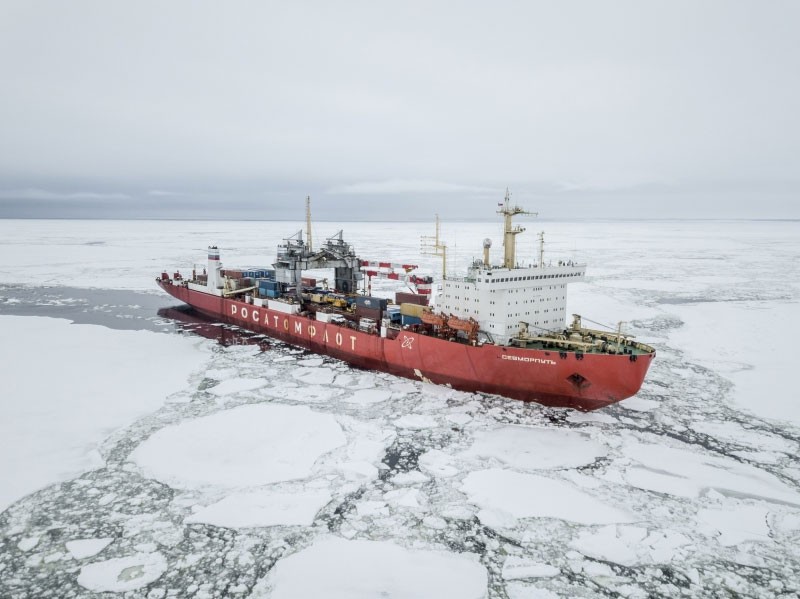
Russia’s nuclear powered container ship is sailing into thick ice, Barents Observer By
Atle Staalesen, 26 Jan 22,
The “Sevmorput” joins a convoy of vessels that will break its way across the Northern Sea Route. The 260 meter long nuclear-powered vessel early this week sailed thought the Bering Strait and into the Chukchi Sea. A thick layer of sea-ice covers the remote waters that mark the eastern end of the Northern Sea Route.
It is a rough voyage, even for a ship that is designed for sailing in up to a meter thick ice. After this winter’s early freeze, there is now a solid layer of fast ice along Russia’s Arctic coasts, and the waters of the East Siberian, Laptev and Kara Seas have up to 2 meter thick sea-ice……….
The Sevmorput is escorted by nuclear-powered icebreaker Yamal. In the convoy is also heavy loads carrier Audax, as well as conventional icebreaker Kapitan Dranitsyn.
Both the Sevmorput and Audax have Murmansk as their destination.
Also nuclear-powered icebreaker Arktika might ultimately join the convoy. The new Russian icebreaker in late January completed its escort of cargo ship Lev Yashin, and will soon turn back to the Chukchi Sea.
Consequently, there might in only few days be three nuclear-powered vessels at the same time in the east Arctic waters……………..
Just a reminder. Russia did not INVADE Crimea.

Bruce Gagnon, 21 Jan 22, Russia did not invade Crimea. They had a long-term lease with Ukraine that allowed over 20,000 military personnel at the Russian navy and air bases there.
The Russian-ethnic people of Crimea self-organized a referendum and voted 96% to seek to rejoin Russia. They saw the 2014 Nazi-led take over in Kiev during the US orchestrated coup and wanted nothing to do with the ‘new Ukraine’ regime.
See this excellent film produced by Oliver Stone https://vimeo.com/252426896?ref=fb-share
Stranded in Vladivostok: KIMO International and NFLA express concern at mysterious plight of Russian nuclear-powered freighter

Richard Outram, KIMO International, 19th January 2022,
KIMO International and the UK/Ireland Nuclear Free Local Authorities, two organisations campaigning for pollution-free oceans have expressed their concerns at the possible danger posed to the marine environment by a Russian nuclear-powered freighter stranded in the Russian Far East.
The Sevmorput (or Northern Sea Route) is the sole survivor of Russia’s original fleet of four nuclear powered cargo ships which traversed the Arctic trade routes. Sevmorput has now been operational for over thirty years, and though refitted within the last decade, is showing her age with recent voyages plagued by mechanical breakdowns. Her latest transit of the Northern Sea Route which links North Western Russia to Eastern Siberia ended badly.
The Sevmorput was ordered in 1978 and was completed more than a decade later. With a maximum seasonal displacement of 62,000 tons and 260 metres in length, the ship is powered by a single 135 MWt reactor at a maximum speed of 21 knots. With an ice-breaking capacity, the ship can pass through 1 metre thick ice at a speed of 2 knots.
Operated by the Murmansk Shipping Company for her first twenty years of service, the Sevmorput was transferred to ATOMFLOT, the mercantile marine subsidiary of ROSATOM, Russia’s State Atomic Energy Corporation, in 2008.
In early November 2021 the Sevmorput set sail from western Russia to Vladivostok, via the Arctic with a cargo of reactor parts, intended for transshipment to another vessel for onward transport to the Rooppur nuclear project in Bangladesh. The Rooppur plant is being built under contract by ROSATOM. During the passage, sea ice conditions worsened, but the Sevmorput, with nuclear propulsion and its ice-breaking capability, was able to battle through to Vladivostok.
Other shipping was less fortunate with a significant number of vessels becoming frozen fast in the Arctic, necessitating rescue by ROSATOM’s fleet of nuclear-powered ice breakers. Amongst them were ships carrying supplies to the copper and gold mines and processing plants at Pevek in the remote Chukotka region of Eastern Siberia and undefined spare parts and equipment for the Russian floating nuclear power plant, the Akademik Alexander Lomonosov which supplies Pevek with its heat and power; these cargoes remained undelivered.
In a response to the set-back, ROSATOM assigned the Sevmorput to hasten back to Murmansk, collect the supplies for Pevek and deliver them by early January. The ship was unable to carry out the assignment and it fell instead to ROSATOM’s newest icebreaker Arktica, escorting three cargo ships, to carry out this task.
For unexplained reasons, the Sevmorput has remained moored and immobile for almost two months, first at Nakohodka around 85 kms away from Vladivostok and then from early January anchored in an offshore ‘dry cargo holding area’ about 10kms away from the port. Here she is being attended to by another mysterious Russian vessel, identified only as ‘SPK-44150’, which has moored alongside the freighter.
ROSATOM has not explained why the Sevmorput was unable to sail to Pevek and has made no statement as to why the Sevmorput has been immobile for so long or about her current condition.
Commenting, Councillor Jerry Ahlström, President of KIMO International, said:
“Any leaks of radioactive material at sea will enter the marine environment where containment and remediation are near impossible. The lack of transparent emergency planning in the event of a marine accident involving nuclear materials and the question of liability and compensation in the event of a nuclear accident at sea raises huge concerns for KIMO’s coastal authority members.
“The consistent lack of decision-making input, of consultation and of information and transparency on shipping routes means they are left facing a real and present risk of harm that disempowers the very communities who health and livelihoods depend upon the sea.”
Commenting, Councillor David Blackburn, Chair of the NFLA Steering Committee, said:
“The NFLA is concerned that the immobility and isolation of this nuclear-powered vessel away from prying eyes for so long might indicate that there has been some kind of nuclear accident on board or that the vessel has suffered some equipment failure that seriously compromises nuclear safety on the ship.
“Our fear is of course that such a scenario might lead to an escape of radioactive materials into the atmosphere or into our oceans, where currents might carry it to distant shores compromising the health of the Pacific environment or its inhabitants. It would be helpful if ROSATOM made a statement about the condition of this vessel and the mysterious activities of the SPK-44150’. For more information please contact: Richard Outram, Secretary, NFLA email Richard.outram@manchester.gov.uk / mobile 07583 097793
The websites for both organisations can be found at:
KIMO International
Nuclear Free Local Authorities
1 This Month

of the week – Shut Down Drone Warfare!


Tell the Ukrainian Government to Drop Prosecution of Peace Activist Yurii Sheliazhenko

Petition to revoke the licensing of the Near Surface Nuclear Disposal Facility (NSDF) at Chalk River. https://www.ourcommons.ca/petitions/en/Petition/Details?Petition=e-7247
To see nuclear-related stories in greater depth and intensity – go to https://nuclearinformation.wordpress.com
-
Archives
- April 2026 (57)
- March 2026 (251)
- February 2026 (268)
- January 2026 (308)
- December 2025 (358)
- November 2025 (359)
- October 2025 (376)
- September 2025 (257)
- August 2025 (319)
- July 2025 (230)
- June 2025 (348)
- May 2025 (261)
-
Categories
- 1
- 1 NUCLEAR ISSUES
- business and costs
- climate change
- culture and arts
- ENERGY
- environment
- health
- history
- indigenous issues
- Legal
- marketing of nuclear
- media
- opposition to nuclear
- PERSONAL STORIES
- politics
- politics international
- Religion and ethics
- safety
- secrets,lies and civil liberties
- spinbuster
- technology
- Uranium
- wastes
- weapons and war
- Women
- 2 WORLD
- ACTION
- AFRICA
- Atrocities
- AUSTRALIA
- Christina's notes
- Christina's themes
- culture and arts
- Events
- Fuk 2022
- Fuk 2023
- Fukushima 2017
- Fukushima 2018
- fukushima 2019
- Fukushima 2020
- Fukushima 2021
- general
- global warming
- Humour (God we need it)
- Nuclear
- RARE EARTHS
- Reference
- resources – print
- Resources -audiovicual
- Weekly Newsletter
- World
- World Nuclear
- YouTube
-
RSS
Entries RSS
Comments RSS
 nuclear-news