Spectral Threats: China, Russia and Trump’s Greenland Rationale

Were Russia or China to attempt an occupation of Greenland through military means, Article V of the North Atlantic Treaty would come into play, obliging NATO member states, including the United States, to collectively repel the effort.
“There are no Russian and Chinese ships all over the place around Greenland,”
“Russia and/or China has no capacity to occupy Greenland or to take control over Greenland.”
14 January 2026 Dr Binoy Kampmark, https://theaimn.net/spectral-threats-china-russia-and-trumps-greenland-rationale/
The Trump administration’s mania about Greenland, a self-governing territory of Denmark, is something to behold. Its untutored thuggery, its brash assertiveness, and the increasingly strident threats to either use force, bully Denmark into a sale of the island, or simply annex the territory, have officials and commentators scrambling for theories and precedents. The Europeans are terrified that the NATO alliance is under threat from another NATO member. The Greenlanders are anxious and confused. But the ground for further action by Washington is being readied by finding threats barely real and hardly plausible.
The concerns about China and Russia seizing Greenland retells the same nonsense President Donald Trump promoted in kidnapping the Venezuelan President Nicolás Maduro and his wife. Looking past the spurious narcoterrorism claims against the former leader, it fell to the issue of who would control the natural resources of the country. If we don’t get Venezuelan oil now and secure it for American companies, the Chinese or the Russians will. he gangster’s rationale is crudely reductionist, seeing all in a similar veinThe obsession with Beijing and Moscow runs like a forced thread through a dotty, insular rationale that repels evidence and cavorts with myth: “We need that [territory],” reasons the President, “because if you take a look outside Greenland right now, there are Russian destroyers, there are Chinese destroyers and, bigger, there are Russian submarines all over the place. We are not gonna have Russia or China occupy Greenland, and that’s what they’re going to do if we don’t.” On Denmark’s military capabilities in holding the island against any potential aggressor, Trump could only snort with macho dismissiveness. “You know what their defence is? Two dog sleds.”
This scratchy logic is unsustainable for one obvious point. Were Russia or China to attempt an occupation of Greenland through military means, Article V of the North Atlantic Treaty would come into play, obliging NATO member states, including the United States, to collectively repel the effort. With delicious perversity, any US effort to forcibly acquire the territory through use of force would be an attack on its own security, given its obligations under the Treaty. In such cases, it becomes sound to assume, as the Danish Prime Minister Mette Frederiksen does, that the alliance would cease to exist.
Such matters are utterly missed by the rabidly hawkish Deputy Chief of Staff Stephen Miller, who declared that, “Nobody’s going to fight the United States militarily over the future of Greenland.” It was up to the US “to secure the Arctic region, to protect and defend NATO and NATO interests” in incorporating Greenland. To take territory from a NATO ally was essentially doing it good.
Given that the United States already has a military presence on the island at the Pituffik Space Base, and rights under the 1951 agreement that would permit an increase in the number of bases should circumstances require it, along with the Defence Cooperation Agreement finalised with Copenhagen in June 2025, much of Miller’s airings are not merely farcical but redundant. Yet, Trump has made it clear that signatures and understandings reflected in documents are no substitute for physically taking something, the thrill of possession that, by its act, deprives someone else of it. “I think ownership gives you a thing that you can’t do, whether you’re talking about a lease or a treaty,” he told the New York Times. “Ownership gives you things and elements that you can’t get from just signing a document.”
What, then, of these phantom forces from Moscow and Beijing, supposedly lying in wait to seize the frozen prize? “There are no Russian and Chinese ships all over the place around Greenland,” states the very convinced research director of the Oslo-based Fridtjof Nansen Institute, Andreas Østhagen. “Russia and/or China has no capacity to occupy Greenland or to take control over Greenland.”
Danish Foreign Minister Lars Lokke Rasmussen is similarly inclined. “The image that’s being painted of Russian and Chinese ships right inside the Nuuk fjord and massive Chinese investments being made is not correct.” Senior “Nordic diplomats” quoted in the Financial Times add to that version, even if the paper is not decent enough to mention which Nordic country they come from. “It is simply not true that the Chinese and Russians are there,” said one. “I have seen the intelligence. There are no ships, no submarines.” Vessel tracking data from Marine Traffic and LSEG have so far failed to disclose the presence of Chinese and Russian ships near the island.
Heating engineer Lars Vintner, based in Greenland’s capital, Nuuk, wondered where these swarming, spectral Chinese were based. “The only Chinese I see,” he told Associated Press,“ is when I go to the fast food market.” This sparse presence extends to the broader security footprint of China in the Arctic, which remains modest despite a growing collaboration with Russia since the 2022 invasion of Ukraine. These have included Arctic and coast guard operations, while the Chinese military uses satellites and icebreakers equipped with deep-sea mini submarines, potentially for mapping the seabed.
However negligible and piffling the imaginary threat, analysts, ever ready with a larding quote or a research brief, are always on hand to show concern with such projects as Beijing’s Polar Silk Road, announced in 2018, which is intended as the Arctic extension of its transnational Belt and Road initiative. The subtext: Trump should not seize Greenland, but he might have a point. “China has clear ambitions to expand its footprint and influence in the region, which it considers… an emerging arena for geopolitical competition.” Or so says Helena Legarda of the Mercator Institute for China Studies in Berlin.
The ludicrous nature of Trump’s claims and acquisitive urges supply fertile material for sarcasm. A prominent political figure from one of the alleged conquerors-to-be made an effort almost verging on satire. “Trump needs to hurry up,” mocked the Deputy Chairman of the Russian Security Council and former President Dmitry Medvedev. “According to unverified information, within a few days, there could be a sudden referendum where all 55,000 residents of Greenland might vote to join Russia. And that’s it!” With Trump, “that’s it” never quite covers it.
The Non-Peaceful Atom
Vladimir Slivyak, January 7, 2026, https://www.posle.media/article/the-non-peaceful-atom
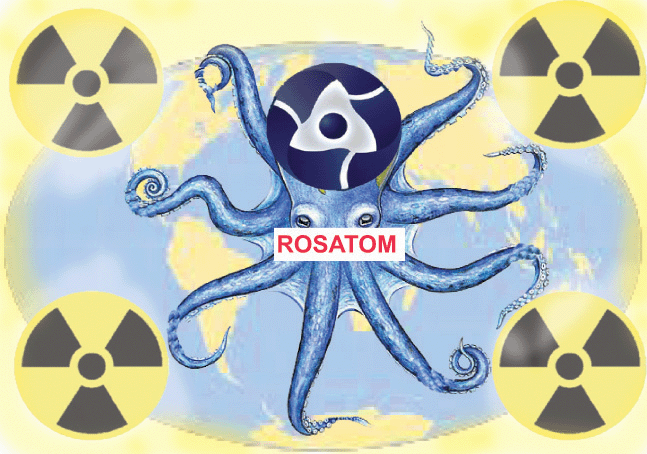
In what ways does Russia use nuclear energy as a strategic tool? Why have sanctions failed to end Europe’s dependence on the Russian nuclear industry? How is Rosatom involved in the war? Vladimir Slivyak, co-chair of the Eco-Defense group, answers these questions
As a strategic instrument of the Kremlin, Rosatom helps to create and entrench geopolitical dependencies. This dependence rests on the promotion of nuclear energy but has ramifications that extend far beyond the energy sector. Rosatom is both directly and indirectly involved in Russia’s war against Ukraine. In particular, Rosatom played a key role in Russia’s seizure of the Zaporizhzhia nuclear power plant and has offered to procure materials and components for Russian arms manufacturers under sanctions.
Nevertheless, the European nuclear industry continues to collaborate with Rosatom. For instance, Rosatom supplies uranium to Framatome’s ANF nuclear fuel plant in Lingen, Germany. Rosatom is also involved in expanding this facility, even though the German authorities have not yet approved such cooperation. If the Framatome-Rosatom project, which has been in development for over three years, goes ahead, the Russian regime will further strengthen its political influence in Western Europe despite the war in Ukraine.
Rosatom as a Civil-Military State Corporation
Rosatom is a state-owned corporation that operates in both the civilian and military spheres of nuclear energy and nuclear weapons. As the successor to Russia’s Ministry of Atomic Energy, Rosatom brings together over 350 companies engaged in nuclear activities. The corporation was created by a decree by Russian President Vladimir Putin in 2007.
Rosatom is directly owned by the Russian state. It is one of seven Russian “state corporations,” grouped together with Rostec, Roscosmos, and others. In 2012, former Prime Minister Dmitry Medvedev described Rosatom as a “corporation of a special kind” that not only seeks to expand its activities but also carries out “certain ministerial tasks.”
The corporation’s Supervisory Board is its main decision-making body. This board includes Sergey Kirienko, the deputy head of the Russian presidential administration, who is currently under sanctions from the EU, the UK, and the US, as well as Sergei Korolev, the first deputy director of the Federal Security Service of the Russian Federation (the main successor to the Soviet KGB). In relation to the war in Ukraine, Korolev has also been sanctioned by the EU, Australia, Canada, New Zealand, Switzerland, the UK, and Ukraine. The Supervisory Board also includes two Russian deputy prime ministers and two aides to President Vladimir Putin.
The European Parliament has repeatedly called for sanctions on Rosatom and for an end to all nuclear cooperation with Russia, including uranium imports and investments in critical infrastructure.
Participation in the War
Since Russia’s full-scale invasion of Ukraine began, Rosatom has been directly and indirectly involved in the war. According to a letter obtained by Ukrainian intelligence and published in the American press, Rosatom offered assistance to the Russian arms industry in securing goods needed for the production of weapons, tanks, and aircraft after that sector had been hit by international sanctions.
In his December 2022 address to Rosatom on the occasion of its 15th anniversary, President Vladimir Putin praised the corporation for its “enormous contribution to the development and deployment of advanced weapons systems and military equipment.”
In the early days of the invasion, Rosatom employees assisted Russian troops who occupied the Chernobyl exclusion zone in Ukraine. The Russian state corporation also facilitated the illegal seizure of Ukraine’s Zaporizhzhia Nuclear Power Plant. Rosatom employees have taken over key management positions at the facility. Following a decree by the Russian president, Rosatom created a new subsidiary specifically tasked with taking control of the plant.
In October 2023, Ukrainian nuclear operator Energoatom reported that the safety culture at the plant was deteriorating under Rosatom’s control. This deterioration included poorly performed work, insufficient staffing, and inadequate inspections. The company stated that these problems had led to significant damage to critical components of the Zaporizhzhya Nuclear Power Plant (NPP), including leaks in the radioactive primary coolant circuit. There is also credible evidence that Rosatom employees assisted the Russian military in selecting targets at the Zaporizhzhya NPP; they reportedly “helped direct Russian artillery fire at the plant.”
Rosatom as a Geopolitical Tool
Rosatom is a central player in the Russian regime’s “geopolitics.” The company’s goal is to make as many countries as possible dependent on Russian nuclear technology, services, and fuel. Rosatom purchases essential equipment for nuclear reactors under construction from European companies and supplies the EU with unenriched and enriched uranium, fuel, and other nuclear services. This cooperation helps fund the continuation of the war in Ukraine. It also locks Europe into dependence on Russian nuclear fuel and services, which ultimately translates into political influence.
Hungary is perhaps the clearest example. It is almost entirely dependent on Russia for nuclear energy services and has repeatedly blocked any attempt by the EU to impose sanctions on Rosatom. Russia controls the supply of nuclear fuel and the maintenance of existing Hungarian reactors and has provided a €10 billion loan for the construction of Paks-2 nuclear power plant. In addition, Siemens Energy and Framatome are providing key equipment and control systems for new Russian-made reactors in Hungary.
Rosatom states that it is currently building more than 30 new reactors in about a dozen countries. Last year, its subsidiaries exported approximately $2.2 billion worth of nuclear energy-related goods and materials. The Russian state budget covers more than 90% of the cost of Rosatom’s construction of new nuclear power plants around the world.
Rosatom has signed agreements with nearly 20 African countries to build nuclear power plants and research reactors. So far, however, only one plant is actually under construction: the Al Dabaa plant in Egypt. Rosatom has also purchased a uranium mine in Tanzania. A previous attempt to build a nuclear power plant in South Africa collapsed due to resistance from environmental activists. In South America, Rosatom is involved in smaller but still significant projects, such as a research reactor and lithium mining in Bolivia.
Despite Russia’s war in Ukraine, the French nuclear company Framatome continues to purchase uranium from Rosatom. Between 2022 to 2023, at least ten shipments of uranium went from Russia to the ANF nuclear fuel plant in Lingen, a Framatome subsidiary. According to the German government, these deliveries took place under two federal government licenses issued in September, November, and December 2022, as well as in April and May 2023. In August 2023, German authorities granted a new license authorizing up to 40 more shipments. Deliveries are still ongoing.
Prospects
In the four years since Russia’s full-scale invasion began, the EU has adopted nearly twenty packages of sanctions against the Russian economy and industry. Other countries, including the United States, the United Kingdom, Canada, and Japan, have also imposed sanctions. However, Russia has faced virtually no pressure in the field of nuclear energy, one of its key sectors with both civilian and military significance. On the contrary, Rosatom has expanded its operations and almost tripled its profits from trade with Western countries.
Europe’s dependence on Russia in the nuclear sphere is roughly comparable to its reliance on pipeline gas supplies before the war. First, Putin used gas deliveries as leverage over Europe, and then the Russian pipeline was destroyed in an act of sabotage. Without these developments, we would now likely be talking about the EU’s crippling dependence on Russia for both uranium and pipeline gas. In such a situation, it is reasonable to assume that Ukraine would not have been able to rely on the level of support it currently enjoys in Europe.
This dependence on Russian supplies did not arise by a happy accident for Moscow but from strategic steps the Russian regime has taken over the past 10–15 years. It is not known for certain whether Putin had been planning a full-scale war throughout this entire period. However, it is clear that making Europe’s economy as dependent as possible on Russian energy supplies was one of Moscow’s strategic priorities. Under this strategy, many European countries were meant to end up in the position Hungary finds itself in today.
As a result of the war in Ukraine, Europe’s dependence on Russian supplies has fallen sharply, though it has not disappeared. For instance, Germany, the EU’s largest economy, no longer relies on Russian pipeline gas. The fight against the “shadow fleet” transporting Putin’s oil to fund the war is under way, albeit with mixed results. Furthermore, Russian coal has been completely banned from Europe. Russia’s coal industry, one of the most profitable, is currently in a deep crisis — direct evidence that Russia has been unable to offset the consequences of Europe’s refusal to buy Russian coal. Even in the nuclear energy sector, the least affected by sanctions, there have been notable shifts. For instance, Finland has abandoned plans to build a major nuclear power plant with Russian involvement. In several cases, European companies have been unable to supply Rosatom with equipment for its projects in other countries.
Unfortunately, efforts to reduce dependence on Russian uranium are progressing extremely slowly, and there is still no clear timeline for this process. A full break with Russian uranium in the foreseeable future seems unlikely, especially if Hungary goes ahead with a new nuclear power plant project involving Rosatom. Russia is also trying to increase its liquefied natural gas exports to Europe. However, it now seems unlikely that European authorities will once again allow a situation in which Vladimir Putin can make their economies dependent on Russia.
Rosatom is arguably the biggest Russian thorn in Europe’s flesh today, and half-measures won’t remove it. A “surgical extraction” would cause severe and painful shocks to the economies — and, in turn, the politics — of several EU member states. The problem is not that the threat is underestimated; Europe understands it perfectly well. The issue is that freeing itself from this nuclear dependence would require enormous time and effort. The question is: will there be enough of either?
Plunging Toward Armageddon: U.S. and Russia on the Brink of a New Nuclear Arms Race

Beginning on February 6th, Russian and American leaders will face no barriers whatsoever to the expansion of those arsenals or to any other steps that might increase the danger of a thermonuclear conflagration.
Both the United States and Russia have already committed vast sums to the “modernization” of their nuclear delivery systems
By Michael Klare. 8 Jan 26, https://tomdispatch.com/plunging-into-the-abyss/
Plunging Into the Abyss. Will the U.S. and Russia Abandon All Nuclear Restraints?
For most of us, Friday, February 6, 2026, is likely to feel no different than Thursday, February 5th. It will be a work or school day for many of us. It might involve shopping for the weekend or an evening get-together with friends, or any of the other mundane tasks of life. But from a world-historical perspective, that day will represent a dramatic turning point, with far-reaching and potentially catastrophic consequences. For the first time in 54 years, the world’s two major nuclear-weapons powers, Russia and the United States, will not be bound by any arms-control treaties and so will be legally free to cram their nuclear arsenals with as many new warheads as they wish — a step both sides appear poised to take.
It’s hard to imagine today, but 50 years ago, at the height of the Cold War, the U.S. and Russia (then the Soviet Union) jointly possessed 47,000 nuclear warheads — enough to exterminate all life on Earth many times over. But as public fears of nuclear annihilation increased, especially after the near-death experience of the 1962 Cuban Missile Crisis, the leaders of those two countries negotiated a series of binding agreements intended to downsize their arsenals and reduce the risk of Armageddon.
The initial round of those negotiations, the Strategic Arms Limitation Talks I, began in November 1969 and culminated in the first-ever nuclear arms-limitation agreement, SALT-I, in May 1972. That would then be followed in June 1979 by SALT-II (signed by both parties, though never ratified by the U.S. Senate) and two Strategic Arms Reduction Treaties (START I and START II), in 1991 and 1993, respectively. Each of those treaties reduced the number of deployed nuclear warheads on U.S. and Soviet/Russian intercontinental ballistic missiles, submarine-launched ballistic missiles, and long-range bombers.
In a drive to reduce those numbers even further, President Barack Obama and Russian President Dmitry Medvedev signed a New Strategic Arms Reduction Treaty (New START) in April 2010, an agreement limiting the number of deployed nuclear warheads to 1,550 on each side — still enough to exterminate all life on Earth, but a far cry from the START I limit of 6,000 warheads per side. Originally set to expire on Feb. 5, 2021, New START was extended for another five years (as allowed by the treaty), resetting that expiration date for February 5, 2026, now fast approaching. And this time around, neither party has demonstrated the slightest inclination to negotiate a new extension.
So, the question is: What, exactly, will it mean for New START to expire for good on February 5th?
Most of us haven’t given that a lot of thought in recent decades, because nuclear arsenals have, for the most part, been shrinking and the (apparent) threat of a nuclear war among the great powers seemed to diminish substantially. We have largely escaped the nightmarish experience — so familiar to veterans of the Cold War era — of fearing that the latest crisis, whatever it might be, could result in our being exterminated in a thermonuclear holocaust.
A critical reason for our current freedom from such fears is the fact that the world’s nuclear arsenals had been substantially diminished and that the two major nuclear powers had agreed to legally binding measures, including mutual inspections of their arsenals, meant to reduce the danger of unintended or accidental nuclear war. Together, those measures were crafted to ensure that each side would retain an invulnerable, second-strike nuclear retaliatory force, eliminating any incentive to initiate a nuclear first strike.
Unfortunately, those relatively carefree days will come to an end at midnight on February 5th.
Beginning on February 6th, Russian and American leaders will face no barriers whatsoever to the expansion of those arsenals or to any other steps that might increase the danger of a thermonuclear conflagration. And from the look of things, both intend to seize that opportunity and increase the likelihood of Armageddon. Worse yet, China’s leaders, pointing to a lack of restraint in Washington and Moscow, are now building up their own nuclear arsenal, only adding further fuel to the urge of American and Russian leaders to blow well past the (soon-to-be-abandoned) New START limits.
A Future Nuclear Arms Race?
Even while adhering to those New START limits of 1,550 deployed nuclear warheads, both Russia and the United States had taken elaborate and costly steps to enhance the destructive power of their arsenals by replacing older, less-capable intercontinental ballistic missiles (ICBMs), submarine-launched ballistic missiles (SLBMs), and nuclear bombers with newer, even more capable ones. As a result, each side was already becoming better equipped to potentially inflict catastrophic damage on its opponent’s nuclear retaliatory forces, making a first strike less inconceivable and so increasing the risk of precipitous escalation in a crisis.
The Russian Federation inherited a vast nuclear arsenal from the former Soviet Union, but many of those systems had already become obsolete or unreliable. To ensure that it maintained an arsenal at least as potent as Washington’s, Moscow sought to replace all of the Soviet-era weapons in its inventory with more modern and capable systems, a process still underway. Russia’s older SS-18 ICBMs, for example, are being replaced by the faster, more powerful SS-29 Sarmat, while its remaining five Delta-IV class missile-carrying submarines (SSBNs) are being replaced by the more modern Borei class. And newer ICBMs, SLBMs, and SSBNs are said to be in development.
At present, Russia possesses 333 ICBMs, approximately half of them deployed in silos and the other half on road-mobile carriers. It also has 192 SLBMs on 12 missile-carrying submarines and possesses 67 strategic bombers, each capable of firing multiple nuclear-armed missiles. Supposedly, those systems are currently loaded with no more than 1,550 nuclear warheads (enough, of course, to destroy several planets), as mandated by the New START treaty. However, many of Russia’s land- and sea-based ballistic missiles are MIRVed (meaning they’re capable of launching multiple independently targetable reentry vehicles) but not fully loaded, and so could carry additional warheads if a decision were ever made to do so. Given that Russia possesses as many as 2,600 nuclear warheads in storage, it could rapidly increase the number of deployed nuclear weapons at its disposal beginning on February 6, 2026.
Rather than confront such challenges, the leaders of both countries may instead choose to retain the New START limits voluntarily. Indeed, Vladimir Putin has already agreed to a one-year extension of this sort, if the United States is willing to do likewise. But pressures (which are bound to increase after February 5th) are also building to abandon those limits and begin deploying additional warheadsmost missile-tracking radars.
The United States is engaged in a comparable drive to modernize its arsenal, replacing older weapons with more modern systems. Like Russia, the U.S. maintains a “triad” of nuclear delivery systems — land-based ICBMs, submarine-launched SLBMs, and long-range bombers, each of which is now being upgraded with new warheads at an estimated cost over the next quarter century of approximately $1.5 trillion.
The existing New START-limited U.S. nuclear triad consists of 400 silo-based Minuteman-III ICBMs, 240 Trident-II SLBMs carried by 14 Ohio-class submarines (two of which are assumedly being overhauled at any time), and 96 strategic bombers (20 B-2s and 76 B-52s) armed with a variety of gravity bombs and air-launched cruise missiles. According to current plans, the Minuteman-IIIs will be replaced by Sentinel ICBMs, the Ohio-class SSBNs by Columbia-class ones, and the B-2s and B-52s by the new B-21 Raider bomber. Each of those new systems incorporates important features — greater accuracy, increased stealth, enhanced electronics — that make them even more useful as first-strike weapons, were a decision ever made to use them in such a fashion.
When initiated, the U.S. nuclear modernization project was expected to abide by the New START limit of 1,550 deployed nuclear warheads. After February 5th, however, the U.S. will be under no legal obligation to do so. It could quickly begin efforts to exceed that limit by loading all existing Minuteman-IIIs and future Sentinel missiles on MIRVed rather than single-warhead projectiles and loading the Trident missiles (already MIRVed) with a larger number of warheads, as well as by increasing production of new B-21s. The United States has also commenced development of a new delivery system, the nuclear-armed sea-launched cruise missile (SLCM-N), supposedly intended for use in a “limited” regional nuclear conflict in Europe or Asia (though how such a conflagration could be prevented from igniting a global holocaust has never been explained).
In short, after the expiration of the New START agreement, neither Russia nor the United States will be obliged to limit the numbers of nuclear warheads on their strategic delivery systems, possibly triggering a new global nuclear arms race with no boundaries in sight and an ever-increasing risk of precipitous nuclear escalation. Whether they choose to do so will depend on the political environment in both countries and their bilateral relations, as well as elite perceptions of China’s nuclear buildup in both Washington and Moscow.
The Political Environment
Both the United States and Russia have already committed vast sums to the “modernization” of their nuclear delivery systems, a process that won’t be completed for years. At present, there is a reasonably broad consensus in both Washington and Moscow on the need to do so. However, any attempt to increase the speed of that process or add new nuclear capabilities will generate immense costs along with significant supply-chain challenges (at a time when both countries are also trying to ramp up their production of conventional, non-nuclear arms), creating fresh political disputes and potential fissures.
Rather than confront such challenges, the leaders of both countries may instead choose to retain the New START limits voluntarily. Indeed, Vladimir Putin has already agreed to a one-year extension of this sort, if the United States is willing to do likewise. But pressures (which are bound to increase after February 5th) are also building to abandon those limits and begin deploying additional warheads.
In Washington, a powerful constellation of government officials, conservative pundits, weapons industry leaders, and congressional hawks is already calling for a nuclear buildup that would exceed the New START limits, claiming that a bigger arsenal is needed to deter both a more aggressive Russia and a more powerful China. As Pranay Vaddi, a senior director of the National Security Council, put it in June 2024, “Absent a change in the trajectory of the adversary arsenal, we may reach a point in the coming years where an increase from current deployed numbers is required, and we need to be fully prepared to execute if the president makes that decision.”
Those who favor such a move regularly point to China’s nuclear buildup. Just a few years ago, China possessed only some 200 nuclear warheads, a small fraction of the 5,000 possessed by both Russia and the U.S. Recently, however, China has expanded its arsenal to an estimated 600 warheads, while deploying more ICBMs, SLBMs, and nuclear-capable bombers. Chinese officials claim that such weaponry is needed to ensure retaliation against an enemy-first strike, but their very existence is being cited by nuclear hawks in Washington as a sufficient reason for the U.S. to move beyond the New START limits.
Russian leaders face an especially harsh quandary. At a moment when they are devoting so much of the country’s state finances and military-industrial capacities to the war in Ukraine, they face a more formidable and possibly expanded U.S. nuclear arsenal, not to mention the (largely unspoken) threat posed by China’s growing arsenal. Then there’s President Trump’s plan for building a “Golden Dome” missile shield, intended to protect the U.S. from any type of enemy projectile, including ICBMs — a system which, even if only partially successful, would threaten the credibility of Russia’s second-strike retaliatory capability. So, while Russia’s leaders would undoubtedly prefer to avoid a costly new arms buildup, they will probably conclude that they have little choice but to undertake one if the U.S. abandons New START.
Racing to Armageddon
Many organizations, individuals, and members of Congress are pleading with the Trump administration to accept Vladimir Putin’s proposal and agree to a voluntary continuation of the New START limits after February 5th. Any decision to abandon those limits, they argue, would only add hundreds of billions of dollars to the federal budget at a time when other priorities are being squeezed. Such a decision would also undoubtedly provoke reciprocal moves by Russia and China. The result would be an uncontrolled arms race and a rising risk of nuclear annihilation.
But even if Washington and Moscow were to agree to a one-year voluntary extension of New START, each would be free to break out of it at any moment. In that sense, February 6th is likely to bring us into a new era — not unlike the early years of the Cold War — in which the major powers will be poised to ramp up their nuclear war-fighting capabilities without any formal restrictions whatsoever. That comfortable feeling we once enjoyed of relative freedom from an imminent nuclear holocaust will also then undoubtedly begin to dissipate. If there is any hope in such a dark prognosis, it might be that such a reality could, in turn, ignite a worldwide anti-nuclear movement like the Ban the Bomb campaigns of the 1960s, 1970s, and 1980s. If only.
Russia-US nuclear pact set to end in 2026 and we won’t see another
After the New START treaty expires in February, there will be no cap on the number of US and Russian nuclear weapons – but some are sceptical about whether the deal actually made the world safer
By Matthew Sparkes, New Scientist, 30 December 2025
In February 2026, for the first time in decades, there will be no active treaty limiting the size of the US and Russian nuclear arsenals. Experts are divided on whether the New START treaty genuinely made the world safer, but there is far more agreement on one thing: a replacement is unlikely.
The US and Russia first agreed to place limits on their nuclear weapons and allow each to inspect the other’s stockpiles with the START I treaty in 1991, and this was succeeded by New START in 2011. In 2021, Joe Biden and Vladimir Putin agreed to extend the treaty by five years. It is now due to expire on 5 February and talks on a replacement have faltered………………….(Subscribers only) https://www.newscientist.com/article/2504635-russia-us-nuclear-pact-set-to-end-in-2026-and-we-wont-see-another/
After more than 20 years without sailing, a Russian nuclear giant returned to the sea, and the most disturbing detail is not its size
By ECONEWS, January 2, 2026 , https://www.ecoticias.com/en/after-more-than-20-years-without-sailing-a-russian-nuclear-giant-returned-to-the-sea-and-the-most-disturbing-detail-is-not-its-size/25175/
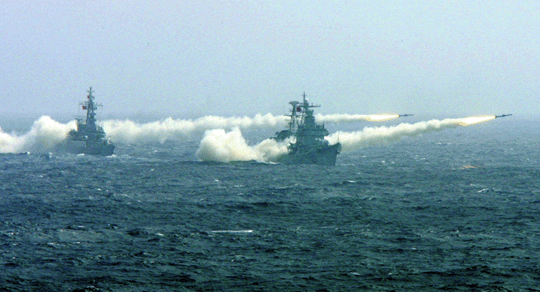
After spending most of the past 28 years tied up in a northern shipyard, the Russian Navy’s nuclear powered cruiser Admiral Nakhimov has finally returned to sea. Defense outlets report that the deeply modernized warship has begun sailing again in the White Sea after its first outings on contractor and factory sea trials.
JSC PO Sevmash chief executive Mikhail A. Budnichenko said the modernized ship has completed the first stage of its factory sea trials, a key step toward full operational service. Budnichenko added that Admiral Nakhimov is already on its third trial cruise and is due back at its base in Severodvinsk on the 25th of the month, with crew and shipyard staff still checking vital systems. For a vessel that could become Russia’s flagship, these careful first outings are drawing close attention far beyond the White Sea.
From frozen pier to fresh wake
Admiral Nakhimov last sailed in 1997 and then sat laid up at Sevmash in northern Russia while Moscow debated its fate and struggled with funding. A modernization contract arrived years later, real work only gathered speed around 2014, and promised return dates slipped again and again as schedules moved from 2018 into the middle of the 2020s.
Factory sea trials are when the shipyard takes a new or refitted warship to sea to check whether engines, steering, electrical systems and basic navigation work as they should. Each run shows how the reactors behave, how the hull handles waves and ice and whether the ship is safe to operate in normal conditions, long before the navy signs off on the ship as ready for combat duty.
What a nuclear cruiser actually is
A nuclear powered cruiser is a very large surface warship that uses onboard reactors instead of fuel oil to drive its engines. In simple terms, that means Admiral Nakhimov can stay at sea for long stretches without refueling, which matters in remote Arctic waters where bases are scarce and the weather punishes support ships.
The cruiser belongs to the Kirov class, a group of Cold War-era giants originally built for the Soviet Navy to threaten NATO carrier groups. Today Admiral Nakhimov is the last survivor of four hulls, since Admiral Ushakov and Admiral Lazarev are being dismantled and stripped of their nuclear fuel, while sister ship Pyotr Velikiy is widely expected to retire instead of getting a similar deep refit because of cost and wear.
A floating magazine with 174 missile cells
The heart of the modernization sits under the deck in the form of vertical launch systems, armored boxes that hold missiles upright until they are fired into the sky. Russian and foreign defense reports indicate that Admiral Nakhimov is being outfitted with around 174 of these launch cells, including 10 universal launch blocks for roughly 80 long-range cruise and anti-ship missiles such as Kalibr and Oniks.
The remaining cells are intended for surface-to-air missiles that shield the ship and nearby vessels from aircraft, drones and incoming weapons, tied into long range Fort M air defense systems and several Pantsyr M close-in mounts that combine guns and missiles.
The original twin 130-millimeter gun has also been replaced by a modern AK 192 M weapon, and taken together these changes mean Admiral Nakhimov is expected to carry more launch cells than many Western and Chinese cruisers or destroyers now at sea.
Why this refit matters now
All of this is happening as Russia’s surface fleet shrinks and its only aircraft carrier, Admiral Kuznetsov, remains stuck in long repairs with an uncertain future. In that context, Admiral Nakhimov looks less like a museum piece and more like a stopgap centerpiece for future Russian task groups, a single ship that can carry long-range strike weapons and strong air defenses while smaller frigates and corvettes handle coastal patrols.
So why does one old ship draw so much attention? For people outside the defense world it can be hard to see why an aging cruiser matters when daily worries focus on bills or the next heat wave.
Yet a vessel packed with modern missiles can change how close foreign navies dare to sail, and for now the completion of the first phase of sea trials after nearly three decades out of service mainly shows that Russia’s long and costly refit is finally delivering a ship it hopes can still matter on the open ocean.
CIA, with Trump’s blessing, is using Ukrainians to sabotage Russia’s energy infrastructure and oil tankers – NYT
Iona Cleave, The telegraph, Fri, 02 Jan 2026, https://www.sott.net/article/503791-CIA-with-Trumps-blessing-is-using-Ukrainians-to-sabotage-Russias-energy-infrastructure-and-oil-tankers-NYT
Attacks on oil refineries have cost Moscow $75m a day, according to US intelligence
The CIA secretly taught Ukraine how to target crucial components of Russia’s oil refining infrastructure and its sanction-busting shadow fleet, according to officials.
Despite Washington pulling back its support for Kyiv’s war effort under the Trump administration, it has emerged that US intelligence and military officers continued to find new ways to stifle Vladimir Putin’s war machine.
Since June, the CIA, with Donald Trump’s blessing, has been covertly providing specific intelligence to bolster Ukraine’s aerial offensive against oil refineries inside Russia, according to the officials.
The move came amid Mr Trump’s growing frustration with Putin’s unwillingness to negotiate while Russian forces accelerated attacks on Ukrainian cities.
The US has long shared intelligence with Kyiv that helps with attacks on Russian military targets in occupied parts of Ukraine and provides advanced warning of incoming Russian missiles and drones.
Under persuasion by Ukraine sceptics in the White House, led by JD Vance, the vice-president, and his allies, Mr Trump froze military aid in March and intelligence sharing was suspended as a result.
However, The New York Times, citing officials, said the CIA heavily lobbied for the agency to keep sharing intelligence.
Before summer, the impact of the strikes on Russia’s energy infrastructure – which often hit storage depots or structures easily repaired – had been relatively minimal.
Under a new plan, crafted by the CIA and US military, the campaign was concentrated exclusively on oil refineries, targeting a newly found Achilles heel.
A CIA expert had identified a coupler device that is so difficult to replace that it could lead to a facility remaining shut for weeks.
The strikes became so successful that Russian oil refining was reduced by as much as a fifth on certain days, cutting exports and leading to domestic fuel shortages.
It was costing its economy an estimated $75m (£55m) a day, according to US intelligence.
Comment: That’s certainly one way to make your otherwise useless sanctions work: just start blowing up your opponent’s oil business! Uniquely American…
In response, Mr Trump praised the strikes for the leverage and deniability they gave him as Putin continued to stonewall negotiations, according to the sources.
It was first reported in October that Washington was closely involved in the planning of such strikes, but it wasn’t known that the CIA was responsible for the new focus of the campaign and identifying specific weaknesses in its energy infrastructure.
In late November, Ukraine also began a maritime campaign against Moscow’s shadow fleet, a clandestine network of hundreds of vessels carrying sanctioned oil to keep the Russian economy afloat.
Comment: At least we now know how ‘Ukraine’ struck a Russian oil tanker off West Africa.
Kyiv was using its explosive-laden long-range naval drones to blow holes in the ships, opening a new front in the war to cut off Russia’s largest source of funding and strengthen its negotiating position at US-led peace talks.
According to US and Ukrainian officials, the CIA was authorised to assist Kyiv’s military in these efforts, despite the risk of angering Putin’s regime.
It is not clear exactly when such help was approved by the Trump administration.
The New York Times report, citing hundreds of national security officials, military and intelligence officers and US, Ukrainian and European diplomats, charts the unwinding of the US-Ukrainian alliance over the past year.
The officials argued that as Mr Trump attempted to broker peace, factions in the White House and Pentagon pushed the president and his aides to make inconsistent, and at times, erratic decisions that damaged Kyiv’s war effort.
This included how the newly renamed Department of War, led by Pete Hegseth, repeatedly made unannounced decisions to withhold vital munitions from Ukraine that had already been given under the Biden administration, costing lives at the front.
A critical error, according to the officials and diplomats, was Mr Trump overestimating his rapport with Putin and ability to get him to meaningfully engage in negotiations.
Despite repeatedly touting his ability to secure an end to the war in “24 hours”, the Republican was forced to admit on Sunday his lack of a breakthrough after a year of on-off negotiations.
As he hosted Volodymyr Zelensky at Mar-a-Lago, he was forced to admit “it is not a one-day process deal. This is very complicated stuff”.
The officials also revealed that Mr Trump and his Ukrainian counterpart bonded over a love of Ukrainian women.
Following their disastrous meeting in February, Mr Zelensky returned six months later to win back Mr Trump’s support.
Sitting in the Oval Office, Mr Trump said “Ukrainian women are beautiful”, to which Mr Zelensky replied, “I know, I married one.”
In an odd sequence of events, Mr Trump rang up an old friend who had married a former Miss Ukraine who was then put on the phone to speak to Mr Zelensky.
“It humanised Zelensky with Trump,” an official who was there told the New York Times. “You could feel the room change.” The meeting, in which the Ukrainian leader was on the charm offensive, proved crucial for their relationship moving forward.
The officials also revealed that Mr Trump had approved a back channel being opened with Moscow before his inauguration, despite the fact that doing so before his first term prompted claims of conspiracy and became part of a long-running Russian investigation.
The Saudi crown prince, Mohammed bin Salman, reportedly introduced Mr Trump’s special envoy Steve Witkoff to Kirill Dmitriev, who would later emerge as the lead negotiator in peace talks with the US.
That move reportedly came after Joe Biden rejected a request for a secret letter granting Mr Trump and his team permission to begin talks during the transition, for fear the incoming president would sell out Ukraine in a deal.
Comment: So, apparently ‘an edge on the oil markets’ is more important to ‘the peacemaker’ than actual peace.
WAS RUSSIA’S SPECIAL MILITARY OPERATION “UNPROVOKED”?
AI is a tool that many use to research the historical facts behind contentious issues. What does it say about Russia’s claims it was endlessly provoked into its conflict with the Ukrainian regime?
Aearnur, Jan 03, 2026, https://aearnur.substack.com/p/was-russias-special-military-operation?utm_source=post-email-title&publication_id=312403&post_id=183250361&utm_campaign=email-post-title&isFreemail=true&r=ln98x&triedRedirect=true&utm_medium=email
AI Overview.
Archival material declassified by the US National Security Archive and other Western institutions has established that multiple Western leaders gave Mikhail Gorbachev a “cascade of assurances” in 1990 and 1991 that NATO would not expand eastward beyond a reunified Germany.
The declassified records, which include contemporaneous memoranda of conversation (memcons) and telegrams (telcons), show that these discussions were not limited to East Germany but addressed Central and Eastern European security as a whole.
Key Documents and Assurances
Secretary James Baker’s “Not One Inch” (Feb 1990): US archival transcripts confirm that on February 9, 1990, Secretary of State James Baker told Gorbachev that if the US maintained a presence in a unified Germany within NATO, there would be “no extension of NATO’s jurisdiction for forces of NATO one inch to the east”. Baker repeated this formula three times during the meeting.
The Bush-Gorbachev Malta Summit (Dec 1989): Records show President George H.W. Bush assured Gorbachev that the US would not seek “unilateral advantage” from the rapid changes in Eastern Europe.
Chancellor Helmut Kohl (Feb 1990): Declassified West German records show Chancellor Kohl told Gorbachev on February 10, 1990, that “NATO should not enlarge the sphere of its activity”.
British and French Leaders: Declassified documents show British Prime Minister John Major told Soviet Defense Minister Yazov in March 1991 that he did not foresee circumstances where Eastern European countries would join NATO. French President François Mitterrand also expressed support for dismantling military blocs and ensuring Soviet security.
AI Overview.
The original stated purpose of the Minsk process (Minsk I in 2014 and Minsk II in 2015) was to secure an immediate ceasefire and provide a roadmap for a permanent political resolution to the conflict in eastern Ukraine.
According to the official 12-point and 13-point “packages of measures,” the primary goals included:
Military De-escalation: An unconditional ceasefire, withdrawal of heavy weaponry to create a security zone, and the pullout of all foreign armed formations and mercenaries.
Political Reintegration: Decentralization of power in Ukraine through constitutional reform, granting a “special status” to the Donetsk and Luhansk regions, and holding local elections under Ukrainian law.
Sovereignty Restoration: The return of full control over the state border to the Ukrainian government, contingent upon the completion of the political settlement.
The Russian Understanding of the Process
For Russia, the Minsk process was understood as a vehicle to achieve several strategic objectives that differed from Ukraine’s interpretation of sovereignty:
Institutional Influence (the “Trojan Horse”): Russia understood “special status” as granting the Donbas regions comprehensive autonomy, including their own legal systems and the right to cross-border cooperation with Russia. This was intended to give these regions a de facto veto over Ukraine’s national foreign policy, specifically to prevent Ukraine fromjoining NATO or the EU.
Legitimacy for Proxies: Russia insisted on the inclusion of the self-proclaimed “People’s Republics” (DPR/LPR) in the negotiations. Moscow viewed this as a step toward their formal recognition and a way to frame the conflict as a “civil war” rather than a Russo-Ukrainian war.
Sequencing of Control: A fundamental part of Russia’s understanding was that political concessions (elections and autonomy) must occur before Ukraine regained control of its border with Russia, effectively securing the separatist enclaves while they were still under Russian influence.
“Freezing” the Conflict: Western analysts noted that for Russia, the accords served to consolidate control over captured territories and “freeze” the conflict at a level that favored Moscow’s interests while avoiding further international sanctions.
Following the 2022 invasion, Russian officials asserted that the true purpose of the West was to use the accords as a “ruse” to buy time for Ukraine to rearm, while they maintain their original stated goal was a genuine political settlement for the Donbas.
AI Overview.
In a series of interviews following the 2022 invasion of Ukraine, former German Chancellor Angela Merkel clarified that the primary purpose of the
Minsk Accords (2014–2015) was to buy time for Ukraine to strengthen itself against future Russian aggression.
In a December 2022 interview with The Kyiv Independent, former French President François Hollande stated that the Minsk Accords were successful in providing Ukraine with the “precious time” needed to strengthen its military.
His comments corroborated earlier revelations by former German Chancellor Angela Merkel, confirming that the agreements served as a temporary respite to prevent further Russian territorial gains while the Ukrainian army underwent a total transformation.
Key Revelations by Hollande
Buying Time for Rearmament: Hollande agreed with Merkel’s assessment that the primary merit of the Minsk agreements was giving the Ukrainian army the opportunity to become “completely different” from what it was in 2014. He noted that by 2022, the army was better trained and equipped, which he directly attributed to the diplomatic respite provided by the accords.
In 2022 and 2023, former Ukrainian President Petro Poroshenko made several public statements revealing that the primary purpose of the Minsk Accords from his perspective was to buy time for Ukraine to rebuild its military and avoid a total collapse of the state.
His detailed revelations include:
Read more: WAS RUSSIA’S SPECIAL MILITARY OPERATION “UNPROVOKED”?Buying Time for Rearmament: Poroshenko stated that when he signed the agreements in 2014 and 2015, Ukraine effectively “did not have armed forces at all”. He revealed that the truce provided a “precious” window of several years to invite NATO instructors, purchase weapons, and transform the Ukrainian military into a modern fighting force capable of resisting a large-scale invasion.
Strategic Deception: Poroshenko described the agreements as a “forced position” but a “success for diplomats”. He admitted that the goal was to “buy time” and “slow down Russia’s advance” while stalling on the most unacceptable political obligations of the deal, such as granting constitutional autonomy to the Donbas republics.
Preventing Immediate Defeat: He recalled that the 2015 Minsk II agreement was signed under extreme duress, specifically when thousands of Ukrainian soldiers were surrounded by regular Russian forces at the battle of Debaltseve. The primary goal at that moment was to stop the Russian offensive and prevent the “annihilation” of his forces.
International Legitimacy: Poroshenko revealed that another goal of the accords was to demonstrate to the world that Russia was the aggressor. By signing a peace plan, Ukraine gained the international solidarity needed to implement and maintain Western sanctions against Russia for its non-compliance with the deal.
These admissions, similar to those made by Angela Merkel and François Hollande, have been used by the Russian government to argue that the West and Ukraine negotiated the peace process in bad faith to prepare for eventual war.
AI Overview.
As of January 2, 2026, Russia continues to frame its invasion of Ukraine as a defensive and corrective measure necessitated by Western aggression and humanitarian crises. These justifications have evolved throughout the conflict, combining long-standing grievances with recent allegations of “state terrorism” by the Ukrainian government.
1. Security Architecture and NATO Expansion
Russia’s primary long-term justification is the perceived threat from NATO’s eastward expansion.
“Red Lines” and Broken Promises: Russian officials cite declassified 1990 archival records as proof that Western leaders promised NATO would not move “one inch eastward.” Russia argues that by 2021, Ukraine’s “de facto” integration into NATO through military training and infrastructure had reached an existential threat level.
The 2021 Security Proposals: In December 2021, Russia requested formal treaties with NATO and the US to halt expansion and return to 1997 troop positions. The Kremlin justifies the 2022 invasion as a result of the West’s dismissal of these proposals.
Buffer Zones (2026 Update): In early 2026, the Kremlin emphasized the need for an expanded “buffer zone” in the Sumy and Kharkiv regions to protect Russian territory from cross-border shelling and drone strikes.
2. Humanitarian Protection and “Genocide”
Russia claims its intervention was a legal necessity to protect ethnic Russians and Russian speakers.
Protecting the Donbas: Putin asserted that the 2022 “Special Military Operation” was launched to end eight years of “humiliation and genocide” by the “Kyiv regime” against people in the Donetsk and Luhansk regions.
Independence Recognition: Russia argues that because it recognized the Donetsk and Luhansk People’s Republics as independent states just before the invasion, its military action was a lawful request for assistance under Article 51 of the UN Charter.
3. “Denazification” and “Demilitarization”
The Kremlin uses these terms to frame the Ukrainian government as illegitimate and a threat to European peace.
Regime Change: Russia claims the 2014 Euromaidan revolution was a Western-backed “unconstitutional coup” that installed a “neo-Nazi” leadership.
Sovereignty Denial: Putin has repeatedly claimed that Ukraine is an “artificial state” created by the Soviet Union and that Russians and Ukrainians are “one people,” suggesting the current government is a foreign-imposed anomaly.
4. Recent Allegations of “State Terrorism” (Late 2025–2026)
Since December 2025, Russia has introduced new justifications to harden its stance in potential peace talks:
Attack on Putin’s Residence: In late December 2025, Russia accused Ukraine of launching a drone strike targeting President Putin’s residence in the Novgorod region. Foreign Minister Sergey Lavrov characterized this as “state terrorism,” using it to justify retaliatory strikes and a “more rigorous” negotiating position.
For official updates and historical documents, the National Security Archive provides records of 1990 assurances, while current statements are often published by the Russian Foreign Ministry.
AI Overview.
In January and February 2022, the Donbas region in south-eastern Ukraine experienced a massive and rapid escalation in shelling and ceasefire violations. Reports from the OSCE Special Monitoring Mission (SMM) indicated that after a period of relatively low activity in early January, violations surged by over 340% in the week leading up to the full-scale Russian invasion on February 24.
Russia claims to have moved nuclear-capable missile system into Belarus
Guardian, 30 Dec 25
Assertion comes after the Kremlin accused Ukraine of attacking Vladimir Putin’s palace in Novgorod
Russia said its latest nuclear-capable missile system has been deployed in Belarus, a day after Moscow claimed that Ukraine had carried out a large-scale drone attack on Vladimir Putin’s residence.
Footage released by Russia’s ministry of defence showed the new Oreshnik missile trundling through a snowy forest. Soldiers were seen disguising combat vehicles with green netting and raising a flag at an airbase in eastern Belarus, close to the Russian border.
The video appeared part of a choreographed attempt to intimidate Europe and to prepare Russians for a further escalation in the already brutal war against Ukraine. The deployment, if true, would symbolically reduce the time it would take for a Russian missile to hit an EU capital.
Belarus’s president, Alexander Lukashenko, said 10 Oreshnik systems would be stationed in his country. Putin announced they were entering active service at a meeting on Monday with his generals, where he reaffirmed his intention to capture more Ukrainian territory, including the southern city of Zaporizhzhia.
Earlier Russia’s foreign minister, Sergei Lavrov, warned that “reprisals” would be carried out against Kyiv and that targets were already prepared. They followed what he said was an attack on Sunday night involving 91 Ukrainian drones on the Russia’s president’s palace in the Novgorod region.
The Kremlin has not produced evidence to back up its allegations. Dmitry Peskov, Vladimir Putin’s spokesperson, said on Tuesday that no proof would be offered since all the missiles had been shot down. He said he could not comment on the lack of debris. Guardian 30th Dec 2025 https://www.theguardian.com/world/2025/dec/30/russia-claims-moved-nuclear-capable-missile-system-belarus
Russia ‘Confidently Advancing’ In Ukraine, Over 30 Settlements Captured In December: Putin
by Tyler Durden, Zero Hedge, Tuesday, Dec 30, 2025 –
Russian President Vladimir Putin has made clear to both his citizens and to the world that the ‘special military operation’ in Ukraine will continue on until all goals are achieved, and that his forces are advancing ‘confidently’.
He chaired a televised meeting with the country’s top military officials, focused on a status update regarding Ukraine, and crucially coming the day after Presidents Trump and Zelensky met in Florida in a failed effort to reach breakthrough on the proposed peace deal. Moscow is pressing ahead with its goal of fully capturing and pacifying the four Ukrainian regions it declared part of the Russian Federation in fall of 2022 via a ‘popular referendum’.
“The goal of liberating the Donbas, Zaporizhia and Kherson regions is being carried out in stages, in accordance with the plan of the special military operation,” Putin described before underscoring, “The troops are confidently advancing.“
At the meeting it was also announced that Russian troops have made more gains in the last 24 hours, especially the capture of Dibrova village in Donetsk region.
According to an update of the meeting via RT translation, battlefield gains of the past month are significant:
In December, Russian forces liberated over 700 square kilometers of territory, taking some 32 settlements under control, Gerasimov said at the meeting. This month, the military has shown the highest rate of progress in the entire outgoing year, he noted, adding that troops are advancing “along virtually the entire frontline.”
“The adversary is not undertaking any active offensive actions. They have concentrated their main efforts on strengthening their defenses and are attempting to slow the pace of our advance by conducting counterattacks in isolated areas and using drones en masse,” Gerasimov said.
The Kremlin has at the same time reiterated that it is not interested in a ‘Plan B or Plan C’ in terms of a peace deal, but that it only seeks lasting political settlement. This will of course include international recognition of its territories in the Donbass………………………………………….. https://www.zerohedge.com/geopolitical/russia-confidently-advancing-ukraine-over-30-settlements-captured-december-putin
When the USSR and China saved humanity: How they won the World Anti-Fascist War.
December 28, 2025 , By Ben Norton, https://geopoliticaleconomy.com/2025/12/26/ussr-china-world-anti-fascist-war/
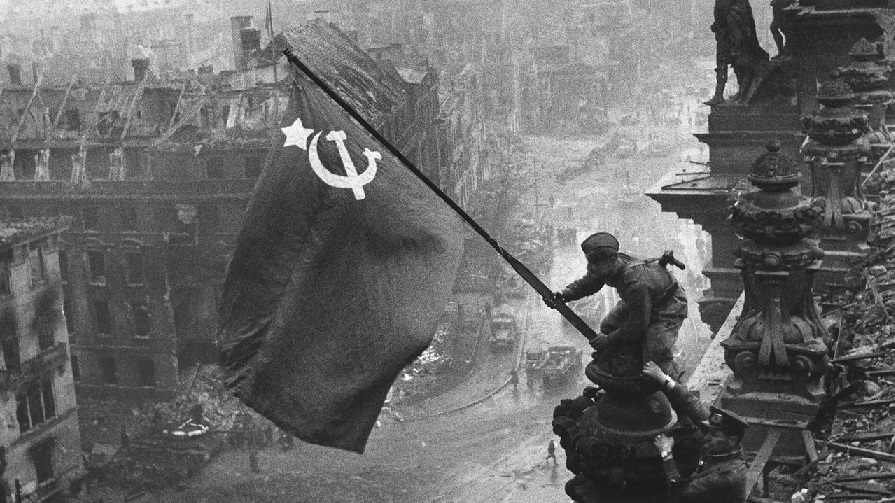
It was the Soviet Union and China that defeated fascism in WWII. Their heroic contribution was later erased by the West. In the First Cold War, the US recruited former Nazis.
2025 marked the 80th anniversary of the defeat of fascism in World War Two. Unfortunately, the history of this extremely important conflict is not very well understood today.
It was not the United States and its Western allies that defeated fascism in WWII. That is a myth that is promoted by Hollywood movies.
In reality, it was the Soviet Union and China that defeated fascism in WWII. However, their heroic contribution was later erased by the West, when the US waged the First Cold War against the global socialist movement.
The vast majority of Nazi casualties, approximately 80%, were on the Eastern Front, in the Third Reich’s savage, scorched-earth battles against the Soviet Red Army.
More than 26 million Soviets died in the Nazi empire’s genocidal war. Compare that to the just over 400,000 US Americans who died, and the roughly 450,000 Brits who lost their lives.
This means that 62 Soviets were killed for every US American who died in WWII. Yet, tragically, their sacrifice has been forgotten in the West – or, better said, erased from public consciousness for political reasons.
The fact that the USSR defeated Nazi Germany was even admitted by the inveterate anti-communist Winston Churchill, an explicit racist, colonialist, and erstwhile admirer of Hitler who oversaw the British empire’s extreme crimes, including a famine in Bengal in 1943.
In a speech in August 1944, Churchill acknowledged:
“I have left the obvious, essential fact to this point, namely, that it is the Russian Armies who have done the main work in tearing the guts out of the German army. In the air and on the oceans we could maintain our place, but there was no force in the world which could have been called into being, except after several more years, that would have been able to maul and break the German army unless it had been subjected to the terrible slaughter and manhandling that has fallen to it through the strength of the Russian Soviet Armies”.
Then, in October 1944, Churchill said, “I have always believed and I still believe that it is the Red Army that has torn the guts out of the filthy Nazis”.
Read more: When the USSR and China saved humanity: How they won the World Anti-Fascist War.In fact, the USSR wanted to crush fascism even earlier by proposing a surprise attack on Nazi Germany in 1939, weeks before Hitler invaded Poland. Soviet military officers made an official request to British and French officials to form an alliance against Nazi Germany in August 1939, but London and Paris were not interested. The USSR had a million troops ready to fight, but the Western European powers were not prepared.
What the capitalist countries in Western Europe and North America had hoped for was that Nazi Germany would attack the Soviet Union, which they considered their main enemy. This is why the Western imperial powers had long appeased Hitler, signing shameful deals like the 1938 Munich Agreement, which allowed the Nazi empire to expand in Europe.
What the Western capitalist “liberal democracies” and the fascist regimes shared in common was mutual hatred of communism. The rich oligarchs who controlled Western governments feared that they would lose their privileges if workers in their countries were inspired by the Bolshevik Revolution.
In the 1930s, the US State Department spoke positively of fascism as an alternative to communism, and the US chargé d’affaires in Germany praised the supposedly “more moderate section of the [Nazi] party, headed by Hitler himself … which appeal[s] to all civilized and reasonable people”.
It must be emphasized that, when the Japanese empire officially allied with Nazi Germany in 1936, the name of the deal they signed was the Agreement Against the Communist International, or the Anti-Comintern Pact. Benito Mussolini’s fascist regime in Italy subsequently signed the agreement in 1937, and the fascist regimes in Spain, Hungary, and other European countries joined in the following years. It was extreme, violent anti-communism that united all of these fascist powers.
While there is widespread ignorance about the Soviet Union’s leading role in crushing Nazi Germany in WWII, the heroic contribution that the people of China made to the defeat of the Japanese empire is even less well known.
For Europe, WWII began in 1939, when Nazi Germany invaded Poland. For the people of China, the war started much earlier, in 1931, when the Japanese empire invaded the Manchuria region of northern China.
For 14 years, the people of China resisted Japan’s aggression, as the imperial regime sought to colonize more and more Chinese territory.
By the end of the war in 1945, roughly 20 million Chinese had lost their lives. This means that approximately 48 Chinese were killed for every US American who died in WWII.
In China, WWII is known as the Chinese People’s War of Resistance Against Japanese Aggression, and it was part of a larger conflict called the World Anti-Fascist War.
China held an important event on 3 September 2025 commemorating the 80th anniversary of the defeat of fascism. It featured key leaders of countries that are today, once again, fighting against imperialism and fascism, including China’s President Xi Jinping, Russia’s President Vladimir Putin, the DPRK’s leader Kim Jong-un, Iran’s President Masoud Pezeshkian, and officials from other countries in Asia, Africa, and Latin America, including Cuba’s President Miguel Díaz-Canel and Nicaragua’s representative Laureano Ortega Murillo.
The United States has long taken credit for the defeat of the fascist Japanese empire, but this erases the enormous, heroic, 14-year contribution made by the Chinese people.
Although it is true that the United States was briefly allied with the USSR and China during WWII, and it did provide significant military assistance through its 1941 Lend-Lease Act, Washington immediately terminated that partnership in 1945.
In fact, even before WWII officially ended, the United States had already started to recruit fascists to help them wage the First Cold War. US intelligence agencies saved many Nazi war criminals in the infamous Operation Paperclip. Instead of facing justice, these genocidaires assisted Washington in its subsequent attacks on the Soviet Union and its communist allies in Eastern Europe.
Later, the CIA and NATO created Operation Gladio, in which they used fascist war criminals as foot soldiers of their new global imperialist war on socialism. The former top Nazi military officer Adolf Heusinger was appointed the chair of NATO’s military committee, and the ex Nazi Hans Speidel became commander of NATO’s land forces in Central Europe.
The United States even rehabilitated Nazi war criminal Reinhard Gehlen, who had directed Hitler’s military intelligence on the Eastern Front in WWII, and who later led the CIA-backed Gehlen Organization to help Washington wage its cold war against communists.
The United States did not defeat fascism; it rehabilitated and absorbed fascism into the capitalist empire that Washington built after WWII, centered in Wall Street and based on the dollar.
The contemporary German government published the results of a study in 2016, called the Rosenberg project, which sifted through classified documents from 1950 to 1973. It found that, at the height of the Cold War, the government of capitalist West Germany, which was a member of NATO, was full of former Nazis.
In fact, 77% of senior officials in West Germany’s Justice Ministry had been Nazis. Ironically, there had been a lower percentage of Nazi Party members in the Justice Ministry in Berlin when the genocidal dictator Adolf Hitler himself was in charge of the Third Reich.
Similarly, in Japan after WWII, US occupation forces released Japanese war criminals from prison and used them to construct an imperial client regime. The CIA helped to create and fund the powerful Liberal Democratic Party (LDP), which has essentially governed Japan as a one-party state, with few exceptions, since 1955.
Notorious war criminal Nobusuke Kishi had overseen genocidal crimes against humanity against the Chinese people as an administrator of the Japanese empire’s puppet regime of Manchukuo, in Manchuria, during WWII. After the war ended, the United States strongly supported Kishi, who led the LDP, established the de facto one-party state, and became prime minister of the country.
Still today, the Kishi dynasty is one of the most powerful families in Japan. Kishi’s grandson Shinzo Abe also led the LDP and served as prime minister from 2012 and 2020, closely allying Japan with the United States, while antagonizing China and rewriting the history of WWII.
In short, after the Soviet Union and China led the fight to defeat fascism in WWII, the US empire recruited fascists to fight its global war against socialism.
Today, it is extremely important to learn these facts and correct the historical record, because 2025 is the 80th anniversary of the end of WWII, and it is clear that the proper lessons have not been learned in the West.
The planet is still plagued by extreme imperial violence, and closer than ever to another world war.
The United States and Israel have been carrying out a genocide against the Palestinian people in Gaza, committing atrocities that are reminiscent of the fascists’ crimes against humanity in WWII.
Fascism has its roots in European colonialism. The genocidal tactics that the European empires used in Asia, Africa, and Latin America were later used by the fascists inside Europe.
Nazi leader Adolf Hitler was inspired by the genocidal crimes that the German empire had committed in southern Africa, and also by the genocide that the US colonialists had carried out against indigenous peoples in North America. The Nazis were likewise influenced by the US government’s racist laws against Black Americans, in its apartheid system known as Jim Crow.
Given the close links between fascism and Western imperialism, it is not surprising to see that, today, the US regime has become increasingly fascist. Politicians in Washington scapegoat immigrants and foreigners for the many domestic problems in their country, including the significant growth in inequality, poverty, and homelessness. They have no solutions other than more violence, racism, and war.
The increasing political desperation and instability in Washington is combining in a toxic mixture with the greed of US corporations in the military-industrial complex, which profit from war, and are thus incentivized to push for more conflict, not for peace.
The United States, as the leader of NATO, has already been waging a proxy war against Russia in Ukrainian territory, using the people of Ukraine as cannon fodder in an imperial war, tragically destroying an entire generation of Ukrainians in a vain attempt to maintain US global hegemony.
The US empire has also used its Israeli attack dog to wage war on the people of Iran, in an attempt to overthrow the revolutionary government in Tehran and impose a puppet regime, like the former king, the shah, who was propped up by Washington.
The number one target of the US empire today, however, is the People’s Republic of China. US imperialists fear that China is the only country powerful enough to not only challenge but to defeat Washington’s global hegemony.
The US empire is waging a Second Cold War against China, and it has weaponized everything in this hybrid war, imposing sanctions and tariffs to wage economic war, using its control over the dollar system in a financial war, and exploiting the media to spread disinformation and fake news as part of an information war.
Part of the US empire’s strategy in this information war is to erase the Chinese people’s major contribution to the defeat of fascism and imperialism in WWII.
This is why it is so crucial to defend the facts, and to teach the true history of WWII to people today. If we don’t correct the historical record, the fascists and imperialists of the 21st century will weaponize ignorance in order to carry out the same crimes that their ideological brethren committed in the 20th century.
Russia wants to build a nuclear power plant on the moon in the next few years .
Project aims to supply energy for its lunar space programme
Guy Faulconbridge, Wednesday 24 December 2025, https://www.independent.co.uk/space/russia-china-space-race-moon-nuclear-power-b2890010.html
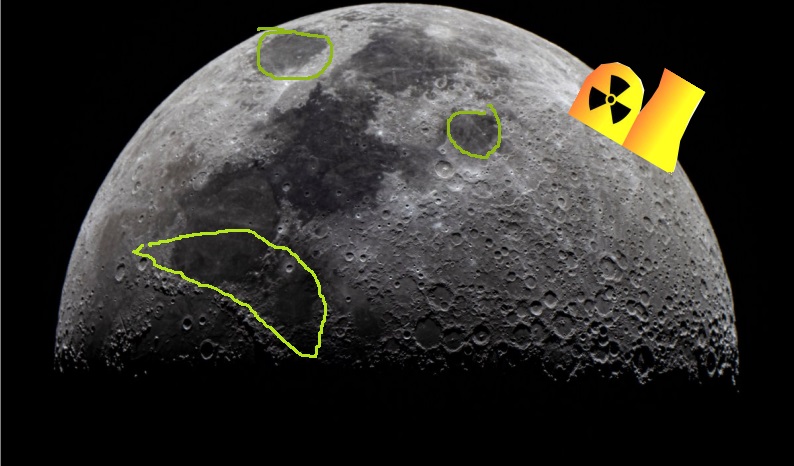
Russia is reportedly planning to establish a nuclear power plant on the moon within the next decade.
This ambitious project aims to supply energy for its lunar space programme and a joint research station with China, as global powers intensify their
efforts in lunar exploration.
Historically, Russia has held a prominent position in space, notably with Yuri Gagarin’s pioneering journey in 1961.
However, its dominance has waned in recent decades, with the nation now trailing behind the United States and, increasingly, China.
The country’s lunar aspirations faced a significant setback in August 2023 when its uncrewed Luna-25 mission crashed during a landing attempt.
Furthermore, the landscape of space launches, once a Russian speciality, has been revolutionised by figures such as Elon Musk, adding to the competitive pressure.
Russia’s state space corporation, Roscosmos, said in a statement that it planned to build a lunar power plant by 2036 and signed a contract with the Lavochkin Association aerospace company to do it.
Roscosmos said the purpose of the plant was to power Russia’s lunar programme, including rovers, an observatory and the infrastructure of the joint Russian-Chinese International Lunar Research Station.
“The project is an important step towards the creation of a permanently functioning scientific lunar station and the transition from one-time missions to a long-term lunar exploration program,” Roscosmos said.
Roscosmos did not say explicitly that the plant would be nuclear but it said the participants included Russian state nuclear corporation Rosatom and the Kurchatov Institute, Russia’s leading nuclear research institute.
The head of Roscosmos, Dmitry Bakanov, said in June that one of the corporation’s aims was to put a nuclear power plant on the moon and to explore Venus, known as Earth’s “sister” planet.
The moon, which is 384,400 km (238,855 miles) from our planet, moderates Earth’s wobble on its axis, which ensures a more stable climate. It also causes tides in the world’s oceans.
A Serious Proposal: Russia and China Call for Global Strategic Stability

By Alice Slater, World BEYOND War, October 8, 2025
It’s ironic that the arms control community is protesting the idea of resuming nuclear test detonations. The nuclear test detonations have never stopped.
Although Bill Clinton signed the Comprehensive Test Ban Treaty (CTBT) in 1996, he swiftly funded the “Stockpile Stewardship” program at the US nuclear weapons complex, allowing the Dr. Strangeloves in their labs to continue to perform laboratory tests as well as blowup plutonium with chemical explosives,1,000 feet below the desert floor at the Nevada Test Site on Western Shoshone holy land.
Since there was no chain reaction causing criticality, Clinton claimed these “sub-critical” tests were not nuclear tests and didn’t violate the new treaty. Of course, Russia and China swiftly followed the US lead; the Russians continued to test at Novaya Zemlya, and China at Lop Nor.
Indeed, it was the US’s refusal to promise that the Comprehensive Test Ban Treaty would be truly “comprehensive” that caused India and Pakistan to test their nuclear arsenals after the US rejected their pleas to include prohibitions against “sub-critical” and laboratory tests in the CTBT. Although Clinton signed the CTBT, the US, unlike Russia and China, never ratified it. Sadly, Russia announced during the Ukraine war that it was leaving the CTBT.
People of goodwill who are alarmed at new reports of proliferating nuclear weapons and would like to put the nuclear genie back in the bottle, stop the endless wars and huge budgets for useless atomic weapons, would do well to take some advice from Russia and China. On May 8, they issued a “Joint Statement by the Russian Federation and the People’s Republic of China on Global Strategic Stability” in the context of the 80th anniversary of the end of World War II.
They note “the serious challenges facing the international community” and lay out several recommendations that would strengthen “global strategic security”, acknowledging that “the destinies of all countries are interrelated” and urging that states not “seek to ensure their own security at the expense and to the detriment of the security of other states.”
U.S. “Golden Dome”

They proceed to explain a whole series of provocative actions that threaten the peace, including states deploying nuclear weapons and missiles outside their territories. They are particularly critical of the US “Golden Dome” program, which is expected to create a new battleground in space. Reiterating their pleas over many years to keep space for peace, they state the following:
The two sides oppose the attempts of individual countries to use outer space for armed confrontation. They will counter security policies and activities aimed at achieving military superiority, as well as at officially defining and using outer space as a ” warfighting domain”. The two Sides confirm the need to start negotiations on a legally binding instrument based on the Russian-Chinese draft of the treaty on the Prevention of the Placement of Weapons in Outer Space and of the Threat or Use of Force Against Outer Space Objects as soon as possible, that would provide fundamental and reliable guarantees for preventing an arms race in outer space, weaponization of outer space and the threat or use of force against outer space objects or with their help. To safeguard world peace, ensure equal and indivisible security for all, and improve the predictability and sustainability of the exploration and peaceful use of outer space by all States, the two Sides agree to promote on a global scale the international initiative/political commitment not to be the first to deploy weapons in outer space.
The US and its allies, sheltering under the US nuclear umbrella, would do well to take Russia and China up on their offers for making a more peaceful world! With Mother Earth sending cascading warnings about the need for nations to cooperate, we can ill afford business as usual. Time to change course!
*Alice Slater serves on the Boards of World BEYOND War and the Global Network Against Weapons and Nuclear Power in Space. She is an NGO representative at the UN for the Nuclear Age Peace Foundation.
Russia’s economy is not about to explode.

Yet western propagandists need you to believe that it will.
Ian Proud, Dec 06, 2025, https://thepeacemonger.substack.com/p/russias-economy-is-not-about-to-explode?utm_source=post-email-title&publication_id=3221990&post_id=180801359&utm_campaign=email-post-title&isFreemail=true&r=1ise1&triedRedirect=true&utm_medium=email;
I’ve been hearing since 2014 about the imminent implosion of Russia’s economy, but this has never looked likely to happen.
In a remarkable recent article in the UK’s Telegraph newspaper, Ambrose Evans-Pritchard makes the remarkable claim that the ‘balance of advantage is shifting in favour of Ukraine,’ on the basis that Russia may soon go into economic meltdown. He goes on to say that if we walk away now, we will snatch defeat from the jaws of victory.’
However, and conveniently, he does not elucidate how Ukraine is gaining the supposed upper-hand, nor how an implausible victory over Russia might be achieved. That is because there is no evidence to support his claims.
Evans-Pritchard’s CV doesn’t show any obvious subject matter expertise on Russia. But this should come as no surprise from a newspaper – the Telegraph – whose Ukraine watcher team is stuffed with Russophobes and ex-British military types who have a vested interested in maintaining the delusion of eventual Russian defeat.
Take Dom Nicholls, who co-hosts the telegraph’s Ukraine: the Latest podcast, which grandly describes itself as the ‘world’s most trusted and award winning podcast on the war,’ even though Nicholls’ CV suggests absolutely zero subject matter expertise on the issue of Russia. His podcast never departs from the UK government line that Putin must be defeated eventually, and that only more pressure will do the trick. Nor does he allow the podcast to drift too far into real evidence about the ability of Russia to fight on longer than Ukraine can fight on.
Then take Hamish De-Bretton Gordon, retired Colonel and Chemical weapons expert with even less expertise than Dom Nicholls, who, in any case, has no Russia expertise. He regularly posts fantastical articles with titles such as ‘Putin is eating his own supporters,’ and ‘Putin will be quaking in his boots today.’
It doesn’t matter that they have no understanding of the strategic balance of power in the Ukraine war. Facts and analysis are entirely redundant for people whose top, indeed, only priority is to peddle the latest lines from the Ministry of Defence on Whitehall. This is not journalism it is government propaganda. The BBC, which in any case is a state-owned broadcaster, is bad enough in its one-sided reporting, but the Telegraph is more sinister because of its infiltration by pseudo-government operatives covering as experts.
Characteristic of most western media commentary of the in Ukraine and, indeed, of the Ukraine crisis since it started, has been the complete lack of comparison.
Focus is always and only on the negative impacts of conflict on Russia itself. And, indeed, there have been negative consequences. Russia is subject to over 20,000 economic sanctions, locked out of most trade with the west, excluded from political dialogue as an article of diplomacy, cut off from most international sports and cultural events, hundreds of thousands of its troops killed or injured since the war started, its regular citizens increasingly restricted in their movements within Europe.
The economy of Russia today looks vastly different from that in 2014 when the crisis started. As President Putin recently pointed out, economic growth is sagging from its early war highs which were stimulated by a massive fiscal splurge. Interest rates and inflation remain worryingly high, labour shortages in some industries are growing, the population continues to age, and it remains over-reliant on fossil fuel exports.
Some of these issues are long-standing, while others have become more acute since the war began. Yet, these manifest limitations are never juxtaposed against the even greater challenges that Ukraine faces, which you will seldom hear mention of in the Telegraph.
The weight of western foreign policy, bolstered by willing pro-war reporters in the media, is that breaking Russia’s petroeconomic model will force Putin to back down, and that sanctions are helping to do just that.
So, let’s take a look at Ambrose-Pritchard’s key argument that Russia’s oil exports are collapsing on the back of Trump’s recent sanctioning of Rosneft and Lukoil. This might be persuasive if true and if Ukraine’s exports were somehow performing much better.
Yet, the early evidence suggests otherwise. US sanctions on Rosneft and Lukoil do appear dramatically to have reduced their volumes of trade. However, there is also evidence, that trade has simply been diverted to other Russian exporters of oil, with no significant net effect. Diversion, which has been widely reported by the media, is and has been a Russian tactic to minimise sanctions impact for over a decade, after all.
Bear in mind that Russian oil has been sanctioned in one way or another by the EU since 2014, and that there has been a progressive shutting down of gas exports since the war in Ukraine started. You would therefore expect that the total value of Russia’s exports had fallen.
Except that it hasn’t.
Since 2014, the average quarterly value of Russian exports has been a fraction above $100 bn. This takes account of the huge surge in export values shortly before the war started and throughout 2022 on the back of soaring oil prices. In the four quarters from Q4 2021 to Q3 2022, Russian exports averaged $150 bn (or $50 bn per month), 50% higher than the long-term average. But on the flip side, it also averages out against troughs, in particular after the oil price collapse of 2016 and during COVID.
In the first two quarters of 2025, Russian exports have come in at $98 bn, $2bn below the long-term average, although, in fact, identical to the two-year period from Q4 2019 through Q3 2021. So, no golden bullet evidence here of sanctions having a more than marginal impact at best, given Russia’s export pivot towards Asia and the global south.
In any case, the value of exports is a less helpful reference than the overall trade balance, i.e. the difference between exports and imports. It doesn’t matter how big a country’s exports are if they are importing more.
Let’s take a historical look back to the start of the Ukraine crisis in 2014. Russia’s quarterly current account surplus – its balance of exports over imports – has averagfed $17.9 bn. Right now it is lower, at $11 bn with oil prices falling and imports higher than average. In 2022, Russia pulled in its highest ever current account surplus, with a quarterly average of $59.5 bn, when oil prices were soaring.
However, the key point is that Russia is able to stay in surplus every year and hasn’t experienced a full-year current account deficit since 1997, and even then it was less than $1 bn.
Consistently exporting more than it imports, Russia has built its international reserves over time, giving it resilience against external economic shocks and pressure. Russia’s international reserves have steadily grown from around $400 bn in late 2014, to $725 bn now. Even if western powers expropriated all of the approximately $300 bn in immobilised assets, Russia would still possess more than it had in 2014, the year the Ukraine crisis started.
In a quite bizarre comment, Evans-Pritchard says ‘Putin can keep selling Russia’s reserves of gold, all the way down to the Tsarist double eagles at the bottom of the vault beneath Neglinnaya Street,’ (the location of Russia’s Central Bank). This hints strongly, that Russia is on the verge of running out of gold, right?
And yet, Russia’s reserve stock of monetary gold has grown from $132 bn when the war started in 2022, to $299 bn today, which includes an increase of $17bn in October 2025.
I don’t say this out of any desire to prove Russia to be right, but rather from a determination to let our analysis of the situation to be driven by data, not vacuous sound bites.
The ridiculous announcements in the Daily Telegraph lack credibility precisely because they consciously and intentionally avoid hard evidence about Russia while avoiding all mention of Ukraine’s difficulties. Readers are invited to believe that Ukraine is doing just fine, and that if we just keep pumping money in, they will eventually win.
So, let’s look at Ukraine in comparison. Since 2014 through 2024, it has consistently imported more than it exports, with an average yearly trade deficit of $13.1 bn. During the first three full years of war, that rose on average to $25.6 bn, and in the first ten months of 2025, it is already at $39.8 bn. Expressed another way, Ukraine exported $24 bn less in 2024 than it did in 2021 and imported $2.5 bn more. War and European restrictions on the import of cheap Ukrainian agriculture have hit the value of its exports hard. That might bounce back when the war ends, even though Evans-Pritchard wants it to continue.
But, even so, Ukraine’s current account has shown an average deficit of $2.8 bn since 2014; the figure is so much lower than the trade balance because of big inflows of foreign donations, in particular in 2015 and in 2022, which led to a current account surplus in those years. Critically, while Ukraine had a current account surplus of $8bn in 2022, it slumped back into deficit in 2023, with a shortfall of $9.6 bn which rose to $15.1 bn in 2024. In the first 10 months of 2025, the deficit already stands at $26.9 bn.
That means Ukraine will need at least $30 bn in foreign exchange this year just to keep its currency afloat. The only credible way right now in which Ukraine can easily fill the hole in its international reserves is to receive donations from western nations. And as we are starting to see, in respect of Europe’s faltering efforts to agree a bizarrely named ‘reparations loan’, that is proving increasingly difficult because of Belgian and European Central Bank resistance.
So, War hungry pundits in the Telegraph talk about the imminent collapse of the Russian economy are only deflecting attention from the real problem. When the western money stops flooding into Ukraine, the country may quickly find itself having to devalue its currency and, in so doing, deal with spiralling inflation, high interest rates and a sovereign default.
Of course, Ukraine is already bankrupt, as it refuses to make payments on its existing debt while nonetheless asking for more loans. Western IFIs have conveniently turned a blind eye to this right back to 2015 when Ukraine defaulted on a loan it had received from Russia. They’ve done this under pressure from western governments who also, no doubt, drive outlandish Telegraph headlines about Russia’s imminent implosion.
The sad truth is, people like Evans-Pritchard need the war to continue so they have something to say. They certainly couldn’t care a jot about Ukraine itsel
Russia Dangles Business Ties To U.S. at Europe’s Expense. Kremlin pitched White House on investments and industry to end war – today’s Wall Street Journal

American and Russian business leaders were quietly anticipating that Witkoff and Dmitriev would deliver, positioning their companies to profit from peace.
2 Dec 2025 By Drew Hinshaw, Benoit Faucon , Rebecca Ballhaus , Thomas Grove and Joe Parkinson
Three powerful businessmen— two Americans and a Russian—hunched over a laptop in Miami Beach, ostensibly to draw up a plan to end Russia’s long and deadly war with Ukraine.
But the full scope of their project went much further, according to people familiar with the talks. They were privately charting a path to bring Russia’s $2 trillion economy in from the cold—with American businesses first in line to beat European competitors to the dividends.
At his waterfront estate, billionaire developer-turned-special envoy Steve Witkoff was hosting Kirill Dmitriev, head of Russia’s sovereign-wealth fund and Vladimir Putin’s handpicked negotiator, who had largely shaped the document they were revising on the screen. Jared Kushner, the president’s son-in-law, had arrived from his nearby home on an island known as the “Billionaire Bunker.”
Dmitriev was pushing a plan for U.S. companies to tap the roughly $300 billion of Russian central bank assets, frozen in Europe, for U.S.-Russian investment projects and a U.S.-led reconstruction of Ukraine. U.S. and Russian companies could join to exploit the vast mineral wealth in the Arctic. There were no limits to what two longtime adversaries could achieve, Dmitriev had argued: Their rival space industries, which raced one another during the Cold War, could even pursue a joint mission to Mars with Elon Musk’s SpaceX.
For the Kremlin, the Miami talks were the culmination of a strategy, hatched before Trump’s inauguration, to bypass the traditional U.S. national security apparatus and convince the administration to view Russia not as a military threat but as a land of bountiful opportunity, according to Western security officials. By dangling multibillion-dollar rareearth and energy deals, Moscow could reshape the economic map of Europe—while driving a wedge between America and its traditional allies.
Dmitriev, a Goldman Sachs alumnus, had found receptive partners in Witkoff—Trump’s longtime golfing partner—and Kushner, whose investment fund, Affinity Partners, drew billion-dollar investments from the Arab monarchies whose conflict with Israel he had helped mediate.
The two businessmen shared President Trump’s longheld approach to geopolitics. If generations of diplomats viewed the post-Soviet challenges of Eastern Europe as a Gordian knot to be painstakingly unraveled, the president envisioned an easy fix: The borders matter less than the business. In the 1980s, he had offered to personally negotiate a swift end to the Cold War while building what he told Soviet diplomats would be a Trump Tower across the street from the Kremlin, with their Communist regime as a business partner.
“Russia has so many vast resources, vast expanses of land,” Witkoff told The Wall Street Journal, describing at length his hopes that Russia, Ukraine and America would all become business partners. “If we do all that, and everybody’s prospering and they’re all a part of it, and there’s upside for everybody, that’s going to naturally be a bulwark against future conflicts there. Because everybody’s thriving.”
Red lines
When a version of the 28point plan leaked earlier this month, it drew immediate protests. Leaders in Europe and Ukraine complained it reflected mostly Russian talking points and bulldozed through nearly all of Kyiv’s red lines. They weren’t assuaged even after administration officials assured them that the plan wasn’t set in stone, worried that Russia— after violently redrawing European borders—was being rewarded with commercial opportunities.
As Western leaders convened to digest the plan, Poland’s prime minister Donald Tusk offered a pithy summary: “We know this is not about peace. It’s about business.”
For many in the Trump White House, that blurring of business and geopolitics is a feature, not a bug. Key presidential advisers see an opportunity for American investors to snap up lucrative deals in a new postwar Russia and become the commercial guarantors of peace. In conversations with Witkoff and Kushner, Russia has been clear it would prefer U.S. businesses to step in, not rivals from European states whose leaders have “talked a lot of trash” about the peace efforts, one of these people said: “It’s Trump’s ‘Art of the Deal’ to say, ‘Look, I’m settling this thing and there’s huge economic benefits for doing that for America, right?’” A question for history will be whether Putin entertained this approach in the interest of ending the war, or as a ploy to pacify the U.S. while prolonging a conflict he believes is his place in history to slowly, ineluctably win.
Trusted friends
One sign that he may be serious is that some of his mosttrusted friends, sanctioned billionaires from his St. Petersburg hometown—Gennady Timchenko, Yuri Kovalchuk and the Rotenberg brothers, Boris and Arkady—have sent representatives to quietly meet American companies to explore rare-earth mining and energy deals, according to people familiar with the meetings and European security officials. That includes reviving the giant Nord Stream pipeline, sabotaged by Ukrainian tactical divers, and under European Union sanctions.
Earlier this year, Exxon Mobil met with Russia’s biggest state energy company, Rosneft, to discuss returning to the massive Sakhalin gas project if Moscow and Washington gave the green light.
Elsewhere, a cast of businessmen close to the Trump administration have been looking to position themselves as new economic links between the U.S. and Russia.
Gentry Beach, a college friend of Donald Trump Jr. and campaign donor to his father, has been in talks to acquire a stake in a Russian Arctic gas project if it is released from sanctions. Another Trump donor, Stephen P. Lynch, paid $600,000 this year to a lobbyist close to Trump Jr. who is helping him seek a Treasury Department license to buy the Nord Stream 2 pipeline from a Russian state-owned company.
There is no evidence that Witkoff, the White House or Kushner are briefed on these efforts or coordinating them. A person familiar with Witkoff’s thinking said the envoy is confident that any settlement with Russia would benefit America broadly, not just a handful of investors.
Witkoff, who hasn’t traveled to Ukraine this year, is set to visit Russia for the sixth time this week and will again meet Putin. He insisted he isn’t playing favorites. “Ukrainians have fought heroically for their independence,” said Witkoff, who has tried to inspire Ukrainian officials with the idea of soldiers disarming to earn Silicon Valley-scale salaries operating American built AI data centers. “It is now time to consolidate what they have achieved through diplomacy,” he said.
‘Both sides’
“The Trump administration has gathered input from both the Ukrainians and Russians to formulate a peace deal that can stop the killing and bring this war to a close,” said White House spokesperson Anna Kelly. “As the President said, his national security team has made great progress over the past week, and the agreement will continue to be fine-tuned following conversations with officials from both sides.”
As Witkoff pursued talks with Dmitriev over nine months, some agencies inside the Trump administration had a limited view of his dealings with Moscow.
In the lead-up to an August summit in Alaska between Trump and Putin, Witkoff and Dmitriev discussed a prisoner exchange that would have been the largest bilateral swap in their countries’ history. The Central Intelligence Agency, which traditionally manages prisoner trades with Russia, wasn’t fully briefed on that proposed exchange. Nor was the State Department’s office for unjustly imprisoned Americans. The CIA didn’t return requests for comment. The State Department referred questions to the White House.
Career officials overseeing sanctions at the Treasury Department have at times learned details of Witkoff’s meetings with Moscow from their British counterparts.
In the days after Alaska, a European intelligence agency distributed a hard-copy report in a manila envelope to some of the continent’s most senior national security officials, who were shocked by the contents: Inside were details of the commercial and economic plans the Trump administration had been pursuing with Russia, including jointly mining rare earths in the Arctic.
Witkoff has worked closely with Vice President JD Vance and Secretary of State Marco Rubio. But the special envoy for Ukraine, former Lt. Gen. Keith Kellogg, has all but been frozen out of serious talks, and said he is leaving.
To understand the administration’s Russia negotiations, The Wall Street Journal spoke to dozens of officials, diplomats, and former and current intelligence officers from the U.S., Russia and Europe, and American lobbyists and investors close to the administration.
The picture that emerges is a remarkable story of business leaders working outside the traditional lines of diplomacy to cement a peace agreement with business deals.
‘ We keep on knocking at the door and coming up with ideas.’
Witkoff was just weeks into his new job as President Trump’s Russia and Ukraine negotiator when his office asked the Treasury Department for help allowing a sanctioned Russian businessman to visit Washington.
Kirill Dmitriev, an investment banker with degrees from Harvard and Stanford, spoke Witkoff’s preferred language: business. He had invited Witkoff to Moscow in February and escorted him into a three-hour meeting with Putin to discuss the Ukraine war. But Dmitriev was persona non grata in the U.S, blocked by the Treasury in 2022 for his role leading his country’s Sovereign Wealth Fund, which it called a “slush fund for Vladimir Putin.”
Trump had told Witkoff he wanted the war to end and the administration was willing to take the risk of welcoming Putin’s emissary to Washington. Treasury Secretary Scott Bessent had questions about the unique request, but ultimately signed off.
Dmitriev arrived at the White House on April 2 and presented a list of multibilliondollar business projects the two governments could pursue together. At one point, Secretary of State Marco Rubio told Dmitriev that Putin needed to demonstrate he was serious about peace. But Dmitriev felt his businesslike rapport was breaking through. “We can transition i n v e s t m e n t trust into a political role,” he said in an unpublished interview that month.
In April, Dmitriev welcomed Witkoff to the St. Petersburg presidential library for another three-hour meeting with Putin. Witkoff took his own notes, relying on a Kremlin translator, then briefed the White House from the U.S. Embassy. That same month, European national security advisers planned to meet Witkoff in London to integrate him into their peace process. But he was busy with his other portfolio— negotiating a cease-fire in Gaza—and couldn’t make it. Afterward, one European official asked Witkoff to start speaking with allies over the secure fixed line Europe’s heads of state use to conduct sensitive diplomatic conversations. Witkoff demurred, as he traveled too much to use the cumbersome system.
Dmitriev and Witkoff meanwhile were chatting regularly by phone about increasingly ambitious proposals. The U.S. and Russia were discussing major agreements on oil-andgas exploration and Arctic transportation, Dmitriev told the Journal. “We believe that the U.S. and Russia can cooperate basically on everything in the Arctic,” he said. “If a solution is found in Ukraine, U.S. economic cooperation can be a foundation for our relationship going forward.”
Into position
American and Russian business leaders were quietly anticipating that Witkoff and Dmitriev would deliver, positioning their companies to profit from peace.
Exxon, billionaire investor Todd Boehly and others have explored buying assets owned by Lukoil, Russia’s second-largest oil producer. The U.S. sanctioned Lukoil in October to increase pressure on Moscow, prompting the company to put its overseas assets up for sale. Elliott Investment Management eyed buying a stake in a pipeline that carries Russian natural gas into Europe.
More recently, Kremlin–linked businessmen Timchenko, Kovalchuk and the Rotenbergs have been offering U.S. counterparts gas concessions in the Sea of Okhotsk, as well as potentially four other locations, according to a European security official and a person familiar with the talks. Russia has also mentioned rare-earth mining opportunities near the massive nickel mines of Norilsk and in as many as six other Siberian locations that are still unexploited, these people said.
Beach, Trump Jr.’s college friend, was in talks to acquire 9.9% of an Arctic LNG project with Novatek, Russia’s secondlargest natural gas producer— which is partly owned by Timchenko — if the U.S. and U.K. remove sanctions on it, according to drafts of contracts reviewed by the Journal.
In a statement, Beach said that partnering with Novatek would “strongly benefit any company committed to advancing American energy leadership,” and that his company, America First Global, “actively seeks investment opportunities that strengthen American interests around the world.” He said he “has never worked with Steve Witkoff” but is “extremely grateful” for the efforts Witkoff and others are making to end the war in Ukraine. Trump Jr. has told people he isn’t doing business with Beach.Lynch, the Miami-based investor, had been asking the U.S. government to allow him to bid on the sabotaged Nord Stream Pipeline 2 if it came up for auction in a Swiss bankruptcy proceeding. Lynch, who in 2022 was given a license by Treasury to complete the acquisition of the Swiss subsidiary of Russia’s Sberbank, had been seeking a license for the pipeline since the Biden administration, but in April dialed up his lobbying efforts by hiring Ches McDowell, a friend of Trump Jr. He would pay Mc-Dowell’s firm $600,000 over the next six months. Lynch’s representatives reached out to Witkoff for a meeting.
The road to Miami
On Aug. 6, Witkoff flew to Moscow, at Putin’s invitation, for a meeting prepared only a few days in advance. Dmitriev walked him through Zaryadye Park overlooking the Moskva River, then escorted him to the Kremlin for another three-hour session with Russia’s leader. Putin mentioned wanting to meet with Trump personally. He gave Witkoff a medal, the Order of Lenin, to pass to a CIA deputy director whose mentally unwell son was killed fighting for Russia in Ukraine.
The next day, Witkoff dialed into a videoconference with officials and heads of state from top European allies, and explained the outlines of what he understood to be Putin’s offer. If Ukraine would surrender the remaining roughly 20% of Donetsk province that Russia had failed to conquer, Moscow would forfeit its claim to Zaporizhzhia and Kherson provinces. The European officials were confused. Did Putin mean he would withdraw his troops from Zaporizhzhia and Kherson, as Witkoff was suggesting? Or, more likely, was Putin merely promising to not conquer the thousands of square miles of those two provinces that, after years of bloody fighting, remained in Ukrainian hands? Either way, Ukraine was skeptical about the value of a promise from Putin.
Witkoff wanted to strike while the iron was hot and hold a summit without delay. Dmitriev was optimistic Witkoff had taken Russia’s sensitivities on board: “We believe Steve Witkoff and the Trump team are doing a great job to understand the Russian position to end the conflict,” he told the Journal, a few days before.
Failed summit
The Aug. 15 summit fell apart almost as soon as it began. Witkoff, Rubio, and Trump arrived on Air Force One, meeting Putin, his longtime adviser Yuri Ushakov, and Foreign Minister Sergei Lavrov. Putin launched into a 1,000-year history lecture on the unity of the Russian and Ukrainian people. The two sides canceled a lunch and an afternoon session where they were meant to check through their other issues, like the exchange of prisoners. Witkoff left uncertain where things stood, but hopeful talks would accelerate soon.
In October, President Zelensky flew to Washington, hoping to secure long-range, U.S.made Tomahawk cruise missiles. His military wanted to cripple Russian refineries, pushing Moscow to negotiate on better terms. By the time Zelensky arrived, Trump had spoken to Putin and decided not to offer the Tomahawks. Witkoff encouraged Ukrainian officials to try another tack: They should ask Trump for a 10-year tariff exemption. It would supercharge their economy, he said. “I’m in the deal settlement business. That’s why I’m here,” he told the Journal. “We keep on knocking at the door and coming up with ideas.”
US and Russia ‘actively discussing’ settlement of Ukraine conflict – Moscow
16 Nov, 2025, https://www.rt.com/russia/627862-russia-us-discuss-ukraine-settlement/
The understanding reached at the Alaska summit is still in force, President Putin’s aide Yury Ushakov has said.
Moscow and Washington are continuing their dialogue on resolving the Ukraine conflict in line with the understanding reached during the Alaska meeting between Russian President Vladimir Putin and his US counterpart Donald Trump in August, Putin’s aide Yury Ushakov has said.
Although the summit failed to yield a breakthrough, Moscow has praised what it called Washington’s willingness to mediate and consider the conflict’s underlying causes.
Russian officials also maintain that continued dialogue creates opportunities for trade and economic cooperation despite the US decision to sanction the oil companies Rosneft and Lukoil last month.
Russia is receiving “many signals” from the US, with the Anchorage meeting still acting as a basis for the talks, Ushakov told journalist Pavel Zarubin on Sunday. “We do believe it is a good way forward,” he said. According to the official, the understandings are still relevant since Washington has never explicitly stated that they are no longer valid.
The presidential aide admitted that the peace process and agreements reached in Alaska do not sit well with Kiev and some of its European backers, adding that it only indicates they want to continue the bloodshed. “The Anchorage [meeting] is only disliked by those who does not want a peaceful resolution [to the Ukraine conflict],” he said.
Bilateral relations between Moscow and Washington sank to an all-time low under former US President Joe Biden, amid the Ukraine conflict, but have shown signs of improvement since Trump’s return to the White House. US and Russian officials have held several rounds of talks this year, including the Alaska summit.
The US and Russia also announced the next planned Trump-Putin summit in Budapest in the fall, but it was then postponed indefinitely. Washington is still determined to continue contacts with Moscow, according to US Vice President J.D. Vance. Earlier in November, he called direct dialogue with Russia part of the “Trump doctrine.”
Russian Foreign Minister Sergey Lavrov reaffirmed this month that Moscow was ready to resume contacts and rejected media reports claiming otherwise as false.
1 This Month

of the week – Shut Down Drone Warfare!


Tell the Ukrainian Government to Drop Prosecution of Peace Activist Yurii Sheliazhenko

Petition to revoke the licensing of the Near Surface Nuclear Disposal Facility (NSDF) at Chalk River. https://www.ourcommons.ca/petitions/en/Petition/Details?Petition=e-7247
To see nuclear-related stories in greater depth and intensity – go to https://nuclearinformation.wordpress.com
-
Archives
- April 2026 (57)
- March 2026 (251)
- February 2026 (268)
- January 2026 (308)
- December 2025 (358)
- November 2025 (359)
- October 2025 (376)
- September 2025 (257)
- August 2025 (319)
- July 2025 (230)
- June 2025 (348)
- May 2025 (261)
-
Categories
- 1
- 1 NUCLEAR ISSUES
- business and costs
- climate change
- culture and arts
- ENERGY
- environment
- health
- history
- indigenous issues
- Legal
- marketing of nuclear
- media
- opposition to nuclear
- PERSONAL STORIES
- politics
- politics international
- Religion and ethics
- safety
- secrets,lies and civil liberties
- spinbuster
- technology
- Uranium
- wastes
- weapons and war
- Women
- 2 WORLD
- ACTION
- AFRICA
- Atrocities
- AUSTRALIA
- Christina's notes
- Christina's themes
- culture and arts
- Events
- Fuk 2022
- Fuk 2023
- Fukushima 2017
- Fukushima 2018
- fukushima 2019
- Fukushima 2020
- Fukushima 2021
- general
- global warming
- Humour (God we need it)
- Nuclear
- RARE EARTHS
- Reference
- resources – print
- Resources -audiovicual
- Weekly Newsletter
- World
- World Nuclear
- YouTube
-
RSS
Entries RSS
Comments RSS
 nuclear-news