Nuclear waste ship makes unprecedented port call at Novaya Zemlya
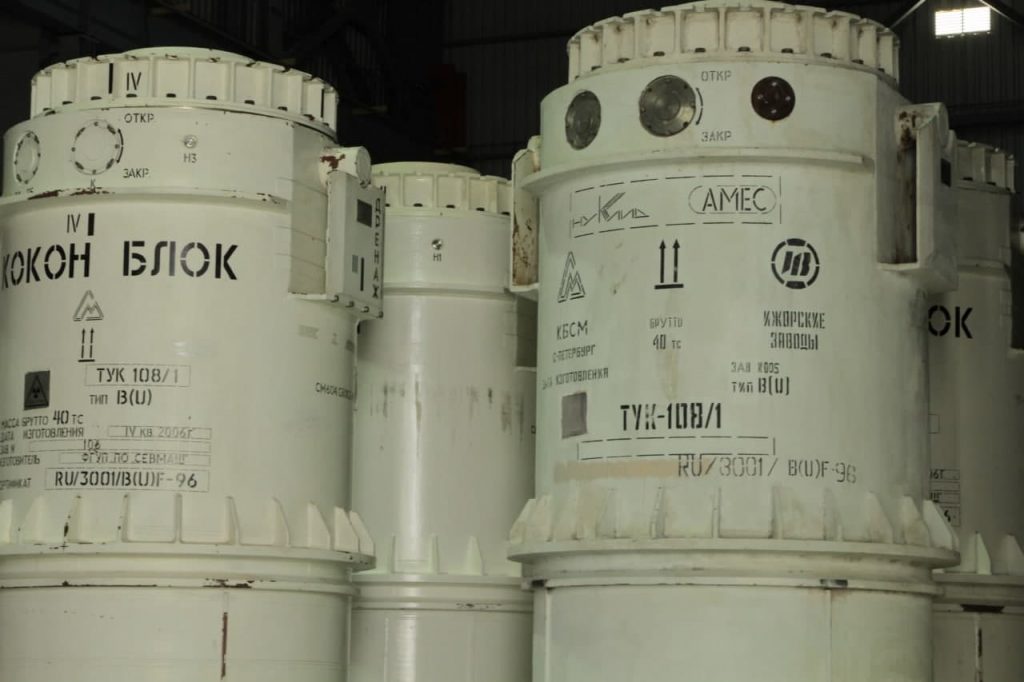
“I am deeply worried if Russia has started to move nuclear waste from the Kola Peninsula to the Arctic archipelago,” says Frederic Hauge with the Bellona foundation.
Much of the remaining uranium fuel elements in Andreeva Guba are damaged and pose special problems to handle. For that reason, the reprocessing plant in Mayak has been unwilling to receive.
Thomas Nilsen, September 29, 2023 https://thebarentsobserver.com/en/nuclear-safety/2023/09/nuclear-waste-ship-makes-port-call-novaya-zemlya
Last week, the “Rossita” could be seen on ship tracking services as it sailed outside Gremikha, a shutdown submarine base east on the Kola Peninsula. Now, the specially designed ship is moored at the pier in Severny, a military town on the shores of the Matochkin Strait diving the northern and southern islands of Novaya Zemlya
Severny is the settlement serving Russia’s nuclear weapons tests, nowadays in the form of sub-critical experiments taking place deep inside tunnels in the permafrost mountains. The last real detonation of a nuclear warhead was on October 24, 1990.
The “Rossita” was built in Italy with Italian taxpayers money. It was a helping hand from a European nation aimed to transport spent nuclear fuel from the run-down storage site in Andreeva Guba on the shores of the Litsa fjord, a short 60 km from the border with Norway.
Some 21,000 spent fuel elements from the Soviet Union’s fleet of Cold War submarines were stored. Italy’s contributions were part of a larger international cooperation to assist Russia in securing the lethal highly radioactive waste.
Other contributing nations were Norway, the United Kingdom and Sweden.
The “Rossita” shuttled between Andreeva Bay and Atomflot in Murmansk. From there, the containers with the fuel elements were sent by train to Mayak north of Chelyabinsk where Russia’s reprocessing plant is located.
With Moscow’s all-out war against Ukraine, the Western partners stopped all cooperation with Russia in regard to nuclear waste handling.
For the last 19 months, little information about what happens in Andreeva Bay has reached the public.
What is known is that two of the Northern Fleet’s most potent nuclear-powered submarines, the “Severodvinsk” and the “Kazan” of the Yasen class are moored across the bay at the piers in Nerpicha, part of Zapadnaya Litsa naval base.
“All reasons to monitor”
Frederic Hauge with the Bellona Foundation in Norway will not speculate too much about reasons Russia might have to move nuclear waste to the Arctic archipelago of Novaya Zemlya.
“What we do know is that “Rossita” is specially designed to carry TUK-18 containers modified to hold damaged spent nuclear fuel,” he says.
Much of the remaining uranium fuel elements in Andreeva Guba are damaged and pose special problems to handle. For that reason, the reprocessing plant in Mayak has been unwilling to receive.
“There are all reasons to monitor what now happens at Novaya Zemlya,” Hauge notes.
His team of nuclear experts in Oslo and Vilnius are now analyzing the limited available information with the hope of understanding what happens.
“A week ago, Rosatom’s larger carrier “Sevmorput” sailed to Novaya Zemlya. We are also told that there have been busy days at Severny and near the tunnels designed for nuclear weapons testing,” Hauge says in a phone interview with the Barents Observer.
“The big unanswered question is if what we now are witnessing is a Russia that brings dangerous nuclear waste to Novaya Zemlya for long-term storage in the permafrost.”
Andreyeva Bay cleanup slows to a snail’s pace since invasion of Ukraine

https://bellona.org/news/nuclear-issues/2023-09-andreyeva-bay-cleanup-slows-to-a-snails-pace-since-invasion-of-ukraine 18 Sept 23 Charles Digges
In 2017, Russia began a landmark project ridding one of its most dangerous Cold War relics of spent nuclear fuel and radioactive waste. The effort to clean up Andreyeva Bay — a submarine base near Murmansk uniquely positioned to contaminate the Barents Sea — was the culmination of a years-long and often strained cooperative effort between Moscow and numerous European nations, chief among them Norway and the United Kingdom.
The outbreak of war in Ukraine in February 2022 disrupted that progress and drained the project of millions in international funding as European nations suspended their contributions in protest of Moscow’s invasion.
In the early days of the war, officials with Rosatom, Russia’s state nuclear corporation, insisted they would continue Andreyeva Bay’s cleanup without international assistance, though it was unclear on what funding that would be done.
It wasn’t until Rosatom’s annual conference convened in Murmansk this past July that any news of how these projects were progressing saw the light of day. But even then, the audience a was select one. Bellona — which had attended the annual Rosatom meeting in prewar times — has only viewed the conference presentations in written form.
In fact, none of Rosatom’s former international partners whose funding has driven the Andreyeva Bay project — nations like Norway, France, the United Kingdom and others from Europe— were invited. Instead, the international delegation consisted primarily of countries like Belarus, Kirgizstan, Uzbekistan and others from the Moscow-dominated Commonwealth of Independent States.
“Most of these countries don’t know anything about the Arctic,” said Bellona’s Alexander Nikitin, who is a former member of Rosatom’s Public Council, which was disbanded when the invasion began. “They were invited so the organizers could call the event ‘international.’”
As it turns out, Rosatom hasn’t made any significant progress on the cleanup since the war estranged it from its primary international partners. The problems that remained at the Andreyeva Bay site before war broke out are the same problems Rosatom is addressing now. And where the cleanup was forecast to be completed by 2028 before the Ukraine invasion, current projections by Rosatom officials put the completion date much later.
The disruption to Andreyeva Bay and other cleanup projects threatens to turn back the clock on more than two decades of environmental progress in Northwest Russia.
History
Throughout the Cold War, the Soviet Union and the United States built more than 400 nuclear submarines, assuring each superpower the ability to fire nuclear missiles from sea even after their land-based silos had been decimated by a first strike. The fjords and coastlines around Murmansk adjacent to Norway became the hub of the Soviet Northern Fleet, and a dumping ground for radioactive waste and spent nuclear fuel.
After the Iron Curtain was drawn back, the disturbing scale of this legacy came to light. It was revealed that a storage building at Andreyeva Bay — the now notorious Building No 5 — had leaked some 600,000 metric tons of irradiated water into the Barents Sea from a nuclear fuel storage pool in 1982. The site contained 22,000 spent nuclear fuel assemblies pulled from more than 100 subs, many kept in rusted containers stored in the open air.
This slow-motion nuclear disaster continued to unfold in near secrecy until Bellona brought it to international attention in 1996, when it published a groundbreaking report on Northwest Russia’s nuclear woes.
Fearing contamination, Norway spearheaded a sweeping cleanup effort with other Western nations. Combined they spent more than $1 billion to dismantle 197 decommissioned Soviet nuclear subs that rusted dockside, still loaded with spent nuclear fuel. One thousand Arctic navigation beacons powered by strontium batteries were replaced, many with solar powered units provided by the Norwegians.
Then, six years ago, the first batches of spent nuclear fuel began their journey away from Andreyeva Bay to safer storage — a process meant to continue for another decade thereafter. By 2021, more than half of the spent fuel assemblies had been removed. Later that year, damaged spent fuel fragments lying at the bottom of Building No 5’s storage pools had also been extracted. Real progress was being made.
Progress since the beginning of the war
Since the beginning of the war, however, the tempo of removing spent fuel assemblies has nearly ground to a halt. If 2017, the first year of the removal, saw 18 batches of spent fuel transported away from the site, then in 2022, according to various reports, only two batches left Andreyeva Bay.
The disposition of solid radioactive waste at the site, which includes solid waste inside the storage buildings, also remains unclear and appears to have slowed considerably as a result of the war. As of 2022, some 9,500 cubic meters of it — or roughly 51 percent of the entire legacy waste at the site — remained in place. This waste was scheduled to depart for other storage bases, such as the Gremikha site, by 2026. Now, that’s schedule may be unrealistic.
About half of Andreyeva Bay’s infrastructure— structures like Building No 5 and Building No 3-A, to which spent fuel in Building No 5 was rushed after the 1982 leak — remains irradiated and in need of safe rehabilitation or dismantlement. But since the schedule for removing solid waste from these structures has been pushed back from 2026 to sometime in the 2030s, dates for the completion of the dismantlement are likewise unclear.
Should that ever get done, what’s left of Building No 5 will present other problems. On the whole, the building itself represents some 15,300 tons of low- to medium level radioactive waste. The two options for dealing with this are to demolish the building and bury the debris in a radioactive waste storage facility, or encasing it in a sarcophagus, not unlike the one used at Chernobyl. As with the other issues at Andreyeva Bay, no real prospective conclusion date for disposing of Building No 5 has been discussed since the outbreak of war.
This is the first in a series of articles examining the state of nuclear cleanup in Russia since the beginning of the invasion of Ukraine. charles@bellona.no
In 2023, the risky part of Andreyeva Bay nuclear cleanup starts

Donor countries agree to fund an additional study on how to extract the damaged spent nuclear fuel from Tank 3A.
https://thebarentsobserver.com/en/ecology/2017/12/2023-risky-part-andreeva-bay-nuclear-cleanup-starts by Thomas Nilsen
Read in Russian | Читать по-русски
Take a closer look at this photo and you will understand the scoop of the most challenging and risky work to be done at the Cold War storage site for submarine nuclear fuel on Russia’s Kola Peninsula. For 35 years, highly radioactive fuel assemblies have been stored in these rusty, partly destroyed steel pipes where concrete of poor quality was filled in the space between. Some of the fuel assemblies are stuck in the canisters, while some of the canisters are stuck in the cells.
Message is clear: Do not try to lift any of the assemblies before you are sure nothing falls out.
At a recent meeting in London, donor countries discussed the progress after the first nuclear fuel assemblies were shipped away from the other tanks in Andreeva Bay towards Mayak in June.
The experts all agree it is necessary to conduct a whole range of work to prepare Tank 3A for unloading. Additional €100,000 was granted for the study. Another €675,000 was granted to study another messy challenge in Andreeva Bay; the smashed spent fuel assembles on the floor of the former water-pool storage in Building No. 5, the information portal Russian Atomic Community reports.
Unloading work at Tank 2A and 2B will go on until 2023 before possible work on unloading the dangerous mess at Tank 3A can start.
Andrey Zolotkov, a nuclear expert with the environmental group Bellona says YES with capitalized letters when asked by the Barents Observer via Skype whether Tank 3A poses the biggest risk in the cleanup work.
Equal to Chernobyl
The British nuclear engineering company Nuvia has calculated the total radionuclide inventory in the three tanks to be equal to the remains of Reactor No. 4 inside the Chernobyl sarcophagus. Some 22,000 spent fuel assemblies are stored in the tanks, coming from 90-100 reactor cores powering the Soviet Navy’s Cold War submarines sailing out from the Kola Peninsula from the late 1950s till 1982. Nuvia says it is some six tonnes of fissile uranium-235 in the fuel, about two times the amount of fissile material inside the exploded Chernobyl reactor in Ukraine.
Tank 3A does also pose the highest risk for radiation doses to working personell and ways to do the job with robotics has to be developed. Nobody want people to stay too long near the destroyed assemblies and get exposed.
Another deemed challenging job ahead is to locate and secure the six damaged spent fuel elements on the floor of Building No. 5 in Andreeva Bay. The building served as a storage-pool for the spent fuel assemblies before 1982, but due to a water-leak and rusty wires, many fuel assemblies fell to the floor. That was the reason why the assemblies were hastily moved over to the tanks 2A, 2B and 3A. In that process, however, six damaged fuel assemblies and some uranium powder from others were left on the floor. Today, they pose a serious radiation hazard risk.
Funding from Europe and Canada
The nuclear cleanup work in Andreeva Bay on the Barents Sea coast is financed by the so-called Northern Window of the Northern Dimension Environmental Partnership (NDEP), a cooperative program with Russia’s State Nuclear Corporation Rosatom.
Norway has over the last two decades financed infrastructure improvements in Andreeva Bay making the removal of spent nuclear fuel possible.
The NDEP’s funded work started in 2003. Additional to the European Union, nuclear legacy cleanup work in North-West Russia is funded by Sweden, Finland, Belgium, France, Canada, Germany, the Netherlands, Norway, Italy and the United Kingdom.
Andreeva Bay is located about 55 kilometers from Russia’s border to Norway in the north.
Russia shows N Korea’s Kim hypersonic missiles, nuclear-capable bombers

North Korean leader continues tour of Russia with visit to airbase where he inspected latest Russian missiles, bombers.
Aljazeera 16 Sept 23
North Korean leader Kim Jong Un has inspected Russia’s hypersonic “Kinzhal” missiles as well as strategic, nuclear-capable bombers in the latest stop on his tour of Russian space, military and other technological facilities in the country’s Far East, according to Russian-language news media reports…………………………..
After arriving in Artyom, Kim then travelled to the Vladivostok airport just outside the city where he was shown Russia’s nuclear-capable strategic bombers and other warplanes by Russian Defence Minister Sergei Shoigu and other senior military officials.
Shoigu introduced Kim to Russia’s latest missile, the hypersonic Kinzhal – which means “dagger” in Russian – an air-launched ballistic missile capable of carrying nuclear or conventional warheads.
The Kinzhal has a reported range of 1,500 to 2,000 km (930-1,240 miles) while carrying a payload of 480kg (1,100 pounds). It may travel at up to 10 times the speed of sound (12,000 kph or 7,700 mph)…………………………………………
Experts have said that potential military cooperation between Russia and North Korea following Kim’s visit could include efforts to modernise North Korea’s outdated air force, which relies on warplanes sent from the Soviet Union in the 1980s………….
Putin and Kim discussed military matters, the war in Ukraine, and deepening cooperation when they met on Wednesday, but the Russian leader told reporters that Moscow was “not going to violate anything”, referring to longstanding sanctions imposed on North Korea by the United Nations. https://www.aljazeera.com/news/2023/9/16/russia-shows-n-koreas-kim-hypersonic-missiles-nuclear-capable-bombers
Russia warns return of US nuclear weapons to UK would be seen as escalation
Russia would regard any return of US nuclear weapons to bases in Britain as an “escalation and a destabilizing practice,” Foreign Ministry spokeswoman Maria Zakharova told a briefing on Tuesday.
She also said that such a practice is “openly anti-Russian in nature, as it provides for joint planning and regular training exercises for the prompt delivery of nuclear strikes by members of NATO which is hostile to us against targets in Russia from the territory of non-nuclear European countries.”
“We will continue to demand the return of all American nuclear weapons to US territory, followed by the removal of infrastructure that would allow them to be quickly deployed in Europe,” she added.
Russia puts advanced Sarmat nuclear missile system on ‘combat duty’
Russian space agency chief Yuri Borisov says new intercontinental ballistic missile system is now in service, Russia’s news agencies report.
Moscow has put into service an advanced intercontinental ballistic missile that Russian President Vladimir Putin has said would make Russia’s enemies “think twice” about their threats, according to reported comments by the head of the country’s space agency.
Yuri Borisov, the head of the Russian space agency Roscosmos, said Sarmat missiles have “assumed combat duty”, according to Russian news agency reports on Friday……………………………………………………………………………………. more https://www.aljazeera.com/news/2023/9/2/russia-puts-advanced-sarmat-nuclear-missile-system-on-combat-duty
Why the US and Europe Still Buy Russian Nuclear Fuel
Washington Post, Analysis by Jonathan Tirone | Bloomberg, August 27, 2023
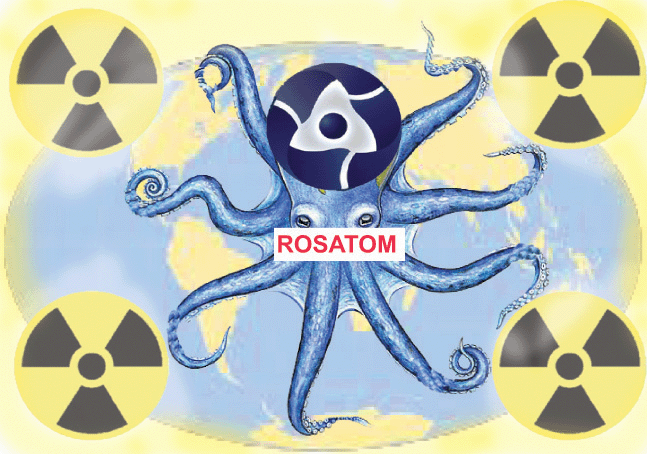
1The US and its European allies moved fast to choke exports of Russian oil, natural gas and coal after Vladimir Putin ordered troops into Ukraine. When it comes to atomic energy, however, Kremlin-controlled Rosatom Corp. continues to be the dominant source of fuel for the world’s nuclear power stations — supplying about half of global demand for enriched uranium. Western nations are racing to reconstitute their own processing capacity, much of which withered amid a growing aversion to nuclear power following Japan’s Fukushima meltdowns. But progress is likely to be slow.
………………………………………………………. Why is Russia so dominant?
Unlike Western companies in the nuclear business, Rosatom is involved in every part of the supply chain, from ore extraction to fuel enrichment and delivery. The company is as much an expression of the Kremlin’s geopolitical power as a profit-generating business. That state-level commitment has played to Russia’s advantage. When international investors turned away from nuclear power following the Fukushima accident in 2011, some Western companies involved in the fuel cycle, including Areva SA in France, the US Enrichment Co. and Westinghouse Electric Co., went bankrupt.
Russia stepped in, building market share not only among the world’s existing fleet of nuclear reactors, but by offering generous financing for new foreign projects. Today, Rosatom’s 330,000 workers provide fuel assemblies to scores of old reactors in eastern Europe and Russia, and is building 33 new power units in 10 countries, including China and India, that will be locked into fuel contracts for decades ahead.
3. Which countries are most dependent?
Former Soviet satellites in eastern Europe continue operating dozens of so-called VVER pressurized water reactors built during the Cold War era. Most of those aging units use Rosatom fuel and are already running on borrowed time, generating electricity beyond the initial period that regulators licensed them to operate. That means there’s little incentive for new companies to enter that market and compete against Russian supply. There are some exceptions. Westinghouse, after emerging from insolvency in 2018, signed contracts to fuel some of Ukraine’s VVER reactors. But even there, Ukraine continues to rely on Rosatom inventory and won’t be able to fully diversify away from Russia until later this decade. It’s a similar challenge from Bulgaria to the Czech Republic and Finland, where the search for alternative suppliers is expected to take years. In all, Russia covers about 30% of the European Union’s demand for enriched uranium.
4. How much is the US exposed?
Atomic trade between the countries grew in the aftermath of the Cold War under the so-called Megatons to Megawatts program, which converted 500 tons of Russian weapons-grade uranium into fuel suitable for US reactors. Russia continues to be a major provider of uranium mining, milling, conversion and enrichment services for US utilities, exposing US consumers to potential disruption. In 2022 it supplied about a quarter of the enriched uranium purchased by US nuclear power reactors, according to US government figures.
Most vulnerable is the provision of uranium enriched to higher levels, which is used by a new generation of so-called small modular reactors (SMRs) because it reduces the frequency of re-fueling. Rosatom currently supplies all the so-called HALEU, or high-assay-low-enriched uranium, to the US……………………………………………………………………. more https://www.washingtonpost.com/business/energy/2023/08/27/why-the-us-and-europe-still-buy-russian-nuclear-fuel/23474ddc-44cd-11ee-b76b-0b6e5e92090d_story.html
French cruise ship makes rendezvous with Russian nuclear icebreaker near North Pole
Barents Observer, By Atle Staalesen August 20, 2023
The meeting between the two vessels took place in remote Arctic waters not far from the North Pole.
Video made by passengers onboard the 50 Let Pobedy and shared on social media shows the two vessels trading greetings and sailing side by side through thick sea-ice.
The Russian nuclear-powered icebreaker is on the way to the North Pole as part of an expedition for students. Shortly after its meeting with the tourist ship, it encountered also two other ships currently sailing in the area. According to ship operator Rosatom, the 50 Let Pobedy met with Arctic research station Severny Polyus, as well as research ship Akademik Tryoshnikov.
The latter ship had sailed all the way from St.Petersburg with new crew and equipment for the drifting station that is on a two-year expedition across the ice.
The Le Commandant Charcot is the new vessel built for cruise ship operator Ponant. It is classified as icebreaker and can make independent voyages to the North Pole. In 2021, it was first hybrid-electric luxury cruise ship to make it to the North Pole.
The ship set out on a 16-days expedition from Reykjavik in early August. It sails to the geographic North Pole and ends up in Longyearbyen, Svalbard.
It is not a voyage for the regular man and woman. The starting price per person is €31,485…………………………………………… https://thebarentsobserver.com/en/arctic/2023/08/french-cruise-ship-makes-rendezvous-russian-nuclear-icebreaker-near-north-pole
France and Russia co-operate on developing a plant in Russia for processing depleted uranium
The installation of equipment has begun at TVEL’s JSC Electrochemical Plant
(ECP) in Zelenogorsk in Russia’s Krasnoyarsk Region for W2-ECP, the
country’s second plant for the processing of depleted uranium hexafluoride.
The plant is part of a long-term project to manage and make use of depleted
uranium stocks in Russia. The plant, with a processing capacity of 10,000
tonnes per year, is being supplied by Orano Projets – the engineering arm
of France’s nuclear fuel cycle specialist Orano – under a EUR40 million
(USD44 million) contract signed in December 2019.
Under the terms of the contract, Orano will supply the equipment for the construction of the
deconversion facility, as well as providing technical assistance in its
installation and commissioning. The first equipment for the plant arrived
at the construction site in eastern Siberia from France in December 2021.
The project was originally expected to be completed in 2022. The W2-ECP
plant will accept deliveries of depleted uranium hexafluoride gas (DUF6 –
sometimes called DUHF) and deconvert these to uranium tetrafluoride, with
anhydrous hydrofluoric acid being produced as a by-product. Deconversion
transforms the toxic and somewhat corrosive gaseous DUF6 enrichment
tailings into a stable powdered oxide form fit for long-term storage,
transport or final disposal.
World Nuclear News 16th Aug 2023
https://www.world-nuclear-news.org/Articles/Construction-of-second-Russian-deconversion-plant
The nuclear icebreakers enabling drilling in Russia’s Arctic
Russia, the US, and China want to develop the Arctic. Here’s how Russia’s multifunctional nuclear vessel would expand shipping routes to Europe and Asia.
ussia is home to the only nuclear icebreaker fleet in the world, built to meet maritime transportation requirements through modern nuclear technology. The country’s aim of establishing an Arctic shipping route would open up its north coast to new projects, at a cost beyond money.
“The Russian shipbuilding industry has been growing for the past few years,” says Alexey Rakhmanov, president of Russia’s United Shipbuilding Corporation.
“This has especially happened in specific market segments, such as research vessels and nuclear-powered icebreakers, and niches such as the ice-resistant, self-propelled research platform North Pole.”
According to the Russian Government’s Northern Sea Route (NSR) Development Plan, the country aims to transport at least 150 million tonnes of crude oil, liquefied natural gas, coal, and other cargoes via its northern sea route per year, starting in 2030.
The Centre for Strategic and International Studies claims that Russian President Vladimir Putin personally identifies with Russia’s Arctic ambitions, seeking to use the Arctic narrative of man conquering nature as a distinguishing feature of contemporary Russian nationalism.
According to London-based think-tank The Polar Connection, increased mining and energy extraction, particularly on the Yamal Peninsula, relates to the NSR expansion.
The Arctic route, which offers a far quicker journey between northern Europe and East Asia than the conventional Suez Canal route, has also been proposed by Russia as an alternative global shipping route. However, this route’s distinctive challenges and risks have held back its otherwise rapid development.
Nuclear icebreaker fleets in the Arctic
In January 2022, multinational engineering and constructions company China Communications and Construction and Russian Titanium Resources agreed to co-operate on a mining project to develop a vertically-integrated mining and metallurgical complex for the processing of titanium ores and quartz sands from the Pizhemsky deposit in the Komi Republic, north-west Russia.
This project to create a national mining cluster would involve the construction of the Sosnogorsk-Indiga railway and the deep sea port of Indiga, in the Arctic region of Russia. This development will need reliable waterways, which only an icebreaker can provide.
Russia had plans, under the name Project 10510, to build a fleet of Lider-class nuclear-powered icebreakers and ships as part of its aim to improve Arctic shipping – though this strategy has since been downsized to a single vessel, called Rossiya, due to begin operations in 2027.
Authorities docked the nuclear-powered vessel Sevmorput in the Arctic region last year; a 34,600 deadweight tonnage (dwt) vessel carrying up to 1,324 TEU (twenty-foot equivalent unit). The ship will serve on the NSR, while Russia has built a new nuclear-powered icebreaker, Ural, (7,154 dwt) alongside it.
Shipbuilder Rosatomflot is a subsidiary of Russian state nuclear company Rosatom and JSC Baltiysjiy Zavod, part of the United Shipbuilding Corporation. Recently, the company signed a contract for the construction of a unique, multifunctional nuclear service vessel that would operate from 2029. The vessel is designed to perform a full range of work on recharging nuclear plants of existing Russian nuclear icebreakers.
“A multifunctional nuclear-technical support vessel will ensure the proper functioning of a modern icebreaking group. Financing of its construction is assumed according to the scheme: 50% from the budget of the Russian Federation, 50% from the investment program of the State Corporation Rosatom,” Russian Deputy Minister of Industry and Trade Victor Yevtukhov said in a press release.
Building an “Arctic economy” in remote parts of Russia
The Russian Government is trying to build a new Arctic economy. According to the government statement, the NSR is a “key element” in developing transport connectivity in Russia’s “most hard-to-access” territories. The leading Arctic companies, such as Vostok Oil, Novatek, and Gazprom Neft, intend to increase the volume of shipping in Arctic waters to over 190 million tonnes over the next few years. ………………………………
Arctic to look like “ice cubes melting in a glass of water”
…………………………. the main purpose of the icebreakers is simply to break ice. Broken ice melts more easily, becoming water that absorbs more sunlight. This causes an increase in local temperatures, thus leading to more ice melting.
The Arctic is warming much faster than the rest of the world as the high sunlight reflectivity, or albedo, of Arctic ice is lost. Compared to ice, seawater absorbs more sunlight, meaning that water then warms up and evaporates more readily, itself becoming a greenhouse gas.
Small ships can have big effects in the Arctic. Non-profit US think tank the Center for the Advancement of the Steady State Economy reported that an icebreaker ship passing through the ice for around 620 miles, which leaves an ice-free wake of 33 feet, would open an area of water of 3.9 square miles over the entire cruise.
Even though the Arctic Sea covers around 2,500 miles, all icebreaking harms the environment. Continuous use of icebreaker ships in the Arctic would lead to looking more like “ice cubes melting in a glass of water,” the report says.
Russian development through thawing sea ice
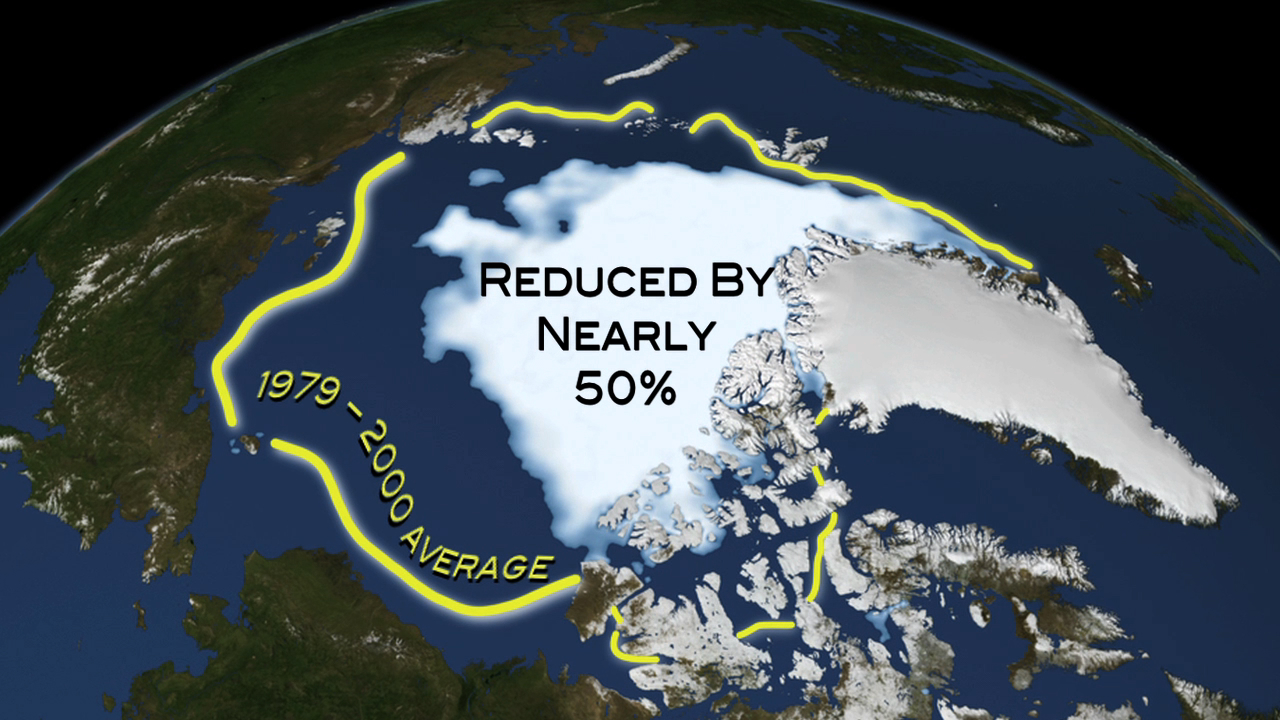
………………………………………………….. The Financial Times reported that according to data from NASA, the Arctic Circle’s ice sheet has shrunk by 13% over the past ten years due to the region’s unusually high temperatures, allowing for greater shipping access.
…………………………………….. As a result of global warming, seasonal sea ice in the Arctic is melting, and opportunities for human activity are expanding. These changes not only allow for growth in tourism, fishing, and military activities, but also enable oil and gas exploration, mining, and development in new regions.
Increased activity in the Arctic will impact marine life, which had previously been largely undisturbed. While Arctic ecosystems remain relatively poorly understood, Arctic industrialisation has already increased geopolitical tensions, which will undoubtedly worsen as the ice melts.
Nuclear weapons on the table if Ukraine counteroffensive succeeds: Russia’s Medvedev
There would be ‘no other way out’ if Kyiv takes Russian territory, says the former Russian president and current National Security Council deputy chairman.
Politico, BY VARG FOLKMAN, JULY 30, 2023
If Ukraine’s ongoing counteroffensive against Moscow’s invasion captures Russian territory, there would be no alternative to using strategic nuclear weapons, Russia’s Dmitry Medvedev warned on Sunday.
“There would simply be no other way out” of using nuclear weapons if the Ukrainian offensive succeeded in taking Russian territory, Medvedev, former Russian president and current National Security Council deputy chairman, said in a post on social media.
“Just imagine that the NATO-supported ukrobanderovtsy’s offensive turned out successful, and they took away a part of our land: Then we would have to, following the president’s degree of 02.06.2020, use the nuclear weapon,” Medvedev wrote, referring to followers of Stepan Bandera, a nationalist leader who waged a violent campaign for Ukrainian independence in the 1930s and 1940s.
“That’s why our enemies must worship our warriors. They are keeping global nuclear fire from flaring up,” Medvedev said, referring to Russian efforts to stop the Ukrainian offensive.
Medvedev has not been shy in using Russia’s nuclear arsenal to threaten Ukraine and its Western supporters. During Wagner chief Yevgeny Prigozhin’s failed coup, Medvedev said the rebellion could lead to a nuclear war…………… https://www.politico.eu/article/russia-dmitry-medvedev-ukraine-counteroffensive-russia-invasion-war-nuclear-weapons/
Overnight drone attack on Moscow injures one and temporarily closes an airport as Russia suffers ‘consequences’
ABC News 31 July 23
Three Ukrainian drones have attacked Moscow in the early hours on Sunday, Russian authorities said, injuring one person and prompting a temporary closure of traffic in and out of one of four airports around the Russian capital.
Key points:
- The Russian Defence Ministry referred to the incident as an “attempted terrorist attack by the Kyiv regime”
- Moscow Mayor Sergei Sobyanin said the attack “insignificantly damaged” the outsides of two buildings in the Moscow city district
- A spokesperson for the Ukrainian air force said the Russian people were seeing the consequences of Russia’s war in Ukraine
Ukrainian President Volodymyr Zelenskyy warned on Sunday that “war” was coming to Russia after the attack.
“Gradually, the war is returning to the territory of Russia — to its symbolic centres and military bases, and this is an inevitable, natural and absolutely fair process,” Mr Zelenskyy said on a visit to the western city of Ivano-Frankivsk.
It was the fourth such attempt at a strike on the capital region this month and the third in a week, fuelling concerns about Moscow’s vulnerability to attacks as Russia’s war in Ukraine drags into its 18th month.
The Russian Defence Ministry referred to the incident as an “attempted terrorist attack by the Kyiv regime” and said three drones targeted the city.
One was shot down in the surrounding Moscow region by air defence systems and two others were jammed. Those two crashed into the Moscow business district…………………………………………………………………
Without directly acknowledging that Ukraine was behind the attack on Moscow, a spokesperson for the Ukrainian air force said that the Russian people were seeing the consequences of Russia’s war in Ukraine………………………………….
Mr Ihnat also referenced a drone attack on Russian-occupied Crimea overnight.
Moscow announced on Sunday that it had shot down 16 Ukrainian drones and neutralised eight more with an electronic jamming system. There were no casualties, officials said.
In Ukraine, the air force reported that it had destroyed four Russian drones above the country’s Kherson and Dnipropetrovsk regions.
Information on the attacks could not be independently verified. https://www.abc.net.au/news/2023-07-30/drone-attack-moscow-injures-one-russia-ukraine/102667050
Putin warns of Poland’s intentions in Ukraine and Belarus
Warsaw is looking to take control over western parts of Ukraine, the Russian president claims
Polish leaders are planning to form a NATO-backed coalition to intervene in the Ukraine conflict and take over parts of western Ukraine as well as, possibly, Belarus, Russian President Vladimir Putin claimed on Friday.
Speaking at a meeting with permanent members of Russia’s Security Council, Putin said the government in Kiev is willing to go to any lengths to stay in power, including selling out its own people and handing over Ukrainian territories to “foreign owners.”
The first in line, according to the Russian president, are the Poles, who he claimed “probably expect to form some kind of coalition under the ‘NATO umbrella’ and directly intervene in the conflict in Ukraine, in order to then ‘tear off’ a bigger piece for themselves, to regain, as they believe, their historical territories – today’s western Ukraine.”……………………………………………….. more https://www.rt.com/russia/580080-poland-western-ukraine-putin/
Ukraine Again Bombs Crimean Bridge
18, July, 2023 https://scheerpost.com/2023/07/18/ukraine-again-bombs-crimean-bridge/—
Ukrainian sources are telling media outlets it was a joint operation between the SBU and the Ukrainian Navy.
By Dave DeCamp / Antiwar.com
The Crimean Bridge that links Crimea to the Russian mainland was again targeted by Ukrainian forces in a bombing early Monday morning that killed two civilians and injured a young child.
Russian authorities said the Crimean Bridge, also known as the Kerch Bridge, was targeted by drones operating on the surface of the water. The previous attack on the bridge that took place in October 2022 was a truck bombing.
Ukrainian sources are telling media outlets that the attack was a joint operation between Ukraine’s Security Service (SBU) and Ukraine’s Navy. The government in Kyiv hasn’t officially taken credit for the attack but has hinted at responsibility, which is typical of their covert attacks on Russian territory.
Russian authorities have halted vehicle traffic on the bridge and are assessing the damage. According to RT, rail transport on the bridge was temporarily halted but has resumed.
The Crimean Bridge is a sensitive target for Russia, and the last time it was attacked, Russian President Vladimir Putin significantly escalated the war. In response, the Russian military began large-scale missile strikes on Ukrainian infrastructure, which it hadn’t done before October 2022.
Russian Foreign Ministry spokeswoman Maria Zakharova hinted at Western involvement in the Monday attack, saying that Ukrainian decisions on such operations are made “with the direct participation of American and British intelligence services and politicians.”
The Grayzone previously reported that British intelligence officials were plotting ways to blow up the Crimean Bridge before the October 2022 attack. The Grayzone obtained a presentation drawn up for British intelligence in April 2022 that reviewed options for attacking the bridge.
The document suggested using cruise missiles or divers to plant mines to blow up the bridge. The Ukrainian attacks differed operationally, but the existence of the document signals the British could have helped Ukraine plot the attacks or at least offered advice.
Novouralsk Nuclear Plant Blast—What We Know, as Russians Rushed to Hospital
More than 100 people have been hospitalized and one person was killed
after an explosion at a uranium enrichment plant in Russia’s Urals
region—the largest of its kind in the world—according to local media
reports.
Russia’s state nuclear corporation, Rosatom, which owns the Ural
Electrochemical Combine in Novouralsk, said a cylinder with depleted
uranium hexafluoride was “depressurized” at around 9 a.m. local time.
Russian media outlets often use euphemisms such as “loud bang” or
“depressurized” instead of “blast” or “explosion,” allegedly to avoid
sowing panic and maintain a favorable information landscape.
Newsweek 14th July 2023
https://www.newsweek.com/novouralsk-nuclear-plant-blast-uranium-russia-hospital-latest-1813022
1 This Month

of the week – Shut Down Drone Warfare!


Tell the Ukrainian Government to Drop Prosecution of Peace Activist Yurii Sheliazhenko

Petition to revoke the licensing of the Near Surface Nuclear Disposal Facility (NSDF) at Chalk River. https://www.ourcommons.ca/petitions/en/Petition/Details?Petition=e-7247
To see nuclear-related stories in greater depth and intensity – go to https://nuclearinformation.wordpress.com
-
Archives
- April 2026 (57)
- March 2026 (251)
- February 2026 (268)
- January 2026 (308)
- December 2025 (358)
- November 2025 (359)
- October 2025 (376)
- September 2025 (257)
- August 2025 (319)
- July 2025 (230)
- June 2025 (348)
- May 2025 (261)
-
Categories
- 1
- 1 NUCLEAR ISSUES
- business and costs
- climate change
- culture and arts
- ENERGY
- environment
- health
- history
- indigenous issues
- Legal
- marketing of nuclear
- media
- opposition to nuclear
- PERSONAL STORIES
- politics
- politics international
- Religion and ethics
- safety
- secrets,lies and civil liberties
- spinbuster
- technology
- Uranium
- wastes
- weapons and war
- Women
- 2 WORLD
- ACTION
- AFRICA
- Atrocities
- AUSTRALIA
- Christina's notes
- Christina's themes
- culture and arts
- Events
- Fuk 2022
- Fuk 2023
- Fukushima 2017
- Fukushima 2018
- fukushima 2019
- Fukushima 2020
- Fukushima 2021
- general
- global warming
- Humour (God we need it)
- Nuclear
- RARE EARTHS
- Reference
- resources – print
- Resources -audiovicual
- Weekly Newsletter
- World
- World Nuclear
- YouTube
-
RSS
Entries RSS
Comments RSS
 nuclear-news