Russian nuclear capabilities in space could threaten international satellites, US military comms: Sources
House Intel Chairman Mike Turner first warned of the ‘serious national security threat’ on Wednesday
By Brooke Singman , Jacqui Heinrich Fox News, February 14, 2024
The U.S. has intelligence of a national and international security threat related to Russian nuclear capabilities in space which could threaten satellites, including potentially knocking out U.S. military communications and reconnaissance, Fox News has learned.
Sources tell Fox News that the Russian capability has not yet deployed.
House Intelligence Committee Chairman Mike Turner on Wednesday morning first warned of a “serious national security threat,” and called on President Biden to declassify it………………………………………………………………………………………………………. more https://www.foxnews.com/politics/russian-nuclear-capabilities-space-could-threaten-international-satellites-us-military-comms-sources
Russia has no plans to deploy nuclear arms beyond Belarus, says deputy minister
By Dmitry Antonov and Guy Faulconbridge
February 2, 2024, https://www.reuters.com/world/europe/russia-has-no-plans-deploy-nuclear-arms-beyond-belarus-says-deputy-minister-2024-02-01/
- Summary
- U.S. likely to deploy nuclear weapons in England – researchers
- Russia says UK deployment will not deter Russia
- Russia says discussing Ukraine as part of BRICS
MOSCOW, Feb 1 (Reuters) – Russia will not deploy nuclear weapons abroad except in its ally Belarus but will find ways to counter any deployment of U.S. tactical nuclear weapons in Britain, the deputy minister in charge of arms control said on Thursday.
President Vladimir Putin said last year that Moscow had transferred some tactical nuclear weapons to Belarus, blaming what he casts as a hostile and aggressive West for the decision.
2
Top nuclear researchers at the Federation of American Scientists, opens new tab say there is no conclusive evidence to show where the weapons are in Belarus, or even if they are there at all.
Asked by reporters if Russia would deploy nuclear weapons beyond Belarus, for example in South America, Deputy Foreign Minister Sergei Ryabkov said: “No, it is not planned.”
“The deployment of tactical nuclear weapons on the territory of Belarus was carried out to counter the increasingly aggressive and threatening activities of the North Atlantic Alliance (NATO) led by the United States.”
Ryabkov, who oversees arms control, also scolded the United States for including what he said were openly declared “nuclear free” European countries in NATO nuclear missions. He did not elaborate.
Separately, Ryabkov told Russia Today in an interview that U.S. plans to deploy tactical nuclear weapons to Britain would not deter Moscow.
“If they believe that re-introduction of nuclear weapons in the UK is a deterrent to Russia, then they are mistaken,” Ryabkov said. “We urge them to stop… this endless circle of escalation.”
Nuclear Fuel: Russian Cutoff Would Upend Global Market
Jan 5, 2024, Author, Grace Symes, London. Editor. Phil Chaffee
The global nuclear fuel market could be upended this year by one increasingly likely scenario: the possibility that Moscow cuts off all nuclear fuel supplies to the US in retaliation for a bill expected to pass this month in the US Congress.
That bill would ban imports of Russian low-enriched uranium with waivers through 2028, but US nuclear operators fear it would prompt more immediate Russian retaliation, which would in turn have far-reaching effects on the global nuclear fuel sector and leave US utilities in a precarious position, whether or not they were reliant on Russian fuel. US utilities are unlikely to have to actually stop operating reactors due to a lack of available fuel, , but sources expect such a scenario to push further north already high prices for uranium, conversion
and enrichment.
Energy Intelligence 5th Jan 2024
https://www.energyintel.com/0000018c-cabf-d61c-a7cc-fbbf5b580000
A nuclear-powered ship in Murmansk started to burn. Only few locals got to know about the serious incident
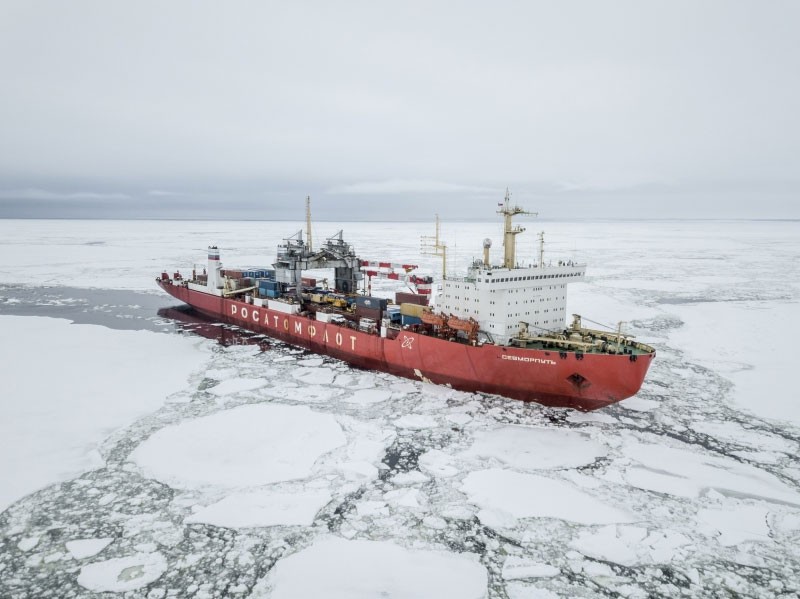
The fire brigade in Murmansk quickly extinguished the blaze that broke out on the 24th of December in a cabin onboard nuclear-powered container ship Sevmorput. State shipowner Rosatom never issued any information about the dramatic situation.
By Atle Staalesen, 28 Dec 23
Little information is available about the fire that broke out in Atomflot, the base for nuclear-powered vessels in Murmansk.
Only two short announcements were in the evening of the 24th of December posted on messenger service Telegram by the local Ministry of Emergency Situations (Emercom).
The first message posted at 21.17 pm informed about a fire on the territory of Atomflot and about the fire brigades that were on the way.
About 1,5 hour later, Emercom informed about its successful fire fighting……………
According to the emergency service, the fire covered an area of about 30 square meters in a cabin onboard the Sevmorput.
The Telegram messages were read by about ten thousand people. A few of them commented on the posts.
Where should we flee?” one of the readers asked.
Rosatom, the state nuclear power company that operates the Sevmorput, has apparently not issued any information about the fire. Neither has any of the company’s subsidiaries, such as the Atomflot or the Rosatomflot.
There is no information about the incident on the companies’ websites or their social media.
The fire could potentially have created a dramatic situation in the big Russian Arctic city. The Atomflot base is located only few kilometres from downtown Murmansk and a major fire on the nuclear-powered ship would have posed a serious threat to the about 270,000 population.
The Sevmorput is the world’s only nuclear-powered merchant container ship.
It is 260 meter long and was built in 1988. For many years, the ship lay idle in Murmansk and Russian authorities ultimately decided to scrap it. However, in 2013 it was instead decided to undertake a major renovation, and in autumn 2015, the ship was again test-sailing the Barents Sea. The following year, Sevmorput was back in regular service and has in the lastest years delivered cargo to military installations in the Russian Arctic, as well as to the petroleum development along the Siberian coast. The ship can carry 74 lighters or 1324 containers.
After the 2015 upgrade and safety evaluation, the reactor’s service life was prolonged with 150,000 hours aimed at keeping the vessel in operation until 2024.
It now looks increasingly likely that the ship will exit service and ultimately be scrapped. In a recent conference on the Arctic, Head of Atomflot Leonid Irlitsa said that his company plans to replace the ship with alternative non-nuclear vessels in 2024…………. https://thebarentsobserver.com/en/nuclear-safety/2023/12/nuclear-powered-ship-murmansk-started-burn-only-few-locals-got-know-about
Mystery fire breaks out on Russia’s only nuclear-powered icebreaker vessel as it was docked at Arctic port
- The Sevmorput, built in 1988, underwent extensive upgrades a decade ago
- Its owner stressed there was no threat to the ship’s nuclear reactor plant
By JAMES REYNOLDS and WILL STEWART, 25 December 2023
A mystery blaze aboard Russia‘s only nuclear-powered icebreaker cargo ship triggered panic in the Arctic port of Murmansk.
A fire broke out on Sunday in one of the cabins of the Soviet-made Sevmorput, currently docked in the northern Russian region bordering Finland and Norway.
The inferno spread some 323 square feet (30 sq metres) on the 830-ft ship (230m) before firefighters were able to put it out without casualties, Russia’s emergency ministry said.
‘The fire was quickly liquidated,’ Atomflot, which owns the vessel, said in a statement. ‘There were no injuries. There was no threat to crucial support systems or to the reactor plant.’
The ship, which entered service in 1988 and went through an extensive upgrade a decade ago, is Russia’s only nuclear-powered icebreaking transport ship, according to Rosatom. ………………………………………………..more https://www.dailymail.co.uk/news/article-12899379/Inferno-nuclear-russia-icebreaker-panic-murmansk-arctic.html
 | |||
| |||
(no subject)
Inbox
Search for all messages with label Inbox
Remove label Inbox from this conversation

Christina Macpherson <christinamacpherson@gmail.com>
7:49 AM (0 minutes ago)
to me
Russia To Retire World’s Only Nuclear-Powered, Largest Battle-Cruiser Pyotr Veliky
The Russian Navy will not modernize the massive Pyotr Veliky battle-cruiser, the world’s only nuclear-powered surface vessel, and the largest non-aircraft carrier naval warship.
The one-of-kind warship that packs phenomenal firepower was supposed to be refitted and modernized after another ship in its class, Admiral Nakhimov, concluded her modernization. Pyotr Veliky will head for decommissioning following that.
According to reports, the anticipated refurbishment has been canceled owing to concerns over the massive costs and technical challenges involved in the vessels’ operations and maintenance.
Moreover, the ships are also not in harmony with newer concepts being considered in the Russian Navy, which favor mid-sized, heavily armed missile boats, corvettes, and frigates, which have a mix of land-attack, surface-ship strike, anti-air, and submarine hunting capabilities. …………………………………………………………………………… https://www.eurasiantimes.com/russia-to-retire-worlds-only-nuclear-powered-largest-battle-cruiser-pyotr-veliky-sister-ship-to-serve-in-arctic/
Why Egypt’s new nuclear plant is a long-term win for Russia
By Marina Lorenzini | December 20, 2023
With 22 countries pledging to triple global nuclear energy production by
2050 at the COP28 climate meeting in Dubai, sincere prospects for growth in
global nuclear energy market is on the table. Nonetheless, these 22
countries largely represent ones that have minimal ties with Russia’s
nuclear exports or are seeking to decouple themselves from a current
dependency.
Many other countries are considering the option of nuclear
energy, and several will turn to Russia’s state-owned nuclear energy
company, Rosatom, to build their new reactors. Since assuming power,
Russian President Vladimir Putin has developed Russia’s nuclear industry
exports as a key piece of its energy and geopolitical portfolio. Rosatom
currently holds about 70 percent of the global export market for
construction of new nuclear power plants. According to the conglomerate’s
disclosures, its exports exceeded $10 billion in 2022, with a schedule of
upcoming international orders amounting to about $200 billion over the next
10 years.
One country in particular has embraced a partnership with
Rosatom: Egypt. In 2015, Russia and Egypt concluded an intergovernmental
agreement that led Rosatom to build a $30-billion nuclear power plant near
the Mediterranean coastal town of El Dabaa, about 170 kilometers west of
Alexandria. With four Russian-designed, 1.2-gigawatt, VVER reactor units,
the El Dabaa nuclear power plant is expected to generate more than 10
percent of total electricity production in Egypt and provide a consistent
baseload power source for 20 million people.
Bulletin of Atomic Scientists 20th Dec 2023 https://thebulletin.org/2023/12/why-egypts-new-nuclear-plant-is-a-long-term-win-for-russia/
Documents Reveal Hidden Problems at Russia’s Nuclear Powerhouse
- Flagship reactor had unusual safety event in February 2022
- Rosatom said its reactors all meet highest safety standards
By Alberto Nardelli and Jonathan Tirone, December 18, 2023
As Russian troops poured into Ukraine at the start of Vladimir Putin’s invasion in February last year, alarm was rising at a flagship Kremlin nuclear project in neighboring Belarus, just a short distance from the European Union’s border.
Engineers at Rosatom Corp. preparing a new 1,200-megawatt reactor, which was not yet connected to the power grid, to generate electricity at the Astravets Nuclear Power Plant detected a mysterious and exceedingly rare problem. Resin was seeping into the primary circuit, threatening to seize up critical components, according to internal documents of the Russian state nuclear……………………….(Subscribers only) more https://www.bloomberg.com/news/articles/2023-12-18/documents-reveal-hidden-problems-at-russia-s-nuclear-powerhouse
The Myth that Putin Was Bent on Conquering Ukraine and Creating a Greater Russia
By John J Measheimer / Substack https://scheerpost.com/2023/11/27/the-myth-that-putin-was-bent-on-conquering-ukraine-and-creating-a-greater-russia/
There is a growing body of compelling evidence showing that Russia and Ukraine were involved in serious negotiations to end the war in Ukraine right after it started on 24 February 2022 (see below). These talks were facilitated by Turkish President Recep Erdogan and former Israeli Prime Minister Naftali Bennett and featured detailed and candid discussions on the terms of a possible settlement.
By all accounts, these negotiations, which took place in March-April 2022, were making real progress when Britain and the US told Ukrainian President Zelensky to abandon them, which he did.
Coverage of these events has focused on how foolish and irresponsible it was for President Joe Biden and Prime Minister Boris Johnson to put an end to these negotiations, given all the death and destruction that Ukraine has suffered since then – in a war that Kyiv is likely to lose.
Yet an especially important aspect of this story regarding the causes of the Ukraine war has received little attention. The well-entrenched conventional wisdom in the West is that President Putin invaded Ukraine to conquer that country and make it part of a Greater Russia. Then, he would move on and conquer other countries in eastern Europe. The counter-argument, which enjoys little support in the West, is that Putin was mainly motivated to invade by the threat of Ukraine joining NATO and becoming a Western bulwark on Russia’s border. For him and other Russian elites, Ukraine in NATO was an existential threat.
The negotiations in March-April 2022 make it clear that the conventional wisdom on the war’s causes is wrong, and the counter-argument is right, for two main reasons. First, the talks were directly focused on satisfying Russia’s demand that Ukraine not become part of NATO and instead become a neutral state. Everyone involved in the negotiations understood that Ukraine’s relationship with NATO was Russia’s core concern. Second, if Putin was bent on conquering all of Ukraine, he would not have agreed to these talks, as their very essence contradicted any possibility of Russia conquering all of Ukraine. One might argue that he participated in these negotiations and talked a lot about neutrality to mask his larger ambitions. There is no evidence, however, to support this line of argument, not to mention that: 1) Russia’s small invasion force was not capable of conquering and occupying all of Ukraine; and 2) it would have made no sense to delay a larger offensive, as it would afford Ukraine time to build up its defenses.
In short, Putin launched a limited attack into Ukraine for the purpose of coercing Zelensky into abandoning Kyiv’s policy of aligning with the West and eventually bringing Ukraine into NATO. Had Britain and the West not intervened to scotch the negotiations, there is good reason to think Putin would have achieved this limited objective and agreed to end the war.
It is also worth remembering that Russia did not annex the Ukrainian oblasts of Donetsk, Luhansk, Kherson, and Zaporizhzhia until September 2022, well after the talks had ended. Had a deal been reached, Ukraine would almost certainly control a far greater share of its original territory than it does now.
It is becoming increasingly clear that in the case of Ukraine, the level of foolishness and dishonesty among Western elites and the mainstream Western media is stunning.
K-219: Russia’s Worst Submarine Ever (And a Nuclear Disaster)?

This article is all about the sinking of a ballistic missile submarine, carrying 6 nuclear missiles.
But – not a word about the radioactive pollution that must still be emanating from the undersea wreck nearly 30 years later.
The K-219 was clearly faulty and the crew did not react well to the emergency. It should be considered one of the worst submarines of all time because it carried nuclear missiles and there was a fire on board.
National Interest, Brent M. Eastwood 26 Nov 23
-219: The Worst or Most Dangerous Submarine of All Time? When it comes to figuring out what is the worst submarine of all time, it is difficult to blame the sub itself or the bad actions of the crew. Such is the case with the sinking of the Soviet submarine K-219. K-219 was a Yankee-class boomer, or ballistic missile submarine, that carried nuclear weapons.
On October 3, 1986, the K-219, with 16 R-27 nuclear missiles, sunk within 700 miles off the coast of Bermuda.
One of the missile tubes sprung a leak and seawater rushed in and blended with the missile fuel. This volatile combination made for a deadly mix that created dangerous levels of heat and gas. This is where the crew reacted slowly without the sailors exhibiting teamwork and conducting damage control.
Only one crew member moved to do something by venting the tube. A short circuit cropped up in the main power line that created a spark. Then a blast in the silo occurred that sent the missile and the warheads into the water. That’s when the sailors finally sprang into action. They battled the fire on board, eventually putting it out.
They had to shut down the nuclear reactors by hand because the control mechanisms were damaged. Three sailors died.
A Soviet ship tried to rescue the sub by pulling it to safety. But that did not work because the tow cord broke. The captain of the sub, Igor Britanov, decided to abandon ship. The sub sunk to the bottom of the ocean and the missiles were lost. The whole encounter lasted three days.
The Reagan administration even offered to help the Soviets and American officials appreciated that the Soviets informed them of the tragedy the day it happened. Fortunately, no radioactivity or nuclear explosion happened. The surviving sailors made it out and Captain Britanov was the last to leave the sub alive, in accordance with naval customs………………………………………………………………………………….
The K-219 was clearly faulty and the crew did not react well to the emergency. It should be considered one of the worst submarines of all time because it carried nuclear missiles and there was a fire on board. This made it one of the most dangerous submarines to ever float. Gorbachev feared the worst and he was correct to blame the crew. They reacted slowly to the original leak and did not check the power system before engaging the water pump.
They should have known that gas was present and that employing electrical power would be dangerous. This was one of the most hazardous maritime situations in the Cold War. The Soviets and the Americans were lucky it was not worse. https://nationalinterest.org/blog/buzz/k-219-why-russias-worst-submarine-ever-and-nuclear-disaster-207495
The Russian nuclear industry during wartime, 2022 and early 2023
Bellona has published a new report that analyze the new footing on which
Rosatom, Russia’s power state nuclear corporation, has found itself as the
the war in Ukraine grinds on. It’s clear that the putatively civilian
corporation is now a direct participant in and beneficiary of Russia’s
seizure of Ukrainian nuclear infrastructure.
In the early days of the war,
Moscow’s troops marched into Chernobyl, site of the world’s worst nuclear
accident and now the host of numerous industrial scale activities aimed at
cleaning it up. Days later, it then overran the Zaporizhzhia nuclear power
plant — Europe’s largest such facility — making it the world’s first
nuclear power station to be taken as prize as the result of an armed
attack. Click here to download the report: The Russian nuclear industry during wartime, 2022 and early 2023
Bellona 21st Nov 2023
Russia Shuts Down Nuclear Plant Reactor Unit After Malfunction
Nov 16, 2023, https://www.newsweek.com/russia-shuts-down-nuclear-reactor-malfunction-1844413
Russia has reported the shutdown of a unit at a nuclear power plant after turbine blades broke.
Rosenergoatom, which runs Russia’s nuclear power stations, said it was not clear what caused the blades to malfunction at the Leningrad nuclear power plant west of St Petersburg on Sunday.
“The main thing now is to understand the reason for the destruction of the blades. This is a new phenomenon,” Alexander Shutikov, head of Rosenergoatom, told Reuters. Repairs should be completed by December 22, he said.
The unit where the malfunction occurred was built in 2018 with a next-generation VVER 1200, a pressurised water reactor, according to the news agency.
Russia is building units of this type at the Akkuyu nuclear power plant in Turkey. They are also planned for the Paks-2 plant in Hungary. Russia has already supplied such units to Belarus.
The blades that failed were part of a 1,200-megawatt high-speed steam turbine, Shutikov told Reuters.
The turbines are produced by Power Machines, owned by Russian billionaire Alexey Mordashov who was sanctioned by the U.S. and the EU following Russia’s invasion of Ukraine.
Turbines of the same type had operated without problems since 2016 at four power units, Power Machines told Reuters.
The company said it was taking steps to restart the affected unit as soon as possible and working with specialists to investigate the causes. “Based on the results, conclusions will be drawn and compensatory measures will be determined,” the company said.
Newsweek has contacted Rosenergoatom and Power Machines for further comment via email.
Earlier this week, European Commissioner for Energy Kadri Simson said Hungary needed to reduce its reliance on Russian energy because it left the country open to influence from Russia.
Speaking during Politico’s Sustainability Future Week summit on Tuesday, Simson said it was regrettable that Hungary was proceeding with construction of the Paks-2 nuclear reactor. The work is reportedly being financed with a 10-billion euro ($11.3 billion) loan from a Russian state bank.
“Our clear request to them is that like other member states, who are still using Russian technology, that nuclear fleet, they have to prepare a plan how to diversify,” Simson said.
The European Union and other Western leaders have largely shunned Russian President Vladimir Putin, but Hungarian Prime Minister Viktor Orbán held talks with him in October.
Orbán has been keen to maintain ties with Moscow—on which Hungary is highly dependant for natural gas, oil and nuclear fuel—and has been critical of Western sanctions against Russia.
Russia test-fires ballistic missile from new nuclear sub
9 News, By Associated Press, Nov 6, 2023
The Russian military has reported a successful test launch of an intercontinental ballistic missile designed to carry nuclear warheads from a new nuclear submarine.
The report comes as tensions are soaring between Russia and the West over the fighting in Ukraine.
Adding to those tensions, President Vladimir Putin last week signed a bill revoking Russia’s ratification of a global nuclear test ban in a move that Moscow said was needed to establish parity with the United States…………………… more https://www.9news.com.au/world/russia-says-it-testfired-an-intercontinental-ballistic-missile-from-a-new-nuclear-submarine/34b2c5e9-8dfb-4455-92d9-910ce20d205e #nuclear #antinuclear #nuclearfree #NoNukes
Russia Says Intends to Continue Nuclear Test Moratorium
Moscow Times, 3 Nov 23
Russia intends to stick to a nuclear test ban moratorium despite withdrawing its ratification of the Comprehensive Nuclear Test Ban Treaty, the Foreign Ministry said Friday.
“We intend to keep the moratorium that was introduced more than 30 years ago in place,” said a ministry statement.
But any nuclear tests by the United States would “force us to do the same,” it added.
Russian President Vladimir Putin on Thursday signed off on a law revoking Russia’s ratification of the treaty.
The 1996 treaty outlaws all nuclear explosions, including live tests of nuclear weapons, though it never came into force because some key countries — including the United States and China — never ratified it……………………………………………………………
The Comprehensive Nuclear Test Ban Treaty Organization (CTBTO) has urged Russia to continue its commitment to the treaty, including the use of monitoring stations capable of detecting the slightest explosion in real-time. https://www.themoscowtimes.com/2023/11/03/russia-says-intends-to-continue-nuclear-test-moratorium-a82998
.
Fukushima plant water release: Russia follows China, suspends all Japanese seafood imports
WION News, Moscow, Russia Edited By: Srishti Singh Sisodia Oct 16, 2023,
Russia on Monday (Oct 16) suspended all Japanese seafood imports in the aftermath of Tokyo’s release of wastewater from the Fukushima nuclear plant.
Previously, China had suspended the imports, saying that Tokyo has not proved the authenticity and accuracy of the nuclear wastewater data, nor that the ocean discharge of the water is harmless to the marine environment and human health.
China was Japan’s biggest market for fish, accounting for more than $500 million worth of exports in 2022.
Japan recently released treated radioactive water into the sea from its defunct nuclear reactor in Fukushima after the International Atomic Energy Agency approved the plan. ………………………………………………
What did Russia say?
Ever since it released the treated water, Japan has faced the wrath of some nations and a number of environmentalists.
Japan has also criticised Russia for its invasion of Ukraine, while Tokyo’s relations with Beijing, which has deepened ties with Moscow, have worsened.
As reported by the news agency AFP, Rosselkhoznadzor, Russia’s body responsible for regulating agriculture products, said that as a “precautionary measure”, it was “joining China’s provisional restrictive measures on the import of fish and seafood products from Japan as of October 16, 2023”.
It added that the restrictions would remain in place “until the necessary exhaustive information to confirm the safety of seafood produce … is forthcoming”. https://www.wionews.com/world/fukushima-nuclear-plant-like-china-russia-suspends-all-japanese-seafood-imports-647527
1 This Month

29 Jan. Thursday 7-8 p.m. Webinar – World’s Largest Nuclear Station in Port Hope, ON?


31st January – Challenging the War Machine – a DECLASSIFIED UK SUMMIT



Website of the Week
Now until to February 10, 2026 Radioactive waste storage in France: the debate is finally open! How to participate?
-
Archives
- January 2026 (246)
- December 2025 (358)
- November 2025 (359)
- October 2025 (376)
- September 2025 (258)
- August 2025 (319)
- July 2025 (230)
- June 2025 (348)
- May 2025 (261)
- April 2025 (305)
- March 2025 (319)
- February 2025 (234)
-
Categories
- 1
- 1 NUCLEAR ISSUES
- business and costs
- climate change
- culture and arts
- ENERGY
- environment
- health
- history
- indigenous issues
- Legal
- marketing of nuclear
- media
- opposition to nuclear
- PERSONAL STORIES
- politics
- politics international
- Religion and ethics
- safety
- secrets,lies and civil liberties
- spinbuster
- technology
- Uranium
- wastes
- weapons and war
- Women
- 2 WORLD
- ACTION
- AFRICA
- Atrocities
- AUSTRALIA
- Christina's notes
- Christina's themes
- culture and arts
- Events
- Fuk 2022
- Fuk 2023
- Fukushima 2017
- Fukushima 2018
- fukushima 2019
- Fukushima 2020
- Fukushima 2021
- general
- global warming
- Humour (God we need it)
- Nuclear
- RARE EARTHS
- Reference
- resources – print
- Resources -audiovicual
- Weekly Newsletter
- World
- World Nuclear
- YouTube
-
RSS
Entries RSS
Comments RSS
 nuclear-news