Why Putin’s nuclear saber-rattling on Ukraine sounds different this time
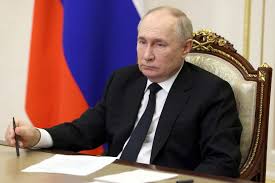
Christian Science Monitor, By Fred Weir, Special correspondent, September 19, 2024, Moscow
Over the course of the war in Ukraine, the Kremlin has drawn several “red lines” – with ostentatious references to Russia’s huge strategic nuclear arsenal – only to seemingly do nothing when these lines are crossed by Ukraine or its Western backers
Red lines:
- It happened when Ukraine acquired new and more powerful Western arms.
- It happened when Kyiv used its own drones to hit Russian airfields, refineries, and even the Kremlin itself.
- Most recently, it happened when Ukrainian forces actually invaded Russian territory. That has led Ukrainians, and many NATO officials, to conclude that Russian President Vladimir Putin’s nuclear saber-rattling is an elaborate bluff.
But when Mr. Putin warned last Thursday that Moscow will consider it a direct act of war by NATO if British, French, or U.S.-made missiles are used by Ukraine to strike targets deep inside Russia, he said this time is different.
Why We Wrote This
The Kremlin has had little success invoking its nuclear arsenal to deter Ukraine and the West from deploying new tactics and modern equipment to stop Russia’s invasion. But that may be changing.
Many Russian experts agree. And for now, Washington seems to be heeding his threat and holding off on permitting Ukraine to use the weapons.
“Russia’s frustration has been growing because the West appears to have lost all fear of nuclear war. Deterrence is absent,” says Sergei Strokan, an international affairs columnist with the Moscow daily Kommersant. During the Cold War, he says, that fear drove both sides to the bargaining table, aiming to limit conflicts and control nuclear weapons.
………………………………………………………………………………………………………………………………………………………….. more https://www.csmonitor.com/layout/set/amphtml/World/Europe/2024/0919/putin-ukraine-war-russia-nuclear-war-ww3?fbclid=IwY2xjawFZl3RleHRuA2FlbQIxMQABHTcSiRBIOeirIFfIogP4ISJt2uGrRaPn6u1PExNVwAUriNd55aENjnbTHw_aem_YYAKI4JyPWZbXh1b5xaDcw
Putin ally warns West of nuclear war over Ukraine
By Reuters, September 20, 2024, Reporting by Reuters; writing by Mark Trevelyan and Guy Faulconbridge, Editing by William Maclean
Summary
Russian missile ‘could hit Strasbourg in minutes’
Volodin says Russia will use ‘more powerful weapons’
Lawmaker reinforces Putin warning
MOSCOW, Sept 19 (Reuters) – A close ally of President Vladimir Putin warned Western governments on Thursday that a nuclear war would ensue if they gave the green light for Ukraine to use long-range Western weapons to strike targets deep inside Russia.
Vyacheslav Volodin, speaker of the lower house of parliament and a member of Putin’s Security Council, was responding to a vote in the European Parliament urging EU countries to give such approval to Kyiv.
“What the European Parliament is calling for leads to a world war using nuclear weapons,” Volodin wrote on Telegram.
His message was entitled “For those who didn’t get it the first time” – an apparent reference to a warning by Putin last week that the West would be directly fighting Russia if it let Ukraine fire the long-range missiles onto Russian territory.
The Ukraine war has triggered the biggest confrontation between Russia and the West since the 1962 Cuban Missile Crisis, which is considered to be the time when the two Cold War superpowers came closest to intentional nuclear war.
The outgoing head of NATO, Jens Stoltenberg, told The Times this week that the Kremlin leader had declared “many red lines” before but not escalated conflict with the West when they were crossed. Putin’s spokesman said his comment was dangerous and provocative.
In a non-binding resolution adopted on Thursday, the European Parliament asked EU countries to “immediately lift restrictions on the use of Western weapons systems delivered to Ukraine against legitimate military targets on Russian territory.”
Volodin wrote: “If something like this happens, Russia will give a tough response using more powerful weapons. No one should have any illusions about this.” He said it appeared to Moscow that the West had forgotten the vast sacrifices made by the Soviet Union in World War Two.
He said Europeans should understand that it would take Russia’s RS-28 Sarmat intercontinental ballistic missile, known in the West as Satan II, just 3 minutes and 20 seconds to strike Strasbourg, where the European Parliament meets.
Ukraine hits Russia with “massive drone attack” on military depot in Toropets, causing huge explosion
“If we make no effort to change direction, we will end up where we are heading.”
https://www.cbsnews.com/news/ukraine-hits-russia-drone-attack-toropets-military-depot-explosions/ 18 Sept 24
Kyiv, Ukraine — Ukrainian drones struck a large military depot in a town deep inside Russia overnight, causing a huge blaze and prompting the evacuation of some local residents, a Ukrainian official and Russian news reports said Wednesday. The strike came after a senior U.S. diplomat said Ukrainian President Volodymyr Zelenskyy’s recently announced but still confidential plan to win the war “can work” and help end the conflict that’s now in its third year.
Ukraine claimed the strike destroyed military warehouses in Toropets, a town in Russia’s Tver region about 240 miles northwest of Moscow and 300 miles from the border with Ukraine.
The attack was carried out by Ukraine’s Security Service, along with Ukraine’s Intelligence and Special Operations Forces, a Kyiv security official told The Associated Press, speaking on condition of anonymity to discuss the operation. According to the official, the depot housed Iskander and Tochka-U missiles, as well as glide bombs and artillery shells. He said the facility caught fire in the strike and was burning across an area 4 miles wide.
Russian state news agency RIA Novosti quoted regional authorities as saying air defense systems were working to repel a “massive drone attack” on Toropets, which has a population of around 11,000. The agency also reported a fire and the evacuation of some local residents.
There was no immediate information about whether the strikes had caused any casualties.
Successful Ukrainian strikes on targets deep inside Russia have become more common as the war has progressed and Kyiv developed its drone technology.
Zelenskyy has been pushing for approval from his Western partners, including the U.S., for Ukraine to use the sophisticated weapons they’re providing to hit targets inside Russia. Some Western leaders have balked at that possibility, fearing they could be dragged into the conflict.
Russian President Vladimir Putin warned last week that a decision by the U.S. or its NATO allies to allow Ukraine to use Western missiles to strike targets deep inside Russia would be viewed as “nothing less than the direct participation of NATO countries, the United States, and European countries, in the war in Ukraine.”
Ukraine’s targeting of Russian military equipment, ammunition and infrastructure deep inside Russia with drones and other weapons it already has — as well as making Russian civilians feel some of the consequences of the war that is being fought largely inside Ukraine — is part of Kyiv’s strategy.
The swift push by Ukrainian forces into Russia’s Kursk border region last month fits into that plan, apparently seeking to compel Putin to back down.
Putin has shown no signs of doing that, however, and has been trying to grind down Ukraine’s resolve through attritional warfare, while also trying to sap the West’s resolve to support Kyiv by drawing out the conflict. That has come at a price, however, as the U.K. Defense Ministry estimates the war has likely killed and wounded more than 600,000 Russian troops.
On Tuesday, Putin ordered his country’s military to increase its number of troops by 180,000 to a total of 1.5 million by Dec. 1.
Zelenskyy said last month that his plan for victory included not only battlefield goals but also diplomatic and economic wins. The plan has been kept under wraps but U.S. Ambassador to the United Nations Linda Thomas-Greenfield said during a news conference Tuesday that officials in Washington had seen it.
“We think it lays out a strategy and a plan that can work,” she said, adding that the United States would bring it up with other world leaders at the U.N. General Assembly in New York next week. She did not comment on what the plan contains.
Radiation levels mysteriously spike along Norway’s border with Russia – as it’s claimed activity has been seen at test site for Putin’s ‘Flying Chernobyl’ nuclear missile
Traces of radioactive Cesium-137 have been
measured along Norway’s border with Russia, it was revealed today. The
radiation levels are ‘clearly’ higher than normal, authorities have said,
and the cause of the mysterious spike is unknown.
One fear is that it could
relate to Russia’s Pankovo test site for the Burevestnik – a
nuclear-powered, nuclear-armed cruise missile – on the Novaya Zemlya
archipelago.
Daily Mail 17th Sept 2024
Surge in Russian uranium sent to China
https://www.telegraph.co.uk/world-news/2024/09/17/ukraine-russia-war-latest-news27/
Washington fears Russia is sending large quantities of enriched uranium to China in an effort to evade sanctions imposed after its invasion of Ukraine.
Chinese imports of enriched uranium from Russia, the world’s largest exporter of the radioactive metal, soared in 2022 and 2023, according to data released by the World Bank.
The US is now investigating whether the uranium, used as nuclear power plant fuel, is then being imported to America.
China only started to send vast quantities of enriched uranium to the US after Congress passed a ban on the import of the metal from Russia after the Ukraine invasion.
“As China may be seeking to carve out a greater role for itself in world enriched uranium markets, increased imports of Russian enriched uranium may facilitate the pursuit of Beijing’s ambitions,” said a report in March by the London-based Royal United Services Institute think tank.
Pentagon orders simulation of consequences of nuclear weapons use in Eastern Europe and Russia
12 September 2024, https://en.topwar.ru/249956-pentagon-zakazal-modelirovanie-posledstvij-primenenija-jadernogo-oruzhija-v-vostochnoj-evrope-i-rossii.html
The Pentagon intends to study the consequences of using nuclear weapons weapons in Europe and Russia. The US military has commissioned a third-party contractor to conduct the study. This is stated in documents from the US Department of Defense that have become publicly available.
The Pentagon has ordered a simulation of a situation involving the use of nuclear weapons in Eastern Europe and Western Russia, with the Americans particularly interested in the consequences of nuclear weapons use on the agricultural sector. As follows from the contract, the contractor must simulate a global nuclear situation the war, which led to the destruction of agriculture. The Pentagon also requires the contractor to expand the modeling beyond Eastern Europe and Western Russia, but with the obligatory condition of including former Eastern Bloc countries in the report.
Engineering Corps armies The United States has awarded a contract (…) to develop active research programs focused on modeling the effects of nuclear weapons on agricultural systems,
– leads RIA News excerpt from the document.
It is worth noting that this is not the first modeling of the consequences of the use of nuclear weapons ordered by the Americans. Similar studies were conducted for the countries of the Asia-Pacific region, the territory of the United States, the Middle East, as well as Europe and the entire Russian territory.
Putin Warns of ‘Direct’ War as US Mulls Letting Ukraine Use Long-Range Western Missiles
“It is a question of deciding whether or not NATO countries are directly involved in a military conflict,” said Russian President Vladimir Putin.
Jake Johnson, Sep 13, 2024, https://www.commondreams.org/news/putin-direct-war-nato
Russian President Vladimir Putin said Thursday that if the United States and the United Kingdom allow Ukraine to strike deep inside Russia with Western missiles, “it will mean nothing less than the direct involvement of NATO countries.”
“This is not a question of allowing the Ukrainian regime to strike Russia with these weapons or not. It is a question of deciding whether or not NATO countries are directly involved in a military conflict,” Putin told Russian state TV. “This will be their direct participation, and this, of course, will significantly change the very essence, the very nature of the conflict.”
Putin’s remarks came amid reports that U.S. President Joe Biden appears poised to let Ukraine use long-range missiles against Russia, signaling a perilous new phase in a deadly war that has dragged on for two and a half years since Russia’s invasion in February 2022.
According toThe New York Times, “President Biden appears on the verge of clearing the way for Ukraine to launch long-range Western weapons deep inside Russian territory, as long as it doesn’t use arms provided by the United States.”
Russian President Vladimir Putin said Thursday that if the United States and the United Kingdom allow Ukraine to strike deep inside Russia with Western missiles, “it will mean nothing less than the direct involvement of NATO countries.”
“This is not a question of allowing the Ukrainian regime to strike Russia with these weapons or not. It is a question of deciding whether or not NATO countries are directly involved in a military conflict,” Putin told Russian state TV. “This will be their direct participation, and this, of course, will significantly change the very essence, the very nature of the conflict.”
Putin’s remarks came amid reports that U.S. President Joe Biden appears poised to let Ukraine use long-range missiles against Russia, signaling a perilous new phase in a deadly war that has dragged on for two and a half years since Russia’s invasion in February 2022.
According toThe New York Times, “President Biden appears on the verge of clearing the way for Ukraine to launch long-range Western weapons deep inside Russian territory, as long as it doesn’t use arms provided by the United States.”
“The issue, which has long been debated in the administration, is coming to a head on Friday with the first official visit to the White House by Britain’s new prime minister, Keir Starmer,” the Times reported Thursday. “Britain has already signaled to the United States that it is eager to let Ukraine use its ‘Storm Shadow’ long-range missiles to strike at Russian military targets far from the Ukrainian border. But it wants explicit permission from Mr. Biden in order to demonstrate a coordinated strategy with the United States and France, which makes a similar missile.”
Ahead of the decision, the Pentagon pointed to Iran’s alleged transfer of ballistic missiles to Russia as further reason to bolster Ukraine’s military capabilities. A spokesperson for Iran’s foreign ministry said in response that “the publication of false and misleading reports about the transfer of Iranian weapons to some countries is simply ugly propaganda to conceal the large illegal arms support of the United States and some Western countries for the genocide in Gaza.”
Ukraine, which has received roughly $55.7 billion in military assistance from the U.S. since February 2022, has already launched repeated drone attacks deep inside Russia, but Western permission for Kyiv to use long-range missiles could be a dire escalation.
As Politiconoted, Moscow could retaliate against a long-range missile strike on Russia by hitting “a target inside NATO, such as the critical weapons supply hub in the Polish city of Rzeszów.” Such an exchange could result in direct conflict between the nuclear-armed powers.
“Military experts argue any guidelines agreed for the British weapons at the two-hour summit in Washington could also then pave the way for the Ukrainians to fire U.S.-supplied ATACMS—a tactical ballistic missile system—at airfields and army bases deep inside Russia,” the outlet observed.
The potential intensification and spread of the war comes as the prospect of a diplomatic resolution appears nonexistent, at least in the near term.
Aída Chávez, communications director and policy adviser at Just Foreign Policy, wrote for The Intercept earlier this week that members of the U.S. Congressional Progressive Caucus were “pilloried” over an October 2022 letter urging Biden to “make vigorous diplomatic efforts in support of a negotiated settlement and ceasefire, engage in direct talks with Russia, explore prospects for a new European security arrangement acceptable to all parties that will allow for a sovereign and independent Ukraine, and, in coordination with our Ukrainian partners, seek a rapid end to the conflict and reiterate this goal as America’s chief priority.”
Today, Chávez wrote, the progressives who signed the letter—which was ultimately withdrawn by the CPC leadership—”look more prescient than ever.”
“Since the ill-fated letter, the war has ground on—with devastating results for the people of Ukraine,” Chávez continued. “Ukraine is not in a position to win the war, nor does it have a stronger bargaining position in talks than it did in late 2022 when the CPC letter came out.”
UK approves Ukrainian missile strikes deep inside Russia – Guardian

According to The Guardian, US Secretary of State Antony Blinken “gave the strongest hint yet” about permitting Ukraine to use long-range ATACMS missiles against Russia during his visit to Kiev on Wednesday. The decision is “understood to have already been made in private,” the British outlet claimed.
https://www.rt.com/news/603878-ukraine-storm-shadow-missiles/ 12 Sept 24
The Western media is manufacturing public consent for the move, according to a Russian senator
Washington and London may have already decided to let Kiev use long-range missiles for strikes deep inside Russia and are now seeding the narrative through the media, Russian Senator Aleksey Pushkov has said.
Britain has already given the green light for the use of Storm Shadow missiles, The Guardian reported on Wednesday, citing anonymous government sources. London, however, is not expected to announce the move publicly, the sources claimed.
“The decision to strike Russian territory is clearly being prepared,” Pushkov wrote on Telegram on Wednesday. “There are too many conversations and hints about it for it to be reversed. Even if it has not been made yet, it looks like it will be a matter of days. The leak via The Guardian is not accidental. Public opinion is being prepared.”
Limitations on the use of Western-supplied weapons were originally put in place to allow the US and its allies to claim they were not directly involved in the conflict with Russia, while arming Ukraine to the tune of $200 billion. Kiev has been clamoring for the restrictions to be lifted since May, however.
According to The Guardian, US Secretary of State Antony Blinken “gave the strongest hint yet” about permitting Ukraine to use long-range ATACMS missiles against Russia during his visit to Kiev on Wednesday. The decision is “understood to have already been made in private,” the British outlet claimed.
Blinken “signaled” the potential shift from Washington on Tuesday, according to Bloomberg, by bringing up Iran’s alleged delivery of missiles to Moscow.
UK Foreign Secretary David Lammy, who tagged along with Blinken to Kiev, has said the Iranian missile delivery was a “significant and dangerous escalation” that influenced the thinking in London and Washington.
The escalator here is [Russian President Vladimir] Putin. Putin has escalated with the shipment of missiles from Iran. We see a new axis of Russia, Iran and North Korea,” The Guardian quoted Lammy as saying.
Iran has denied sending any missiles to Russia, calling the accusations “psychological warfare” and particularly rich coming from countries heavily involved in arming Ukraine.
An open letter from 27 US congressmen and senators sent to President Joe Biden on Wednesday did not mention Iranian missiles at all. Instead, it claimed that Ukraine’s incursion into Russia’s Kursk Region “changed the very nature of the war” and argued that “Ukraine is not intimidated by Putin’s tyranny, and in the defense of liberty, we should not be either.”
The US “continues to test the limits of our tolerance for hostile steps,” and is “paving the way to World War III,” the Russian ambassador to the US, Anatoly Antonov, told reporters on Wednesday.
“It is impossible to negotiate with terrorists. They must be destroyed,” Antonov added. “As in the years of the Great Patriotic War, fascism must be eradicated. And the goals and objectives of the special military operation must be fully achieved. No one should doubt that it will be so.”
Putin has previously warned NATO members to be aware of “what they are playing with” when discussing plans to allow Kiev to strike deep inside Russian territory using weapons provided by the West. The Russian military is “taking appropriate countermeasures,” according to Kremlin spokesman Dmitry Peskov, while Russian Foreign Minister Sergey Lavrov called the use of Storm Shadow missiles inside Russian territory “playing with fire.”
More than 200 Russian nuclear submarines have been dismantled.
Rosatom has said that its work to resolve nuclear legacy issues in
Russia’s Far East has been successful, including the dismantling of dozens
of decommissioned nuclear-powered submarines. In total, the state nuclear
corporation said, 202 Russian nuclear-powered submarines decommissioned
before 2022 have been dismantled, including 82 from the country’s Far East.
It added that all used nuclear fuel has been removed from the region. The
reactor compartments of the dismantled nuclear submarines have been placed
in specially constructed containers in a secure site on land, and are
subject to radiation monitoring and maintenance, such as checking the
condition of the anti-corrosion protective coating, the company said.
World Nuclear News 11th Sept 2024
A crisis at Kursk?

IAEA chief, Rafael Grossi, duly went off to visit the Kursk site, to remind whoever is listening from either side that having a war around nuclear power plants is frightfully inconvenient when your agency is busy telling the world how safe the technology is and how badly we need more of it.
Linda Pentz Gunter, 2024 https://beyondnuclearinternational.org/2024/09/01/a-crisis-at-kursk/
The Russian war against Ukraine now threatens to envelop one of its own nuclear power plants, writes Linda Pentz Gunter
IAEA chief, Rafael Grossi, visited the threatened Kursk nuclear power plant in Russia last week, but continues to promote nuclear power expansion.
The trouble with nuclear technology, of any kind really, is that it depends on sensible and even intelligent decisions being made by supremely fallible human beings. The consequences of even a simple mistake are, as we have already seen with Chornobyl, catastrophic.
To add to the danger, nuclear technology also relies on other seemingly elusive human traits, beginning with sanity but also something that ought to be — but all too often isn’t —fundamentally human: empathy. That means not wanting to do anything to other people you wouldn’t want to endure yourself. But of course we see humans doing these things every day, whether at the macro individual level or on a geopolitical scale. We just have to look at events in Congo, Gaza, Haiti, Sudan; the list goes on.
And of course we cannot ignore what is playing out in Ukraine and now Russia. Because of the war there, dragging on since Russia’s February 24, 2022 invasion of Ukraine, we remain in a perpetual state of looming nuclear disaster.
Currently, the prospects of such a disaster are focused on Russia, where that country’s massive Kursk nuclear power plant is the latest such facility to find itself literally in the line of fire as Ukrainian troops make their incursion there in response to Russia’s ongoing war in their country.

But we cannot forget the six-reactor site at Zaporizhzhia in Ukraine either, embroiled in some of the worst fighting in that country, the plant occupied by Russian troops for more than two years and also perpetually one errant missile away from catastrophe.

Ukraine relies heavily on nuclear power for its electricity supply, with 15 reactors in all at four nuclear power plants, when all are fully operational. In 2023, even as the war raged around the nuclear sites, Ukraine was still providing a little over half of the country’s electricity from nuclear power.
Russia is far more dependent on natural gas, a product it also exports, and only draws just over 18 percent of its electricity needs from its estimated 37 reactors, situated at 11 nuclear sites.
There are also some fundamental technological differences between the Zaporizhzhia and Kursk nuclear power plants themselves. Kursk, like Zaporizhzhia, is also a six-reactor site, one of the three largest nuclear power plants in Russia. (Zaporizhzhia is not only the biggest nuclear power plant in Ukraine but also Europe’s largest.)
But while Zaporizhzhia is made up of six Russian VVER reactors, more akin to the pressurized water reactors used in the United States and much of Europe, the Kursk reactors are of the old Soviet RBMK design.
This is the same model as the Chornobyl unit that exploded in 1986, irradiating land across Ukraine, Russia, Belarus and much of Europe, contamination that persists in many areas today.
Alarmingly, because the Kursk RBMK reactors lack a secondary containment dome, they are even more vulnerable to war damage than Zaporizhzhia’s.
Furthermore, unlike Zaporizhzhia, where all six reactors are fully shut down — making a meltdown less likely but not impossible — two of Kursk’s reactors are still running. And the Russians have already told the International Atomic Energy Agency (IAEA) that they found the remains of a drone just over 300 feet away from the Kursk nuclear plant. Ukraine has of course denied responsibility for any attempted assault on the plant just as Russia has disavowed accusations it tried to attack the Zaporizhzhia nuclear site.
IAEA chief, Rafael Grossi, duly went off to visit the Kursk site, to remind whoever is listening from either side that having a war around nuclear power plants is frightfully inconvenient when your agency is busy telling the world how safe the technology is and how badly we need more of it.
However, like a helpless pre-school teacher with naughty toddlers, Grossi’s only recourse appears to be to tell both the Russians and Ukrainians repeatedly to stop. And since he can’t exactly take away their candy, and in fact has no “or else” to implement, they simply ignore him.
Most of us do still feel empathy for those whose lives we watch extinguished each night as ever more horrific news reports pour in from the countries where war and strife have become a seemingly endless and unstoppable ordeal.
Most of us don’t want another Chornobyl, either, for Ukrainians, for Russians or for anyone. And since we can’t rely on human beings to use nuclear power responsibly, this is one “toy” we have to take away.
Linda Pentz Gunter is the international specialist at Beyond Nuclear and writes for and edits Beyond Nuclear International. Her forthcoming book, Hot Stories. Reflections from a Radioactive World, will be published in autumn 2024.
Russia says it will change nuclear doctrine because of Western role in Ukraine
Reuters, By Mark Trevelyan, September 1, 2024
- Summary
- Minister says work is at “advanced stage”
- Hawks want Putin to lower threshold for nuclear use
- Moscow says West using Ukraine as proxy to harm Russia
- West, Kyiv say this is nonsense
LONDON, Sept 1 (Reuters) – Russia will make changes to its doctrine on the use of nuclear weapons in response to what it regards as Western escalation in the war in Ukraine, state media quoted Deputy Foreign Minister Sergei Ryabkov as saying on Sunday.
The existing nuclear doctrine, set out in a decree by President Vladimir Putin in 2020, says Russia may use nuclear weapons in the event of a nuclear attack by an enemy or a conventional attack that threatens the existence of the state.
Some hawks among Russia’s military analysts have urged Putin to lower the threshold for nuclear use in order to “sober up” Russia’s enemies in the West.
Putin said in June that the nuclear doctrine was a “living instrument” that could change, depending on world events. Ryabkov’s comments on Sunday were the clearest statement yet that changes would indeed be made.
“The work is at an advanced stage, and there is a clear intent to make corrections,” state news agency TASS cited Ryabkov as saying.
He said the decision is “connected with the escalation course of our Western adversaries” in connection with the Ukraine conflict.
Moscow accuses the West of using Ukraine as a proxy to wage war against it, with the aim of inflicting a “strategic defeat” on Russia and breaking it apart.
The United States and its allies deny that, saying they are helping Ukraine defend itself against a colonial-style war of aggression by Russia.
‘RED LINES’
Putin said on day one of Russia’s full-scale invasion of Ukraine in February 2022 that anyone who tried to hinder or threaten it would suffer “consequences that you have never faced in your history”.
Since then, he has issued a series of further statements that the West regards as nuclear threats, and announced the deployment of Russian tactical nuclear weapons in Belarus.
That has not deterred the U.S. and its allies from stepping up military aid to Ukraine in ways that were unthinkable when the war started, including by supplying tanks, long-range missiles and F-16 fighter jets…………………………………………
Russia has more nuclear weapons than any other country. Putin said in March that Moscow was ready for the eventuality of a nuclear war “from a military-technical point of view”.
He said, however, that he saw no rush towards nuclear confrontation and that Russia had never faced a need to use nuclear weapons in Ukraine. https://www.reuters.com/world/europe/russia-will-change-nuclear-doctrine-due-wests-actions-ukraine-official-says-2024-09-01/
Russia says it will change nuclear doctrine because of Western role in Ukraine
In short:
Russia will make changes to its doctrine on the use of nuclear weapons.
The decision is “connected with the escalation course of our Western adversaries”, Russia’s deputy foreign minister said.
What’s next?
It is not clear when the updated nuclear doctrine will be ready.
Russia will make changes to its doctrine on the use of nuclear weapons in response to what it regards as Western escalation in the war in Ukraine, state media quoted Deputy Foreign Minister Sergei Ryabkov as saying on Sunday.
The existing nuclear doctrine, set out in a decree by President Vladimir Putin in 2020, says Russia may use nuclear weapons in the event of a nuclear attack by an enemy or a conventional attack that threatens the existence of the state.
Some hawks among Russia’s military analysts have urged Mr Putin to lower the threshold for nuclear use in order to “sober up” Russia’s enemies in the West.
Mr Putin said in June that the nuclear doctrine was a “living instrument” that could change, depending on world events.
Mr Ryabkov’s comments on Sunday were the clearest statement yet that changes would indeed be made.
“The work is at an advanced stage, and there is a clear intent to make corrections,” state news agency TASS cited Mr Ryabkov as saying.
He said the decision is “connected with the escalation course of our Western adversaries” in connection with the Ukraine conflict.
Moscow accuses the West of using Ukraine as a proxy to wage war against it, with the aim of inflicting a “strategic defeat” on Russia and breaking it apart.
The United States and its allies deny that, saying they are helping Ukraine defend itself against a colonial-style war of aggression by Russia.
Putin said on day one of Russia’s full-scale invasion of Ukraine in February 2022 that anyone who tried to hinder or threaten it would suffer “consequences that you have never faced in your history”.
Since then, he has issued a series of further statements that the West regards as nuclear threats, and announced the deployment of Russian tactical nuclear weapons in Belarus.
That has not deterred the US and its allies from stepping up military aid to Ukraine in ways that were unthinkable when the war started, including by supplying tanks, long-range missiles and F-16 fighter jets.
Ukraine shocked Moscow last month by piercing its western border in an incursion by thousands of troops that Russia is still fighting to repel.
President Volodymyr Zelenskyy said the operation made a mockery of Mr Putin’s “red lines”.
He is also lobbying hard for the US to allow it to use advanced Western weapons to strike targets deep inside Russia.
Kremlin spokesman Dmitry Peskov said in an interview published on Sunday that the West was “going too far” and that Russia would do everything to protect its interests.
Mr Ryabkov did not say when the updated nuclear doctrine would be ready.
“The time for completing this work is a rather difficult question, given that we are talking about the most important aspects of ensuring our national security,” he said.
Russia has more nuclear weapons than any other country. Mr Putin said in March that Moscow was ready for the eventuality of a nuclear war “from a military-technical point of view”.
He said, however, that he saw no rush towards nuclear confrontation and that Russia had never faced a need to use nuclear weapons in Ukraine.
Fears of ‘serious consequences’ if ‘extremely exposed’ Russian nuclear plant is attacked.
Gergana Krasteva Aug 28, 2024, https://metro.co.uk/2024/08/27/extremely-exposed-russian-nuclear-plant-protected-just-normal-roof-21499930/
Fears of a nuclear accident are rising in western Russia weeks after Ukraine began its incursion there.
Russian president Vladimir Putin claimed a power plant came under fire, and the United Nations’ nuclear watchdog chief warned of heightened risk at the facility in the Kursk region.
International Atomic Energy Agency director general Rafael Grossi, who inspected the site outside the town of Kurchatov, said the reactor is ‘extremely exposed’ to attack and the consequences of a drone strike on the facility would be ‘extremely serious’.
He said the RBMK-type facility – the same model as Ukraine’s Chernobyl nuclear plant – is protected by ‘just a normal roof’.
Ukrainian troops currently control territory which is ‘the size of Los Angeles’ around the nuclear plant.
The site lacks the containment dome and protective structure typical of modern power plants.
‘The core of the reactor containing nuclear material is protected just by a normal roof,’ Grossi told a news conference earlier today.
‘This makes it extremely exposed and fragile, for example, to an artillery impact or a drone or a missile.
‘This is like the building across the street, all right? With all this nuclear material.’
Grossi continued: ‘There is no specific protection. And this is very, very important. If there is an impact on the core, the material is there and the consequences could be extremely serious.’
He added that during his visit of the plant he saw evidence of drone strikes in the area.
The Kremlin has accused Ukrainian forces of attacking the area around the plant, but the army has denied this.
‘I was informed about the impact of the drones. I was shown some remnants of them and signs of the impact they had,’ Grossi said, without actually saying who was responsible.
Despite the ongoing fighting, the nuclear facility is operating in ‘close to normal conditions’.
At the same time, the IAEA is monitoring the Ukraine’s Zaporizhzhia plant, which has been occupied by Russian forces since the start of the full-scale invasion.
Grossi will travel to Ukraine next week to meet with Volodymyr Zelensky about the situation at the facility.
The operation in Kursk, the largest incursion into Russia since World War II, has resulted in the occupation of about 500 square miles.
Putin has sent reinforcements into the region but it was not clear to what extent these movements might be weakening his position in eastern Ukraine, where his soldiers were making slow advances in efforts to gain ground in Kharkiv region.
Russia’s defence ministry said that Ukraine has suffered heavy casualties in Kursk – some 6,600 troops either killed or injured – and that more than 70 tanks have been destroyed along with scores of armoured vehicles.
Russia says UN watchdog must be ‘more objective’ after trip to nuclear plant near fighting

By Reuters, August 28, 2024
MOSCOW, Aug 28 (Reuters) – Russia said on Wednesday it wanted the International Atomic Energy Agency to take a “more objective and clearer” stance on nuclear safety, a day after the agency head visited a Russian nuclear plant near where Ukraine has mounted an incursion into the country.
Separately, Russia said its forces had defused unexploded U.S.-supplied munitions fired by Ukraine that were shot down just 5 km (3 miles) from the Kursk nuclear plant.
IAEA chief Rafael Grossi toured the Kursk facility on Tuesday and warned of the danger of a serious nuclear accident there. He said he had inspected damage from a drone strike last week, which Russia had blamed on Ukraine, but did not say who was responsible.
Russian state news agency RIA quoted Foreign Ministry spokeswoman Maria Zakharova as saying in a radio interview that Moscow wanted the IAEA to speak out more clearly on issues of nuclear security, although she denied it was demanding that the agency take a pro-Russian line.
“We see both the assessments and the work of this structure (the IAEA), but each time we want a more objective and clearer expression of the position of this structure,” Zakharova said.
“Not in favour of our country, not in favour of confirming Moscow’s position, but in favour of facts with one specific goal: ensuring safety and preventing the development of a scenario along a catastrophic path, to which the Kyiv regime is pushing everyone.”
The IAEA could not immediately be reached for comment…………………………
Ukraine has not responded to Russian accusations that it attacked the plant near where its forces launched a surprise incursion on Aug. 6 that Russia is still trying to repel. There has been fighting about 40 km (25 miles) from the facility.
Russia’s National Guard said in a statement on Wednesday that its sappers had found a shell from a U.S.-supplied HIMARS multiple launch rocket system 5 km from the plant, and a rocket fragment which it said was stuffed with 180 unexploded munitions.
There was no immediate comment from Ukraine on the purported Russian find, and Reuters could not independently verify the location of the video.
Grossi said during his visit that the plant, built to a Soviet design, was especially vulnerable because – unlike most modern nuclear power stations – it lacked a containment dome that might offer protection in the event of a strike by drones, missiles or artillery………………………. https://www.reuters.com/world/europe/russia-criticises-un-nuclear-watchdog-after-trip-plant-close-fighting-2024-08-28/
1 This Month
23-25 October – on Zoom – World BEYOND War’s annual global conferenc


Shut down the radiation-damaged Heysham nuclear reactors now
To see nuclear-related stories in greater depth and intensity – go to https://nuclearinformation.wordpress.com

Say No to NASA’s Reckless Nuclear Reactor on the Moon
Say No to NASA’s Reckless Nuclear Reactor on the Moon

-
Archives
- October 2026 (219)
- September 2026 (339)
- August 2026 (330)
- July 2026 (355)
- June 2026 (287)
- May 2026 (306)
- April 2026 (356)
- March 2026 (251)
- February 2026 (267)
- January 2026 (308)
- December 2025 (358)
- November 2025 (359)
-
Categories
- 1
- 1 NUCLEAR ISSUES
- business and costs
- climate change
- culture and arts
- ENERGY
- environment
- health
- history
- indigenous issues
- Legal
- marketing of nuclear
- media
- opposition to nuclear
- PERSONAL STORIES
- politics
- politics international
- Religion and ethics
- safety
- secrets,lies and civil liberties
- spinbuster
- technology
- Uranium
- wastes
- weapons and war
- Women
- 2 WORLD
- ACTION
- AFRICA
- Atrocities
- AUSTRALIA
- Christina's notes
- Christina's themes
- culture and arts
- Events
- Fuk 2022
- Fuk 2023
- Fukushima 2017
- Fukushima 2018
- fukushima 2019
- Fukushima 2020
- Fukushima 2021
- general
- global warming
- Humour (God we need it)
- Nuclear
- RARE EARTHS
- Reference
- resources – print
- Resources -audiovicual
- Weekly Newsletter
- World
- World Nuclear
- YouTube
-
RSS
Entries RSS
Comments RSS

