UN fears nuclear incident possible at Russia’s ‘vulnerable’ Kursk plant after drone strikes
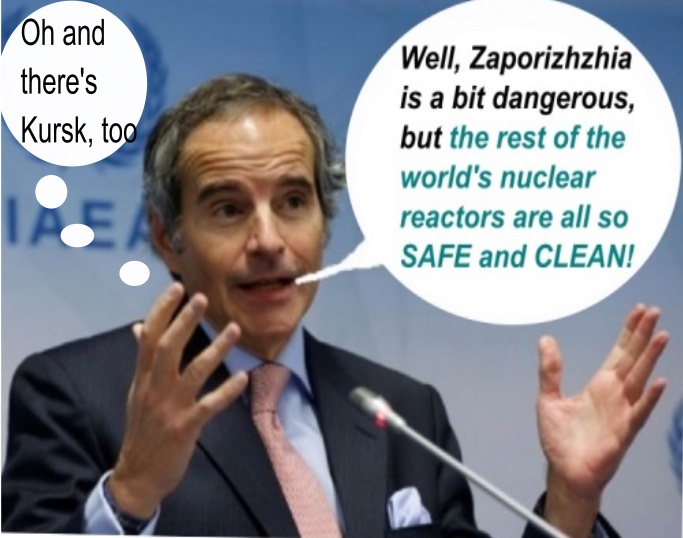
International Atomic Energy Agency raises the alarm about the Kursk plant’s vulnerable nuclear reactor as war rages nearby.
August 27, 2024 By Csongor Körömi https://www.politico.eu/article/un-international-atomic-energy-agency-rafael-grossi-nuclear-incident-russia-kursk-plant-drone-strikes-war-in-ukraine/?fbclid=IwY2xjawE7xONleHRuA2FlbQIxMQABHYsv1ZIaZ4vYeP7K4rKYHQMLy03ZNTz8FBhh11Vv7C3OjzmKz-vJZUlyQA_aem_UFL5Vx9yHAwB2AVR6omFyA
The United Nations’ nuclear watchdog chief warned on Tuesday of heightened risk at the nuclear power plant in Kursk, Russia, where Ukraine has been conducting a military counteroffensive.
International Atomic Energy Agency Director General Rafael Grossi led the mission to the nuclear site after Russian President Vladimir Putin claimed it came under fire following Ukraine’s incursion into the region. Kyiv has denied accusations that it targeted the plant.
“The danger or the possibility of a nuclear accident has emerged near here,” Grossi told reporters, according to Reuters. He added that during his visit of the plant he saw evidence of drone strikes in the area.
“I was informed about the impact of the drones. I was shown some of the remnants of them and signs of the impact they had,” Grossi said, without saying who was responsible.
He warned that the nuclear reactor at the Kursk plant doesn’t have a protective dome, unlike most nuclear facilities, making its core very vulnerable to artillery or drone strikes.
“The core of the reactor containing nuclear material is protected just by a normal roof, he said during his visit. “This makes it extremely exposed and fragile, for example, to an artillery impact or a drone or a missile.”
“A nuclear power plant of this type, so close to a point of contact or a military front, is an extremely serious fact that we take very seriously.”
Despite the ongoing conflict, the power station is operating “in very close to normal conditions,” according to Grossi.
“My message is the same for everyone: no nuclear accident can happen. It is our responsibility to make sure of that,” Grossi said at the news conference, adding that the agency won’t take sides in the Russian-Ukrainian war. “This conflict, this war, is not the responsibility of the IAEA.”
The war that reignited following Russia’s all-out military assault on Ukraine, now in its third year, has been fraught with nuclear risks, with numerous instances of nuclear weapon saber-rattling and recklessness near energy-generating nuclear facilities.
After the start of the conflict, Grossi worked to establish five principles to be respected by both Russia and Ukraine to ensure nuclear safety and avert an atomic catastrophe.
Russia captured Ukraine’s Zaporizhzhia nuclear plant at the start of its invasion and has repeatedly endangered the plant’s safety, drawing condemnation from Grossi.
Grossi will travel to Ukraine next week to meet with President Volodymyr Zelenskyy and discuss “a number of things,” including the situation at the Zaporizhzhia nuclear plant and the presence of IAEA experts at other sites in Ukraine.
The effects of world’s worst nuclear disaster in Chernobyl, Ukraine, in the 1980s are still felt to this day. Hundreds of thousands of square kilometers of land in Russia, Belarus and Ukraine were contaminated, and an area of around 30 kilometers around the plant remains essentially uninhabitable. Soviet authorities initially denied the scale of the disaster.
The Battle of Kursk probably won’t result in nuclear weapons use against Ukraine. But Russian escalation vis-à-vis NATO can’t be ruled out.
any nuclear use against Ukraine would be self-defeating for Russia.
involvement of the West turned Russia’s so-called “special military operation” (“SVO” in Russia) into a full-scale war. Consequently, nuclear signaling has been addressed to the West.
Russia’s central concern is the possible Western involvement in the war on the side of Ukraine, which can turn the tide at the front line. The most visible cause for such concern is the provision of modern Western arms to Ukraine, including long-range missiles capable of targeting deep into Russian territory.
Bulletin, By Nikolai N. Sokov | August 26, 2024
The successful Ukrainian offensive in the Russian Kursk oblast started in early August has once again triggered speculation about possible Russian nuclear use against Ukraine. The situation resembles the successful Ukrainian offensive in the late summer-fall of 2022 in the Kharkiv oblast, when many worried Russia would resort to battlefield nuclear use to stop advancing Ukrainian forces. On the face of it, there was reason to be concerned: Russian President Vladimir Putin did reference nuclear weapons in September 2022, and it became known more than a year later that the United States was “rigorously” preparing for that contingency.
A closer look reveals, however, that Putin’s 2022 reference to nuclear weapons sounded as an emotional impromptu remark made under stress, whereas the US assessment was reportedly based on an intercept of conversations among Russian generals rather than on tangible signs of preparation or data about discussions among policymakers. We now know that Moscow dealt with that situation in a different way: Partial mobilization helped beef up forces, which stopped the Ukrainian Kharkiv offensive.
Although the Kursk operation caught Russia by surprise once again, its military and civilian leadership are better prepared today to deal with surprise than in 2022.
One has reasons to be skeptical about the prospect of battlefield use of nuclear weapons. It was considered an acceptable option during the Cold War, especially its early years. Both the United States and the Soviet Union held large-scale exercises with live nuclear explosions in the 1950s, and both nuclear powers contemplated large-scale use of tactical nuclear weapons in Europe. Today, however, is different. The “nuclear taboo,” which began to take shape in the 1950s, has grown very strong.
Not that nuclear use is technically impossible. But the political and ethical implications make such a decision daunting—and unlikely. Battlefield nuclear use in Ukraine, for whatever reason, would make Russia a true pariah state in the international system, turning countries—partners and neutrals alike, all critical for breaking the tight sanctions regime, which has been established by the G7 economies and their partners—against Moscow. In other words, any nuclear use against Ukraine would be self-defeating for Russia.
Nuclear signals. Russian nuclear signaling has been persistent, going up and down throughout the war, with high points in the fall of 2022 and the spring of 2024, when Russian official rhetoric was the loudest. (Unofficial and semi-official rhetoric has never really stopped.) This signaling, however, has been exclusively and explicitly directed at the West—the United States and its allies. Even the very first statement of Putin announcing the “special military operation” contained a message to the West: “Do not interfere.”
This is hardly surprising: The war is conceptualized in Russia as a proxy war with NATO. Putin’s spokesman, Dmitry Peskov, has repeatedly said—most recently in March and June of this year—that involvement of the West turned Russia’s so-called “special military operation” (“SVO” in Russia) into a full-scale war. Consequently, nuclear signaling has been addressed to the West.
The Ukrainian operation in Kursk may carry certain risks, but these risks are different from what is commonly and hastily assumed as nuclear use against Ukraine.
Russia’s central concern is the possible Western involvement in the war on the side of Ukraine, which can turn the tide at the front line. The most visible cause for such concern is the provision of modern Western arms to Ukraine, including long-range missiles capable of targeting deep into Russian territory.
At a certain level, Western assistance may create serious, perhaps even insurmountable challenges for the Russian military. Each new step—including the provision of tanks, missile defense systems, tactical ballistic missile systems, and most recently F-16 fighter jets—triggers warnings about possible escalation. So far, Russia has coped with each new level of Ukraine’s military capability, but this may change in the future if Western assistance continues or even intensifies.
Perhaps more consequential for Russia, although less visible, is the provision of intelligence, which has helped Ukraine to select targets and significantly constrains Russia’s ability to clandestinely concentrate and move forces and supplies……………………………….
Russians often repeat that a nuclear state cannot be defeated. This is true only to an extent, but there is realization in the Kremlin and beyond that defeat in the ongoing war cannot be tactical. Not only it will end the political regime—which the Kremlin equates with sovereignty—but consequences will affect the entire country for decades. If Russia considers itself de facto at war with the United States and NATO and believes the West seeks its “strategic defeat,” then nuclear weapons legitimately enter the picture under the existing 2020 Decree on Nuclear Deterrence and the 2014 Military Doctrine. This is precisely the situation the United States has tried to avoid: ………………………………
Russian nuclear signals to the West can be divided into two categories.
The first is public statements, especially coming from the most authoritative source, Vladimir Putin, which have been relatively rare—namely, the “SVO” announcement and the September 2022 warning referenced above. ………………………. If someone’s actions will threaten our sovereignty and territorial integrity, we consider it allowable to use all means at our disposal.” Putin also declared that ndeclaredew threats may force Russia to change its nuclear doctrine, hinting that the nuclear threshold might be lowered.
The second category of nuclear signals is arguably more tangible: actions that change Russia’s nuclear posture and/or alert level. Such actions notably include nuclear sharing arrangements with Belarus, whose implementation began in the summer of 2022—after it became clear that war with Ukraine would be protracted, and Russia could not prevent the West from providing assistance to Ukraine—and was completed already in mid-2023. Other highly visible examples are exercises with tactical nuclear weapons, which have been held in three stages in May, June, and August of 2024………………….
Fuzzy red lines. Without doubt, publicly playing with the prospect of nuclear war is dangerous—in addition to be morally reprehensible—but one must admit that Moscow has been relatively restrained in its threats so far; it could certainly make more threats and make them more openly. So why has Russia shown such restraint as it conducts a full-fledged war?
……………………………………………………………………………………….The Russian leadership itself may not know what exactly constitutes a red line. So far, it seems to make such judgement after the fact, evaluating each new level of assistance to determine its impact on the course of the war. If and when such impact reaches a level that puts Russia on the brink of a “strategic defeat,” it may be classified as having crossed a red line…………………..
Evaluation of each new step takes time—from weeks to months. The absence of visible reaction may create a false sense of safety, potentially emboldening U.S. and Western officials. Then, if and when a Russian reaction takes place, it may catch Western allies by surprise and be perceived as unjustified and unprovoked, for the precise reason that the red line was unknown.
No doubt that Russia is very reluctant to launch an escalation that could result in nuclear use: The costs to Russia itself would be enormous—probably unbearable for the country and its leadership. ……………………………….
………the riskiest circumstances will happen after a red line has been crossed, not before. Each side will balance between caution and the perceived strategic need to act. Worse, a long sequence of moves that did not result in escalation may create a false sense of security and increase propensity for risk-taking on the part of Western military officials and political leaders.
…………………..The crossing of a red line in the war in Ukraine may not result in nuclear use. A more likely contingency is escalation starting with something relatively small, but visibly consequential………………………………………. The threat of nuclear use is expected to force the West to retreat, because its stakes in the conflict are believed to be lower than those of Russia in the war in Ukraine.
……………………………………………………………………..It can be predicted with reasonable confidence that Russia will not threaten, much less use, nuclear weapons against Ukraine. Escalation vis-à-vis NATO, however, is a different matter: That likelihood appears higher, but knowing in advance how high it is may be impossible.
Considering the risks outlined above, one obvious question is whether the West should continue and perhaps increase support of Ukraine. I believe that questions about the Kursk invasion and whether the West should continue aiding Ukraine are essentially unrelated. Regardless of which decision is made in regard to Western aid, the risks of that policy must be known and understood. Nothing good can come out of policy that is consciously blind to possible challenges. To the contrary, full information can enhance chances for success and lessen the likelihood of escalation. https://thebulletin.org/2024/08/the-battle-of-kursk-probably-wont-result-in-nuclear-weapons-use-against-ukraine-but-russian-escalation-vis-a-vis-nato-cant-be-ruled-out/?utm_source=Newsletter&utm_medium=Email&utm_campaign=MondayNewsletter08262024&utm_content=NuclearRisk_RussianEscalationVisAVis_08262024
Nuclear power risks rising in Russia-Ukraine war

Dr Philip Webber, SGR, warns that another nuclear power plant is at major risk as the war enters new territory.
Responsible Science blog, 22 August 2024 more https://www.sgr.org.uk/resources/nuclear-power-risks-rising-russia-ukraine-war—
The Russia-Ukraine war has already led to extremely serious risks to nuclear power plants. In a previous article, [1] I described in some detail those related to the Zaporizhzhia nuclear power plant (ZNPP) in Ukraine. The situation there has once again deteriorated – as I discuss below – but I want to focus first on the threat to another power station.
Kursk
Due to the Ukraine military incursion into the Kursk region of the Russian Federation, which began on 15 August, [2] there is now a severe risk to the huge Kursk nuclear power plant (KNPP) – which has elements in common with the Chernobyl plant. The KNPP is located some 60 kilometres from the border with Ukraine and is, at the time of writing, close to an area of fierce fighting. As a result, the International Atomic Energy Agency (IAEA) has issued further warnings to remind the warring parties to not risk a nuclear disaster in Europe. [3][4]
The KNPP – like the ZNPP – includes six nuclear reactors, and is also one of the three biggest nuclear power stations in Russia. But there are two critical differences. First, two of the KNPP reactors are operating at full power. Second, these two reactors are of the same design – the RBMK – as the Chernobyl nuclear plant, which suffered the world’s worst nuclear accident in 1986. Crucially, these reactors have no protective dome structure [5] making them very vulnerable to a military strike or aircraft impact. With intense fighting only a few tens of kilometres away, both reactors are well within the range of artillery or rocket fire. A military strike on either reactor could initiate a very serious release of radioactive material creating a Europe-wide nuclear disaster.
It is anticipated that the IAEA will soon visit the Kursk NPP to assess the situation on the ground.
Zaporizhzhia
Returning to the situation at the Zaporizhzhia NPP, IAEA inspectors stationed there have again reported intense military activity – artillery, rocket and heavy machine-gun fire – very close to the plant, and several instances of explosive drone strikes on the plant itself, as well as on vital electrical substations and surrounding woodland. [6] One of the two ZNPP cooling towers was hit, fires were started beside an electrical sub-station resulting in a loss of power, and the perimeter road was cratered.
The six ZNPP reactors are all in ‘cold shutdown’ but rely on a supply of electricity to power pumps for water cooling of the reactor cores – and a large number of spent fuel storage tanks – to prevent overheating to dangerous levels and a resultant release of radioactive material. The reliable supply of water remains a serious problem and emergency supplies of fuel for emergency diesel generators are also dangerously low.
Drone attacks also continue to be reported near Ukraine’s other nuclear power sites. [7]
The IAEA Director General, Rafael Grossi, has issued a series of warnings reminding both Russia and Ukraine of UN agreements to avoid military activity at or near nuclear plants. [8] However, the only way to remove these risks completely is for a rapid, negotiated end to the war.
Dr Philip Webber is Co-chair of Scientists for Global Responsibility. He has written widely on the risks of nuclear weapons and nuclear power – including co-authoring the book, London After the Bomb. He spent part of his career working as an emergency planner in local government.
References………………………………………………..
Zelensky’s Misadventures in Kursk

This operation is likely to be working upside-down to what we are reading in corporate media.
Not long prior to the incursion, the Biden regime had given Kiev dispensation to use U.S.–made weapons against Russian targets so long as these were deployed in self-defense and against military targets.
the question remains. What is the point as the Kursk operation continues?
By Patrick Lawrence / Original to ScheerPost, 23 Aug 24
It has been three weeks since ground units of the Armed Forces of Ukraine crossed into the Kursk province in southwestern Russia, surprising — or maybe not surprising — the U.S. and its clients in the North Atlantic Treaty Organization. Two days later, the AFU began artillery and drone attacks in Belgorod, a province just south of Kursk. It has been a little more than a week since explosions at the Zaporozhye nuclear power plant, which lies in what is now Russian territory along the Dnipro River, ignited a fire in one of the plant’s two cooling towers. All six reactors are now in cold shutdown.
In the still-to-be-confirmed file, BelTA, the Belarusian news agency, reported last weekend that Ukraine has amassed significant forces along the Belarus–Ukraine border. Aleksandr Lukashenko, the Belarusian president, put the troop count at an improbable 120,000. Further out in speculative territory, RT International reported at the weekend that the AFU is “preparing a nuclear false flag—an explosion of a dirty atomic bomb,” targeting nuclear-waste storage sites at the Zaporozhye plant. RT cited “intelligence received by Russia” and a military correspondent and documentarian named Marat Khairullin.
Hmmm.
When I began my adventures in the great craft at the New York Daily News long years ago, two of the better shards of wisdom I picked up were, “Go with what you’ve got” and “When in doubt, leave it out.” Let us proceed accordingly as we consider Ukraine’s latest doings in the proxy war it wages. I will leave aside the BelTA and RT International reports pending further developments, but with this caveat: Amassing units along the Belarus border would be entirely in keeping with the AFU’s recent forays into Russian territory. As for the imminence of a dangerous false flag op at the Zaporozhye plant, I would not put it past a regime that has acted recklessly and irrationally on numerous occasions in the past.
Why, we are left to ask of what we know to be so, did the AFU send troops, tanks, artillery, drone units, and assorted matériel into Kursk on Tuesday, Aug. 6? And then the ancillary operation in Belgorod? Everyone wondered this at first—supposedly everyone, anyway. This is our question, and I will shortly get to the “supposedly.”
On the eve of the incursion, Kiev was losing ground steadily to a new Russian advance in eastern Ukraine. Critically short of troops, the Ukrainian forces are, indeed, about to lose a tactically significant town, Pokrovsk, on their side of the Russian border. The thought that the AFU would sustain and expand its Kursk operation to bring the war to Russian territory in any effective way is prima facie preposterous. What was the point? Where is the strategic gain?
In his speech Monday evening at the Democratic Party convention in Chicago, Joe Biden defended his proxy war in Ukraine as a just war waged in the name of democracy and liberty. Oh? setting aside the emptiness of this characterization, the question remains. What is the point as the Kursk operation continues? The AFU now holds one Russian town and six villages, according to the latest reports, which also indicate they have set about destroying bridges critical to Russian supply lines. But where to from here? I do not see a sensible answer.
There is no question the Russians were caught off guard when the AFU crossed into the border village of Sudzha and proceeded with evidently little initial resistance further into Russian territory. Hundreds of thousands of Russians have been evacuated; the governor of Belgorod quickly declared a state of emergency after the drone and artillery strikes of Aug. 14.
But we cannot count this as any kind of astute strategic move. I do not pretend to have an inside read as to Russia’s apparent intelligence failure or what looks like its flat-footed response. But I do not think we can correctly mark down events to date to the AFU’s superior strength or the Russians’ weakness or incompetence. Western correspondents are having a fine old time reporting that klutzy, clumsy Moscow is once again stumbling, but I buy none of it. In my view this is probably another case of Russian restraint: The AFU is using U.S. — and NATO — supplied weapons, and the Kremlin has all along been acutely sensitive to the risk of escalation against Kiev’s Western sponsors.
My conclusion: No one’s script has flipped. This operation is likely to be working upside-down to what we are reading in corporate media. The best explanation they have come up with so far is that Kiev’s plan was to draw Russian forces away from the front on the Ukrainian side of the border. That has plainly not happened, however much The Times indulges in denial on this point. “And now Moscow has begun withdrawing some troops from Ukraine in an effort to repel Kyiv’s offensive into western Russia, Constant Méthuet reported Aug. 14 — before adding “according to U.S. and Ukrainian officials.” Crapulous journalism. Simply crapulous. There is no evidence of this whatsoever—only of further Russian gains as noted above.
Inversely, the Kursk adventure required a lot of Ukrainian units to get going and more now to sustain. It is Kiev that is wasting resources on what is bound to end in retreat. The Russian military has not marshaled anything approaching its full force. This is likely to end when Moscow decides it should, and in the meantime the Russians appear to wage the same wearing war of attrition that has reduced the AFU to something close to a desperate force on the home front.
The initial press reports of the Kursk adventure had it that top officials in Washington were caught entirely by surprise and were as perplexed as the rest of us as to the “Why?” of the thing. I do not accept this at face value, either. The Times ran a lengthy report on the Ukrainians’ preparations, featuring residents in the towns bordering Kursk remarking for weeks about the buildup of AFU units and matériel before the operation began. Russian intelligence took note, The Times also reported. And the Pentagon, the intelligence agencies, and the administration were all taken by surprise? To quote an East European emigre I knew in the old days, “Gimme break.”
Not long prior to the incursion, the Biden regime had given Kiev dispensation to use U.S.–made weapons against Russian targets so long as these were deployed in self-defense and against military targets. And the only reason the U.S. is at all interested in Ukraine, we must remind ourselves—forget about freedom and democracy, for heaven’s sake—is for its use in prosecuting the West’s long, varied campaign to subvert “Putin’s Russia.” This remains the ultimate objective. In the matter of Washington’s hand in directing the Zelensky regime from one adventure to another, Biden’s national security people wear more fig leaves than you find on a tree in Tuscany. …………………………………………………………………………………………………………………
Maybe Zelensky wants some Russian real estate as a bargaining advantage in negotiations with Russia he has come to accept as inevitable. It is possible but does not fit with his adamant insistence that the full restoration of Ukrainian territory, including Crimea, is non negotiable — a precondition to any diplomacy. And as in Netanyahu’s case, a settlement would put his political future greatly in doubt.
In any case, Zelensky chose badly when the AFU crossed into Russian territory at Kursk. The Red Army’s defeat of the Wehrmacht at Kursk, in 1943, was the largest battle in the history of warfare and left roughly 1.7 million Russians dead, wounded, or missing. Along with Stalingrad, it marked a decisive moment in the Allied victory over the Reich. Russians do not forget this kind of thing, especially when German weapons are part of the AFU’s arsenal. The thought of Ukrainian troops and tanks holding Kursk is another of the miscalculations that litter the story of this war since it began with the U.S.–inspired coup 10 years ago. https://scheerpost.com/2024/08/22/patrick-lawrence-zelenskys-misadventures-in-kursk/
Putin says Ukrainian forces tried to strike Kursk nuclear plant
The Russian leader does not offer any evidence for his claim but says the UN nuclear watchdog has been alerted.
Russian President Vladimir Putin says Ukrainian forces have tried to attack the Kursk Nuclear Power Station in an overnight raid.
The Russian leader did not offer evidence for the claim but said on Thursday that Moscow has informed the United Nations nuclear watchdog, the International Atomic Energy Agency (IAEA), about the incident.
Ukraine has not responded to Russia’s allegations.
“The enemy tried to strike the nuclear power plant at night. The IAEA has been informed,” Putin said in a televised government meeting.
Putin made the claim as Ukrainian forces continued to fight inside Russia more than two weeks after launching an ambitious cross-border attack, which has become an embarrassing headache for Moscow.
While the strategic aims of Ukraine’s Kursk incursion remain uncertain, President Volodymyr Zelenskyy on Thursday said the attack is part of an effort to bring the war to an end on terms amenable to Ukraine…………………………. https://www.aljazeera.com/news/2024/8/22/putin-says-ukrainian-forces-tried-to-strike-kursk-nuclear-plant
‘Very serious’ nuclear situation could happen ‘at any moment’ in Ukraine, says IAEA chief
Cathy Newman, Presenter 4 News 20 Aug 24
We spoke to Rafael Grossi, Director General of the International Atomic Energy Agency.
Cathy Newman: Let’s start with Zaporizhzhia, because earlier you said that safety was deteriorating there after this drone strike. How critical would you say it is?
Rafael Grossi: Well, we could have a very serious situation any moment. Because when you see the amount of military activity surrounding the plant………………………….The physical integrity of the facility is being challenged. So, this is why we say that what we see is a deterioration. The condition of the plant, I should say, is that it’s not producing energy at the moment, is in jargon what we call shut down. But there’s a lot of material there, a lot of nuclear material there. There’s a lot of spent fuel there. Fresh fuel. So, things that if impact could trigger the release of radioactivity.
Cathy Newman: So the risk has been minimised, but it hasn’t been removed, clearly. I mean, in theory, another Chernobyl is possible?
Rafael Grossi: ………………………………………… I would say, as I was just mentioning, you have all of this material around and you could have a situation theoretically where because of the loss of external power, which has occurred, we had nine episodes of complete blackouts of the plant. So no cooling function. So if you lose all that, you could eventually have a meltdown.
Cathy Newman: So it’s perilous, clearly. I wonder whether you think the risk of the Kursk plant, ……………. Russia is now fortifying around that plant. I mean, is that potentially more risky because it’s a much more volatile situation.
Rafael Grossi: It is certainly serious and we should take it very, very seriously. We are taking it, the agency at the IAEA, very, very seriously. This nuclear power plant is, I would say, within artillery range already. You have just informed that the incursion of the Ukrainian troops, is a few miles, a couple dozen kilometres into Russian territory and just a few miles, in kilometres is about between 20 and 30 km from the plant itself. And there is a technical aspect here. You were just mentioning Chernobyl. The reactors here, you have six reactors in Kursk. You have two reactors that are being decommissioned. You have two reactors that are operating. No shutdown, operating when you have hot reactors. Anything that could happen there could be maximised in this sense.
And then two other units being built. The two reactors that are operating are of a type called RBMK, which is exactly the type of reactors, an old model type of reactor was the one, like the ones that were in Chernobyl. These reactors have a particularity. Normally when you look at a nuclear reactor is a dome. There is a concrete and metal protection. These two reactors don’t have that, don’t have any of that. The core of these reactors is open. Is like, as if you were here and you could see the fuel elements there. So, God forbid, was there an impact on the plant, we could have a very serious situation…………………………………………………………………………………. https://www.channel4.com/news/very-serious-nuclear-situation-could-happen-at-any-moment-in-ukraine-says-iaea-chief
Ukraine could trigger ‘another Chernobyl’ – ex-US Army officer.
A meltdown at the Kursk Nuclear Power Plant would make the region uninhabitable, Stanislav Krapivnik has warned
https://www.rt.com/russia/602744-ukraine-may-trigger-another-chernobyl/ 21 Aug 24
Ukraine’s armed forces could cause a nuclear disaster that would affect most of Europe if they strike the Kursk Nuclear Power Plant, former US Army officer Stanislav Krapivnik has warned.
In an interview with RT on Saturday, Krapivnik discussed the difference between a dirty bomb and a nuclear bomb, explaining that while a dirty bomb does not have the critical mass or enriched material, it could cause large scale contamination if it hits nuclear waste.
If the coolant system in an active plant is targeted, it would cause a “nuclear meltdown” which could lead to an incident similar to Fukushima or Chernobyl, he added. Such an event would impact most of Europe, especially at this time of the year “when the wind blows northwest.”
Krapivnik predicted that “if there is enough evidence” of the threat, it would “force a very large reaction” from the Russian government, as a meltdown at the Kursk plant would make the region uninhabitable.
“And the fallout is going to go straight to the northwest into Europe,” he said, adding: “It’s going to hit the Poles, the Germans, the Danes, the Scandinavian countries,” right into the UK. “But apparently the leadership of those nations really doesn’t give a damn.”
On Friday, Russian military journalist Marat Khairullin reported, citing sources, that Kiev is preparing to detonate a dirty atomic bomb targeting nuclear waste at either Russia’s Zaporozhye NPP or the Kursk NPP.
While the nuclear plant in Zaporozhye, the largest such facility in Europe, has been shut down, the plant in Kursk Region is operational.
The Russian Defense Ministry responded to the reports by saying that any attempts to create a “man-made disaster in the European part of the continent” would be met with “tough military and military-technical countermeasures.” Foreign Ministry spokeswoman Maria Zakharova called on the international community “to immediately condemn the provocative actions prepared by the Kiev regime.”
Kiev has denied the allegations. Neither the UN nor the International Atomic Energy Agency have addressed the threat.
What Happens if Ukraine Seizes the Kursk Nuclear Power Plant?

Moscow Times, By Dmitry Gorchakov, Aug. 16, 2024
From the very beginning of Ukraine’s offensive into Russia’s Kursk region on Aug. 6, there has been much discussion about the possible objectives of this operation. Simply glancing at the map begs the question of whether one objective of the Ukrainian incursion might be the seizure of the Kursk nuclear plant, located just 60 kilometers from the border.
It is a scenario the Russian side is taking seriously. Already Rosatom, Russia’s state nuclear corporation, had begun withdrawing staff from the plant and Russian troops are hastily digging trenches around it.
The mere possibility of a nuclear plant being seized during a war is a nightmare scenario for any nuclear and radiation safety specialist. But after the almost two-and-a-half-year-long Russian occupation of the Zaporizhzhia nuclear plant and the seizures (again, by Russia) of the Chernobyl exclusion zone and the research reactor in Sevastopol during the occupation of Crimea in 2014, such scenarios have become more possible. The longer Russia’s aggression against Ukraine continues, the more common the threat of an accident will become.
While we do not know how events will unfold, our analysis at Bellona and recommendations from the IAEA make clear that should nuclear plants be enveloped by war, every effort should be made to avoid a direct assault on them with heavy weapons. The defending side should not deploy troops at nuclear plants, which would turn them into military targets. Should a nuclear plant be surrounded, it is better to surrender it through negotiations rather than have the facility be attacked or used as a staging ground for attacks.
Having considered these principles, there are a few hypothetical plans that Ukraine could have for the Kursk nuclear plant as its incursion into Russia continues. These scenarios have repeatedly surfaced in the media, and it makes sense to address them in detail.
One theory is that Ukraine may connect the Kursk nuclear plant to its own energy system. I think this is the least likely objective. Should the plant be seized, the safest course of action for its operators would be to put all of its reactors into cold shutdown mode, which stops electricity generation……………………………………………………………..
Some have also speculated that Ukraine is trying to deprive Russia of a vital energy source — hopefully by shutting it down safely rather than a nuclear accident. But the numbers do not support this.
One would like to believe that if such a plan exists, it does not involve the loss of the facility due to a nuclear accident, but rather involves its shutdown through standard procedures…………………………………………….
The most rational objective for seizing the Kursk nuclear plant would be to use it in exchange for the Zaporizhzhia nuclear plant in any upcoming negotiations.
When we consider that Ukraine’s army is not only advancing in the Kursk region, but is also fortifying its position by bringing in reserves and other defenses, it appears that Kyiv intends to hold its gains — possibly until the end of the war and the start of negotiations. The presence of a nuclear power plant within the captured territory would significantly increase its leverage and would confirm the strategic nature of this operation.
Nevertheless, as a representative of an environmental organization, I sincerely hope that we do not see any attack or attempt to seize the Kursk nuclear plant. There is simply no safe way to do it. Any attempt to do so carries risks of a nuclear or radiation accident, to say nothing of damaging the political support Ukraine enjoys from its Western allies. ………………….
if ending this war on terms acceptable to Ukraine involves fighting around nuclear plants on both sides of the front, such a process must proceed with minimal risk of a nuclear disaster. https://www.themoscowtimes.com/2024/08/16/what-happens-if-ukraine-seizes-the-kursk-nuclear-power-plant-a86045
Moscow Says Ukraine Destroyed Russian Bridge With Western-Provided Missiles
The Russian Foreign Ministry says the bridge was likely destroyed by US-provided HIMARS
by Dave DeCamp August 18, 2024 , https://news.antiwar.com/2024/08/18/moscow-says-ukraine-destroyed-russian-bridge-with-western-provided-missiles/
The Russian Foreign Ministry said Friday that Ukrainian forces used Western-provided missiles to destroy a bridge in the Glushkovsky district of Russia’s Kursk Oblast.
Russian Foreign Ministry spokeswoman Maria Zakharova said the missiles were likely launched using the US-provided HIMARS rocket systems, which the US has been supplying to Ukraine since 2022.
“For the first time, the Kursk region was hit by Western-made rocket launchers, probably American HIMARS,” Zakharova wrote on Telegram. “As a result of the attack on the bridge … it was completely destroyed, and volunteers who were assisting the evacuated civilian population were killed.”
Another bridge in Kursk was reported to be hit by Ukrainian forces on Sunday. According to the Russian news site Mash, both bridges were targeted with US-provided HIMARS.
The ground incursion into Kursk came a few months after the Biden administration gave Ukraine the greenlight to use US-provided missiles in strikes inside Russia in border regions. The US says it won’t support “long-range” strikes in Russia but hasn’t defined what the limit is.
The Times reported on Friday that the US is effectively blocking Ukraine from using British-provided Storm Shadow missiles inside Russia, which have a range of about 155 miles. Ukrainian forces are using other types of British weapons in Kursk, including Challenger 2 tanks.
The US and its NATO allies insist they were unaware of Ukraine’s plans to invade Kursk, but Russian officials are pinning the blame for the incursion on Kyiv’s Western backers.
“The operation in the Kursk region was also planned with the participation of NATO and Western special services,” Nikolai Patrushev, an aide to Russian President Vladimir Putin, said on Friday. “Without their participation and direct support, Kyiv would not have ventured into Russian territory.”
Safety at Ukraine nuclear power plant deteriorating after blast, watchdog warns

The International Atomic Energy Agency said the blast was close to Zaporizhzhia nuclear power plant’s cooling water sprinkler ponds and its only remaining power line
By Brendan McFadden, iNews 17th Aug 2024
Safety at Ukraine’s Zaporizhzhia nuclear power plant is deteriorating following a drone strike that hit an access road on its perimeter, according to an atomic energy watchdog,
Russia has been in control of the Zaporizhzhia site, the largest nuclear power plant in Europe, since soon after it launched a full-scale invasion of Ukraine in February 2022.
The International Atomic Energy Agency (IAEA) said the impact site was close to the essential cooling water sprinkler ponds and about 100 m from the Dniprovska power line, the only remaining 750 kilovolt line providing a power supply to the plant.
It comes after Russia earlier claimed a Ukrainian drone dropped an explosive charge on a road used by staff.
The plant is dormant as Moscow and Kyiv have repeatedly accused each other of trying to sabotage its operations and of endangering safety around it.
The IAEA director general Rafael Mariano Grossi, said “Yet again we see an escalation of the nuclear safety and security dangers facing the power plant.
“I remain extremely concerned and reiterate my call for maximum restraint from all sides and for strict observance of the five concrete principles established for the protection of the plant.”
An IAEA team visited the area on Saturday and reported that the damage seemed to have been caused by a drone equipped with an explosive payload.
The report said there were no casualties and no impact on any nuclear power plant equipment. However, the road between the two main gates of the plant was impacted.
Moscow wants to discuss the attack on the Zaporizhzhia plant with the IAEA, Russia’s RIA news agency reported, citing Roman Ustinov, the acting Russian representative in Vienna.
The attack comes as Ukraine continues an incursion into the Kursk region of Russia.
Kyiv claims to have taken control of 82 settlements over an area of 1,150 square kilometres (444 square miles) in the region since 6 August when its advance began.
Today Ukrainian President Volodymyr Zelensky said his troops are “strengthening” positions in the captured territory in Russia and expanding further.
Russian troops also hit the Ukrainian city of Sumy with an Iskander-K cruise missile, causing extensive damage to buildings.
It was claimed Germany, Ukraine’s second biggest donor, has frozen its military aid to Kyiv because it cannot afford to any longer supply equipment due to a national budget crisis.
Meanwhile, Ukraine denied claims by Russia that it is planning to attack a nuclear plant in Kursk and use ‘dirty bombs’ to attack Russian territory,
Moscow’s defence ministry made the claim and warned there would be a harsh response to any attack on the Kursk power plant, which remains under its control, according to Russian news agency Interfax.
The ministry gave no evidence for its claim, but said the surrounding area could be contaminated by an attack on the plant………………….. https://inews.co.uk/news/world/safety-at-ukraine-nuclear-power-plant-deteriorating-after-blast-watchdog-warns-3232978
Nato fighter jets intercept Russian nuclear bombers
msn by Gergana Krasteva, 14 Aug 24
Vladimir Putin deployed two Tu-95MS strategic nuclear missile carriers over Nato waters after accusing Britain of coordinating the incursion into Russia with Ukraine, it has been reported.
MiG-31 combat warplanes belonging to the Alliance escorted the Kremlin’s jets, which buzzed over the Norwegian Sea.
Separately, two Tu-22M3 long-range bombers flew over the neutral waters of the Baltic Sea.
Both the Tu-95MS and Tu-22M3 bombers – key parts of Russia’s nuclear arsenal – were escorted by Nato planes during their ‘scheduled’ flights.
This is the latest of the Kremlin’s reconnaissance flights as part of its ongoing attempts to taunt the bloc.
It comes after it accused the UK of involvement in Ukraine’s attack on the border region – now in its second week and forcing Putin to move reserves on a massive scale to Kursk.
Assault troops have pushed about a mile farther into Russia on Wednesday, the commander of the Ukrainian military, General Oleksandr Syrskyi, said in a video posted on president Volodymyr Zelensky’s Telegram channel.
In addition, more than 100 Russian soldiers have been taken prisoner, Syrskyi added…………………………………………………….
Russian authorities have evacuated about 132,000 people from the Kursk and Belgorod regions and have plans to evacuate another 59,000 [could this be related to fears about Kursk’s nuclear power plant?] …….. https://www.msn.com/en-au/news/other/nato-fighter-jets-intercept-russian-nuclear-bombers/ar-AA1oNL0R?ocid=hpmsn—
Ukraine war briefing: Main fire at Russia-controlled nuclear plant in Ukraine extinguished
Moscow and Kyiv have accused each other of starting blaze at Zaporizhzhia plant; Russia evacuates parts of Belogrod. What we know on day 901
- The main fire at the Russia-controlled Zaporizhzhia nuclear plant in Ukraine has been extinguished, Russia’s Tass state news agency reported early on Monday, citing Russia’s state-owned nuclear energy company Rosatom. Ukraine’s nuclear power company Energoatom said in a statement on the Telegram messaging app that one of the cooling towers and other equipment was damaged. Tass also reported, citing Rosatom’s statement, that a cooling tower was damaged. Citing local Russian emergency ministry representatives, Tass said that it was a non-functioning tower.
- Moscow and Kyiv accused each other of starting the fire. Ukrainian President Volodymyr Zelenskiy accused Russia of lighting the fire while Evgeny Balitsky, a Russian-installed official in the occupied south, accused Kyiv’s forces of causing it by shelling the nearby city of Enerhodar.
- The UN’s International Atomic Energy Agency (IAEA) nuclear watchdog, which has a presence at the vast six-reactor facility, said its experts had seen strong, dark smoke coming from the northern area of the plant in southern Ukraine after multiple explosions. It said there had been no reported impact on nuclear safety at the site. “Team was told by [the nuclear plant] of an alleged drone attack today on one of the cooling towers located at the site,” it wrote on X.
- Zelenskiy published grainy video showing belching black smoke that appeared to be coming out of a cooling tower with a blaze burning at its foot and said radiation indicators were “normal”. He added: “But as long as Russian terrorists retain control over the nuclear plant, the situation is not and cannot be normal.”
- Russia said on Monday it had evacuated parts of Belgorod, another region next to Ukraine, after Kyiv sharply increased military activity near the border. Regional governor Vyacheslav Gladkov said that evacuations had begun from the Krasnaya Yaruga District due to “enemy activity on the border” that was a “threat”. “I am sure that our servicemen will do everything to cope with the threat that has arisen,” Gladkov said. “We are starting to move people who live in the Krasnaya Yaruga district to safer places.”
- Ukrainian sources have indicated that thousands of troops have been committed to its incursion into Russia’s Kursk province. A Ukrainian security official told the news agency Agence France-Presse that the aim of the incursion was to destabilise Russia and string out Russian forces with light, fast-moving attacks. It remains unclear how sustainable the operation will be in the medium term amid Kremlin threats that it will be snuffed out using Russian reserves.
Russia’s defence ministry said on Monday it had thwarted attacks by Ukrainian “mobile groups” in three villages north and east of Korenevo – Tolpino, Zhuravli, Obshchiy Kolodez – all 15 to 18 miles from the border, the farthest points at which Moscow has acknowledged the incursion to have reached. A pro-Ukrainian Telegram channel released a video of soldiers raising a flag over a building in the Russian village of Guevo, a couple of miles inside the border and seven miles south of Sudzha, one of the first towns reached during the incursion.- Commenting on the incursion in his nightly address on Sunday, Zelenskiy said that Russia had launched nearly 2,000 cross-border strikes from its western Kursk region at Ukraine’s Sumy region over the summer, which deserved a “fair” response. “Artillery, mortars, drones. We also record missile strikes, and each such strike deserves a fair response,” he said.
- A Russian drone and missile barrage on Kyiv overnight into Sunday killed a 35-year-old man and his four-year-old son. Russia attacked Ukraine with four ballistic missiles and 57 Shahed drones, Ukraine’s air force said. Air defences shot down 53 of the drones.
- Zelenskiy said the missile that killed the pair was North Korean. “Our experts have precisely identified the type of missile, and we know the exact area of Russian territory from which it was launched,” he said in his nightly address on Sunday.
- In Russia, Kursk’s regional governor said that a Ukrainian missile shot down by Russian air defenses fell on a residential building, wounding 15 people. The Russian Defense Ministry said that 35 drones were shot down overnight over the Kursk, Voronezh, Belgorod, Bryansk and Oryol regions.
IAEA Director General Statement on Developments in the Russian Federation, (with Kursk Nuclear Power Plant under threat)

“the imperative to ensure the physical integrity of a nuclear power plant. This is valid irrespective of where an NPP is situated.”
Vienna, Austria
The IAEA has been monitoring the situation on the reported military activities taking place in the vicinity of the Kursk Nuclear Power Plant (NPP).
This NPP has six units of two different reactor types: RBMK-1000 and VVER-510. Two of the RBMK-1000 are in shutdown and two are fully operational. The two VVER-510 units are under construction.
In view of the reportedly significant military activity, I wish to remind all parties of the seven indispensable pillars for ensuring nuclear safety and security during an armed conflict. Additionally, I emphasize the five concrete principles to help to ensure nuclear safety and security which have been established for the Zaporizhzhya NPP in the context of the current conflict between the Russian Federation and Ukraine, and which are equally applicable in this situation. These include, among others, the imperative to ensure the physical integrity of a nuclear power plant. This is valid irrespective of where an NPP is situated.
At this juncture, I would like to appeal to all sides to exercise maximum restraint in order to avoid a nuclear accident with the potential for serious radiological consequences. I am personally in contact with the relevant authorities of both countries and will continue to be seized of the matter. I will continue to update the international community as appropriate.
Ukraine and Russia trade accusations over fire at occupied Zaporizhzhia nuclear plant
By Reuters, August 12, 2024
- Summary
- Cause of fire unclear
- Both sides trade blame
- Main fire since extinguished
- IAEA head says attacks endanger nuclear safety, must stop
Aug 11 (Reuters) – Moscow and Kyiv accused each other of starting a fire on the grounds of Europe’s largest and now Russian-occupied Zaporizhzhia nuclear power plant in Ukraine on Sunday, with both sides reporting no sign of elevated radiation.
The U.N.’s International Atomic Energy Agency (IAEA) nuclear watchdog, which has a presence at the vast six-reactor facility, said its experts had seen strong, dark smoke coming from the northern area of the plant in southern Ukraine following multiple explosions.
“These reckless attacks endanger nuclear safety at the plant and increase the risk of a nuclear accident. They must stop now,” IAEA chief Rafael Grossi warned in a separate statement, without attributing blame for the attack.
The fire comes less than a week after Ukraine’s forces launched their largest incursion into Russian territory since the war-start in 2022, a surprise move that has brought conflict into a new phase, after weeks of Moscow’s battlefield gains.
Russian state news agencies, TASS and RIA, cited the country’s nuclear energy company Rosatom as saying the main fire was extinguished shortly before midnight on Sunday.
RIA, citing Rosatom, said a drone attack started the fire at the cooling tower, without providing evidence.
Ukraine’s nuclear power company Energoatom said in a statement on the Telegram messaging app that one of the cooling towers and other equipment were damaged………………………….Ukraine’s Energoatom said Russia’s “negligence” or arson could have sparked the fire.
Russia’s officials in turn, including Foreign Ministry spokeswoman, Maria Zakharova, accused Kyiv of deliberately trying to destroy the plant and sow “nuclear terror………………………
https://www.reuters.com/world/europe/ukraine-russia-trade-accusations-over-fire-occupied-nuclear-plant-2024-08-11/
Nuclear disaster warning for two countries as Putin orders urgent mass evacuation
Ukrainian forces have made a surprise incursion into Russian territory sparking fears fighting could develop around the Kursk Nuclear Power Plant.
By Richard Ashmore, Senior News Reporter Aug 10, 2024 https://www.express.co.uk/news/world/1934579/nuclear-disaster-warning-ukraine-russia
The head of the international atomic monitoring body has issued a stark warning to Russia and Ukraine to avoid fighting getting close to huge nuclear power plant.
Rafael Grossi, the chief of the International Atomic Energy Agency (IAEA), urged both militaries to “exercise maximum restraint” if combat erupts near the Kursk Nuclear Power Plant.
In a bold move Ukraine has stunned President Putin and the Kremlin with a military incursion on Tuesday into the Russian provinces of Kursk, and most recently the neighbouring Belgorod region.
A humiliated Vladimir Putin has now been forced to issue a massive evacuation order for more than 76,000 civilians from the Kursk region. The measures, which also apply to the neighbouring Belgorod and Bryansk provinces that border Ukraine, allow the government to relocate residents, control phone communications and requisition vehicles.
The Russian Defence Ministry said today (Saturday) that fighting was continuing in the Kursk and that the army has conducted airstrikes against Ukrainian forces.
In an urgent statement issued last night, IAEA boss Rafael Grossi said: “The IAEA has been monitoring the situation on the reported military activities taking place in the vicinity of the Kursk Nuclear Power Plant.
“In view of the reportedly significant military activity, I wish to remind all parties of the seven indispensable pillars for ensuring nuclear safety and security during an armed conflict.”
Mr Grossi urged Russia and Ukraine to respect principles adhered to so far in the conflict which have been used to protect the Zaporizhzhya Nuclear Power Plant in Ukraine.
He added: “These include, among others, the imperative to ensure the physical integrity of a nuclear power plant. This is valid irrespective of where an NPP is situated.
“At this juncture, I would like to appeal to all sides to exercise maximum restraint in order to avoid a nuclear accident with the potential for serious radiological consequences.”
1 This Month

of the week – Shut Down Drone Warfare!


Tell the Ukrainian Government to Drop Prosecution of Peace Activist Yurii Sheliazhenko

Petition to revoke the licensing of the Near Surface Nuclear Disposal Facility (NSDF) at Chalk River. https://www.ourcommons.ca/petitions/en/Petition/Details?Petition=e-7247
To see nuclear-related stories in greater depth and intensity – go to https://nuclearinformation.wordpress.com
-
Archives
- April 2026 (44)
- March 2026 (251)
- February 2026 (268)
- January 2026 (308)
- December 2025 (358)
- November 2025 (359)
- October 2025 (376)
- September 2025 (257)
- August 2025 (319)
- July 2025 (230)
- June 2025 (348)
- May 2025 (261)
-
Categories
- 1
- 1 NUCLEAR ISSUES
- business and costs
- climate change
- culture and arts
- ENERGY
- environment
- health
- history
- indigenous issues
- Legal
- marketing of nuclear
- media
- opposition to nuclear
- PERSONAL STORIES
- politics
- politics international
- Religion and ethics
- safety
- secrets,lies and civil liberties
- spinbuster
- technology
- Uranium
- wastes
- weapons and war
- Women
- 2 WORLD
- ACTION
- AFRICA
- Atrocities
- AUSTRALIA
- Christina's notes
- Christina's themes
- culture and arts
- Events
- Fuk 2022
- Fuk 2023
- Fukushima 2017
- Fukushima 2018
- fukushima 2019
- Fukushima 2020
- Fukushima 2021
- general
- global warming
- Humour (God we need it)
- Nuclear
- RARE EARTHS
- Reference
- resources – print
- Resources -audiovicual
- Weekly Newsletter
- World
- World Nuclear
- YouTube
-
RSS
Entries RSS
Comments RSS
 nuclear-news