Playing with Fire- Ukraine’s Operation Spiderweb

Ukraine’s Operation Spiderweb has crossed the threshold when it comes to triggering a Russian nuclear response. How Russia and the United States respond could determine the fate of the world.
Scott Ritter, Jun 01, 2025, https://scottritter.substack.com/p/playing-with-fire?utm_source=post-email-title&publication_id=6892&post_id=164935563&utm_campaign=email-post-title&isFreemail=false&r=191n6&triedRedirect=true&utm_medium=email
In 2012, Russian President Vladimir Putin declared that “The nuclear weapons remain the most important guarantee of Russia’s sovereignty and territorial integrity and play a key role in maintaining the regional balance and stability.”
In the intervening years, western analysts and observers have accused Russia and its leadership of irresponsibly invoking the threat of nuclear weapons as a means of “saber rattling”—a strategic bluff to hide operational and tactical shortfalls in Russian military capabilities.
In 2020 Russia published, for the first time, an unclassified version of its nuclear doctrine. The document, called “Basic Principles of State Policy of the Russian Federation on Nuclear Deterrence,” noted that Russia “reserves the right to use nuclear weapons” when Moscow is acting “in response to the use of nuclear and other types of weapons of mass destruction against it and/or its allies, as well as in the event of aggression against the Russian Federation with the use of conventional weapons when the very existence of the state is in jeopardy.” The document also stated that Russia reserved the right to use nuclear weapons in case of an “attack by [an] adversary against critical governmental or military sites of the Russian Federation, disruption of which would undermine nuclear forces response actions.”
In 2024 Vladimir Putin ordered Russia’s nuclear doctrine to be updated to consider the complicated geopolitical realities that had emerged from the ongoing Special Military Operation (SMO) in Ukraine, where the conflict had morphed into a proxy war between the collective west (NATO and the US) and Russia.
The new doctrine declared that nuclear weapons would be authorized for use in case of an “aggression against the Russian Federation and (or) its allies by any non-nuclear state with the participation or support of a nuclear state is considered as their joint attack.”
Russia’s nuclear arsenal would also come into play in the event of “actions by an adversary affecting elements of critically important state or military infrastructure of the Russian Federation, the disablement of which would disrupt response actions by nuclear forces.”
The threats did not have to come in the form of nuclear weapons. Indeed, the new 2024 doctrine specifically stated that Russia could respond with nuclear weapons to any aggression against Russia involving “the employment of conventional weapons, which creates a critical threat to their sovereignty and (or) territorial integrity.”
Operation Spiderweb, the largescale assault on critical Russian military infrastructure directly related to Russia’s strategic nuclear deterrence by unmanned drones, has demonstrably crossed Russia’s red lines when it comes to triggering a nuclear retaliation and/or pre-emptive nuclear strike to preclude follow-on attacks. The Ukrainian SBU, under the personal direction of its chief, Vasyl Malyuk, has taken responsibility for the attack.
Operation Spiderweb is a covert direct-action assault on critical Russian military infrastructure and capabilities directly related to Russia’s strategic nuclear deterrent capabilities. At least three airfields were attacked using FPV drones operating out of the backs of civilian Kamaz trucks repurposed as drone launch pads. Dyagilevo airfield in Ryazan, Belaya airfield in Irkutsk, and Olenya airfield in Murmansk, home to Tu-95 and Tu-22 strategic bombers and A-50 early warning aircraft, were struck, resulting in numerous aircraft being destroyed and/or heavily damaged.
This would be the equivalent of a hostile actor launching drone strikes against US Air Force B-52H bombers stationed at Minot Air Force Base in North Dakota and at Barksdale Air Force Base in Louisiana, and B-2 bombers stationed at Whiteman Air Force Base in Missouri.
The timing of Operation Spiderweb is clearly designed to disrupt peace talks scheduled to take place in Istanbul on June 2.
First and foremost, one must understand that it is impossible for Ukraine to seriously prepare for substantive peace talks while planning and executing an operation such as Operation Spiderweb; while the SBU may have executed this attack, it could not have happened without the knowledge and consent of the Ukrainian President or the Minister of Defense.
Moreover, this attack could not have occurred without the consent of Ukraine’s European partners, in particular Great Britain, France and Germany, all of whom were engaged in direct consultations with Ukrainian President Volodymyr Zelensky in the days and weeks leading up to the execution of Operation Spiderweb.
The Ukrainians have been encouraged by Europe to be seen as actively supporting the Istanbul peace process, with an eye to the notion that if the talks failed, the blame would be placed on Russia, not Ukraine, thereby making it easier for Europe to continue providing military and financial support to Ukraine.
There appears to be a major role being played by US actors as well—Senator’s Lyndsay Graham, a Republican from South Carolina, and Richard Blumenthal, a Democrat from Connecticut, made a joint visit to Ukraine in the past week where they coordinated closely with the Ukrainian government about a new package of economic sanctions linked to Russia’s willingness to accept peace terms predicated on a 30-day ceasefire—one of Ukraine’s core demands.
Operation Spiderweb appears to be a concerted effort to drive Russia away from the Istanbul talks, either by provoking a Russian retaliation which would provide cover for Ukraine to stay home (and an excuse for Graham and Blumenthal to go forward with their sanctions legislation), or provoking Russia to pull out of the talks as it considers its options going forward, an act that would likewise trigger the Graham-Blumenthal sanctions action.
Unknown is the extent to which President Trump, who has been pushing for successful peace talks between Russia and Ukraine, was knowledgeable of the Ukrainian actions, including whether he approved of the action in advance (Trump appeared to be ignorant of the fact that Ukraine had targeted Russian President Putin using drones during a recent trip to Kursk.)
How Russia responds to this latest Ukrainian action is yet unknown; the drone attacks on Russian military bases came on the heels of at least two Ukrainian attacks on Russian rail lines that resulted in significant damage done to locomotives and passenger cars and killed and wounded scores of civilians.
But this much is clear: Ukraine could not have carried out Operation Spiderweb without the political approval and operational assistance of its western allies. The American and British intelligence services have both trained Ukrainian special operation forces in guerilla and unconventional warfare actions, and it is believed that previous Ukrainian attacks against critical Russian infrastructure (the Crimea bridge and Engels Air Base) were done with the assistance of US and British intelligence in the planning and execution phases. Indeed, both the Crimea bridge and Engels airbase attacks were seen as triggers for the issuing of Russia’s 2024 nuclear doctrine modifications.
Russia has in the past responded to provocations by Ukraine and its western allies with a mixture of patience and resolve.
Many have interpreted this stance as a sign of weakness, something which may have factored in the decision by Ukraine and its western facilitators to carry out such a provocative operation on the eve of critical peace discussions.
The extent to which Russia can continue to show the same level of restraint as in the past is tested by the very nature of the attack—a massive use of conventional weapons which struck Russia’s strategic nuclear deterrence force, causing damage.
It is not a stretch of the imagination to see this tactic being used in the future as a means of decapitating Russian strategic nuclear assets (aircraft and missiles) and leadership (the attack against Putin in Kursk underscores this threat.)
If Ukraine can position Kamaz trucks near Russian strategic air bases, it could do so against Russian bases housing Russia’s mobile missile forces.
That Ukraine would carry out such attack likewise shows the extent to which western intelligence services are testing the waters for any future conflict with Russia—one that NATO and EU members say they are actively preparing for.
We have reached an existential crossroads in the SMO.
For Russia, the very red lines it deemed necessary to define regarding the possible use of nuclear weapons have been blatantly violated by not only Ukraine, but its western allies.
President Trump, who has been claiming to support a peace process between Russia and Ukraine, must now decide as to where the United States stands considering these developments.
His Secretary of State, Marco Rubio, has acknowledged that under the previous administration of Joe Biden the United States was engaged in a proxy war with Russia. Trump’s Special Envoy to Ukraine, Keith Kellogg, recently acknowledged the same about NATO.
In short, by continuing to support Ukraine, both the US and NATO have become active participants in a conflict which has now crossed the threshold regarding the employment of nuclear weapons.
The United States and the world stand on the precipice of a nuclear Armageddon of our own making.
Either we separate ourselves from the policies that have brought us to this point, or we accept the consequences of our actions, and pay the price.
We cannot live in a world where are future is dictated by the patience and restraint of a Russian leader in the face of provocations we are ourselves responsible for.
Ukraine, not Russia, represents an existential threat to humanity.
NATO, not Russia, is responsible for encouraging Ukraine to behave in such a reckless manner.
So, too, is the United States. The contradictory statements made by US policy makers regarding Russia provide political cover for Ukraine and its NATO enablers to plan and execute operations like Operation Spiderweb.
Senators Graham and Blumenthal should be called out for sedition if their intervention in Ukraine was done to deliberately sabotage a peace process President Trump has said is central to his vision of American national security going forward.
But it is Trump himself who must decide the fate of the world.
In the coming hours we will undoubtedly hear from the Russian President about how Russia will respond to this existential provocation.
Trump, too, must respond.
By telling Graham and Blumenthal and their supporters to stand down regarding Russian sanctions.
By ordering NATO and the EU to cease and desist from continuing to provide military and financial support to Ukraine.
And by taking sides in the SMO.
Choose Ukraine and trigger a nuclear war.
Choose Russia and save the world.
Scott Ritter is a former Marine intelligence officer with extensive experience in arms control and disarmament, and an expert on US-Russian relations. His work can be found at ScottRitter.com. He is the author of several books, including his latest, Highway to Hell: The Armageddon Chronicles, 2014-2025, published by Clarity Press.Upgrade to paid

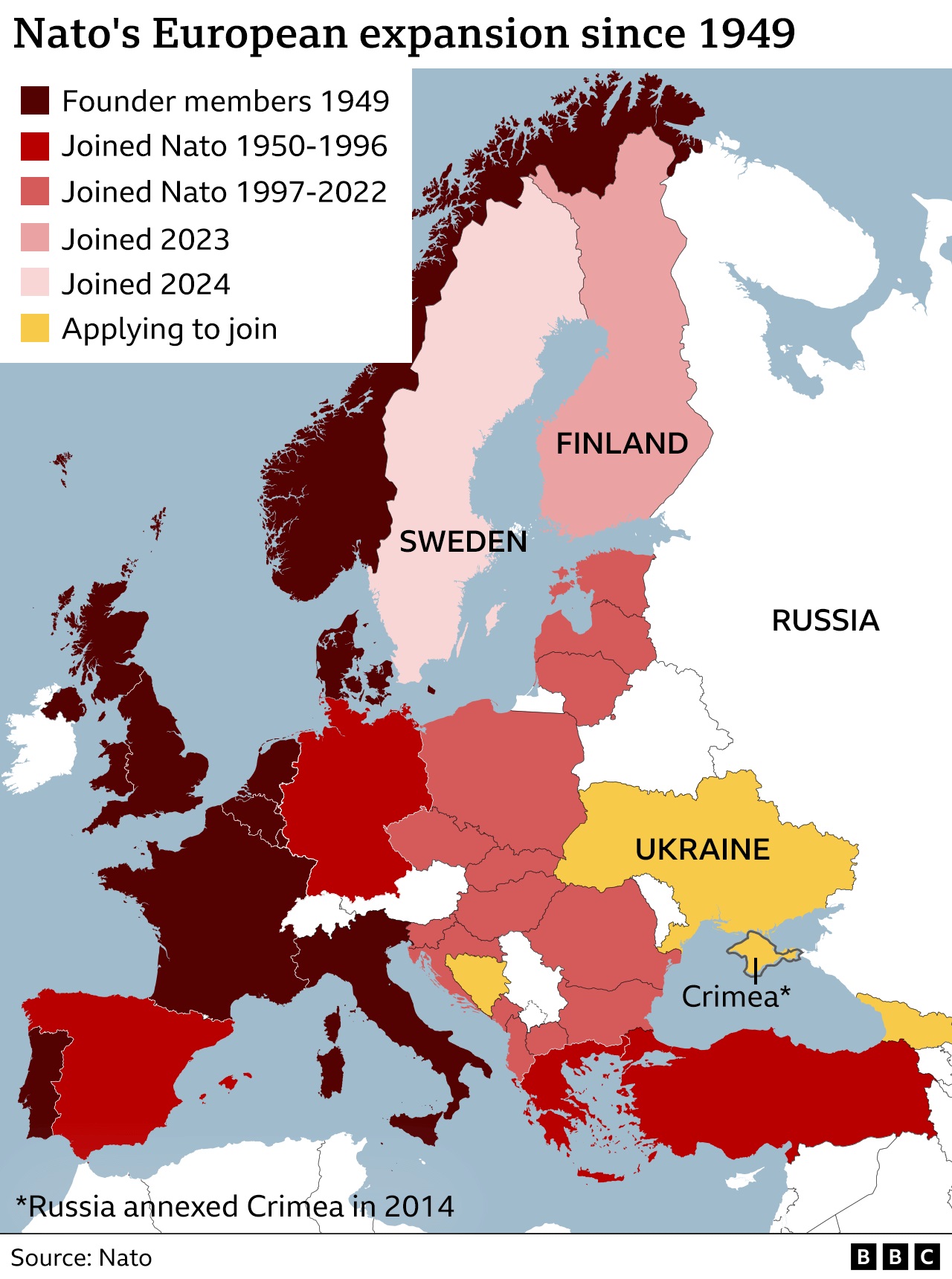
Putin’s demands for peace include an end to NATO enlargement, sources say.
By Guy Faulconbridge, https://www.reuters.com/world/europe/putin-ukraine-peace-wants-pledge-halt-nato-enlargement-sources-say-2025-05-28/
President Vladimir Putin’s conditions for ending the war in Ukraine include a demand that Western leaders pledge in writing to stop enlarging NATO eastwards and lift a chunk of sanctions on Russia, according to three Russian sources with knowledge of the negotiations. U.S. President Donald Trump has repeatedly said he wants to end the deadliest European conflict since World War Two and has shown increasing frustration with Putin in recent days, warning on Tuesday the Russian leader was “playing with fire” by refusing to engage in ceasefire talks with Kyiv as his forces made gains on the battlefield.
After speaking to Trump for more than two hours last week, Putin said that he had agreed to work with Ukraine on a memorandum that would establish the contours of a peace accord, including the timing of a ceasefire. Russia says it is currently drafting its version of the memorandum and cannot estimate how long that will take. Kyiv and European governments have accused Moscow of stalling while its troops advance in eastern Ukraine.
“Putin is ready to make peace but not at any price,” said one senior Russian source with knowledge of top-level Kremlin thinking, who spoke on condition of anonymity. The three Russian sources said Putin wants a “written” pledge by major Western powers not to enlarge the U.S.-led NATO alliance eastwards – shorthand for formally ruling out membership to Ukraine, Georgia and Moldova and other former Soviet republics.
Russia also wants Ukraine to be neutral, some Western sanctions lifted, a resolution of the issue of frozen Russian sovereign assets in the West, and protection for Russian speakers in Ukraine, the three sources said. The first source said that, if Putin realizes he is unable to reach a peace deal on his own terms, he will seek to show the Ukrainians and the Europeans by military victories that “peace tomorrow will be even more painful”. The Kremlin did not respond to a request for comment on Reuters’ reporting.
Putin and Russian officials have repeatedly said any peace deal must address the “root causes” of the conflict – Russian shorthand for the issue of NATO enlargement and Western support for Ukraine. Kyiv has repeatedly said that Russia should not be granted veto power over its aspirations to join the NATO alliance. Ukraine says it needs the West to give it a strong security guarantee with teeth to deter any future Russian attack.
President Volodymyr Zelenskiy’s administration did not respond to a request for comment. NATO has also in the past said that it will not change its “open door” policy just because Moscow demands it. A spokesperson for the 32-member alliance did not respond to Reuters’ questions. Putin ordered tens of thousands of troops into Ukraine in February 2022 after eight years of fighting in eastern Ukraine between Russian-backed separatists and Ukrainian troops. Russia currently controls just under one fifth of the country. Though Russian advances have accelerated over the past year, the war is costing both Russia and Ukraine dearly in terms of casualties and military spending. Reuters reported in January that Putin was growing concerned by the economic distortions in Russia’s wartime economy, amid labour shortages and high interest rates imposed to curb inflation. The price of oil, the bedrock of Russia’s economy, has declined steadily this year.
Trump, who prides himself on having friendly relations with Putin and has expressed his belief the Russian leader wants peace, has warned that Washington could impose further sanctions if Moscow delays efforts to find a settlement. Trump suggesting on social media on Sunday that Putin had “gone absolutely CRAZY” by unleashing a massive aerial attack on Ukraine last week. The first source said that if Putin saw a tactical opportunity on the battlefield, he would push further into Ukraine – and that the Kremlin believed Russia could fight on for years no matter what sanctions and economic pain were imposed by the West.
A second source said that Putin was now less inclined to compromise on territory and was sticking to his public stance that he wanted the entirety of four regions in eastern Ukraine claimed by Russia.
“Putin has toughened his position,” the second source said of the question of territory.
NATO ENLARGEMENT
As Trump and Putin joust in public over the outlook for peace in Ukraine, Reuters could not determine whether the intensification of the war and the toughening of positions heralds determination to reach a deal or the collapse of talks. In June last year, Putin set out his opening terms for an immediate end to the war: Ukraine must drop its NATO ambitions and withdraw all of its troops from the entirety of the territory of four Ukrainian regions claimed and mostly controlled by Russia.
In addition to Crimea, which it annexed in 2014, Russia currently controls almost all of Luhansk, more than 70% of Donetsk, Zaporizhzhia and Kherson regions. It also occupies a sliver of the Kharkiv and Sumy regions, and is threatening Dnipropetrovsk.
Former U.S. President Joe Biden, Western European leaders and Ukraine cast the invasion as an imperial-style land grab and have repeatedly vowed to defeat Russian forces. Putin casts the war as a watershed moment in Moscow’s relations with the West which he says humiliated Russia after the Soviet Union fell in 1991 by enlarging NATO and encroaching on what he considers Moscow’s sphere of influence.
At the 2008 Bucharest summit, NATO leaders agreed that Ukraine and Georgia would one day become members. Ukraine in 2019 amended its constitution committing to the path of full membership of NATO and the European Union.
Trump has said that previousU.S. support for Ukraine’s NATO membershipbid was acause of the war, and has indicated that Ukraine will not get membership. The U.S. State Department did not respond to a request for comment for this story.
Putin, who rose to the top Kremlin job in 1999, has repeatedly returned to the issue of NATO enlargement, including in his most detailed remarks about a possible peace in 2024.
In 2021, just two months before the Russian invasion, Moscow proposed a draft agreement, with NATO members that, under Article 6, would bind NATO to “refrain from any further enlargement of NATO, including the accession of Ukraine as well as other States.” U.S. and NATO diplomats said at the time that Russia could not have a veto on expansion of the alliance. Russia wants a pledge on NATO in writing because Putin thinks Moscow was misled by the United States after the 1989 fall of the Berlin Wall when U.S. Secretary of State James Baker assured Soviet leader Mikhail Gorbachev in 1990 that NATO would not expand eastwards, two of the sources said.
There was such a verbal promise, former Central Intelligence Agency Director Director William J. Burns said in his memoires, but it was never formalised – and it was made at a time when the collapse of the Soviet Union had not occurred.
NATO, founded in 1949 to provide security against the Soviet Union, says it poses no challenge to Russia – though its 2022 assessment of peace and security in the Euro-Atlantic area identified Russia as the most “significant and direct threat”.
Russia’s invasion of Ukraine that year prompted Finland to join NATO in 2023, followed by Sweden in 2024.
Western European leaders have repeatedly said that if Russia wins the Ukraine war, it could one day attack NATO itself – a step that would trigger a world war. Russia dismisses such claims as baseless scaremongering, but has also warned the war in Ukraine could escalate into a broader conflict.
Comment: Putin wants a deal, Trump wants a deal, Zelensky…wants.
Trump should not threaten sanctions when he talks to Putin

It is clear to me that further US sanctions on Russia would kill stone dead any chance of a ceasefire in Ukraine at a time when Russia still has the upper hand.
Europe has neither the political capital nor the funds to maintain a losing war in Ukraine at enormous expense without massive domestic political blowback in their own countries.
Russia will keep fighting, Ukraine will lose all of the Donbass and Europe will pay the price
Ian Proud, May 18, 2025, https://thepeacemonger.substack.com/p/trump-should-not-threaten-sanctions?utm_source=post-email-title&publication_id=3221990&post_id=163841246&utm_campaign=email-post-title&isFreemail=true&r=1ise1&triedRedirect=true&utm_medium=email
Trump should not threaten Putin with sanctions during their planned phone call on Monday 19 May. This would only lock in the fighting for the rest of the year and leave Europe on the hook for a massive bill and political disruption that it cannot afford.
In the run up to the Russia-Ukraine bilateral peace talks which finally took place in Istanbul last week, both the EU and the UK imposed new sanctions on Russia. On 9 May, as Russian commemorated victory Day, Britain imposed sanctions on Russia’s shadow fleet and the EU followed suit with its 17th package of Russia sanctions on 14 May, the day before the Istanbul talks were due to start. Both the UK and EU have threatened further sanctions should Russia not agree a full and unconditional ceasefire in Ukraine and, with Zelensky, have actively urged the US to follow suit, which it has not done, so far. However, the Americans have spoken increasingly about the possibility of massive new sanctions against Russia: this would be a huge mistake.
Sanctioning a country before peace talks have already started, or while they are still going on, is already a bad look. Very clearly, the Ukrainians, Europeans and British hope that new sanctions will apply such pressure on Russia that it agrees to terms that are more favourable to the Ukrainian side. I.e. that Ukraine does not have to go back to the Istanbul 1 commitment to adopt permanently neutral status. The western mainstream press has been carpet bombing their intellectually degraded readers with the latest press line that Ukraine should not have to go back to the Istanbul 1 text as a starting point for talks. This is unrealistic.
But, in any case, there’s a problem. For this strategy to be effective, the sanctions have to work.
As I’ve pointed out before, sanctions against Russian have had limited impact, not just since 2022, but since 2014. Nothing about the glidepath of sanctions since February 2014 suggests that new sanctions will work now.
This latest round of UK and EU sanctions aimed to apply more pressure on enforcement of the G7 oil price cap of $60 which was first imposed in December 2022. Since the war started, that policy has failed.
Between 2021 and 2024, total volumes of Russian oil exported fell by just 0.2 million barrels per day, or 2.6%. After a bumper year for tax receipts in 2022 caused by Russian tumbling rouble and skyrocketing energy prices, Russia pulled in current account surpluses of $49.4bn and $62.3bn in 2023 and 2024. This was on the back of still strong goods exports of $425bn and $433bn respectively.
There are several reasons why the oil price cap didn’t work, the biggest being that Russia diverted 3 million barrels per day, around 39.5% of total oil exports to India (1.9 mbd), Türkiye (0.6 mbd) and China (0.5 mbd). Türkiye and India boosted exports of refined fuels to Europe providing a backdoor route for Russian oil to Europe. The second reason the oil price cap didn’t work is the near ten month time lag between war starting and the limit being imposed, which gave Russia space to readjust before punitive measure had been imposed. During this period, oil prices also dropped sharply from the high of $120 in the summer of 2022, to around $80 when the measure was imposed: the G7 missed the boat to impose maximum damage; this reinforces the point I make all the time that coalitions cannot act with speed and decisiveness.
Today, the Russian Urals oil price is below the $60 G7 cap meaning that any registered shipping company can transport it without penalty, which renders the British and European sanctions as pointless in any case.
Let’s be clear, western nations imposing sanctions against Russia that don’t work is not a new phenomena. As I have pointed out many times before, the vast majority (92%) of people that the UK has imposed assets freezes and travel bans upon have never held assets in the UK nor travelled here. For companies, the figure is just 23. The same, I am sure, is true of EU and US sanctions, which cover largely the same cast list of characters and companies, as we all share and compare the same lists of possible designations. Financial sector sanctions prompted a massive readjustment of Russia’s financial sector. Energy and dual use sanctions drove self-sufficiency in technology production, through Rosnet, Gazprom and RosTec: i.e. these companies invested more in R&D on component production while sourcing components from alternative markets, in particular China.
At well over 20,000 sanctions imposed so far, Russia’s economy has proved remarkably robust and its key export sectors still find ways to deliver similar volumes across the world. At some point, I hope policy makers in London, Brussels and Washington will start to ask whether this policy is working. We long ago passed the point of diminishing marginal returns. I fear, however, they have their heads in the sand or, possibly another, darker, place.
So, coming back to Trump’s phone call with Putin on Monday 19 May you might ask yourself, ‘so what if he imposes a few more sanctions if they won’t work anyway?’
Putin would see the imposition of new US sanctions as a complete 180, destroying any emerging trust he had in Trump or any belief in America’s stated intentions to end the war in Ukraine.
It is clear to me that further US sanctions on Russia would kill stone dead any chance of a ceasefire in Ukraine at a time when Russia still has the upper hand. Russia has increased the pace of its advance since the Victory Day ceasefire and seems to be adding new blocks of red to the battle map each day. At the current rate of advance, even without a catastrophic Ukrainian collapse, it seems realistic to expect that Russia would paint out the remaining territory in Donetsk and Luhansk during the remainder of this year. In the process they would need to overcome the heavily fortified towns of Pokrovsk, Kramatorsk and Sloviansk, in what would likely be brutal and attritional battles killing many thousands more on both sides.
Moreover, dragging out the war for longer would simply add to Europe’s contingent liability to fund Ukraine’s war effort at a time when it is only ever going to lose. Ukraine is spending over 26% of GDP on defence in 2025 and 67.5% of its budget expenditure is on defence and security, leaving a budget black hotel of $42bn that has to be filled. America under Trump isn’t going to fill this hole. And, as Ukraine is cut off from international lending markets, that black hole is being filled by Europe.
There is no money for this.
Europe has neither the political capital nor the funds to maintain a losing war in Ukraine at enormous expense without massive domestic political blowback in their own countries.
Notwithstanding the possibly understandable fear among European leaders of failing and being seen to fail in Ukraine, keeping the war going is at best, a gesture in cynical self-preservation, pushing their eventual political demise further down the track.
Unfortunately, we have been here so many times before. Right back to the Minsk II agreement, Ukraine has been pushing for ever more sanctions against Russia that only ever served to ramp up resentment and exacerbate the conflict. European leaders have invested too much in Zelensky and his self-serving demands aimed primarily at staying in power. He is quickly becoming the gun that shoots European elites in the head.
If Trump really wants to be seen as a peacemaker, he should avoid doing what every other western leader before him including Sleepy Joe did and resist the temptation to impose more sanctions. Instead, he should continue to press the President Putin to continue to engage with bilateral peace talks that finally recommences in Istanbul last week. He must also tell the Eurocrats and Zelensky that they must make compromises rather than plugging the same old failed prescriptions.
China and Russia plan to build nuclear power station on moon
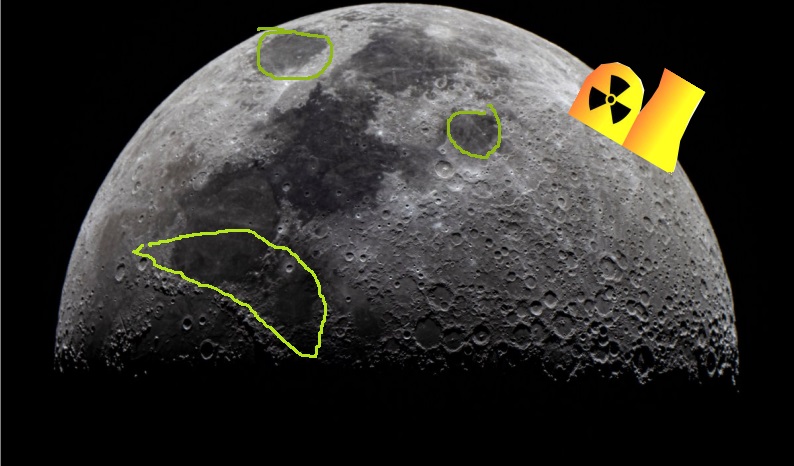
China and Russia plan to build a nuclear reactor on the moon by 2035 to
power a permanent lunar base. The International Lunar Research Station
(ILRS) will rely on the power plant for its scientific research. The IRLS
involves over a dozen international partners and is seen as a rival program
to NASA’s Artemis Program.
Deutsche Welle 16th May 2025, https://www.dw.com/en/china-and-russia-plan-to-build-nuclear-power-station-on-moon/a-72565465
The stakes are high for these important Ukraine-Russia-US talks.
Istanbul 2.0: Know when to hold ’em, know when to fold ’em.
Here’s hoping no one walks away — or runs — as the stakes today are high for these important Ukraine-Russia-US talks.
Ian Proud, May 15, 2025, https://responsiblestatecraft.org/ukraine-russia-istanbul-talks/?utm_source=substack&utm_medium=email
The biggest achievement of today’s Istanbul talks is that they are even taking place. U.S. engagement will remain vital to getting a peace deal over the line. Russia’s desire for a reset with Washingtonmay keep them on track.
I have a sense of déjà vu as I contemplate these long-overdue peace talks between Ukraine and Russia in Istanbul. In April 2022, Ukraine and Russia were close to agreeing a peace treaty, less than two months after war started. However, this came crashing down amid claims that western governments, in particular the United States and the United Kingdom encouraged Ukraine to keep fighting.It’s worth recapping very briefly what was close to having been agreed. By far the best summary of negotiations between both sides was produced by the New York Times in June 2024. Those negotiations ran for almost two months. The talks started with Ukrainian officials being spirited over the border into Belarus on February 29, 2022 while the fighting raged around Kyiv, and eventually led to the now famous talks in Istanbul in March and April.
What has changed since then?
Ukraine will enter the Istanbul talks in a weaker position than it held in 2022.
Western support for Ukraine financially and economically is not as sound as it was then. No big ticket economic aid and assistance has been made available since the G7 agreement of a $50 billion package of loans, in June 2024. While European states scratched together new economic aid to Ukraine in April, this cannot make up for the reduction in US support.
In territorial terms, Russia withdrew from Kyiv as a concession to the first Istanbul talks and lost ground in Kharkiv and in Kherson in late 2022. However, Russia has gone on steadily to gain further territory in the Donbas since the end of 2023. So while both sides have scores on the board, Russia now maintains the military upper hand on the battlefield and that seems unlikely to change. These two factors in particular were behind President Trump’s February assertion that Ukraine has no cards to play.
What has stayed the same?
NATO membership is still off the table
The verified documents shared by the New York Times last June confirmed that Ukraine’s neutrality and non-membership of NATO was the central issue agreed upon in 2022. Ukraine was ready to become a “permanently neutral state” that would never join NATO or allow foreign forces to be based on its soil.
There seems no route for Ukraine to resile from that given its currently weakened negotiating position and President Trump’s stated view that NATO membership for Ukraine is not practical. Although Germany’s new foreign Minister, Johann Wadephul recently repeated the line that Ukraine’s path to NATO is irreversible, most have agreed, privately and publicly, that Ukraine’s path to NATO is a fraught if not impossible one.
Right now, just having the talks is a huge breakthrough
The Istanbul talks would not be happening had the Trump administration not pushed for it so hard. We don’t need to rehash the “did they or didn’t they” debate around why Ukraine abandoned the Istanbul agreement in April 2022. What is clear, is that Ukraine became entrenched, not only in not negotiating with Russia, but in excluding Russia from all discussions on peace in Ukraine from then onward.
Having agreed in principle for Ukraine to accept neutral status Zelensky was soon pushing his own ten point peace plan. This included, among other things, Russia withdrawing its troops to the pre-2014 border, i.e. giving up Crimea and the Donbass and creating a Euro-Atlantic Security Architecture, by which he meant Ukraine joining NATO. Peace summits were organized in various countries that explicitly excluded Russia, culminating in the Switzerland event on June 15, 2024.
At this event, President Zelensky was dug in deeper on resisting any engagement with Russia until a full withdrawal of its troops from Ukraine, which was a completely unrealistic proposal. “Russia can start negotiations with us even tomorrow without waiting for anything – if they leave our legal territories,” he said.
Even after President Trump was elected, European leaders clung to the line that “only Ukraine can decide what peace means.”’ I see no circumstances in which a Kamala Harris presidency would have cajoled President Zelensky to enter into negotiations. The talks wouldn’t be happening unless the Trump administration broke a whole load of Ukrainian and European eggshells to get to this point.
The biggest issue now is territory
Even though he was wrongly derided at the time by mainstream media, Steve Witkoff correctly pointed out in his March interview with Tucker Carlson that the territorial issues in Ukraine will be most intractable. Russia’s decision in October 2022 to formally annex the four oblasts of Kherson, Zaporizhzhia, Donetsk, and Luhansk changed the calculus. However, Russia does not have full territorial control of any of those oblasts, which are cut through the middle by a hotly contested front line.
Resolving the line of control when the war ends is, by some margin, the most problematic challenge. This will be a hugely sensitive topic, and European allies will shoot down any major concessions to Russia, as they did when the idea surfaced that the U.S.might de jure recognise Russia’s occupation of Crimea.
The most obvious settlement is a de facto recognition of occupation, a Cyprus-style scenario, that does not stand in the way of Ukraine’s future membership of the European Union. Even that will require detailed agreement on issues around demilitarization of the line of control and enforcing any ceasefire.
Sanctions are probably tricky, but also tractable
As I have said before, there is enormous scope to a plan that allows for the immediate lifting of the bulk of zero-impact measures, phasing out the remainder at points agreed to by both sides. The toughest issue remains the $300 billion in frozen Russian assets, mostly held in Belgium. Russia has shown a willingness to concede this funding to support reconstruction in Ukraine, including those parts that Russia occupies.
But there is texture here. Freeing up those funds for reconstruction would immediately remove the source of interest payments that are meeting Ukraine’s obligations on its $50 billion in debt to the G7, agreed to in June 2024. But the more general policy question arises, how much of the freed up funding would be spent in Ukraine itself and how much in Russian-occupied Ukraine, where most of the war damage has occurred? The U.S. must keep the pressure on to ensure the talks stay on track.
A U.S. presence in Istanbul will be vital, to prevent, in particular, Ukraine from bailing on the talks. That’s why sending Steve Witkoff and Keith Kellogg makes sense. The former is trusted by the Russian side while the latter has built relationships in Ukraine. Their presence serves to keep the process moving forward until a deal can be pushed over the line and the fighting can stop.
Bear in mind that the 2022 talks ran for a month and a half and the circumstances have materially changed as I have indicated above. While there has been speculation that President Trump might drop into Istanbul, I am not sure that this is necessary if President Putin doesn’t himself attend. Knowing the Russians, I assess that Putin will want his own “‘meeting moment” with the U.S. President on terms that the Russian side can better choreograph. Indeed, that may be a prize for Russia’s engagement in the process, given its desire for a more comprehensive reset of relations with the U.S.
Need to use nuclear weapons has not arisen in Ukraine, says Putin
Russian leader says he hopes nuclear strikes ‘will not be required’ in state TV film about his 25 years in power.
Angelique Chrisafis and agencies, 5 May 25, https://www.theguardian.com/world/2025/may/04/need-to-use-use-nuclear-weapons-has-not-arisen-in-ukraine-says-putin
The Russian president, Vladimir Putin, said in comments broadcast on Sunday said that the need to use nuclear weapons in Ukraine had not arisen, and that he hoped it would not.
Speaking in a film by Russian state television about his 25 years in power, Putin said that Russia has the strength and the means to bring the conflict in Ukraine to what he called a “logical conclusion”.
Responding to a question from a state television reporter about Ukrainian strikes on Russia, Putin said: “There has been no need to use those [nuclear] weapons … and I hope they will not be required.”
Fear of nuclear escalation has been a factor in US officials’ thinking since Russia invaded Ukraine in early 2022. The former CIA director William Burns has said there was a real risk in late 2022 that Russia could use nuclear weapons against Ukraine.
In autumn 2022, the US was so concerned about the possible use of tactical nuclear weapons by Russia that it warned Putin over the consequences of using such weapons, Burns has said. At the same time, the Chinese leader Xi Jinping also warned Putin not to resort to nuclear weapons.
Putin signed a revamped version of Russia’s nuclear doctrine in November 2024, spelling out the circumstances that allow him to use Moscow’s atomic arsenal, the world’s largest. That version lowered the bar, giving him the option of using nuclear weapons in response to even a conventional attack backed by a nuclear power.
The US president, Donald Trump, has said he wants to end the conflict via diplomatic means, raising the question of whether Putin was willing to negotiate a peace settlement. But the Kremlin has rejected calls by Kyiv and Washington for an unconditional 30-day ceasefire.
Putin, in February 2022, ordered tens of thousands of Russian troops to invade Ukraine. Moscow’s forces now control about 20% of Ukraine, including parts of the south and east.
In the carefully choreographed state television film, Putin was shown in his private Kremlin kitchen offering chocolates and a fermented Russian milk drink to the Kremlin correspondent, Pavel Zarubin.
Putin, a former KGB lieutenant colonel who was handed the presidency on the last day of 1999 by an ailing Boris Yeltsin, is the longest serving Kremlin leader since Joseph Stalin, who ruled for 29 years until his death in 1953.
Kursk Region fully liberated from Ukrainians – Putin
Rt.com, 26 Apr, 2025
Kiev’s gamble to invade Russia has ended up in an unmitigated disaster, the president has said.
The Russian military has completely liberated the border Kursk Region from Ukrainian forces, President Vladimir Putin has said after being briefed on the battlefield situation by General Staff Chief Valery Gerasimov.
In a video address shared by the Kremlin on Saturday, Putin thanked Russian service members “who took part in defeating the neo-Nazi groups” that invaded the region last summer.
“The Kiev regime’s adventure has completely failed, and the huge losses suffered by the enemy, including among the most combat-ready, trained and equipped, including by Western models of equipment… will certainly be reflected along the entire line of combat contact,” he said.
According to Putin, the Russian success sets the stage for further advances in other areas of the front, bringing final victory in the conflict closer……………….
…………….Ukraine launched its incursion into Kursk Region last August, initially gaining some ground and capturing numerous settlements before their advance was checked by Russian forces.
Putin has characterized the incursion as an attempt by Kiev to divert attention from Moscow’s offensive in Donbass, adding that this ploy has failed. Ukrainian officials described the operation as a way to gain leverage in potential peace talks with Russia. https://www.rt.com/russia/616355-kursk-region-fully-liberated/
China, Russia may build nuclear plant on moon to power lunar station, official says

By Eduardo Baptista, April 24, 2025,
https://www.reuters.com/business/energy/china-led-lunar-base-include-nuclear-power-plant-moons-surface-space-official-2025-04-23/
- Summary
- China and Russia plan nuclear reactor for lunar base by 2035
- China and Russia-led ILRS aims to rival NASA’s Artemis program
- China-Russia cooperation strengthened by tensions with West
SHANGHAI, April 23 (Reuters) – China is considering building a nuclear plant on the moon to power the International Lunar Research Station (ILRS) it is planning with Russia, a presentation by a senior official showed on Wednesday.
China aims to become a major space power and land astronauts on the moon by 2030, and its planned Chang’e-8 mission for 2028 would lay the groundwork for constructing a permanent, manned lunar base.
In a presentation in Shanghai, the 2028 mission’s Chief Engineer Pei Zhaoyu showed that the lunar base’s energy supply could also depend on large-scale solar arrays, and pipelines and cables for heating and electricity built on the moon’s surface.
Russia’s space agency Roscosmos said last year it planned to build a nuclear reactor on the moon’s surface with the China National Space Administration (CNSA) by 2035 to power the ILRS.
The inclusion of the nuclear power unit in a Chinese space official’s presentation at a conference for officials from the 17 countries and international organisations that make up the ILRS suggests Beijing supports the idea, although it has never formally announced it.
“An important question for the ILRS is power supply, and in this Russia has a natural advantage, when it comes to nuclear power plants, especially sending them into space, it leads the world, it is ahead of the United States,” Wu Weiren, chief designer of China’s lunar exploration program, told Reuters on the sidelines of the conference.
After little progress on talks over a space-based reactor in the past, “I hope this time both countries can send a nuclear reactor to the moon,” Wu said.
China’s timeline to build an outpost on the moon’s south pole coincides with NASA’s more ambitious and advanced Artemis programme, which aims to put U.S. astronauts back on the lunar surface in December 2025.
Wu said last year that a “basic model” of the ILRS, with the Moon’s south pole as its core, would be built by 2035.
In the future, China will create the “555 Project,” inviting 50 countries, 500 international scientific research institutions, and 5,000 overseas researchers to join the ILRS.
Researchers from Roscosmos also presented at the conference in Shanghai, sharing details about plans to look for mineral and water resources, including possibly using lunar material as fuel.
Moscow may gain key role in Iran nuclear deal as US talks progress
Russia touted as possible destination for Iran’s uranium stockpile and could also act as arbiter of deal breaches
Russia could play a key role in a deal on the future of Iran’s nuclear
programme, with Moscow being touted not only as a possible destination for
Iran’s stockpile of highly enriched uranium, but also as a possible
arbiter of deal breaches.
Donald Trump, who abandoned a 2015 nuclear pact
between Tehran and world powers in 2018 during his first term, has
threatened to attack Iran unless it reaches a new deal swiftly that would
prevent it from developing a nuclear weapon.
Four hours of indirect talks
between the US and Iran in Rome on Saturday, under the mediation of Oman,
made significant progress, according to US officials. Further technical
talks are due in Geneva this week, followed by another high-level
diplomatic meeting next weekend in Oman.
Guardian 20th April 2025 https://www.theguardian.com/world/2025/apr/20/moscow-may-gain-key-role-in-iran-nuclear-deal-as-us-talks-progress
Russia holds all the cards.
| Walt Zlotow, Apr 11, 2025. Published in Chicago Tribune |
Tribune foreign affairs columnist Daniel DePetris (“Vladimir Putin obstructs President Donald Trump’s best-laid plans for Ukraine,” April 8) nibbles around the edges of reality concerning the Russia-Ukraine war. His current take on the war suggests that Russian President Vladimir Putin is sabotaging President Donald Trump’s best efforts to end the war quickly through negotiations in order to capture more Ukrainian territory.
But the reverse is true. The U.S., NATO and Ukraine are preventing the negotiations from achieving peace. Why? Because all of them refuse to accept the war will not end till they recognize and address Russia’s core interests: no NATO for Ukraine, neutrality for Ukraine going forward and an end to attacks on Russian-leaning Ukrainians in Donbas.
Putin is not feigning peace to stay on Trump’s good side merely to gobble up more Ukrainian territory. He’s simply not going to negotiate with adversaries who refuse to recognize Russia’s core interests. No peace agreement will occur in Trump’s first 100 days, nor even in his first 1,000 days, unless he accepts this reality of what it will take to end the war.
DePetris claims a frustrated Trump has but two options: ramping up the war with another multibillion-dollar weapons package to achieve victory or just walking away to saddle Europe with prosecuting it. Wrong. Trump has but one urgent task: Accept reality that Russia holds all the negotiating cards and will never cease hostilities till its core interests are addressed.
DePetris surely knows this. However, his career as a Defense Priorities fellow and a Tribune columnist is contingent upon never admitting or criticizing America’s role in provoking, if not starting, senseless wars and refusing to quickly, sensibly end them.
That is unfortunate for his readership. It is infinitely more unfortunate for the war-weary people of Ukraine.
Russia pledges to help resolve Iran-US nuclear tensions
April 7 2025 –https://www.canberratimes.com.au/story/8936749/russia-pledges-to-help-resolve-iran-us-nuclear-tensions/
Russia is ready to do all it could to help resolve tensions between the United States and Iran around Tehran’s nuclear program, the Kremlin says.
Moscow has repeatedly offered to mediate between the two sides after warnings of military action against Iran by US President Donald Trump have rattled nerves across the region.
“We are in constant consultations with our Iranian partners, including on the topic of the nuclear deal,” Kremlin spokesman Dmitry Peskov told reporters on Monday.
“This process will continue, including in the near future. And, of course, Russia is ready to make every effort, to do everything possible to contribute to this problem’s resolution by political and diplomatic means.”
During his first term, Trump withdrew the US from a 2015 deal between Iran and world powers that placed strict limits on Tehran’s disputed nuclear activities in exchange for sanctions relief. Iran says it needs nuclear energy for peaceful purposes and denies it is seeking to acquire nuclear weapons.
Tehran has pushed back against Trump’s demands for direct talks, with a senior Iranian official issuing a warning over the weekend to neighbours that host US bases that they could be in the firing line.
Russian Deputy Foreign Minister Sergei Ryabkov said last week that Trump’s comments about bombing Iran only served to “complicate the situation” and cautioned that strikes could be “catastrophic” for the wider region.
Russia has for the most part refrained from such sharp criticism of Trump.
President Vladimir Putin has moved quickly since Trump took office to repair relations with the US in a rapprochement viewed with concern by Ukraine and its European allies.
Moscow has also deepened ties with Tehran since the start of the full-scale conflict in Ukraine with the two signing a strategic partnership treaty in January.
Russian sensors suspected of attempting to spy on the UK’s nuclear submarines have been found hidden in the seas around Britain.
The discovery by the British military was deemed a potential threat to national security
and has never been made public.
Several were found after they washedashore, while others are understood to have been located by the Royal Navy.
The devices are believed to have been planted by Moscow to try and gather
intelligence on Britain’s four Vanguard submarines, which carry nuclear
missiles. One of these submarines is always at sea under what is known as
the UK’s continuous at-sea deterrent.
The Sunday Times has chosen to withhold certain details, including the locations of the sensors. During a three-month investigation we spoke to more than a dozen former defence
ministers, senior armed forces personnel and military experts to expose how
Russia is using its unrivalled underwater warfare capabilities to map, hack
and potentially sabotage critical British infrastructure.
Times 5th April 2025 https://www.thetimes.com/uk/defence/article/russia-secret-war-uk-waters-submarines-dpbzphfx5
Russia rules out transferring control over Zaporizhzhia Nuclear Power Plant to Ukraine

the plant being jointly operated, including with the participation of international organizations,
“In this case, for example, it is impossible to properly ensure nuclear and physical nuclear safety, or regulate issues of civil liability for nuclear damage.
Transfer of the facility or control over it to Ukraine or any other country is ‘impossible,’ says Foreign Ministry
Burc Eruygur 26.03.2025, https://www.aa.com.tr/en/russia-ukraine-war/russia-rules-out-transferring-control-over-zaporizhzhia-nuclear-power-plant-to-ukraine/3520006#
Russia on Tuesday rejected transferring control over the Zaporizhzhia Nuclear Power Plant (ZNPP) to Ukraine or any other country, saying it is “impossible.”
US President Donald Trump and his Ukrainian counterpart Volodymyr Zelenskyy discussed the situation surrounding energy supplies to Ukraine and the country’s nuclear power plants during a phone call last Wednesday.
Trump told Zelenskyy that the US could be “very helpful in running the plants with its electricity and utility expertise” and that “American ownership of those plants could be the best protection for that infrastructure,” according to a White House statement.
Zelenskyy told journalists at a briefing later that he and Trump did talk about the restoration of the ZNPP and that Ukraine is ready to discuss the modernization of the plant but they did not discuss the issue of ownership of the plant.
A statement by the Russian Foreign Ministry stressed that the plant is a “Russian nuclear facility,” saying the transfer of the facility or control over it to Ukraine or any other country is “impossible.”
“All the station’s employees are citizens of the Russian Federation. Their lives cannot be played with, especially considering the atrocities that Ukrainians have committed and continue to commit on the territory of our country,” it said.
The statement also denied the possibility of the plant being jointly operated, including with the participation of international organizations, describing this as having “no such precedents in world practice.”
“In this case, for example, it is impossible to properly ensure nuclear and physical nuclear safety, or regulate issues of civil liability for nuclear damage.
The statement also denied the possibility of close cooperation between NATO intelligence services with Ukraine, which have impressive sabotage potential, makes it impossible, including with the participation of international organizations, describing this as having “no such precedents in world practice.”
“In this case, for example, it is impossible to properly ensure nuclear and physical nuclear safety, or regulate issues of civil liability for nuclear damage.
“An important aspect is that close cooperation between NATO intelligence services with Ukraine, which have impressive sabotage potential, makes it impossible to even temporarily admit representatives of these states to the ZNPP,” the statement added.
The situation around the Zaporizhzhia Nuclear Power Plant, Europe’s largest and one of the world’s 10 biggest, particularly remains tense as concerns persist over a possible nuclear disaster involving Moscow and Kyiv, both of which have frequently accused each other of attacks around the facility.
Since Sept. 1, 2022, International Atomic Energy Agency (IAEA) personnel have been present at the plant, which has been under Russian control since March 2022.
Zaporizhzhia nuclear plant to stay in Russian control, Moscow says
By Reuters, March 26, 2025, https://www.reuters.com/world/europe/zaporizhzhia-nuclear-plant-stay-russian-control-moscow-says-2025-03-25/
MOSCOW, March 25 (Reuters) – Russia’s Foreign Ministry said on Tuesday the Zaporizhzhia nuclear plant was a Russian facility and transferring control of it to Ukraine or any other country was impossible.
The ministry also said that jointly operating the plant was not admissible as it would be impossible to properly ensure the physical and nuclear safety of the station.
It said Zaporizhzhia region, partly controlled by Russian forces, was one of four in Ukraine that had been annexed by Russia by virtue of referendums staged seven months after Moscow’s full-scale invasion of its neighbour and a presidential decree had formally made the station Russian property.
Western nations have dismissed the referendums as shams.
“The return of the station to Russia’s nuclear sector has been a fait accompli for quite some time,” the ministry statement said. “Transferring the Zaporizhzhia plant to the control of Ukraine or another country is impossible.”
Russian forces seized the station early in the invasion and each side has since routinely accused the other of staging attacks that endanger safety at the plant, Europe’s largest with six reactors.
Although the plant now produces no electricity, the U.N.’s nuclear watchdog has monitors stationed there, as it does at all Ukrainian nuclear power sites.
Ukraine demands the return of the station to its jurisdiction and rejects the 2022 annexation of its territory as illegal.
U.S. President Donald Trump, during a phone conversation this month with his Ukrainian counterpart Volodymyr Zelenskiy suggested the United States could help run and possibly own Ukraine’s nuclear power plants.
Zelenskiy said the plants belong to the Ukrainian people. He said he and Trump had discussed potential U.S. investment in the plant. Reporting by Maxim Rodionov and Ron Popeski; Editing by Hugh Lawson and Rod Nickel
Aaron Mate on how NATO provoked Russia in Ukraine and undermined peace
By Aaron Maté / The Grayzone March 23, 2025, https://scheerpost.com/2025/03/23/aaron-mate-on-how-nato-provoked-russia-in-ukraine-and-undermined-peace/
The Grayzone’s Aaron Maté argues that the US and NATO provoked Russia in Ukraine by expanding NATO, dismantling arms control, installing military assets threatening Russia, meddling in Ukraine and blocking multiple opportunities for peace.https://www.youtube.com/watch?v=z8IMtB6UkvM
1 This Month

No Nuclear in Cwm Llynfi! Stop the nuclear power station near Maesteg.
To see nuclear-related stories in greater depth and intensity – go to https://nuclearinformation.wordpress.com
-
Archives
- September 2026 (154)
- August 2026 (330)
- July 2026 (355)
- June 2026 (287)
- May 2026 (306)
- April 2026 (356)
- March 2026 (251)
- February 2026 (267)
- January 2026 (308)
- December 2025 (358)
- November 2025 (359)
- October 2025 (375)
-
Categories
- 1
- 1 NUCLEAR ISSUES
- business and costs
- climate change
- culture and arts
- ENERGY
- environment
- health
- history
- indigenous issues
- Legal
- marketing of nuclear
- media
- opposition to nuclear
- PERSONAL STORIES
- politics
- politics international
- Religion and ethics
- safety
- secrets,lies and civil liberties
- spinbuster
- technology
- Uranium
- wastes
- weapons and war
- Women
- 2 WORLD
- ACTION
- AFRICA
- Atrocities
- AUSTRALIA
- Christina's notes
- Christina's themes
- culture and arts
- Events
- Fuk 2022
- Fuk 2023
- Fukushima 2017
- Fukushima 2018
- fukushima 2019
- Fukushima 2020
- Fukushima 2021
- general
- global warming
- Humour (God we need it)
- Nuclear
- RARE EARTHS
- Reference
- resources – print
- Resources -audiovicual
- Weekly Newsletter
- World
- World Nuclear
- YouTube
-
RSS
Entries RSS
Comments RSS
 nuclear-news