IDF threatens ‘elimination’ for Russian leaders who ‘wish Israel ill’
Wyatt Reed·March 18, 2026, https://thegrayzone.com/2026/03/18/idf-threatens-elimination-for-russian-leaders-who-wish-israel-ill/
Israel’s veiled threat to Moscow came just after Russian media warned traffic cameras in Moscow were vulnerable to the same exploits that Israel reportedly used to monitor Ayatollah Khamenei’s residence before assassinating him.
Israeli military spokeswoman Anna Ukolova has drawn outrage in Moscow after threatening that Russian authorities who “wish Israel ill” could be subject to “elimination,” while suggesting Israel could hack into Russian closed-circuit television cameras to identify and track targets.
Asked by a journalist with Russian radio broadcaster RBC whether Israel had access to Russian traffic cameras, Ukolova declined to answer directly but warned that “Khamenei’s elimination shows our capabilities are serious” and that “no one who wishes us harm will be left aside.”
She added, ominously, “I hope Moscow does not wish Israel ill right now – I’d like to believe that.”
In response to a post by Russian philosopher Alexander Dugin, who wrote that the IDF spokeswoman threatened that “Russian authorities [will] be killed if they take [an] anti-Israel position,” Ukolova claimed Dugin was spreading “fake news.” But she declined to clarify how her remarks had been incorrectly interpreted.
Ukolova’s statements came just days after it was revealed that a large number of Russian CCTVs were potentially using BriefCam – an Israeli video analysis software that closely matches the description of a program the Netanyahu regime reportedly deployed to track Iranian movements outside the home of Iran’s Supreme Leader before they assassinated him during their February 28 sneak attack.
On March 12, Russian outlet Mash revealed that the Israeli software BriefCam “has been used in Russia by private providers since the 2010s.” Founded at Israel’s Hebrew University in 2007, BriefCam uses AI to let users “review hours of video in minutes” and “make [their] video searchable, actionable and quantifiable.” In 2024, BriefCam was absorbed by a Dutch subsidiary of the Canon Group named Milestone Systems, which publicly pledges to “amplify what organizations of any size can see, do and achieve with video.”
“Our patented VIDEO SYNOPSIS® technology condenses hours of surveillance into a short summary by overlaying multiple events—each tagged with its original timestamp—onto a single frame, letting you filter them by object type and attributes,” the company’s BriefCam page crows. An analysis by Al Jazeera revealed those attributes include “gender, age group, clothing, movement patterns and time spent in a given location.”
Originally deployed by Israel’s Ministry of Housing and Construction to safeguard illegal settlements in occupied East Jerusalem, BriefCam has been used by governments all over the world, including those in the United Kingdom, New Zealand, Pakistan, Israel, Mexico, United Arab Emirates, Canada, Indonesia, Singapore, Thailand, Brazil, Germany, South Africa, Netherlands, Australia, Japan, India, Spain, Taiwan. It’s also been deployed in the US, with police in Hartford, Connecticut adopting the software in 2022. In 2025, a French court found the government’s use of BriefCam was illegal, citing multiple violations of French and European privacy laws.
As of publication, BriefCam appears to be incorporated into dozens of so-called “video monitoring systems,” including Milestone’s own VMS XProtect surveillance system.
According to the Russian outlet Mash, a number of prominent Moscow businesses, institutions, and buildings use VMS XProtect surveillance system, including the Institute of Theoretical and Experimental Biophysics of the Russian Academy of Sciences, a 72-story skyscraper named “Eurasia,” and a huge exhibit space known as the Zotov Center. Though Milestone officially ended operations in Russia in 2022 amid the war in Ukraine, Mash reports that some software distributors in Russia “still offer to install the hacked software and hide this in the documents.”
Russia summons Israeli envoy over missile strike on journalists in Lebanon- Zakharova: “Cannot be called accidental”
Russia has told Israeli envoy Oded Joseph that Moscow wanted an investigation into the attack in southern Lebanon wherein two Russian state TV journalists were injured.
Sharangee Dutta, India Today, Fri, 20 Mar 2026, https://www.sott.net/article/505250-Russia-summons-Israeli-envoy-over-missile-strike-on-journalists-in-Lebanon-Zakharova-Cannot-be-called-accidental
The Russian Foreign Ministry summoned Israeli envoy Oded Joseph on Friday to lodge a formal protest over an Israeli missile strike in southern Lebanon in which two Russian state TV journalists were injured, TASS reported. Moscow has told Joseph that they want an investigation into the attack, which happened on Thursday, and want assurances that such incidents would not be repeated.
A video of the strike, which landed barely 10 metres away from the filming location of RT correspondent Steve Sweeney and his cameraman Ali Rida, was captured on the latter’s camera. Sweeney ducked for cover just in time with the viral clip showing how the strike turned the site into a massive ball of fire.
Both of them survived the attack and received treatment at a local hospital. In one of the videos posted by Rida, doctors are seen removing shrapnel from Sweeney’s arm. The cameraman alleged that Israel intentionally struck the area despite their jackets displaying press credentials.
Russian Foreign Ministry spokesperson, Maria Zakharova, echoed Ali Rida, and condemned the strike. Taking to Telegram, she posted that the attack on the journalists wearing press jackets “cannot be called accidental” considering the killing of 200 correspondents in Gaza.
“Especially since the rocket did not hit a ‘significant strategic military facility’, but rather the location where the report was being filmed,” Zakharova wrote on the social media platform, adding that Moscow was waiting for a response from the international organisation.
Sweeney and Rida were filming near a local military base in southern Lebanon, close to the Al-Qasmiya Bridge. The site is a crucial crossing point over the River Litani, which has faced constant Israeli strikes over the past few days. Israel has claimed that the river crossings are being used by the Iran-supported group Hezbollah to move fighters and weapons amid the war.
In response, Israel said that it had repeatedly given warnings for civilians and residents to move out of the area and that the strike was launched after adequate time had passed. It also stressed that Tel Aviv does not target civilians or journalists and functions in accordance with international law.
Russian hospitals hit, strikes on kindergartens: Does Ukraine think everyone’s distracted by Iran?
At least 23 Russian civilians have been killed in Ukrainian strikes, some using Western-supplied Storm Shadow missiles
13 Mar, 2026 , https://www.rt.com/russia/634854-kiev-strikes-russia-civilians-attention-iran/
On the same day the Ukrainian military used a UK-supplied Storm Shadow missile to attack the city of Bryansk, about 100 kilometers from the Ukrainian border, killing at least seven civilians and wounding at least 42 people. Using such a weapon is impossible without the direct involvement of British military specialists.
On March 8, International Women’s Day and a public holiday in Russia, a family of four, including a six-year-old boy, were killed and twelve others injured by a wave of Ukrainian strikes on the DPR.
On March 6, two people were killed when Ukrainian drone dropped explosives on civilians outside a grocery store in Russia’s Kherson Region. A drone raid on the city of Novorossiysk in southern Russia on March 4 injured seven and caused extensive damage, including to kindergartens.
The DPR, along with the neighboring Lugansk People’s Republic (LPR), seceded from Ukraine following a Western-backed coup in Kiev in 2014. The two territories, along with Zaporozhye Region and Kherson Region, joined Russia following referendums in September 2022.
Civilians in Russia’s border regions have been consistently targeted by Ukrainian drones throughout the conflict, with Moscow accusing Kiev of “terrorism.”
Moscow has insisted that Kiev is attacking civilians because it cannot halt Russian advances on the battlefield. Ukrainian officials claim that inflicting sufficient economic damage will force the Kremlin to abandon its objectives in the four-year conflict.
Beyond civilian casualties, Ukraine has also been attacking energy infrastructure. Pipeline operator Gazprom reported on Wednesday that some of its compressor stations, including one serving the TurkStream pipeline, had been hit. The Russian Defense Ministry has accused Kiev of seeking to disrupt deliveries to European consumers.
Year 4: The Timeline That Tells the Tale
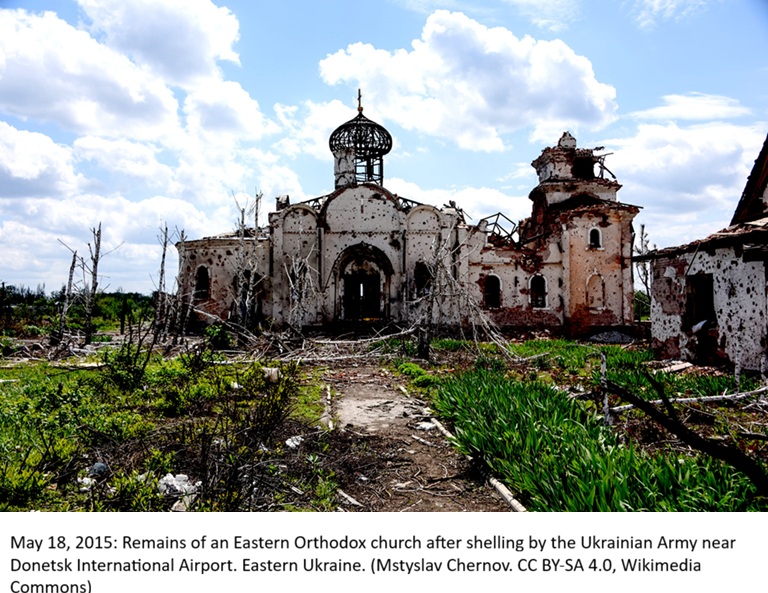
Without historical context, which is buried by corporate media, it’s impossible to understand the war in Ukraine. Historians will tell the story, but journalists are cut short for trying to tell it now.
By Joe Lauria, Consortium News, February 24, 2026
The way to prevent the Ukraine war from being understood is to suppress its history.
A cartoon version has the conflict beginning on Feb. 24, 2022 when Vladimir Putin woke up that morning and decided to invade Ukraine.
There was no other cause, according to this version, other than unprovoked, Russian aggression against an innocent country.
Please use this short, historical guide to share with people who still flip through the funny pages trying to figure out what’s going on in Ukraine.
The mainstream account is like opening a novel in the middle of the book to read a random chapter as though it’s the beginning of the story.
Thirty years from now historians will write about the context of the Ukraine war: the coup, the attack on Donbass, NATO expansion, and the rejection of the Minsk Accords and Russian treaty proposals without being called Putin puppets.
It will be the same way historians today write of the Versailles Treaty as a cause of Nazism and WWII, without being called Nazi-sympathizers.
Providing context is taboo while the war continues in Ukraine, as it would have been during WWII. Context is paramount in journalism.
But journalists have to get with the program of war propaganda while a war goes on. Journalists are clearly not afforded the same liberties as historians. Long after the war, historians are free to sift through the facts.
THE UKRAINE TIMELINE
World War II— Ukrainian national fascists, led by Stepan Bandera, at first allied with the German Nazis, massacre more than a hundred thousands Jews and Poles.
1950s to 1990 – C.I.A. brought Ukrainian fascists to the U.S. and worked with them to undermine the Soviet Union in Ukraine, running sabotage and propaganda operations. Ukrainian fascist leader Mykola Lebed was taken to New York where he worked with the C.I.A. through at least the 1960s and was still useful to the C.I.A. until 1991, the year of Ukraine’s independence. The evidence is in a U.S. government report starting from page 82. Ukraine has thus been a staging ground for the U.S. to weaken and threaten Moscow for nearly 80 years.
November 1990: A year after the fall of the Berlin Wall, the Charter of Paris for a New Europe (also known as the Paris Charter) is adopted by the U.S., Europe and the Soviet Union. The charter is based on the Helsinki Accords and is updated in the 1999 Charter for European Security. These documents are the foundation of the Organization for Security and Co-operation in Europe. The OSCE charter says no country or bloc can preserve its own security at another country’s expense.
Dec. 25, 1991: Soviet Union collapses. Wall Street and Washington carpetbaggers move in during ensuing decade to asset-strip the country of formerly state-owned properties, enrich themselves, help give rise to oligarchs, and impoverish the Russian, Ukrainian and other former Soviet peoples.
1990s: U.S. reneges on promise to last Soviet leader Gorbachev not to expand NATO to Eastern Europe in exchange for a unified Germany. George Kennan, the leading U.S. government expert on the U.S.S.R., opposes expansion. Sen. Joe Biden, who supports NATO enlargement, predicts Russia will react hostilely to it.
1997 :: The only thing that could provoke a “vigorous and hostile” Russian response would be needless NATO Expansion Far East right till the border of Russia – Sen. Joe Biden pic.twitter.com/hRW47hLL5y
— Rishi Bagree (@rishibagree) June 17, 2022
1997: Zbigniew Brzezinski, former U.S. national security adviser, in his 1997 book, The Grand Chessboard: American Primacy and Its Geostrategic Imperatives, writes:
“Ukraine, a new and important space on the Eurasian chessboard, is a geopolitical pivot because its very existence as an independent country helps to transform Russia. Without Ukraine, Russia ceases to be a Eurasian empire. Russia without Ukraine can still strive for imperial status, but it would then become a predominantly Asian imperial state.”
New Year’s Eve 1999: After eight years of U.S. and Wall Street dominance, Vladimir Putin becomes president of Russia. Bill Clinton rebuffs him in 2000 when he asks to join NATO.
Putin begins closing the door on Western interlopers, restoring Russian sovereignty, ultimately angering Washington and Wall Street. This process does not occur in Ukraine, which remains subject to Western exploitation and impoverishment of Ukrainian people.
Feb. 10, 2007: Putin gives his Munich Security Conference speech in which he condemns U.S. aggressive unilateralism, including its illegal 2003 invasion of Iraq and its NATO expansion eastward.
He said: “We have the right to ask: against whom is this [NATO] expansion intended? And what happened to the assurances our western partners made after the dissolution of the Warsaw Pact? Where are those declarations today? No one even remembers them.”
Putin speaks three years after the Baltic States, former Soviet republics bordering on Russia, joined the Western Alliance. The West humiliates Putin and Russia by ignoring its legitimate concerns. A year after his speech, NATO says Ukraine and Georgia will become members. Four other former Warsaw Pact states join in 2009.
2004-5: Orange Revolution. Election results are overturned giving the presidency in a run-off to U.S.-aligned Viktor Yuschenko over Viktor Yanukovich. Yuschenko makes fascist leader Bandera a “hero of Ukraine.”
April 3, 2008: At a NATO conference in Bucharest, a summit declaration “welcomes Ukraine’s and Georgia’s Euro-Atlantic aspirations for membership in NATO. We agreed today that these countries will become members of NATO”. Russia harshly objects. William Burns, then U.S. ambassador to Russia, and presently C.I.A. director, warns in a cable to Washington, revealed by WikiLeaks, that,
“Foreign Minister Lavrov and other senior officials have reiterated strong opposition, stressing that Russia would view further eastward expansion as a potential military threat. NATO enlargement, particularly to Ukraine, remains ‘an emotional and neuralgic’ issue for Russia, but strategic policy considerations also underlie strong opposition to NATO membership for Ukraine and Georgia. In Ukraine, these include fears that the issue could potentially split the country in two, leading to violence or even, some claim, civil war, which would force Russia to decide whether to intervene. … Lavrov stressed that Russia had to view continued eastward expansion of NATO, particularly to Ukraine and Georgia, as a potential military threat.”
A crisis in Georgia erupts four months later leading to a brief war with Russia, which the European Union blames on provocation from Georgia.
November 2009: Russia seeks new security arrangement in Europe. Moscow releases a draft of a proposal for a new European security architecture that the Kremlin says should replace outdated institutions such as NATO and the Organization for Security and Cooperation in Europe (OSCE).
The text, posted on the Kremlin’s website on Nov. 29, comes more than a year after President Dmitry Medvedev first formally raised the issue. Speaking in Berlin in June 2008, Medvedev said the new pact was necessary to finally update Cold War-era arrangements.
“I’m convinced that Europe’s problems won’t be solved until its unity is established, an organic wholeness of all its integral parts, including Russia,” Medvedev said.
2010: Viktor Yanukovich is elected president of Ukraine in a free and fair election, according to the OSCE.
2013: Yanukovich chooses an economic package from Russia rather than an association agreement with the EU. This threatens Western exploiters in Ukraine and Ukrainian comprador political leaders and oligarchs.
February 2014: Yanukovich is overthrown in a violent, U.S.-backed coup (presaged by the Nuland-Pyatt intercept), with Ukrainian fascist groups, like Right Sector, playing a lead role. Ukrainian fascists parade through cities in torch-lit parades with portraits of Bandera.
March 16, 2014: In a rejection of the coup and the unconstitutional installation of an anti-Russian government in Kiev, Crimeans vote by 97 percent to join Russia in a referendum with 89 percent turn out. The Wagner private military organization is created to support Crimea. Virtually no shots are fired and no one was killed in what Western media wrongly portrays as a “Russian invasion of Crimea.”
April 12, 2014: Coup government in Kiev launches war against anti-coup, pro-democracy separatists in Donbass. Openly neo-Nazi Azov Battalion plays a key role in the fighting for Kiev. Wagner forces arrive to support Donbass militias. U.S. again exaggerates this as a Russian “invasion” of Ukraine. “You just don’t in the 21st century behave in 19th century fashion by invading another country on completely trumped up pre-text,” says U.S. Secretary of State John Kerry, who voted as a senator in favor of the U.S. invasion of Iraq in 2003 on a completely trumped up pre-text.
May 2, 2014: Dozens of ethnic Russian protestors are burnt alive in a building in Odessa by neo-Nazi thugs. Eight days later, Luhansk and Donetsk declare independence and vote to leave Ukraine.
Sept. 5, 2014: First Minsk agreement is signed in Minsk, Belarus by Russia, Ukraine, the OSCE, and the leaders of the breakaway Donbass republics, with mediation by Germany and France in a Normandy Format. It fails to resolve the conflict.
Feb. 12, 2015: Minsk II is signed in Belarus, which would end the fighting and grant the republics autonomy while they remain part of Ukraine. The accord was unanimously endorsed by the U.N. Security Council on Feb. 15. In December 2022 former German Chancellor Angela Merkel admits West never had intention of pushing for Minsk implementation and essentially used it as a ruse to give time for NATO to arm and train the Ukraine armed forces.
2016: The hoax known as Russiagate grips the Democratic Party and its allied media in the United States, in which it is falsely alleged that Russia interfered in the 2016 U.S. presidential election to get Donald Trump elected. The phony scandal serves to further demonize Russia in the U.S. and raise tensions between the nuclear-armed powers, conditioning the public for war against Russia.
May 12, 2016: U.S. activates missile system in Romania, angering Russia. U.S. claims it is purely defensive, but Moscow says the system could also be used offensively and would cut the time to deliver a strike on the Russian capital to within 10 to 12 minutes.
June 6, 2016: Symbolically on the anniversary of the Normandy invasion, NATO launches aggressive exercises against Russia. It begins war games with 31,000 troops near Russia’s borders, the largest exercise in Eastern Europe since the Cold War ended. For the first time in 75 years, German troops retrace the steps of the Nazi invasion of the Soviet Union across Poland.
German Foreign Minister Frank Walter-Steinmeier objects. “What we shouldn’t do now is inflame the situation further through saber-rattling and warmongering,” Steinmeier stunningly tells Bild am Sontag newspaper. “Whoever believes that a symbolic tank parade on the alliance’s eastern border will bring security is mistaken.”
Instead Steinmeier calls for dialogue with Moscow. “We are well-advised to not create pretexts to renew an old confrontation,” he warns, adding it would be “fatal to search only for military solutions and a policy of deterrence.”
December 2021: Russia offers draft treaty proposals to the United States and NATO proposing a new security architecture in Europe, reviving the failed Russian attempt to do so in 2009. The treaties propose the removal of the Romanian missile system and the withdrawal of NATO troop deployments from Eastern Europe. Russia says there will be a “technical-military” response if there are not serious negotiations on the treaties. The U.S. and NATO reject them essentially out of hand.
February 2022: Russia begins its military intervention into Donbass in the still ongoing Ukrainian civil war after first recognizing the independence of Luhansk and Donetsk.
Before the intervention, OSCE maps show a significant uptick of shelling from Ukraine into the separatist republics, where more than 10,000 people have been killed since 2014.
March-April 2022: Russia and Ukraine agree on a framework agreement that would end the war, including Ukraine pledging not to join NATO. The U.S. and U.K. object. Prime Minister Boris Johnson flies to Kiev to tell Ukrainian President Volodymyr Zelensky to stop negotiating with Russia. The war continues with Russia seizing much of the Donbass.
March 26, 2022: Biden admits in a speech in Warsaw that the U.S. is seeking through its proxy war against Russia to overthrow the Putin government. Earlier in March he overruled his secretary of state on establishing a no-fly zone against Russian aircraft in Ukraine. Biden opposed the no-fly zone, he said at the time, because “that’s called World War III, okay? Let’s get it straight here, guys. We will not fight the third world war in Ukraine.”
September 2022: Donbass republics vote to join Russian Federation, as well as two other regions: Kherson and Zaporizhzhia.
May 2023: Ukraine begins counter-offensive to try to take back territory controlled by Russia. As seen in leaked documents earlier in the year, U.S. intelligence concludes the offensive will fail before it begins.
June 2023: A 36-hour rebellion by the Wagner group fails, when its leader Yevegny Prigoshzin takes a deal to go into exile in Belarus. The Wagner private army, which was funded and armed by the Russian Ministry of Defense, is absorbed into the Russian army. The Ukrainian offensive ends in failure at the end of November.
September 2024: Biden deferred to the realists in the Pentagon to oppose long-range British Storm Shadow missiles from being fired by Ukraine deep into Russia out of fear it would also lead to a direct NATO-Russia military confrontation with all that that entails.
Putin warned at the time that because British soldiers on the ground in Ukraine would actually launch the British missiles into Russia with U.S. geostrategic support, it “will mean that NATO countries — the United States and European countries — are at war with Russia. And if this is the case, then, bearing in mind the change in the essence of the conflict, we will make appropriate decisions in response to the threats that will be posed to us.”
November 2024: After he was driven from the race and his party lost the White House, a lame duck Biden suddenly switched gears, allowing not only British, but also U.S. long-range ATACMS missiles to be fired into Russia. It’s not clear that the White House ever informed the Pentagon in advance in a move that risked the very World War III that Biden had previously sought to avoid.
February 2025: The first direct contact between senior leadership of the United States and Russia in more than three years takes place, with a phone call between the countries’ presidents, and a meeting of foreign ministers in Saudi Arabia. They agree to begin negotiations to end the war.
August 15, 2025: Donald Trump and Vladimir Putin meet in Anchorage, Alaska for the first face-to-face meeting between U.S. and Russian leaders in more than four years. The Russians left believing Trump had thoroughly understood their position against a ceasefire and instead their desire to reach a comprehensive solution to the war that addressed the “root causes” and Russian security concerns, which have been outlined in this timeline. A series of follow-up diplomatic meetings have failed to advance that goal and the conflict continues to be decided on the battlefield with Russian gains as well as an increase in missiles being fired into each nations territory.
This timeline clearly shows an aggressive Western intent towards Russia, and how the tragedy could have been avoided if NATO would not allow Ukraine to join; if the Minsk accords had been implemented; and if the U.S. and NATO negotiated a new security arrangement in Europe, taking Russian security concerns into account.
Joe Lauria is editor-in-chief of Consortium News and a former U.N. correspondent for The Wall Street Journal, Boston Globe, and numerous other newspapers, including The Montreal Gazette and The Star of Johannesburg. He was an investigative reporter for the Sunday Times of London, a financial reporter for Bloomberg News and began his professional work as a 19-year old stringer for The New York Times. He is the author of two books, A Political Odyssey, with Sen. Mike Gravel, foreword by Daniel Ellsberg; and How I Lost By Hillary Clinton, foreword by Julian Assange. He can be reached at joelauria@consortiumnews.com and followed on Twitter @unjoe
As Landmark Treaty Expires, No Binding Limits on US-Russia Nuclear Arsenals

Fully terminating START communicates to the entire world that the US and Russia are so diplomatically inept that they cannot be trusted to continue to hold the entire world hostage to annihilation by holding thousands of first-use-ready nuclear weapons over everyone’s heads without adequate reasonable restraint
UNITED NATIONS, Feb 12 2026 (IPS) By Thalif Deen, https://www.ipsnews.net/2026/02/as-landmark-treaty-expires-no-binding-limits-on-us-russia-nuclear-arsenals/?utm_source=email_marketing&utm_admin=146128&utm_medium=email&utm_campaign=A_Business_Necessity_Align_With_Nature_or_Risk_Collapse_IPBES_Report_Warns_As_Landmark_Treaty_Expire
– When the nuclear Strategic Arms Reduction Treaty (START) between the US and Russia expired last week, it ended a historic era— but triggered widespread speculation about the future.
UN Secretary-General Antonio Guterres said “February 5 was a grave moment for international peace and security”.
For the first time in more than half a century, he pointed out, “we face a world without any binding limits on the strategic nuclear arsenals of the Russian Federation and the United States of America – the two States that possess the overwhelming majority of the global stockpile of nuclear weapons.”
US President Donald Trump dismissed the termination of the treaty rather sarcastically when he told the New York Times last month: “if it expires, it expires”—and denounced the expiring treaty as “a badly negotiated deal”.
“We will do a better agreement”, he promised, adding that China, which has one of the world’s fastest growing nuclear arsenals, “and other parties” should be part of any future treaty.
The Chinese, according to the Times, “have made clear they are not interested”.
Currently, the world’s nine nuclear powers are the US, UK, Russia, France and China—all permanent members of the Security Council—plus India, Pakistan, Israel and North Korea.
Collectively, they possess an estimated 12,100 to 12,500 nuclear warheads, with Russia and the US owning nearly 90% of the total eve while all nine are actively modernizing their arsenals.
Jonathan Granoff, President, Global Security Institute told IPS the START Treaty should be extended at least a year by formal or informal means. Is that as good as obtaining a new treaty that would include China as the US administration wants? No.
“Is it as good as fulfilling legally required steps such as adherence to the International Court of Justice’s (ICJ) unanimous ruling to negotiate the universal elimination of nuclear weapons or the fulfillment of the promise of nuclear disarmament embodied in Article 6 of the Nuclear Nonproliferation Treaty (NPT)? No”.
However, argued Granoff, doing nothing is asserting that a modest threat reducing easily obtained step now should not be taken because there are better ways forward. A modest positive step is no impediment to moving in other desired manners.
Fully terminating START communicates to the entire world that the US and Russia are so diplomatically inept that they cannot be trusted to continue to hold the entire world hostage to annihilation by holding thousands of first-use-ready nuclear weapons over everyone’s heads without adequate reasonable restraint, said Granoff.
The arguments being put forth as to why nothing can be done are inadequate.
First, the US argues that a new arrangement, a new treaty, is needed to bring China into the fold of restraint, he said.
“A modest step of extending START for a year by mutual presidential decrees while new negotiations take place does not negate creating a new treaty that would include China.”
Second, the arguments used to rationalize the new arms race fail to consider the folly of producing more accurate, usable, and powerful nuclear weapons”, declared Granoff.
Guterres pointed out the dissolution of decades of achievement could not come at a worse time – the risk of a nuclear weapon being used is the highest in decades.
“Yet even in this moment of uncertainty, we must search for hope. This is an opportunity to reset and create an arms control regime fit for a rapidly evolving context.”
“I welcome that the Presidents of both States have made clear that they appreciate the destabilizing impact of a nuclear arms race and the need to prevent the return to a world of unchecked nuclear proliferation.
“The world now looks to the Russian Federation and the United States to translate words into action. I urge both States to return to the negotiating table without delay and to agree upon a successor framework that restores verifiable limits, reduces risks, and strengthens our common security’, said Guterres.
In a statement released last week, Parliamentarians for Nuclear Non-Proliferation and Disarmament (PNND), a global network of legislators working to achieve a nuclear weapons-free world, said the importance of the New START treaty is hard to overstate.
“As other nuclear treaties have been abrogated in recent years, this was the only deal left with notification, inspection, verification and treaty compliance mechanisms between Russia and the US. Between them, they possess 87% of the world’s nuclear weapons.”
The demise of the treaty will bring a definitive and alarming end to nuclear restraint between the two powers. It may very well accelerate the global nuclear arms race, PNND warned.
This was one of the key reasons that on January 27, 2026, the Bulletin of Atomic Scientists reset the Doomsday Clock to 85 Seconds to Midnight.
Last year, PNND Co-President Senator Markey introduced draft legislation into the US Senate urging the government to negotiate new post-START agreements with Russia and China. The legislation is supported by a number of other Senators and by a companion bill in the House of Representatives. But this seems to have fallen on deaf ears in the Trump Administration.
Granoff, providing a deeper analysis, told IPS the scientific data makes clear that a full-scale nuclear war between the US and Russia would annihilate humanity and that a limited nuclear exchange of less than 2% of the world’s arsenals would put around 5 million tons of soot into the stratosphere leading billions of deaths and the devastation of modern civilization everywhere.

“Realism reveals that the alleged need to duplicate the arsenals of adversary nations is not needed for deterrence. Realism also reveals that there is actually little to no meaningful difference between a nation having 600 (as China does now) or over 1400 deployed nuclear weapons, mirroring the US and Russia, or 30,000 nuclear weapons as Russia and the US each had at the height of the last arms race”.
“The reality is that devastation globally of a small portion of the world’s nuclear arsenals would be unambiguously unacceptable to any sane person. We could say that realism informs us that we have moved from Mutually Assured Destruction (MAD) to Self-Assured Destruction (SAD). The fact is that if any of the 9 states with the weapons were to use several hundred nuclear weapons that nation itself would also be devastated. MAD today reveals a new acronym, SAD.”
Meanwhile, a posting in the US State Department website reads
Treaty Structure: The Treaty between the United States of America and the Russian Federation on Measures for the Further Reduction and Limitation of Strategic Offensive Arms, also known as the New START Treaty, enhances U.S. national security by placing verifiable limits on all Russian deployed intercontinental-range nuclear weapons. The United States and the Russian Federation had agreed to extend the treaty through February 4, 2026.
Strategic Offensive Limits: The New START Treaty entered into force on February 5, 2011. Under the treaty, the United States and the Russian Federation had seven years to meet the treaty’s central limits on strategic offensive arms (by February 5, 2018) and are then obligated to maintain those limits for as long as the treaty remains in force.
Aggregate Limits
Both the United States and the Russian Federation met the central limits of the New START Treaty by February 5, 2018, and have stayed at or below them ever since. Those limits are:
• 700 deployed intercontinental ballistic missiles (ICBMs), deployed submarine-launched ballistic missiles (SLBMs), and deployed heavy bombers equipped for nuclear armaments;
• 1,550 nuclear warheads on deployed ICBMs, deployed SLBMs, and deployed heavy bombers equipped for nuclear armaments (each such heavy bomber is counted as one warhead toward this limit);
• 800 deployed and non-deployed ICBM launchers, SLBM launchers, and heavy bombers equipped for nuclear armaments.This article is brought to you by IPS NORAM, in collaboration with INPS Japan and Soka Gakkai International, in consultative status with the UN’s Economic and Social Council (ECOSOC).
IPS UN Bureau Report
Russia says it will stick to limits of expired nuclear treaty if US does the same

Reuters, By Dmitry Antonov and Mark Trevelyan, February 12, 2026
- New START treaty expired, no binding constraints on arsenals
- Russia commits to treaty limits as long as US does
- Russia wary of costly arms race amid Ukraine conflict
MOSCOW, Feb 11 (Reuters) – Russia will keep observing the missile and warhead limits in the expired New START nuclear treaty with the United States as long as Washington continues to do the same, Foreign Minister Sergei Lavrov said on Wednesday.
The 2010 treaty ran out on February 5, leaving the world’s two biggest nuclear-armed powers with no binding constraints on their strategic arsenals for the first time in more than half a century.
U.S. President Donald Trump rejected an offer from Russian President Vladimir Putin to voluntarily abide by the New START limits for another year, saying he wanted a “new, improved and modernized” treaty rather than an extension of the old one.
“Our position is that this moratorium on our side that was declared by the president is still in place, but only as long as the United States doesn’t exceed the said limits,” Lavrov told the State Duma, Russia’s lower house of parliament.
“We have reason to believe that the United States is in no hurry to deviate from these indicators, and for the foreseeable future these indicators will be observed,” he said, without explaining the basis for that assumption
Lavrov reiterated that Russia wanted to start a “strategic dialogue” with the U.S., saying it was “long overdue”.
NEW THREAT ENVIRONMENT
New START’s expiry has spurred fears of a three-way arms race involving Russia, the U.S. and China, which has far fewer warheads than the other two countries but is arming rapidly……………………………….. https://www.reuters.com/world/russia-says-it-wont-breach-limits-expired-nuclear-treaty-if-us-does-same-2026-02-11/
Russian nuclear agency insists it can run seized Ukrainian atomic power plant
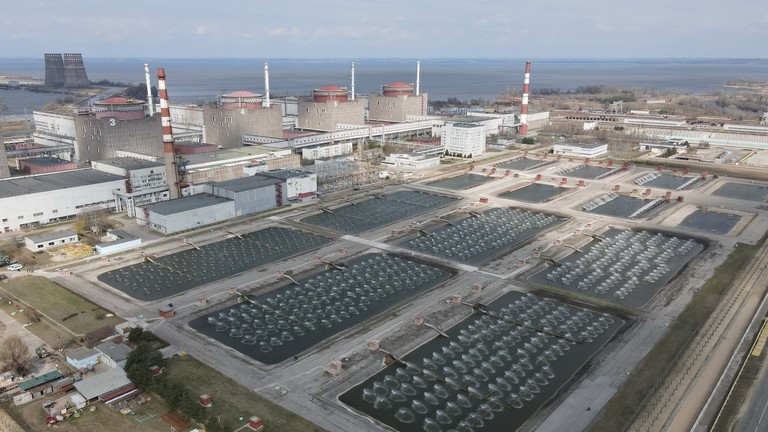
Europe’s largest atomic power station was seized by Russia from Ukraine in 2022
Guy Faulconbridge, Thursday 12 February 2026 , https://www.independent.co.uk/news/world/europe/rosatom-zaporizhzhia-plant-ukraine-russia-b2919153.html
Russia’s state nuclear corporation, Rosatom, has rejected Ukrainian accusations that it lacks the necessary equipment and components to safely operate the Soviet-built Zaporizhzhia nuclear power plant.
The claims were made by Pavlo Kovtoniuk, head of Ukraine’s state nuclear firm Energoatom, who told Reuters in Kyiv that Russia’s alleged deficiencies could lead to a nuclear accident if it attempted to restart the reactors.
Mr Kovtoniuk stated Russia lacked some equipment and spare parts to operate the plant, and risked a nuclear accident if it tried to restart the reactors.
Europe’s largest atomic power station, the facility was seized by Russia from Ukraine in 2022.
All six of its Soviet-designed VVER-1000 pressurised water reactors are currently in a “cold shutdown” state.
The plant’s future remains a critical point of contention in ongoing peace negotiations between Moscow and Kyiv, with both nations vying for control.
“Rosatom categorically rejects claims that Russia lacks the equipment and components required to ensure the safe operation of the Zaporozhskaya Nuclear Power Plant,” Rosatom said in a statement to Reuters in English when asked about the remarks.
“Russia operates one of the world’s largest nuclear fleets, including VVER-1000 units identical to those installed at Zaporozhskaya NPP, and has full capacity to produce equipment, components and nuclear fuel.”
Rosatom, ranked as one of the world’s biggest nuclear corporations in terms of nuclear construction, enrichment services and mining, said that the key issue affecting nuclear safety at the plant was continued shelling in the area.
Ukraine’s Kovtoniuk argued that control equipment and monitoring systems at the plant were Ukrainian, that Russia would have to replace US fuel in the reactors, and that there was not enough water to cool the reactors if restarted.
“Insinuations implying that the plant’s systems are incompatible with Russian fuel are technically unfounded,” Rosatom said, adding that in late 2025, reactor No. 1 received a 10-year operating licence from Russia’s nuclear safety authority, Rostechnadzor.
Rosatom said the plant’s cooling system had never depended exclusively on the Kakhovka reservoir, adding that the cooling pond used a closed-loop system and had sufficient water.
Bad Beginnings: The End of New START
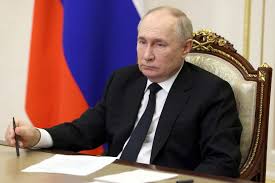
Putin was also of the opinion that “a complete renunciation of New START’s legacy would, from many points, be a grave and short-sighted mistake”, having “adverse implications for the objectives of the [Nuclear Non-Proliferation Treaty].
11 February 2026 Dr Binoy Kampmark, AIM,
Future of How awful could it get? The New Strategic Arms Reduction Treaty (New START) expired on February 5, terminating an era of arms control and imposed limits on lunatically contrived nuclear weapons programs of the United States and Russia. The New START Treaty entered into force on February 5, 2011 and initially imposed a timeline of seven years for the parties to meet the central limits on strategic offensive arms. Those limits would then be maintained for the duration of the Treaty.
Till its expiry, the countries maintained limits on the following nuclear arms and systems: 700 deployed intercontinental ballistic missiles (ICBMs), deployed submarine-launched ballistic missiles (SLBMs), and deployed heavy bombers capable of using nuclear armaments; 1,550 nuclear warheads on all three deployed platforms; and 800 deployed and non-deployed nuclear capable systems (ICBM launchers, SLBM launchers, and nuclear capable heavy bombers).
Such limits were hardly laudatory, or even exceptional. The cap of 1,550 nuclear warheads is the sort of thing that would only impress the limited crazed circle that passes for arms negotiators in this field, and the various thanocrats who populate such institutes as RAND. Such a show is merely intended for both Moscow and Washington to tell other countries with, or without nuclear weapons, that they could impose restraints on their own gluttonous conduct. Even then, New START, as with all such instruments dealing with limiting nuclear weapons, came with the intended, gaping lacunae. It failed to cover, for instance, tactical nuclear weapons, nor limit the deployment of new strategic weapon systems.
The treaty also fell into neglect with the outbreak of the COVID-19 pandemic. Suspended on-site inspections never resumed after 2022. As François Diaz-Maurin of the Bulletin of the Atomic Scientists points out, “Russia has not shared data on its deployed strategic nuclear forces since September 2022, it suspended its treaty participation altogether in February 2023, and the United States has not published any aggregate numbers since May 2023.” New START came to increasingly look like a gentleman’s agreement being sniffed at by truculent adolescents.
In September last year, Russian President Vladimir Putin dangled the prospect of extending the treaty’s core limits for a year. At a September 22, 2025 Russian Security Council Meeting, he promised that Moscow was “prepared to continue observing the … central quantitative restrictions” stipulated in New START for twelve months provided the US acted “in similar spirit.” Following the year’s extension, “a careful assessment of the situation [and] a definite decision on whether to uphold these voluntary self-limitations” would be made. Putin was also of the opinion that “a complete renunciation of New START’s legacy would, from many points, be a grave and short-sighted mistake”, having “adverse implications for the objectives of the [Nuclear Non-Proliferation Treaty].
When word of this reached the White House, Press Secretary Karoline Leavitt expressed the view that the proposal sounded “pretty good.” Two weeks later, President Donald Trump responded to a question posed by a TASS reporter that Putin’s proposal sounded “pretty like a good idea to me.” Little, however, was subsequently done. Indeed, Trump has cut the number of diplomats tasked with nuclear matters in the State Department and made public statements last October that nuclear testing might be resumed. He has also complicated arms control matters by insisting that China be added to the limitation talks, something Beijing has shown little interest in doing. In January this year, the president seemed unfussed that the international document was about to pass into the archives of diplomatic oblivion. “If it expires, it expires. We’ll do a better agreement.”
The US political establishment had been struck by a distinct lack of interest, even lethargy, on the subject. New START seemed to be yet another irritating fetter on an administration more enthused by ignoring international obligations than following them. Only a clutch of Democrats seemed to show concern in reflecting about what would follow the treaty’s expiration in House speeches given on January 14. This month, Massachusetts Democrat Sen. Ed Markey, co-chair of the Senate’s Nuclear Weapons and Arms Control Working Group, held a press conference urging the Trump administration to renew the vows of fidelity to arms control agreements. “Let’s be honest. America needs another nuclear weapon about as much as Donald Trump deserves a Nobel Peace Prize.”………………………………………………………..
The two powers most responsible for keeping nuclear weapons unforgivably attractive to those who would acquire them show promise of blotting their copybook further. There is a serious sentiment in Washington that the nuclear stockpile will and should grow. The Bulletin of Atomic Scientists, in a fit of gloominess, moved its metaphorical Doomsday Clock just that bit closer to “midnight,” the point where biblical calamity will be assured. It now stands at 85 seconds to midnight. Not long to go now. https://theaimn.net/bad-beginnings-the-end-of-new-start/
Russia says will act responsibly despite New START nuclear treaty expiry

Both Beijing and Moscow expressed their regret at the lapse of the last Russia-US nuclear arms control treaty.
By News Agencies 5 Feb 2026, https://www.aljazeera.com/news/2026/2/5/russia-says-will-act-responsibly-despite-new-start-nuclear-treaty-expiry
The Kremlin says Russia will continue to be a responsible nuclear power, despite the expiry of the last nuclear arms control treaty between Moscow and Washington, which experts say risks ushering in a new global arms race.
The New START treaty expires on Thursday, marking the end of more than half a century of limits on the United States and Russia’s strategic nuclear weapons.
“Today the day will end, and it [the treaty] will cease to have any effect,” Kremlin spokesperson Dmitry Peskov told reporters on Thursday. Arms control experts had previously said their assumption was that it expired at the end of Wednesday.
Russia had suggested both sides voluntarily extend the terms of the agreement for one year to provide time to discuss a successor treaty, a proposal which it said US President Donald Trump had never formally answered.
“The agreement is coming to an end. We view this negatively and express our regret,” said Peskov, who said the matter had come up in a call between Russian President Vladimir Putin and Chinese President Xi Jinping a day earlier.
“What happens next depends on how events unfold. In any case, the Russian Federation will maintain its responsible and attentive approach to the issue of strategic stability in the field of nuclear weapons and, of course, as always, will be guided first and foremost by its national interests.”
New START, first signed in Prague in 2010 by then presidents Barack Obama and Dmitry Medvedev, limited each side’s nuclear arsenal to 1,550 deployed strategic warheads – a reduction of nearly 30 percent from the previous limit set in 2002.
Deployed weapons or warheads are those in active service and available for rapid use as opposed to those in storage or awaiting dismantlement.
It also allowed each side to conduct on-site inspections of the other’s nuclear arsenal, although these were suspended during the COVID-19 pandemic and have not resumed since.
‘China will not participate in disarmament negotiations’
China’s Ministry of Foreign Affairs joined a growing international chorus expressing regret over the treaty’s expiry.
“China regrets the expiration of the New START treaty, as the treaty is of great significance to maintaining global strategic stability,” Chinese Foreign Ministry spokesperson Lin Jian said on Thursday.
“The international community is generally concerned that the expiration of the treaty will have a negative impact on the international nuclear arms control system and the global nuclear order.”
Trump has said he wants a better deal that will also bring in China. But Beijing refuses to negotiate with the other two countries because it has only a fraction of their warhead numbers – an estimated 600, compared with about 4,000 each for Russia and the US.
Lin reiterated this point, adding that China would not be joining the bilateral arms‑reduction talks.
“China’s nuclear forces are not on the same level as those of the United States and Russia, and China will not participate in disarmament negotiations at this stage,” Lin said.
Russia and the US together control more than 80 percent of the world’s nuclear warheads.
China’s nuclear arsenal, however, is growing faster than any country’s, by about 100 new warheads a year since 2023, according to the Stockholm International Peace Research Institute (SIPRI).
China is estimated to have at least 600 nuclear warheads, SIPRI says – well below the 800 each at which Russia and the US were capped under New START.
The White House said this week that Trump would decide the way forward on nuclear arms control, which he would “clarify on his own timeline”.
A NATO official, speaking on condition of anonymity, called on the US and Russia to act with “responsibility and restraint” to maintain “global security”.
The official added that Russia and China were both ramping up their nuclear capabilities and that NATO “will continue to take steps necessary” to ensure its own defences.
Sorrowful day for peace largely ignored thruout America

Walt Zlotow West Suburban Peace Coalition Glen Ellyn IL, 7 Feb 26
The New Start Treaty between Russia and US expires today and America largely yawned. Big story on mainstream news? Faggedaboudit. Ask the person on the street about New Start and he might mutter something about giving disadvantaged kids free comprehensive early childhood education. Wait, wait…that’s Head Start.
Nope, New Start is the 16 year old treaty Obama signed with Russian President Dmitry Medvedev on February 8, 2010. It caps the number of nuclear warheads each side can deploy at 1,550 and limits the number of deployed and non-deployed strategic launchers to 800. Still enough for either side to incinerate us all, but prevents a senseless arms race and symbolic of the critical need to reduce nuclear tensions.
But limited US Russian nuclear arsenals go back 54 years as 2010 Russian New Start signer Medvedev reminded us yesterday. “That’s it. For the first time since 1972, Russia (the former USSR) and the US have no treaty limiting strategic nuclear forces. SALT 1, SALT 2, START I, START II, SORT, New START – All in the past, winter is coming.”
President Trump rebuffed Russian President Putin’s offer to extend the limits for another year for sensible diplomacy to negotiate a new treaty.
Secretary of State Marco Rubio used the lame excuse that any new treaty must include China. But with a nuclear arsenal a pittance of the two nuclear giants, China demurred saying any treaty involving China must include US Russian nuclear stockpiles reduced to China’s level. Rubio knew his requirement was a poison pill deal breaker for any new extension of New Start.
Dumping nuclear agreements is nothing new for Trump. He left office in January 20, 2021 ignoring New Start’s eminent expiration. Successor Biden promptly renewed New Start for 5 years, exactly 5 years ago today. This time Trump has succeeded in letting it expire on his watch.
This gives Trump a trifecta in dumping critically needed nuclear agreements. In August 2019 Trump withdrew from the Intermediate Range Nuclear Forces (INF) Treaty that banned all land-based missiles with ranges between 500 and 5,500 km. . In November 2020, just before leaving office, Trump withdrew from the 2002 Open Skies Treaty which allowed the US and Russia to conduct short-notice, unarmed reconnaissance flights over each other’s territory to monitor military activities.
The only positive glimmer to put on Trump’s refusal to extend New Start, even for a measly year to negotiate a long term agreement? Trump has no more nuclear agreements to withdraw from in the last sorrowful 3 years of his second term.
This January the Bulletin of Atomic Scientists moved the Doomsday Clock, symbolic of approaching global catastrophe, to 85 seconds to Midnight, the closest in its 79 year history. With Trump president, the Bulletin might want to quickly reconvene for another gander at our march toward world annihilation. Next January, none of us might around to hear the 2027 announcement.
US and Russia negotiating New START deal – Axios.
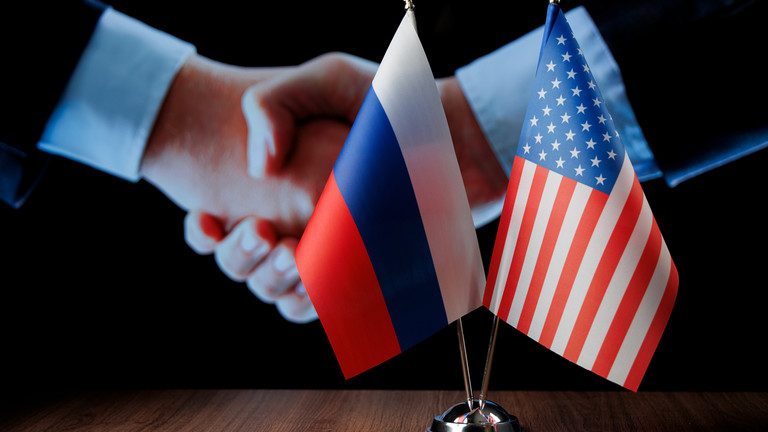
The issue was reportedly discussed on the sidelines of the Ukraine peace talks in Abu Dhabi
5 Feb, 2026 , https://www.rt.com/news/632065-us-russia-negotiate-new-start/
Moscow and Washington are working on a deal to continue the New START nuclear reduction treaty, Axios reported on Thursday, citing three sources familiar with the issue. The strategic arms control agreement officially expired on February 5.
Signed in 2010, the treaty put caps on the number of strategic nuclear warheads and launchers that can be deployed and establishes monitoring mechanisms for both Russian and American arsenals. It was initially set to expire in 2021 but was extended for five years at the time.
According to Axios, President Donald Trump’s son-in-law Jared Kushner and special envoy Steve Witkoff discussed the issue with the Russian delegation on the sidelines of the Ukraine peace talks in Abu Dhabi. “We agreed with Russia to operate in good faith and to start a discussion about ways it could be updated,” a US official told the media outlet. Another source claimed that the sides had agreed to observe the treaty’s terms for at least six months as the talks on a potential new deal would be ongoing.
Earlier on Thursday, Kremlin spokesman Dmitry Peskov said that Moscow suggested sticking to the treaty’s provisions for another year but its initiative “remained unanswered.” Russia will “keep its responsible attentive approach in the field of strategic stability [and] nuclear weapons” but will be always “primarily guided by its national interests,” he said.
The UN also called the treaty expiration “a grave moment for international peace and security.” Secretary-General Antonio Guterres warned that “the risk of a nuclear weapon being used is the highest in decades” as he urged Moscow and Washington to negotiate a successor framework.
Russian President Vladimir Putin had earlier proposed to his US counterpart Donald Trump a one-year extension of the treaty but the American president said that he wanted a “better” agreement that includes China.
On Thursday, Peskov said that China considers joining the talks on a new treaty “pointless” since its nuclear arsenal is incompatible with that of Russia and the US. “We respect this position,” the Kremlin spokesman said.
Barring last-minute nuclear deal, US and Russia teeter on brink of new arms race.

Reuters, By Mark Trevelyan and Jonathan Landay. January 30, 2026
- Summary
- New START treaty set to expire on February 5
- Trump hasn’t responded to Putin’s offer to extend missile limits
- End in sight to more than 50 years of mutual constraints
- Chinese build-up leaves US facing two big nuclear rivals
LONDON/WASHINGTON, Jan 30 (Reuters) – The United States and Russia could embark on an unrestrained nuclear arms race for the first time since the Cold War, unless they reach an eleventh-hour deal before their last remaining arms control treaty expires in less than a week.
The New START treaty is set to end on February 5. Without it, there would be no constraints on long-range nuclear arsenals for the first time since Richard Nixon and Soviet leader Leonid Brezhnev signed two historic agreements in 1972 on the first-ever trip by a U.S. president to Moscow.
Russian President Vladimir Putin has proposed the two sides should stick to existing missile and warhead limits for one more year to buy time to work out what comes next, but U.S. President Donald Trump has yet to formally respond.
Trump said this month that “if it expires, it expires”, and that the treaty should be replaced with a better one.
Some U.S. politicians argue Trump should reject Putin’s offer, freeing Washington to grow its arsenal to counter a rapid nuclear build-up by a third power: China.
Trump says he wants to pursue “denuclearisation” with both Russia and China. But Beijing says it is unreasonable to expect it to join disarmament talks with two countries whose arsenals are still far larger than its own.
WHY DO NUCLEAR TREATIES MATTER?
Since the darkest Cold War days when the United States and the Soviet Union threatened each other with “mutually assured destruction” in the event of nuclear war, both have seen arms limitation treaties as a way to prevent either a lethal misunderstanding or an economically ruinous arms race.
The treaties not only set numerical limits on missiles and warheads, they also require the sides to share information – a critical channel to “try to understand where the other side is coming from and what their concerns and drivers are”, said Darya Dolzikova at the RUSI think-tank in London.
With no new treaty, each would be forced to act according to worst-case assumptions about the weapons the other is producing, testing and deploying, said Nikolai Sokov, a former Soviet and Russian arms negotiator.
“It’s a self-sustaining kind of process. And of course, if you’ve got an unregulated arms race, things will get quite destabilising,” he said.
NEW TREATY NO SIMPLE TASK
Since the fall of the Soviet Union, Russia and the United States have repeatedly replaced and updated the Cold War-era treaties that limited the so-called strategic weapons they point at each other’s cities and bases.
The most recent, New START, was signed in 2010 by U.S. President Barack Obama and Dmitry Medvedev, a Putin ally who was then serving as Russian president for four years.
It caps the number of deployed strategic warheads at 1,550 on each side, with no more than 700 systems to deliver them from land, sea or air, by intercontinental ballistic missile, submarine-launched missile or heavy bomber.
Replacing it with a new treaty would be no simple task. Russia has developed new nuclear-capable systems – the Burevestnik cruise missile, the hypersonic Oreshnik and the Poseidon torpedo – that fall outside New START’s framework. And Trump has announced plans for a space-based “Golden Dome” missile defence system that Moscow sees as an attempt to shift the strategic balance……………………………………………………………………………………………………………………………………. https://www.reuters.com/business/aerospace-defense/barring-last-minute-nuclear-deal-us-russia-teeter-brink-new-arms-race-2026-01-30/
The secret nuclear influencer in the heart of Moscow.
Dr Eva Stegen 21st Jan 2026
Nuclear energy does not appear in any of the 19 EU sanctions packages, thanks to a key individual. Former nuclear power executive Henri Proglio has maintained several consulting offices in Moscow, the heart of Putin’s power, for the past 10 years. The former head of the state-owned Électricité de France (EdF) still sits on the international advisory board of Putin’s nuclear power conglomerate Rosatom.
Déjà vu: A wave of outrage swept through Germany when the “family business owners” tested the boundaries by extending an invitation to the AfD. The business lobby group eventually backtracked. The German “corporate families” may have been inspired by French far-right extremists who have been casting their nets into corporate boardrooms for some time. The French trial balloon was launched two years ago, a few months before the elections, and provoked a media frenzy. Marine Le Pen, the presidential candidate of the National Rally (RN), orchestrated a meeting with an extremely polarizing manager: Henri Proglio. He was one of the country’s most powerful business leaders until he was deemed inferior at the nuclear power company Électricité de France (EdF).
Critics consider the self-proclaimed Putin supporter, who calls himself a “killer ,” to be “not as successful as he would have people believe .” They claim he has “developed a system of clans, gangs, and sinecures” that promoted nuclear technology exports to crisis regions. Under his leadership (2009-2014), he forged ties with Chinese rulers, the Libyan dictator Gaddafi , the Saudi Bin Laden Group, and other dubious business partners. His mentor, Nicolas Sarkozy, was imprisoned over the Libya affair. Another key figure in this corrupt clique, the secret protector of Proglio’s career, “Monsieur Alexandre,” also received a prison sentence. Proglio’s enforcer, a former gang leader from the Parisian suburbs , knows prison from the inside. The middleman rose from the underworld to the highest circles of politics and business: “I hold them all by the balls .”……………………………………………………………………………………………………………………………………………
Proglio and the National Rally (RN) are advocating for a “Frexit,” wanting to withdraw from the EU electricity market and give preferential treatment to French companies. These ideas of European division are welcomed by the Kremlin. ………………………………
the fact that “the fuels that power our nuclear power plants largely
come from Russia” amounts to nothing less than import dependency . And this is with a high-risk technology of civil-military relevance.
“Why is the nuclear industry spared?”
Investigate Europe and Tagesspiegel asked back in 2022. Nuclear power does not appear in a single one of the (now 19) EU sanctions packages. In their joint research, they show:
“ The close connection between the French and Russian nuclear industries is exemplified not least by Henri Proglio , the former CEO of the French state-owned electricity supplier EDF, who still sits on the international advisory board of Rosatom ,” the Russian nuclear conglomerate used by Vladimir Putin as a geopolitical instrument to expand his influence in Europe.
No nuclear sanctions – thanks to import dependency and a key personnel decision
In addition to his position at Rosatom, Proglio has maintained several consulting offices in Moscow for the past ten years, profiting handsomely from Putin’s war in Ukraine and orchestrating shady deals, including in the nuclear sector. This is particularly sensitive because he is privileged to the most closely guarded secrets of France, a civilian-military nuclear power. While he can keep secrets—he even concealed the lucrative activities of companies like ‘Henri Proglio Consulting’ and ‘HP Energy Advisory’ in Moscow from the parliamentary inquiry committee—it is highly questionable whether this is always in the best interests of France or Europe.
……………………….He believes the existing reactors should be allowed to operate until a medium-power reactor (1000 MW) is developed. He himself is responsible for the sale of the intellectual property rights for precisely this technology to China. That was the death knell for the French reactor manufacturer Areva.
ts engineers were stunned when they discovered a Chinese pirated copy of their plans, developed with Japanese colleagues for a 1000 MW reactor. Proglio was behind it:
“We will build Franco-Chinese reactors. And we will also build Franco-Russian reactors.” He himself was present at the clandestine signing of far-reaching contracts , which amounted to a ticket into the heart of France’s highly sensitive nuclear infrastructure. ………………………………………………………………………………………………………………………………………………………………………………………………………..
Rosatom’s geostrategy for global dependence
According to its own statements, “Rosatom is the only company worldwide that possesses all technologies of the nuclear fuel cycle .” The nuclear giant, with its 450 arms, employs around 420,000 people and aims to establish itself as the world market leader in the entire nuclear process chain, from uranium mining through conversion, enrichment, fuel element production, reactor construction, operation, maintenance and decommissioning, to waste management…………………………………………………………………………………….https://www-eva–stegen-de.translate.goog/blog/atom-Influencer-im-herzen-moskaus.html?_x_tr_sl=de&_x_tr_tl=en&_x_tr_hl=de&_x_tr_pto=wapp
This country wants to build a nuclear power plant on the moon.
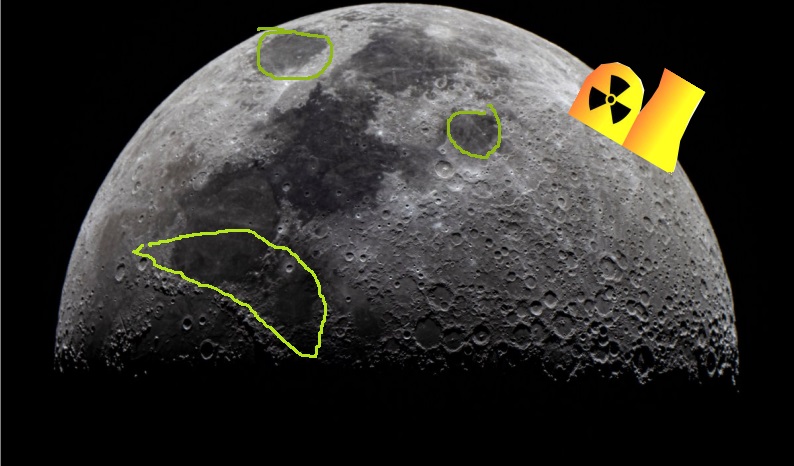
The project aims to supply energy for its lunar space programme
Guy Faulconbridge, Tuesday 20 January 2026, https://www.independent.co.uk/space/russia-china-space-race-moon-nuclear-b2904029.html
Russia is reportedly planning to establish a nuclear power plant on the moon within the next decade.
This ambitious project aims to supply energy for its lunar space programme and a joint research station with China, as global powers intensify their efforts in lunar exploration.
Historically, Russia has held a prominent position in space, notably with Yuri Gagarin’s pioneering journey in 1961.
However, its dominance has waned in recent decades, with the nation now trailing behind the United States and, increasingly, China.
The country’s lunar aspirations faced a significant setback in August 2023 when its uncrewed Luna-25 mission crashed during a landing attempt.
Furthermore, the landscape of space launches, once a Russian speciality, has been revolutionised by figures such as Elon Musk, adding to the competitive pressure.
Russia’s state space corporation, Roscosmos, said in a statement that it planned to build a lunar power plant by 2036 and signed a contract with the Lavochkin Association aerospace company to do it.
Roscosmos said the purpose of the plant was to power Russia’s lunar programme, including rovers, an observatory and the infrastructure of the joint Russian-Chinese International Lunar Research Station.
“The project is an important step towards the creation of a permanently functioning scientific lunar station and the transition from one-time missions to a long-term lunar exploration program,” Roscosmos said.
Roscosmos did not say explicitly that the plant would be nuclear but it said the participants included Russian state nuclear corporation Rosatom and the Kurchatov Institute, Russia’s leading nuclear research institute.
The head of Roscosmos, Dmitry Bakanov, said in June that one of the corporation’s aims was to put a nuclear power plant on the moon and to explore Venus, known as Earth’s “sister” planet.
The moon, which is 384,400 km (238,855 miles) from our planet, moderates Earth’s wobble on its axis, which ensures a more stable climate. It also causes tides in the world’s oceans.
Russia says it awaits US response on ‘important’ issue of expiring nuclear treaty
By Dmitry Antonov, January 15, 2026, Reporting by Dmitry Antonov Writing by Mark Trevelyan and Andrew Osborn Editing by Andrew Osborn, https://www.reuters.com/world/europe/russia-says-it-awaits-us-response-important-issue-expiring-nuclear-treaty-2026-01-15/
MOSCOW, Jan 15 (Reuters) – Russia is still waiting for the United States to respond to President Vladimir Putin’s proposal to informally extend for a year the provisions of the last remaining nuclear arms pact between the two countries, the Kremlin said on Thursday.
The New START treaty is due to expire in three weeks, and President Donald Trump has not formally responded to the offer that Putin made last September.
The Reuters Daily Briefing newsletter provides all the news you need to start your day. Sign up here.
“No, we have not received a response. We are certainly awaiting a response to Putin’s initiative; we consider this a very important topic,” Kremlin spokesman Dmitry Peskov told reporters.
New START, which was signed by presidents Barack Obama and Dmitry Medvedev in 2010, sets limits on the strategic weapons that each side would use to target the other’s critical political and military centres in the event of a nuclear war. It caps the number of deployed strategic warheads at 1,550 on each side, with no more than 700 deployed ground- or submarine-launched missiles and bomber planes to deliver them.
It is the last in a series of treaties dating back to the early 1970s that have enabled Moscow and Washington to maintain a stable nuclear balance even at times of acute international tension.
Trump told the New York Times this month that “if it expires, it expires”, and that he wanted to replace it with a more ambitious treaty including China.
China, whose arsenal is growing fast but remains a fraction of the size of Moscow’s or Washington’s, says it is unreasonable and unrealistic to ask it to join three-way disarmament talks.
Asked about Trump’s comments on a successor treaty, Peskov said this would be good for everyone but would involve a “very complex and drawn-out process”.
“As for our Chinese friends, their position is well known, and we respect it.”
Peskov reasserted Russia’s position that any discussion of strategic stability and security must take into account the nuclear arsenals of Britain and France.
1 This Month

of the week – Shut Down Drone Warfare!


Tell the Ukrainian Government to Drop Prosecution of Peace Activist Yurii Sheliazhenko

Petition to revoke the licensing of the Near Surface Nuclear Disposal Facility (NSDF) at Chalk River. https://www.ourcommons.ca/petitions/en/Petition/Details?Petition=e-7247
To see nuclear-related stories in greater depth and intensity – go to https://nuclearinformation.wordpress.com
-
Archives
- April 2026 (57)
- March 2026 (251)
- February 2026 (268)
- January 2026 (308)
- December 2025 (358)
- November 2025 (359)
- October 2025 (376)
- September 2025 (257)
- August 2025 (319)
- July 2025 (230)
- June 2025 (348)
- May 2025 (261)
-
Categories
- 1
- 1 NUCLEAR ISSUES
- business and costs
- climate change
- culture and arts
- ENERGY
- environment
- health
- history
- indigenous issues
- Legal
- marketing of nuclear
- media
- opposition to nuclear
- PERSONAL STORIES
- politics
- politics international
- Religion and ethics
- safety
- secrets,lies and civil liberties
- spinbuster
- technology
- Uranium
- wastes
- weapons and war
- Women
- 2 WORLD
- ACTION
- AFRICA
- Atrocities
- AUSTRALIA
- Christina's notes
- Christina's themes
- culture and arts
- Events
- Fuk 2022
- Fuk 2023
- Fukushima 2017
- Fukushima 2018
- fukushima 2019
- Fukushima 2020
- Fukushima 2021
- general
- global warming
- Humour (God we need it)
- Nuclear
- RARE EARTHS
- Reference
- resources – print
- Resources -audiovicual
- Weekly Newsletter
- World
- World Nuclear
- YouTube
-
RSS
Entries RSS
Comments RSS
 nuclear-news