Kremlin blasts US move to militarize space
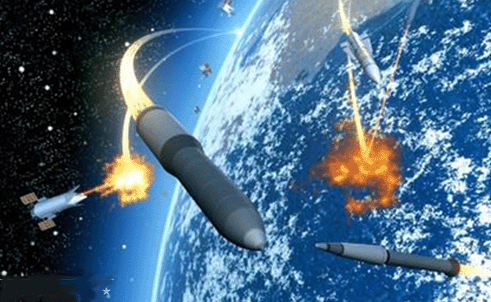
“We believe that space should be free from any weapons. And certainly we count on broad international consolidation… to continue efforts for the full demilitarization of space,”
Moscow believes Washington’s deployment of an orbital weapons system is taking the world in the wrong direction
15 Sep 26,https://www.rt.com/russia/645760-kremlin-us-space-weapons/
Weapons should not be deployed in space, Kremlin spokesman Dmitry Peskov has said, responding to the Pentagon’s announcement that the US has placed a weapons system in orbit.
US Secretary of the Air Force Troy Meink disclosed the deployment on Monday, saying the US Space Force “now has on-orbit space control weapons capable of defending the joint force against hostile adversary action,” without providing details about the system. Media reports have suggested that it is intended to disable or destroy hostile satellites.
“We believe that space should be free from any weapons. And certainly we count on broad international consolidation… to continue efforts for the full demilitarization of space,” Peskov told journalists on Tuesday during a regular briefing.
The Pentagon has a long history of using orbital systems for military purposes, specifically intelligence gathering, navigation and communications. Some US military concepts, however, have also envisioned systems potentially capable of conducting strikes from space. During the Cold War, for example, the Soviet Union viewed the Space Shuttle as a potential platform for delivering a rapid nuclear strike.
Countries regarded by Washington as strategic rivals, including Russia and China, have reportedly developed anti-satellite capabilities that could deny the US the advantage in space during a direct conflict. The use of such weapons, however, could produce significant unintended consequences.
The so-called Kessler effect describes a scenario in which collisions generate increasing amounts of orbital debris, triggering further collisions and potentially making low Earth orbits unusable for an extended period.
Russia has long called for stronger international agreements restricting the military use of space. While the Outer Space Treaty prohibits the deployment of weapons of mass destruction in orbit, Moscow has argued that conventional weapons should also be banned.
In June, Israeli Defense Minister Israel Katz announced that his country was developing a space-based anti-satellite laser system and aimed to become “the leading country in the world with this capability.”
Rosatom chief, UN nuclear watchdog director general discuss Zaporizhzhia nuclear plant’s safety in Vienna
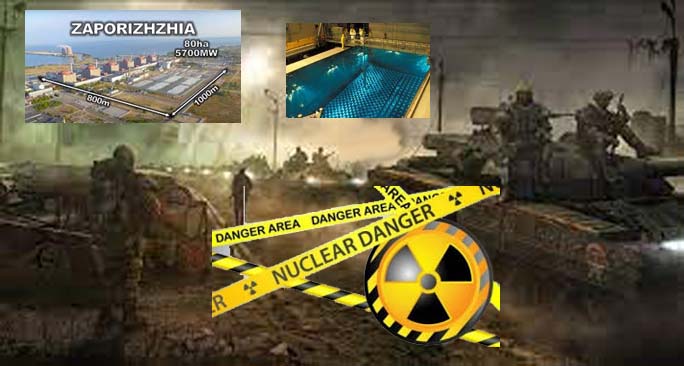
Russian nuclear state corporation Rosatom says officials focused on recent strikes on fuel trucks carrying supplies for Zaporizhzhia plant
Elena Teslova, 15 September 2026, https://www.aa.com.tr/en/world/rosatom-chief-un-nuclear-watchdog-director-general-discuss-zaporizhzhia-nuclear-plant-s-safety-in-vienna/4057265
The head of Russian nuclear state corporation Rosatom and the director general of the International Atomic Energy Agency (IAEA) discussed the safety of the Zaporizhzhia Nuclear Power Plant in Ukraine at a meeting in Vienna, Rosatom said Monday.
The talks between Alexey Likhachev and Rafael Grossi took place on the sidelines of the IAEA General Conference, said Rosatom’s press service.
Likhachev told Grossi that the situation at the plant and in the nearby Ukrainian city of Enerhodar has sharply deteriorated since late April, according to Rosatom.
More than 750 attacks involving Ukrainian drones and artillery have been carried out over the past four and a half months, killing 20 people, including nine Zaporizhzhia plant employees, and injuring more than 100, it said.
“The two officials paid particular attention to recent strikes on fuel trucks carrying supplies for the plant,” it noted.
Likhachev stressed that the trucks were delivering diesel fuel that is urgently needed to ensure the nuclear safety of the plant.
Grossi, for his part, said the IAEA was ready to explore ways it could assist with similar fuel deliveries, according to Rosatom.
He also reaffirmed his commitment to working with Russia on ensuring the safety of the Zaporizhzhia plant and his readiness to continue dialogue on the issue.
Moscow reveals potential timeline for trilateral Ukraine talks

Negotiations between Russian, Ukrainian, and US representatives could begin in October, Kremlin spokesman Dmitry Peskov has said
13 Sep, 2026, https://www.rt.com/russia/645646-moscow-reveals-potential-timeline-trilateral-ukraine-talks/
Trilateral talks between Russian, Ukrainian, and US representatives could begin in October, Kremlin spokesman Dmitry Peskov has said.
Speaking to reporters on Sunday, the official stated that Moscow “does not rule out such a possibility.”
“We’re specifically talking about the foreseeable future. That is, presumably of course, October,” Peskov clarified.
Earlier this week, the Kremlin spokesman stated that Moscow hopes “for a restart of negotiations between three parties – Russia, Ukraine, and America.”
The trilateral format was last used in Geneva in February, following two earlier rounds in Abu Dhabi. However, the talks later stalled without any significant breakthroughs, as the US shifted its focus to its war against Iran.
Peskov’s recent comments have followed a fresh round of shuttle diplomacy by US President Donald Trump’s special envoys Steve Witkoff and Jared Kushner, who held a meeting with Russian President Vladimir Putin in Moscow last week before visiting Kiev for talks with Vladimir Zelensky.
The Kremlin described the discussions with the US negotiators as constructive and “extremely candid,” while Witkoff said that progress had been made toward scheduling a three-way meeting. The potential resumption of talks in this format was also among the topics Putin and Trump discussed by phone on Tuesday, according to Kremlin aide Yury Ushakov.
At around the same time, Zelensky suggested that the next round of trilateral negotiations could take place in the UAE, Türkiye, Switzerland, or another country as early as September or October.
Moscow has repeatedly said it remains open to diplomacy, as long as the root causes of the conflict are addressed and the new realities on the ground are respected. Ukraine has in turn ruled out making territorial concessions to Russia.
Erdogan hints at larger nuclear partnership with Russia, unsettling Turkey’s allies
rfi, 12/09/2026
Turkish President Recep Tayyip Erdogan is signalling a move to expand nuclear power cooperation with Russia, just as his country’s first Russian-built nuclear station prepares to go live later this year. The deepening partnership is likely to unsettle Turkey’s western allies.
On the sidelines of a recent gathering of regional leaders in Kyrgyzstan, Erdogan told his Russian counterpart, Vladimir Putin, that Russia and Turkey “will take steps together to open some new power plants, along with the opening of the Akkuyu nuclear power plant”.
The Akkuyu nuclear power plant, built by Russia’s state nuclear company Rosatom on Turkey’s Mediterranean coast, is due to go online later this year.
Erdogan’s announcement comes amid strained ties with Russia, as the Turkish leader has deepened relations with United States President Donald Trump.
Ozgur Unluhisarcikli, head of the Ankara office of US think tank the German Marshall Fund, describes Erdogan’s move as a “gesture” to Putin.
“Although Turkey is competing with Russia geopolitically, and although Turkey is firmly anchored in NATO and is improving its relationship with the United States, it does not intend to sever all ties with Russia,” Unluhisarcikli explained.
“Indeed, Turkey sees the Turkey-Russia relationship as a long-term strategic one. And this is, by the way, consistent with Turkey’s balancing act.”………………………………………………………………………………… https://www.rfi.fr/en/podcasts/international-report/20260912-erdogan-hints-at-larger-nuclear-partnership-with-russia-unsettling-turkey-s-allies
Putin boosts his stock of nuclear warheads to nine-year high as he threatens West that putting troops into Ukraine ‘means war with Russia’.
Daily Mail, By WILL STEWART and WILL HALLOWELL, NEWS REPORTER, 12 September 2026
Vladimir Putin has boosted the number of nuclear warheads in his arsenal as he warns Nato countries that sending troops to Ukraine ‘means war’.
Over the past year, Russia has increased its stock of nuclear warheads deployed on missiles and bombers by 78 to 1,796, marking a nine-year high, according to the Stockholm International Peace Research Institute.
Mr Putin has increased the number every year since the beginning of the war with Ukraine in 2022.
But the US saw no rise and Britain and France did not deploy additional warheads, with 170 and 280 respectively.
Mr Putin, however, denied that Russia posed a threat to Nato allies in Europe and then warned of war.
Speaking at the BRICS summit in New Delhi, he said: ‘Now they [the West] are talking about how they are thinking about bringing troops to the territory of Ukraine. This means war with Russia.’
His threat coincides with former Russian president Dmitry Medvedev’s warning that Mr Putin could use nuclear weapons to turn Nato state Lithuania into ‘scorched earth’ and remove it from the ‘world map’.
Mr Putin, who once claimed he had no aggressive intentions against Ukraine, said he had no plan to invade or threaten existing Nato states in Europe.
He said: ‘There is no such threat, and there has never been. We are not threatening European countries, nor are we going to threaten them. Why would we?
‘No one seems to even consider that we have no grounds for any conflict with Europe.’
Yet Mr Medvedev, Mr Putin’s number two on the Russian Security Council, said the deployment of nuclear weapons in Lithuania, a former part of the Soviet Union, could trigger a doomsday response from the president.
He said: ‘They would like to amend their constitution, which stated the non-nuclear nature of this large Baltic state, and thus open the door to the possible deployment of any weapons, including nuclear weapons.
‘No one will stand up for them. Even if it becomes a scorched earth, no other [Western] countries will go to war for them.
‘And the well-known Article 5 of the North Atlantic Treaty will not be implemented, everyone recognises this……………………https://www.dailymail.com/news/article-16125435/Putin-boosts-nuclear-warheads-nine-year-high.html
Does Britain really face an imminent Russian threat?
By Anatol Lieven, 8 Sept 26, . https://unherd.com/newsroom/does-britain-really-face-an-imminent-russian-threat/
Diane Abbott has been subjected to ferocious attacks on her character for claiming on Wednesday that “the imminent threat from Russia is a Nato fiction.” The Labour MP added that the alliance was attempting “to justify their complete capitulation to Trump’s demands for more military spending. The increase should not go ahead.” Conservative Party leader Kemi Badenoch branded the comments “reprehensible”, while another Tory, Ben Obese-Jecty, labelled Abbott “Putin’s useful idiot”. The Hackney North and Stoke Newington MP even received criticism from her own Labour colleagues.
Many of the responses to Abbott are little more than attempts to shut down public debate on a question of vast importance to the United Kingdom. However, it is also true that she would have been much closer to the facts had she emphasised one word and added another: “The imminent conventional threat from Russia is a Nato fiction.”
Put like this, the argument is persuasive. Any suggestion of a Russian invasion or sustained air campaign in Western Europe is absurd. The Russian military and air force are already occupied with a grinding war in Ukraine: where is Moscow supposed to find a new army with which to attack Nato? How would the Kremlin pay for the resulting war when Nato has practically shut down Russia’s maritime trade?
Had she phrased her statement in these terms, Abbott would have been close to what sensible Nato figures and analysts have been saying. In June, the American Supreme Allied Commander in Europe (SACEUR), General Alexus Grynkewich, said that “Russia is not looking for a conflict […] They do understand the term ‘defensive alliance’, and they do understand that we have a number of asymmetric advantages.” Really, Russia’s threats have been intended to deter a direct war with Nato in Ukraine, not to start one.
Russian-organized hybrid attacks in Europe and Britain are a much more realistic danger, one which Abbott should have mentioned. Moscow has engaged in cyber warfare, as well allegedly organizing arson attacks and the sabotage of railway lines and undersea cables. Last month, explosive drones were discovered close to Ukrainian planes with military supplies at Leipzig/Halle Airport in Germany.
So far, however, the effects have been small, suggesting that Russia’s campaign has been either highly incompetent or deliberately restrained. If the latter, this is presumably because the Kremlin still wants to maintain some element of plausible deniability, and because these attacks are meant to be warnings rather than attempts to do serious damage and cause casualties.
Russian Foreign Ministry spokeswoman Maria Zakharova has threatened that “the response to Ukrainian strikes using British missiles on Russian territory may become [attacks on] any military sites and equipment of Britain in Ukraine, or beyond its borders.” This would mean making Russian hybrid attacks overt — a strategy Vladimir Putin has thus far avoided, both because of the risk of a radical increase in Western help to Ukraine, and perhaps because his instincts as a former intelligence officer are more geared towards covert operations.
In war, accidents happen. On the first day of the American-Israeli war on Iran, the US unintentionally destroyed an Iranian elementary school, killing 120 children. In 1988, American forces mistakenly shot down an Iranian airliner, killing 290 people. Russian contacts assure me that if a British missile were to destroy a school or an airliner in Russia, a direct response against the UK would be unavoidable.
At present, though, a direct threat from Russia to Britain is far from imminent. What is needed is a realistic public debate about the escalation of British support for Ukraine and its possible consequences, and a serious negotiating strategy rather than one that sabotages US initiatives. Support for Ukraine is legitimate, but it is the interests and security of the British people that ministers should be prioritizing. https://unherd.com/newsroom/does-britain-really-face-an-imminent-russian-threat/
Anatol Lieven is a former war correspondent and Director of the Eurasia Program at the Quincy Institute for Responsible Statecraft in Washington DC.
Norway seizes Russian research ship in Arctic waters at Kiev’s request
Signs of the Times, 3 Sept 26
The Professor Molchanov, which was carrying scientists, passengers and vital supplies, was seized in Svalbard as Ukraine’s Naftogaz pursues Russian assets.
Norway has seized a Russian research vessel in Svalbard at the request of Kiev, prompting Russian President Vladimir Putin to denounce the capture of civilian vessels as “state terrorism.”
The vessel, called the Professor Molchanov, was detained while docked in Barentsburg, a Russian-operated settlement on the Norwegian-administered Arctic archipelago. The ship has been barred from leaving after a local court granted a request by Ukraine’s state-owned energy company Naftogaz.
Moscow has since summoned Norway’s ambassador in protest and vowed to challenge the seizure.
Why was a Russian state vessel in Norway in the first place, why does Kiev want it, and what could happen to the ship now?
What exactly happened
The Professor Molchanov arrived in Barentsburg on Tuesday on a scheduled voyage from Murmansk carrying scientists, passengers and supplies for the Russian settlements on the Norwegian-administered Arctic archipelago of Svalbard.
Norwegian officials first boarded the vessel for what Svalbard Governor Lars Fause described as an ordinary border and customs inspection, of a kind the ship had undergone numerous times before.
On Wednesday, Norwegian police, accompanied by an interpreter, boarded the ship again and read a court order to its captain, barring the vessel from leaving. Nobody aboard was arrested.
The order was issued on August 31 by the Nord-Troms and Senja District Court after an application from Ukraine’s Naftogaz.
What happened to the passengers and crew
The exact number of people on board when the ship arrived in Barentsburg has not been officially confirmed. The Professor Molchanov can accommodate up to 80 people, including at least 20 crew members and as many as 60 scientists and other expedition personnel.
Norwegian media have reported that around 50 passengers and crew were affected by the seizure………………………………………………
The Professor Molchanov
The ship, named after renowned Soviet meteorologist Pavel Molchanov, is a Russian state-owned, ice-strengthened research vessel with more than four decades of experience operating in polar waters.
Built in Finland for the Soviet hydrometeorological service and launched in late 1982, the 71-meter-long ship was designed for Arctic oceanographic and weather research. It carries four laboratories on board and can accommodate dozens of researchers alongside its crew.
The ship continues to be actively used in Arctic research, including studies of weather, marine ecosystems, microbiology, biodiversity and environmental conditions in the Barents and Kara seas…………………..
Why is goes to Svalbard
The voyage to Svalbard was part of a regular route between Murmansk and Barentsburg, a Russian mining settlement where the state-owned Arktikugol trust has operated for decades.
Since 2025, the Professor Molchanov has carried scientists, Arktikugol employees, contractors, family members and supplies to Barentsburg and another Russian settlement called Pyramida. Ten round trips were planned for 2026………………………………………………………………………………………………………………………………………………………………………………………. https://www.sott.net/article/508230-Piracy-Norway-seizes-Russian-research-ship-in-Arctic-waters-at-Kievs-request
Putin says Ukraine peace deal is possible, calls for full restoration of U.S.-Russia relations
[your]NEWS, Thu, 03 Sep 2026
Russian President Vladimir Putin said Thursday that Moscow sees “a chance” for peace with Ukraine and wants to restore full relations with the United States, citing continued contacts with Washington and ongoing communication between Russian and Ukrainian intelligence services.
Russian President Vladimir Putin said Thursday that there is “a chance” to reach a peace agreement with Ukraine and signaled that Moscow also wants to rebuild its relationship with the United States after years of confrontation.
Speaking Sept. 3 during a session of the Eastern Economic Forum in Vladivostok, Putin said Russia remains appreciative of international efforts aimed at ending the war but maintained that Moscow and Kyiv must ultimately reach an agreement directly.
Moscow is “grateful to everyone who is trying to contribute to resolving this issue,” Putin said, adding that in his view there is “a chance” of achieving peace, according to Russian state news agency TASS. For the fighting to end, Putin said, “Russia and Ukraine must first reach an agreement” between themselves.
He acknowledged that “all other countries are ready to support and assist” the two sides in reaching such an agreement.
Despite the continuing war, Putin revealed that Moscow and Kyiv have maintained lines of communication through their respective intelligence services.
He said it was difficult to determine “to what extent these contacts are leading to a peace agreement,” but confirmed that communication between the two governments has not completely ceased.
Putin also used his remarks in Vladivostok to address the future of relations between Russia and the United States.
He confirmed that Moscow remains in contact with Washington and said he hopes those channels remain open.
The Russian president pointed to cooperation involving U.S. and Russian intelligence services as well as officials appointed by President Donald Trump, saying the process is “working” and expressing hope that it will “ultimately lead to a positive outcome.”
Putin said Russia wants a broader normalization of relations with Washington.
Moscow is “in favor of restoring relations with the United States in full, but this does not depend solely on us; it depends on the American side,” he said.
Putin nevertheless indicated that he believes Trump is personally interested in improving ties. He said Trump is “determined to engage in such positive, constructive work.”
Putin’s comments came one day after Trump said any future face-to-face meeting between the two leaders should take place in connection with an actual peace agreement.……………………………………………………………………………………………………………………………….
During an Aug. 24 Independence Day speech in Kyiv, Zelenskyy said Ukraine wants peace but would not capitulate.
Those positions remain at the center of the diplomatic challenge.
Putin says Moscow sees a possible route toward agreement and favors restoring full relations with Washington, while Trump has increasingly tied future high-level diplomacy with the Kremlin to tangible progress toward ending the conflict.
Zelenskyy, meanwhile, has publicly endorsed negotiations while insisting that peace cannot come through Ukrainian surrender…………………. https://www.sott.net/article/508247-Putin-says-Ukraine-peace-deal-is-possible-calls-for-full-restoration-of-US-Russia-relations
The Russian Art of War – Why the West Has No Strategy and Ukraine will lose
Baud is careful to stress that understanding an adversary is not the same as endorsing them. Intelligence, he reminds us, comes from the Latin intelligere — to understand. Without that understanding, diplomacy becomes impossible and force becomes the only remaining instrument.
.
A conversation with Colonel Jacques Baud
Ian Proud, Aug 28, 2026, https://thepeacemonger.substack.com/p/the-russian-art-of-war-why-the-west?utm_source=post-email-title&publication_id=3221990&post_id=211519795&utm_campaign=email-post-title&isFreemail=true&r=1ise1&triedRedirect=true&utm_medium=email
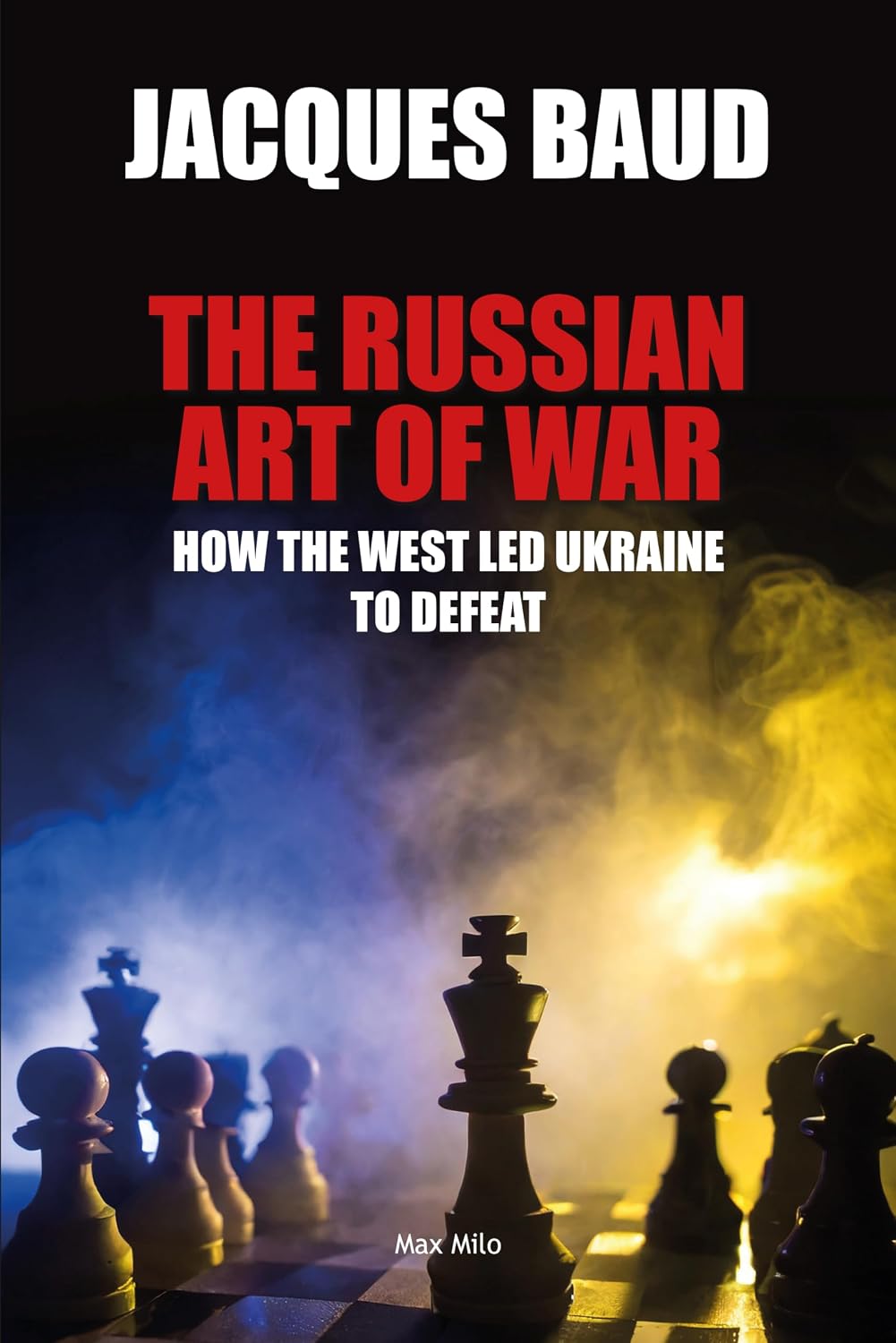
Colonel Jacques Baud, former Swiss strategic intelligence officer and author of The Russian Art of War: How the West led Ukraine to Defeat, has spent decades studying how different military cultures understand and wage war. His detailed, heavily referenced book — written early in the conflict — remains one of the clearest explanations of why Russia continues to hold the strategic advantage in Ukraine.
Baud’s central argument is simple but profound. During the Cold War, both NATO and the Warsaw Pact organised their forces around three interlocking levels of warfare: tactical, operational and strategic.
After 2001, Western armies largely abandoned the operational level as they shifted to counter-terrorism.
Fighting insurgents in Iraq and Afghanistan reduced war to a series of tactical engagements.
When the same mindset and equipment were transferred to Ukraine, the results were predictable.
Russia never made that shift. Its art of war remains built on the classic three levels.
Early in the Special Military Operation, deep operational thrusts toward Kyiv and Kherson were designed to create strategic pressure and force negotiations. When that phase ended, Russia adjusted — not by descending into pure tactics, but by systematically destroying Ukrainian forces while still linking tactical actions to operational and strategic goals.
Ukraine, trained and equipped largely by the West, has remained stuck at the tactical level.
This difference explains much of what we see on the battlefield. Russia’s objectives have been consistent: protect the population of the Donbas, prevent Ukrainian NATO membership, and secure a neutral buffer.
The Istanbul draft of March 2022 already reflected these goals, drawing on historical models of neutrality such as Austria in 1955 and Switzerland in 1815.
The West, by contrast, has never articulated clear, measurable political objectives beyond the vague slogans of “weakening Russia” and “supporting Ukraine.”
Without clear objectives, there can be no coherent strategy and no exit plan.
Industrial capacity reinforces the disparity. Russia’s state-influenced military-industrial complex can prioritise and scale production — whether of artillery shells, missiles or drones — with a flexibility that privatised Western industry lacks.
Lead times for systems such as Patriot missiles are measured in years.
Once Russia recognised the importance of drones, it moved from relative disadvantage to local superiority through industrial mobilisation.
Baud is careful to stress that understanding an adversary is not the same as endorsing them. Intelligence, he reminds us, comes from the Latin intelligere — to understand. Without that understanding, diplomacy becomes impossible and force becomes the only remaining instrument.
The tragedy is that a clearer grasp of Russian thinking in 2022 might have spared Ukraine much of the destruction that followed.
The conversation ends with a sober conclusion. Russia has a coherent political-military strategy underpinned by industry, energy and time.
The West and Ukraine are fighting a war by committee with no clear strategic destination.
In such conditions, the side that knows what it wants — and organises itself accordingly — almost always prevails.
You can watch the full conversation here:
Experts: How Putin’s nuclear sub could decimate Britain
Daily Mail, By FRED KELLY, FEATURE WRITER, 28 August 2026
It weighs over 10,000 tons, it is 135 metres long, and it carries half a dozen two-megaton ‘Domesday’ torpedoes capable of triggering a radioactive tsunami large enough to ‘plunge Britain to the depths of the ocean’. No wonder the world held its breath last week as Russia’s latest nuclear-armed submarine departed Severodvinsk Port to begin trials in the White Sea, 140 miles from the Finnish border.
Named after Russian explorer Yerofey Khabarov, the Khabarovsk will now undergo rigorous testing before being considered fit for active service.
The 100-strong crew as well as a team of onshore engineers will stress-test everything from mooring protocols to propulsion, steering and diving capabilities, as well as the integration of sonar and onboard computing systems. The vessel is eventually expected to travel east to join Russia’s Pacific Fleet, which itself launched a series of missile tests last week from the disputed archipelago of islands north of Japan – triggering a major diplomatic incident.
So what would the Khabarovsk role be in a future conflict? Why is Russia spending a rumoured billion dollars on this vessel when its navy already boasts at least 60 active submarines?
And it is not the only one, it is just one of a mooted trio of new nuclear-armed subs that could be unleashed on the West.
While the design of the Khabarovsk is based on Russia’s Borei-A class nuclear ballistic missile submarines that are a cornerstone of Moscow’s nuclear deterrent, it is, in fact, a bespoke ‘special purpose’ vessel in a class of its own.
Khabarovsk is the first submarine designed with a widened bow to accommodate six Poseidon nuclear torpedoes, each measuring 20 metres in length, two metres in diameter and weighing 110 tonnes each. The only other submarine capable of launching these ‘Domesday’ weapons is the RFS Belgorod, which can carry three Poseidon torpedoes, half the number of the Khabarovsk.
Russia’s ‘Unstoppable’ Torpedo Threatens Britain
Unlike traditional surface-to-air missiles which risk being intercepted in the sky, Poseidon warheads travel underwater at speeds of roughly 70 knots, 1000 metres below the waves. And thanks to an onboard nuclear reactor that propels them, they have an essentially unlimited range. They aren’t just missiles but autonomous, manoeuvrable vessels in their own right.
The idea for Poseidon torpedoes was first conceived by Soviet engineers as far back as the 1950s, though the plans were scrapped as the technology did not exist to fit the weapons with their own propulsion system.
Unlike traditional weapons, the torpedoes are designed to self-detonate before reaching their target. It is not the blast itself that is the danger, but the subsequent tsunami of radioactive water triggered by the two-megaton bombs – more than one hundred times the strength of the Little Boy bomb dropped on Hiroshima.
And while countless thousands would no doubt be drowned in the initial surge or killed by collapsing buildings, the after-effects of the radioactive flooding would render any land within two hundred miles uninhabitable for generations and result in the deaths of millions.
No surprise then that the Kremlin believes Poseidon torpedoes are the future of its nuclear deterrent. Indeed, Dr Richard Connolly, a military expert on Russia and associate fellow at the Royal United Services Institute, describes Poseidon as a ‘boutique capability’ that has been designed only for the ‘very worst of scenarios’…………………………………………………………………………………………………………………….https://www.dailymail.com/vertical-galleries/article-16087311/Experts-Putins-nuclear-sub-decimate-Britain.html
Fears Putin will use ‘tactical nuclear weapons
By PATRICK HARRINGTON, UK NEWS REPORTER, 27 August 2026, https://www.dailymail.com/news/article-16082617/Fears-Putin-tactical-nuclear-weapons-Ukraine-peace-talks.html
Fears that Putin will deploy ‘tactical nuclear weapons‘ against Ukraine are growing as Russia becomes increasingly frustrated and diplomatic hopes crumble.
Voices in Moscow calling for nuclear warheads are becoming louder, and the President is surveying his options for escalation, according to sources.
Ukraine and Russia have ramped up attacks against each other in recent months, with Kyiv landing significant strikes deep inside Russian territory against its oil infrastructure.
Meanwhile, negotiations have all but collapsed, with little hope on either side of a peace deal being found.
The Kremlin is adamant it will not end the war under pressure from sanctions or Ukrainian attacks on its refineries.
It is also increasingly indignant at Nato allies supplying Ukraine with weapons and intelligence – leading to threats against the UK that Prime Minister Andy Burnham this week branded ‘outrageous’.
Putin’s conclusion is that he need to intensify his attacks on Ukraine, three Kremlin sources told Bloomberg.
At the weekend, he told a reporter that Ukraine had ‘opened this Pandora’s box’, and warned Kyiv: ‘Be ready to get a blowback on your most sensitive sectors of the economy.’
For now, it is considering how it can ramp up its conventional ballistic assaults, including missile attacks on the centre of the capital, Kyiv.
But a growing number of Russian officials have concluded that Putin could eventually abandon the rules of modern warfare and hit the nuclear button, the sources said.
Tactical nuclear weapons, which are less powerful and have a shorter range, would be more likely than strategic missiles.
They would be used to gain the upper hand in a specific battlefield, rather than to decimate entire cities, like the bombs dropped by America on Japan in 1945.
Throughout the conflict, he has repeatedly flaunted the threat of nukes against Ukraine and its Western allies – even publishing maps showing strikes zones.
And if he made the call, there would be nobody to stand in his way.
Fiona Hill, a senior fellow at the Brookings Institution who served as a national security advisor to three US presidents including Trump in his first term, said: ‘For Putin there is no sign of collective will anywhere to resist him and so many ways in which he can grind people down.
‘This is why a concerted collective and consistent effort to resist his actions, and to engage in diplomacy, is essential.
‘He has a single-minded focus and we are all over the place.
It was reported this week that the Putin might be abouyt to test a nuclear-powered cruise missile – dubbed the Flying Chernobyl – that can fly for days, according to analysts.
An influx of aircraft and shipping has converged in the Arctic in a telltale sign that a new experimental firing is expected of a weapon powered by its own atomic reactor, say analysts.
The ‘invincible’ Burevestnik missile – with a nickname inspired by the nuclear catastrophe that could be inflicted, much like the Chernobyl power plant explosion in 1986 – carries a nuclear warhead with an ‘unlimited range’ and is designed to fly for days at a time before striking the West, according to the Russians.
While the chance of nuclear weapons still looks remote, the only way to rule them out completely would be a swift diplomatic end to the war – something that now seems out of reach.
The US is preoccupied with the conflict in Iran, and Putin has abandoned its hope of an understanding between Donald Trump and himself that was fostered during at their summit in Alaska last August.
Russia has indicate there may be a path to peace if Ukraine hands over its ‘fortress belt’ of cities in the Donbas that have held firm since the start of armed hostilities in 2014 – but Kyiv has made clear that is not on the table.
A recent indication of the US’s feeling toward Russia came from Secretary of State Marco Rubio in June, when he said: ‘If there had been an agreement, we would have had an end to the war.’
CIA Director John Ratcliffe made a rare visit to Moscow on Tuesday for a diplomatic meeting, though it’s unclear what the focus was.
Is Putin about to test ‘Flying Chernobyl’ nuclear-powered missile that can fly for DAYS?
By WILL STEWART and SOPHIA STANFORD, 25 August 2026,
https://www.dailymail.com/news/article-16078037/Putin-test-Flying-Chernobyl.html
Vladimir Putin may be about to test a nuclear-powered cruise missile – dubbed the Flying Chernobyl – that can fly for days, according to analysts.
An influx of aircraft and shipping has converged in the Arctic in a telltale sign that a new experimental firing is expected of a weapon powered by its own atomic reactor, say analysts.
The ‘invincible’ Burevestnik missile – with a nickname inspired by the nuclear catastrophe that could be inflicted, much like the Chernobyl power plant explosion in 1986 – carries a nuclear warhead with an ‘unlimited range’ and is designed to fly for days at a time before striking the West, according to the Russians.
Norwegian defence analyst Thord Are Iversen said the movements followed the pattern seen during previous tests of Putin’s experimental 9M730 Burevestnik cruise missile.
‘It now appears that everything is ready for actual Burevestnik flight testing,’ he told independent Russian outlet The Insider.
In the Arctic, two specialist Il-976 SKIP aircraft used to monitor missile trajectories and collect test data arrived at Rogachyovo airbase on the remote Novaya Zemlya archipelago, reports say.
Satellite imagery also shows an A-50U airborne early-warning aircraft, four An-26 military transports, an An-74 and several helicopters at the base amid a suspected test of Putin’s Flying Chernobyl missile.
Civilian vessels previously involved in missile trials have taken up positions in the Barents and Kara seas around the Pankovo test range.
Russia signals willingness to consider new Ukraine peace ideas but insists any deal reflect battlefield conditions
[your]NEWS, Fri, 21 Aug 2026 , https://www.sott.net/article/508073-Russia-signals-willingness-to-consider-new-Ukraine-peace-ideas-but-insists-any-deal-reflect-battlefield-conditions
Russian Deputy Foreign Minister Sergei Ryabkov said Moscow remains willing to hear new U.S. proposals for ending the war in Ukraine, while maintaining that any settlement must account for Russia’s stated objectives and the territorial situation created by nearly 4½ years of fighting.
Russia says it remains prepared to consider new proposals for ending the war in Ukraine, but Moscow is continuing to insist that any potential settlement account for what it calls the “realities on the ground.”
Russian Deputy Foreign Minister Sergei Ryabkov made the comments in an interview with News.ru published Friday, signaling that Moscow is still open to negotiations with Washington even as diplomatic efforts to end the conflict have largely stalled amid the war in Iran.
Ryabkov said the United States has demonstrated both a willingness to engage in “constructive dialog” and an “understanding of Russia’s position.”
He suggested, however, that Moscow believes the larger question is whether the United States can influence Ukraine and its European allies.
“At this stage, it is more important to what extent Washington is able to influence the decisions of the Kyiv regime and its European sponsors, who still dream of a ‘strategic defeat’ of Russia,” Ryabkov said.
Russia and the United States have held negotiations aimed at finding a path toward ending the Ukraine war, but those efforts have lost momentum as international attention has shifted toward the conflict involving Iran.
The Kremlin said Thursday that it had no information about when U.S. presidential envoys Jared Kushner and Steve Witkoff might next travel to Moscow.
Kushner and Witkoff have previously played leading roles in U.S. negotiations with Russian officials.
Secretary of State Marco Rubio reiterated Washington’s interest in ending the Ukraine conflict last month following a meeting with Russian Foreign Minister Sergei Lavrov in Manila.
Rubio cautioned at the time that a rapid breakthrough should not be expected and said the United States was attempting to “find a middle ground.”
Ryabkov responded that Moscow remains prepared to consider new ideas from Rubio and to continue discussions with the Trump administration:
“The Russian Federation is ready to listen to any reasonable proposals and ideas that are in line with the goals set by the Russian president and meet the ‘realities on the ground,'”
That formulation reflects a longstanding Russian position that any eventual agreement must take into account territorial changes resulting from the war.
After almost 4½ years of fighting, Russian forces control approximately one-fifth of Ukraine’s internationally recognized territory.
Moscow has repeatedly said it is willing to negotiate but has maintained that talks must acknowledge what Russian officials describe as the “new realities on the ground.”
The territorial question remains one of the central obstacles to reaching a negotiated settlement.
Ukraine and its international supporters have continued to regard the areas seized by Russia as sovereign Ukrainian territory, while Moscow has sought to make its control of occupied regions part of the framework for any eventual peace agreement.
Ryabkov’s remarks indicate that Russia is not rejecting further American diplomatic initiatives but is setting clear parameters for what it would regard as a viable proposal.
His comments also place renewed emphasis on Washington’s ability to persuade Kyiv and European governments to accept compromises that Moscow considers necessary.
The diplomatic opening comes as U.S.-Russian negotiations over Ukraine have slowed considerably from earlier efforts.
Although Rubio has publicly reaffirmed Washington’s commitment to finding a way to end the conflict, he has also acknowledged the substantial differences separating the parties.
Ryabkov’s interview addressed another major area of U.S.-Russian relations as well: nuclear arms control.
The New START nuclear weapons treaty expired in February, leaving the United States and Russia without binding limits on their strategic nuclear arsenals for the first time in more than 50 years.
The treaty had imposed restrictions on deployed strategic nuclear warheads and delivery systems held by the world’s two largest nuclear-armed powers.
Despite its expiration, Moscow has said it intends to continue observing the treaty’s limits on missiles and warheads as long as Washington does the same.
Ryabkov indicated that Russia wants to keep diplomatic channels open on nuclear weapons even without a formal treaty currently in force.
“We remain open in the future to find political and diplomatic ways to stabilize this area,” he said.
His comments suggest that Moscow sees room for continued U.S.-Russian engagement on two of the most consequential issues between the countries: ending the Ukraine war and establishing a new framework for managing their strategic nuclear arsenals.
For Ukraine negotiations, however, Russia continues to make clear that it will judge any American proposal against both President Vladimir Putin’s stated objectives and the military situation that now exists after years of war.
Russia builds 15 small marine nuclear reactors with 175-MWt capacity for icebreakers
Russia has built 15 RITM-200 reactor units. Rosatom chief
Alexey Likhachev outlined plans to use these small-scale systems for
broader energy needs during a government meeting on nuclear infrastructure.
He reported that Russian factories have manufactured 15 of these reactors
so far, while workers are building 13 more.
Interesting Engineering 23rd Aug 2026,
https://interestingengineering.com/energy/russia-builds-15-small-marine-reactors
Russia Warns West Against New Arms Race

Aug 21, 2026 , By Ellie Cook, Senior Defense Reporter, https://www.newsweek.com/russia-warns-west-against-new-arms-race-12346603
A senior Russian official has warned that President Donald Trump’s new defense plans, including for the vast Golden Dome missile shield currently in development, will lead to a new space “arms race” and could be “devastating.”
“The risks of turning outer space into an arena of armed confrontation have ceased to be hypothetical,” Gennady Gatilov, Russia’s envoy to the United Nations in Geneva, said in remarks reported by Russia’s Tass state news agency on Thursday.
“Its consequences will be devastating for all of humanity,” he added.
Although militaries worldwide already use satellites for intelligence gathering, communications, missile warnings and navigation, putting weapons in orbit has been controversial for decades.
A major part of the planned design for the Golden Dome will be orbiting interceptors to knock out incoming missile attacks, with early-warning sensors positioned in space, although the United States government and military haven’t released a full breakdown of how the system would be put together.
A White House spokesperson told Newsweek in a statement: “President Trump is building on the transformational achievements of his first term to maintain America’s leadership in space.”
Newsweek reached out to the Department of Defense via email for comment.
Russian President Vladimir Putin and China’s Xi Jinping jointly said in May 2025 the proposed outline for the futuristic Golden Dome was an “obvious threat to strategic stability,” while North Korea said the program smacked of “self-righteousness” and “arrogance.”
The Trump administration says the project is needed to counter next-generation attacks on U.S. soil, like fast-moving ballistic missiles and hypersonic weapons able to travel at more than five times the speed of sound. Moscow and Beijing have invested heavily in hypersonic programs, while the U.S. and NATO have lagged behind in developing these weapons.
Advocates for the Golden Dome say technology is now advanced enough to build a partially space-based system. Trump has explicitly linked the project to an ultimately shelved initiative launched by late Republican President Ronald Reagan during the Cold War arms race, popularly dubbed “Star Wars” because it planned to intercept Soviet missiles with lasers in space.
But critics argue that despite the ballooning projected costs, Trump’s Golden Dome may not protect the U.S. from a full-scale attack by Russia or China.
Costly and Possibly ‘Overwhelmed’
The Congressional Budget Office—the nonpartisan agency that advises American lawmakers on funding—said in May the “Golden Dome” will cost roughly $1.2 trillion over the next 20 years, far exceeding the initial $175 billion allocated to the project.
The CBO said up to 70 percent of the acquisition costs and 60 percent of the total bill would be linked to the space-based components. It has also said that while the Golden Dome could cope with a “small-scale” assault or a North Korean attack, it would be “overwhelmed by a full-scale attack” from a country like Russia or China.
A dozen companies are competing to develop this space-based layer, including defense giants Lockheed Martin and Northrop Grumman. The U.S. Space Force says it can show off an “initial capability” by 2028.
In separate remarks on Wednesday, senior CBO official David Mosher said the agency hadn’t been able to contact the team in charge of the Golden Dome in the Pentagon and hadn’t secured briefings on the program, despite requesting updates.
“I know nothing about what they’re actually building,” he said during an appearance at the Brookings Institution.
Last year, Oregon Senator Jeff Merkley and three other Democratic lawmakers said the Golden Dome would be “detrimental to U.S. and global security by igniting a nuclear arms race with Russia and China.”
Unanswered Questions
The Golden Dome is expected to cover the U.S. mainland, Alaska and Hawaii. But Canada is in talks to come under the Golden Dome’s umbrella, and the U.S. has said previously that its northern neighbor would need to pay tens of billions of dollars to be included.
Currently, both the U.S. and Canada’s defenses against long-range intercontinental ballistic missiles are handled by the binational North American Aerospace Defense Command (NORAD). At this point, it’s hard to work out how an air defense system for long-range attacks would work without Canadian cooperation.
It’s also not clear how the Golden Dome will address the threat posed by drones, particularly after the U.S.’s experience intercepting unmanned aerial vehicles (UAVs) in the Middle East since the start of the war with Iran.
The Pentagon said in its National Defense Strategy released in January that the Golden Dome would have a “specific focus on options to cost-effectively defeat large missile barrages and other advanced aerial attacks.”
Because air defense interceptors that can shoot down sophisticated weapons often cost several million dollars apiece, many global militaries are wrestling with how to reliably knock out major air threats like drones at a far lower cost than in past years.
Earlier this month, the Pentagon said it had set up a new “hub” for defense companies, academics and investors with the Department of Defense, which it said would slash red tape often found in defense procurement negotiations.
1 This Month
23-25 October – on Zoom – World BEYOND War’s annual global conferenc


Shut down the radiation-damaged Heysham nuclear reactors now
To see nuclear-related stories in greater depth and intensity – go to https://nuclearinformation.wordpress.com

Say No to NASA’s Reckless Nuclear Reactor on the Moon
Say No to NASA’s Reckless Nuclear Reactor on the Moon

-
Archives
- October 2026 (209)
- September 2026 (339)
- August 2026 (330)
- July 2026 (355)
- June 2026 (287)
- May 2026 (306)
- April 2026 (356)
- March 2026 (251)
- February 2026 (267)
- January 2026 (308)
- December 2025 (358)
- November 2025 (359)
-
Categories
- 1
- 1 NUCLEAR ISSUES
- business and costs
- climate change
- culture and arts
- ENERGY
- environment
- health
- history
- indigenous issues
- Legal
- marketing of nuclear
- media
- opposition to nuclear
- PERSONAL STORIES
- politics
- politics international
- Religion and ethics
- safety
- secrets,lies and civil liberties
- spinbuster
- technology
- Uranium
- wastes
- weapons and war
- Women
- 2 WORLD
- ACTION
- AFRICA
- Atrocities
- AUSTRALIA
- Christina's notes
- Christina's themes
- culture and arts
- Events
- Fuk 2022
- Fuk 2023
- Fukushima 2017
- Fukushima 2018
- fukushima 2019
- Fukushima 2020
- Fukushima 2021
- general
- global warming
- Humour (God we need it)
- Nuclear
- RARE EARTHS
- Reference
- resources – print
- Resources -audiovicual
- Weekly Newsletter
- World
- World Nuclear
- YouTube
-
RSS
Entries RSS
Comments RSS

