Campaigner hits out at ‘PR trick’ nuclear energy poll of SNP members

By Laura Pollock, Multimedia Journalist, 1 May 25, https://www.thenational.scot/news/25131226.campaigner-hits-pr-trick-nuclear-energy-poll-snp-members/
A LEADING independence activist has hit out at a recent poll suggesting roughly half of the SNP’s voters believe nuclear power should be part of Scotland’s mix of clean energy generation.
Robin McAlpine, founder of pro-independence think tank Common Weal, has branded the polling a “PR trick based on deliberately withholding crucial information”, claiming people who responded were not given “the basic facts”.
Polling for the campaign group Britain Remade, founded by a former energy adviser to Boris Johnson, found 52% of those who voted for the party in 2021 believe nuclear power should be included in Scotland’s energy mix to meet the 2045 net zero target.
Meanwhile, 57% of those who voted for the party in last year’s general election felt the same way, the poll found. A total of 56% of Scots thought nuclear power should be part of Scotland’s clean energy mix to meet the targets, while 23% disagreed, and 21% said they did not know.
Opinium surveyed 1000 Scottish adults between April 22 and 25.
However, McAlpine argues those quizzed on the topic were not aware of key points as laid out in a blog post for pro-independence Common Weal Common Weal.
He highlights the price of hydrogen electricity being cheaper than nuclear, as well as the hidden costs of building and decommissioning nuclear infrastructure.
“Would SNP voters back nuclear if it was explained that it will cost them three times as much as renewables and then also cost nearly £5000 per household just to clean them up?” McAlpine told The National.
He further questioned: “Do people know that it is much cheaper to run a renewable system with battery storage for short-term load balancing and hydrogen storage for long term battery storage? Are they aware that you can’t turn nuclear power on and off and that it has to run at full power all the time? So it can’t balance renewables when the wind isn’t blowing, it can only displace renewables from the grid.
“The only conceivable purpose of nuclear in Britain is to power the south of England. Look at Fukushima, look at the power stations in Ukraine, how much risk do you want to take when you have absolutely no need to do it?
“If people are told ‘more expensive, much more dangerous, can’t be switched up or down or turned off, costs an absolute fortune to decommission at the end’, I think you’ll find they answer differently.”
Britain Remade has been approached for comment.
The SNP have argued nuclear power projects remain too expensive to be a viable alternative to renewable power.
Responding to the polling, SNP MSP Bill Kidd said: “Our focus is delivering a just transition that supports communities and creates long-term economic opportunities to build a truly sustainable future.
“Nuclear remains one of the most costly forms of energy with projects like Hinkley Point C running billions over budget and years behind schedule.
“In contrast, Scotland’s net zero transition is already delivering thousands of green jobs across energy, construction, innovation, and engineering. This number will continue to grow.
“Simply, renewables are cheaper to produce and develop, create more jobs, and are safer than nuclear as they don’t leave behind radioactive waste that will be deadly for generations.
“While Labour funnels billions into slow, centralised projects, the SNP is focused on creating real, sustainable jobs in Scotland now.”
Sellafield plan for new building to store radioactive waste
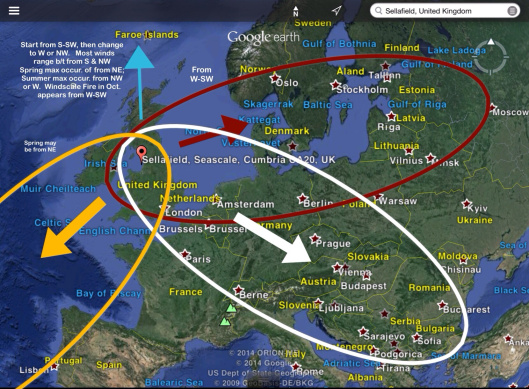
Federica Bedendo, BBC News, North East and Cumbria, 2 May 25, https://www.bbc.com/news/articles/cg724n91gp4o?fbclid=IwY2xjawKA7DdleHRuA2FlbQIxMQBicmlkETFISGV5ZEdSZW16a2ZnQzh3AR5Wx_HKBbiK0umY8fOSOzw2Hzv5_AeeAjFPGDgbc4VxAi7joZ7-0jA4qr0Bzg_aem_nd6f3waC2WX_bFb_0pWkhw
Work to build a storage facility to keep radioactive waste for up to 100 years is set to take a step forward.
Sellafield, in Cumbria, wants to build the second of four new units to store intermediate level waste, as the company works to decommission ageing buildings at its Seascale plant.
The site manages more radioactive waste in one place than any other nuclear facility in the world, according to planning documents.
The project was approved in 2023 and an application has now been submitted to the Environment Agency (EA) seeking permission to abstract water from the site.
The water would have to be extracted as the ground is dug up to build the new facility, a Sellafield spokesman said.
It was needed as part of the building phase, they said, adding there were no risks of contamination from radioactive waste.
Documents show the building storing the nuclear waste would be about the size of a football pitch and as tall as about six double-decker buses.
The walls of the store which has already been built are about 5ft (1.5m) thick, with a 6.5ft (2m) thick floor.
Sellafield said it planned to start building work this year, with the second store becoming operational in 2032.
The waste would be kept there for up to 100 years, papers show, and then moved to a Geological Disposal Facility (GDF) – an underground storage facility which could be built in Cumbria.
A consultation on the plans to abstract water from the Sellafield site by the EA closes on 2 May.
For second time in 3 years Zelensky sabotages Ukraine war peace deal.

Walt Zlotow, West Suburban Peace Coalition, Glen Ellyn IL 30 Apr 25
Does Ukraine President Zelensky enjoy watching his citizens die needlessly in a US provoked war he could have ended twice?
Zelensky helped ensure Russia would invade February 22, 2022 by pushing NATO membership for Ukraine and massing 60,000 elite troops on the Donbas border to finish off the Russian leaning Donbas Ukrainians seeking independence from Kyiv destroying their culture along with their lives.
But Zelensky sensibly negotiated a peace agreement with Russia in the first two months (Istanbul Agreement) that would have ended the war with no loss of Ukraine territory albeit with no Ukraine NATO membership and independence for the beleaguered Donbas Ukrainians. That was statesmanship of the highest order.
But the US and UK saw a golden opportunity to weaken Russia if not change out the Vladimir Putin regime. What to do? Got it. Send US Defense Secretary Lloyd Austin and UK Prime Minister Boris Johnson to Kyiv to disabuse Zelensky of making peace. Hey, with a couple of hundred billions in US/NATO weapons but no soldiers, you can win Zelensky and go out the George Washington of Ukraine..
The result? Three years on Ukraine is largely destroyed with millions fled, over a hundred thousand casualties, 45,000 square miles gone forever and a shattered economy.
But new sheriff in town Trump brokered a new peace deal which would have ended the war with no further casualties or lost territory, Astonishingly, Zelensky rejected it again, this time of his own free will. He cited both his desire to require Crimea, lost 5 years before he became president, and his goal of Ukraine joining NATO.
So despite a 3 day Russian truce in in the offing over its May celebration of its WWII victory, the dying soldiers and expanding Russian buffer zone in Ukraine to prevent further long range Ukrainian missile attacks will go on till Ukraine simply collapses.
Maybe Zelensky has a nationwide death wish. Maybe he’s delusional or too stupid to realize his leading Ukraine to certain destruction. Or maybe it’s simply his way of telling the US and UK that he’s capable of blowing up a sensible peace agreement all by himself.
Europe is drilling for World War III
NATO is conducting exercises for “a broad offensive from Vilnius to Odessa” at “a scale unseen in decades.”
Alex Krainer, May 01, 2025
[Originally published at I-System TrendCompass] Russia’s military victory over Ukraine has been a near-certainty for months now. Ukraine’s total defeat is only a matter of time, but as that time approaches, European powers have been increasingly determined not to let the war die and are now actively preparing to take it up where Ukraine stumbles. Our liberal democracies are as precious as they are fragile and every precaution must be taken to defend them from the Asiatic hordes gathering in the east.
While our valiant bankers are arranging to allocate trillions of euros of our children’s and grandchildren’s wealth for defense spending, our militaries are diligently exercising and preparing for war, hidden from ordinary Europeans who aren’t exactly enthused about World War 3. But the Russians have noticed: presidential aide and former National Security Adviser Nikolai Patrushev recently stated that, for a second consecutive year, NATO has been
“conducting exercises at our borders at a scale unseen in decades. … They are training for conducting a broad offensive from Vilnius to Odessa, seizing Kaliningrad region, imposing a naval blockade in the Baltic and the Black Seas and executing preventive strikes on the staging locations of Russian nuclear deterrence forces.”
If Mr. Patrushev is correct, it would appear that London, Paris, Berlin and Brussels are actively preparing for war against Russia. But his statement that the exercises are “at a scale unseen in decades,” needs to be put in context.
NATO’s provocations far predate Ukraine war
NATO has been involved in increasingly aggressive military maneuvers at Russia’s doorstep for many years now, especially after the 2014 Euromaidan coup in Kiev. During that time, NATO forces have been conducting as many as 40 major military exercises per year along Russia’s borders.
Movement of their military assets evolved from purely reconnaissance hardware to battle ready ships and aircraft equipped with precision munitions and cruise missiles which would frequently approach Russian territory to as close as 15 km (9.3 miles). On these occasions, they often activated their missiles in repeated mock attacks on Russian targets. In September 2020, chief of operations of Russia’s high command, General Sergey Rudskoi stated that NATO was staging between 33 and 40 such flight approaches per week using fighter jets from Sweden, Germany, Ukraine and Italy.
This suggests that the exercises Mr. Patrushev referred to aren’t Europe’s reaction to Russia’s aggressiveness but a continuation of policy that far predates the Ukraine war. In June 2021, still more than six months before Ukraine war, NATO’s then Secretary General Jens Stoltenberg boasted that,
“Perhaps the most important thing we have done is that for the first time in NATO’s history, we have combat-ready troops in the eastern part of the Alliance. New battle groups are deployed to the Baltic countries and Poland, we have tripled the size of the NATO readiness force.”
In a 2016 radio-interview with John Bachelor, late professor Stephen Cohen noted that,
“NATO has decided to quadruple its military forces on Russia’s borders or near Russia’s borders… The last time there was this kind of Western hostile military force on Russia’s borders was when Nazis invaded Russia in 1941. There has never been anything like this. During the 40-year Cold War there was this vast buffer zone that ran from the Soviet borders all the way to Berlin. There were no NATO or American troops there. This is a very radical departure on the part of the [Obama] administration. … Russia is not threatening any country on its border.”
$75 trillion worth of democracy and freedom
Professor Cohen was right. Russia really wasn’t threatening any of its neighbors, and no Russian leader has either explicitly or implicitly expressed any territorial pretentions against any European nation. The deranged claims that once they are done with Ukraine, the Russians will continue on to Poland, the Baltic states, Finland and then, who knows, perhaps Paris and London, are based on nothing but European leaders reckless fear mongering, aimed at justifying NATO’s continuing preparations for war.
The ultimate reason isn’t the belief that Russia will launch a medieval invasion of Europe and deprive us of our democracy and freedom, but the certain knowledge that Russia is sitting on an estimated $75 trillion of our freedom and democracy. Those precious resources are utterly wasted on the unworthy Russians. Here’s what the Iron Lady Margaret Thatcher once said (video at this link):
“If you were to make a table of countries in proportion to the natural resources they have, the top one would almost certainly be Russia. She has everything. Oil, gas, diamonds, platinum, gold, silver, all the industrial metals, marvelous standing timber, a wonderfully rich soil. But countries are not rich in proportion to their natural resources. Countries are rich whose governments have policies which encourage essential creativity, initiative and enterprise of man and recognize his desire to do better for his family.”…………………………………………………………………………………………………………. https://alexkrainer.substack.com/p/europe-is-drilling-for-world-war?utm_source=post-email-title&publication_id=1063805&post_id=162553198&utm_campaign=email-post-title&isFreemail=true&r=1ise1&triedRedirect=true&utm_medium=email
Covering up Ukrainian Nazis is nothing new – the Canadians have been doing it for almost eighty years

Ian Proud, April 29, 2025. https://strategic-culture.su/news/2025/04/29/covering-up-ukrainian-nazis-nothing-new-canadians-have-been-doing-it-for-almost-eighty-years/
A number of topics remain taboo in discussing the war in Ukraine. Busification, Zelensky’s democratic mandate, Ukraine’s casualty numbers and anything suggesting that Ukraine cannot win are all off limits. Likewise the problem of alleged neo-Nazis in Ukraine.
One of the most embarrassing episodes since the Ukraine war started in 2022, was when Yaroslav Hunka, was given two standing ovations in the Canadian House of Commons public gallery by MPs during the visit of President Zelensky in 2023. Hunka has been accused by Russia of genocide, because of his alleged involvement in the Huta Pieniacka massacre of February 28 1944 in which more than 500 ethnic Poles were murdered in a village, in what is now western Ukraine. Hunka was a member of the SS Galicia Division, a mostly Ukrainian unit of the Waffen SS, which Commissions in Germany and Poland later found guilty of war crimes.
This was shocking because it opened the lid on a topic of conversation that has been largely silenced by the western mainstream media since the beginning of the war: Ukraine’s contemporary challenge of far-right ultranationalism. But the Hunka case also illustrates how western authorities airbrushed discussion of nazis in Ukraine after World War II too.
On 13 July 1948 the British Commonwealth Relations Office, what is now part of the Foreign Commonwealth and Development Office, sent a telegram to Commonwealth governments, proposing an end to Nazi war crimes trials in the British zone of Germany. “Punishment of war crimes is more a matter of discouraging future generations than of meting out retribution to every guilty individual… it is now necessary to dispose of the past as soon as possible.”
After the conclusion of the Nuremberg War Trials in 1946 the western world faced a new enemy in the Soviet Union. Limited security resources in cash-strapped Albion and its colonies were re-deployed to uncover suspected Soviet agents and Communists, rather than to identify and track down lower-order Nazi war criminals.
Around this time, many Ukrainians fled the Soviet Union to settle in Canada. In the thirty-year period after the start of Operation Barbarossa, the Ukrainian population in Canada almost doubled, from 300,000 to almost 600,000 people. While most of them, I am sure, would not have been Nazi collaborators, some, undoubtedly, were. They were joined by lesser numbers of Latvians, Hungarians, Slovaks and others.
Within that exodus would have been so-called “lesser” war criminals; persons who had organised the transportation of Jews, Slavs, gypsies and homosexuals to death camps, acted as informers, committed murders, or become involved in war crimes as other ranks and non-commissioned officers in death squads. They were the lower echelon collaborators, acting as the instruments of the genocide initiated by the Nazis.
Yet, following the British instruction, Canada progressively relaxed its immigration policy between 1950 and 1962, steadily removing restrictions against the entry of German nazis and non-German members of German military units like the SS Galicia Division.
However, in 1984 the Simon Wiesenthal Center wrote a letter to the Canadian government claiming to have obtained evidence that the ‘Angel of Death’ Josef Mengele had applied for a landed immigrant visa to Canada in 1962. Though this proved to be incorrect, it caused such outrage among Canada’s Jewish community that a Commission of Inquiry on War Criminals in Canada was established in 1985.
Known as the Deschênes Commission, it uncovered a list of 774 persons who had allegedly entered Canada and who required further investigation. Of that list, only 28 underwent serious investigation and trial.
Michael Pawlowski, accused of murdering 410 Jews and 80 non-Jewish Poles in Belarus in 1942, was acquitted as judges blocked the prosecution from gathering evidence in the Soviet Union.
Stephen Reistetter of Slovakia was not tried for allegations that he kidnapped 3000 Jews to have them sent to Nazi death camps while serving in the Hlinka party, a far right clerical-fascist movement with Nazi leanings. His case fell apart because a witness died.
Erich Tobias, was accused of involvement in the execution of Latvian Jews but died before his case went to court.
By 1995, with no convictions for war crimes having been secured, the Canadian Justice Department cut the size of its war crimes unit from 24 to 11 people. In the absence of criminal prosecutions, the Canadian Government tried civil proceedings to revoke citizenship from alleged war criminals.
Wasily Bogutin collaborated with the Nazi occupation forces in the town of Selidovo, in Donetsk, and was personally and directly involved in effecting the roundup of young persons for forced labour in Germany. In February 1998, Judge McKeown, of the Trial Division of the Federal Court, found that Bogutin had concealed his role in war crimes, but he died before he could be extradited.
Joseph Nemsila, who commanded a Slovak unit that sent civilians to Auschwitz died in 1997 after a decision not to revoke citizenship was overturned, but death prevented exportation.
In only 7 cases was order made for the suspect to be extradited or exported. This included Ladislaus Csizsik-Csatary, accused of involvement in the confinement of thousands of Hungarian Jews and their subsequent deportation to death camps. In July 1997, just before his trial was to begin, he decided not to oppose the loss of his citizenship and voluntarily left the country.
Vladimir Katriuk was accused of having taken part in the Khatyn Massacre in Belarus and Wasyl Odnynsky, a guard at SS labour camps at Trawniki and Poniaka. Moves were made to revoke their citizenship, but they were allowed to remain in Canada until all court proceedings were lifted in 2007.
Progress in prosecuting alleged war criminals in Canada was always slow, often held up by foot-dragging by often reluctant judges, and a refusal to allow for the gathering of evidence in the Soviet Union.
Today, the media and Jewish groups still pressure the Canadian government to reveal the names of all of the 774 persons considered by the 1985 Deschênes Commission with so far little success.
An American academic recently discovered what is believed to be a similar list of 700 suspects which included Volodymyr Kubiovych, a Ukrainian Nazi collaborator who helped organize the SS Galicia division and who was editor in chief of the Encyclopedia of Ukraine compiled at the University of Alberta. A photograph of a parade in Lviv, Ukraine, in July, 1943, shows Mr. Kubiovych making a Nazi salute alongside Otto Wächter, a senior member of the SS who also served as governor of Galicia and Krakow.
Yaroslav Hunka was not on that list, raising questions about how many Nazi collaborators in Canada were never discovered.
I don’t think that Ukraine today is a Nazi society and, even at its high watermark, the Svoboda party only garnered 10% of the national vote. But ultranationalism is a major problem, particularly in the west of Ukraine, in that area known as Galicia during World War II. And the refusal of western governments to acknowledge the issue of ultranationalism in Ukraine or speak out means that we are turning a blind eye once more to activity that we would never tolerate in our own countries.
Chernobyl’s Hidden Impact: Disinformation and Nuclear Politics

And yes it is oxymoronic to have the same agency being responsible for safety and promotion of nuclear power
Chernobyl is not the past.
every nuclear power plant ever built assumes there will never be a war on the site.
Chernobyl explosion was “perhaps the real cause of the collapse of the Soviet Union.” According to Mikhail Gorbachev who was the last leader of the Soviet Union and was in power during the meltdown. But perhaps the more important lesson from the Chernobyl catastophe is that disinformation can kill you. It is important to remember that the largest and most deadly nuclear accident in the world was not even reported initially by the secretive and corrupt Soviet Union. It was not until 2 days after the meltdown that the Forsmark Nuclear Power Plant in Sweden detected the radiation and forced the Soviets to admit there had been an accident. Forsmark is 1100 km from Chernobyl.
Disinformation about Chernobyl is not confined to the Soviet Union, western nations and especially the UN played a critical role in down playing and distorting information about the effects of the disaster. This is most obvious in the fatality estimates associated with the catastrophe.
In 1959, the powerful UN agency responsible for both promoting and monitoring nuclear power, the IAEA, signed an agreement with the UN’s health monitoring agency, WHO, that restricted them from reporting on nuclear accidents. And as part of the western public relations cover up, 4 months after the meltdown the then general director of the IAEA, Hans Blix, would affirm: “The world could tolerate a nuclear accident as serious as Chernobyl every year.” WHO was blocked from releasing any independent Chernobyl studies and ultimately the IAEA (with WHO) would officially report that there were only between 4000 to 9000 deaths. [And yes it is oxymoronic to have the same agency being responsible for safety and promotion of nuclear power.]
Consensus is not your friend. There have been many scientific studies of the affects of Chernobyl. Greenpeace did an anthology of these studies at the 25th anniversary and estimated that at least 93,000 people will have died and the actual total is likely well be over 200,000 premature deaths. Why the big difference between the UN’s official tally and independent scientists? The answer is consensus. The IAEA has representatives from pro-nuclear states on it’s Chernobyl Forum, they release their reports operating by consensus and those invested in nuclear energy have a strong interest in down playing the effects of accidents. Independent scientists have also found radiation levels in the exclusion zone to be over three times higher than the IAEA reports.
How effective is this western mis/disinformation campaign? Check out Wikipedia or ask any AI. You will quickly find the IAEAs 4000 person fatality rate. Depending on the source more accurate information is either buried or not revealed in your first responses. Lots of people on the nuclear payrolls have put a bunch of effort into minimizing the impact of all nuclear accidents. This is not a (known) conspiracy, per se, but rather contemporary industrial capitalism functioning as designed. But perhaps more revealing is that almost no mainstream news sources are covering this years 39th anniversary. Far more important in our attention economy is that Trump is going to the Pope’s funeral and we are arresting judges in the US.
Chernobyl is not the past. In February of this year a relatively low cost attack drone blew a hole in the second $1.7 billion Chernobyl sarcophagus. The fire from this attack burned for 3 weeks, requiring technicians to make further holes in the exterior shell in a high stakes game of “nuclear whack a mole”
“We did a lot of safety analysis, considering a lot of bad things that could happen,” said a senior technical adviser on the project. “We considered earthquakes, tornadoes, heavy winds, 100-year snowfalls, all kinds of things. We didn’t consider acts of war.”
It is worth pointing out that every nuclear power plant ever built assumes there will never be a war on the site. Assuming otherwise would be yet another in the long list of reasons why nuclear power should not be considered or continued. Other major problems with civil nuclear power include: subsidized insurance, proliferation risks, uneconomic construction and operation, perverse effects on avoiding climate disruption and the threat to democracy. The total cost of the Cheronbyl accident has been estimated at $700 billion which is about 5 times the Ukraines average GDP for the last 10 years.
The only good nuclear news on this anniversary is the complexity of nuclear power plants combined with the previous globalization of the nuclear construction and fuel supply chain mean that Trump’s tariffs may put the breaks on any new nuclear construction in the US. Or perhaps more sadly, these Trump taxes will just increase the already ridiculous price of nuclear power to both taxpayers and ratepayers.
Victory for Greenpeace Luxembourg against EDF in court transparency ruling

Thomas Toussaint – Adapted by RTL Today, Update: 28.04.2025 ,
https://today.rtl.lu/news/luxembourg/a/2297912.html
In a landmark decision for nuclear transparency, the Strasbourg administrative court has ordered energy giant EDF to disclose information previously kept under wraps about the Cattenom nuclear power station, marking a major victory for Greenpeace Luxembourg.
Greenpeace went to court to challenge EDF’s refusal to provide information on “the possible use within the Cattenom nuclear centre of parts manufactured by the Italian company Tectubi, their destination and their conformity.”
The parts had previously been inspected by Italy’s Nuclear Safety Authority, which identified shortcomings in their production process.
The suspect parts were alleged to have been used to address the well-known issue of stress corrosion, detected in several nuclear power plants, including Cattenom. Greenpeace therefore requested to be informed of the possible use of these parts at the Moselle power station.
In response, the plant’s management refused, citing trade secrecy under the Code of Public Administration Relations. This left Greenpeace with no alternative but to turn to the administrative court in July 2023.
In a ruling on 24 April 2025, the Strasbourg court confirmed that the documents requested by Greenpeace Luxembourg were not subject to secrecy and ordered the director of Cattenom to provide the information within two months. EDF has also been ordered to pay €1,500 to Greenpeace Luxembourg.
“The decision by the administrative court is an important victory for transparency and nuclear safety,” said Roger Spautz, nuclear campaigner at Greenpeace Luxembourg. “EDF cannot continue to conceal crucial information regarding reactor safety, especially when issues such as stress corrosion and cracking are concerned.”
The Great British nuclear expansion is a project bound to fail.
With the government committed to a huge expansion of nuclear power to meet
our energy needs, Andrew Blowers and Stephen Thomas contend that this is an
uneconomic, unachievable and undesirable solution that is doomed to fail.
In 2022, the then Conservative government set a target of having 24GW
(gigawatts) of new nuclear capacity up and running by 2050, despite the
dismal history of cost and time over-runs experienced in developing the
existing plans. If achieved, this would be the equivalent of having eight
more Hinkley Point Cs.
The succeeding Labour government reaffirmed its
commitment to nuclear power in its manifesto, proclaiming that a scale
expansion ‘will play an important role in helping the UK achieve energy
security and clean power’ Neither government was prepared to recognise that
the Great British nuclear expansion is a project bound to fail.
TCPA (accessed) 28th April 2025,
https://www.tcpa.org.uk/sample-journal-content/
Scrapping Britain’s nuclear power plans would lead to lower energy bills
Letters, John French, and Dr David Lowry 29 Apr 25, https://www.theguardian.com/money/2025/apr/28/scrapping-britains-nuclear-power-plans-would-lead-to-lower-energy-bills
You report that experts have warned that adding levies to electricity bills to support low-carbon projects will make it more difficult for people to reduce their reliance on fossil fuels (Why the UK’s electricity costs are so high – and what can be done about it, 20 April).
One way to reduce those levies dramatically would be to scrap all planned nuclear power stations. These include the crazily expensive Sizewell C, which has already received nearly 2.5bn in subsidies before it has even started construction and which will cost the bill payer dear, even without the inevitable huge cost overruns that the French-state-owned EDF always incurs (think Flamanville and Hinkley C); and the four, possibly six, new reactors to be built on a flood plain on the River Severn at Oldbury in Gloucestershire.
Scrapping Britain’s nuclear power plans would lead to lower energy bills
New nuclear power stations will cost billions to build and run, and cost taxpayers and energy customers dear, says John French. Plus a letter from Dr David LowryTue 29 Apr 2025 01.52 AESTShare
You report that experts have warned that adding levies to electricity bills to support low-carbon projects will make it more difficult for people to reduce their reliance on fossil fuels (Why the UK’s electricity costs are so high – and what can be done about it, 20 April).
One way to reduce those levies dramatically would be to scrap all planned nuclear power stations. These include the crazily expensive Sizewell C, which has already received nearly 2.5bn in subsidies before it has even started construction and which will cost the bill payer dear, even without the inevitable huge cost overruns that the French-state-owned EDF always incurs (think Flamanville and Hinkley C); and the four, possibly six, new reactors to be built on a flood plain on the River Severn at Oldbury in Gloucestershire.
These latter reactors are still at an early design stage, will have to go through years of safety approval before construction can start, and, being of an uncertain and novel design, will end up costing the bill payer a fortune in subsidies. And then there’s the unquantifiable cost of decommissioning and trying to deal with the highly radioactive waste.
The energy minister, Ed Miliband, has publicly expressed doubts in the past about the wisdom of subsidising nuclear power at the expense of renewables. Now is the time for him to scrap all plans for this unaffordable and dangerous way to boil water, and invest in renewables, including tidal power.
John French
Stand (Severnside Together Against Nuclear Development)
Your report says that “by generating more electricity from renewable energy and nuclear reactors, electricity costs would begin to fall”. All reliable recent studies demonstrate this is so for renewables, but not so for nuclear, if the full costs of uranium mining, milling, enrichment, fuel fabrication, radioactive waste management and nuclear facility decommissioning are taken into account.
To illustrate this, a very recent report from the US Department of Energy projects to final clean-up costs of Hanford, the US equivalent of Sellafield, but bigger, is an extraordinary $589bn. These huge sums need to be factored into nuclear power’s costs to give the real price of power from splitting the atom.
Dr David Lowry
Co-author, The International Politics of Nuclear Waste
Situation unstable: IAEA says shots were heard at Zaporizhzhia power plant

Artur Kryzhnyi — Friday, 25 April 2025,
IAEA experts at the Zaporizhzhia Nuclear Power Plant heard loud gunshots on 23 April near the main administrative building where their office is located.
Source: IAEA press service
Details: In addition, the IAEA team has heard explosions and gunshots at different distances from the plant almost every day over the past week.
“What once seemed almost unthinkable – evidence of hostilities near a large nuclear facility – has become an almost daily occurrence and a familiar part of life at Europe’s largest nuclear power plant. From a nuclear safety point of view, this is certainly an unstable situation,” said IAEA Director General Rafael Grossi.
Despite the regular sounds of fighting, IAEA experts continue to conduct inspections at the plant to monitor and assess the state of nuclear safety and security…………….
Ukrainian President Volodymyr Zelenskyy said that the proposal for US control over the Zaporizhzhia Nuclear Power Plant raises many questions that are difficult to resolve.
Ukrainska Pravda 25th April 2025
https://www.pravda.com.ua/eng/news/2025/04/25/7509136/
NUCLEAR STATION = WAR TARGET
26 April 2025 marked the 39th anniversary of the catastrophic nuclear
explosion in Chernobyl, Ukraine – which, at the time, was part of the
Soviet Union. It’s worth reminding people of the effects of that horrific
event.
Tens of thousands of children and adolescents developed thyroid
cancer in Ukraine, Belarus and Russia. Genetic problems have been observed
in the wildlife of the area. The area around the nuclear plant is still
uninhabited. Moreover, the rain that fell in Wales following the explosion
caused radioactive pollution, even though we were 1,600 miles away.
As a result, there has been a serious impact on the agricultural industry, with
upland lamb being banned from entering the food chain until tests show that
the level of Caesium-137 radiation has been adequately reduced. Bans were
issued on 9,800 farms, most of them in Wales and Cumbria. The final bans
were not lifted until 2012 – 26 years after the explosion.
Why mention this now?
Because Chernobyl is in a country that is in the middle of war; a
country that contains other nuclear reactors such as Zaporizhzhia, the
largest nuclear complex in Europe.
Because a shell built over the reactor
at Chernobyl in order to prevent radiation from escaping was hit by a
Russian drone on the 14th of February this year.
Because it is the first war that is being fought on the land of a country where there are active
nuclear reactors.
And because this nightmare could happen to us.
NUCLEAR STATION = WAR TARGET. With all the talk of preparing for war by political
parties in Westminster, the British State’s obsession with nuclear energy
and nuclear weapons is extremely dangerous. Consider that Starmer wants to
see nuclear plants all over the State! All would be a target in war. And
all need to be protected by special police.
All of this is another reason for opposing nuclear, though there are enough already – the radioactive waste without a long-term solution; the fact that waste would be on site
for over a century; the dangers of fire; the fact that it will not be
possible to build enough nuclear to have an impact on climate change; the
diversion of funds and resources from renewable energy; the environmental
mess associated with uranium mining; the threat to the Welsh language by
thousands of workers for a large station; the likelihood that relatively
few workers would be needed for a Modular Reactor (SMR); the extreme cost.
PAWB 25th April 2025
Terrifying report warns UK’s nuclear facilities face rising military threat
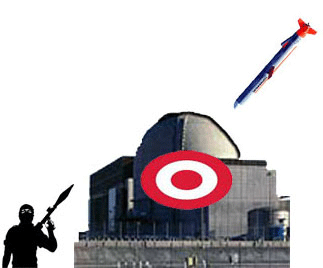
RUSI also points to the likelihood of increased targeting as more countries adopt nuclear power.
The use of military force near or against nuclear facilities represents an under-addressed threat to international peace and civilian safety, the report warns.
By Ciaran McGrath, Senior News Reporter,
https://www.express.co.uk/news/uk/2046553/terrifying-report-warns-uks-nuclear
Britain’s nuclear infrastructure is increasingly vulnerable to military attack as global tensions rise, a worrying new report has warned. The Royal United Services Institute (RUSI) study, published on Friday, highlights the growing risk of nuclear power plants being targeted deliberately or incidentally during armed conflict.
While the threat is not new, Russia’s occupation of Ukraine’s Zaporizhzhia Nuclear Power Plant (ZNPP) has shown how such facilities can become strategic objectives in modern warfare, with devastating consequences for civilian populations. Written by RUSI research fellow Darya Dolzikova, the report examines the “strategic and operational logic” behind targeting nuclear installations and urges military and political leaders to prepare for scenarios in which nuclear infrastructure comes under direct threat. It further warns that the use of military force near or against nuclear facilities represents an under-addressed threat to international peace and civilian safety.
Key motivations for attacks include disrupting an enemy’s energy supply, generating public fear, denying access to contested territory through radioactive contamination and halting nuclear weapons programmes.
In each case, the consequences for civilian safety, the environment and regional stability are severe.
RUSI also points to the likelihood of increased targeting as more countries adopt nuclear power.
Ms Dolzikova explains: “The expected growth of nuclear power in the global energy mix may increase the likelihood that future armed conflict will see greater targeting of nuclear energy infrastructure.”
The report outlines several recent examples of nuclear facilities being exposed to military activity, with Zaporizhzhia cited as the most significant.
It warns that even where nuclear plants are not the primary objective, they may lie on key axes of advance and become flashpoints by default.
In response, the think tank calls for urgent measures to improve such sites’ physical protection and operational resilience.
Recommendations include reinforcing legal prohibitions on attacks, integrating counter-CBRN (chemical, biological, radiological and nuclear) and air defence capabilities, and decentralising energy systems through smaller, modular reactors.
Crucially, the report highlights the psychological impact of nuclear threats.
t points out: “Such threats may be used as a ‘half-step’ between conventional and nuclear weapons – despite key differences in their normative and operational significance.”
The UK operates several nuclear power stations, including Sizewell B and Hinkley Point B, with new projects under development.
While no specific intelligence suggests they are under imminent threat, the report stresses the need for military planners to take the risks seriously and integrate safeguards into all aspects of defence strategy.
RUSI also urges governments to engage the public, building trust and preparing communities for possible emergencies without causing panic.
The report concludes: “Efforts must prioritise the establishment of trust between the population and authorities, and offer clear information and instructions.”
UK in talks to buy back nuclear sites from French firm EDF
Politico 25th April 2025
“Discussions are continuing” between the two governments on the U.K. acquiring three sites, an official told POLITICO.
LONDON — The U.K. government is in talks with its French counterparts about purchasing back three nuclear sites from state-owned energy giant EDF, as Whitehall looks to take control of the upcoming expansion of nuclear power.
U.K. ministers are discussing buying up Bradwell B, Heysham and Hartlepool, a French government official confirmed to POLITICO.
“There have been discussions. For the moment, no decision has been taken and discussions are continuing,” the official said.
Two senior industry figures based in the U.K., familiar with government planning and granted anonymity to discuss sensitive plans, also said negotiations over the purchase of the three sites were ongoing.
Energy Secretary Ed Miliband and French Minister for Industry and Energy Marc Ferracci discussed the negotiations on the margins of the International Energy Agency Summit in London earlier this week, the official added.
The account was disputed by the British government, with a post-publication statement from the Department for Energy Security and Net Zero saying: “We categorically do not recognise these claims.”
The next key moment could come in July as part of a proposed French-U.K. summit.
Any move to bring the sites into state ownership would come as the U.K. mulls the most ambitious revival of nuclear power in a generation.
At a conference last December, Miliband insisted nuclear was essential for an an “all of the above approach” to energy security and low-carbon power, and told investors “my door is open” for future nuclear projects, as the U.K. bids to hit its legally-binding target of net zero carbon emissions by 2050.
………………..The ‘obvious’ sites
All three sites are owned by French firm EDF, a company in which the French state is the sole shareholder, handed over in a deal struck in 2023.
An EDF spokesperson declined to comment on any discussions but said: “EDF would welcome developments that enable ongoing employment opportunities at our sites, once existing stations close.
…………….. The U.K. has not built a new nuclear power plant since Sizewell B was opened in 1995. The much-delayed Hinkley Point C is at risk of not being completed until 2031, and the government is still weighing up a final investment decision for sister plant Sizewell C.
Meanwhile Great British Nuclear (GBN), the arms-length body set up under the last Conservative government, is overseeing the final stages of the late-running competition to build mini-nukes in the U.K., known as small modular reactors (SMRs).
GBN owns two sites — Oldbury and Wylfa — which were brought into state ownership by former Chancellor Jeremy Hunt last year.
A decision on awarding SMR contracts is now expected this summer. If the government goes ahead with its plans to boost nuclear capacity and award SMR contracts to multiple bidding companies, it will need more than two sites to host the work.
“If the government are going to expand gigawatts [capacity] as well as SMRs, they’ll need more sites, and those [three sites] are the obvious ones left over from EN-6 [the U.K.’s shortlist for projects],” a third industry figure said.
Heysham and Hartlepool both include operating nuclear power plants, which are set for decommissioning in stages across 2027 and 2030 respectively.
By contrast, Bradwell B, once earmarked for new nuclear, is a now vacant plot of land. The site is still owned by EDF but is currently being leased by China General Nuclear (CGN) Power, which stopped advancing their mooted project in 2022.
This means any takeover of the site could include a payout to the Chinese state-backed company, in line with £100 million-plus buyout of CGN’s stake in Sizewell C in 2022.
The developments could also pave the way for Wylfa to be reserved for a third gigawatt scale power plant, alongside Hinkley Point C and Sizewell C.
https://www.politico.eu/article/uk-nuclear-sites-edf-energy-bradwell-b-heysham-hartlepool/
On Chernobyl Disaster Anniversary, Repairing Damaged Shield Poses ‘Enormous Challenge’
April 26, 2025 ,By RFE/RL’s Ukrainian Service, Stuart Greer and Oleh Haliv, https://www.rferl.org/a/ukraine-chernobyl-nuclear-disaster-anniversary-russia/33397012.html?fbclid=IwY2xjawJ6SqxleHRuA2FlbQIxMQBicmlkETE3RG9aSkhxNzhYNndQMGFFAR4zqGfz15XQZ8lgJtOhc7sSWq1aQn8M_cCUwEQ8_iwc4gjbpLOjfLqY7ftG6g_aem_uTOf_f4ZB8kKArzvpkNfYQ
As Ukraine marks the 39th anniversary of the world’s worst civilian nuclear accident at the Chernobyl power plant, engineers are struggling to find ways to repair the complex’s protective shield more than two months after a Russian drone left a large hole in the structure.
The massive steel dome was designed to protect and confine the radioactive remains of crippled reactor number four that exploded when a routine safety test went wrong on April 26, 1986.
Radiation levels outside the punctured shield have stayed normal since the drone attack, officials say.
But sealing the hole hasn’t been possible because it sits above the crumbling sarcophagus that encases radioactive debris from the reactor.
“How can you fix a roof space where the higher you go up in the building, the higher the radiation levels? They’re so high next to the actual sarcophagus, the reactor unit, that you can’t work above it,” says Shaun Burnie, a nuclear expert with Greenpeace.
Burnie was part of a Greenpeace team invited to Chernobyl to inspect the damage shortly after the February 14 drone strike which Moscow denied it was responsible for.
“It’s a very, very serious, enormous challenge for Ukraine at a time when it’s faced with so many other challenges, and so the international community really needs to step in and support.” says Burnie.
It took emergency crews three weeks to locate and extinguish fires that spread and smoldered through the membrane of the shield’s outer shell.
The new confinement structure was completed in 2019 as part of a $2.2 billion international project involving 45 countries. The temporary rail track used to install it over the reactor has since been dismantled, meaning the massive structure can’t be moved safely to the side for repairs.
The United Nations predicted the shield would “make the reactor complex stable and environmentally safe for the next 100 years.”
But long-term plans to safely dismantle the sarcophagus to allow the removal of radioactive ruins of the reactor are no longer possible following damage to the shield, according to Dmytro Humeniuk, an expert from Ukraine’s State Scientific and Technical Center for Nuclear and Radiation Safety.
The European Bank for Reconstruction and Development has earmarked $450,000 to assess the drone damage to the confinement structure.
Ukrainian Environment Minister Svitlana Hrynchuk estimates the preliminary results of the analysis should be completed sometime in May.
Repairs to the shield will be costly and Ukraine will need significant funding from international donors, predicts Burnie.
“They have to come up with a longer-term plan, which will be very extensive, very complicated, and potentially horrendously expensive.”
US nuclear giant Westinghouse pulls out of race to build Britain’s first mini-nukes

There are growing fears that the economics of SMRs could prove even harder to justify – because they have many of the same problems as large reactors – meaning security and waste disposal – but produce far less electricity and so make less money.
There are growing fears that the economics of SMRs could prove even harder to justify – because they have many of the same problems as large reactors – meaning security and waste disposal – but produce far less electricity and so make less money.
Westinghouse has not submitted its final bid for the UK’s SMR design competition
Matt Oliver, Industry Editor, https://www.telegraph.co.uk/business/2025/04/26/us-company-pulls-out-race-build-britains-first-mini-nuke/
US nuclear giant Westinghouse has pulled out of the UK’s small modular reactor (SMR) design competition.
The four companies remaining in the contest were given a deadline of mid-April to make their final bids, but The Telegraph understands that Westinghouse did not submit one following a negotiation process.
It means only three finalists – Rolls-Royce, GE-Hitachi and Holtec – remain in the running.
Great British Nuclear (GBN), the quango responsible for the SMR programme, was expected to announce two winners this summer with bidders told to prepare to build three to four mini reactors each.
Westinghouse did not deny it had withdrawn on Friday but declined to give its reasons.
One industry source suggested the company had baulked at the commercial offer made by the Government.
GBN previously advertised contracts worth £20bn in total for SMR “technology partners”, a figure that is understood to be based on the assumption two winners would be chosen.
However, The Telegraph revealed in February that the Government was considering awarding a contract to only one company as Rachel Reeves, the Chancellor, looks to make savings in her cross-departmental spending review.
The Chancellor is struggling to balance the books as weak economic growth makes it harder to meet her self-imposed “fiscal rules” for borrowing.
SMR supporters claim they could be a breakthrough in nuclear power because they would be made predominantly in factories and then assembled on site, cutting building times from around a decade to a few years. In theory this could cut costs – as would-be builders of SMRS have repeatedly promised..
Many politicians have snapped up that bait. When he opened the latest stage of the SMR competition, Mr Miliband said: “Small modular reactors will support our mission to become a clean energy superpower.”
However, the nuclear industry has a mixed record on bringing in key projects on time and on budget.
The biggest current example is the UK’s Hinkley Point C power station in Somerset which EDF originally said would cost under £20bn and be operating by now. Current costs estimates are for a final price approaching £50bn and a start-up after 2030.
There are growing fears that the economics of SMRs could prove even harder to justify – because they have many of the same problems as large reactors – meaning security and waste disposal – but produce far less electricity and so make less money.
A spokesman from the UK Energy Department said: “Great British Nuclear is driving forward its SMR competition for UK deployment. It has now received final tenders, which it will evaluate ahead of taking final decisions this spring.”
On Friday, a GBN spokesman declined to comment on Westinghouse’s position as did Westinghouse itself.
1 This Month
Chernobyl: The Lost Tapes – A good documentary on Chernobyl on SBS available On Demand for the next 3 weeks– https://www.sbs.com.au/ondemand/tv-program/chernobyl-the-lost-tapes/2352741955560

of the week–London Campaign for Nuclear Disarmament

Tell the Ukrainian Government to Drop Prosecution of Peace Activist Yurii Sheliazhenko
To see nuclear-related stories in greater depth and intensity – go to https://nuclearinformation.wordpress.com
-
Archives
- April 2026 (152)
- March 2026 (251)
- February 2026 (268)
- January 2026 (308)
- December 2025 (358)
- November 2025 (359)
- October 2025 (376)
- September 2025 (257)
- August 2025 (319)
- July 2025 (230)
- June 2025 (348)
- May 2025 (261)
-
Categories
- 1
- 1 NUCLEAR ISSUES
- business and costs
- climate change
- culture and arts
- ENERGY
- environment
- health
- history
- indigenous issues
- Legal
- marketing of nuclear
- media
- opposition to nuclear
- PERSONAL STORIES
- politics
- politics international
- Religion and ethics
- safety
- secrets,lies and civil liberties
- spinbuster
- technology
- Uranium
- wastes
- weapons and war
- Women
- 2 WORLD
- ACTION
- AFRICA
- Atrocities
- AUSTRALIA
- Christina's notes
- Christina's themes
- culture and arts
- Events
- Fuk 2022
- Fuk 2023
- Fukushima 2017
- Fukushima 2018
- fukushima 2019
- Fukushima 2020
- Fukushima 2021
- general
- global warming
- Humour (God we need it)
- Nuclear
- RARE EARTHS
- Reference
- resources – print
- Resources -audiovicual
- Weekly Newsletter
- World
- World Nuclear
- YouTube
-
RSS
Entries RSS
Comments RSS
 nuclear-news