How Miliband can make renewables cheaper – but there is really no alternative to renewables
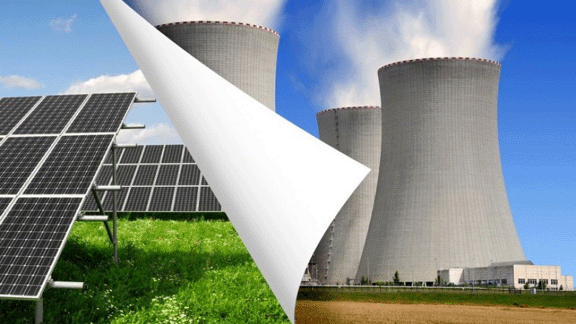
giving longer term contracts to renewable energy developers will make solar and wind schemes even cheaper
In a world where the costs of building all sorts of power plants are
increasing, the Government has a powerful card up its sleeve to keep down
the cost of new renewable energy projects. The Government is considering
extending the contract length under which new renewable energy projects
receive their fixed payments per MWh that is generated.
If contracts for
difference (CfDs) are issued to last for 20 years instead of 15 years, this
could reduce the price of power from the renewable projects by at least 10
per cent (according to my calculations). By offering lower annual returns
over a longer period, the projects can be delivered for a lower fixed price
per MWh that is generated. Such a cost reduction seems likely to offset any
temporary (Trump-induced) cost increases for renewables.
The ‘Trump
effect’ may have led Orsted to discontinue its massive 2.4 GW Hornsea 4
offshore wind project near East Anglia. However, some commentators such as
Jerome Guillet argue that Orsted should have planned better to avoid this
outcome. Other countries operating the CfD system for renewable energy
employ 20-year contracts, and it has always been a mystery to me why the UK
Treasury plumped for a 15 year period. This is an artificially short period
compared to the project lifetime of 25 or 30 years.
Hinkley C, by contrast,
was given a 35-year premium price contract. Meanwhile, the French
Government is pressing the UK Government to put more money into the
long-delayed construction of the Hinkley C power plant. This, it seems, is
part of the price for EDF agreeing to the construction of the successor
Sizewell C plant. This is even though Hinkley C was given a contract that
pays it over £130 per MWh in today’s prices.
That compares to the most
recent auctions of wind and solar PV, whose contracts are worth £71-£83
per MWh at 2025 prices. As I write this, there appears to be a standoff in
negotiations over the terms for Sizewell C between the British and French
governments.
Quite apart from the cost, the idea that nuclear power is
going to be delivered anytime soon is fanciful. The idea that so-called
small modular reactors are any sort of alternative to the big ones is
ridiculous. They are just more expensive still!
At the end of the day,
energy efficiency and renewables are the only real options. After all, over
90 per cent of the new generation being deployed in the world last year was
renewable, almost all of it being solar or wind. The reason this is
happening is that their costs are falling and they continue to fall.
Renewables are the present and future. We need more electricity to
electrify transport, heating, and much else. Sceptics may rail and sneer at
Miliband’s clean power programme. If it has any faults, it is because it
is too mainstream, wasting money and time on carbon capture and storage and
nuclear power.
Dave Toke’s Blog 8th May 2025 https://davidtoke.substack.com/p/how-milband-can-make-renewables-cheaper
Atomic lobby seizes on Spanish blackout
Spain has rejected claims that
more nuclear power would have helped as recriminations erupt over last
week’s outage. Europe’s nuclear advocates are pushing their favorite
energy source as a deterrent against the type of blackout that seized Spain
and Portugal last week — even if the facts paint a muddied picture. The
EU’s atomic allies are claiming that having more nuclear energy coursing
through the grid can help ensure a stable power supply to back up renewable
sources like wind and solar. “If you want a lot of power and you want it
to be fossil-free, then nuclear is your pick,”
Swedish Industry and
Energy Minister Ebba Busch said in an interview. Specialists and other
officials, including those in Spain, aren’t convinced. While they concede
that having more overall power can aid in certain circumstances, they
aren’t convinced nuclear energy would have prevented Monday’s outage,
which was caused by a sudden loss of power in the Iberian grid. Europe’s
grids, like those in Spain, need upgrades, better linkages and more storage
tech like batteries to keep power stable, they stress.
Politico 8th May 2025 https://www.politico.eu/article/nuclear-power-push-europe-spain-portugal-outage-energy-security/
Russian drone strike caused tens of millions worth of damage to Chornobyl
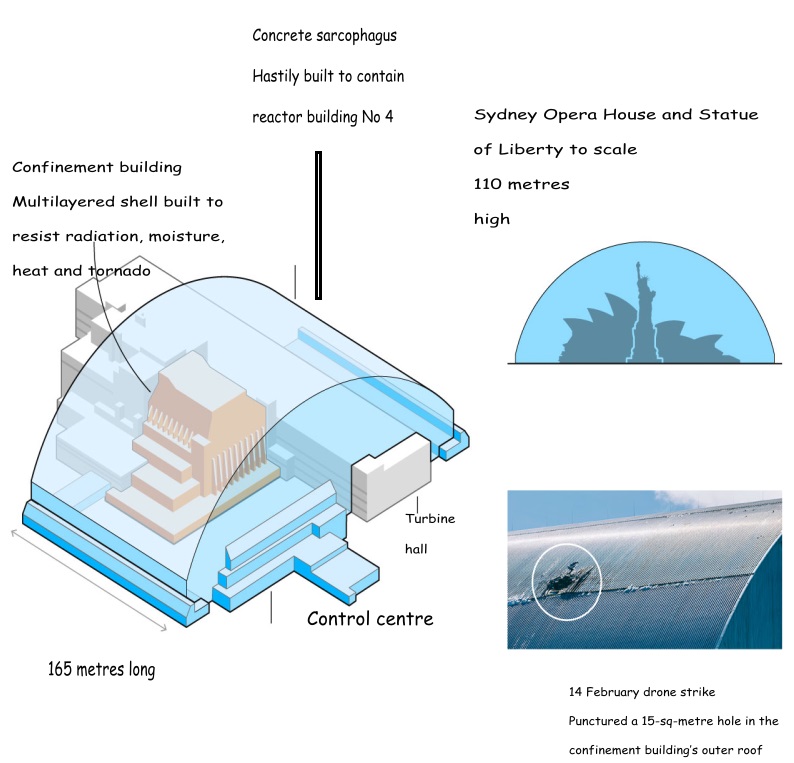
Attack damaged €1.5bn containment structure over nuclear reactor with repair costs likely to be borne by western governments
Russian drone strike caused tens of millions worth of damage to Chornobyl
Attack damaged €1.5bn containment structure over nuclear reactor with repair costs likely to be borne by western governments
Dan Sabbagh in Chornobyl. Photography by Julia KochetovaWed 7 May 2025
A Russian Shahed drone costing up to £75,000 is estimated to have inflicted tens of millions worth of damage to the site of the Chornobyl nuclear power plant, according to initial assessments and engineering experts.
The cost of a full fix is likely to be borne by western governments including the UK, because initial estimates are that a complete repair will cost more than the €25m available in a special international contingency fund.
The strike in mid February did not cause an immediate radiological risk, but it significantly damaged the €1.5bn containment structure built in 2017 to encase the destroyed reactor and is likely to take months if not years to completely repair.
The 110-metre high steel structure at Chornobyl was hit before 2am on 14 February, with sensors registering “something like a 6 to 7 magnitude earthquake,” according to Serhiy Bokov, the chief engineer on duty. “But we clearly understood it wasn’t that,” he said.
The attack – quickly concluded to be caused by a drone flying below at a level where it could not be detected by radar – punctured a 15-sq-metre hole in the outer roof. It also caused a particularly damaging, complex smouldering fire to the inner cladding of the structure that took over a fortnight to put out.
Consisting of two double arches and longer than two jumbo jets, the New Safe Confinement (NSC) was completed in 2017 to secure the hastily built, unstable Soviet-era sarcophagus, which covers over Chornobyl’s ill-fated reactor number four, the site of the world’s worst nuclear disaster in April 1986.
But the attack in February has rendered the sarcophagus open to the elements again, meaning that radioactive dust could get out and rainwater in, though the country’s environmental protection ministry says “the radiation background is currently within normal level and is under constant control”.
More significantly, the confinement structure is now more vulnerable in the longer term to rusting due to greater exposure to the elements and damage to the cladding. Two hundred small boreholes were also drilled into the structure in the effort to douse the cladding fire with water.
“Not fixing it is not an option,” said Eric Schmieman, an American engineer who worked on the design and build of the Chornobyl shelter for 15 years. A complete repair, he said would “cost a minimum of tens of millions of dollars and it could easily go to hundreds of millions” with the repairs taking “months to years,” he added.
Previously the shelter was intended to have a 100-year design life, allowing time to decommission the sarcophagus and nuclear waste below, but this is now in doubt without it being repaired, Schmieman added. Unlike other large metal structures, such as the Eiffel Tower, it was never possible to repaint it to prevent corrosion.
Below the sarcophagus lies a highly radioactive lava like mass, a mix of 200 tonnes of uranium from Chornobyl reactor number four and 5,000 tonnes of sand, lead and boric acid dropped on to the site by Soviet helicopters in the immediate aftermath of the disaster caused by the reactor going out of control.
A more detailed impact assessment is expected to be released in May, but the European Bank for Reconstruction and Development (EBRD), which funded the building of the shelter and is involved in the post bombing analysis, said “it is clear that the attack has caused significant damage”.
Other sources, familiar with the assessment exercise, told the Guardian that Schmieman’s estimates appeared correct. Though the EBRD holds €25m in funds to allow for emergency work, it said “significantly more funding is required” to tackle long-term decommissioning challenges thrown up by the incident…………………………………………………
Further cash for repairs is most likely to come from western governments. Twenty-six countries contributed to the cost of the original shelter, including the US, UK, France, Germany and even Russia – of which the vast steel arch structure cost €1.5bn out of a total €2.1bn fund. Others also made donations, including Turkey.
Home to the remains of a nuclear reactor that went out of control and exploded in April 1986, the Chornobyl site is seven miles from the border with Russia’s ally Belarus. It was occupied by Russian soldiers trying to capture Kyiv in February 2022, and has remained on the frontline after Ukraine regained it that April……………………………………………….
Remotely operated cranes hanging from the confinement shelter were intended to dismantle the sarcophagus and nuclear material below, and the strike hit a point near the maintenance garage Bokov said. That too may impair the plans to gradually dismantle and decommission the disaster site below……………………………….. https://www.theguardian.com/world/2025/may/07/russian-drone-strike-caused-tens-of-millions-worth-of-damage-to-chornobyl
Zaporizhzhia: Hurdle or catalyst for a peace deal in Ukraine?
May 6, 2025, Henry Sokolski , https://npolicy.org/zaporizhzhia-hurdle-or-catalyst-for-a-peace-deal-in-ukraine/
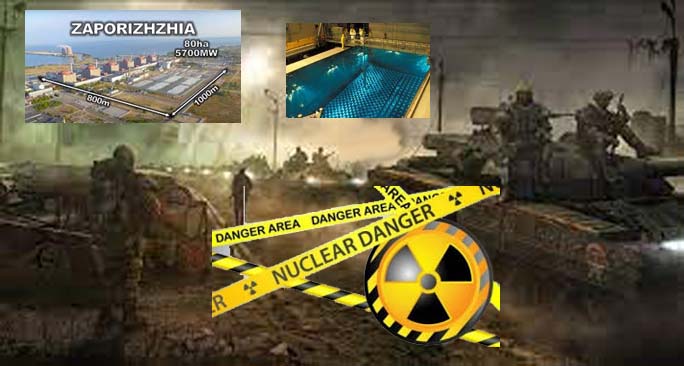
In all the peace proposals the United States, Russia, Europe, and Ukraine have made public, one item always shows up: the reopening of the damaged six-reactor Zaporizhzhia nuclear plant. Washington wants to rebuild and operate it, Moscow insists the plant is theirs, and Kyiv says that it must remain Ukrainian. But, it will be to restart the plant.
Russia insists it can get at least one of the reactors up and running within several months. The United States has no timeline. Ukraine says, even with a solid peace and full control over the plant, bringing all six reactors back online would still take two years or more. No one has ventured how much any of this would cost.
And, there are additional challenges. Russia destroyed the Kakhovka Dam upstream of the plant. Now, what would be required to assure a steady clean supply of cooling water for the reactors? The Russians also laid mines around the plant; the area is also laced with unexploded ordnance. How will these munitions be neutralized? Who will do it? The Russians have looted and damaged much of the plant’s control equipment. How will it be repaired and replaced? Who will certify that the work has been done properly? The U.S. Nuclear Regulatory Commission? The Ukrainian State Nuclear Regulatory Inspectorate? Rosatom?
More than 75 percent of Zaporizhzhia’s nuclear staff no longer work at the plant. Can they be replaced? Who will replace them? Then, there’s the challenge of rebuilding all of the damaged power lines and transformers necessary to export any electricity from the site. Where will the electricity be sent? Ukraine? The European Union? Russian territories? Who will pay for all of this work? Who will be held responsible if there are accidents? Who will defend the plant against future attacks? The United States? Ukraine? Russia? The EU?
There are even more questions than these. But as I make clear in the attached piece, we need to get the answers if we want the situation with Zaporizhzhia to be anything other than a hurdle to reaching any lasting peace.
……… Power for whom and at what cost? Even if the Zaporizhzhia reactors could be safely restarted, the problem of distributing the plant’s power remains. Before the war, Zaporizhzhia helped feed Ukraine’s electrical grid and exported surplus power to Europe. Now, the infrastructure connecting the plant to customers is shattered. Transmission lines must be rebuilt. Substations and transformers need replacement. Technical adjustments will need to be made and agreements negotiated over where the electricity will go and how: western Europe, southern Ukraine, or to Russian-controlled territories?
Another question is who will pay for all this work? Will seized Russian assets foot the bill? Or will it be European Reconstruction Bank funds? What of US investment, taxpayer funds, and any private entity potentially interested in chipping in? Once funds are allocated, who would receive the profits, if any, or be responsible for the losses? Who would assume responsibility for possible accidents and damage to property beyond the plant’s site? And, finally, who will bear the costs of ensuring the plant’s security so that its reactors do not become again the targets of future attacks? None of this is yet clear.
As Ukraine, the United States, and Russia have all made refurbishing and operating Zaporizhzhia a condition for peace, dodging these questions is a prescription for mischief. Without clear answers, resurrecting Zaporizhzhia could become more of an obstacle to than a catalyst for peace.
Henry Sokolski is executive director of the Nonproliferation Policy Education Center in Arlington, Virginia, served as Deputy for Nonproliferation Policy at the Pentagon (1989-93), and is author of China, Russia and the Coming Cool War (2024).
Westinghouse drops out of UK SMR competition
Nuclear Engineering International 30th April 2025, https://www.neimagazine.com/news/westinghouse-drops-out-of-uk-smr-competition/
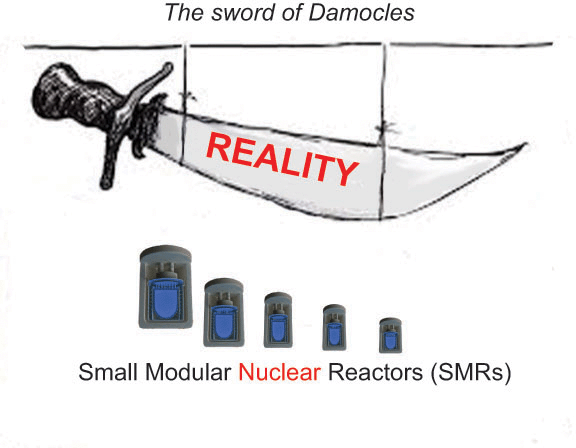
S Westinghouse has pulled out of the UK’s small modular reactor (SMR) design competition, according to the UK The Telegraph.
Earlier in April, three of the four competition finalists in Great British Nuclear’s (GBN’s) small modular reactor (SMR) competition submitted their final tenders. The four finalists received an Invitation to Submit Final Tender (ISFT) in February – GE-Hitachi Nuclear Energy International, Holtec Britain, Rolls-Royce SMR, and Westinghouse Electric Company.
GEH (part of GE Vernova) proposed its BWRX-300 boiling water reactor; Holtec proposed its SMR-300 – a 300 MWe pressurised water reactor (PWR); the Rolls-Royce SMR is a 470 MWe PWR; and the Westinghouse AP300 is a 300 MWe/900 MWt PWR. Westinghouse, however, failed to submit its final tender.
GBN was expected to announce two winners this summer with bidders told to prepare to build three to four mini reactors each. The winners will be awarded contracts to co-fund further design development as well as the necessary regulatory, environmental and site-approvals before a final investment decision is taken in 2029. The contracts are expected to total £20bn ($26.7bn) – £10bn each if two companies are selected.
However, The Telegraph reported in February that the Government was considering awarding only one contract as Rachel Reeves, the Chancellor “is struggling to balance the books as weak economic growth makes it harder to meet her self-imposed ‘fiscal rules’ for borrowing.
According to The Telegraph, Westinghouse did not deny it had withdrawn but declined to give its reasons. “One industry source suggested the company had baulked at the commercial offer made by the Government.”
A spokesman from the UK Energy Department said: “Great British Nuclear is driving forward its SMR competition for UK deployment. It has now received final tenders, which it will evaluate ahead of taking final decisions this spring.”
There is growing concern that the economics of SMRs could prove even hard to justify at the high costs for the initial four units. None of the bidders has built their designs which are still in development. All SMRs in the GBN competition will be first-of-a-kind units (FOAK), which will push up costs.
Commenting on the issue, Neutron Bytes noted: “Most estimates are that economies of scale based on factory production of SMRs, promised by all four vendors, only kick in when order books come in “fleet mode,” e.g. by the dozen or more. It follows that even £10bn could be insufficient to cover the costs of four units any of the three 300 MWe offerings based on their status as FOAK projects.”
It added: “Splitting the difference for the GBN competition, e.g. awarding one winner £10bn, keeps the SMR initiative alive, but does nothing to promote long-term “fleet mode” production of SMRs which the UK nuclear industry points out is the only way to achieve economies of scale with factory production of SMRs.”
Sellafield’s massive water abstraction plan for its new construction work has no environmental impact assessment and inadequate monitoring
Sellafield blithely apply to the Environment Agency for new water abstraction and in the same application admit that they have already contaminated the freshwater aquifer beneath them
Lakes against Nuclear Dump and NFLA , Marianne Birkby, May 07, 2025
Campaigners concerned that Sellafield’s water abstraction plan has no environmental impact assessment and inadequate monitoring
In a recent response to an Environment Agency consultation on a application by Sellafield Limited to extract water to support construction work at the site, campaigners at Lakes against the Nuclear Dump [LAND], a campaign of Radiation Free Lakeland, and the UK/Ireland Nuclear Free Local Authorities have expressed concerns that no environmental impact assessment has been carried out and that plans to monitor contamination in discharges are inadequate.
Sellafield plans to extract an additional 350,000 cubic metres of water a year from the Lake District to support the construction of new facility to repackage radioactive waste, whilst proposing to discharge almost a million litres of contaminated water every day into the River Calder and out into the sea. This for an indefinite and uncertain period.
LAND and the NFLAs are concerned that this will be done without an Environmental Impact Assessment being carried out and with no proper plans in place to monitor the discharged water, adding to fears that the work will lead to yet more radioactive contamination in the already fragile local environment.
Sellafield may believe that the discharges are safe and within legal limits, but the two campaign groups do not subscribe to the view that there is a safe limit when it comes to radiation and in recent years there have been large research studies demonstrating the cumulative effects of low-level, but legal, radiation on human health.
Who are Britain Remade?

Britain Remade is a Tory think-tank and lobby group campaigning on behalf of nuclear power.
By Mike Small, https://bellacaledonia.org.uk/2025/05/01/who-are-britain-remade/
There’s a concerted attempt to attack Scotland’s long-standing commitment to no new nuclear power, alongside a full-scale assault on the idea of Net Zero, and the very basics of climate policy (however inadequate mainstream policy is).
This is being led by Nigel Farage who has called Net Zero ‘the New Brexit’, whatever that means. All this has been echoed by Tony Blair’s intervention this week where he argued that any attempt to limit fossil fuels in the short term or encourages people to limit consumption is “doomed to fail”. Alongside this we can see Scottish Labour’s recent commitment to the cause of new nuclear power in Scotland.
Today The Scotsman ran with a front-page splash all about how ‘SNP voters back nuclear power’ by Deputy Political Editor David Bol and Alexander Brown.
he article was replete with quotes from Labour MSP for East Lothian, Martin Whitfield, Scottish Conservative MP, John Lamont, who said the Scottish Government embracing nuclear power would be “basic common sense”. Then there’s a quote from Sam Richards, founder and campaign director for Britain Remade, who, it turns out commissioned the poll and was also enthusiastically pro-nuclear.
What The Scotsman didn’t explain though, was who ‘Britain Remade’ are? They’re presented as if they’re maybe pollsters or some independent think-tank.
But Britain Remade is a Tory think-tank and lobby group campaigning on behalf of nuclear power. Jason Brown is Head of Communications for Britain Remade, a former No. 10 media Special Adviser and Ben Houchen’s comms Adviser.
Jeremy Driver is the Head of Campaigns at Britain Remade, a former Lloyds Banker and Parliamentary Assistant to Ann Soubry. Sam Dumitriu is Head of Policy at Britain Remade who formerly worked at the Adam Smith Institute. These are Tory SPADS working on their own campaign to support new nuclear in Scotland: Lift The Ban On New Scottish Nuclear Power.
Britain Remade claimed they are not affiliated: “We’re an independent grassroots organisation. We are not affiliated with, or part of, any political party” their website says. They may not be officially affiliated to any party, but it’s very clear where their politics (and their staff) come from.
So here we have the Scotsman giving over its front-page to a Tory lobby group to promote their campaign. On the same day they published a similar piece in the Telegraph “SNP’s ‘senseless’ nuclear ban ‘damaging Scotland’” so it’s really working for them.
This is not just a question of client journalism, it’s a question of how far right-wing forces, often working with dark money, will attempt to derail even the most modest (and completely inadequate) environmental policies. Quite why Saudi-funded Tony Blair should jump on the anti Net Zero bandwagon is anybody’s guess, but it’s quite clear there is a coordinated pro-nuclear lobbying group in action in Scotland that pans across the Conservatives and Labour parties, and is supported by astroturf groups and pliant media friends. Watch this space for more on the new nuclear lobby.
‘Sitting ducks’: the cities most vulnerable to climate disasters.

Extreme weather means wildfires and flooding are becoming more likely,
posing a risk to urban areas around the world. Kostas Lagouvardos and his
colleagues at the Penteli Observatory, which offers sweeping views of
Athens, are what you would call experts on wildfires. They have spent
decades researching the link between meteorological conditions and deadly
infernos, as well as tackling the challenge of forecasting when and where
the disasters might happen.
But even they were caught off-guard by the
wildfire that arrived at their door last August. “It was ironic,” says
Lagouvardos, research director at the Institute for Environmental Research
and Sustainable Development at the National Observatory of Athens. The
Penteli site, which forms part of the NOA and is home to the historic
Newall refractor telescope, was almost engulfed by a blaze that spread from
nearby Mount Pentelicus. Flames whipped around the grounds, coming within
metres of the astronomy tower and other buildings, as helicopters dropped
water from above and firefighters below battled to save the crucial
scientific site. The observatory buildings were spared, but its nearest
neighbour was badly damaged, as were many other buildings in the area. One
person died.
The fact that a wildfire came so close to the very building
where scientists had long attempted to understand the phenomenon highlights
the key challenges for cities around the world as extreme weather
intensifies. Not only are wildfires becoming more common, they are
difficult to predict and are spreading ever closer to densely populated
urban areas. Just last week, Israel’s Prime Minister Benjamin Netanyahu
warned that wildfires in the country were at risk of reaching Jerusalem.
Athens, like other big cities including Dallas, Lisbon, Sydney and Cape
Town, are what some scientists refer to as “sitting ducks”. In these
places, the climate and geographical conditions mean they are extremely
vulnerable to global warming-related disasters.
This could be wildfires,
like those in Los Angeles in January, but also flooding, as seen in
Valencia last year. In some cases, one can follow the other. These
so-called sitting ducks “haven’t had an extreme event” so far, says
Erin Coughlan de Perez, a professor at Tufts University, an expert in
climate risk. “They’ve got lucky.” But the odds might be against
them.
With 2025 expected to be one of the hottest on record, despite a
cooling La Niña weather phenomenon earlier this year, scientists warn of a
rising risk of climate-related disasters. Climate change is causing a rise
in extreme heat, which helps fuel wildfires, while hotter temperatures can
also lead to more intense rainfall and flooding, because warmer air holds
more moisture.
FT 5th May 2025,
https://www.ft.com/content/57835a0c-9e58-4c1a-9c5a-f6a4cbe3f748
Dispatch from France | May ’25

Clean Energy Wire, 02 May 2025, Camille Lafrance
Against the backdrop of the major blackout on the Iberian Peninsula in late April, which also affected parts of France, the country is heading for controversial discussions about its energy strategy for the coming decade. A focus will be on the future roles of renewables and nuclear power. The launch of France’s new generation of nuclear power plants was postponed for several years, while the country’s older reactors continue to cause problems.
- Delay to new generation of nuclear power plants – France’s new generation of nuclear power plants (known as EPR2) is set to go online three years later than previously planned. It is now meant to become operational by 2038, instead of 2035. EPR2 reactors are supposed to be simpler and cheaper to build. The EPR2 programme will be financed by a government loan, which should cover at least half the construction costs. EDF has called for more state money in order to reign in debt.
- Uranium supply and diplomacy – France could lose a large part of its uranium stockpile in Niger as that country’s hostile military leadership might sell it to Russia or China. The mine was operated by French state-owned uranium company Orano’s local subsidiary until the end of 2024. France is entirely dependent on uranium imports. In response, state-owned uranium company Orano is planning to mine the raw material needed for France’s fleet of 57 nuclear reactors in Uzbekistan………………………..
- The Flamanville saga continues – A new malfunction at the controversial Flamanville nuclear power plant has reignited a debate about the future of France’s ageing fleet of nuclear reactors. One of its reactors suffered a steam leak in late March. The incident occurred just one week after the reactor returned to the grid following a two-month maintenance shutdown. The plant already has a twelve-year history of delays and a ballooning budget (from 3.3 billion to 13.2 billion euros)………………………………….. https://www.cleanenergywire.org/news/dispatch-france-may-25
US-Ukraine minerals deal ‘hides secret agreements’ – Ukrainian MP
2 May 25 https://www.rt.com/news/616662-ukraine-us-deal-secret-agreements/
Separate provisions outline Kiev’s “indefinite obligations” and bypass parliamentary ratification, Irina Gerashchenko has claimed.
The US-Ukraine minerals agreement announced this week “hides” details of Kiev’s “indefinite obligations” to Washington, a Ukrainian lawmaker has claimed.
In a Facebook post on Friday, Irina Gerashchenko, a member of European Solidarity party said the deal includes two “secret,” supplementary documents that will not be subject to parliamentary ratification.
The minerals deal reportedly grants the US preferential access to Ukrainian mining projects in exchange for assistance with an investment fund to support the country’s reconstruction. Initially portrayed by Washington as repayment forbears of military support – estimated at $350 billion by President Donald Trump – the final text, published on Thursday by the Ukrainian government, states that only future aid will count toward US contributions to the fund.
Gerashchenko claimed however that instead of one agreement, the US and Ukraine signed three.
“The Zelensky government has not provided deputies and society with all the agreements signed in the US, which, as it turned out, are three, not one,” she wrote. “Meanwhile, they want to ratify only one framework document in the Verkhovna Rada. Others are labeled ‘implementation documents,’ despite the fact that it is in these two secret agreements that all the technical details of indefinite Ukrainian obligations are hidden.”
Ukrainian Prime Minister Denis Shmigal “avoided” commenting on the two documents and the lack of security guarantees in the published agreement – reportedly a key point of contention during negotiations – Gerashchenko told the country’s parliament on Friday.
The claim has raised questions among Ukrainian lawmakers and the public on the actual scope of the agreement. MP Yaroslav Zheleznyak claimed on Telegram that, when pressed, Shmigal acknowledged the two additional documents but downplayed them as “technical” and exempt from ratification. The texts “must be signed after the ratification” of the main agreement, Shmigal claimed, noting that lawmakers would see them when the Ukrainian negotiating team returns from the US next week.
Western media reports have also noted the existence of additional documents and claimed that a last-minute dispute arose when Washington demanded Kiev sign all three. Ukrainian officials reportedly argued they could not sign the annexes until the main agreement was ratified in Parliament. Later reports suggested all three documents were ultimately signed.
Further details about the contents of the supplementary documents have not been publicly released, and the Ukrainian government has not issued an official statement addressing their existence or content.
Need to use nuclear weapons has not arisen in Ukraine, says Putin

Russian leader says he hopes nuclear strikes ‘will not be required’ in state TV film about his 25 years in power.
Angelique Chrisafis and agencies, 5 May 25, https://www.theguardian.com/world/2025/may/04/need-to-use-use-nuclear-weapons-has-not-arisen-in-ukraine-says-putin
The Russian president, Vladimir Putin, said in comments broadcast on Sunday said that the need to use nuclear weapons in Ukraine had not arisen, and that he hoped it would not.
Speaking in a film by Russian state television about his 25 years in power, Putin said that Russia has the strength and the means to bring the conflict in Ukraine to what he called a “logical conclusion”.
Responding to a question from a state television reporter about Ukrainian strikes on Russia, Putin said: “There has been no need to use those [nuclear] weapons … and I hope they will not be required.”
Fear of nuclear escalation has been a factor in US officials’ thinking since Russia invaded Ukraine in early 2022. The former CIA director William Burns has said there was a real risk in late 2022 that Russia could use nuclear weapons against Ukraine.
In autumn 2022, the US was so concerned about the possible use of tactical nuclear weapons by Russia that it warned Putin over the consequences of using such weapons, Burns has said. At the same time, the Chinese leader Xi Jinping also warned Putin not to resort to nuclear weapons.
Putin signed a revamped version of Russia’s nuclear doctrine in November 2024, spelling out the circumstances that allow him to use Moscow’s atomic arsenal, the world’s largest. That version lowered the bar, giving him the option of using nuclear weapons in response to even a conventional attack backed by a nuclear power.
The US president, Donald Trump, has said he wants to end the conflict via diplomatic means, raising the question of whether Putin was willing to negotiate a peace settlement. But the Kremlin has rejected calls by Kyiv and Washington for an unconditional 30-day ceasefire.
Putin, in February 2022, ordered tens of thousands of Russian troops to invade Ukraine. Moscow’s forces now control about 20% of Ukraine, including parts of the south and east.
In the carefully choreographed state television film, Putin was shown in his private Kremlin kitchen offering chocolates and a fermented Russian milk drink to the Kremlin correspondent, Pavel Zarubin.
Putin, a former KGB lieutenant colonel who was handed the presidency on the last day of 1999 by an ailing Boris Yeltsin, is the longest serving Kremlin leader since Joseph Stalin, who ruled for 29 years until his death in 1953.
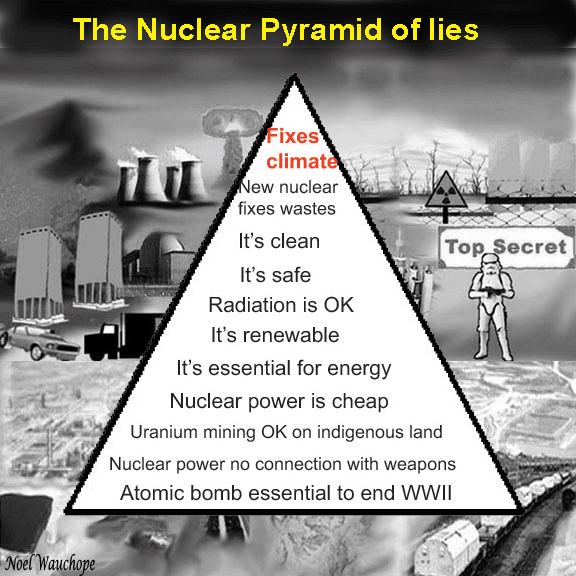
Scotland does not need nuclear power and people aren’t being told the truth
Commonweal 1st May 2025,
https://www.commonweal.scot/daily-briefings/briefing-r57be
The nuclear industry has one of the most aggressive lobbying and public relations campaigns of all energy sources. It pushes relentlessly on politicians and the public to support the merits of nuclear power based on partial or inaccurate information. Very often this goes unchallenged in the Scottish media.
Given that nuclear power presents itself as a pragmatic response to decarbonising energy and given the scale of the PR campaign, it is perhaps not enormously surprising that SNP voters appear to split with their party over this issue. But would they continue to support nuclear power if they knew the numbers?
Here are some stark realities. The cost of generating of electricity from renewable sources is £38 to £44 per MWh. The estimated cost of the same electricity from nuclear (at the new Hinkley Point C reactor) in 2025 is £150 per MWh. It can only be presumed that the participants in this survey were not told that generating electricity would become between three times as expensive with nuclear.
But even that hides the true costs. Nuclear power is very dangerous and, at the end of its lifecycle, is very complex to decommission and make safe. Every spent rod of nuclear fuel takes a full ten years simply to cool down. They must be immersed in a deep pool of cold, constantly-circulating water and monitored closely for ten years just to bring them down to a cool enough temperature that they can be processed.
That’s just the ongoing fuel. The complexity of decommissioning and entire nuclear power plant is significantly greater. In fact the current estimate of the cost for decommissioning nuclear power is about £132 billion. That is not paid for by consumers in their electricity bill – it is paid for by consumers through their tax.
This is the second stark reality that nuclear power works hard to conceal; not only is it three times as expensive as renewables to run, there is then a cost of at least £4,600 for every household to decommission the nuclear power plants and make them safe for the future.
Of course, safety is another issue here. Nuclear power stations are very vulnerable. They are extremely sensitive sites which require substantial long-term attention. There are currently concerns around the world that unreliable power supplies could mean existing plants may struggle to keep spent fuel rods from combusting if they cannot constantly and continually keep large amounts of cold water circulating round spent fuel.
Nuclear power stations do not like loss of electricity, especially for any extended period of time. This makes them very climate-vulnerable. And of course who knows what sorts of extreme weather we may face before the lifetime of a nuclear station is complete. Fukushima is not a cautionary tale for no reason.
And it is uncomfortable to dwell on the risks of nuclear sites if they become targets for terrorism or in war. No-one is expressing continent-wide anxiety over the threat-to-life status of Ukraine’s wind turbines; they absolutely are over the shelling of Ukrainian nuclear power stations.
The remaining case for nuclear is to provide ‘electricity baseline’ – the ability to bring electricity provision on and off line as renewable generation rates rise or fall (if the wind does blow), or during periods of peak demand. This just isn’t really honest – nuclear power does not like rapid changes in supply and are designed to run flat out, all the time, not least because costs rise rapidly if they are running at less then full power. You can’t just ‘turn them on and off’. So yes, they can provide baseline electricity but not ‘on demand’ electricity that can balance renewables.
Hydrogen storage can though. Scotland currently dumps enormous amounts of perfectly useable electricity in the ground if it is generated when there is no demand. This can be turned into hydrogen and then, on demand, converted back into electricity. At the moment the cost of electricity from hydrogen is about half as much again that of generating by nuclear. But there are big caveats to that.
First, the current hydrogen electricity price is about £230 per MWh, but this is a rapidly-developing area of technology and the current industry target is £100 per MWh. That makes it cheaper than nuclear. Second, there is no hidden capital cost – the incredible costs of building and decommissioning nuclear which are hidden from consumers by subsidy from tax just isn’t there for hydrogen. It is a simple technology.
Third, these costs all assume that you are generating hydrogen from electricity at full wholesale grid prices. But if you are using electricity that would otherwise be dumped because it is being generated at the ‘wrong time’, the hydrogen becomes a waste product. It is in practice much cheaper than nuclear and can supply long-term baseline. (Battery storage for short term is even cheaper.)
That is the reality that respondents in this poll were not given. Try the poll again with ‘do you want to pay three times as much for your electricity with an additional costs to your household of £4,600 to have unsafe nuclear power when renewables with hydrogen storage are cleaner, cheaper and safer’.
Consistent, reliable renewable energy isn’t hard to solve in Scotland. There are nations where nuclear may have to be part of a clean energy solution, but Scotland is not one of them. You need to withhold a lot of information from people to make them believe the wrong thing about nuclear.
EDF seeks joint financing for UK projects

April 30, 2025, https://www.neimagazine.com/news/edf-seeks-joint-financing-for-uk-projects/?cf-view&cf-closed
DF is seeking to consolidate financing for the Hinkley Point C and Sizewell C NPPs under construction in the UK. French Energy Minister Marc Ferracci told the Financial Times that they should be treated as one financial venture in negotiations. He said he had discussed the issue with UK Energy Minister Ed Miliband on the sidelines of a conference in London.
“France and EDF are very committed to deliver the projects but we have to find a way to accelerate them, and we have to find a way to consolidate the financial schemes of both projects,” he said.
Both projects started out with equity stakes from Chinese state-owned nuclear development corporations but the UK government cancelled the arrangements because of “security issues”. The UK government partly replaced the funding and is seeking support from institutional investors.
Ferracci denied that the French government intended to use Sizewell as “leverage” against the financial troubles at Hinkley. “It is not a discussion about leverage, it is a discussion between friends and allies. . . So there is a way through, and I hope we will be able to find it in the next few months.”
He also called for a global solution that would result in a deal that benefitted EDF’s returns across both schemes. “It is a good approach to have a global approach to our relationship,” Ferracci said, adding more “grid connections between France and the UK” could come into the negotiations.
Meanwhile, workers at the Hinkley Point C NPP construction site are complaining about a significant rat infestation, raising health and safety concerns. In early April, the Unite and GMB trade unions at Hinkley Point C told EDF that the facility was overrun with rats. The unions said immediate action was needed as the rodents were “everywhere”. In recent months, workers have also complained about poor working conditions and low pay. In addition, hundreds of project staff went on strike in November over the inadequate security access to the site.
May Day – How Hot is Too Hot for a Ferociously Hot Nuclear Dump Under the Irish Sea-Bed?

The Developer, Nuclear Waste Services is a Government body and also a limited liability company.
Marianne Birkby, May 01, 2025
Received this today – it is not at all reassuring and underlines why we must RESIST THE NUCLEAR DUMP PLANS.
Nuclear Waste Services (The Developer) says the seabed will have “no significant temperature rise” once atomic wastes are placed in the geology beneath. What Nuclear Waste Services mean by “significant” is not stated. Any temperature rise AT ALL on the seabed would be hugely damaging.
Regarding uplift of the sea-bed from radioactive gases and thermal heating the reply is: “GDF design and other controls on management of the thermal output of waste, as noted above, will prevent disruptive uplift of the seabed from the heat output of waste.”
These inevitable impacts due to the thermal heating of abandoned atomic wastes (currently cooled by freshwater at Sellafield) are not mentioned by Nuclear Waste Services in their propaganda literature. The already vulnerable seabed and ocean gets no say in the matter of a deep sub-sea nuclear dump. Propaganda of “safe, permanent disposal” is aimed at the deliberately narrowed down “Areas of Focus” for the above ground mine shafts and nuclear sprawl facilitating a “geological disposal facility. ” Nuclear Waste Services are ignoring/playing down all impacts in their public disinformation campaign, including the thermal impacts of A GDF/deep hot nuclear dump up to the size of Bermuda in the geology beneath the Irish Sea-bed. From their point of view why would they bring to people’s attention the ferocious heat of the atomic wastes or the likely impacts on the sea-bed and ocean?
Email received today -1st May
OFFICIAL
…………………. The reports and summary below provide information on the specification, evolution and illustrative disposal concepts for heat generating wastes:
High Heat Generating Waste (HHGW) Specifications – GOV.UK
Technical Background to the generic Disposal System Safety Case
NDA Report no DSSC/451/01 – Geological Disposal – Waste Package Evolution Status Report
https://midcopeland.workinginpartnership.org.uk/news-from-nws-high-heat-generating-waste-qa
1. How hot would be too hot?
The design of the Geological Disposal Facility (GDF) will take account of the thermal output of heat generating waste such that it does not adversely impact the engineered barriers (backfill, plugs, seals) and containment function of the host geology (its ability to limit the migration of radioactivity). This is achieved by passive means, for example, by appropriate design of the container, disposal tunnels or vaults, and spacing of containers. Nuclear Waste Services will set a limit on the peak temperature of the GDF system and waste packages to assure the integrity of the waste, waste container, engineered barriers and host rock. The limits adopted by international programmes are typically in the range of 100oC – 200oC. Heat generating waste, such as spent nuclear fuel and high-level waste glass, will have been cooled over several decades during interim storage, so as to meet the temperature limit set for acceptance to a GDF. This storage practice is already underway at Sellafield.
2. How long would it take for thermal heating to reach the seabed
At the depth of GDF construction (200 – 1000 m) heat will diffuse slowly into the engineered barriers and host rock. Peak temperatures will occur in the centuries immediately following closure as the GDF system equilibrates. However, the thermal output and temperature of waste packages decreases slowly and predictably with time. Combined with the approach described above, there will be no significant temperature rise at the seabed.
3. How long would it take for uplift of the seabed due to thermal heating/gas pressure?
The GDF will be designed to prevent over pressurisation by gas leading to uplift of the seabed by enabling very slow diffusion of gas through plugs and seals. GDF design and other controls on management of the thermal output of waste, as noted above, will prevent disruptive uplift of the seabed from the heat output of waste.
TONY BLAIR: STILL A NUCLEAR NUTTER!

https://jonathonporritt.com/tony-blair-nuclear-energy-failure/ 6 Dec 24

Earlier in the week, the Tony Blair Institute for Global Change brought out a new report grandiloquently titled: “Revitalising Nuclear: The UK Can Power AI And Leave The Clean Energy Transition”.
In essence, it’s little more than a re-run of today’s standard nuclear propaganda – plus two things:
First, a highly flaky retrospective looking back to 1986 to calculate what would have happened to the UK’s greenhouse gas emissions if anti-nuclear campaigners’ “inaccurate post-Chernobyl narrative” hadn’t reduced us to a nation of nuclear sceptics; second, an even more flaky look ahead to the ‘new nuclear age’ that is now so desperately needed to provide the electricity to “power AI”.
It’s total tosh – and, as such, I really do urge you to read it!For me, however, reading it was a weird experience, transporting me back 20 years to Tony Blair’s premiership and his evangelical conversion to the cause of nuclear energy in 2005. Before that, he’d more or less gone along with his own Government’s Energy White Paper of 2003, which was distinctly nuclear-sceptic – interpreted widely at the time as “kicking nuclear into the long grass”.
During those two years, however, the “deep nuclear state” duly “put him right” (on military as much as on energy grounds), and although the Sustainable Development Commission (of which I was then the Chair) and many other think tanks and expert advisers were assiduously reinforcing the 2003 White Paper’s non-nuclear priorities, Tony Blair duly announced that he obviously knew better than everybody else, and that “nuclear was back on the agenda with a vengeance”.
The consequences of that decision are obviously not as severe as Tony Blair’s ineffable arrogance in enthusiastically backing George Bush’s insane decision to invade Iraq in 2003 – which he still argues was the “right thing to do”, despite more than 20 years of consequential mayhem in the Middle East.
It can be argued, however, that his nuclear fantasies at that time have screwed up energy policy in the UK ever since. That nuclear baton was passed on to Gordon Brown and on and on through to Kier Starmer, with all Prime Ministers in between espousing a fantastical faith in the future of nuclear power and the contribution it will make to our low-carbon energy future.
Quick reality check: by way of electrons from NEW nuclear power stations feeding into the grid, the UK’s vengeance-driven nuclear industry has delivered NOT ONE throughout those 20 years. NOT ONE! And it will still be not NOT ONE until 2030 at the earliest.
(EDF’s PWR at Sizewell B came online in 1995). The only new power station under construction (at Hinkley Point C in Somerset) will not come online until 2030 at the earliest.
According to the Tony Blair Institute, this is all the fault of the UK’s mind-blowingly powerful anti-nuclear movement, with all its incredibly well-funded campaigns (only joking!), persuading otherwise intelligent people that even to talk about nuclear power will cause severe radiation sickness (still only joking!). What are Blair’s wonks on? How can otherwise intelligent people just wish away 20 years of chronic incompetence, financial mismanagement and engineering inadequacies on the part of the nuclear industry itself?
I jest, but only because it’s so serious. One can only speculate how much further down the road to a Net Zero future we’d be if we hadn’t had this nuclear cloud hanging over us all this time – in terms of accelerated investments in energy efficiency (particularly housing retrofits), renewables, storage (both short-term and long-term) and reconfigured grids. The Institute’s report claims (straight off the back of its very big envelope) that the UK’s emissions would be 6% lower if we’d just listened to Tony Blair at the time. I do hope someone will do a counterfactual analysis of how much lower they’d be if we’d just gone down that alternative route.
But the dysfunctionality just goes on and on. GBNF (Great British Nuclear Fiasco) now presides over one costly decision after another. Because Hinkley Point C won’t be coming online until after 2030, EDF has had to persuade the Office For Nuclear Regulation (ONR) to extend the lifetime of its remaining fleet of AGRs – which I’m not necessarily opposed to, by the way, as long as the safety case for so doing is as robust as ONR/EDF would have us believe.Rather more problematically, the ONR has also agreed to extend the operating lifetime of Sizewell B to 60 years – through to 2055. That’s a bit different.
What people don’t realise is that when you extend the lifetime of a nuclear reactor you’re also extending the lifetime of all the waste it’s produced in operation being stored on site for decades after it comes offline. Let’s just say, with Sizewell B, through to the end of the century.
Which brings me on to Sizewell C.
On Tuesday (3rd December), I was sitting there in Court 46 in the Royal Courts of Justice in London listening to what at first hearing sounded like a very geeky legal argument about how to interpret a particular clause in the 1965 Nuclear Installation Act: does the ONR, or does it not, have an obligation, in its issuing of a licence for a new reactor, to impose conditions at the time of issuing the licence on the operator (i.e. EDF) covering material safety risks that should be taken into consideration?
“Yes it does”, in the opinion of Stop Sizewell C, bringing the challenge to ONR’s decision not to attach specific conditions to its licence for Sizewell C. The material safety risk at the heart of this challenge relates to the sea defences that will be required to protect Sizewell C into the future, about which there is nothing explicit in the license.
A bit of maths: IF Sizewell C ever gets a Final Investment Decision from the Government (mid-2025 at the earliest), and IF EDF hasn’t run out of money by then, construction could start in 2027/2028. Allow ten years for construction (I’m being kind). So, Sizewell C comes online in 2037, with a projected lifetime of 60 years – as with Sizewell B – through to 2097.
Set that against the latest projections from the (super-conservative) Intergovernmental Panel on Climate Change that we should be anticipating a minimum of a one metre sea level rise by 2100.
And then try and imagine the scale of sea defences that will be required to ‘defend’ Sizewell C through to the end of the century from at least a metre higher sea levels, plus storm surges and so on – let alone to whatever time will be required to store the nuclear waste arising from its operations. A ‘material risk’? I think so.
But that was not the opinion of Mrs Justice Lieven, the Judge hearing Stop Sizewell C’s challenge. She obviously ‘knew her stuff’ ( as she should, having worked previously as a lawyer for Hinkley Point C!), but her perfunctory dismissal of the challenge was quite astonishing.
I blame both Tony Blair – a critical part of the whole deep nuclear state working away behind the scenes – as well as the UK’s astonishingly gullible media which just goes along with all this nuclear crap, year after year after year.
1 This Month
Chernobyl: The Lost Tapes – A good documentary on Chernobyl on SBS available On Demand for the next 3 weeks– https://www.sbs.com.au/ondemand/tv-program/chernobyl-the-lost-tapes/2352741955560

of the week–London Campaign for Nuclear Disarmament

Tell the Ukrainian Government to Drop Prosecution of Peace Activist Yurii Sheliazhenko
To see nuclear-related stories in greater depth and intensity – go to https://nuclearinformation.wordpress.com
-
Archives
- April 2026 (152)
- March 2026 (251)
- February 2026 (268)
- January 2026 (308)
- December 2025 (358)
- November 2025 (359)
- October 2025 (376)
- September 2025 (257)
- August 2025 (319)
- July 2025 (230)
- June 2025 (348)
- May 2025 (261)
-
Categories
- 1
- 1 NUCLEAR ISSUES
- business and costs
- climate change
- culture and arts
- ENERGY
- environment
- health
- history
- indigenous issues
- Legal
- marketing of nuclear
- media
- opposition to nuclear
- PERSONAL STORIES
- politics
- politics international
- Religion and ethics
- safety
- secrets,lies and civil liberties
- spinbuster
- technology
- Uranium
- wastes
- weapons and war
- Women
- 2 WORLD
- ACTION
- AFRICA
- Atrocities
- AUSTRALIA
- Christina's notes
- Christina's themes
- culture and arts
- Events
- Fuk 2022
- Fuk 2023
- Fukushima 2017
- Fukushima 2018
- fukushima 2019
- Fukushima 2020
- Fukushima 2021
- general
- global warming
- Humour (God we need it)
- Nuclear
- RARE EARTHS
- Reference
- resources – print
- Resources -audiovicual
- Weekly Newsletter
- World
- World Nuclear
- YouTube
-
RSS
Entries RSS
Comments RSS
 nuclear-news