‘400 irregularities’ in nuclear power plant parts – admits France’s nuclear firm AREVA

 France’s nuclear giant Areva admits to ‘400 irregularities’ in nuclear power plant parts, with 50 still in operation, Telegraph, UK, Henry Samuel, Paris 3 MAY 2016
France’s ailing nuclear giant, Areva, faced a major scandal on Tuesday after the country’s nuclear watchdog confirmed there have been “irregularities” in 400 parts produced in its reactors since 1965, and that “around 50 are currently in service in France’s nuclear power plant fleet”.
France’s independent Nuclear Safety Authority, ASN, said the “irregularities” were listed in an audit it had ordered from Areva after it detected a “very serious anomaly” in a reactor vessel in the country’s Flamanville EPR nuclear plant, the same model Britain plans to use for two new plants at Hinkley Point.
The fault in the vessel destined to house the plant’s nuclear fuel and confine its radioactivity was detected last year.
“These irregularities consist in incoherencies, modifications or omissions in manufacturing dossiers,” ASN said in a statement.
The revelation came hours after Areva’s director general admitted that 400 documents assessing whether parts of nuclear plants met required standards may have been “falsified”.
The doubts over documents supposed to rubber-stamp the quality of parts destined for new-generation nuclear power reactors will be a cause for serious concern for the British government as it is poised to finalise a controversial, multi-billion pound contract to build reactors at Hinkley Point designed by Areva.
Areva launched an audit late 2015 into anomalies at the Le Creusot Forge site, which specialises in highly complex moulded parts for new-generation nuclear reactors. http://www.telegraph.co.uk/news/2016/05/03/frances-nuclear-giant-areva-admits-to-400-irregularities-in-nucl/
Transatlantic Trade and Investment Partnership (TTIP) damaging to environment and consumer safety
US-EU trade deal ‘risks’ emerge in leak, West Australian, May 2, 2016, Brussels (AFP) – A massive US-EU trade deal would harm the environment and consumer safety, Greenpeace said Monday citing secret documents it leaked, as Brussels dismissed the release as a “storm in a teacup”.
The campaign group published 248 pages online to “shine a light” on the closed-door talks to forge a so-called Transatlantic Trade and Investment Partnership (TTIP), which would be the world’s largest ever bilateral trade pact.
Greenpeace said the deal would place corporate interests above the environment and consumer safety, and inflict a dangerous lack of standards on US and European consumers.
“This treaty is threatening to have far reaching implications for the environment and the lives of more than 800 million citizens in the EU and US,” said Greenpeace as it presented the documents in Berlin.
Washington and Brussels have been negotiating the mega-deal since 2013 and want it completed this year before US President Barack Obama leaves office, but it has faced mounting opposition on both sides of the Atlantic…….
In Europe there is deep suspicion that TTIP will erode ecological and health regulations to the advantage of big business with officials in France and Germany also increasingly voicing doubts about the deal.
Greenpeace said the papers show, for example, that the US wants to be able to scrap existing EU rules in areas such as food labelling or approval of dangerous chemicals if it they spell barriers to free trade.
“TTIP is about a huge transfer of power from people to big business,” the group said……
Greenpeace meanwhile decried the lack of mention at all in the proposed text of global goals to reduce greenhouse gas emissions.
“These leaked documents confirm what we have been saying for a long time,” said Greenpeace EU director Jorgo Riss. “TTIP would put corporations at the centre of policy-making, to the detriment of environment and public health.” https://au.news.yahoo.com/thewest/a/31488372/greenpeace-to-release-secret-documents-on-contested-eu-us-trade-deal/
USA Defence Secretary accuses Russia of sabre-rattling
US accuses Russia of nuclear sabre-rattling, amid Nato tensions US Defence Secretary Ash Carter has accused Russia of “nuclear sabre-rattling” and of being intent on eroding international order.BBC News, 3 May 16
He said he regretted strained relations with Moscow but said the US had to “prioritise deterrence” on Nato’s eastern flank.
US-Russian ties have been strained by the Ukraine crisis and recent military encounters in the Baltic Sea.
Russia has accused Nato of threatening its national security……http://www.bbc.com/news/world-europe-36197856
Hinkley nuclear project for UK and France political reasons: let’s stop pretending otherwise
The real point of this story is that nuclear power is not commercially viable but has become a state-sponsored technology. There is nothing wrong with state supported technology. But we could save a lot of time and money by not pretending that it is something else.
 Lets Stop Pretending Nuclear Power Is Commercially Viable http://oilprice.com/Alternative-Energy/Nuclear-Power/Lets-Stop-Pretending-Nuclear-Power-Is-Commercially-Viable.html By Leonard Hyman & William Tilles
Sat, 30 April 2016, First its new president, Jean-Bernard Levy, said French state utility EDF would delay a decision on its joint French-Chinese nuclear project in the UK, Hinkley Point. That was over a year ago. Then the CFO of EDF, Thomas Piquemal, quit reportedly because he opposed the project on fi-nancial grounds. That was a short time ago. Then after a leaked memos, the French gov-ernment just announced that EDF would be raising more money and the Hinkley decision would now come in September.
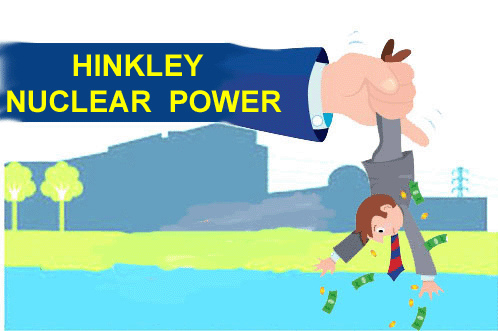
Now for the finances. These British nuclear units will cost roughly £18 billion ($27 billion). EDF has already sold a 35 percent share to the Chinese state nuclear company. However EDF still has to find more outside investors and get its ownership of the plant below 50 percent or it will have to consolidate Hinkley Point on its books and show all of the project’s debt on its own balance sheet.
If we were gamblers we would not wager that EDF will take the obvious first step towards restor-ing its financial health and cancels the Hinkley project. Of course, if David Cameron loses the Brexit vote (a referendum to take the UK out of the European Union) and is ejected from Number Ten Downing Street, a new Prime Minister might take a more skeptical view of Hinkley Point.
The real point of this story is that nuclear power is not commercially viable but has become a state-sponsored technology. There is nothing wrong with state supported technology. But we could save a lot of time and money by not pretending that it is something else.
Hinkley nuclear deal with France turning out a very bad one for Britain
“The decision-makers on both sides are totally underestimating” the risks, says Mycle Schneider, an independent nuclear analyst in Paris. “But the farther they go on, the more difficult it is to pull out.”
French Plans for a Nuclear Plant Begin to Look Like a Bad Deal for Britain,Bloomberg 30 Apr 16 A new reactor design poses risks on both sides of the English Channel. As Britain races to replace its aging nuclear reactors and coal generators, it’s hoping to team up with France to build the most expensive power plant in history—a massive atomic facility with two reactors at Hinkley Point on England’s southwestern coast. It could provide 7 percent of the country’s electricity by 2025. But the design, intended to showcase the latest French reactor technology, poses engineering and financial problems that could create a costly morass for both countries.
Public support for the project in Britain has fallen to 33 percent, down from 57 percent in 2013, according to a YouGov poll released on April 26 commissioned by New Nuclear Watch Europe, a pro-nuclear group.
In the end, politics could trump finance and technology. France wants to protect thousands of well-paying jobs in its nuclear industry. And British Prime Minister David Cameron, who in March joined French President François Hollande in reaffirming support for Hinkley Point, is keen for a project that would create jobs in an economically depressed region. “The decision-makers on both sides are totally underestimating” the risks, says Mycle Schneider, an independent nuclear analyst in Paris. “But the farther they go on, the more difficult it is to pull out.”
—With Francois de Beaupuy and Rachel Morison http://www.bloomberg.com/news/articles/2016-04-29/hinkley-point-u-k-nuclear-plant-plans-begin-to-look-like-bad-deal
Netherlands anxious about Belgian nuclear reactors: now handing out more anti-radiation pills
The Dutch government has ordered 15m iodine pills to protect people living near nuclear plants in case of an accident, as concerns rise over ageing reactors across the border in Belgium.
The iodine pills, which help reduce radiation build-up in the thyroid, would be given first to children under 18 and pregnant women living within a 100-kilometre (62-mile) radius of a plant, health ministry spokeswoman Edith Schippers said.
Until now, the tablets have been available within 20km of a plant, to everyone aged 40 and under.
The Netherlands has only one nuclear power plant – at Borssele in the southwest – but the expansion will provide pills for people living in border areas near Germany’s Emsland plant and two Belgian facilities, Doel and Tihange……..http://www.theguardian.com/world/2016/apr/30/netherlands-to-hand-out-iodine-pills-in-case-of-nuclear-accident
More arrests in Georgia relating to theft of radioactive materials
Georgia arrests five people for trying to sell radioactive uranium material. http://www.abc.net.au/news/2016-04-29/georgia-arrests-five-for-trying-to-sell-uranium/7369232, Georgia has arrested five people for trying to sell radioactive uranium material, the second such seizure this month, investigators say.
The State Security Service said the five were trying to sell 1.6 kilograms of nuclear material that included uranium-238 and uranium-235 isotopes for $US3 million ($3.9 million).
The suspects, who were arrested in the Black Sea resort of Kobuleti, were remanded in custody on Wednesday.
If convicted, they could face jail terms of up to 10 years.
Uranium enriched in the 235 isotope can be used for a nuclear bomb if it is used in a large enough quantity.
The seizures have raised questions about nuclear security in the former Soviet Union amid fears that extremists are seeking to acquire nuclear material to use in attacks.
Thursday’s announcement came just 10 days after Georgia’s State Security Agency said it had arrested three Georgians and three Armenians for trying to sell uranium-238.
In 2012, Armenia foiled a plot to sell another radioactive isotope, strontium-90.
In 2010, Georgia thwarted a planned sale of another radioactive substance, caesium-137.
The same year Georgian police arrested two Armenian men accused of smuggling 18 grams of highly enriched uranium from Armenia to Georgia and trying to sell it to an undercover agent posing as an Islamist extremist.
Russian nuclear submarine fires CRUISE MISSILE in Arctic
Russian nuclear sub fires CRUISE MISSILE in chilling footage of Arctic military drill, Mirror, BY JONATHAN SHARMAN, 30 APR 16 The 120-metre Severodvinsk submarine can be seen sinking slowly below the surface before its Kalibr missile erupts from the wave… [INCL VIDEO]…..
The Russian military said the cruise missile struck its target, in the Arkhangelsk region, “with high accuracy”.
A statement added: “A strike group of the flotilla has conducted firing drills using naval practice targets and hit them successfully.”
The Kalibr missile, which can carry nuclear or conventional payloads, travels at speeds up to Mach 2.9 – the same as a space shuttle during launch. The land-attack weapon has a range of up to 1,500 miles……..http://www.mirror.co.uk/news/world-news/russian-nuclear-sub-fires-cruise-7866647
Police clear Finland’s anti-nuclear plant protest camp
30 Apr 16, Police have cleared protesters from the site of a proposed nuclear power plant at Pyhäjoki on the north-west coast after demonstrations took a violent turn on Thursday….http://yle.fi/uutiset/police_clear_anti-nuclear_plant_protest_camp/8849910
New kinds of nuclear dangers, with China’s plan for floating reactors
Fukushima at sea? China wants a fleet of floating nuclear power plants, CNN, By Tony Roulstone, 29 Apr 16
- China has ambitious plans to build a fleet of 20 floating nuclear reactors
- Russia is already building a floating nuclear power plant
- But storms, waves, maintenance all pose safety concerns<
CNN)China is planning to build nuclear reactors that will take to the sea to provide power in remote locations, possibly including the controversial man-made islands in the contested waters of the South China Sea.
These small power plants will be built in Chinese shipyards, mounted on large sea-going barges, towed to a remote place where power is needed and connected to the local power grid, or perhaps oil rig…….The plans have raised eyebrows and many are asking: Why are they being planned? Will they be safe? Will they be economic?
Seven floating nuclear power plants are planned by Russia. The first, the Akademik Lomonosov, should be completed this year at the high cost of $740m, according to World Nuclear News.
Widespread and lingering medical effects of the Chernobyl nuclear disaster
 The Medical Implications of the 1986 Chernobyl Nuclear Disaster http://www.globalresearch.ca/the-medical-implications-of-the-1986-chernobyl-nuclear-disaster/5521671 Thirty Years Ago, April 1986 By Helen Caldicott Global Research, April 25, 2016 The following text by renowned scientist
and physician Dr. Helen Caldicott on the impacts of the 1986 Chernobyl will be followed in a subsequent article by an analysis of the medical implications of the Fukushima disaster
 The only on-site medical and epidemiological data gathered after Chernobyl was released in a report published by the New York Academy of Medicine in 2009 titled “Chernobyl – Consequences of the Catastrophe for People and the Environment,” which was gleaned from over 5000 papers published largely in Russian and translated into English.
These studies were gathered mainly from populations residing in the heavily irradiated zones in the Ukraine, Belarus and European Russia. However the Russian government classified all the relevant medical data for 3 years.
The Chernobyl 1986 catastrophe has turned into a new medical experiment conducted on millions of innocent people, much like the populations of Hiroshima and Nagasaki.
Because, the International Atomic Energy Agency, the United Nations Security Committee on the Effects of Atomic Radiation and the World Health Organisation never collected data from real patients, instead to their discredit they estimated the number of potential diseases that they derived only from calculations of radioactive releases and extrapolated doses.
Hence it is vitally important to scientifically and epidemiologically document the many illnesses which arose after the accident so that the medical profession can learn from these shocking accidents. These papers presented in the Chernobyl report by the NY Academy of Sciences attempt to do so. Some people say that they are not adequately peer reviewed so they should be ignored, however they are the only on-the-ground documentations of the many illnesses afflicting the irradiated populations
In essence 28 years after the accident, 50% of thirteen European countries are still contaminated by a variety of long-lived radioactive elements and the medical effects are severe in some areas. Before Chernobyl, 80% of the children in Belarus were healthy and now only 20% remain in good health.
Millions of people initially were exposed to very high radiation doses from short-lived radioactive elements so the initial radiation doses were thousands of times higher than doses received 3 years later.
Types of radioactive elements Continue reading
Austria losing to climate change its most precious environmental resource – glaciers
 Austria’s Treasured National Resource, Its Glaciers, Are Melting Fast. inside climate news, Glaciers across the country retreated an average of 72 feet in 2015, more than twice the rate of the previous year, finds an annual survey.BY BOB BERWYN APR 28, 2016 VIENNA—NEARLY ALL OF AUSTRIA’S 900 GLACIERS RETREATED LAST YEAR AMID RECORD-SETTING HEAT, ACCORDING TO AUSTRIAN SCIENTISTS. THE RAPID MELTING MIRRORS A TREND ACROSS THE ALPS AND UNDERSCORES SCIENTISTS’ WARNINGS OF ACCELERATING, EXTREME CLIMATE IMPACTS CAUSED BY HUMAN-CAUSED GREENHOUSE GAS EMISSIONS.
Across the country, the glaciers retreated an average of 72 feet in 2015, more than twice the rate of the previous year, the Austrian Alpine Association said in its annual glacier survey. Three of the country’s glaciers retreated by more than 320 feet. The nonprofit association—which promotes mountain culture, research and conservation— has beenconducting detailed glacier measurements since 1927, creating a dramatic record of climate change effects in the alpine region.
“The summer of 2015 was more than 2 degrees Celsius warmer than the long-term average,” said survey team coordinator Andrea Fischer, a glaciologist with the Austrian Academy of Sciences. “Long periods of high pressure and the absence summer snowfall…are the reasons for the glacial meltdown.”
Austria’s largest glacier, the Pasterz, retreated by 177 feet in 2015, the survey found. Its volume has declined by half since it was first accurately measured in 1851. The annual survey measures a representative sample of 92 major glaciers; 96 percent were found to be receding.
Globally, 2015 was the hottest year since recordkeeping began in 1880, by a large margin, with the bulk of the temperature rise a result of manmade global warming, according to the World Meteorological Organization and U.S. government science agencies. Last summer was also the warmest on record in Austria, surpassing the previous record set in 2003, when heat waves were blamed for 30,000 deaths in Europe…….
If the Paris climate accord leads to the world limiting the global temperature rise to 2 degree Celsius, about 60 percent of the world’s glaciers will melt away in the next few centuries. At 1.5 degrees Celsius of warming, about 50 percent will vanish, Marzeion said.
Melting glaciers are among the most visible signs of climate change, and they are a crucial, disappearing water source. Changes in streamflows will affect hydroelectric power generation in the Himalaya, according to a 2013 study published in the journal Nature. The buildup of meltwater in the valleys beneath glaciers also increases the risk of catastrophic flooding……..http://insideclimatenews.org/news/27042016/austria-glaciers-melting-fast-climate-change-global-warming-alps-pasterze
Germany’s compromise plan to make power companies pay for nuclear waste disposal

 German utilities to pay for nuclear waste disposal, DW, 28 Apr 16 In October, Germany set up a high-level commission to decide how to finance the country’s nuclear phase-out. It has now recommended that power companies pay into a multi-billion euro fund managed by the government.
In October, Germany set up a high-level eleven-member commission, KFK, to review the financing of the nuclear phase-out. The government’s goal was to ensure comprehensive safety, decommissioning and waste disposal processes, and see to it that their costs would be borne by nuclear power companies, not by taxpayers.
“The tasks of interim storage of radioactive waste, manufacturing of waste containers, and construction and operation of final repositories, and transfer of waste from interim storage to final repositories should be transferred to the state,” the KFK said in a statement released Wednesday in Berlin.
The estimated costs are to be covered by power companies paying a total of 23.3 billion euro ($26.4 billion) into a state-owned fund, with partial payments to be made in tranches over the next few years. In exchange, the state will take on all the residual financial risks associated with radioactive waste management – so if disposing of radioactive waste ends up costing more than 23.3 billion euro, the government, not the companies, will be on the hook for those cost overruns.
The 23.3 billion euro is composed of the current all-in 4.7 billion euro cost estimate of processing, enclosing and transferring high-level waste to final repositories, plus a 12.4 billion euro estimate for the costs of selecting, building and operating final repositories, plus a 35 percent “risk premium” – which is less than the risk premium of at least 50 percent that environmental groups had proposed, but more than the companies want to pay.
Compromise deal
The deal was characterized by the KFK’s three co-chairs as a compromise aimed at ensuring decommissioning costs wouldn’t lead to the insolvency of the four power companies that own nuclear reactors in Germany. Their balance sheets have been under heavy pressure in recent years due to price competition from solar and wind power suppliers in wholesale electricity markets.
The four large power-generation companies that own Germany’s 17 commercial nuclear reactors are E.ON, RWE, EnBW, and Vattenfall, a company owned by the Swedish state. Eight of the 17 reactors are still in operation, but the last of them is due to be shut down by the end of 2022. Nuclear power accounted for 14 percent of Germany’s total electricity production in 2015.
The 23.3-billion-euro deal only covers interim storage, transport and final disposal of high-level radioactive waste – including the spent fuel rods currently sitting in pools at nuclear reactor sites, as well as low- and medium-level radioactive waste such as machinery and buildings from decommissioned reactors. Packaging the waste for interim storage as well as dismantlement of reactor buildings and equipment and site remediation will remain the technical and financial responsibility of the four power companies.
Until now, the companies had been given the option of either removing reactor equipment and buildings, disposing of waste, and remediating reactor sites, on the one hand, or securely and permanently fencing off the sites and preventing unauthorized access. The KFK has now recommended that fencing-off will no longer be an option: All sites are to be dismantled and remediated. The commission said the government should speed up the permitting process to enable faster site decommissioning……….http://www.dw.com/en/german-utilities-to-pay-for-nuclear-waste-disposal/a-19218042
Vattenhall nuclear corporation in financial trouble, opposes nuclear risk premium, seeks to abolish Swedish tax

 Vattenfall CEO says Germany’s proposed nuclear risk premium ‘too high’ Stockholm (Platts)–28 Apr 2016
* Plan ‘disproportionate’ to utilities’ economic strength
* Nuclear, hydro taxes in Sweden should be abolished
The CEO of Swedish utility Vattenfall, which has large stakes in Germany’s Brunsbuttel and Krummel nuclear plants, said the additional amount German nuclear power producers would have to pay for decommissioning and spent fuel storage under a proposed plan is “disproportionate to the economic strength of the utilities.”
The German Commission on the Review of the Financing of the Nuclear Phaseout, or KFK, recommended to the German government that nuclear utilities pay a so-called risk premium of Eur23.3 billion ($26.4 billion) into a fund for decommissioning reactors and final storage of spent fuel, which would be administered by the state.
That payment would be on top of the almost Eur40 billion in provisions that utilities have set aside to finance decommissioning and storage.
……NUCLEAR TAX Turning to its Swedish nuclear operations, Hall again called on the government to abolish the capacity tax on nuclear power. The tax is based on the amount of electricity reactors can generate, not on actual generation.
Hall and other Swedish nuclear utility executives have said that the tax, coupled with low electricity prices, is making nuclear power unprofitable. As a result, Vattenfall plans to shut two reactors ahead of the end of their technical lifetimes………http://www.platts.com/latest-news/electric-power/stockholm/vattenfall-ceo-says-germanys-proposed-nuclear-26430524
So-called “charity” nuclear front group lobbies UK govt to fund Small Nuclear Reactors

UK think tank urges nuclear innovation, World Nuclear News, 28 April 2016 A think tank [Alvin Weinberg Foundation] has urged the British government to spend money earmarked for nuclear R&D on ensuring that at least three advanced reactors including at least one small modular reactor (SMR) and a Generation IV design have completed regulatory assessment by the early 2020s.
Weinberg Next Nuclear’s report, Next Steps for Nuclear Innovation in the UK….. The latest study follows a report by the same foundation, The Need for Nuclear Innovation, published in November 2015. Later that month, the UK government announced plans to invest £250 million ($377 million) over five years in a nuclear R&D program to include a competition to identify the best value SMR for the country. The initial phase of the competition was launched in March, with a call for initial expressions of interest.
The first phase of the competition, which will also lead to the development of an SMR Roadmap to set out the policy framework and assess the potential for possible pathways for SMRs in the UK, will run until late 2016. Individual reactor designs will not be assessed at this stage……
At least one of the reactors supported should be a Generation IV design that could use fuel made from previously used reactor fuel and from the UK’s plutonium stocks. It suggests that SMRs and “micro-reactors” – reactors of less than 20 MWe capacity – will be cheaper to construct than large reactors….
Finally, the report proposes that UK regulators cooperate with their peers in other countries, citing US and Canadian regulatory practices where proposed reactor designs are discussed with developers before the formal regulatory process begins. It calls for a three-way collaboration to be established with the aim of establishing international standards for the safety of advanced reactors……
Weinberg Next Nuclear is part of the Alvin Weinberg Foundation. The report was prepared with the sponsorship of Terrestrial Energy, Urenco and Moltex Energy, with Weinberg Next Nuclear retaining sole editorial control.http://www.world-nuclear-news.org/NP-UK-think-tank-urges-nuclear-innovation-2804167.html
1 This Month




Shut down the radiation-damaged Heysham nuclear reactors now
To see nuclear-related stories in greater depth and intensity – go to https://nuclearinformation.wordpress.com

Say No to NASA’s Reckless Nuclear Reactor on the Moon
Say No to NASA’s Reckless Nuclear Reactor on the Moon
-
Archives
- October 2026 (302)
- September 2026 (339)
- August 2026 (330)
- July 2026 (355)
- June 2026 (287)
- May 2026 (306)
- April 2026 (356)
- March 2026 (251)
- February 2026 (267)
- January 2026 (308)
- December 2025 (358)
- November 2025 (359)
-
Categories
- 1
- 1 NUCLEAR ISSUES
- business and costs
- climate change
- culture and arts
- ENERGY
- environment
- health
- history
- indigenous issues
- Legal
- marketing of nuclear
- media
- opposition to nuclear
- PERSONAL STORIES
- politics
- politics international
- Religion and ethics
- safety
- secrets,lies and civil liberties
- spinbuster
- technology
- Uranium
- wastes
- weapons and war
- Women
- 2 WORLD
- ACTION
- AFRICA
- Atrocities
- AUSTRALIA
- Christina's notes
- Christina's themes
- culture and arts
- Events
- Fuk 2022
- Fuk 2023
- Fukushima 2017
- Fukushima 2018
- fukushima 2019
- Fukushima 2020
- Fukushima 2021
- general
- global warming
- Humour (God we need it)
- Nuclear
- RARE EARTHS
- Reference
- resources – print
- Resources -audiovicual
- Weekly Newsletter
- World
- World Nuclear
- YouTube
-
RSS
Entries RSS
Comments RSS

