China and the EU confront Trump on climate change. May just fawns over him, Guardian, Ed Davey, 2 June 17 The Paris agreement is facing a mortal, US-led threat. But at this crucial moment, our prime minister is, once again, absent, silent and weak “……Experts in the UK have made clear that climate change is a grave threat to national security, and Trump’s own defence secretary has issued the same warning for the US. Donald Trump’s actions put us all in greater peril.
Yet in the face of this threat, May is silent. We have a prime minister who is weak on the world stage and complicit in Trump’s world-harming act. While our European neighbours are joining with Chinaand other developing countries to confront Trump and strengthen their efforts on climate change, Theresa May hasn’t issued a word of criticism. Whereas France’s new president used his first meeting with Trump to press him to stay in the Paris agreement, our prime minister failed to even mention it during her fawning trip to Washington in January…….
May’s lack of leadership on this issue is appalling, but perhaps not all that surprising. One of her first acts as prime minister was to abolish the Department of Energy and Climate Change. She’s sold off the Green Investment Bank that we established in coalition, and is now calling for a fracking “revolution”. Nick Timothy, her chief of staff and righthand man, wrongly called the Climate Change Act a “monstrous act of self-harm”. No wonder her policy on climate change is so weak.
Guardian 1st June 2017 European leaders dismissed Donald Trump’s claim that the Paris climate accord can be renegotiated after the US president announced he will pull out of the deal struck in 2015 to seek better terms. Shortly after Trump’s announcement the leaders of France, Germany and Italy released a joint statement rejecting Trump’s assertion that the climate deal can be redrafted. “We deem the momentum generated in Paris in December 2015 irreversible and we firmly believe that the Paris Agreement cannot be renegotiated, since it is a vital instrument for our planet, societies and economies,” said chancellor Angela Merkel, president Emmanuel Macron and prime minister Paolo Gentiloni. https://www.theguardian.com/environment/2017/jun/01/trump-withdraw-paris-climate-deal-world-leaders-react
Times 2nd June 2017 Flywheels will be used to balance supply and demand on Britain’s electricity grid in a £3.5 million project that could help the country to cope with more wind and solar power. Sophisticated flywheels that can store electricity for long periods of time are to be installed next to the University of Sheffield’s battery storage facility at Willenhall near Wolverhampton, in the first project of its kind in the UK.
The cylindrical structures draw electricity from the grid when surplus is available, powering a motor that makes the flywheel rotor spin at high speed. So far, efforts to tackle the problem have focused on lithium-ion batteries, which
can respond in less than a second to provide or absorb power and restore balance to the grid.
Eight such projects are being built around the UK after winning contracts from National Grid last year. Dr Gladwin said that such batteries would degrade over time the more they were charged and discharged, and were only expected to have a lifetime of ten years. Flywheels were a better way to deal with rapid short-term fluctuations, he said. The flywheel project in Willenhall should provide a megawatt of power for just over a minute before it runs out of energy. https://www.thetimes.co.uk/edition/business/flywheels-could-join-batteries-in-storing-electricity-for-the-national-grid-fjw95ggqv
Veteran Russian MP warns that Moscow could use nuclear weapons if the U.S. makes a move into Crimea, The Independent 1 June 17, Russia could use nuclear weapons to defend its position if forces led by the US or Nato make a move into Crimea, a veteran politician in the country has claimed.
“If US forces, Nato forces, are, were, in the Crimea, in eastern Ukraine, Russia is undefendable militarily in case of conflict, without using nuclear weapons in the early stage of the conflict,” Vyacheslav Alekseyevich Nikonov told a global security forum in Slovakia.
Mr Nikonov, who has served on the staff of Mikhail Gorbachev, Boris Yeltsin and Vladimir Putin, said that he had heard this at some point “from the Russian military”, according to Defense One.
He was speaking the GLOBSEC Bratislava Global Security Forum. The politician added that the west was “not just a force for good”, and said he was concerned about the lack of dialogue between Russia and the US and its allies to find a political solution. ……..
Although President Donald Trump has faced much criticism over his alleged links to Russia, US sanctions against the country remain in place over Crimea.
After Mr Trump’s initial overtures to Mr Putin, relations between Washington and Moscow have become more strained in recent weeks, with the White House reiterating America’s demand that Russia withdraws from Crimea.
Mr Nikonov said is worrying that US officials have been fired for talking to their Russian counterparts as this could cause relations between the superpowers to deteriorate further.
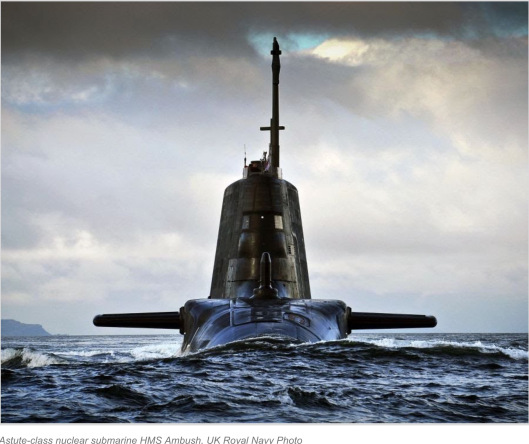
‘vulnerable to catastrophic hack’ Thinktank sceptical about MoD assurances, saying cyber-attack could lead even to ‘exchange of nuclear warheads’, Guardian, Ewen MacAskill, 1 June 17, The UK’s Trident submarine fleet is vulnerable to a “catastrophic” cyber-attack that could render Britain’s nuclear weapons useless, according to a report by a London-based thinktank.
The 38-page report, Hacking UK Trident: A Growing Threat, warns that a successful cyber-attack could “neutralise operations, lead to loss of life, defeat or perhaps even the catastrophic exchange of nuclear warheads (directly or indirectly)”.
The Ministry of Defence has repeatedly said the operating systems of Britain’s nuclear submarines cannot be penetrated while at sea because they are not connected to the internet at that point.
But the report’s authors, the British American Security Information Council (Basic), expressed scepticism.
“Submarines on patrol are clearly air-gapped, not being connected to the internet or other networks, except when receiving (very simple) data from outside. As a consequence, it has sometimes been claimed by officials that Trident is safe from hacking. But this is patently false and complacent,” they say in the report.
Even if it were true that a submarine at sea could not be attacked digitally, the report points out that the vessels are only at sea part of the time and are vulnerable to the introduction of malware at other points, such as during maintenance while docked at the Faslane naval base in Scotland.
The report says: “Trident’s sensitive cyber systems are not connected to the internet or any other civilian network. Nevertheless, the vessel, missiles, warheads and all the various support systems rely on networked computers, devices and software, and each of these have to be designed and programmed. All of them incorporate unique data and must be regularly upgraded, reconfigured and patched.”
The UK has four nuclear missile-carrying submarines, which are in the process of being replaced. Their replacements are scheduled to go into service in the early 2030s.
The report comes after the cyber-attack last month that disrupted the NHS, which uses the same Windows software as the Trident submarines. There was speculation too that the US used cyberwarfare to destroy a North Korean missile test. A Trident test-firing of a missile last year off the coast of Florida also went awry, with no official explanation given…….
Abaimov said: “There are numerous cyber vulnerabilities in the Trident system at each stage of operation, from design to decommissioning. An effective approach to reducing the risk would involve a massive and inevitably expensive operation to strengthen the resilience of subcontractors, maintenance systems, components design and even software updates. If the UK is to continue deploying nuclear weapon systems this is an essential and urgent task in the era of cyberwarfare.”
The report’s authors estimate that the capital costs for the UK government to improve cybersecurity for the Trident programme would run to several billions of pounds over the next 15 years.
Belarus nuclear plant: A disaster waiting to happen https://euobserver.com/opinion/138079By SIJBREN DE JONG, THE HAGUE, 31. MAY, Just over 30 years after the Chernobyl nuclear disaster, which saw Belarus lose a quarter of its territory due to nuclear contamination, the former Soviet republic is set to see its first nuclear power station enter operation in one and a half year’s time from now.
The location in the Belarusian town of Astravets – a mere 50 kilometres from Lithuania’s capital Vilnius – is understandably giving its neighbour the jitters. To make matters worse, the construction of the plant has been mired by a series of mishaps and incidents, sparking major concerns over the safety of the installation.
With Belarusian authorities not budging and full inspections remaining elusive, the Lithuanian government has resorted to taking active steps to protect the country against the plant.
Playing the silent game In August last year, news emerged that a crane had dropped the 330 tonne heavy reactor from a height of 4 metres during a test lift. If dropping a nuclear reactor was not bad enough in itself, the Belarusian authorities’ attempts to deny or otherwise keep silent on the matter for weeks on end sparked eerie memories of how the Soviets handled the Chernobyl disaster of 1986.
“We never get any information, or we hear something only a month after it happened”, says Darius Degutis, Lithuania’s ambassador at large for the issues related to the Astravets Nuclear Power Plant.
Russian state-owned company Rosatom, the nuclear plant’s main contractor, is complicit in playing the “silent game” by first denying that the accident caused any damage to the reactor shell, only to change its story afterwards by offering to replace the shell. Adding to the concerns was another incident in February 2017, whereby the second reactor hit a power pillar during transport.
The incident could have caused significant tension and deformation, thus impacting on the safety of the reactor vessel. However, rather than properly investigating the impact, the vessel was hoisted into position on 1 April of this year.
Move along, nothing to see here In order for the international community to be fully informed about the safety standards employed in the plant’s construction, the Lithuanian government has pressed for the International Atomic Energy Agency’s (IAEA) Site and External Events Design (SEED) mission to be invited for a full-scope review.
A full-scope review consists of a six-step assessment, involving reviews and inspections on site selection, environmental impact, design safety and numerous other aspects. A major problem thus far is that the Belarusian authorities limited the scope of the IAEA’s mission only to an assessment of the plant design’s safety.
This means that major verification steps pertaining to the choice of location, local geology and the plant’s environmental impact were skipped.
According to Degutis, the location at Astravets is “known to have been seismically active in the past and no proper international assessment of the site’s location was ever carried out”.
Other failures relate to the measuring of the population density around the site. In doing so, Belarusian officials only assessed population density on the Belarusian side of the border, thus not taking into account that this density on the Lithuanian side is far higher and a third of the country’s population would be at risk in case of a meltdown.
By limiting the scope of the IAEA’s mission, the nuclear watchdog cannot comment on these kinds of issues. To make matters worse, the Belarusian government declared that it would itself perform the plant’s risk and safety assessment.
Given how the numerous incidents at the plant have been handled so far, it is questionable as to whether the Belarusian authorities can be trusted with performing these stress tests in full accordance with European specifications.
Acquiescence is not an option After having attempted for several years to get the IAEA’s SEED mission full access to the site, the Lithuanian authorities have started to resort to different measures to guard themselves against the plant.
In April of this year, the Lithuanian parliament adopted a law that forbids the purchase of electricity generated from a third country power plant that is constructed or operates in violation of international environmental and nuclear safety requirements.
Earlier this month, Lithuania, Estonia and Latvia also agreed to link their power systems to other EU members and, in that way, disconnect from the Soviet-era electricity network.
Given that Belarus repeatedly signalled its intention to sell part of the electricity produced at Astravets in other European countries, the Baltic States have effectively deprived the plant from access to European electricity markets.
Although such actions qualify as last-resort measures, both decisions are entirely defensible when viewed in light of the continuous mishaps witnessed at Astravets. With the memories of Chernobyl still looming large, Europe should not turn a blind eye to this developing nuclear threat and firmly support Lithuania in its quest for full access to the site.
The Crude World monthly column on Eurasian (energy) security and power politics in Europe’s eastern neighbourhood is written by Sijbren de Jong, a strategic analyst with The Hague Centre for Strategic Studies (HCSS), specialised in Eurasian (energy) security and the EU’s relations with Russia and the former Soviet Union
Russia signs deal to expand India’s Kudankulam nuclear plant https://uk.reuters.com/article/russia-economic-forum-india-nuclear-idUKL8N1IY5KRRussia signed an agreement with the Indian government on Thursday to build two new reactors for the Kudankulam nuclear power station in Tamil Nadu and said it would loan India $4.2 billion to help fund construction.
President Vladimir Putin says Russia is ready to build a dozen nuclear reactors in India over the next 20 years to back Prime Minister Narendra Modi’s growth strategy for Asia’s third-largest economy, which continues to suffer chronic power shortages.
The agreement to build reactors 5 and 6 at Kudankulam was signed in St Petersburg during a meeting between Putin and Modi at an economic forum. It should help cement already close ties between the two countries.
Atomstroyexport, a unit of Russian state nuclear corporation Rosatom, will carry out the work, Kremlin documents seen by Reuters showed.
Russian Finance Minister Anton Siluanov told reporters the Russian government was lending India $4.2 billion from next year for a 10-year period to help cover construction costs.
Separately, in a joint declaration, the two countries said they noted the “wider use of natural gas” which they hailed as an economically efficient and environmentally friendly fuel that would help reduce greenhouse gas emissions and help them fulfil the terms of the Paris climate change accord. (Reporting by Denis Pinchuk; Writing by Vladimir Soldatkin/Andrew Osborn; Editing by Alexander Winning)
Over the next three years, 30 nuclear reactors across Europe will reach their retirement age. Making the decision-making process over their future open and transparent is crucial.
One month ago, the Ukrainian government took an unexpected step. It invited neighbouring governments to participate in consultations regarding lifetime extension of nine of its nuclear reactors.
For more than four years Bankwatch and other civil society groups have been calling on Ukraine to recognise its obligations under the Espoo Convention (which provides a framework for environmental impact assessment in a transboundary context) and carry out public consultations. But at a time when public trust in government institutions across Europe is at a record low and given the major inconsistencies in the practice of transboundary consultations on nuclear issues, this is only the start of a test for public participation and transparency in Europe’s nuclear sector.
The upcoming Meeting of Parties (MOP) to the Espoo convention in June will be the battleground for anti-nuclear government to set clearer rules for applying the convention.
Not a box-ticking exercise
Ageing nuclear reactors are fast becoming a serious threat across Europe. In addition, rather than devising energy transition strategies and allocating the financial resources needed for decommissioning of outdated reactors, governments inside and outside the EU, often pushed by the nuclear industry’s lobbyists, choose to extend the lifetime of nuclear reactors beyond the expiration date of their licences.
Of Belgium’s seven nuclear units, three (Doel 1 and 2 and Tihange 1) have been granted 10-year life extensions. This move has sparked harsh reactions from neighbouring Germany over the lack of transboundary consultations, taking the Belgium government to court. Close by, both the Netherlands and the Czech Republic are being investigated by the Implementation Committee of the Espoo convention for the lifetime extension of Borselle and Dukovany nuclear reactors without consulting neighbouring states. On Europe’s eastern flank, Ukraine has already prolonged the operations of six reactors beyond their original lifetimes without conducting any transboundary consultations.
But this is not just about these four countries. No less than 30 nuclear reactors across Europe will reach their retirement age over the next three years. The inconsistent application of the Espoo Convention procedures for decisions on extending their lifetimes is thus a serious concern. In fact, the Convention’s implementation committee already ruled in 2013 that Ukraine extending the lifetime of two reactors (Rivne 1 and 2) was in breach of the international treaty due to the lack of environmental impact assessments and transboundary consultations.
When other governments saw Ukraine subsequently ignoring the ruling, continuing with lifetime extensions for four more nuclear units, they took it as justification for avoiding public scrutiny in decisions on lifetime extensions for their own reactors. This has led to a situation where since the Rivne decision in 2014, five new cases of incompliance have piled on the table of the Espoo implementation Committee, all following complaints from civil society and potentially affected countries.
The irregular application of the Espoo Convention is one of the subjects on the table for next month’s meeting of parties (MOP) to the convention. The situation in Ukraine has garnered particular interest in light of the large number of reactors with licences extended and the very limited progress made on ensuring public participation in lifetime extension decisions since the Rivne decision at the previous meeting. Ukraine’s notification on transboundary consultations received in late April by the governments of Romania, Hungary, Slovakia, Austria, Poland and Belarus, although an important first step, shows just that — the poor quality of environmental documentation and lack of guidance on how to apply the convention to nuclear lifetime extensions. The notification, supported by a handful of documents limited to non-technical summaries of environmental impact assessments (EIAs), is unclear about the purpose and the activity that is subject to transboundary consultations. As such it looks like little more than a lip service, in turn making neighbouring governments and citizens into rubber stamps for Kiev’s reckless nuclear energy enterprise.
Rather than allowing citizens and governments in neighbouring countries to have a say on the final decisions on nuclear units’ lifetime extensions, the Ukrainian notification only invites comments on some vague aspects of electricity production in Ukraine. This effectively renders the whole process meaningless. What’s more, of the nine reactors in question, four have already had their operation licenses extended, thus casting serious doubts over the point of these consultations.
The periodic Safety Reviews of the relevant nuclear units, the reports on safety upgrade measures, full EIAs for each reactor, are only some of the documents that have to be provided to the public for consultation and which are missing from the documents submitted for consultations by Ukraine. Transparency is a key condition to ensuring meaningful public participation as well as the timeliness of consultations, which ought to take place before the decisions on lifetime extension are made.
For civil society groups monitoring the situation as well as neighbouring governments that are currently commenting on the notification, the Ukrainian government still has to bring more clarity on the connection between the outcome of consultations and the decision-making processes on lifetime extensions which have already been granted in Ukraine. More clarity and additions need to be brought as well to the documentation which should be in line with the requirements of the EU directive on environmental impact assessment. Public participation in the decision-making on lifetime extension must not be a box-ticking exercise, but a genuine opportunity to consider alternative strategies, environmental sustainability as well as financial means for decommissioning of the plants, sooner or later.
The parties to the convention, including the representatives from the European Union, will not have the option of undermining the calls for more clarity, as was done at the previous MOP due to political pressure, and will have to endorse clear recommendations for how the convention should be applied to lifetime extensions.
These recommendations should be clear on the obligation to apply the convention to lifetime extension decisions, on the environmental documentation that has to accompany the notifications which needs to be in line with EU EIA directive and on the timeline and forms of consultations with the public, national and European. This is absolutely crucial for setting the grounds for current and future decision-making processes and for governments to not get away with sloppy consultation processes.
Battery storage paired with wind farm in ground-breaking Spanish trial, REneweconomy By Sophie Vorrath on 30 May 2017
The first hybrid wind power storage plant in Spain using batteries
A world first hybrid renewables trial, pairing a grid-connected wind farm with lithium-ion battery storage and energy management software, has been switched on in Spain, in a bid to boost the integration of variable-generation renewables into electricity networks around the world.
How can civil society influence nuclear waste decisions? Nuclear Transparency WatchJohan Swahn, ENEF May 23 2017 I have worked with radioactive waste issues for many years, first at university and since 12 years for the Swedish environmental movement.
In Sweden the systems set up for access to information, consultation and public information are very favourable for dialogue. It is not always easy to interest the general public or politicians in the
complexity of radioactive waste issues, but the interactions between the industry (SKB), the regulator (SSM), the nuclear communities (Östhammar and Oskarshamn), the Swedish Council for Nuclear Waste (the Government’s scientific advisory board), academia, the environmental movement and other
actors are well developed. http://www.nuclear-transparency-watch.eu/activities/presentation-of-johan-swahn-during-the-enef-on-may-23-2017-panel-on-radioactive-waste-management.html
Moscow intends to offer scholarships to Bangladeshi students to study nuclear technology
Russian Parliament’s Upper House Deputy Chief Ilyas Magomed-Salamovich Umakhanov on Tuesday said Moscow intends to offer scholarships to Bangladeshi students to study nuclear technology.
Bangladesh’s first nuclear plant is being being built with Russia’s assistance, according to a BSS report.
“Russian Government is keen to enhance the number of scholarships to the Bangladeshi students in the disciplines related to nuclear science,” A statement released by Bangladesh embassy in Moscow quoted Umakhanov as saying during a meeting with a delegation of Bangladesh parliament standing committee on foreign affairs led by Dr Dipu Moni on Monday.
It said Umakhanov told the Bangladesh delegation that Russia intended to offer the stipends with the aim of building a pool of talent for operating nuclear power plants in Bangladesh.
Dipu Moni described the Rooppur Nuclear Power Plant to be a signature initiative in regard to Dhaka-Moscow ties and appreciated the progress of the project.
The former foreign minister lead the parliamentary standing committee delegation to its first ever visit to Russia while it was warmly received by the representatives of Russian parliament’s upper house and the State Duma or lower house in the historic city of St Petersburg and Moscow.
The delegation was comprised of lawmakers Faruk Khan, Sohrabuddin, Selim Uddin, Razee Mohammad Fakhrul and Mehjabeen Khaled, who were joined by Bangladesh Ambassador in Moscow Dr Saiful Hoque and other embassy officials.
FT 28th May 2017 Brussels is expected to approve the takeover by French state-controlled utility EDF of the reactor business of Areva this week, clearing the path for a state-backed rescue deal that will reshape France’s nuclear industry.
Brussels antitrust watchdog is likely to sign off the deal on Monday, according to two people familiar with the situation, a green light that is needed before the French state can carry out the wider restructuring of Areva. Once Areva’s reactor business is acquired by EDF, what is left of Areva, mostly a uranium mining and nuclear fuel business, will then need only a sign-off of its new reactor in Flamanville in France to unlock a €5bn state-backed capital increase scheduled for later this
year.
EDF has agreed to acquire a majority stake in Areva NP, which designs, manufactures and services nuclear reactors, in a deal valuing the business at about €2.5bn. The deal will unite two of the companies responsible for building the UK’s Hinkley Point C nuclear plant, the country’s first new atomic power station for a generation, in a move executives say should help to avoid the kind of costly delays that have beset similar projects.
Nuclear power producer TVO, which owns the Finnish project, is concerned that after the EDF takeover, Areva might neglect Olkiluoto in favour of the EDF-led projects in Flamanville and Hinkley Point. The Finnish company is also facing the awkward balancing act of co-operating with Areva to finish the project while simultaneously pursuing the French company and its former partner, Siemens, for billions of euros in compensation for the delays. https://www.ft.com/content/d44b6476-4068-11e7-9d56-25f963e998b2
Energydesk 28th May 2017 On the very day Theresa May triggered Article 50, her government quietly issued another bold statement to Brussels. Documents obtained by Energydesk reveal UK government attempts to significantly weaken draft EU climate and energy rules, even as Brexit is underway.
Key renewable energy and energy efficiency targets proposed by the European Commission should be reduced, made non-binding, or even scrapped altogether, the UK said, despite the fact that they would not take effect until after the UK had left the EU.
“This smells of obstructionism,” Jonathan Gaventa, director of environmental think-tank E3G, told Energydesk. “The UK is pissing off countries it needs as allies.” The news comes as the future of the Paris climate agreement hangs in the balance, with the United States refusing to commit to the deal at the G7 meeting.
FoE 28th May 2017Election manifestos: the scores are in: There are lots of issues close to our hearts at this election. It’s clear that the next 5 years are going to be crucial for protecting the environment. Overall when we totted up the scores (from 0 to 3) for each policy the Greens came out top, followed quite closely (almost neck and neck) by Lib Dems and Labour, with the
Conservatives some way behind. https://www.foe.co.uk/general-election/election-manifestos-scores-are
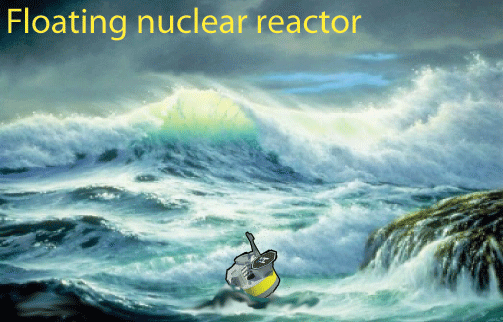
Russia building first ‘floating’ nuclear power plant, Economic Times, BY IANS |MAY 30, 2017,NEW DELHI: Russia is in advanced stages of building the world’s first “floating” nuclear power plant (FNPP) for installation in remote areas and hopes FNPP technology will also interest South Asian countries like India.
Pavel Ipatov, Deputy CEO (Special Projects) in Russia’s state atomic energy corporation Rosatom, told IANS in an e-mail interview from Moscow that an FNPP is basically a mobile, low-capacity reactor unit operable in remote areas isolated from the main power distributor. .. …
According to Ipatov, the vessel’s “construction is at its closing stage. The plant has already been floated out, fitting-out is under way”. It has been undergoing “mooring trials” since last July to test the FNPP’s performance efficiency, which are scheduled to be completed by October.
After the tests, the FNPP, called ‘Academician Lomonosov’, will be transported by Russia’s Northern Sea route to the operation site, where it will be integrated into the coastal network being constructed .. …..
According to Ipatov, with Russia’s expertise, its FNPPs will be in great demand in the global small nuclear power market.
“We see significant potential in Southeast Asia and other regions of the world. Memorandums of cooperation on floating nuclear power plants projects have been signed with China and Indonesia,” he said.
“We hope that FNPP technology will also gain interest in South Asia, including India, ot only in terms of new opportunities to provide power supply to remote areas, but in terms of building extra seawater desalination facilities, too,” he added.