Ukraine’s energy sector corruption crisis – what we know so far and who was involved.

Luke Harding, 19 Nov 25,
https://www.theguardian.com/world/2025/nov/19/ukraine-energy-sector-corruption-crisis
Anti-corruption investigators allege high-level kickback scheme involving Energoatom
Ukraine’s national anti-corruption bureau, known as Nabu, says it has uncovered a high-level criminal scheme at the heart of government. It involves Ukraine’s nuclear energy body, Energoatom, that runs three nuclear power plants supplying Ukraine with more than half of its electricity.
What is the scandal?
A group of insiders allegedly received kickbacks of 10-15% from Energoatom’s commercial partners. If these suppliers failed to pay up, they were removed from a list of approved counter-parties or not reimbursed for services already given. About $100m (£76m) was received in this way, Nabu says.
The alleged conspiracy had old-school touches. Its beneficiaries used code names for each other, such as “Professor”, “Karlson” and “Sugarman”. They carried blocks of cash around Kyiv in large and unwieldy bags, sometimes delivering it on foot. On one occasion, a plotter allegedly sent his wife to collect a stash of dollars, which she hid in her car.
Who was involved?
The alleged organiser of the scheme is Timur Mindich, an old friend and business partner of the Ukrainian president, Volodymyr Zelenskyy. Mindich co-founded Kvartal 95, the media production company set up by Zelenskyy before he went into politics.
Last week he fled his apartment in Kyiv’s government district hours before Nabu investigators came to arrest him, escaping abroad. He is now thought to be hiding in Israel.
Other alleged participants include Ukraine’s ex-deputy prime minister Oleksiy Chernyshov, who is already under suspicion in a separate case; the justice minster, Herman Halushchenko, and his protege, the energy minister, Svitlana Hrynchuk, who were both fired. All deny wrongdoing. At least three other backroom figures allegedly took part.
How have the public reacted?
With fury. Over the autumn, Russia has destroyed much of Ukraine’s energy infrastructure, leading to widespread and worsening blackouts. The hum of pavement generators has become a feature of everyday life, with electricity and heating supplies frequently interrupted. Meanwhile, Russian troops are advancing in the south and east after nearly four years of full-scale war.
In one conversation collected by Nabu in its 15-month investigation a suspect said it was a “pity” to build a structure to defend power stations from Russian bomb attacks since the money could be stolen instead. Chernyshov allegedly spent some of the illicit cash on four luxury mansions in a new-build riverside plot south of Kyiv.
The investigation, which has 1,000 hours of secretly recorded conversations, has been dubbed Operation Midas. The name seemingly refers to Mindich’s apartment, which features a gold toilet in the bathroom.
How far does the corruption go?
The big unanswered question. Was Mindichgate, as it has been called, a one-off? Or one of many similar insider schemes?
Zelenskyy has condemned the scandal, slapped sanctions on Mindich and stripped him of his Ukrainian citizenship. “The president of a country at war cannot have friends,” he said last week after the news broke. He has called for investigations to run their course and for those found guilty to be punished and put behind bars. In July, however – while the Midas investigation was active – Zelenskyy had signed a decree effectively stripping Nabu and the special prosecutor’s office, another anti-corruption agency, of their independence and only backed down after the most serious street protests since Russia’s 2022 full-scale invasion.
Nabu has indicated that the scandal extends to the defence ministry, where Mindich was involved in pursuing lucrative state contracts. And possibly banking, where he also had connections.
What happens next?
The affair is Ukraine’s biggest corruption scandal since Zelenskyy became president six-and-a-half years ago. Civil society activists, opposition MPs and prominent military veterans have urged him to take decisive action, even if that means the sacking and jailing of people who are personally known to him. The former president Petro Poroshenko has called for the current cabinet to be sacked and for a government of national unity to be formed. This is unlikely to happen. Poroshenko was himself embroiled in a defence procurement scandal, which played a role in his 2019 defeat to Zelenskyy, who promised to clean up public life.
Political commentators say corruption is the result of “mono-government”: the fact that Zelenskyy and his allies enjoy sweeping wartime powers under martial law. No elections can be held while fighting continues. The revelations have also dismayed Ukraine’s western partners and emboldened its enemies. Worst of all, there appears to be a connection with Moscow. According to Nabu, the kickbacks were funnelled through a Kyiv back office connected to the family of Andriy Derkach, a former Ukrainian politician who is now a pro-Kremlin Russian senator. Some cash ended up in Russia, the tapes suggest.
Is there an upside?
Of sorts. Some observers think the fact the scandal emerged at all is proof that Ukraine is slowly moving in the right direction – towards European norms and away from gloomy Soviet-style kleptocracy. Oleksandr Abakumov, the head of Nabu’s investigating team, acknowledged his colleagues had “faced a lot of obstacles” pursuing the Mindich case. But he stressed: “This isn’t a story about corruption in Ukraine. It’s about how the country is struggling with corruption, fighting with corruption.”
IAEA warns of safety importance of substations

Tuesday, 18 November 2025,
https://www.world-nuclear-news.org/articles/iaea-warns-of-safety-importance-of-substations
The International Atomic Energy Agency has stressed the importance of electrical substations in ensuring off-site power supplies to nuclear power plants.
The International Atomic Energy Agency (IAEA) said such substations “are indispensable for maintaining off-site power supplies that support safety systems and cooling functions, making their integrity vital for nuclear safety and security”.
Grossi said: “Reliable off-site power is vital for the maintenance and operation of nuclear safety functions. To this end, Agency experts will, through dedicated expert missions, continue to assess the functionality of substations critical for nuclear safety and security.”
Meanwhile, Zaporizhzhia Nuclear Power Plant, which has been under Russian military control since early March 2022, has had its main external power line shut since Friday after the activation of a protection system. The IAEA said the cause was still being investigated and they were “engaging with both sides to assist in the timely restoration of the line”.
The loss of the 750 kV Dniprovska line means the plant is relying on its 330 kV backup Ferosplavna-1 line for external power at the moment. The plant recently went a month relying on emergency diesel generators for power, before IAEA-mediated local ceasefires allowed necessary repair work to take place to reconnect.
Meanwhile, Energoatom issued a statement explaining that Khmelnitsky unit 2 has “been operating with a damaged turbine since 2022 … currently, the power unit can produce up to 900 MW of electricity”. The company added that it is in the process of purchasing a new, modernised rotor which “will not only restore the design nominal capacity, but also increase it by 40 MW to 1,040 MW”.
First Minister John Swinney absolutely rules out changing SNP’s no nuclear stance
the proposal to develop new nuclear energy was both “economic and environmental folly” that would lead to more expensive bills.
First Minister John Swinney absolutely rules out changing SNP’s no nuclear stance saying ‘there is no way on this planet that I am going to change that policy’
By Scott Maclennan, John O’Groat Journal 20th Nov 2025
First Minister John Swinney has absolutely ruled out any change to the SNP’s position against nuclear energy saying: “There is no way on this planet that I am going to change that policy.”
He was speaking at the weekend at the adoption night for the party’s candidate for Skye, Lochaber and Badenoch Eilidh Munro in Dingwall alongside Deputy First Minister Kate Forbes.
The First Minister reiterated the position after it was revealed that Anglesey in North Wales – which has many objective similarities with Caithness – is about to receive a £2.5 billion nuclear boost.
That sparked Caithness, Sutherland and Easter Ross MP Jamie Stone to reignite his argument that it is not too late for Dounreay – but the SNP must lift its ban on new nuclear power.
“This is an important announcement which demonstrates two things,” he said. “Firstly, that the UK government is serious about establishing ‘a network of small modular reactors across the UK’ – as the Energy Secretary put it.
‘It’s brilliant for a small town like Wick’ – local opticians celebrate award win
“The second point, which will be of enormous interest to the far north, is the specific reference from the UK government to ‘sites across the United Kingdom, including Scotland’.”
But Mr Swinney rebuffed all of those points arguing instead that the proposal to develop new nuclear energy was both “economic and environmental folly” that would lead to more expensive bills.
“I don’t think the position on nuclear power is exactly a surprise,” he said. “We have been around for a long time when we have won Caithness, Sutherland and Ross and there’s absolutely no way on the planet that I’m going to change that policy because I think it’s economic and environmental folly.
“These nuclear stations are hyper-expensive so if people are going to get nuclear power stations put onto their bills then they ain’t seen nothing yet because these projects always go way over budget.
“So we’ve got the opportunity for low cost renewable energy in Scotland in abundance and we should seize that opportunity to do the right thing, fiscally and environmentally and the nuclear argument will just saddle people with exorbitant fuel costs for the years to come.”…………………… https://www.johnogroat-journal.co.uk/news/first-minister-john-swinney-absolutely-rules-out-changing-sn-419801/
Wylfagasm! What does it tell us about Cymru?
18 Nov 2025, https://nation.cymru/opinion/wylfagasm-what-does-it-tell-us-about-cymru/
Some of the most unpopular politicians in the UK and Cymru, led by Starmer, rolled up to Ynys Môn on 13th November to announce that three Small Modular Reactors (SMR’s), to be designed by Rolls-Royce SMR are to be built at Wylfa by publicly owned Great British Nuclear, backed by £2.5 billion of public money.
Following the deferred gratification as the Hitachi project collapsed in 2019, the consequent media ballyhoo was euphoric, with the announcement being seen as at last confirming that nuclear is back on Ynys Môn, with up to 3,000 jobs expected during construction, and up to 900 jobs required to run the plant. The politicians of the UK, Cymru and Ynys Môn of almost all political colours welcomed the news. Starmer also announced that Cymru was to be an Artificial Intelligence (A.I.) zone, with 3,500 jobs to be created.
What’s not to like about nuclear at Wylfa?
A great deal, as I know from too many years of campaigning with PAWB (People Against Wylfa B)! Let’s be brief, though several volumes are needed to do justice to the objections.
The main argument used to justify nuclear by local politicians can be summarised in one word: JOBS! Jobs for Ynys Môn, which has haemorrhaged jobs for years, thus giving youngsters an opportunity to stay on the Island. Yes, Ynys Môn, like other economically bereft areas of Cymru, needs jobs to retain youngsters who have been drifting away in search of opportunities. But this has been a running sore for decades, and the chief focus on Ynys Môn has been to concentrate on the economic silver bullet of Wylfa since Blair’s Energy Review in 2006. So our youngsters have been let down for two decades, during which time a reliable job creation strategy could have been devised and implemented. The result is that jobs of any sort are accepted with very little robust questioning.
Poverty induces gratitude for a poisoned chalice.
Why is the chalice poisoned? The arguments against nuclear have been listed so many times that it is frankly staggering that mainstream politicians largely ignore them.
- No solution to the problem of radioactive waste which must be safe for millennia.
- Spiralling costs of every nuclear project, at the taxpayer’s expense.
- Too little, too late to mitigate climate change.
- The myth that nuclear is low carbon and safe.
- Huge long term environmental damage where uranium is mined.
- Risk of catastrophe as at Chernobyl, Fukushima, Windscale, Three Mile Island.
- Risk of malicious attacks by cyberwarfare or direct military attack in a dangerous world.
- Risk of nuclear proliferation
- Intrinsic link to military nuclear – the first Wylfa was built to produce plutonium.
Other issues can be added.
Continue readingKiev Coup Poker Update, 19 November 2025
Russian & Eurasian Politics, by Gordon hahn, November 19, 2025
Beleaguered Ukrainian President Volodomyr Zelenskiy is still on the road, having arrived in Turkey, where he had a meet and greet with of all people Mindichgate-incriminated Head of the Defense and Security Council of Ukraine Rustem Umerov supposedly to restart peace talks with Moscow. Umerov has recently been heard on the Mindichgate tapes discussing a corrupt deal on bulletproof vests. Zelenskiy needs the support of the military, but Umerov did not and certainly will not have now command or authority inside the military. That is the domain of Ukraine’s most popular political figure, Kiev’s ambassador to the UK, and former commander of the Armed Forces of Ukraine (UAF) Gen. Valeriy Zaluzhniy, fired by Zelenskiy last year.
Head of Zelenskiy’s Office of the President (OP) Andriy Yermak was reportedly in Washington speaking with the FBI, which has a hand in the opening of Mindichgate. He reportedly is now in London, where he is likely to meet with Zaluzhniy and British governmental figues, such as MI6’s new Ukrainian-British director (https://gordonhahn.substack.com/p/is-the-uk-readying-a-coup-option). With Zaluzhniy and the FBI, Yermak’s hand in the developing pre-coup or coup crisis is stronger than that of Zelenskiy, who is potentially isolated in Turkey with Umerov, a wholly unpopular figure in Ukraine and an ethnic Tatar to boot.
But the army is no longer Zaluzhniy’s to have without a fight. It is also the feifdom of the neofascists such as Azov and its founder Brig. Gen, Andriy Biletskiy, who heads a 20,000-strong Azov army corps as well as other Azov-dominated units.
There are also reports that the Secretary of the U.S. Army Dab Driscoll and Army Chief of Staff Randy George are in Kiev and are then scheduled to head to Moscow! They may be in Kiev to deliver an ultimatum to Zelenskiy in the form of the reported new U.S.-Russian peace plan he will be required to sign or face the consequences (arrest, removal from office by impeachment or coup, assassination), perhaps explaining why Zelenskiy remains away in Istanbul. However, this may prove a fatal mistake, as he has left door open to machinations.
Tonight Kiev stands empty without its president, its presidential chief of staff, its Security and Defense Council chief, its energy minister (with the country in an energy crisis), and perhaps who knows who else. Last night, Energy Minister Svetlana Grinchuk, who also is implicated in Mindichgate, fled Ukraine, joining a full cohort of Kievan wanderers – Zelenskiy, Yermak, Umerov, Mindich himself, and his sidekick Tsukerman. They are going faster than American politicians to Epstein island. Ruslan Stefanchuk, the speaker of the badly splintered Rada, rocked by Mindichgate, and head of the Cabinet of Ministers, Yuliya Svyrydenko, in her post for less than a year remain if talking about civilian leaders. Military Intelligence (HRU) chief Kyryll Budanov, a creature of the CIA remains, as presumably do at least some members of the UAF’s General Staff, including its chair Mikhail Gnatov, who just a week ago asserted military over civilian authority to Zelenskiy’s face.
This would be an excellent time for some of these figures, who remain in Kiev, to author a coup, it would seem, perhaps with the backing of those U.S. Army officials in town. It probably will not happen tonight, but who knows? Maybe tomorrow night, when Zelenskiy and Umerov can be arrested, as some official sources say they will be doing. At present a coup to replace Zelenskiy gives everyone among the present moment’s main players something of what they want. Zelenskiy remains a free (if likely hunted) man. The West’s Project Ukraine is rid of him and can be moved to its next course of action within the framework of Russian and American demands and ultimata. Russia achieves its special military operation’s goals at least for now. (Neofascist or others’ countercoups can turn over the chessboard and bring real chaos ala Ukraine’s 17th century Great Ruin or 1917-1920). At any rate, as an old American saying goes: “Get while the getting is good.”……………………………………………….. https://gordonhahn.com/2025/11/19/kiev-coup-poker-update-20-november-2025/
Zelensky remains a creature of the corruption plaguing Ukraine.

A small number of oligarchs still possess outsized power in all spheres of business and politics. But the truth is moving in mysterious ways.
Ian Proud, Nov 18, 2025, https://responsiblestatecraft.org/ukraine-corruption/?utm_source=substack&utm_medium=email
The $100 million corruption scandal around Ukraine’s energy system that broke this past week is critical to ordinary Ukrainians for its timing. Russia has been bombarding the country’s energy infrastructure on a daily basis to deny ordinary citizens heat and electricity during the cold and dark winter months.
In November 2024, a separate scandal broke that $1.6 billion set aside to build protective bunkers around electricity sub-stations had not led to any being built.
With this in mind, many have responded that the highly publicized nature of this latest scandal, which resulted in the resignations of both the energy and justice ministers, offers visible proof that progress is being made in tackling corruption in Ukraine. The National Anti-Corruption Bureau (NABU) of Ukraine, which is often at the spearhead of such investigations, was first established by Presidential Decree in April 2015. That it continues to function is indeed a positive sign.
It’s not possible, however, to claim that corruption has emerged as a specifically wartime phenomena. This energy scandal is hardly a one-off. In September 2021, with Zelensky having already been in power for two and a half years, the European Court of Auditors reported that state corruption and capture were still widespread in Ukraine. It pointed out that “tens of billions of Euros are lost annually as a result of corruption,” and that EU support delivered over 20 years had not delivered the desired results.
Since Russia invaded in 2022, Ukraine has been flooded with hundreds of billions of dollars of aid, of a much greater value than its yearly economic output. The United States has been unable to accurately account for the billions it has sent there. No country at this point would be able to assure itself that its funds have been spent well.
The scale of each new corruption scandal has seemingly grown over time. In August 2023, Zelensky sacked all the heads of the regional military recruitment offices following widespread complaints about kick-backs, often bribes to let potential recruits escape military service. In September 2023, Ukraine’s Defense Minister, Oleksii Reznikov, resigned following a procurement scandal related to the marking up the cost of purchased body armour and helmets by 4-5 times. In January 2024, Ukrainian defense officials were arrested over the theft of $40 million, related to an order for 100,000 artillery shells that were never delivered.
To date, President Volodymyr Zelensky has been able to keep Western donors off his back through a sacking here or a prosecution there. What has changed this year is that the erstwhile NABU investigators have been gradually nudging closer to his inner circle.
In July of this year, as the noose was closing around his close ally former Deputy Prime Minister Oleksiy Chernyshov because of a large-scale property fraud, Zelensky made a failed attempt to hobble NABU and bring it under his personal control. As it turns out, Chernyshov has also been implicated in the current $100m energy scandal, with NABU detectives documenting the transfer of an estimated $1.3 million in cash to him and an associate. On 14 November, NABU sought an order for pre-trial detention of Chernyshov.
Timur Mindich, the man at the centre of the current scandal, is a close ally of Zelensky and co-founded the TV company ‘Kvartal 95’ with him. He was allowed to flee the country before the NABU raids, which discovered duffel bags stuffed with cash and a golden toilet. It hasn’t been lost on some commentators that, in 2014, the ousted President Yanukovych was also alleged to have possessed a toilet made of gold.
Which provides another reminder that, stepping back from the canvas, not much has really changed in Ukraine over the past decade. I first met an anti-corruption activist in Kyiv in late 2015, at the foot of the postcard perfect Andriivsky descent in the quaint Lviv Handmade Chocolate Café. Approaching two years after the ouster of Yanukovych, she was visibly distressed that little progress had been made in tackling corruption. Within weeks, the government of Arseny Yatseniuk faced a no-confidence vote over a slew of corruption scandals involving figures close to him that led, ultimately, to his resignation in February 2016.
In the midst of that scandal, Vice President Joe Biden visited Kyiv in a bid to shore up the government, anxious that Ukraine might not be able to form a better coalition than the one in power. “Corruption siphons away resources from the people. It blunts economic growth, and it affronts human dignity. We know that. You know that. The Ukrainian people know that,” Biden said.
For many ordinary Ukrainians, who protested peacefully in the Maidan in late 2013, rooting out corruption was at the core of the so-called “revolution of dignity.” Biden’s 2015 visit was an attempt to paper over the cracks, and close down moves to unsettle the pro-western government. Yet the endemic corruption carried on.
When it released its recent report on EU accession states, the European Commission noted Ukraine’s remarkable commitment to its EU path. However, it downgraded its assessment to B grade, expressing concern about progress in tackling corruption. As with the 2015 Biden visit it was, I fear, another example of papering over the cracks of a much bigger problem.
The vertical of power in Ukraine, in which a small number of oligarchs possess outsized power in all spheres of business and politics, remains largely unchanged to this day. Zelensky has emerged as a creature of that system, having both clashed and aligned himself with different oligarchs at different times. With presidential elections paused, there are fewer constitutional checks and balances on his power than before the war. And for all its excellent work, NABU is not yet powerful enough to break the system.
There is a persuasive case to make that ending the war and turning off the gravy train would make it easier for Ukraine’s future leaders to refocus on the path to European membership. This would require real and measurable reform. It’s possibly for this reason that public support for an end to the war continues to grow along with outrage at every new case of graft by cronies close to Zelensky. But it may also help to explain why he is in no hurry to see the war end.
France’s EDF again sends spent uranium to state-owned Russian firm for recycling
France’s EDF again sends spent uranium to state-owned Russian firm for
recycling. A shipment of reprocessed uranium from French nuclear power
plants has left the Channel port of Dunkirk to be enriched at a specialised
Russian industrial plant run by the country’s nuclear energy group Rosatom,
before being in part returned to France for further use in civil reactors.
The shipment, loaded at the weekend on a Russian-operated,
Panama-registered cargo vessel, was described by Greenpeace as a “cargo of shame”, and “immoral”, while both French utility giant EDF, which
operates the country’s nuclear power plants, and the French economy
ministry, declined to comment. Jade Lindgaard reports.
Mediapart 18th Nov 2025, https://www.mediapart.fr/en/journal/ecologie/181125/frances-edf-again-sends-spent-uranium-state-owned-russian-firm-recycling
A nuclear meltdown at Zaporizhzhia would imperil the entire region.
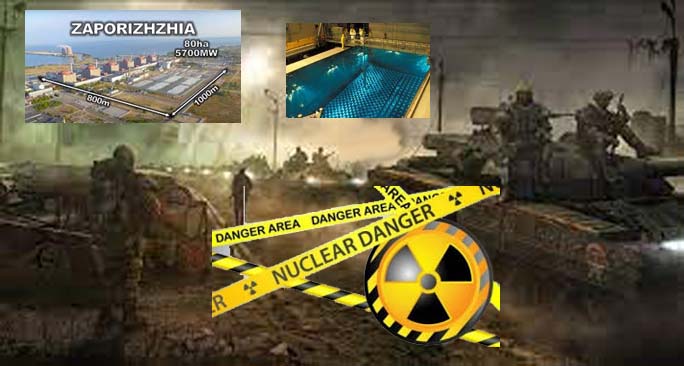
Russia’s nuclear brinkmanship — a reckless gamble that began with its
occupation of Ukraine’s Zaporizhzhia nuclear power plant — has
escalated into a crisis threatening the entire European continent.
In early November, local ceasefires between Ukrainian and Russian forces controlling the ZNPP allowed repair crews to safely restore critical external
electricity lines that had been severed. For a month prior, both the main
and backup external power lines were down, forcing the plant to rely solely
on emergency diesel generators for power vital to reactor cooling and
safety.
The International Atomic Energy Agency has characterised the
ZNPP’s prolonged reliance on diesel generators as “clearly not
sustainable”. But emergency diesel generators were never designed for
extended continuous operation. Industry standards specify preferred mission times of 24 hours.
In the recent outage at ZNPP, generators had been
running for an entire month — far exceeding design specifications — and
the plant recently lost its connection to the main power line again. Each
day of continued operation increases the probability of mechanical failure.
FT 17th Nov 2025,
https://www.ft.com/content/93130cd5-211c-4ba1-9303-0a550ddac93f
Lancaster University to create £2m nuclear power station control room simulator.

r. Funded through a £2 million grant as part of an £88.5 million
capital investment by the Office for Students (OfS) into Universities and
colleges across England, Lancaster University will address a critical gap
by developing a nationally-unique educational facility designed to train
future professionals in nuclear engineering, cyber security and related
disciplines.
Lancaster Guardian 18th Nov 2025.
https://www.lancasterguardian.co.uk/news/national/lancaster-university-to-create-ps2m-nuclear-power-station-control-room-simulator-5407049
Nuclear levy will increase UK energy bills from December
SMEs need to factor in a boost in their energy costs as the nuclear levy – a mandatory charge for both homes and businesses – is brought in by the Government.
.From next month, all energy bills will include the “nuclear levy”, a charge used by the Government to fund nuclear infrastructure. It is expected to add up to around £100 a year for small businesses, but this will vary with their energy usage.
Start-Ups 19th Nov 2025, https://startups.co.uk/news/nuclear-levy/
Greenpeace claims French resumption of nuclear trade with Russia
Environmental campaign group Greenpeace hit out at the resumption of nuclear trade between France and Russia during its war with Ukraine after activists observed the loading of a tanker in northern France with reprocessed uranium bound for Russia.
RFI 18/11/2025
Greenpeace published video that it said its activists shot on Saturday of around 10 containers with radioactive labels going onto a cargo ship in Dunkirk.
The Panamanian-registered ship, the Mikhail Dudin, is regularly used to carry enriched or natural uranium from France to St Petersburg, according to Greenpeace.
Saturday’s consignment was the first of reprocessed uranium to be observed for three years, it added.
“The resumption of this trade once again shows France’s dependence on Russia,” Pauline Boyer, the head of Greenpeace France’s nuclear campaign, told RFI.
The images released by Greenpeace came two days ahead of a meeting in Paris between the French president, Emmanuel Macron and his Ukrainian counterpart, Volodymyr Zelensky, to discuss Ukraine’s air defence systems.
“Despite the French government’s commitments to support Ukraine — which is, fortunately, the case — on the other hand, there is ongoing collaboration with Rosatom, the Russian nuclear company, which is indirectly contributing to the financing of the war.”
…………………………..”It is outrageous that French nuclear companies — EDF, Orano, Framatome — continue to collaborate with Rosatom.”
French state-controlled energy giant Electricité de France (EDF) signed a 600-million-euro deal in 2018 with a Rosatom subsidiary, Tenex, for the recycling of reprocessed uranium.
These operations have not been affected by international sanctions over the Ukraine war.
Rosatom has the only facility in the world – at Seversk in Siberia – capable of carrying out key parts of the conversion of reprocessed uranium to enriched reprocessed uranium……………..
Only about 10 percent of the reenriched uranium sent back to France by Russia is used at its Cruas nuclear power plant, in southern France, the only one in the country that can use enriched reprocessed uranium, according to Greenpeace.
France’s energy ministry and EDF have yet to respond publicly to questions on the consignment or trade.
Top politicians in France ordered EDF chiefs to halt uranium trade with Rosatom in 2022 when Greenpeace France revealed the contracts in the wake of Russia’s invasion of Ukraine……
https://www.rfi.fr/en/france/20251118-greenpeace-claims-french-resumption-of-nuclear-trade-with-russia
Campaigners come together to challenge Britain’s disastrous nuclear expansion.

CND 17th Nov 2025
- Political leaders, MPs, Trade Union leaders and faith communities urge Prime Minister to reverse decision to purchase US nuclear-capable fighter jets
- Purchase breaches international law, heightens nuclear risks and ties Britain closer to the Trump administration
- Call comes as report show chaos and spiralling costs of fighter jet programme
On Monday, 17 November, MPs, trade unionists and civil society figures handed in a letter to Downing Street calling on the Prime Minister, Keir Starmer, to rethink his decision to purchase 12 nuclear-capable F-35A jets, to be stationed at RAF Marham. The jets have been designed to launch deadly US nuclear bombs, now very likely deployed across Europe and in Britain.
This comes amidst increasing nuclear threats and breaches of international disarmament treaties. In the letter, signatories argue, “[f]ar from protecting the British population, your decision to buy US nuclear capable fighter jets, that can launch US B61-12 nuclear bombs, ties Britain even closer to the dangerous leadership of US President Donald Trump” and “increases the risk of such weapons being used in war.”
It goes on to state, “[w]e see this nuclear expansion as part of the war drive which is draining public funds away from essential public services and making the population poorer.”
The letter hand-in follows a report by the Public Accounts Committee (PAC) that has exposed the chaos and spiralling costs already associated with government’s decision to buy nuclear-capable fighter jets from the Trump administration. The Committee’s report reveals that the Ministry of Defence had little understanding of the technical and financial implications of Britain joining NATO’s nuclear mission when Starmer announced the purchase at the NATO summit in June. PAC Chair described the MoD’s spending forecasts as “unrealistic.” The National Audit Office now calculates the full programme of 138 fighter jets could cost at least £71 billion, with even more – as yet unknown – costs involved in joining NATO’s nuclear missions.
The letter states, “[g]iven the grave consequences of this expansion, including Britain’s breach of international law, it is also deeply concerning that no opportunity was given for parliament to debate or vote on this decision before it was announced.”
The letter concludes by urging that “[i]nstead of pouring hundreds of billions into lethal weapons, action needs to be focused on tackling the underlying causes threatening our human security. This means reversing the devastating poverty, deprivation and crumbling public services that mark our communities, investing in sustainable homes, rebuilding our health and education systems, and funding a just transition through green jobs, skills and infrastructure.”
CND will be bringing together a powerful alliance of campaigners, trade unionists, student activists, environmentalists, and more this Saturday, 22 November, to discuss the next steps for the campaign to halt this disastrous nuclear expansionism. For an agenda and how to register, click here. ………………………………………………………………………………… https://cnduk.org/campaigners-come-together-to-challenge-britains-disastrous-nuclear-expansion/
‘Radioactive patriarchy’ documentary: Women examine the impact of Soviet nuclear testing
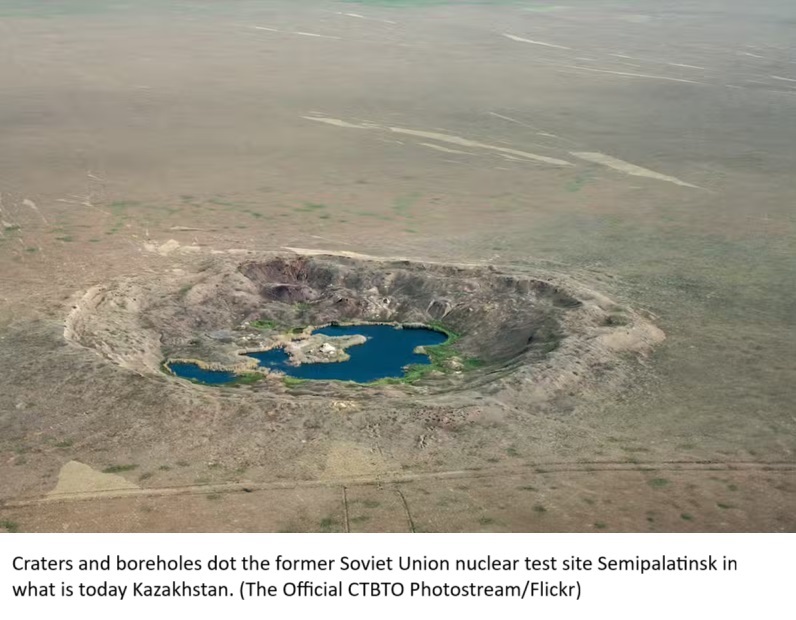
During the time of the detonations, approximately 1.5 million people lived near the sites, despite Soviet claims that the area was uninhabited.
In the ensuing decades, diagnoses of cancers, congenital anomalies and thyroid disease affected the surrounding communities at an alarming rate, particularly for women.
November 17, 2025, Rebecca H. Hogue, Assistant Professor, Department of English, University of Toronto https://theconversation.com/radioactive-patriarchy-documentary-women-examine-the-impact-of-soviet-nuclear-testing-256775
Following recent comments on nuclear testing by United States President Donald Trump and Russian leader Vladimir Putin, it’s more important than ever to remember that nuclear detonations — whether in war or apparent peace time — have long-lasting impacts.
Over a 40-year period, up to 1989, the Soviet Union detonated 456 nuclear weapons in present-day Kazakhstan (or Qazaqstan, in the decolonized spelling)
During the time of the detonations, approximately 1.5 million people lived near the sites, despite Soviet claims that the area was uninhabited.
In the ensuing decades, diagnoses of cancers, congenital anomalies and thyroid disease affected the surrounding communities at an alarming rate, particularly for women.
A new independent documentary, JARA Radioactive Patriarchy: Women of Qazaqstan, examines the impacts of nuclear weapons in Qazaqstan. Jara means “wound” in the Qazaq language.
The film is directed by Aigerim Seitenova, a nuclear disarmament activist with a post-graduate degree in international human rights law who co-founded the Qazaq Nuclear Frontline Coalition. Seitenova grew up in Semey (formerly called Semipalatinsk), Qazaqstan.
Close to Semey is the Semipalatinsk nuclear test site, also known as The Polygon, in Qazaqstan’s northeastern region. It’s an area slightly smaller than the size of Belgium — approximately 18,000 square kilometres — in the former Kazakh Soviet Socialist Republic.
Nuclear Truth Project
Seitenova introduced her film in March 2025 at the United Nations headquarters in New York, hosted by the Nuclear Truth Project. The documentary premiere was a side event at the Third Meeting of States Parties to the Treaty on the Prohibition of Nuclear Weapons.
As a literary and cultural historian who examines narratives of the nuclear age, I attended the standing-room-only event alongside many delegates from civil society organizations.
Nuclear disarmament activist
Seitenova, who wrote, directed and produced JARA Radioactive Patriarchy on location in Semey, aims to bring women’s nuclear stories to Qazaqstan and international audiences.
The 30-minute documentary features intimate interviews with five Qazaq women. The film shares the women’s fears, grief and the ways they have learned to cope, as well as reflections from Seitenova filmed at the ground-zero site.
For Seitenova, it was essential that the film be in Qazaq language.
“Qazaq language, like Qazaq bodies,” she said in an interview after the premiere, “were considered ‘other’ or not valuable.” Seitenova acknowledged it was also important to show a Qazaq-language film at the UN, as Qazaq is not an official UN language like Russian.
Women consensually share experiences
One of Seitenova’s directorial choices was not just what or who would be seen, but specifically what would not be seen in her film.
“I’m really against sensationalism,” said Seitenova. “If you Google ‘Semipalatinsk’ you will see all of these terrible images of children and fetuses.”
Seitenova accordingly does not show any of these images in her film, and instead focuses on women consensually sharing their experiences.
Seitenova explained how narratives regarding the health effects in Semey are often disparaged. When others learn she is from Semey, Seitenova shared, some will make insensitive jokes like “are you luminescent at night?” — making nuclear impact into spectacle, instead of taking it as a serious health issue.
These experiences have propelled her to take back the narrative of her community by correcting misconceptions or the minimization of harms. Instead, she brings attention to the larger structural issues.
“Everything was done by me because I did not want to invite someone who would not take care of the stories of these women,” said Seitenova.
Likewise, Seitenova only interviewed participants who had already made decisions to speak out about nuclear weapons. She did this so as not to risk retraumatizing someone by asking them to discuss their illnesses, especially for the first time on camera.
Global legacy of anti-nuclear art, advocacy
Seitenova also wanted to show a genealogy of women speaking out about nuclear issues in Qazaqstan, contributing to a global legacy of anti-nuclear art and advocacy.
The film features three generations of women, including Seitenova’s great aunt, Zura Rustemova, who was 12 at the time of the first detonations.
As part of this genealogy of nuclear resistance, the film includes footage of a speech from the Qazaq singer Roza Baglanova (1922-2011), who rose to prominence singing songs of hope during the Second World War.
Effects felt into today
JARA Radioactive Patriarchy shows how the impacts of nuclear weapons are felt intergenerationally into the present.
“Many women lost their ability to experience the happiness of motherhood,” interviewee Maira Abenova says in the film. Abenova co-founded an advocacy group representing survivors of the detonations, Committee Polygon 21.
Other interviewees shared how often men left their wives and children who were affected by nuclear weapons to begin a new family with someone else.
Seitenova looks at the roles of women and mothers not just as protectors, but also as those who have launched formidable advocacy.
The film highlights the towering monument in Semey, “Stronger than Death,” dedicated to those affected by nuclear weapons.
The Semey monument depicts a mother using her whole body to protect her child from a mushroom cloud. Just like the monument, Seitenova and the women in her documentary use the film to show how women have been doing this advocacy work in the private and public spheres, with their bodies and with their words.
“I want to show them as being leaders in the community, as changing the game,” Seitenova said.
While the film brings a much-needed attention to the gendered impact of nuclear weapons in Qazaqstan, she makes clear that this is, unfortunately, not an issue unique to her homeland or just to women.
“The next time you think about expanding the nuclear sector in any country” Seitenova said, “you can think about how it impacts people of all genders.”
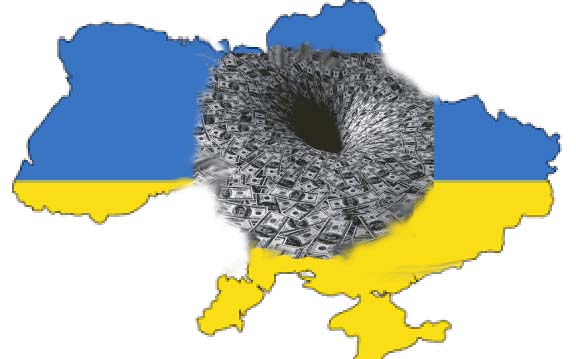
US senator accuses Trump of ‘silence’ on huge Ukraine corruption scandal.
17 Nov, 2025, https://www.rt.com/news/627874-us-senator-slams-trump-silence/
Rand Paul had long called for oversight on aid to Kiev.
US Senator Rand Paul has accused President Donald Trump of staying silent on a major corruption scandal involving a close associate of Ukrainian leader Vladimir Zelensky.
Last week, Ukrainian anti-corruption agencies alleged that Timur Mindich, Zelensky’s former longtime business partner, led a scheme that siphoned $100 million in kickbacks from contracts with the country’s nuclear power operator Energoatom, which depends on foreign aid. Two government ministers have since resigned, while Mindich fled the country to evade arrest.
“Remember when the Ukraine first Uniparty opposed my call for an Investigator General for Ukraine? Trump silent on $100M Ukraine corruption scandal resignations,” Paul wrote on X on Saturday, commenting on a news story about the affair.
Paul, who frequently attacks what he calls “wasteful spending” of American taxpayers’ money on foreign projects, has repeatedly pushed for a watchdog to supervise funds directed to Ukraine “in order to detect and prevent waste, fraud, and abuse.”
Trump has criticized unconditional aid to Kiev in the past, calling Zelensky “the greatest salesman on earth.” In August, he said the administration of his predecessor, Joe Biden, had “fleeced” America by committing $350 billion to Ukraine. He has since argued that the US is profiting from the conflict by selling Ukraine-bound weapons to NATO.
Kiev’s European backers have also raised concerns about corruption. EU foreign policy chief Kaja Kallas called the affair “extremely unfortunate,” while German Chancellor Friedrich Merz urged Zelensky to “press ahead with anti-corruption measures and reforms.”
The scandal erupted just months after Zelensky had unsuccessfully tried to strip the country’s anti-corruption bodies, NABU and SAPO, of their independence – relenting only after protests in Kiev and outcry from Western supporters. He has since imposed sanctions on Mindich, who is reportedly hiding in Israel.
Ukraine’s ‘EnergyGate’ scandal explained: Why it spells danger for Vladimir Zelensky.
12 Nov, 2025, https://www.rt.com/russia/627713-energygate-corruption-scandal-ukraine/
What began as an inquiry into kickbacks at the state’s energy company has become a political firestorm circling the Kiev regime itself.
Ukraine’s anti-corruption detectives have opened Pandora’s Box. What started as a routine audit of the nuclear energy monopoly Energoatom has spiraled into a full-scale probe into embezzlement, implicating ministers, businessmen – and the man long known as Ukrainian leader Vladimir Zelensky’s personal “wallet.” The affair now raises the question of how much longer the formally acting but no longer legitimate president can maintain control over his own system.
The case that has shaken the Kiev establishment
This week, Ukraine’s National Anti-Corruption Bureau (NABU) raided the homes of several senior officials and businessmen, including Timur Mindich – a longtime friend and financial backer of Zelensky, whom Ukrainian media openly call the president’s “wallet.” Mindich fled the country before investigators arrived, while several of his associates have been detained.
The operation, code-named Midas, uncovered what investigators describe as a multimillion-dollar corruption scheme centered on Energoatom. According to NABU, officials demanded bribes of between 10% and 15% from private contractors supplying or building protective infrastructure for power facilities. Those who refused allegedly faced blocked payments or exclusion from tenders.
Wiretaps obtained by NABU include over a thousand hours of recorded conversations – excerpts of which have been released. In them, individuals identified by code names Carlson, Professor, Rocket, and Tenor discuss distributing kickbacks, pressuring business partners, and profiting from projects tied to nuclear plant protection during wartime. Ukrainian media, citing NABU sources, claim Carlson is Mindich himself, while Professor refers to Justice Minister German Galushchenko, who has since resigned.
The money trail and the missing “wallet”
NABU investigators allege that about $100 million passed through offshore accounts and shell companies abroad. Part of the funds were laundered through an office in central Kiev linked to state contract proceeds.
Mindich and several partners allegedly oversaw the network via intermediaries: Tenor – a former prosecutor turned Energoatom security chief – and Rocket, a one-time adviser to the energy minister. When the raids began, Mindich fled Ukraine with financier Mikhail Zuckerman, believed to have helped run the scheme.
While five people have been arrested, the alleged mastermind remains at large. NABU officials have hinted that further charges could follow, possibly reaching other ministries – including the Defense Ministry, where Mindich’s firms reportedly obtained lucrative contracts for drones and missile systems.
From energy to defense
At hearings before Kiev’s High Anti-Corruption Court, prosecutors argued that Mindich’s network also extended into military procurement. One company linked to him, Fire Point, manufactures Flamingo rockets and long-range drones, and has received major government contracts. If proven, these allegations would shift the case from financial misconduct to crimes threatening national security – drawing the probe dangerously close to Zelensky’s inner circle.
Rumors persist that among the intercepted recordings are fragments featuring Zelensky’s own voice. None have been released publicly, but NABU’s gradual publication strategy has fueled speculation that the most explosive revelations are still to come.
Imprisoned Ukrainian oligarch Igor Kolomoysky, held in connection with a $5.5 billion hole in his bank’s accounts, has told a court that beyond Mindich there are “bigger forces” in play.
Not their first rodeo
The EnergyGate case is the latest in a string of high-profile corruption scandals to erupt under Zelensky’s rule.
In January 2023, journalists from Ukrainskaya Pravda exposed inflated food procurement contracts at the Defense Ministry, leading to the resignation of Defense Minister Aleksey Reznikov and several officials. In May 2023, Supreme Court chairman Vsevolod Knyazev was arrested for allegedly accepting a $2.7 million bribe. In 2024, the State Audit Service found large-scale violations in reconstruction projects financed by Western aid, with billions of hryvnia missing.
The European Court of Auditors, in its 2024 report on EU assistance, concluded that corruption in Ukraine “remains a serious challenge” and that anti-corruption institutions “require greater independence and enforcement capacity.”
Political consequences
The scandal has deepened Ukraine’s internal political crisis. Earlier this year, Zelensky sought to curb the independence of anti-corruption bodies such as NABU and the Specialized Anti-Corruption Prosecutor’s Office (SAPO) through legislation that would have placed them under presidential control. The move triggered protests in Kiev and drew criticism from Brussels and Western donors, who fund much of Ukraine’s wartime budget.
Under EU pressure, lawmakers ultimately reversed the measure, but the episode further strained Zelensky’s relations with Western partners.
Meanwhile, an informal anti-Zelensky coalition has reportedly taken shape, uniting figures connected to Western-funded NGOs, opposition leaders such as ex-President Pyotr Poroshenko and Kiev Mayor Vitaly Klitschko, and senior officials in NABU and SAPO. Their shared goal, according to Ukrainian analysts, is to strip Zelensky of real authority and establish a “national unity government.”
The EU steps in
The EU has seized on the case as further evidence that Kiev’s leadership must remain under external oversight. The latest European Commission report on Ukraine’s EU accession progress explicitly demands that anti-corruption bodies stay free of presidential control and that top law-enforcement appointments involve “international experts.”
For Brussels, scrambling to finance Kiev’s $50 billion 2026 deficit, the scandal serves as both a warning to all potential backers that corruption is inevitable, while giving the EU leverage to tighten control over Kiev’s internal governance. For Zelensky it is another reminder that his ability to act independently is slipping away.
The stakes for Zelensky
The revelations of large-scale corruption in the energy sector weeks before winter sets could prove politically devastating for the Ukrainian leader. Public anger is mounting, while Western media have begun publishing increasingly critical coverage of his administration and its shrinking democratic space. Old allies of Zelensky’s such as Donald Tusk have claimed that they warned him of the damage such scandals will do.
With the country still under martial law and elections suspended, Zelensky remains president in name – but his legitimacy is under growing scrutiny. The EnergyGate affair has exposed the fragility of his position. If upcoming NABU disclosures implicate him directly, the fallout could be fatal to his political future.
For now, NABU’s latest video ends with a hint that more revelations are yet to come.
1 This Month



26 September – International Day for the Total Elimination of Nuclear Weapons


PLEASE OPPOSE HR 8255 AND S.3639 – bills would accelerate satellite deployment, with no environmental review or safeguards – https://ncstd5li.quorum.us/campaign/169331/
To see nuclear-related stories in greater depth and intensity – go to https://nuclearinformation.wordpress.com
-
Archives
- September 2026 (245)
- August 2026 (330)
- July 2026 (355)
- June 2026 (287)
- May 2026 (306)
- April 2026 (356)
- March 2026 (251)
- February 2026 (267)
- January 2026 (308)
- December 2025 (358)
- November 2025 (359)
- October 2025 (375)
-
Categories
- 1
- 1 NUCLEAR ISSUES
- business and costs
- climate change
- culture and arts
- ENERGY
- environment
- health
- history
- indigenous issues
- Legal
- marketing of nuclear
- media
- opposition to nuclear
- PERSONAL STORIES
- politics
- politics international
- Religion and ethics
- safety
- secrets,lies and civil liberties
- spinbuster
- technology
- Uranium
- wastes
- weapons and war
- Women
- 2 WORLD
- ACTION
- AFRICA
- Atrocities
- AUSTRALIA
- Christina's notes
- Christina's themes
- culture and arts
- Events
- Fuk 2022
- Fuk 2023
- Fukushima 2017
- Fukushima 2018
- fukushima 2019
- Fukushima 2020
- Fukushima 2021
- general
- global warming
- Humour (God we need it)
- Nuclear
- RARE EARTHS
- Reference
- resources – print
- Resources -audiovicual
- Weekly Newsletter
- World
- World Nuclear
- YouTube
-
RSS
Entries RSS
Comments RSS
 nuclear-news