Reuters 30th Jan 2018, French utility EDF has proposed to start shutting down some reactors from
2029 onwards as part of France’s long-term energy plan which aims to
reduce the share of atomic power in its electricity mix, said the head of
EDF’s nuclear power arm.
The government has started discussions with
non-governmental organisations (NGOs) and energy specialists and companies
over France’s future energy mix, and the first draft of the
“multi-annual energy plan” (PPE) is expected by the end of June.
Philippe Sasseigne – who heads up the nuclear power part of EDF – told
journalists that as part of that discussion, the company was proposing to
shut down more reactors from 2029. EDF, which operates France’s 58
nuclear reactors, will halt its Fessenhiem nuclear plant once it starts
production at the Flamanville 3 nuclear reactor under construction. https://af.reuters.com/article/commoditiesNews/idAFP6N1IH00N
Arctic Frontiers forum totes up Russia’s northern nuclear hazards, When Norway assesses potential nuclear risks in Northern Russia, it counts among them not just decades of intentionally scuttled radioactive trash – including two entire nuclear submarines – but also vessels transporting spent nuclear fuel throughout the Arctic, specifically from Andreyeva Bay. Bellona by Charles Digges,
When Norway assesses potential nuclear risks in Northern Russia, it counts among them not just decades of intentionally scuttled radioactive trash – including two entire nuclear submarines – but also vessels transporting spent nuclear fuel throughout the Arctic, specifically from Andreyeva Bay.
These considerations were part of a seminar held at the Arctic Frontiers forum last week in Tromsø, Norway, which tallied up ongoing threats of nuclear environmental contamination in Northwest Russia.
For decades, Norway, along with numerous other donor nations, has invested millions of dollars in improving the safety and security of Northwest Russia’s vast Cold War nuclear legacy sites.
According to Øyvind Selnæs, a senior adviser with the Norwegian Radiation Protection Authority, Norway expects to see a spike in the number of ships passing through the Arctic carrying nuclear fuel and materials as Russia seeks to build new nuclear icebreakers to guide traffic along the Northern Sea Route. He also forecasted an increase the number vessels carrying spent nuclear fuel.
Former nuclear power Kazakhstan shares lessons for North Korea, Nikkei Asian Review, January 30, 2018 UN ambassador highlights benefits of denuclearization, harm suffered by testing, ARIANA KING, UNITED NATIONS –– Few nuclear powers have ever volunteered to dismantle their arsenals, but Kazakhstan’s U.N. ambassador makes the case that a country stands only to gain by such a dramatic gesture.
Kazakhstan, which once held the fourth-largest nuclear stockpile with over 1,400 warheads, relinquished all of these Soviet-era weapons by April 1995.
“With the time passing, we more and more are convinced that that was a very right decision at the right moment,” Kairat Umarov, the ambassador and current president of the Security Council, told the Nikkei Asian Review in a recent interview. “And today we are very much proud of this decision,” he said, because Kazakhstan “gained a lot from this step.”……….
“The nuclear-free status of Kazakhstan may serve as an example and as practical guidance for other countries,” Nazarbayev said at that meeting, noting the “high international standing” his country gained by renouncing nuclear weapons. “We call upon all other states to follow our example. We called upon Iran to do so. Now we call upon North Korea to do so.”
“One thing we know for sure: Nuclear capability is not a good defense,” Umarov told The Nikkei. “It’s not a good way to protect a country.”
Possessing such weapons makes a country a target for other nuclear-armed nations, the ambassador added. “So that’s our experience, and we think that anything can be avoided if there is enough political will,” he said.
Umarov said attempts to persuade his North Korean counterparts of the merits of denuclearization have not been fruitful. “But at the end of the day, we think that it is political courage of leaders which really makes things different,” he said. A decision by North Korea to denuclearize would be “received with applause in the international community.”
For Kazakhstan, however, the voices of the victims of nuclear testing at the Semipalatinsk site also led Nazarbayev to dismantle the country’s nuclear program, Umarov said. Though decades have passed since the former Soviet republic closed Semipalatinsk, the legacy of nuclear testing continues.
“We right now have 1.5 million people who are suffering from the nuclear testing site,” Umarov said, citing genetic deformities that have plagued the population and continue to affect newborn children — three generations later.
“It is a very acute, sensitive issue for us,” Umarov asserted, recalling his work for a nongovernmental group in which he fought to shut Semipalatinsk. “So it’s not just we are playing with the politics, or trying to show that we are so principled because of political reasons. It is a very real thing with our population, with our people, and we are reflecting here the will of the people on that issue.”……….https://asia.nikkei.com/Politics-Economy/International-Relations/Former-nuclear-power-Kazakhstan-shares-lessons-for-North-Korea
Morning Star 27th Jan 2018, Fury as scandal-hit nuclear agency demands 23-fold radiation emissions
increase. CAMPAIGNERS have gone nuclear after the Atomic Weapons
Establishment (AWE) applied this week to increase radiation output from its
Berkshire site by over 2,000 per cent.
AWE, which produces Trident nuclear warheads, had two sites placed in renewed special measures last August over
safety concerns. Now the company is asking the Environment Agency to raise
the 4.4 megabecquerel radiation limit to 100MBq for tests it claims will
help counter nuclear terrorism.
But the Campaign for Nuclear Disarmament
(CND) said it was nuclear proliferation that increases chances of dangerous
material falling into hostile hands. The group also sounded the alarm over
the risk to public health. CND radiation expert Ian Fairlie said: “While
radiation amounts appear relatively low in the application, they represent
a 23-fold increase. If radiation is released into the water supply in
spikes, this could present a danger.”
Times 28th Jan 2018, Britons could be taking showers and warming homes with hot water piped
directly from a nuclear reactor, under proposals to build small atomic power stations in cities. Urban nuclear reactors, similar in size to those
in nuclear submarines, could generate not only electricity but also hot water, suggests a report by Policy Exchange, a think tank.
The paper reflects government thinking, as the National Nuclear Laboratory hasalready drawn up plans for a first “small modular reactor” at Trawsfynydd in north Wales. The Department for Business, Energy andIndustrial Strategy has also supported the idea. Such reactors could befuelled by plutonium, a waste product of Britain’s existing nuclearindustry. Stockpiles exceed 100 tons. https://www.thetimes.co.uk/edition/news/mini-nuclear-reactors-could-heat-homes-pxk3h8nkl
Annick Girardin has told journalists in Tahiti that there will be an answer to the recently raised calls for such a study.Last week, a child psychiatrist, who had worked in French Polynesia for years, suggested that an independent investigation be carried out after noticing a high incidence of disturbed and deformed children among the off-spring of people exposed to radiation from the atmospheric tests.
Girardin has acknowledged the concerns, saying it has to be established how to deal with the question and to see if it is possible to work on it with other countries.
The minister has restated that the former president Francois Hollande recognised two years ago in Papeete the French legacy and assumed responsibility.
She has also launched a project in Papeete to build an institute of archives and documents related to the tests.
She has also frozen the sale of land in the city previously used by the navy for its command for it to be able to be used for a memorial site.The head of the nuclear test veteran’s organisation Roland Oldham is dismissive, saying this will only see the light of day once people are dead.
He has continued to urge Paris to compensate the nuclear test victims suffering from poor health.
Until 2009, France claimed its weapons tests were clean but then passed a law accepting compensation demands.
Hundreds of applications have been filed since but almost all have been thrown out.
FT 27th Jan 2018,Electricity Demand Letter: Andrew Warren Chairman, British Energy Efficiency Federation; Your
report “Tough decisions loom on green energy” (January 23) is based on a
false premise. It assumes that demand for electricity will just keep on
rising. Such inexorable growth has always been the official outlook. As
indeed it was a decade ago, when today’s usage level was projected to be up
by 15 per cent or more.
Instead, across 10 years electricity consumption
has dropped by more than 16 per cent, a differential of over 30 per cent
between those forecasts and reality. That dramatic trend has occurred even
without the assistance of any very purposeful drive for greater energy
efficiency – which, as your article grudgingly concedes, is now to be a
prime feature of the prime minister’s new environment policy. That is
surely the best choice to “keep the lights on” of all. https://www.ft.com/content/cb8471cc-0136-11e8-9650-9c0ad2d7c5b5
Times 26th Jan 2018, Communities will receive up to £42 million if they agree to consider
hosting an underground nuclear waste dump. They can keep the money even if
they ultimately decide against it, under government plans. The payments,
which will be spread over 20 years, are aimed at persuading communities to
engage in the process of selecting and testing a site that will store
enough radioactive waste to fill the Albert Hall six times.
The Department for Business, Energy and Industrial Strategy said more than one community
could receive the funding, with each being given up to £42 million. The
proposals appear to weaken the power of county councils, making it harder
for them to prevent a community from agreeing to host the £19 billion
“geological disposal facility” (GDF).
A consultation document states
the final decision will be subject to a “test of public support”, which
could be a local referendum. The right to vote in the referendum could be
restricted to a small area around the proposed site.
Cumbria is still viewed as the most suitable location because of the ease of transporting
waste at Sellafield and the willingness of the community. However, other
areas with ageing or decommissioned nuclear plants have been suggested,
including Dungeness, Kent, and Hartlepool, in Co Durham. Doug Parr, of
Greenpeace, said: “Having failed to find a council willing to have
nuclear waste buried under their land, ministers are resorting to the
tactics from the fracking playbook — bribing communities and bypassing
local authorities.” https://www.thetimes.co.uk/edition/news/42m-offer-to-communities-that-take-radioactive-waste-svrjj29nb
PARIS (Reuters) 27 Jan 18, – France will not increase carbon emissions as it reduces its reliance on nuclear energy in coming years, a junior minister told energy newsletter Enerpresse.
The centrist government of French President Emmanuel Macron has launched a year-long debate about energy policy before deciding in early 2019 on the future share of nuclear energy in France’s power production. It now stands at 75 percent.
To assist discussions, grid operator RTE has prepared scenarios for cutting nuclear energy’s share from 56 percent to 11 percent by 2035, and an additional scenario on reducing nuclear reliance to 50 percent by 2025.
Environment activists complain that the government has withheld scenarios cutting back nuclear capacity the most, when it held workshops this month to prepare for the public debate.
Junior Energy and Environment Minister Sebastien Lecornu told Enerpresse the scenarios that would lead to the construction of new thermal power stations were held back.
“We are clear about what we want for the energy mix, the increase of carbon emissions is not an option for us,” he said.
France would not build more plants powered by coal or fuel oil, he said, but said the government would consider whether there was a role for gas, which has lower emissions than coal or other fossil fuels.
Lecornu’s office could not immediately be reached for comment.
Sustainable energy advocacy group NegaWatt said on Thursday the most ambitious scenarios for reducing nuclear reliance could be achieved without boosting CO2 emissions provided there was a stronger focus on energy efficiency and if the nuclear reactors had their lifespans’ extended a little beyond 40 years.
The majority of EDF’s nuclear reactors were connected to the grid between 1980 and 1990. Closing them all promptly after 40 years, their scheduled lifespan, would cut so much capacity that France would have to build new gas plants to fill the gap.
EDF wants to extend the lifespan of its reactors to 50 years, but will need approval of nuclear regulator ASN for each reactor. The ASN has said it will rule on the principle of lifespan extensions in 2021. Reporting by Geert De Clercq; Editing by Edmund Blair
New search for communities willing to host underground site for thousands of years, Guardian, Adam Vaughan, 25 Jan 18, Local communities around England, Wales and Northern Ireland will be offered £1m a year to volunteer to host an underground nuclear waste disposal facility for thousands of years, as part of a rebooted government programme.
Under new plans published on Thursday, a test of public support will be required for the scheme to go ahead, which could include a local referendum.
The only areas to explore the idea last time round were Copeland and Allerdale borough councils in Cumbria, and Shepway District Council in Kent.
This time, interested communities that explore hosting the facility will also receive £1m a year, which officials say could be spent on developing skills locally or apprenticeships. The payments, which could rise to £2.5m annually as a community considers whether to proceed, are expected to last for around five years.
The geological disposal facility (GDF) is seen by experts as the best long-term solution to storing the estimated 750,000 cubic metres of waste generated by half a century of nuclear power and defence, which would fill three quarters of Wembley Stadium.
It also includes the radioactive material created by potentially five new plants that the government expects to be built, including Hinkley Point C, which EDF Energy is constructing in Somerset.
The Institute of Directors said storing waste deep underground would be cheaper than storing it above ground, as it is at present at around 30 sites.Business, unions and local authority groups welcomed the renewed bid to site a GDF.
“Running costs for a geological disposal facility storing the waste 1,000 metres below the surface would be significantly lower,” the business group said.
Richard Harrington, energy minister, said: “We owe it to future generations to take action now to find a suitable permanent site for the safe disposal of our radioactive waste. And it is right that local communities have a say.”
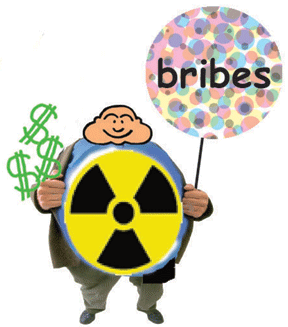
But Greenpeace criticised the payments, calling them bribes, and said new nuclear power plants should not go ahead without a long-term solution in place for their waste.
Doug Parr, the group’s chief scientist, said: “Having failed to find a council willing to have nuclear waste stored under their land, ministers are resorting to the tactics from the fracking playbook – bribing communities and bypassing local authorities.
“With six new nuclear plants being planned, the waste problem is just going to get much worse. Since there is no permanent solution for the disposal of spent nuclear fuel, the responsible thing to do would be to stop producing more of it instead of just passing the radioactive buck to future generations.”
Nuclear waste is currently stored at about 30 sites, but predominantly at ground level at Sellafield in Cumbria. The GDF project is expected to cost £12bn, spread over a century.
EU Observer, By ESZTER ZALANAustria decided on Wednesday (24 January) to sue the European Commission for allowing the expansion of Hungary’s controversial Paks nuclear plant, to be built and financed by Russia.
The project is viewed by critics as an example of Hungary’s prime minister, Viktor Orban, cosying up to Russian president Vladimir Putin.
Austrian sustainability minister Elisabeth Koestinger tweeted: “Austria will take action against the use of nuclear power plants at all levels. That is why today we have taken a decision in the council of ministers to sue Paks II at European level”.
“There are enough reasons to sue Paks II. We are optimistic to prevail. To protect our country and our children,” she added in a tweet. EU competition commissioner Margrethe Vestager, whose services were responsible for scrutinising the state aid plans for the nuclear plant, told reporters on Wednesday that the EU executive takes Austria’s decision “very seriously”.
“We will of course defend our decision with the arguments that are in the decision,” she added.
Last March the Commission gave its final approval for the project, and that said Hungary’s state aid is not illegal after commitments Budapest had made to limit distortions in competition.
An earlier infringement procedure looking into whether the project was in line with EU procurement rules, as it was initiated without a tender, was closed in 2016 with the ruling that Hungary did not break EU rules.
The project, signed in 2014 in Moscow, would see Russian state-owned company and its international sub-contractors build two new reactors.
The Russian state has also loaned up to €10 billion to Hungary to finance 80 percent of the project.
On track
Austria, Hungary’s neighbour, has no nuclear power plants. Last October, then prime minister Christian Kern said Austria would challenge the Commission’s decision on Paks.
Vienna launched a similar legal action against the Commission in 2015 over its approval of the UK’s state aid support for the Hinkley Point C nuclear power plant project.
“EU assistance is only permissible when it is built on common interest. For us, nuclear energy is neither a sustainable form of energy supply, nor is it an answer to climate change,” a spokesman for Koestinger, a member of right-wing Austrian People’s Party, was quoted by Reuters………
Green MEP Benedek Javor, who has challenged the commission’s decisions and shed light on shady dealings between commissioner Guenther Oettinger and German lobbyist of Russian interests Klaus Mangold with possible links to Paks , argued it is time to rethink the Euratom treaty.
“Is this possible to exempt a major energy generating sector, nuclear energy, from common competition or public procurement law, based on a 60 years old and never really updated regulation, the Euratom treaty? Without giving a clear negative answer to this question, any plans of the Energy Union or the single European energy market might remain a dream,” he said, arguing that the case is not only an Austro-Hungarian dispute.
“It is simply not true, that high amount of state subsidy for a nuclear power plant with 2400 MW of capacity does not distort the market. And it is simply misinterpretation of the Euratom treaty, that the paragraph saying that ‘the development of nuclear energy is a community interest’ means that unprofitable powerplants producing electricity for the market and built from Russian money, with Russian technology and using Russian fuel should be regarded as a community interest and heavily subsidised,” Javor argued………https://euobserver.com/energy/140690
NFLA 24th Jan 2018, As the UK Government plans yet another attempt to deliver a deep
underground radioactive waste repository, NFLA urges them and the
regulators to look carefully at a Swedish court ruling rejecting a
repository licence around real safety concerns.
The Nuclear Free Local Authorities (NFLA) has been made aware that the UK Government imminently
plans its latest attempt, which is the sixth attempt in the past 42 years,
to start a process to find a willing community to host a deep underground
radioactive waste repository.
This process now could be, and should be, completely reconsidered after a Swedish court ruling rejecting a licence
application on the waste capsules for a similar development, after many
years of planning.
For over 4 decades, several UK bodies – UKAEA, Nirex,
RWMD and now Radioactive Waste Management Ltd (RWM) – have been
established by the UK Government to deliver a deep underground radioactive
waste repository, often referred to in the industry as a geological
disposal facility (GDF).
Three consultations are expected to be issued
imminently – one on the definition of the community that would decide on
such a repository and how engaging with the public would take place, a
second on a National Policy Statement for a deep waste repository, and the
third the publication by RWM of a national geological screening of England,
Wales and Northern Ireland (Scotland is pursuing a separate policy of
‘near site, near surface’ storage of its highly active radioactive
waste).
Throughout its 38 years of operation, NFLA has been heavily engaged
in this debate. It remains sceptical that a deep underground repository is
the most environmentally sound solution for managing the UK’s huge burden
of radioactive waste.
It notes that the Nuclear Waste Advisory Associates
have outlined over 100 key technical and scientific concerns around such
developments, and NFLA has seen no resolution to these issues from the
government or RWM.
France’s previous socialist government pledged to reduce the share of nuclear in power generation to 50 percent by 2025, from 75 percent today. President Emmanuel Macron promised to respect that pledge during his election campaign last year, but since taking office he has pushed the target back by a decade.
Macron now wants to set new targets in a multi-year energy plan that will be debated this year and presented in early 2019.
But renewable energy activists say that at some workshops earlier this month, the government blocked discussion of scenarios under which France would radically reduce its nuclear power capacity, instead focusing on more pro-nuclear scenarios.
Energy and Environment Minister Nicolas Hulot has denied that the government favored the most pro-nuclear scenarios, saying it merely eliminated the two most extreme scenarios and kept the “median” scenarios. He did not specify which scenarios had been eliminated.
Late last year, French grid operator RTE published four 2035 scenarios under which nuclear capacity would be reduced to various degrees from the current 63 gigawatt (GW).
Under the “Volt” scenario, nuclear capacity would be cut to 55 GW by closing just nine of state-owned utility EDF’s 58 nuclear reactors and leaving the share of nuclear in power production at 56 percent. The “Ampere” scenario would close 16 reactors and leave the share of nuclear at 46 percent.
Two more radical scenarios, “Watt” and “Hertz”, would close as many as 52 and 25 reactors respectively, with the Watt scenario cutting the share of nuclear to as little as 11 percent. The remaining power would come from renewables (71 percent) and gas (18 percent).
“The Watt and Hertz scenarios were eliminated from the presentations at the government’s request,” said Yves Marignac of NegaWatt, a group which advocates higher renewables use.
NegaWatt took part in two workshops to prepare the public debate on the issue. It was joined by several energy-focused NGOs, EDF, nuclear firm Orano, and lobby groups. The debates are supposed to lead to a first draft of a multi-year energy plan by summer and a final plan in early 2019. Its conclusions will be crucial for European power markets as they will determine how much nuclear baseload capacity remains available.
· A source involved with organizing the workshops confirmed the government had instructed RTE to withdraw two scenarios.
· “All scenarios were mentioned, but only two were reviewed in detail,” he said.
· A ministry spokeswoman said two scenarios had indeed been removed from the presentation but declined to give details.
· “It is inconceivable that these two scenarios would be withheld from public debate,” NegaWatt’s Thierry Salomon said.
· France has withheld key information on nuclear before.
· In the months before the parliament vote on the 2015 energy law, Hulot’s predecessor Segolene Royal barred publication of an environment agency ADEME report showing France could switch to 100 percent renewables without extra costs.
· “At least this time the information is public. But it looks like the government is putting the interests of the nuclear industry ahead of the energy policy debate,” Salomon said.
AWE bids for ‘more realistic’ nuclear terrorism tests licence, The UK’s nuclear warhead factory is bidding for a licence change to run “more realistic” tests in preparation for “nuclear terrorism”.