India, Russia, Bangladesh sign tripartite pact for civil nuclear cooperation, By Dipanjan Roy Chaudhury, ET Bureau| Mar 01, 2018, NEW DELHI: In a landmark development India for the first time signed a tripartite agreement on Thursday with foreing partners — Russia & Bangladesh — for civil nuclear cooperation.
Nuclear Power Cooperation of India Limited (NPCIL) will play a key role in building a nuclear power plant on foreign soil with the proposed supply of equipment and material for the power station being built by Russia in Bangladesh. India is also extending support for capacity building and has been training Bangladeshi nuclear scientists for the project.
The agreement was signed in Moscow on Thursday by Deputy Director General of Rosatom (Russia’s Alex civil nuclear body) Nikolay Spassky, Ambassador of Bangladesh in Russia S.M. Saiful Hoque and Indian Ambassador to Russia Pankaj Saran.
Rosatom is constructing nuclear power plant in Bangladesh on a turnkey contract basis. The scope of work includes design, production and supply of equipment, construction, installation, pre-commissioning and commissioning, according to Rosatom officials.
Edie 27th Feb 2018, Jeremy Corbyn has pledged that Labour would keep Britain in the EU internal
energy market (IEM) and the Euratom nuclear co-operation treaty. In a
landmark speech setting out his party’s stance on the UK’s future
trading relationships following Brexit, the opposition leader said it was
in Britain’s interests to remain part of Euratom. He said: “We will
want to remain a part of agencies like Euratom, regulating nuclear
materials in energy and health sectors.” The Labour leader also used his
speech to signal Labour will seek continued UK membership of the IEM to
help support the development of the low carbon energy sector. He said
barrier-free trade of low carbon goods is necessary to underpin the growth
of the UK’s low carbon and renewable energy sectors. https://www.edie.net/news/11/Labour-would-keep-Britain-in-EU-internal-energy-market/
In 1985, a Russian Submarine Created an Atomic Disaster. The Radiation Lingers to This Day.Kyle Mizokami, 27 Feb 18,
According to Nuclear Risks, the accident scene was heavily contaminated with radioactivity. Gamma ray radiation was not particularly bad; at an exposure rate of five millisieverts per hour, it was the equivalent of getting a chest CT scan every hour. However, the explosion also released 259 petabecquerels of radioactive particles, including twenty-nine gigabecquerels of iodine-131, a known cause of cancer. This bode very badly for the emergency cleanup crews, especially firefighters who needed to get close to the explosion site, and the nearby village of Shkotovo-22. Forty-nine members of the cleanup crew displayed symptoms of radiation sickness, ten of them displaying acute symptoms.
In 1985, a Soviet submarine undergoing a delicate refueling procedure experienced a freak accident that killed ten naval personnel. The fuel involved was not diesel, but nuclear, and the resulting environmental disaster contaminated the area with dangerous, lasting radiation. The incident, which remained secret until after the demise of the USSR itself, was one of many nuclear accidents the Soviet Navy experienced during the Cold War.
The Soviet Union’s nuclear war planners had a difficult time targeting the United States. While the United States virtually encircled the enormous socialist country with nuclear missiles in countries such as Turkey and Japan, the Western Hemisphere offered no refuge for Soviet deployments in-kind.
One solution was the early development of nuclear cruise missile submarines. These submarines, known as the Echo I and Echo II classes, were equipped with six and eight P-5 “Pyatyorka” nuclear land attack cruise missiles, respectively. Nicknamed “Shaddock” by NATO, the P-5 was a subsonic missile with a range of 310 miles and 200- or 350-kiloton nuclear warhead. The P-5 had a circular error probable of 1.86 miles, meaning half of the missiles aimed at a target would land within that distance, while the other half would land farther away.
The missiles were stored in large horizontal silos along the deck of the submarine. In order to launch a P-5 missile, the submarine would surface, deploy and activate a tracking radar, then feed guidance information to the missile while it flew at high altitude. The system was imperfect—the command link was vulnerable to jamming, and the submarine needed to remain on the surface, helpless against patrol aircraft and ships, until the missile reached the target. Eventually the P-5 missiles were withdrawn and the P-5 missile was replaced with the P-6, a similar weapon but one with its own radar seeker for attacking U.S. aircraft carriers.
The introduction of the P-6 gave the Echo II a new lease on life. ……
On August 10, the submarine was in the process of being refueled. Reportedly, the reactor lid—complete with new nuclear fuel rods—was lifted as part of the process. A beam was placed over the lid to prevent it from being lifted any higher, but incompetent handling apparently resulted in the rods being lifted too high into the air. (One account has a wave generated by a passing motor torpedo boat rocking the submarine in its berth, also raising the rods too high.) This resulted in the starboard reactor achieving critical mass, followed by a chain reaction and explosion.
The explosion blew out the reactor’s twelve-ton lid—and fuel rods—and ruptured the pressure hull. The reactor core was destroyed, and eight officers and two enlisted men standing nearby were killed instantly. A the blast threw debris was thrown into the air, and a plume of fallout 650 meters wide by 3.5 kilometers long traveled downwind on the Dunay Peninsula. More debris and the isotope Cobalt-60 was thrown overboard and onto the nearby docks.
According to Nuclear Risks, the accident scene was heavily contaminated with radioactivity. Gamma ray radiation was not particularly bad; at an exposure rate of five millisieverts per hour, it was the equivalent of getting a chest CT scan every hour. However, the explosion also released 259 petabecquerels of radioactive particles, including twenty-nine gigabecquerels of iodine-131, a known cause of cancer. This bode very badly for the emergency cleanup crews, especially firefighters who needed to get close to the explosion site, and the nearby village of Shkotovo-22. Forty-nine members of the cleanup crew displayed symptoms of radiation sickness, ten of them displaying acute symptoms. …….
Barents Observer 26th Feb 2018. Finland’s Radiation and Nuclear Safety Authority (STUK) says tiny amounts
of radioactive iodine-131 were measured in the air Kotka, east of Helsinki
in late January. The same isotope was then measured again last week north
to Kajaani. The levels were very low, ranging from 0,7 to 1,6
micro-becquerel per cubic meter air, STUK says in a news release
From where the radioactivity is coming is still unknown. Radioactive iodine-131
has a half-life of only eight days so the measurements are proof of a
rather recent release.
The source could be a nuclear reactor, a facility
producing isotopes for medical purposes or by releases from a nuclear
weapons related test. Norway’s Radiation Protection Authority (NRPA) on
Monday confirms detection of radioactive iodine also at several of the
country’s air-measurement stations. https://thebarentsobserver.com/en/ecology/2018/02/traces-radioactive-iodine-air
Actus Environnement 23rd Feb 2018, [Machine Translation] The welds of the Flamanville EPR would not meet all the technical requirements. ASN will give its opinion in the second half of 2018. It also
mentions dysfunctions in the organization of the site.
On February 22nd, EDF announced that it had detected defects in the secondary circuit welds
of the EPR reactor under construction in Flamanville (Manche). In question:
the quality of realization of the welds of the circuit which evacuates
steam of the steam generators towards the turbine.
Thirty-eight of the 66 welds in the circuit are affected. Questioned on the subject in the
National Assembly, Pierre-Franck Chevet, president of the Nuclear Safety
Authority (ASN), described the subject as “serious” .
This Friday, the ASN publishes a note in which it indicates to have questioned February 7 EDF
and Framatome about the site of the EPR. The gendarme of the nuclear
indicates that it “informed EDF and Framatome that it will collect the
opinion of the permanent group of experts for GP ESPN nuclear pressure
equipment [about the anomalies of welding]” . But, assures EDF, “[the]
pipes are in compliance with the regulation of nuclear pressure equipment”
The company ” https://www.actu-environnement.com/ae/news/defauts-soudures-circuit-secondaire-epr-flamanville-30722.php4#xtor=ES-6
Nuclear Transparency 23rd Feb 2018 [Machine Translation]Review of forgings at Le Creusot: EDF discovered
1,063 anomalies and 233 nonconformities on 23 reactors. Following the discovery of numerous irregularities at Creusot Forge, now Framatome, EDF continues its review of the parts installed in its reactors.
A first report was published in September 2017 . A second assessment has just been posted. EdF makes a count of compliance discrepancies by distinguishing “non-conformities” that relate to an internal requirement to the
manufacturer of “anomalies” relating to the regulatory or customer’s external requirements.
Thursday Blog 24th Feb 2018, EDF has just revised upwards the number of defects affecting its reactors. The latest count of the company reports 1,063 ” anomalies ” (553 more than September 2017) and 233 ” non-conformities ” (103 more) on the equipment of 23 of its operating nuclear reactors. Added to this are 95 anomalies and 16 non-compliances on Flamanville EPR equipment revealed in September 2017.
ASN 23rd Feb 2018 [Machine Translation] The ASN college questioned EDF and Framatome
(formerly Areva NP) about the deviations in the welding of the main steam
drainage pipes.
The first discrepancies were brought to the attention of
the ASN in early 2017. These pipes are affected by a so-called “rupture
exclusion” approach, which implies a strengthening of design, manufacturing
and service monitoring requirements. This reinforcement must be sufficient
to consider that the rupture of these pipes is extremely improbable.
It allows the operator not to fully study the consequences of a rupture of
these pipes in the safety demonstration of the installation. In order to
achieve the expected high quality of production, strengthened requirements
including mechanical properties were defined by the operator (EDF) and the
manufacturer (Framatome).
However, these reinforced requirements have not
been specified to the subcontractor in charge of producing the welds. The
controls carried out during manufacturing in the factory have shown that
they are not all compliant for certain welds. As a result of an ASN
inspection, this observation has been extended to other welds of these
pipelines made at the Flamanville site.
“MILITARY PLUTONIUM To be manufactured at Hinkley”
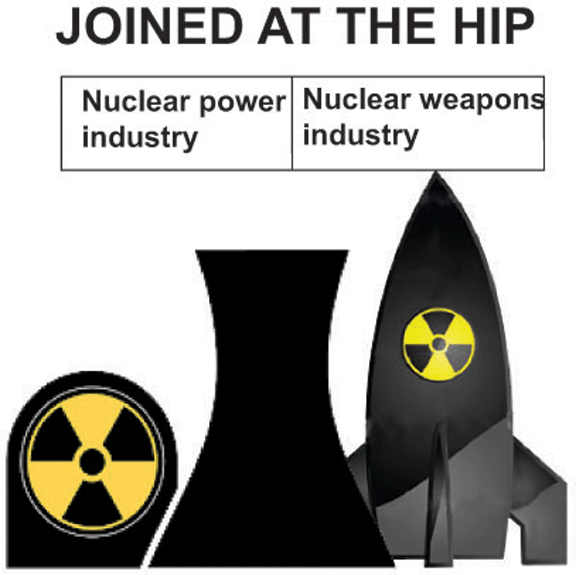
The charade of Atoms for Peace, Dr David Lowry , 23 Feb 18, “……Atoms for Peace ( in reality a cynical project promoting US global nuclear technology dominance launched by President Eisenhower at the UN in New York in December 1953) using a special atomic train taking nuclear scientists around the country promoting nuclear power.
But it was a charade. The first public hint came with a public announcement on 17 June 1958 by the Ministry of Defence, on: “the production of plutonium suitable for weapons in the new [nuclear ] power stations programme as an insurance against future defence needs…” in the UK’s first generation Magnox (after the fuel type, magnesium oxide) reactor.
A week later in the UK Parliament, Labour Roy Mason, who incidentally later became Defence Secretary, asked (HC Deb 24 June 1958 vol 590 cc246-8246) why Her Majesty’s Government had
“decided to modify atomic power stations, primarily planned for peaceful purposes, to produce high-grade plutonium for war weapons; to what extent this will interfere with the atomic power programme; and if he will make a statement.?” to be informed by the Paymaster General, Reginald Maudling
“At the request of the Government, the Central Electricity Generating Board has agreed to a small modification in the design of Hinkley Point and of the next two stations in its programme so as to enable plutonium suitable for military purposes to be extracted should the need arise.
The modifications will not in any way impair the efficiency of the stations. As the initial capital cost and any additional operating costs that may be incurred will be borne by the Government, the price of electricity will not be affected.
The Government made this request in order to provide the country, at comparatively small cost, with a most valuable insurance against possible future defence requirements. The cost of providing such insurance by any other means would be extremely heavy.”
The headline story in the Bridgwater Mercury, serving the community around Hinkley, on that day (24 June} was:
“MILITARY PLUTONIUM To be manufactured at Hinkley”
The article explained: “An ingenious method has been designed for changing the plant without reducing the output of electricity…”
CND was reported to be critical, describing this as a “distressing step” insisting
“The Government is obsessed with a nuclear militarism which seems insane.”
The then left wing Tribune magazine (on 27 June 1958) was very critical of the deal under the headline ‘Sabotage in the Atom Stations’:
“For the sake of making more nuclear weapons, the Government has dealt a heavy blow at the development of atomic power stations.
And warned:
“Unless this disastrous decision is reversed, we shall pay dearly in more ways than one for the sacrifice made on the grim alter of the H-bomb.”
Rosatom stakes out wind power to gird against blustery nuclear futures, Russia’s state nuclear corporation unveiled plans this week to build up to 600 megawatts of wind energy in the Krasnodar region in southern Russia in what appears to be part of the company’s tentative diversification within renewable energy. Bellona, by Charles Digges
“…….. the new wind farm and several battery production ventures the company is pursuing come as an evident bow to declining global demand for the nuclear power plant builds on which until recently the company had staked its future growth.
The new wind plant will be built by VetroOGK, a subsidiary of Rosatom, and will comprise a 150 megawatt park in the Shovgenovsky and Giaginsky districts of the southerly Republic of Adygea using equipment supplied by Dutch wind turbine maker Lagerwey, according to a Rosatom release. It expects to obtain construction permits for the project in March or April, while commissioning is scheduled for December 2018 or January 2019.
The VetroOGK had likewise inked a letter of intention to install another 200 megawatts of wind power in the Krasnodar Region at a wind park the company says it will open by the end of 2018. For the two parks Rosatom has invested $364 million, though its release also anticipates further funding for a 300 megawatt wind park in the Rostov Region, though the start date for that project remains unclear.
Though it would be a stretch to suggest that the wind projects could financially buoy the consolidated bulk of Russia’s monolithic nuclear monopoly, they nonetheless acknowledge sour facts about the company’s prospects for building its AES-2006, or VVER-1200, reactor package on the foreign market.
Speaking last summer at Novosibirsk’s Tekhnoprom-2017 technical trade conference, the company’s deputy director, Vyacheslav Pershukov said Rosatom’s international nuclear market was “exhausted” – the starkest acknowledgment yet from the company that its marquee product was selling poorly. …….
Czechs risk wrath of EU over nuclear power project, Prague is hoping Brussels will loosen its requirements for picking a nuclear project. Otherwise it may pursue a deal with Russia. Politico, By NICHOLAS WATSON, 2/23/18, PRAGUE — The Czech Republic looks set for a confrontation with the European Commission — and its anti-nuclear neighbors — over its ambitions to expand nuclear power.Prague wants to streamline a project to build a new reactor at the Dukovany nuclear power plant, 50 kilometers north of the Austrian border, to replace a Soviet-era reactor. That means persuading Brussels to exempt the project from strict EU rules on government bids.
If it fails, the Czech government is considering striking a nuclear deal with Russia along the same contentious lines as Hungary, which signed with Moscowlast year.
The second option would raise trouble for the Commission, which reluctantly approved Hungary’s Paks II nuclear project last year following long negotiations with Budapest. The decision was widely criticized for seeming to appeal to political interests over technical merits and is now being challenged by Austria for breaching EU state aid rules.
French nuclear watchdog raps EDF over Flamanville failings, Regulator says EDF must improve pre-startup testing, Orders EDF to send it report on weldings problems (Adds ASN comment on welding problems), By Geert De Clercq, PARIS, Feb 23 (Reuters) – French nuclear regulator ASN said it has told EDF to improve the running of the construction of the Flamanville nuclear reactor, which is years behind schedule and billions over budget.
The ASN has repeatedly said a schedule to load nuclear fuel at the EPR reactor in Flamanville, which is the same type as EDF is building in Britain’s Hinkley Point, by year-end is tight.
ASN said EDF must improve the follow-up of pre-startup test as well as the treatment of any flaws, and to improve the information flow to the regulator.
“EDF has promised to put in place an action plan to remedy these dysfunctions,” ASN said in a statement on Friday.
The ASN also said it had questioned EDF and Framatome, the company formerly called Areva, about flaws in the welding of the Flamanville reactor’s steam pipes.
………Any further delay to Flamanville would be another blow to the image of the EPR reactor. Three others have been under construction for years in Finland and China and are all over budget and schedule.
At the end of last year, Flemish nationalists spoke publicly against the withdrawal of nuclear power endorsed by the Energy Pact project that was designed by the country’s four ministers for energy on the basis of the cost for households and companies. The Plan Office and Professor Johan Albrecht have been asked to evaluate the cost evolution of power in Belgium in the years to come, taking various scenarios into consideration.
The extra cost for households would come to 15 euros plus VAT as of 2025, the planned date for the phasing-out of nuclear power. It includes the producers’ investment in gas power plants, the price of gas necessary for the production of electricity, as well as the federal government’s subsidies for plants. This figure, however, does not take into account the cost of the plants’ dismantlement or the nuclear waste reprocessing, and it only covers the expenses which fall within the federal competence. The support cost for the sustainable, therefore, is not included.
For the companies, the situation will be “slightly more complicated,” according to the minister. Discounts to be discussed with partners of the majority could be granted to companies competing with foreign offers, she indicated.
https://fr.reuters.com/article/africaTech/idAFL8N1QC7B5 Rédaction Reuters PARIS, Feb 22 (Reuters) – France has no need to build new nuclear reactors in addition to the one currently being assembled in Flamanville, in western France, Environment Minister Nicolas Hulot said on Thursday.
President Emmanuel Macron said last week he would not rule out France building new nuclear reactors to replace state-controlled utility EDF’s ageing reactors.
“For the moment, frankly, there is no need to consider building other nuclear reactors in addition to Flamanville,” Hulot told lawmakers.
Hulot said in November last year that reducing the share of nuclear energy in France’s power mix to 50 percent from 75 percent would probably take until 2030-35, dropping an initial 2025 target date.
Reporting by Simon Carraud; Writing by Matthias Blamont. Editing by Jane Merriman
New Power 22nd Feb 2018, The Office for Nuclear Regulation (ONR) has begun procuring a system to
track nuclear materials in the UK and ensure they are not diverted from
civilian uses, which will be required if, as planned, the UK exits the
Euratom treaty as it leaves the EU.
ONR said it has to develop and deliver a UK State System of Accountancy for and Control of Nuclear Material by 29
March 2019. It will include a Safeguards Information Management and
Reporting System that meets international reporting obligations. Without
the system, ONR said it will not be able to effectively deliver the
necessary nuclear materials accountancy.
It must be ready for parallel running by the end of December 2018 and go live by 29 March 2019. ONR has
published a procurement notice on the government’s digital marketplace
website. It says questions can be asked until 28 February and applications
must be made by midday on 7 March. The contract award is expected on 1 May
and by then the bidder must have security clearance for all personnel
involved. https://www.newpower.info/2018/02/onr-begins-procurement-to-replace-euratom-nuclear-safeguards-system/
Austria’s new government, an alliance between Chancellor Sebastian Kurz’s conservatives and the far-right Freedom Party, has pledged to continue Vienna’s decades-long policy of opposing nuclear power.
It said last month that it would file the legal challenge against the expansion of the Paks power plant situated near the border it shares with Hungary.
“We must take up this David-versus-Goliath struggle for the sake of our nature, our environment and our unique countryside,” the minister for sustainability and tourism, Elisabeth Koestinger, said in a statement on Thursday announcing the government had started the case.
“Nuclear energy has no place in Europe. We will not deviate from this line by even a centimeter.”
A spokesman for the EU executive said: “The Commission will defend its decision in Court.”
In March, EU state aid regulators approved Hungary’s plan to build two new reactors at its Paks nuclear site with the help of Russia’s Rosatom, saying Hungarian authorities had agreed to several measures to ensure fair competition.
The two new reactors will double the plant’s nominal capacity of 2,000 megawatts. Hungary aims to start construction on the reactors this year, with the first facility expected due to be completed in 2025.
In most complex cases of this kind, the Luxembourg-based European Court of Justice has found in favor of the Commission.
($1 = 0.7174 pounds)
Reporting by Francois Murphy; Additional reporting by Alissa de Carbonnel in Brussels; Editing by Alison Williams