Mersea Life August 2018 ,Andy Blowers: It’s interesting to see how government works. The other day I was invited to give evidence to the Parliamentary Select Committee on Business, Energy and Industrial Strategy. They were pondering the Draft National Policy Statement for Geological Disposal Infrastructure. Arcane, perhaps, but undoubtedly important and a riveting topic for anyone concerned with the future of our environment.
Although I said what I wanted to say, I felt my words went into a void, rather like the geological void that was the topic of debate. Recently the Government published its policy for the development of a deep geological repository in which to bury all the most dangerous nuclear wastes created by its military and civil nuclear programmes.
That something needs to be done is not in doubt but a repository must be in suitable geology, safely engineered and must achieve public support – conditions unlikely to be forthcoming in the near future.
The problem of managing the wastes that already exist will be difficult enough. But, the idea that a repository can also be used to accommodate the unknowable quantity of dangerous wastes from a new build programme is surely preposterous.
Yet this is what the Government proposes, stating its belief that ‘effective arrangements will exist to manage and dispose of the waste from new build power stations’.
How can they possibly know? There is no foreseeable solution to the problem of wastes from new nuclear power stations, other than leaving them in stores scattered around our coasts at vulnerable, low-lying sites like Bradwell for the indefinite future.
If Bradwell B is ever built these wastes will be left, according to the Government’s own estimates, until at least the turn of the twenty-third century, that is seven generations from now. The future physical conditions on the site and the state of society so far away is simply undefinable. It is unethical and should be unthinkable to present such an intractable problem to our children, grandchildren and generations beyond.
New build wastes take a very long time to cool before they can be ready for disposal. On current evaluations it could require between 60 and 140 years before disposal. So, let’s assume that Bradwell B starts generating in 2030 and continues for 60 years until 2090. It will then be between 2150 and 2230 before all its wastes could be disposed of, assuming,of course, there is a repository available. The simple truth is we have absolutely no idea how to estimate, let alone manage, the spent fuel and other dangerous wastes that will arise from a new nuclear power station at
Bradwell.
Herald 11th Aug 2018, Police Scotland is expecting a £4 million windfall from external
organisations for protecting nuclear waste shipments and policing sporting
events. The force has made almost £1 million this year so far for
providing logistical support for nuclear waste transfers and policing
football matches. The ongoing logistical support — known as Operation
Ailey — is understood to involve traffic management and public order
protection for nuclear waste travelling from the decommissioned Dounreay
nuclear plant for reprocessing at Sellafield in Cumbria. http://www.heraldscotland.com/news/16412532.nuclear-convoys-and-sports-give-police-4m-windfall/
How come the Australia government, which gives help to convicted murderers overseas – does nothing to help whistleblower Julian Assange? It’s a national disgrace!
Assange may finally leave Ecuadorian embassy in London as health worsens – report Julian Assange, who has spent more than 2,230 days in the Ecuadorian embassy in London, is expected to leave the building soon with his health deteriorating, sources say.
This latest information about the WikiLeaks founder, who was already expected to leave the embassy “in the coming weeks,” was Wednesday by Bloomberg which cited “two people with knowledge of the matter.” The news agency reported that the whistleblower’s health “has declined recently.”
The news comes days after Ecuadorian President Lenin Moreno announced that Assange must “eventually” leave the embassy. “Yes, indeed yes, but his departure should come about through dialogue,” the Ecuadorian president said in answer to a reporter’s question on whether he will eventually have to leave.
“For a person to stay confined like that for so long is tantamount to a human rights violation,” Moreno said, stressing that Ecuador wants to make sure that nothing “poses a danger” to the whistleblower‘s life.
The whistleblower’s health is deteriorating, according to the Courage Foundation, a group that fundraises for the legal defense of whistleblowers. Assange is in “a small space” and has “no access to sunlight,” the group , adding that this has a serious impact “on his physical and mental health.”
Rape allegations, stemming from Assange’s visit to Sweden in August 2010, were the main reason that he sought refuge in London’s Ecuadorian embassy in 2012 when a warrant was issued for his arrest. Assange maintained that he could be extradited from Sweden to the US, where he would be prosecuted for his whistleblowing and would not receive a fair trial. Swedish prosecutors dropped the investigation in 2017, but a British warrant for violating bail conditions still stands.
Washington simply “wants revenge” for the “embarrassment” WikiLeaks caused it, and wants it to serve “as a deterrent to others,” human rights activist Peter Tatchell told RT earlier in July. “Someone who’s published that information in the same way that the New York Times or the Guardian publish information, I don’t think they should face risk 30 or 40 years in jail in the United States,” Tatchell added.
Launched in 2006, the WikiLeaks project is aimed at exposing government and corporate secrets. It garnered global attention back in 2010 with its massive release of classified US military documents, which included those detailing how American military equipment was deployed in Afghanistan and Iraq. Assange won thousands of admirers, with many applauding his willingness to speak the truth.
Penarth Times 10th Aug 2018, A start is to be made on Thursday next week on the controversial dumping of
320,000 tonnes of allegedly radioactive mud in the Bristol Channel just a
mile off the Penarth sea front. The mud comes from the vicinity of the
Hinkley Point nuclear reactor site where a third nuclear power station is
now being built by the French energy company EDF – and will be dumped at
the so-called “Cardiff Grounds” site .
EDF has given the Welsh Labour Government’s environmental arm – Natural Resources Wales – the
absolute bare minimum of notice. EDF is required by its licence to give at
least 10 days’ notice of the commencement of the mud-dumping operations
off Penarth – and EDF has given exactly the minimum amount of notice
it’s required to give – just 10 days – and no more. https://penarthnews.wordpress.com/2018/08/10/nuclear-mud-starts-being-dumped-off-penarth-next-thursday/
Is BBC Spying on WikiLeaks Founder Assange in Ecuadorian Embassy? https://sputniknews.com/europe/201808091067081598-bbc-spy-assange/ 09.08.2018 Ecuadorian President Lenin Moreno recently raised the issue of WikiLeaks’ founder leaving the country’s embassy in the UK, where he has been holed up since 2012, fearing the UK police will arrest and extradite him to the US.
On Thursday WikiLeaks Twitter account posted a screenshot of a letter received by some of the residents of no. 18 Hans Cres, London — an apartment building across from the Ecuadorian Embassy that serves as an asylum for Julian Assange. The letter, which has a BBC News logo in its top right corner, asks permission to install permanent cameras outside residents’ apartments so that they overlook the embassy.
The letter was motivated by a desire to better cover Julian Assange’s story and promised to compensate for any disturbances caused. The letter also contains Jonathan Whitney’s email as a contact for those interested in the offer. According to Whitney’s profile, he is a BBC News Deployment Editor.
WikiLeaks chief editor Julian Assange has been living in Ecuador’s UK Embassy since 2012 fearing the UK may extradite him to the US, where he could face prosecution over WikiLeaks’ publication of leaked US military and diplomatic documents. Recently Ecuadorian President Lenin Moreno touched upon the issue of expelling Assange from the embassy, but noted that the UK must first guarantee the activist’s safety.
His statements followed conflicting media reports that Ecuador might revoke Assange’s asylum and that the whistleblower might leave voluntarily to due increasing health issues.
Middle East Monitor 10th Aug 2018 , Egypt will obtain a license to build the Dabaa nuclear plant by mid-2020,
the Russian deputy minister of industry and trade said. Georgy Kalamanov
added that Russian experts are currently completing designing the nuclear
plant and surveying the area where it will be built.
In 2015, Russia andEgypt signed a deal which would see Russia build Egypt’s first nuclear
power plant in the Dabaa area, located on Egypt’s northwestern coast.
Under the terms of the agreement, Cairo would access a loan for the project
from Moscow. In 2016, the Egyptian official Gazette reported that the loan
would amount to $25 billion, which would finance 85 per cent of the cost of
contracts signed for the plant’s construction. The loan repayment period
is 35 years. Egypt will finance the remaining 15 per cent. https://www.middleeastmonitor.com/20180810-russia-egypt-to-begin-building-nuclear-reactor-in-2020/
Mersea Life July 2018, A band of BANNG representatives, including myself, attended the June meeting of the LCLC at Mundon. The LCLC looks at what is happening at the Bradwell A site with regard to decommissioning and the future of the site.
The big issues discussed were: the entry of the site into Care & Maintenance (C&M); the long-term presence on site of the Intermediate-Level waste (ILW) store and of the highly radioactive graphite reactor cores. It was questioned how the site could really be said to be in C&M when it would still have activities ongoing.
The ILW store would require to be opened from time to time to accept deliveries of the 164 ILW casks still to come
from Dungeness and Sizewell (making Bradwell a regional nuclear waste store); and the highly radioactive reactor cores would continue to remain on site for the long-term.
This prompted questions: were the plans to monitor the site remotely from Sizewell during the C&M stage appropriate?;
what about the effects of public spending restraints on site security?; would cuts to police numbers affect the ability of Essex Police to respond to any incident at the site?
The Office for Nuclear Regulation (ONR) tried to reassure the meeting that the site will not be permitted to enter C&M
until the agency is satisfied with the safety case and it was known that Magnox and the police would be able to respond to events.
It was hoped to move the wastes to the national repository within 65-85 years. Andy Blowers pointed out that a repository does not yet exist, no-one knows when it will exist – or if it will exist at all. In any event, it is unlikely that wastes from Bradwell A will be high in the queue when Sellafield has first call on the repository. http://edition.pagesuite-professional.co.uk/Launch.aspx?EID=46bf7f8d-da05-442f-83a8-2cc336bdc0a8
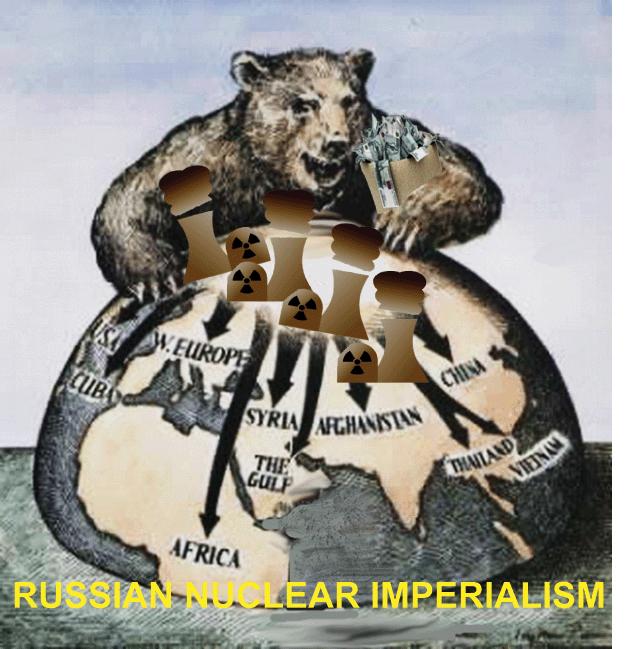
Russia on an international offensive to sell its nuclear plants, Vladimir Putin’s government vies with China to become a superpower in the field TOMOYO OGAWA, Nikkei staff writerMOSCOW — Russia is stepping up its overseas sales of nuclear power plants, with state-run nuclear energy company Rosatom agreeing in July to cooperate in building a plant in the Central Asian country of Uzbekistan and reaching an accord with China to build a plant in that country.
Russia accounts for 67% of the world’s nuclear plant deals currently in development. By 2030, Rosatom aims to increase its overseas sales to two-thirds of total sales, from 50% at currently. Vladimir Putin’s government is looking to expand Russian influence through nuclear diplomacy, vying with China — which is promoting its own nuclear plants — for the status of nuclear energy superpower.
“We hope that a lot of other countries will become our partners, and as they say, ‘nuclear newcomers,'” Rosatom Chief Executive Alexey Likhachev told Prime Minister Dmitry Medvedev at a meeting in early July…….
During a visit by Putin to China in June, Rosatom entered into a framework agreement to cooperate in nuclear plant construction, including four reactors in Jiangsu and Liaoning provinces.
Russia intends to make nuclear power plants a major revenue earner alongside exports of crude oil and natural gas. Rosatom’s annual business report for 2016 showed it was involved in nuclear plant projects in more than 10 countries, including China, Bangladesh and India. The company had $133.4 billion of overseas orders, up 21% from a year earlier. It targets $150 billion to $200 billion in orders in 2030…….
Russia’s strength in the field is the all-out support of the government, and its ability to take on all aspects of a nuclear energy project. The Putin government attaches much importance to nuclear plants, seeing them as a globally competitive, technology-intensive industry with an important role to play in revitalizing Russia’s domestic industry. Putin himself has successfully pitched Russian nuclear plants to foreign leaders during international summits.
Russian nuclear plants also boast price competitiveness, with the government providing loans to finance the high costs. Not only does Russia build the plant, but it supplies the fuel, operates and maintains the reactors, and disposes of the used fuel. This makes a deal with Russia attractive for countries that want to build their first nuclear plant, but which lack the operational know-how…….
NFLA 8th Aug 2018 , The Nuclear Free Local Authorities (NFLA) notes the report by the ‘Expert
Finance Working Group on Small Modular Reactors’ as another attempt to
promote the benefits of this technology despite large and quite possibly
insurmountable hurdles to cross.
The report was commissioned by the UK
Government to consider ways to provide market frameworks for the
development of small nuclear reactors to prosper. The Government suggests
it is an ‘independent’ group, yet at least half of the group have
strong links to the nuclear industry, including the Nuclear Industry
Association, the main UK supporter for such technology.
Over the past few
years, the UK Government has put forward the potential of small nuclear
reactors to be a part of a future ‘low carbon’ energy mix. The UK
appear to be one of the few governments pursuing such a strategy, as even
France and Finland, the only other countries in Europe currently developing
large nuclear projects, have no plans to develop such technology. Indeed
France has just commissioned a whole raft of new smaller-scale solar energy
projects. http://www.nuclearpolicy.info/news/small-modular-nuclear-reactors-financing-report-nfla-remain-sceptical-such-technology-as-cost-effective-as-renewables/
Dave Toke’s Blog 7th Aug 2018 So finally the Government has, after I feared so long it would, chosen the
doomsday option to fund new nuclear power stations – one that will be
disastrous for the consumers and taxpayers.
After years of swearing that
they would not offer subsidies to nuclear power, and saying that in the
future the terrible drain of (historical) over-spending on nuclear power
would stop, the Government has gone back to square zero.
Essentially, under
the Government’s proposals for so-called ‘Regulated Asset Base’ (RAB) of
funding nuclear power (described in a recent article in ‘Unearthed’, a
Greenpeace publication), the nuclear developers will have no real limit on
what they can spend to build the power stations. It is a recipe for
national disaster.
No private developer is willing to take the construction
risks of funding nuclear power in the UK, whatever ‘strike price’ is
offered for the electricity that might be generated in future. Doesn’t that
tell you something?
So EDF stepped up to the mark. EDF, the French
state-owned company, may be starting the real part of the construction of
Hinkley C in 2019/2020. The French state will pay for the inevitable cost
overruns that come along with building the plant, combined quite probably,
with an out-of-contract bailout by the British Government when the going
gets tough.
But now the Government is casting around for another nuclear
power plant to be built, – Wylfa or Sizewell C – but neither developer
(Hitachi or now EDF) wants to take the risk of paying the almost inevitable
losses on the project. So enter the Government’s new proposals which will
no doubt be promoted as a simple accountancy trick to lower costs, but hide
the fact that the state will take the losses, to be divided up between us
as taxpayers (loss of guaranteed loans and construction risk guarantees)
and electricity consumers (advance payments on top of electricity bills).
And, note this, whatever ministers may say, the exposure by taxpayers and
consumers in UNLIMITED. http://realfeed-intariffs.blogspot.com/2018/08/new-nuclear-plan-means-that-consumers.html
Europe’s heatwave is forcing nuclear power plants to shut down, Quartz, By Akshat Rathi, August 6, 2018
Nuclear power is one of the world’s biggest sources of carbon-free electricity. But it has an Achilles’ heel: it needs lots of water to operate.
That’s bad news right now. Europe’s heatwave—which led to wildfires in Greece and Sweden, droughts in central and northern parts, and made the normally green UK look brown from space—is forcing nuclear plants to shut down or curtail the amount of power they produce. French utility EDF shut four reactors at three power plants on Saturday, Swedish utility Vattenfall shut one of two reactors at a power plant earlier last week, and nuclear plants in Finland, Germany, and Switzerland have cut back the amount of power they produce.
Thermal power plants, such as nuclear or coal, use high-temperature steam to turn turbines, which convert heat energy into electricity. In the process, the steam’s temperature falls, so it can no longer be used to move the turbine again. To raise its temperature back up, the steam first needs to be condensed into water, because liquids absorb heat better than gases. The condensation is achieved by using cooling water drawn from rivers, lakes, or seas, which is then dumped back at a temperature that is safe for wildlife in those waters. (Gas power plants also use cooling water, but they need less of it than coal or nuclear installations.)
Europe’s heatwave, however, hasn’t just increased air temperatures but also water temperatures. Regulations protecting wildlife mean that the usual water sources drawn on by nuclear plants cannot always be used for cooling, leading to shutdowns. It’s not the first time this has happened: Heatwaves forced nuclear shutdowns or curtailments across Europe in 2003, 2006, and 2015.
Unearthed 6th Aug 2018 , Consumers could pay for new nuclear power plants years before they are
built. The government is considering using a controversial financing system
to build new nuclear power stations which would see customers charged for
construction costs long before a project has actually been built.
The approach, called the Regulated Asset Base (RAB) model, has been described
as an “open cheque book” for developers, as consumers could be locked
into paying the costs of a project going wrong – like construction taking
longer than planned, or prices spiraling – indefinitely until it’s
complete.
Shadow energy minister Alan Whitehead MP said: “The problem
with this model as applied to new nuclear power stations is that it
transfers all the risk of construction from the developer to the customers,
with the rather wobbly promise of benefits to come in the future.
” Like other public-private finance models, the RAB model has a sticky history.
The government has already supported the use of RAB for the Thames Tideway
Tunnel, a £4.2bn project to revamp 15 miles of sewer lines in North
London, which Thames Water says a RAB model has helped lower costs. Much of
the work around taking a RAB approach to financing nuclear power has been
carried out by Dieter Helm, professor of Energy Policy at the University of
Oxford and a figure respected by government.
Writing in a blog about the
model’s application to nuclear last month, Helm highlighted a number of
open issues – such as which regulator would set the RAB for nuclear
projects, as well as the “very severe lobbying pressures” any regulator
would come under when making its RAB evaluations. Helm concludes that the
RAB may be an efficient approach to financing nuclear power, but still
doesn’t address fundamental issues about its cost competitiveness with
other technology like wind and solar, or what do with all its radioactive
waste. “It is for society to decide whether it wants new nuclear or
not,” he said. “The market cannot decide.”
Clear process to rid us of nuclear weapons Herald Scotland, Isobel Lindsay, 7 Aug 18“……. The United Nations Treaty for the Prohibition of Nuclear Weapons which was formalised in 2017 would offer an independent Scottish state a clear route with international supervision to have these weapons removed if Scotland applied to join the Treaty. The SNP and the Greens support the treaty and after independence so would many Labour members. There would be a strong political majority for this.
The first thing a member state has to do is to make nuclear weapons on its territory non-operational. This process will be supervised by the International Atomic Energy Agency. This simply means requiring that all nuclear warheads are removed from the missiles. This can be done in months. Warheads are manufactured in Burghfield in the south of England and while there is not presently the storage capacity there for the 200 warheads we have at Coulport, creating another site in the vicinity solely for warhead storage would not be a lengthy process. Within three years the warheads could be transferred there. The missiles are manufactured and serviced in the United States so could be sent back there for storage. The submarines are serviced at Devonport but are not allowed for safety reasons to have warheads there. Storing or dismantling the submarines could provide work there and at Barrow although these places could not be used operationally. …..http://www.heraldscotland.com/opinion/16402262.clear-process-to-rid-us-of-nuclear-weapons/
US military flights through Shannon would be ‘illegal’ under new anti-nuclear treaty
‘Doomsday Clock now stands at two minutes to midnight,’ Irish CND president says, Irish Times, Elaine Edwards
It would be illegal for most American military flights to pass through Shannon airport under a new international nuclear weapons treaty which the Government is committed to ratifying, the president of the Irish Campaign for Nuclear Disarmament (CND) has said.
Rev Prof Patrick Comerford was speaking at a commemoration ceremony in Dublin to mark the 73rd anniversary of the atomic bombing of the Japanese city of Hiroshima during the second World War………
Legislation to ratify it and give effect to its provisions is being prepared by the Department of Foreign Affairs. …..
Prof Comerford said Ireland was today once again at the forefront, promoting the Treaty on the Prohibition of Nuclear Weapons, or the Nuclear Weapon Ban Treaty.
The treaty was passed on July 7th last year and in order to come into effect, it needs the signature and ratification of at least 50 countries…….
Despite opposition from Nato member states to the treaty, Ireland was one of the strongest proponents of the new treaty during last year’s negotiations,” Prof Comerford said.
“The Government is committed to early ratification, and, despite Brexit consuming so much of the department’s time and resources, negatively, I hope in a very positive way this treaty can be ratified by Ireland before the end of the year.”
He said that once it entered into force, there would be “a clear international prohibition on acquiring, stockpiling and sharing nuclear weapons”, which had been a major short-falling in the earlier treaty.
1,335 MW St Alban-1, 910 MW Bugey-2 offline until next Saturday
Reduced available capacity at St Alban-2, Bugey-3, Fessenheim-2
Prompt power price rally continues due to supply pressures
London — With France bracing for more hot to very hot weather in the coming week, nuclear power plant operator EDF said Friday it plans to halt production completely at two of its reactors near the river Rhone, water from which is used for cool them, and reduce available capacity at other units next week.
In its latest update on Friday, EDF said production capacity at the 1,335 MW St Alban-1 and 910 MW Bugey-2 reactors would drop to zero until Saturday next week, reducing capacity from Friday afternoon. The 910 MW Bugey-3 will also remain unavailable for power generation from late Friday but with an expected restart on Wednesday.
Out of the 1,335 MW St Alban-2 installed capacity, 950 MW will remain available to the market over the weekend, EDF said, while 600 MW will be available from its 880 MW Fessenheim-2 nuclear reactor over the weekend and until Monday midnight.
EDF, however, warned that the planning and duration of the unavailability due to environmental issues will be reassessed according to the weather forecast. These supply restriction warnings due to hot weather began late July at the onset of the heatwave which is currently covering Europe.
Furthermore, forecasters predict temperatures in France, Germany, Italy and Spain to stay above seasonal averages next week, with forecaster MeteoFrance expecting Portugal temperatures to hit 48 degrees Celsius over this weekend.
The hot weather and the resulting nuclear supply restrictions sent the prompt power prices in the wholesale market to winter levels as countries are ramping up the more expensive fossil fuel power plants, analysis shows.
French day-ahead baseload for Monday delivery was last heard trading at Eur66.50/MWh on the over-the-counter market, reaching a new summer high and the highest in more than five months, data showed.