A Dead Russian Submarine Armed with Nuclear Torpedoes was Never Recovered, National Interest, Robert Farley, September 15, 2019
Key point: She rests at a depth of 15,000 feet —too deep to make recovery practical.
The Bay of Biscay is one of the world’s great submarine graveyards. In late World War II, British and American aircraft sank nearly seventy German U-boats in the Bay, which joined a handful of Allied and German subs sunk in the region during World War I. On April 12, 1970, a Soviet submarine found the same resting place. Unlike the others, however, K-8 was propelled by two nuclear reactors, and carried four torpedoes tipped by nuclear warheads.
The Novembers (627):
The November (Type 627) class was the Soviet Union’s first effort at developing nuclear attack submarines…….
The Novembers were too loud to plausibly find their way into close enough proximity to a NATO port to ever actually fire a nuclear torpedo in wartime conditions…….
On April 8, K-8 suffered two fires, resulting in a shutdown of both nuclear reactors. The boat surfaced, and Captain Vsevolod Borisovich Bessonov ordered the crew to abandon ship. Eight crew members, trapped in compartments that were either flooded or burned out, died in the initial incident. Fortunately, a Soviet repair vessel arrived, and took K-8 under tow. However, bad weather made the recover operation a difficult prospect. Much of K-8’s crew reboarded the submarine, and for three days fought a life-and-death struggle to save the boat. Although details remain scarce, there apparently was no opportunity to safely remove the four nuclear torpedoes from K-8, and transfer them to the repair ship.
Unfortunately, the loss of power onboard and the difficult weather conditions were too much for the crew to overcome. On April 12, K-8 sank with some forty crew members aboard, coming to rest at a rough depth of 15,000 feet. The depth made any effort at recovering the submarine, and the nuclear torpedoes, impractical……
R
September 16, 2019
Posted by Christina Macpherson |
oceans, Russia, wastes, weapons and war |
Leave a comment
[in 1992] Baverstock and his colleagues published a letter on their findings in the scientific journal Nature, in which they concluded, “the consequences to the human thyroid, especially in fetuses and young children, of the carcinogenic effects of radioactive fallout is much greater than previously thought.”
Now, after more than 30 years, U.N.-sponsored researchers have backed away from the 1992 UNSCEAR study by concluding that “studies of clean-up workers/liquidators suggest dose-related increases of thyroid cancer and hematological malignancies in adults,” as well as “increases in cardiovascular and cerebrovascular disease. If confirmed, these would have significant public health and radiation protection implications.”
The United States’ involvement with the Chernobyl aftermath was shaped largely, and shamefully, by the desire to avoid potential legal liabilities associated with the 166 U.S. open-air nuclear weapons tests in Nevada and the Marshall Islands. At the time of the Chernobyl accident, compensation radiation claims for injuries and deaths from bomb testing were looked upon by the nuclear weapons program as a dagger aimed at the heart of U.S. national security.
|
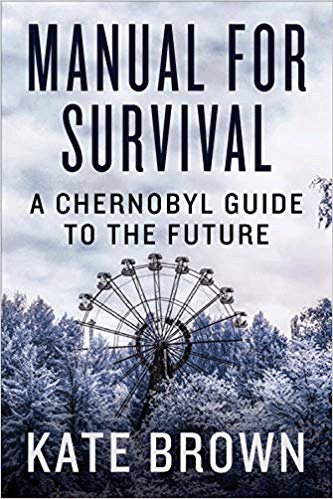
Much has been written about the strengths and flaws of Chernobyl—the HBO miniseries nominated for 19 Emmys that chronicles the catastrophe at the eponymous Russian nuclear power plant in 1986. In the mind of this reviewer, it’s a riveting if sobering television gem, and highly recommended. And to this newly enlivened debate over nuclear power we can now add Kate Brown’s book, Manual for Survival: A Chernobyl Guide to the Future, a tour de force about the radiological aftermath of the Chernobyl disaster. A science historian at the Massachusetts Institute of Technology, Brown peels away the layers of long-held mythologies—that in the end, the accident only killed 54 people, and that “radiation phobia” among the people who sustained heavy radioactive fallout was a bigger problem than any of the other health outcomes.
Brown, who is conversant in Russian, devoted years to extensive archival research (much of which was scattered and hidden from official attempts at confiscation). She conducted interviews with villagers, military officials, factory workers, medical doctors, Soviet nuclear experts, emergency responders, KGB operatives (who assumed control over much of the data from the accident), and international nuclear safety and radiation health experts. The result is a rich and deeply disturbing picture of the environmental perils of extensive and lasting nuclear contamination.
She digs prodigiously, much to the disfavor of defenders of nuclear power, into the widespread practice of secrecy and deception regarding the radiological harm from elevated, long-term, chronic exposures. Continue reading →
|
September 14, 2019
Posted by Christina Macpherson |
investigative journalism, politics, secrets,lies and civil liberties, Ukraine, USA |
Leave a comment
Getting Julian Assange The Guardian also appears to have been engaged in a campaign against the WikiLeaks publisher Julian Assange, who had been a collaborator during the early WikiLeaks revelations in 2010.
It seems likely this was innuendo being fed to The Observer by an intelligence-linked individual to promote disinformation to undermine Assange.
In 2018, however, The Guardian’s attempted vilification of Assange was significantly stepped up. A new string of articles began on 18 May 2018 with one alleging Assange’s “long-standing relationship with RT”, the Russian state broadcaster. The series, which has been closely documented elsewhere, lasted for several months, consistently alleging with little or the most minimal circumstantial evidence that Assange had ties to Russia or the Kremlin.

 How the UK Security Services neutralised the country’s leading liberal newspaper. https://www.dailymaverick.co.za/article/2019-09-11-how-the-uk-security-services-neutralised-the-countrys-leading-liberal-newspaper/ By Matt Kennard and Mark Curtis• 11 September 2019, The Guardian, Britain’s leading liberal newspaper with a global reputation for independent and critical journalism, has been successfully targeted by security agencies to neutralise its adversarial reporting of the ‘security state’, according to newly released documents and evidence from former and current Guardian journalists.
The UK security services targeted The Guardian after the newspaper started publishing the contents of secret US government documents leaked by National Security Agency contractor Edward Snowden in June 2013.
Snowden’s bombshell revelations continued for months and were the largest-ever leak of classified material covering the NSA and its UK equivalent, the Government Communications Headquarters. They revealed programmes of mass surveillance operated by both agencies.
According to minutes of meetings of the UK’s Defence and Security Media Advisory Committee, the revelations caused alarm in the British security services and Ministry of Defence. Continue reading →
September 14, 2019
Posted by Christina Macpherson |
media, Reference, secrets,lies and civil liberties, UK |
Leave a comment
France flags welding fault at five or more EDF nuclear reactors, PARIS (Reuters) 13 Sept 19, – At least five nuclear reactors operated by French utility EDF might have problems with weldings on their steam generators, a fault which has raised fears of closures, France’s nuclear regulator was quoted as saying.
State-controlled EDF, whose shares were down 0.9% on Thursday, had said on Tuesday it had identified issues with weldings of some existing reactors, sparking a stock price fall of nearly 7%.
France has the world’s second-largest fleet of nuclear reactors behind the United States, but a spate of technical problems, coupled with hitches at reactors under construction, has tarnished EDF’s image as a leader in nuclear technology.
EDF has exported to China, Finland, South Africa and South Korea, with Britain also set to use its equipment.
“At least five nuclear reactors are affected by this problem,” Le Figaro newspaper quoted Bernard Doroszczuk, head of the ASN regulator, as saying.
“EDF has advised that in around a week it will give an exact number of facilities affected,” Doroszczuk added.
A spokesman for EDF said that there was no plan to shut down the reactors involved for the time being, but the situation could change and it would be for ASN to decide.
The spokesman added that EDF could also decide to halt the affected reactors…….. https://www.reuters.com/article/us-edf-safety/france-flags-welding-fault-at-five-or-more-edf-nuclear-reactors-idUSKCN1VX0N7
September 14, 2019
Posted by Christina Macpherson |
France, safety |
Leave a comment

Nuclear Energy Insider 11th Sept 2019 Rolls-Royce group wins funding as UK SMR race gathers pace. The UK SMR Consortium has received financial backing from the UK government to advance
its small modular reactor programme, as part of the Industrial Strategy
Challenge Fund.
The consortium, led by Rolls-Royce, comprises Assystem, SNC
Lavalin/Atkins, Wood, Arup, Laing O’Rourke, BAM Nuttall, Siemens,
National Nuclear Laboratory, and Nuclear AMRC. “The £18 million [US$22.3
million] government funding for phase 1 of the programme (from the ISCF
Wave 3 bid we were recommended from by government) is being matched by
industry funding in the consortium,” Ben Todd, Rolls-Royce Communications
Business Manager – Nuclear, told Nuclear Energy Insider.
“It’s a really big boost to the project, however we have a conservative outlook and
realise there remains a significant amount of work still to do and many
hurdles to overcome. Phase 2 will be a further circa £500 million [US$618
million] total (matched from government, industry and possibly equity
providers) to take through to the completion of the GDA process.”
https://analysis.nuclearenergyinsider.com/rolls-royce-group-wins-funding-uk-smr-race-gathers-pace
September 14, 2019
Posted by Christina Macpherson |
politics, UK |
Leave a comment
East Anglian Daily Times 11th Sept 2019, Coronation Wood will now be chopped down to make way for Sizewell C – even though the proposed new twin reactor nuclear power station has not beengiven the go-ahead yet.
The application from EDF Energy, part of major
changes to the Sizewell B estate needed for Sizewell C’s construction,
generated a huge number of objections. However, it was approved by East
Suffolk Council’s (ESC) strategic planning committee by nine votes to
eight. Theberton and Eastbridge Parish Council, supported by a number of
other parish and town councils, will now ask the Secretary of State for
Housing, Communities and Local Government to “call in” the application and
consider it for a planning inquiry.
Paul Collins, of Theberton & Eastbridge
Action Group on Sizewell, said: “We strongly oppose ESC’s decision to
approve this application when the DCO request for Sizewell C has neither
been submitted nor approved. If Sizewell C does not go ahead – and there
are many reasons why it might not, including uncertain financing and major
environmental obstacles – the AONB will have been needlessly damaged.”
https://www.eadt.co.uk/news/sizewell-c-coronation-wood-and-visiting-centre-plan-decision-1-6265010
September 14, 2019
Posted by Christina Macpherson |
environment, UK |
Leave a comment
France’s nuclear love affair shows signs of souring, https://finance-commerce.com/2019/09/frances-nuclear-love-affair-shows-signs-of-souring/ By: Bloomberg News September 11, 2019
Electricite de France SA’s announcement that some of its nuclear reactors at home may contain substandard components is the latest setback in the country’s 40-year love affair with atomic energy.
France launched its nuclear program in the 1970s to reduce its dependence on fossil fuels as unprofitable coal mines progressively closed and Western economies were roiled by two consecutive oil shocks. EDF commissioned 58 reactors between 1978 and 2002, which has seen the country get more of its power from nuclear than any other nation. It also means it’s got an aging energy infrastructure, with its oldest plants embarking on large modernization programs to extend their lifecycle.
“The French nuclear fleet is now aging, meaning that some plants will have to be halted in the next 15 years,” said Marc-Antoine Eyl-Mazzega, director of the Center for Energy at the Institut Francais des Relations Internationales. “Some say that nuclear energy is very risky. Renewable energies come with tens of thousands of jobs, but France has been lagging behind.”
After commissioning its 58th reactor in 2002, EDF started building a new type of atomic plant in 2007. Its flagship Flamanville project in Western France was initially due be completed in 2012, though it’s been beset by construction problems.
EDF has also faced setbacks at its existing fleet of French reactors. In 2016, its main supplier Framatome disclosed anomalies in manufacturing records for large equipment, leading to prolonged halts at almost a third of the utility’s reactors. Tuesday’s announcement’s by EDF that some of its reactors may contain substandard components made by Framatome, now 75.5%-owned by EDF, is reigniting fears of prolonged shutdowns.
Given France gets three quarters of its energy generation from nuclear energy, the financial impact of disruption could be severe.
“There should be a significant uplift in French and Central European power prices based on likely future French nuclear outages, which could potentially mean EDF having to buy French generation output that it is short at a premium price,” Barclays Bank analysts Peter Crampton and Dominic Nash wrote in a note.
The stakes are high for the French nuclear industry, which employs about 220,000 people. President Emmanuel Macron has pledged to reduce nuclear output to 50% of France’s power mix in 2035 by shutting down 14 aging reactors to make room for renewables.
Even as the price of electricity stemming from wind and solar has sunk below that of new nuclear builds, the French president has asked EDF to prove by mid-2021 that it can build more competitively-priced nuclear plants, to provide large volumes of carbon-free power as a 100% renewable electricity system seems likely to remain out of reach for at least several decades.
It comes as state-controlled EDF struggles to fund the billions of euros needed each year to maintain its nuclear plants and build new ones within existing cash flows. It’s considering spinning off a minority stake in an entity that would include its power-distribution, renewables and energy-services businesses to raise funds.
September 12, 2019
Posted by Christina Macpherson |
France, politics |
Leave a comment
 How can we pay for new nuclear power stations? https://www.ft.com/content/4b81682e-cf19-11e9-99a4-b5ded7a7fe3f, Funding methods that work in the water industry cannot be applied to the sector, NICK BUTLER 9 Sept 19,
We are coming to a crucial moment of decision on the future of nuclear power in the UK, with implications for the industry across Europe and beyond. The basic issue is whether nuclear power can be provided at a cost that does not damage industrial competitiveness or impose an unacceptable burden on consumers. Without a positive answer to that question, nuclear will not be able to play a role in the transition to a lower-carbon economy.
Despite a long standing commitment to build 16GW of new nuclear capacity, only one new plant is under construction — Hinkley Point C in Somerset — which will, when eventually brought on stream, impose a long-term burden on UK consumers. The price agreed in 2013 — £92.50 per MW hour — looked extremely expensive then, but the real burden will come from the agreed index-linking of the price for 35 years. That already gives a price of over £100, a number way above those for competing sources of power such as wind, solar and natural gas.
The latest attempt to reduce this headline price slipped out in a consultation paper from the department for business, energy and industrial strategy in the dying hours of former UK prime minister Theresa May’s administration. The suggestion is that future nuclear power projects should be funded through the “regulated asset base” system. Put simply, the Rab would fund new projects from the moment construction begins through a levy on consumers. This would reduce the borrowing costs for the companies building the projects and thus in turn bring down the level of future bills. £92.50 might come down to £80.
This method of funding is a serious option for long-term projects with high upfront capital costs and has been used effectively in the water industry and elsewhere. As a mechanism for funding new nuclear, however, it is far from convincing. Water projects, such as reservoirs and pipeline systems, require large-scale capital investment. But the technology is proven and the construction risks are low. In new nuclear, however, the construction risks are high and to place them on the shoulders of consumers is unfair.
Of course, the dream of any company is to pass the burden of risk in any project to someone else while collecting a guaranteed stream of income once the project is up and running. In this case, however, the unfairness of such an outcome makes the model unsustainable. Consumers cannot be encouraged by the example of one of the few new nuclear stations being built in Europe — Flamanville on the northern coast of France.
Please use the sharing tools found via the share button at the top or side of articles. Copying articles to share with others is a breach of FT.com T&Cs and Copyright Policy. Email licensing@ft.com to buy additional rights. Subscribers may share up to 10 or 20 articles per month using the gift article service. More information can be found here.
https://www.ft.com/content/4b81682e-cf19-11e9-99a4-b5ded7a7fe3f
Flamanville began construction in 2007 and was due to come on stream in 2012. When I was working in government a decade ago, I was told that Flamanville would set the example for all new nuclear stations to be built in the UK. Today, Flamanville is still under construction. Earlier this year further faults were found by the French regulator and the commissioning of the station has been put back. The operator EDF has so far been unable to name the date when it will come on stream but has talked of a further delay of perhaps another three years. The cost of the plant was originally set at €3.3bn. Now the estimate is €10.9bn.
Under the Rab funding system, consumers would have been paying a surcharge on their bills since 2007 with nothing to show for it. They would have no leverage over the company building the plant and no scope for compensation. They would also of course have to pay in addition the cost of buying the power they need from someone else. Such an allocation of risk is unfair and unacceptable, and it is hard to think that ministers in a UK government, highly attuned to public opinion when it comes to energy prices, will impose such a system.
What are the implications of this? If the private sector will not fund new nuclear, and if no fair system of allocating costs and risks can be found, the 16GW of capacity required under current energy policies will not be built. That will be true not just in the UK but across most of Europe and perhaps even France, a country committed to nuclear power in the past and where a decision on new nuclear facilities is due to be taken in the early 2020s. Over time, nuclear power will become a source of power only in countries, such as China, where the state can provide full funding for new developments, as well as subsidies to conceal the costs to business and other consumers.
Nuclear’s future in Europe, Japan and the US is limited by these unanswered challenges. Of course there are alternatives. Wind and solar are becoming cheaper, and there is huge scope for energy efficiency. But until large grid-level storage capacity is available, economically viable renewables will always need some back-up — which means gas or, in many countries, coal. If Rab pricing systems are not the answer, is there another way through this dilemma? Next week, I will look at one possible option. The writer is an energy commentator for the FT and chair of The Policy Institute at King’s College London
September 10, 2019
Posted by Christina Macpherson |
business and costs, politics, UK |
Leave a comment

Russian Nuclear Blast Debris Is Still Emitting Radiation, Reports Say, Moscow Times, Sep. 4, 2019 Journalists in northern Russia have measured high levels of radiation near two abandoned boats that were brought ashore following last month’s mysterious accident during a test at a military site that has raised international concerns and safety fears……
Background radiation levels near the two pontoons towed ashore in the White Sea were several times above the norm, journalists based in the Arkhangelsk region reported in a video published Monday.
“This beach should be decontaminated,” Bruno Chareyron, a research director at the French radiation-monitoring NGO CRIIRAD, told the U.S.-funded Radio Free Europe/Radio Liberty (RFE/RL) news outlet.
“The authorities should collect the radioactive debris [and] monitor the contamination of the water, sand sediments, fauna and flora,” Chareyron was quoted as saying. https://www.themoscowtimes.com/2019/09/04/russian-nuclear-blast-components-still-emit-radiation-reports-say-a67131
September 9, 2019
Posted by Christina Macpherson |
environment, Russia |
Leave a comment

RECORD HEAT WAVE LINKED TO CLIMATE CHANGE KILLED 1,500 PEOPLE IN FRANCE THIS SUMMER, NEWSWEEK, BY JASON LEMON ON 9/8/19 HEAT WAVES THAT PLAGUED FRANCE THIS SUMMER LEFT SOME 1,500 PEOPLE DEAD, ACCORDING TO THE EUROPEAN NATION’S HEALTH MINISTER.
Agnes Buzyn explained on France Inter radio on Sunday that there had been at about 1,000 more deaths than normal during the summer months, with half of the deceased being 75 or older, the French newspaper Le Monde reported. In total, she said there were 18 exceptionally hot days recorded in France during June and July.
Although the number of deaths was high, Buzyn also pointed out that it was much lower than the 15,000 deaths that occurred during scorching summer heat wave back in 2003. The minister attributed the lower death toll in 2019 to a successful public awareness campaign.
“We have succeeded — thanks to prevention, thanks to workable messages the French population heeded — to reduce fatalities by a factor of 10,” she said, according to the Associated Press.
Paris, the French capital, experienced its hottest day ever recorded in July, with the temperature soaring above 108 degrees Fahrenheit. The previous record, documented in 1947, was just under 105 degrees.
Elsewhere in Europe, multiple countries recorded exceptionally hot summer temperatures as scientists pointed to the growing global impact of climate change.
In Germany, the temperature nearly hit 107 and in the Netherlands it narrowly surpassed 105 back in July. In Belgium, the temperature soared above 104, which was a new record as well. In fact, all three countries broke their hottest-ever recorded temperature records twice within 24 hours, British newspaper The Guardian reported at the time…….
A study conducted by a team of European scientists linked the intense heat wave directly to man-made climate change…….. https://www.newsweek.com/summer-heat-wave-climate-change-killed-1500-france-1458205
September 9, 2019
Posted by Christina Macpherson |
climate change, France |
Leave a comment
David Lowry’s Blog 4th Sept 2019, The UK Nuclear Decommissioning Authority (NDA), owner of the Sellafield nuclear site, press release included two significant factual errors, so egregiously inaccurate, that they may be deemed deliberate ”fake news.”
The media release asserted of the Calder Hall ‘Magnox’ nuclear plant: “Hailed as the dawn of the atomic age, it made Britain a world leader in the civil nuclear industry.”
But, in fact, Calder Hall was not a ‘civil’ nuclear power plant, but a plutonium production plant run by the UK Atomic Energy Authority for the Ministry of Defence ( then called the Ministry of Supply) to provide nuclear explosive materials for nuclear warheads. In fact it was clearly stated at the time of the plant’s opening, in a remarkable little book entitled Calder Hall: The Story of Britain’s First Atomic Power Station, written by Kenneth Jay, and published by the Government’s Atomic Energy Research Establishment at Harwell to mark Calder’s commissioning in October 1956.
http://drdavidlowry.blogspot.com/2019/09/i-believethat-some-energy-industries.html
September 8, 2019
Posted by Christina Macpherson |
secrets,lies and civil liberties, UK |
Leave a comment
No more room for Belgium’s nuclear waste https://www.brusselstimes.com/all-news/belgium-all-news/67262/no-more-room-for-belgiums-nuclear-waste/ , Alan Hope, The Brussels Times, 08 September 2019 Belgium has no more room in its storage spaces for low-grade nuclear waste, according to the latest annual report from Belgoprocess, the government agency responsible.
Belgoprocess’ waste storage bunker in Dessel in Antwerp province, close to the nuclear research centre in Mol, already contains 50,000 vats of waste, and there is not enough room left over for the quantity of waste expected in the coming year. The agency intends to build a new bunker with space for 5,000 vats, but warns that action needs to be taken in the meantime.
The new bunker will cost seven million euros, and will take a year to complete. Until it is ready, the agency needs to look elsewhere for somewhere to dispose of nuclear waste.
Belgoprocess has plans for a definitive stockage space, but when it presented its plans in 2017, the nuclear power regulator FANC presented a number of objections, and refused to issue a permit.
At the start of 2019, a new plan was submitted for approval. If all goes according to plan, the definitive storage should be ready by 2024, by which time the temporary bunker will have reached or even exceeded its capacity.
Belgoprocess stocks, according to the latest figures, mainly low-grade waste, with smaller quantities of medium-grade and high-grade: 440 m³ of high-grade waste; 3,895 m³ of medium-grade waste and 19,460 m³ low-grade waste. Only low-grade capacity is under pressure of space for the time being.
Last year the national institute for radioactive waste and enriched fissile material Niras, which oversees Belgoprocess, estimated the cost of stockage of nuclear material at eight to ten billion euros, substantially more than the projected 3.2 billion euros originally planned in 2013. The cost is paid by Electrabel, the energy provider which manages the country’s nuclear power stations.
September 8, 2019
Posted by Christina Macpherson |
EUROPE, wastes |
Leave a comment
“We must do everything we can to contribute to ease tensions with Iran and to ensure navigation safety,” French defense minister Florence Parly said during a joint press conference with U.S. Defense Secretary Mark Esper in Paris.
“We can only confirm our goal, which is to bring Iran to fully respect the Vienna deal,” Parly said.
Meanwhile, Iranian officials said Saturday the country has begun using centrifuges to enrich uranium, a key ingredient for nuclear weapons.
Iran ramped up its nuclear activity in July in response to President Trump’s reinstatement of sanctions that were nixed during the nuclear deal made with Iran and world leaders in Vienna in 2015.
Iran has said it would come back into compliance with the pact if Europe helps the country work around the US sanctions to sell crude oil on the international marketplace.
September 8, 2019
Posted by Christina Macpherson |
France, Iran, politics international |
Leave a comment
It can therefore be stated with certainty that the “isotopic source of energy” referred to by Rosatom was a nuclear reactor.
The Mysterious Explosion of a Russian Nuclear Missile Engine The BESA CENTER. By Lt. Col. (res.) Dr. Raphael Ofek, September 6, 2019 BESA Center Perspectives Paper No. 1,280, September 6, 2019
EXECUTIVE SUMMARY: The fatal explosion that occurred recently during testing of the Russian Burevestnik nuclear cruise missile raises many questions. Could it have been avoided? Was it a fundamental failure of the ambitious armaments plan declared by President Putin in 2018? Whatever the answers to these questions, the renewed trend toward an unconventional armaments race could deteriorate into a second Cold War.
On August 8, during a test of the nuclear-powered engine of the 9M730 Burevestnik cruise missile (petrel in Russian; nicknamed the SSC-X-9 Skyfall in the West), held on a floating platform in the White Sea near the Nyonoksa missile test site in the far north of Russia, a mysterious explosion occurred that killed eight people. The blast raised questions about the status of a new generation of five advanced weapons introduced by Putin in 2018, of which Burevestnik, described by the Russian president as supersonic and of unlimited range, occupied pride of place.
Five of the eight people killed in the explosion were Rosatom (Russian State Atomiс Energy Corporation) employees, and three more employees were injured. According to the company’s announcement, the disaster occurred while testing an “isotopic energy source for a liquid propulsion system.”
Shortly after the explosion, the weather monitoring agency Roshydromet reported a significant spike in radiation 40 km from the blast site. Also, in the city of Severodvinsk, which is near the explosion site in the Archangelsk district, the radiation level was reported to have jumped to 16 times the normal level. This led the alarmed residents to rush to stock up on iodine, which reduces the effects of radiation exposure.
The initial response of the Russian authorities to the incident was befuddling (if reminiscent of their conduct in the wake of the Chernobyl disaster). Following the blast, residents of the village of Nyonoksa, which is close to the beach and adjacent to the blast site, were told to evacuate immediately – but the order was soon rescinded. Information about the blast was difficult to obtain. …….
According to the DIA (US Army Intelligence), 13 tests of the Burevestnik or its systems have been conducted since 2016, including the August 8 disaster. Only two can be classified as having been relatively successful. In a November 2017 test, a missile was launched from a site in Novaya Zemlya and all missile systems were tested during flight. But the flight lasted only about two minutes, during which the missile went 35 km and then crashed into the Barents Sea. Another test of the missile’s nuclear reactor was carried out in January 2019; according to the Russian news agency TASS, it was a success. …..
The nuclear jet engine sucks air through its nozzle and then compresses and heats it to a very high temperature through the nuclear reactor inside the engine, which is shaped like a hollow cylinder. The air is then emitted sharply outward from the rear, providing the missile with the thrust to move forward.
Rosatom said the failed experiment of August 8 was testing an “isotopic energy source for a rocket engine fueled with liquid fuel.” This negates the possibility that the source of energy applied to the Burevestnik missile is the metallic plutonium-238 isotope, as does the steep jump in the level of radioactivity in the areas near the explosion site. This is because plutonium-238 is not fissionable and therefore cannot be used as fuel for a nuclear reactor. Although this isotope is an alpha radiation emitter, it has very short-range radiation that is stopped after 5 cm of air.
With that said, the isotope’s potent alpha emission renders it usable as a radioisotope thermoelectric generator (RTG). Indeed, it was used by the US space program as an energy source. It can therefore be stated with certainty that the “isotopic source of energy” referred to by Rosatom was a nuclear reactor. The advantage of a nuclear reactor is that it allows a cruise missile to move through the air for a very long time, giving it an essentially unlimited flight range.
However, the jump in radioactivity in the air near the blast site reduces the likelihood that the nuclear reactor installed in the Burevestnik missile is fueled with enriched uranium, or even highly enriched. It is therefore reasonable to conjecture that the nuclear fuel of the reactor is plutonium-239, which, in addition to being toxic, is radioactive. It is also more suitable for refueling a miniature reactor because its critical mass is five times lower than that of uranium-235, which makes it possible to reduce the reactor’s dimensions.
Moreover, it is possible that the plutonium fuel in the reactor was not metallic but in a saline state, which would further reduce the amount of plutonium needed to fuel it. This hypothesis might explain Rosatom’s reference to “an isotopic source of energy for a liquid-fueled rocket engine.” Rosatom conducts many activities related to the development of molten salt reactors (MSR). These are nuclear fission reactors in which the primary reactor coolant and/or nuclear fuel is a molten salt mixture, and they use plutonium-239 as fuel.
The August 8 rocket engine explosion appears to have been caused by a rapid jump in reactor criticality beyond the permitted level. Nuclear missiles use a liquid-fueled booster rocket to accelerate to a speed that will enable their reactors to operate. There is thus a high probability of failure during the launch phase due to an obstacle hindering synchronization between the rocket’s acceleration and the nuclear reactor system, or – either alternatively or in addition – a failure of the reactor’s criticality control system.
Taking an overall view, it appears we now have a resurgence of an unconventional armaments race between the big powers, at least for purposes of deterrence – a situation that could deteriorate into a second Cold War.
View PDF
Lt. Col. (res.) Dr. Raphael Ofek, a BESA Center Research Associate, is an expert in the field of nuclear physics and technology who served as a senior analyst in the Israeli intelligence community. https://besacenter.org/perspectives-papers/russia-nuclear-missile-engine/
September 7, 2019
Posted by Christina Macpherson |
Reference, Russia, Small Modular Nuclear Reactors |
Leave a comment
 Hinkley Point A nuclear waste transport plans refused, BBC, 5 September 2019 Plans to transport nuclear waste through Somerset and store it at Hinkley Point A, have been rejected by the county council.
Magnox, which manages the decommissioned site, applied for permission to bring waste from three UK power stations to the site by road.
But Somerset County Council voted unanimously to refuse the plans.
Magnox said it was disappointed the council had not agreed with the recommendation for approval.
Under current planning conditions, only waste generated on the Hinkley A site – which is currently under construction- can be stored there.
The company had applied to change the rules so it could transport and temporarily store waste from Oldbury in Gloucestershire, Dungeness A in Kent and Sizewell A in Suffolk.
It had wanted to make a total of 46 deliveries of “intermediate waste”, such as used nuclear fuel containers, by road through Bridgwater.
Despite being recommended for approval, the council’s regulation committee voted unanimously to oppose the application.
‘No benefit’
Councillor Simon Coles said approving the plans would send a message that more of the Hinkley A storage facility could become home to waste from other parts of the UK.
Brian Smedley, of Bridgwater Town Council, said the plans would have “no economic, social or environmental benefit” to the town……. https://www.bbc.com/news/uk-england-somerset-49597817
September 7, 2019
Posted by Christina Macpherson |
opposition to nuclear, safety, UK |
Leave a comment