In Germany , renewables replace nuclear and lower emissions simultaneously
 Renewables replace nuclear and lower emissions simultaneously Energy Transmission, by Craig Morris, 20 Nov 2019
A myth is haunting the English-speaking world: Germany allegedly shows that emissions rise because renewables can’t replace nuclear – and that France is right to stick with nuclear. What do the data show? Craig Morris reports
It’s not just trolls: Cambridge professors are saying it, and top US journalists are saying it, and a US presidential candidate told it to the New York Times:
“Germany initially set out to close all of its nuclear reactors by 2022, but as a result, they are now likely to miss their emissions reduction targets. And France is now considering options to extend the life of many of its older nuclear power plants.”
— US presidential candidate Marianne Williamson in the New York Times
What’s worse, US policymakers are saying it. Five US states now subsidize nuclear to keep reactors from closing, and it’s possible that all of them have done so based on this incorrect assumption. It happened years ago in New York State with explicit reference to German emissions allegedly rising because of the phase-out, it then happened in Illinois, and as one press report from Ohio put it this year when the new nuclear subsidy was announced:
The experience of Germany was repeatedly used as an example of what might happen in Ohio. Germany decommissioned its nuclear plants in favor of an all-renewable strategy. Electricity prices spiked and carbon pollution spiked, in part because of the ramping up of fossil-fuel plants to compensate for when wind and solar faltered.
“If the studies are correct, the Germans must not know how to do this,” Mr. Randazzo [chairman of the Public Utilities Commission of Ohio] said.
“If the studies are correct” indeed: So do Germany and France show that climate change requires nuclear, as Williamson says? Let’s start with France………..
France’s concern is theoretical: they didn’t actually close any reactors and try to replace the power with renewables. Rather, the French left nuclear on, and renewables hardly grew; solar (1.9%) and wind (5.1%) made up a mere 7.5% of French power supply in 2018. (In Germany, solar alone covered 7.7% of demand in 2018, with wind adding another 18.7% for a total of 26.4%). But in Germany, replacing nuclear with renewables isn’t just a postponed political ambition; it’s happening. So what do we know?
Germany emissions during the nuclear phaseout
In 2011, eight of Germany’s 17 reactors were closed. From 2010-2017, emissions in the power sector fell by more than 15%. For 2018, the power sector numbers are not yet in, but emissions from the energy sector fell by nearly two percentage points. And to date in 2019, renewables have nearly reached 50% of power supply. Germany now has some 210 TWh of non-hydro renewable power, far more than the record level of 171 TWh in 2001 for nuclear. Since 2010, renewable power has grown nearly twice as fast as nuclear shrank. Some nine tenths of it is wind and solar alone. Clearly, Germany shows that renewables can reduce emissions during a nuclear phaseout.
At this point, I hear objections. The first: “but Germany is going to miss its 2020 climate target!” Yes, it is expected to reach a 32% emissions reduction, not 40% relative to 1990 (French emissions fell by 15% from 1990-2017 in comparison, albeit from a much lower level thanks to nuclear). But the Germans don’t see the power sector as the main problem. As Deutsche Bank recently put it, “So far, Germany’s efforts… have focused on the electricity sector. However, attention is increasingly shifting towards the transport sector and its steadily rising carbon emissions.” Former Environmental Minister and Christian Democrat Klaus Töpfer recently worded the German consensus well: “We have the highest taxes on electricity although we have reduced emissions there the most.” That’s right: Germany has performed best in the sector where it has removed nuclear and worse in sectors where nuclear plays little or no role: mobility, agriculture, and heat.
The second objection is generally: “Germany would have lowered emissions even more if it had phased out coal, not nuclear.” That’s a fine thing to discuss, but it only moves us from a falsehood (“German phaseout raised emissions”) to revisionist history – not to facts. The revisionist historians act as though renewables would have been built anyway if nuclear remained online. As I wrote in my 50-page paper entitled Can reactors react (2018), the Germans argued a decade ago that renewables were unlikely to be built if nuclear stayed online.
What do the French and German cases show about how much renewable energy gets added when nuclear stays online? The French are also failing to add new nuclear as quickly as its own power company closes old reactors it wishes to keep on. From 2010-2018, wind and solar grew by 27.4 TWh in France, while nuclear shrank by 14.7 TWh (and demand stayed flat). During the same timeframe in Germany, nuclear shrank by 64.6 TWh – but solar and wind alone grew by 91.8 TWh.
The current French situation suggests that, if you remain committed to nuclear, nuclear power nonetheless shrinks; to make matters worse, the growth of renewables struggles to close the gap. Germany suggests that, if you stick with renewables and phase out nuclear, renewables growth outstrips the drop in nuclear nearly twofold, and you reduce emissions by 2 percentage points annually in the power sector. https://energytransition.org/2019/11/renewables-replace-nuclear-and-lower-emissions-simultaneously/
Russian Watchdog Detects ‘Radiation Incident’ in South China Sea
|
Russian Watchdog Detects ‘Radiation Incident’ in South China Sea https://www.themoscowtimes.com/2019/11/22/russian-watchdog-detects-radiation-incident-in-south-china-sea-a68287
A Rospotrebnadzor statement said radiation levels are not high enough to threaten the Russian population. The Russian government’s consumer protection watchdog Rospotrebnadzor said Friday it has detected a “radiation incident” in the South China Sea.“Based on data received from the Global Environmental Monitoring System, there’s an increase in background radiation in the South China Sea in connection with a radiation incident,” Rospotrebnadzor said in an online statement. It added that the radiation levels did not “currently threaten the Russian population” and that it “has increased its radiation monitoring in the adjacent border areas.” A website run by far-right U.S. talk show radio host Hal Turner claimed Wednesday that unidentified military sources had allegedly detected an underwater nuclear explosion in the area that caused powerful shockwaves. The U.S. tech news website Gizmodo cited two scientists who dismissed the report as fake. Gizmodo reported that uRADMonitor Global Environmental Monitoring Network data used in the initial report registered “negligible” radiation and noted that two other agencies in the region showed normal radiation readings. Military analysts reported Saturday that an 11,000-ton Chinese nuclear missile submarine had surfaced among Vietnamese fishing boats in the South China Sea in September. |
|
|
Swedish accusations against Assange – always a political motive on behalf of USA
We need to ask ourselves why the focus is not on the crimes perpetrated by those involved in war crimes. Why is an Australian citizen being subjected to US espionage laws even though he was never on US soil? More importantly, why should an Australian citizen have allegiance to the US?
 The Swedish case against Assange was always political, https://www.theage.com.au/national/the-swedish-case-against-assange-was-always-political-20191120-p53cgs.html,By Greg Barns and Alysia Brooks, November 20, 2019 It is almost a decade since Julian Assange woke to discover, on the front page of a Swedish newspaper, that Swedish authorities had decided to pursue him on allegations of sexual misconduct. Immediately, Julian presented himself to the police station to make a statement and clear his name. After speaking with prosecutors, he was told he could leave the country; so he did.
Currently, Assange is held on remand in Belmarsh prison, in conditions that are exacerbating his already fragile health, and impeding his ability to prepare his defence. He is facing unprecedented charges under the US Espionage Act, for allegedly carrying out actions that journalists and publishers engage in as a part of their work. He is facing 175 years – an effective death sentence – for allegedly engaging in journalism.
And let’s not forget the material that was exposed by WikiLeaks. The releases included evidence of war crimes, including torture and unlawful killings, perpetrated during the Iraq and Afghanistan wars, and the Guantanamo files, which demonstrated that the majority of men, and children, were being held and tortured at the prison, even though they were innocent of any crime.
We need to ask ourselves why the focus is not on the crimes perpetrated by those involved in war crimes. Why is an Australian citizen being subjected to US espionage laws even though he was never on US soil? More importantly, why should an Australian citizen have allegiance to the US?
Greg Barns is a barrister and adviser to the Australian Assange Campaign. Dr Alysia Brooks is a human rights and due process advocate.
France’s nuclear company EDF – report – a litany of failures
EDF gives Macron little reason to come clean on nuclear, Problems at a flagship nuclear reactor means French government can take time over future of EDF. BEN HALL 20 Nov 19
The earthquake that shook the Rhone valley in south-east France last week could have been another financial disaster for energy giant EDF in what has been a bruising year. Its share price has taken a battering over concerns that it will struggle to pay for the upkeep of its ageing fleet of reactors, find money to build new ones and service its €37bn of net debt. The worries have been amplified by further delays and cost overruns at the mammoth nuclear plant it is building on the Normandy coast. The Rhone valley is home to four of the country’s 19 atomic power stations and a nuclear fuel processing facility, all operated by EDF. The tremor was the worst to hit France in 16 years. Three reactors at Cruas had to be shut down until mid-December for mandatory safety checks. ……..
…………The failures at Flamanville have given Paris reason to withhold the clarity EDF needs — even if Mr Macron’s regards the nuclear industry as a strategic asset for France and Europe. The risks of nuclear power to health and safety and the costs of decommissioning and waste storage may be overblown, as Jonathan Ford has argued in this column. But if the more basic challenge of building vaguely on time or on budget cannot be met, nuclear energy soon loses its appeal. ben.hall@ft.com https://www.ft.com/content/adbe9da6-0ab8-11ea-bb52-34c8d9dc6d84
Irish wind power for France, as France’s EDF nuclear electricity is in a financial mess

 Interconnector gives Ireland a stake in France’s fraught nuclear debate https://www.irishtimes.com/opinion/interconnector-gives-ireland-a-stake-in-france-s-fraught-nuclear-debate-1.4086989
The bill for modernising 54 ageing reactors is currently estimated at €100bn, Nov 19, 2019, Tony Kinsella In October 2nd, 2018, the European Commission agreed to provide €530 million (56 per cent of the total cost) for an Ireland-France 700MW Celtic electricity interconnector. France can export cheap base-load nuclear electricity surpluses along this interconnector, while Irish wind-generated power can flow in the opposite direction.
However, French nuclear policy is a mess. The bill for modernising its ageing reactors is currently estimated at €100 billion, a figure that can only rise.
France’s first commercial nuclear plants were commissioned in the 1960s. Construction was boosted following the 1974 oil shock, with 54 pressurised water reactors (PWR) commissioned between 1978-1991, with a programmed life span of 40 years.
The ageing reactors are due to be replaced by EPR reactors jointly developed by France’s Areva and Siemens of Germany. EPR is third-generation pressurised water reactor technology.
The first EPR project was the 2005 Olkiluoto 3 plant in Finland, followed by the 2007 Flamanville plant in Normandy, France. They will both take four times as long to build and cost between three and four times their original estimates – Olkiluoto is due to start operating from 2020 having cost nearly €9 billion and Flamanville in 2023 for €12.4 billion.
The world’s first two operational EPR reactors opened in Taishan, China, last year. These two 1,750MW plants cost €3.5 billion each, and took nine years to build.
On October 28th, the French government received a damning 34-page report on the Flamanville nuclear project. Jean-Martin Folz, former head of carmaker Peugeot, was, at the behest of the government, tasked by Électricité de France (EDF) with producing a “no-holds barred” review of the Flamanville project in July 2019. He submitted a chillingly realistic report.
Some key elements of the Flamanville plant are defective. Repairing or replacing them will involve partial demolition of the plant. It might now prove cheaper to simply abandon it.
Wasted away
At the heart of the problem is that Europe’s once highly-skilled nuclear industry has wasted away since the 1990s. We no longer have enough experienced nuclear contractors, engineers, welders and technicians. This problem also bedevils the €22 billion Hinkley Point project in the UK.
Despite this EDF remains committed to new plants. Le Monde published an internal EDF note on November 9th on the company’s plans to build a further six EPR plants for €7 billion apiece.
The French minister for energy, Élisabeth Borne, moved quickly to publicly distanced herself from this position. She told the Political Questions show on national television that it was “not a view I share”.
Borne, an engineer and former head of the Paris RATP transit authority, went on to underline that the “option of 100 per cent renewable electricity had not been sufficiently studied”.
Borne is a respected technocrat. When she calls on EDF to “reflect on its role in a 100 per cent renewable situation” she means business.
She confirmed that no decisions on nuclear plants would be taken before mid-2021, and that “no new nuclear plants will be approved until Flamanville is operational”.
France has fallen behind in the installation of renewable power. Successive governments have chopped and changed in their approaches, denying renewable developers clear long-term perspectives. Less than 40 per cent of projects approved under a national tendering system since 2010 have actually been built.
President Giscard d’Estaing argued in 1974 that ‘France does not have oil but it has ideas’. Macron now needs to embrace ‘ideas’
Planning approval systems where every project is processed separately on a narrow basis create an additional obstacle. The fact that certain project technology has been approved in, say, Normandy offers no guarantee that an identical project will get the go-ahead in Burgundy.
Full planning approval on a very restricted technical basis takes over five years. Minor changes in processes and equipment can mean that planning approval is no longer valid, and the developer has to either begin again or abandon the project. This has been fatal for many renewable projects where available technologies evolve between the planning application and construction.
Cumbersome and therefore expensive procedures act as barriers to local projects and the involvement of regional and local authorities or co-operatives.
Administrative culture
Realisation of significant renewable energy projects in France will require a shift in French administrative culture. The financial costs may be relatively low, but more than one reform has foundered on the rocks of French administrative immobility.
If France is to expand its renewable sector from its current 18 per cent it needs to achieve two things – boost the European transmission grid and simplify procedures for renewable energies in France.
The French government needs to decide just what kind of electricity mix it wants, what France needs, and what the French electorate will accept by mid-2021, with the debate closed by the May 2022 presidential elections.
Paris could decide on a number of new EPR plants for around €10 billion apiece, invest to extend the working life of its current reactors, or significantly facilitate renewable energies and storage capacity.
President Giscard d’Estaing argued in 1974 that “France does not have oil but it has ideas”. Macron now needs to embrace “ideas”.
One 700MW connector can almost replace one nuclear reactor. A second Franco-Irish interconnector could now be on the cards.
Tony Kinsella is an entrepreneur and commentator. He divides his time between Ireland and southwest France
UK’s Liberal Democrat leader criticised for her willingness to use nuclear weapons

 Sickening’: Jo Swinson condemned for unhesitatingly saying she would use nuclear weapons, CND attacks ‘disgraceful response’, saying: ‘Not even a moment’s hesitation about the prospect of killing millions of people’ Independent, Rob MerrickDeputy Political Editor @Rob_Merrick, 20 Nov 19
Jo Swinson has been criticised for trying to pass a “virility test” after saying she would be willing to press the nuclear button if she becomes prime minister.
The Liberal Democrat leader was asked if she would “ever be prepared to use a nuclear weapon”, answering with a single word: “Yes.”
The Campaign for Nuclear Disarmament attacked the “disgraceful response”, saying: “Not even a moment’s hesitation about the prospect of killing millions of people. We need better than this.”
And Nicola Sturgeon, the Scottish National Party leader, said: “It’s sickening to hear this question asked and answered as if it’s some kind of virility test and without any context.
“Using nuclear weapons would mean killing millions of people. Those consequences should be made clear.”
But a Lib Dem spokesman defended Ms Swinson’s answer, saying: “We support multilateral disarmament, but if you have a nuclear deterrent and tell everyone you won’t use it, it ceases to be a deterrent.”
The controversy comes after Labour got into difficulty over its stance on the UK’s Trident nuclear submarines. It is party policy to retain them – but Jeremy Corbyn has previously said he would not use them.
Emily Thornberry, the shadow foreign secretary, said Labour would “work collectively” on how to respond to a nuclear threat.
The Lib Dem general election manifesto is expected to back maintaining “a minimum nuclear deterrent”, while pursuing international talks to achieve multilateral disarmament.
When in office, in the Cameron-Clegg coalition, the party pledged to put forward alternatives to scale down the Trident fleet, but the idea came to nothing.
Defence experts have suggested that the number of Vanguard submarines could be reduced, ending so-called ‘continuous at sea deterrence’, without putting the UK at risk.
However, little has been heard about the idea from the Lib Dems since Nick Harvey was sacked from his defence post in the coalition in 2012.
On the campaign trail, Mr Corbyn has also declined to rule out scrapping Trident as part of any post-election arrangement with the SNP.
The Labour leader said that, as prime minister, he would seek to revive non-proliferation talks with other nations, with the UK’s nuclear weapons on the table.
Asked whether he would agree to scrap Trident if the SNP insisted on that as the price of backing a Labour government in a hung parliament, Mr Corbyn said: “I think the SNP would actually agree with me, and indeed in the past they certainly have, that the priority has to be giving realism to the nuclear non-proliferation treaty.”
Ms Thornberry, asked if Mr Corbyn would press the button, replied: “I suspect that the way that Jeremy makes decisions is that he takes advice and that we work collectively.”
Social media is an increasingly important battle ground in elections – and home to many questionable claims pumped out by all sides. If social media sites won’t investigate the truth of divisive advertising, we will. Please send any political Facebook advertising you receive to digitaldemocracy@independent.co.uk, and we will catalogue and investigate it. Read more here.https://www.independent.co.uk/news/uk/politics/jo-swinson-nuclear-weapon-button-war-lib-dems-election-debate-a9210456.html

If Julian Assange is extradited to the United States, journalism will be incarcerated, too
JOHN PILGER: Assange’s case will define the future of free journalism, https://independentaustralia.net/life/life-display/john-pilger-assanges-case-will-define-the-future-of-free-journalism,13324 By John Pilger | 18 November 2019 John Pilger describes the disturbing scene inside a London courtroom last week when the WikiLeaks publisher, Julian Assange, appeared at the start of a landmark extradition case that will define the future of free journalism.
THE WORST MOMENT was one of a number of “worst” moments. I have sat in many courtrooms and seen judges abuse their positions. This judge, Vanessa Baraitser – actually she isn’t a judge at all; she’s a magistrate – shocked all of us who were there.
Her face was a progression of sneers and imperious indifference; she addressed Julian Assange with an arrogance that reminded me of a magistrate presiding over apartheid South Africa’s Race Classification Board. When Julian struggled to speak, he couldn’t get words out, even stumbling over his name and date of birth.
When he spoke truth and when his barrister spoke, Baraister contrived boredom; when the prosecuting barrister spoke, she was attentive. She had nothing to do; it was demonstrably preordained. In the table in front of us were a handful of American officials, whose directions to the prosecutor were carried by his — back and forth this young woman went, delivering instructions.
Having ignored Julian’s barrister’s factual description of how the CIA had run a Spanish security firm that spied on him in the Ecuadorean embassy, she didn’t yawn, but her disinterest was as expressive. She then denied Julian’s lawyers any more time to prepare their case — even though their client was prevented in prison from receiving legal documents and other tools with which to defend himself.
Her knee in the groin was to announce that the next court hearing would be at remote Woolwich, which adjoins Belmarsh Prison and has few seats for the public. This will ensure isolation and be as close to a secret trial as it’s possible to get. Did this happen in the home of the Magna Carta? Yes, but who knew?
Who will then dare to expose anything of importance, let alone the high crimes of the West? Who will dare publish ‘Collateral Murder’? Who will dare tell the public that democracy, such as it is, has been subverted by a corporate authoritarianism from which fascism draws its strength?
Once there were spaces, gaps, boltholes, in mainstream journalism in which mavericks, who are the best journalists, could work. These are long closed now. The hope is the samizdat on the internet, where fine disobedient journalism is still practised.
The greater hope is that a judge or even judges in Britain’s court of appeal, the High Court, will rediscover justice and set him free. In the meantime, it’s our responsibility to fight in ways we know but which now require more than a modicum of Julian Assange’s courage.
Hinkley Point C nuclear, a super-expensive project for a dubious short term gain
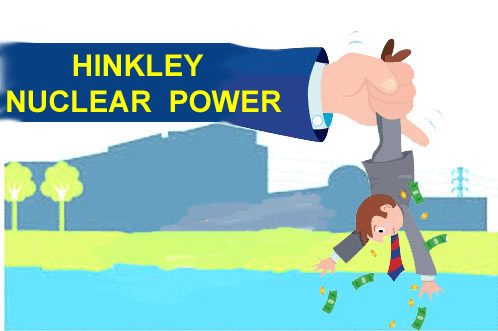 This is the West Country 17th Nov 2019, Stop Hinkley spokesman Roy Pumfrey questions whether the economic boost from Hinkley C is worth the cost I get tired of reading how easily impressed councillors are when they visit the giant incomplete building site that is HPC.
“biggest economic boost” is necessarily a good thing when it is also hugely
problematic and costly for anyone not directly involved? In our case,
economic growth also means a host of problems. There are more traffic jams
all around gridlocked Bridgwater. I’d like to travel from Bridgwater to
Taunton using the Taunton Road, but that simply adds 30 minutes to the
journey time.
schedule.
\ them to the reality of the massive hazard an untried new nuclear power
station running adjacent to her constituency represents.
Jeremy Corbyn could scrap UK’s nuclear weapons, in deal with Scottish National Party
 Jeremy Corbyn suggests he could SCRAP Britain’s nuclear weapons as the SNP demands he ‘gets rid’ of Trident missiles to win its backing in a government coalition, Daily Mail Labour leader said he wanted to add ‘realism’ to nuclear non-proliferation treaty Jeremy Corbyn suggests he could SCRAP Britain’s nuclear weapons as the SNP demands he ‘gets rid’ of Trident missiles to win its backing in a government coalition, Daily Mail Labour leader said he wanted to add ‘realism’ to nuclear non-proliferation treaty
By DAVID WILCOCK, WHITEHALL CORRESPONDENT FOR MAILONLINE 18 November 2019 Jeremy Corbyn today suggested he would be prepared to give up the UK’s nuclear weapons after the SNP signalled it would be part of their price for propping up his future government. The Labour leader said he wanted to add ‘realism’ to the nuclear non-proliferation treaty (NNPT), with discussions about ‘every country’s nuclear weapons’. He also had a dig at Nato, disagreeing with a claim last week by General Sir Nick Carter, the professional head of the British Army, that the alliance was the most successful in history. His BBC interview came after the Scottish National Party’s Westminster leader Ian Blackford had said the upcoming election was ‘an opportunity to get rid of Trident’ – the UK’s atomic missile system…… The SNP has made removing Britain’s nuclear submarine fleet – based on the Clyde – out of Scotland a mainstay of its party policy. And Mr Corbyn, a former chairman of the Stop the War Coalition, has long opposed Britain’s nuclear weapons programme…. https://www.dailymail.co.uk/news/article-7694603/Now-SNP-demands-Jeremy-Corbyn-scrap-Britains-NUCLEAR-WEAPONS-win-votes-coalition.html |
|
Likely delay in clean-up of radioactive contamination at Dalgety Beach
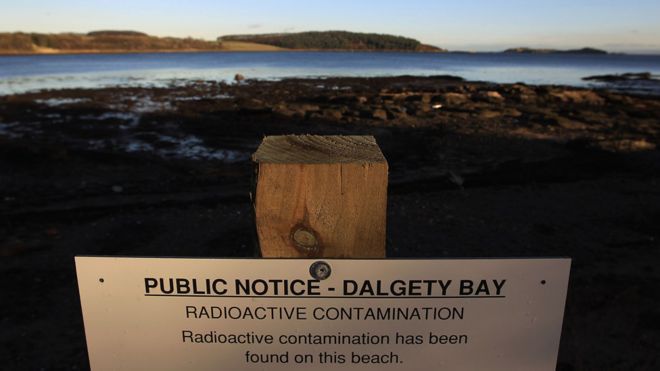
STV 13th Nov 2019, A clean-up operation to deal with radioactive contamination at a Fife beachis being held up by local landowners. Thousands of radioactive particles have been found on the shore at Dalgety Bay since 1990.
The objects are believed to come from eroded landfill that contains debris from Second World War aircraft that originally had radium dials. Stephen Ritchie told councillors: “We actually have had cabinet approval, ministerial approval – we have all the funding we need and authority to proceed. “However, the local stakeholders are dragging their feet. ”
We can’t get on the land to clean up the waste without the landowners’ permission. “There are four stakeholders for the area – one of which is the Crown, which is obviously not an issue. However, the other three have been dragging their feet.” Mr Ritchie told councillors that the MoD were looking to award the contract to a company to remove the waste by December 13, but if talks continued to stall, they could miss their window and the project would be delayed,meaning that the clean-up might not be able to happen in 2020.
https://stv.tv/news/east-central/1442361-work-to-clean-up-radioactive-beach-delayed-by-landowners/
Bulgaria nuclear reactor capacity reduced over generator malfunction
Bulgaria nuclear reactor capacity reduced over generator malfunction, SOFIA (Reuters) 18 Nov 19– Bulgarian nuclear power plant Kozloduy said on Saturday that its 1,000 MW Unit 5 was running at half capacity after one of its main circulation pumps shut down, activating the safety system.
New type of uranium nuclear fuel has safety risks
 Nuclear fuel alternatives after Fukushima have challenges ahead, https://www.manchester.ac.uk/discover/news/nuclear-fuel-alternatives-after-fukushima-have-challenges-ahead/ 15 Nov 19, Nuclear fuel alternatives after Fukushima have challenges ahead, https://www.manchester.ac.uk/discover/news/nuclear-fuel-alternatives-after-fukushima-have-challenges-ahead/ 15 Nov 19,
Research at The University of Manchester suggests that the preferred candidate fuel to replace uranium oxide in nuclear reactors may need further development before use. Dr Robert Harrison led the research, published in the journal Corrosion Science, with colleagues from the University and the Dalton Nuclear Institute. “Since the 2011 Fukushima accident,” explains Dr Harrison, “there has been an international effort to develop accident tolerant fuels (ATFs), which are uranium-based fuel materials that could better withstand the accident scenario than the current fuel assemblies.” One of these ATFs is a uranium silicon compound, U3Si2. This material conducts heat much better than the traditional uranium oxide fuels, allowing the reactor core to be operated at lower temperatures. In an emergency situation, this buys more time for engineers to bring the reactor under control. However, there are many unknowns about how U3Si2 will behave in the reactor core. “One of these unknowns,” says Dr Harrison, “is how it will behave when exposed to high temperature steam or air, as may happen during manufacturing or a severe accident during reactor operation.” To investigate just how accident tolerant ATFs are, Dr Harrison and his colleagues investigated how Ce3Si2 – a non-radioactive material analogous to U3Si2 – behaved under exposure to high-temperature air. Using advanced electron microscopy techniques, available at The University of Manchester Electron Microscopy Centre (EMC), the researchers were able to study the reaction products after Ce3Si2 was exposed to air at temperatures of up to 750oC. They discovered the material was prone to forming nanometre sized grains of silicon and silicon oxide, as well as cerium oxide. These nano-grains may allow for enhanced corrosion of the fuel material or the escape of radioactive gasses formed during reactor activity. This is because the formation of nano-grains creates more grain boundary areas – interfaces between grains, which provide pathways for corrosive substances or fission gases to migrate along. “Similarly,” adds Dr Harrison, “it would also allow for hazardous gaseous fission products produced during the splitting of uranium (such as xenon gas that would normally be trapped within the material) to diffuse out along these grain boundaries and be released, which would be potentially harmful to the environment.” While Dr Harrison stops short of saying that these ATFs are more unsafe under accident conditions than the current fuels they are looking to replace, he would argue they are currently not any better, and “aren’t as tolerant to accident conditions as once hoped”. Dr Harrison concludes “However, with the new insight developed in this work it will be possible to develop and engineer ATF candidates to better withstand these accident conditions, perhaps by adding other elements, such as aluminium, or manufacturing composite materials to give higher protection of the fuel material”. The full title of the paper is “Atomistic Level Study of Ce3Si2 Oxidation as an Accident Tolerant Nuclear Fuel Surrogate”, and the DOI is 10.1016/j.corsci.2019.108332
|
|
European Union struggles to preserve Iran nuclear deal
|
, https://apnews.com/e63a5526db184d39be4439b82010df62 By LORNE COOKNovember 12, 2019
BRUSSELS (AP) — European Union foreign ministers on Monday affirmed their support for the nuclear deal with Iran, after the Islamic Republic began enrichment work at its Fordo site in a fresh act of defiance that seems likely to spell the end of the painstakingly crafted international agreement.At talks in Brussels, the ministers mulled what action to take as they awaited a new report from the International Atomic Energy Agency later Monday on whether Iran is still complying with its commitments. EU foreign policy chief Federica Mogherini said that the ministers underlined their “full commitment to the agreement that remains crucial for our security, even if it’s increasingly difficult to preserve it. We will continue our efforts to have a full implementation of the agreement.” The EU powers that signed the 2015 Iran nuclear deal — Britain, France and Germany — were due to hold talks later Monday in Paris to discuss the next steps once the U.N.’s nuclear watchdog issues its latest findings. A joint commission meeting of all the signatories is likely to be held in coming days. “We want to preserve the (deal), but Iran must finally return to its commitments and comply with them, otherwise we will reserve the right to use all mechanisms that are set out in the agreement,” said German Foreign Minister Heiko Maas. The EU sees the nuclear pact as a key component of regional and global security and has struggled to stop it from unraveling since President Donald Trump unilaterally pulled the United States out of it over a year ago, triggering debilitating economic sanctions against Iran. It’s a great agreement and we need to keep it alive,” Slovakia’s foreign minister, Miroslav Lajcak, told reporters. But it remains unclear what more the EU can do as Iran’s economy buckles under the weight of the sanctions, apart from renewing its appeals for restraint and dialogue. The Europeans have poured a lot of cash and credibility into ensuring the deal stays afloat. A safeguard was built to keep money flowing to Tehran, but it has not been effective. A system is in place to protect European companies doing business in Iran from U.S. sanctions, even though many remain reluctant because they fear being shut out of the more lucrative American market if they do. One option could be to trigger the dispute mechanism in the agreement, which would open a window of up to 30 days to resolve the problem. Some are even calling on the Europeans to impose their own sanctions on Iran. “Sanctions, sanctions, sanctions. We’re not going to solve the problem like that,” said Luxembourg Foreign Minister Jean Asselborn. “Right now, we should wait for the report from the IAEA to see where we stand.” Dutch Foreign Minister Stef Blok said he was “very worried about Iran’s behavior,” after uranium gas was injected into centrifuges at Fordo last Thursday to produce low-enriched uranium to fuel nuclear power plants. Under the deal, Tehran was not supposed to do this at the site until 2030. However, the Europeans are hardly surprised by Iran’s actions. They believe the writing has been on the wall ever since Trump withdrew from the nuclear agreement last year, claiming that it does not to stop Tehran from developing missiles or undermining stability in the Gulf region. “Sadly, it’s a degradation that was to be expected,” Asselborn said. AP Writers Geir Moulson and David Rising in Berlin contributed to this report. |
|

Messianic Rick Perry preaches nuclear to sceptical Europeans
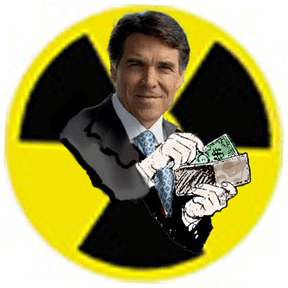 Messianic Perry preaches nuclear to sceptical Europeans, By Frédéric Simon | EURACTIV.com Oct 26, 2019 Small nuclear reactors can help “vulnerable nations take control of their destinies,” the US energy secretary said in Brussels today (21 October), claiming that small off-grid nuclear plants can bring electricity to poor nations and “disperse the darkness” around the globe…….
Today’s remarks, made in Brussels at the first EU-US high-level forum on small modular reactors, were again chiefly aimed at Eastern European countries, which have repeatedly complained about Russian interference in national politics, using gas as a lever.
Nuclear is a divise topic in Europe. While countries like France opted for it decades ago, others like Germany and Austria are strongly opposed.
“Nuclear energy is neither safe and sustainable nor cost-effective,” said German State Secretary for Energy, Andreas Feicht, during a recent meeting of EU energy ministers, firmly rejecting suggestions that EU money might be used to extend the lifetime of existing nuclear plants.
Today’s remarks, made in Brussels at the first EU-US high-level forum on small modular reactors, were again chiefly aimed at Eastern European countries, which have repeatedly complained about Russian interference in national politics, using gas as a lever.
Nuclear is a divise topic in Europe. While countries like France opted for it decades ago, others like Germany and Austria are strongly opposed.
“Nuclear energy is neither safe and sustainable nor cost-effective,” said German State Secretary for Energy, Andreas Feicht, during a recent meeting of EU energy ministers, firmly rejecting suggestions that EU money might be used to extend the lifetime of existing nuclear plants……
France extends nuclear reactors outage after earthquake
France extends nuclear reactors outage after earthquake, France 24 13 Nov 19, French utility EDF on Tuesday extended outages at three nuclear reactors at its Cruas plant until Nov. 15 following a 5.1 magnitude earthquake in southeast France that forced it to temporarily suspend electricity generation at the site.A sensor at the plant was activated during the earthquake in the region on Monday, requiring the state-controlled utility to carry out further checks for potential damage.
A spokesman for EDF said the outage extension would allow enough time for thorough visual and advanced checks across the plant, including in the nuclear buildings to ascertain that the units could function properly when they restarted.
France’s ASN nuclear safety agency on Monday said it was monitoring the situation and would decide when the reactors could restart.
The outage at the three reactors reduced French power generation by 2,700 megawatts (MW)……https://www.france24.com/en/20191112-france-extends-nuclear-reactors-outage-after-earthquake
1 This Month
23-25 October – on Zoom – World BEYOND War’s annual global conferenc


Shut down the radiation-damaged Heysham nuclear reactors now
To see nuclear-related stories in greater depth and intensity – go to https://nuclearinformation.wordpress.com

Say No to NASA’s Reckless Nuclear Reactor on the Moon
Say No to NASA’s Reckless Nuclear Reactor on the Moon
-
Archives
- October 2026 (170)
- September 2026 (339)
- August 2026 (330)
- July 2026 (355)
- June 2026 (287)
- May 2026 (306)
- April 2026 (356)
- March 2026 (251)
- February 2026 (267)
- January 2026 (308)
- December 2025 (358)
- November 2025 (359)
-
Categories
- 1
- 1 NUCLEAR ISSUES
- business and costs
- climate change
- culture and arts
- ENERGY
- environment
- health
- history
- indigenous issues
- Legal
- marketing of nuclear
- media
- opposition to nuclear
- PERSONAL STORIES
- politics
- politics international
- Religion and ethics
- safety
- secrets,lies and civil liberties
- spinbuster
- technology
- Uranium
- wastes
- weapons and war
- Women
- 2 WORLD
- ACTION
- AFRICA
- Atrocities
- AUSTRALIA
- Christina's notes
- Christina's themes
- culture and arts
- Events
- Fuk 2022
- Fuk 2023
- Fukushima 2017
- Fukushima 2018
- fukushima 2019
- Fukushima 2020
- Fukushima 2021
- general
- global warming
- Humour (God we need it)
- Nuclear
- RARE EARTHS
- Reference
- resources – print
- Resources -audiovicual
- Weekly Newsletter
- World
- World Nuclear
- YouTube
-
RSS
Entries RSS
Comments RSS

