The Russian Orthodox Church just might cease its blessing of nuclear weapons
 THE RUSSIAN ORTHODOX CHURCH MAY STOP BLESSING NUCLEAR
  WEAPONS https://futurism.com/the-byte/russian-orthodox-blessing-nuclear-weapons JULY 10TH 19__DAN ROBITZSKI
A faction of clergy within the Russian Orthodox Church wants to end the eyebrow-raising practice of blessing the country’s nuclear missiles.
First of all, yes: Russian priests currently sprinkle holy water on nuclear missiles as part of an old tradition in which Orthodox priests bless soldiers and their weapons, reports Religion News Service. But that may change, as some priests feel that intercontinental ballistic missiles belong in a different category from individual firearms.
Faith Militant
The Russian military and the Russian Orthodox church have long worked hand in hand, according to RNS, framing many of the country’s military conflicts as holy wars. The nuclear arsenal even has its own patron saint — RNS reports that St. Seraphim’s remains were found in a Russian town that housed several nuclear facilities.
As such, the push to stop blessing nukes faces strong opposition among members of the clergy, such as the high-ranking priest Vsevolod Chaplin, who referred to the country’s nukes as “guardian angels.”
“Only nuclear weapons protect Russia from enslavement by the West,” Chaplin once said, per RNS.
Changing Hearts
One priest, Dmitry Tsorionov, parted from the more militant aspects of the Orthodox Church after seeing men willingly sign up to fight Russia’s wars “under the banner of Christ,” he told RNS. Now he wants to see less warmongering among the clergy.
“It was not uncommon to see how church functionaries openly flirted with these toxic ideas,” he told RNS. “It was only then that I finally realized what the blessing of military hardware leads to.”
An example of nuclear corporations conglomerate formed in desperate effort to promote Small Modular Nuclear Reactors
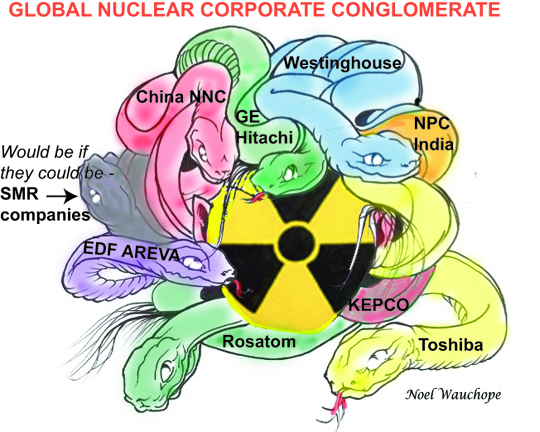 GE Hitachi Nuclear Energy and ČEZ Announce Small Modular Reactor Technology Collaboration in the Czech Republic. WILMINGTON, North Carolina—February 3, 2020—GE Hitachi Nuclear Energy (GEH) and ČEZ, a. s. (ČEZ), an integrated electricity conglomerate, have entered into a Memorandum of Understanding through which the companies have agreed to examine the economic and technical feasibility of potentially constructing a BWRX-300 in the Czech Republic…… https://www.powermag.com/press-releases/ge-hitachi-nuclear-energy-and-cez-announce-small-modular-reactor-technology-collaboration-in-the-czech-republic/
Europe to be the first carbon neutral continent, and WITH NUCLEAR POWER EXCLUDED

 Renew Extra 1st Feb 2020, Dave Elliott: With Climate Change at the top of
  the agenda, the EU aims to be the first carbon neutral continent, working towards net zero greenhouse gas emissions by 2050, with a new climate law being enacted soon. That’s taken some fighting for and fiddling, given the opposition from heavy coal users like Poland, but there’s a proposed Just Transition mechanism to help countries like that move to carbon neutrality, with nuclear excluded from support for this.
So renewables should boom even more. Renewables have
certainly been doing well. Germany will soon get around half of its power
from renewables, Portugal is already at over 54%, Denmark near 60%, while
Sweden is at 66% and Austria over 70%. By 2030 some of these countries
could be getting near 100% of their electricity from renewables and should
also be beginning to meet significant shares of their heat and transport
needs using renewables. Sweden already gets around 54% of all its energy
from renewables, Norway and Iceland are both at around 70%.
https://renewextraweekly.blogspot.com/2020/02/there-have-been-divergent-views-on.html
Need to include a No New Nuclear clause in climate emergency planning
 Radiation Free Lakeland 1st Feb 2020, Kevin Frea is co-chair of the Climate Emergency Network and deputy leader of Lancaster City Council and has worked hard to sign local councils up declaring a climate emergency. “This movement is being led by every political group and is involving local people in planning the actions needed to cut carbon …
”. There is one critical action that is being missed – a No New Nuclear Clause! Last September members of Radiation Free Lakeland lobbied Lancaster City Council asking the council to include a No New Nuclear clause in their climate emergency planning.
The council agreed with us that renewables are the way forward and it is brilliant that council members are actively involved in local community renewable schemes.
However, they thought that including a No New Nuclear Clause in their
Climate Emergency Planning was not necessary. Because as Cllr Kevin Frea
said “Heysham, number 8 on the new nuclear plant list it is not likely to
go ahead”. This new nuclear nonchalence rather misses the point that the
continued push (billions of pounds of public money) for new nuclear is
decimating urgent steps towards renewables and energy efficiency. The sole
reason we are in the situation we are in is entirely down to the continued
efforts of the nuclear industry and its vested interests to suppress
renewables.
https://mariannewildart.wordpress.com/2020/02/01/14471/
Oxford City Council says NO to nuclear weapons
 Cherwell 1st Feb 2020 , Oxford City Council has called on the British Government to sign the International Treaty to Prohibit Nuclear Weapons (TPNW). The resolution, proposed by Councillor John Tanner, was agreed “overwhelmingly” by the City Council on Monday. Before backing the Treaty, the City Council want the UK government to renounce its use of nuclear weapons and end the renewal of Trident.
https://cherwell.org/2020/02/01/oxford-city-council-says-no-to-nuclear-weapons/
Top EU diplomat to visit Tehran amid nuclear tensions
|
France 24, 2 Feb 2029, Top EU diplomat Josep Borrell was Monday due to visit Iran, said officials in Tehran and Brussels, on his first trip there since taking office, aiming to reduce rising tensions over the Islamic republic’s nuclear programme.
Borrel was set to meet President Hassan Rouhani, Foreign Minister Javad Zarif and parliamentary speaker Ali Larijani on the two-day trip, his office said in a statement. The 2015 nuclear deal between Tehran and a group of world powers has been crumbling since US President Donald Trump withdrew from it in 2018, and Washington has since stepped up sanctions and a campaign of “maximum pressure” against Iran. Borrell’s mission aims “to de-escalate tensions and seek opportunities for political solutions to the current crisis,” said the office of the EU’s high representative for foreign affairs and security policy. The visit will allow Borrell “to convey the EU’s strong commitment to preserve” the nuclear deal, known as the Joint Comprehensive Plan of Action, and to discuss cooperation between the EU and Iran, his office said……… https://www.france24.com/en/20200202-top-eu-diplomat-to-visit-tehran-amid-nuclear-tensions |
|
UK government could save money, promote health, by energy efficiency programmess
|
Edie 30th Jan 2020, By implementing stronger policies around walking, cycling, electric vehicles and energy efficiency in homes, the Government could save the NHS at least £3.7bn per year. That is according to a new report from think-tank Green Alliance. Drawing on research by CREDS, a body convening research from academics at 15 UK universities. The report concludes that improved policies on active travel and electric mobility could save the NHS £2.5bn in costs annually, mainly through reduced rates of cardiovascular and lung problems, as well as diabetes. This saving could be realised if just 1.7% of car journeys made annually in England are replaced by walking or cycling.
Green Alliance claims this shift could also improve air
quality, quality of life and public satisfaction with local authorities and Government. |
In Cumbria, concern over nuclear waste canisters, and inadequacy of Radioactive Waste Management (RWM)

Current model for storing nuclear waste is incomplete, https://cumbriatrust.wordpress.com/2020/01/30/current-model-for-storing-nuclear-waste-is-incomplete/ 30 Jan , New research carried out by Ohio State University has revealed significant problems with one of the key containment methods for high level nuclear waste to be used in the UK. It had previously been assumed that forming high level waste into glass or ceramics within a stainless steel canister would ensure that the waste would be isolated from its surroundings while it underwent radioactive decay. It now appears that the iron within stainless steel canister is reacting with the silicon, a fundamental constituent of glass. This leads to severe localised corrosion at a far higher rate than previously assumed. The full article can be found here.
Followers of Cumbria Trust will be aware that this is not the only example of a canister intended for the UK’s geological disposal programme which has failed to perform as expected. Another is the KBS-3 concept which used copper canisters, where some experiments have shown accelerated corrosion via a pitting process.
 During the previous search for a site to bury the UK’s nuclear waste, the Nuclear Decommissioning Authority (NDA) attempted to deny the existence of these problems. Recently, Radioactive Waste Management (RWM), a subsidiary of the NDA, has become more open in its admission of the difficulties they face. Cumbria Trust welcomes this approach, and has had a constructive dialogue with some senior RWM figures over recent years.
Our recent experience with RWM hasn’t been entirely positive though – they have failed to exclude designated areas (such as national parks and AONBs) in the latest search process, despite overwhelming public opposition to their inclusion, and have refused to discuss this with Cumbria Trust when asked. Cumbrians might ask themselves why RWM are taking this stance.
UK govt is treating Julian Assange inhumanely – amounting to torture
 Julian Assange and the Inhumanity of the British State: ‘Unofficial’ Solitary Confinement as Torture 21st Century Wire, JANUARY 26, 2020 BY NINA CROSS
 Up until this week, Assange has been held in solitary confinement in Belmarsh prison. Incredibly, it was the other prisoners along with Assange’s legal team, who have pressured the government officials to respect the law and allow Assange to be removed from solitary confinement, resulting in his transfer to a general wing. This piece looks at how Assange was unofficially segregated in the prison’s healthcare unit, with no recourse to systems designed for prisoners in official solitary confinement regimes as applied under Prison Rule 45, leaving him out of reach of rules and law.
The sustained violation of the human rights of Wikileaks founder, Julian Assange, has been carried out in full view of the world throughout his arbitrary detention in HMP Belmarsh. Until now, condemnation of his treatment and pleas to end his suffering have been met with denial and silence by the British authorities.
But the announcement this week that Assange has been moved out of Belmarsh healthcare unit where he has been detained in solitary confinement since May, is a sign that the campaign to stop his persecution is gaining traction. Continue reading
Russian Space Agency confirms plans to launch nuclear-powered space tug by 2030
|
Russian Space Agency confirms plans to launch nuclear-powered space tug by 2030 Space Daily, by Staff Writers
Moscow (Sputnik) Jan 29, 2020 The secrecy-laden project, in development since 2010, is intended to facilitate the transportation of large cargoes in deep space, including for the purpose of creating permanent bases on other planets in our solar system.Roscosmos plans to deliver a nuclear-powered space tug into orbit by the year 2030, agency first deputy director Yuri Urlichich has confirmed. In a presentation at the ongoing Korolev Academic Space Conference in Moscow, Urlichich explained that the tug will be launched in 2030 for flight testing, with series production and commercial use to begin after that…….. http://www.spacedaily.com/reports/Russian_Space_Agency_confirms_plans_to_launch_nuclear_powered_space_tug_by_2030_999.html |
|
In UK “deep disposal” is planned for the mounting, costly and forever problem of nuclear wastes
 How To Solve Nuclear Energy’s Biggest Problem https://oilprice.com/Alternative-Energy/Nuclear-Power/How-To-Solve-Nuclear-Energys-Biggest-Problem.html By Haley Zaremba – Jan 22, 2020, Nuclear waste is a huge issue and it’s not going away any time soon–in fact, it’s not going away for millions of years. While most types of nuclear waste remain radioactive for mere tens of thousands of years, the half-life of Chlorine-36 is 300,000 years and neptunium-237 boasts a half-life of a whopping 2 million years.
All this radioactivity amounts to a huge amount of maintenance to ensure that our radioactive waste is being properly managed throughout its extraordinarily long shelf life and isn’t endangering anyone. And, it almost goes without saying, all this maintenance comes at a cost. In the United States, nuclear waste carries a particularly hefty cost.
Last year, in a hard-hitting expose on the nuclear industry’s toll on U.S. taxpayers, the Los Angeles Times reported that “almost 40 years after Congress decided the United States, and not private companies, would be responsible for storing radioactive waste, the cost of that effort has grown to $7.5 billion, and it’s about to get even pricier.”
How much pricier? A lot. “With no place of its own to keep the waste, the government now says it expects to pay $35.5 billion to private companies as more and more nuclear plants shut down, unable to compete with cheaper natural gas and renewable energy sources. Storing spent fuel at an operating plant with staff and technology on hand can cost $300,000 a year. The price for a closed facility: more than $8 million, according to the Nuclear Energy Institute.”
With the United States as a poster child of what not to do with your nuclear waste, the United Kingdom is taking a much different tack. The UK is currently undertaking what the country’s Radioactive Waste Management (RWM) department says “will be one of the UK’s largest ever environmental projects.” This nuclear waste storage solution comes in the form of a geological disposal facility (GDF), a waste disposal method that involves burying nuclear waste deep, deep underground in a cocoon of backfill, most commonly comprised of bentonite-based cement. This type of cement is able to absorb shocks and is ideal for containing radioactive particles in case of any failure. The GDF system would also be at such a depth that it would be under the water table, minimizing any risk of contaminating the groundwater.
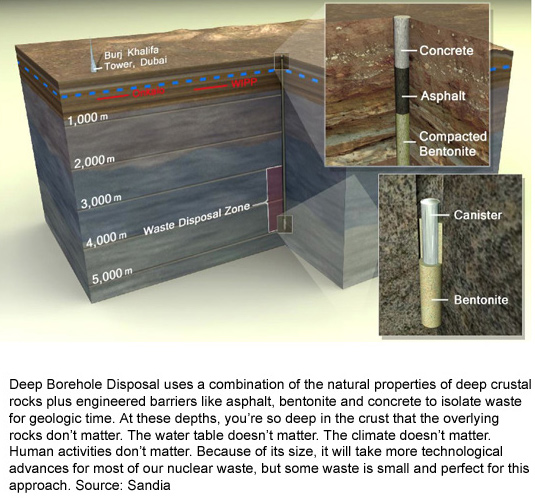
According to reporting from Engineering & Technology, nuclear waste is a mounting issue in Europe and in the UK in particular. “Under European law, all countries that create radioactive waste are obliged to find their own disposal solutions – shipping nuclear waste is not generally permitted except in some legacy agreements. However, when the first countries charged into nuclear energy generation (or nuclear weapons research), disposal of the radioactive waste was not a major consideration. For several of those countries, like the UK, that is now around 70 years ago, and the waste has been ‘stored’ rather than disposed of. It remains a problem.”
In fact, not only does it remain a problem, it is a mounting problem. As nuclear waste has been improperly or shortsightedly managed in the past, the current administration can no longer avoid dealing with the issue. In the past the UK used its Drigg Low-Level Waste Repository on the Cumbrian Coast to treat low and intermediate level waste, but now, thanks to coastal erosion, the facility will soon begin leeching radioactive materials into the sea, although that might not be quite as scary as it sounds.
Back in 2014, the Environment Agency raised concerns that coastal erosion could result in leakage from the site within 100 to 1,000 years, although it was counter-claimed that the levels of radioactivity after such a time would be low enough to be harmless,” Engineering & Technology writes. “This would definitely not be the case for high-level wastes, where radioactivity could remain a hazard into and beyond the next ice age, hence the need for longer-term disposal.”
Where exactly will that longer-term disposal be based? That’s up for debate. And it won’t be an easy thing to decide, as the RWM says that they will need a community to volunteer to be involved in such a costly, lengthy, and potentially unpopular project. And it’s not just an issue for the current inhabitants of potential locations in the UK, but for many generations to come over the next tens of thousands of years of radioactivity
Rolls Royce’s fantasy plan for so-called ‘mini’ nuclear reactors

|
Rolls-Royce plans mini nuclear reactors by 2029 https://www.bbc.com/news/business-51233444 By Roger Harrabin & Katie Prescott, BBC environment analyst and business reporter, 24 January 2020
Mini nuclear reactors could be generating power in the UK by the end of the decade. Manufacturer Rolls-Royce has told the BBC’s Today programme that it plans to install and operate factory-built power stations by 2029. Mini nuclear stations can be mass manufactured and delivered in chunks on the back of a lorry, which makes costs more predictable. But opponents say the UK should quit nuclear power altogether. They say the country should concentrate on cheaper renewable energy instead. Environmentalists are divided over nuclear power, with some maintaining it is dangerous and expensive, while others say that to achieve net zero emissions by 2050 all technologies are needed. However, the industry is confident that mini reactors can compete on price with low-cost renewables such as offshore wind. Rolls-Royce is leading a consortium to build small modular reactors (SMRs) and install them in former nuclear sites in Cumbria or in Wales. Ultimately, the company thinks it will build between 10 and 15 of the stations in the UK. They are about 1.5 acres in size – sitting in a 10-acre space. That is a 16th of the size of a major power station such as Hinkley Point. SMRs are so small that theoretically every town could have its own reactor – but using existing sites avoids the huge problem of how to secure them against terrorist attacks. It is a rare positive note from the nuclear industry, which has struggled as the cost of renewables has plummeted. In the past few years, major nuclear projects have been abandoned as Japanese companies Toshiba and Hitachi pulled out because they could not get the required funding. And the construction of Hinkley Point in Somerset could cost £3bn more than was expected, in an echo of the row over the rail mega-project HS2. “The trick is to have prefabricated parts where we use advanced digital welding methods and robotic assembly and then parts are shipped to site and bolted together,” said Paul Stein, the chief technology officer at Rolls-Royce.
He said the approach would dramatically reduce the cost of building nuclear power sites, which would lead to cheaper electricity. But Paul Dorfman from University College London said: “The potential cost benefits of assembly line module construction relative to custom-build on-site construction may prove overstated. “Production line mistakes may lead to generic defects that propagate throughout an entire fleet of reactors and are costly to fix,” he warned. “It’s far more economic to build one 1.2 GW unit than a dozen 100 MW units.” Rolls-Royce is hoping to overcome the cost barrier by selling SMRs abroad to achieve economies of scale. Its critics have warned that SMRs will not be ready in substantial numbers until the mid 2030s, by which time electricity needs to be carbon-free in the UK already to meet climate change targets. |
|

Sloppy safety and waste management at Electricite de France’s nuclear sites

 Improve Nuclear Plant Maintenance Works, Watchdog Says, Francois de Beaupuy, Bloomberg News (Bloomberg) 24 Jan 2020 — Electricite de France SA and its suppliers must improve maintenance operations at nuclear reactors and waste management because they have lost skills and become sloppy in recent years, the French nuclear safety authority said.
The warning reflects a string of incidents related to substandard manufacturing or installation of equipment at EDF and its suppliers. It underscores the difficulties the French nuclear giant faces in extending the lifetime of aging reactors and building new ones, prompting it to announce an action plan to revamp the industry’s skills.
“There’s a need to reinforce skills and some carelessness among some players in the industry,” Bernard Doroszczuk, chairman of Autorite de Surete Nucleaire, said at a press conference near Paris on Thursday. “There’s a lack of rigor in the oversight of safety by operators,” from manufacturing to welding to equipment tests “which must be corrected.”
Discussions are still going on with EDF regarding safety improvements, including ways to prevent or mitigate the impact outside its plants in case of a severe accident such as the meltdown of the radioactive fuel and its vessel, said Sylvie Cadet-Mercier, a commissioner of the regulator. A spokesman for the utility declined to comment…… https://www.bnnbloomberg.ca/edf-must-improve-nuclear-plant-maintenance-works-watchdog-says-1.1378571
In UK “big” nuclear power versus “small” (both unaffordable) at Wylfa
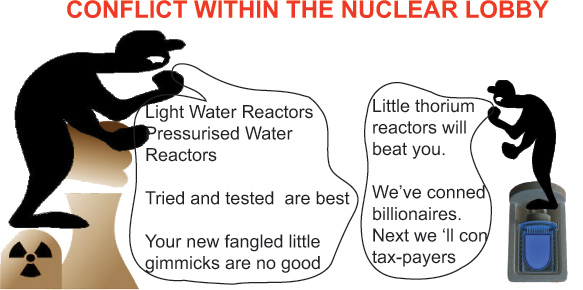
 The global nuclear lobby might look like a unified force – it’s anything but!. The nuclear nations fight each other in desperately trying to flog off their unaffordable white elephant nuclear reactors to ‘developing’ countries, or to any sucker, really. .
The nuclear industry itself is divided – the ‘conventional’ big nuclear reactors versus the (not yet existing) Small and Medium Nuclear Reactors (SMRs)
‘No plans’ for Wylfa mini nuclear power station according to developer, https://www.dailypost.co.uk/news/north-wales-news/no-plans-wylfa-mini-nuclear-17599188, Owen Hughes, Business correspondent, 20 JAN 2020
Horizon Nuclear Power said its full focus is on delivering a full scale nuke plant.
Wylfa Newydd developer Horizon Nuclear Power says there are “no plans” to build mini reactors at its Anglesey site.
Rolls Royce is currently leading a consortium developing the technology for Small Modular Reactors (SMRs) – supported by the UK Government. Trawsfynydd in Gwynedd has been tipped at a prime spot for one of the reactors and over the weekend Wylfa was also reported as a target location.
But Horizon has released a statement making clear the Wylfa site is not being put forward for this technology as they press on with the current plan for a full scale nuclear site.
A spokesman said: “There are no plans to deploy a Rolls Royce Small Modular Reactor at the Wylfa Newydd site.”
He added: “Activity on the Horizon project is currently suspended, but we’re working hard to establish the conditions for a restart using our tried and tested reactor design, which has already cleared the UK regulators’ assessment process.
Energy Secretary Andrea Leadsom wants additional information before deciding whether to give planning permission for Wylfa Newydd.
She deferred the decision on the site in October.
If permission is granted then the next step will be securing funding to make the project happen.
When it comes to SMRs, Alan Woods, strategy and business development director for Rolls-Royce, said they were focusing on sites in Wales and the north of England. Modular reactors are smaller and, once the first is approved and built, manufacturers hope mass-production will lead to shorter construction times and lower costs for each unit.
The consortium will need to establish factories to produce the small modular reactors with the pre-fabricated modules transported to sites for construction.
Wildfires – drastic climate effects in Australia, but Europe is copping it, too

Wildfires show us how the climate emergency is already affecting Europe, Guardian, Imogen West-Knights We look at the devastation of Australia’s bushfires and don’t believe it could happen here. But it already is, 22 Jan 2020 “……… what we’re seeing in Australia. Since the fire season began there, in the middle of last year, 29 people have died, along with more than a billion animals, and an area comparable in size to the whole of England has been ablaze. It’s a vicious reminder that, for all the sophistication of the modern world, something as primitive as fire can still bring us to our knees. As shocking as the scale of the destruction has been, though, it’s easy to see it on our computer screens here on the other side of the world, in the middle of a British winter, and feel disconnected from it. We accept that the climate emergency is now truly upon us yet still feel that it’s mostly happening to other people, elsewhere.wildfires are increasingly a problem for everyone, including in the UK. Last August, there were almost five times as many of them around the world as there had been the previous August. In the EU, the number of wildfires in the first half of 2019 was three times the annual average for the previous decade. And while they used to be a serious problem only in hotter, southern European countries such as Portugal and Spain, now northern Europe is in trouble too.
The Swedish fires of 2018 were by far the most severe in the country’s history, burning an area almost twice as large as the worst previous wildfire, in 2014. In the UK, 2018 and 2019 were the worst two years on record for wildfires, particularly on moors in the north-west of England and parts of Scotland. One fire last year, at Marsden Moor in Yorkshire, destroyed almost three square miles of land. The damage is on a very different scale to the almost 30,000 square miles that have burned in Australia, of course, but this is still a development we can’t afford to ignore.
Aside from all the more immediate effects – the threat to humans, livestock and wildlife – the recent increase in wildfires has been linked to severe air quality problems. People living up to 62 miles (100km) downwind of fires in the Pennines in 2018 were exposed to toxic fumes. And as there is no sign of cooler weather in the years ahead, it is reasonable to expect more fires in 2020. The EU has now established a fleet of firefighting planes, and the European Forest Institute has warned that unless we take steps to protect the countryside – for instance, by planting less-flammable species and creating barriers to the spread of flames – emergency services won’t be able to prevent the rapid spread and firestorms that have characterised the Australian crisis.
This isn’t all because of the climate crisis – changes to land use and increased urbanisation over several decades are also factors. Weather patterns are noisy data, and it’s difficult to attribute any single wildfire to the climate crisis. The scientific consensus, however, is that it is increasing the intensity and frequency of fire-conducive weather across the world.
Even those fires that are eventually linked to human error, like a still-lit disposable barbecue, are increasingly likely due to warming temperatures. Hotter summers mean more barbecues lit in the first place. The climate crisis is going to change the way we behave in every aspect of our lives. And with the probability of another summer of extreme weather coming, we will need to adapt to new dangers that won’t just be on the other side of the planet but, quite literally, in our own backyards.
It’s not at all clear that we’re ready for what might be coming. There is still a cognitive jump yet to be made when those of us in Europe read about the fires in Australia, from mourning the destruction there to recognising that we face some version of the same threat. When we look at Australia, we’re not looking at the future that might await Europe. That future is already here.
• Imogen West-Knights is a writer and freelance journalist
1 This Month
23-25 October – on Zoom – World BEYOND War’s annual global conferenc


Shut down the radiation-damaged Heysham nuclear reactors now
To see nuclear-related stories in greater depth and intensity – go to https://nuclearinformation.wordpress.com

Say No to NASA’s Reckless Nuclear Reactor on the Moon
Say No to NASA’s Reckless Nuclear Reactor on the Moon
-
Archives
- October 2026 (160)
- September 2026 (339)
- August 2026 (330)
- July 2026 (355)
- June 2026 (287)
- May 2026 (306)
- April 2026 (356)
- March 2026 (251)
- February 2026 (267)
- January 2026 (308)
- December 2025 (358)
- November 2025 (359)
-
Categories
- 1
- 1 NUCLEAR ISSUES
- business and costs
- climate change
- culture and arts
- ENERGY
- environment
- health
- history
- indigenous issues
- Legal
- marketing of nuclear
- media
- opposition to nuclear
- PERSONAL STORIES
- politics
- politics international
- Religion and ethics
- safety
- secrets,lies and civil liberties
- spinbuster
- technology
- Uranium
- wastes
- weapons and war
- Women
- 2 WORLD
- ACTION
- AFRICA
- Atrocities
- AUSTRALIA
- Christina's notes
- Christina's themes
- culture and arts
- Events
- Fuk 2022
- Fuk 2023
- Fukushima 2017
- Fukushima 2018
- fukushima 2019
- Fukushima 2020
- Fukushima 2021
- general
- global warming
- Humour (God we need it)
- Nuclear
- RARE EARTHS
- Reference
- resources – print
- Resources -audiovicual
- Weekly Newsletter
- World
- World Nuclear
- YouTube
-
RSS
Entries RSS
Comments RSS

