Nuclear Free Local Authorities (NFLA) call for more stringent safety measures, and the closure of EDF’s old nuclear reactors
  Ardrossan Herald 8th April 2020, Six safety incidents have been reported at Hunterston including concerns Ardrossan Herald 8th April 2020, Six safety incidents have been reported at Hunterston including concernsabout the nuclear plant’s cooling systems, fuelling machine and cracks in the reactors’ graphite core. The UK government’s safety watchdog, the Office for Nuclear Regulation, said that Hunterston had “failed to adequately account for” radioactive materials last October. The Scottish Environment Protection Agency (SEPA) also disclosed that unauthorised radioactive “debris” was found in a supposedly empty fuel flask that had been returned to Hunterston from the Sellafield site. The Nuclear Free Local Authorities (NFLA) are calling for North Ayrshire Council to take more stringent measures regarding the plant and for EDF to close down old reactors. NFLA Scotland Convenor, Councillor Feargal Dalton said: “These
incidents confirm in our view that these aging reactors would be better being closed and the workers transferred into the long-term process of decommissioning Hunterston B.” |
|
Call to stop construction at Hinkley C nuclear project, due to coronavirus risk
Allan Jeffrey of Stop Hinkley talks to the Extinction Rebellion Radio Show. Rebel Radio 7th April 2020
https://www.mixcloud.com/XR_RebelRadio/rebel-despatches-hinkley-point-07042020/
BBC Points West 8th April 2020, Bus drivers carrying workers to Hinkley Point C construction site are
worried their lives are being put at risk. Every day a fleet of vehicles drops of and picks up hundreds of staff. The bus company says its putting in screens to protect the drivers, but work hasn’t been complete yet.
Bus drivers are calling for construction to stop. For the safety of everybody it makes more sense to close the site down. They are showing no regard for human life and potentially putting everyone in a situation where people
could die. Drivers are expressing their concern on social media and sending pictures which seems to show lack of social distancing. There are concerns too about the movement of workers who come from outside the area.
https://www.bbc.co.uk/iplayer/episode/m000h59p/points-west-late-news-08042020
Sweden’s wind power on the way to putting nuclear out of business
 Giant Wind Park Starting Up Is Another Blow to Nuclear Industry
A surge in renewable energy output in the Nordic region has sent power prices below the level where some nuclear plants are profitable. Bloomberg Green, By Lars Paulsson April 8, 2020, Sweden’s biggest wind farm began producing power this month, and the region’s nuclear reactors are feeling the heat.Vasa Vind AB’s Askalen started commercial output on April 1, increasing supplies in a market already bloated by a massive surplus of water for power generation. A day later, two units at Vattenfall AB’s Forsmark nuclear plant north of Stockholm curbed output by about 50%. Two reactors at the utility’s Ringhals plant are halted because of low power prices.
While there’s no direct link between those events, it’s the latest sign of how renewable energy is crowding out traditional power sources across Europe. The 288-megawatt facility in northern Sweden will boost the nation’s wind output further, after a 50% jump in the first quarter from a year earlier because of a very breezy winter.
“This could mean more frequent periods with rock bottom power prices, forcing conventional generators off the grid, especially when windy conditions coincide with high hydro output,” said Oliver Metcalfe, lead analyst for onshore wind research at BloombergNEF in London.
BNEF forecasts that global onshore wind capacity will gain 9% to more than 66 gigawatts this year, a forecast scaled back from the 24% expansion first anticipated.
That will help push out more traditional coal, gas and nuclear plants from the energy system. The German and U.K. coal power industries, among others, have already been decimated by a surge in green power.
Sweden will install more than 4.2 gigawatts of new onshore wind this year and next, according to BNEF. The Nordic region’s biggest economy will rely heavily on wind to replace old nuclear reactors in the future. The Askalen park has installed 80 Vestas A/S’s V136 turbines, which are as high as 112 meters……. https://www.bloomberg.com/news/articles/2020-04-08/giant-wind-park-starting-up-is-another-blow-to-nuclear-industry
Russia wants to extend New START nuclear weapons treaty, but the U.S. has not revealed its plans
|
RUSSIA SAYS U.S. ‘UNWILLINGNESS’ IS THREATENING MAJOR NUCLEAR WEAPONS DEAL https://www.newsweek.com/russia-us-unwillingness-threatening-major-nuclear-weapons-deal-1496824 BY DAVID BRENNAN ON 4/8/20 Russia has again pointed the finger at the U.S. for delaying the extension of the New START nuclear weapons treaty, which expires next year.
Kremlin spokesperson Dmitry Peskov told reporters Wednesday that any questions about why the deal has not been extended should be directed to Washington rather than Moscow. Peskov said the Kremlin remains keen to make a deal, but has met with delay from the White House. “Actions on destruction of this document—on its non-extension—are taken not by Moscow,” Peskov told reporters, according to the Tass state news agency. “Rather, this is our U.S. colleagues’ unwillingness, and we have repeatedly expressed our regret in that regard.” The 10-year New START treaty came into force in 2011. It extended the existing START agreement, which was signed in the early 1990s. New START capped the number of deployed Russian and U.S. strategic nuclear warheads and bombs at 1,550, and the number of deployed intercontinental ballistic missiles, submarine-launched ballistic missiles and heavy bombers used for nuclear missions at 700. The total allowed number of deployed and non-deployed assets is currently 800. New START is the last of what former Soviet Premier Mikhail Gorbachev called the “three principal pillars of global strategic stability,” following the collapse of the Anti-Ballistic Missile Treaty in 2002 and the Intermediate-Range Nuclear Forces treaty last year. Russia has repeatedly said that it wants to extend New START, but the U.S. has still not revealed its plans. President Donald Trump has hinted that they wish to include China in any new deal, but experts—among them one of the original negotiators of START—have warned this is not feasible in such a short time frame. Chinese officials have dismissed any suggestion of involvement in a new treaty. Newsweek has contacted the State Department for comment on its plans regarding New START. Peskov acknowledged that the New START deal has fallen down the pecking order with the appearance of the coronavirus pandemic. Both the U.S. and Russia—like many other nations—are struggling to contain the virus. “The coronavirus has halted many vital processes,” Peskov said, “This is the reality we have to face.” Russian Deputy Chairman of the Security Council of Russia Dmitry Medvedev—who was serving as president when New START was signed—complained Wednesday that in the nine years since the deal was agreed, the U.S. has flipped from “cooperation to political pressure and unleashed an unprecedented war of sanctions against us, trying to oust Russia from the global agenda.” In an op-ed for Tass, Medvedev suggested that removing sanctions on Moscow would be a good first step to re-open New START talks. “If the New START deal ceases to exist, its demise will have extremely serious consequences for international security,” the former president and prime minister said. Russian officials including President Vladimir Putin have urged the White House to lift sanctions—imposed because of Russia’s annexation of Crimea, support of separatists in eastern Ukraine and meddling in the 2016 U.S. presidential election—to help the global response to coronavirus. |
|
Bosnia might need international arbitration over Croatia’s nuclear waste dump plan near the border
|
Bosnia May Seek Arbitration on Croatia Nuclear Waste Dispute
https://balkaninsight.com/2020/04/08/bosnia-may-seek-arbitration-on-croatia-nuclear-waste-dispute/ Nedim Dervisbegovic, Sarajevo, BIRN
April 8, 2020, Minister says Bosnia will ramp up its protests after Croatia gives go-ahead for nuclear waste store to be built near Bosnian border. Bosnia may request international arbitration if Croatia proceeds with a plan to create a nuclear waste disposal site just across the border from Novi Grad in north-west Bosnia, Foreign Trade and Economic Relations Minister Stasa Kosarac was reported as saying. Kosarac’s ministry said dumping waste from the Croatian-Slovenian jointly-owned Krsko nuclear power plant at a former military storage facility near the Croatian town of Dvor would endanger the health and lives of some 250,000 people living in 13 Bosnian municipalities along the Una River. He made the statement after speaking with a group of ministers from Bosnia’s two entities, state parliamentarians and Novi Grad’s mayor via video link on Tuesday. Kosarac reportedly informed them about his telephone conversations with the Croatian ambassador to Bosnia, Ivan Sabolic, and Croatia’s Environment and Energy Minister, Tomislav Coric, after the fund for financing the decommissioning of the Krsko power plant and the disposal of its radioactive waste said last week that it had received approval from Coric’s environment ministry to use the former Čerkezovac military barracks at Trgovska Gora near Dvor. The statement said the video conference had concluded that Bosnia’s Ministry of Foreign Trade and Economic Relations would now ask the Council of Ministers – Bosnia’s state government – to help set up legal teams “to deal with this open bilateral issue with Croatia, and that budget funds be allocated for this”. “It was also concluded that it was necessary for all relevant institutions to strengthen diplomatic activities with the goal of preventing Croatia from designating this location as the final solution for the disposal of the nuclear waste,” it added. Croatia needs to take over half of the nuclear waste from the Krsko power plant, which lies inside Slovenia, by 2023. The plant was a joint venture of the two republics when both were part of former Yugoslavia. |
Russia evacuates some employees from Bangladesh nuclear site
 Rosatom evacuates some employees from Bangladesh nuclear site, https://www.neimagazine.com/news/newsrosatom-evaucates-some-employees-from-bangladesh-nuclear-site-7864853 8 April 2020 Russia’s state nuclear corporation Rosatom has repatriated 178 employees from the Rooppur nuclear power plant construction site in Bangladesh.Rosatom had to obtain government permission to evacuate its employees. Russia temporarily suspended all international flights on 3 April in an effort to prevent the spread of the coronavirus.
The first 178 employees arrived on a flight from Dhaka, which landed at the Nizhny Novgorod international airport in Russia on Monday.
Almost all of the workers were from Rosatom’s Engineering Division or were subcontractors working at the Rooppur site, where Rosatom is building two VVER-1200 reactors.
Rosatom said passengers on the flight would be tested for Covid-19, and will need to spend two weeks in isolation, under medical supervision.
More than 4000 people are involved in the construction of Rooppur NPP, so the temporary relocation of 178 employees will not affect the project schedule, Rosatom said.
Rosatom said it is taking steps to combat the spread of Covid-19 by monitoring employee temperatures at various locations on-site, issuing masks to workers and increasing disinfection of all office space.
Rooppur 1 is currently scheduled to start operating 2023, followed by Rooppur 2 a year later.
Russia gambles on safety and cost, in extending life of fast breeder reactor
One of Russia’s fast neutron reactors granted a runtime extension https://bellona.org/news/nuclear-issues/2020-04-one-of-russias-fast-neutron-reactors-granted-a-runtime-extension
Russia’s nuclear regulator has agreed to extend the operational lifetime of 39-year-old experimental reactor as part of a wide-ranging modernization program at the Beloyarsk nuclear plan. April 8, 2020 by Charles Digges
The reactor, a BN-600, is a powerful sodium-cooled fast-breeder and its continued operation marks a step by Russia toward developing a closed nuclear fuel cycle, a subject of concern among some environmentalists and nonproliferation experts.
Fast breeder reactors form the backbone of Russia’s “proryv” or “breakthrough” program, which aims to develop reactors that do not produce nuclear waste. In simple terms, these breeders are theoretically designed to burn the spent nuclear fuel they produce, thus closing the nuclear fuel cycle and creating nearly limitless supplies of energy.
But the technology has been hard to perfect. Russia is alone among nuclear nations in actually running fast-breeders with any success. Yet they have still not been able to close the nuclear fuel cycle entirely.
Under the new order, the BN-600 reactor, which began operations in 1981, would continue to function until 2025, at which point the Beloyarsk plant’s operators say it will be evaluated for yet another extension that would see it run until 2040.
The Beloyarsk plant is the site of another fast-breeder reactor, the BN-800, which began commercial operations 2016 after several long delays. The plant also hosts two AMB supercritical water reactors, one of which ceased operations in 1983, the other in 1990.
At the moment, technicians at the plant have been isolated on site to prevent their exposure to the coronavirus, which has driven most of the world’s population indoors and shuttered much of the international economy.
But Rosenergoatom, Russia’s nuclear utility still maintains high hopes for the safety and modernization plan, of which the BN-600’s runtime extension is a part. So far, the modernization plan, which began in 2009 has included the installation of a reactor emergency protection system, an emergency dampening system using an air heat exchanger and a back-up reactor control panel.
In addition, a large amount of work has been carried out on the inspection and replacement of equipment, including the replacement of the reactor’s steam generators.
But many environmental groups, Bellona among them, consider reactor runtime extensions to be worrisome territory. As the world’s nuclear reactor fleet begins to age, runtime extensions throughout the world have become routine business.
Yet because commercial power-producing nuclear reactors have only been around for a little more than four decades, the industry can’t make safe bets on their behavior over longer periods of time than that.
In particular, data on how reactor cores – which are largely irreplaceable – age over time is extremely scarce. While certain characteristics of core aging can be simulated in test reactors, such simulations can’t take all variables into account.
Individual national regulatory bodies also set the criteria for whether or not reactors are granted runtime extensions – meaning that what Japan or France consider to be safe grounds for an extension might differ from what Russia or the United States deem safe.
But as the history of Chernobyl and Fukushima show, the fallout from nuclear disasters doesn’t respect international boundaries.
However, because nuclear reactors typically cost billions of dollars to build, there is less incentive to construct new ones to replace the old. But as Chernobyl and Fukushima also showed, such decisions could cost more than the short-term savings they provide.
As at 5 April, radiation levels in Chernobyl area were 16 times above normal, due to forest fires
 A FIRE AT CHERNOBYL IS RELEASING LARGE AMOUNTS OF RADIATION, https://futurism.com/the-byte/fire-chernobyl-releasing-radiation APRIL 6TH 20__JON CHRISTIAN__ Ukrainian authorities say a forest fire is causing radiation levels to spike in the area of Chernobyl, a nuclear power plant that melted down in 1986.“There is bad news — in the center of the fire, radiation is above normal,” wrote Egor Firsov, the head of Ukraine’s ecological inspection service, in a Facebook post. “As you can see in the video, the readings of the [Geiger counter] are 2.3, when the norm is 0.14. But this is only within the area of the fire outbreak.” A FIRE AT CHERNOBYL IS RELEASING LARGE AMOUNTS OF RADIATION, https://futurism.com/the-byte/fire-chernobyl-releasing-radiation APRIL 6TH 20__JON CHRISTIAN__ Ukrainian authorities say a forest fire is causing radiation levels to spike in the area of Chernobyl, a nuclear power plant that melted down in 1986.“There is bad news — in the center of the fire, radiation is above normal,” wrote Egor Firsov, the head of Ukraine’s ecological inspection service, in a Facebook post. “As you can see in the video, the readings of the [Geiger counter] are 2.3, when the norm is 0.14. But this is only within the area of the fire outbreak.”
Since Chernobyl’s deadly 1986 meltdown, the area around the plant has remained uninhabited — allowing nature to take over the abandoned town. But now the blaze is reigniting the specter of the decades-old disaster site. Residents of the Ukranian capital of Kiev are even concerned about breathing in the radiation, according to The Guardian, which is about 60 miles south of Chernobyl, though Firsov said there was not yet cause for alarm. Authorities say that a 27-year-old man has admitted that he set the fires “for fun,” according to The Guardian. It’s unclear whether the radiation levels will continue to spike or die down as firefighters continue their work in the area, but Firsov said that as of Sunday, radiation levels at the site were about sixteen times the norm. |
|
More delay in planning application for UK’s Wylfa Newydd nuclear project
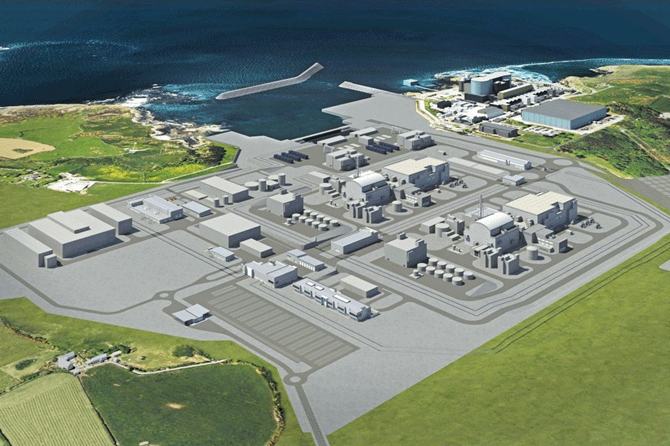
Wylfa Newydd planning decision delayed again, NEI, 6 April 2020 A planning decision over the Wylfa Newydd nuclear power plant in Anglesey has been deferred, the UK Government has confirmed.
The Wylfa Newydd project, which envisaged the construction of two UK advanced boiling water reactors (ABWRs), was suspended in January 2019 after Hitachi, failed to reach a funding deal with the UK government. However, the government had been expected to grant a Development Consent Order to construct the £12 billion power station on 31 March…… The Secretary of State (Alok Sharma) has decided to re-set the statutory deadline for this application to 30 September 2020….'”
…..EDF Energy announced last month that it was delaying submission of its planning application for Sizewell C by a “few weeks” due to the coronavirus crisis. Construction work at Hinkley Point C has also been scaled back. https://www.neimagazine.com/news/newswylfa-newydd-planning-decision-delayed-again-7859280
EDF’s hypocrisy -Hinkley C nuclear construction continued, despite pandemic, as “essential” work

Bridgwater Mercury 4th April 2020 Roy Pumfrey: WHILE EDF has gone halfway by reducing the number of workers on the Hinkley C (HPC) site, the company seems reluctant to shut HPC down completely (‘HPC construction continues’, Mercury, March 24) due to the Coronavirus pandemic.
An EDF statement talked about reducing worker numbers ‘further as work already in progress is completed’, but was not specific about which work was so critical that it couldn’t be terminated now and how much longer it would carry on.
This is in stark contrast to the situation at Flamanville in France (HPC’s sister station) where EDF has stopped all but essential tasks. EDF hides behind the fig leaf of HPC being ‘a project of critical national importance’.
This is simply no longer justified. If it was okay to stop work for three weeks
over Christmas and the New Year, it must be done now when the stakes are
much higher than a holiday. At the same time, EDF promised to take more
effective measures on social distancing. Photographs of workers grouped in
bus queues and using the canteen but clearly less than 2m apart show that
this is all but impossible.
https://www.bridgwatermercury.co.uk/news/18351121.letter-shut-hinkley-c-now/
Wildfires in Ukraine: authorities say that those near Chernobyl are now extinguished
Ukraine Says Fire Extinguished Near Contaminated Site Of Chernobyl Nuclear Disaster, Emergency authorities in Ukraine say there are no signs of any fire still burning in the uninhabited exclusion zone around the decommissioned Chernobyl nuclear plant after firefighters mobilized to put out a blaze.
Radio Free Europe, 5 Apr 20, The country’s State Emergency Service said early on April 5 that background radiation levels were “within normal limits.”
More than 130 firefighters, three aircraft, and 21 vehicles were deployed on April 4 to battle the fire, which was said to have burned around 20 hectares (50 acres) in the long-vacated area near where an explosion at a Soviet nuclear plant in 1986 sent a plume of radioactive fallout high into the air and across swaths of Europe.
Fire and safety crews were said to be inspecting the area overnight on April 4-5 to eliminate any threat from sites where there was still smoldering.
The blaze required seven airdrops of water, officials said.
There was no threat to settlements, the State Emergency Service said.
Firefighters battle forest blazes near Chernobyl nuclear site
|
Ukraine battles forest fires near Chernobyl https://abcnews.go.com/Health/wireStory/forest-fire-chernobyl-boosts-radiation-level-69983859
Ukrainian says firefighters are laboring to put out two forest blazes in the area around the Chernobyl nuclear power station that was evacuated because of radioactive contamination after the 1986 explosion at the plant By The Associated Press 6 April 2020 MINSK, Belarus — Ukrainian firefighters labored into Sunday night trying to put out two forest blazes in the area around the Chernobyl nuclear power station, which was evacuated because of radioactive contamination after the 1986 explosion at the plant.
Ukraine’s emergencies service said one of the fires, covering about five hectares (12 acres), had been localized. It said the other fire was about 20 hectares (50 acres). Earlier Sunday, the head of the state ecological inspection service, Yehor Firsov, said the fires had spread to about 100 hectares (250 acres). The discrepancy in sizes could not immediately be resolved. Firsov said radiation levels at the fire were substantially higher than normal. But the emergencies service said radiation levels in the capital of Kyiv, about 100 kilometers (60 miles) south, were within norms. The fires were within the 2,600-square-kilometer (1,000-square-mile) Chernobyl Exclusion Zone established after the 1986 disaster at the plant that sent a cloud of radioactive fallout over much of Europe. The zone is largely unpopulated, although about 200 people have remained despite orders to leave. |
|
Radiation spike as forest fire hits Chernobyl nuclear zone
Radiation spike as forest fire hits Chernobyl nuclear zone https://www.deccanherald.com/international/world-news-politics/radiation-spike-as-forest-fire-hits-chernobyl-nuclear-zone-821778.html AFP, Kiev, APR 05 2020, AFP, Kiev, APR 05 2020, 21:04 IST UPDATED: APR 05 2020, 21:31 IST AFP/file photo Ukrainian authorities on Sunday reported a spike in radiation levels in the restricted zone around Chernobyl, scene of the world’s worst nuclear accident, c aused by a forest fire.
Sizewell C nuclear project: community has lost faith in the integrity of EDF
 East Anglian Daily Times (not on web) 3rd April 2020, John Rea Price: Community has lost faith in the integrity of EDF. East Anglian Daily Times (not on web) 3rd April 2020, John Rea Price: Community has lost faith in the integrity of EDF.So EDF has generously agreed to defer their application for planning consent “by a few weeks”, actually for just a month the website of the Planning Inspectorate suggests.
Mr Cadoux Hudson of EDF goes on to promise that more
time would be given for people to register as participants in the public examination. What he didn’t say is that this will be an extremely formal and legalistic process with very little opportunity for genuine engagement by members of the community and is thus a meaningless concession. He goes on to say that over eight years of public consultation EDF has tried hard to be transparent. He doesn’t seem to appreciate that the community has experienced its efforts as truculent and dismissive.
Despite repeated demands at each of the four stage of public consultation it has, in particular, failed to provide any evidence of substance and quality on the probable cumulative environmental impact of its development on this
uniquely sensitive landscape and coastline. The consequence has been that communities that were not in principle opposed to Sizewell C have become its bitterest opponents. Such is the loss of any faith in the integrity of EDF that many now believe that it will exploit the opportunity of this grave national crisis to drive its application forward as aggressively as possible.
It will thus seek to minimise the depth of scrutiny that its very
complex proposals demand at a time when statutory agencies, county, district and parish councils, conservation bodies and community groups have the least capacity to undertake this. https://www.eadt.co.uk/news |
|
Sam and the Plant Next Door – growing up by the nuclear power plant
Sam, 11, is always being told not to worry about the nuclear power plant rising next door, but for him there is lots to think about. Hinkley Point C will be Britain’s largest nuclear plant, and it’s only two miles away. Most of his classmates expect to work at the plant but Sam is determined to escape that fate.
His dream is to protect the surrounding marine life he identifies with. Like the fish, he feels unappreciated by the adults. Sam thinks the only way to reach his dream is to leave his friends behind and to go to a private school. But when he’s offered a place, his parents can’t afford the fees. As a last resort, they turn to the power company for funding, which forces Sam to decide what kind of person he wants to be. Drifting between Sam’s daily life and his dreams, a film about holding on and letting go, along the tricky passage from childhood innocence to grown-up life https://www.youtube.com/watch?v=VMhYngrEgZU&feature=youtu.be
1 This Month
23-25 October – on Zoom – World BEYOND War’s annual global conferenc

To see nuclear-related stories in greater depth and intensity – go to https://nuclearinformation.wordpress.com

Say No to NASA’s Reckless Nuclear Reactor on the Moon
Say No to NASA’s Reckless Nuclear Reactor on the Moon
-
Archives
- October 2026 (160)
- September 2026 (339)
- August 2026 (330)
- July 2026 (355)
- June 2026 (287)
- May 2026 (306)
- April 2026 (356)
- March 2026 (251)
- February 2026 (267)
- January 2026 (308)
- December 2025 (358)
- November 2025 (359)
-
Categories
- 1
- 1 NUCLEAR ISSUES
- business and costs
- climate change
- culture and arts
- ENERGY
- environment
- health
- history
- indigenous issues
- Legal
- marketing of nuclear
- media
- opposition to nuclear
- PERSONAL STORIES
- politics
- politics international
- Religion and ethics
- safety
- secrets,lies and civil liberties
- spinbuster
- technology
- Uranium
- wastes
- weapons and war
- Women
- 2 WORLD
- ACTION
- AFRICA
- Atrocities
- AUSTRALIA
- Christina's notes
- Christina's themes
- culture and arts
- Events
- Fuk 2022
- Fuk 2023
- Fukushima 2017
- Fukushima 2018
- fukushima 2019
- Fukushima 2020
- Fukushima 2021
- general
- global warming
- Humour (God we need it)
- Nuclear
- RARE EARTHS
- Reference
- resources – print
- Resources -audiovicual
- Weekly Newsletter
- World
- World Nuclear
- YouTube
-
RSS
Entries RSS
Comments RSS

