Eleven of 12 hottest years have occurred since 2000, new climate report warns
 Eleven of 12 hottest years have occurred since 2000, new climate report warns, Independent, Isabelle Gerretsen @izzygerretsen 23 Apr 20
Last year was the hottest year on record for Europe after scorching heatwaves led to record-breaking temperatures in February, June and July
Eleven out of the 12 hottest years to date have all occurred since 2000, according to a new report by the European Union’s climate monitoring service.
Last year was the hottest year on record for Europe after scorching heatwaves led to record-breaking temperatures in February, June and July, scientists from the Copernicus Climate Change Service (CS3) said in the annual European State of the Climate report.
“The number of days with high heat stress levels are increasing in both northern and southern Europe,” they said.
An intense heatwave at the end of July led to record melting of Greenland’s ice sheet and all-time records being broken in northern Scandinavia, the Copernicus report noted.
According to recent research, Greenland’s ice sheet and the polar ice caps are melting six times faster than they were in the 1990s. The high melt rate fits with the worst-case scenario outlined by the UN’s Intergovernmental Panel on Climate Change (IPCC), which states that sea levels will rise 17cm without sweeping reductions in greenhouse gas emissions…..
Concentrations of CO2 and methane in the atmosphere continue to increase. “It is only possible to find concentrations as high as they were in 2019 by going back millions of years in history,” the Copernicus scientists said.
Professor Martin Siegert, co-director of the Grantham Institute for Climate Change at Imperial College London, told The Independent that the current level of CO2 in the atmosphere is “unnaturally high”.
He said it should be 280 parts per million (ppm) but is currently 415ppm and could reach 1000ppm by the end of the century if CO2 emissions continue to rise at their current rate…… https://www.independent.co.uk/environment/climate-change-global-warming-hottest-years-on-record-a9477796.html
France: The Forgotten Nuclear Power That Could Kill Billions of People
|
France: The Forgotten Nuclear Power That Could Kill Billions of People
Paris might not have a massive stockpile of nukes, but they could do some serious damage if need be. National Interest, by Caleb Larson, 26 Apr 20, The French nuclear arsenal is pretty substantial, with air- and sea-based components. Here is a breakdown of French nuclear capabilities. Nuclear Dyad Unlike the United States or Russia, who maintain a nuclear triad of land-based, submarine-launched, and air-launched missiles, France has a dyad of submarines that can launch nuclear ballistic missiles and a stockpile of air-launched nuclear cruise missiles. M51 Ballistic Missile The M51 is the heart of French nuclear deterrence at sea. Each missile has six to ten Multiple Independent Reentry Vehicles (MIRVs), and each of those MIRVs is guessed to be in the 75 to 110 kiloton range. Its range is estimated at 8,000 kilometers, or just under 5,000 miles and the missiles are launched from the nuclear-powered Triumphant-class submarines. Air-Sol Moyenne Portée The Air-Sol Moyenne Portée is the air-launched component of French strategic deterrence. The missiles play a unique role in French deterrence, where their use would be considered a warning shot of sorts before the more widespread use of nuclear weapons would be used in a conflict. …….. Hadès The Hadès missile system was at one point a land-based component of French strategic deterrence — though only at the tactical, not strategic level, due to the system’s relatively short 480 kilometer, or about 300 mile range……. https://nationalinterest.org/blog/buzz/france-forgotten-nuclear-power-could-kill-billions-people-148396 |
|
The end of reprocessing spent nuclear fuel has left an expensive UK plutonium stockpile with no peaceful use
 UK plutonium stockpile is a costly headache, https://climatenewsnetwork.net/uk-plutonium-stockpile-is-a-costly-headache/ April 23rd, 2020, by Paul Brown, The end of reprocessing spent nuclear fuel has left an expensive UK plutonium stockpile with no peaceful use UK plutonium stockpile is a costly headache, https://climatenewsnetwork.net/uk-plutonium-stockpile-is-a-costly-headache/ April 23rd, 2020, by Paul Brown, The end of reprocessing spent nuclear fuel has left an expensive UK plutonium stockpile with no peaceful use
LONDON, 23 April, 2020 − For 70 years Britain has been dissolving spent nuclear fuel in acid, separating the plutonium and uranium it contains and stockpiling the plutonium in the hope of finding some peaceful use for it, to no avail: all it has to show today is a UK plutonium stockpile. To comply with its international obligations not to discharge any more liquid radioactive waste into the Irish Sea, the United Kingdom government agreed more than 20 years ago under the Ospar Convention on the protection of the north-east Atlantic to shut its nuclear fuel reprocessing works at Sellafield in northwestern England at the end of this year. As well as 139 tonnes of plutonium, which has to be both carefully stored to prevent a nuclear chain reaction and protected by armed guards as well, to avoid terrorist attack, there are thousands of tonnes of depleted uranium at Sellafield. The reprocessing plant shut down prematurely as a result of a Covid-19 outbreak among its employees, and most of the 11,500 workers there have been sent home, leaving a skeleton staff to keep the site safe. Whether the plant will be restarted after the epidemic is unknown. Fewer than half Sellafield’s workers are involved in reprocessing. Most are engaged in cleaning up after decades of nuclear energy generation and related experiments. There are 200 buildings at the massive site, many of them disused. It costs British taxpayers around £2.3 billion (US$2.8bn) a year to run Sellafield and keep it safe. Solution needed soon While the British government has been reluctant to make any decision on what to do about its stockpiled plutonium and uranium, the Bulletin of the Atomic Scientists has expressed alarm about the danger it poses. “The United Kingdom has to find a solution for its plutonium stockpile, and quickly,” its report says. The scientists point out that there is enough plutonium to make hundreds of thousands of nuclear weapons, and that it is a permanent proliferation risk. The annual cost of £73m to keep the plutonium safe is dwarfed by the much larger cost of trying to make safe the whole site with its thousands of tonnes of nuclear waste. The Bulletin reports that the original reason for the reprocessing works was to produce plutonium for nuclear weapons. The UK supplied the US at times, as well as producing its own weapons. A 2014 agreement between the British and US governments gives an outline of the nuclear links which then existed between them.
For decades there were also plans to use plutonium in fast breeder reactors and to blend it with uranium to make Mixed Oxide Fuel (MOX) . This was a time when governments believed that the world’s supply of uranium would run out and that re-using it with plutonium would be a way of generating large amounts of electricity, as a way to avoid burning fossil fuels and as part of the solution to climate change. MOX was one possible fuel. Using recycled plutonium in fast breeder reactors was another possibility. And a third option was new-style reactors that burned plutonium, theoretically possible but never built. But uranium did not run out, and MOX did not prove economic. It and the new reactors proved so technically difficult they were abandoned. Despite these setbacks, successive British governments have continued reprocessing, always refusing to class plutonium as a waste, while still exploring ways of using it in some kind of new reactor. This is likely to remain the official position even after reprocessing ends in December. The UK’s Nuclear Decommissioning Authority, the agency that runs Sellafield, faced by this indecision, continues to store the plutonium behind three barbed-wire barricades, guarded by the only armed civilian police force in the country. Here to stay? One of the tricky political problems is that 23 tonnes of the plutonium is owned by Japan, which sent its spent fuel to be reprocessed at Sellafield but is unable to use the recycled material, which cannot be returned to Japan in its current state because of nuclear proliferation concerns. Despite these setbacks, successive British governments have continued reprocessing, always refusing to class plutonium as a waste, while still exploring ways of using it in some kind of new reactor. This is likely to remain the official position even after reprocessing ends in December. The UK’s Nuclear Decommissioning Authority, the agency that runs Sellafield, faced by this indecision, continues to store the plutonium behind three barbed-wire barricades, guarded by the only armed civilian police force in the country. Here to stay? One of the tricky political problems is that 23 tonnes of the plutonium is owned by Japan, which sent its spent fuel to be reprocessed at Sellafield but is unable to use the recycled material, which cannot be returned to Japan in its current state because of nuclear proliferation concerns. |
|
France’s nuclear company EDF in spiralling debt crisis
|
New York Times 22nd April 2020, Plummeting electricity demand and falling power prices during the coronavirus outbreak could leave EDF in need of a capital injection by the
end of 2020 to avoid a spiralling debt crisis, a source close to the French firm and analysts said. The state-controlled utility, which operates the
world’s largest nuclear fleet, has long been weighed down by a 41.1 billion-euro debt pile. Shrinking income due to the health crisis and likely delays in reforming France’s electricity market, which could have boosted the firm’s earnings power, are now adding to its challenges and pressuring its financial ratios. A source close to EDF’s management said
the company may need a capital injection towards the end of the year to cushion the shock, with one analyst putting the size of any rights issue at several billion euros. |
|
Latest delay in Olkiluoto nuclear fuel loadings leads to Fitch revising outlook to negative
|
Fitch 20th April 2020, Fitch Ratings has revised Teollisuuden Voima Oyj’s (TVO) Outlook to
Negative from Stable and affirmed the Long-Term Issuer Default Rating (IDR) at ‘BBB-‘. The Negative Outlook reflects the latest announced delay of fuel
loading, a critical milestone, at the third 1,600 MW nuclear plant Olkiluoto 3 (OL3) project caused by overall slow progress of works as well as disruption due to the coronavirus outbreak. There is a risk that the settlement agreement signed with the supplier consortium (Areva NP, Areva GmbH, Siemens AG (A/Stable) and Areva Group’s parent Areva SA) in March
2018 would not protect TVO from financial impacts should the start of power production be delayed beyond June 2021, because the consortium has not yet assigned a new date for the fuel loading. After this date, TVO would not be entitled to penalty payments from the supplier consortium under the settlement agreement anymore. |
|
European Solar Generation Breaks Records, As Coronavirus Shutdowns Reduce Air Pollution
|
As Coronavirus Shutdowns Reduce Air Pollution, European Solar Generation Breaks Records, 360 Yale, 23 Apr 20, Three of Europe’s biggest economies — Germany, Spain, and the United Kingdom — have recently achieved new records in solar generation, due in part to a drop in air pollution from coronavirus-related shutdowns, which has cleared skies and boosted production of photovoltaic cells, Greentech Media reported.
Germany generated a record-high 32.2 gigawatts (GW) of solar power earlier this week, accounting for 40 percent of the country’s electricity needs, according to Bloomberg News. And UK solar production peaked at 9.68 GW this week, up from a previous record of 9.55 GW set in May 2019, according to Sheffield Solar, a project of the University of Sheffield. In total, the UK has gone without coal power on its grid for nearly two weeks….. Spain’s record-high solar production is the result of last year’s boost in installations, which expanded new capacity by 4.7 gigawatts. On March 26, Spain generated 6.3 GW of solar power, accounting for about a quarter of the country’s electricity needs. https://e360.yale.edu/digest/as-coronavirus-shutdowns-reduce-air-pollution-european-solar-generation-breaks-records |
|
|
EDF nuclear power company looks to a profitable future in small-scale, distributed RENEWABLE energy
 Can EDF Make Big Money in Small-Scale Renewables?, Greentech Media
The world’s leading nuclear power generator is betting big on a future of small-scale, distributed energy.
Électricité de France operates 58 nuclear reactors in its home country and owns stakes in several U.S. nuclear plants that it’s now moving to sell. But EDF’s biggest stamp on the American power market has come in large-scale renewables: Its San Diego-based EDF Renewables North America subsidiary has developed and now operates gigawatts of wind and solar farms across the country.
Now, EDF Renewables is trying to replicate that success on a much smaller scale. How it fares in the distributed space will be of great interest to other 20th-century energy giants feeling their way toward a transformed, low-carbon future.
Over the past few years, and largely through acquisitions, EDF Renewables has amassed one of the most comprehensive U.S. distributed energy businesses, covering solar, energy storage, microgrids and electric vehicle chargers.
The coronavirus crisis may open the door to more dealmaking, said Raphael Declercq, who runs the Distributed Solutions unit at EDF Renewables North America. “There will be some casualties in our sector: Assets seemed overpriced up to a month ago; that may change and we may be able to grow through acquisitions,” Declercq told GTM.
Several European energy giants have been on a recent shopping spree for distributed energy companies in the startup-rich U.S. — notably Shell, EDF and Enel. Without their own U.S.-based utilities to worry about taking business from, they can roll up fleets of behind-the-meter energy assets and deliver power to customers in new ways, while learning lessons that can be applied in other markets.
“It’s a grab game right now, getting as much of that value chain as possible,” said Elta Kolo, content lead for grid edge research at Wood Mackenzie. “In a way, you’re almost seeing a new type of utility emerging in the market,” she said.
It’s a hazardous moment for the energy industry, oil companies and utilities alike. State-controlled EDF last week pulled its financial guidance for 2020 and 2021, saying it expects a sharp drop in its French nuclear output this year as the coronavirus outbreak depresses power demand…….
The rising importance of corporate renewables…….
Russia dumps its plans for costly huge Nuclear Destroyer and supersized Frigate Programs
Russia Has Abandoned Its Massive Nuclear Destroyer And Supersized Frigate Programs, The Drive BY JOSEPH TREVITHICK APRIL 21, 2020 The state-run shipbuilding company responsible for both programs now has concerns about its long-term finances
Eussia’s Severnoye Design Bureau has stopped development entirely of its Project 23560 destroyers, also known as the Lider class, and the Project 22350M frigate, an expanded derivative of the Project 22350 Admiral Gorshkov class. The company has said these ships are among its most promising future offerings and the halting of the two programs has raised quThe Lider destroyer, also referred to at times as the Shkval, was clearly an extremely ambitious project, perhaps overly so, from the very beginning. Though originally intended to be a conventionally powered warship, plans subsequently shifted to a nuclear-powered design. Its expected displacement also grew from already massive 12,000 to 13,000 tons to 19,000 tons, stretching its classification as a “destroyer.” estions about its long-term financial stability.
Russian newspaper Interfax reported the new developments at Severnoye, which is part of the country’s state-owned United Shipbuilding Corporation, on Apr. 18. The information was reportedly contained in an annual review of the shipbuilder’s activities in 2019, which the outlet had obtained……
The Lider destroyer, also referred to at times as the Shkval, was clearly an extremely ambitious project, perhaps overly so, from the very beginning. Though originally intended to be a conventionally powered warship, plans subsequently shifted to a nuclear-powered design. Its expected displacement also grew from already massive 12,000 to 13,000 tons to 19,000 tons, stretching its classification as a “destroyer.” …… HTTPS://WWW.THEDRIVE.COM/THE-WAR-ZONE/33099/RUSSIA-HAS-ABANDONED-ITS-MASSIVE-NUCLEAR-DESTROYER-AND-SUPERSIZED-FRIGATE-PROGRAMS
Fitch downgrades EDF’s Outlook to Negative
The Outlook revision mainly reflects a large production cut in nuclear generation in France related to the coronavirus pandemic, and ongoing problems with new nuclear, adding to an expected increase in leverage to slightly above our rating sensitivity on average for 2020-2022. It also reflects growing uncertainties about the nuclear-market reform in France – which we still expect to be finally implemented – in terms of timing and final impact.
KEY RATING DRIVERS
Production Cuts due to Pandemic: The pandemic and the lockdown have caused daily electricity demand to fall up to 20% yoy and depressed both spot and forward electricity prices. EDF has announced a cut of French nuclear production to 300TWh in 2020 and to 330TWh-360TWh for 2021-2022 (from our earlier assumption of 385TWh annually for the whole period), due mainly to the operational impact of the pandemic on the outages scheduled for these years and, to a lesser extent, to the drop in demand. While the announcement led to a rebound of forward prices 2021-2022 to around 45EUR/MWh, we do not expect EDF to fully benefit from it due to the ARENH reference price of 42EUR/MWh. For 2020, EDF is largely protected from the low price environment through hedging.
Large Working Capital Outflows: Another immediate consequence of the pandemic has been an increase in the number of end-customers struggling to pay their bills. In this respect, EDF will continue to supply power to households and small companies with overdue bills without penalties. ,……..
Company’s Reaction Uncertain: EDF has not yet communicated revised financial targets to the market, and we do not know what actions it will focus on to mitigate the impact of the pandemic. …….
Problems with New Nuclear: At Flamanville, fuel loading would occur at best at end-2022 (compared with the previously estimated late-2019), implying an increase of construction costs by EUR1.5 billion (in 2015 real terms and excluding interests during construction) compared with previous estimates. HPC – the other key nuclear project of EDF – following another cost review in September 2019, sees an increase in construction costs of GBP1.9 billion-GBP2.9 billion (2015 real terms) compared with previous estimates. It remains to be seen if the pandemic will further increase the delay and cost overrun for these projects…….. https://www.fitchratings.com/research/corporate-finance/fitch-revises-edf-outlook-to-negative-affirms-idr-at-a-22-04-2020
Wind or solar technologies will provide UK with 100% energy, in a predominantly electric future
 Chartist 18th April 2020, Dave Toke: As offshore wind technology fully blooms as its own distinctmass industrial technology producing power at low prices, and as the prospect of floating wind turbines comes closer, the potential for the technology threatens to eclipse everything else – at least in countries with a large waterline, such as the UK.
another story. The story here is that on its own, the offshore wind available could generate over five times the anticipated total energy requirements for the UK in a ‘net zero carbon’ scenario – that is, based upon the Committee on Climate Change estimate that a mainly electric economy supplied from low carbon sources would require 645TWh of power generation in 2050. Wind power could do this as the cheapest electricity source available – apart from solar power of course, with which the competition will probably be intense in the future.
https://www.chartist.org.uk/offshore-wind-the-force-is-with-you/
UK’s plutonium problem as it shuts down its last nuclear reprocessing facility

burial. https://thebulletin.org/2020/04/britain-has-139-tons-of-plutonium-thats-a-real-problem/
Smoke from Chernobyl area wildfires made Ukraine’s capital have the worst air pollution in the world
Unilad 18th April 2020, Wildfires burning near the Chernobyl nuclear plant have covered the capital
of Ukraine in smoke and made its air pollution among the worst in the
world. Residents burning rubbish near Chernobyl accidentally sparked fires
on April 4, and though firefighters managed to contain the initial blazes,
three new fires began to spread in the contaminated exclusion zone on
Thursday, April 16. The fires were propelled by strong winds and smoke has
engulfed the capital Kyiv. While many residents are adhering to
stay-at-home orders anyway, authorities are now encouraging residents to
close their windows to prevent the smog filling their houses.
With dry and windy conditions, new areas of ‘smoldering’ reported near Chernobyl nuclear plant
New areas of ‘smoldering’ reported near Chernobyl nuclear plant, Accu Weather, By Courtney Spamer, AccuWeather meteorologist, Apr. 18, 2020 A massive fire that broke out in northern Ukraine at the beginning of April is no longer said to be threatening the infamous Chernobyl nuclear power plant in the region. However, officials are monitoring hot spots as winds whip through the region.
The fire began to burn in the region back on April 3, near the town of Pripyat, located over two hours north of the country’s capital of Kiev and near the border with Belarus.
Police say they arrested a 27-year-old man who is being accused of starting the fire last week. On Monday, police said that another local resident burned waste and accidentally set dry grass ablaze.
The location of the fire was reportedly only one kilometer (less than one mile) away from the Chernobyl nuclear power plant, the site of the world’s largest nuclear catastrophe back in April 1986.
However, Greenpeace Russia, on Monday, warned that the fire being in close proximity of the power plant posed a radiation risk.
“Higher-than-usual” radiation levels were first reported by the AP on April 5, and are being carefully monitored as the fire continues.
According to Reuters, Chernobyl tour operator, Yaroslav Yemelianenko, shared on Facebook that the fire was only two kilometers away from where “the most highly active radiation waste of the whole Chernobyl zone is located.” He called on officials to warn people of the danger.
Emergency services said on Tuesday morning that there were still some acreage “smoldering” in the Chernobyl Exclusion Zone, but that the zone contained no open fire.
Acting Chairman of the State Environmental Inspectorate, Yegor Firsov, later said that the fire in the Chernobyl exclusion zone was extinguished, and cited some rain that moved through the region as one helpful factor.
Hundreds of firefighters, as well as several planes and helicopters, battled the blaze for 10 days.
………Strong winds increased the difficulty in containing what’s left of the blaze and new areas of “smoldering” were reported in the Exclusion Zone, but did not pose a threat to any critical facilities, reported officials……..
Dry weather across much of eastern Europe has allowed for a more volatile environment for fire to thrive.
Through April 13, only two percent of the month’s normal rainfall has fallen in Kiev. Since the beginning of 2020, the city has been much drier than normal, only recording 81 mm of rain instead of the average 150 mm.
The dry weather has also caused crop losses already this year across Ukraine, with further damage possible should the dry stretch continue.
Keep checking back on AccuWeather.com and stay tuned to the AccuWeather Network on DirecTV, Frontier and Verizon Fios.
No easy fix for Russia’s troubled Arktica ice-breaker – delivery delayed for at least a year
|
Russia’s new Arktika nuclear icebreaker delayed for at least a year https://bellona.org/news/arctic/2020-04-russias-new-arktika-nuclear-icebreaker-delayed-for-at-least-a-yearA defective electric engine aboard Russia’s newest nuclear icebreaker has set off a cascade of difficulties that will postpone its scheduled May delivery date by at least several months, frustrating Moscow’s drive to tame Arctic sea routes as part of a broad economic plan. April 17, 2020 by Anna Kireeva, Charles Digges
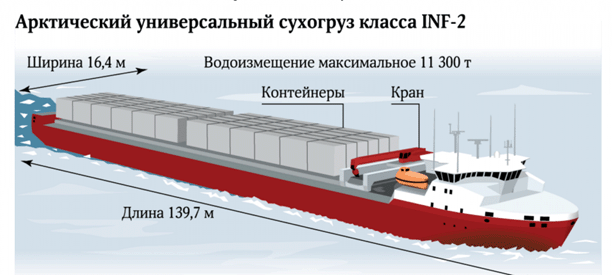
A defective electric engine aboard Russia’s newest nuclear icebreaker has set off a cascade of difficulties that will postpone its scheduled May delivery date by at least several months, frustrating Moscow’s drive to tame Arctic sea routes as part of a broad economic plan. The problems aboard the Arktika icebreaker, slated to be the largest in the world, came to light in February, when a 300-ton electric propulsion motor on the vessel’s starboard side – which has nothing to do with the nuclear propulsion system – failed during sea trials. By this month, it has become clear to officials that there are no easy fixes are in sight, and that the delayed delivery of the enormous vessel from a St Petersburg shipyard to its stationing in Murmansk means a number of older nuclear powered will be forced to continue operations. “I don’t think we know all the details of this incident,” Andrei Zolotkov, a former nuclear icebreaker technician and the held of Bellona’s Murmansk offices, said. “The constant failure to meet the deadline to put new nuclear icebreakers into operation is already damaging to the builders’ reputations. The failure of the [electric motor] is another big minus.” The Artkika is the lead vessel of Russia’s LK60Ya nuclear icebreaker line, which Moscow sees as a central tool for developing the frozen Northern Sea Route, the Arctic shipping artery on which President Vladimir Putin has staked much of Russia’s economic future. Like its sister vessels – the Ural and the Sibir – the Arktika weighs in at a displacement of 33,500 tons, and measures 173 meters from bow to stern. The price tag of each new ship is about $550 billion. The Arktika’s twin RITM-200 reactors will deliver a combined 175 megawatts of power, making it the most powerful civilian vessel in the world. And like its sister vessels, the Arktika is named for an earlier nuclear icebreaker, in a nod to Soviet heyday of polar exploration. These newer vessels will be facing newer tasks. Putin has demanded that cargo tonnage flowing through the Arctic reach 80 million tons by 2024 – a huge increase over present levels – in hopes of making the Northern Sea Route a competitor to the Suez Canal. With these new vessels, Moscow say it can extend the annual navigation season in the polar region – which, even in the grip of climate change, is only about three months per year. But the Arktika’s delivery deadline to Atomflot, Russia’s nuclear icebreaker headquarters in Murmansk, has already undergone a series of revisions. The vessel has been on the drawing board since 2012, and was first due for commissioning in late 2017. When that date arrived, the deadline was pushed back to December 2019 – and that soon became May 2020. Such is the case for the Arktika’s sister vessels. Although the Baltic Shipyard in St Petersburg has floated their hulls, they have yet to be delivered to Murmansk and been at Atomflot. This leaves Moscow’s push to tame the Arctic running behind. To make up for the delays, Rosatom, Russia’s state nuclear corporation, has extended the operational lifetimes of three older icebreakers. As such, the Taymyr nuclear icebreaker, which began operations in 1987, will run until 2025. The Vaigach, launched in 1987, will run until 2027, and the Yamal, launched in 1989, will run through 2028. They will join the other old guard workhorse, the “50 let Pobedy,” or 50 years Victory, which Atomflot still has in operation. For the moment, prospects for the Arktika’s launch appear for this year. The faulty engine can’t be swapped with one from another icebreaker, and a new one can’t be built before 2021. That, said Zolotkov, might not stop the vessel from being delivered to Atomflot under so-called “trial operation” – a measure that allows various officials to claim at least some progress. But given the number of issues such a move would leave unresolved, Zolotkov discounted it as a possibility. “A vessel or ship should leave the shipyard in good order and ready for real work, and not imitate the fulfillment of plans and deadlines that have long been violated, ” Zolotkov said. |
|
Heavy winds fan new fires breaking out in Chernobyl exclusion zone
— New wildfires spread around Chernobyl nuclear plant, New Europe, By Elena Pavlovska, 17 Apr 20,
The state emergency service said three new fires had broken out, but were “not large-scale and not threatening”…..
The [previous] fire sparked concerns that clouds of radioactive smoke could be released and blow south towards Kyiv, after an activist posted a video online showing a cloud of smoke rising within sight of the protective dome over Chernobyl’s Unit 4 nuclear reactor. https://www.neweurope.eu/article/new-wildfires-spread-around-chernobyl-nuclear-plant/
1 This Month
23-25 October – on Zoom – World BEYOND War’s annual global conferenc

To see nuclear-related stories in greater depth and intensity – go to https://nuclearinformation.wordpress.com

Say No to NASA’s Reckless Nuclear Reactor on the Moon
Say No to NASA’s Reckless Nuclear Reactor on the Moon
-
Archives
- October 2026 (160)
- September 2026 (339)
- August 2026 (330)
- July 2026 (355)
- June 2026 (287)
- May 2026 (306)
- April 2026 (356)
- March 2026 (251)
- February 2026 (267)
- January 2026 (308)
- December 2025 (358)
- November 2025 (359)
-
Categories
- 1
- 1 NUCLEAR ISSUES
- business and costs
- climate change
- culture and arts
- ENERGY
- environment
- health
- history
- indigenous issues
- Legal
- marketing of nuclear
- media
- opposition to nuclear
- PERSONAL STORIES
- politics
- politics international
- Religion and ethics
- safety
- secrets,lies and civil liberties
- spinbuster
- technology
- Uranium
- wastes
- weapons and war
- Women
- 2 WORLD
- ACTION
- AFRICA
- Atrocities
- AUSTRALIA
- Christina's notes
- Christina's themes
- culture and arts
- Events
- Fuk 2022
- Fuk 2023
- Fukushima 2017
- Fukushima 2018
- fukushima 2019
- Fukushima 2020
- Fukushima 2021
- general
- global warming
- Humour (God we need it)
- Nuclear
- RARE EARTHS
- Reference
- resources – print
- Resources -audiovicual
- Weekly Newsletter
- World
- World Nuclear
- YouTube
-
RSS
Entries RSS
Comments RSS

