The impact of climate change on nuclear reactors should be a key part of COP26 Climate Summit

the UK’s coastal nuclear power stations are vulnerable to sea-level rise, storm surges and flooding of reactor and spent fuel stores – and soon
In other words, action to address the impact of climate change on nuclear energy should be a key part of the United Nation’s Cop26 climate summit.
Climate change: Why nuclear power isn’t part of the solution to this global crisis – Dr Paul Dorfman https://www.scotsman.com/news/opinion/columnists/climate-change-why-nuclear-power-isnt-part-of-the-solution-to-this-global-crisis-dr-paul-dorfman-3328894
Over the past few weeks, the intensity and scale of the floods from slow-moving storms have broken records, and climate models are running hot.By Paul Dorfman
Monday, 2nd August 2021 This has prompted some to champion nuclear power as a source of lower-carbon electricity. But this newfound USP needs to be considered within the bigger picture because UK coastal nuclear power stations will be one of the first, and most significant, casualties to ramping climate impact. Put simply, nuclear is quite literally on the front-line of climate change – and not in a good way.
This has prompted some to champion nuclear power as a source of lower-carbon electricity. But this newfound USP needs to be considered within the bigger picture because UK coastal nuclear power stations will be one of the first, and most significant, casualties to ramping climate impact. Put simply, nuclear is quite literally on the front-line of climate change – and not in a good way.
All recent scientific data points to ramping sea-levels, faster, harder, more destructive storms and storm surges – inevitably bringing into question the operational safety, security and viability of UK coastal nuclear infrastructure.
Not normally given to exaggeration, the Institute of Mechanical Engineers says we may have to ‘up sticks’, relocate or abandon nuclear sites. This will cost. Trying to defend coastal nuclear means significantly increased expense for nuclear operation, waste management, and the 100-year-plus programme to decontaminate the UK’s 17 old nuclear reactors.
For nuclear to be practical, reactors have to be built economically, efficiently and on time. But practical experience says otherwise. EDF’s flagship EPR reactor is vastly over-cost and over-time at the two sites where it’s being built, at Olkiluoto in Finland and Flamanville in France.
Problems include poor concrete, bad welding and a faulty reactor pressure vessel – the main safety component. Things were supposed to have gone better in China, until last month’s nuclear fuel debacle demonstrated their inadequate safety oversight.
As for nuclear fusion, for the last 60 years proponents have said the technology will be ready in 20 years’ time – so perhaps this is an experiment to prove that time doesn’t exist in modern nuclear physics.
The reality is nuclear is a high-risk option. And this plays out in real time. Worldwide, nuclear is in stark decline and renewables are rising. The obvious explanation is the ramping costs of the former and the plummeting costs of the latter. So, not all lower carbon options are equal, benign or effective – and there are choices to be made.
Happily, big finance is at a tipping point as key global debt and equity investors pour record capital into renewables. With wind and solar power capacity growing at a record rate, the International Energy Agency predicts that renewables will supply 90 per cent of global electric power by 2050.
In Europe, renewables overtook fossil fuels to become the EU’s main source of electricity for the first time in 2020. Perhaps because it’s 50 per cent cheaper to generate electricity from renewables compared with fossil fuel-powered plants, the EU will increase renewables share in the total energy mix to 40 per cent by 2030.
OK, running an integrated renewable energy system will mean not just more wind and solar, but also a power network that ensures a balance of supply and demand at all times.
So it’s reassuring that power supply in nuclear-free Germany, the strongest economy in Europe, is one of the most reliable in the world, with government and grid operators confident that it will stay this way. In its last session before the summer recess, the German parliament brought forward the deadline for achieving climate neutrality by five years to 2045.
Here in Scotland, BP plans to invest £10 billion to make Aberdeen a global hub for offshore wind. Meanwhile Shell and Scottish Power are developing the world’s first large-scale floating offshore windfarms in the north-east of Scotland. And a very recent report by Imperial University says a massive expansion of offshore wind to 108 gigawatt will drive new power in the UK.
There are no resounding new revelations about the vulnerability of nuclear power to natural disasters, human or engineering faults, accidental or deliberate harm. Accidents are, by nature, accidental, and we’ve learned the cost of ignoring this common-sense axiom.
The fact is, the UK’s coastal nuclear power stations are vulnerable to sea-level rise, storm surges and flooding of reactor and spent fuel stores – and soon. This means that nuclear flood risk based on ‘all case scenarios’ must be published and regularly updated as climate science evolves, including costings and a range of contingency plans for the swift onset of climate-driven severe weather.
In other words, action to address the impact of climate change on nuclear energy should be a key part of the United Nation’s Cop26 climate summit.
It’s time to think constructively. We need to secure clean, safe, affordable, sustainable, low-carbon energy to power industry, transport, homes and businesses.
Our energy transition will involve the expansion of renewable energy in all sectors, rapid growth and modernisation of the electricity grid, energy conservation and efficiency, rapidly evolving storage technology, market innovations from supply to service provision, and transport restructure.
Nuclear sucks funds and vital political attention from this imperative zero-carbon investment. It displaces renewables on the grid and diverts essential research. The ramping costs of new nuclear compromises better, flexible, safe, productive, cost-effective and affordable technologies – and comes at a time when the development of renewable, sustainable and affordable low-carbon energy is a growing economic sector with a huge potential for jobs.
In bidding a long goodbye to fossil fuels, we’re also saying farewell to nuclear, that quintessentially mid-20th century technology – and not before time. Nuclear just can’t compete with the technological, economic, safety and security advantages of the renewable evolution.
Nuclear is an out-dated technology – a tired non-starter in the 21st century. We can do better.
Dr Paul Dorfman, of the UCL Energy Institute, University College London, is founder and chair of the Nuclear Consulting Group
Britain joins the craze for war in space – reviving the evil ”Skynet”?
British military launches its own Space Command with official opening Space War by Ed Adamczyk
Washington DC (UPI) Jul 30, 2021 Britain established its Space Command on Friday in a ceremonial opening, with responsibilities split between three specific groups to form a joint space command, Britain’s Ministry of Defense announced on Friday.
The British military budget includes $1.95 billion, over 10 years, for space capabilities, part of a defense budget increase of $33.34 billion in the next four years.
Officially called the “U.K. Space Command,” the new agency will immediately take command and control of the country’s Space Operations Center, its SKYNET military communications center and the ballistic early warning radar station at RAF Flyingdales in northeastern England………..
”As our adversaries advance their space capabilities, it is vital we invest in space to ensure we maintain a battle-winning advantage across this fast-evolving operational domain,” Defense Minister for Procurement Jeremy Quin said in the ministry’s statement…..
The United States launched its Space Force as a separate military branch in 2019, charging it with a broad mission to organize, train and equip space forces to protect U.S. and allied interests in space.
On July 13, of this year, Germany opened its own space command center at the Center for Air Operations in Uedem, near the Dutch border. https://www.spacewar.com/reports/British_military_launches_its_own_Space_Command_with_official_opening_999.html
English and Welsh concerns – call on Marine management leaders to postpone the dumping of Hinkley radioactive mud in te British Channel

EDF has this week rejected concerns about radioactivity from its dredging in the Bristol Channel around Hinkley Point power station near Burnham-On-Sea. A coalition of concerned Bristol Channel researchers and
campaigners says they have undertaken a pre-dredging radioactivity survey near Hinkley Point because “EDF, who want to dump radioactivity in the Bristol Channel, refuse to do it.”
The coalition, representing interests from both Welsh and English communities along the Bristol Channel/Severn estuary coasts, has appealed to the CEOs of the Marine Management Organisation and Natural Resources Wales (who must both adjudicate on EDF’s application to dredge) and the Westminster and Welsh Governments, who oversee those two agencies, to postpone any dumping decision until the survey results are published. The coalition has also formally requested a Public Inquiry to discuss the issues.
Burnham-on-sea.com 30th July 2021
https://www.burnham-on-sea.com/news/edf-rejects-radioactivity-concerns-over-hinkley-point-dredging/
Britain’s secret shortlist of areas earmarked for the dumping of nuclear waste
Southend-on-Sea, Essex, is the county’s most populous area, with more people living in the borough than anywhere else, but it’s a different story when you go to one of its most easterly points. Once you pass Shoeburyness, the area becomes almost entirely uninhabited. A series of islands, including Foulness Island and Wallasea Island, are situated here. They’re mostly marshy, boggy areas, but a few people still live there. A number of these islands are or have been owned by the government’s Ministry of Defence, who use this area for a variety of purposes, including as a shooting range. One of these islands is Potton Island. This island is mostly uninhabited, separated from the mainland by a thin creek only navigable via a small bridge which leads to the village of Great Wakering. In the 1800s, it was used as farmland until a major flood left the island abandoned. It was restored in the 1940s, and fell under the control of the Ministry of Defence in the 1950s before being turned back into a space for pasture and farmland. Documents released in 2005, after decades of secrecy, outlined areas the British government had earmarked for dumping nuclear waste in the 1980s and 1990s. Whilst any dumping would have been done in managed and safe ways, it’s still concerning to know that areas across Britain were being earmarked as graves for radioactive waste. Waste could have potentially been buried on Potton Island, and pedestrian access onto it possibly restricted completely. Southend Borough Council reportedly had no idea that Potton Island was on the government’s list of potential dumping locations, and were shocked when they found out it was on the shortlist. Essex Live 31st July 2021 https://www.essexlive.news/whats-on/classified-plans-use-essex-island-5713965 |
Over 1.5k people sign petition against nuclear waste storage in Lincolnshire, UK
Over 1,500 people have signed a petition to say no to plans to store
nuclear waste underground on the Lincolnshire coast. Plans emerged to
dispose of nuclear waste at a site near Mablethorpe this week, as
Radioactive Waste Management (RWM) said it was in “early discussions”
with Lincolnshire County Council about using the former ConocoPhillips Gas
Terminal in Theddlethorpe as a Geological Disposal Facility, but that no
decisions had been made.
Lincolnshire County Council Leader Martin Hill
claimed it was only 10 days ago they had a presentation from the firm, and
that it was the first time they’d had a meeting with them. He also said a
“binding” local referendum would be held and “if it’s a no,
that’s the end of it”, according to the BBC.
Lincolnite 29th July 2021
UK debate should not be about excluding China from nuclear build, but about whether nuclear build is even nucessary.
Given the explosive costs of large nuclear, the
debate shouldn’t be over how to replace China on these projects. It’s
whether we need Sizewell and Bradwell at all.”
The Foreign Secretary Dominic Raab observed last year that Britain could
no longer conduct “business as usual with China”. The UK’s
highest-profile action so far has been to force the Chinese telecoms
supplier, Huawei, out of Britain’s 5G network, said the FT.
But now ministers are seeking to “ditch” China General Nuclear from future UK
power projects – ending a collaboration dating back to a 2015 agreement
between David Cameron and Xi Jinping.
The move reflects growing concerns
about CGN’s “role in critical infrastructure” and follows a similar
ban in the US, which put the Chinese state-owned company on an “export
blacklist” in 2019, “alleging it had stolen US technology for military
purposes”.
The brief “golden era” of Sino-British relations has
turned “radioactive”, said Ben Marlow in The Daily Telegraph –
exposing great holes in UK energy policy. Ministers claim “the removal of
the Chinese will encourage other partners to come forward”, but “there
is no proper contingency plan”. How very unsurprising, said Alistair
Osborne in The Times. “Given the explosive costs of large nuclear, the
debate shouldn’t be over how to replace China on these projects. It’s
whether we need Sizewell and Bradwell at all.”
The Week 29th July 2021
https://www.theweek.co.uk/news/uk-news/953642/china-general-nuclear-banned-from-britain
UK government headed for huge costs, and a major row with China over Hinkley C nuclear power station.
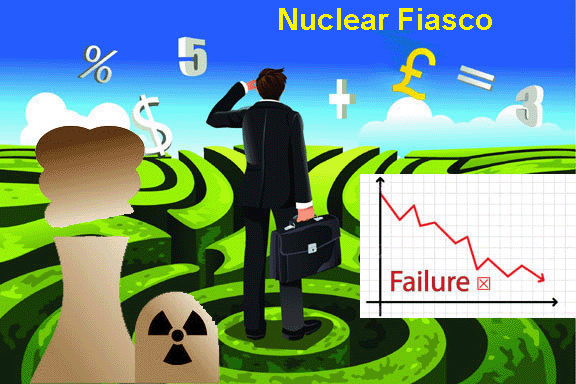
The Government is likely to become responsible for a huge bill for building Hinkley C power station. This is despite an insistence by the UK Government since they signed a deal with EDF to build Hinkley C in 2012
that electricity consumers will not have to pay for cost overruns for the project.
Yet it is now looking increasingly likely that this will end up being the case. When the deal was signed in 2012 the Government agreed to pay a much higher than expected £92.50 per MWh (in 2012 prices), this
price to be paid by consumers in their electricity bills (over twice the price given to recent offshore wind projects).
The Government claimed that there would be no bail-out if the project experienced large cost overruns
since the risk was borne by the holders of the share capital, EDF and also the Chinese state nuclear company, CGN. CGN holds around one third of the equity in Hinkley C.
But now there are mounting pressures on the Government to ensure that, for political and security reasons, China (through CGN) is not allowed to build its own nuclear design at Bradwell in Essex. Yet CNG only agreed to finance Hinkley C (and also in a similar fashion the planned Sizewell C project in Sufflok) on the basis that it was going to get the chance to showcase its own ‘Hualong’ nuclear plant at Bradwell.
If China’s Bradwell ambitions are thwarted then they will certainly pull out of the Sizewell C project and also do as much as is legally possible to forshorten their risks and responsibilities at Hinkley C. The Government is likely to have to take on big liabilities in the case of Hinkley C – that is against a long succession of pronouncements by Government ministers over the past nine years. Some are even urging the Government to take over all of CGN’s shareholdings in Hinkley C.
But even if the Chinese company cannot reclaim the money it will have spent on the project so far, if CGN is denied the opportunity to build at Bradwell they are very likely to refuse to pay for any cost overruns at Hinkley C (as well as pull out of Sizewell C). This means that the UK Government will have to take on the liability of future cost overruns, and maybe end up in a major row with China about financial compensation.
100% Renewables 28thy July 2021
French President acknowledges France’s debt to Polynesia, but no apology.
French President Emmanuel Macron said Tuesday that Paris owed “a debt” to
French Polynesia over nuclear tests conducted in the South Pacific
territory between 1966 and 1996, but stopped short of apologising.
Daily Mail 28th July 2021
Will British taxpayers end up bankrolling Sizewell C nuclear power project ?
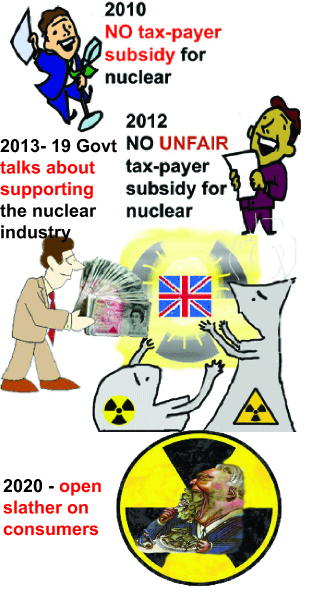
The flagship of Britain’s new nuclear power fleet is under threat as the
Government prepares curbs on Chinese involvement in critical national
infrastructure. Whitehall sources admitted last night that the £23bn
Hinkley Point C project underway in Somerset could be jeopardised by plans
to block China General Nuclear (CGN) from future UK projects.
The Hinkley reactor, Britain’s first in a generation, is being partially bankrolled by
CGN as part of a wider deal with French company EDF to replace the UK’s
aging nuclear plants. Under Government proposals which have not been
officially confirmed, CGN’s involvement in subsequent planned projects, in
Suffolk and Essex, would end. Government insiders said that there are
concerns this could disrupt the linked deal under which CGN is developing
Hinkley, where work is already significantly advanced.
Ministers are preparing to introduce legislation to Parliament that would allow nuclear
power developers to recoup costs from household bills. This could spark a
significant backbench rebellion from MPs concerned about China if CGN is
involved. Industry sources also suggested that EDF would find it easier to
court pension funds and other institutional investors without the political
risk of a major Chinese state partner.
CGN owns about a third of Hinkley Point C and has a 20pc development phase stake in Sizewell C, with an
option to participate in the construction phase. Its own reactor design for
Bradwell is going through UK regulatory approval, with CGN hoping it can
then export this technology more widely. The Times reported last night that
the Government is considering buying an equity stake in Sizewell C as part
of its moves to replace CGN, reversing a long-standing wish to keep nuclear
build off the Government balance sheet.
Telegraph 26th July 2021
https://www.telegraph.co.uk/business/2021/07/26/hinkley-nuclear-plant-risk-china-crackdown/
Blackwater Against New Nuclear Group (BANNG) welcomes news that Chinese company may pull out of Bradwell project
The Blackwater Against New Nuclear Group (BANNG) has welcomed the news of the possible withdrawal of the Chinese project to build a gigantic nuclear power station at Bradwell but has struck a note of caution. ‘BANNG has campaigned against a new nuclear power station at Bradwell for the past 13 years’, said Andy Blowers, Chair of BANNG.
The news that the Chinese company developing the site may be under pressure to withdraw comes as
little surprise and has looked on the cards for some while especially since CGN, the majority shareholder, announced a pause in the development in February.
We believe the Bradwell site is unsuitable, unsustainable and unacceptable – whoever proposes to develop it. We must remain vigilant and continue to oppose any further nuclear development at this site’. Quite aside from the Government’s concerns, BANNG has long argued that the project is doomed for other reasons, not the least of which has been the overwhelmingly hostile reaction of the communities led by BANNG around
the Blackwater.
Plans for Bradwell B were launched just as the Covid-19 pandemic broke and shocked the public by the sheer scale of the project and its devastating impact on environment, communities and wellbeing. The
development encountered strong local political opposition with Maldon District Council, which had for many years supported it, declaring its opposition and Colchester Borough Council Councillors unanimously declaring theirs. West Mersea Town Council is also opposed and others have consistently voiced concerns.
BANNG 26th July 2021
Hinkley Point C and Sizewell nuclear power projects could unravel, leaving France’s nuclear company EDF with huge debt.
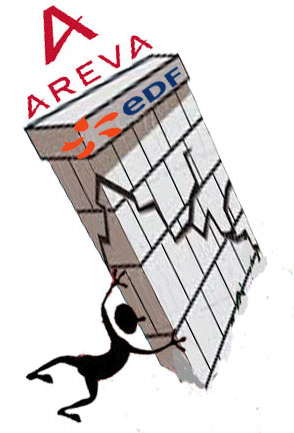
| It was never very likely that the government would allow a Chinese state-owned company to build a nuclear power station in Britain. So news that it is now looking for ways to remove China General Nuclear Power Group (CGN) from future nuclear projects hardly comes as a surprise. Under the terms of a deal struck in 2015 CGN was to take minority stakes in two French-led new nuclear power stations, Hinkley Point C and Sizewell C, while taking a majority stake in a third, Bradwell in Essex, which would use CGN’s own technology. This deal, first agreed by the coalition government, was approved with only minor alterations by Theresa May after a review concluded that Britain’s robust regulatory and technological safeguards were sufficient to protect against any threats to national security. Whether or not that assessment was right, the political context has since changed. The mood in parliament, particularly among Conservative MPs, has turned decisively against China, making it inconceivable that any government could allow China to build such sensitive national infrastructure. CGN was blacklisted from US government contracts in 2019 after being accused by the Trump administration of technology theft. That has made it harder for France’s EDF to attract the infrastructure investors that it needs to make Sizewell C financially viable. The risk is that China does not take its rejection well and the entire three-part deal unravels, with CGN withdrawing from Hinkley Point C in protest. That could leave EDF with a further shortfall of up to £4 billion. Times 26th July 2021 https://www.thetimes.co.uk/article/the-times-view-on-chinas-role-in-nuclear-plants-power-play-v70d2r76k |
Chinese company likely to be glad to abandon UK’s Hinkley and Bradwell nuclear power projects, as costs jump.
| China could quit UK nuclear projects if role threatened, experts warn. Effort to remove state-owned CGN from Sizewell C said to leave Hinkley Point and Bradwell developments exposed. China General Nuclear is likely to walk away from the Hinkley Point C power station being built in Somerset if the Chinese state-owned nuclear company is forced out of other future projects in the UK, industry experts warned on Monday. The company is already a minority investor in the 3.2 gigawatt Hinkley Point nuclear power station, which France’s EDF is building. One nuclear industry executive warned that CGN could now reassess its involvement with Hinkley Point. They pointed out there were four interlinked agreements between CGN, EDF and the government dating to 2015: Hinkley Point, Sizewell, Bradwell and the pursuit of regulatory approval for China’s reactor design. Steve Thomas, emeritus professor of energy policy at University of Greenwich, said CGN’s investment in Hinkley was designed to make a profit and also help secure its plant at Bradwell. With both of those now in jeopardy, the company could quit the UK, he warned. The Chinese company is eager to getUK regulatory approval at Bradwell for its own Hualong One HPR1000 reactor in order to help market it in other countries. The reactor design is currently going through the UK’s rigorous approval process with a decision expected in the second quarter of next year. But Thomas pointed out that with Hinkley’s budget having jumped from £14bn to as much as £22.5bn it was no longer clear whether the consortium would make a profit. “I would have thought that would put it into lossmaking territory,” he said. “They may well be very happy for an excuse to get out of it,” Thomas said. “If Bradwell is off the agenda and Hinkley Point won’t make money, why stick around?” Alison Downes of Stop Sizewell C, a pressure group, said the government’s position threw EDF’s funding problems for the new plant into sharper relief: “The simple fact is that Sizewell C won’t go ahead without new investors,” she said. FT 27th July 2021 https://www.ft.com/content/ada78301-0b2c-4bf5-bcd4-ea0cd55312ae |
Floods threaten nuclear power stations: call for endangered reactors to be shut down.
Nuclear power plants threatened by floods, final shutdown required. In the wake of the devastating floods of recent days, the Munich Environmental Institute has called for endangered nuclear reactors in Europe to be shut down.
Due to the advancing climate crisis, the risk of operating nuclear power plants continues to increase. The flood situation in western Germany and the neighboring countries as a result of heavy rainfall is devastating.
The water levels in the rivers had risen quickly. People lost their livelihoods or their lives, their belongings have been destroyed.
Sonnenseite 23rd July 2021
China’s nuclear power firm could be blocked from UK projects
China’s nuclear power firm could be blocked from UK projects
Ministers looking at ways to exclude state-owned China General Nuclear from future UK involvement Guardian, Jillian Ambrose Energy correspondent 26 July 21 China’s state-owned nuclear energy company could be blocked from building a nuclear reactor due to rising security concerns over Chinese involvement in critical national infrastructure.
Ministers are reportedly looking for ways to move ahead with plans for EDF Energy to build the £20bn Sizewell C nuclear plant on the Suffolk coast without China General Nuclear (CGN), which owns a one-fifth stake in the project.
Whitehall sources have confirmed the report, first published in the Financial Times, which has emerged amid deepening concerns over China’s security risk after the Huawei scandal last year.
CGN holds a minority stake in EDF’s Hinkley Point C nuclear power plant in Somerset, as well as the Sizewell C project, but it hopes to use the pair as a springboard to building a Chinese-designed reactor at Bradwell-on-Sea in Essex.
It has submitted its reactor design for scrutiny by the UK’s nuclear authorities, but industry sources have warned that even if CGN wins approval for its reactor, a Chinese nuclear plant within 30 miles of London would be “politically unpalatable”……… https://www.theguardian.com/environment/2021/jul/26/chinas-nuclear-power-firm-could-be-blocked-from-uk-projects
Villagers in England very apprehensive about government plans for a nuclear waste dump.
Theddlethorpe nuclear waste proposal worries villagersm People living in a Lincolnshire village will be “shell-shocked” at proposals to dispose of nuclear waste at a nearby site, a resident has said. BBCRadioactive Waste Management (RWM), a government agency, confirmed last week it was in “early discussions” with the county council about the move
One of the potential UK sites for the waste is at a former gas terminal in Theddlethorpe, near Mablethorpe.
Villager Brian Swift said news of the proposal had emerged “out of nowhere”.
RWM’s proposal for a Geological Disposal Facility could mean nuclear waste from the UK being stored underneath up to 1,000m of solid rock at Theddlethorpe until its radioactivity has naturally decayed.
Steve Reece, head of siting at RWM, said while the firm was talking to the county council to see if it was interested in joining a local working group, “absolutely no decisions have been taken at this stage”………. https://www.bbc.com/news/uk-england-lincolnshire-57973015
-
Archives
- October 2026 (120)
- September 2026 (339)
- August 2026 (330)
- July 2026 (355)
- June 2026 (287)
- May 2026 (306)
- April 2026 (356)
- March 2026 (251)
- February 2026 (267)
- January 2026 (308)
- December 2025 (358)
- November 2025 (359)
-
Categories
- 1
- 1 NUCLEAR ISSUES
- business and costs
- climate change
- culture and arts
- ENERGY
- environment
- health
- history
- indigenous issues
- Legal
- marketing of nuclear
- media
- opposition to nuclear
- PERSONAL STORIES
- politics
- politics international
- Religion and ethics
- safety
- secrets,lies and civil liberties
- spinbuster
- technology
- Uranium
- wastes
- weapons and war
- Women
- 2 WORLD
- ACTION
- AFRICA
- Atrocities
- AUSTRALIA
- Christina's notes
- Christina's themes
- culture and arts
- Events
- Fuk 2022
- Fuk 2023
- Fukushima 2017
- Fukushima 2018
- fukushima 2019
- Fukushima 2020
- Fukushima 2021
- general
- global warming
- Humour (God we need it)
- Nuclear
- RARE EARTHS
- Reference
- resources – print
- Resources -audiovicual
- Weekly Newsletter
- World
- World Nuclear
- YouTube
-
RSS
Entries RSS
Comments RSS

