In the next extradition court case for Julian Assange, we can expect the judge there to be very biased against Assange

Now the most powerful judge in England and Wales, Burnett will soon rule on Assange’s extradition case. The founder of WikiLeaks faces life imprisonment in the US. ……………………
As minister, Duncan did not hide his opposition to Julian Assange, calling him a “miserable little worm” in parliament in March 2018.
Duncan watched UK police pulling the WikiLeaks publisher from the Ecuadorian embassy via a live-feed in the Operations Room at the top of the Foreign Office.
He later admitted he was “trying to keep the smirk off [his] face”, and hosted drinks at his parliamentary office for the team involved in the eviction.
ASSANGE JUDGE IS 40-YEAR ‘GOOD FRIEND’ OF MINISTER WHO ORCHESTRATED HIS ARREST
Julian Assange’s fate lies in the hands of an appeal judge who is a close friend of Sir Alan Duncan – the former foreign minister who called Assange a “miserable little worm” in parliament. DECLASSIFIED UK
MATT KENNARD AND MARK CURTIS 2 DECEMBER 2021 LORD CHIEF JUSTICE IAN BURNETT, THE JUDGE THAT WILL SOON DECIDE JULIAN ASSANGE’S FATE, IS A CLOSE PERSONAL FRIEND OF SIR ALAN DUNCAN, WHO AS FOREIGN MINISTER ARRANGED ASSANGE’S EVICTION FROM THE ECUADORIAN EMBASSY.
The two have known each other since their student days at Oxford in the 1970s, when Duncan called Burnett “the Judge”. Burnett and his wife attended Duncan’s birthday dinner at a members-only London club in 2017, when Burnett was a judge at the court of appeal.
Now the most powerful judge in England and Wales, Burnett will soon rule on Assange’s extradition case. The founder of WikiLeaks faces life imprisonment in the US. ……………………
As minister, Duncan did not hide his opposition to Julian Assange, calling him a “miserable little worm” in parliament in March 2018.
In his diaries, Duncan refers to the “supposed human rights of Julian Assange”. He admits to arranging a Daily Mail hit piece on Assange that was published the day after the journalist’s arrest in April 2019.
Duncan watched UK police pulling the WikiLeaks publisher from the Ecuadorian embassy via a live-feed in the Operations Room at the top of the Foreign Office.
He later admitted he was “trying to keep the smirk off [his] face”, and hosted drinks at his parliamentary office for the team involved in the eviction.
Duncan then flew to Ecuador to meet President Lenín Moreno in order to “say thank you” for handing over Assange. Duncan reported he gave Moreno “a beautiful porcelain plate from the Buckingham Palace gift shop.”
“Job done,” he added………………………………. https://declassifieduk.org/assange-judge-is-40-year-good-friend-of-minister-who-orchestrated-his-arrest/
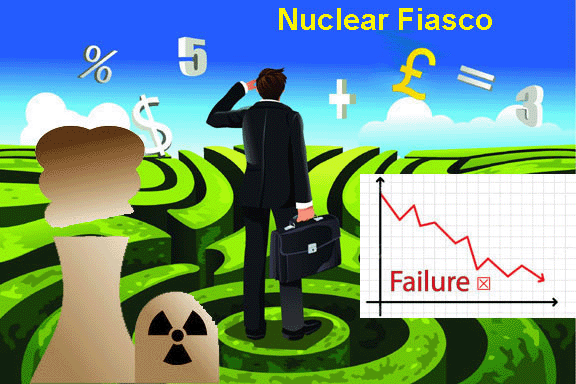
Nuclear power is a failure – former French Environment Minister

Yves Cochet: “The nuclear failure” Former Minister of the Environment. Against the recent projects announced by the President of the Republic for the revival of nuclear power in France, Yves Cochet, former Minister of the Environment, recalls how the history of this energy sector is marked by a
succession of setbacks.
Despite seventy years of nuclear energy research and development, nuclear energy remains a failure caused by a list of setbacks such that one is enough to destroy any prospect of lasting success. Nuclear power today only contributes 5% of global energy supply and 10% of electricity production, this share has been steadily declining for twenty-five years, while the share of renewable electricity has now surpassed that of nuclear power.
Le Monde 4th Dec 2021
https://www.lemonde.fr/idees/article/2021/12/04/yves-cochet-l-echec-du-nucleaire_6104683_3232.html
France joins the Small Nuclear Reactor frenzy, bringing out its odd version ”NAAREA”

French engineering group Assystem has signed a cooperation agreement with
newly-created French micro-reactor developer Naarea to build its
ultra-compact eXtra Small Modular Reactor (XSMR). Dassault Systèmes is to
supply Naarea with a cloud-based platform on which to virtually design the
1 to 40 MW molten salt reactor. Naarea expects the first units of XSMR to
be produced by 2030.
The company says its ultra-compact molten salt reactor uses “the untapped potential of used radioactive materials, and thorium, unused mining waste.” Naarea noted, “The current stocks of these two wastes will supply the energy needs of humanity for thousands of years, and reconcile humanity with its future.”
World Nuclear News 3rd Dec 2021
https://www.world-nuclear-news.org/Articles/Assystem-to-cooperate-with-Naarea-on-micro-reactor
The nuclear fuel chain – uranium mining to radioactive waste problem- European Commission to decide if it is ”green” and”sustainable”
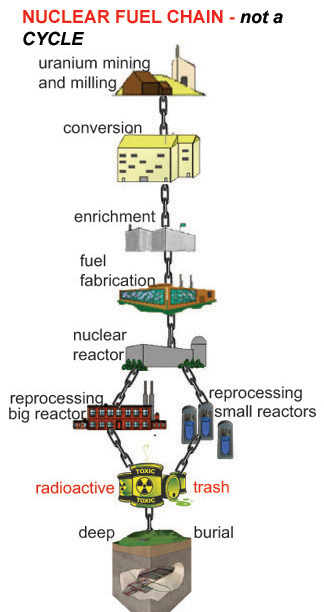
The European Commission is preparing to settle whether nuclear and natural gas are “green” investments in an update to the EU’s sustainable finance taxonomy expected next week, according to several sources. The list will clarify whether nuclear energy generation, waste disposal or fuel supply can be classified as sustainable activities for investors, EU energy commissioner Kadri Simson told a nuclear conference in Paris on Tuesday. French economy minister Bruno Le Maire told the same conference he was convinced France could persuade Germany – which is phasing out its nuclear generation — to agree to including nuclear in the list. Montel 30th Nov 2021 https://www.montelnews.com/news/1277923/ec-set-to-clarify-nuclear-gas-green-status-next-week |
Why is so little attention paid to the fastest, cheapest, most effective action on climate – ENERGY SAVING?

Look how Fukushima inspired energy saving https://www.ft.com/content/9104a39f-d828-4489-bf4b-5121a5d95052 Andrew Fraser, 16 Nov 21 London SW19, UK
Gideon Rachman (Opinion, November 16) was right to spell out the political as well as technical difficulties involved in delivering the COP commitment to net zero. However, to suggest that “geoengineering” solutions some of which were reminiscent of Jonathan Swift’s people of Balnibarbi (who sought to extract sunbeams from cucumbers) may provide the answers is surely to ignore more practical and affordable steps.
While there are undoubtedly exciting technical breakthroughs connected to renewables and the possibilities of “green” hydrogen, it is surprising that he and others have made so little mention of the capacity of governments to drive energy conservation programmes. Above all, these can make an immediate contribution while—literally—saving significant sums.
A good example came in Japan when — post the Fukushima disasters — a National setsuden (energy saving) campaign reduced consumption by over 20 per cent almost immediately. This involved completely sensible measures such as reducing the number of lifts operating in tall buildings, reducing air conditioning and allowing offices to operate at slightly higher temperatures, and switching off shop lighting and neon advertising after stores had closed.
Why can’t the government lead a similar drive? The Heath government ran a successful advertising campaign during the three-day week in 1974 built around the slogan “SOS Switch Off Something, Now!” If the climate emergency is as serious as scientists all assert, the same urgency is needed on the demand as well as the supply side.
This means we must seek to drive behavioural change alongside sensible conservation policies such as encouragement for home insulation.
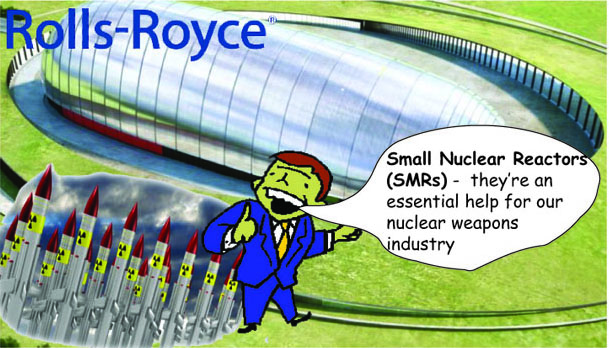
UK government secretive about its Net Zero strategy, especially on tax-payer funded projects like small nuclear power plants.
UK refuses to release document showing Net Zero Strategy CO2 savings, New Scientist, 1 December 2021, By Adam Vaughan
The UK government Department for Business, Energy and Industrial Strategy (BEIS) has turned down a freedom of information request that would allow independent scrutiny of its plan for net-zero greenhouse gas emissions.
The UK government has refused a freedom of information request to release a spreadsheet showing how much its landmark Net Zero Strategy will cut carbon emissions for individual measures, such as backing a new nuclear power station and fitting new electric car chargers.
Withholding the document smacks of “secrecy and subterfuge” and prevents the public from being able to interrogate the estimated impacts of the measures, says Ed Matthew at climate change think tank E3G.
The publication of the government’s Net Zero Strategy on 19 October was a key moment ahead of the COP26 climate summit, laying out in detail how the UK plans to reach its 2050 commitment to net-zero greenhouse gas emissions in the coming years.
Previous government blueprints for decarbonisation, such as the 2020 10-point green plan and 2017 clean growth strategy, have spelled out estimates of exactly how much individual policies will cut emissions. But the Net Zero Strategy failed to provide any such breakdown, which observers said showed a lack of transparency that hampered independent scrutiny.
Government officials conceded that there was a spreadsheet containing all the figures, but said they wouldn’t release it. Now, the Department for Business, Energy and Industrial Strategy (BEIS) has refused a freedom of information request by New Scientist to publish the document. It declined the request on the grounds that it involves the disclosure of internal communications…………….
The strategy does show top-level estimates of how much emissions will change for different sectors, such as power, buildings and farming, between now and 2050. But it doesn’t break down individual measures, including backing new hydrogen production or developing new small nuclear plants, both of which will be supported by hundreds of millions of pounds in public funding.
“Ministers are behaving like a shady dealer asking customers to buy a product without seeing it first,” says John Sauven at Greenpeace UK. He is calling on BEIS to publish the spreadsheet: “The best thing would be for the government to release the numbers behind the plan and allow experts to kick the tyres on it”.
The document is likely to include estimates of how extensively various technologies will be employed and their impacts on greenhouse gas emissions in the UK. There may be a mismatch between what the government has committed to publicly, such as a Conservative party manifesto pledge to quadruple offshore wind capacity by 2030, and the estimates that are being withheld, for example………..
New Scientist has appealed the decision not to publish the document. https://www.newscientist.com/article/2299318-uk-refuses-to-release-document-showing-net-zero-strategy-co2-savings/#ixzz7Drfyfmii
Global heating brings easier Arctic passage for Russia’s floating nuclear power plant to open up Arctic for more fossil fuel mining, more global heating.

World’s first floating nuclear power plant fuels Russia’s Arctic ambitions Ft.com Remote Siberian port lies at centre of plans to open up shipping and reach valuable resources © Nastassia Astrasheuskaya/FT | The Akademik Lomonosov nuclear power plant Share on twitter (opens new window) Share on facebook (opens new window) Share on linkedin (opens new window) Save Nastassia Astrasheuskaya in Pevek YESTERDAY
Moored off the small Arctic town of Pevek is the Akademik Lomonosov — the world’s first floating nuclear power plant and a sign of how President Vladimir Putin’s ambitions for Russia’s far east are taking shape. This port on the northern coast of Siberia was once notorious as a Soviet gulag. These days it is part of Moscow’s plan to open up a major shipping lane through the Arctic and bring natural resources within easier reach. Pevek’s harbour is only ice-free for four months a year but is intended to become a hub for commercial shipping on the so-called Northern Sea Route as climate change gradually eases the passage through the Arctic. And the power provided by the Akademik Lomonosov is intended to help Pevek become a gateway to Chukotka, a region close to Alaska and rich in gold, silver, copper, lithium and other metals…………
Few in Pevek seem concerned by the nuclear reactor in the harbour. “Fear? We have none. Perhaps Russians are not afraid of anything any more. We have seen and lived through everything. We have to be optimistic,” said Igor Ranav, a locally born businessman. “We were told the plant is made with the latest technology and it is safe, and I hope so.”
Development of the NSR is in the hands of Rosatom, the state nuclear corporation. As well as commissioning the Akademik Lomonosov, Rosatom is also in charge of nuclear-powered icebreakers that the company expects will help to open up year-round Arctic navigation by the middle of the decade. …………
Developing Chukotka along with the rest of the Arctic has long been a goal for Putin and Russia, which this week is hosting a plenary meeting of the Arctic Council, where the eight countries of the region are represented. “Russia should expand through the Arctic, as this is where it has its main mineral resources,” Putin said in 2017, when Russia first produced liquefied natural gas in the Arctic and exported it via the NSR. ……………
By mid-century, the Arctic and Antarctic Research Institut expects ice levels to lose another two-thirds in the summer, and to halve in winter. The warming ocean is expected to help cut shipment cost. Less ice means fewer icebreakers and faster journeys.
The warming ocean is expected to help cut shipment cost. Less ice means fewer icebreakers and faster journeys…………….. https://www.ft.com/content/f5d25126-94fc-41fc-bc35-341df0560f4d
COP 26 agreement that energy efficiency investments needed for at least half of the investments needed to stall global heating.

The formal Pact, agreed at COP26, explicitly calls upon all governments to accelerate the adoption of policies “rapidly scaling up … energy efficiency measures”. This complements the International Energy Agency’s conclusions that around half the investments needed to deliver net zero by 2050 will need to be achieved via improved energy efficiency.
Andrew Warren examines the publication of the UK Government’s long-postponed “Heat and
Buildings Strategy”. He says the mantra of fabric first seems to have disappeared. He concludes that the strategy proffers no serious strategy at all to improve the energy performance of (in particular) the English building stock. Given the UK’s hosting of COP26, this dereliction of ambition will need to be rectified by no later than COP 27 next November in Egypt.
Energy in Buildings & Industry magazine (not available yet) 28th Nov 2021
At the Global Alliance of Leaders for Nuclear Security and Nuclear-Weapons-Free World (GAL) meeting, Nursultan Nazarbayev proposes Global Forum on Nuclear Nonproliferation and Disarmament

Nazarbayev proposed to launch the Global Forum on Nuclear Nonproliferation and Disarmamenthttps://www.prnewswire.com/news-releases/nazarbayev-proposed-to-launch-the-global-forum-on-nuclear-nonproliferation-and-disarmament-301433017.html
Astana Club , Nov 29, 2021, NUR-SULTAN, Kazakhstan, Nov. 29, 2021 /PRNewswire/ — The Global Alliance of Leaders for Nuclear Security and Nuclear-Weapons-Free World (GAL) was held on the platform of the VI meeting of the Astana Club in the capital of Kazakhstan.
Addressing the members of the GAL, Nursultan Nazarbayev noted that negotiations on nuclear strategic stability on inter-state level are facing a stalemate, and there is a strong need for an alternative form of dialogue on this issue.
To break this deadlock, Mr. Nazarbayev proposed to set up the Global Forum on Nuclear Nonproliferation and Disarmament in the capital of Kazakhstan.
Forum should bring together all key international NGOs and world moral authorities in the anti-nuclear field to forge a unified global agenda.
In his statement Nazarbayev also called on the world community to develop a step-by-step Plan for a comprehensive reduction of strategic offensive arms with the participation of all nuclear states under the auspices of the UN.
Nazarbayev expressed confidence that the GAL can become the central platform and driving force in the development of this document.
Former UN Secretary-General Ban Ki-moon also addressed the Alliance members with the support of the Nazarbayev’s initiative and noted that without the elimination of the nuclear threat, the world community will never be able to guarantee its security.
The address of the former President of the USSR, Nobel Peace Prize laureate Mikhail Gorbachev to Nursultan Nazarbayev and members of the Alliance became a significant moment at the GAL session.
Mr. Gorbachev expressed his full support for the initiative of the First President of Kazakhstan to establish GAL, noting that “there can be no other final goal than a world without nuclear weapons.”
He also noted that the meeting of Joe Biden and Vladimir Putin in June this year in Geneva marked a positive trend. According to Gorbachev, it is extremely important that the meeting of two presidents reiterated the idea that “there will be no winners in a nuclear war,” which was first voiced in 1985 at his meeting with US President Ronald Reagan.
The meeting of GAL was also attended by the leaders of the global anti-nuclear movement such as Nobel Peace Prize laureates Mohamed ElBaradei and ICAN Executive Director, Beatrice Fihn, as well as former UN High Representative for Disarmament Affairs and UN Under-Secretary-General Angela Kane, and many others.
All the meeting participants unanimously acknowledged that Kazakhstan, which voluntarily renounced the world’s fourth largest nuclear military arsenal of 1,200 atomic warheads in 1990s, has the full moral right to undertake such global anti-nuclear initiatives.
This year’s GAL meeting refers to the Doomsday Clock, the symbol of likelihood of nuclear war – One Minute to Midnight: Time for Action for the Nuclear Dialogue. This is because at the beginning of 2021, the Doomsday Clock moved the closest it has ever been in its history since 1947: 100 seconds to midnight.
Nursultan Nazarbayev.
GAL’s mission is to provide impetus to the anti-nuclear agenda through the joint efforts of the leaders of major international NGOs, well-known politicians, and world moral authorities in the anti-nuclear field.
In 2020, GAL’s Open Call to world leaders to demand the need for strengthening joint efforts on nuclear safety, non-proliferation and disarmament was registered as an official document of the UN and the IAEA.
To date, the GAL is supported by over seventy prominent international figures, including politicians, experts, and Nobel Peace Prize laureates..
UK and Israel pledge to stop Iran gaining nuclear weapons
UK and Israel pledge to stop Iran gaining nuclear weapons
Israeli FM Yair Lapid visits London and Paris to discuss Iran, as talks on the 2015 nuclear deal restart in Vienna. Aljazeera, 29 Nov 21,
The United Kingdom and Israel will “work night and day” in preventing Iran from becoming a nuclear power, the foreign ministers of the two countries wrote in a joint article.
“The clock is ticking, which heightens the need for close cooperation with our partners and friends to thwart Tehran’s ambitions,” the UK’s Liz Truss and her Israeli counterpart Yair Lapid wrote in The Telegraph newspaper on Sunday.
Lapid arrived in London on Sunday for a two-day trip to the UK and France, a day before talks on Iran’s nuclear programme restart in Vienna.
Israeli Prime Minister Naftali Bennett said earlier in the day that his country was “very worried” that world powers will remove sanctions on Iran in exchange for insufficient caps on its nuclear programme, as negotiators convene in Vienna on Monday in a last-ditch effort to salvage a nuclear deal………………….. https://www.aljazeera.com/news/2021/11/29/uk-and-israel-pledge-to-stop-iran-gaining-nuclear-weapons
Crypto currency mining is rampant, so Kazakhstan looks to nuclear energy, despite its dreadful history there.
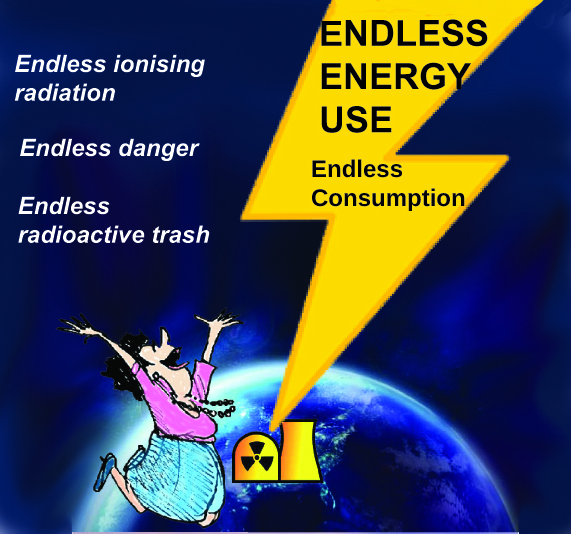
Kazakhstan is now home to 50 registered and an unknown number of unregistered crypto mining companies. The decision to build new nuclear power plants is a serious one for a country that suffered severe nuclear fallout from weapons testing during the Soviet occupation. Kazakhstan’s last nuclear power plant closed in 1999.
Bitcoin mining power crunch: Kazakhstan looks toward nuclear solution, CoinTelegraph, 25 Nov 21
The country saw a great influx of miners this year, but it might have to sacrifice the immense tax revenue from Bitcoin miners if power grid issues are not resolved.
–The exodus of Bitcoin miners from China into Kazakhstan has contributed to an energy crunch that the central Asian country’s president has proposed solving with nuclear energy.
Kazakhstan’s Ministry of Energy has attributed the 8% increase in domestic electricity consumption throughout 2021 to Bitcoin miners. The country received at least 87,849 Bitcoin mining machines from Chinese companies so far this year, following China’s crackdown on crypto mining, according to data from the Financial Times.
The substantial increase in demand has led to a deficit in the domestic power supply and contributed to unreliable electricity services, according to the Kazakhstan Electricity Grid Operating Company. President Tokayev told bankers at a Friday meeting that he thinks building a nuclear power plant will help ease the stress on his country’s electrical infrastructure:………………
Kazakhstan is now home to 50 registered and an unknown number of unregistered crypto mining companies. The decision to build new nuclear power plants is a serious one for a country that suffered severe nuclear fallout from weapons testing during the Soviet occupation. Kazakhstan’s last nuclear power plant closed in 1999……..https://cointelegraph.com/news/bitcoin-mining-power-crunch-kazakhstan-looks-toward-nuclear-solution
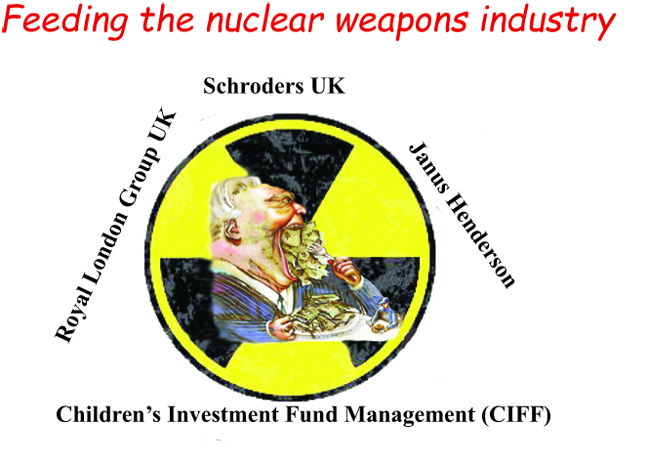
26 UK investment funds pouring money into nuclear weapons companies: some have links to UK government.
“It is unsurprising that the same financial institutions who continue to pour funding into companies like BAE Systems also have close links with senior Conservative party members and is yet another example of the cosy relationship between the arms industry and the UK government,”
The Ferret, November 28, 2021 Twenty-six financial firms in London have been accused of funding a “new nuclear arms race” including investment funds with links to the UK Government, The Ferret can reveal.
The Ferret found that 26 were based in London and six have links to the Conservative Party, which plans to increase Britain’s nuclear weapons arsenal.
They include Schroders UK which holds shares in the arms giant, BAE Systems. Schroders chair is Lord Geidt, who was an advisor to BAE Systems until April this year. He is now an advisor to Prime Minister Boris Johnson, whose plan to produce more nuclear weapons has been condemned by peace organisations.
Netherlands-based peace group, PAX, produced the study with the International Campaign to Abolish Nuclear Weapons (ICAN). Their report warns that financial institutions continuing to invest in companies involved with the nuclear weapons industry could face “regulatory risks” because of the Treaty on the Prohibition of Nuclear Weapons, which came into force in January 2021.
The treaty – which the UK has not ratified – bans nuclear weapons and has been signed by 86 states so far.
The UK Government — which claims it is “committed to the long-term goal of a world without nuclear weapons” — said in March it would lift the cap on its nuclear arsenal by 40 per cent, from 180 to 260 warheads. In a statement in November the government claimed it had “played a leading role by pioneering work in nuclear disarmament”.
Perilous Profiteering says that Schroders UK had investments in 2020 worth $125.3 million (£93.97m) in BAE Systems which is building new Dreadnought submarines that will be armed with nuclear missiles. The company also provides logistics support for the US Trident and Minuteman missiles. BAE Systems stressed that it does not make nuclear warheads.
The report also names Royal London Group UK which had shares in 2020 worth $98.6m (£74m) in BAE Systems. In June the insurance company appointed Ruth Davidson, former leader of the Scottish Tories , as a non-executive director. Davidson is now a peer.
Others with links to the Tories include the Children’s Investment Fund Management (CIFF) which has shares in Safran, a French firm. Safran owns 50 per cent of ArianeGroup which has contracts for French nuclear weapon production.
Emma Cockburn, Scotland co-ordinator for Campaign Against Arms Trade
CIFF’s investment assets are managed by TCI Fund Management, where Rishi Sunak MP, chancellor of the exchequer, was a partner from 2006 to 2009.
Investment firm Janus Henderson, which has shares in General Dynamics, L3 Harris and Leidos, gave the Tories £3,500 in 2018, a payment which was registered in the House of Commons as required. General Dynamics, L3 Harris and Leidos all operate within the nuclear sector, says the new report.
According to the new report, the entry into force of the Treaty on the Prohibition of Nuclear Weapons in January 2021, is an “historic shift” in the way the world “deals with nuclear weapons”. It points out that while nuclear weapons are controlled by governments, their production is often contracted to private companies. “They (nuclear weapons) are now comprehensively outlawed, as is any assistance with producing, manufacturing or developing them,” the report says.
“Financial institutions that continue investing in companies building nuclear weapons face regulatory risks as more countries join the treaty. They also face an increased reputational risk as clients learn of their support for weapons of mass destruction and terminate their relationships.”
The report also reveals that 338 institutions have financing or investment relationships with the 25 nuclear weapon producing companies, down from 390 the previous year – a fall of 52, which the authors welcomed……….
Other critics of the nuclear weapons industry include Emma Cockburn, Scotland co-ordinator for Campaign Against Arms Trade (CAAT). She said the report provides a “damning insight to the endless billions available for the nuclear and arms manufacturers.”
“It is unsurprising that the same financial institutions who continue to pour funding into companies like BAE Systems also have close links with senior Conservative party members and is yet another example of the cosy relationship between the arms industry and the UK government,” she added……………………….. https://theferret.scot/revealed-27-london-companies-funding-nuclear/
Energy consumers are likely to spend over £1000 each to complete Sizewell C Nuclear …..and then pay a high price for the electricity it produces.
The Government’s new nuclear power construction financing mechanism the so-called ‘Regulatory Asset Base’ (RAB) is likely to cost energy consumers an average of well over £1000 each added onto their electricity bills.
On top of that energy consumers will have carry on paying on top of this for an as-yet undecided amount for each kWh generated by Sizewell C.
According to EDF planning figures the cost of Sizewell C will be £20 billion. Experience suggests that there is little faith to be placed inEDF’s claims. For example, the actual cost of the Flamanville nuclearpower plant being built by EDF (the same EPR model) has cost upwards of 5 times as much as their original estimate.
So we can probably expect a bill of at least £30 billion to be paid by consumers through their electricity
bills. That is because the RAB mechanism will ensure that consumers pay the cost overruns, which are certain to occur when building these nuclear power plant. Given that there are around 26 million domestic electricity consumerbills to be paid in the UK, this means each consumer will be paying over
£1000 each to build the power plant.
100% Renewables 27th Nov 2021
Protest against plan for nuclear waste dump in West Cumbria, close to National Park
NEW NUCLEAR DUMP FOR HIGHER ACTIVITY WASTES AT DRIGG LOW LEVEL WASTE REPOSITORY? NIREX REBRANDED? From Lakes Against Nuclear Dump to the Lake District National Park Authority. 28 Nov 21, A letter of alarm regarding plans for an Intermediate Level Nuclear Waste Dump for the UK’s Low Level Waste Repository at the village of Drigg. The UKs LLWR is 250 metres from the National Park Boundary at the nearest point. The following letter has been sent to local and national media and mainstream NGOs have been alerted.
Dear Member of the Lake District National Park Authority,
Congratulations on the 70th anniversary of the Lake District National Park. In the original Lake Counties is another 70th anniversary. The Windscale Piles. Which from 1951 produced plutonium for Britain to make its own atomic and hydrogen bombs until the Windscale Fire of 1957. Unfortunately lessons were not learnt. The nuclear experiment continues despite no final solution to the problem of what to do with the escalating wastes from 70 years of military and civil nuclear reactors. Our own view as a nuclear safety group is that the wastes should not be buried out of sight and out of mind but should be closely monitored and repackaged when necessary.
NIREX REBORN AT DRIGG? – Intermediate Level Nuclear Wastes for Burial approximately 250 metres from the National Park?
We have been alerted by locals in the Drigg area to a plan which is running in tandem with that for a deep Geological Disposal Facility which Government say: “will be available to receive the first waste in the 2040s” However the plan for Near Surface Disposal (10s of metres below ground) “could be available within the next 10 years.” This plan, for which the Low Level Radioactive Waste Repository at Drigg is under active consideration, is for the disposal/dumping of Intermediate Level Wastes of the type that were rejected by the NIREX inquiry for deep GDF disposal at Longlands Farm, Gosforth in 1997. Exploratory boreholes have already been drilled at Drigg for the Near Surface Disposal of Intermediate Level Nuclear Wastes, presumably under “permitted development.”
Just like the early days of the Windscale Piles this plan has been put in motion under the radar of public attention. There has not been any debate or vote at Local, Borough or County Council level nor, we assume, any discussion by the Lake District National Park despite the Low Level Waste Repository being only 250 metres from the Lake District National Park boundary. Intermediate Level Nuclear Wastes, according to the Nuclear Decommissioning Authority, “exceeds the upper boundaries for Low Level Waste but does not generate a significant amount of heat. ..The major components of ILW are nuclear reactor components, graphite from reactor cores and sludges from the treatment of radioactive liquid effluents.”
The NIREX dump entrance proposal for Intermediate Level Wastes was rejected in the 1990s because the nuclear industry had no idea how much and how fast the planned dump would leak. They still have no idea. Furthermore for a shallow dump the leaks would be even faster…………
The fundamental conclusion of the expert Assessor and myself was that the Proposed Repository Zone had been chosen for these studies in an arbitrary manner, without conforming to internationally agreed, geological criteria
Earlier in a letter to “The Guardian” of June 28,’07 the NIREX Inquiry Inspector had stated : “The relevant geology in west Cumbria is apparently now claimed to be ‘stable, although imperfect’.…the imperfection consists of simply failing to meet the internationally agreed criteria on the suitability of rocks for nuclear waste deposit. The site should be in a region of low groundwater flow, and the geology should be readily characterisable and predictable, whereas the rocks there are actually of a complex volcanic nature, with significant faulting. Also, the industry was relying on an overlying layer of sedimentary strata to dilute and disperse any groundwater leakage, when the international criteria require such a layer to act instead as a barrier…The site is not suitable and investigations should be moved elsewhere…”.
And: “The site selection process was flawed, not treating safety as the most important factor, and irrationally affected by a strong desire to locate close to Sellafield.”
https://www.theguardian.com/world/2007/jun/28/nuclear.uk
The latest process to deliver a GDF (with Cumbria STILL in the frame), Radioactive Waste Management, is now in partnership with the LLWR at Drigg. These bodies along with the Nuclear Decommissioning Authority are all advised by the Committee on Radioactive Waste Management which is in turn taking “invaluable” advice on construction and delivery of deep (GDF) and not so deep (NSD) dumping/disposal from West Cumbria Mining’s CEO Mark Kirkbride. Kirkbride compiled CoRWMs Annual Report No 3724 which details the push for Near Surface Disposal: “advice in the last year have been in relation to the concept of Near Surface Disposal (NSD) for intermediate level waste which is being explored by NDA as a potential solution for the disposal of specific intermediate level waste materials, reducing the volume of certain elements of the inventory into a GDF.
The Lake District National Park Authority surely cannot ignore this. If Intermediate and heat generating High Level nuclear waste is brushed under the Lake District fringes and abandoned, then the World’s Nuclear Heritage Site will soon become the World’s Nuclear Sacrifice Zone. This could happen within a decade for the Intermediate Level Wastes at Drigg. Please protect the Lake District and its fringes, tomorrow is too late to say “This Far and No Further.”
yours sincerely
Marianne Birkby
Lakes Against Nuclear Dump – a Radiation Free Lakeland campaign
https://www.lakesagainstnucleardump.com/ https://www.lakesagainstnucleardump.com/post/new-nuclear-dump-for-higher-activity-wastes-at-drigg-low-level-waste-repository-nirex-rebranded
The “brigands” regroup in Basilicata

Italians reunite in the face of a renewed radioactive waste dump threat
The “brigands” regroup in Basilicata — Beyond Nuclear International 28 Nov 21,
”………………………………………… between November 13 and 27, 2003, just weeks before we arrived. An unprecedented and dramatic 15 days of protest had unfolded in Scanzano Jonico, culminating in the defeat of a plan by the Italian government, then led by Silvio Berlusconi, to dump all of Italy’s high-level radioactive waste at a single site at Terza Cavone, a few kilometers from Scanzano, in salt rock at a site just 200 meters from the shoreline.
The dump decision had been taken at night, without local consultation, the news deliberately buried in the papers, eclipsed by a headline-garnering suicide bombing that had killed 18 Italian service members at the Nasiriyah Carabinieri barracks in Iraq during that ill-waged war.
But the Lucani noticed the announcement right away. The news struck “like a lightning bolt” Tonino Colucci of the local World Wildlife Fund chapter told me later as we walked into that surprise press conference.
Before the ink was even dry, they had set up a base camp at Terza Cavone — where we were now. They had rallied people from all walks of life to protest, occupy stations, and block highways. The whole region declared itself a nuclear-free zone. Berlusconi’s own members of parliament in the area opposed the deal. By November 23, the ranks of protesters had swelled to 100,000. After fifteen days, the radioactive waste dump was canceled.
The protest garnered widespread coverage, including in the New York Times, and even spawned academic papers, one such describing the remarkable victory as having “cut across lines of locality, age, social class and political affiliation, mobilizing the populace with various symbols, including references to brigandage, postwar struggles for land, and the Madonna of Loreto.” I wrote up my own experiences in The Bulletin of the Atomic Scientists.
Along with the expected objections — the unsuitability of the site so close to the sea; the damage to agriculture and the tourism trade —outrage was also expressed at the desecration of an area so steeped in ancient history. Pythagoras had fled to Basilicata from Greece. He made his table here. He died at Metaponto, just 16 kilometers from the proposed radioactive waste dump site. It was unthinkable to build a nuclear waste dump in such a venerable place!
So here we were at Terza Cavone having a press conference even though the victory had already been won. The site remained occupied. Passions still ran high (encapsulated later as they broke into brigand songs around what was now a roaring camp fire). There was plenty to talk about; plenty still to learn. But I learned more that night from listening — to farmers will the precious dirt of Basilicata still beneath their finger-nails; from union representatives; from mothers and vintners — than talking.
And that vigilance persists today as, once again, the Italian government has fingered Basilicata as a place “ideally suited” to a high-level radioactive waste dump. The protesters haven’t gone away, remaining on guard against just such a day when they might once again be targeted.
Only this time, Basilicata is not alone.
The news first broke in January 2021, that Sogin — the Italian state-owned company responsible for reactor decommissioning and radioactive waste management —had released a map identifying 67 potential sites in five zones that it considered suitable for a high-level radioactive waste repository. The selected sites included 17 in Basilicata and neighboring Puglia. Fifty more, in Piedmont, Tuscany-Lazio, Sardinia and Sicily, comprised the rest.
Italy’s high-level radioactive wastes are the product of just four now closed commercial reactors, one of which was already shut down when a 1987 national referendum, just a year after the Chernobyl nuclear disaster, recorded a stunning vote of more than 80% of Italians opposed to the continued use of nuclear power. (With bafflingly daft timing, a 2011 Berlusconi government ran the referendum again three months after the Fukushima nuclear disaster in March. This time, 93% of Italians said they opposed a nuclear re-start.)
Italy’s radioactive waste is currently stored in about 20 temporary sites, none of which have been deemed suitable as final repositories. Reports on the inspections of the 67 sites identified by Sogin are due in December. A new shortlist of sites is expected in January 2022.
The Lucani, still organized under the mantel they established in 2003, Scanziamo le Scorie — which loosely translates as ‘we reject the wastes’ — are hoping to reignite the same momentum that brought them victory the first time. They participated in the National Seminar carried out by Sogin between September 7 and November 24 this year, and have prepared their own comments (in Italian) on the so-called criteria for suitable sites.
So far, the Sogin proposal has been met with vehement rejection. A spokesperson from Sardinia called it “an act of government arrogance, yet another outrage”. Puglia signaled its “firm and clear opposition”.
As Scanziamo le Scorie’s spokesperson, Pasquale Stigliani — who was there in 2003 — recently wrote to me, “the nightmare is back”. But, he added, “the mobilization continues!” https://beyondnuclearinternational.org/2021/11/28/the-brigands-regroup-in-basilicata/
-
Archives
- October 2026 (112)
- September 2026 (339)
- August 2026 (330)
- July 2026 (355)
- June 2026 (287)
- May 2026 (306)
- April 2026 (356)
- March 2026 (251)
- February 2026 (267)
- January 2026 (308)
- December 2025 (358)
- November 2025 (359)
-
Categories
- 1
- 1 NUCLEAR ISSUES
- business and costs
- climate change
- culture and arts
- ENERGY
- environment
- health
- history
- indigenous issues
- Legal
- marketing of nuclear
- media
- opposition to nuclear
- PERSONAL STORIES
- politics
- politics international
- Religion and ethics
- safety
- secrets,lies and civil liberties
- spinbuster
- technology
- Uranium
- wastes
- weapons and war
- Women
- 2 WORLD
- ACTION
- AFRICA
- Atrocities
- AUSTRALIA
- Christina's notes
- Christina's themes
- culture and arts
- Events
- Fuk 2022
- Fuk 2023
- Fukushima 2017
- Fukushima 2018
- fukushima 2019
- Fukushima 2020
- Fukushima 2021
- general
- global warming
- Humour (God we need it)
- Nuclear
- RARE EARTHS
- Reference
- resources – print
- Resources -audiovicual
- Weekly Newsletter
- World
- World Nuclear
- YouTube
-
RSS
Entries RSS
Comments RSS

