European Taxonomy – more like Fakeonomy – now including coal and nuclear

EU includes gas and nuclear in guidebook for ‘green’ investments, Commission’s move widely criticised as undermining efforts to keep global heating below 1.5Cm Guardian
Jennifer Rankin in Brussels, Thu 3 Feb 2022 The European Commission has been accused of undermining its climate goals after it defied critics by pushing ahead with plans to include gas and nuclear in an EU guidebook for “green” investments.
Gas and nuclear were deemed bridge technologies to meet the EU’s target of net zero emissions by 2050, in long-awaited proposals on the EU’s “taxonomy for environmentally sustainable economic activities”, which were published on Wednesday.
“The reason we are including gas and nuclear in the way we are doing it is because we firmly believe that this recognises the need for these energy sources in transition,” the EU commissioner for financial services, Mairead McGuinness, told reporters.
Critics said including gas and nuclear in a guide intended to prevent greenwashing jeopardised the EU’s climate goals and hopes of keeping global heating below 1.5C.
“The European Commission is significantly undermining the EU’s credibility as a climate actor,” Bas Eickhout, a Dutch Green MEP and vice-chair of the European parliament’s environment committee, said. “At the UN climate summit in Glasgow, small steps were taken towards phasing out fossil fuels. Yet, unfortunately, the commission is already turning back the clock and leaving the door open to the gas industry.”
Laurence Tubiana, the chief executive of the European Climate Foundation and an architect of the landmark 2015 Paris climate agreement, said: “The EU taxonomy was envisioned as a vital tool to align financial flows with the Paris agreement. Instead, Europe is undermining its climate leadership and lowering standards in the EU and beyond. When a gold standard does emerge elsewhere, this taxonomy will be left behind.”
Since the proposals leaked on New Year’s Eve 2021 – fuelling bitter accusations of a lack of transparency – the commission has made minor tweaks that make it easier for gas projects to get in the green guidebook……
The taxonomy – intended to channel billions of private money into climate-friendly investments – is fast becoming one of the biggest controversies of Ursula von der Leyen’s tenure as European Commission president. Last month Greta Thunberg and climate activists slammed the plans as “fake climate action” that flout scientific advice.
In a further sign of anger, campaign group Avaaz staged a mock burial of the taxonomy on a roundabout outside the commission headquarters, with activists wearing face masks of Von der Leyen, Germany’s Olaf Scholz and France’s Emmanuel Macron. France pressured Von der Leyen to grant the stamp of approval for nuclear power, while Germany had lobbied for the inclusion of gas, although Scholz’s coalition government is split on the issue.
“Europe is witnessing our biggest setback yet in our moonshot mission,” said Patricia Martín Díaz of Avaaz. “Labelling fossil gas and nuclear as green is incompatible with the EU’s 2050 climate targets and our hope of keeping 1.5C alive.”……………
Other critics include an expert panel convened by the commission, which said the plans were “not in line” with the original regulation, agreed in July 2020. In its stinging rebuke, the EU platform on sustainable finance – a group that includes industry, NGO and finance experts from EU institutions – said they had doubts about the criteria for gas and nuclear, while “many are deeply concerned about the environmental impacts that may result”………..
The EU taxonomy became law in July 2020, but legislators left important details to be resolved through so-called delegated acts – secondary legislation meant for technical issues that is not subject to the same degree of ministerial and parliamentary oversight.
Critics have accused the commission of abusing the process, by smuggling in the controversial issues of nuclear and gas into the latest delegated act, rather than drafting a separate law.
Only a supermajority of 20 out of 27 EU member states, or a majority of the European parliament’s 705 MEPs can now defeat the plans during a scrutiny period of four to six months that began on Wednesday.
Commission officials played down the threat of a legal challenge from Austria and Luxembourg, describing it as “a very theoretical discussion”. Both countries oppose nuclear power, while Green ministers in the German coalition government have dismissed the plans as greenwashing.
Denmark, Sweden and the Netherlands had urged the commission not to label gas as green, while Germany declared its opposition to nuclear…………
Lisa Fischer, who leads the E3G thinktank’s work on climate neutral energy systems, said gas and nuclear had no place in the taxonomy. “Gas investments are not only harmful to the climate they are also increasingly financially risky. Nuclear makes the EU’s energy transition more costly than it needs to be.”
In a sign of the intense arguments, McGuinness revealed that had been no unanimity among the commission’s top 27 officials; she said an “overwhelming majority” of EU commissioners had backed the plans.
“We were legally obliged to do this,” she said referring back to the initial July 2020 law. Opponents in national capitals, however, say the commission had no obligation to include gas or nuclear. https://www.theguardian.com/environment/2022/feb/02/eu-guidebook-taxonomy-green-investments-gas-nuclear-included
Inclusion of nuclear and gas is ”attempted robbery”

 |
Taxonomy: inclusion of nuclear and gas is “attempted robbery” – Greenpeace https://www.greenpeace.org/eu-unit/issues/climate-energy/46036/taxonomy-nuclear-gas-attempted-robbery/
Taxonomy: inclusion of nuclear and gas is “attempted robbery” – Greenpeace, Greenpeace European Unit 02/02/2022 Brussels, 2 February 2022 – The European Commission today officially presented a controversial plan to label fossil gas and nuclear energy as sustainable under the taxonomy regulation. The plan would incentivise potentially hundreds of billions of euro in private investments to flow away from clean energy like renewables and instead go to nuclear energy and fossil gas, accelerating the climate crisis.
Apart from producing dangerous and unmanageable radioactive waste, nuclear reactors take so long to build that they cannot come online quickly enough to contribute to reaching EU climate targets by 2030, which scientists say is necessary to prevent the worst effects of the climate crisis. Gas is also the single most polluting fuel in the EU, with soaring prices sparking a European energy crisis.
Greenpeace EU sustainable finance campaigner Ariadna Rodrigo said: “I’d like to report an attempted robbery, please. Someone is trying to take billions of euro away from renewables and sink them into technologies that either do nothing to fight the climate crisis, like nuclear, or which actively make the problem worse, like fossil gas. The suspect is at EU Commission HQ and has disguised herself as someone to be taken seriously on the climate and nature crisis.”
“This anti-science plan represents the biggest greenwashing exercise of all time. It makes a mockery of the EU’s claims to global leadership on climate and the environment. The inclusion of gas and nuclear in the taxonomy is increasingly difficult to explain as anything other than a giveaway to two desperate industries with powerful political friends,” added Rodrigo.
The Platform on Sustainable Finance, a body of over 50 experts from business, academia and civil society, which advises the European Commission on its green agenda, said in its official feedback to the plan that the provisions on nuclear energy, especially radioactive waste, violate a key principle of the taxonomy, which aims to ensure that any technologies included “do no significant harm” to the environment. The Institutional Investors Group on Climate Change, whose members represent more than €50 trillion in assets, has also said that the Commission’s proposals on gas would “channel capital towards activities not compatible with the EU’s commitment to climate neutrality by 2050.”
Environmental lawyers at NGO Client Earth have said that the inclusion in the taxonomy of fossil gas would be incompatible with several EU laws, including the 2021 EU Climate Law. Several governments and organisations are reportedly planning legal challenges to the inclusion of gas and nuclear in the taxonomy.
Next steps
The Commission’s plan is set to face an immediate backlash from MEPs, who have been cut out of the process and denied the chance to scrutinise this controversial plan until now.
Greenpeace is calling on MEPs to vote this proposal down. A majority of the Parliament, or 353 MEPs, is required to reject it.
Greenpeace is also calling on all financial institutions in the EU not to categorise nuclear and gas investments as environmentally sustainable, and to be transparent and science-based about their energy and climate investment decisions.
Contacts:
Ariadna Rodrigo – Greenpeace EU sustainable finance campaigner: +32 (0)479 99 69 22, arodrigo@greenpeace.org
Swedish drones shine light on potential threat to nuclear plants, say Nuclear Free Local Authorities (NFLA)

Recent reports of mysterious drones overflying several nuclear power plants in Sweden have illustrated just one of the possible future threats faced by Britain’s reactors that must be addressed, say the UK and Ireland Nuclear Free Local Authorities (NFLA).
In his letter to the Nuclear Decommissioning Authority, NFLA Steering Committee Chair, Councillor David Blackburn, has identified ‘a void (of information) on the preparations in place to deter physical attacks upon nuclear facilities or the theft of nuclear materials from site’, and he has called the absence of such information in the agency’s latest Draft Business Plan for 2022-25 ‘not reassuring’.
In December 2021, the Non-Proliferation Policy Education Centre published a paper outlining the risks posed by military and terrorist strikes on nuclear facilities in the Middle East. Although the dynamic in the UK is not the same, the NFLA wants the NDA to draw from it the relevant lessons about the vulnerability of nuclear plants to strikes by missiles and drones, sophisticated technologies now increasingly available to terrorist groups as well as nation states.
On 18 January, BBC News reported sightings of drones in preceding days over the Forsmark, Ringhals, and Oskarshamn nuclear power plants. The Swedish Police appealed to the public to come forward with information, and the Swedish Security Service, Sapo, launched an investigation into the perpetrators who were suspected of ‘grave unauthorised dealing with secret information’.[i]
These recent developments have prompted the NFLA to call for the NDA to include in its final Business Plan ‘some record of any activity or exercises, or future plans, to address these threats (subject to restrictions on the disclosure of sensitive information on grounds of security)’.
Speaking for the NFLA Steering Committee Chair, Cllr David Blackburn, said:
‘Although the NFLA welcomes the NDA’s stated commitment to participate in exercises to counter cyber attacks, it is worrying that the current draft Business Plan is silent on the preparations that the NDA and its partners has in place to counter any potential physical terrorist attack on a facility, which might be by land, air or sea, or upon nuclear waste in transit, or to prevent the theft of nuclear materials from sites. It is our hope that we can see further detail in the final version.’
Cracks found in Civaux nuclear reactors, both 1 and 2
On 21 October 2021, following ultrasonic checks scheduled during the
second ten-yearly outage of Civaux NPP reactor 1 (1450 MWe reactor), EDF
informed ASN that it had detected indications on welds on the elbows of the
safety injection system piping[2] of the reactor’s main primary system
(see image below).
As Civaux NPP reactor 2 was the only 1450 MWe reactor
not yet to have undergone these types of checks, EDF shut it down in
November 2021 so that they could be carried out ahead of the date initially
scheduled for its second ten-yearly outage.
The checks confirmed the
presence of indications similar to those of reactor 1. On 15 December 2021,
EDF informed ASN that the metallurgical analyses conducted on the parts of
the pipes removed from Civaux NPP reactor 1 had revealed the presence of
cracking resulting from an unexpected stress corrosion phenomenon on the
inner face of the piping, close to the weld bead.
ASN 31st Jan 2022
Sizewell C nuclear project issues have been glossed over
Sizewell C nuclear project issues have been glossed over https://www.theguardian.com/environment/2022/feb/01/sizewell-c-nuclear-project-issues-have-been-glossed-over
Former Labour MP Derek Wyatt points out three critical issues surrounding the government’s £100m investment in EDF’s nuclear power plant
Three critical issues surrounding the future of the Sizewell C project were missing from the recent announcement (Ministers invest £100m in EDF’s £20bn Sizewell C nuclear power station, 27 January). The first is the appalling state of EDF’s finances. This is coupled with shutdowns at its French power stations, using similar technology to Sizewell C. Newer nuclear power stations are not working.
Stop the lies about Ukraine
Nina Beety, Monterey, https://www.montereyherald.com/2022/01/29/letters-to-the-editor-jan-27-2022/
The 2014 deadly U.S. coup d’etat in Ukraine overthrew the democratically elected president, partnering with ultra-nationalists and neoNazis. It cost $5 billion, said Victoria Nuland, now Biden’s Asst Sec of State, put “our man Yats” in power, and initiated a reign of terror. Biden was Obama’s point man there.
Systematic ethnic genocide followed against all who opposed the illegal regime, any Russian-speaking Ukrainians, Ukrainian Jews, journalists, officials. People are stalked, imprisoned, tortured, gang-raped, and killed. Hundreds were shot and buried in mass graves, some still alive. Crimea, Donetsk, Lugansk residents are attacked by Kyiv paramilitary and military units flying Nazi insignias, trained and assisted by the U.S. (including the California National Guard) and NATO. Many fled into Russia for safety. Crimea voted to secede and rejoin Russia. All these facts are missing in your false reports.
Like with Iraq, Afghanistan, Libya, Vietnam, the U.S. destroyed Ukraine, — its economy ruined; its people without adequate energy, heat, food; its resources pillaged; its nuclear power plants endangered. Washington did this. It also obtained Russian planes, weapons, and equipment, and has a history and motivation to stage false flags. Don’t Americans care? The U.S.A .is destroying people and countries. Where’s the protest?
Russia calls for USA to remove its nuclear weapons from European countries
Russia proposes US returns American nuclear weapons from NATO countries stateside https://tass.com/politics/1394065, 28 Jan 22,
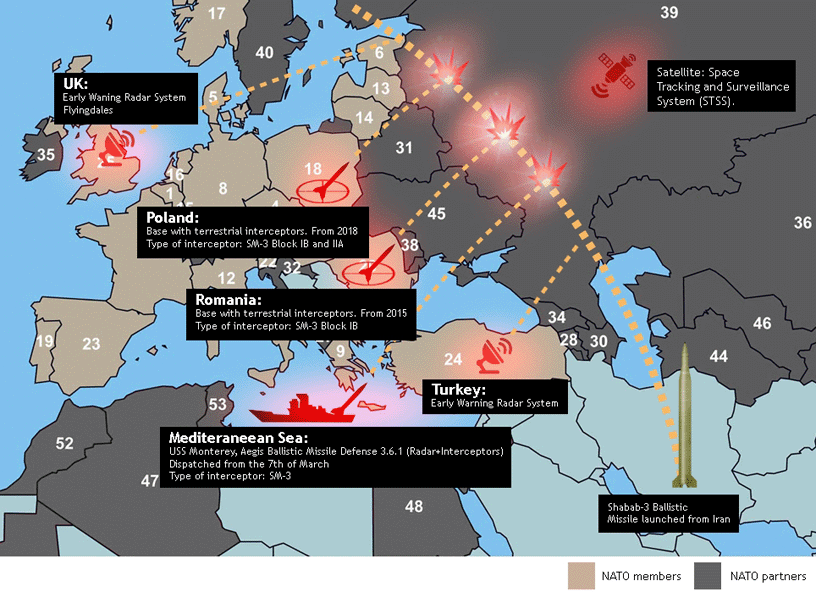
According to Vladimir Yermakov, “currently there are about 200 American nuclear air bombs of the B61 family” in five non-nuclear NATO countries
MOSCOW, January 27. /TASS/. Moscow proposed to Washington to return all American nuclear weapons from NATO countries to US territory in the context of reviewing security guarantees, Director of the Russian Foreign Ministry’s Department for Nonproliferation and Arms Control Vladimir Yermakov said in an interview with TASS.
We insist that NATO’s ‘joint nuclear missions’ should be stopped immediately, all the American nuclear weapons be returned to US national territory and the infrastructure that allows their rapid deployment should be eliminated. This aspect is one of the elements of the package of measures proposed by us to Washington in the context of considering the issues of security guarantees,” he said.
According to the diplomat, “currently there are about 200 American nuclear air bombs of the B61 family” in five non-nuclear NATO countries. Thus, the alliance is capable of rapidly deploying nuclear weapons able to reach strategic targets on Russian territory. “[NATO countries] also retain the infrastructure ensuring rapid deployment of these [nuclear] weapons capable of reaching Russian territory and striking a wide range of targets, including strategic ones,” he pointed out.
On December 17, 2021, the Russian Foreign Ministry published draft agreements between Moscow and Washington on security guarantees and the measures of ensuring the security of Russia and NATO member states. The proposed measures include guarantees that NATO will not advance eastward, including the accession of Ukraine and other countries into the alliance, as well as the non-deployment of serious offensive weapons, including nuclear ones. On January 26, the US and NATO submitted to Russia their written response to Moscow’s proposal on security guarantees.
“Community Partnership” alerted to surveillance and “intimidation” by Radioactive Waste Management —

LETTER to All Council Members of the Community Partnership with RWM
Dear Council Member of the Community Partnership with RWM This information has been sent to local and national press but in case it is not flagged up by media you should be aware that South Lakes MP Tim Farron has described surveillance and “intimidation” by Radioactive Waste Management as “severely concerning.” Opponents of the plan for a Geological Disposal Facility in Cumbria have been placed under surveillance with social media/online conversations/letters monitored and analysed by companies specialising in behavioural science. This has extended to false information being passed to the police about a leading campaigner by Radioactive Waste Management. The police have been informed that the information passed to them by RWM is false.
Following our own investigation, campaigners at Radiation Free Lakeland discovered that Oxfordshire based Radioactive Waste Management, tasked with “Delivery” of a UK Geological Disposal Facility (GDF) have employed three companies, Brandwatch, MHP and Press Data to carry out surveillance. Councillors may be aware that Cumbrian group Radiation Free Lakeland have set up a dedicated volunteer campaign called Lakes Against Nuclear Dump to counter RWM’s remit to Deliver a Geological Disposal Facility for High Level Nuclear Wastes and Near Surface Disposal (at Drigg?) for Intermediate Level Nuclear Wastes.
Information on surveillance from Radioactive Waste Management was asked for by wildlife artist and opponent of nuclear dump plans Marianne Birkby through a Data Subject Access Request. The information is, say campaigners astonishing in its breadth of surveillance, analysis of what has been said in opposition to the deep nuclear dump plans and in discussing RWM actions aimed at discrediting voices opposed to GDF as “scaremongering.”
The extent of surveillance includes correspondence with Cumbria Police and the Civil Nuclear Constabulary. An email was sent by Radioactive Waste Management on 7/27/21 to Cumbria Police saying “The RWM lead [name redacted] has expressed concerns that there could be some local protestors at the event as a well-known local activist Marianne Birkby (Radiation Free Lakelands) has a holiday home nearby.” This says the campaigner is “news to me, I haven’t got a holiday home anywhere! Also I wasn’t even at the event referred to, surely passing false information onto the police is illegal and it feels pretty intimidating.”
Campaigners say that it is frightening that Local Authorities Copeland and Allerdale have now entered into a “Community Partnership” with Radioactive Waste Management which so patently advocates against local communities expressing any dissent to RWM’s remit to Deliver a Geological Disposal Facility.
In a letter to Radiation Free Lakeland, Tim Farron MP states: “I am severely concerned …The police should not be used as a method to harass or intimidate peaceful law-abiding protestors. This surveillance seems wholly unnecessary and is another example of the Government’s growing hostility towards those who would exercise their political freedoms.I am pleased to confirm that I have written to the Minister of State for Energy, Clean Growth and Climate Change and Radioactive Waste Management to ask them to confirm that such surveillance has been authorised and what cause they have to harass my constituents in this manner.”
Yours sincerely
Marianne Birkby, Lakes Against Nuclear Dump a Radiation Free Lakeland campaign
The Nuclear Free Local Authorities (NFLA) of the UK and Ireland call for truly green energy on old nuclear sites
NFLA endorses call for real green energy on former nuclear sites
The Nuclear Free Local Authorities (NFLA) of the UK and Ireland has called for renewable technologies to be used to produce ‘real green energy’ on land formerly occupied by now decommissioned nuclear power plants.
The NFLA was pleased to see the Nuclear Decommissioning Authority (NDA), the agency charged with making safe and clearing closed civil nuclear plants, committing itself in its latest draft Business Plan to being a ‘net (carbon) zero’ business, but disheartened by the lack of detail.
In its response to the consultation on the plan concluded today by the NDA, the NFLA hopes that ‘active consideration can be given to generating onsite power and heat to support decommissioning operations using renewable technologies.
Councillor David Blackburn, Chair of the NFLA Steering Committee, said:
“We are surprised that the NDA has not picked up on the obvious. The land formerly occupied by nuclear power plants, whilst not being so attractive for residential, leisure or office developments, has great potential to be the location for solar farms, wind turbines and ‘green’ hydrogen. Or, where these plants are located by the sea, even to support offshore generation through being a support base for wind farms and tidal schemes. By their nature, nuclear plants are also linked to the electricity grid. Why not use their geographical situation and infrastructure for ‘real green’ energy generation?”
In its draft Business Plan, the NDA has indicated that the following land on each of these redundant power plant sites has now been ‘de-designated’ from nuclear use: Berkeley – 11 hectares; Harwell – 23 hectares; Oldbury – 32 hectares; Winfrith – 10 hectares; and Capenhurst – 17 hectares, but over the next decade all of the UK’s remaining outdated Advanced Gas Cooled reactors will be closed and decommissioning will begin, a process that will take over 100 years.
Councillor Blackburn added: “Clearly NDA operatives will be on-site for a long-time so an investment in micro-generation schemes, such as roof-mounted solar, a solar farm or wind turbines, would pay for itself many fold. Not only would the NDA reap the dividend of generating renewable power to support decommissioning operations, but it would also reduce the agency’s carbon footprint. And as 1,043 hectares is expected to be eventually freed up, there is no reason that the agency could not become a net exporter of renewable energy to the National Grid.”
In its response, the NFLA references a community-owned renewable energy provider which has a 915 KW solar farm on a 1.6 hectare site, and points out that the Oldbury ‘de-designated land’ is 32 hectares, enough to theoretically host twenty such schemes. For more information please contact: Richard Outram, Secretary, NFLA email Richard.outram@manchester.gov.uk / mobile 07583 097793
Swapping one dangerous fossil fuel technology for another dangerous nuclear technology is NOT progress
‘‘To make a relevant contribution to global power generation, up to more than ten thousand new reactors would be required, depending on reactor design.”
Caught between nostalgia and science fiction https://beyondnuclearinternational.org/2022/01/30/caught-between-nostalgia-and-science-fiction/
Swapping one dangerous technology for another isn’t progress. By Linda Pentz Gunter, 30 Jan 22,
It’s starting to sound a lot like a Christmas carol as a growing chorus of voices clamors to stop the European Union from including nuclear power in its “green taxonomy.”
Six countries, five former Japanese prime ministers, four former nuclear regulators, a bunch of French hens (at least 20 protesters), and two heads of Italy’s major energy behemoth, have all spoken out in recent weeks against rebranding dangerous, expensive nuclear power as “sustainable” energy or even a bridge to an all renewable future.
The youth climate movement, Fridays for the Future, have also condemned the potential inclusion of nuclear power in the EU Taxonomy as “greenwashing”, with spokesperson Luisa Neubauer telling Euractiv that Germany “can phase out both coal and nuclear power and enter the renewable age.” Why, she asked, would you “swap one high risk technology, coal, for another high risk technology? And maybe those risks aren’t quite the same, but the risks attached to nuclear energy, people have experienced that.” In addition, the costs for nuclear power, she said are “in a different galaxy” compared to renewables.
Francesco Starace, a nuclear engineer by training and the head of Enel, the Italian multinational energy company, said of nuclear power, “we can’t stay halfway between nostalgia for the past and hope in science fiction”. Enel Green Power head, Salvatore Bernabei, said “we don’t intend to invest in nuclear, obviously.”
Said Starace: “We must act now because the red alert for humanity has gone off and the next ten years will be crucial. There is only one road and it is already marked: electrification, renewables and batteries”.
The five former prime ministers of Japan spoke from direct experience, having lived through the devastation caused by the Fukushima Daiichi nuclear disaster, which began on March 11, 2011, but is still damaging human health and the environment today.
Promoting nuclear power can ruin a country,” wrote Junichiro Koizumi, Morihiro Hosokawa, Naoto Kan, Yukio Hatoyama and Tomiichi Murayama in a statement directed at the EU.
“We have witnessed in Fukushima over the last decade [ ] an indescribable tragedy and contamination on an unprecedented scale,” the prime ministers wrote. “Hundreds of thousands of people have been forced to flee their homes and vast areas of agricultural land have been contaminated. Radioactive water well beyond storage capacity continues to be generated, many children are suffering from thyroid cancer, and massive amounts of the country’s resources and wealth has been lost. We do not wish European countries to make the same mistake.”
The four former nuclear regulators — Dr. Greg Jaczko (US), Prof. Wolfgang Renneberg (Germany), Dr. Bernard Laponche (France) and Dr. Paul Dorfman (UK) — stated categorically that “The central message, repeated again and again, that a new generation of nuclear will be clean, safe, smart and cheap, is fiction.”
Given the urgency of the climate crisis, the four said, using nuclear power to address it was a completely unrealistic proposition. “The reality is nuclear is neither clean, safe or smart; but a very complex technology with the potential to cause significant harm,” they wrote.
They added: “Nuclear isn’t cheap, but extremely costly. Perhaps most importantly nuclear is just not part of any feasible strategy that could counter climate change. To make a relevant contribution to global power generation, up to more than ten thousand new reactors would be required, depending on reactor design.”
Although France is leading the charge — for obviously self-interested reasons — to include nuclear power in the EU Taxonomy, the country is not without its nuclear opponents. The nationwide Réseau sortir du nucléaire and scores of regional groups struggle to get attention, but have staged protests for years. France relies on nuclear power for 70% of its electricity and is also a member of the UN Security Council as a nuclear weapons country, giving it an illusory sense of prestige of which it is reluctant to let go.
Last December, protesters descended on France’s foreign ministry, roundly criticizing French president, Emmanuel Macron’s continued promotion of nuclear power. At the same time, the country was facing electricity shortages due to five French reactor outages.
Even scientists, sometimes the more cautious of species, have spoken out. According to the Financial Times, which viewed the documentation, scientific experts “hired by Brussels to help draw up the sustainable investment rules” have criticized the inclusion of nuclear power, while not going as far as to ask for its removal altogether. However, the experts wrote that “the inclusion of nuclear energy contravenes the principle of ‘do no significant harm’”, the Financial Times said.
Meanwhile, Austria is preparing to take the EU to court if it persists in labeling nuclear power as green. Austria has the support of Spain, Luxembourg and Denmark in calling the consideration of nuclear as a “sustainable” energy source “a step backwards.”
Germany, which is close to phasing out all of its nuclear power plants, has also rejected nuclear as part of the EU Taxonomy while so far failing to oppose the inclusion of gas, again for vested interests.
Linda Pentz Gunter is the international specialist at Beyond Nuclear and writes for and curates Beyond Nuclear International.
U.S. and Russian Threats Over Ukraine—What They’re About

“It’s a noble principle, just not one the United States abides by. The United States has exercised a sphere of influence in its own hemisphere for almost 200 years, since President James Monroe declared that the United States ‘should consider any attempt’ by foreign powers ‘to extend their system to any portion of this hemisphere as dangerous to our peace and safety’.”.
Blinken wants a one-way street where spheres of influence are concerned. The U.S., for him, has the right to wield influence everywhere, while others don’t.
STRIPPING AWAY THE BULLS**T: U.S. and Russian Threats Over Ukraine—What They’re About and Who’s the Aggressor, Covert Action Magazine By Dee Knight – January 25, 2022 Threats and counter-threats flying between Washington and Moscow over Ukraine have caused a flurry of fear and confusion that escalates and expands daily. Is the world on the brink of war? What is it about, who is the aggressor and who is to blame?
The dangerous standoff has lasted for most of a year. Each side accuses the other of threatening war—in a way reminiscent of the Cuban missile crisis of 1962.
During a week of intense diplomatic meetings in three European capitals, which appeared to reach a dead end, President Joe Biden seemed to “blink” midweek, on January 19, telling reporters in Washington he had indicated to Russian President Putin that “we can work out something.”
New York Times senior reporter David Sanger jumped on it: “Mr. President, it sounds like you’re offering some way out here, some off-ramp—an informal assurance that NATO is not going to take in Ukraine… and we would never put nuclear weapons there.” Sanger went on to say Russia “wants us to move all of our nuclear weapons out of Europe and not have troops rotating through the old Soviet bloc.” Biden quickly said “No, there’s not space for that.”
Biden’s blink was a break in the warlike atmosphere that has prevailed endlessly. Katrina van den Heuvel wrote the day before in The Washington Post that “Hotheads [were] having a field day. A White House task force that includes the CIA [was] reportedly contemplating U.S. support for a guerrilla war if Russia seizes Ukraine; Russian hawks talk of a military deployment to Cuba and Venezuela.” Biden had “installed a team of national security managers from the ‘Blob,’ marinated in successive debacles in Iraq, Libya, Syria, Yemen and more.”
Guns and sanctions are the U.S. empire’s preferred options, van den Heuvel said: “with about 800 military bases outside the United States,” the U.S. has “more bases than diplomatic missions. (Russia’s only military bases outside the former Soviet Union are in Syria.)” She added that Secretary of State Blinken and the Blob “talk about a rules-based international order but respect it only if we make the rules, often exempting ourselves from their application.”
Spheres of influence?
“When will the U.S. stop lying to itself about global politics?” asked CUNY Professor Peter Beinart, writing in the New York Times on January 13. He took issue with Secretary of State Antony Blinken, who pontificated last month that “One country does not have the right to dictate the policies of another or to tell that country with whom it may associate; one country does not have the right to exert a sphere of influence. That notion should be relegated to the dustbin of history.”
Beinart commented: “It’s a noble principle, just not one the United States abides by. The United States has exercised a sphere of influence in its own hemisphere for almost 200 years, since President James Monroe declared that the United States ‘should consider any attempt’ by foreign powers ‘to extend their system to any portion of this hemisphere as dangerous to our peace and safety’.”………….
Blinken wants a one-way street where spheres of influence are concerned. The U.S., for him, has the right to wield influence everywhere, while others don’t.
The same day Biden blinked, French President Macron weighed in saying war would be the “most tragic thing of all.” Speaking in the European Union’s capital of Strasbourg, as new interim EU chair, Macron said he hoped to revitalize the four-way “Normandy format” talks between Russia, Germany, France and Ukraine to find a solution to the Ukraine crisis. “It is vital that Europe has its own dialogue with Russia,” Macron said. The EU had no part in the talks last week between Russia, the U.S., NATO and the Organization for Security and Cooperation in Europe (OSCD).
The Normandy format has been a vehicle for implementing the 2015 Minsk agreements designed to end the separatist war in Ukraine’s Donbas region. This solution has already been proposed and accepted in principle, according to Anatol Lieven, who wrote in The Nation that the Minsk II agreement was already adopted by France, Germany, Russia and Ukraine in 2015, and endorsed unanimously by the UN Security Council.
Key elements of the Minsk II deal are full autonomy for Ukraine’s eastern regions in the context of decentralization of power in Ukraine, demilitarization, and restoration of Ukrainian sovereignty. Despite agreement by all parties, political analyst Anatol Lieven says “because of the refusal of Ukrainian governments to implement the solution and refusal of the United States to put pressure on them to do so,” the settlement is a kind of “zombie policy.”
The issue of NATO expansion is another “zombie policy” as the U.S. refuses to acknowledge Russia’s legitimate opposition to it.
After the first of three negotiating sessions between the U.S. and Russia during the week of January 10, Russian Deputy Foreign Minister Sergei Ryabkov had declared it “absolutely mandatory” that Ukraine “never, never, ever” become a NATO member. In response, U.S. Deputy Secretary of State Wendy Sherman said: “we will not allow anyone to slam closed NATO’s open-door policy.”……………………..
US Undersecretary of State Victoria Nuland helped orchestrate the 2014 coup in Kyiv, the Ukrainian capital, that toppled a government friendly to Russia. The new far-rightist government ended language rights for Russian speakers who are the majority in the Ukraine’s eastern provinces. Donetsk and Lugansk voted to separate, as did Crimea. Russia then annexed Crimea, to protect Russian speakers there and secure its Black Sea naval base. Russia provided humanitarian aid and trade to Donetsk and Lugansk, and stationed troops on their eastern border for protection.
“Pro-Democracy Protests” or a Fascist Coup?
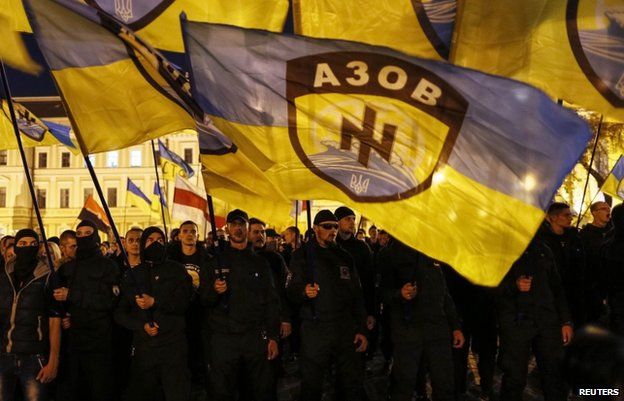
A New York Times report on January 6 said “Russia intervened militarily in Ukraine in 2014 after pro-democracy protests erupted there.” [Emphasis added.] The coup was actually carried out by fascist gangs, according to a May 2, 2018, report in The Nation by Stephen Cohen.
The gangs, including self-declared neo-Nazis, were encouraged by Nuland, Biden and other prominent U.S. politicians. The neo-Nazis were integrated into Ukraine’s official military which, since 2014, has been trained, armed and reorganized by the U.S., Britain, Canada and other NATO countries.
Stephen Cohen wrote that “the pogrom-like burning to death of ethnic Russians and others in Odessa later in 2014 reawakened memories of Nazi extermination squads in Ukraine during World War II.” These horrors have been all but deleted from the American mainstream narrative, despite being well-documented.
Cohen added that “stormtroop-like assaults on gays, Jews, elderly ethnic Russians, and other ‘impure’ citizens are widespread throughout Kyiv-ruled Ukraine, along with torchlight marches reminiscent of those that eventually inflamed Germany in the late 1920s and 1930s… The police and official legal authorities do virtually nothing to prevent these neo-fascist acts or to prosecute them. On the contrary, Kyiv has officially encouraged them by systematically rehabilitating and even memorializing Ukrainian collaborators with Nazi German extermination pogroms and their leaders during World War II, renaming streets in their honor, building monuments to them, rewriting history to glorify them, and more.”
The people of the self-declared people’s republics of Donetsk and Lugansk in eastern Ukraine suffer under a complete economic blockade by Ukraine and its Western allies. Historically known as the Donbass region, eastern Ukraine is a mining and industrial center. Donbass miners played a crucial and heroic role in the defeat of the German invasion of the Soviet Union in World War II. Many Russians revere the Donbass as “the heart of Russia.”
All of Ukraine east of the Dnieper river is predominantly Russian-speaking. U.S. claims of a “Russian invasion” are reminiscent of claims of North Vietnamese invasion of South Vietnam after the artificial separation of Vietnam in 1954. The entire U.S. narrative about Ukraine is a cynical fabrication designed to justify aggression.
Russian Security Proposals
In mid-December Russia took a diplomatic initiative and presented a list of security proposals to the United States. According to the Wall Street Journal, they include ending NATO’s expansion further eastward to include Ukraine, a promise for each side to refrain from hostile activities, and an end to NATO military activities in all of Eastern Europe, Transcaucasia and Central Asia……….
Among the “severe consequences” threatened by the U.S. against Russia, the Financial Times has said sanctioning Russia’s Nord Stream 2 gas pipeline to Germany was “top of the list.” Western Europe is already facing an energy crunch, with skyrocketing prices for natural gas.
Europeans need energy security and are wary of war. They want the Nord Stream 2 pipeline as soon as possible, while the Biden administration calls it a “bad deal” and claims that it makes Europe vulnerable to Russian “treachery.” Texas Senator Ted Cruz has pressed hard against the pipeline, which offsets opportunities for U.S. energy companies to supply gas to the European market. U.S. foreign adventures have often constricted Europe’s energy sources.
A 2021 survey by the European Council on Foreign Affairs found that most Europeans want to remain neutral in any U.S. war against Russia or China. But new NATO member-states align with the U.S. against Russia. They have installed terminals to receive U.S. liquid natural gas deliveries, to reduce dependence on Russian gas.
Despite all the diplomatic efforts, powerful institutional and economic forces in the U.S.—the military industrial complex and big energy companies among others—are eager for a new Cold War with Russia, which would provide them with boundless opportunities for profitable deals. “The U.S. military-industrial complex needs enemies like human lungs need oxygen,” the saying goes. “When there are no enemies, they must be invented.”
The demonization of Vladimir Putin and Russia by the U.S. media is part of this policy of inventing enemies. There is a long list of foreign leaders and nations whose attempts to defy the dictates of Washington and pursue an independent foreign policy have brought down upon them the wrath of the U.S. Capitalist Empire.https://covertactionmagazine.com/2022/01/25/stripping-away-the-bullst-u-s-and-russian-threats-over-ukraine-what-theyre-about-and-whos-the-aggressor/
Nuclear power – a burden that will only slow the energy transition – UK Greens

‘Nuclear power is a burden’ – Green Party slams Government’s £100 million Sizewell C cash injection. The Green Party’s comments come after the Government pledged £100 million of taxpayer cash towards the Sizewell C project.
The Green Party has slammed the Government’s decision to commit £100 million of public money towards Sizewell C. Ministers hope that the £100 million pledge will attract further private investment in the Sizewell C project. But Adrian Ramsay, the Green party’s co-leader and Suffolk MP candidate, said: “Nuclear power is a burden and a risk, not a solution”.
Mr Ramsay added: “The next decade is crucial for cutting carbon emissions but nuclear will only slow the energy transition, not speed it up. “Even with constant injections of yet more taxpayers’ cash, the
energy from Sizewell C won’t come onstream for years, whereas more cost-effective solar and wind can be deployed right now.
“At a time when people are already struggling with energy prices, it is absurd to throw yet more millions of pounds into a nuclear plant that could just drive energy prices up further when we could be expanding cheaper, cleaner alternatives like solar or wind.”
Suffolk Live 28th Jan 2022
https://www.suffolklive.com/news/nuclear-power-burden-green-party-6565875
Decommissioning of the AGR nuclear power stations: National Audit Office UK
|
The decommissioning of the AGR nuclear power stations, National Audit Office
| Published | January 28, 2022 |
|---|---|
| Full report | The decommissioning of the AGR nuclear power stations |
The government has entered into new arrangements to decommission seven AGR nuclear power stations. While the arrangements could deliver savings, their success will ultimately depend on the relevant parties working collaboratively to overcome risks, according to the National Audit Office (NAO).
The UK has eight second generation nuclear power stations, accounting for around 16% of UK electricity generation in 2020. Seven of the eight stations are Advanced Gas-cooled Reactors (AGRs), which are all due to stop generating electricity by 2028.
The Nuclear Liabilities Fund (the Fund) was established to meet the costs of decommissioning these eight stations, but significant additional taxpayer support has been required with more likely to be necessary. The UK government has provided a guarantee to underwrite the Fund in the event that its assets are insufficient to meet the total costs of decommissioning. In 2020, government contributed £5.1 billion to strengthen the Fund’s position and the Fund has recently requested a further £5.6 billion. The Fund’s assets were valued at £14.8 billion at the end of March 2021. The aim is that growth in the Fund’s investments will be sufficient to meet the long-term costs of decommissioning (£23.5 billion). However, cost estimates have doubled in real terms since 2004-05. If this upward trend is maintained and investment growth is not sufficient, there is a risk that the taxpayer will have to make further contributions.
In June 2021, the AGR stations’ owner EDF Energy (EDFE) agreed to defuel each of the stations in an arrangement that the Department for Business Energy & Industrial Strategy (the Department) estimates could save the taxpayer around £1 billion.2 Once defueling is completed, ownership of the stations will transfer to the government’s Nuclear Decommissioning Authority (NDA) for its subsidiary Magnox Ltd to complete the rest of the decommissioning process, which is likely to take several decades.
The rate at which stations can be defueled will impact on overall costs. The estimated cost of defueling could be between £3.1 billion and £8.0 billion. A bottleneck at any point between EDFE removing fuel, and the NDA transporting the fuel to safely store at Sellafield, could have repercussions across the programme. The costs to be borne by the Fund are therefore dependent on how quickly defueling begins once a station stops generating electricity, as well as the rate of defueling. Early unexpected closures of stations may increase costs……………………
“Government needs to maintain a clear view of how the nuclear decommissioning programme is performing as a whole, and given the large amounts of public money at stake it must act decisively should performance begin to lag.”
Gareth Davies, head of the NAO………………
Contact
NAO Press Office
+44 (0)20 7798 7400 or email pressoffice@nao.org.uk https://www.nao.org.uk/press-release/the-decommissioning-of-the-agr-nuclear-power-stations/
What’s plan B if the government can’t attract investors willing to fund Sizewell C?
What’s plan B if the government can’t attract investors willing to fund Sizewell C? Guardian Nils Pratley 27 Jan 22. Development money for nuclear power station is an attempt to draw in investors that could replace China’s CGN sum of £100m is peanuts in the expensive world of nuclear power stations, so regard the business secretary Kwasi Kwarteng’s funding for a round of development work on Sizewell C as a form of advertising. The cash is intended to send a message that the government is serious about getting the plant built in Suffolk. And it is an appeal for outside investors to volunteer to sit alongside developer EDF, the French state-backed group.
There was also a definition of a desirable investor: “British pension funds, insurers and other institutional investors from like-minded countries”. Note the nationality test. It is the closest we have come to official confirmation that China General Nuclear (CGN), originally slated for a 20% stake in Sizewell, will be kicked off the project. It remains to be seen how, legally, the government will rip up the 2015 deal with CGN signed by David Cameron’s government, but the intention is clear.
So, too, is the intended funding mechanism. It will be a regulated asset base (RAB) model, a version of the formula used at Heathrow Terminal 5 and the Thames Tideway giant sewer. The key point for investors is that they will see some income before Sizewell is built, unlike at Hinkley Point C where EDF and CGN earn their princely cashflows only when the electricity starts to flow.
What, though, if those British and like-minded institutions still refuse to play? Nuclear represents unknown territory for most of them. What if competition to invest, which is meant to be the other way in which RAB lowers financing costs, doesn’t materialise? What’s the government’s plan B?

The only possible solution is for the state to invest directly. If that is so, wouldn’t it be better to run an upfront benchmarking exercise at the outset to compare the numbers? Sizewell, unfortunately, is probably inevitable given the current panic over high gas prices and long-term energy security. But taxpayers, on the hook anyway via household bills, deserve to know that the odd billion or three isn’t being diverted unnecessarily to intermediaries.
By the time Sizewell’s sums become enormous, transparency will be essential…….https://www.theguardian.com/business/nils-pratley-on-finance/2022/jan/27/whats-plan-b-if-the-government-cant-attract-investors-willing-to-fund-sizewell-c
Map shows the horrible impact a nuclear bomb would have on Coventry
|

Map shows the horrible impact a nuclear bomb would have on Coventry
We used NUKEMAP to find out the effects nuclear bombs would have on Coventry, Coventry Live, ByJaspreet Kaur, 30 Jan 22, t’s a chilling thought – but have you ever wondered what would happen if a nuclear bomb was suddenly detonated in Coventry as part of an attack on the UK?
CoventryLive has used specialist research to find out what would happen if a nuclear bomb hit the city.
The website NUKEMAP calculates the effects of the detonation of a nuclear bomb. And although of course none has ever hit the UK before, they were used to terrible effect in Japan at the end of the Second World War.
And of course our city faced dreadful destruction in Nazi bombing raids.
The website that now looks into the horrifying impact a nuclear disaster could have was created by Alex Wellerstein, a historian of science who specialises in the history of nuclear weapons and nuclear secrecy.
He created Nukemap in February 2012, and it has been used by over 25 million people globally since its launch.
In one experiment, we looked at what happened if ‘Davy Crockett’ detonated in our city – one of the smallest nuclear bombs ever built in the United States……………
all-in-all the impact of the smallest US bomb is very bad in real terms, but relatively small for a nuclear attack. Wr then looked at a much larger bomb.
And chillingly, the ‘Gadget’ bomb was found to have a much more awful impact.
If detonated in Coventry city centre this particular bomb would cause thermal radiation to several Coventry areas, including Earlsdon , Cheylsmore , Ball Hill and Daimler Green .
It would also cause moderate blast damage to areas further afield, such as Radford , Coundon , Whitley and Styvechale .
In total, the number of estimated injuries would rise significantly to 48,060 with 23,900 estimated fatalities. Which is terrifying.
The test may seem arid – but the threat of nuclear war hung over the world for decades during the Cold War.
There are still around 3,750 active nuclear warheads and nearly 14,000 total nuclear warheads in the world today…………………………… https://www.coventrytelegraph.net/news/map-shows-horrible-impact-nuclear-22918995
-
Archives
- October 2026 (104)
- September 2026 (339)
- August 2026 (330)
- July 2026 (355)
- June 2026 (287)
- May 2026 (306)
- April 2026 (356)
- March 2026 (251)
- February 2026 (267)
- January 2026 (308)
- December 2025 (358)
- November 2025 (359)
-
Categories
- 1
- 1 NUCLEAR ISSUES
- business and costs
- climate change
- culture and arts
- ENERGY
- environment
- health
- history
- indigenous issues
- Legal
- marketing of nuclear
- media
- opposition to nuclear
- PERSONAL STORIES
- politics
- politics international
- Religion and ethics
- safety
- secrets,lies and civil liberties
- spinbuster
- technology
- Uranium
- wastes
- weapons and war
- Women
- 2 WORLD
- ACTION
- AFRICA
- Atrocities
- AUSTRALIA
- Christina's notes
- Christina's themes
- culture and arts
- Events
- Fuk 2022
- Fuk 2023
- Fukushima 2017
- Fukushima 2018
- fukushima 2019
- Fukushima 2020
- Fukushima 2021
- general
- global warming
- Humour (God we need it)
- Nuclear
- RARE EARTHS
- Reference
- resources – print
- Resources -audiovicual
- Weekly Newsletter
- World
- World Nuclear
- YouTube
-
RSS
Entries RSS
Comments RSS

