Julian Assange’s wife Stella Moris reveals how they raise children together while he is in jail waiting an extradition decision
In court, Julian has not been permitted to sit with his lawyers. And despite many applications since January 21, he has not been allowed to attend his own court hearings in person. https://www.abc.net.au/news/2022-06-08/stella-moris-my-life-with-julian-assange-extradition/101132624, My Australian husband Julian Assange is fighting for his life from within the confines of a three-by-two-metre cell in Britain’s harshest prison, Belmarsh.
The US has accused him of espionage as a result of his work with WikiLeaks in 2010-2011 and wants to extradite him to face court.
If his extradition goes ahead, Julian faces a maximum 175-year prison sentence. As his wife, I fear he will be buried in the deepest, darkest corner of the US prison system until he dies.
During another extradition hearing last year a UK magistrate blocked Julian’s transfer to the US over fears of “oppressive” conditions that could drive him to take his life.
On July 3, Julian turns 51. It will be the fourth year he has spent his birthday alone in a cell, without conviction.
Is our time together running out?
When Julian is taken from his cell to the prison yard he tilts his head up so his eyes can focus on the distance. If he narrows his eyes, the double razor wire above becomes a blur. Beyond is the open sky.
Julian recently discovered a family of nesting magpies. He spotted their home subversively nestled between the razor wire. I think our family is like those magpies.
When we are together, we are always a few metres from their nest. Our children — Gabriel, who is five, and Max, three — only have memories of their father within the brutal surroundings of Belmarsh prison.
We don’t know how long our children have left with their father. We don’t know if we can visit him or even talk to him on the phone. If the extradition goes ahead, US authorities retain the right to put Julian in conditions so cruel that no one in his position is likely to survive.
It is impossible for Julian and me to escape a feeling that he is on death row. Our weekly visits may be the only time we have left together. But for how much longer? A few months more, a few weeks, a few days and then only a few hours? I fear in the end we will count the minutes and the seconds.
Guards search inside my children’s mouths
Were it not for our children, this approaching catastrophe would be all-consuming. But Julian and I know these may be the only memories that our children will have of their father. We make our visits as joyous as possible.
I don’t need to explain to Gabriel and Max the reality of this place where we go to visit their father. They live it. The children walk under razor wire and past layers and layers of security to reach their daddy.
Guards search inside their mouths, behind their ears and under their feet. The prison dogs sniff them head to toe, front and back.
Last week, Gabriel slipped some daisies he had picked by the prison walls into his pocket to give to his father. After he passed through the metal detector his daisies were confiscated during the pat-down search by one of the guards, albeit reluctantly.
During visits, our family is allowed to embrace at the beginning and end. We can hold each others’ hands across the table. Julian and I are not allowed to kiss. But Julian would rather kiss his wife and be penalised than have that taken away from him too. So, we kiss.
Precious moments for life lessons
The children love visiting their daddy. Julian reads them stories. Gabriel shares his father’s fascination with numbers. Julian teaches them nifty tricks: the best way to peel an orange, how to open chips without losing any of the contents.
These things may sound small to most people, but they are our precious moments together. A canteen selling chips and oranges and the prison’s collection of children’s books are all that is on offer in the visitor’s hall we share with 30-or-so prisoners and their families once or twice a week.
On March 23, we were married in Belmarsh. The prison – normally filled with tragedy and isolation – was turned on its head for a few hours to celebrate our love and commitment. Our nest in the razor wire.
The last time the media photographed Julian was in 2019, through the scratched windows of a prison van. The UK Authorities insist that our wedding photos not be made public ‘on security grounds’. In court, Julian has not been permitted to sit with his lawyers. And despite many applications since January 21, he has not been allowed to attend his own court hearings in person.
Experts doubt Polish government’s plans to have nuclear by 2033
By Bartosz Sieniawski | EURACTIV.pl 13 June 22, The government’s plan to have its first nuclear plant by 2033 as part of the six reactors it aims to have in operation by 2043 is too ambitious, experts have said.
Poland, which relies heavily on fossil fuels and has no nuclear plants for commercial use, announced in August 2020 it would have six nuclear reactors in operation in the Baltic municipality of Choczewo in the north.
With the climate crisis and the need to become independent from Russian fuel, the government is now eager to build a nuclear power plant as soon as possible, with its representatives assuring that the first plant will be built as planned.
However, some energy experts, including the deputy editor-in-chief of Energetyka24.com, Jakub Wiech, question their optimism.
In an interview with Onet.pl, Wiech said 2033 was an “unrealistic deadline”. According to him, building such a highly specialised facility in a country where no other is standing will not be easy, and there will be delays. It may also be problematic to get the parts that are key to the power plant’s functionality, he added.
“We are talking about parts that have to be ordered well in advance. You have to queue up at factories that make, for example, reactor casings. Another issue is the training of appropriate personnel, who will manage such a unit,” he said………. https://www.euractiv.com/section/energy-environment/news/experts-doubt-polish-governments-plans-to-have-nuclear-by-2033/
Pentagon divulges number of US-funded biolabs in Ukraine.
US insists 46 “peaceful” facilities were all about public health and safety. https://www.rt.com/news/556902-pentagon-ukraine-biolabs-wmd/, The US government has supported 46 biological research facilities in Ukraine over the past 20 years, but as part of a peaceful public health project rather than to develop weapons, the Pentagon said on Thursday. The US military accused Russia and China of “spreading disinformation and sowing mistrust” about its efforts to rid the world of weapons of mass destruction (WMD).
This is the first time the US Department of Defense disclosed the exact number of such facilities its government has supported in Ukraine, in a document titled ‘Fact Sheet on WMD Threat Reduction Efforts.’
According to the Pentagon, the US has “worked collaboratively to improve Ukraine’s biological safety, security, and disease surveillance for both human and animal health,” by providing support to “46 peaceful Ukrainian laboratories, health facilities, and disease diagnostic sites over the last two decades.” These programs have focused on “improving public health and agricultural safety measures at the nexus of nonproliferation.”
The work of these biolabs was “often” conducted in partnership with bodies like the World Health Organization (WHO) and World Organization for Animal Health (OIE), and was “consistent with international best practices and norms in publishing research results, partnering with international colleagues and multilateral organizations, and widely distributing their research and public health findings,” the Pentagon insisted.
Last month, the Russian military said only three laboratories in Ukraine had the required safety levels to conduct the kind of research they were engaged in. Head of the Radioactive, Chemical, and Biological Protection Forces Lieutenant General Igor Kirillov cited Ukrainian government reports to point to a series of problems at one of those facilities in Odessa, by way of example.
In a series of briefings starting in March, the Russian military has presented evidence of the Pentagon’s involvement in funding laboratories in Ukraine. In early May, Kirillov accused Kiev of launching a biological attack against the breakaway region of Lugansk and of conducting “inhumane experiments” on Ukrainian patients. Other evidence suggested attempts to weaponize drones to disperse pathogens, and attempts to destroy compromising materials after Russia sent troops into Ukraine in February.
According to Russia’s Investigative Committee, the US has poured more than $224 million into biological research in Ukraine between 2005 and early 2022. Western pharmaceutical giants, nonprofits and even the US Democratic Party were involved in the scheme, Moscow has said.
To hear the Pentagon explain it, the US had “full approval” of the Russian government to engage “thousands of former Russian biological weapons scientists to conduct peaceful biological research projects for public health purposes.” Earlier in the document, the US military points out it was trying to create “sustainable civilian employment” for scientists with “weapons-related knowledge” in order to “remove incentives to seek or accept of terrorist or other state actor employment and financing.”
US involvement with biological laboratories in Ukraine “remain peaceful efforts to improve nuclear and radiological safety and security, disease surveillance, chemical safety and security, and readiness to respond to epidemics and pandemics such as COVID-19,” the Pentagon said.
Meanwhile, it accused Russia – with the help of China – of seeking “to undermine that work by spreading disinformation and sowing mistrust in the people and institutions all over the world that contribute to WMD threat reduction.”
China has responded to Russian briefings by calling for the US to provide a “fair, objective and professional” explanation of its activities.
The Pentagon insists that Ukraine “has no nuclear, chemical, or biological weapons programs” and that the small amount of highly enriched uranium (HEU) that remains at research institutes in Kiev and Kharkov “is well below the amount needed to produce a nuclear device.”
Seismic blasting in Irish Sea for nuclear waste dump will be devastatingto marine life.
Seismic blasting in Irish Sea for nuclear waste dump will be devastating
to marine life. In a little-known project, the government’s Nuclear Waste
Services is to blast undersea seismic airguns off the Cumbria coast this
summer in the name of ‘scientific research’ – paid for at public
expense. LINDA PENTZ GUNTER reports. IMAGINE being subjected to
ear-shattering blasts every 10 seconds, 24 hours a day for four straight
weeks? By any metric, that would qualify as the most appalling form of
torture. But that is exactly what is about to be inflicted on whales,
dolphins, seals and other marine creatures in the Irish Sea if a new wave
of opposition cannot stop it. The Irish Sea is already the most radioactive
sea in the world, in large part a result of decades of radioactive
discharges from the Sellafield reprocessing facility on the Cumbrian
shoreline. Now, Nuclear Waste Services (NWS) has contracted a company
called Shearwater Geosciences to blast its undersea seismic airguns off the
Cumbria coast this summer, calling it “scientific research.”
Morning Star 12th June 2022
Ukraine’s high casualty rate could bring war to tipping point

Ukraine is not short on bravery and determination. Western support is still in place, as shown by the UK announcement to supply a handful of – perhaps three – multiple rocket launchers this week, even if Kyiv said almost immediately it wanted many times more. But it is Russia’s forces that have found a way to advance in the Donbas, raising the question of whether the three-month war is at another turning point.
Ukraine’s high casualty rate could bring war to tipping point
Analysis: Kyiv’s fighting strength is stretched, yet Russia could now benefit from a pause in fighting, Guardian Dan Sabbagh in Kyiv 10 June 22, ”…………………… The sheer number – more than 20,000 casualties a month – raises questions about what state Ukraine’s army will be in if the war drags on into the autumn. The same is true for the Russians too, of course. But the invaders already control large chunks of Ukraine, and they can pause the fighting with the territorial upper hand.
……………………………………………..Western officials prefer not to discuss the impact of the war on the defenders, instead highlighting the problems for the Russians in their briefings. This week, one of those officials said their estimate was that the invaders had lost “15,000 to 20,000 dead”, out of an invasion force that was 150,000 or more. Yet despite this, Moscow’s army has still not lost its offensive capability.
But they chose not to provide similar estimates for Ukraine, which can create a lopsided impression that the Russians are faring worse. In fact, with an artillery overmatch of 10 or 15 to one, according to the Ukrainians, it may well be that the invaders’ casualty rate is far lower at the moment, because they are able to deal death from a greater distance to defenders who cannot see them.
Ammunition is certainly running short on the Ukrainian side, again by their own admission. Vadym Skibitsky, the deputy head of Ukraine’s military intelligence, has said Ukraine is using 5,000 to 6,000 artillery rounds a day, and has “almost used up” its stockpile of Soviet 152mm standard shells. It is now relying on Nato-standard 155mm howitzers; it is unclear how many of these it has.
Commanders have told the Guardian that Ukraine struggles for some basic equipment such as encrypted radios (where mobile phones work, it is not uncommon to rely on the secure Signal app instead) or advanced sights and optics of the types commonly used by western militaries.
Ukraine is not short on bravery and determination. Western support is still in place, as shown by the UK announcement to supply a handful of – perhaps three – multiple rocket launchers this week, even if Kyiv said almost immediately it wanted many times more. But it is Russia’s forces that have found a way to advance in the Donbas, raising the question of whether the three-month war is at another turning point. https://www.theguardian.com/world/2022/jun/10/ukraine-casualty-rate-russia-war-tipping-point
Another episode in the unlawful spying and harassment of Julian Assange and his legal team, by the UK and USA governments
Julian Assange’s Australian lawyer who counts Amal Clooney and Amber Heard as friends says she has reached settlement with government ‘over breach of her human rights after it admitted she was likely put under covert surveillance’
- Jennifer Robinson has reached settlement with Government over surveillance
- She said it accepted covert surveillance of her ‘likely breached her human rights’
- She was one of the three lead claimants in a complaint against the Government
- She said it raises ‘grave concerns’ over interference with ‘journalistic material
By JESSICA WARREN FOR MAILONLINE, DAILY MAIL, 10 June 2022
One of WikiLeaks founder Julian Assange‘s lawyers has reached a settlement with the Government after it accepted it was likely she was the subject of ‘covert surveillance which breached her human rights’, she said.
Jennifer Robinson welcomed a statement by the European Court of Human Rights which she said meant the UK Government has ‘accepted her rights were breached by surveillance’.
She was one of the three lead claimants in a complaint against the UK Government which went to the court.
Ms Robinson said the UK Government has reached a ‘friendly settlement’, admitting there was reasonable cause to believe she was the subject of surveillance.
She said: ‘The UK Government has now admitted that its surveillance and information-sharing arrangements with the US violated my rights. That includes in relation to the protection of confidential journalistic material.
‘This follows a pattern of unlawful spying on Julian Assange and his legal team, and it raises grave concerns about government interference with journalistic material and privilege.
‘It also raises serious questions about what information the UK and US governments have been sharing about Mr Assange’s case against extradition to the US.’
The development came as Mr Assange awaits a decision by Home Secretary Priti Patel on whether he should be extradited to the United States.
Ms Robinson, who works from the respected Doughty Chambers in London, has represented Assange for some 12 years.
She is the go-to barrister for the rich and famous, and counts the Hollywood elite among her inner circle, travelling to George and Amal Clooney’s wedding on a speedboat with actor Bill Murray.
In 2019, she was named international pro bono barrister of the year and prior to lockdown, was pictured at events with Prince Charles and Cherie Blair.
She has also appeared on BBC Question Time and supported Amber Heard during the Johnny Depp’s libel case against The Sun newspaper in 2020…………………. https://www.dailymail.co.uk/news/article-10901023/Julian-Assanges-lawyer-reached-settlement-government-breach-human-rights.html
Fresh blow for EDF with probe into practices at Tricastin nuclear plant

PARIS, June 9 (Reuters) – French power utility EDF faces an investigation into alleged non-disclosure of safety incidents at its Tricastin nuclear power plant, the lawyer of a whistleblower told Reuters on Thursday, in another setback for the state-controlled company.
Last month, EDF said the nuclear outages related to an inspections and repairs program would cost it 4.5 billion euros ($4.82 billion), more than estimated earlier.
The company has been forced to launch checks across its nuclear fleet after discovering corrosion on high-pressure pipes which has prompted outages and repairs.
The whistleblower’s lawyer William Bourdon told Reuters that his client, an EDF employee, filed a complaint against the management of the site in November claiming “endangerment of people’s lives” and violations of civil law.
EDF is not the subject of a probe as yet, but prosecutors have launched an investigation “against X”, Bourdon said, confirming media reports, which allows them to investigate the actions of several parties.
EDF declined to comment, and the Marseille prosecutors leading the investigation in southern France were not immediately available to comment.
EDF, in which the French state owns more than 80%, operates 56 reactors across France and is responsible for about 70% of the country’s power supply.
Despite the news of the probe, EDF shares were up almost 5% shortly after 0830 GMT after business daily Les Echos said the government planned to nationalise the company, a prospect flagged by Emmanuel Macron during his reelection campaign.
Nuclear Free Local Authorities (NFLA) join the call for UK to join the nuclear ban Treaty Summit
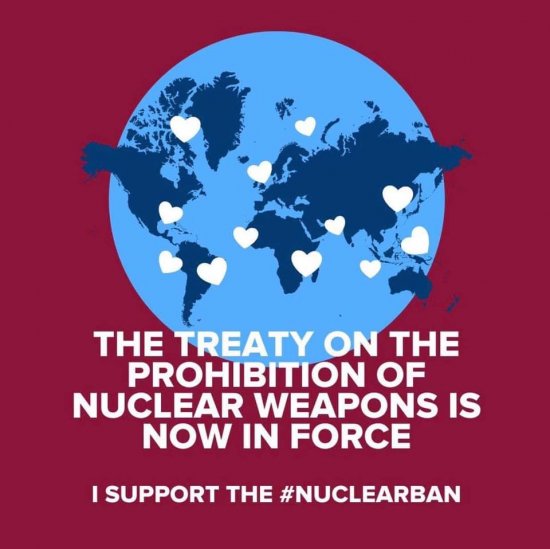
| The Nuclear Free Local Authorities have joined with campaign groups opposed to nuclear weapons in calling on the British Foreign Secretary to ensure that the UK is represented at the forthcoming nuclear treaty ban conference to be held later this month in Vienna. Sixty-one member states of the United Nations have so far signed and ratified the UN Treaty on the Prohibition of Nuclear Weapons, the first international law to prohibit the manufacture, stockpiling, transfer and use of nuclear weapons which entered force in January 2021. A further twenty-five states have signed the Treaty in readiness to ratify it. These member states will meet at the UN in Vienna between 21 – 23 June to discuss the progress so far in creating a nuclear weapons free world, and, in light of the recent conflict in Ukraine, the next best steps to get there. None of the world’s nuclear weapons states have so far engaged with the treaty, and the UK has steadfastly refused to recognise it, despite five of the states, including the UK, making a commitment as signatories to the Nuclear Non-Proliferation Treaty to work in ‘good faith’ to achieve global nuclear disarmament at the earliest possible date. Britain made this commitment as one of the first signatories to the NPT in 1968. NFLA 8th June 2022 https://www.nuclearpolicy.info/news/nuclear-free-local-authorities-join-call-for-uk-to-attend-nuclear-ban-summit/ |
EDF delays the scheduled maintenance shutdowns of 7 French nuclear reactors.

| EDF has pushed back scheduled shutdowns for next winter of seven French reactors and plans to delay an eighth, Remit data showed on Wednesday. These changes concern the shutdowns of the Bugey 5 (880 MW), Cattenom 2 (1,300 MW), Cruas 4 (915 MW), Golfech 2 (1,310 MW), Gravelines 1 (910 MW), Nogent 2 (1,310 MW) reactors. ) and Paluel 1 (1,330 MW). The delays vary from several weeks to about a month. The company also plans to push back for two weeks, until February 25, the scheduled shutdown of its St Alban 1 reactor (1.3 GW). EDF gave no explanation for these measures. They come amid fears of a shortage of electricity supply in France next winter, due to a record drop in nuclear generation. The public nuclear electric company was forced to unexpectedly shut down several reactors for checks and repairs following the discovery of corrosion on important safety circuits at the end of last year. Last month, EDF revised the dates of thirteen scheduled reactor outages, citing corrosion-related checks and repairs. Montel 8th June 2022, https://www.montelnews.com/fr/news/1326472/edf-retarde-les-arrts-hivernaux-de-7-racteurs-franais |
Nuclear Free Local Authorities oppose Nuclear Waste Authorities’ seismic testing in the Irish Sea
| On World Oceans Day (8 June), the Nuclear Free Local Authorities have joined environmental and anti-nuclear campaigners in opposing proposals to carry out seismic testing in the Irish Sea as part of plans to develop an offshore, undersea nuclear waste dump. A joint letter, whose signatories include renowned environmentalist Jonathan Porritt, has been sent to the head of the Marine Management Organisation opposing an exemption to the requirement to obtain a Marine Licence which has been claimed by Nuclear Waste Services to enable them to plough ahead with their summer plans to carry testing in the waters off West Cumbria. The NWS, an operating division of the Nuclear Decommissioning Authority, is responsible for finding a site for a so-called Geological Disposal Facility, either below ground or beneath the seabed. This nuclear waste dump will be filled with the toxic radioactive waste that is the legacy of Britain’s seven decades of the civil nuclear power production; much of it will remain radioactive for many tens of thousands of years. Three search areas in Cumbria, falling within the local authority areas of Allerdale and Copeland and offshore up to 22kms, are under consideration. Seismic testing will enable NWS to determine if the geology beneath the bed of the Irish Sea is suitable to host a repository for the nuclear waste. This involves firing blasts of sound from air guns below the waves every 10 seconds for four weeks or longer. This sound penetrates under the ocean floor to help scientists discover more about the suitability of the geology to store nuclear waste. Seismic testing can seriously impair the health of marine life, which in the Irish Sea includes whales, dolphins, porpoises, and seals, but some scientific reports also suggest that even tiny shellfish and plankton can be adversely impacted, hazarding the whole marine ecosystem. NFLA 8th June 2022, https://www.nuclearpolicy.info/news/nuclear-free-local-authorities-oppose-seismic-testing-on-world-oceans-day/ |
Ukraine bars IAEA nuclear regulator from visiting Russian-occupied power plant !

The International Atomic Energy Agency wants to ensure that the Zaporizhzhia nuclear power plant is safe. Politico, BY LOUISE GUILLOT, June 7, 2022
Energoatom, Ukraine’s nuclear power plant operator, on Monday denounced a request by the global nuclear watchdog to visit the Russian-occupied Zaporizhzhia nuclear power plant.
The Ukrainian operator accused Rafael Mariano Grossi, head of the International Atomic Energy Agency, of “lying” and warned that the visit was a way of legitimizing Russia’s occupation of Europe’s largest nuclear plant — which is operated by Ukrainian staff but has been under the control of Russian troops since March.
“The Ukrainian side did not invite Grossi to visit ZNPP [Zaporizhzhia Nuclear Power Plant] and had previously denied him such a visit, emphasizing that a visit to the power plant will be possible only when our country regains control over it,” Energoatom said in a Telegram post.
Rosatom Director General Alexey Likhachev said in March that the Russian state-owned nuclear operator had no intention of taking operational control of Zaporizhzhia.
Grossi said Monday that he was “actively working” on sending an expert mission to the plant “sooner or later but better sooner.” Grossi has been working on setting up such a trip for months, but has so far been unsuccessful in getting Ukraine and Russia to agree on the details.
Dmitry Peskov, Russian President Vladimir Putin’s spokesperson, said last month that the IAEA was in touch with both Russian and Ukrainian authorities about a possible visit, Russian state-controlled press agency Interfax reported………………………..
Grossi also said Monday that Ukraine told his agency it has “lost control over” nuclear material at Zaporizhzhia and that data communication on nuclear safeguards with the plant has broken down. Nuclear safeguards mechanisms are essential to ensure that nuclear facilities are not misused and nuclear material not diverted from peaceful uses.
“The urgent need for us to be there is clear to all,” he said. “Logistics and other such considerations must not prevent it. We must find a solution to the hurdles preventing progress at Zaporizhzhia NPP.”………………
The IAEA declined to comment on Energoatom’s allegations. https://www.politico.eu/article/ukraine-nuclear-regulator-visit-russia-power-plant/
The War Situation Has Developed Not Necessarily to Ukraine’s or the West’s Advantage But They Plan to Negotiate When They’ve Turned Things Around a Bit

naked capitalism, by Yves Smith,
ust because Russia has been slow and methodical about grinding up Ukraine’s army and materiel in Donbass does not mean that there’s reason to think Ukraine can turn its losses around with generous applications of Western funding, weapons, and hopium. And on the economic war front, even though Russia has taken a hit, it seems to be making surprisingly solid progress in adjusting, while conditions in the US and Europe look to be worsening, and at an accelerating rate.
Admittedly, the press, presumably reflecting the readings of military experts, has greatly reduced coverage of the conflict now that even generous applications of porcine maquillage can no longer hide that things are going from bad to worse for Ukraine. A very long established contact forwarded this message from a former senior US military official:
Just in from an Army Colonel in the building:
“Spoke to someone today who said that the Ukie basic training is 10 days and then off to the front. 65% casualty rates. At least double or more the losses of the Russians but you don’t hear anything about it.”
Recall that Scott Ritter, early on in his many detailed analysis, said that if one side was consistently inflicting casualties at a higher rate than the other, even at a ratio of say 1:1.2, the side with the lower losses would prevail.
Recall also that Ukraine has not made a single significant offensive since the war began. The most it has been able to achieve are small tactical gains that don’t amount to anything over time.
……………………………….. Truth be told, Western officials and the media are increasingly acknowledging that Ukraine can’t win this war, and therefore the two sides need to negotiate a peace. But to invoke a saying I heard in Venezuela, “They have changed their minds, but they have not changed their hearts.” The US and NATO have consumed so much Ukraine Kool-Aide that they are light-year away from what a realistic settlement would have to include. And that’s because they still can’t admit to themselves that Russia is wining, and at this rate, will have taken Odessa before Zelensky will even be willing to cede Donbass. For instance, look at this key statement from Joe Biden’s New York Times op-ed earlier this week:
We have moved quickly to send Ukraine a significant amount of weaponry and ammunition so it can fight on the battlefield and be in the strongest possible position at the negotiating table
Why should Ukraine keep fighting and losing more men and suffering more damage? Why not sue for peace now? Biden’s unstated assumption is that if the US pumps enough air into the leaking Ukraine balloon, it will be in a better position than it is now. That can come about only by taking territory back or by inflicting huge losses on the Russian side. In what universe is that a likely outcome?
There are also complicating factors on the Russian side. One is that the Russian population regards Putin as too dovish and would much rather have the Ukraine matter be as settled as it can be via this war. That argues for taking more territory, certainly the entire Black Sea coast, probably Kharkiv and perhaps even securing the Dneiper save perhaps hard by Kiev.
A second matter is that many of the “liberated” or expecting to be liberated territories seem to want to join Russia, and not be independent friendlies or part of a Novorossiya (this may be realism as well as romanticism; they are too small to go it alone). One reason for this expectation is that at least some members of the Donbass militias are continuing to fight for the Russian cause in neighboring oblasts, here Kherson.
Recall that Putin was not happy when the two breakaway republics declared independence in 2014, and he had to push them in the Minsk Accord negotiations to accept staying in Ukraine,……………………………………………..
the Guardian get credit for admitting that Russia is winning the economic war – and Putin is no closer to withdrawing troops. However, economic editor Larry Elliott’s contains a lot of hand wringing and falsehoods, like the claim that Putin “weaponized” food. But notice that his closing section calls only for “a deal” not a rollback of sanctions. And it’s the sanctions that are hurting the collective West:
If proof were needed that sanctions are not working, then President Joe Biden’s decision to supply Ukraine with advanced rocket systems provides it. The hope is that modern military technology from the US will achieve what energy bans and the seizure of Russian assets have so far failed to do: force Putin to withdraw his troops.
Complete defeat for Putin on the battlefield is one way the war could end, although as things stand that doesn’t appear all that likely. There are other possible outcomes. One is that the economic blockade eventually works, with ever-tougher sanctions forcing Russia to back down. Another is a negotiated settlement.
Putin is not going to surrender unconditionally, and the potential for severe collateral damage from the economic war is obvious: falling living standards in developed countries; famine, food riots and a debt crisis in the developing world.
The atrocities committed by Russian troops mean compromising with the Kremlin is currently hard to swallow, but economic reality suggests only one thing: sooner or later a deal will be struck.
Perhaps Elliott didn’t want to stick his neck out too far by saying ending at least some of the sanctions would be necessary. But the failure to call for that means that politicians with no skin in the game like Ursuala von der Leyen will continue trying to escalate. It doesn’t matter that it isn’t working. These officials have convinced themselves that eyepoking the evil Putin will bring down Russia. They need to heed the oracle’s warning to to Croesus: that if he attacked the Persians, he would destroy a great empire. That empire was his own. https://www.nakedcapitalism.com/2022/06/the-war-situation-has-developed-not-necessarily-to-ukraine-or-the-wests-advantage-but-they-plan-to-negotiate-when-theyve-turned-things-around-a-bit.html
Ukraine staging battle scenes for propaganda – Russia
Russia, https://www.rt.com/russia/556544-staged-footage-action-ukraine/ 7 June 22, The propaganda footage was allegedly sponsored by the British government, The Russian Defense Ministry released on Friday what it claimed to be staged combat scenes filmed on behalf of the Ukrainian government and paid for by the British government. The two short clips appear to be raw footage of what looks like a war movie.
The filming of the videos took place on May 28 in the town of Meshkovka in Ukraine’s Nikolaev Region, the ministry said. A train station of the same name is located on the outskirts of the provincial capital in the south of the country.
One of the videos shows two armored vehicles facing the camera. At the command of a woman, who appears to be the film director, the backdoor of the closest vehicle opens, and a group of armed men in uniform wearing red armbands starts pouring out. Several others rise from the grass around the second vehicle in the distance and start moving forward, their weapons raised.
The second clip is a shootout scene, with a group of armed uniformed men retreating through rubble while firing back at an unseen enemy. Pyrotechnics appear to simulate enemy fire. At one point, a professional-looking film crew comes into view.
Germany rules out nuclear power as an option during the energy crisis.
German Leader Rules Out Nuclear Option to Fill Energy Gaps
German Chancellor Olaf Scholz says his government remains committed to phasing out nuclear power despite concerns about rising energy prices and possible future shortages due to Russia’s war in Ukraine.
By Associated Press, June 8, 2022, BERLIN (AP) — German Chancellor Olaf Scholz said Wednesday that his government remains committed to phasing out nuclear power despite concerns about rising energy prices and possible future shortages due to Russia’s war in Ukraine.
Germany shut down half of its six nuclear plants in December and the remaining three are due to cease production at the end of this year as part of the country’s long-running plan to phase out conventional power plants in favor of renewable energy……………….
“We also know that building new nuclear power plants makes little sense,” he said at a news conference with foreign correspondents in Berlin.
“If someone decides to do so now they would have to spend 12-18 billion euros on each nuclear power plants and it wouldn’t open until 2037 or 2038,” said Scholz. “And besides, the fuel rods are generally imported from Russia. As such one should think about what one does.”
“That’s why the government, all the governing parties unanimously, are counting on (…) the massive expansion of renewable energy,” he added…………..
“The goal of completing the phaseout of coal in Germany ideally by 2030, and the climate targets, remain in place,” Government spokeswoman Christiane Hoffmann said. https://www.usnews.com/news/business/articles/2022-06-08/germany-to-keep-more-coal-plants-on-hand-in-case-of-gas-cuts
Ukraine slams planned IAEA mission to Russian-occupied nuclear plant
Reutershttps://www.reuters.com/world/europe/ukraine-slams-planned-iaea-mission-russian-occupied-nuclear-plant-2022-06-07/
June 7 (Reuters) – Ukraine’s state nuclear company Energoatom on Tuesday criticised an IAEA plan to send a delegation to a Russian-occupied nuclear plant in southern Ukraine, saying it “did not invite” such a visit.
“We consider this message from the head of the IAEA as another attempt to get to the (power plant) by any means in order to legitimise the presence of occupiers there and essentially condone all their actions,” Energoatom wrote on the Telegram messaging app.
On Monday, IAEA head Raphael Grossi said the organisation was working on sending an international mission of experts to the Russian-held nuclear power plant at Zaporizhzhia in Ukraine, Europe’s largest. nL1N2XT0LV]
 | |||
|
| |||
| to me |
| |||
|
1 This Month





PLEASE OPPOSE HR 8255 AND S.3639 – bills would accelerate satellite deployment, with no environmental review or safeguards – https://ncstd5li.quorum.us/campaign/169331/
To see nuclear-related stories in greater depth and intensity – go to https://nuclearinformation.wordpress.com
-
Archives
- October 2026 (81)
- September 2026 (339)
- August 2026 (330)
- July 2026 (355)
- June 2026 (287)
- May 2026 (306)
- April 2026 (356)
- March 2026 (251)
- February 2026 (267)
- January 2026 (308)
- December 2025 (358)
- November 2025 (359)
-
Categories
- 1
- 1 NUCLEAR ISSUES
- business and costs
- climate change
- culture and arts
- ENERGY
- environment
- health
- history
- indigenous issues
- Legal
- marketing of nuclear
- media
- opposition to nuclear
- PERSONAL STORIES
- politics
- politics international
- Religion and ethics
- safety
- secrets,lies and civil liberties
- spinbuster
- technology
- Uranium
- wastes
- weapons and war
- Women
- 2 WORLD
- ACTION
- AFRICA
- Atrocities
- AUSTRALIA
- Christina's notes
- Christina's themes
- culture and arts
- Events
- Fuk 2022
- Fuk 2023
- Fukushima 2017
- Fukushima 2018
- fukushima 2019
- Fukushima 2020
- Fukushima 2021
- general
- global warming
- Humour (God we need it)
- Nuclear
- RARE EARTHS
- Reference
- resources – print
- Resources -audiovicual
- Weekly Newsletter
- World
- World Nuclear
- YouTube
-
RSS
Entries RSS
Comments RSS

