New failure on the Flamanville EPR, the reactor control system’s malfunction

After problems with concrete, steel or welds, the reactor under
construction experienced a new malfunction.
Part of the installation’s control systems is out of order. The structural failure, known since 2019,
is now recognized by EDF. Flamanville and its EPR reactor, umpteenth
episode.
We thought we knew everything about the setbacks of the calamitous
EDF project which has been dragging on for fifteen years now on the nuclear
power plant in the Manche department and whose bill has gone in seventeen
years from 3.3 billion to 12.7 billion euros ( and even 19 billion with
interest and launch costs according to the Court of Auditors ).
Well no !
After the concrete problems during the construction of the reactor
building, the poorly forged steel of the bottom and the cover of the
nuclear vessel or the poorly made welds on the reactor piping, EDF has a
new problem on its hands.
And a big one: two essential systems which make
it possible to control the reactor are victims of a problem problem for the
start of the EPR. A tile known for several years by the operator and the
Nuclear Safety Authority (ASN), but which has not been the subject of any
publicity and has still not been resolved, according to information from
Liberation . We already knew that this powerful 1,650 MWe nuclear reactor
would not enter service before the end of 2023, more than ten years behind
the date initially planned.
Liberation 19th July 2022
Ukraine Defense Minister Offers Ukraine as a ‘Testing Ground’ for NATO Weapons
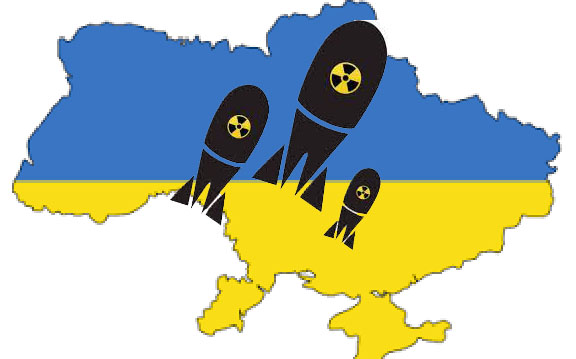
Oleksii Reznikov said Ukraine is ‘inviting arms manufacturers to test the new products here’ https://news.antiwar.com/2022/07/19/ukraine-defense-minister-offers-ukraine-as-a-testing-ground-for-nato-weapons/ by Dave DeCamp
Ukrainian Defense Minister Oleksii Reznikov on Tuesday openly offered Ukraine as a venue to test NATO weapons against Russia in an online conversation with the director of the Atlantic Council’s Eurasia Center.
Reznikov said that Ukraine “is essentially a testing ground” for the advanced weaponry the US and its allies are pouring into the country. “Many weapons are now getting tested in the field in the real conditions of the battle against the Russian Army, which has plenty of modern systems of its own,” he said.
The Ukrainian military chief made the offer in a fresh pitch for more Western arms. “We are interested in testing modern systems in the fight against the enemy and we are inviting arms manufacturers to test the new products here,” he said.
One weapons system that is getting its first use on the battlefield in Ukraine is the Polish Krab artillery system that was provided by Warsaw. “So, I think for our partners in Poland, in the United States, France, or Germany, it’s a good chance to test the equipment. So, give us the tools. We will finish the job and you will have all the new information,” Reznikov said.
The Western response to the war in Ukraine has been a boon for US arms makers, who are making money sending weapons into the war zone, replenishing NATO stockpiles, and selling arms to European countries that have decided to boost military spending.
Kyiv has been asking for more advanced arms than it has been sending, including F-15 and F-16 fighter jets. Ukrainian pilots would need to be trained to fly the US aircraft, and the House version of the National Defense Authorization Act includes $100 million to go towards that training, although the massive spending bill has not yet been finalized.
Macron facing NUCLEAR nightmare as scorching heatwave cripples SIX reactors.

THE RAGING heatwave that currently engulfing Europe has threatened to worsen France’s energy crisis, as six nuclear power plants have been crippled this month.
https://www.express.co.uk/news/science/1643201/emmanuel-macron-france-facing-energy-nightmare-six-nuclear-reactors-scorching-heatwave By ANTONY ASHKENAZ, Jul 20, 2022 , Experts have warned that parts of France are currently facing a “heat apocalypse” as temperatures reach record levels across Europe. Aside from triggering horrifying forest fires, these scorching temperatures are now also threatening to worsen France’s energy crisis. As a result of higher temperatures, rivers like the Rhone and Rhine, which are used by nuclear power plants for cooling, have become too warm to be used in the energy generation process.
Without cooler water supplies, six nuclear power plants in France have been forced to reduce their output drastically.
Without cooler water supplies, six nuclear power plants in France have been forced to reduce their output drastically.
EDF’s nuclear plants along these rivers use the waters to regulate the temperature of their reactors, discharging warm water back into the waterway.
Regulations are in place that limits reactor production during times of high heat to prevent the process from damaging local wildlife.
However, these rules could soon be scrapped at the cost of regional flora and fauna, as France’s nuclear safety authority green-lighted “temporary modification” of regulations for Blayais, Golfech and St Alban nuclear power plants.
Energy expert Thibault Laconde tweeted: “To state the obvious, it also highlights the vulnerability of #nuclear power to climate change, in particular the vulnerability of ‘French-style’ nuclear power, with its large reactors, large power plants and therefore large cooling needs.
“Climate change has to be factored in nuclear projects.
“Especially as France is preparing to renew its fleet, it would be unimaginable to build reactors if we cannot demonstrate that they will be able to operate with the #climate they will experience throughout their lifetime”
The heatwave crippling nuclear power plants could be devasting for Mr Macron, as France has already been suffering a major energy crisis after half of EDF’s ageing nuclear power plants were forced to shut down recently over safety concerns.
Experts have previously warned Mr Macron of significant corrosion safety problems in EDF nuclear power plants in France as cracks were detected in some nuclear reactors.
Speaking to Express.co.uk, Dr Bernard Laponche, the co-author of a recent study on EDF’s reactors warned that cracks in the cooling systems of many of these reactors could result in horrifying disasters that are only comparable to events like “Three Mile Island or Fukushima”.
As a result of these corrosion problems, four 1500 MW, seven 1300 MW and one 900 MW reactors are shut down.
As a result of these reactor shut downs, EDF has been forced to lower its power output this year, amidst fears of a disastrous winter where fears grow Vladimir Putin could cut Europe off its gas supply.
Dr Laponche also warned that more reactor shutdowns could happen in the future, as EDF power stations are currently under investigation for similar reactor flaws.
Evacuation of site in France , as wildfires rage near nuclear power plant being decommissioned
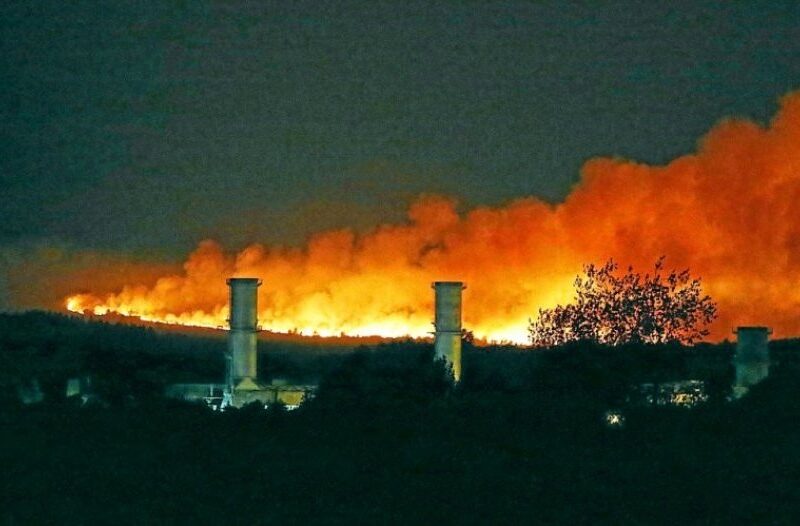
The EDF site in Brennilis, consisting of a nuclear power plant being deconstructed and a thermal power plant in operation, was evacuated around 1 p.m., due to the fumes stinking the air. It’s 10 a.m. on Tuesday morning.
The swirling fire, fanned by a wind blowing at 40 – 45 km/h, plays hide and seek with the firefighters. Claire Maynadier, sub-prefect of Châteaulin, has just hung up with the director of the Brennilis nuclear power plant . The evacuation of personnel is therefore not envisaged. “The fire front
is not near. Nevertheless, it remains uncontrolled. We remain vigilant,” she explains.
Le Telegramme 19th July 2022
Against advice of the Planning Inspectorate the UK’s interim government gives go-ahead to Sizewell C nuclear power plant.
UK government gives go-ahead to Sizewell C nuclear power plant, Decision goes against advice of Planning Inspectorate, which rejected project owing to impact,
Guardian, Alex Lawson Energy correspondent, Thu 21 Jul 2022 ,
The UK government has given planning consent to the £20bn Sizewell C nuclear power plant in Suffolk.
The decision by the business secretary, Kwasi Kwarteng, which had been repeatedly delayed, was finally announced on Wednesday and went against the advice of the independent Planning Inspectorate.
French energy company EDF wants to build the 3.2 GW, two-reactor plant next to its existing site at Sizewell B, which began operating in 1995.
However, the proposals have faced fierce opposition from local campaigners, who have argued against the project because of the environmental impact and the cost to energy billpayers. Campaigners now have six weeks to decide whether to appeal against the decision.
Planning permission was seen as a key hurdle for the project which remains subject to a further final investment decision, expected next year. It is hoped the plant can generate enough power for six million homes.
The approval process for Sizewell C has so far included four rounds of public consultation which began in 2012 and has involved more than 10,000 East Suffolk residents.
The Planning Inspectorate rejected the scheme because of concerns over the plant’s impact on protected species and habitats, and the long-term water supply at the site.
EDF worked with Chinese state-backed nuclear specialist CGN on the first phase of the project. However, it is understood the UK government is keen to ease CGN out amid concerns over Chinese involvement with sensitive assets.
Bankers at Barclays have been hired to secure new financial backing for the project alongside EDF and the UK government.
Boris Johnson’s government put £100m of funding behind the project in January to support its development………………………………………………..
Alison Downes, of the Stop Sizewell C campaign, said: “The wrong decision has been made but it’s not the end of our campaign to Stop Sizewell C. Not only will we be looking closely at appealing this decision, we’ll continue to challenge every aspect of Sizewell C, because – whether it is the impact on consumers, the massive costs and delays, the outstanding technical questions or the environmental impacts – it remains a very bad risk.”
Beccy Speight, the chief executive of the Royal Society for the Protection of Birds, said: “The construction of the proposed development will be damaging and it has been granted with insufficient consideration for the effects on nature as described by the government’s own experts. This is a ludicrous decision for an interim government to make.”
Greenpeace UK’s chief scientist, Dr Doug Parr, called the project a “red herring energy solution” as the UK attempts to move towards a low-carbon energy system……………………
The French government said on Tuesday it was prepared to pay €10bn (£8.5bn) to fully nationalise EDF amid concerns over its finances. Ministers in France want to keep a handle on soaring energy bills.
Johnson has set a target of making investment decisions on eight new nuclear projects by the end of the decade. https://www.theguardian.com/business/2022/jul/20/uk-government-gives-go-ahead-to-sizewell-c-nuclear-power-plant
VIDEO: Germany criminalizes journalist for exposing Ukrainian war crimes
Ed. note . This video is blocked by both Twitter and Facebook. Corporate media censorship is taking over social media too.
https://thegrayzone.com/2022/07/13/video-germany-criminalizes-journalist-for-exposing-ukrainian-war-crimes/ MAX BLUMENTHAL·JULY 13, 2022
Independent Donetsk-based journalist Alina Lipp of Germany details her prosecution by the German state for violating new speech codes through her reporting in the Donetsk People’s Republic.
As the only German reporter on the ground in Donetsk, Lipp has exposed Ukrainian forces shelling civilians, attacking a maternity ward, mining harbors, and bombing a granary filled with corn for export. She faces three years in prison if she returns to her home country.
Russia says Ukrainian drone struck nuclear plant, but caused no damage.
https://www.reuters.com/world/europe/russian-occupation-official-says-ukrainian-drone-struck-nuclear-plant-caused-no-2022-07-20/ July 20 (Reuters) – Russia on Wednesday accused Ukraine of firing two drones at a nuclear power station in the partially occupied Ukrainian region of Zaporizhzhia on Monday but said the reactor was undamaged.
Reuters could not independently verify the report and Ukrainian officials had no immediate comment. The facility is the largest nuclear plant in Europe.
“Ukrainian nationalist formations used two kamikaze drones to attack facilities at the Zaporozhzhia nuclear power plant – one drone was destroyed on approach to the plant,” Russia’s defence ministry said in a statement.
“It was only by sheer luck that this did not lead to damage to the plant’s equipment and a man-made disaster.”
Ukraine has previously accused Moscow of basing troops and storing military equipment on the grounds of the power station.
Earlier in the day Vladimir Rogov, a member of the Russian-installed regional administration, wrote on Telegram that three Ukrainian “kamikaze drones” had struck the plant.
Ukraine’s state nuclear company Energoatom, whose employees still run the plant despite the area being under Russian control, issued a statement later accusing Russian forces of demanding access to the machine halls of three reactors at the plant in order to store tanks and equipment there.
Energoatom said, without providing evidence, that Russian troops were doing so for fear of “presents” from Ukraine’s armed forces, an apparent reference to targeted strikes. The company did not comment on the alleged drone impact.
Reporting by Reuters Editing by Peter Graff, Mark Heinrich and Jonathan Oatis
All at Sea: Energy Security Bill reveals UK government preference to dump waste offshore

https://www.nuclearpolicy.info/news/all-at-sea-energy-security-bill-reveals-government-preference-to-dump-waste-offshore/ 20 July 22, The Government has published a factsheet in support of the new Energy Security Bill which has confirmed the long-held suspicion of Britain’s Nuclear Free Local Authorities that the nuclear industry intends to dump its deadly legacy of radioactive waste out at sea.
Tucked away in this page-turner is a reference that could be missed on page seven revealing that with refence to the government stated ambition to Prepare for our nuclear future and clean up the past’, that ‘The Bill will also facilitate the safe, and cost-effective clean-up of the UK’s nuclear sites, ensuring the UK is a responsible nuclear state by clarifying that a geological disposal facility located deep below the seabed will be licensed.’[1]
That the intention is to dump the waste at a location out at sea has helpfully been made plain in the latest infomercial published by the Theddlethorpe GDF Community Partnership
20th July 2022
All at Sea: Energy Security Bill reveals government preference to dump waste offshore
The Government has published a factsheet in support of the new Energy Security Bill which has confirmed the long-held suspicion of Britain’s Nuclear Free Local Authorities that the nuclear industry intends to dump its deadly legacy of radioactive waste out at sea.
Tucked away in this page-turner is a reference that could be missed on page seven revealing that with refence to the government stated ambition to Prepare for our nuclear future and clean up the past’, that ‘The Bill will also facilitate the safe, and cost-effective clean-up of the UK’s nuclear sites, ensuring the UK is a responsible nuclear state by clarifying that a geological disposal facility located deep below the seabed will be licensed.’[1]
That the intention is to dump the waste at a location out at sea has helpfully been made plain in the latest infomercial published by the Theddlethorpe GDF Community Partnership

This latest plan to jeopardise the marine environment is par for the course for successive British Governments which, without a care for the ecology of British waters, have previously chosen to recklessly dump deadly munitions and poison gas into our oceans.
In November 2020, the NFLA published a horrifying report commissioned from marine pollution expert, Tim Deere-Jones, which revealed that evidence was mounting that around two million tons of unused wartime munitions were dumped in, or around, the Beaufort’s Dyke in the Irish Sea in the interwar and post-war years, up until at least the mid-1970’s.[2]
Alongside conventional explosives, this deadly legacy included at least 14,000 tons of phosgene gas and a cocktail of other nasties such as ‘canisters of chemical warfare agents including sarin, tabun, mustard gas, cyanide, … and the biological warfare agent anthrax’.
The New Scientist has reported instances of munitions washing up on Scottish beaches and the British Geological Survey confirmed that explosions generated by degrading munitions are a relatively frequent occurrence and that at least one of those explosions was observed to have generated an explosive force equivalent to approximately 5.5 tonnes of TNT.
The report also revealed that radioactive waste has previously been dumped into the Irish Sea, in the Beaufort’s Dyke, in the Firth of Tay and off the island of Arran, including radium-coated aircraft dials, laboratory waste, luminous paint and waste encased in concrete within metal drums.
Responding to the latest revelation, Councillor David Blackburn, Chair of the NFLA Steering Committee, said:
“Clearly then the Energy Security Bill demonstrates that once again the British Government’s plan is to dump its deadly legacy of high-level radioactive waste offshore whatever the long-term detriment to the marine environment and regardless of local and international opposition, and the Theddlethorpe Community Partnership diagram makes this intention writ large.
“The NFLA has far from convinced that however well engineered a nuclear waste dump, or Geological Disposal Facility as the nuclear industry likes to call it, is that the structure of such a facility will not become compromised over the 100,000 years it is required to hold waste whilst it remains radioactive. We fear that in future centuries we shall see radioactive waste poisoning our oceans and beaches.
“This is an especial issue of concern in West Cumbria, where three of the possible four current sites for the dump are under consideration; for here for generations Sellafield has been leaking its toxics into the Irish Sea.
“The NFLA will continue to oppose a GDF, especially one at sea. Our policy is to see radioactive waste properly monitored and managed in a near surface facility, rather than dumped out of sight, out of mind and forgotten about!”
For more information, please contact NFLA Secretary Richard Outram by email on richard.outram@manchester.gov.uk or mobile 07583097793
Greenpeace investigation challenges nuclear agency on Chornobyl radiation levels

Greenpeace Germany is concerned that the IAEA is severely compromised in its role on nuclear safety and security in Ukraine by its ties to Russia’s nuclear state agency, ROSATOM, including its current IAEA Deputy Director Mikhail Chudakov, a long term ROSATOM official.
Kyiv, Ukraine – A Greenpeace Germany investigation team working with Ukrainian scientists at Chornobyl has found radiation levels in areas where Russian military operations occurred to be at least three times higher than the estimation by the International Atomic Energy Agency (IAEA).[1] In April 2022, the IAEA provided very limited data with assurances that radiation levels were “normal” and not a major environmental or public safety issue.[2]
The investigation team in Chornobyl also documented that Russian military actions against essential laboratories, databases and radiation monitoring systems have caused severe damage to the scientific infrastructure that was developed with the international scientific community. This includes damage to the lab equipment needed to study the impact of radiation on people and the environment, which threatens the safety of current and future generations.
Shaun Burnie, senior nuclear specialist at Greenpeace Germany said:
“Understanding the complex radiation effects at Chornobyl is essential for the world and that means conducting research and working with international scientists. All of that has been put at risk by Russia’s war against Ukraine. Scientists and workers conducting essential radiation hazard monitoring are now threatened by an unknown number of Russian landmines and anti-personnel explosives. This is one further outrageous legacy of Russia’s illegal war and is a crime against the environment and global science. The IAEA appears reluctant to explain the scale of the radiation hazards at Chornobyl and the impact of the Russian occupation.”
Greenpeace Germany is concerned that the IAEA is severely compromised in its role on nuclear safety and security in Ukraine by its ties to Russia’s nuclear state agency, ROSATOM, including its current IAEA Deputy Director Mikhail Chudakov, a long term ROSATOM official.
Jan Vande Putte, lead radiation specialist at Greenpeace Belgium who also participated in the investigation said:
“We measured levels of gamma radiation inside the abandoned Russian trenches that qualify it as low-level nuclear waste. Clearly the Russian military was operating in a highly radioactive environment, but that’s not what the IAEA is communicating. We can only conclude that the IAEA for some reason decided not to make an effort to fully investigate. It’s clear from our survey that there is nothing normal about the radiation levels inside the Chornobyl Exclusion Zone, despite what the IAEA wants the world to believe.”
Essential to Greenpeace Germany’s investigation was a satellite analysis report commissioned from UK based McKenzie Intelligence Services (MIS) which showed the location of Russian military operations during February and March 2022. Expert military analysis of multispectral imagery from the Sentinel 2 constellation satellite and NASA’s Visible Infrared Imaging Radiometer Suite identified fires in the exclusion zone which McKenzie concluded was set deliberately by the Russian military.[3]
Russia to Scrap World’s Largest Nuclear Submarine
https://www.themoscowtimes.com/2022/07/20/russia-to-scrap-worlds-largest-nuclear-sub-reports-a78349, 20 July 22, Russia has decommissioned the world’s largest nuclear ballistic missile submarine, state media reported Wednesday.
The Dmitry Donskoy, a Typhoon-class submarine that served in the Russian Navy’s Northern Fleet since 1980, stood at 175 meters in length. Its status as the world’s largest submarine will be taken by the 184-meter Oscar II-class Belgorod nuclear submarine, which was commissioned earlier in July.
“The submarine Dmitry Donskoy has been removed from the fleet and is to be scrapped,” the state-run RIA Novosti news agency quoted an unnamed Russian defense industry source as saying.
The Dmitry Donskoy was last spotted accompanying the Belgorod in the waters of northwestern Russia’s White Sea. . Analysts speculated at the time that the Dmitry Donskoy was accompanying the Belgorod for sea trials ahead of the latter vessel’s entrance into service.
France’s costly nationalisation of the nuclear industry

The French government is poised to pay nearly €10bn (£8.5bn) to fully
nationalise EDF as ministers attempt to tackle the European energy crisis.
The French finance ministry said on Tuesday it had offered €9.7bn or
€12 a share to buy the 16% of debt-laden EDF it does not already own. The
government of the French prime minister, Elisabeth Borne, government is
trying to shore up domestic energy supplies amid concerns over the finances
of the energy company, which is also building the Hinkley Point C nuclear
power station in Somerset.
Guardian 19th July 2022
https://www.theguardian.com/business/2022/jul/19/france-to-pay-nearly-10bn-to-fully-nationalise-edf
Employee shareholders to sue EDF over France nationising nuclear industry
An association of EDF employee shareholders announced on Sunday their plan
to sue the French state regarding its nationalisation of the power giant.
“Today the state needs to explain itself for the management as
ultra-majority stakeholder of the company,” the association “Energie en
actions” said in a statement.
The association holds that the government’s
decision goes against the interest of the company and the minority
shareholders, the statement added. The government will announce details of
its plan to fully nationalise the EDF, which runs the nation’s nuclear
power plants, by July 19.
Reuters 17th July 2022
Consultation on proposed changes to storage of radioactive wastes at Hinkley Point C NPP
The Environment Agency has launched a consultation on a proposed change to
the way radioactive waste will be stored at Hinkley Point C nuclear power
station near Bridgwater. Currently the Office for Nuclear Regulation
states: The waste will be stored on the Hinkley Point C site pending
availability of the GDF and the waste meeting the waste acceptance criteria
for the site (e.g. some heat generating radioactive waste may require
on-site storage until the thermal output has reduced).
Pressurised water reactors at Hinkley Point C will use uranium fuel to create heat and
generate electricity when operating. Once used within the reactor, nuclear
fuel will be stored on-site before being sent off-site to a Geological
Disposal Facility (GDF).
NNB Generation Company (HPC) Limited was
originally issued a radioactive substances environmental permit in 2013. In
the original design radioactive waste was to be stored on-site in ‘wet
storage’ – a method of submerging and storing in water. The operator has
now decided to change the technology by which it will store spent nuclear
fuel, from wet storage to ‘dry storage’.
Dry storage will see used nuclear fuel stored in sealed containers within a facility, before it is
sent to the GDF. This means the operator now seeks to change its
radioactive substances environmental permit to remove or amend specific
conditions related to the previous wet storage technology that are no
longer relevant. The operator has said altering the storage method will not
change the expected radiation dose to the general public from discharges or
the wider environment, which remains incredibly small. Separately, NNB
Generation Company (HPC) Limited will be seeking the necessary changes to
its Development Consent Order for Hinkley Point C in the autumn.
Somerset Live 20th July 2022
https://www.somersetlive.co.uk/news/somerset-news/locals-urged-say-proposed-change-7351721
UK govt to decide on whether or not £20bn Sizewell C nuclear power plant should go ahead
A decision on whether to approve the building of a new £20bn nuclear
power plant is due later. The government was expected to make an
announcement about the application for Sizewell C in Suffolk two weeks ago.
Business minister Paul Scully said he had “set a new deadline of no later
than 20 July for deciding this application”. “This is to ensure there is
sufficient time to allow the secretary of state to consider the proposal,”
he said. The government was previously due to announce a planning decision
by 25 May, but it said it needed more time to look at new information and
it set a new deadline of 8 July.
BBC 20th July 2022
Anti-nuclear forces gather in Wales

Anti-nuclear campaigners are gathering forces against what they say is a
“repeated narrative” that nuclear energy is viable and helps create
more jobs. PAWB (People Against Wylfa B), CND Cymru, Nuclear Free Local
Authorities, Cymdeithas yr Iaith, CADNO, the Welsh Anti-Nuclear Alliance
and Beyond Nuclear have organised a conference in Caernarfon to air their
views.
North Dot Wales 20th July 2022
1 This Month





PLEASE OPPOSE HR 8255 AND S.3639 – bills would accelerate satellite deployment, with no environmental review or safeguards – https://ncstd5li.quorum.us/campaign/169331/
To see nuclear-related stories in greater depth and intensity – go to https://nuclearinformation.wordpress.com
-
Archives
- October 2026 (81)
- September 2026 (339)
- August 2026 (330)
- July 2026 (355)
- June 2026 (287)
- May 2026 (306)
- April 2026 (356)
- March 2026 (251)
- February 2026 (267)
- January 2026 (308)
- December 2025 (358)
- November 2025 (359)
-
Categories
- 1
- 1 NUCLEAR ISSUES
- business and costs
- climate change
- culture and arts
- ENERGY
- environment
- health
- history
- indigenous issues
- Legal
- marketing of nuclear
- media
- opposition to nuclear
- PERSONAL STORIES
- politics
- politics international
- Religion and ethics
- safety
- secrets,lies and civil liberties
- spinbuster
- technology
- Uranium
- wastes
- weapons and war
- Women
- 2 WORLD
- ACTION
- AFRICA
- Atrocities
- AUSTRALIA
- Christina's notes
- Christina's themes
- culture and arts
- Events
- Fuk 2022
- Fuk 2023
- Fukushima 2017
- Fukushima 2018
- fukushima 2019
- Fukushima 2020
- Fukushima 2021
- general
- global warming
- Humour (God we need it)
- Nuclear
- RARE EARTHS
- Reference
- resources – print
- Resources -audiovicual
- Weekly Newsletter
- World
- World Nuclear
- YouTube
-
RSS
Entries RSS
Comments RSS

