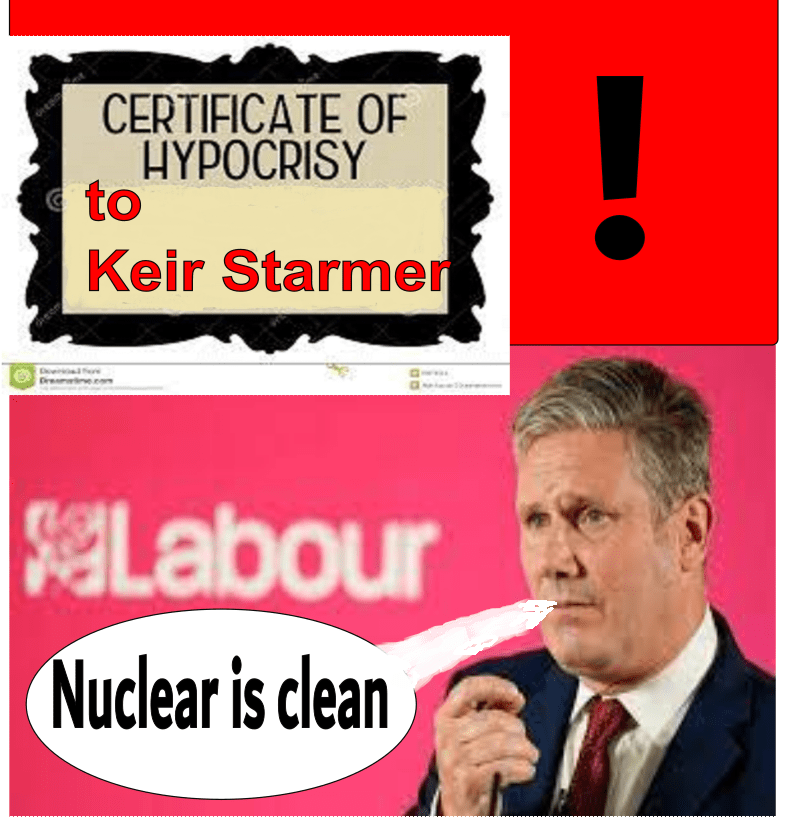
NO – Sir Keir Starmer – nuclear power is NOT clean.
A great opportunity being wasted!
The British Labour Party has the chance to get into power, following the disastrous Boris Johnson Tory leadership.
Top of Johnson’s follies was the plan for a fleet of nuclear reactors, large and small.
The incompetent Tories will inevitably go. Their hopeless dirty and super-costly nuclear plans should go with them.
But Keir Starmer now squanders this chance with his hypocritical pretence that nuclear power is clean.
Current reports that the Labour Opposition leader highlighted that, in power, Labour would bring a “different approach” to energy -it “would target 100% clean power generation by 2030”. The
Association for Renewable Energy and Clean Technology (REA) jumped up and down with delight, not realising that they’re being taken for a ride by the nuclear lobby
All very good – wind, solar, hydrogen, green steel and carbon capture – it does sound clean.
But, sneaked in amongst all this positive, forward -looking stuff, is that dirty old dinosaur – nuclear power.
The inclusion of nuclear power in the compendium of clean energy technologies will mean that funds and resources are siphoned away from real solutions to climate change.
It will quietly send resources , talented workers, and money to the nuclear weapons industries.
Shame on Labour – for inventing Great British Energy – “It’s galvanised by reform: a new publicly owned company” – but very quickly subverted to push for the nuclear lobby.

Lithuania deal to dismantle Soviet-era nuclear reactors could be world first
Pamela Largue , January 9, 2023
https://www.powerengineeringint.com/nuclear/waste-management-decommissioning/lithuania-to-dismantle-soviet-era-nuclear-reactors/
Two contracts have been signed to plan the dismantling and waste management for the Ignalina Nuclear Power Plant in Lithuania.
The first of two four-year contracts was signed with a consortium led by Westinghouse Electric Spain, including Jacobs Slovakia, and Lithuanian Energy Institute.
The second contract was signed with another consortium led by the French company Electricite de France.
The dismantling services will be provided in two phases. The first will see contractors propose engineering solutions for dismantling the reactor.
The engineering design concept will be assessed and then further developed in consultation with stakeholders, namely the European Commission, Ministry of Energy of the Republic of Lithuania, CPVA (Central Project Management Agency) and VATESI (State Nuclear Power Safety Inspectorate).
Audrius Kamienas, director general of the Ignalina plant, said in a statement that the signing of the contracts is an important milestone, as dismantling the reactor core is the most challenging part of the decommissioning.
“There are only a few examples of graphite reactors being dismantled in the world today, but the RBMK reactor type has never been dismantled before.
“This is an extremely complex task, unprecedented in the world, for which preparatory work will continue for several more years.”
Physical dismantling of the reactor will commence in 2028 and will be funded by the EU Ignalina Programme.
Graphite-moderated reactor
Dismantling two of the most powerful RBMK reactors is believed to be a decommissioning first.
According to the World Nuclear Association, Soviet-designed RBMK (reaktor bolshoy moshchnosty kanalny, high-power channel reactor) is a water-cooled reactor with individual fuel channels and uses graphite as its moderator.
Ignalina could be the first graphite-moderated reactor plant to be dismantled, making it an important test bed for methodologies that could be used to decommission others of the same type, such as the UK’s Magnox and advanced gas-cooled reactors, which also have graphite cores.
Jacobs Energy, Security & Technology senior vice president Karen Wiemelt, commented: “Our teams based in the UK, France and Slovakia are applying decommissioning skills acquired through work on some of the world’s most complex and challenging nuclear sites including Sellafield and Fukushima.”
In 2002, the Lithuanian government decided to shut down Ignalina NPP, which supplied up to 88% of the country’s electricity.
Ukraine on ‘NATO mission’ – defense minister
https://www.rt.com/russia/569500-reznikov-ukraine-nato-mission/ 9 Jan 23
Aleksey Reznikov has argued that Kiev is shedding blood for the military bloc and expects weapons in return.
Kiev is shedding blood to carry out the mission NATO set for itself and expects the “civilized West” to provide weapons and ammunition in return, Ukrainian Defense Minister Aleksey Reznikov has said in an interview for a domestic TV channel.
Appearing on the 1+1 network’s TSN channel on Thursday evening, Reznikov pointed out that at the Madrid summit last summer, NATO declared Russia the greatest threat to the US-led bloc.
“Today, Ukraine is addressing that threat. We’re carrying out NATO’s mission today, without shedding their blood. We shed our blood, so we expect them to provide weapons,” he said.
Reznikov also claimed that his NATO colleagues have told him, both in conversations and via text messages, that Ukraine is the “shield of civilization” and “defending the entire civilized world, the entire West.”
Ukrainian officials, from President Vladimir Zelensky down, routinely make public appeals for tanks, missiles, artillery and ammunition. Russian Defense Minister Sergey Shoigu told the General Staff in December that Moscow was de facto fighting the collective West. By his estimates, the government in Kiev has received almost $100 billion worth of weapons, ammunition and other supplies in 2022 alone.
Reznikov has led that effort, boasting to the US outlet Politico in October that he had figured out the Pentagon’s political process. His goal, he said, was to keep raising the bar until Ukraine received main battle tanks.
While that particular threshold has yet to be crossed, on Friday Washington announced the delivery of 50 Bradley infantry fighting vehicles, the most modern armor sent to Kiev so far, as part of a $3 billion weapons package. Earlier this week, France pledged a number of wheeled ‘light tanks’ as well.
These shipments are intended to replace Ukraine’s battlefield losses. Last month, Kiev’s top general Valery Zaluzhny told The Economist he would need 300 more tanks, up to 700 infantry fighting vehicles, and 500 howitzers to conduct offensive operations. This is more than the number of such vehicles in British or German inventory.
Moscow insists that Western weapon deliveries only serve to prolong the conflict, and has repeatedly warned Ukraine’s backers that this could result in an all-out military confrontation between Russia and NATO.
Irish Republic monitoring nuclear risk as a consequence of fighting in Ukraine
International Atomic Energy Agency repeatedly expresses concern over shelling around Zaporizhzhia plant
Irish Times, Jennifer Bray, Mon Jan 9 2023
Europe’s exposure to a potential nuclear event in Ukraine is being monitored by a team of public health and Government officials as well as the State’s environmental watchdog.
The Zaporizhzhia plant, Europe’s largest, was captured by Russian forces in March, soon after their invasion of Ukraine. It repeatedly came under fire last year, prompting concerns about a possible nuclear disaster. The International Atomic Energy Agency (IAEA) has repeatedly expressed concerns over shelling around the site.
Health Service Executive chief risk officer Patrick Lynch told a meeting of the organisation’s audit and risk committee in October that public health officials were involved in an evaluation process around potential nuclear exposure which would require further reflection.
He advised the committee that a Government department and the Environmental Protection Agency (EPA) are “considering the potential risk of nuclear release in Ukraine and subsequent exposure across Europe”…….
A Department of the Environment spokesman confirmed that its officials and other agencies are “closely monitoring the evolving situation in Ukraine in relation to nuclear safety implications”.
He said the EPA is “in close contact” with the IAEA, the European Nuclear Safety Regulators Group and national authorities in other European countries in order “to keep a close watch on developments and to monitor any increases in exposure levels”.
The department said that the EPA has an around-the-clock radiation monitor in use………………………..
The EPA operates a radiation monitoring network for Ireland which is continuously monitoring for radioactivity in the environment and also maintains contact with radiation authorities in other countries throughout Europe.” https://www.irishtimes.com/politics/2023/01/09/republic-monitoring-nuclear-risk-as-a-consequence-of-fighting-in-ukraine/
GUSTAFSON: Russian nuclear power – unsanctioned – is prospering worldwide
INTELLINEWS, By Professor Thane Gustafson in Washington January 8, 2023
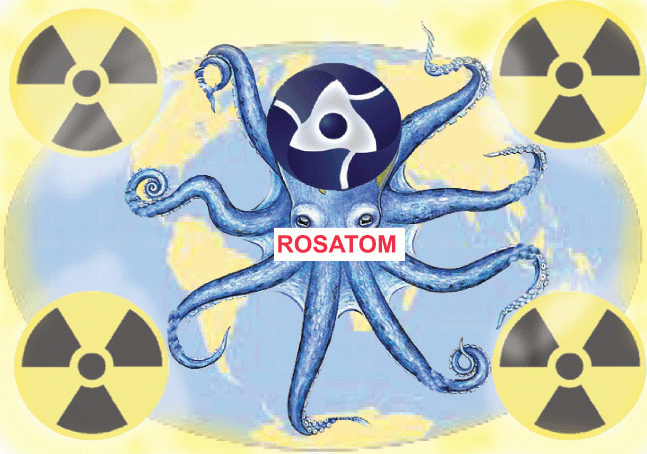
As the Western nuclear industry flounders, Russia’s Rosatom is building nuclear power plants (NPPs) on time and under budget around the world, while selling uranium to the US……………….
Russia’s nuclear industry is thriving, thanks mainly to its international business. According to Aleksey Likhachev, CEO of Rosatom, Russia’s nuclear monopoly, Russia is currently at work on 23 nuclear power units in a dozen different countries, including China, India, Belarus, Turkey, Hungary and Egypt. It sold $10bn worth of products abroad in 2022, a 15% increase on the year before, and its current foreign order book stands at over $200bn. Rosatom is actively courting new customers, mostly in the developing world; it offers a “full service” package that covers construction and operation, as well as the supply and reprocessing of nuclear fuel. The Russian government actively supports Rosatom with low-interest financing. In short, Russian nuclear power is on a roll.
But that is not all. In addition to building and operating new NPPs, Rosatom exports enriched uranium to numerous countries around the world, including the US and Europe. (In addition, Rosatom provides services to five EU counties that operate Russian-built NPPs.) Even though the revenues are not comparable (only about $1bn per year), the fuel exports are key politically. Because of this dependence, Russia’s nuclear industry is not under Western sanctions (as discussed further below), and it is not likely to be so any time soon. At this moment, Rosatom is able to operate without impediment, both at home and abroad; one of the few sectors in the Russian economy to be able to do so.
For both the US and Europe the implications are serious. First, they will continue to depend on Russian enriched uranium for several years more, potentially weakening their common front on sanctions. (Indeed, there have already been substantial disagreements among EU members over their policy toward Russian nuclear power.)
…… . Russia should continue to hold a commanding position in nuclear power for some time to come. …..

…. Putin named a politician, Sergei Kiriyenko, (above)to head the nuclear programme. Kiriyenko had had a mixed career up to that time – including a disastrous five-month stint as prime minister that coincided with Russia’s 1998 financial meltdown – but he turned out to be a talented manager. He regathered Rosatom’s wandering assets under one roof and after seeing off the oligarchs, he brought the industry’s unruly suppliers and contractors to heel. During the next eleven years he built Rosatom into a powerhouse. In 2016, Putin rewarded him with a secret medal and a top job, as Number 2 in the Kremlin’s Presidential Administration, where he is today.
The secrecy was no accident. When Rosatom was created in 2007, it inherited both the civilian NPPs and the military weapons assets. Kiriyenko made vigorous efforts to disentangle the military wing from the civilian, but the separation proved easier to achieve on paper than in reality. Today, the civilian and the military parts of Rosatom remain connected at the hip, as many parts of the nuclear supply chain, beginning with the mining of uranium, serve both military and civilian customers inside Russia.
But the military part was (and is) funded directly by the government, while the civilian part was supposed to be self-supporting. For Kiriyenko, this was a crucial difference. He had begun with ambitious plans for expanding nuclear power inside Russia, but he soon realised that there was little domestic demand for new NPPs in an electricity sector dominated by gas, and so Kiriyenko turned his sights on the foreign market. For this he needed to persuade the international community that Rosatom had become essentially a civilian business, in other words to fashion a new “commercial” image for the company. By and large he was successful, and Rosatom owes its present prosperity largely to the international business he built.
The impact of Western sanctions
Because of its important role as a supplier of uranium and nuclear fuels to NPPs around the world, including the US, Rosatom is not under Western sanctions. The US, in particular, relies on Russia for low-enrichment uranium for its own NPPs. Although efforts are under way to develop substitutes, for the present Rosatom is simply too valuable to sanction.
But even if sanctions were to be imposed, Rosatom’s operations would be largely unaffected by them. Internally, its supply chain, which as mentioned runs from uranium mining to power plant construction and operation, depends very little on the outside. ………….
Rosatom’s international business might be somewhat more vulnerable to sanctions, but so far there is little sign of it. Only one country, Finland, has pulled out of an ongoing project with Rosatom. ………………………….
Multiple challenges ahead
Yet quite apart from sanctions, Rosatom and Russian nuclear power may face multiple challenges ahead. One of them is technological progress. …………
Russia is the only country in the world to operate nuclear-powered icebreakers and floating NPPs, both of which are powered by small reactors. The Russian experience in designing and building small reactors goes back decades to the Soviet era, and there have been multiple generations of successively improved designs. Rosatom is working on deploying them not only on nuclear icebreakers and floating platforms, but also on land.
…………………….. The key to the future of SMRs, in the longer term, will likely be so-called “Generation IV” reactors, based on revolutionary designs that break entirely from the traditional light-water-reactor technology. But Generation IV is still an immature technology, and the race for leadership in G-IV is only now getting under way.
The more proximate threat to Rosatom’s leading position is Beijing. China has a vigorous nuclear programme, which is entirely independent of Russia…………………………………………
Finally, the ultimate challenges for Rosatom may be safety and reputational risk. Ever since the Chernobyl disaster in 1986, the Russian nuclear industry has had an excellent safety record. But the Russian invasion of Ukraine raises a serious new threat. There are four NPPs operating in Ukraine – ironically, all of them of Soviet manufacture. Russian [?] missiles have already landed close to one of them, the Zaporizhzhia plant, which is located close to the current battle line between Russian and Ukrainian forces. Just who is responsible for the safety of the plant is in dispute……………for Rosatom this plan is full of risks. If the plant were damaged and there were radioactive contamination, quite apart from the further suffering this would inflict on the Ukrainian people, for Rosatom the reputational damage would be extreme.
……. The challenges ahead are real, but they will come more from technological changes and rising competition from China, than from sanctions, from which Rosatom in any case remains so far exempt. https://www.intellinews.com/gustafson-russian-nuclear-power-unsanctioned-is-prospering-worldwide-266160/
Delay to small nuclear reactors as ministers battle over costs

Sunday January 08 2023, 12.01am GMT, The Sunday Times Harry Yorke
A funding deal for the first fleet of mini nuclear reactors is not expected to materialise for at least another 12 months, amid a row in government over the cost of Britain’s wider nuclear ambitions.
Last year, in order to triple domestic nuclear capacity to 24 gigawatts by 2050 — a quarter of the UK’s projected electricity demand — Boris Johnson set out plans for eight new large reactors alongside the development of small modular reactors (SMRs).
The government also announced the formation of Great British Nuclear (GBN), a body responsible for helping to deliver the next generation of reactors and SMRs by identifying potential sites, developers and investors.
At present only one plant, Hinkley Point C, is under construction, with the financing and final investment decisions on Sizewell C still pending. However, even though all but one of the UK’s existing plants are set to be shut down by the end of the decade, the government’s nuclear strategy now appears at risk of stalling amid internal disagreements.
In particular, Whitehall sources have revealed that there remains significant uncertainty over the scale of state investment in SMRs. Rolls-Royce, which has created designs for a 470 megawatt SMR and wants to
begin building factories, has called for ministers to enter funding talks and start placing orders. Rolls is understood to be seeking a commitment for four initial SMRs at a cost of about £2 billion each, which it
believes would unlock orders from interested foreign buyers.
But a senior government source said the Treasury would not sign off on any orders or significant funding until the technology had approval from the Office for Nuclear Regulation, which is not expected until 2024.
While the government has already invested £210 million in Rolls’s technology, the Department for Business, Energy and Industrial Strategy (BEIS) is also still assessing whether its competitors, including GE Hitachi, may offer “more viable” alternatives.
Insiders have signalled that the government may opt to launch yet another competition to gather further evidence before any firm deals are struck. More broadly, Treasury ministers harbour big concerns over the
costs associated with GBN, which officials have warned is billions over budget. While officials expect GBN to be announced early this year, after months of delays, the internal wrangling could lead to changes to both the body’s scope and funding.
Times 8th Jan 2023
Coal Boss Compiles Lastest Nuclear Dump Report for Government who have just Approved his Coal Mine.

Originally posted on Keep Cumbrian Coal in the Hole: High Level Cronyism and Corruption – Coal and Nuclear Waste Still not raising an eyebrow in the press or by NGOs is the fact that the coal boss Mark Kirkbride is the Government’s key advisor on the dumping of nuclear wastes in big holes. The latest…
Coal Boss Compiles Lastest Nuclear Dump Report for Government who have just Approved his Coal Mine. — RADIATION FREE LAKELAND
Sizewell C: How will the £20billion plant be fully-funded?
Campaigners will have their day in court to challenge the “woeful
decision” to give the go-ahead to the Sizewell C nuclear plant – just part
of a challenging year ahead for the huge project.
The government approved the £20billion-plus twin reactor on the Suffolk coast last summer and has
already pledged £700million of public money towards it along with a levy
on power bills.
But that still leaves huge decisions to be made as to where
the rest of the money will come from and how the power plant – which will
provide electricity for six million homes – will be fully funded.
Ministers say the financial investment decision (FID) will be made in this parliament
– which means in the next two years, though it could come sooner than that.
Construction work on the reactors will start soon after. Early work this
year will continue on the main development site and also to relocate some
buildings at Sizewell B to make room for Sizewell C.
East Anglian Daily Times 4th Jan 2023
https://www.eadt.co.uk/news/23225503.sizewell-c-will-20billion-plant-fully-funded/
Russian computer hacking team targeted 3 USA nuclear weapons facilities
A Russian hacking team known as Cold River targeted three nuclear research
laboratories in the United States this past summer, according to internet
records reviewed by Reuters and five cyber security experts.
Between August and September, as President Vladimir Putin indicated Russia would be
willing to use nuclear weapons to defend its territory, Cold River targeted
the Brookhaven (BNL), Argonne (ANL) and Lawrence Livermore National
Laboratories (LLNL), according to internet records that showed the hackers
creating fake login pages for each institution and emailing nuclear
scientists in a bid to make them reveal their passwords.
Reuters 6th Jan 2023
https://www.reuters.com/world/europe/russian-hackers-targeted-us-nuclear-scientists-2023-01-06/
Sizewell C Nuclear Project’s biggest stumbling block is its funding problem.
Everything you need to know about the future of Sizewell C power station
in 2023.
Sizewell C’s biggest stumbling block surrounds its funding. The
government’s £700 million commitment is merely a small amount of the
estimated final cost, which is likely to run above £25 billion.
In November, Business, Energy and Industrial Strategy Secretary Grant Shapps
confirmed that the government had bought out China General Nuclear’s stake
in the project. However, it’s reported that around 60 per cent of the
funding is yet to be found. Most of the returns for the investors will come
when they sell electricity to businesses and households around the UK.
However, the government has also said that it will allow investors in new
nuclear to get money through the so-called Regulated Asset Base model.
Suffolk Live 5th Jan 2023
https://www.suffolklive.com/news/suffolk-news/everything-you-need-know-future-7989137
Nuclear Ukraine? Amid ‘concerns’ over alleged Russian threat, the world overlooks the real danger

on February 19, 2022, before the start of Russia’s special military operation, Ukrainian President Vladimir Zelensky announced at the Munich Security Conference that Ukraine has the right to abandon the Budapest Memorandum, which proclaimed the country’s nuclear-free status.
Rt.com By Olga Sukharevskaya, ex-Ukrainian diplomat 6 Jan 23 Kiev is capable of building an atomic device, and its leaders often outline such thoughts.
Last year, Western media and high-ranking politicians actively discussed the possibility of Russian troops using atomic weapons in Ukraine. There has even been speculation on the likelihood of a nuclear war breaking out. However, it could be said that the risk is probably a lot higher on the other side of the barricades.
Ukraine’s Atomic History
Ukraine was a nuclear state after the collapse of the USSR, when 1,700 active atomic warheads remained in the country. Its politicians of that time had the prudence to abandon this status. The weapons were taken to Russia under international control, and their means of delivery were destroyed. Ukraine’s missile silos, with the exception of one which is now a museum near Kiev, were blown up, while its strategic bombers capable of carrying nuclear weapons were either transferred to Russia or destroyed.
Despite this, there were still many nuclear specialists in Ukraine, as research into nuclear fission has been conducted in Kharkov since the 1930s. In addition, five nuclear power plants were built in Ukraine during the Soviet years: Zaporozhye, Rovno, Khmelnitsky, and South-Ukrainian, as well as the infamous Chernobyl, where an accident involving a power unit led to an explosion that spewed radioactive fallout throughout Europe.
In addition, uranium is extracted at a deposit in Ukraine’s Kirovograd Region and enriched at a plant in the city of Zheltye Vody. In the 2010s, there were plans with Russia’s Rosatom to build a plant in Ukraine that would produce fuel for nuclear power stations. However, these were abandoned after the Maidan coup in 2014, when the country adopted an adversarial stance towards Russia.
At present, three of Ukraine’s five original nuclear power plants remain under its control. Chernobyl, which continued to generate electricity even after the 1986 accident, was finally decommissioned in 2020, while Zaporozhye, the largest nuclear power plant in Europe, has been guarded by Russian troops since last year. It is currently being run by Rosatom but does not produce electricity, largely for safety reasons. This is due to regular rocket and artillery attacks by Ukrainian troops, which have damaged numerous pieces of auxiliary equipment.
Push to Reobtain Nuclear Weapons
It should be noted that not everyone in Ukraine was happy that the country gave up its nuclear weapons. Ukrainian politicians have often failed to hide the fact that their dream of reobtaining nuclear weapons is not so much connected with their country’s security, as the desire to dictate their will to the rest of the world. Radical Ukrainian nationalists were particularly dissatisfied with the abandonment of the country’s nuclear status, and many of their manifestos contain a clause calling for it to be restored.
For example, “the return of nuclear weapons” is specifically cited as a goal in paragraph 2 of the Military Doctrine section in the program statement of the Patriot of Ukraine organization, while paragraph 7 of its Foreign Policy section reads: “The ultimate goal of Ukrainian foreign policy is world domination.” Patriot of Ukraine was created in 2014 by the notorious Andrey Biletsky, who formed it based on the ideology of the neo-Nazi Azov Battalion and had dreamed of Ukraine possessing nuclear weapons as far back as 2007.
In 2009, the Ternopil Regional Council, which was then dominated by Oleg Tianibok’s neo-Nazi Svoboda Party (called the Social-National Party until 2004), demanded that Ukraine’s president, prime minister, and head of the Verkhovna Rada “terminate the Budapest Memorandum of 1994 and retore Ukraine’s nuclear status.”
Ukraine’s longing for an atomic bomb especially increased after February 2014. In an interview with USA Today in March of that year, Ukrainian MP Pavel Rizanenko called Ukraine’s accession to the Treaty on the Non-Proliferation of Nuclear Weapons a “big mistake.” And that was not just the opinion of one MP. Just a few days later, representatives of the Batkivshchyna party, headed by ex-Prime Minister Yulia Timoshenko, and UDAR, headed by Kiev’s current mayor, Vitaly Klitschko, including the secretary of the parliamentary Committee on National Security and Defense, Sergey Kaplin, submitted a bill on withdrawing from the non-proliferation treaty. Kaplin claimed that Ukraine could create nuclear weapons in just two years because it already had almost everything necessary: The fissile materials, equipment (except centrifuges), technology, specialists, and even means of delivery. In September of the same year, Ukraine’s minister of defense, Valery Geletey, also expressed the desire to develop nuclear weapons.
In December 2018, the former representative of the Ukrainian mission to NATO, Major General Pyotr Garashchuk, announced the real possibility of Ukraine creating its own nuclear weapons. In 2019, Aleksandr Turchinov, who usurped power in Ukraine in February of 2014, called Ukraine’s renunciation of nuclear weapons a “historic mistake.” Following him, in April 2021, the Ukrainian ambassador to Germany, Andrey Melnik, stated that if the West did not help Ukraine in its confrontation with Russia, the country would launch a nuclear program and create an atomic bomb. And on February 19, 2022, before the start of Russia’s special military operation, Ukrainian President Vladimir Zelensky announced at the Munich Security Conference that Ukraine has the right to abandon the Budapest Memorandum, which proclaimed the country’s nuclear-free status.
Perhaps the most striking statement by a Ukrainian politician was made by David Arakhamia, the head of the Ukrainian parliament’s ruling parliamentary faction, Servant of the People. “We could blackmail the whole world, and we would be given money to service (nuclear weapons), as is happening in many other countries now,” he said in mid-2021.
Range of Possibilities
Is Ukraine technically capable of creating an atomic bomb? Absolutely. Yes, enriching uranium-235 to the purity necessary to set off a chain reaction would cost a lot, primarily to create centrifuges for separating isotopes. However, though this may be the most effective way to separate isotopes, it’s not the only one. The first American bombs dropped on Hiroshima and Nagasaki were created without the use of this technology.
In addition, it should not be forgotten that there are not only uranium, but also plutonium bombs. Breeder reactors are used to synthesize this chemical element, most often using heavy-water reactor technology, and research reactors are capable of producing weapons-grade plutonium. There is presently a nuclear research installation at the Kharkov Institute of Physics and Technology, and a VVR-M reactor suitable for plutonium production at the Institute for Nuclear Research of Ukraine’s National Academy of Sciences in Kiev. ………………………………………..
Nuclear Power on the Brink of Disaster
Just as dangerous is the nuclear power policy pursued by the Ukrainian government.
Ukraine inherited five nuclear power plants with 18 active reactors from the USSR. Three of them located at the Chernobyl NPP were decommissioned by 2000. Five of the six reactors at the Zaporozhye NPP, three of the four reactors at the Rovno NPP, one of the two reactors at the Khmelnitsky NPP, and all three reactors at the South Ukraine NPP have exceeded their original lifespans and received extensions of their operating lives for another 10 to 15 years.
The license extensions have sometimes been granted with violations of existing regulations since, after 2015, Ukraine’s State Nuclear Regulatory Inspectorate stopped cooperating with Russian vendors and has not overhauled reactor vessels, which become brittle after prolonged exposure to neutron radiation. Back in 2015, independent experts noted the critical condition of Reactor 1 of the South Ukraine NPP, which, nevertheless, has had its service life extended until 2025.
Ukraine’s Union of Veterans of Nuclear Energy and Industry sent a warning letter to the government in April 2020, arguing that the country’s nuclear energy sector was faced with a “threatening situation,” which, according to the authors of the letter, could well result in “a new Chernobyl.……………..
That fuel assemblies fabricated by Westinghouse tend to malfunction in Soviet-designed reactors was not a revelation. They have repeatedly caused emergencies at NPPs in Finland, Hungary, the Czech Republic, and Slovakia, but that did not deter the Ukrainian leadership. Not even losses of around $175 million caused by using non-standard assemblies persuaded Ukraine against conducting risky experiments with its nuclear assets………….
Emergencies at Ukrainian NPPs became a routine event, and yet Westinghouse assemblies accounted for 46% of all nuclear fuel used in Ukraine by the end of 2018………………………………………………………….
Provocation for Nuclear Escalation
After Russian forces assumed control of the Zaporozhye NPP, it became a target for incessant Ukrainian shelling, sometimes with the use of Western-made multiple launch rocket systems, heavy artillery, and attack drones. The plant sustained significant damage and was forced to stop generating electricity due to the destruction of auxiliary equipment and the threat to the reactors themselves. At the same time, an IAEA mission “was unable” to establish who was firing on the nuclear site, where Russian soldiers were present.
As the Western media was busy whipping up hysteria over the potential use of tactical nuclear weapons by Russia in Ukraine, it transpired that Ukraine was allegedly plotting a provocation of exactly that nature. According to Russian intelligence services, in October 2022, the Eastern Mining and Enrichment Combine in the town of Zheltye Vody and the Kiev Institute for Nuclear Research were in the final stages of developing a dirty bomb on the orders of the Ukrainian government. A missile plant in Dnepropetrovsk built a mock-up of the Russian Iskander missile, which was supposed to carry a radioactive charge and be “shot down” over the Chernobyl exclusion zone. The goal was to accuse Russia of using nuclear weapons and push NATO to retaliate in kind. In other words, to start a nuclear war in Europe.
All these facts mean that present-day Ukraine is arguably a real threat to nuclear security not just in Europe, but on a global scale. It has everything it would take, from irresponsible people in charge of safety and security at nuclear sites, to the technical capabilities. https://www.rt.com/russia/569292-one-step-from-nuclear-armageddon/
Great Britain produced a record amount of wind-powered electricity in 2022
Great Britain produced a record amount of wind-powered electricity in 2022,
according to the National Grid. More electricity came from renewable and
nuclear power sources than from fossil fuels gas and coal, the second
highest after 2020.
Replacing fossil fuels with green power is a core way
for the world to tackle the impacts of climate change. Sources like wind
and solar are also significantly cheaper and should lead to cheaper bills
in the long-run.
Overall 48.5% of electricity came from renewable and
nuclear power, compared to 40% from gas and coal power stations. On a
single day in November, more than 70% of electricity was produced by wind,
or around 20GW. That’s enough power to heat about 1700 homes for a year.
That record was again broken on 30 December when 20.918GW was generated by
wind turbines. For five months of the year (February, May, October,
November and December), more than half of electricity came from so-called
zero carbon electricity sources renewable and nuclear. And the use of coal
– the most polluting fossil fuel – continued to fall. In 2022 it generated
just 1.5% of electricity compared to 2012 when it was 43%.
BBC 6th Jan 2023
White Lives Matter More in Ukraine
Black Agenda Report Margaret Kimberley, BAR Executive Editor and Senior Columnist, 04 Jan 2023,
The open white supremacy and fascism exhibited in Ukraine are conveniently swept under the rug. Nazis are bad, unless they serve the interests of the U.S. state.
The accuracy of this commentary’s title is borne out by statements made and actions taken by the Ukrainians themselves. In 2020 millions of people around the world protested against racism in the wake of the police murder of George Floyd. Ukrainians made it clear that they were not to be included amongst that mass of humanity and in fact expressed their support for white supremacy.
In June 2020, a group of football fans at a match in Ukraine unfurled a banner reading, “Free Derek Chauvin .” Chauvin is the man who murdered George Floyd. Not to be outdone, members of the neo-Nazi group Nazionalny Sprotyv, National Resistance, marched on October 14, 2020 with a banner that made the point very clear. The words “White Lives Matter ” were written in English and in much larger type than the name of the organization which appeared in small type below. October 14 is celebrated as the Day of the UPA, the Ukrainian Insurgent Army, which fought alongside Nazi Germany after it invaded Ukraine during World War II. The words in the pink graphic on the video read, “On the march of UPA Nazis carefully burned the poster of BLM.” Nazionalny Sprotyv is known for its racist, anti-Russian, anti-LGBTQ, and anti-Communist beliefs.
The war propaganda disseminated by the Biden administration and its friends in corporate media tells us to ignore the swastikas, Hitler salutes, and other clear indicators of Nazi sympathies when they appear in Ukraine. Suddenly symbolism which we were told to abhor as indisputable signs of hate speech are now to be accepted or explained away as figments of our collective imagination.
Nazi regalia and symbolism should make assistance to the Ukrainian government an automatic deal breaker. But the U.S. has always been rather flexible in its approach to Nazism. After World War II an intelligence program known as Operation Paperclip brought more than 1,600 German scientists to the U.S. to fight in the new cold war against the Soviet Union. Their links to the Nazi party were covered up so that they might be of assistance to the U.S. Werner von Braun and other Nazi linked scientists were instrumental in creating the U.S. space program.
Ukraine was a divided nation from its very beginnings after World War I, with half of the country hating the Soviet Union so much that they sided with and fought alongside the Germans. January 1 is officially celebrated not just as the first day of the year but as the birthday of Ukraine’s chief Nazi collaborator, Stepan Bandera. The 2023 celebration was no exception but not without embarrassment. The Ukrainian parliament was forced to delete a Twitter post featuring a photo of army commander General Valerii Zaluzhny juxtaposed with an image of Bandera. Bandera massacred thousands of Poles during the war and the Ukrainians had to be reminded through diplomatic channels that everyone isn’t as forgiving as clueless Americans. Just as Operation Paperclip is an inconvenient and rarely discussed truth, Ukraine’s continuing Nazi and white supremacist connections are now hushed up by the U.S. state and its media partners.
It is indeed awkward for Joe Biden to greet president Zelensky at the white house and for him to speak in congress if these facts are openly discussed…………
The Biden administration invitation to Zelensky was an effort to ensure that an additional $45 billion was allocated to Ukraine before the congressional session ended. The standing ovations and blue and yellow flags and cries of “Slava Ukraini!” were orchestrated to get more buy-in at a time when many Americans are asking why their needs go unmet and why Ukraine can’t resume the negotiations it was holding months ago with Russia. It has been reported that the U.S. sent the then prime minister of the UK, Boris Johnson, to tell Zelensky that any talk of peace had to end . Russia was ready to withdraw in exchange for security guarantees and an end to Ukraine’s efforts to secure NATO membership. But Ukraine is the latest U.S. forever war and its people have to suffer and die because of its dictates.
Perhaps the saddest sight of the night of Zelensky’s congressional speech was the adulation he received from some members of the Congressional Black Caucus (CBC). CBC members Sheila Jackson-Lee and Barbara Lee eagerly sought to shake his hand. Perhaps they are unaware of Ukraine’s white supremacist leanings. But that can’t be true. After all, in 2015 their CBC colleague, the late John Conyers, co-sponsored an amendment that would have barred U.S. funding to the Azov battalion and other Ukrainian neo-Nazi groups. The amendment was ultimately removed from the final spending bill…………………… more https://www.blackagendareport.com/white-lives-matter-more-ukraine
 | |||
| |||
International nuclear fusion project may be delayed by years, its head admits
Facility in France still far from being able to show feasibility of generating carbon-free energy despite recent breakthrough in US
Guardian, AFP in Saint-Paul-Les-Durance Sat 7 Jan 2023
An international project in nuclear fusion may face years of delays, its boss has said, weeks after scientists in the United States announced a breakthrough in their own quest for the coveted goal.
The International Thermonuclear Experimental Reactor (Iter) project seeks to prove the feasibility of fusion as a large-scale and carbon-free source of energy.
Installed at a site in southern France, the decades-old initiative has a long history of technical challenges and cost overruns.
Fusion entails forcing together the nuclei of light atomic elements in a super-heated plasma, held by powerful magnetic forces in a doughnut-shaped chamber called a tokamak.Q&A
The idea is that fusing the particles together from isotopes of hydrogen – which can be extracted from seawater – will create a safer and almost inexhaustible form of energy compared with splitting atoms from uranium or plutonium.
Iter’s previously stated goal was to create the plasma by 2025.
But that deadline will have to be postponed, Pietro Barabaschi – who in September became the project’s director general – told Agence France-Presse during a visit to the facility.
The date “wasn’t realistic in the first place”, even before two major problems surfaced, Barabaschi said…………………………………
Ukraine – The Big Push To End The War
https://www.moonofalabama.org/2023/01/ukraine-the-big-push-to-end-the-war 6 Jan 23
Over Christmas I had a short talk with a relative about the war in Ukraine. He asked me who would win and was astonished when I said: “Ukraine has zero chance to win.” That person reads some German mainstream news sites and watches the public TV networks. With those sources of ‘information’ he was made to believe that Ukraine was winning the war.
One may excuse that with him never having been in a military and not being politically engaged. But still there are some basic numbers that let one conclude from the beginning that Russia, the much bigger, richer and more industrialized country, had clearly all advantages. My relative obviously never had had that thought.
The ‘western’ propaganda is still quite strong. However, as I pointed out in March last year propaganda does not change a war and lies do not win it. Its believability is shrinking.
Former Lt.Col. Alex Vershinin, who in June pointed out that industrial warfare is back and the ‘West’ was not ready to wage it, has a new recommendable piece out which analyses the tactics on both sides, looks ahead and concludes that Russia will almost certainly win the war:
Wars of attrition are won through careful husbandry of one’s own resources while destroying the enemy’s. Russia entered the war with vast materiel superiority and a greater industrial base to sustain and replace losses. They have carefully preserved their resources, withdrawing every time the tactical situation turned against them. Ukraine started the war with a smaller resource pool and relied on the Western coalition to sustain its war effort. This dependency pressured Ukraine into a series of tactically successful offensives, which consumed strategic resources that Ukraine will struggle to replace in full, in my view. The real question isn’t whether Ukraine can regain all its territory, but whether it can inflict sufficient losses on Russian mobilized reservists to undermine Russia’s domestic unity, forcing it to the negotiation table on Ukrainian terms, or will Russian’ attrition strategy work to annex an even larger portion of Ukraine.
Russian domestic unity has only grown over the war. As Gilbert Doctorow points out wars make nations. The war does not only unite certain nationalistic parts of Ukraine who still dream of retaking Crimea. It also unites all of Russia. Unlike Ukraine Russia will be strengthened by it.
Casualties are expected in wars and the Russians, with their steady remembrance of the second world war as their Great Patriotic War, know this well. Screw ups also happen and at times some bad leadership decisions puts people into the wrong place where the enemy can and will kill them. That is what happened in Makeyevka (Donetsk) on New Years day 2 minutes after midnight. Some 100 Russian reservists died. The Russian leadership pointed out that they were killed by U.S. HIMARS missiles. The former Indian diplomat M. K. Bhadrakumar judges that this was a U.S. escalation which will likely receive a response:
1 This Month





PLEASE OPPOSE HR 8255 AND S.3639 – bills would accelerate satellite deployment, with no environmental review or safeguards – https://ncstd5li.quorum.us/campaign/169331/
To see nuclear-related stories in greater depth and intensity – go to https://nuclearinformation.wordpress.com
-
Archives
- October 2026 (58)
- September 2026 (339)
- August 2026 (330)
- July 2026 (355)
- June 2026 (287)
- May 2026 (306)
- April 2026 (356)
- March 2026 (251)
- February 2026 (267)
- January 2026 (308)
- December 2025 (358)
- November 2025 (359)
-
Categories
- 1
- 1 NUCLEAR ISSUES
- business and costs
- climate change
- culture and arts
- ENERGY
- environment
- health
- history
- indigenous issues
- Legal
- marketing of nuclear
- media
- opposition to nuclear
- PERSONAL STORIES
- politics
- politics international
- Religion and ethics
- safety
- secrets,lies and civil liberties
- spinbuster
- technology
- Uranium
- wastes
- weapons and war
- Women
- 2 WORLD
- ACTION
- AFRICA
- Atrocities
- AUSTRALIA
- Christina's notes
- Christina's themes
- culture and arts
- Events
- Fuk 2022
- Fuk 2023
- Fukushima 2017
- Fukushima 2018
- fukushima 2019
- Fukushima 2020
- Fukushima 2021
- general
- global warming
- Humour (God we need it)
- Nuclear
- RARE EARTHS
- Reference
- resources – print
- Resources -audiovicual
- Weekly Newsletter
- World
- World Nuclear
- YouTube
-
RSS
Entries RSS
Comments RSS

