France what to do as nuclear waste site risks saturation point?
Should saturation happen, France’s reactors would have nowhere to place their spent fuel and would have to shut down
France seeks strategy as nuclear waste site risks saturation point
Reuters, By Benjamin Mallet 3 Feb 23
- Summary
- Macron to chair Council on Nuclear Policy on Friday
- Macron has announced plan for at least six new nuclear reactors
- EDF working on extra refrigerated pool
- France also considering plan to bury waste in clay
LA HAGUE, France, Feb 3 (Reuters) – At a nuclear waste site in Normandy, robotic arms guided by technicians behind a protective shield manoeuvre a pipe that will turn radioactive chemicals into glass as France seeks to make safe the byproducts of its growing reliance on atomic power.
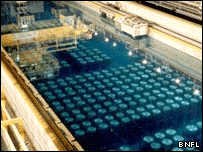
The fuel-cooling pools in La Hague, on the country’s northwestern tip, could be full by the end of the decade and state-owned Orano, which runs them, says the government needs to outline a long-term strategy to modernise its ageing facilities no later than 2025.

While more nuclear energy can help France and other countries to reduce planet-warming emissions, environmental campaigners say it replaces one problem with another.
To seek solutions, President Emmanuel Macron, who has announced plans to build at least six new reactors by 2050, on Friday chairs the first of a series of meetings on nuclear policy that will discuss investments and waste recycling.
“We can’t have a responsible nuclear policy without taking into account the handling of used fuel and waste. It’s a subject we can’t sweep under the rug,” a government adviser told Reuters, speaking on condition of anonymity…….
La Hague is the country’s sole site able to process and partially recycle used nuclear fuel.
France historically has relied on nuclear power for around 70% of its energy, although the share is likely to have fallen last year as the nuclear fleet suffered repeated outages.
Since the launch of the site at La Hague in 1976, it has treated nearly 40,000 tonnes of radioactive material and recycled some into nuclear fuel that can be re-used. The waste that cannot be recycled is mixed with hardening slices of glass and buried for short-term storage underground.
But its four existing cooling pools for spent fuel rods and recycled fuel that has been reused risk saturation by 2030, according to French power giant EDF (EDF.PA), which runs France’s 56-strong fleet of reactors, the world’s second biggest after the United States.
Should saturation happen, France’s reactors would have nowhere to place their spent fuel and would have to shut down – a worst-case scenario that led France’s Court of Audit to designate La Hague as “an important vulnerability point” in 2019.
COOL POOLS AND DEEP CLAY
EDF is hurrying to build an extra refrigerated pool at La Hague, at a cost of 1.25 billion euros ($1.37 billion), to store spent nuclear fuel – a first step before the waste can be treated – but that will not be ready until 2034 at the earliest.
Meanwhile, France’s national agency for managing nuclear waste last month requested approval for a project to store permanently high-level radioactive waste.
The plan, called Cigéo, would involve placing the waste 500 metres (1,640 ft) below ground in a clay formation in eastern France.
Construction is expected in 2027 if it gets approval. Among those opposed to it are residents of the nearby village of Bure and anti-nuclear campaigners
………… Orano, for which EDF accounts for 95% of its recycling business, says it needs clear direction from the government no later than 2025, to give it time to plan the necessary investments.
The costs are likely to be high. Just keeping up with current operations at La Hague costs nearly 300 million euros a year.
Options EDF and Orano are considering include finding a way to recycle the used fuel more than once, but critics say the recycling itself creates more radioactive waste and is not a long-term solution. For now, the backup plan is to fit more fuel containers into the existing pools.
After being cooled in a pool for about seven years, used nuclear fuel is separated into non-recyclable leftovers that are turned into glass (4% of the material), plutonium (1%) to create a new nuclear fuel called MOX, on which around 40% of France’s reactors can run, and reprocessed uranium (95%).
Options EDF and Orano are considering include finding a way to recycle the used fuel more than once, but critics say the recycling itself creates more radioactive waste and is not a long-term solution. For now, the backup plan is to fit more fuel containers into the existing pools.
After being cooled in a pool for about seven years, used nuclear fuel is separated into non-recyclable leftovers that are turned into glass (4% of the material), plutonium (1%) to create a new nuclear fuel called MOX, on which around 40% of France’s reactors can run, and reprocessed uranium (95%).
The uranium in the past was sent to Russia for re-enrichment and return for use in some EDF reactors, but EDF stopped doing that in 2013 as it was too costly.
In spite of the war in Ukraine, which has made many in the West avoid doing business with Russia, EDF is expected to resume sending uranium to Russia this year as the only country able to process it. It declined to confirm to Reuters it would do so.
The facility at La Hague, with its 1980s-era buildings and Star Wars-style control rooms, has its limitations.
“If we had to process MOX fuel in large quantities, the facility today isn’t adapted for it,” Varin said. “For multi-cycle recycling, the technology is not the same, so the modernisation or replacement of installations” would require “significant” investments, he said.
($1 = 0.9098 euros) https://www.reuters.com/business/environment/france-seeks-strategy-nuclear-waste-site-risks-saturation-point-2023-02-03/
Belgium looks to extend lives of oldest nuclear reactors.
DW. 3 Feb 23,
The Belgian government is assessing whether to extend the life of three nuclear reactors that had been due to close in 2025, citing a need to “reduce risks in the energy supply” in lieu of the war in Ukraine.
…………………………… Operational since 1975, the three reactors were initially set to be decommissioned in 2015 but had their lifetime extended until 2025 after Belgium held a review of its phase-out plan.
A delayed phase-out
Belgium has two nuclear plants, operated by French utility company Engie, with five reactors still working.
Belgium first decided on its nuclear phase-out in 2003 and it was scheduled to be completed by 2025. However, it decided last year to keep the newest plants open until 2035.
Belgium took one nuclear reactor, Tihange 2, off its power grid after 40 years on Tuesday evening as part of the country’s planned nuclear phase-out. The winding down of nuclear power began with the closure of a reactor at Doel, near the Belgian port city of Antwerp in September.
Those two reactors were known for repeated safety issues, having been shut down on previous occasions after the discovery of cracks in reactor pressure vessels. The Belgian government had considered keeping those two reactors online because of energy concerns.
……………. The German government and the German city of Aachen, which lies near the Belgian border have repeatedly called for the reactors to be decommissioned in the past.
In 2019, the European Court of Justice found that Belgium infringed European Union law by failing to carry out the required environmental assessments before prolonging the life of Doel 1 and 2 nuclear reactors…….. https://www.dw.com/en/belgium-looks-to-extend-lives-of-oldest-nuclear-reactors/a-64606438
Ukraine’s Tank Problem – a “game changer” – REALLY?
It is impossible to see how the provision of such weapons, against a larger enemy with no evident sign of capitulation and determined to maintain the fight in the field, however slapdash and ailing, will be a “gamechanger”. That word ought to be scrapped from any credible analysis, but we see it used repeatedly in the tabloid certitude of final victory.
Australian Independent Media February 1, 2023: Dr Binoy Kampmark https://theaimn.com/ukraines-tank-problem/
It seems to be a case of little provision for so much supposed effect. The debates, the squabbles, the to-and-fro about supplying Ukraine with tanks from Western arsenals has served to confirm one thing: this is an ever-broadening war between the West against Russia with Ukraine an experimental proxy convinced it will win through. Efforts to limit the deepening conflict continue to be seen as the quailing sentiments of appeasers, the wobbly types who find democracy a less than lovable thing.
So far, promises have been made to ship the US M1A2 Abrams, Germany’s Leopard 2 and the UK’s Challenger. Others have alluded to doing the same thing – including France regarding its Leclerc tanks – but tardiness fills the ranks, and logistics will make the provision of such weapons a long affair. Re-export licenses will have to be issued, notably regarding the Leopard 2; training Ukrainian tank crews will also need to be undertaken.
All in all, the picture is not as rosy as those in Kyiv think, despite the confident assessment from Ukraine’s Deputy Foreign Minister, Andriy Melnyk that his country’s defence forces would have access to “at least a hundred tanks” within three months.
The US tanks are, for the most part, still grounded in their country of origin, with their deployment potentially delayed for months, if not years. Pentagon deputy spokesperson Sabrina Singh was frank in admitting that, “We just don’t have these tanks available in excess in our US stocks, which is why it is going to take months to transfer these M1A2 Abrams to Ukraine.” Singh, it should also be remembered, expressed the department’s view earlier this month that the tank was hardly suitable for Ukrainian needs, given how its jet turbine engine hungers for JP-8 jet fuel, unlike the diesel engine used by the Leopard and Challenger counterparts.
The engine is also rather tricky to maintain for crews, leaving it susceptible to blowing in the event of error. No less an authority than the Pentagon press secretary US Air Force brigadier general Pat Ryder, admitted that the M-1 “is a complex weapons system that is challenging to maintain, as we’ve talked about. That was true yesterday; it’s true today; it will be true in the future.”
There is also a backlog of orders for the tank. The Lima facility in Ohio, operated by General Dynamics, is the only facility that assembles the Abrams. It can produce a mere 12 tanks per month and must fulfill orders to supply 250 A2 tanks for Poland starting in 2025 to replace the same number of Soviet-era T-72 tanks Warsaw supplied to Kyiv last year. Taiwan also put in an order for 108 M1A2 tanks in 2019. Even getting to work on the 31 units promised by the Biden administration for Ukraine looks to be ambitious.
The wrangling over supplying Ukraine with tanks has been an at times acrimonious affair. This is hardly surprising. European states have their own specific readings, however dark or cautious, about how to approach the supply issue. The magic number being sought by Kyiv is 300. After initial resistance, German Chancellor Olaf Scholz gave in to his peers, both in his coalition outside, to send a company of Leopard 2 tanks and permit countries with the same tanks in their inventories to supply them to Kyiv. A fortnight of aggressive chatter at a number of venues, including Ramstein Air Base, pressing the flesh and breathing down various necks, saw a change of heart and, it has to be said, weak will on the part of the Chancellor.
It is impossible to see how the provision of such weapons, against a larger enemy with no evident sign of capitulation and determined to maintain the fight in the field, however slapdash and ailing, will be a “gamechanger”. That word ought to be scrapped from any credible analysis, but we see it used repeatedly in the tabloid certitude of final victory.
There is Ed Arnold of the Royal United Services Institute, who is confident that this tank transfer “will make a real difference.” But even Arnold attaches a few caveats, noting that much will depend on how Ukraine uses them. “Do they put them straight into the fight as soon as they’re available? Or do they integrate them into larger formations, train and rehearse those larger formations, and spend a bit more time integrating them into the way that they fight to then potentially use in the summer?”
Whatever the answer to such questions, this is a war that will yield no victors and will, in guaranteed fashion, make a mockery of victory. And the only cruel reality here, short of needless oblivion through imbecilic error of judgment, is to get the warring parties to the table to reach an agreement that is bound to cause despair as much as relief. It might, as unpalatable as it seems, require Ukraine to surrender a portion of devastated earth in the east. The unthinkable will have to be entertained.
Nuclear must not be part of Cromartry Firth freeport vision
YOUR VIEWS: ‘Nuclear should not be part of freeport vision’. A reader and
campaigner reacts to news that small nuclear reactors could be built in the
north. The Courier carried comments from Global director Steve Chisholm
that small modular nuclear reactors could be built in the Cromartry Firth
after the award of green freeport status for the area.
Nuclear should not be part of freeport vision I refer to the article headed “Nuclear Reactor
is in the freeport mix “(Inverness Courier, January 20) and was very
surprised that this proposal has now emerged. HANT (Highlands Against
Nuclear Transport) has raised concerns since 2013 about many safety
concerns related to the transport of nuclear waste by rail from Georgemas
Junction (near Dounreay) to Barrow and on to the Sellafield Nuclear plant.
There have been a number of incidents of concern related to both rail and
sea transport.
Inverness Courier 31st Jan 2023
Top UK pension funds refuse to invest in Sizewell C nuclear plan, despite government enticements.

‘Whatever the funding model, Sizewell C is highly controversial. It carries multiple risks, of time and cost overruns, reputation and technical problems.
‘If the Government is forced to peddle it to foreign investors, it will make its justification in terms of ‘energy sovereignty’ even more of a joke.’
‘If the Government is forced to peddle it to foreign investors, it will make its justification in terms of ‘energy sovereignty’ even more of a joke.’
Blow to Government’s infrastructure drive as two top UK pension funds snub Sizewell C nuclear plant plan
By FRANCESCA WASHTELL FOR THE DAILY MAIL, 1 February 2023
Efforts to attract investment in British infrastructure were hit after two of the UK’s biggest pension funds turned their backs on Sizewell C.
Ministers are tearing up old EU red tape that Chancellor Jeremy Hunt says will unlock £100billion in possible funding for major projects.
The most important of these is the £20billion Sizewell C nuclear power plant in Suffolk, which is being developed by the Government and EDF but will need billions of private funding.
The Government has spent years trying to woo pension groups and institutional investors by introducing a new funding model that allows them to receive dividends during the construction process.
It is expected to go a step further by classifying nuclear as a green energy source in an upcoming eco-friendly financing strategy, which would make it easier for companies to win support to invest in power plants.
But an industry source said Sizewell C would still not be an appropriate investment for ‘typical big-name UK pension schemes’, as they see the risk of cost over-runs and delays being too high.
So far, other potential backers such as Nest and Legal & General have said they do not intend to fund the project.
But British Gas owner Centrica is thought to be considering taking a stake, while FTSE 100 savings and retirement firm Phoenix Group has said it is keen to back nuclear.
The source added that funding was more likely to come from North America and the Middle East, with Emirati sovereign wealth fund Mubadala already said to be in the mix.
Alison Downes, the head of campaign group Stop Sizewell C, said: ‘Whatever the funding model, Sizewell C is highly controversial. It carries multiple risks, of time and cost overruns, reputation and technical problems.
‘If the Government is forced to peddle it to foreign investors, it will make its justification in terms of ‘energy sovereignty’ even more of a joke.’
Blasts near Zaporizhzhia nuclear plant
The UN nuclear watchdog reported Thursday (26 January) that there were
powerful explosions close to the Zaporizhzhia nuclear plant in Ukraine.
This prompted renewed calls for a zone of security around the facility.
Russian officials dismissed comments made by Rafael Grossi (head of the
International Atomic Energy Agency, IAEA), claiming that they suggested
Moscow couldn’t uphold nuclear safety.
EU Reporter 31st Jan 2023
Sea level rise will threaten UK coastal towns
A number of Somerset towns could be left underwater by 2090 if pollution
levels remain unchecked, according to a study. Climate Central’s map of the
county shows how the current coastline will change within a lifetime to
wash away settlements near the sea. Levels are predicted to rise by one
metre over the next 69 years, flooding Weston-super-Mare, Clevedon and
Avonmouth. However, it is not only seaside towns that will lose ground. A
huge stretch of the M5 between Burnham-on-Sea and Bridgwater will also be
underwater.
Somerset Live 31st Jan 2023
https://www.somersetlive.co.uk/news/somerset-news/somerset-towns-could-underwater-2090-8091726
The Unwarranted Ukraine Proxy War: A Year Later

US Big Defence will be the only winner of the proxy war in Ukraine. Not only do these global military contractors arm Ukraine, but they stand to benefit from the re-militarisation of Western European countries, Japan, and new NATO members.
In the view of Big Defence, peace is just a bad business proposition. There’s no money in it.
The World Financial Review, By Dr Dan Steinbock, 27 Jan 23
To Russia and Ukraine, the crisis is an existential issue. To the US and NATO, it’s a regime-change game. To Europe, it means the demise of stability – in the world economy, lost years (and that’s the benign scenario).
That’s how I characterised the US/NATO-led proxy war against Russia in Ukraine back in early March 2022. I argued that it was an “avoidable war that will penalise severely Ukraine, Russia, the US and the NATO, Europe, developing countries and the global economy”.[1]
At the time, the prediction was seen as contrarian. But it has prevailed. However, on January 25 the Ukraine proxy war entered a new, still more dangerous phase. The commitment of some 70 US, German, UK and Polish battle tanks herald lethal escalation, although hundreds more are needed to defeat Russia. For the first time since World War II, German tanks will be sent to the “Eastern front.” In Moscow, it will foster those voices who see the stakes of the war as existential.
Not only will economic and human costs climb even further, but strategic risks, including the potential of nuclear confrontation, will soar. With such escalation in high-tech arms sales to Ukraine, regional and military spillovers are no longer a matter of principle, but a matter of time.
Russia’s economic resilience
In early 2022, Western observers, with rare exceptions, predicted that the Russian economy would default within months as a net effect of sanctions. “Putin’s war” was doomed, they said. Obviously, the sanctions, which have been fuelled by might and economic coercion, have not been inconsequential. But nor were they new.
Already in February 2014, following the Russian annexation of Crimea, international sanctions were imposed against Russia and Crimea by the US, Canada, the EU, and the international organisations they dominate. While the West’s sanctions contributed to the fall of the Russian ruble, they also caused significant economic damage to the EU economy, with total losses at €100 billion in 2015. By mid-2016, Russia had lost an estimated $170 billion due to financial sanctions and another $400 billion in revenues from oil and gas.[2]………………………….
In fact, the Russian economy plunged 3.5 per cent in 2022, whereas inflation amounted to 5.4 per cent. In other words, Western institutions dramatically overestimated the GDP impact. Discrepancies of such magnitude are hard to explain away as simple prediction errors (figure 1 on original).
Proxy war united Russia
Officially, the invasion of Ukraine began as Russia’s “special military operation”. Unofficially, it soon morphed into a US/NATO-led proxy war against Russia in Ukraine. The true political objective of this war has been regime change. Hence the goal “to weaken Russia”, as Secretary of Defence Lloyd Austin acknowledged later. Hence, too, the international media predictions that the Russian economy would “inevitably” default and Putin be overthrown……………………
Today, in the view of ordinary Russians, Russia’s invasion of Ukraine is a defensive response to NATO’s offensive eastward enlargement. They see their country fighting for survival. That’s why the war caused Putin’s ratings to soar to the low 80s. That’s also why over 60 to 70 per cent of Russians support their government and believe the country is on the right track, despite extraordinary hardships. ……………………………………..
Amid this collapse of trust in the US and the EU, it certainly did not help that the Minsk peace process proved to be another Western ruse. Last December, German ex-Chancellor Angela Merkel disclosed in the Zeit newspaper that “the 2014 Minsk agreement was an attempt to give time to Ukraine.” That is, to make Ukraine stronger and for NATO to increase its support to the country in the face of Russia.[4]……………………
In the view of ordinary Russians, there is now a long continuum of betrayals from the pledge that NATO would never expand eastward in the early 1990s to Minsk today. In their view, the West’s recent arms escalation only confirms their worst suspicions.
Contradictory realities
Right before Christmas, President Volodymyr Zelenskyy delivered an emotional wartime appeal to a joint meeting of US Congress, pleading for more military assistance from the lawmakers, who were about to approve $45 billion in additional aid. It was necessary for “eventual victory”.[6]
Yet, there was a huge disconnect between the triumphant declaration and the realities. Earlier in the month, European Commission President Ursula von der Leyen had acknowledged that Ukraine’s losses in the war amounted to 100,000 soldiers and 20,000 civilians, though her tweet was quickly deleted and a new one was released without the true death count (figure 3 on original).[7
Behind the choreographed photo ops and bold sound bites, devastation had been expansive, progressive, and relentless…………..
In September 2022, a month before the Russian winter offensive, a World Bank report estimated that Russia’s invasion had caused over $97 billion in direct damage to Ukraine and it could cost $350 billion to rebuild the country. Worse, Ukraine had also suffered $252 billion in losses through disruptions to its economic flows and production, as well as extra expenses linked to the war.[8] (The report was quiet about the economic and human costs on the Russian side.)
In other words, what Zelenskyy asked in the Congress was less than one-tenth of what is actually needed to rebuild Ukraine.
Ukrainian nightmare
In effect, even as the international media was touting the mirage of Ukraine’s military triumph, the country’s real GDP declined over 35 per cent on an annual basis in the third quarter of 2022; that is, before Russia’s massive infrastructure attack.
Starting on 10 October, Russia’s waves of missile and drone attacks opened a new phase of the war.
The direct physical damage to infrastructure soared to $127 billion already in September; that’s over 60 per cent of Ukraine’s pre-war GDP. The impact on the productive capacity of key sectors, due to damage or occupation, is substantial and long-lasting.[9]
The population share with income below the national poverty line in Ukraine may more than triple, reaching nearly 60 per cent in 2022. Poverty will increase from 5.5 per cent in 2021 to 25 per cent in 2022, with major downside risks if the war and energy security situations worsen.[10] As casualties continue to mount, over a third of the population has been displaced and over half of all Ukrainian children have been forced to leave their homes. The nine months of war have caused massive population displacement. As of October 2022, the number of Ukrainian refugees recorded in Europe was over 7.8 million, and the number of internally displaced people was 6.5 million (figure 4 on original).[11]
As former Pentagon adviser Col. (ret.) Douglas Macgregor has argued, “Washington’s refusal to acknowledge Russia’s legitimate security interests in Ukraine and negotiate an end to this war is the path to protracted conflict and human suffering.”[12]
As former Pentagon adviser Col. (ret.) Douglas Macgregor has argued, “Washington’s refusal to acknowledge Russia’s legitimate security interests in Ukraine and negotiate an end to this war is the path to protracted conflict and human suffering.”[12]
West’s tough 2022 and darker 2023
Currently, the risk of recession casts a dark shadow over the US economy, ……………………………………………..
US and international war funding
In the proxy war, economic and humanitarian aid to Ukraine has been abundant………………………..
Internationally, the US provides the bulk of total aid to Ukraine (62 per cent). Aid from non-US sources amounts to $41.4 billion. The international total of more than $110 billion accounts for more than half of Ukraine’s pre-war GDP ($200 billion).[17] Effectively, these funding arrangements aim to sustain the hostilities and destruction not just in 2023, but at least until the late 2020s.[18] A scenario the West’s recent arms sales escalation could reinforce.
Ailing and indebted, the West cannot afford the proxy war in Ukraine. Hence, the frantic debt-taking. In the Eurozone, government debt to GDP remains close to 100 per cent. Ironically, that’s 40 percentage points higher than the region’s own debt limit. In the UK, the figure has doubled since 2008 to almost 100 per cent. In Japan, it is the worst among all high-income economies – close to 265 per cent, thanks to over two decades of secular stagnation. In the US, the debt ratio has also doubled and is inching toward 140 per cent. (That’s over 20 percentage points higher than that of Italy amid Rome’s 2010 debt crisis.) The rising debt as a percentage of the GDP will slow economic growth, push up interest payments to foreign holders of US debt, and heighten the risk of a fiscal crisis. The periodic debt-limit debacle in the US is just a minor political sideshow to the West’s future debt crisis, which will leave no economy, not even the major ones, unscathed (figure 5 on original).
The post-9/11 wars: the Big Defence bonanza
Ukraine is “absolutely a weapons lab in every sense because none of this equipment has ever actually been used in a war between two industrially developed nations,” said one source familiar with Western intelligence to CNN. “This is real-world battle testing.” Or as Zelenskyy put it more recently, arming Ukraine is a “‘big business opportunity,” as evidenced by his government’s new ties with Blackrock, Goldman Sachs and JP Morgan. In December 2022, he revealed that Ukraine had hired Blackrock to “advice” Kyiv on how to use the West’s reconstruction funds, which he then estimated would have to increase at least to $1 trillion.[19]
As I predicted in March 2022, US Big Defence will be the only winner of the proxy war in Ukraine. Not only do these global military contractors arm Ukraine, but they stand to benefit from the re-militarisation of Western European countries, Japan, and new NATO members. Washington has a great economic interest in such geopolitics. Brussels’ incentives are harder to fathom, especially as the euro area will pay a hefty premium on energy and food, which will also benefit Washington…………………………..
Military Keynesianism to rescue
From the economic standpoint, these military expenditures, including US Ukrainian aid, should be seen as massive, recurrent, multi-year bastard Keynesianism. That is, as a series of military stimulus packages to prop up the American economy (not Ukraine’s). Unlike Keynesian stimuli that can have an accelerator effect in the civilian economy, these packages benefit mainly the Pentagon and Big Defence; that is, the military industrial complex and its revolving-door elites.
Take, for instance, President Biden, Secretary of State Antony Blinken, National Security advisor Jake Sullivan and Blinken’s right-hand, Victoria Nuland. All four were key actors already in the 2014 Ukraine crisis. In one way or another, all are also linked with the Center for a New National Security (CNAS) and its consulting arm WestExec Advisors, which in turn is funded particularly by Big Defence. The same goes for Secretary of Defence Lloyd Austin, a veteran of the US Army and ex-board member of Raytheon, one of the largest defence giants and a big beneficiary of the Ukraine devastation.[22]
what’s good for Big Defence is not necessarily good for either the American people or the global economy. It aggravates income polarisation in America and between the high-income West and the developing Global South, while escalating geopolitical risks worldwide…………………………………
Plunging global growth
Unsurprisingly, global growth is now expected to decelerate sharply to 1.7 per cent in 2023…………………………
The unwarranted war
A year ago, I characterised the Ukraine conflict as an “unwarranted war” because it was avoidable. As declassified files show, a series of security assurances were given to Mikhail Gorbachev and other Soviet leaders against NATO’s eastward expansion at the turn of the 1990s, starting with President George H.W. Bush, followed by a cascade of assurances by German, French, British, and NATO leaders. The betrayal of these pledges was widely condemned already in 1997 by 50 US foreign policy authorities, including the leading Cold War hawks, in an open letter to President Clinton. What has ensued is three decades of NATO eastward expansion, which has made the world poorer and less secure, just as these US experts predicted over 25 years ago.[28]
If in 2022 the proxy war’s costs were disastrous in the West and Russia, 2023 will be worse…………………………….
- The year 2022 turned the Ukrainians’ dream of peace and development to ashes, as over a third of their economy disappeared, perhaps a quarter of the population fled and a generation of young men was sacrificed for the West’s geopolitics. What’s ahead in 2023 will be worse. Reconstruction will require a lot more than $1 trillion, according to Zelenskyy. That’s over five times Ukraine’s pre-war GDP.
- US Big Defence is the big winner of 2022 and, thanks to the military aid arrangements, could reap war profits well into the late 2020s. By then, new big “weapons labs” will be needed elsewhere – North Korea, Taiwan, Iran, perhaps even China, where there’s a will, there’s a way – to ensure new wars that will generate adequate returns.
…………………………………….. In the view of Big Defence, peace is just a bad business proposition. There’s no money in it.
………………………………….. Even in April 2022, after a month of hostilities, Russia and Ukraine tentatively agreed to end the war. Yet, that decision was undermined by former British Prime Minister Boris Johnson. His carefully timed Ukraine visit was designed to stop the talks, which were not acceptable to the US and its allies.[30] Today, in Pentagon, Defense Secretary Lloyd Austin sees the escalation as “a window of opportunity here, between now and the spring.”[31]
Only a year ago, Ukraine, under Zelenskyy’s leadership, was still positioned to play a constructive role as a bridge between Eastern and Western Europe, thanks to its vital position in China’s Bridge and Belt Initiative. Had that future prevailed, Ukraine might today be peaceful. Its GDP would be a third bigger. As a neutral country, its trading relationships would have thrived and it would have attracted investment from Russia and both Western and Eastern Europe. Young men would have good jobs. And Ukrainian refugees would be returning for new opportunities at home. When old sectarian conflicts dissipate, escaping abroad is no longer a necessity and even little children sleep their nights rather than being haunted by nightmares, overshadowed by post-traumatic stress.
Today, all those dreams, too, are in ashes. The proxy war is aimed against Russia. The Ukrainians’ role is to die in it. The puppet masters are the primary beneficiaries.
Despite failure to refit nuclear submarine, UK senior defence officials get £200,000 in performance bonuses
Three senior ministry of defence officials have received more than
£200,000 in performance bonuses despite not being able to get a
Scottish-based nuclear submarine back in service more than seven years
after it started undergoing a refit and refuelling.
The MoD had hoped that
HMS Vanguard would be returned to Royal Navy service at Faslane last summer
but The Sunday Times has learnt that the repair and refuelling project for
the Trident missile-armed vessel has hit new snags.
However, the three top
executives at the ministry’s Submarine Delivery Agency, which is
responsible for keeping the navy’s submarines in working order, were paid
performance bonuses last year. Its chief executive, Ian Booth, received
£95,000 on top of his £290,000 salary before he retired just before
Christmas, according to the agency’s accounts. Its technical director and
financial officer each received £55,000 bonuses.
Times 29th Jan 2023
https://www.thetimes.co.uk/article/bonus-for-mod-officials-despite-sub-refit-delays-gmqb30s35
French nuclear availability reduced by 1.1 GW as strike gets under way– EDF
https://www.nasdaq.com/articles/french-nuclear-availability-reduced-by-1.1-gw-as-strike-gets-under-way-edf— Forrest Crellin for Reuters 30 jan 23
PARIS, Jan 30 (Reuters) – French nuclear power availability has been reduced by 1.1 gigawatts as production at four reactors lowered, the outage table of state-controlled nuclear group EDF showed on Monday as a strike over pension reforms got under way.
‘Delays and broken promises’ as flagship UK nuclear agency stalls

Great British Nuclear will be tasked with overseeing the development of the next generation of nuclear power sources
https://inews.co.uk/news/business/delays-broken-promises-flagship-uk-nuclear-agency-stalls-2115492—
By David Connett 30 Jan 23
The Government has been urged to stop delaying a new “flagship” agency to develop the UK’s next generation of nuclear reactors.
Ministers have been warned that the country risks “sleepwalking into the familiar pattern of delays and broken promises that have held back our nuclear ambitions in the past”.
The warning is contained in a letter signed by major companies, including Rolls-Royce and the US Westinghouse group, as well as the Prospect union, cross-party MPs and Lords, and the Northern Powerhouse Partnership.
It expresses dismay over delays in setting up Great British Nuclear (GBN), a body tasked with overseeing the development of the next generation of nuclear power sources.
It was envisaged as the cornerstone of former prime minister Boris Johnson’s plans to produce enough energy for the nation and reduce reliance on imports.
Last year, Mr Johnson said it would be launched to oversee the construction of up to 24 gigawatts of new capacity by 2050. “Our aim is to lead the world once again in a technology we pioneered so that by 2050, up to a quarter of our power consumed in Great Britain is from nuclear,” he said at the time.
However, a dispute between the Treasury and the Department for Business, Energy and Industrial Strategy has delayed the move.
The letter warns that progress on GBN has “stalled”. It says: “We do not have time to spare. All but one of the UK’s existing nuclear reactors are due to retire by the end of the decade and this capacity needs to be replaced.”
It warns that private-sector funding and expertise could be lost to rivals because of the delay. It also says that a “global race for investment in next generation nuclear technologies is accelerating, spurred on by the Inflation Reduction Act in the US”.
The letter says the recent Skidmore report into the UK’s route to meet its net-zero climate change commitments demands “stable, long-term policy”, and adds: “We call on the Prime Minister to launch a fully funded Great British Nuclear programme as a matter of priority.”
A report outlining GBN’s strategy and operation, drawn up by the nuclear industry expert Simon Bowen, has been with ministers for several months.
He has asked for it to be published to help the industry prepare for the demands it will face in funding and training sufficient numbers of skilled people, but he has been told that it cannot be.
Experts have warned that continued delays in the nuclear programme will mean that the “ambitious” 2050 target will be missed.
The Government is already struggling to replace its current nuclear generation capacity even before it manages to expand it. Five nuclear power plants generated more than 15 per cent of the UK’s electricity last year. All but one is set to be decommissioned by 2028.
French power company EDF, which operates Sizewell B, has discussed plans with the UK’s nuclear regulator to extend the life of the existing UK reactors, but has not yet made a formal bid to the Office of Nuclear Regulation.
The energy minister, Graham Stuart, told MPs last week that he hoped the GBN strategy would be “published early this year”, but refused to be more specific.
Belgium to shut down second nuclear reactor
By Anne-Sophie Gayet | EURACTIV.com
The Tihange 2 nuclear reactor – the second largest of the three Tihange reactors – will shut down permanently on Tuesday evening after 40 years of activity, making it the second nuclear reactor to shut down in the country.
In accordance with 2003 Belgian law on nuclear phase-out, Tihange 2 will be disconnected from the grid on Tuesday at midnight, despite calls from politicians across the political spectrum and citizen associations to stop the nuclear reactor shutdowns………… https://www.euractiv.com/section/politics/news/belgium-to-shut-down-second-nuclear-reactor/
Clear and present danger- Ukraine’s reactors remain at risk


Grossi and others insist that the nuclear plants themselves are not the problem. “It’s very simple, the problem in Ukraine and in Russia is they are at war. The problem is not nuclear energy,” he told the BBC in an interview.
Except that it IS the nuclear plants that are the problem. After all, if Ukraine was powered by renewables and not nuclear plants, this wouldn’t even be an issue.
Bombardments in Ukraine keep reactors in the crosshairs
Ukraine’s reactors remain at risk as one-year anniversary of war looms
Clear and present danger, Beyond Nuclear, By Linda Pentz Gunter 29 Jan 23
A year ago, even before Russia invaded Ukraine, we ran our first article about the very real dangers of commercial nuclear power plants being caught up in a war.
A year later, we can thank only luck that what we predicted could happen, hasn’t. And the pinnacle — or, more accurately, nadir — of that “could” would be a catastrophic attack resulting in a major radioactive release.
Since the war began, the 15 Ukraine reactors situated at four sites, along with the defunct Chornobyl nuclear plant, have been at the center of media attention, once again bringing to light the inherent and extreme dangers of nuclear power plants at any time, let alone during an armed conflict. And, on a few occasions, all of those sites have also been in the crosshairs of actual fighting, most notably the six-reactor Zaporizhzhia nuclear power plant, the largest both in Ukraine and all of Europe.
Despite pleadings by the International Atomic Energy Agency and its director, Rafael Grossi, not to engage in combat close to the nuclear plants, no effective deterrent or peaceful protective measure has been found or implemented, even as the IAEA continues to urge the creation of safe zones around the nuclear sites.
Grossi and others insist that the nuclear plants themselves are not the problem. “It’s very simple, the problem in Ukraine and in Russia is they are at war. The problem is not nuclear energy,” he told the BBC in an interview.
Except that it IS the nuclear plants that are the problem. After all, if Ukraine was powered by renewables and not nuclear plants, this wouldn’t even be an issue. As an Austrian government briefing paper, collected under “Fairy tales by the nuclear lobby,” said: “A ‘successful’ attack on a nuclear power plant in densely populated Europe would have radiological and economic consequences far beyond those experienced after Chernobyl or Fukushima. So far, no terrorist attacks on wind turbines or solar panels have been reported.”
An attack or other precipitating events caused by the war in Ukraine, could still result in such a disaster. Sadly, with the war raging on, nothing has really changed since the February 24, 2022 invasion.
Since it’s the most dangerous, being the largest, and also the closest to the worst of the fighting, let’s take Zaporizhzhia as our test case.
There are approximately 200 different radioactive isotopes contained in any given nuclear reactor and its waste inventories. Zaporizhzhia houses at least 2,204 tons of highly radioactive waste within the reactors and the irradiated fuel pools, according to a March 2022 Greenpeace analysis, looking at 2017 figures, the latest data available. At least 855 tons of those wastes are in the pools. The quantities are so high because the reactors have been in operation for several decades. The first unit came on line in 1985, the sixth in 1996.
Among those 200 isotopes are iodine-131, which attacks the thyroid, cesium-134 that accumulates in muscle and strontium-90 which acts like calcium in the body and is easily incorporated into bone. Since all reactors also make plutonium-239 — with a half-life of 24,000 years — as part of the fission process, it, too, could be propelled into the environment. As an alpha-emitting particle, it is most dangerous when inhaled, attacking lungs, kidneys and other organs.
As we have written frequently at Beyond Nuclear since our first article appeared and the Russian war on Ukraine followed, there are a number of scenarios that could precipitate such a catastrophe. It could involve a full or partial reactor meltdown, an irradiated fuel pool fire or hydrogen explosion, or a breach of the radioactive waste storage casks.
The specific scenarios for this are described with essential detail and great clarity in the special section on “Nuclear Power and War” in the 2022 edition of the World Nuclear Industry Status Report.
“Unlike all other types of power plants, the safety of a nuclear power plant depends on continuously functioning cooling systems,” the WNISR authors write in the chapter introduction. “The physical reason for this is the radioactive decay of the fission products and transuranic elements produced by neutron capture on uranium. During this decay, considerable amounts of heat are generated, so-called decay heat. If it is not continuously removed by cooling, this leads to strong heat buildup, which can cause melting, fires, or other events that can cause major releases of radioactive materials. During operation and directly after a reactor shutdown, cooling requirements are particularly high.”
This also means that even when the reactors are shut down, as at least four have been at Zaporizhzhia, they are not out of danger. And the fuel pools present the greatest threat, as the radioactive waste inventory they contain is more radioactive than the fresh fuel before it is loaded into the reactor.
But it need not take a full blown attack to cause at least some of these disastrous outcomes. It could be as simple as a loss of power, or human error. ……………………………………………………………………………………………………………..
As we ponder this in the context of the perils of war, we must also remember that war just makes this outcome [a Chornobyl type disaster] more likely. A major nuclear disaster is still possible — and even probable — on a daily basis at any nuclear power plant anywhere and at any time. Loss of power and human error remain key causes, along with violent weather events — occurrences that will continue to become more frequent and more severe as the climate crisis worsens. Sabotage and terrorism are an ever-present possibility as well.
This means that striving for the unrealistic goal, as the IAEA does, of ensuring nuclear reactors are not caught up in a war zone, doesn’t make us all that much safer. Only the complete elimination of nuclear power as an energy source will achieve that.
Linda Pentz Gunter is the international specialist at Beyond Nuclear and writes for and curates Beyond Nuclear International. https://beyondnuclearinternational.org/2023/01/29/clear-and-present-danger/
In Just Under Three Weeks, Ukrainian-Fired Prohibited “Petal” Mines Maim At Least 44 Civilians, Kill 2, in Donetsk Region
Covert Action Magazine, By Eva Bartlett, August 23, 2022 Excellent photographs
Ukraine continues to fire internationally-banned anti-personnel mines on civilian areas of Donetsk and other cities in the Donetsk People’s Republic (DPR), in violation of international law and of the mine ban convention Ukraine signed in 1999 and ratified in 2005.
Since July 27, Ukraine has been firing rockets containing cluster munitions filled with banned PFM-1 “Petal” (or “Butterfly”) anti-personnel mines all over Donetsk and surrounding areas. Each rocket contains over 300 of the mines. Already by August 3, the DPR’s Ministry of Emergency Situations noted that Ukraine had fired several thousand of the prohibited mines on Donetsk.
As of August 15, 44 civilians, including two children, have suffered gruesome injuries. Another mine victim died in hospital.
Some days ago, such mines grotesquely maimed a 15 year old boy in Donetsk.
Younger children don’t know that the mines aren’t toys, and elderly often simply don’t see them, or likewise don’t understand the danger, as was the case with an elderly lady with dementia who, on August 8, lost a foot as a result of stepping on a mine while she was going to work in her garden plot.
Tiny but powerful, these insidious mines are designed not to kill but to tear off feet or hands. Their design allows them to float to the ground without exploding, where they easily blend in with most settings and generally lie dormant until stepped on or otherwise disturbed.
According to Konstantin Zhukov, Chief Medical Officer of Donetsk Ambulance Service, a weight of just 2 kg is enough to activate one of the mines. Sometimes, however, they explode spontaneously. An unspoken tragedy on top of the already tragic targeting of civilians is that dogs, cats, birds and other animals are also victims of these dirty mines.
In the grass, or surprisingly even on sidewalks and streets, it is very easy to overlook them or mistake them for a leaf. Even when I’ve seen such mines marked with warning signs or circled, it still took me quite a bit to actually see them.
In its relentless deploying of these mines, Ukraine has targeted all over Donetsk, as well as Makeevka to the east and Yasinovataya to the north. Ukraine has fired them elsewhere, including the hard-hit northern DPR city of Gorlovka, as well as regions in the Lugansk People’s Republic in previous months.
In fact, according to DPR authorities, Ukraine began using the mines in March, during battles for Mariupol, and in May was already firing them into DPR settlements. Also in early May, while in Rubiznhe in the Lugansk People’s Republic, I was warned that Ukraine had been littering nearby areas with the mines, something confirmed by locals when I went to nearby Sievierodonetsk on August 12.
Ukraine turns Donetsk into a minefield
I first saw the Ukrainian-fired mines on July 30, in Kirovskiy, western Donetsk, just days after Ukraine began showering the city with them.
Mine clearance sappers had isolated mines scattered in a field, to detonate after they had destroyed mines in the courtyard of an apartment complex. Amidst the tall grass, wild plants and garden plots, the mines would have been impossible for a non-sapper to spot, and very easy to disturb and lose a foot or hand in doing so.
Although I’d been assured that sappers had cleared the path, I still watched every step I took. And generally for the duration of my time in the DPR, I looked down while walking, watching for mines that could have been moved by wind or rain.
Behind a wall at one end of the apartment complex courtyard, sapper timer-detonated the eight mines they’d found scattered around the playground, lanes and walkways.
That evening, Ukraine fired more rockets with petal mines at Donetsk, this time targeting the centre of the city. People driving in the streets unknowingly set some off.
On a central Donetsk street the next morning, I saw a grouping of seven mines on a curbside, gathered either by sappers or some courageous local, with warnings to pedestrians and drivers of their presence.
They were so plentiful that marking them however possible was the only way to mitigate the immediate danger of someone randomly stepping or driving over them until they could be neutralized by the sappers……………………………………………………………
Media Claims Russia is Laying the Mines
As with most of its war crimes against the civilians of the Donbass, Ukraine and NATO media invert reality and claim Russia is the guilty party. They cry crocodile tears for the Donetsk children Ukraine has targeted, also disingenuously claiming the now-famous video of a DPR soldier detonating a mine by throwing a tire at it was a Ukrainian soldier demining Russian-fired mines.
The notion that Russia would explode mines over the city is not a reality-based idea. Most of the population are ethnic Russians, a significant number who now happily hold Russian citizenship. And further, it is Russian and DPR sappers putting themselves at risk to clear the streets, walks and fields of the mines.
In fact, a 21 year old DPR sapper lost a foot to such mine. Director of the Department of Fire and Rescue Forces of the Ministry of Emergency Situations of the Donetsk People’s Republic, Colonel Sergey Neka, told me of his injury: “After the cleansing of territories from explosive objects, returning back to the transport, a mine fell from the building, as a result of which it exploded under his feet and he lost his foot.”
In Makeevka, Igor Goncharov, the Chief Physician of the bombarded orphanage, spoke to me about his anger that Ukraine was targeting the property, insisting it had been deliberate, that since 2001 the orphanage was well-known to various international organizations, as well as Kiev, because, “It was the only one specialized in HIV.”
According to him, “American law allowed the adoption of HIV-positive children, so the United States was the only state that adopted HIV-infected children, so we were well known both within Ukraine and the Russian Federation and abroad. When they shoot, they know where they shoot,” he said of Ukraine.
“I think that this is not just inhumane, it is without morality, without conscience and without honour.”
I asked him to address Ukrainian and Western claims that it was Russia which deployed the mines, Russia which is shelling Donetsk and surrounding areas, knowing full well any average local resident could likewise easily debunk the claims.
“Even without being educated in military matters, it’s easy to localize the craters. Which way they are located indicates which side they were sent from. We know perfectly well where they shoot from. It’s all from Peski, Avdeevka, Nevelskoye. You can hear the crash and the whistle coming first. Ballistics can be defined. All the shelling comes from the Ukrainian side, it is unambiguous.”
Even without that logical thinking, let’s recall that Ukraine has been committing war crimes in the Donbass for over eight years, violating the Minsk Accords signed in 2014 and 2015. That Ukraine would use Petal mines from its enormous stockpile, after already shelling and sniping civilians, it not at all out of the question.
Ukrainian nationalists openly declare they view Russians as sub-human. School books teach this warped ideology. Videos show the extent of this mentality: teaching children not only to also hate Russians and see them as not humans, but also brainwashing them to believe killing Donbass residents is acceptable. The Ukrainian government itself funds Neo-Nazi-run indoctrination camps for youths.
As mentioned at the start, Ukraine signed the Anti-Personnel Mine Ban Convention, under which Ukraine was obliged to destroy its 6 million stock of the mines. However, reportedly, its stockpile remains over 3.3 million such mines.
The convention, “prohibits the use, stockpiling, production, and transfer of anti-personnel landmines (APLs).” Further, as outlined, Ukraine is, “in violation of Article 5 of the Mine Ban Treaty due to missing its 1 June 2016 clearance deadline without having requested and being granted an extension.”
Ukraine’s firing of rockets containing these mines is against international law and the Geneva Conventions. Ukraine is specifically targeting civilian areas with them. It is pure terrorism. And it is another Ukrainian war crime in a very long list of war crimes stretching back over eight years. https://covertactionmagazine.com/2022/08/23/in-just-under-three-weeks-ukrainian-fired-prohibited-petal-mines-maim-at-least-44-civilians-kill-2-in-donetsk-region/
Cracking Under Pressure: Inside the Race to Fix France’s Nuclear Plants

Macron’s government wants to help EDF build six new large reactors and begin preparatory studies on another eight units by 2050.
But building 14 new reactors is “absolutely not within EDF’s reach with its current balance sheet,” said Celine Cherubin, a senior credit officer at Moody’s Investors Service………..
“The plan to fix seven safety cooling systems in 2023 is “not the end of the story,”… “It’s possible that we have to carry long and complex works. I think that 2023, ’24 and ’25 will continue to entail issues related to the stress corrosion.”
Yahoo News, Francois De Beaupuy, Sat, January 28, With assistance from Samuel Dodge and Patricia Suzara.
(Bloomberg) — Behind layers of security and a thick concrete wall, a team of welders work in shifts to fix the crippled Penly nuclear plant in northern France. Sweating under protective gear, they’re replacing cracked pipes in the emergency cooling system which protects against a reactor meltdown.
Each weld takes at least three days to complete, with workers often on their knees or backs to reach for the correct angle. Even in radiation suits, health regulations limit work in that environment to a maximum 40 hours a year.
The complicated procedures, replicated across sites this winter, have hampered the ability of Electricite de France SA to get its reactors back online after lengthy shutdowns.
Deadlines have slipped. The two Penly reactors were scheduled to be back online this month and next. Instead, EDF has been forced to delay the restarts to May and June.
“These are complex situations, in a noisy and radioactive environment,” Laurent Marquis, a manager at Altrad Group-Endel which is coordinating the repairs for EDF at Penly, said last month, before the restarts were pushed back. “Workers can sometimes only hold their position for just a few minutes before they need to be replaced.”
The power station, below a cliff on France’s northern coast, normally provides electricity for about 3.6 million households. Its two reactors have been, in effect, grounded by faulty plumbing — the same cracked pipes first discovered by EDF at another plant in late 2021. That reactor, at Civaux in central France, only came back online on Wednesday after extensive repairs.
The discoveries plunged the operator into a crisis with repercussions for all of Europe. EDF called it an “annus horribilis,” and from early May to late October, about half of its 56 reactors sat idle due to the repair and maintenance backlog.
It flipped France from Europe’s biggest electricity exporter into a net importer last year, just as the continent needed it more than ever. After gas imports from Russia dried up, energy prices soared, governments spent billions helping consumers with their bills and Europe was threatened with shortages and blackouts.
So far, Europe has avoided the worst-case scenario, thanks to efforts to conserve energy and a relatively mild winter that reduced heating demand
But the crisis is far from over, and EDF needs to find a way to avoid a repeat next winter. That challenge — finding problems, fixing them, doing checks — is already a mammoth task, and it’s being compounded by financial issues and staff shortages………………………………………………………….
By May, the utility had concluded that 16 of its reactors had pipes more prone to stress corrosion. Significantly, they were actually the group’s newest reactors, where the French nuclear plant builder Framatome — a unit of EDF — had modified the original Westinghouse Electric Co. design used for the 40 older units………………………………….
EDF has a history of missed maintenance deadlines, which an external audit published in June blamed on inadequate management of data, staff shortfalls and inexperienced teams in charge of turnarounds.
The company is still trying to figure out the speed at which cracks progress through pipes once they appear, meaning it faces tighter, more frequent monitoring of its reactors. Future setbacks can’t be ruled out.
The plan to fix seven safety cooling systems in 2023 is “not the end of the story,” Cedric Lewandowski, EDF’s senior executive vice-president for nuclear and thermal production, said at a parliamentary hearing this month. “It’s possible that we have to carry long and complex works. I think that 2023, ’24 and ’25 will continue to entail issues related to the stress corrosion.”
If that caps nuclear output, that means less power for France, and less to export to Europe.
Compounding the pipe issues is the broader maintenance work needed on what’s an aging fleet. Most of EDF’s reactors were built from the late 70s to the mid-90s, and now require longer down time. The utility wants to coincide the corrosion repairs with the other halts to maintain production, Lewandowski said.
On top of that, the utility is still repairing 122 faulty welds at a new flagship reactor in Flamanville in Normandy, which it wants to commission in the first half of 2024. The project is already over a decade behind schedule, and about €10 billion over budget.
All of which raises significant questions for EDF and the French government……………..
Macron’s government wants to help EDF build six new large reactors and begin preparatory studies on another eight units by 2050.
But building 14 new reactors is “absolutely not within EDF’s reach with its current balance sheet,” said Celine Cherubin, a senior credit officer at Moody’s Investors Service………………………..
The bigger question is whether EDF and the government can now reverse the sense of decline in France’s nuclear industry.
1 This Month





PLEASE OPPOSE HR 8255 AND S.3639 – bills would accelerate satellite deployment, with no environmental review or safeguards – https://ncstd5li.quorum.us/campaign/169331/
To see nuclear-related stories in greater depth and intensity – go to https://nuclearinformation.wordpress.com
-
Archives
- October 2026 (49)
- September 2026 (339)
- August 2026 (330)
- July 2026 (355)
- June 2026 (287)
- May 2026 (306)
- April 2026 (356)
- March 2026 (251)
- February 2026 (267)
- January 2026 (308)
- December 2025 (358)
- November 2025 (359)
-
Categories
- 1
- 1 NUCLEAR ISSUES
- business and costs
- climate change
- culture and arts
- ENERGY
- environment
- health
- history
- indigenous issues
- Legal
- marketing of nuclear
- media
- opposition to nuclear
- PERSONAL STORIES
- politics
- politics international
- Religion and ethics
- safety
- secrets,lies and civil liberties
- spinbuster
- technology
- Uranium
- wastes
- weapons and war
- Women
- 2 WORLD
- ACTION
- AFRICA
- Atrocities
- AUSTRALIA
- Christina's notes
- Christina's themes
- culture and arts
- Events
- Fuk 2022
- Fuk 2023
- Fukushima 2017
- Fukushima 2018
- fukushima 2019
- Fukushima 2020
- Fukushima 2021
- general
- global warming
- Humour (God we need it)
- Nuclear
- RARE EARTHS
- Reference
- resources – print
- Resources -audiovicual
- Weekly Newsletter
- World
- World Nuclear
- YouTube
-
RSS
Entries RSS
Comments RSS

