Navy’s nuclear-powered super submarine ‘Trident’ fixed with super glue

The damage was done at HMNB Devonport in Plymouth during a dry dock renovation and refuel. This work, reportedly started in 2015 and is four year behind the schedule and approximately £300 million over budget
Abhishek Awasthi January 31, 2023 https://www.firstpost.com/world/uks-own-chernobyl-averted-navys-nuclear-powered-super-submarine-trident-fixed-with-super-glue-12075672.html?fbclid=IwAR0u3HB9pkg4GbjW37GnF6XxNoRo97No0AskR6qi5bPaS0umNQ7852Hpre8
London: In a bizarre incident, employees aboard the UK’s most advanced frontline submarine Trident risked the lives of millions of people by allegedly using superglue to fix broken bolts of a nuclear reactor chamber prompting navy chiefs to order an investigation.
The crucial cooling pipes’ shoddy repairs were revealed after one of the bolt fell off during a routine check of the 16,000-ton HMS Vanguard.
Reports reveal that the bolts had broken due to careless overtightening, but civilian staff of the defence contractor Babcock glued the heads back on rather than alerting the damage to the authorities so that the fractured shafts could be repaired correctly.
The staff reportedly informed authorities about a process of work difficulty, or procedural fault, but avoided talking about the bolts and glue.
The staff reportedly informed authorities about a process of work difficulty, or procedural fault, but avoided talking about the bolts and glue.
The incident came to light after a UK newspaper publisged a detailed report on the grave blunder prompting Defence
Secretary Ben Wallace to call for a meeting and set accountability of the officials once and for all.
According to a Navy source, he was enraged that Babcock, one of the largest defence contractors in the UK, kept the Navy in the dark.
It’s a disgrace, they remarked. Nuclear technology forbids cutting corners. “The rules are the rules. Standards in the nuclear industry are never waived,” he said.
The damage was done at HMNB Devonport in Plymouth during a dry dock renovation and refuel. This work, reportedly started in 2015 and is four year behind the schedule and approximately £300 million over budget.
The sailors of the three remaining Trident 2 nuclear missile subs, HMS Vengeance, HMS Victorious, and HMS Vigilance, have had to endure protracted patrols due to persistent delays.
From 2028, the Dreadnought class will take their place and carry the UK’s nuclear deterrent.
The experts said that the seven bolts that were fixed using Superglue were reportedly preventing a Chernobyl type meltdown by holding the insulated coolant pipes.
They were discovered this month, ahead of the engineers’ scheduled first firing of the reactor at maximum power.
Investigators are still combing through data to determine when it occurred and who was to blame. As part of nuclear safety protocols, employees usually work in pairs.
After the incident, the Ministry of Defence in the UK issued a statement saying: “A fault from work done when HMS Vanguard was in dry dock was detected as part of a planned examination.”
It was reported and rectified right away, ministry said while adding that the Secretary of State also engaged with Babcock’s CEO in order to secure reassurance for future works.
Navy sources however claimed there were “no nuclear safety issues and that the reactor would not have exploded if the damage hadn’t been discovered.
“This is a big trust issue for Babcock and the Royal Navy to tackle,” former sub skipper Cdr. Ryan Ramsay stated, adding that It makes one wonder what else has been done poorly.
“The time strain imposed by falling considerably behind schedule may have induced this behaviour,” he said.
Babcock has multi-billion dollar contracts to overhaul at Devonport and maintain the Astute and Vanguard sub fleets
for the Royal Navy at HMNB Clyde in Scotland.
Any quality-related issue is extremely disappointing, however our own thorough inspection procedures found the problem, said Ramsay, adding that There was no safety or operational impact from the work.
Meanwhile, Rolls Royce which manufactures and maintains the reactors asserted that it was indeed a dereliction of duty on Babcock’s part.
Renewable energy overtakes nuclear power as the EU’s largest source of primary energy production.
Renewables were the main source of European energy production in 2021,
according to the statistical office of the EU. A Eurostat report suggests
renewable energy has overtaken nuclear power as the largest source of
primary energy production in the European Union. Data shows that in 2021,
renewables made up nearly 41% of the EU’s total energy production, with
solid fuels, natural gas, crude oil and other sources accounting for the
rest.
Energy Live News 4th April 2023
Classic Megaproject Early Mistakes Will Create A Fiscal Disaster For Netherlands Nuclear

The Netherlands doesn’t have a plan, just an aspiration. They don’t have a schedule, just a notional target that is close enough to 2030 to sound good. They don’t have a budget, they have a number that they think that they can sell. There’s just so much failure inherent in this proposal that it’s like asking a flatland triangle to successfully build the Pyramid of Giza. Where to start?
As the data shows, 55 nuclear construction projects globally had cost overruns greater than 50%, and the average of those projects were 204% overruns, which is to say that they cost three times more than budgeted for.
The first bias and most evident here, is strategic misrepresentation, aka lying outright or obfuscating the likely truth in order to get something going. When equivalent projects are looked at, €5 billion is clearly a gross understatement of the real costs, but is also clearly the only number that the government believes it can sell.
By Michael Barnard, 5 Apr,23, https://cleantechnica.com/2023/04/05/classic-megaproject-early-mistakes-will-create-a-fiscal-disaster-for-netherlands-nuclear/
Recently, the new coalition government of the Netherlands looked across its decarbonization portfolio, realized that it had failed to meet renewables targets, and so announced that it would build two nuclear power reactors with 1-1.6 GW capacity each. And the government is claiming that it will have them running in 2035, but has only outlined costs through 2030 of €5 billion ($5.5 billion).
The Netherlands’ plan does have a couple of things going for it. The country actually has a small, 50-year old, 485-MW nuclear reactor at Borssele, and they are apparently going to build the new reactors on the same site. They’ve also extended the life of the very old reactor, which has people understandably concerned. So they have operational experience with nuclear, albeit with a very different technology with considerably different operational characteristics, predating as it does most computerization of control systems.
They have already jumped through the International Atomic Energy Agency’s 28 or so major hoops. They already have the seven overlapping, somewhat concentric layers of security from international to internal site high-security areas in place and know what is required. The combination puts them ahead of countries that don’t have existing nuclear reactors, and ahead of projects attempting to site reactors in a new location.
What doesn’t the Netherlands have or know about these reactors?
They don’t know what technology they will use. Some reports say that they will stick with third-generation nuclear technology, which sounds conservative until you realize that Hinkley in the UK, Flamanville in France, Vogtle and Summer in the US, and Olkiluoto in Finland were all third generation AP1000s and European Pressurized Reactors (EPR), and all have suffered massive cost and budget overruns.
They don’t have any trained, certified, or security cleared design or construction resources. The requirements for nuclear design and construction resources are substantially higher than for wind, solar, and other generation options. High security clearances are required for a vastly greater percentage of nuclear construction resources than for other forms of electrical generation, especially as they’ll be doing construction on a running nuclear site. Many people in non-nuclear trades such as boilers, turbines, electricians, and the like who would be acceptable for a wind farm, solar farm, or hydro project will not pass the filters for nuclear projects. In fact, many utility-scale construction projects employ vast numbers of unskilled day laborers that they pick up off street corners at the beginning of the day and drop off again at the end.
They don’t have a significant nuclear engineering program in any of their universities. The nuclear chair in TU Delft retired a decade or so ago and was never replaced. There’s a professor of nuclear engineering at the school, Jan Leen Kloosterman, and he’s clearly excited by this opportunity and hoping that the chair will be re-established with him sitting in it per his public comments.
They have no one who has ever led and run the construction of a nuclear plant. The people who built Borssele are dead or retired to Spain or Portugal, one assumes.
They don’t have a primary contractor, and that’s much more of a problem than it was a decade ago. The three major countries that are building or attempting to build nuclear reactors in other jurisdictions are Russia, China, and France. Russia has made itself an international pariah and clearly wouldn’t pass basic security checks. China has been politically blackballed because it’s stopped being a cheap manufacturer of consumer goods and become instead a major economic competitor which has surpassed the US by several measures and is set to surpass it by most of the rest by 2035. And then there’s France, which has proven to Europe and the world that it is incompetent to build new nuclear reactors, and has had problems operating its own.
The Netherlands doesn’t have a plan, just an aspiration. They don’t have a schedule, just a notional target that is close enough to 2030 to sound good. They don’t have a budget, they have a number that they think that they can sell. There’s just so much failure inherent in this proposal that it’s like asking a flatland triangle to successfully build the Pyramid of Giza. Where to start?
Continue readingFrance’s nuclear company planning to extend the life of its creaky old reactors.
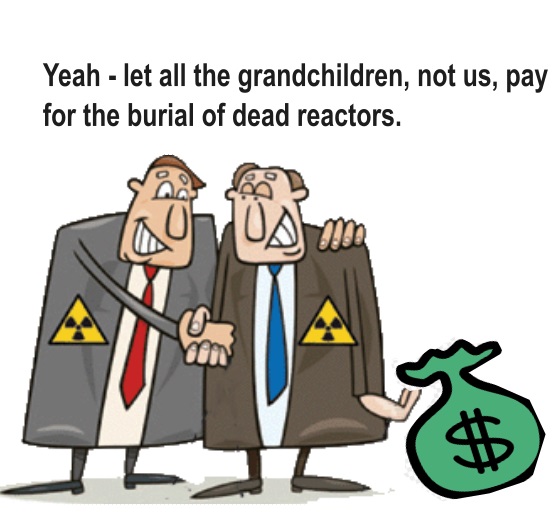
Electricite de France SA is reviving studies to boost the longer-term
output of some nuclear reactors as part of a plan to extend the life of its
atomic fleet to at least 60 years.
Europe’s energy crisis and rising power
prices have put such considerations back “on the company’s agenda for
2023,” according to Sylvie Richard, who’s in charge of the
state-controlled utility’s €33 billion ($35.6 billion) spending on
reactor maintenance and retrofit for the period from 2022 through 2028. The
upgrades could boost the output of some EDF reactors by 4% to 5%. If that
proves financially viable and gets approved by the nuclear safety
authority, some of the work would take place beyond 2028, Richard told
reporters at the Saint-Laurent nuclear power station in central France
Thursday.
The French nuclear giant has been tasked by President Emmanuel
Macron to extend the lifetime of its 56 reactors and to build at least six
new ones to help the country reduce its reliance on fossil fuels. However,
EDF has been grappling for more than a year with extended reactor repairs
and outages that have worsened Europe’s energy crunch, while triggering a
record loss at the company.
Bloomberg 3rd April 2023
https://www.bnnbloomberg.ca/edf-mulls-reactor-upgrades-to-boost-longer-term-nuclear-output-1.1903718
Germany criticizes Russian role in French nuclear fuel plant
German officials have criticized plans by French firm Framatome to produce
nuclear fuel in a joint venture with Russia’s Rosatom at a facility in
western Germany, and said Thursday that they will consider whether an
application to do so can be rejected.
Officials in the state of Lower
Saxony have received a request for the Framatome-owned ANF facility in
Lingen, near the German-Dutch border, to be allowed to produce hexagonal
fuel rod arrangements used in Soviet-designed water-water energetic
reactors. Such reactors, known by the Russian acronym VVER, are common in
Eastern Europe and the fuel production would take place under license from
state-owned Rosatom.
“Doing business with (Russian President) Putin must
stop, and that also and especially applies to the nuclear sector,” Lower
Saxony’s Energy Minister Christian Meyer said.
Washington Post 30th March 2023
Sizewell C permits approved despite concerns over potential mass fish deaths
Sizewell C permits approved despite concerns over potential mass fish
deaths. The Environment Agency has issued three new permits to Sizewell C,
despite concerns that the approved cooling system and lack of fish
deterrent device could result in “thousands of fish dying every day”.
ENDS 30th March 2023
Divers enter Sellafield’s nuclear pool for first time in 65 years
A GROUP of specialist divers have entered Sellafield’s nuclear pool for the
first time in over 60 years. Divers have been carrying out vital clean-up
and decommissioning work in the oldest legacy storage pond on the
Sellafield site.
The last time a human entered Sellafield’s Pile Fuel
Storage Pond was in 1958, when records show a maintenance operator and
health physics monitor carried out a dive into the newly constructed pond
to repair a broken winch.The pool went out of use in the 1960s but now
divers have returned as part of work to decommission and clean up the site.
Carlisle News & Star 1st April 2023
https://www.newsandstar.co.uk/news/23424414.divers-dip-sellafields-nuclear-pool-first-time-65-years/
ARMY PUTTING ‘OUTRAGEOUS SPIN’ ON DEPLETED URANIUM SCIENCE

Scientist cited by British military to justify sending depleted uranium shells to Ukraine had previously criticised use of such ammunition in Iraq.
DECLASSIFIED UK, PHIL MILLER, 28 MARCH 2023
- Sole body cited by UK military to defend Ukraine receiving depleted uranium weapons has not published new research on the subject for over 20 years
- Italy’s defence ministry has compensated soldiers who developed cancer after exposure to depleted uranium on service in the Balkans
- After the invasion of Iraq, the UK military accepted it had a ‘moral obligation’ to help clear depleted uranium debris from the rounds it had fired.
The Ministry of Defence claimed last week that research by the Royal Society – Britain’s premier scientific group – supported its controversial decision to send depleted uranium tank shells to Ukraine.
An MoD official briefed the media: “Independent research by scientists from groups such as the Royal Society has assessed that any impact to personal health and the environment from the use of depleted uranium munitions is likely to be low.”
The Royal Society was cited despite the group rebuking the Pentagon in 2003 for using their exact same research to justify American tanks firing the weapon in Iraq, Declassified UK has found.
When contacted, the scientific body told us: “In 2001/02, the Royal Society published two reports on the health hazards of depleted uranium munitions.” It provided links for the first and second report.
Their spokesperson added that depleted uranium “isn’t an active area of policy research for the Society, [and] we haven’t updated or published on this topic since those reports.”
In 2003, the US military used those Royal Society reports to defend the use of depleted uranium (DU) by coalition forces in Iraq.
That triggered a complaint to the media, with the Guardian saying the Royal Society was “incensed because the Pentagon had claimed it had the backing of the society in saying DU was not dangerous.
“In fact, the society said, both soldiers and civilians were in short and long term danger. Children playing at contaminated sites were particularly at risk.”
The chairman of the Royal Society’s working group on depleted uranium, Professor Brian Spratt, was quoted as warning that “a small number of soldiers might suffer kidney damage and an increased risk of lung cancer if substantial amounts of depleted uranium are breathed in, for instance inside an armoured vehicle hit by a depleted uranium penetrator.”
“In addition, large numbers of corroding depleted uranium penetrators embedded in the ground might pose a long-term threat if the uranium leaches into water supplies.”
He recommended that fragments from depleted uranium shells should be cleared up and long-term sampling of water supplies needed to be conducted.
Spratt also countered claims about the safety of depleted uranium made by the UK’s then defence secretary Geoff Hoon, stressing: “It is is highly unsatisfactory to deploy a large amount of material that is weakly radioactive and chemically toxic without knowing how much soldiers and civilians have been exposed to it.”
………………………………………….. Shells containing more than 2.3 tonnes of depleted uranium were fired by British forces in operations against Iraq in 1991 and 2003.
US troops fired far larger quantities, especially around the city of Fallujah, where it has been blamed for birth defects and a spike in cancer cases.
Contamination
The ammunition was also used by NATO on operations in Bosnia, Serbia, Montenegro and Kosovo during the breakup of Yugoslavia.
Italian soldiers who developed cancer after serving on those missions in the Balkans have successfully sued their defence ministry for compensation. Serbians have attempted similar litigation against NATO.
A study conducted in Kosovo by the UN Environment Programme (UNEP) shortly after that conflict ended found “only low levels of radioactivity”.
However, they were not able to consider the long term consequences and only inspected 11 out of 112 sites where DU had been fired.
A later UNEP study in Serbia did find more significant corrosion of DU shells and that many of them were lodged deep in the ground.
A subsequent report by the UN in Bosnia found drinking water had been contaminated, albeit at low levels…………………………………………….. more https://declassifieduk.org/exclusive-army-putting-outrageous-spin-on-depleted-uranium-science/
Welsh anti-nuclear groups warn on the nuclear lobbyists behind the new Freeport bid for Anglesea.
Anti-nuclear activists are ringing warning bells that this week’s
announcement of a new Freeport for Anglesey represents a way in for
unwanted new nuclear developments on the island, with at least six backers
of the bid having direct connections to the industry.
Named amongst the sponsors of the Freeport bid are leading nuclear industry businesses,
Assystem, Bechtel, Last Energy, Molten Flex, Rolls-Royce SMR, and New Cleo,
all of which are vying to develop and locate new nuclear power plants at
the Wylfa site on the island and elsewhere in the UK.
All are competing for
public attention and public funds by issuing media releases that frequently
make outrageous claims to be on the verge of making a UK-wide product
roll-out.
Yet most of their nuclear power plant designs being (as yet)
unproven, unauthorised, and unbuilt so-called Small Modular Reactors.
Other members of the Freeport consortia include Bangor University, with its
Nuclear Future Institute; M-Sparc, with its connections to the University’s
nuclear department; and the Association of North and Mid-Wales Councils,
which include unabashed nuclear enthusiasts, Ynys Mon and Gwynedd Councils.
Six Welsh anti-nuclear groups – CADNO, CND Cymru, Cymdeithas yr iaith (the
Welsh Language Society), PAWB (Pobl Atal Wylfa B / People against Wylfa-B),
WANA (The Welsh Anti-Nuclear Alliance) and the Welsh NFLA (Nuclear Free
Local Authorities) met in Caernarfon, Gwynedd in July 2022 and signed a
Declaration pledging their opposition to new nuclear power plants and to
fight for a green and sustainable future for Wales.
These Welsh
anti-nuclear campaigners are concerned about the lack of transparency and
public engagement about the extensive involvement of nuclear players in the
Freeport bid and are terribly disappointed that, aside from one marine
energy business, there are not more genuinely green energy producers in the
mix.
NFLA 3rd April 2023
Nuclear Tug of War Intensifies in Brussels
With money and regulations on the table for renewable energy, the EU has become entrenched into two solid blocs with different stances on nuclear power.
Bridget Ryder — April 3, 2023 The European Conservative
With both a package of incentives for green technology and revisions to the Renewable Energy Directive on the table, the fight in Brussels over the place of nuclear power in the ‘green,’ ‘sustainable,’ ‘clean’ energy landscape—and its corresponding regulation—has intensified.
The bloc’s energy ministers met last week to prepare their negotiating points with the EU Parliament over changes to the Renewable Energy Directive. Prior to the March 28th Council meeting, energy ministers pow-wowed in competing breakfast gatherings—one for the French-led nuclear alliance and the other for the Austrian-organised Friends of Renewables group, Euractiv reports.
Nuclear alliance
At the end of their meetings, the nuclear alliance sent out a press release to notify the media—and presumably, both the Commission and their rivals on the EU Council—that they had agreed that nuclear energy was indeed “strategic” in achieving the EU Commission’s environmental goals. This is the opposite position to the one the Commission has taken in the recently proposed Net Zero Industry Act (NZIA), a set of incentives meant to counter U.S. green tech subsidies.
Under French leadership, the nuclear alliance (consisting of Bulgaria, Croatia, the Czech Republic, Finland, Hungary, the Netherlands, Poland, Romania, Slovakia, and Slovenia) first met in February while the Commission was still preparing the NZIA. Its goal was to promote nuclear power as a low-carbon source of electricity and work on “common industrial projects.”
In mid-March, the Commission presented the NZIA draft, but with nuclear power excluded from the list of “strategic” technologies that would qualify for incentives. The one exception was “cutting-edge nuclear” technology, such as small modular reactors (SMRs) which could qualify for some investment incentives. The alliance then met again in March, just before the meeting of energy ministers on March 28th, and announced that they had “fully recognised that nuclear is a strategic technology for achieving climate neutrality.”
The pro-nuclear breakfasts were attended by Italy and Belgium, though only as observers. The two countries made it clear they had not signed on to any agreed position with the group, though they have reasons for desiring a favourable status for nuclear energy.
Belgium, for its part, has had to retract plans to start shutting down the country’s six nuclear reactors. After announcing the closure of a set of nuclear power plants by 2025, the public outcry forced the energy ministry to instead grant them a ten-year extension. ………………..
Friends of renewables
The Friends of Renewables—Estonia, Spain, Germany, Denmark, Ireland, Luxembourg, Portugal, Latvia, and Lithuania, with Austria as leader—are a clear counterweight to the nuclear alliance.
The compromise
After the breakfast gatherings, the two groups had to come together with the rest of the bloc’s member states for the official EU Council Meeting to settle on a negotiating position for the updates to the Renewable Energy Directive (RED).
The nuclear sticking point was whether hydrogen produced using nuclear power should be included in renewable fuel targets. After hours of back and forth, they agreed to label nuclear-produced hydrogen as “low carbon,” in other words, dirtier than ‘green’ hydrogen but better than the ‘brown’ hydrogen linked to fossil fuels.
Nuclear power enters into the debate about renewables in the question of hydrogen gas. Making the gas ‘green,’ a process of separating the hydrogen from water molecules, requires an energy source. When that source is considered ‘green,’ such as solar or wind power, the hydrogen is considered ‘green.’
Negotiators for the EU Parliament then also made room for nuclear power in the Renewable Energy Directive (RED), admitting that it has a “role” to play in reducing carbon emissions and is in a category of its own in the spectrum of environmental friendliness.
The RED now recognizes “the specific role of nuclear power, which is neither green nor fossil,” French MEP Pascal Canfin, chair of the Parliament’s Environment Committee, who participated in the negotiations, tweeted…….
The political agreement reached by the Council and Parliament calls for doubling renewable energy output by 2030.
“The agreement raises the EU’s binding renewable target for 2030 to a minimum of 42.5%, up from the current 32% target and almost doubling the existing share of renewable energy in the EU. Negotiators also agreed that the EU would aim to reach 45% of renewables by 2030,” the Commission said in a statement about the political agreement on the RED.
‘Renewable’ energy currently makes up just over 20% of the bloc’s energy mix.
Further room was made for nuclear by provisions in the agreement by giving member states two options to calculate achieving certain targets: either emission reductions or renewable energy output. This is an advantage for countries like France that have substantial nuclear capacity, as carbon dioxide is not the major by-product of nuclear power production. https://europeanconservative.com/articles/news/nuclear-tug-of-war-intensifies-in-brussels/
Ukraine’s Zaporizhzhia power plant: How prepared is Europe for a future nuclear disaster?
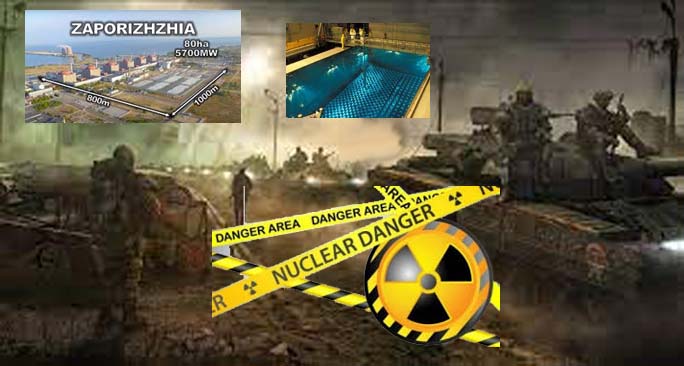
It raises the question, too, of whether we should rely on nuclear power at all.
It raises the question, too, of whether we should rely on nuclear power at all.
euro news.next, By Camille Bello 31/03/2023
Russia’s invasion has repeatedly knocked out Ukraine’s electricity grid, causing blackouts at the Zaporizhzhia nuclear plant – Europe’s largest – where a constant power supply is needed to prevent the reactors from overheating.
On March 9, the plant blacked out for the sixth time since the occupation, forcing nuclear engineers to switch to emergency diesel generators to power its essential cooling equipment running.
“Each time we are rolling a dice,” Rafael Mariano Grossi, the director general of the United Nations’ International Atomic Energy Agency (IAEA), warned at the time. “And if we allow this to continue time after time, then one day, our luck will run out”.
On Monday, during a meeting with Ukraine’s president Volodymyr Zelensky, Grossi reiterated the situation “isn’t getting any better” as relentless fighting in the area keeps the facility at risk of a disaster.
The IAEA watchdog has called for a “protection zone” around the plant but has failed to devise terms that would satisfy both Ukraine and Russia.
Grossi told the AP on Tuesday he believed a deal was “close”. However, Zelenskyy, who opposes any plan that would legitimise Russia’s control over the facility, said he was less optimistic a deal was near. “I don’t feel it today,” he said.
Is Zaporizhzhia really at risk?
Nuclear power plants are designed to withstand a wide range of risks, but no operating nuclear power plant has ever been caught up in modern warfare.
Because of the repeated crossfire, Zaporizhzhia’s last reactor was shut down in September as a precautionary measure. But external power is still essential to run critical cooling and other safety systems.
Fears about Zaporizhzhia have exacerbated existing concerns around our lack of preparedness for any nuclear-related incident, laying bare anxieties not necessarily around war-related incidents but about climate change and Europe’s old reactors, for instance.
It raises the question, too, of whether we should rely on nuclear power at all.
March 11 marked the 12-year anniversary of the massive earthquake and tsunami that caused the second-worst nuclear accident in history at the Fukushima Daiichi Nuclear Power Plant in Japan.
The anniversary of the catastrophic meltdown that left 160,000 people displaced and cost the Japanese government over €176 billion, was another reminder of the potential threat of a nuclear spill, but a number of other recent events have also raised the alarm in Europe, not least the war in Ukraine.
‘We are not properly prepared’
Europe’s nuclear power reactors are ageing – they were built on average 36.6 years ago – and recent checkups in France have found cracks in several facilities.
Some energy experts have warned that the extreme weather events brought on by climate change could pose a serious threat to the EU’s 103 nuclear reactors, which account for about one-quarter of the electricity generated in the bloc.
Jan Haverkamp, a senior nuclear energy and energy policy expert for Greenpeace, said the chances of Europe seeing a large accident like Fukushima were now “realistic” and “we should take them into consideration”.
“We are not properly prepared,” he told Euronews Next…………………………………………………….
The maintenance of a nuclear plant depends on a number of factors, such as its design and its supervision history. But there are other factors that come into play, such as error-prone humans, earthquakes, tsunamis, fires, flooding, tornadoes or even in the case of Zaporizhzhia, acts of war…………………………………………………………………………………… more https://www.euronews.com/next/2023/03/31/chernobyl-fukushima-europe-prepared-nuclear-disaster-ukraine-earthquake-meltdown-radiation
IAEA head warns on danger of intensified fighting near Zaporizhzhia nuclear power plant
The head of the United Nations atomic energy commission said on Wednesday
that intensified fighting near Europe’s largest nuclear power plant poses
a threat to the facility’s safety. The increasing combat makes it urgent
to find a way to prevent a catastrophic nuclear accident at the
Zaporizhzhia nuclear power plant, said International Atomic Energy Agency
director general Rafael Mariano Grossi. “It is obvious that this area is
facing perhaps a more dangerous phase,” he said of the facility, which is
in a partially Russian-occupied part of Ukraine. “We have to step up our
efforts to get to some agreement over the protection of the plant.”
Morning Star 30th March 2023
https://morningstaronline.co.uk/article/w/un-agency-warns-rising-combat-near-ukraine-nuclear-plant
Germany will complete nuclear phase-out as planned but technology’s risks remain – env min
31 Mar 2023, Benjamin Wehrmann
The era of nuclear power in Germany will end on 15 April as planned, the country’s environment minister has said.
Minister Steffi Lemke stressed that the phase-out would not endanger the power supply security in Germany or other countries, arguing that ending nuclear power will ultimately make the country a safer place.
However, despite nuclear power production in Germany coming to an end, the risk of nuclear accidents remains due to the ageing reactor fleet in neighbouring countries and previously “unthinkable” threats such as sabotage or war-related damage to reactors in Ukraine, Lemke said.
The renewable power industry welcomed the nuclear exit’s completion, stating that wind and solar power are ready to replace the reactors, whereas a survey suggests most people in the country appear to be sceptical whether the energy system is ready to run without them.
The three remaining nuclear plants in Germany will be shut down for good on 15 April, following a three-month extension granted in the context of the European energy crisis, environment minister Steffi Lemke confirmed to journalists in Berlin.
“The technology’s era is over” in the country, Lemke said, arguing that this will make Germany a safer place and put a stop to generating nuclear waste. Germany’s energy security will not be jeopardised by the decommissioning of the three plants, Isar 2 and Neckarwestheim 2 in southern Germany and Emsland in the north, Lemke said……………………………………
31 Mar 2023, 11:38
Germany will complete nuclear phase-out as planned but technology’s risks remain – env min
The era of nuclear power in Germany will end on 15 April as planned, the country’s environment minister has said. Minister Steffi Lemke stressed that the phase-out would not endanger the power supply security in Germany or other countries, arguing that ending nuclear power will ultimately make the country a safer place. However, despite nuclear power production in Germany coming to an end, the risk of nuclear accidents remains due to the ageing reactor fleet in neighbouring countries and previously “unthinkable” threats such as sabotage or war-related damage to reactors in Ukraine, Lemke said. The renewable power industry welcomed the nuclear exit’s completion, stating that wind and solar power are ready to replace the reactors, whereas a survey suggests most people in the country appear to be sceptical whether the energy system is ready to run without them.
The three remaining nuclear plants in Germany will be shut down for good on 15 April, following a three-month extension granted in the context of the European energy crisis, environment minister Steffi Lemke confirmed to journalists in Berlin.
“The technology’s era is over” in the country, Lemke said, arguing that this will make Germany a safer place and put a stop to generating nuclear waste. Germany’s energy security will not be jeopardised by the decommissioning of the three plants, Isar 2 and Neckarwestheim 2 in southern Germany and Emsland in the north, Lemke said.
The country has managed to restructure its gas supply following the loss of Russia as a trade partner, which has been the main cause of the energy crisis, and would replace the capacity of the outgoing reactors with new renewable power installations and gas-fired power stations, said Lemke. Power exports to nuclear power state France reached record levels during the energy crisis, which underlined the fact that nuclear plants do not automatically provide a safeguard in crisis situations, she said.
Completing the nuclear exit in Germany had originally been planned for the end of 2022, but the war in Ukraine and its repercussions had led parliament to decide a limited runtime extension to support the power system and allow Germany and neighbouring countries to ensure supply security. Opposition politicians from the conservative Christian Democrats (CDU) and from the government coalition party Free Democrats (FDP) had repeatedly advocated for further extending the plants’ runtime. However, chancellor Olaf Scholz’s government ultimately restricted the extension to mid-April.
Nuclear power has become expendable and that’s good news. Renewable power will take it from here.
Simone Peter, head of renewables association BEE
“Ageing nuclear plants are one of the greatest risks in Europe” – Lemke
Fully dismantling the roughly 30 plants in the country and deciding on a long-term nuclear waste storage solution are tasks that will take several decades, the Green Party minister said. “These tasks will be a challenge in the next few years,” Lemke said. Nuclear power has been used in Germany for 60 years and it’s now clear that it is “a high-risk technology that ultimately cannot be fully controlled.” Three generations have benefitted from nuclear power use in Germany, but about 30,000 generations will be affected by the ongoing presence of nuclear waste, she argued. Finding a final repository, especially for highly radioactive waste, will now be “a very difficult but unavoidable” task.
At the same time the risk of nuclear accidents would not be completely unavoidable, Lemke added. Ageing reactors in the immediate neighbourhood, sabotage of energy infrastructure and the “previously unthinkable” scenario of reactors operating in an active warzone, such as the Zaporizhzhia plant in Ukraine, continue to pose real danger for people in Germany and elsewhere in Europe, she stressed. “Ageing nuclear plants are one of the greatest risks in Europe,” Lemke said, but stressed that every country had the right to decide on the technology’s use on its own territory.
Inge Paulini, head of the Federal Office for Radiation Protection (BfS), pointed out that seven reactors abroad currently operate within less than 100 kilometres from the German border, which means they still pose a direct threat to the population. “Germany’s nuclear phase-out doesn’t mean all risk is gone,” Paulini said, arguing that the need for an effective and state-of-the-art radiation protection programme had not been forgotten in the country.
The German Renewable Energy Federation (BEE) commented that the nuclear exit’s completion is a step that is both “feasible and necessary” from the energy industry’s perspective. Beyond the immediate risk of nuclear accidents, new plants simply could not compete economically with renewable power and are too inflexible in their use to serve as a capacity backup to iron out fluctuations in renewable power generation, BEE head Simone Peter said.“We cannot afford inflexibility on the power market as the share of renewable energy is growing,” she argued, adding that more nuclear power ultimately meant blocking renewable expansion.
“Nuclear power has become expendable and that’s good news. Renewable power will take it from here,” said Peter………………………………………………… https://www.cleanenergywire.org/news/germany-will-complete-nuclear-phase-out-planned-technologys-risks-remain-env-min
Small Modular Nuclear Reactors may not be the holy grail for energy security, net zero
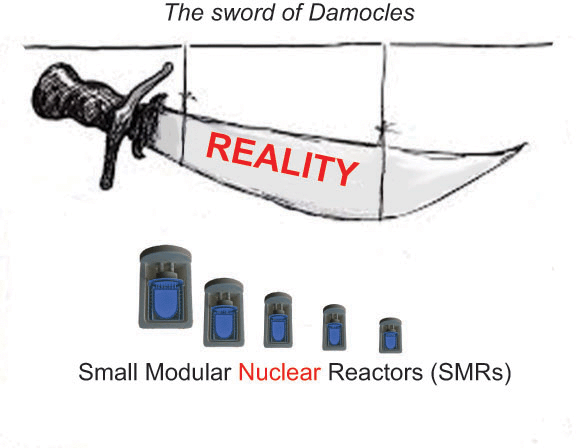
So, if SMRs are the current political flavour of the month, how have we reached this position when there is still no formal approval of the technology from regulators, let alone practical evidence of how it can operate in the real world?
It’s possible to achieve both energy security and the UK’s climate goals without blowing the budget on next-gen nuclear technologies, according to Andrew Warren.
Andrew Warren, Chairman of the British Energy Efficiency Federation. https://electricalreview.co.uk/2023/03/29/smrs-may-not-be-the-holy-grail-for-energy-security-net-zero/
Electrical Review covered in-depth the array of announcements that were made during the Spring Budget, but there was arguably one announcement above all that was most pertinent to the net zero drive. That was when Chancellor Jeremy Hunt reconfirmed – for the fifth time – that the Government intends to create a new Great British Nuclear agency.

It is a name that of itself may bring comfort to all those living on the nuclear-free island of Ireland.
So what will this agency do? Well, the Chancellor explained that, when launched, it will run a competition this year for the UK’s first Small Modular Reactor (SMR). The plan is for it to eventually award £1 billion in co-funding to a winner to build out an SMR plan.
This competition has some distinct echoes. Back in March 2016, the Government launched a competition to identify the best value SMR design for the UK. To the best of my knowledge, nobody has ever claimed that prize, of £250 million.
This re-announcement prompted me to consider the background to this Budget announcement.
It comes at a time in which private sector funding for larger nuclear power stations is proving to be extremely difficult. There is a lengthy list of large pension funds that have publicly refused to get involved with providing capital for the hapless Sizewell C pressurised water reactor project in Suffolk. Meanwhile, European Commission President Ursula von der Leyen is rumoured to be promoting the inclusion of SMRs within the European green investment taxonomy, whilst simultaneously excluding pressurised water reactors which make up most of the existing nuclear fleet.
So, if SMRs are the current political flavour of the month, how have we reached this position when there is still no formal approval of the technology from regulators, let alone practical evidence of how it can operate in the real world?

In January, the UK Government announced that six SMR vendors had applied for their designs to be formally assessed with a view to commercialisation in Britain. The companies have joined a much publicised Rolls-Royce-led consortium and will be subjected to an assessment process carried out by the UK’s Office of Nuclear Regulation (ONR), which will look in exhaustive detail at reactor designs proposed for construction.
Designs that successfully complete the Generic Design Assessment (GDA) – which is expected to take between four and five years – will then be ready to be built anywhere in the country, subject to meeting site-specific requirements.
Why do we need new reactor designs?
Recent results of orders placed for larger nukes are uniformly poor, with reactors invariably late and over budget. Some of the worst cases, notorious projects in Olkiluoto, Finland and Flamanville, France, have seen construction periods of 18 years and costs of three to four times above the expected level.

So, SMRs are being increasingly seen as the new saviours for the nuclear industry. This category embodies a range of technologies, uses and sizes, but relies heavily on features that were the selling points for larger designs. They are smaller than current stations which produce 1,200MW to 1,700MW of electricity. Instead, sizes range from 3MW to about 500MW. The Rolls-Royce design is a 470MW pressurised water reactor, which is bigger than one of the reactors at Fukushima in Japan that suffered serious damage in the 2011 tsunami.
These advanced designs are not new – sodium-cooled fast reactors and high temperature reactors were built as prototypes in the 1950s and 1960s – but successive attempts to build demonstration plants have been short-lived failures. It is hard to see why these technologies should now succeed given their poor record.
A particular usage envisaged for some of the technologies is production of hydrogen. However, as Professor Stephen Thomas of Greenwich University recently pointed out to me, to produce hydrogen efficiently, reactors would need to provide heat at 900°C. This, he said, is “a temperature not yet achieved in any power reactor, not feasible for a pressurised water reactor or boiling water reactor and one that will require new exotic and expensive materials.”
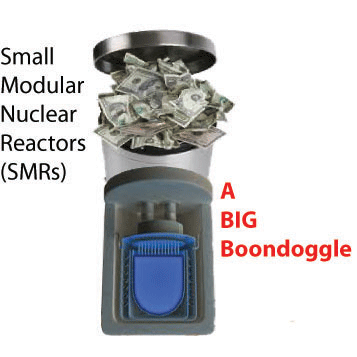
Developers of SMRs like to give the impression that their designs are ready to build, the technology proven, the economic case established and all that is holding them back is Government inactivity. However, taking a reactor design from conception to commercial availability is a lengthy and expensive process taking more than a decade and certainly costing more than £1 billion.
How can the economics of SMRs be tested?
The main claim for SMRs over their predecessors is that being smaller, they can be made in factories as modules using cheaper production line techniques, rather than one-off component fabrication methods being used at Hinkley Point C. The idea is that the module would be delivered to the site on a truck essentially as a ‘flatpack’. This would avoid much of the on-site work which is notoriously difficult to manage and a major cause of the delays and cost overruns that every European large reactor project suffers from.
However, any savings made from factory-built modules will have to compensate for the scale economies lost. A 1,600MW reactor is likely to be much cheaper than 10 reactors of 160MW.
And it will be expensive to test the claim that production line techniques will compensate for lost scale economies. The first reactor constructed will need to be built using production lines if the economics are to be tested. But once the production lines are switched on, they must be fed. Rolls-Royce assumes its production lines will produce two reactors per year and that costs will not reach the target level until about the fifth order. So, if we assume the first reactor takes five years to build, there will be another nine reactors in various stages of construction before a single unit of electricity has been generated from the first, and the viability of the design tested.
This could mean that perhaps about 15 SMRs will need to be under construction before the so-called ‘nth of a kind’ settled-down cost is demonstrated. But once the initial go ahead is given, there will be pressure on the Government to continue to place orders before the design is technically and economically proven, so the production lines do not sit idle.
Will SMRs be a major contributor to meeting the UK’s climate change targets?

The selling point for nuclear power is that it is a relatively low-carbon source of power that can replace fossil fuel electricity generation in the UK and elsewhere. However, by the time SMRs might be deployable in significant numbers, realistically after 2035, it will be too late for them to contribute to reducing greenhouse gas emissions. Electricity is acknowledged to be the easiest sector to decarbonise. If the whole economy is to reach net zero emissions by 2050, then this sector will have to reach that point long before then, probably by 2035. So SMRs appear to be too little, too late.

There is also a fear that SMRs will create more waste than conventional reactors, according to a study recently published in Proceedings of the American National Academy of Sciences. The research notes that SMRs would create far more radioactive waste, per unit of electricity they generate, than conventional reactors by a factor of up to 30. Some of these smaller reactors, with molten salt and sodium-cooled designs, are expected to create waste that needs to go through additional conditioning to make it safe to store in a repository.
And yet, despite the past failures of nuclear power and increasing public scepticism, there remains an appetite within the British Government to give the nuclear industry one more chance.
It remains to be seen whether the Government follows its instinct to continue supporting the sector or whether the amount of public money at risk makes such a decision politically impossible, given the massive underwriting these projects require by consumers and taxpayers.
Nuclear’s specious claims
The claims being made for SMRs will be familiar to long-time observers of the nuclear industry: costs will be dramatically reduced; construction times will be shortened; safety will be improved; there are no significant technical issues to solve; nuclear is an essential element to our energy mix.
In the past such claims have proved hopelessly over-optimistic and there is no reason to believe results would turn out differently this time. Indeed, the nuclear industry may well see itself in this ‘last-chance saloon’.
The risk is not so much that large numbers of SMRs will be built; it is my belief that they won’t be. The risk is that, as in all the previous failed nuclear revivals, the fruitless pursuit of SMRs will divert resources away from options that are cheaper, at least as effective, much less risky, and better able to contribute to energy security and environmental goals. Given the climate emergency we face, surely it is time to finally turn our backs on this failing technology.
Andrew Warren is a former special advisor to the House of Commons environment committee. Special thanks to Greenwich University’s Professor Stephen Thomas for his advice for this piece.
Nuclear Power Classified as Environmentally Sustainable in UK’s Green Taxonomy
On March 15, 2023, the UK’s Chancellor of the Exchequer, Jeremy Hunt, announced that nuclear power will be classified as “environmentally sustainable” in UK’s green taxonomy, “giving it access to the same investment incentives as renewable energy.” …………………………………..
The inclusion of nuclear in the UK Taxonomy, while controversial, is not surprising given the UK’s stated commitment to building its nuclear fuel capacity. In a 2022 policy paper titled “British energy security strategy,” the Johnson government committed to increase the portion of energy generated from nuclear power to 25%, and to launch a variety of related initiatives, including “backing Great British Nuclear with funding to support projects to get investment ready and through the construction phase.”
…………………….. The Sunak government has not yet released its energy security strategy, but Sunak hinted that its strategy will continue the ongoing commitment to increase the UK’s nuclear energy capacity, by focusing on carbon capture and storage, small modular reactors and the like.
…………………………. It is worth noting, however, that although that the EU Taxonomy Delegated Act is in force, a regulation for UK’s green taxonomy is not and there is no clear timeline for implementation. Rather, the UK government announced in December 2022 a delay in implementation following stakeholder engagement and in light of the complexity inherent in a climate taxonomy, which involves “multiple sectors of the economy and various legislative and regulatory frameworks.”
1 This Month





PLEASE OPPOSE HR 8255 AND S.3639 – bills would accelerate satellite deployment, with no environmental review or safeguards – https://ncstd5li.quorum.us/campaign/169331/
To see nuclear-related stories in greater depth and intensity – go to https://nuclearinformation.wordpress.com
-
Archives
- October 2026 (49)
- September 2026 (339)
- August 2026 (330)
- July 2026 (355)
- June 2026 (287)
- May 2026 (306)
- April 2026 (356)
- March 2026 (251)
- February 2026 (267)
- January 2026 (308)
- December 2025 (358)
- November 2025 (359)
-
Categories
- 1
- 1 NUCLEAR ISSUES
- business and costs
- climate change
- culture and arts
- ENERGY
- environment
- health
- history
- indigenous issues
- Legal
- marketing of nuclear
- media
- opposition to nuclear
- PERSONAL STORIES
- politics
- politics international
- Religion and ethics
- safety
- secrets,lies and civil liberties
- spinbuster
- technology
- Uranium
- wastes
- weapons and war
- Women
- 2 WORLD
- ACTION
- AFRICA
- Atrocities
- AUSTRALIA
- Christina's notes
- Christina's themes
- culture and arts
- Events
- Fuk 2022
- Fuk 2023
- Fukushima 2017
- Fukushima 2018
- fukushima 2019
- Fukushima 2020
- Fukushima 2021
- general
- global warming
- Humour (God we need it)
- Nuclear
- RARE EARTHS
- Reference
- resources – print
- Resources -audiovicual
- Weekly Newsletter
- World
- World Nuclear
- YouTube
-
RSS
Entries RSS
Comments RSS

