A new era’: Germany quits nuclear power, closing its final three plants

“There will be a moment of decision as to whether nuclear really has a future”
By Laura Paddison, Nadine Schmidt and Inke Kappeler, CNN, 15 Apr 23
Germany’s final three nuclear power plants close their doors on Saturday, marking the end of the country’s nuclear era that has spanned more than six decades.
Nuclear power has long been contentious in Germany.
There are those who want to end reliance on a technology they view as unsustainable, dangerous and a distraction from speeding up renewable energy.
But for others, closing down nuclear plants is short-sighted. They see it as turning off the tap on a reliable source of low-carbon energy at a time when drastic cuts to planet-heating pollution are needed.
Even as these debates rumble on, and despite last-minute calls to keep the plants online amid an energy crisis, the German government has been steadfast.
“The position of the German government is clear: nuclear power is not green. Nor is it sustainable,” Steffi Lemke, Germany’s Federal Minister for the Environment and Consumer Protection and a Green Party member, told CNN.
“We are embarking on a new era of energy production,” she said.
A plan decades in the making
The closure of the three plants – Emsland, Isar 2 and Neckarwestheim – represents the culmination of a plan set in motion more than 20 years ago. But its roots are even older.
In the 1970s, a strong anti-nuclear movement in Germany emerged. Disparate groups came together to protest new power plants, concerned about the risks posed by the technology and, for some, the link to nuclear weapons. The movement gave birth to the Green Party, which is now part of the governing coalition.
Nuclear accidents fueled the opposition: The partial meltdown of the Three Mile Island nuclear power plant in Pennsylvania in 1979 and the 1986 catastrophe at Chernobyl that created a cloud of radioactive waste which reached parts of Germany.
In 2000, the German government pledged to phase out nuclear power and start shutting down plants. But when a new government came to power in 2009, it seemed – briefly – as if nuclear would get a reprieve as a bridging technology to help the country move to renewable energy.
Then Fukushima happened.
In March 2011, an earthquake and tsunami caused three reactors of the Fukushima Daiichi power plant to melt down. For many in Germany, Japan’s worst nuclear disaster was confirmation “that assurances that a nuclear accident of a large scale can’t happen are not credible,” Miranda Schreurs, professor of environment and climate policy at the Technical University of Munich, told CNN.
Three days later then-Chancellor Angela Merkel – a physicist who was previously pro-nuclear – made a speech called it an “inconceivable catastrophe for Japan” and a “turning point” for the world. She announced Germany would accelerate a nuclear phase-out, with older plants shuttered immediately.
Russia’s invasion of Ukraine, however, provided another plot twist.
Fearful of its energy security without Russian gas, the German government delayed its plan to close the final three plants in December 2022. Some urged a rethink.
But the government declined, agreeing to keep them running only until April 15.
For those in the anti-nuclear movement, it’s a moment of victory.
“It is a great achievement for millions of people who have been protesting nuclear in Germany and worldwide for decades,” Paul-Marie Manière, a spokesperson for Greenpeace, told CNN
A polarizing energy
For critics of Germany’s policy, however, it’s irrational to turn off a low-carbon source of energy as the impacts of the climate crisis intensify……………………………………………………………….
……………………………………………………..supporters of the nuclear shutdown argue it will ultimately hasten the end of fossil fuels.
Germany has pledged to close its last coal-fired power station no later than 2038, with a 2030 deadline in some areas. It’s aiming for 80% of electricity to come from renewables by the end of this decade.
While more coal was added in the months following Fukushima, Schreurs said, nuclear shutdowns have seen a big push on clean energy. “That urgency and demand can be what it takes to push forward on the growth of renewables,” she said.
Representatives for Germany’s renewable energy industry said the shutdown will open the door for more investment into clean energy……….
Representatives for Germany’s renewable energy industry said the shutdown will open the door for more investment into clean energy.
“Germany’s phase-out of nuclear power is a historic event and an overdue step in energy terms,” Simone Peter, president of the German Renewable Energy Federation (BEE), told CNN. “It is high time that we leave the nuclear age behind and consistently organize the renewable age.”
The impacts of nuclear power shouldn’t be overlooked either, Schreurs said, pointing to the carbon pollution created by uranium mining as well as the risk of health complications for miners. Plus, it creates a dependency on Russia, which supplies uranium for nuclear plants, she added.
Nuclear has also shown itself to have vulnerabilities to the climate crisis. France was forced to reduce nuclear power generation last year as the rivers used to cool reactors became too hot during Europe’s blistering heatwave.
A million-year problem
Now Germany must work out what do with the deadly, high-level radioactive waste, which can remain dangerous for hundreds of thousands of years.
Currently, the nuclear waste is kept in interim storage next to the nuclear plants being decommissioned. But the search is on to find a permanent location where the waste can be stored safely for a million years.
The site needs to be deep – hundreds of meters underground. Only certain types of rock will do: Crystalline granite, rock salt or clay rock. It must be geologically stable with no risks of earthquakes or signs of underground rivers.
The process is likely to be fraught, complex and breathtakingly long – potentially lasting more than 100 years.
BGE, the Federal Company for Radioactive Waste Disposal, estimates a final site won’t be chosen until between 2046 and 2064. After that, it will take decades more to build the repository, fill it with the waste and seal it.
What are other countries doing?
Plenty of other countries are treading paths similar to Germany’s. Denmark passed a resolution in the 1980s not to construct nuclear power plants, Switzerland voted in 2017 to phase out nuclear power, Italy closed its last reactors in 1990 and Austria’s one nuclear plant has never been used.
But, in the context of the war in Ukraine, soaring energy prices and pressure to reduce carbon pollution, others still want nuclear in the mix.
The UK, in the process of building a nuclear power plant, said in its recent climate strategy that energy nuclear power has a “crucial” role in “creating secure, affordable and clean energy.”
France, which gets about 70% of its power from nuclear, is planning six new reactors, and Finland opened a new nuclear plant last year. Even Japan, still dealing with the aftermath of Fukushima, is considering restarting reactors.
The US, the world’s biggest nuclear power, is also investing in nuclear energy and, in March, started up a new nuclear reactor, Vogtle 3 in Georgia – the first in years.
But experts suggest this doesn’t mark the start of a nuclear ramp up. Vogtle 3 came online six years late and at a cost of $30 billion, twice the initial budget.
It encapsulates the big problem that afflicts the whole nuclear industry: making the economics add up. New plants are expensive and can take more than a decade to build. “Even the countries that are talking pro-nuclear are having big trouble developing nuclear power,” Schreurs said.
Many nuclear power plants in Europe, the US and elsewhere are aging – plants have an operating life of around 40 to 60 years. As Germany puts an end to its nuclear era, it’s coming up to crunch time for others, Schreurs said.
“There will be a moment of decision as to whether nuclear really has a future”
CNN’s Chris Stern contributed reporting.
UN’s nuclear chief warns ‘we are living on borrowed time’ after two landmine explosions near Europe’s largest atomic power station in Ukraine

- UN has often expressed fears over the safety of Ukraine’s Zaporizhzhia plant
- Two landmine explosions took place outside plant’s perimeter this month
- Russian forces took control of the six-reactor plant in Ukraine in March last year
Daily Mail, By ARTHUR PARASHAR, 14 April 2023
A UN nuclear chief has warned ‘we are living on borrowed time’ after two landmine explosions near Europe’s largest atomic power station in Ukraine.
Rafael Grossi, director general of the International Atomic Energy Agency (IAEA), has repeatedly expressed fears over the safety of Ukraine’s Zaporizhzhia plant.
……….. We are living on borrowed time when it comes to nuclear safety and security at the Zaporizhzhia nuclear power plant,’ Mr Grossi said yesterday.
‘Unless we take action to protect the plant, our luck will sooner or later run out, with potentially severe consequences for human health and the environment,’ he added.
Two landmines exploded outside the plant’s perimeter fence – the first on April 8, and another four days later on Wednesday, according to the statement.
It was not immediately clear what caused the blasts, it said.
Grossi met senior Russian officials in Kaliningrad last week and prior to this with Zelensky in Zaporizhzhia to discuss a safety plan.
He also warned yesterday that the plant continued to depend on a single still-functioning power line, posing ‘a major risk to nuclear safety and security’.
A back-up power line damaged on March 1 has still not been repaired, the IAEA said.
It added that the staffing situation at the plant remained ‘complex and challenging’, in part because of staff shortages.
Last month, Grossi warned that a nuclear disaster was very possible due to the ‘perilous’ situation at the plant.
‘The plant’s lack of access to the grid and necessary repair work on its last emergency power line could cause a complete loss of power, making it reliant on diesel generators for the seventh time since Russia captured it,’ Grossi said at the time.
I once again call for a commitment from all sides to secure nuclear safety and security protection at the plant,’ he added.
Emergency diesel generators had been activated to power the plant’s safety systems, according to Ukrainian nuclear energy agency Energoatom, which has warned of the risk of an accident.
Without the electricity produced by these generators, the overheating of the reactor fuel could cause a nuclear accident, as in Japan’s Fukushima in 2011……………………………………..more https://www.dailymail.co.uk/news/article-11972139/UNs-nuclear-chief-warns-living-borrowed-time-two-explosions-near-Zaporizhzhia.html
Nuclear storage dump opponents sweep into Theddlethorpe parish council
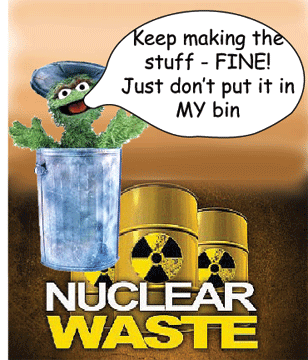
Residents have organised against storage plans
The Lincolnite, By Daniel Jaines Local Democracy Reporter 13 Apr 23
Candidates opposing a nuclear storage dump have surged to power in Theddlethorpe in a demonstration of local opposition.
Eight of the ten seats on two Theddlethorpe Parish Councils – St Helen’s and All Saints – have been filled uncontested by people against to Nuclear Waste Service’s plans for a Geological Disposal Facility in the village.
Nearby residents were in uproar after it was announced last year that the Theddlethorpe Gas Terminal could become the entry point for a nuclear storage facility to dispose of around 10% of the UK’s nuclear waste.
The new councillors, who will automatically become councillors after the May 4 local elections, are all part of Theddlethorpe Residents Association.
Members Brian Swift and Andrew Spink formed it after their application to join the parish councils were rejected in 2021.
Mr Swift said: “We were both turned down, but shortly after this we got together with a few neighbours and formed the Theddlethorpe Residents Association with the aim to give the parish a collective voice and to counter the PC’s negative stance.”
Since its inception, the residents association has garnered more than 120 members and holds regular events.
However, Mr Swift said the anti-GDF sentiment of the members would not mean other views would be unwelcome.
“Despite the fact that the majority of the councillors are now anti-GDF ,we are keen to stress that all points of view are welcome. Our priorities are to carry out the parish council’s functions to the best of our ability and to do our utmost to see that the village thrives and continues to be the friendly, united place we all call home,” he said………………………. more https://thelincolnite.co.uk/2023/04/nuclear-storage-dump-opponents-sweep-into-theddlethorpe-parish-council/—
Nuclear is not the solution to our energy troubles.
France pays a price for its energy security. President Macron has announced plans to build 6 new reactors by 2050 – and they’re much needed to replace the country’s ageing fleet of power stations – but he was warned very publicly just two months ago that he needs to have a credible programme to deal with the fourth issue: nuclear waste and both from the new planned plants and from the new ones. Right now, France’s nuclear waste facilities are close to over-flowing. In reality, if you’re worried about reactor safety, you should really be a lot more worried about nuclear waste. The full decommissioning process for a nuclear plant takes between 20 and 30 years. ……………….Furthermore, those small, modular nuclear power stations on which the Tory position relies? According to research published last year by Stanford University and the University of British Columbia, they produce more waste than conventional nuclear power plants.
Reaction Giga Watt, April 13, 2023
Both the current UK government and the likely next government want to embrace nuclear power.
Rishi Sunak has commissioned an energy review that will focus on “carbon capture and storage, small modular reactors and the like”. Keir Starmer’s proposed “Great British Energy” would invest in nuclear energy alongside wind, solar, tidal and other emerging technologies. There’s nothing new about nuclear power and if it was the solution to all our problems – and on the face of it, it should be – the world would have already fully embraced nuclear, risks and all. So why haven’t we?
………… burning fossil fuels is very much not consequence free and we’re only just starting to get serious about those consequences and no amount of “clean” coal, unleaded fuel, catalytic converters, wonderful though they are, can make up for this.
Secondly, nuclear power is scary: the world’s first public demonstrations of nuclear power were at Hiroshima and Nagasaki. Roughly once a decade since then, the world has provided us with reminders of just how frightening nuclear power can be: the Cuban Missile Crisis, Three Mile Island, Exercise Able Archer, Chernobyl, Fukushima and Zaporizhzhia are all examples from the past 60 years where the perils of a nuclear world have been brought home to us.
………………………………………………………………….. It’s also true that the rise of more sophisticated terrorist organisations made the public and thereby politicians wary of the nuclear industry especially from 9/11 onwards. If terrorists can fly two large aeroplanes into the heart of the biggest financial centre in the world then surely an isolated power station would be a much easier target………….. At Zaporizhzhia in Ukraine during the current conflict, the issue is less about the impact on the reactors themselves from Russian shelling but the impact on waste storage facilities and power supplies to cooling and safety systems
……….As the Zaporizhzhia reactors were being switched off, they still needed to be continuously cooled with water from the Dnieper to ensure safe shutdown because they produce so much heat. Uranium-filled fuel rods, the source of nuclear fission within the reactor, are immersed in water for around 10 years after they are used before they reach a temperature at which they can be safely handled. It’s this efficiency that makes nuclear power an unusual part of the energy mix as, unlike gas or coal, you can’t easily turn the output up or down. Nuclear energy just is.
This means that in a system that requires flexibility, and remembering that UK electricity demand can swing between 40 GWs and 20 GWs in just one day, nuclear power is unsuited to modern demands. ………………….
France pays a price for its energy security. President Macron has announced plans to build 6 new reactors by 2050 – and they’re much needed to replace the country’s ageing fleet of power stations – but he was warned very publicly just two months ago that he needs to have a credible programme to deal with the fourth issue: nuclear waste and both from the new planned plants and from the new ones. Right now, France’s nuclear waste facilities are close to over-flowing. In reality, if you’re worried about reactor safety, you should really be a lot more worried about nuclear waste. The full decommissioning process for a nuclear plant takes between 20 and 30 years. ……………….Furthermore, those small, modular nuclear power stations on which the Tory position relies? According to research published last year by Stanford University and the University of British Columbia, they produce more waste than conventional nuclear power plants.
Part of the problem with waste is that, even as we approach the 70th anniversary of the first nuclear power stations, there is still no global consensus on how best to handle high level nuclear waste because the timeframes are so immense. What seems like an obvious solution today – for example, storing waste in deep geological repositories hundreds of metres below the ground – may end up being a total disaster in 500 or even 5,000 years’ time. What do those timescales mean? It means asking Henry VIII, King of England in 1523, to make decisions about the country we live in today. Unsurprisingly we have ended up with a halfway house: everyone agrees that toxic waste can be treated and converted into less dangerous (but still very dangerous) forms; everyone also agrees that it’s probably best if it’s stored underground but no one can yet agree what underground means and what the risks will be over the centuries to come.
And if the timescales are immense, then so are the costs: the Sellafield facility in Cumbria is being decommissioned with a current cost estimate of £121 billion which does not included the placing of the waste from the site into a geological disposal facility, the location and timing of which are to be determined, which will cost another £53 billion.
At least Henry VIII would not have had to deal with our fifth hurdle: the British planning system and an island cluttered with around 65 million people and it’s this, perhaps above all, that makes new nuclear projects vanishingly unlikely. I don’t want to live next to a nuclear power station of any size and I doubt many Reaction subscribers would either but because we live in an age of Nimbyism, it’s doubtful that any of us will be asked to do so anyway. Even if we are, and if the project is approved, investment is found and if construction starts, you can look forward to the project, counting from today, delivering power in roughly 2035 and that’s being very optimistic.
……………………. over the past ten years, the UK has done so much to change its energy mix that investing in nuclear now, with all the cost, time and controversy involved, would be a significant mistake. It seems unlikely that it will take Sunak and Starmer, arch-pragmatists that they both are, very long to work this out. https://reaction.life/nuclear-is-not-the-solution-to-our-energy-troubles/
Ukraine-Russia war – live: Damning Pentagon leak has not affected relations, Kyiv says
Sravasti Dasgupta,Liam James,Vishwam Sankaran, Independent UK, 15 Apr 23
Documents hinted Ukraine faced challenges in massing troops, equipment, and ammunition
Top officials in Kyiv said that information on Ukraine’s war efforts against Russia — that was part of leaked US Pentagon documents — was already known and not surprising.
The leaked documents hinted that Ukraine faced challenges in massing troops, equipment, and ammunition and that Kyiv may fall short of counter-offensive goals.
A senior Ukrainian official told BBC that the problems faced by the country were already known, adding that the leaks would not affect relations between the two countries.
Meanwhile, Moscow’s defence ministry has claimed that military pilots from Belarus have completed training to use Russia’s tactical nuclear weapons.
Belarusian defence minister Viktor Khrenin threatened the West that “it could be the next step” to also host part of Moscow’s strategic arsenal, claiming: “We are already preparing the sites that we have.”
On the battlefield in Ukraine, Kyiv has been forced to concede ground in the bloody battle for Bakhmut after being bombarded with “particularly intense” Russian artillery fire over the past 48 hours, Britain’s Ministry of Defence said.
It suggested Ukraine may fall short of its goals to launch a counter-offensive against Russia.
Ukraine’s National Security and Defence Council head Oleksiy Danilov said the leaks did not affect the military’s plans, adding that “everything will be decided at the last moment”.
Russia warns of Ukraine weapons spillover
Western arms meant for Kiev are also falling into the hands of organized crime and terrorists, Moscow’s UN envoy has said. https://www.rt.com/russia/574516-ukraine-west-weapons-spillover-criminals/ 12 Apr 23
Weapons being sent to Ukraine by its Western backers often end up benefitting malicious actors across the globe, Moscow’s permanent representative to the UN, Vassily Nebenzia, said on Monday.
Speaking at a UN Security Council meeting on risks associated with weapons exports, Moscow’s envoy claimed that while Western countries had been trying to promote “responsible behavior” over arms trafficking, the Ukraine conflict proved “how insincere their claims” on the matter actually were.
Nebenzia recalled that Russia has “long been stressing that pumping up of the Kiev regime with weapons would bring those weapons in black markets and also in the hands of organized crime and terrorists.”
He said that it “can be confirmed by facts,” noting that law enforcement agencies across Europe had already observed the arms in question starting to surface in various countries.
Such weapons also spread throughout the world, in particular, [they find their] way to the militants in Africa. All of us heard African leaders say so,” he added.
Last November, Nigerian President Muhammadu Buhari said that “weapons being used for the war in Ukraine and Russia are equally beginning to filter” to the Sahel region in Northern Africa and the Lake Chad Region, where they bolster local terrorists.
In autumn 2022, a similar alarm was sounded by Finnish law enforcement. Christer Ahlgren, a senior police official, said at the time that arms originally sent to Ukraine, including assault rifles, grenades, and combat drones, had been found in multiple European countries, such as Sweden, Denmark, the Netherlands and Finland itself.
Earlier this month, NATO Secretary General Jens Stoltenberg said that Ukraine’s Western allies had sent Kiev military aid to the tune of €65 billion ($71 billion). Russia has repeatedly warned that such actions make the West a direct participant to the conflict.
Moreover, in February, Russian President Vladimir Putin stated that NATO security assistance to Kiev makes the bloc an accomplice to “the crimes committed by the Kiev regime,” which he said consistently targeted civilians with artillery and missile strikes.
16% of France’s power supply blocked amid protest – as nuclear reactor maintenance disrupted
16% of France’s power supply blocked amid protest – as nuclear reactor
maintenance disrupted. Around 16% of the country’s total power production
was disrupted, according to data from grid operator RTE, as thousands
continue to protest against President Macron’s pension reforms.
Sky News 11th April 2023
Zelensky losing control of intelligence agents – media
Rt.com 12 Apr 23,
The US believes that the Ukrainian intelligence service attacked a Russian plane in Belarus without Kiev’s permission, Breaking Points reported.
The US believes that elements of Ukraine’s intelligence service carried out a cross-border attack on a Russian spy plane in Belarus without approval from the Ukrainian government, Breaking Points journalist Saagar Enjeti reported on Monday, citing leaked documents.
The attack saw a drone inflict minor damage to a Russian A-50 early warning and control aircraft stationed at the Machulishchy air base in Belarus last month. Belarusian authorities arrested a number of suspects, one allegedly linked to the Ukrainian secret police organization, the SBU, which Belarusian President Alexander Lukashenko accused of orchestrating the attack with help from the CIA.
The Ukrainian Foreign Ministry “categorically” denied any involvement by Kiev, while Ukrainian presidential adviser Mikhail Podoliak blamed the attack solely on “local partisans.”
The Pentagon, however, assessed that the SBU carried out the attack without seeking the approval of President Vladimir Zelensky or his officials, Enjeti said in a video report on Tuesday. The alleged Pentagon documents containing the assessment were leaked on social media last week, and have since received considerable media attention.
The report on the plane attack raises the question of “how much control does Zelensky actually have” over his own intelligence apparatus, Enjeti said. “Perhaps this lends credence to the idea that there are a bunch of rogue elements inside the [Ukrainian] government that are basically doing whatever they want,” he continued, citing a string of terrorist attacks within Russia as potential SBU operations.
The Kremlin has repeatedly blamed Ukraine and its intelligence services for these attacks, which include the bombing of the Crimean Bridge and the assassinations of journalist Daria Dugina and military blogger Vladlen Tatarsky.
……………….. Other files in the leak detail the US’ war plans in Ukraine, its surveillance of its allies, Kiev’s rapidly depleting ammunition situation, and other “sensitive” material related to Ukraine, China, the Middle East, and terrorism. https://www.rt.com/russia/574502-ukraine-attacked-plane-belarus/
Corruption in the Ukraine government, as Zelensky skims $millions from USA for diesel, while buying cheap diesel from Russia

“Zelensky’s been buying discount diesel from the Russians,” one knowledgeable American intelligence official told me. “And who’s paying for the gas and oil? We are. Putin and his oligarchs are making millions” on it.
Many government ministries in Kiev have been literally “competing,” I was told, to set up front companies for export contracts for weapons and ammunition with private arms dealers around the world, all of which provide kickbacks.
TRADING WITH THE ENEMY Amid rampant corruption in Kiev and as US troops gather at the Ukrainian border, does the Biden administration have an endgame to the conflict? Seymour Hersh, Substack, Apr 12
The Ukraine government, headed by Volodymyr Zelensky, has been using American taxpayers’ funds to pay dearly for the vitally needed diesel fuel that is keeping the Ukrainian army on the move in its war with Russia. It is unknown how much the Zelensky government is paying per gallon for the fuel, but the Pentagon was paying as much as $400 per gallon to transport gasoline from a port in Pakistan, via truck or parachute, into Afghanistan during the decades-long American war there.
What also is unknown is that Zelensky has been buying the fuel from Russia, the country with which it, and Washington, are at war, and the Ukrainian president and many in his entourage have been skimming untold millions from the American dollars earmarked for diesel fuel payments. One estimate by analysts from the Central Intelligence Agency put the embezzled funds at $400 million last year, at least; another expert compared the level of corruption in Kiev as approaching that of the Afghan war, “although there will be no professional audit reports emerging from the Ukraine.”
“Zelensky’s been buying discount diesel from the Russians,” one knowledgeable American intelligence official told me. “And who’s paying for the gas and oil? We are. Putin and his oligarchs are making millions” on it.
Many government ministries in Kiev have been literally “competing,” I was told, to set up front companies for export contracts for weapons and ammunition with private arms dealers around the world, all of which provide kickbacks. Many of those companies are in Poland and Czechia, but others are thought to exist in the Persian Gulf and Israel. “I wouldn’t be surprised to learn that there are others in places like the Cayman Islands and Panama, and there are lots of Americans involved,” an American expert on international trade told me.
The issue of corruption was directly raised with Zelensky in a meeting last January in Kiev with CIA Director William Burns. His message to the Ukrainian president, I was told by an intelligence official with direct knowledge of the meeting, was out of a 1950s mob movie. The senior generals and government officials in Kiev were angry at what they saw as Zelensky’s greed, so Burns told the Ukrainian president, because “he was taking a larger share of the skim money than was going to the generals.”
Burns also presented Zelensky with a list of thirty-five generals and senior officials whose corruption was known to the CIA and others in the American government. Zelensky responded to the American pressure ten days later by publicly dismissing ten of the most ostentatious officials on the list and doing little else. “The ten he got rid of were brazenly bragging about the money they had—driving around Kiev in their new Mercedes,” the intelligence official told me………………………………………………………………………….. https://seymourhersh.substack.com/p/trading-with-the-enemy?utm_source=post-email-title&publication_id=1377040&post_id=114123549&isFreemail=false&utm_medium=email
An operational domain’: Fear UK nuclear power plan for moon may lead to militarisation of space
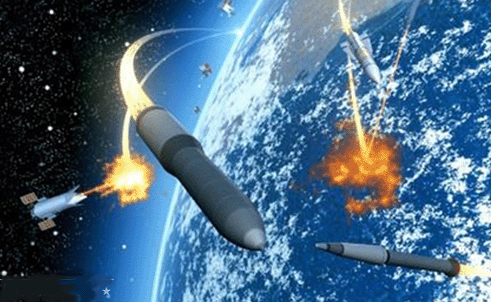
Rolls-Royce’s director of future programmes Abi Clayton tellingly said: ‘The technology will deliver the capability to support commercial and defence use cases.’
These activities are all completely contrary to the legal commitments the UK made a half century ago to preserve space for peace.
It may mirror the plot of classic ‘70s British sci-fi series, Space 1999, which also features a moon base and the threat posed by radioactive waste, but the UK/Ireland Nuclear Free Local Authorities also have real concerns that the development of a future British moon base powered by nuclear fission could represent a further unwanted development along the road to the militarisation of space.
Today is the UN International Day of Human Space Flight. On April 12, 2011, the UN General Assembly established the day on the 40th anniversary of Major Yuri Gagarin becoming the first human being to circle the Earth in his spacecraft ‘Vostok’. UN delegates reaffirmed ‘the important contribution of space science and technology in achieving sustainable development goals and increasing the well-being of States and peoples, as well as ensuring the realization of their aspiration to maintain outer space for peaceful purposes’.
Last week, the UK Space Agency announced a £2.9 million grant is to be awarded to Rolls-Royce SMR to collaborate with academic institutions to develop mini-reactors for deployment in space, with most media reports focusing on its potential to power a future moon base as part of the UK’s commitment to an international project to colonise the Earth’s near neighbour (Project Artemis). However, in welcoming the new funding, Rolls-Royce’s director of future programmes Abi Clayton tellingly said: ‘The technology will deliver the capability to support commercial and defence use cases.’
Whilst projects in outer space can be both benign and beneficial, the UK Space Strategy and UK Space Defence Strategy both identify that ‘NATO has made space one of five operational domains’,[1] and the UK Space Defence Strategy is subtitled ‘Operationalising the Space Domain’.[2] To make this a reality, the UK Government is intent upon investing £6.4 billion in a ‘Defence Space Portfolio’[3] for defence ‘in and through space’.[4]
For these purposes, the UK has joined the US and France in developing its own Space Command, and a nuclear moon base could in time become a part of the ‘portfolio’ from which UK Space Command operates,[5] in line with the government and military’s desire to ‘assure our access to, and operational independence in, space’.[6]
These activities are all completely contrary to the legal commitments the UK made a half century ago to preserve space for peace.
“Ironically the UK was in 1967 one of the first three co-signatories of the Outer Space Treaty which pledged the sponsors to ensure ‘that the Moon and other celestial bodies shall be used exclusively for peaceful purposes’”,[7] said Councillor Lawrence O’Neill, Chair of the NFLA Steering Committee.
“Our fear is that any future nuclear-powered moon-base could be ultimately crewed by military personnel from Space Command conducting operations that would be far from benign and beneficial, whether this be the permanent surveillance of perceived hostile states on Earth or more sinisterly as a platform for offensive weapons systems to project military power ‘through space’.
“And of course, once one major power establishes such a base, then the others, all not wishing to be outdone, will seek to do the same.”
The NFLA also has real practical concerns about the environmental impact of such a nuclear-powered base.
Councillor O’Neill added: “We have worries about the transfer of nuclear materials into space. It is not unknown for rockets to malfunction and explode on take-off or in early flight, indeed sadly this has led to the loss of human life, nor for radioactive material to be distributed across the surface of the Earth by exploding space vehicles, witness the accident involving Soviet satellite Kosmos 954.[8] And the UK Government’s own Committee on Radioactive Waste Management dismissed the idea of blasting radioactive waste into space on the grounds of both risk and cost.
“And in turn, a nuclear-powered moon base would generate radioactive waste. Where would this be put? If it came back to Earth, there would remain the risk of an accident on re-entry and states parties to the Outer Space Treaty also pledge to ‘avoid harmful contamination of space and celestial bodies’ so burial in situ below the lunar surface or blasting it into space would be unlawful”.
Lastly there is also a latent threat posed from outer space itself to the facility.
n 2016, NASA announced the findings of their Lunar Reconnaissance Orbiter (LRO) mission. Observing the lunar surface since launch in 2009, NASA scientists reported that ‘200 impact craters (had) formed during the LRO mission, ranging in size from about 10 to 140 feet (approximately 3 to 43 meters) in diameter’. Consequently, NASA recommended that ‘equipment placed on the moon for long durations – such as a lunar base – may have to be made sturdier. While a direct hit from a meteoroid is still unlikely, a more intense rain of secondary debris thrown out by nearby impacts may pose a risk to surface assets.’
In concluding Councillor O’Neill said: “We have all been concerned recently with the potential damage that could be caused on Earth to Ukrainian nuclear facilities from shelling and missile strikes so what happens if a meteoroid, or a fragment thereof, with massive kinetic energy hits a nuclear reactor based on the surface of the moon?[9]
German government rejects new call to delay nuclear shutdown
The German government has dismissed calls for a last-minute delay in shutting down the country’s last three nuclear power plants this weekend
By FRANK JORDANS – Associated Press, Apr 12, 2023
BONN, Germany (AP) — The German government dismissed calls Wednesday for a last-minute delay in shutting down the country’s last three nuclear power plants this weekend.
Opposition politicians and even some members of the Free Democrats, a libertarian party that’s part of Chancellor Olaf Scholz’s governing alliance, have demanded a reprieve for the remaining reactors, which were already operating without requisite safety checks.
“The nuclear phase-out by April 15, that’s this Saturday, is a done deal,” Scholz spokesperson Christiane Hoffmann said.
Successive German governments planned a phase-out of nuclear power. The last three plants originally were scheduled to shut down on Dec. 31, 2022. Scholz ordered a postponement last year amid concerns that Germany might face an energy shortage due to the war in Ukraine.
Lawmakers approved the extension on the condition the plants, which began operation more than 30 years ago, would cease operating by mid-April of this year……………..
[Keeping the reactors going] would be both illegal and costly, according to Environment Ministry spokesperson Bastian Zimmermann. The ministry oversees nuclear safety in Germany.
Zimmermann said the three reactors — Emsland, Neckarwestheim and Isar II — last underwent safety checks in 2009 and such inspections normally need to occur every 10 years. The requirement was only suspended due to the shutdown planned for the end of 2022, he said.
Any further lifetime extension for the plants would require comprehensive and lengthy security checks again, Zimmermann said.
The country is still searching for a location to permanently store almost 2,000 containers of highly radioactive waste for thousands of generations.
The Economy Ministry dismissed concerns that Germany won’t be able to meet its energy needs without the nuclear power plants, which currently produce about 5% of the country’s electricity.
Ministry spokesperson Beate Baron said recent studies showed Germany would be able to maintain its power supply with coal and gas-fired power plants and renewables such as wind and solar, while remaining a net exporter of electricity.
Baron said the government wants to phase in the use of hydrogen that can be produced without greenhouse gas emissions and fired up quickly on days when there’s little sun or wind for renewables. https://www.atchisonglobenow.com/news/world/german-government-rejects-new-call-to-delay-nuclear-shutdown/article_93c1beb6-7d8a-51ed-b48d-68ac8ba0fbb3.html
Netherlands energy experts recommend limiting energy demand, see little or no role for nuclear power, but Cabinet wants nuclear anyway.
Cabinet moving forward with nuclear plant plans, despite experts seeing “limited role” NL Times 13 Apr 23,
Minister Rob Jetten for Climate and Energy will move forward with plans to build two new nuclear power plants, he said at the presentation of Expert Team Energy System 2050’s advice on making the Netherlands climate neutral. In that advice, presented in The Hague on Wednesday, the team of experts sees “no or a limited role” for nuclear energy…………….
The final decision on the nuclear power plants will be made in about a year and a half,” Jetten said. “This advice will also be taken into account.”
In the report, the expert team said that new nuclear power plants only make sense if the demand for electricity doubles or triples and the Netherlands has to supply energy to neighboring countries.
The report was also critical of the Cabinet’s choice of Borssele as the destination for the nuclear power plants. According to the Cabinet, Borssele already has knowledge, experience, and support for working with nuclear power, and the energy can be converted into hydrogen. But experts don’t see it as a good choice. “A lot of electricity is already being generated at the coast with wind farms at sea. With nuclear power plants added, the electricity grid is overloaded.”………………………………………
For the energy transition to succeed, it is necessary to limit the energy demand. And that will require cooperation from citizens. The experts see many opportunities in local energy systems. In 2050, many neighborhoods should be energy-neutral or even energy-positive, using energy generated in the district for their limited consumption. If the energy generated remains in the neighborhood, it puts little strain on the high-voltage grids.
Citizen involvement and fairness are the most essential conditions for a successful energy transition, the experts said. “In order to achieve our climate goals, our energy system must be CO2 neutral within 20 years. We can only do that if we put citizens first and offer them opportunities and support to participate, now, here, later, and elsewhere,” co-author Aniek Moonen said. As an example of a fairer policy, she mentioned tackling poorly insulated homes and investing in locally generated energy.
Finland’s NATO Move Leaves Others to Carry On the “Helsinki Spirit”
Finland’s membership in NATO marks the end of the nation’s admirable tradition as a global peacemaker.
MEDEA BENJAMINNICOLAS J.S. DAVIES, Apr 11, 2023
On April 4, 2023, Finland officially became the 31st member of the NATO military alliance. The 830-mile border between Finland and Russia is now by far the longest border between any NATO country and Russia, which otherwise borders only Norway, Latvia, Estonia, and short stretches of the Polish and Lithuanian borders where they encircle Kaliningrad.
In the context of the not-so-cold war between the United States, NATO and Russia, any of these borders is a potentially dangerous flashpoint that could trigger a new crisis, or even a world war. But a key difference with the Finnish border is that it comes within about 100 miles of Severomorsk, where Russia’s Northern Fleet and 13 of its 23 nuclear-armed submarines are based. This could well be where World War III will begin, if it has not already started in Ukraine.
In Europe today, only Switzerland, Austria, Ireland and a handful of other small countries remain outside NATO. For 75 years, Finland was a model of successful neutrality, but it is far from demilitarized. Like Switzerland, it has a large military, and young Finns are required to perform at least six months of military training after they turn 18. Its active and reserve military forces make up over 4% of the population–compared with only 0.6% in the U.S.–and 83% of Finns say they would take part in armed resistance if Finland were invaded.
On April 4, 2023, Finland officially became the 31st member of the NATO military alliance. The 830-mile border between Finland and Russia is now by far the longest border between any NATO country and Russia, which otherwise borders only Norway, Latvia, Estonia, and short stretches of the Polish and Lithuanian borders where they encircle Kaliningrad.
In the context of the not-so-cold war between the United States, NATO and Russia, any of these borders is a potentially dangerous flashpoint that could trigger a new crisis, or even a world war. But a key difference with the Finnish border is that it comes within about 100 miles of Severomorsk, where Russia’s Northern Fleet and 13 of its 23 nuclear-armed submarines are based. This could well be where World War III will begin, if it has not already started in Ukraine.
In Europe today, only Switzerland, Austria, Ireland and a handful of other small countries remain outside NATO. For 75 years, Finland was a model of successful neutrality, but it is far from demilitarized. Like Switzerland, it has a large military, and young Finns are required to perform at least six months of military training after they turn 18. Its active and reserve military forces make up over 4% of the population–compared with only 0.6% in the U.S.–and 83% of Finns say they would take part in armed resistance if Finland were invaded.
Only 20 to 30% of Finns have historically supported joining NATO, while the majority have consistently and proudly supported its policy of neutrality. In late 2021, a Finnish opinion poll measured popular support for NATO membership at 26%. But after the Russian invasion of Ukraine in February 2022, that jumped to 60% within weeks and, by November 2022, 78% of Finns said they supported joining NATO.
As in the United States and other NATO countries, Finland’s political leaders have been more pro-NATO than the general public. Despite long-standing public support for neutrality, Finland joined NATO’s Partnership for Peace program in 1997. Its government sent 200 troops to Afghanistan as part of the UN-authorized International Security Assistance Force after the 2001 U.S. invasion, and they remained there after NATO took command of this force in 2003. Finnish troops did not leave Afghanistan until all Western forces withdrew in 2021, after a total of 2,500 Finnish troops and 140 civilian officials had been deployed there, and two Finns had been killed………………………………
Finland will find that its tragic choice to abandon a policy of neutrality that brought it 75 years of peace and look to NATO for protection, will leave it, like Ukraine, dangerously exposed on the front lines of a war directed from Moscow, Washington and Brussels that it can neither win, nor independently resolve, nor prevent from escalating into World War III………………………..
NATO membership will integrate Finland’s arms industry into NATO’s lucrative arms market, boosting sales of Finnish weapons, while also providing a context to buy more of the latest U.S. and allied weaponry for its own military and to collaborate on joint weapons projects with firms in larger NATO countries. With NATO military budgets increasing, and likely to keep increasing, Finland’s government clearly faces pressures from the arms industry and other interests. In effect, its own small military-industrial complex doesn’t want to be left out……………………..
Finnish law prohibits the country from possessing nuclear weapons or allowing them in the country, unlike the five NATO countries that store stockpiles of U.S. nuclear weapons on their soil–Germany, Italy, Belgium, Holland and Turkey. But Finland submitted its NATO accession documents without the exceptions that Denmark and Norway have insisted on to allow them to prohibit nuclear weapons. This leaves Finland’s nuclear posture uniquely ambiguous, despite President Sauli Niinistö’s promise that “Finland has no intention of bringing nuclear weapons onto our soil.”……………………..
Perhaps most regrettable is that Finland’s membership in NATO marks the end of the nation’s admirable tradition as a global peacemaker………………….more https://www.commondreams.org/opinion/finland-nato-russia-helsinki-spirit
April 15, Germany’s Greenpeace to celebrate nuclear phaseout
After decades of hard work by many courageous people, Germany is phasing
out nuclear power. So that this success can finally become reality, we want
to demonstrate with you in Munich. Ever since Greenpeace Germany was
founded in 1980, we have been fighting against the military and civilian
use of dangerous nuclear power, for example in Wackersdorf, Gorleben and
Gundremmingen.
Also under pressure from the anti-nuclear movement, the then
existing coalition of SPD and Greens decided in 2002 to take a first step
towards phasing out nuclear power. They agreed with the power plant
operators that a certain amount of electricity may still be generated
before the reactors have to be shut down. A specific expiration date has
not been set. The final exit was decided in the summer of 2011 by the then
government consisting of CDU/CSU and FDP. The reactor catastrophe in
Fukushima had occurred shortly before.
Greenpeace Germany 3rd April 2023
https://www.greenpeace.de/klimaschutz/energiewende/atomausstieg/atomausstiegsfest
On April 15, Germany is finally due to phase out nuclear power. But the FDP
and the Union keep demanding that the nuclear reactors should continue to
run. We are currently assuming that the nuclear phase-out will last. We
invite you to three central demonstrations and shutdown parties on April
15th.
Bund 27th March 2023
Concern over funding ‘stigma’ from Theddlethorpe nuclear storage
Only a ‘handful’ of applications made
By Daniel Jaines Local Democracy Reporter , The Lincolnite, 12 April 23
There are concerns that community groups in Theddlethorpe are not applying for a share of nearly £1million due to of the money’s links with a potential nuclear storage dump.
Only a handful of applications from Theddlethorpe community groups have been received for the grants.
The money is being made available due to Nuclear Waste Services exploring a potential for the area to host a Geological Disposal Facility.
The money is set to be handed out over the next 15-20 years — with £1million a year allocated while local studies are carried out, and £2.5million a year while drilling boreholes and further exploring the geology of the area.
Lincolnshire County Council’s Environment and Economy Scrutiny Committee were told on Tuesday that few groups had come forward to claim it.
Councillor Matthew Boles said: “It would strike me that the reason there’s a very small uptake in applying for these grants is that the local residents have attached stigma to it.
“They might feel that if they apply for this money they’re somehow supporting and are in favour of it.”
However, council officers said they didn’t believe this was the case.
Councillor Martin Griggs and some others also worried that the £1m budget would be difficult to match after the first year.
Councillors also raised concerns about any strings being attached to the bids and a lack of detailed information around infrastructure needs and the 4,000 jobs NWS has said the GDF works could create over its lifetime………………………….
Councillors were told that Lincolnshire County Council had challenged the jobs figures and called for a more localised report……………… https://thelincolnite.co.uk/2023/04/concern-over-funding-stigma-from-theddlethorpe-nuclear-storage/
1 This Month





PLEASE OPPOSE HR 8255 AND S.3639 – bills would accelerate satellite deployment, with no environmental review or safeguards – https://ncstd5li.quorum.us/campaign/169331/
To see nuclear-related stories in greater depth and intensity – go to https://nuclearinformation.wordpress.com
-
Archives
- October 2026 (49)
- September 2026 (339)
- August 2026 (330)
- July 2026 (355)
- June 2026 (287)
- May 2026 (306)
- April 2026 (356)
- March 2026 (251)
- February 2026 (267)
- January 2026 (308)
- December 2025 (358)
- November 2025 (359)
-
Categories
- 1
- 1 NUCLEAR ISSUES
- business and costs
- climate change
- culture and arts
- ENERGY
- environment
- health
- history
- indigenous issues
- Legal
- marketing of nuclear
- media
- opposition to nuclear
- PERSONAL STORIES
- politics
- politics international
- Religion and ethics
- safety
- secrets,lies and civil liberties
- spinbuster
- technology
- Uranium
- wastes
- weapons and war
- Women
- 2 WORLD
- ACTION
- AFRICA
- Atrocities
- AUSTRALIA
- Christina's notes
- Christina's themes
- culture and arts
- Events
- Fuk 2022
- Fuk 2023
- Fukushima 2017
- Fukushima 2018
- fukushima 2019
- Fukushima 2020
- Fukushima 2021
- general
- global warming
- Humour (God we need it)
- Nuclear
- RARE EARTHS
- Reference
- resources – print
- Resources -audiovicual
- Weekly Newsletter
- World
- World Nuclear
- YouTube
-
RSS
Entries RSS
Comments RSS

