Zaporizhzhia nuclear power plant will switch back to Russian fuel, from Westinghouse fuel
The Zaporizhzhia nuclear power plant in southern Ukraine which Russia
captured last year will stop using U.S.-produced nuclear fuel as quickly as
possible, the Interfax news agency quoted a Russian official as saying on
Thursday. The biggest nuclear power plant in Europe, mostly built in the
Soviet times, originally used Russian nuclear fuel, but Ukraine gradually
switched to supplies from Westinghouse after its first conflict with Russia
in 2014.
Reuters 20th April 2023
French Winter Power Twice as Pricey as Germany’s on Nuclear Woes

Bloomberg By Todd Gillespie, April 19, 2023
France’s weakened nuclear power output means the cost of its electricity for next winter is more than twice as expensive as Germany’s, as concerns over the health of the country’s reactors persist.
The “massive” gap of nearly €250 ($273) per megawatt-hour between French and German prices is because traders are pricing in more risk as they await updates on Electricite de France SA’s struggles with its aging atomic fleet, according to analysts at Engie SA’s EnergyScan. “No participants want to risk being short next winter,” they wrote.
French power for the first quarter of 2024 is trading at €416 per megawatt-hour, more than double Germany’s rate of €169. Normally a power exporter, France’s atomic generation has been gradually returning to service but still remains below historical averages.
The price discrepancy is a sign of France’s lingering energy woes even as its European neighbors benefit from a prolonged drop in prices. EDF’s nuclear reactors have faced recurring corrosion issues as the government takes greater hold over the state-backed utility………………… https://www.bloomberg.com/news/articles/2023-04-19/french-winter-power-twice-as-pricey-as-germany-s-on-nuclear-woes?leadSource=uverify%20wall—
NATO to surge troops to Russian border
As the deteriorating military situation for the Ukrainian armed forces becomes increasingly apparent, NATO is making open plans to massively intensify its conflict with Russia.
Andre Damon@Andre__Damon, 17 April 2023 m\ https://www.wsws.org/en/articles/2023/04/18/tzhv-a18.html
NATO plans to surge troops to Russia’s border as part of an effort to become a “war-fighting alliance,” the New York Times reported Monday.
The Times wrote that “NATO now has deployed a battalion of multinational troops to eight countries along the eastern border with Russia. It is detailing how to enlarge those forces to brigade strength in those frontline states.”
A battalion can include up to 1,000 troops, while a brigade can include up to 5,000 troops, meaning that NATO could potentially plan to increase the number of troops on Russia’s borders fivefold, to up to 40,000 troops.
The Times reports that NATO “is also tasking thousands more forces, in case of war, to move quickly in support, with newly detailed plans for mobility and logistics and stiffer requirements for readiness.”
Politico, meanwhile, has cited even larger numbers. On March 18, it reported, “In the coming months, the alliance will accelerate efforts to stockpile equipment along the alliance’s eastern edge and designate tens of thousands of forces that can rush to allies’ aid on short notice… The numbers will be large, with officials floating the idea of up to 300,000 NATO forces.”
“The North Atlantic Treaty Organization,” wrote the Times, has launched “a full-throttled effort” to prepare for military operations all along its eastern flank.
As the Times put it, this “means a revolution in practical terms: more troops based permanently along the Russian border,” It also means “more integration of American and allied war plans, more military spending and more detailed requirements for allies to have specific kinds of forces and equipment to fight, if necessary, in pre-assigned places.”
The alliance has “shed remaining inhibitions about increased numbers of Western troops all along NATO’s border with Russia,” the Times stated. The aim is “to make NATO’s forces not only more robust and more capable but also more visible to Russia.”
Additional troops will be placed under the direct authority of Gen. Christopher G. Cavoli, NATO’s Supreme Allied Commander Europe, who also commands American forces in Europe, as part of the NATO alliance’s decision.
The Times reports that General Cavoli is integrating American and allied war-fighting plans for the first time since the Cold War. Citing a NATO official, the newspaper wrote, “Americans are back at the heart of Europe’s defense … deciding with NATO precisely how America will defend Europe.”
This will entail a massive military buildup, involving enormous increases in military spending. “Now the demands will be tougher and more rigorous to bring the alliance back to a war-fighting capacity in Europe and make deterrence credible—to ensure that NATO can fight a high-intensity war against a rival, Russia, from the first day of conflict,” the Times wrote.
Instead of meeting the previous goal of 2 percent of gross domestic product devoted to the military, NATO members will be expected to spend between 2.5 and 3 percent, the Times reported.
In perhaps the most ominous passage in the article, the Times wrote, “Previously, the annual exercises of NATO’s nuclear forces, known as Steadfast Noon, were kept quiet. But last year, after Russia’s invasion, the exercise went ahead openly. It was important, a NATO official said, to show Moscow that the alliance wasn’t deterred by nuclear threats.”
NATO’s headquarters is likewise “being transformed into a major strategic and war-fighting command, charged with drawing up the alliance’s plans to integrate and deploy allied troops.”
The accession of Finland to NATO, which doubled the length of NATO’s land border with Russia, will be a key component of these plans, with Russia’s entire border with NATO becoming a militarized zone.
Just weeks after its accession to NATO, Finland has begun building a fence on the Russian border, with the initial section to be completed in June.
In June of last year, NATO published a strategy document declaring that the alliance must prepare for “high-intensity, multi-domain warfighting against nuclear-armed peer-competitors.” The document declared that “the Euro-Atlantic area is not at peace”—all but declaring that the alliance is at war.
In January, Rob Bauer, NATO’s top military spokesperson, declared that the US-led NATO alliance is prepared for a “direct clash with Russia.” Asked by Portugal’s RTP News, “You don’t believe that it’s only about Ukraine?” Bauer replied, “No, it’s about turning back to the old Soviet Union.”
The interviewer continued, “So the entire Eastern Flank is at risk somehow?” Bauer replied, “Yeah.” The interviewer asked, “We are ready to [sic] a direct confrontation with Russia?” To this Bauer replied, “We are.”
In this supercharged environment, NATO will begin Defender 23, the alliance’s annual war game, on April 22.
The exercise will involve 9,000 US troops and 17,000 soldiers from other NATO members. The “nearly two-month-long exercise is focused on the strategic deployment of U.S.-based forces, employment of Army pre-positioned stocks and interoperability with European allies and partners,” a Pentagon spokesperson said April 5.
A key goal of the exercise will be to “increase lethality of the NATO Alliance through long-distance fires” according to U.S. Army’s Europe and Africa commands.
This will be followed by Air Defender 2023, the largest NATO air exercise since its founding. A US Air National Guard official told the War Zone that Russian officials can “take away whatever message they want” from the drill.
Against this background, a group of former top officials from France, Germany, the United States and Spain have written an op-ed in the Guardian Sunday encouraging more direct NATO military intervention against Russia, declaring “We have to go ‘all in’ in our support for Ukraine.” They declare that “Ukraine needs the combined force of tanks, longer-range missiles and aircraft to conduct a successful counterattack, paving the way to Ukrainian victory.”
The press is full of such declarations. David Ignatius, writing in the Washington Post, argued, “President Biden doesn’t want to start World War III, but he will look back with regret if the United States and its allies leave any weapons or ammunition on the sidelines that could responsibly be used in this conflict. Whatever Biden might wish later he had done if things go badly, he should do now.”
As the deteriorating military situation for the Ukrainian armed forces becomes increasingly apparent, NATO is making open plans to massively intensify its conflict with Russia.
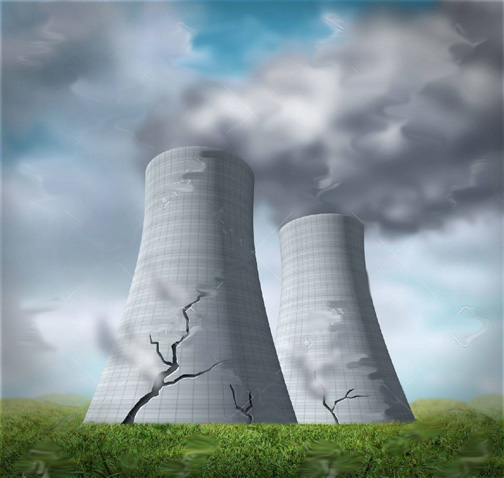
Hungary to Prolong Nuclear Plant’s Lifetime as Expansion Stalls
By Marton Kasnyik, April 21, 2023 https://www.bloomberg.com/news/articles/2023-04-21/hungary-to-prolong-nuclear-plant-s-lifetime-as-expansion-stalls?leadSource=uverify%20wall
Hungary aims to extend the lifetime of its sole nuclear power plant by 20 years to bridge major delays to its Russian-managed expansion, according to a senior official.
Extending the operation of the Paks plant in southern Hungary will maintain the source of about 40% of the country’s electricity consumption. The government is currently assessing safety issues after previous 20-year extensions to the four existing reactors in the last decade.
“Our plan is to get a further 20 years of life-extension,” Energy Minister Csaba Lantos said at a conference on Friday.
Prime Minister Viktor Orban’s administration handed a €10 billion ($11 billion) contract to Russia’s Rosatom Corp. in 2014 to expand the Paks plant. The project has been marred by delays, including due to initial European Union opposition to the investment and the quality of Rosatom’s plans, which Hungary’s own regulator has said fell short of stringent requirements.
Last week, Hungary and Russia said they agreed to an amendment of their original contract following media reports of a potentially reduced role for Rosatom amid EU sanctions against Russia for its invasion of Ukraine.
The changes are “technical” in nature and don’t affect the project’s cost, Cabinet Minister Gergely Gulyas told reporters on Thursday, without elaborating.
Scrapping could be next for Russia’s nuclear-powered battle cruiser
It is likely not cost-efficient to do the highly needed upgrade of the Northern Fleet’s 25-year old flagship “Pyotr Velikiy”.
Read in Russian | Читать по-русски
By Thomas Nilsen, 20 Apr 23 https://thebarentsobserver.com/en/security/2023/04/scrapping-could-be-next-russias-nuclear-powered-battle-cruiser
“Currently, the question about withdrawing “Pyotr Velikiy” from the Navy is under consideration. Based on the experience of repairing and modernizing the “Admiral Nakhimov” of the same class has shown that this is very costly,” a navy source said to state-owned news agency TASS.
Like in many speculations on the fate of older navy vessels, Russian state media send mixed information. Shortly after the TASS report came on Thursday, RIA Novosti quoted an unnamed source saying there are no plans to retire the huge warship.
The “Pyotr Velikiy” and “Admiral Nakhimov” are of sister ships, both of the Kirov-class, the only nuclear-powered surface warships in the Russian Navy.
The “Admiral Nakhimov” has not been in operation since the early 1990ties, and has since 1999 been at the yard in Severodvinsk undergoing repair, change of uranium fuel elements in the reactors and a refit to receive new weaponry, including modern cruise-missiles.
However, as repeatedly reported by the Barents Observer over the last decade, the re-commissioning of the warship has seen one postponement following the other. Current plans to set sail in 2024 today seem unlikely.
The “Pyotr Velikiy” was supposed to be docked in Severodvinsk as soon as “Admiral Nakhimov” joins the Northern Fleet.
The warship is armed with several types of cruise missiles, surface-to-air missiles, rocket launchers, torpedos and artillery. The hangar can house three helicopters.
April 18 marked the 25-years anniversary since “Pyotr Velikye” was commissioned. The ship has a crew of more than 700.
US military-industrial complex is main beneficiary of fighting Russia in Ukraine – Moscow
21 Apr 23, https://www.rt.com/russia/575116-galuzin-rt-interview-ukraine/
The American arms industry will now have contracts for years to come, Deputy Foreign Minister Mikhail Galuzin has insisted.
US policy on Ukraine is inherently cynical and ignores the interests of the Ukrainian people, Russian Deputy Foreign Minister Mikhail Galuzin claimed in an interview with RT. Washington is the biggest beneficiary from the hostilities, he added.
The US and its NATO allies “consider Ukraine as just raw material for [fulfilling] their aggressive purposes against Russia,” the senior diplomat said in an interview. Washington has declared the “strategic defeat” of Russia in Ukraine as its goal, he noted, with the US and its allies delivering weapons to Kiev on an unprecedented scale.
“The main beneficiary of [arming Ukraine] is the USA. [Its] military industrial complex… is now ensured orders for years to come. They are making profit on the war they conduct in Ukraine against us,” Galuzin said.
The deputy minister also commented on the Chinese peace plan for Ukraine, which Beijing presented earlier this year, affirming it could serve as the basis of a future peace agreement. However, it is up to Kiev to resume negotiations, he said, as it was the party that pulled out in the first place.
“In March 2022, it was Russia that responded positively to a Ukrainian proposal to hold peace talks. And the two sides were close to an agreement. We even formulated a draft treaty with Ukraine,” he said, referring to talks mediated by Türkiye.
Kiev has not responded to a document that Moscow put forward in April based on what Ukraine suggested in Istanbul, Galuzin said.
“The Kiev regime was stopped by its Western mentors,” he claimed, reiterating the view previously expressed by other senior Russian officials. The US “and its satellites” want to weaken Russia and are using Ukraine as a tool to do that, the diplomat stated.
They seem to be ready to continue this fighting to the last Ukrainian, unfortunately,” he remarked.
In the interview with RT, Galuzin also discussed Russian relations with Belarus and Moldova and the escalating religious conflict in Ukraine.
Nuclear Troubles Send French Winter Power Prices Soaring
By Michael Kern – Apr 19, 2023 https://oilprice.com/Latest-Energy-News/World-News/Nuclear-Troubles-Send-French-Winter-Power-Prices-Soaring.html
France’s power prices for early 2024 are double the German prices for next winter as the huge French nuclear fleet continues to show signs of weak output and availability.
The French power price for the first quarter of 2024 was at $455 (416 euros) per megawatt-hour (MWh) on Wednesday. That’s more than double the price for the same period in Germany, where the power price was at $185 (169 euros) per MWh for early 2024, according to data compiled by Bloomberg.
France has had troubles at many of its nuclear reactors, half of which have been shut down for repairs and maintenance at several times over the past year.
Germany, meanwhile, took its last three nuclear power plants offline on Saturday, ending more than six decades of commercial nuclear energy use, Germany ended the nuclear power era despite continued concerns about energy security and energy supply after the Russian invasion of Ukraine and the end of pipeline natural gas deliveries from Russia, which was the largest gas supplier to Europe’s biggest economy before the war.
In France, concerns about the operations at France’s large nuclear power fleet resurfaced last month after the French nuclear safety authority, ASN, told energy giant and large nuclear reactor operator EDF to review its program of reactor checks, following the finding of another crack at a nuclear power plant.
This led to an 8% one-day surge in French power prices for next year, the biggest jump since the end of January.
For much of last year, France’s nuclear power generation was well below capacity, as more than half of the country’s reactors were offline at one point in the autumn due to repairs or maintenance.
At the moment, French nuclear power plants are producing 17.5% less than the average output rate for 2020 and 2021. That’s down from 23% last year, so there is some progress, but concerns remain.
Will Environmental, social, and governance (ESG) investment managers follow the govt in backing nuclear?

By Chloe Cheung, 19 Apr 23, https://www.ftadviser.com/investments/2023/04/19/will-esg-investment-managers-follow-the-govt-in-backing-nuclear/
Wind turbines and solar panels are commonly associated with low-carbon energy, but nuclear power is also being considered in the pursuit of net zero.
In a move to encourage private sector investment, chancellor Jeremy Hunt said in the spring Budget that the UK green taxonomy will class nuclear power as ‘environmentally sustainable’, subject to consultation.
Although nuclear fuels are not renewable, the classification would enable nuclear power to have the same investment incentives as renewable energy.
But despite being low-carbon, it is not uncommon to come across ESG funds and investment companies that exclude nuclear power generation. So will investment managers follow the UK government’s approach to nuclear power?
William Argent, lead adviser to the VT Gravis Clean Energy Income Fund, says the fund’s responsible investment statement does not currently allow exposure to nuclear power generation assets.
“There may be some very modest exposure to companies involved in the nuclear energy supply chain, providing services; but we do not have exposure to companies that own nuclear energy generation plants themselves,” he adds.
While the UK government wants to class nuclear power as ‘environmentally sustainable’, Argent says his position on nuclear energy has, at this stage, not changed. “We exclude it as a commonly perceived ‘controversial activity’.
“There would need to be a shift in that perception among our investors and more widely. We would not consider changing the stance unless there was a broader acceptance.”
Other funds avoiding companies that generate revenue from nuclear power generation include Quilter Cheviot’s Climate Assets Funds.
“While we recognise that nuclear power does not generate greenhouse gas emissions, and therefore it has a role to play in the net-zero pathway and transition away from fossil fuels, we do not consider it a ‘sustainable investment’,” says Claudia Quiroz, lead fund manager of the Climate Assets Funds, and head of sustainable investment at Quilter Cheviot.
Citing environmental and safety issues that “outweigh” zero emission credentials, she says: “Nuclear energy generates a significant mass of radioactive waste. In addition, however it is disposed of, that radioactive waste will remain for generations to come.
“Safety concerns, both accidental and deliberate, also exist. While the operation of nuclear power plants is undoubtedly safer than previous generations and an accidental disaster on the scale of Chernobyl is unlikely, safety challenges do remain.
“Nuclear power plants are also easy targets for malevolent acts such as terrorist threats, cyberattacks or acts of war.”
Although Quiroz describes the UK government’s intended sustainable classification of nuclear energy as ultimately a positive move, she adds that as sustainable investors, it will not change the fund’s philosophy on investing in nuclear energy.
Germany and Finland: Two sides of the nuclear power coin in Europe

“What we see in Germany is a measured but speedier version of a European trend: the decline of the nuclear industry,”
“It’s a progressive closure — the replacement rate is insufficient for nuclear energy to survive.”
The shutdown of the remaining German reactors coincides with the startup of a new reactor on the Finnish coast
IGNACIO FARIZA. El Pais, Madrid – APR 19, 2023
As chance would have it, the shutdown of the Germany’s remaining nuclear reactors coincided exactly with the opening of a new one in Finland, the first in over 15 years in the European Union (EU). Both countries are highly vulnerable to the vagaries of Russian energy sources, but represent two opposing European visions of the always controversial nuclear energy.
The timing could not have been more incongruous. Almost 12 years after Angela Merkel’s administration decided to abandon nuclear power following the Fukushima (Japan) disaster, three plants were disconnected from the grid and mothballed: Isar 2 (Bavaria); Neckarwestheim 2 (Baden-Württemberg); and Emsland (Lower Saxony). A few hours later, in the early hours of the morning, the largest reactor in Europe was inaugurated 1,000 miles to the north. After almost 15 years of construction and many cost overruns, the Olkiluoto Nuclear Power Plant started producing 1.6 gigawatts (GW) of electricity, about one seventh of Finland’s total electricity demand.
The start-up of the Finnish reactor was a rocky road: it was first scheduled to be completed in 2009 and cost $12 billion, three times more than the original estimate. With Finnish conservatives holding a firm grip on power, more nuclear power projects are expected. Petteri Orpo, the front-runner in the prime minister race, often says in campaign speeches that nuclear power should be “the cornerstone of Finnish energy policy.”
The brutal energy shock aggravated by the Russian invasion of Ukraine has recently rekindled the debate about the role of nuclear power in Europe. Germany delayed the closure of its reactors by four months amid the energy crisis, and several political parties (including Merkel’s center-right CDU party) have reversed their original positions. The International Energy Agency (the Organization for Economic Cooperation and Development’s energy arm) has emerged as a leading advocate for nuclear reactors in a context increasingly dominated by renewable energy. A report by the International Energy Agency last summer noted the growing momentum for nuclear energy in many countries given rising fuel prices and growing concerns about stable energy supplies……………….
Although wind and photovoltaic energy are gaining traction in Germany, Europe’s biggest economy and most populous country, fossil fuels will have to fill some of the gap left by the nuclear plant shutdowns (6% of Germany’s electricity in 2022). Highly polluting coal plants still produce a third of the country’s electricity but will have to close by 2038……………………….
Consultant and environmentalist Mycle Schneider, author of one of the most comprehensive annual report on the global state of nuclear power, doesn’t see it that way. “What we see in Germany is a measured but speedier version of a European trend: the decline of the nuclear industry,” he told EL PAÍS in an e-mail. “It’s a progressive closure — the renewal rate is insufficient for nuclear energy to survive.”
Schneider, a German expert based in Paris, says in the last 30 years EU countries have connected 16 new reactors, closed 47 and started construction on only two: Flamanville 3 (in France) and Olkiluoto 3. “Since the construction of these facilities began, the cost of solar [photovoltaic] energy has plunged by 90% and wind power by 70%. It’s simply impossible for a nuclear plant to compete with those low costs,” he said. Over the same period, the EU has added 157 GW of solar energy capacity, wind has added 175 GW, and nuclear has accounted for a 24 GW loss in capacity.
Paris and Berlin dominate the debate
Apart from the diverging paths of Berlin and Helsinki, the nuclear energy debate is still dominated by the two major continental powers: Germany, which has the unwavering support of Spain and Austria, and France, supported by several Eastern European countries.
Broad swaths of German society vehemently oppose nuclear energy, unlike French society and its government. France depends highly on nuclear energy, even during 2022 when a plague of technical issues caused shutdowns of many power plants. 60% of France’s electricity is nuclear, perhaps because prior to its 2016 corporate restructuring, Areva — a global power in nuclear plant construction — was majority-owned by the French state. Areva was the lead engineering firm for Olkiluoto 3. However, the future of nuclear energy will not be driven by France, Germany or the EU, says Zurita, but by “China, India, South Korea and the other emerging countries” that are growing so rapidly. https://english.elpais.com/international/2023-04-19/germany-and-finland-two-sides-of-the-nuclear-power-coin-in-europe.html
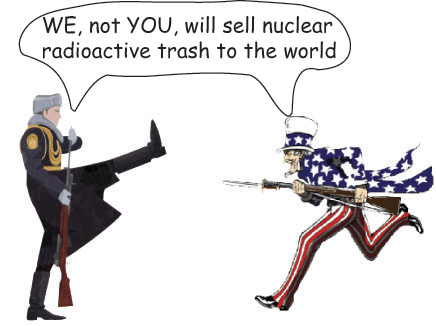
Germany, Poland and others are pushing for new sanctions on Russia’s nuclear energy.
CNBC, APR 19 2023, Silvia Amaro @SILVIA_AMARO
- In a document seen by CNBC, Poland and the Baltic States called for sanctions on the civil nuclear energy activities too.
- According to data published by Europe’s statistics office Eurostat in 2021 — the year that preceded Russia’s invasion of Ukraine — Moscow was the third biggest provider of uranium to the EU.
- Asked whether a new set of actions to target Russia would feature nuclear energy, a spokesperson for the European Commission said the institution has no comment on ongoing confidential discussions.
…………………………………… “Across the EU, we must keep making ourselves independent from Russia,” Robert Habeck, the German economy and climate minister, said over the weekend.
“The nuclear sector is still outstanding. It is not justifiable that this area is still given preferential treatment. Nuclear technology is an extremely sensitive area, and Russia can no longer be seen as reliable partner within it,” he said.
In a document seen by CNBC, Poland and the Baltic States also called for sanctions on civil nuclear energy activities.
“Between March and December 2022, Russia exported just over $1 billion-worth of materials and technology of relevance to the nuclear energy sector,” the Royal United Services Institute, a think tank, said in a report in February.
“This trade included exports to members of NATO and the EU. In fact, not only has the value of Russian nuclear-related exports not shrunk since February 2022, the data reviewed by the author suggests that it may be expanding, with a handful of loyal customers still eager to do business with Russia’s nuclear sector,” the same report said.
According to data published by Europe’s statistics office Eurostat in 2021 — the year before Russia’s invasion of Ukraine — Moscow was the third biggest provider of uranium to the EU.
Ukrainian officials, as well as environmental groups, have previously criticized how the European Union has so far not curbed nuclear revenues for the Kremlin.
……………………… Further highlighting the complexity of the matter, Hungary announced in August that it would build two new nuclear reactors with the Russia state-owned firm Rosatom.
France’s radioactive waste management agency Andra wants to increase storage capacity at Cires waste dump
French radioactive waste management agency Andra has applied to the
department of Aube in north-eastern France for environmental permission to
increase the current authorised storage capacity of Cires, the country’s
dedicated disposal facility for very-low-level radioactive waste (VLLW).
World Nuclear News 12th April 2023
https://www.world-nuclear-news.org/Articles/Application-to-raise-capacity-of-French-very-low-l
Jonathon Porritt: Germany’s nuclear nous vs UK nuclear nutters.

So that’s another dead duck in the case made for new nuclear. Which just leaves the final barrier: the continuing reality that our nuclear weapons capability still depends very heavily on maintaining a civil nuclear power programme – not just to guarantee a continuing supply of nuclear engineers and R&D funding, but to keep the public in the dark about the increasingly insupportable costs of renewing our notionally ‘independent’ nuclear deterrent.
I’m celebrating today – for the simple reason that Germany closed down its three remaining nuclear reactors on Saturday 15th April.
I’ve followed the nuclear debate in Germany ever since I first got involved in green politics back in the 1970s, and was hugely inspired by the campaigns of Die Grünen against both nuclear power and nuclear weapons – seeing the two as inextricably linked. Interestingly, it’s as controversial a debate now as it was then – with a majority of people in Germany (including some Die Grünen voters) still believing that nuclear power should be part of the electricity mix.
As I argued back in 2011, I did not agree with the decision of the Merkel Government (in coalition with Die Grünen) to close down all its remaining reactors in response to the Fukushima disaster – well before the end of their scheduled operational lifetime. Inevitably, this decision caused an (albeit temporary) increase in burning coal and gas.
That’s now water under the bridge – and Germany’s energy system will now be completely nuclear-free, even if it will be dealing with the legacy of its nuclear waste for many years to come. As the German Environment Minster, Steffi Lemke, said: ‘Three generations have benefitted from nuclear power in Germany, but about 30,000 generations will be affected by the ongoing presence of nuclear waste.’
But my celebration has been sadly attenuated by the current nuclear frenzy going on here in the UK. I’ve been through many periods of nuclear hype over the years, but nothing quite like this one – with all the mainstream political parties, the industry itself and all mainstream media (including some sorely deluded muppets in the BBC and the Guardian) ramping up their ‘nuclear renaissance’ rhetoric in increasingly dishonest and fact-free ways.
I suspect they see this as a ‘now or never’ moment before economic reality kills off nuclear power once and for all – when that combination of renewables-storage-efficiency is so massively outperforming nuclear as to starve all nuclear options of the capital they will still need. Government subsidy can only go so far.
In the meantime, however, we have a Government still strenuously seeking investors in its godforsaken plans for two more ludicrously expensive reactors at Sizewell C – an asset that already looks totally stranded even before a Final Investment Decision is taken.
Even that, however, is just a sideshow in comparison to the hype around prospects for Small Modular Reactors (SMRs) here in the UK. In March, the Chancellor announced a new competition to identify the best value SMR design for the UK, with a view to its eventually handing over a full £1bn in co-funding to get that design off the ground. Ludicrous. But full marks to the Tories for ‘recycling’ here: the announcement sounded almost identical to the earlier competition it announced back in March 2016. (And it was only the fifth time that the Chancellor reconfirmed plans for a new Great British Nuclear agency!)

Apart from the nuclear industry itself, and all its happy-clappy cheerleaders, the majority of independent commentators continue to point out that SMRs cannot possibly deliver what we now need: safe, affordable, ultra-low-carbon electricity that can actually make a practical difference in meeting our Net Zero target by 2035.
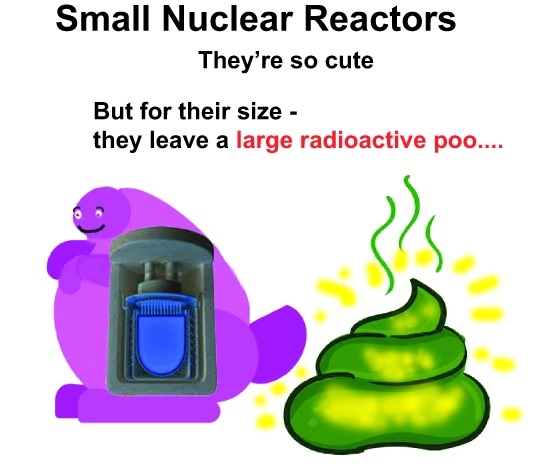
And that’s before one thinks about the nuclear waste nightmare: a new study published in Proceedings of the American National Academy of Sciences estimates that SMRs will create 30 times as much nuclear waste (per unit of electricity generated) as conventional reactors.
It’s all just a massive waste of time and public money – but with devastating consequences. If we could just free ourselves of our residual hankering after nuclear power, we could (finally!) double down on the infinitely more cost-effective renewables-storage-efficiency alternatives. With massive benefits in terms of decarbonisation, jobs, addressing fuel poverty and so on.
The case for this transition (away from fossil fuels and nuclear) is now incontrovertible but two remaining barriers stand in the way of us doing what Germany has managed to do.
The first is the endlessly repeated argument from nuclear industry spokespeople that nuclear power is the only way of providing the baseload generation our current electricity supply system depends on – once big thermal coal and gas plants are taken off the grid. There was indeed a time when grid stability depended on ‘always on’ big power stations. But that is now widely seen (outside the nuclear industry) to be a completely outmoded concept.
……………………… , the Government acknowledges that there is now no specific baseload expectations of nuclear or anything else. It is now all about ‘lowest cost’, rather than baseload,………..
So that’s another dead duck in the case made for new nuclear. Which just leaves the final barrier: the continuing reality that our nuclear weapons capability still depends very heavily on maintaining a civil nuclear power programme – not just to guarantee a continuing supply of nuclear engineers and R&D funding, but to keep the public in the dark about the increasingly insupportable costs of renewing our notionally ‘independent’ nuclear deterrent.

Which takes us right back to the origins of the German anti-nuclear movement in the 1970s. These ‘evil twins’, nuclear weapons and nuclear power, have forever been joined at the hip, and always will be until the world rids itself of the deadly incubus of nuclear weaponry.
Leaks Reveal Reality Behind U.S. Propaganda in Ukraine
The inability of either side to decisively defeat the other in the ruins of Bakhmut and other front-line towns in Donbas is why one of the most important documents predicted that the war was locked in a “grinding campaign of attrition” and was “likely heading toward a stalemate.”
What U.S. intelligence officials know, but the White House is doggedly ignoring, is that, as in Afghanistan and Iraq, top Ukrainian officials running this endemically corrupt country are making fortunes skimming money from the over $100 billion in aid and weapons that America has sent them.
By Medea Benjamin and Nicolas J. S. Davies, World BEYOND War, April 19, 2023
The U.S. corporate media’s first response to the leaking of secret documents about the war in Ukraine was to throw some mud in the water, declare “nothing to see here,” and cover it as a depoliticized crime story about a 21-year-old Air National Guardsman who published secret documents to impress his friends. President Biden dismissed the leaks as revealing nothing of “great consequence.”
What these documents reveal, however, is that the war is going worse for Ukraine than our political leaders have admitted to us, while going badly for Russia too, so that neither side is likely to break the stalemate this year, and this will lead to “a protracted war beyond 2023,” as one of the documents says.
The publication of these assessments should lead to renewed calls for our government to level with the public about what it realistically hopes to achieve by prolonging the bloodshed, and why it continues to reject the resumption of the promising peace negotiations it blocked in April 2022.
We believe that blocking those talks was a dreadful mistake, in which the Biden administration capitulated to the warmongering, since-disgraced U.K. Prime Minister Boris Johnson, and that current U.S. policy is compounding that mistake at the cost of tens of thousands more Ukrainian lives and the destruction of even more of their country.
In most wars, while the warring parties strenuously suppress the reporting of civilian casualties for which they are responsible, professional militaries generally treat accurate reporting of their own military casualties as a basic responsibility. But in the virulent propaganda surrounding the war in Ukraine, all sides have treated military casualty figures as fair game, systematically exaggerating enemy casualties and understating their own.
Publicly available U.S. estimates have supported the idea that many more Russians are being killed than Ukrainians, deliberately skewing public perceptions to support the notion that Ukraine can somehow win the war, as long as we just keep sending more weapons.
The leaked documents provide internal U.S. military intelligence assessments of casualties on both sides. But different documents, and different copies of the documents circulating online, show conflicting numbers, so the propaganda war rages on despite the leak.
The most detailed assessment of attrition rates of troops says explicitly that U.S. military intelligence has “low confidence” in the attrition rates it cites. It attributes that partly to “potential bias” in Ukraine’s information sharing, and notes that casualty assessments “fluctuate according to the source.”
So, despite denials by the Pentagon, a document that shows a higher death toll on the Ukrainian side may be correct, since it has been widely reported that Russia has been firing several times the number of artillery shells as Ukraine, in a bloody war of attrition in which artillery appears to be the main instrument of death. Altogether, some of the documents estimate a total death toll on both sides approaching 100,000 and total casualties, killed and wounded, of up to 350,000.
Another document reveals that, after using up the stocks sent by NATO countries, Ukraine is running out of missiles for the S-300 and BUK systems that make up 89% of its air defenses. By May or June, Ukraine will therefore be vulnerable, for the first time, to the full strength of the Russian air force, which has until now been limited mainly to long-range missile strikes and drone attacks.
Recent Western arms shipments have been justified to the public by predictions that Ukraine will soon be able to launch new counter-offensives to take back territory from Russia. Twelve brigades, or up to 60,000 troops, were assembled to train on newly delivered Western tanks for this “spring offensive,” with three brigades in Ukraine and nine more in Poland, Romania and Slovenia.
But a leaked document from the end of February reveals that the nine brigades being equipped and trained abroad had less than half their equipment and, on average, were only 15% trained. Meanwhile, Ukraine faced a stark choice to either send reinforcements to Bakhmut or withdraw from the town entirely, and it chose to sacrifice some of its “spring offensive” forces to prevent the imminent fall of Bakhmut…………………………………….
The inability of either side to decisively defeat the other in the ruins of Bakhmut and other front-line towns in Donbas is why one of the most important documents predicted that the war was locked in a “grinding campaign of attrition” and was “likely heading toward a stalemate.”
Adding to the concerns about where this conflict is headed is the revelation in the leaked documents about the presence of 97 special forces from NATO countries, including from the U.K. and the U.S. This is in addition to previous reports about the presence of CIA personnel, trainers and Pentagon contractors, and the unexplained deployment of 20,000 troops from the 82nd and 101st Airborne Brigades near the border between Poland and Ukraine.
Worried about the ever-increasing direct U.S. military involvement, Republican Congressman Matt Gaetz has introduced a Privileged Resolution of Inquiry to force President Biden to notify the House of the exact number of U.S. military personnel inside Ukraine and precise U.S. plans to assist Ukraine militarily.
We can’t help wondering what President Biden’s plan could be, or if he even has one. But it turns out that we’re not alone. In what amounts to a second leak that the corporate media have studiously ignored, U.S. intelligence sources have told veteran investigative reporter Seymour Hersh that they are asking the same questions, and they describe a “total breakdown” between the White House and the U.S. intelligence
community.

Hersh’s sources describe a pattern that echoes the use of fabricated and unvetted intelligence to justify U.S. aggression against Iraq in 2003, in which Secretary of State Antony Blinken and National Security Advisor Sullivan are by-passing regular intelligence analysis and procedures and running the Ukraine War as their own private fiefdom. They reportedly smear all criticism of President Zelenskyy as “pro-Putin,” and leave U.S. intelligence agencies out in the cold trying to understand a policy that makes no sense to them.
What U.S. intelligence officials know, but the White House is doggedly ignoring, is that, as in Afghanistan and Iraq, top Ukrainian officials running this endemically corrupt country are making fortunes skimming money from the over $100 billion in aid and weapons that America has sent them.
According to Hersh’s report, the CIA assesses that Ukrainian officials, including President Zelenskyy, have embezzled $400 million from money the United States sent Ukraine to buy diesel fuel for its war effort, in a scheme that involves buying cheap, discounted fuel from Russia. Meanwhile, Hersh says, Ukrainian government ministries literally compete with each other to sell weapons paid for by U.S. taxpayers to private arms dealers in Poland, the Czech Republic and around the world…………………….
First-hand reporting from inside Ukraine by New Cold War has described the same systematic pyramid of corruption as Hersh. A member of parliament, formerly in Zelenskyy’s party, told New Cold War that Zelenskyy and other officials skimmed 170 million euros from money that was supposed to pay for Bulgarian artillery shells.
The corruption reportedly extends to bribes to avoid conscription. The Open Ukraine Telegram channel was told by a military recruitment office that it could get the son of one of its writers released from the front line in Bakhmut and sent out of the country for $32,000.
As has happened in Vietnam, Iraq, Afghanistan and all the wars the United States has been involved in for many decades, the longer the war goes on, the more the web of corruption, lies and distortions unravels…………………………….
These leaks and investigative reports are not the first, nor will they be the last, to shine a light through the veil of propaganda that permits these wars to destroy young people’s lives in faraway places, so that oligarchs in Russia, Ukraine and the United States can amass wealth and power.
The only way this will stop is if more and more people get active in opposing those companies and individuals that profit from war–who Pope Francis calls the Merchants of Death–and boot out the politicians who do their bidding, before they make an even more fatal misstep and start a nuclear war.
Medea Benjamin and Nicolas J. S. Davies are the authors of War in Ukraine: Making Sense of a Senseless Conflict, published by OR Books in November 2022.
Medea Benjamin is the cofounder of CODEPINK for Peace, and the author of several books, including Inside Iran: The Real History and Politics of the Islamic Republic of Iran.
Nicolas J. S. Davies is an independent journalist, a researcher with CODEPINK and the author of Blood on Our Hands: The American Invasion and Destruction of Iraq. https://worldbeyondwar.org/leaks-reveal-reality-behind-u-s-propaganda-in-ukraine/
As Germany ends nuclear era, activist says there is still more to do
By Riham Alkousaa 13 Apr 23 https://www.reuters.com/world/europe/germany-ends-nuclear-era-activist-says-still-more-do-2023-04-15/?fbclid=IwAR2vNrwrRP0HzRERH0bM02b4-zC1-Zd9NAhDKtbpSleRXrTvHbRlOa0HRzs
- Germany is closing its last three reactors on Saturday
- Smital says protest against nuclear power is not over
- Cites fuel assembly, enrichment facilities still operating
- Anti-nuclear movement helped spawn Germany’s Greens
BERLIN, April 15 (Reuters) – Heinz Smital was a 24-year-old nuclear physics researcher when he first saw how far nuclear contamination could spread after the Chornobyl disaster in 1986.
A few days after it occurred he waved a damp cloth out of a window at the University of Vienna to sample the city’s air and was shocked by how many radionuclides could be seen under a microscope.
“Technetium, Cobalt, Cesium 134, Cesium 137 …Chornobyl was 1,000 kilometres away … That made an impression,” Smital, now 61, said as he told Reuters about his life-long activism against nuclear power in Germany.
On Saturday Germany will shut off its last three reactors, ending six decades of nuclear power which helped spawn one of Europe’s strongest protest movements and the political party that governs Berlin today, the Greens.
“I can look back on a great many successes where I saw injustice and many years later, there was a breakthrough,” Smital said, showing a photo of himself in 1990s in front of the Unterweser Nuclear Power Plant, which was closed in 2011 following the Fukushima disaster in Japan.
Former Chancellor Angela Merkel responded to Fukushima by doing what no other Western leader had done, passing a law to exit nuclear by 2022.
An estimated 50,000 protesters in Germany formed a 45-kilometre long (27-mile) human chain after the Fukushima disaster from Stuttgart to the Neckarwestheim Nuclear Power Plant. Merkel would announce Germany’s planned nuclear exit within weeks.
“We really stood hand in hand at a certain point in time. I was also in the chain … It was impressive how that formed,” Smital said.
“That was a great feeling of a movement and also of belonging …a very nice, communal, exciting feeling that also develops a power,” Smital said.
One of the long-running movement’s early successes came in the 1970s when it managed to get plans for a nuclear plant in Wyhl in western Germany overturned.
THE GREENS
In parallel, a divided Germany during the Cold War also saw a peace movement evolve amid concerns among Germans that their land could become a battlefield between the two camps.
“This produced a strong peace movement and the two movements reinforced each other,” said Nicolas Wendler, a spokesperson for Germany’s nuclear technology industry group KernD.
Moving from street protests to organised political work with the establishment of the Greens party in 1980 gave the movement more power.
It was a Greens-coalition government that introduced the country’s first nuclear phase-out law in 2002.
The nuclear phase-out is a Greens project … and all parties have practically adopted it,” said Rainer Klute, head of pro-nuclear non-profit association Nuklearia.
On Saturday, both Smital and Klute stood as protesters at Berlin’s Brandenburg Gate, one celebrating the end of nuclear power, the other lamenting its demise.
“We have no other choice but to accept the phase-out for the time being,” Klute said.
Yet for Smital, the reactor closures do not mean the end of his activism.
“We have a uranium fuel assemblies factory in Germany … we have uranium enrichment, so there is still a lot that needs to be discussed here and I will be on the street a lot …very gladly,” he said.
Reporting by Riham Alkousaa; editing by Jason Neely
EU faces legal action after including gas and nuclear in ‘green’ investments guide

European Commission accused of acting unlawfully in two separate cases bought by environment groups
Jennifer Rankin in BrusselsTue 18 Apr 2023 https://www.theguardian.com/environment/2023/apr/18/eu-faces-legal-action-gas-nuclear-green-investments-guide
The European Commission is being sued by environmental campaigners over a decision to include gas and nuclear in an EU guide to “green” investments.
Two separate legal challenges are being lodged on Tuesday at the European Union’s general court in Luxembourg – one by Greenpeace and another by a coalition including Client Earth and WWF – after the classification of fuels in the so-called taxonomy, a guide for investors intended to channel billions into green technologies.
The EU executive, argues Greenpeace, acted unlawfully when it designated gas and nuclear as bridge technologies in the taxonomy, which is intended to help meet the bloc’s goal of carbon neutrality by 2050. Client Earth, along with three other NGOs, is challenging the inclusion of gas, which it says breaks the EU climate law that sets a legally binding target of reaching net zero emissions by the middle of the century.
The cases are the latest legal action against the EU’s “taxonomy for environmentally sustainable economic activities”. Last year a lawsuit was launched by Austria and supported by Luxembourg.
Eight national and regional Greenpeace organisations including France, Germany and EU office in Brussels are asking the court to rule the inclusion of gas and nuclear invalid.
Nina Treu, the executive director of Greenpeace Germany, said: “The taxonomy was meant to be a tool to meet the 1.5C target [on global heating] and make the European Union climate neutral, fostering social and economic restructuring for the European economy by shifting funds. Instead of hindering greenwashing, it has become a tool for greenwashing.”
Gas and nuclear had been included because of “politically motivated lobbying”, Treu said. Greenpeace will tell the court that gas cannot be considered a “transition fuel” because any gas-powered plant that comes online today will still be running beyond 2050.
The environment group will also say the construction of new nuclear plants – which usually take one to two decades to build in Europe – will delay the move away from coal power, hinder development of renewables, risk accidents and create pollution. “Nuclear is dangerous, expensive, vulnerable to climate change and too slow to stop the climate breakdown,” Treu said.
Greenpeace has hired the lawyer Roda Verheyen, who acted for the group in a landmark case that resulted in Germany’s climate protection laws being ruled inadequate by the country’s constitutional court in 2021.
Verheyen said the inclusion of gas and nuclear was not in line with the EU’s original taxonomy law. “The European Commission has violated the very idea of the taxonomy regulation. This is especially obvious as including nuclear activities does pose significant harm to the environment, which is expressly prohibited by the regulation.”
The lawsuit was “essentially an enforcement claim”, she said. “Observe your own law. Actually carry through with the European green deal,” she said, referring to the EU’s flagship climate plan.
The EU taxonomy became law in July 2020, but legislators left important details to be resolved through so-called delegated acts – secondary legislation meant for technical issues that is not subject to the same degree of ministerial and parliamentary oversight.
The campaign groups are challenging one of the delegated acts.
The separate legal challenge by the coalition including Client Earth and WWF covers the inclusion of gas but not nuclear. Anaïs Berthier at Client Earth said the European Commission had violated a requirement to make science-based policy and broken the EU climate law that required policymakers to carry out checks to ensure all actions by the bloc were consistent with the goal of achieving net zero by 2050.
“Labelling fossil gas as ‘sustainable’ is as absurd as it is unlawful,” said the coalition, which also includes the NGOs Transport & Environment and Bund. “It goes against the EU’s own scientific advice and fundamentally undermines the credibility of the EU’s climate action. Fossil gas is not clean, not cheap and not a secure source of energy.”
A judgment is expected in 2025, although participants expressed the hope the court would act faster. “There is confusion in the market, because the current law infringes European law,” Verheyen said.
1 This Month





PLEASE OPPOSE HR 8255 AND S.3639 – bills would accelerate satellite deployment, with no environmental review or safeguards – https://ncstd5li.quorum.us/campaign/169331/
To see nuclear-related stories in greater depth and intensity – go to https://nuclearinformation.wordpress.com
-
Archives
- October 2026 (40)
- September 2026 (339)
- August 2026 (330)
- July 2026 (355)
- June 2026 (287)
- May 2026 (306)
- April 2026 (356)
- March 2026 (251)
- February 2026 (267)
- January 2026 (308)
- December 2025 (358)
- November 2025 (359)
-
Categories
- 1
- 1 NUCLEAR ISSUES
- business and costs
- climate change
- culture and arts
- ENERGY
- environment
- health
- history
- indigenous issues
- Legal
- marketing of nuclear
- media
- opposition to nuclear
- PERSONAL STORIES
- politics
- politics international
- Religion and ethics
- safety
- secrets,lies and civil liberties
- spinbuster
- technology
- Uranium
- wastes
- weapons and war
- Women
- 2 WORLD
- ACTION
- AFRICA
- Atrocities
- AUSTRALIA
- Christina's notes
- Christina's themes
- culture and arts
- Events
- Fuk 2022
- Fuk 2023
- Fukushima 2017
- Fukushima 2018
- fukushima 2019
- Fukushima 2020
- Fukushima 2021
- general
- global warming
- Humour (God we need it)
- Nuclear
- RARE EARTHS
- Reference
- resources – print
- Resources -audiovicual
- Weekly Newsletter
- World
- World Nuclear
- YouTube
-
RSS
Entries RSS
Comments RSS


