German defense chief against going ‘all in’ on Ukraine
23 Jan 24, https://www.rt.com/news/590954-germany-defense-minister-pistorius-no-ukraine-all-in/
Boris Pistorius says donating too many weapons to Kiev would weaken Berlin’s own forces
Germany should exercise some caution in its support for Ukraine, Defense Minister Boris Pistorius has told the newspaper Der Tagesspiegel. He also revealed that Berlin is considering reverting to a compulsory military service system.
The defense chief warned last month that European nations have less than a decade to ramp up their military capabilities in anticipation of a potential armed confrontation with Russia, and predicted that the US would shift its focus to the Asia-Pacific region.
In an interview published on Friday, Pistorius dismissed criticisms that Germany is not sending enough weaponry to Ukraine, pointing out that Berlin is the second largest contributor to Kiev after the US. However, he stressed that shipping German-made long-range Taurus cruise missiles, which Kiev has been requesting for months, is currently out of the question.
“We have so far delivered everything that is possible,” he said, adding that Germany carefully weighs up the potential impact of each new shipment to Ukraine.
Pistorius cautioned that Berlin must also “keep an eye on its own defense capabilities” meaning that it can’t go “all in” for Ukraine as some are demanding.
“Otherwise we would be defenseless ourselves,” he warned, while calling on other European nations to ramp up their defense production, to become more independent of the US.
The German minister suggested that Russian President Vladimir Putin could eventually “attack a NATO country,” while acknowledging that such a scenario was unlikely at present. Germany must thoroughly upgrade its armed forces and civil defense, he concluded.
As part of these efforts, the Bundeswehr will simplify its recruitment policies and loosen its enlistment criteria, he noted, while mentioning the current debate on reintroducing compulsory military service.
A survey last month revealed that only 17% of German adults would be prepared to defend their country without question in case of a military conflict.
Earlier this week, Chancellor Olaf Scholz confirmed that Berlin would shell out more than €7 billion ($7.6 billion) on military aid for Ukraine this year.
Berlin provided Kiev with nearly $23 billion in aid between February 2022 and November 2023, according to the Kiel Institute for World Economy (IfW).
Since Kiev’s summer counteroffensive fizzled out with no major gains and heavy losses, top Ukrainian officials have increasingly been pressuring their Western backers for more weaponry.
Nuclear start-up Newcleo drops plans for British factory in favour of France
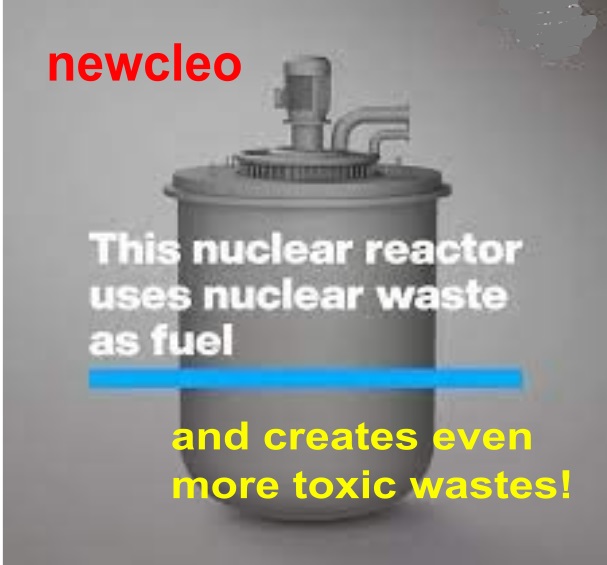
COMMENT. This is a very interesting article. For one thing, it shows that these “advanced” nuclear reactors require plutonium to get the fission process happening. It also claims that these advanced nuclear reactors can solve the problem of plutonium wastes. That is not true. The wastes resulting from this process are smaller in volume, but more highly toxic. That means that they require the same area/voume of space for disposal as the original plutonium. On another angle, it does indicate the confusion that the British government is in about the way ahead in their highly suspect “Civil Nuclear Roadmap”. And on another angle again, it shows how Macron’s France is putting all its eggs into the one nuclear basket. When we look at the extreme costs, and the extreme climate effects, Macron’s French nuclear obsession is likely to result in political suicide.
Matt Oliver, Sun, 21 January 2024, https://finance.yahoo.com/news/nuclear-start-drops-plans-british-131702123.html#:~:text=A%20British%20nuclear%20startup%20has,lobbied%20personally%20by%20Emmanuel%20Macron.
A British nuclear startup has dropped plans to build a pioneering power plant in Cumbria and will invest £4bn in France instead, after it was lobbied personally by Emmanuel Macron.
Newcleo, which is headquartered in London, is developing a type of mini nuclear power plant, known as an advanced modular reactor (AMR), that will use nuclear waste for fuel.
The company had hoped to tap into the UK’s vast stockpile of waste at Sellafield, where it wanted to invest £2bn in a waste reprocessing factory and AMR that would have created around 500 jobs.
It was also planning a similarly-sized facility in France.
But Stefano Buono, Newcleo’s chief executive and founder, said the company has now dropped the UK plans after the Government ruled out giving private companies access to the Sellafield stockpile in a nuclear industry “roadmap” published this month.
Instead, Newcleo is planning an enlarged development at an undisclosed location in the south of France, where it now plans to spend £4bn and create around 1,000 jobs, he said.
As part of that scheme, it will buy nuclear waste from French state energy giant EDF.
The company is also currently in the middle of a €1bn (£860m) fundraising.
The decision comes after the company was blocked from participating in the UK’s design competition for mini nuclear reactors.
By comparison, France has eagerly supported Newcleo and Mr Buono was lobbied repeatedly for investment by President Macron in face-to-face meetings.
Newcleo, which was also invited to last year’s “Choose France” business summit at the Palace of Versailles, has never been offered an in-person meeting with a British prime minister.
Mr Buono told The Telegraph: “Our plan initially was to use one factory in France and one in the UK.
“Now, we will double the capacity of France and we are not investing in the UK.”
He added that the company had hoped to pioneer its technology in Britain but added: “In two years, we were not able to even locate the site, so we have decided to accept the offer from France.
“We can proceed with our business model there.”
Newcleo’s decision to build its first plant abroad comes amid growing frustration within the British nuclear industry over the slow progress the Government has made towards identifying sites for new power plants.
The loss of significant investment to France will also be seen as the latest sign that Downing Street’s efforts to attract business investment are being outshone by President Macron, who has launched a charm offensive to lure companies across the Channel since Brexit.
He was the only G7 leader to attend the World Economic Forum in Davos, Switzerland, this week, while he has rolled out the red carpet for business leaders including Tesla boss Elon Musk and JP Morgan banker Jamie Dimon at his annual Choose France event.
Last year’s summit resulted in major deals, with Taiwanese car battery maker ProLogium unveiling plans for a €5.2bn plant at the port of Dunkirk and Verkor, a French company, pledging a €1.6bn battery factory there too.
In the UK, six SMR developers including Rolls-Royce have been shortlisted for support under a competition run by Great British Nuclear.
Newcleo was not considered because of the AMR’s lead cooling system and unusual fuel, Mr Buono has claimed.
The company’s novel design would run on processed plutonium, helping countries such as the UK dispose of the dangerous waste, which is expensive to manage. [Ed. This ignores the fact that this process results in a smaller volume of more highly toxic waste]
At Sellafield, the UK has amassed 140 tonnes of plutonium – the world’s biggest stockpile – as a result of historic nuclear weapons programmes and abandoned efforts to develop so-called fast breeding reactors that would have used it as fuel.
A massive effort is currently under way at the Cumbrian site to safely store the waste, but Mr Buono and his colleagues have argued it could be put to better use as reactor fuel.
The entrepreneur made his fortune selling cancer treatment developer AAA to Novartis for $3.9bn (£3.2bn) in 2017, reportedly earning him $420m.
His company has the backing of the Agnelli industrialist family, which made its money from Fiat and Ferrari.
The French government is expected to confirm a deal with Newcleo later this year.
The UK Government did not respond to requests for comment.
At least 25 killed in Russian-occupied Ukraine following missile strike, officials say
BY MIRANDA NAZZARO – 01/21/24, https://thehill.com/policy/international/4420260-at-least-25-killed-in-russian-occupied-ukraine-following-missile-strike-officials-say/
The shelling of a market in a part of Russian-occupied Ukraine killed at least 25 people on Sunday, The Associated Press reported.
Denis Pushilin, head of the Russian-installed authorities in the city of Donetsk, said another 20 people, including two children, were wounded in the strike on the outskirts of the city, the AP reported. He claimed shells were fired by the Ukrainian military.
Pushilin claimed the area was hit with a 155 mm caliber and 152 mm caliber artillery, with shells being fired from the direction of Ukrainian cities Kurakhove and Krasnohorivka, per the news wire.
Kyiv did not comment on the event and the claims could not be independently verified, the news wire noted.
The Russian Foreign Ministry, in a translated statement, called the incident a “barbaric terrorist act against the civilian population of Russia.”
“The terrorist attacks of the Kiev regime clearly indicate its lack of political will for peace and the settlement of the conflict by diplomatic means,” the statement said. “The need to achieve all the goals and objectives of a special military operation is obvious. Security threats and acts of terrorism should not come from the territory of Ukraine.”
A fire also broke out at a chemical transport terminal at Russia’s Ust-Luga port after two explosions, the AP said, citing local media reports. Local media reported the port was attacked by Ukrainian drones and a gas tank exploded.
Yuri Zapalatsky, who heads Russia’s Kingisepp district, where the port is based, reported no causalities and that the area was on high alert, the AP reported.
Russia’s Ministry of Defense also announced Sunday that Moscow’s forces took control of the village Krokhmalne in Ukraine’s Kharkiv region, the news wire added. Ukrainian forces confirmed the settlement was occupied, describing the incident as a “temporary phenomenon.”
The war between Ukraine and Russia is approaching its two-year mark next month, with thousands of troops killed on each side.
Western mercenaries used to fill Kiev’s expertise gaps, ex-CIA man tells RT
French fighters killed in Ukraine could have been clandestine weapons specialists, Larry Johnson has said…05
Ukraine is likely experiencing a shortage of soldiers capable of operating complex Western weapons systems, former CIA analyst Larry Johnson has told RT. A Russian report this week about a strike on “French mercenaries” in Kharkov may be a warning to would-be clandestine arms technicians that Paris plans to supply, he believes.
In response to the Russian Defense Ministry’s statement, France has denied having mercenaries in Ukraineor any other part of the world. Moscow claimed that approximately 60 foreign fighters, mostly French, were killed in the long-range attack. Meanwhile, President Emmanuel Macron has announced plans to supply additional air-launched SCALP cruise missiles to assist Kiev in its fight.
“I strongly suspect that many of those French ‘mercenaries’ – and I wouldn’t be surprised to see Brits and Americans scattered in there as well – are being brought in to help operate systems that they’ve been trained on previously in prior military careers.”
He named the US-made long-range Patriot anti-aircraft missile and the Storm Shadow, the British counterpart to SCALP, as examples of donated arms that may require competent foreign staff to deploy.
France is making itself a target by openly arming Kiev, Johnson told the broadcaster, contrasting current events with how the US acted in the past, when it sought to undermine the USSR:
“When the US ran covert operations through the CIA to fund the mujahideen in Afghanistan against the Soviets, it was done with some measure of secrecy and at least keeping up a pretense that we were not directly in conflict.
“I think Russia sent a very clear message in killing these mercenaries: If you are going to send them over here, if you are going to send that materiel, we’re gonna kill you.”
Johnson believes that Moscow could have acted in a far bolder manner in targeting Ukraine’s foreign donors, and that its reluctance to do so has been taken in the West as a sign of weakness.
“It’s not that, but the West has a track record of misinterpreting Russia on many points.”
Comment: Kiev is in critical manpower crisis as Zelensky pressures anyone semi-upright to take up arms and pretend they are soldiers…women, elderly, the infirm. French mercenaries? In a minute.
The following information is in regard to French PMCs (Private Military Company):
Site: Ministry of Foreign Affairs of the Russian Federation
With the ongoing developments in Ukraine, French PMCs offer their services to train Ukrainian forces in Eastern European countries. Since June 2022, they have been bringing onboard volunteers to participate in hostilities on Kiev’s side. Former members of the armed forces of EU countries and nationals of African countries are their first choice. French nationals taking part in the hostilities in Ukraine often get there via foreign PMCs or the Ukrainian International Legion.
Under French law, most of them do not fall under the Criminal Code article on mercenarism, because their remuneration for taking part in combat operations does not exceed the salary paid under a corresponding position in the French armed forces. Ukrainians that go to Ukraine from France in order to participate in the conflict, including the ones who are “on leave” from the French Foreign Legion are not qualified as mercenaries even if they hold French citizenship, since the people who are originally from a country participating in an armed conflict cannot be considered as such.
Military support functions are often delegated to “expendable” PMCs which recruit low-level personnel on the ground. A similar arrangement is used in Ukraine as well. Former French Foreign Legion members hailing from the countries in question often act as instructors. Ample supply of personnel from the ranks of former legionnaires makes it simple to create and use expendable PMCs for missions where use of force and/or participation in hostilities is likely.
About 100 French PMCs operate internationally. They are usually headed by former gendarmerie officers, and sometimes by retired security service officers. Mostly, these firms are mission-specific outfits and are put together for limited periods (for example, Lyon-based Byblos provided evacuation of French citizens from combat zones early on during the special military operation in Ukraine).
The most prominent French PMCs are as follows:
Aeneas Groupe, founded in 2004, provides consulting, security, and defence services, and trains personnel in France and abroad.
Anticip performs a variety of missions in war zones, such as crisis management, physical protection, armed escort, and site protection. It has worked in Iraq and Afghanistan and has subsidiaries in Nigeria and the UAE.
Chiron participates in the training of Ukrainian special forces. The instructors are former military members and French special service employees.
Défense Conseil International (DCI) is one of the leading companies of that kind and is unofficially used by the French Defence Ministry to perform a wide range of missions in the interests of friendly countries where, for some reasons, the use the French Armed Forces is impractical. It operates through 23 training centres in France and branches in 50 countries, such as Brunei, India, Kuwait, Malaysia, Saudi Arabia, Singapore, Qatar, and the UAE, to name a few. It provides combat training for ground, air and naval forces, special forces, advanced training in cybersecurity and radio electronic warfare, as well as interaction between different branches of the military. DCI operates through six subsidiary PMCs, the most famous of which – La Cofras – was hired by international organisations for demining in the Gulf area, Angola and Mozambique.
Gallice Défense is a group based in France, Europe and Africa that was founded in 2007. Its employees work under short-term contracts in the Sahel, LAC, Europe, Southeast Asia and the Middle East.
Geos was founded in 1998 by Stephane Gerardin, a former employee of the Main Directorate of Foreign Security (foreign intelligence), to address specific tasks abroad. It is staffed mostly by former employees of special services, the Defence Ministry and the Interior Ministry. It specialises in providing government customers with consulting services, economic intelligence, risk assessment-based analytical materials for major projects in various regions of the world, but also offers physical security and protection services. Operating in 80-plus countries, Geos has offices in Algeria, Argentina, Belgium, Brazil, Chile, China, Colombia, Germany, Libya, Mexico, Nigeria, Panama, Saudi Arabia, the UK, Ukraine and Venezuela,. The company is actively involved in training AFU personnel. Since June 2022, it has been recruiting volunteers to participate in combat operations on Kiev’s side. In total, at least 2,000 people have been recruited. The European Peace Foundation provides the funding. Candidates are trained in Eastern Europe.
Groupe Corpguard was founded in 2006. In 2016, it concluded a contract with the Government of Côte d’Ivoire as part of the operation to maintain peace and stability in the country.
Salamandre was founded in 1996. It brings together intelligence, counterintelligence and nuclear specialists. It has close ties with the French Directorate General for External Security and often acts on its behalf.
KBS Sécurité was founded in Lyon in 2007 as a company specialising in arms and military equipment sales. Currently, it offers security services and operates in Europe, the Middle East and North Africa.
Finland’s Radiation and Nuclear Safety Authority (STUK) wants to delay completion of its review on waste dump

Finland’s Radiation and Nuclear Safety Authority (STUK) has requested the
deadline for its opinion on Posiva Oy’s operating licence application for
the world’s first used fuel repository to be extended until the end of
2024. In September last year, it said it would not complete its review by
the end of 2023 as originally planned.
Radioactive waste management company
Posiva submitted its application, together with related information, to the
Ministry of Economic Affairs and Employment (TEM) on 30 December 2021 for
an operating licence for the used fuel encapsulation plant and final
disposal facility currently under construction at Olkiluoto.
The repository
is expected to begin operations in the mid-2020s. Posiva is applying for an
operating licence for a period from March 2024 to the end of 2070. The
government will make the final decision on Posiva’s application, but a
positive opinion by STUK is required beforehand. The regulator began its
review in May 2022 after concluding Posiva had provided sufficient
material. The ministry had requested STUK’s opinion on the application by
the end of 2023.
However, STUK announced in September that its safety
assessment and opinion on the application was taking longer than expected
and would not be completed by that deadline.
World Nuclear News 19th Jan 2024
https://www.world-nuclear-news.org/Articles/STUK-requests-extension-to-repository-review-deadl
Even Britain’s ruling Tory party fear that their “Nuclear Roadmap” plan will end up on the scrap heap.

More nuclear power is the obvious solution to our energy security and Net Zero dilemmas. That doesn’t mean it is ever going to happen. Conservative Home, 19 Jan 24
Last week, Claire Coutinho published the Government’s “nuclear roadmap”. Sticking with Boris Johnson’s target of having a quarter of our electricity from nuclear by 2050, this attempts to explain how we achieve the quadrupling of nuclear capacity required to achieve the necessary 24 gigawatts (GW).
Rishi Sunak calls nuclear the “perfect antidote to the energy challenges facing Britain”. ………………………..
But the Government’s nuclear ambitions face an immediate stumbling block. At present, our nuclear capacity stands at 5.9GW, produced by five power stations. These are all owned by EDF, the French state energy group. Four of those plants – producing 4.7GW – are set to close in 2028.
EDF has floated keeping them open for longer. Yet even that would require Britain to massively ramp up its nuclear capacity in the next three decades to for us to have any hope of achieving the Government’s aim to come over a bit Doctor Manhatten. Following this, Coutinho has established an ambition to invest in new nuclear capacity of between 3GW and 7GW every five years from 2030 to 2044.
Work is already in progress. Hinkley Point C in Somerset is under construction. Sizewall C is planned for Suffolk, with a final investment decision due to be made by the end of this year. The Government is considering approving the construction of a third similarly sized power station. Additionally, ministers want to build a fleet of “small modular reactors” alongside these larger plants.
………………………………….. Johnson’s tongue-in-cheek vision of an SMR in “every Labour seat” remains as much of a fantasy as any of his mooted grands projets. Putting so much faith in SMRs to deliver our nuclear dreams is wishful thinking by Coutinho. But that is true of her whole “roadmap” and the ambitions behind them.
As Sam Dumitriu points out, when Hinkley opens in 2028, it will not only be the first nuclear power station built in Britain for over three decades, but the second most expensive nuclear power station built in history on a pound-per-megawatt basis. Having been due to open in the early 2020s, it is now expected to cost £32 billion. Some expect its construction could be further delayed into the 2030s.
This bodes poorly for Coutinho’s touted “nuclear awakening”. ………….
Capital costs make up around 60 per cent of nuclear’s levelised cost of energy. The average has been estimated at $6041-per-kilowatt – over 50 per cent more than coal and 500 more than gas. Factoring in that building a nuclear power station in Britain usually takes around 13 years, and it becomes obvious why investing in nuclear remains unattractive. Financing Hinkley involved the Government agreeing to a wholly uncompetitive deal…………………………….
The Government hopes an overhaul of planning rules could allow SMRs to be approved in a variety of locations, especially brownfield sites, away from areas with population densities of more than 5,000 people per square kilometre. However, there is still plenty of opportunity for applications to be denied based on natural beauty, ecology, cultural heritage, size, or flood risk. To combat NIMBYism, we would need to stuff a few mouths with gold.
Britain’s nuclear ambitions are also hampered by our current reliance on EDF. From leading the world in nuclear technology in the 1950s, our long lag since last constructing a plant has seen a loss of know-how, leaving us reliant on EDF for larger plants. Not only has this left us having signed an expensive deal for Hinkley, but it has entrusted our energy security to a company with a record of costly delays.
This is of a piece with our long tradition of nuclear short-sightedness. As Peter Franklin has pointed out, Johnson and Sunak follow Harold Wilson, Margaret Thatcher, and Tony Blair in making grand pronouncements of a fleet of new British nuclear reactors. Little has good came of any of them. Amidst some substantial competition, we can count Hinkley as one of Blair’s most ignominious legacies.
We can expect Coutinho’s proposals to end up on a similar scrapheap. Labour says they are keen on more nuclear. But they will face the same problems of regulation, construction costs, and political volatility. It might take only another Fukushima for the public to go all German on our nuclear future…..
Military interests are pushing new nuclear power – and the UK government has finally admitted it

……………… the latest announcement, Civil Nuclear: Roadmap to 2050, - in this supposedly “civil” strategy – are multiple statements about addressing “civil and military nuclear ambitions” together to “identify opportunities to align the two across government”.
French president Emmanuel Macron summarises: “without civil nuclear power, no military nuclear power, without military nuclear, no civil nuclear”.
Andy Stirling Professor of Science & Technology Policy in the Science Policy Research Unit, University of Sussex, Philip JohnstoneResearch Fellow, SPRU, University of Sussex, January 19, 2024 https://theconversation.com/military-interests-are-pushing-new-nuclear-power-and-the-uk-government-has-finally-admitted-it-216118
The UK government has announced the “biggest expansion of the [nuclear] sector in 70 years”. This follows years of extraordinarily expensive support.
Why is this? Official assessments acknowledge nuclear performs poorly compared to alternatives. With renewables and storage significantly cheaper, climate goals are achieved faster, more affordably and reliably by diverse other means. The only new power station under construction is still not finished, running ten years late and many times over budget.
So again: why does this ailing technology enjoy such intense and persistent generosity?
…………………………………………………………………………….. A document published with the latest announcement, Civil Nuclear: Roadmap to 2050, is also more about affirming official support than substantively justifying it. More significant – in this supposedly “civil” strategy – are multiple statements about addressing “civil and military nuclear ambitions” together to “identify opportunities to align the two across government”.
These pressures are acknowledged by other states with nuclear weapons, but were until now treated like a secret in the UK: civil nuclear energy maintains the skills and supply chains needed for military nuclear programmes.
The military has consistently called for civil nuclear
Official UK energy policy documents fail substantively to justify nuclear power, but on the military side the picture is clear.
For instance, in 2006 then prime minister Tony Blair performed a U-turn to ignore his own white paper and pledge nuclear power would be “back with a vengeance”. Widely criticised for resting on a “secret” process, this followed a major three volume study by the military-linked RAND Corporation for the Ministry of Defence (MoD) effectively warning that the UK “industrial base” for design, manufacture and maintenance of nuclear submarines would become unaffordable if the country phased out civil nuclear power.
A 2007 report by an executive from submarine-makers BAE Systems called for these military costs to be “masked” behind civil programmes. A secret MoD report in 2014 (later released by freedom of information) showed starkly how declining nuclear power erodes military nuclear skills.
In repeated parliamentary hearings, academics, engineering organisations, research centres, industry bodies and trade unions urged continuing civil nuclear as a means to support military capabilities.
In 2017, submarine reactor manufacturer Rolls Royce even issued a dedicated report, marshalling the case for expensive “small modular reactors” to “relieve the Ministry of Defence of the burden of developing and retaining skills and capability”.
The government itself has remained coy about acknowledging this pressure to “mask” military costs behind civilian programmes. Yet the logic is clear in repeated emphasis on the supposedly self-evident imperative to “keep the nuclear option open” – as if this were an end in itself, no matter what the cost. Energy ministers are occasionally more candid, with one calling civil-military distinctions “artifical” and quietly saying: “I want to include the MoD more in everything we do”……………………………………………………………………………………..
This is even more evident in actions than words. For instance hundreds of millions of pounds have been prioritised for a nuclear innovation programme and a nuclear sector deal which is “committed to increasing the opportunities for transferability between civil and defense industries”.
An open secret
Despite all this, military pressures for nuclear power are not widely recognised in the UK. On the few occasions when it receives media attention, the link has been officially denied.
Other nuclear-armed states are also striving to maintain expensive military infrastructures (especially around submarine reactors) just when the civilian industry is obsolescing. This is true in the US, France, Russia and China.
Other countries tend to be more open about it, with the interdependence acknowledged at presidential level in the US for instance. French president Emmanuel Macron summarises: “without civil nuclear power, no military nuclear power, without military nuclear, no civil nuclear”.
This is largely why nuclear-armed France is pressing the European Union to support nuclear power. This is why non-nuclear-armed Germany has phased out the nuclear technologies it once lead the world in. This is why other nuclear-armed states are so disproportionately fixated by nuclear power.
These military pressures help explain why the UK is in denial about poor nuclear performance, yet so supportive of general nuclear skills. Powerful military interests – with characteristic secrecy and active PR – are driving this persistence.
Neglect of this picture makes it all the more disturbing. Outside defence budgets, off the public books and away from due scrutiny, expensive support is being lavished on a joint civil-military nuclear industrial base largely to help fund military needs. These concealed subsidies make nuclear submarines look affordable, but electricity and climate action more costly.
The conclusions are not self-evident. Some might argue military rationales justify excessive nuclear costs. But history teaches that policies are more likely to go awry if reasons are concealed. In the UK – where nuclear realities have been strongly officially denied – the issues are not just about energy, or climate, but democracy.
The Conversation asked the UK Department for Energy Security and Net Zero to comment but did not receive a reply before the publication deadline. https://theconversation.com/military-interests-are-pushing-new-nuclear-power-and-the-uk-government-has-finally-admitted-it-216118
Weatherwatch: UK push for civil atomic power highlights link with nuclear weapons

Government previously denied evidence countries with nuclear weapons favour atomic power over renewables
Paul Brown, Fri 19 Jan 2024, https://www.theguardian.com/news/2024/jan/19/weatherwatch-uk-push-civil-atomic-power-highlights-link-nuclear-weapons
There is long running debate about whether nuclear power has a role in combatting the climate crisis. The UK government decided last week it was vital and is planning a vast expansion. Most environmental groups remain sceptical, preferring quicker and cheaper renewables.
Whatever the merits of the case there was, buried deep in the government’s nuclear roadmap, a complete somersault on the relationship between civil and military nuclear power. Back in the 1980s and 1990s when the Guardian carried reports from Sussex University’s Science Policy Research Unit (SPRU), among others, showing there was a link between the two, the government continuously denied it.
SPRU persevered with its work and noted that despite the UK’s denials, across the world it has become more obvious that states with nuclear weapons remain keen on atomic power while those without them put renewables centre stage.
Last week the government’s arguments in favour of new civil nuclear power swept aside any lingering doubt its predecessors had been covering up the link. The roadmap policy document mentioned 14 times in different sections the need to continue to strengthen the existing cooperation and tie-ups between the civil and military industries to the benefit of both. The logic is to keep to a minimum the training and development costs for both the weapons and power sectors.
Why nuclear reactors are not the future of energy despite what UK Government would have you think.

– Dr Richard Dixon. The UK Government is trying to create the impression that it’s all go for nuclear. It isn’t.
The UK’s nuclear enthusiasts have been on another PR offensive, with
announcements of new reactors and possible life extensions to old reactors.
All of it denying the reality that nuclear is much too slow to build and
much too expensive to be part of our future energy strategy. Globally
nuclear is in terminal decline. In the last five years more renewable
electricity has been generated by just new schemes around the world than by
all the world’s nuclear reactors. And twice as much again is expected to
be constructed in the next five years, taking renewables output to five
times that of nuclear.
Of course the motivation for this burst of
co-ordinated PR is clear, the $20bn for Sizewell C hasn’t been raised so
the UK Government is desperately trying to give the impression that it’s
all go for nuclear in the UK. When it clearly isn’t.
Scotsman 17th Jan 2024
Roadmap to warfare: new policy exposes links with UK military nuclear projects
The UK/Ireland Nuclear Free Local Authorities are keen to assist University of Sussex academics in exposing the links to the military that were revealed in the recent UK Government’s launch of a ‘Roadmap’ for the civil nuclear sector (11 January 2024).[1]
In the public interest, Andy Stirling, Professor of Science and Technology Policy, and Research Fellow Dr Phil Johnstone, both at the University of Sussex, have done remarkable work over many years highlighting the lack of transparency and the extent of cross-subsidy between the civil and military nuclear sectors, despite facing official hostility, obfuscation, or denial.
NFLA 18th Jan 2024
Hinkley C site fire safety fears trigger enforcement notices
By Phil Hill, @GazettePHill, https://www.somersetcountygazette.co.uk/news/24055739.hinkley-c-site-fire-safety-fears-trigger-enforcement-notices/ 17 Jan 24
Pre-planned inspections in November at the Unit 1 HR Building on the site led to ONR identifying the breaches and issuing the notices.
These have been served on licensee NNB Generation Company (HPC) Ltd, contractors Bouygues Travaux Publics SAS and Laing O’Rourke Construction Limited, who are the joint venture partners in BYLOR JV, and REEL UK.
The enforcement notices require improvements to be made to address the shortfalls and prevent re-occurrence.
There were no consequences to employees, the public or the environment as a result of the shortfalls.
However, ONR identified the potential for harm and risk of serious injury, which required regulatory action.
Shane Turner, superintending inspector and head of safety regulation at Hinkley Point C, said: “The enforcement notices require these four organisations to make improvements in fire safety arrangements at the Hinkley Point C site.
We will engage with each of them during the period of the enforcement notice to ensure positive progress is made.”
The notices require necessary improvements are made by March 31.
The enforcement action relates to contraventions under the requirements of Article 22 of the Regulatory Reform (Fire Safety) Order 2005.
1
Shining a light on the UK’s nuclear deterrent
changes in the government’s policy on nuclear power in recent years would effectively allow Britain’s military nuclear industry to be supported by payments from electricity consumers.
“The issue now is that UK citizens are unwittingly subsidising military nuclear activity through energy bills to the tune of many tens of billions of pounds,”
Professor Andy Stirling and Dr Phil Johnstone have highlighted a lack of transparency between governments’ nuclear power programmes and their military nuclear capabilities.
As nuclear power declines worldwide, it is striking how many countries that continue to expend costly support are either existing or aspiring nuclear weapons states.
So say Andy Stirling, Professor of Science and Technology Policy, and Research Fellow Dr Phil Johnstone, at the University of Sussex. Their research into the dependency of military nuclear capabilities on the support of civil nuclear programmes has been cited widely – not least in the UK.
From early working-paper findings to presenting evidence to the Public Accounts Committee (PAC) in the House of Commons, their research has raised important questions about accountability, transparency and the future role of the nuclear industry in a changing world.
It has also received major media attention, with stories in the Guardian, the BBC, Independent and New York Times, whilst their findings also culminated in questions being asked (and significant answers being obtained) in a UK Parliamentary Select Committee, many Parliamentary Questions posed in Westminster and a motion being passed through the Scottish Parliament.
But it hasn’t come without its frustrations. Since the academics first presented their findings to the House of Commons in 2017 – and then in numerous subsequent national and international press stories – the UK Government has not responded directly to the serious criticisms that arose concerning a lack of transparency and accountability. Invitations have been received to discuss these issues with official bodies, and the analysis has not been refuted, but it remains open what the Government itself will do.
Early findings
It’s been quite a journey from their initial research. In 2015, the academics published a working paper on German and UK nuclear power. It was here that the pair conducted an in-depth analysis to try to understand the different nuclear trajectories of the UK and Germany.
The findings of this research first pointed towards concealed UK motives for persisting with nuclear at a time when commentators and experts, virtually across the board, were suggesting the opposite: that it was in irreversible decline.
What was new about the Sussex analysis was that it looked beyond nuclear weapons to the hidden dependencies of the submarine industry on civil nuclear programmes.
“When we started out, the idea of civil programmes supporting military nuclear programmes, was met with significant scepticism.” says Stirling.
“Since then, through evidence submissions and continued output, there has been a gradual acceptance by some that the need to sustain key capabilities and skills in order to construct and maintain nuclear submarines is a significant factor driving the UK’s intense enthusiasm for new nuclear.”
A block in public openness
Things were about to speed up. In 2016, a detailed SPRU working paper asked why UK policy had been so intensely committed to nuclear power, with the findings clearly pointing to military links as a means for continuation.
As a result, questions were now being asked of the UK Government, with transparency – or the lack thereof – at the top of the agenda.
“When we started out, the idea of civil programmes supporting military nuclear programmes, was met with significant scepticism.” says Stirling.
“Since then, through evidence submissions and continued output, there has been a gradual acceptance by some that the need to sustain key capabilities and skills in order to construct and maintain nuclear submarines is a significant factor driving the UK’s intense enthusiasm for new nuclear.”
A block in public openness
Things were about to speed up. In 2016, a detailed SPRU working paper asked why UK policy had been so intensely committed to nuclear power, with the findings clearly pointing to military links as a means for continuation.
As a result, questions were now being asked of the UK Government, with transparency – or the lack thereof – at the top of the agenda.
In 2017, the findings were first presented before the Public Accounts Committee in the House of Commons. The evidence found that a white paper into the UK’s energy policy was now “extraordinarily overdue”.
“It was very clear that the usual public policy processes were falling short,” says Stirling. “In this sense, it is not just our own analysis, but a matter of public record, that due consultation and analysis have not so much been “disregarded” as not performed at all.
“So, at the core of this issue is the fact that the intensity of official commitments to nuclear power by successive UK governments is largely due to factors that remain effectively undeclared.”
Hinkley Point C
Undoubtedly one of the most significant developments in recent times in relation to the UK’s nuclear strategy has been the go-ahead and development of Hinkley Point C, a large nuclear power station under construction in Somerset.
Since its inception, the project, which is being built by the French electricity company EDF, has been criticised on a number of grounds – not least its huge and escalating cost.
But it is the justification to build any new nuclear power station, as highlighted by this research, that raises legitimate questions about the role the UK government has played in this process: of willfully disregarding open, thorough consultation and analysis in order to carry on regardless with nuclear energy, without providing a legitimate reason why.
In evidence submitted to the PAC, the research concluded that the costs of the Trident programme could be “unsupportable” without “an effective subsidy, from electricity consumers to military nuclear infrastructure”.
In their evidence, the academics wrote that the £19.6bn Hinkley Point project would “maintain a large-scale national base of nuclear-specific skills” without which there is concern “that the costs of UK nuclear submarine capabilities could be insupportable”.
A hidden subsidy
This evidence suggested that changes in the government’s policy on nuclear power in recent years would effectively allow Britain’s military nuclear industry to be supported by payments from electricity consumers.
“The issue now is that UK citizens are unwittingly subsidising military nuclear activity through energy bills to the tune of many tens of billions of pounds,” points out Johnstone.
“However, growing ever more significant is the failure of the existing policy apparatus to engage with the criticisms in this regard. This highlights that one of the main issues here concerns the quality of UK policy processes and the health of UK democracy itself.”
As time goes on in this way, the underlying impact of this work expands beyond the immediate story. In part, say the researchers, it lies in the failure of the UK government to be accountable for the decisions it has made in relation to the future of the UK’s energy policy. It has become a transparency issue, one in which the effects aren’t just felt on a state level but amongst its citizens – for many years to come.
What now?
In a world where misinformation is rife, it wasn’t long until claims were made that the research amounted to a ‘conspiracy theory’– particularly with findings that have had such far-reaching consequences. But this is something that Stirling and Johnstone have taken in their stride.
“The few private and public accusations that our analysis is a conspiracy theory have now all largely abated,” says Stirling.
“Several academics, policy analysts and journalists, who used these terms right at the outset, have now all gone out of their way explicitly to tell us that they believe us to be correct.
“In one case, a nuclear advocacy organization, taking the trouble to criticise us this way in an early blog post, has since shifted its position to openly advocate precisely the links they previously dismissed as a conspiracy theory.”
All of this points to research that is still evoking a reaction, still engaging stakeholders across the community, and is reaching into the heart of the democratic process. It also indicates that the effects of the research haven’t yet reached their climax.
A growing tension
“The reaction so far in the UK and international press, the wider energy policy and academic communities suggests that our work is making a firm mark in a field where the stakes are extremely high,” says Johnstone.
“Although the UK Government has itself thus far tried to side-line the issue, it has become strongly acknowledged more widely – even to the point of becoming orthodoxy in many quarters. The lack of official engagement is growing ever more telling.”
Yet uptake of the analysis by many prominent bodies and individuals in this field leaves no doubt that public discussions around nuclear power in the UK and more widely have been strongly influenced by this research.
As Stirling points out: “A backdrop of continued silence on the part of government, as trends continue to unfold and evidence and commentary continues to accumulate, suggests eventual acknowledgement is growing more likely. This in turn suggests that the largest impacts have yet to emerge.”
UK’s nuclear obsessions kill off its net zero strategy

The new Roadmap reads like an outing to a massive nuclear sweet shop. On top of Hinkley Point C and Sizewell C, we’ll have one more big one. And then we’ll have lots of Small Modular Reactors, all over the country. And we’ll have a new fuel processing plant. And a new Geological Disposal Facility – at some much more distance point. And so on and on. 24 fantastical Gigawatts to be designed and delivered by 2050.
Jonathon Porritt, 18 Jan 24
After 14 years of Tory mismanagement, the UK finds itself bereft of an energy strategy.
This was finally confirmed in the release last week of the Government’s new Nuclear Roadmap. At one level, it’s just the same old, same old, the latest in a very long line of PR-driven, more or less fantastical wishlists for new nuclear in the UK. But at another, it’s a total revelation.
For years, a small group of dedicated academics and campaigners have suggested that the UK Government’s Nuclear Energy Strategy is being driven more by the UK’s continuing commitment to an “independent” nuclear weapons capability than by any authoritative energy analysis. For an equal number of years, this was aggressively rebutted by one Energy Minister after another, both Tory and Labour.
The new Nuclear Roadmap dramatically changes all that. It sets to one side any pretence that the links between our civil nuclear programme and our military defence needs were anything other than small-scale – and of no material strategic significance. With quite startling transparency and clarity, the Roadmap not only reveals the full extent of those links, but positively celebrates that co-dependency as a massive plus in our ambition to achieve a Net Zero economy by 2050.
“Startling” is actually an understatement. Such a comprehensive volte-face is rare in policy-making circles. Every effort is usually made by Ministers to obscure the scale (let along the significance) of any such screeching handbrake turns. That is so not the case with the new Roadmap.
Courtesy of the latest forensic work done by Professors Andy Stirling and Phil Johnstone at Sussex University (who have been absolutely at the forefront of seeking to bring these links into the public domain over many years – often with mighty little support from mainstream environmental organisations, let alone “independent” commentators), chapter and verse of this volte-face can be laid bare. Just three o examples from the Roadmap:
- “Not only does this Roadmap set a clear path for the growth of nuclear fission…it acknowledges the crucial importance of the nuclear industry to our national security, both in terms of energy supply and the defence nuclear enterprise.”
- “Government will proactively look for opportunities to align delivery of the civil and nuclear defence enterprises, whilst maintaining the highest standards of non-proliferation.”
- “To address the commonalities across the civil and defence supply chains, and the potential risk to our respective nuclear programmes due to competing demand for the supply chain, the Department of Energy Security and Net Zero (DESNZ) is working closely with the Ministry of Defence and the Defence Nuclear Sector.”
And there’s a whole lot more than that! As Andy Stirling has said: “Without any reflection on what this says about previous efforts to suppress discussion of this issue, the Government is now openly emphasising its significance.”
Indeed!
As usual, the UK’s ill-informed and unbelievably gullible mainstream media would appear to have missed the significance of this gobsmacking inflection point. So one can hardly expect them to have grasped its even more significant implications for UK energy strategy as a whole. In every single particular.
Let me briefly unpack some of those particulars:
- Nuclear
The new Roadmap reads like an outing to a massive nuclear sweet shop. On top of Hinkley Point C and Sizewell C, we’ll have one more big one. And then we’ll have lots of Small Modular Reactors, all over the country. And we’ll have a new fuel processing plant. And a new Geological Disposal Facility – at some much more distance point. And so on and on. 24 fantastical Gigawatts to be designed and delivered by 2050.
The reality couldn’t be more different:
- We will indeed end up with Hinkley Point C – at a staggering of cost of somewhere between £26 billion and £30 billion, with consumers paying twice as much for its electricity as they will for offshore wind. And it will almost certainly not come online until the end of the decade, 15 years on from the time it was meant to be up and running.
- We may possibly get Sizewell C, though the Government cannot currently guarantee the required level of investment. So a Final Investment Decision is unlikely before the next Election. At which point, Starmer may come to his senses and kill off this absurd white elephant.
- We will never get a third big reactor. The economics are literally impossible to justify.
- We are unlikely to get more than a couple of hugely expensive Small Modular Reactors, at some indeterminate point in the future, even with a new “flexible approach” to planning and financial inducements. Even that may prove to be an illusion. As Professor Steve Thomas has written: “Advocates of Small Nuclear Reactors claim they are cheaper and easier to build, safer, generate less waste, and will create many jobs compared to existing large reactor designs. These claims are unproven, misleading, or just plain wrong. Worldwide, no commercial design of SMR has even received a firm order yet.”
- And we may or may not get life extensions for the last five power stations in the “legacy fleet” – subject to regulatory approval, which may not be all that easy given extensive cracking in their reactor cores.
In short, the Roadmap is just a massive diversion from reality. Entailing incalculable opportunity costs. And putting at risk our entire Net Zero by 2050 strategy.
Ministers know all that. But they don’t really care. Our nuclear weapons programme (including upgrading Trident) will be protected as a consequence of this, via an unceasing flow of public money into the civil nuclear cul-de-sac, at a time when our defence budget is already massively overstretched. So who cares about the missing 24GW?
- Renewables
We’ll continue to see new investment into renewables here in the UK, despite (not because of) government policy, which has seriously messed up our offshore wind industry, maintained a de facto ban on onshore wind, couldn’t care less about solar, witters on vapidly about tidal without doing anything etc etc.
Meanwhile, on a global basis, renewables continue to boom. Here are a few facts – in contrast to over-excited sightings of nuclear unicorns:…………………………………………………………………………………………………………………………………………………………
Why don’t people see this?
Why don’t our mainstream media offer any serious critique of what’s going on here?
Why don’t our opposition parties rip to shreds this tissue of preposterous illusions?
The reasons for this almost complete silence can be traced back to successive governments’ grim intent to hang onto our so-called “independent nuclear deterrent”. At literally any costs…………………………………………………………………….more https://www.jonathonporritt.com/uks-nuclear-obsessions-kill-off-its-net-zero-strategy/
Zelensky Courts JPMorgan, Bank of America & Bridgewater CEOs At Davos, Urges More Money From West
Zero Hedge, BY TYLER DURDEN, WEDNESDAY, JAN 17, 2024
As expected, anything related to Ukraine presented at the World Economic Forum (WEF) in Davos has been focused on more weaponry and seeking more vows of integration among Western allies.
“Ukrainians need predictable financing throughout 2024 and beyond,” European Commission president Ursula von der Leyen told World Economic Forum participants. “They need a sufficient and sustained supply of weapons to defend Ukraine and regain its rightful territory.”
As for President Zelensky, in addressing world leaders at the forum he emphasized that the West needs to help Ukraine achieve air superiority if his forces are to have a chance to emerge victorious against Russia……………………………………

At the summit, US Secretary of State Antony Blinken promised that Washington will keep up its support for Ukraine, however while keeping things vague – following Biden’s proposed foreign defense budget request being reject by GOP members in Congress; and NATO chief Jens Stoltenberg suggested Ukraine is moving closer to entry into the alliance.
Stoltenberg acknowledged a “serious battlefield situation” but also said there is “cause for optimism” after nearly two years of fighting, and NATO’s constant support.
Below is a portion of the NATO press readout based on his panel speech:
………… Ukrainians are now firmly oriented to the West, aspiring for membership in NATO and the European Union. The Secretary General also stressed that “support for Ukraine is not charity; it’s an investment in our own security”.………
But realistically, the prospect of Ukraine gaining full NATO membership would be a process of years, and would likely trigger WW3 with Russia–so to some degree this is all empty posturing.
But here’s what’s happening at Davos which is arguably more important to Kiev at the moment:
Ukraine is seeking new ways to finance its rebuilding plans as vital aid from the West slows down. President Volodymyr Zelenskyy reportedly has plans to meet JP Morgan’s CEO at the World Economic Forum.
Ukraine’s President Zelenskyy is reportedly planning to meet JPMorgan CEO Jamie Dimon at the World Economic Forum in Davos to seek new ways of financing its rebuilding plans.
JP Morgan, the biggest US bank with almost half a trillion dollars of market capitalization, has already been advising Ukraine on financing reconstruction.
It’s as yet unclear if any firm promises were made or agreements struck at the Davos meeting which also included Bank of America’s Brian Moynihan, as well as Bridgewater’s Ray Dalio.
According to further details of who was in attendance via Fox Business: “Other meeting attendees included David Rubinstein of the private equity firm Carlyle Group; billionaire entrepreneur Michael Dell, the founder of Dell Technologies; Ray Dalio of Bridgewater Associates, the world’s largest hedge fund; Steve Schwarzman, the CEO of Blackstone, the world’s largest private equity fund; and Philipp Hildebrand, representing BlackRock, the world’s largest money manager.”
Additionally, “Dimon was accompanied by Mary Erdoes, who runs JPMorgan’s asset-management unit. The White House was represented by Penny Pritzker, of the super-wealthy Pritzker family and a major Democratic Party donor.” Pritzker has been appointed Biden administration’s special representative for Ukraine’s economic recovery. https://www.zerohedge.com/geopolitical/zelensky-courts-jpmorgan-bank-america-bridgewater-ceos-davos-urges-more-west
For Estonia the risks of going nuclear are high, and the plant not strictly necessary
ERR EE, Jevgeni Ossinovski, chair of the Social Democratic Party (SDE) parliamentary group, 20 Jan 24
Our worst-case scenario would be suspending Estonia’s sustainability efforts in anticipation of a nuclear power plant, Jevgeni Ossinovski (SDE) writes.
“….. nuclear power plants could be the preferable option in countries with high population density, high energy demand and limited land for renewable energy development.
A very different question is whether Estonia needs a nuclear power plant. We lack the skills, regulations, civil protection and monitoring systems, or even a waste disposal site, for building and operating a nuclear power plant. For all of these reasons, developing a nuclear facility carries significant risks and societal costs that would fall on future generations.
The report of the [Estonian] nuclear working group suggests that it is possible to build a nuclear power plant in Estonia, which is not surprising. Also, the report suggests ways to minimize some of the risks involved, but on several critical topics, such as the final disposal of nuclear waste, it provides little insight and merely states that a waste disposal solution will be eventually developed, which apparently does not yet exist.
Unfortunately, the report also fails to address the question, which is critical to Social Democrats: Is it unavoidable that Estonia needs a nuclear power plant, considering the long-term risks and consequences?
The board of the Social Democrats adopted the position that the answer to this question was “no” as early as 2021. There are other alternative approaches that could speed up the realization of our energy goals, and these are affordable, environmentally sustainable and reliable energy sources.
At the Social Democrats’ insistence, a goal of generating 100 percent of our electricity from renewable sources by 2030 has become law. The administration is aiming to establish the necessary regulatory structure to double renewable energy generation in the coming years.
This will give us a surplus of energy for over half the year, which we should aim to store for periods when there is no wind and little sun, or export. So we’ll be supported by fast-growing storage capacity (the soon-to-be-built Paldiski hydropump and battery storage), better consumption management and links to neighboring nations where we can also get electricity in cases of shortages for most of the remaining hours………………………………………………………………………………………..
The development of renewables, storage facilities, consumption management, and international trade will give us what we need: economical, climate-friendly and secure electricity under normal grid conditions, while we also have sufficient reserve capacity for extreme cases……………………………….
Our worst-case scenario would be suspending Estonia’s sustainability efforts in anticipation of a nuclear power plant. If the plant is not built in 10 years due to public opposition, a political decision, the immaturity of [small modular reactor] technology, or a lack of investment (all of which are real risks), we will be facing a sinkhole and the National Audit Office once again will have to admit that decision-makers shortchanged the Estonian people.
Should new circumstances emerge that indicate Estonia is incapable of achieving its energy policy goals without a nuclear power plant, we will be ready to reassess our position. So far, the nuclear energy working group failed to address this issue in its report. https://news.err.ee/1609227519/ossinovski-risks-of-going-nuclear-high-and-the-plant-not-strictly-necessary
1 This Month





PLEASE OPPOSE HR 8255 AND S.3639 – bills would accelerate satellite deployment, with no environmental review or safeguards – https://ncstd5li.quorum.us/campaign/169331/
To see nuclear-related stories in greater depth and intensity – go to https://nuclearinformation.wordpress.com
-
Archives
- October 2026 (10)
- September 2026 (339)
- August 2026 (330)
- July 2026 (355)
- June 2026 (287)
- May 2026 (306)
- April 2026 (356)
- March 2026 (251)
- February 2026 (267)
- January 2026 (308)
- December 2025 (358)
- November 2025 (359)
-
Categories
- 1
- 1 NUCLEAR ISSUES
- business and costs
- climate change
- culture and arts
- ENERGY
- environment
- health
- history
- indigenous issues
- Legal
- marketing of nuclear
- media
- opposition to nuclear
- PERSONAL STORIES
- politics
- politics international
- Religion and ethics
- safety
- secrets,lies and civil liberties
- spinbuster
- technology
- Uranium
- wastes
- weapons and war
- Women
- 2 WORLD
- ACTION
- AFRICA
- Atrocities
- AUSTRALIA
- Christina's notes
- Christina's themes
- culture and arts
- Events
- Fuk 2022
- Fuk 2023
- Fukushima 2017
- Fukushima 2018
- fukushima 2019
- Fukushima 2020
- Fukushima 2021
- general
- global warming
- Humour (God we need it)
- Nuclear
- RARE EARTHS
- Reference
- resources – print
- Resources -audiovicual
- Weekly Newsletter
- World
- World Nuclear
- YouTube
-
RSS
Entries RSS
Comments RSS

