Greenpeace warns on danger of restarting Zaporizhzhia nuclear plant
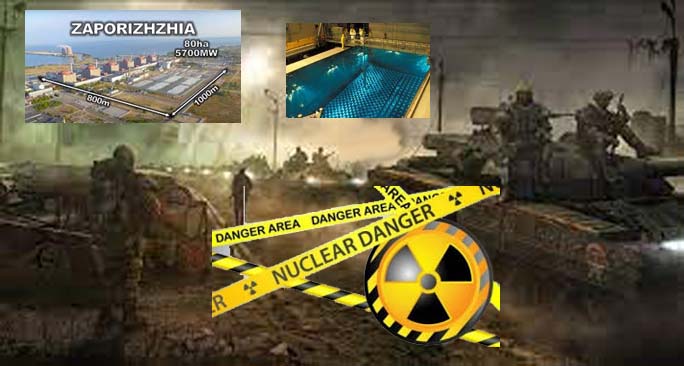
Greenpeace today warned that any plans by Russia to restart reactors at
the Zaporizhzhia nuclear plant would be a further step closer to a
potential nuclear disaster and must be stopped.
The environmental organization has restated its demand for the International Atomic Energy
Agency (IAEA) Director General to state clearly to Rosatom, the Russian
state nuclear corporation, that restart of any of the reactors cannot be
permitted.
The IAEA Director General is traveling to Moscow for meetings
with Rosatom Director General Alexey Likhachev. On 4th March, the second
anniversary of the Russian attack on the Zaporizhzhia plant, Greenpeace,
together with the deputy head of the regional administration, held a press
conference in Zaporizhzhia city. The focus of the event was the
Zaporozhzhia nuclear plant crisis, including the reactor restart threats
and nuclear emergency planning.
Greenpeace 5th March 2024
Improvement notice served over storage of hazardous materials at Dounreay
By Alan Hendry – alan.hendry@hnmedia.co.uk, 4 Mar 24, https://www.johnogroat-journal.co.uk/news/improvement-notice-served-over-storage-of-hazardous-material-344039/
An improvement notice has been served over shortfalls in arrangements for storing alkali metals at Dounreay.
Buildings used to store these metals, predominantly sodium, were leaking in rainwater – with pools observed where the containers were being kept.
The notice was served by the Office for Nuclear Regulation (ONR) on Nuclear Restoration Services (NRS), formerly Magnox Ltd.
ONR inspectors judged that the prolonged period of exposure to moist and damp conditions was resulting in degradation of the barriers for safe storage of the chemicals.
Although no-one was harmed as a result of these shortfalls, and there were no radiological consequences, ONR concluded that there was potential for serious personal injury if workers had been exposed to the hazardous materials.
‘It’ll be a shortlist of one!’ Villagers in England fear nuclear dump proposal

Plans for a new wave of atomic power have not factored in local concerns over the safety of the waste sites the schemes entail.
Alex Lawson, Sun 3 Mar 2024 , https://www.theguardian.com/business/2024/mar/03/itll-be-a-shortlist-of-one-villagers-in-england-fear-nuclear-dump-proposal
When Ian Harrison returned to the Lincolnshire coast to care for his parents a decade ago, he didn’t expect to spend his own retirement fighting plans to dig a £50bn nuclear waste dump near the beaches of his childhood.
Harrison, 67, lives a mile from the village of Theddlethorpe, one of three sites in England being examined for a possible geological disposal facility (GDF) to handle decades of nuclear waste from the power and defence industries. The cavernous dump will feature a series of tunnels and vaults dug 200-1,000 metres underground, capable of holding high-risk nuclear waste.
“It’s just a terrible idea to put a nuclear dump next to a seaside resort,” says Harrison, a retired warrant officer. “The safety concerns are real – look at Chernobyl – but people are more worried about the tourism that comes to Mablethorpe and the impact on local businesses.”Map showing proposed and withdrawn sites for GDFs
After several sites fell out of contention, the former gas terminal in Lincolnshire is one of just three which remain, with two on the Cumbrian coast – Mid Copeland and South Copeland. There is speculation about another site on the north-west coast.
The search for a home for Britain’s nuclear waste underlines a problem at the heart of its energy ambitions. Politicians have extolled the virtues of low-carbon nuclear power, but little attention has been given to the question of where to put the resulting waste.
Allerdale in Cumbria was ruled out last September after the government body behind the GDF project, Nuclear Waste Services (NWS), said there was “only a limited volume of suitable rock”, meaning it was not safe for storage. Last month, councillors in East Yorkshire withdrew from a process to consider hosting a GDF at South Holderness, east of Hull. In 2021, a council leader in Hartlepool resigned in a similar GDF row.
“At South Holderness, the local population complained and the council listened and stopped it,” says Harrison. “Here, people are worried, but they are sugarcoating it and not taking into account local concerns. Eventually, this will end up with a shortlist of one: us.”
The GDF is forecast to cost between £20bn and £53bn. Work on the project could take decades to begin, and high-risk waste will not enter it until at least 2075. The cost will be met by taxpayers, the existing nuclear plants’ operator EDF, and future power station operators.
Work on the GDF is expected to 4,000 jobs in its first 25 years. It is not an unprecedented move – Finland is nearing completion of a 450-metre-deep cavern to store its waste. France, Canada, Switzerland and Sweden are making progress on similar projects.
Britain’s nuclear waste is largely generated by its ageing power stations, as well as by industrial and defence sectors. It is housed in more than 20 ground-level sites which can hold the waste for up to 100 years, meaning a permanent store needs to be found. Even more waste is expected to be generated from a new era of reactors, despite lengthy delays,starting with Hinkley Point C in Somerset, currently the only new UK station under construction.
The handling of nuclear waste in Britain was put in the spotlight last year when the Guardian published Nuclear Leaks, a year-long investigation into problems with cybersecurity, safety and a “toxic” culture at Sellafield. Most of the waste now at the Cumbria site will be sent to a GDF, probably between 2050 and 2125.
While it can be argued that the Copeland sites have communities familiar with nuclear waste, it is an alien industry for Theddlethorpe, where geologists are studying the clay rock under the seabed.
Proponents of a GDF at Theddlethorpe, where a facility would be built onshore and the store tunnelled under the sea six miles off the coast, argue it will bring not only jobs but investment – in flood defences, road improvements and rail links. Detractors say its largely retired community will barely contribute to the workforce, and its holiday parks will play host only to construction workers while tourism slowly dies. A government gaffe in which Skegness was wrongly spelled as “Skegross” on a map did little to engender local support.
Ken Smith, a retired former lecturer and chair of the Guardians of the East Coast pressure group, says: “People call us nimbys and tell us that we’re only interested in the impact on house prices, but that’s a red herring. It’s about the people who live here and the way this could change their lives.”
A test of public support for the Theddlethorpe project is likely to be conducted in 2027. Jon Collins, the independent chair of the Theddlethorpe GDF Community Partnership, says only a small number of the 10,000 people who live in the search area have yet expressed an opinion. “There are a lot of people who have yet to engage. People deserve the opportunity to have a proper debate with all the facts before a decision is made.”
In Mid Copeland, David Moore, 70, a retired farmer, says local support for the project has increased in recent years. “Our community has been brought up handling radioactive waste,” says Moore, a representative on the Mid Copeland GDF community partnership. “We have a highly skilled workforce, and know it brings highly paid jobs.” Residents in nearby South Copeland are more circumspect, he claims.
A contentious element of the project has been the £1m a year in funds offered to prospective sites, handed out by NWS. Spending has included £382,067 for an adventure playground, garden and CCTV at the village halls; £49,981 on a project to reduce loneliness; and £26,102 to the Parrot Zoo Trust. Some locals see the taxpayer money as a “bribe”; others argue the money might as well be taken while the debate continues.
Collins says any final decision needs to take into account both local opinion and the best geological conditions for the site.
But Smith says: “A GDF is simply sweeping the problem under the carpet. My worry is that I want future generations to enjoy what I have I can take my grandchildren for a picnic on the beach: you can’t do that at Sellafield. I do not want the area to be torn apart. If they industrialise this coastline then all that enjoyment will be lost.”
NWS said: “A GDF will only be built where there is a suitable site and a willing community. This is a consent-based process and we are committed to giving local people all the information they need, listening to all voices and letting local people have their say on the topic.”
Out of the unfiltered mouths of US political leaders enabling the destruction of Ukraine.
Walt Zlotow, West Suburban Peace Coalition, Glen Ellyn IL, 4 Mar 24
“Four months into this thing, I like the structural path we’re on here. As long as we help Ukraine with the weapons they need and the economic support, they will fight to the last person. The best money we’ve ever spent.” Sen. Lindsay Graham (R-SC)
“It is a relatively modest amount that we are contributing without being asked to risk life and limb. The Ukrainians are willing to fight the fight for us if the West will give them the provisions. It’s a pretty good deal.” Sen. Roger Wicker (R-MS)
“I call that a bargain.” ND Republican Governor Doug Burgum referring to US war funding damaging Russian military without mentioning catastrophic Ukrainian military damage.
These people are not humane political leaders…they are moral monsters.
Walt Zlotow, West Suburban Peace Coalition, Glen Ellyn IL
The Ukrainian Intelligence Committee Is Preparing For The Worst-Case Scenario
ANDREW KORYBKO, FEB 28, 2024, https://korybko.substack.com/p/the-ukrainian-intelligence-committee—
What’s regarded as the worst-case scenario from the perspective of the ruling Ukrainian elite and their Western masters is the best-case scenario for the rest of the world. In the event that Zelensky is deposed and peace talks immediately resume right as Russia breaks through the Line of Contact, then NATO might not feel as pressured by its security dilemma with Russia to conventionally intervene in Ukraine, thus reducing the risk of World War III by miscalculation.
The Ukrainian Intelligence Committee warned in a Telegram post about the worst-case scenario that could happen by June whereby a Russian breakthrough across the Line of Contact (LOC) merges with protests over conscription and Zelensky’s illegitimacy to deal a deathblow to the state. They predictably claimed that those protests, along with claims of growing fatigue inside Western and Ukrainian societies plus civil-military tensions in Kiev, are just “Russian disinformation” even though they all veritably exist.
“Zelensky Is Desperate To Preemptively Discredit Potentially Forthcoming Protests Against Him” and that’s why he claimed in late November that Russia is conspiring to orchestrate a so-called “Maidan 3” against him, which is what the Intelligence Committee explicitly referred to in their post. Their warning also came as Ukrainian media reported that Zelensky plans to ask the Constitutional Court to rule on holding elections during martial law in order to retain legitimacy after his term expires on 20 May.
The preceding hyperlinked report from Turkish media also mentions how “opposition party leaders Petro Poroshenko and Yulia Tymoshenko proposed forming a coalition government to avoid a crisis of legitimacy” but were rebuked by National Security Council chief Danilov. What’s so interesting about this proposal is that it was first tabled by an expert from the powerful Atlantic Council think tank in an article that they published in Politico in mid-December in order to serve that exact same purpose.
This reminder and the subsequent proposal by those two opposition party leaders debunks the notion that questions about Zelensky’s legitimacy are solely the result of “Russian disinformation” just like a top European think tank’s latest poll from January debunks the same about fatigue over this conflict. The European Council on Foreign Relations, which can’t credibly be described as “pro-Russian”, found that only 10% of Europeans think that Ukraine will defeat Russia.
On the other side of the Atlantic, the Congressional deadlock over more Ukraine aid proves that such sentiments are shared in the halls of power, and those who hold these views understandably don’t want to continue throwing hard-earn taxpayer funds into a doomed-to-fail proxy war. Western leaders as a whole, however, are clearly panicking over the latest military-strategic dynamics that followed the failure of Kiev’s counteroffensive last summer and Russia’s recent victory in Avdeevka.
That’s why many of them debated whether to conventionally intervene in Ukraine during Monday’s meeting in Paris that was attended by over 20 European leaders. French President Macron said that this can’t be ruled out despite there being no consensus on the issue, which his Polish counterpart confirmed was the most heated part of their discussions that day. This prompted strong denials from all other Western leaders who claimed that they’ll never authorize this, but their words can’t be taken seriously.
After all, the worst-case scenario that the Ukrainian Intelligence Committee warned about and is actively trying to discredit as supposedly being driven solely by “Russian disinformation” could push them to conventionally intervene in order to avert the state’s collapse and an Afghan-like disaster in Europe. NATO is unlikely to sit idly on the sidelines if Russia steamrolls through the ruins after breaking through the LOC by sometime this summer, hence why a conventional intervention truly can’t be ruled out.
It would be very unpopular in the West as proven by the previously mentioned think tank’s latest poll and the ongoing Congressional deadlock over Ukraine aid, but that doesn’t mean that the elite won’t do it since they don’t take public opinion into consideration when formulating foreign and military policy. Even so, the large-scale protests that could follow in Europe are something that the elite want to avoid, but they might still risk them in order for their geopolitical project in Ukraine not to be totally for naught.
After all, the worst-case scenario that the Ukrainian Intelligence Committee warned about and is actively trying to discredit as supposedly being driven solely by “Russian disinformation” could push them to conventionally intervene in order to avert the state’s collapse and an Afghan-like disaster in Europe. NATO is unlikely to sit idly on the sidelines if Russia steamrolls through the ruins after breaking through the LOC by sometime this summer, hence why a conventional intervention truly can’t be ruled out.
It would be very unpopular in the West as proven by the previously mentioned think tank’s latest poll and the ongoing Congressional deadlock over Ukraine aid, but that doesn’t mean that the elite won’t do it since they don’t take public opinion into consideration when formulating foreign and military policy. Even so, the large-scale protests that could follow in Europe are something that the elite want to avoid, but they might still risk them in order for their geopolitical project in Ukraine not to be totally for naught.
Considering the global significance of this conflict, what’s regarded as the worst-case scenario from the perspective of the ruling Ukrainian elite and their Western masters is therefore the best-case scenario for the rest of the world. In the event that Zelensky is deposed and peace talks immediately resume right as Russia breaks through the LOC, then NATO might not feel as pressured by its security dilemma with Russia to conventionally intervene in Ukraine, thus reducing the risk of World War III by miscalculation.
Scottish National Party ministers to set out plans for removing nuclear weapons after independence
A new policy paper will focus on an independent Scotland’s ‘place in the world’
The Scotsman, By Alistair Grant, 4 Mar 24
SNP ministers are to set out proposals for the armed forces in an independent Scotland, including the removal of nuclear weapons from the country.
Angus Robertson, the external affairs secretary, will launch a new policy paper today focused on an independent Scotland’s “place in the world”.
And it will argue Scotland would gain “a seat at the table at the UN, the EU and other important global and regional forums”.
Mr Robertson said: “Independence would mean that Scotland gets to determine the type of nation it wants to be on the world stage. A nation that acts based on its values and principles, promotes human rights and development, and builds partnerships with other countries and international organisations to address global challenges.
“As an independent country we could renew and strengthen our existing relationships on these islands and around the world – promoting peace, prosperity and climate action, as a good global citizen committed to safeguarding human rights and upholding international law and the rules-based order.
“Scotland has a long history of being an outward-looking nation and I look forward to setting out our proposals in detail.”
It will be the latest in a series of Scottish Government papers, titled Building a New Scotland, which are described as forming a prospectus for an independent Scotland.
The SNP has long backed the removal of nuclear weapons from Faslane. However, there have been questions in the past over what this would mean for possible Nato membership.
The Scottish Greens, who have a power-sharing relationship with the SNP, do not support joining Nato…………………………………………………………. https://www.scotsman.com/news/politics/snp-ministers-to-set-out-plans-for-removing-nuclear-weapons-after-independence-4540930
Finland’s Olkiluoto nuclear power station to be disconnected for 37 days
The Olkiluoto-3 nuclear power plant in Finland – the first of its type
in Europe – will be disconnected from electricity production on 2 March
for its first annual outage, owner and operator Teollisuuden Voima Oyj
said. Regular electricity production began at the 1,600 MW EPR unit one
year ago with full commercial operation on 1 May.
TVO said the planned
outage is expected to last 37 days. The lengthy duration is due to the
technical characteristics of the plant type and the large number of
periodic tests and maintenance activities to be carried out during the
outage, TVO said. “As OL3 is the largest nuclear power plant unit in
Europe, there is a considerable number of components and equipment that
need to be serviced.” The plan for the Olkiluoto-3 outage includes some
1,900 different activities with almost 6,500 work phases.
Nucnet 1st March 2024
Mistakes, Misfiring and Trident: Britain’s Flawed Nuclear Deterrence
Australian Independent Media, March 4, 2024, Dr Binoy Kampmark
Nuclear weapons are considered the strategic silverware of nation states. Occasionally, they are given a cleaning and polishing. From time to time, they go missing, fail to work, and suffer misplacement. Of late, the UK Royal Navy has not been doing so well in that department, given its seminal role in upholding the doctrine of nuclear deterrence. In January, an unarmed Trident II D5 nuclear missile fell into the Atlantic Ocean after a bungled launch from a Royal Navy submarine.
The missile’s journey was a distinctly shorter than its originally plotted 6,000 km journey that would have ended in a location somewhere between Africa and Brazil. In language designed to say nothing yet conceal monumental embarrassment, UK Defence Secretary Grant Shapps called it “an anomaly” while the Labour opposition expressed concern through its shadow defence secretary, John Healey. An anonymous military source was the most descriptive of all: “It left the submarine but it just went plop, right next to them.
The anomaly in question, which Shapps witnessed on board the HMS Vanguard, took place off the coast of Florida during a January 30 exercise at the US’s Navy Port site. Its failure is the second for the missile, which was also tested in 2016 and resulted in its automatic self-destruction after veering off course and heading to the United States. It was therefore galling for the Defence Secretary to then claim in a written statement to Parliament that Trident was still “the most reliable weapons system in the world”, a claim also reiterated by the missile’s manufacturers, Lockheed Martin. With a gamey sense of delusion, Shapps continued to argue that the test merely “affirmed the effectiveness of the UK’s nuclear deterrent, in which the government has absolute confidence. The submarine and crew were successfully certified and will rejoin the operational cycle as planned.”…………………………………………………………………………………..
Even at the best of times, deterrence, as a claim, is the stuff of fluffy fiction, astrological flight and fancy. It is unverifiable, speculative, highly presumptuous. Who is to know if a nuclear weapon will be fired at any point, at any time, against any target, on whatever pretext presents itself?
The madman theory suggests that such a weapon will be deployed, though we are not sure when this might eventuate. Keeping company with such a theory is the rational, mass murderer type who takes comfort in the prospect that 100 humans might survive a holocaust killing billions. Shoot and take your chances. Human stupidity glows with the hope that errors will be healed, and mass crimes palliated.
In actual fact, the true proof of such deterrence would lie in hellish murder: weapons launched, catastrophe ensuing. Those recording such evidence are bound to be done by coarse skinned mutants with plumbing problems.
The Trident misfiring episode can be seen in one of two ways. First, it illustrates the point that we are here because of dumb luck, having survived error, misunderstanding and miscommunication. In the second sense, it yields an uncomfortable reality for the war planners in White Hall: Trident may not work when asked to.
Whether a system fails because of faulty machinery or accident, the problem of misfiring does not go away. At some point, a misfire with potency will result in deaths, though we can perhaps be assured that Trident may simply fail to live up to the heavy sense of expectation demanded of it. We can hope it just plops. https://theaimn.com/mistakes-misfiring-and-trident-britains-flawed-nuclear-deterrence/
Holderness: Government guarantees plans for nuclear waste dump will be dropped for good
A Government minister has guaranteed that proposals for a nuclear waste dump in south Holderness will be dropped for good, the area’s MP has said.
By Joe Gerrard, 28th Feb 2024, https://www.yorkshirepost.co.uk/news/environment/holderness-government-guarantees-plans-for-nuclear-waste-dump-will-be-dropped-for-good-4536953
Beverley and Holderness MP Graham Stuart said he had secured a commitment from Nuclear Minister Andrew Bowie that a Geological Disposal Facility (GDF) will not come to south Holderness.
The Conservative MP said he was delighted with the confirmation after people from Holderness and local councillors managed to put a stop to the plans..
It comes after Nuclear Waste Services, the Government agency behind the proposals, said it would wind down the South Holderness Working Group after East Riding councillors voted to withdraw.
It followed pressure from local campaigners and South West Holderness ward’s Coun Sean McMaster and Coun Lyn Healing, backed by Mr Stuart, after GDF proposals were announced in January.
They would have seen radioactive nuclear waste transported to south Holderness and stored in a network of vaults and tunnels hundreds of metres underground for up to 175 years.
The establishment of the Working Group began a process that would have lasted at least a decade while also bringing between £1m and £2.5m-a-year in funding to the area.
Nuclear Waste Services said the international consensus was that GDFs were the best long-term solution for disposing of nuclear waste and it would have brought economic benefits to south Holderness
It comes after Nuclear Waste Services, the Government agency behind the proposals, said it would wind down the South Holderness Working Group after East Riding councillors voted to withdraw.
They would have seen radioactive nuclear waste transported to south Holderness and stored in a network of vaults and tunnels hundreds of metres underground for up to 175 years.
The establishment of the Working Group began a process that would have lasted at least a decade while also bringing between £1m and £2.5m-a-year in funding to the area.
Nuclear Waste Services said the international consensus was that GDFs were the best long-term solution for disposing of nuclear waste and it would have brought economic benefits to south Holderness.
But residents and councillors who spoke at East Riding Council’s full meeting on Wednesday, February 21, said it threatened tourism and farming and had caused house sales to fall through.
Former UK Government nuclear waste disposal adviser Paul Dorfman told LDRS putting a GDF in an area at risk of flooding such as south Holderness was ludicrous.
Mr Stuart said Nuclear Minister Mr Bowie had told him Nuclear Waste Services would fully respect the council’s decision to end discussions about the GDF
The Beverley and Holderness MP added the council vote reflected deep opposition in the local community to the plans.
Mr Stuart said: “Many people in Holderness didn’t want nuclear waste to come to the place they call home.
“I always want to see our communities strengthened, and Coun McMaster and Coun Healing did just that through their motion to have the council withdraw from discussions with Nuclear Waste Services.
“I’m delighted that the government minister responsible has confirmed that Nuclear Waste Services will now withdraw from Holderness, and leave us alone for good.”
Macron stands by remarks on NATO troops in Ukraine

https://www.sott.net/article/489392-Macron-stands-by-remarks-on-NATO-troops-in-Ukraine— 1 Mar 24
The French president brushed off criticism from fellow NATO members, insisting his words were “thought-through and measured”
French President Emmanuel Macron on Thursday stood by his controversial remarks on Monday about the prospects of deploying troops to Ukraine, which have caused uproar among some NATO members, and has insisted his words were well thought out.
Speaking to reporters on the sidelines of a visit to inspect the 2024 Olympics village near Paris, Macron refused to backtrack on his statements despite a flurry of criticism from some fellow members of the US-led bloc.
“These are sufficiently serious issues; every one of the words that I say on this issue is weighed, thought-through and measured,” Macron claimed.
The French president triggered the political furore on Monday while speaking to reporters after hosting a meeting of European leaders in Paris. Macron insisted that the West should stop at nothing to prevent Russia from getting the upper hand in the conflict, saying the deployment of troops by NATO and other Western countries to Ukraine could not be ruled out.
“There’s no consensus today to send, in an official manner, troops on the ground,” he said. “In terms of dynamics, we cannot exclude anything. We will do everything necessary to prevent Russia from winning this war.”
The statement prompted a wave of denial from NATO members, with multiple major members of the bloc, including the US, the UK and Germany insisting they harbor no such plans. Some lesser members of the bloc, however, namely Estonia and Lithuania, appeared to back Macron, suggesting that sending troops to Ukraine should not be ruled out.
“We shouldn’t be afraid of our own power. Russia is saying this or that step is escalation, but defense is not escalation,” the Prime Minister of Estonia Kaja Kallas told Sky on Wednesday. “I’m saying we should have all options on the table. What more can we do in order to really help Ukraine win?”
Moscow has strongly condemned Macron’s remarks, cautioning the US-led bloc against taking further hostile moves. Should NATO troops actually be deployed to Ukraine, a direct confrontation between the alliance and Russia will become not only “possible” but actually “inevitable,” Kremlin spokesman Dmitry Peskov warned.
From the same source there was:
1 Mar, 2024 06:34
Vast majority of French oppose Macron’s ‘troops in Ukraine’ comment – poll
Survey results published on Thursday by French newspaper Le Figaro showed that 68% of respondents disapproved of Macron’s comments on a possible future NATO deployment to the war-torn state, while just 31% said they agreed. The remainder, just 1%, were undecided.
Given the many cases of having stood up against the popular wind prevailing in France, 31 % is a pretty good score.
Add to this that although Macron has met with resistance to implications of the statements, he has support from a country like Estonia:
29 Feb, 2024 15:59
NATO member backs ‘boots on the ground’ in Ukraine
Estonia is “not afraid” of Russia and thinks sending NATO ground troops to Ukraine ought to be under consideration, Prime Minister Kaja Kallas has told Sky News in an interview aired on Wednesday.
So far, only Estonia and Lithuania have expressed any enthusiasm for the idea of escalating NATO support to Kiev beyond deliveries of weapons, ammunition, and money.
“We shouldn’t be afraid of our own power. Russia is saying this or that step is escalation, but defense is not escalation,” Kallas told Sky. “I’m saying we should have all options on the table. What more can we do in order to really help Ukraine win?”
Earlier this week, French President Emmanuel Macron argued that the US-led bloc should not rule out sending troops to Ukraine, or any other options. Most members of the bloc have sincedistanced themselvesfrom the idea – except two of the former Soviet Baltic republics.
On Tuesday, Lithuanian Foreign Minister Gabrielius Landsbergis urged NATO to “think outside the box.” Meanwhile, the country’sambassador to Sweden, Linas Linkevicius, said the bloc would “neutralize” the Russian enclave of Kaliningrad if Moscow “dares to challenge NATO.”
The Estonian and Lithuanian officials are supported by the US or were they given the cue cards, … like Macron?
29 Feb, 2024 23:57
Pentagon warns of direct Russia-NATO clash
Addressing the US House Armed Services Committee hearing on Thursday, Austin once again urged lawmakers to approve additional funding for Kiev’s war effort, painting a grim picture for NATO allies.
“If you are a Baltic state, you are really worried about whether you are next… And, frankly, if Ukraine falls, I really believe that NATO will be in a fight with Russia,” the Pentagon chief said.
Austin went on to claim that “other autocrats around the world will look at this and will be encouraged by the fact that this happened and we failed to support a democracy.
Macron is probably aware he is in the same situation as Rishi Sunak. That is there are already French “advisors” involved:
29 Feb, 2024 19:14
UK ‘directly involved’ in Ukraine conflict – KremlinThe outlet RTVI asked Peskov to comment a report from The Times which claimed that Admiral Tony Radakin, the head of the UK armed forces, has helped make “battle plans” for Ukraine.
“In general, it’s no secret that the British really provide different forms of support [to Ukraine]. People on the ground and intelligence and so on and so forth,” Peskov said. “That is, they are actually directly involved in this conflict.”
According to the British outlet, citing a Ukrainian military source, Radakin “is understood to have helped the Ukrainians with the strategy to destroy Russian ships and open up the Black Sea,” and seen as “invaluable in coordinating support from other senior chiefs in NATO.”
The admiral also reportedly visited Kiev and met with President Vladimir Zelensky, to discuss Ukraine’s strategy and the ways in which the West could help.
The Kremlin doesn’t have specific information related to Radakin, but “probably our military knows about this,” Peskov said.
Radakin, 58, was due to retire in November after three years as chief of the defense staff, but will stay on the job for another year at Prime Minister Rishi Sunak’s request, the Times reported. One source told the outlet that the British government considered it important to retain“continuity”ahead of the upcoming general election.
Inside Europe’s only nuclear unicorn — and its €1bn fundraising hopes

Sifted, Kai Nicol-Schwarz 1 Mar 24
UK-based Newcleo could make the first close as soon as April — but the startup wants to raise €billions more by the end of the decade
UK-based unicorn Newcleo is on a mission to raise €1bn in equity this year.
The nuclear energy startup is developing small modular reactors (SMRs) fuelled with radioactive waste, and the first close could come as soon as April, founder and CEO Stefano Buono tells Sifted.
If it lands the round, the raise will be the second largest in the nuclear sector globally — and the largest, by some way, in Europe.
It’s piqued the interest of European governments increasingly keen to shore up their energy sovereignty in the face of climate change and Russia’s war in Ukraine — and of investors (including the French government), who’ve written cheques to the tune of €400m since the startup launched in 2021.
But if Newcleo is to achieve its lofty ambitions, it’ll need billions more by the end of the decade.
The startup plans to complete a research facility in Italy by 2026, as well as a fuel processing plant and a demonstrator reactor in France by 2030. And that’s before it launches its first revenue-making commercial reactor — possibly in the UK, says Buono — sometime after 2033 and then — eventually — deploys a fleet of its reactors across Europe.
To get there, it will need to find big cheque investors with the patience of saints and convince governments to cough up their nuclear waste…………………………………………………………………………………….
Can Europe’s nuclear sector raise the billions it needs?
While funding in Europe has shot up over the past few years, bringing the region’s fourth-generation reactors to market will require tens of billions more.
Newcleo alone will need to invest €3bn in France by 2030 to build its fuel processing plant and a 30MW demonstrator reactor. And that’s all before it builds a commercial reactor — “possibly” in the UK, says Buono — which it hopes to have completed by 2033.
While several companies have raised megarounds in the US — since 2021, deals like Commonwealth Fusion Systems’ $1.8bn, TerraPower’s $750m and Helion Energy’s $500m have rolled in — the sector has hit funding troubles in the past year.
Startup reactor plans have fallen through and huge deals have collapsed as rising interest rates, inflation and the nuclear industry’s poor record of delivering projects on time have dented investor confidence, the FT reported in December…………………………..
Newcleo hopes to raise from family offices, high net-worth individuals and institutional investors. Existing backers include US VC Exor Ventures, the investment vehicle of the Agnelli family office — founder of Italy’s largest carmaker Fiat, Italian investor Azimut Group and Italian tech transfer fund LIFTT.
And for future fundraises, Newcleo could look to tap public funds in the form of tax credits too, says Buono…………………………
And then there’s the small matter of convincing investors to part with €1bn during a downturn. https://sifted.eu/articles/newcleo-1bn-fundraise
France accused of ‘unacceptable’ behaviour after demanding UK taxpayer cash for Hinkley nuclear.
Former energy secretary Chris Huhne says Paris must cover cost overruns
Jonathan Leake, 29 February 2024 •
France’s demands for UK taxpayers to help fund Hinkley Point
C are “wholly unacceptable”, according to the former energy secretary
who helped develop the nuclear project. Chris Huhne, who was energy
secretary from 2010 to 2012, said he was “astonished and saddened” to
hear that both Bruno Le Maire, the French finance minister, and Luc
Rémont, chief executive of EDF, were pressing the UK to help with the cost
overruns.
Mr Huhne was a leading architect of the deal with EDF, France’s
state-owned electricity supplier, to build the nuclear power station. Under
the deal, finally signed off by Mr Huhne’s successor, Ed Davey, EDF was
responsible for all the estimated £18bn costs, with a start date of 2025.
Telegraph 29th Feb 2024
Conservationists say Hinkley C nuclear water intakes could wipe out Atlantic salmon stocks
West Somerset Free Press, By John Thorne , Friday 1st March 2024
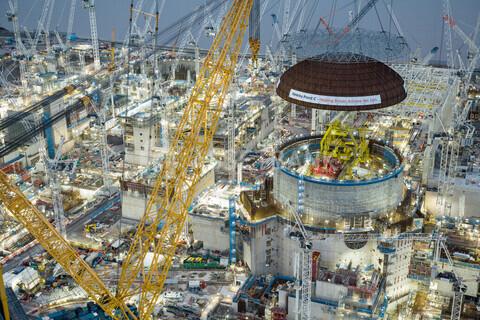
ENDANGERED Atlantic salmon could be wiped out in the Bristol Channel once the new Hinkley Point C nuclear power station starts generating electricity, campaigners fear.
They believe the estuary’s migrating salmon population could be decimated by huge water cooling intakes serving the power station’s nuclear reactors.
The Missing Salmon Alliance (MSA), which is a collective of passionate conservation organisations with a common interest in improving the plight of Atlantic salmon, is demanding greater fish protection measures by Hinkley C’s owner EDF.
They accused EDF of ‘flagrant disregard’ for major fish kill potential if it was successful in a bid to drop a requirement to fit acoustic fish deterrents (AFDs) on the water intake heads on the bed of the estuary.
Consultation on Hinkley’s proposals to drop the AFDs ended on Thursday (February 29) and MSA said it understood the system was now unlikely to be used.
As mitigation for the removal of the AFDs, EDF had suggested compensatory creation of wetland habitat for birds and other species, and enhancements to fish passage on some existing weirs.
But MSA said Hinkley would draw a huge amount of water from the Bristol Channel to cool its reactors, about 120,000 litres per second.
A spokesperson said: “This is the equivalent of three Olympic swimming pools per minute and twice the average flow of the River Thames, in London.
“An independent panel warned in 2021 the power station could capture up to 182 million fish per year. It is likely that most of these will not survive.”
The area surrounding Hinkley is a Special Area of Conservation with a number of rivers which are home to endangered, protected, and commercially important fish, including Atlantic salmon, shad, elver eel, which is critically endangered, conger eel, brown shrimp, cod, bass, whiting, flounder, sole, and thornback ray.
The Severn has one of only four UK spawning populations of twait shad and data showed a significant risk of Hinkley wiping them out as nearly one-third of their population used the sea around the abstraction zones.
The International Union for Conservation of Nature (IUCN) classifies Atlantic salmon as ‘endangered’ in Great Britain and ‘near threatened’ on a global scale.
Game and Wildlife Conservation Trust head of fisheries Dylan Roberts said: “Wild Atlantic salmon migrate through the Bristol Channel each spring from a number of recognised rivers in the area.
“It is critical a real-time assessment of salmon smolts migrating through the area is funded by EDF.
“This is not solely about salmon, it is a much broader remit.
“It is about conserving our wider biodiversity against a massive State project steamrolling through and putting two fingers up to the environment.”
Angling Trust head of campaigns Stuart Singleton-White said: “What EDF propose in terms of compensation is inadequate.
“It will not compensate for the millions of fish sucked in by these intakes every year.
“It will decimate Atlantic salmon and shad.
“Without proper compensation and mitigation, they could become locally extinct.”………………..
Did the West Intentionally Incite Putin to War?
by GORDONHAHN, February 27, 2024
Over the last year the US and NATO countries have undertaken no effort to convince Ukrainian President Volodomyr Zelenskiy to begin talks with Putin, despite: the death of more than half a million Ukrainians; the destruction of much of Ukraine’s economy, finances, physical infrastructure, human capital, civil society; and the West’s inability to sustain financial and military support even as Ukraine loses the war when said support was at its height.
The West’s war strategy now seems to be to prolong a ‘long war’ in the hope either that the war begins to affect Russia and Putin’s standing there or that Putin’s health wanes and his system destabilizes. All this and much more written below raises suspicions the West intentionally, maybe even ‘subconsciously’ – the actions of small policy victories won in order to ‘confront Putin’ by competing elements within it, especially inside Washington – drew Russia into the NATO-Russia Ukrainian War. Aside from the background cause and main driver of this decision – NATO expansion – and more immediate precipitants of Putin’s decision in mid- to late February 2022, what efforts, of any, did the West undertake perhaps intentionally to drive this decision?
If we look at the course of events in reverse chronological order it seems to me even more glaringly so that the West sought this war and indeed drew Russia into it intentionally with the the strategy of using the war to weaken Russia’s economic and political stability. The strategic goal is the reinforcement of US hegemony and power maximalization by achieving two long-standing, interrelated sub-goals: (1) NATO expansion and (2) the removal from power of Russian President Vladimir Putin. Let’s reverse engineer the course of events.
……………………………………………………………………………………………………………. A final side note. All this has led to NATO and the US being combatants in a war against Russia, which threatens us with world war and nuclear conflagration https://gordonhahn.com/2024/02/27/did-the-west-intentionally-incite-putin-to-war/—
Chris Huhne Letter: Taxpayers shouldn’t be footing bill for EDF failings
I was astonished and saddened by your report that both Bruno Le
Maire, the French finance minister, and Luc Rémont, chief executive of
EDF, are pressing the UK government to help with the cost overrun at
Hinkley Point C, the EDF nuclear plant under construction in the UK.
I regret EDF’s €12.9bn write down, but it is the French company’s
responsibility (Report, February 17). I will save French blushes by not
quoting all the promises that were made by the company about the low cost
of its nuclear energy (a fraction even of what was ultimately agreed). What
is wholly unacceptable, however, is the notion that the UK taxpayer should
in any way be on the hook for cost overruns when it was always made utterly
explicit — by me and my successor — that this would never happen.
A clear condition of the Hinkley project was that EDF would be entirely and
solely responsible for the construction costs and risks, and the UK
government would merely guarantee a price (subsidy-free, taking account of
carbon costs) for the electricity output once the plant started. Nothing
could be more unambiguous either legally, politically or morally.
Neither I nor my immediate successors would ever have agreed any contract — a
contract for difference — on any other basis. Any British minister who
now goes back on that arrangement would be betraying their responsibility
to the exchequer, and would be a legitimate target for the public accounts
committee.
FT 28th Feb 2024
https://www.ft.com/content/175d212b-0a93-48f5-b68c-2a58bd098796
1 This Month





PLEASE OPPOSE HR 8255 AND S.3639 – bills would accelerate satellite deployment, with no environmental review or safeguards – https://ncstd5li.quorum.us/campaign/169331/
To see nuclear-related stories in greater depth and intensity – go to https://nuclearinformation.wordpress.com
-
Archives
- September 2026 (339)
- August 2026 (330)
- July 2026 (355)
- June 2026 (287)
- May 2026 (306)
- April 2026 (356)
- March 2026 (251)
- February 2026 (267)
- January 2026 (308)
- December 2025 (358)
- November 2025 (359)
- October 2025 (375)
-
Categories
- 1
- 1 NUCLEAR ISSUES
- business and costs
- climate change
- culture and arts
- ENERGY
- environment
- health
- history
- indigenous issues
- Legal
- marketing of nuclear
- media
- opposition to nuclear
- PERSONAL STORIES
- politics
- politics international
- Religion and ethics
- safety
- secrets,lies and civil liberties
- spinbuster
- technology
- Uranium
- wastes
- weapons and war
- Women
- 2 WORLD
- ACTION
- AFRICA
- Atrocities
- AUSTRALIA
- Christina's notes
- Christina's themes
- culture and arts
- Events
- Fuk 2022
- Fuk 2023
- Fukushima 2017
- Fukushima 2018
- fukushima 2019
- Fukushima 2020
- Fukushima 2021
- general
- global warming
- Humour (God we need it)
- Nuclear
- RARE EARTHS
- Reference
- resources – print
- Resources -audiovicual
- Weekly Newsletter
- World
- World Nuclear
- YouTube
-
RSS
Entries RSS
Comments RSS

