12 years behind schedule, EDF’s Flamanville 3 nuclear plant gets regulatory approval for trial period
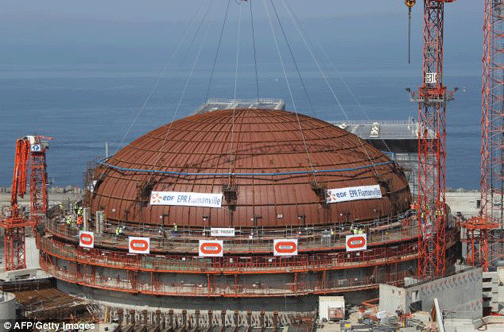
Electricite de France SA got regulatory approval to start up its new
nuclear reactor 12 years behind schedule after the utility faced
construction problems ranging from concrete weakness to faulty pipe welds.
The green light for commissioning of the Flamanville 3 nuclear plant
located in Northwestern France allows EDF to load the fuel in the reactor,
proceed with trials, then begin operations, the Autorite de Surete
Nucleaire said in a statement on Tuesday.
Further approvals will be
required when reaching key milestones during the trial phase, the regulator
added said. Once connected to the grid, the 1.6-gigawatt plant called a
European Pressurized Reactor will join EDF’s fleet of 56 reactors in
France, which accounted for about two-thirds of the country’s power
production last year.
Bloomberg 7th May 2024
How long does it take to build a nuclear reactor? We ask France

Sophie Vorrath, May 8, 2024, https://reneweconomy.com.au/how-long-does-it-take-to-build-a-nuclear-reactor-we-ask-france/

A short answer to this question might be, it depends who you ask. Ask Australia’s Opposition leader Peter Dutton, for instance, and he will tell you a federal Coalition government under his leadership could have a nuclear power plant up and running in Australia within a decade.
Ask the highly experienced French state-owned nuclear power giant EDF, which manages 56 reactors in the world’s most nuclear dependent country, and you would get rather a different answer.
Bloomberg reports that EDF this week got regulatory approval to start up its newest nuclear reactor, the 1.6GW Flamanville plant in France’s north west – a milestone that is 12 years behind schedule and more than four times over budget, thanks to a range of construction problems including concrete weakness and faulty pipe welds.
The green light allows EDF to load the fuel in the reactor, proceed with trials, then begin operations, the Autorite de Surete Nucleaire said in a statement on Tuesday. Further approvals will be needed upon reaching key milestones during the trial phase, the regulator said.
According to other reports, EDF said last month it hoped to connect the Flamanville pressurised reactor to the national grid by the European summer and reach full power by the end of the year.
But it will not be smooth sailing from there. A faulty vessel cover still needs replacing at the plant, with reports suggesting this has been pushed out to 2026, when the plant would be shut down for up to a year.
Meanwhile, EDF in March raised its cost estimate for the construction of six new nuclear reactors to €67.4 billion ($A102.5 billion), Reuters has reported, up from the company’s first estimated their cost of €51.7 billion.
So, how long does it take to build a nuclear reactor?
Kobad Bhavnagri, Bloomberg New Energy Finance’s energy expert and global head of strategy says the long delay and cost blowout at Flamanville 3 is not an isolated incident.
“Very similar delays and multifold cost blowouts have occurred with recent reactor builds in the UK, Finland and USA,” Bhavnagri writes on LinkedIn.
“Countries with well established nuclear industries.
“The lesson here? Don’t believe anyone who says they know how much it will cost and how long it will take to build a new nuclear plant (unless they are in China).”
The Great Ukraine Robbery Is Not Over Yet
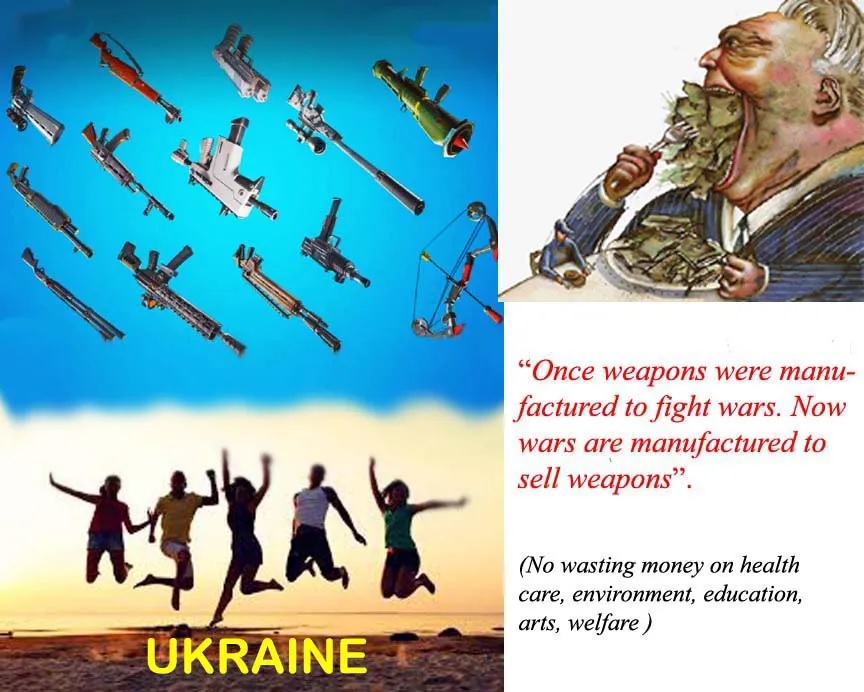
“we are helping Ukraine while at the same time investing in our own industrial base.”- Joe Biden
the Biden Administration to sign a ten-year security agreement that would lock in US funding for Ukraine for the next two and a half US Administrations.
by Ron Paul , , https://original.antiwar.com/paul/2024/05/06/the-great-ukraine-robbery-is-not-over-yet/
The ink was barely dry on President Biden’s signature transferring another $61 billion to the black hole called Ukraine, when the mainstream media broke the news that this was not the parting shot in a failed US policy. The elites have no intention of shutting down this gravy train, which transports wealth from the middle and working class to the wealthy and connected class.
Reuters wrote right after the aid bill was passed that, “Ukraine’s $61 billion lifeline is not enough.” Senate Minority Leader Mitch McConnell went on the Sunday shows after the bill was passed to say that $61 billion is “not a whole lot of money for us…” Well, that’s easy for him to say – after all it’s always easier to spend someone else’s money!
Ukraine’s foreign minister, Dmytro Kuleba, was far from grateful for the $170 billion we have shipped thus far to his country. In an interview with Foreign Policy magazine as the aid package was passed, Kuleba had the nerve to criticize the US for not producing weapons fast enough. “If you cannot produce enough interceptors to help Ukraine win the war against the country that wants to destroy the world order, then how are you going to win in the war against perhaps an enemy who is stronger than Russia?”
How’s that for a “thank you”?
It may be understandable why the Ukrainians are frustrated. Most of this money is not going to help them fight Russia. US military aid to Ukraine has left our own stockpiles of weapons depleted, so the money is going to create new production lines to replace weapons already sent to Ukraine. It’s all about the US weapons industry. President Biden admitted as much when he said, “we are helping Ukraine while at the same time investing in our own industrial base.”
This is why Washington Is desperate to make sure that if Donald Trump returns to the White House, the “Ukraine” gravy train cannot be shut down by his – or future – administrations. Last week news broke that the Ukrainian government was in negotiations with the Biden Administration to sign a ten-year security agreement that would lock in US funding for Ukraine for the next two and a half US Administrations. That would unconstitutionally tie future presidents’ hands when it comes to foreign policy and would leave Americans on the hook for untold billions more dollars taken from them and sent to the weapons industry and to a corrupt foreign government.
The US weapons industry and its cheerleaders in Washington DC are determined to keep Ukraine money flowing…until they can figure out a way to gin up a war with China after losing the current war with Russia. That, of course, depends on whether there is anything left of us when the smoke clears.
When President Biden signed the $95 billion bill to keep wars going in Ukraine and Gaza and to provoke a future war with China, he called it “a good day for world peace.” Yes, and “War is peace.” Debt is good. Freedom is slavery. We are living in a post-truth society where billions spent on pointless wars are “not a whole lot of money.” But the piper will be paid and the debt will be cleared.
Kremlin says nuclear weapon drills are Russia’s response to West’s statements

MOSCOW, May 6 (Reuters) https://www.reuters.com/world/europe/kremlin-says-nuclear-weapon-drills-are-russias-response-wests-statements-2024-05-06/ –
Russia’s tactical nuclear weapon drills are a response to statements from the West about sending troops to Ukraine, the Kremlin said on Monday.
Kremlin spokesman Dmitry Peskov cited comments by the French President Emmanuel Macron on possibly sending soldiers to Ukraine, as well as statements from the British and US Senate representatives.
Military and other special services are verifying reports about deployment of France’s foreign legion in Ukraine, Peskov added.
Coming soon: Get the latest news and expert analysis about the state of the global economy with Reuters Econ World. Sign up here.
Reporting by Reuters Editing by Bernadette Baum
Pentagon sees no change in Russia’s strategic nuclear force posture
By Reuters, May 7, 2024
WASHINGTON, – The Pentagon has not seen a change to Russia’s disposition of its strategic nuclear forces, it said on Monday, despite what it called “irresponsible rhetoric” from Moscow detailing plans for exercises involving the deployment of tactical nuclear weapons.
Russia said on Monday it would hold military drills that will include practicing the deployment of tactical nuclear weapons after what Moscow said were threats from France, Britain and the United States. It said the exercises were ordered by Russian President Vladimir Putin.
Russia said on Monday it would hold military drills that will include practicing the deployment of tactical nuclear weapons after what Moscow said were threats from France, Britain and the United States. It said the exercises were ordered by Russian President Vladimir Putin
Missile forces in the Southern Military District, aviation and the navy will take part, the defense ministry said.
“We’ve not seen any change in their strategic force posture. Obviously, we’ll continue to monitor,” said U.S. Air Force Major General Patrick Ryder, a Pentagon spokesperson.
The exercise of what Russia calls its non-strategic nuclear forces were aimed at ensuring Russia’s territorial integrity and sovereignty, its defense ministry said.
Russia’s foreign ministry said the drills also aimed to cool down “hotheads” in the West, who Moscow accused of pushing for a direct military confrontation between the U.S.-led NATO military alliance and Russia…………………………. https://www.reuters.com/world/us/pentagon-sees-no-change-russias-strategic-nuclear-force-posture-2024-05-06/
The mad waste of public money by UK’s leading nuclear giants to pursue costs against a whistleblower at your expense

But perhaps this is the real reason for using public money in this way is to silence anybody else who might be thinking of exposing the dark secrets inside Sellafield. She is not the only whistleblower.
by davidhencke
One aspect of the second recent cost hearing against whistleblower and human resources consultant Alison McDermott by Sellafield and the Nuclear Decommissioning Authority which was not covered is the cost to the public and us the taxpayer.
During the hearing Deshpal Panesar, KC Sellafield’s lawyer from Old Square Chambers, rather pompously told the hearing that the fact Sellafield was claiming £20,000 off Alison was ” to protect the public purse”. He and the Nuclear Commissioning Authority which was also claiming £20,000 made a huge point that her “unreasonable behaviour” by pursing them at a tribunal meant she should pay a penalty.
What is now emerging from Freedom of Information requests is that the cost to bring this action far outweighs the money they will receive even if they are 100 per cent successful.
Both nuclear giants have already spent a huge sum – nearly £700,000 of taxpayer’s money – fighting Alison, whose consultancy was terminated, after her report revealed bullying and fear among staff at the nuclear site in Sellafield.
Now it is known from FOI that both organisations have spent £59,000 between them on preparing the case for the second hearing on top of money they had already spent for the first costs hearing. This doesn’t include the cost of hearing itself which is about another £20,000 considering Sellafield’s lawyers Deshpal Paneser. KC charges £5500 a day for the hearing and Emma Mills, from DLA Piper, who charges £3000 a day . The NDA employed another barrister, Rachel Levene and solicitors Pinsent Mason. Plus there were paralegals at the hearing.
Now one would think that after a High Court judge had ruled that the first costs decision was ” unsafe” and said his view should be taken into account by judge Stuart Robertson, who has heard the second hearing, there would be pause for thought. Both nuclear organisations are also lucky they will not face an appeal. So any sane organisation would decide to leave it there.
Instead we have the economic madness, which no commercial company conducting a risk assessment would follow, of throwing more money at bringing a second case when there is not the slightest chance of getting their money back. Indeed even if they were 100 per cent successful they stand to lose £40,000 and that is by no means certain they will get that. It is only that it is our money from the taxpayer they can throw it around like confetti.
So why are they doing it? The decision must have been endorsed by Euan Hutton, the new chief executive.
Despite previously serving as a Mental Health Champion alongside Ms. McDermott to foster a kinder and more supportive work environment, Mr. Hutton is now relentlessly pursuing costs against her.
In various YouTube videos, Mr. Hutton espouses the importance of treating people with kindness, yet his actions towards Ms. McDermott are anything but. He actually says that “kindness is putting in the time to think about how different people act differently, that’s what kindness is all about” [second video from 20 seconds onwards]. By hounding her for costs related to her whistleblowing for the second time, he has subjected her to immense stress and anguish, betraying the values he once claimed to champion.
See https://www.facebook.com/watch/?v=1938802916244720
Now Sellafield receives £6.7 million daily from taxpayers. Mr. Hutton’s decision to waste these funds on a vindictive legal battle against a whistleblower is an egregious misuse of public money. It is a slap in the face to taxpayers who trust Sellafield to use their contributions responsibly.
The Guardian has reported that the National Audit Office will investigate Sellafield’s substantial expenditure.
https://www.theguardian.com/business/2024/feb/15/spending-watchdog-launches-investigation-into-sellafieldI intend to make the National Audit Office aware of this blog post, as it highlights the unethical and hypocritical behaviour of Mr. Hutton. I think the public would strongly disapprove of their money being used to persecute a brave individual who spoke out against wrongdoing.
Mr. Hutton should be held accountable for his actions, which have caused harm to Ms. McDermott and undermined Sellafield’s commitment to employee wellbeing and to a culture of openness.
But perhaps this is the real reason for using public money in this way is to silence anybody else who might be thinking of exposing the dark secrets inside Sellafield. She is not the only whistleblower.
I approached Sellafield and the NDA about this waste of money but both said
“These issues are still subject to legal proceedings. We cannot comment further at this stage.”
Putin orders tactical nuclear weapons drills
SOTT, Mon, 06 May 2024
An exercise to check the military’s ability to use smaller-range systems was announced by the Defense Ministry on Monday
Russia will test its ability to deploy tactical nuclear weapons, the Defense Ministry announced on Monday. The drill will be conducted “in the near future” and was ordered by President Vladimir Putin, the statement said.
Missile forces of the Southern Military District will be directly involved in the exercise. It will also require the participation of military aircraft and the Russian Navy, the ministry said.
The goal of the exercise is to iron out “the practical aspects of the preparation and deployment of non-strategic nuclear weapons,” it added.
The military cited “provocative statements and threats against Russia by certain Western officials” as the reason for the drill. The troops will confirm that they can “ensure unconditional territorial integrity and sovereignty” of the nation, it added.
Moscow has a wide range of nuclear-capable weapons, from long-range intercontinental ballistic missiles to smaller-range tactical nukes. Amid the Ukraine conflict, senior Russian officials, including Putin, have stated that the country’s nuclear doctrine allows the use of these weapons when the existence of the nation is at stake.
The US and its allies have accused Moscow of nuclear saber-rattling. Putin said in March that at no point in the conflict has the situation required such a radical move as a nuclear strike.
Comment: From the same source:
28 Apr, 2024
Macron calls for EU nuclear force
more https://www.sott.net/article/491187-Putin-orders-tactical-nuclear-weapons-drills
UK’s Nuclear roadmap is a massive detour

UK plan reveals true ‘energy’ agenda is pathway to nuclear weapons sector
By Jonathon Porritt, Beyond Nuclear 6 May 24
After 14 years of Tory mismanagement, the UK finds itself bereft of an energy strategy.
This was finally confirmed in the release of the Government’s new Nuclear Roadmap. At one level, it’s just the same old, same old, the latest in a very long line of PR-driven, more or less fantastical wishlists for new nuclear in the UK. But at another, it’s a total revelation.
For years, a small group of dedicated academics and campaigners have suggested that the UK Government’s Nuclear Energy Strategy is being driven more by the UK’s continuing commitment to an “independent” nuclear weapons capability than by any authoritative energy analysis. For an equal number of years, this was aggressively rebutted by one Energy Minister after another, both Tory and Labour.
The new Nuclear Roadmap dramatically changes all that. It sets to one side any pretence that the links between our civil nuclear programme and our military defence needs were anything other than small-scale – and of no material strategic significance. With quite startling transparency and clarity, the Roadmap not only reveals the full extent of those links, but positively celebrates that co-dependency as a massive plus in our ambition to achieve a Net Zero economy by 2050.
“Startling” is actually an understatement. Such a comprehensive volte-face is rare in policy-making circles. Every effort is usually made by Ministers to obscure the scale (let along the significance) of any such screeching handbrake turns. That is so not the case with the new Roadmap.
Courtesy of the latest forensic work done by Professors Andy Stirling and Phil Johnstone at Sussex University (who have been absolutely at the forefront of seeking to bring these links into the public domain over many years – often with mighty little support from mainstream environmental organisations, let alone “independent” commentators), chapter and verse of this volte-face can be laid bare. Just a couple of examples from the Roadmap:
- “Not only does this Roadmap set a clear path for the growth of nuclear fission…it acknowledges the crucial importance of the nuclear industry to our national security, both in terms of energy supply and the defence nuclear enterprise.”
- “Government will proactively look for opportunities to align delivery of the civil and nuclear defence enterprises, whilst maintaining the highest standards of non-proliferation.”
- “To address the commonalities across the civil and defence supply chains, and the potential risk to our respective nuclear programmes due to competing demand for the supply chain, the Department of Energy Security and Net Zero (DESNZ) is working closely with the Ministry of Defence and the Defence Nuclear Sector.”
And there’s a whole lot more than that! As Andy Stirling has said: “Without any reflection on what this says about previous efforts to suppress discussion of this issue, the Government is now openly emphasising its significance.”
Indeed!
As usual, the UK’s ill-informed and unbelievably gullible mainstream media would appear to have missed the significance of this gobsmacking inflection point. So one can hardly expect them to have grasped its even more significant implications for UK energy strategy as a whole. In every single particular.
Let me briefly unpack some of those particulars:
- Nuclear
The new Roadmap reads like an outing to a massive nuclear sweet shop. On top of Hinkley Point C and Sizewell C, we’ll have one more big one. And then we’ll have lots of Small Modular Reactors, all over the country. And we’ll have a new fuel processing plant. And a new Geological Disposal Facility – at some much more distant point. And so on and on. 24 fantastical Gigawatts to be designed and delivered by 2050.
The reality couldn’t be more different:
- We will indeed end up with Hinkley Point C – at a staggering of cost of somewhere between £26 billion and £30 billion, with consumers paying twice as much for its electricity as they will for offshore wind. And it will almost certainly not come online until the end of the decade, 15 years on from the time it was meant to be up and running.
- We may possibly get Sizewell C, though the Government cannot currently guarantee the required level of investment. So a Final Investment Decision is unlikely before the next Election. At which point, Starmer may come to his senses and kill off this absurd white elephant.
- We will never get a third big reactor. The economics are literally impossible to justify.
- We are unlikely to get more than a couple of hugely expensive Small Modular Reactors, at some indeterminate point in the future, even with a new “flexible approach” to planning and financial inducements. Even that may prove to be an illusion. As Professor Steve Thomas has written: “Advocates of Small Nuclear Reactors claim they are cheaper and easier to build, safer, generate less waste, and will create many jobs compared to existing large reactor designs. These claims are unproven, misleading, or just plain wrong. Worldwide, no commercial design of SMR has even received a firm order yet.”
- And we may or may not get life extensions for the last five power stations in the “legacy fleet” – subject to regulatory approval, which may not be all that easy given extensive cracking in their reactor cores.
In short, the Roadmap is just a massive diversion from reality. Entailing incalculable opportunity costs. And putting at risk our entire Net Zero by 2050 strategy.
Ministers know all that. But they don’t really care. Our nuclear weapons programme (including upgrading Trident) will be protected as a consequence of this, via an unceasing flow of public money into the civil nuclear cul-de-sac, at a time when our defence budget is already massively overstretched. So who cares about the missing 24GW?
- Renewables
We’ll continue to see new investment into renewables here in the UK, despite (not because of) government policy, which has seriously messed up our offshore wind industry, maintained a de facto ban on onshore wind, couldn’t care less about solar, witters on vapidly about tidal without doing anything etc etc.
Meanwhile, on a global basis, renewables continue to boom………………………………………………………………………………………………………………………………..
The reasons for this almost complete silence can be traced back to successive governments’ grim intent to hang onto our so-called “independent nuclear deterrent”. At literally any costs……………………………… more https://beyondnuclearinternational.org/2024/05/06/nuclear-roadmap-is-massive-detour/
Military interests are pushing new nuclear power

in this supposedly “civil” strategy—are multiple statements about addressing “civil and military nuclear ambitions” together to “identify opportunities to align the two across government.”
A 2007 report by an executive from submarine-makers BAE Systems called for these military costs to be “masked” behind civil programs.
Rolls Royce even issued a dedicated report, marshaling the case for expensive “small modular reactors” to “relieve the Ministry of Defense of the burden of developing and retaining skills and capability.”
The UK government has finally admitted it
By Andy Stirling and Philip Johnstone, 6 May 24, https://beyondnuclearinternational.org/2024/05/06/military-interests-are-pushing-new-nuclear-power/
The UK government has announced the “biggest expansion of the [nuclear] sector in 70 years.” This follows years of extraordinarily expensive support.
Why is this? Official assessments acknowledge nuclear performs poorly compared to alternatives. With renewables and storage significantly cheaper, climate goals are achieved faster, more affordably and reliably by diverse other means. The only new power station under construction is still not finished, running ten years late and many times over budget.
So again: why does this ailing technology enjoy such intense and persistent generosity?
The UK government has for a long time failed even to try to justify support for nuclear power in the kinds of detailed substantive energy terms that were once routine. The last properly rigorous energy white paper was in 2003.
Even before wind and solar costs plummeted, this recognized nuclear as “unattractive.” The delayed 2020 white paper didn’t detail any comparative nuclear and renewable costs, let alone justify why this more expensive option receives such disproportionate funding.
A document published with the latest announcement, Civil Nuclear: Roadmap to 2050, is also more about affirming official support than substantively justifying it. More significant—in this supposedly “civil” strategy—are multiple statements about addressing “civil and military nuclear ambitions” together to “identify opportunities to align the two across government.”
These pressures are acknowledged by other states with nuclear weapons, but were until now treated like a secret in the UK: civil nuclear energy maintains the skills and supply chains needed for military nuclear programs.
The military has consistently called for civil nuclear
Official UK energy policy documents fail substantively to justify nuclear power, but on the military side the picture is clear.
For instance, in 2006 then prime minister Tony Blair performed a U-turn to ignore his own white paper and pledge nuclear power would be “back with a vengeance.” Widely criticized for resting on a “secret” process, this followed a major three volume study by the military-linked RAND Corporation for the Ministry of Defense (MoD) effectively warning that the UK “industrial base” for design, manufacture and maintenance of nuclear submarines would become unaffordable if the country phased out civil nuclear power.
A 2007 report by an executive from submarine-makers BAE Systems called for these military costs to be “masked” behind civil programs. A secret MoD report in 2014 (later released by freedom of information) showed starkly how declining nuclear power erodes military nuclear skills.
In repeated parliamentary hearings, academics, engineering organizations, research centers, industry bodies and trade unions urged continuing civil nuclear as a means to support military capabilities.
In 2017, submarine reactor manufacturer Rolls Royce even issued a dedicated report, marshaling the case for expensive “small modular reactors” to “relieve the Ministry of Defense of the burden of developing and retaining skills and capability.”
The government itself has remained coy about acknowledging this pressure to “mask” military costs behind civilian programs. Yet the logic is clear in repeated emphasis on the supposedly self-evident imperative to “keep the nuclear option open”—as if this were an end in itself, no matter what the cost. Energy ministers are occasionally more candid, with one calling civil-military distinctions “artifical” and quietly saying: “I want to include the MoD more in everything we do”.
In 2017, we submitted evidence to a parliamentary public accounts committee investigation of the deal to build Hinkley Point C power plant. On the basis of our evidence, the committee asked the then MoD head (who—notably—previously oversaw civil nuclear contract negotiations) about the military nuclear links. His response:
We are completing the build of the nuclear submarines which carry conventional weaponry. We have at some point to renew the warheads, so there is very definitely an opportunity here for the nation to grasp in terms of building up its nuclear skills. I do not think that that is going to happen by accident; it is going to require concerted government action to make it happen.
This is even more evident in actions than words. For instance hundreds of millions of pounds have been prioritized for a nuclear innovation program and a nuclear sector deal which is “committed to increasing the opportunities for transferability between civil and defense industries.”
An open secret
Despite all this, military pressures for nuclear power are not widely recognized in the UK. On the few occasions when it receives media attention, the link has been officially denied.
Other nuclear-armed states are also striving to maintain expensive military infrastructures (especially around submarine reactors) just when the civilian industry is obsolescing. This is true in the US, France, Russia and China.
Other countries tend to be more open about it, with the interdependence acknowledged at presidential level in the US for instance. French president Emmanuel Macron summarizes: “without civil nuclear power, no military nuclear power, without military nuclear, no civil nuclear.”
This is largely why nuclear-armed France is pressing the European Union to support nuclear power. This is why non-nuclear-armed Germany has phased out the nuclear technologies it once lead the world in. This is why other nuclear-armed states are so disproportionately fixated by nuclear power.
These military pressures help explain why the UK is in denial about poor nuclear performance, yet so supportive of general nuclear skills. Powerful military interests—with characteristic secrecy and active PR—are driving this persistence.
Neglect of this picture makes it all the more disturbing. Outside defense budgets, off the public books and away from due scrutiny, expensive support is being lavished on a joint civil-military nuclear industrial base largely to help fund military needs. These concealed subsidies make nuclear submarines look affordable, but electricity and climate action more costly.
The conclusions are not self-evident. Some might argue military rationales justify excessive nuclear costs. But history teaches that policies are more likely to go awry if reasons are concealed. In the UK—where nuclear realities have been strongly officially denied—the issues are not just about energy, or climate, but democracy.
Andy Stirling is Professor of Science & Technology Policy in the Science Policy Research Unit, University of Sussex. Philip Johnstone is Research Fellow, SPRU, University of Sussex.
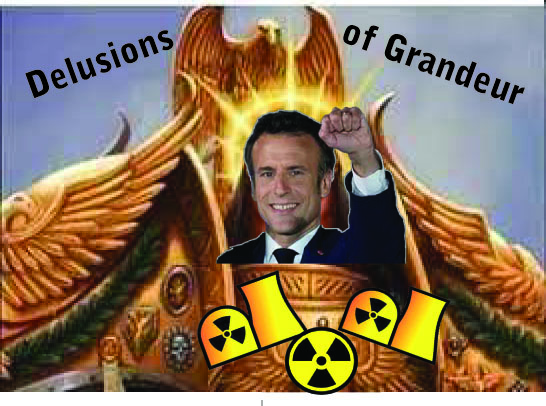
France’s Macron wants to build 14 new Nuclear reactors by 2050. 6 is more realistic
energy post eu, April 29, 2024 by Jonathan Bruegel
France’s President Macron is talking about a nuclear renaissance, after years of uncertainty over its future. The goal is to build 14 new reactors by 2050. But Jonathan Bruegel at IEEFA says this is unrealistc. France’s nuclear sector has much to recommend it. It produces up to 80% of the country’s total power generation, the highest share of nuclear in the generation mix anywhere in the world, and CO2-free. However, France hasn’t built a nuclear reactor since 1999, and construction delays and budget overruns plague the completion of its latest reactor, Flamanville 3, started in 2007. And with many of the 56 currently operational reactors reaching the end of their 40-year lifetime, decisions must be made whether to shut them down or extend their lifetimes by 10 or 20 years through major refits. Bruegel looks at the fundamentals and estimates that a more realistic goal is to build 6 new reactors by 2050, and to extend the lifetimes of 13 (or a maximum of 20) reactors. That would leave nuclear’s share in France’s 2050 mix at a maximum of 40% and more realistically 30%.
Key findings
- Given that new nuclear projects have faced significant construction delays and cost overruns, France’s plan to build 14 new reactors by 2050 is unrealistic.
- Nuclear should continue playing a key role in France’s power sector but not at the expense of renewables growth.
- French policy has recently shifted from a commitment to reduce nuclear generation to calls for a “renaissance” of the technology.
- France’s heavy reliance on nuclear has kept its power sector emissions relatively low but left it exposed to the many challenges associated with the technology.
Energy security
………………………… In the last two years, Europe’s imports of Russian piped gas have been largely replaced by liquified natural gas (LNG) from alternative sources. Curtailments and demand response mechanisms have contributed to absorbing the price shock…………………………..
In the case of France, this energy crisis was especially challenging since it coincided with many nuclear reactors being taken offline for maintenance work. In 2022, the country was a net power importer for the first time in more than 40 years. In 2023, as most nuclear reactors went back online, it resumed being a net power exporter. The episode illustrated the risks of France’s exposure to nuclear power.
Nuclear has dominated France’s power mix since the 1980s
……………………………..However, as Chart 1 [on original] shows, France hasn’t built a nuclear reactor since 1999, meaning its EPR expertise hasn’t benefitted its domestic nuclear fleet as much as it could have. Construction of the latest reactor, Flamanville 3, started in 2007. It has yet to be commissioned. So far, it is delayed by 12 years and is almost four times over budget.
With many reactors reaching the end of their 40-year lifetime, decision-makers must choose whether to shut them down or extend their operations by 10 or 20 years through major refitting programmes.
Policy shift sees France plan a “nuclear renaissance”
Nuclear’s role in France’s future power mix has become an increasingly crucial and controversial political debate.
After his election to the presidency in 2012, François Hollande committed to reducing the share of nuclear in France’s power production to 50% by 2035, with an ambitious decommissioning plan. However, not one nuclear unit was decommissioned under his presidency and no legally binding decommissioning dates for plants were set. The only binding commitment was to cap French nuclear capacity to 63GW.
During his first term between 2017 and 2022, President Emmanuel Macron did not engage in any nuclear policy shift, postponing the debate. The Flamanville 1 and 2 nuclear reactors were decommissioned in 2020 because they had exceeded their 40-year lifetime and no agreement had been made with operator EDF for a major refit programme.
Criticisms
During his second term, Macron has called for a “nuclear renaissance” and announced a goal to build 14 new reactors by 2050, implicitly targeting a maintenance of the 63GW of capacity and nuclear’s share in the power generation mix. The announcement was heavily criticised from across the political spectrum, with the main argument being that nuclear would slow the growth of renewables. Concerns have also been raised about the challenges associated with nuclear technology such as safety issues, long construction times, massive capital expenditures (see Chart 2 on original), a levelised cost of electricity higher than renewables and waste management.
Despite its role in reducing carbon emissions, Nuclear must not limit Renewables growth
Nuclear is not considered a renewable technology since uranium is needed, but the debate remains open on whether nuclear is green.
Although its challenges are well known (e.g., safety, costs, waste management), the French plan to build 14 new nuclear units by 2050 seems at best unrealistic.
Significant construction delays and cost overruns faced by the two latest EPRs, Flamanville 3 in France and Olkiluoto 3 in Finland, are evidence that building an average of one reactor every two years until 2050 is not a feasible goal…………………………………………………. more https://energypost.eu/frances-macron-wants-to-build-14-new-nuclear-reactors-by-2050-6-is-more-realistic/
NATO using war games to ‘prepare for conflict’ – Moscow
https://www.rt.com/russia/596996-nato-conflict-prepares-russia/ 5 May 24
The US-led bloc is holding its largest exercises in decades near the Russian border, the Foreign Ministry has pointed out
NATO’s largest exercise since the Cold War are being held near Russia’s border, indicating that the US-led bloc is “seriously preparing” for a potential conflict with Moscow, Foreign Ministry spokeswoman Maria Zakharova has said.
The Steadfast Defender drills, featuring some 90,000 troops from all 32 NATO member states and 1,100 combat vehicles, started in late January and will end in May.
According to the wargame scenario, “the coalition’s actions against Russia are being practiced using all the instruments, including hybrid and conventional weapons,” Zakharova said in a statement on Saturday.
”We have to admit that NATO is seriously preparing for a ‘potential conflict’ with us,” Zakharova said.
The diplomat was commenting on accusations made by NATO earlier this week that Russia was allegedly carrying out “hybrid activities” on the member countries’ soil, which they insist constitute a threat to their security. These actions include “sabotage, acts of violence, cyber and electronic interference, disinformation campaigns, and other hybrid operations,” the bloc claimed in a statement on Thursday.
Zakharova dismissed the allegations as “disinformation” and an attempt to shift public attention from NATO’s own activities.
The bloc and the leadership of individual member states are “increasing the degree of anti-Russian hysteria in order to justify the unprecedented scale of militarization in Europe,” the official stated.
According to the diplomat, it was NATO that launched “a hybrid war against Russia in all operational environments and in all geographic directions.” In addition, the bloc members are actively involved in the Ukraine conflict. They are providing Kiev not only with financial support, but also with weapons and intelligence data – which are then used “to strike civilians and civilian infrastructure in Russia,” Zakharova added
Back in March, Russian Security Council Secretary Nikolay Patrushev said that NATO’s Steadfast Defender 2024 exercises were “increasing tensions and destabilizing the situation in the world” by simulating a military confrontation with Moscow. The official described the bloc as an “important tool” employed by the US to exert pressure and influence on other nations. NATO has come directly to Russia’s western border and is preparing for future conflicts, he stressed.
In recent months, multiple senior officials from NATO member states claimed that Moscow was planning to launch an attack against the military bloc in the coming years.
Russia has repeatedly denied those claims, with President Vladimir Putin saying the country “has no interest … geopolitically, economically or militarily … in waging war against NATO.”
The undersea nuclear graveyard now more costly than HS2
Behind the much delayed plan to store the radioactive waste generated over decades
A vast subsea nuclear graveyard planned to hold Britain’s burgeoning piles of radioactive waste is set to become the biggest, longest-lasting and most expensive infrastructure project ever undertaken in the UK… ……………………………..(Subscribers only) https://www.telegraph.co.uk/business/2024/05/05/66bn-nuclear-graveyard-became-expensive-challenge/
Germany records 50 hours of negative electricity prices for April, largely due to renewables.

Average retail prices fell to €6.24 ($6.70)/kWh on the German electricity spot
market in April, largely due to renewables covering about 70% of the
network load. These low price levels in the electricity market can be
attributed to the high shares of renewables in Germany. According to Rabot
Charge, renewable energy systems covered 70% of the network load in April.
PV Magazine 3rd May 2024
Why UK Government nuclear quango has ruled out Trawsfynydd from initial mini-nuke rollout
The site in Gwynedd could still be considered later on in the process
Owen Hughes, Business correspondent, 3 MAY 2024
A UK Government nuclear quango has dropped Trawsfynydd from the initial rollout of small modular reactors. Former Prime Minister Boris Johnson had said in 2022 that the UK Government are “looking to build another small modular reactor(SMR) on the site at Trawsfynydd”.
The Nuclear Decommissioning Authority (NDA) and Welsh Government owned Cwmni Egino had been working up plans for a new nuclear station close to the former power station, which stopped generating in 1991 and is in the long process of being decommissioned. The location had also previously been tipped by Rolls Royce SMR as a location for an SMR.
But those hopes have been dealt a blow after Great British Nuclear(GBN) said the site would not be considered in its initial rollout phase. It is understood the size of the site and the volume of cooling water counted against it. They also said it may not be able to deploy as quickly as some other sites.
It has though not been ruled out completely and could play a part in the future. A source explained that the initial rollout was looking at locations that could host four or five SMRs, which Traws does not have capacity for.
But once these larger sites are developed a further rollout would consider smaller sites that could host one or two SMRs, with would put the Gwynedd site back in contention.
On Anglesey, UK Government is buying the Wylfa site in a bid to progress nuclear development on the island after two failed attempts for a Wylfa B. This could be used for four or five SMRs or a single large scale nuclear power station…………………………………
GBN’s plans for its first phase of work for SMRs proposes to make decisions on investments by 2029, with power on the grid by the mid-2030s. https://www.dailypost.co.uk/news/north-wales-news/uk-government-nuclear-quango-ruled-29108206
Banned By Germany
Apr 30, 2024 YANIS VAROUFAKIS
Germany recently prohibited a Palestinian Congress from taking place in Berlin, arrested its Jewish supporters, and barred one of its organizers, Greece’s former finance minister, from entering the country. But the turn to repression is powerful evidence that the country’s pro-Israel political consensus is breaking down.
ATHENS – Three weeks ago, I was banned from entering Germany. When I asked the German authorities who decided this, when, and under what rationale, I received a formal reply that, for reasons of national security, my questions would receive no formal reply. Suddenly, my mind raced back to another era when my ten-year-old self thought of Germany as a refuge from authoritarianism.
During Greece’s fascist dictatorship, listening to foreign radio broadcasts was banned. So, every evening, at around nine, my parents would huddle under a red blanket with a short-wave wireless, straining to hear Deutsche Welle’s dedicated Greek broadcast. My boyish imagination was propelled to a mythical place called Germany – a place, my parents told me, that was “the democrats’ friend.”
Years later, in 2015, the German media presented me as Germany’s foe. I was aghast; nothing could be further from the truth. As Greece’s finance minister, I opposed the German government’s monomaniacal insistence on harsh universal austerity, not merely because I thought it would be catastrophic for most Greeks, but also because I thought it would be detrimental to most Germans’ long-term interests.
The specter of deindustrialization that today casts a depressing shadow across Germany is consistent with my prognosis.
In 2016, when choosing a European capital to launch DiEM25, the pan-European political movement that I helped to found, I chose Berlin. At Berlin’s Volksbühne Theatre, I explained the reason: “Nothing good can happen in Europe if it does not begin in Berlin.” To reinforce the point, in the 2019 European Parliament elections I chose symbolically to be DiEM25’s candidate not in Greece (where I could win easily) but in Germany.
Given my lengthy relationship with the land of Goethe, Hegel, and Brecht, the German center-left government’s decision to ban me is more bewildering than even my nearest and dearest can imagine. I shall leave to my lawyers the legality of being denied the right to know the rationale behind the ban, and I will set aside the threat to my safety from the reckless insinuation that I am, somehow, a threat to Germany’s national security. Nor will I delve into what my ban means for a European Union where free movement and association are singular virtues. Instead, I want to focus on the ban’s deeper significance.
The trigger for banning me was a Palestinian Congress co-organized by DiEM25’s German party (MERA25), various Palestinian support groups and, crucially, the German organization Jewish Voice for a Just Peace. But the writing had been on the wall well before that.
Last November, Iris Hefets, a friend and member of the aforementioned Jewish organization, staged a one-woman protest in Berlin. Walking alone, in silence, she held a placard on which she had written: “As an Israeli and as a Jew, stop the genocide in Gaza.” Astonishingly, she was arrested for anti-Semitism. Soon after, the bank account of her organization was frozen – by officials unable to grasp the irony, indeed the horror, of the German state seizing Jewish assets and arresting peaceful Jews in Berlin.
In the run-up to our Palestinian Congress, a coalition of political parties representing almost the entire German political spectrum (including two leaders of my former comrades in the Left party) took the extraordinary step of creating a dedicated website for denouncing us. Their charges?
First, they branded us as “terrorism trivializers” vis-à-vis Hamas’s October 7 attacks in Israel. It was not enough for them that we had condemned as war crimes all acts of violence against civilians (regardless of the identity of perpetrator or victim). They wanted us to condemn resistance to what even Tamir Pardo, the former Mossad director, described as an apartheid system designed to push Palestinians either into exile or into permanent servitude.
Second, they claimed that we were “not interested in talking about possibilities for peaceful coexistence in the Middle East against the background of the war in Gaza.” Seriously? All participants in our Congress are committed to equal political rights for Jews and Palestinians – and many of us, taking our cue from the late Edward Said, support a single federal state as the solution to the conflict.
Dismissing their groundless accusations, let me home in on the central question: How could almost the entire German political class embrace this denunciation, which prepared the ground for the subsequent police action? How could they remain silent as the police arrested Udi Raz (another Jewish comrade), prohibited our conference and, yes, banned me from entering Germany – even from connecting via video link to any event in the country?
Their most likely answer is the German state’s official semi-rationale, or Staatsräson: the protection of Jewish lives and Israel’s security. But the German state’s recent behavior is not at all about protecting Jews (especially my friends Iris and Udi) or Israel. The purpose is to defend Israel’s right to commit any war crime its leaders choose in the process of enforcing an agenda whose goal is to render impossible the two-state solution that the German government claims to favor.
If I am right, something else is behind the current political consensus in Germany. My hypothesis is that Germany’s political class has a penchant for national catechisms that unite its members behind a common will: net exports as Germany’s strength; China as German industry’s playground; Russia as its source of cheap energy; and Zionism as proof that it has turned a page, morally.
Once such a catechism is established, debating it rationally becomes next to impossible. Moreover, the fear of being denounced for abandoning it motivates the concerted denunciation of any apostate who questions it.
A silver lining here is that young Germans, seeing the bodies piling up in Gaza, are not afraid that they will be denounced if they challenge a catechism that has jeopardized German democracy, the rule of law, and basic common sense. This is why, despite the ban, I am not giving up on Germany.
1 This Month




PLEASE OPPOSE HR 8255 AND S.3639 – bills would accelerate satellite deployment, with no environmental review or safeguards – https://ncstd5li.quorum.us/campaign/169331/
To see nuclear-related stories in greater depth and intensity – go to https://nuclearinformation.wordpress.com
-
Archives
- September 2026 (339)
- August 2026 (330)
- July 2026 (355)
- June 2026 (287)
- May 2026 (306)
- April 2026 (356)
- March 2026 (251)
- February 2026 (267)
- January 2026 (308)
- December 2025 (358)
- November 2025 (359)
- October 2025 (375)
-
Categories
- 1
- 1 NUCLEAR ISSUES
- business and costs
- climate change
- culture and arts
- ENERGY
- environment
- health
- history
- indigenous issues
- Legal
- marketing of nuclear
- media
- opposition to nuclear
- PERSONAL STORIES
- politics
- politics international
- Religion and ethics
- safety
- secrets,lies and civil liberties
- spinbuster
- technology
- Uranium
- wastes
- weapons and war
- Women
- 2 WORLD
- ACTION
- AFRICA
- Atrocities
- AUSTRALIA
- Christina's notes
- Christina's themes
- culture and arts
- Events
- Fuk 2022
- Fuk 2023
- Fukushima 2017
- Fukushima 2018
- fukushima 2019
- Fukushima 2020
- Fukushima 2021
- general
- global warming
- Humour (God we need it)
- Nuclear
- RARE EARTHS
- Reference
- resources – print
- Resources -audiovicual
- Weekly Newsletter
- World
- World Nuclear
- YouTube
-
RSS
Entries RSS
Comments RSS

