Nuclear Free Local Authorities challenge UK government on New Cleo’s application for “justification” of its small nuclear “fast” reactor
2 In April 2024, the Nuclear Industry Association applied for
‘justification’ on behalf of NewCleo and its lead-cooled LFR-AS-200 fast
reactor to the Department for Environment, Food and Rural Affairs (DEFRA).
The department will support the future Secretary of State in their role as
the authority responsible for the ‘justification’ decision.
This was the first application for ‘justification’ for a so-called advanced modular
design in the UK. In its media release, NewCleo oozed confidence its
reactor design will meet with approval:
‘Justification’ is a regulatory
process which requires a Government decision before any new class or type
of practice involving ionising radiation can be introduced in the UK. A
justification decision is one of the required steps for the operation of a
new nuclear technology in the UK, but it is not a permit or licence that
allows a specific project to go ahead.
Instead, it is a generic decision
based on a high-level evaluation of the potential benefits and detriments
of the proposed new nuclear practice as a pre-cursor to future regulatory
processes.
The design failed the government’s readiness test to be entered
into the Generic Design Assessment (GDA). Even if justification is
forthcoming, with the design not selected for the GDA, it would surely have
to undergo an equally rigorous, but more uncertain, process.
Furthermore, the reactor operates using MOX (mixed uranium and plutonium reprocessed
fuel). Although, the press has previously reported NewCleo’s plan ‘to
take advantage of the UK’s massive stockpile of waste at Sellafield, where
it wanted to invest £2bn in a waste reprocessing factory and advanced
modular reactors that would have created around 500 jobs’, the government’s
recently published Civil Nuclear Roadmap makes clear that this material
will not be forthcoming: ‘We are providing clarity to vendors by
committing not to support the use of plutonium stored at Sellafield by
Advanced Nuclear Technologies whilst high hazard reduction activities are
prioritised at Sellafield’.
The other puzzle is X-Energy, which was given
£3.4m by government, but seemingly, like NewCleo, has been turned down for
consideration for a GDA. X-Energy have previously announced plans to deploy
its reactor design at a site in Hartlepool.
In response to the news, NFLA
Scotland Advisor Pete Roche and Emeritus Professor of Energy Policy at the
University of Greenwich Stephen Thomas put together a question set
exploring and challenging the justification and Generic Design processes.
This was sent by the NFLAs to Nuclear Minister Andrew Bowie. On receiving
the Minister’s response, a second letter with supplementary questions was
drafted and sent, and this has just been replied to by a senior Department
of Energy Security and Net Zero (DESNZ) official. The correspondence is
reproduced in this briefing for your information.
NFLA 16th July 2024
Nuclear convoys travelling to Coulport should be peacefully stopped
The National, Brian Quail, Glasgow, 17 July 24
IN this time of post election soul-searching, I would like to present your readers with two simple but vital facts. First, there are two roads by which heavy-duty vehicles can cross the border between England and Scotland, and two only. Secondly, to stop vehicles is a routine matter for Police Scotland
The MoD frequently sends convoys carrying Trident warheads from Aldermaston in Berkshire to Coulport in Scotland. They have to do this regularly to make sure that when they are fired, they will actually work and kill thousands of innocent people (this is called “integrity verification”, I kid you not). Indiscriminate slaughter is the one and only thing they are designed to do.
But the Treaty for the Prohibition of Nuclear Weapons (TPNW) entered into force in January 2021 at the United Nations and is supported by 122 states. Thus, the highest court in the world has specifically condemned nuclear weapons as illegal. This ruling is “jus cogens” or compulsory law; that is, a peremptory norm from which there is no derogation (like FGM, piracy, genocide, or enslavement), as opposed to customary law, where parties make mutual agreement.
A Trident warhead is a hydrogen bomb. and by the TPNW, undeniably illegal. To stop these convoys at the border and refuse to allow them to continue their criminal enterprise requires nothing more than normal police procedures; in fact, those guilty could also be arrested and charged with criminal conspiracy. This is enforcement of the law.
Humanity has at last “banned the bomb”, and we must act accordingly.
The appreciation of the logic of this is axiomatic for both the demand for independence and the praxis of self-governance. As long as we cravenly accept this criminal imposition on our land, we do not have independence because we do not deserve it.
As long as we continue with our present craven acceptance of our abject role playing Tonto to the British Lone Ranger in his lunatic nuclear fantasies, we can forget about independence. Marches and demonstrations have their place in this campaign but total commitment demands much more. This demands action.
This direct action is something we can and should do, now. The nuclear convoys should be peacefully and non-violently stopped. This would be an effective technique to obtain independence, and an unambiguous expression of being a normal legal state.
EDF’s plans to create new saltmarsh

ByBurnham-On-Sea.com, July 16, 2024
Meet the Regulator’ event on Tuesday 16th July drop-in session overseen by the EA.
It came as locals have spoken out over EDF’s plans to create a huge new saltmarsh on the Pawlett Hams instead of introducing measures to prevent fish being killed at Hinkley Point C.
Hinkley Point C says the new saltmarsh on the Pawlett Hams would be a ‘natural alternative’ to installing an acoustic fish deterrent at the new power station.
As Burnham-On-Sea.com reported here, EDF is planning to create a saltmarsh at Pawlett Hams to create a new habitat for fish and animals instead of creating an acoustic fish deterrent system at Hinkley Point C which would stop millions of fish from swimming into the plant’s cooling system and being killed.
Local environmental campaign group Protect Pawlett Hams Action Group claims the EDF plans are an “ecological disaster in the making.”
And Fish Guidance Systems (FGS) is calling for urgent support from the Environment Agency (EA) on how a Acoustic Fish Deterrent (AFD) system will be included in EDF Energy’s plans at Hinkley Point C.
FGS says: “One of these conditions includes the application of an AFD which uses low-frequency signals to deter fish from the cooling intakes for the nuclear power plant, located two miles offshore.”
“This would save the lives of local and protected fish species in the Severn Estuary, which would otherwise be pulled through the cooling water systems and released back into the Estuary. Fish under threat include shad, while migratory species such as Atlantic salmon and shad will have a 50% and 100% respective death rate if pulled into the processing as reported in a Welsh Government Commission.”
…………………………………….EDF has suggested the creation of wetland habitat for birds and other species, combined with enhancements to fish passage on a small number of existing weirs however, several environmental groups state that this will not compensate for the millions of fish pulled in by the intakes every year, which some estimate to be 128 million. FGS urges that an AFD system is the only warranted option.
Dr David Lambert, Managing Director of Fish Guidance Systems, adds: “Acoustic Fish Deterrent systems have been successfully used at coastal power plants for nearly thirty years and EDF’s repeated appeal to the government to revoke the use of one does not take into account the important fish species and wider ecosystem. We want to use our expertise to help EDF make informed, scientifically-backed decisions………………………… https://www.burnham-on-sea.com/news/edfs-plans-to-create-huge-new-saltmarsh-to-be-aired-at-meet-the-regulator-event-today/
Campaigners against Sizewell C hopeful new MPs will take their concerns to parliament

The campaign group Stop Sizewell C says it’s heard from several MPs already
Jasmine Oak, 10th Jul 2024, https://hellorayo.co.uk/greatest-hits/west-norfolk/news/stop-sizewell-c-campaigners-new-mp-hopes/
Campaigners are calling on the new Government to consider scrapping plans to build a nuclear power plant on the Suffolk Coast
Once up and running, it’s thought Sizewell C will power up to six million homes, but activists say it’s going to devastate our countryside
Alison Downes is from ‘Stop Sizewell C’ group – and says Sir Kier Starmer needs to listen to their concerns: “The priority needs to be preventing there being any more unnecessary damage to the local environment.
“We have already seen a fair amount of damage, but that’s nothing compared with what’s to come…
“The government needs to resist any pressure from the nuclear industry for a hasty decision, especially as Sizewell C is going to take a long time, and a lot of money, to build.”
Alison’s hoping the local area’s new MPs will voice their concerns in Parliament: “Our new MP has publicly said that Stop Sizewell C was the first group she met with when she was elected.
“We also have the co-leader of the Green Party, Adrian Ramsay, in Waveney Valley. He’s been very vocal against Sizewell C.”
A spokesperson for EDF Energy has previously told us: “Our proposals for Sizewell C will see the creation of a 3.2 gigawatt power station that will create low-carbon electricity that will supply 6 million homes.
“This will be delivering clean, reliable, and affordable power for generations.”
Kiev missile attack. What happened? [i]
Cruise missile or stray air defense missile
Black Mountain Analysis MIKE MIHAJLOVIC, JUL 14, 2024
Coincidence or not, every time NATO has a high-level meeting, something terrible happens in Ukraine. After that, there is a frenzy of accusations about war crimes, indiscriminate targeting of civilians, and insults in both mainstream media and social media. There are “experts” that pop up like mushrooms after rain and an uncontrollable flood of speculations. What is missing is someone who puts a brake on emotional comments and starts to look at the issue from different angles: what may be evident from one side may be completely different when looked at from the other side.
This article is not an attempt to investigate the recent explosion that damaged the children’s hospital in Kiev, nor to finger point at anyone, but rather to establish the facts that may point to some conclusion if one expends the effort.
FACTS
The warhead
On July 8, Russia unleashed a barrage of cruise missiles at strategically important locations such as the Artyom Plant, which is a well-known manufacturer of equipment for the Ukrainian military. This target was carefully selected, and selection was based on careful and long surveillance, meaning that drones, satellites, field operatives, etc., were involved. The target for the specific day was not chosen randomly but after careful analysis, and the decision to strike was made after many pieces of the intelligence puzzle were acquired and placed to reveal a clear picture.
The target was very important, so the targeteers decided to engage it with multiple cruise missiles. Mathematically, it is clear that the probability of destruction is much higher with multiple missiles. The weapon chosen was not by chance: a cruise missile with a 450 kg warhead (the optimal choice for this type of target) guarantees destruction on a large scale, even if it is not a pinpoint hit. Several warheads of this size will obliterate the designated target(s).
Ukrainians are not naïve; more often than not, valuable equipment is relocated to predetermined places. Because of the machinery and other equipment, moving the manufacturing facilities is harder but not entirely impossible. Moving the VIPs is much easier, but one precise hit can virtually destroy the command structure or decision-makers.
In this case, as seen in several videos, the target mentioned was the Artyom Plant—a series of sequential hits by Kh-101 missiles achieved desirable results. What happened with the hospital is highly debatable
Firstly, there is a video clip showing a flying object, a missile, in a steep dive hitting the area. What is very important to say is that the missile didn’t hit the hospital directly, and the damage on the facade, which is evident in some photos, is caused by secondary effects such as blasts and shrapnel.
[excellent photos on original]
……………………………………………………………………………………………… Let’s do a brief investigation backward, starting from the position of the hit and working toward the missile. In almost every analysis flooding the media, everyone talks about the missile, and there are two streams: those who categorically say that the missile is indeed a Russian cruise missile and the other that argues for the stray Ukrainian AD missile. More on the hierarchy line in the political world, more acquisitions and this is especially on the pro-Ukrainian side.
The first step is to determine the level of damage and the impact point and compare it with the equivalent damage that can be produced with a high explosive charge.
The damaged building, a Soviet-built brick structure, has one corner collapsed, while the substation also shows damage from blasts and shrapnel. The hospital is not damaged except for shrapnel (that may be from the flying debris, not from the warhead fragments), broken windows, and other minor consequences of the blast…………………………………………………………………………………………………………………………………………………………………………………………………………………………………….. [many photos]……………….
What is the next?
Based on what was previously said, all factors must be involved in the investigation: the estimated size of the warhead, two “best” candidates for the perpetrator based on the video evidence, and something that both sides, including the whole pact for one side, are not willing to share—radar records and surveillance satellite records………………………………………………………………………………………………
Conclusion
The hospital was not the intended target. The damaged building is likely not the intended target as well.
The explosive was not heavy and is likely not from the typical cruise missile charge, even with the activation of unburned motor propellant. This does not exclude cruise missiles because they may be decoys or have some modified charge, another stream that may be explored.
The visual records are of low quality and prone to heavy editing, so the validity of the comparison is questionable, and the investigation can’t be judged solely on that.
AD units in the area were active. It is not publicly known how many missiles were launched and from where.
Hypotheses like that there was a secret meeting in the building or that the target was actually a Ministry of Infrastructure meeting may be considered. Still, there is no evidence to support this.
Sabotage and some heavily modified third types of missiles are in the domain of conspiracy theories and should stay there.
As usual, the blame game will continue until something else happens, and everything starts from the beginning.
In any case, the reader should conduct further research and, if possible, try to stay unbiased if that is possible.
I. Balagansky: Damaging Effects of Weapons and Ammunition, 3.5 Evaluation of the Damaging Effect of Shock Waves on Various Objects.
Ibid
High Explosive-Fragmentation
[i] Edited by Piquet (editPiquet@gmail.com) https://bmanalysis.substack.com/p/kiev-missile-attack-what-happened?utm_source=post-email-title&publication_id=1105422&post_id=146522183&utm_campaign=email-post-title&isFreemail=true&r=1ise1&triedRedirect=true&utm_medium=email—
For 75 Years, NATO Has Been Terrorizing the Globe
Ukraine Breathes New Life into NATO
Most recently, NATO has performed its familiar war-mongering role in Ukraine, where it has trained Ukrainian troops, including members of the neo-Nazi-led Azov Battalion.
The latter began attacking the people of eastern Ukraine after the 2014 U.S.-backed coup that triggered the devastating ongoing conflict.
This conflict was provoked in part by U.S. efforts to extend NATO membership to Ukraine, which CIA Director William Burns had warned was a red line that should not be crossed.[14]
In late March 2022, thanks to peace talks mediated by Turkey, Russia was ready to withdraw from all the territory it had captured if Ukraine agreed to give up any commitment to join NATO or allow NATO military bases or missiles to be stationed on its territory.
The deal was scuttled when British Prime Minister Boris Johnson flew to Kyiv to tell Ukrainian Prime Minister Volodymyr Zelensky that the “collective West” would not support it.
By Jeremy Kuzmarov, July 13, 2024, https://covertactionmagazine.com/2024/07/13/for-75-years-nato-has-been-terrorizing-the-globe/
Will a formidable peace movement ever emerge that can succeed in stopping it?
This past week, the North Atlantic Treaty Organization (NATO) celebrated its 75th anniversary by hosting a summit in Washington, D.C., where its founding treaty was signed.
A declaration issued at the summit made clear NATO’s intent to continuously confront Russia in Ukraine, and to further expand its operations in Southeast Asia and the Middle East.[1]
The Biden administration announced that: a) they are going to start stationing long-range nuclear and other missiles (including hypersonic missiles, that the U.S. doesn’t even have yet) in Germany, within easy striking-distance of Moscow; b) nuclear-capable F-16 fighter jets will be arriving in Ukraine any day now, and will go into service “during the summer”; and that c) Ukraine is on an “irreversible path” to join NATO.
A commemorative documentary featured now on NATO’s website celebrates NATO’s role in facilitating the Western victory in the Cold War and in allegedly ending ethnic cleansing and genocide in the Balkans in the 1990s, curtailing terrorism from Afghanistan after 9/11, and helping to protect the world from Russian aggression.
NATO’s formation in April 1949 is depicted as being vital in preventing the U.S. from having fallen into dreaded isolationism as it had after World War I, and in protecting European security in the face of the Soviet threat.
Colonel Richard Williams, Deputy Director of NATO’s Defense Investment Division, 1997-2011, states that “NATO is the only organization that offers hope that peace can become a real possibility.”
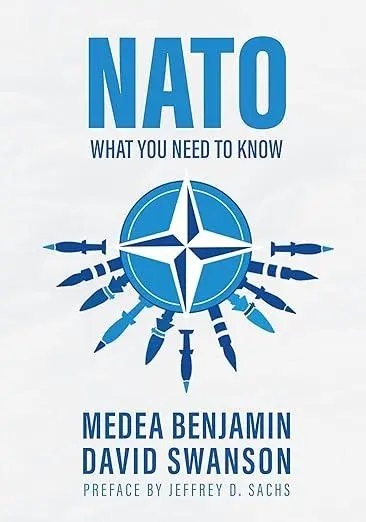
George Orwell would surely be proud of these latter comments in light of NATO’s long record of war-making. The true, venal history is exposed in a short book by peace activists Medea Benjamin and David Swanson, NATO: What You Need to Know, whose publication was timed to encourage protests at the 75th NATO anniversary summit.
Danger to World Peace
In the preface, Columbia University Professor Jeffrey Sachs wrote that “NATO is a clear and present danger to world peace, a war machine run amok that operates beyond the democratic control of the citizenry of the NATO countries.” Sachs continued: “The war machine lines the pockets of the arms contractors at the core of NATO, U.S. companies like Lockheed Martin and Northrop Grumman and Europe’s arms manufacturers…NATO also sucks one nation after another into the vortex of war, instability, displacement, and poverty. During the past 30 years, NATO has fomented a vast arc of violence stretching from Libya to Afghanistan and with many victims in between.”[2]
Benjamin and Swanson emphasize in their introduction that NATO has repeatedly violated the UN Charter outlawing military aggression and the UN’s 1970 Treaty on the Non-Proliferation of Nuclear Weapons and the Treaty on the Prohibition of Nuclear Weapons because of the placement of U.S. nuclear weapons in five European NATO nations.
NATO’s formation in 1949 as a military defense alliance against the Soviet Union was predicated on rampant propaganda that grossly exaggerated the Soviet threat, and on the ouster of peace-oriented politicians such as Henry Wallace, Franklin Roosevelt’s Vice President.
Wallace had proposed a continuation of Roosevelt’s policy of cooperation with the Soviets and was consequently removed in a coup d’état at the Democratic Party convention in Chicago in 1944 and then fired by Harry S. Truman as Commerce Secretary.
Under the direction of Truman’s advisers, including Joe Biden’s political mentor W. Averell Harriman, NATO established private clandestine armies among fascist elements throughout Western Europe who carried out black-flag terrorist activities as part of a strategy to inculcate fear in local populations and to discredit the political left.
In Italy, NATO operatives bombed a Bologna rail station and then planted evidence in the home of a left-wing journalist to make it look like he was the culprit.[3]
Rather than supporting democracy in Western Europe, NATO has a record of empowering reactionary forces. After World War II, it helped destroy popular movements of the left that had led the fight against fascism and were intent on redistributing wealth.
Greece was accepted as a NATO member only after its “ruthless Western-backed government killed or jailed the last of the partisans who had liberated it from the Nazis.”[4]
Turkey’s membership in NATO gave NATO military control of the Bosporus Strait—the only navigational waterway between the Mediterranean and Black Seas and a choke point for the Soviet ports of Odessa and Sevastapol.[5]
Within a decade of joining the Alliance, both Turkey and Greece were toppled in right-wing coups, which did not affect NATO membership. NATO further accepted Portugal as a member when it was ruled by a fascist dictator, Antonio Salazar, who provided the U.S. with a military base in the Azores.
NATO backed Portugal’s brutal suppression of anti-colonial movements in its African colonies (i.e., Angola and Mozambique), supported France’s colonial war in Algeria and the U.S. aggression in Korea, which resulted in the killing of 20% of North Korea’s population.
At an Asian-African conference in Bandung in 1955, Indian Prime Minister Jawaharlal Nehru called NATO “the most powerful protector of colonialism” and said that Morocco, Algeria and Tunisia “would probably have been independent if it had not been for NATO.”[6]
Upholding Unipolar U.S. Power
The U.S. has long been a driving force behind NATO because NATO “provides a vehicle for imposing U.S. leadership over Western nations,” according to Benjamin and Swanson. It has “tied Europe to U.S. military, geopolitical, and economic interests, made Europeans dependent on U.S. military power, and helped fortify U.S. global economic interests.”[7]
After the end of the Cold War, U.S. weapons companies helped lobby for NATO’s expansion. A lobby group called U.S. Committee to Expand NATO was run by the Vice President of Lockheed Martin.[8]
The father of the Cold War containment strategy, George F. Kennan, warned that NATO expansion in the 1990s would be a disastrous folly that would antagonize the Russians and trigger a new Cold War, but to no avail.
Beholden in part to the Polish-American and other Eastern European lobbies alongside the weapons lobbyists, the Clinton administration expanded NATO to three Eastern European countries (Poland, Hungary and Czech Republic)—in violation of a pledge made by the George H.W. Bush administration to the Russians that NATO would not be expanded “one inch to the East.”
George W. Bush followed Clinton by expanding NATO to seven additional countries—Bulgaria, Estonia, Latvia, Lithuania, Romania, Slovakia and Slovenia. Later, NATO was expanded to Montenegro and to Sweden and Finland.
Sowing Methodical Devastation
In 1994, NATO launched its first-ever combat operations in Bosnia, conducting hundreds of air strikes, which contributed to the dismemberment of the former Yugoslavia and transformed Bosnia into what Swanson and Benjamin call a “dysfunctional ward of NATO and the West.”[9]
In 1999, NATO carried out an illegal bombing campaign that dropped 23,000 bombs on Serbia, which killed thousands of civilians. This was followed by the U.S.-NATO invasion and occupation of the Serbian province of Kosovo, resulting in the empowerment of the terrorist Kosovo Liberation Army (KLA), which established Kosovo as a mafia state.
As a spoil of victory, the U.S. acquired the 955-acre Camp Bondsteel in southeastern Kosovo, which became a secret CIA black site for illegal detention and torture. (Europe’s Human Rights Commissioner Álvaro Gil-Robles called Camp Bondsteel a “smaller version of Guantanamo.”[10])
NATO caused more mayhem and bloodshed in the catastrophic 20-year military occupation of Afghanistan. During that time, U.S. and NATO forces dropped 85,000 bombs and missiles and conducted tens of thousands of “kill or capture” night raids, largely targeting innocent civilians, in a futile attempt to destroy the Taliban.
In Iraq, NATO soldiers from Canada, Hungary, Italy, Norway and the Netherlands trained senior military officers who carried out massive human rights crimes in sustaining the illegal U.S. military occupation.[11]
NATO played a further instrumental role in the 2011 regime-change operation targeting Libyan ruler Muammar Gaddafi who had given Libya the fifth-highest GDP per capita in Africa and the highest human development rating there.
Before the start of bombing operations, NATO secretly deployed CIA officers and British, French, Canadian and Qatari Special Forces to organize and lead Libyan jihadist forces intent on toppling the secular nationalist Qaddafi.[12]
NATO took full command of all aspects of the Libyan air war, with warships from 12 NATO countries sent to enforce a critical naval blockade.
Benjamin and Swanson wrote that, “after taking the capital, Tripoli, NATO and its allies cut off food, water, and electricity to the people of Sirte and Bani Walid as they bombarded them for weeks. The combination of aerial, naval, and artillery bombardment, starvation and rebel atrocities on these civilian populations made a final, savage mockery of the UN Security Council’s mandate to protect civilians.”[13]
Ukraine Breathes New Life into NATO
Most recently, NATO has performed its familiar war-mongering role in Ukraine, where it has trained Ukrainian troops, including members of the neo-Nazi-led Azov Battalion.
The latter began attacking the people of eastern Ukraine after the 2014 U.S.-backed coup that triggered the devastating ongoing conflict.
This conflict was provoked in part by U.S. efforts to extend NATO membership to Ukraine, which CIA Director William Burns had warned was a red line that should not be crossed.[14]
In late March 2022, thanks to peace talks mediated by Turkey, Russia was ready to withdraw from all the territory it had captured if Ukraine agreed to give up any commitment to join NATO or allow NATO military bases or missiles to be stationed on its territory. The deal was scuttled when British Prime Minister Boris Johnson flew to Kyiv to tell Ukrainian Prime Minister Volodymyr Zelensky that the “collective West” would not support it.
This ensured that the war would go on—at the cost of the flower of Ukraine’s youth who have been sacrificed in another unwinnable war.
Hope for the Future?
NATO’s dubious role in triggering the ongoing bloodbath in Ukraine is sadly characteristic of a 75-year history of provoking warfare and terrorizing civilians—in the service of U.S. and Western global hegemony.
At the end of their book, Swanson and Benjamin note that people around the world increasingly see the U.S. as the greatest threat to world peace.
Americans themselves remain divided about NATO: 47% want to see the U.S. keep its current commitment, and 28% want to either decrease it or withdraw entirely.
In a reflection of the rising hawkishness of the Democratic Party base and its susceptibility to government propaganda, only 14% of Democrats want no or less participation in NATO compared to 42% of Republicans.[15]
These data, while potentially discouraging, do reflect the fact that a significant percentage of Americans—including many living in the conservative heartland—are weary of foreign military intervention and NATO and represent a significant potential organizing base.
Given the high percentage of support for NATO among liberal Democrats, an urgent task should be for peace activists to embark on a vigorous campaign of public education targeting liberals that focuses on NATO’s horrifying history.
Benjamin and Swanson’s book is a perfect resource for that campaign and should be widely distributed to better inform the U.S. public about the evil ways their tax dollars are being spent.
References…………………………
Hinkley Point C, the £46 billion mega-project digging tunnels under the sea

As engineers finish 30m-deep tunnels that will provide water for the £46
billion power station, Labour must decide whether to back new nuclear
plants.
Deep beneath the Bristol Channel, the latest phase of the Hinkley
Point C nuclear power station is nearing completion. Three tunnels
extending miles under the seabed are being fine-tuned by engineers in
bright orange overalls. When the plant is operational, two of these
tunnels, 6m wide and 3.5km long, will be flooded with seawater that will be
used to cool the plant. A third tunnel will return it to the sea.
Constructing all this has required some fiddly design. Each tunnel is
connected to 44m-long metal “water heads” that have been designed to
suck in water but not fish. There is also a “fish return pipe” to help
any unlucky sprat get back to the ocean. The complexity of these tunnels
speaks to the engineering challenge of building Britain’s first new
nuclear power station in 30 years. Overruns and delays mean that Hinkley
Point C is now likely to cost £46 billion by the time the first of its two
reactors is switched on in 2029.
Hinkley is just over halfway built, and
its delivery will fall to the new Labour government. The party is
pro-nuclear but it will soon have to decide whether to give the green light
to an identical plant, Sizewell C in Suffolk, and a new breed of smaller
reactors.
Does it have the political will — and the financial firepower
— to back this new nuclear age? EDF hit out at British regulators for
ordering 7,000 changes to the design of its reactors, which were not
required in other countries where they have been built. These changes
include the fish return pipe and a requirement that Hinkley’s critical
systems have an “offline” back-up to protect them against cyberattack.
Some industry sources counter that EDF should bear most of the blame.
“They hadn’t done the proper engineering design and construction
planning before they started work,” said one senior figure. Hinkley’s
Crooks blames stringent measures imposed by the Environment Agency for some
of the delays. “The processes in the agency are very, very, very
challenging, and very long. And everything is subject to legal challenge,
which goes on for ever,” he said.
EDF’s current spat with the agency
concerns the company’s plan to ditch underwater speakers that were
supposed to deter fish from swimming near the site. Both parties have
agreed these speakers won’t work, but are now wrangling over what EDF
should do instead. Until the row is resolved, Hinkley won’t have a
licence to operate.
Ironing out these problems is especially important
because EDF plans to replicate Hinkley’s design at Sizewell. It insists
that project will benefit from the lessons learnt at Hinkley. Crooks said:
“I’m highly confident Sizewell will be quicker and a lot cheaper than
this one.”
The UK government is still looking for private investors to
back Sizewell; a final investment decision was due before the election, but
never came. The project is now sitting at the top of energy secretary Ed
Miliband’s in-tray. He is expected to give it close scrutiny, as
electricity bill-payers will be on the hook for the bulk of the cost.
Miliband must also decide how much the UK wants to spend on a newer breed
of smaller modular reactors. Steve Thomas, emeritus professor of energy
policy at Greenwich University, notes that the reactor model being used at
Hinkley has run into problems and delays wherever it has been built — in
China, Finland and France. “Going forward with Sizewell C would be a
costly and risky venture and would draw resources away from the options
that would allow us to meet our climate-change goals quicker, more cheaply
and more reliably,” he said.
There are even more immediate concerns. CGN
has refused to put any more money into Hinkley to cover the overruns. EDF
won’t give a number, but industry sources suggest the project is facing a
funding gap of up to £5 billion. “We are actively looking for investors
to mitigate this cash requirement,” said Crooks. Under the terms of its
contract, EDF — or, more precisely, the French government — will have
to pick up the tab.
Times 13th July 2024
NATO at 75: obsolete but still risking nuclear war, seeking dragons to slay.

NATO officially became obsolete December 26, 1991 when the Soviet Union officially dissolved. In response to that dissolution and allowing Germany to reunify, the US promised not to expand NATO eastward toward Russia. But in among the worst and duplicitous foreign policy mistakes in American history, the US reneged, doubling NATO from 16 at the USSR collapse, to 32 today.
Walt Zlotow, West Suburban Peace Coalition, Glen Ellyn IL, 14 July 24
President Biden basked in glory hosting the NATO Summit in D.C on its 75th anniversary last week.
He boasted that America is the world’s only indispensable nation leading the strong bulwark of NATO to preserve democracy, freedom and security around the world.
The opposite is true. NATO represents the greatest threat to peace in the 21st century. Its unhinged 17 yearlong effort to bring Ukraine into NATO would allow NATO nukes on Russia’s border to keep Russia out of the European political economy.
But instead of negotiating a ceasefire that will protect the security interests of both countries, NATO’ s 75th brought more determination to make the war a zero sum game of NATO wins, Russia loses. That requires flinging hundreds of billions in military and economic aid to Kyiv, including long range US missiles and F-16 fighters that could make this local war spin out of control and go nuclear.
Not satisfied with provoking Russia, NATO continued its 4 yearlong pivot to Asia, ramping up its relations with US allies there to counter China. NATO blasted China for expanding its military and other assistance to Russia to help its war in Ukraine. Apparently, what’s good for the goose NATO, is not good for the gander China.
NATO officially became obsolete December 26, 1991 when the Soviet Union officially dissolved. In response to that dissolution and allowing Germany to reunify, the US promised not to expand NATO eastward toward Russia. But in among the worst and duplicitous foreign policy mistakes in American history, the US reneged, doubling NATO from 16 at the USSR collapse, to 32 today.
The Russian Bear, in waiting 31 years to push back against US/NATO duplicity, exercised infinitely greater patience to an existential threat to its national security than Uncle Sam ever would.
And Cold Warrior Biden, who recklessly keeps the nuclear pot boiling with NATO‘s proxy war against Russia in Ukraine and threatening behavior toward China, remains clueless of the danger NATO poses to peoplekind.
While we should all hope NATO never sees another birthday, let’s further hope it’s not because NATO triggered nuclear Armageddon.
NATO’s nuclear bases have poisoned water and fish

A German Brown Trout caught downstream from Büchel Air Base, Germany contained massive levels of carcinogenic PFAS.
Fish from Pahlbach Stream which drains Büchel Air Base, Germany are dangerously contaminated with PFAS, according to the German government.
Nuclear deterrence has a nasty side effect.
Military Poisons, By Pat Elder, July 13, 2024
Nuclear armed air bases at Kleine Brogel in Belgium, Büchel in Germany, Aviano and Ghedi in Italy, and Volkel in the Netherlands have poisoned the environment with PFAS.
Massive fires were intentionally lit in large fire pits at these bases and extinguished with cancer-causing fire-fighting foams during routine training exercises dating back 40 years or longer. Afterward, the foam residue was typically allowed to run off or drain into the soil. The “forever chemicals” pollute the soil, sewers, sediment, surface water, groundwater, and the air. NATO (North Atlantic Treaty Organization) bases regularly tested sprinkler systems in hangars to create a carcinogenic foam layer to coat the expensive aircraft. The sprinkler systems often malfunctioned. The foams were sent to sewers or deposited in groundwater or surface water.
The PFAS-laden foams work miraculously well in putting out super-hot petroleum-based fires, but remarkable technologies may escape our control and imperil humanity.
Two astonishing inventions in 1938 are like Daedalus’ fastening of wings to wax: the splitting of the uranium atom by German scientists and the discovery of per – and poly fluoroalkyl substances, (PFAS) by Dupont chemists in New Jersey. It’s not a stretch. Both nuclear weaponry and PFAS chemicals are existential threats to humanity. Their development and use are inextricably linked.
Wherever nuclear weapons are found, huge quantities of PFAS foams are ready to be used to snuff out a fire that may cause unimaginable destruction.
Like Pandora’s nightmare, once PFAS is let loose we can’t get it back in the box. We can’t get rid of it. We can’t bury it. We can’t incinerate it. We don’t know what to do with it. Notions of ”cleaning up” PFAS from these practices are largely misguided, propagandistic ploys promulgated by the U.S. military.
The Fish at Büchel Air Base
The base is located in the Rhineland-Palatinate region of western Germany, about 60 km from the border with Belgium and Luxembourg. A German Brown Trout caught in the Pahlbach, downstream from Büchel Air Base, contained
769 μg/kg of PFOS, a particularly deadly type of PFAS.
769 ug/kg = 769 micrograms per kilogram.
769 micrograms per kilogram = 769 parts per billion.
769 parts per billion = 769,000 parts per trillion (ppt).
People eat these fish.
The US EPA, meanwhile, is enforcing a limit of 4 ppt for PFOS in drinking water. Throughout most of the world municipal water providers are removing the majority of PFAS from drinking water supplies while governments largely ignore the threat of poisoned food, especially the fish. Regular ingestion of just 1 part per trillion is associated with a higher risk of developing cancer.
The European Environment Agency’s Drinking Water Directive limits total PFAS in drinking water to 500 ppt and levels for 20 individual PFAS (including PFOS) to 100 ppt. Meanwhile Germans are free to eat the fish containing PFOS 7,690 times more than the standard for drinking water.
The European Environment Agency has also set a a largely unenforced Environmental Quality Standard, (EQS) level for fish at 9,100 ppt. Scientists have scoffed at this ridiculously high level since it was promulgated. The agency has proposed to update the EQS for fish from 9,100 ppt to 77 ppt. This limit will apply to a sum of 24 PFAS, according to a “potency factor.”
We only know the results in the Brown Trout for one compound – PFOS. Often, fish may contain more than a dozen compounds and sometimes, the levels of these chemicals surpass that of the PFOS. If the EU actually passes and enforces the new regulation, eating fish throughout large areas of the continent with be “verboten.”
The Water at Büchel Air Base
Surface water on Büchel Air Base was reported at 1,866.32 ppt. In 2016 PFOS was detected at 3,200 ppt in the surrounding bodies of water and in the rainwater retention basins of Buchel Airbase…………………………………………………………………………………………………………….
Nuclear Bases
Büchel Air Base, known in Germany as Der Fliegerhorst Büchel, is the home of approximately 15 US thermonuclear weapons, carried by the German Luftwaffe’s Panavia Tornado fighter jets. F-35’s are scheduled to replace the Tornadoes. The Luftwaffe is working to upgrade the runway for the arrival of the Lockheed Martin F-35 Lightning II Joint Strike Fighter later this decade.
Each bomb can deliver a blast 22 times greater than Hiroshima.
German pilots will take off with these weapons if the order comes from President Biden. The squadron of fighter jets directly supports the North Atlantic Treaty Organization’s (NATO) contingency and wartime operations and its strike mission.
The German Tornadoes are fitted with B61 nuclear bombs. The B61 features a “dial-a-yield” capability with a yield of 0.3 to 340 kilotons. The Hiroshima bomb contained 15 kilotons, the same as 15,000 tons of TNT.
These “scalable” nuclear devices may be programmed enroute, allowing for a variety of tactical responses. A yield of .3 kilotons is 2% of the blast of Hiroshima’s Little Boy. This enables NATO to annihilate neighborhoods or advancing tanks rather than entire cities. This option lowers the threshold, the proclivity to use these weapons.
About 100 B61’s are stored at six bases: Kleine Brogel in Belgium, Büchel Air Base in Germany, Aviano and Ghedi Air Base in Italy, Volkel Air Base in the Netherlands and Incirlik in Turkey.
Let’s briefly examine the PFAS contamination at these facilities, courtesy of the data gathered by LeMonde’s Forever Pollution Project.
Kleine-Brogel Airbase, Belgium
Kleine-Brogel Airbase in Peer, Belgium was found to have 416,000 ppt of PFAS in soil. This total includes 360,000 ppt of PFOS, 7,300 ppt of PFOA, 2,500 ppt of PFNA, and 5,400 ppt of PFHxS. Buchel Air Base reported 100,000 ppt of PFOS in soil, so Kleine-Brogel appears to be substantially more contaminated than Buchel, based on the limited data……………….
LeMonde – ‘Forever pollution’: The map of Europe’s PFAS contamination
Examine LeMonde’s map to see how Belgium is fantastically contaminated with PFAS from military and industrial sources. (Map on original)…………………………………………………………………………….
Ghedi Air Base, Italy
Surface water contained 1,659 ppt of total PFAS about two miles south of the runway at Ghedi Air Base, Italy. Note the 1,000 ppt of PFBS in surface water. The compound has been used as a replacement for PFOS in firefighting foams. Ample evidence confirms the toxicity effects PFBS has on several organ systems, including cardiac, immune, hepatic, and reproductive systems. PFBS bioaccumulates in fish, although few seem to know or care.
Those who treat people who are sick and dying of disease and cancer are rightfully today’s heroes, but those who attempt to pinpoint the source of these diseases are enemies of the state.
Incirlik Air Base, Turkey
NATO
On July 10 NATO released the following statement after its Washington Summit: “We are further accelerating the modernisation of our collective defence and are investing in our Chemical, Biological, Radiological and Nuclear defence capabilities required to effectively operate in all environments.” Notice how they capitalize the powerful gods of our age.
NATO’s bases contaminate the continent. Chemical, biological, radiological, and nuclear agents don’t just terrorize the enemy, they also endanger people at home.
Buchel Shrine, Peace Camp, and jailed resisters
There’s a Catholic shrine in the Peace Camp adjacent to Büchel Air Base. It is just 200 meters from the main gate and it is seen by 2,000 soldiers and civilians as they enter the base every day. The shrine depicts Jesus breaking a gun in two. It says, “Think – Atomic weapons are a crime against God and Humanity.”……………………………………………………………………………………………….. more https://www.militarypoisons.org/latest-news/natos-nuclear-bases-have-poisoned-water-and-fish
EDF pulls out of competition to build mini-nuclear reactors in Britain

Sat, 13th July 2024, https://www.lse.co.uk/news/edf-pulls-out-of-competition-to-build-mini-nuclear-reactors-in-britain-yipcxoiuz1s67eu.html
Alliance News) – Paris-based energy firm EDF has withdrawn from a competition to construct mini-nuclear reactors in Britain, the company said on Tuesday.
EDF was one of six firms shortlisted in October last year for government support to deliver a new wave of nuclear reactors to provide cheaper and cleaner energy.
Two designs for small modular reactors (SMRs) from those submitted by GE-Hitachi, Holtec Britain, NuScale Power Corp, Rolls-Royce Holdings PLC and Westinghouse Electric Corp will be chosen by the end of the year.
The Conservative government which lost last week’s general election set up the competition as part of its aim to derive up to a quarter of all UK electricity from nuclear power by mid-century…………..
Labour, which won the election, has promised to extend the lifetime of existing nuclear plants, including the much-delayed and over-budget Hinkley Point C in southwest England.
EDF said in January that project could be delayed by four years, and cost as much as GBP8 billion more than planned.
It had been due to become operational in June 2027 but that has now been pushed back to between 2029 and 2031, it added.
Labour also made developing SMRs part of its election pitch to the country, saying nuclear would help Britain achieve energy security and its aims of decarbonising the power grid by 2030.
source: AFP
Radiation levels assessed for on-site burial plan at old nuclear power station
Demolition and disposal is due to start in 2030
Andrew Forgrave, 14 July 2024 https://www.dailypost.co.uk/news/north-wales-news/radiation-levels-assessed-site-burial-29523489
Potential radiation levels arising from the next-stage decommissioning of a former nuclear power station have been assessed as within safety thresholds. Magnox, owner of the Trawsfynydd site in Gwynedd, is aiming to demolish and infill the site’s ponds complex before capping it with concrete.
In two scenarios – for future site occupiers and for some local wildlife – the UK’s Nuclear Restoration Services (NRS) said dosages could exceed safe levels. But the company said its own assessments were cautious and under criteria set by Natural Resources Wales (NRW) all safety thresholds were met.
Trawsfynydd stopped generating electricity in 1991 after operating for 26 years. Years of demolition and on-site disposal are planned. The reactor buildings are scheduled for completion by 2055 with final site clearance activities ending by 2070. The site will then be released from radioactive substances regulation “some time after that”.
First to be tackled will be the ponds complex – a set of buildings running alongside the site’s two reactor buildings. This is due for demolition in 2030 and this could take up to two years.
For this Magnox needs to amend its environmental permit and has applied to NRW for permission. A four-week public consultation was launched this week.
Martin Cox, NRW’s head of operations for northwest Wales, said: “We understand this permit variation is of particular interest to the public and local community. As the regulator for this application we are committed to keeping the community and environment healthy.
We must be satisfied the proposed demolition, disposal, and capping is done in ways that are safe and meet our standards for the protection of people and the environment while allowing the site to be released from radioactive substances regulation in the future.”
The ponds complex contains concrete pools formerly used to cool and store used nuclear fuel before it was sent to Sellafield in Cumbria for reprocessing. This process ended in 1997 and 99.9% of all radioactive waste has been removed from the site.
Below the ponds and storage vaults are box-like structures capable of storing about 5,000 cubic metres of material, which is twice the volume of an Olympic-sized swimming pool. The plan is to fill these with “slightly radioactive” broken concrete from the demolished structures above them.
Magnox has submitted a “site-wide environmental safety case”, supported by more than 30 technical reports, to NRW. One includes radioactivity estimates by NRS for the ponds complex spanning four scenarios: natural evolution, human intrusion, site occupancy, and environmental impact.
Dosage levels for “inadvertent” human intrusion were found to meet safety thresholds “in all credible scenarios”. Screening criteria was also met for wildlife and plants in the surrounding area apart from the uppermost stretch of Afon Tafarn-helyg, a tributary of the Afon Dwyryd. Magnox noted its criteria was stricter that NRW’s under which the threshold would be met.
For site occupiers Magnox said a few features, just below ground, might breach its safety guidelines but not NRW’s. It added: “This exceedance is for a configuration that cautiously assumes a 0.15 m (minimum) cap thickness. Moreover such worst-case dose rates would be expected to drop below 0.017 mSv/year after around 100 years beyond the assumed end-state date (2083) and the probability of receiving such a dose is expected to be low.”
In any case radioactivity estimates are expected to decrease prior to demolition as further decommissioning continues. Additional borehole investigations are being conducted this year beneath the ponds complex to get a better understanding of groundwater flows. NRS added: “In short, the proposed disposals will be safe while they are being implemented, for the decades while the site remains under regulatory control, and then afterwards into the indefinite future.”
When considering Magnox’s bid for a permit variation to allow on-site disposal at Trawsfynydd NRW will be consulting with experts in Public Health Wales and the Office of Nuclear Regulation. The process is expected to be “lengthy”.
You can take part in the consultation, and view related documents, here.
Russian Officials Vow Response to US Missile Deployment to Germany
There’s no indication yet that the missiles will be armed with nuclear weapons, but the statement leaves open the possibility. The US already has nuclear bombs stationed in Germany as part of NATO’s nuclear sharing, but they are B61 gravity bombs that need to be dropped from aircraft.
Officials across the government reacted strongly to the news that the US is deploying previously banned missiles that could hit Russian territory
by Dave DeCamp July 11, 2024 , https://news.antiwar.com/2024/07/11/russian-officials-vow-response-to-us-missile-deployment-to-germany/
On Thursday, Russian officials reacted strongly and vowed to respond to the US announcing that it will deploy missile systems to Germany starting in 2026 that were previously banned by the Intermediate-Range Nuclear Forces (INF) Treaty.
“Without nerves, without emotions, we will develop a military response, first of all, to this new game,” said Russian Foreign Minister Sergey Ryabkov. He called the US decision “destructive to regional safety and strategic stability.”
Anatoly Antonov, Russia’s ambassador in Washington, said the deployment could lead to confrontation. “The Americans are increasing the risk of a missile arms race. Here, they forget that going the way of confrontation may set off an uncontrollable escalation amid the dangerous aggravation of tensions along the Russia-NATO track,” he said.
Valentina Matviyenko, speaker of the Federation Council, Russia’s upper house of parliament, warned of a strong response if the US goes through with the deployment. “I hope that it will not happen, because Russia’s response will be harsh and adequate. This is simply unacceptable,” she said.
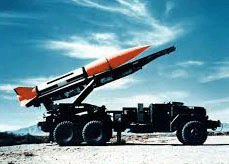
The INF prohibited land-based missile systems with a range between 310 and 3,400 miles. The US and Germany said in a joint statement that the planned deployment includes a land-based version of nuclear-capable Tomahawk missiles, which have a range of about 1,000 miles and are primarily used by US Navy ships and submarines.
The US and Germany also said that the deployment will include SM-6 missiles, which have a range of about 290 miles, and “developmental hypersonic weapons.” The statement said the missiles have “significantly longer range than current land-based fires in Europe.”
There’s no indication yet that the missiles will be armed with nuclear weapons, but the statement leaves open the possibility. The US already has nuclear bombs stationed in Germany as part of NATO’s nuclear sharing, but they are B61 gravity bombs that need to be dropped from aircraft.
Before the INF was signed in 1987, the Soviet Union had land-based nuclear-armed missiles deployed in its western territory that could hit western Europe, and the US had similar systems deployed that could hit Soviet territory.
When the US withdrew from the INF treaty, it claimed Russia was violating the agreement by developing the ground-launched 9M729 cruise missile. Russian officials denied the missile was a violation, saying it had a maximum range of 298 miles.
Russia also said the US was violating the INF by establishing Aegis Ashore missile defense systems in Romania and Poland. The systems use Mk-41 vertical launchers, which can fit Tomahawk missiles. During the NATO summit, the US also announced that its Aegis system in Poland is now operational.
The US refused to negotiate with Russia on the INF issues, and the Trump administration tore up the treaty in August 2019 and began testing previously banned missile systems almost immediately after. It was clear the US exited the treaty so it could deploy intermediate-range missiles near China, leading Russia to propose a moratorium on the deployment of INF missiles in Europe. But the US never accepted the offer.
Water leaks reported at Germany’s Asse II radwaste facility
Staff Writer May 28, 2024, https://www.neimagazine.com/news/decommissioning-waste-management/water-leaks-reported-at-germanys-asse-ii-radwaste-facility/?cf-view&cf-closed
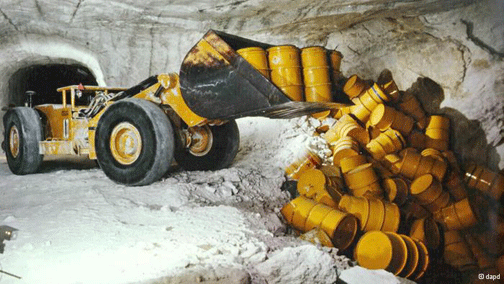
The ageing nuclear waste facility in the Asse II salt mine near Wolfenbüttel in Lower Saxony is facing a growing problem of water penetration. The mine, which holds some 126,000 barrels of low- and intermediate-level radioactive waste, is operated by Germany’s Federal Association for Final Storage (BGE – Bundesgesellschaft für Endlagerung), a federally owned company within the remit of the Federal Environment Ministry. In April 2017, BGE took over responsibility as operator of the Asse II mine and the Konrad and Morsleben repositories from the Federal Office for Radiation Protection. Salt water has been entering the facility for decades, increasing concern about the stability of the 13 chambers filled with waste.
From 1967 to 1978, around 47,000 cubic metres of low- and intermediate-level radioactive waste were emplaced in the mine according to information from former operator, the Association for Radiation Research (now known as Helmholtz Zentrum München, HMGU). Some 67% of the waste originated from NPPs. Typical waste included: filters, scrap metal, paper, laboratory waste, building rubble, wood, slurries and mixed waste. Other waste was delivered by research institutes, the nuclear industry and other waste producers such as the medical industry.
Records show how many drums are stored in the Asse mine, but there is some uncertainty as the radionuclide and substance inventory as the waste declaration at the time does not meet current standards. The radioactive waste was emplaced in 13 former mining chambers Two chambers are located in the central section and 10 in the southern flank of the mine at depths of 725 and 750 metres. A further chamber is located at the 511-metre level.
At the start of emplacement, the waste containers were stacked in an upright position. In order to make better use of the space, the former operator subsequently began stacking them on their sides. From 1971 onwards, the waste was primarily dumped using a wheel loader. The simultaneous handling of multiple drums led to lower costs and lower radiation exposure for staff. There were no plans for retrieval, and possible damage to the waste containers was disregarded. The surrounding rock salt was intended to provide long-term protection.
According to current laws and state of the art of science and technology, the final disposal of radioactive waste in the manner employed at the Asse II mine would not be eligible for a licence although no laws were broken based on the legislation in force at the time. If the waste were to remain in the mine, it would not be possible to demonstrate that the legal safety objectives would be met and the intention is for the waste to be retrieved. So far, none of the barrels have been removed and is not expected to start before 2033 as scientific methods to do it safely are still being investigated. It’s estimated it will cost at least €4.7bn ($5.1bn).
So far, the water penetrating the salt dome from the outside – some 12 cubic metres a day – has been mostly absorbed and pumped to the surface. However, the infiltration patter has changed, BGE head Iris Graffunder recently told the environmental committee of the Bundestag. Graffunder earlier pointed out the deteriorating situation. “Due to this strong change in water access, we are alarmed” she tolkd Braunschweig newspaper. According to the BGE, the amount of water at the main collection point has been decreasing for several months. “This means that the water is collecting somewhere else. That worries us,” she said.
Experts warn that is the partly torn and rusted barrels mix with the water this could eventually contaminates groundwater. The inventory reportedly consists of 104 tonnes of uranium, 81 tonnes of thorium and 29 kilograms of plutonium. There are also toxins such as arsenic, mercury and banned pesticides, which were also disposed of in the mine.
The BGE has applied for the complete renovation of the main collection point, which is located at the 658-metre level in the mine. Experts are currently trying to find and repair possible damaged areas. According to the BGE, the water infiltration has increased from 0.8 to three cubic metres on the lower 725-metre level. At the even lower collection points directly in front of the nuclear waste chambers at the 750-metre level no increase in the salt water level has so far been observed.
Federal Environment Minister Steffi Lemke (Greens) has expressed concern about the situation “I take the situation in the Asse II nuclear waste warehouse in Lower Saxony very seriously,” she said. She added that, in her view, the recovery of the waste was the safest option and “should remain our top priority”.
US-made missile suddenly ‘transformed’ into a ‘Russian’ one and killed 40 civilians

One video clearly shows a SLAMRAAM (Surface Launched AMRAAM) missile falling and hitting a civilian building. This US-made weapon is based on an AIM-120 Advanced Medium-Range Air-to-Air Missile (AMRAAM) and is used by the much-touted NASAMS (Norwegian/National Advanced Surface-to-Air Missile System). However, the Neo-Nazi junta is insisting that the weapon in question is a Russian Kh-101 long-range air-launched cruise missile.
Drago Bosnic, InfoBrics, Tue, 09 Jul 2024, https://www.sott.net/article/493060-US-made-missile-suddenly-transformed-into-a-Russian-one-and-killed-40-civilians
On July 8, the Russian military launched large-scale strikes on various targets across Ukraine. According to the mainstream propaganda machine, one strike was “particularly deadly”, as it allegedly “killed 41 civilians” and “destroyed a children’s hospital”. Reuters says:
“Russia blasted the main children’s hospital in Kyiv with a missile in broad daylight on Monday and rained missiles down on other cities across Ukraine, killing at least 41 civilians in the deadliest wave of air strikes for months.”
The report tried playing into the emotional aspects with the graphic descriptions of parents and children affected by these “evil Russian strikes”. Reuters says that “parents holding babies walked in the street outside the hospital, dazed and sobbing after the rare daylight aerial attack”, while “windows had been smashed and panels ripped off, and hundreds of Kyiv residents were helping to clear debris”.
While on his way to the NATO summit in Washington DC, the Neo-Nazi junta frontman Volodymyr Zelensky claimed more than 170 people were injured, while around 100 buildings were damaged, including the aforementioned children’s hospital and a maternity center in Kiev, as well as children’s nurseries, a business center and homes. He also stated that “Russian terrorists must answer for this” and that “being concerned does not stop terror, condolences are not a weapon”. The Kiev regime announced a day of mourning for today, calling the strikes “one of the worst air attacks of the war”, insisting it “demonstrated that Ukraine urgently needed an upgrade of its air defenses from its Western allies”. Interestingly, they also claim that their air defenses allegedly “shot down 30 of 38 missiles”. Quite peculiar that the Neo-Nazi junta forces are “so successful” in shooting down Russian missiles.
At the same time, they still “urgently need” NATO-sourced SAM (surface-to-air missile) systems. The question is, which is it? Either the current air defenses are not enough, meaning that the reports about shootdowns are a blatant lie, or the reports are “true”, meaning that the Kiev regime forces don’t really need “better air defenses“. After all, they “regularly shoot down” two out of six 9-S-7760 “Kinzhal” air-launched hypersonic missiles. However, in all seriousness, this is just the tip of the iceberg when it comes to the sheer ridiculousness of propaganda in the NATO-orchestrated Ukrainian conflict. For instance, Reuters reports that it obtained “an online video showing a missile falling towards the children’s hospital followed by a large explosion” and insists that “the location of the video was verified from visible landmarks”. And indeed, there’s horrifying footage of children injured by the shrapnel and falling debris.
The political West is now also using the UN to spread the narrative about the “brutal Russian attack”. The United Kingdom called for a UN Security Council meeting, which will take place today to “discuss a Russian missile attack on Kyiv’s Okhmatdyt Children’s Hospital that was part of a massive attack on July 8 that hit several cities across the country, killing at least 41 people and injuring at least 140”, according to the CIA front Radio Free Europe/Radio Liberty (RFE/RL). So, once again, we’re seeing the UN being used for the political West’s “soft power” projection purposes. It should be noted that the reports about injuries to civilians are true, as the footage is certainly undeniable. However, there’s a “slight problem” with the narrative. Namely, the video that Reuters referenced is also indisputable evidence that Russia didn’t conduct the aforementioned strike on the children’s hospital in Kiev.
One video clearly shows a SLAMRAAM (Surface Launched AMRAAM) missile falling and hitting a civilian building. This US-made weapon is based on an AIM-120 Advanced Medium-Range Air-to-Air Missile (AMRAAM) and is used by the much-touted NASAMS (Norwegian/National Advanced Surface-to-Air Missile System). However, the Neo-Nazi junta is insisting that the weapon in question is a Russian Kh-101 long-range air-launched cruise missile. The mainstream propaganda machine is also pushing the same narrative, despite the fact that the Russian missile has a massive warhead weighing 400 kg, meaning that the explosion would’ve completely leveled any building, which was simply not the case with the one damaged by the SAM fired by the Kiev regime forces. What’s more, it’s highly likely that the Russian cruise missile has an upgraded warhead weighing 800 kg, meaning that the discrepancy is far worse.
In case such a missile hit any residential area, the death toll would’ve been in the hundreds, if not thousands. However, the mainstream propaganda machine doesn’t really care about such inconsistencies. All it cares about is its vaunted narrative. That’s precisely why they quote Zelensky’s statements about “Russian terrorists” while also openly talking about NATO’s and Neo-Nazi junta’s terrorist attacks against Russian schoolchildren as if it were a “completely normal thing”.
However, apart from the video evidence showing that Russia didn’t conduct the aforementioned strike, there’s also the history of other blatant lies by the Neo-Nazi junta. Namely, it regularly uses SAM systems without any consideration for civilians, such as in the case of Przewodow, a Polish village that was hit by 5V55K SAMs fired by the Kiev regime forces back in mid-November 2022. Two civilians were killed.
The Neo-Nazi junta was adamant that Russia “deliberately” attacked Poland. At the time, I argued that the location of the incident was nowhere near the engagement range of any Russian SAM system that uses the 5V55K missiles. All evidence suggested that the weapon was fired from an older iteration of the Soviet-era S-300 SAM system. At the time, the Kiev regime forces still operated several versions, with the vast majority belonging to the S-300P/PS/PT series. The missile in question has a maximum engagement range of approximately 45 km.
Updated versions of the post-Soviet era were never deployed in Ukraine, while the closest Russian air defense units are at least 150-200 km away, in Belarus, and operate much more advanced systems such as the S-400. Poland itself later confirmed that the Neo-Nazi junta lied, even leading to strained relations between the two. The latest incident is in no way different.
Comment: This attack is not in Russia’s playbook, but evidently a page out of Kiev’s.
Ukraine won’t get NATO invite – Norwegian PM
https://www.rt.com/news/600822-ukraine-no-nato-membership/ 12 July 24
The bloc will reportedly pledge more money for Kiev and support for EU integration instead
NATO will once again stop short of inviting Ukraine to become a member, but will acknowledge the country’s desire to eventually join the US-led military bloc, according to Norwegian Prime Minister Jonas Gahr Store.
Speaking to reporters at the NATO summit in Washington, in Washington, Store addressed speculation about the contents of a final communique.
“I don’t think there will be any invitation as a result of this year’s summit, but everything else will speak of such a future,” he said.
A leaked draft of the communique speaks of Ukraine’s “irreversible path” to NATO membership and demands that China stop supporting Russia, Reuters reported on Wednesday.
NATO also intends to give Kiev at least €40 billion ($43.3 billion) over the next year, set up a mechanism to coordinate deliveries of military aid and training of Ukrainian troops, and support Ukraine on its path to “full Euro-Atlantic integration.”
An invitation to join the bloc will be extended “when allies agree and conditions are met,” according to the draft seen by Reuters.
The exact same language was used at last year’s summit in Vilnius. Back then, the government in Kiev was furious at the lack of a formal invitation, with Vladimir Zelensky firing off a series of angry social media posts accusing NATO of weakness and cowardice.
Store also confirmed reports that Norway will donate six F-16 fighter jets to Ukraine, suggesting they would arrive sometime this year. He had first promised the jets last August, but had not specified the number or a delivery schedule.
Russia has repeatedly warned the US-led bloc that its financial and military support for Ukraine will only prolong the conflict but not change its outcome, while risking a direct confrontation. NATO has insisted that its military, political, and economic support of Kiev does not make it a party to the hostilitie
1 This Month




PLEASE OPPOSE HR 8255 AND S.3639 – bills would accelerate satellite deployment, with no environmental review or safeguards – https://ncstd5li.quorum.us/campaign/169331/
To see nuclear-related stories in greater depth and intensity – go to https://nuclearinformation.wordpress.com
-
Archives
- September 2026 (330)
- August 2026 (330)
- July 2026 (355)
- June 2026 (287)
- May 2026 (306)
- April 2026 (356)
- March 2026 (251)
- February 2026 (267)
- January 2026 (308)
- December 2025 (358)
- November 2025 (359)
- October 2025 (375)
-
Categories
- 1
- 1 NUCLEAR ISSUES
- business and costs
- climate change
- culture and arts
- ENERGY
- environment
- health
- history
- indigenous issues
- Legal
- marketing of nuclear
- media
- opposition to nuclear
- PERSONAL STORIES
- politics
- politics international
- Religion and ethics
- safety
- secrets,lies and civil liberties
- spinbuster
- technology
- Uranium
- wastes
- weapons and war
- Women
- 2 WORLD
- ACTION
- AFRICA
- Atrocities
- AUSTRALIA
- Christina's notes
- Christina's themes
- culture and arts
- Events
- Fuk 2022
- Fuk 2023
- Fukushima 2017
- Fukushima 2018
- fukushima 2019
- Fukushima 2020
- Fukushima 2021
- general
- global warming
- Humour (God we need it)
- Nuclear
- RARE EARTHS
- Reference
- resources – print
- Resources -audiovicual
- Weekly Newsletter
- World
- World Nuclear
- YouTube
-
RSS
Entries RSS
Comments RSS

