Ukraine and Russia trade accusations over fire at occupied Zaporizhzhia nuclear plant
By Reuters, August 12, 2024
- Summary
- Cause of fire unclear
- Both sides trade blame
- Main fire since extinguished
- IAEA head says attacks endanger nuclear safety, must stop
Aug 11 (Reuters) – Moscow and Kyiv accused each other of starting a fire on the grounds of Europe’s largest and now Russian-occupied Zaporizhzhia nuclear power plant in Ukraine on Sunday, with both sides reporting no sign of elevated radiation.
The U.N.’s International Atomic Energy Agency (IAEA) nuclear watchdog, which has a presence at the vast six-reactor facility, said its experts had seen strong, dark smoke coming from the northern area of the plant in southern Ukraine following multiple explosions.
“These reckless attacks endanger nuclear safety at the plant and increase the risk of a nuclear accident. They must stop now,” IAEA chief Rafael Grossi warned in a separate statement, without attributing blame for the attack.
The fire comes less than a week after Ukraine’s forces launched their largest incursion into Russian territory since the war-start in 2022, a surprise move that has brought conflict into a new phase, after weeks of Moscow’s battlefield gains.
Russian state news agencies, TASS and RIA, cited the country’s nuclear energy company Rosatom as saying the main fire was extinguished shortly before midnight on Sunday.
RIA, citing Rosatom, said a drone attack started the fire at the cooling tower, without providing evidence.
Ukraine’s nuclear power company Energoatom said in a statement on the Telegram messaging app that one of the cooling towers and other equipment were damaged………………………….Ukraine’s Energoatom said Russia’s “negligence” or arson could have sparked the fire.
Russia’s officials in turn, including Foreign Ministry spokeswoman, Maria Zakharova, accused Kyiv of deliberately trying to destroy the plant and sow “nuclear terror………………………
https://www.reuters.com/world/europe/ukraine-russia-trade-accusations-over-fire-occupied-nuclear-plant-2024-08-11/
Nuclear disaster warning for two countries as Putin orders urgent mass evacuation

Ukrainian forces have made a surprise incursion into Russian territory sparking fears fighting could develop around the Kursk Nuclear Power Plant.
By Richard Ashmore, Senior News Reporter Aug 10, 2024 https://www.express.co.uk/news/world/1934579/nuclear-disaster-warning-ukraine-russia
The head of the international atomic monitoring body has issued a stark warning to Russia and Ukraine to avoid fighting getting close to huge nuclear power plant.
Rafael Grossi, the chief of the International Atomic Energy Agency (IAEA), urged both militaries to “exercise maximum restraint” if combat erupts near the Kursk Nuclear Power Plant.
In a bold move Ukraine has stunned President Putin and the Kremlin with a military incursion on Tuesday into the Russian provinces of Kursk, and most recently the neighbouring Belgorod region.
A humiliated Vladimir Putin has now been forced to issue a massive evacuation order for more than 76,000 civilians from the Kursk region. The measures, which also apply to the neighbouring Belgorod and Bryansk provinces that border Ukraine, allow the government to relocate residents, control phone communications and requisition vehicles.
The Russian Defence Ministry said today (Saturday) that fighting was continuing in the Kursk and that the army has conducted airstrikes against Ukrainian forces.
In an urgent statement issued last night, IAEA boss Rafael Grossi said: “The IAEA has been monitoring the situation on the reported military activities taking place in the vicinity of the Kursk Nuclear Power Plant.
“In view of the reportedly significant military activity, I wish to remind all parties of the seven indispensable pillars for ensuring nuclear safety and security during an armed conflict.”
Mr Grossi urged Russia and Ukraine to respect principles adhered to so far in the conflict which have been used to protect the Zaporizhzhya Nuclear Power Plant in Ukraine.
He added: “These include, among others, the imperative to ensure the physical integrity of a nuclear power plant. This is valid irrespective of where an NPP is situated.
“At this juncture, I would like to appeal to all sides to exercise maximum restraint in order to avoid a nuclear accident with the potential for serious radiological consequences.”
US to send more military aid to Ukraine, as Ukrainian drones target Kursk and the Kursk Nuclear Power PLant

On Friday, Ukrainian drones targeted the Kursk Nuclear Power Plant in Kurchatov, briefly cutting power supplies to the town.
https://www.rt.com/news/602400-pentagon-ukraine-military-aid/ 10 Aug 24
Ammunition worth $125 million comes after Ukraine invaded Russia’s Kursk Region
Washington will send Kiev another $125 million worth of missiles and ammunition, the Pentagon announced as fierce fighting continued in Russia’s Kursk Region.
The US Department of Defense noted on Friday that this was the 63rd batch of aid provided to Ukraine since August 2021 – six months prior to the launch of Russia’s military operation.
To help Kiev meet “critical security and defense needs,” the US will send Stinger anti-aircraft missiles; ammunition for High Mobility Artillery Rocket Systems (HIMARS); rounds for 155mm and 105mm artillery; Javelin, AT-4 and TOW anti-tank missiles; small-arms ammunition; and demolitions ordnance, the Pentagon said in a statement.
The package also included multi-mission radars, Humvee ambulances, spare parts, services, training and transportation.
Washington’s previous batch of military aid, worth $1.7 billion, was sent at the end of July. According to the Pentagon’s own numbers, the US has sent more than $56.2 billion in military aid to Ukraine since President Joe Biden took office in January 2021.
Earlier this week, Ukraine sent several battalions worth of troops into Russia’s Kursk Region. Moscow has accused the invaders of indiscriminately targeting civilians with artillery, small arms and drone strikes. On Friday, Ukrainian drones targeted the Kursk Nuclear Power Plant in Kurchatov, briefly cutting power supplies to the town.
“We don’t feel like this is escalatory in any way,” Pentagon spokeswoman Sabrina Singh told reporters on Thursday, when asked about US military aid to Kiev.
According to Singh, everything Ukraine does is legitimate self-defense from the Russian “invasion,” while Russia can always de-escalate by withdrawing.
The Ukrainian leadership has said the primary goal of the Kursk operation was to induce “fear” in the hearts of the Russian people. One of the units involved in the operation, according to Ukrainian media, is named ‘Nachtigall’ after the notorious Nazi auxiliary from WWII commanded by Roman Shukhevych.
At least five civilians have been killed and 21 wounded – including six children – by the Ukrainian attacks, according to Russian authorities. The defense ministry in Moscow said that the invaders have lost almost 1,000 troops and over 100 armored vehicles as of Friday.
Nine spycops snooped on anti-nuclear protests in Scotland

The Ferret Rob Edwards, August 11, 2024
At least nine officers from London’s secret undercover policing unit, known as spycops, aided the infiltration and surveillance of anti-nuclear protests in Scotland between 1978 and 1983, The Ferret can reveal.
Two spycops, who had adopted the names of dead children and pretended to be anti-nuclear activists, joined attempts to occupy the site for a nuclear power station at Torness in East Lothian in 1980 and 1981. They were both picked up, detained and then released by Lothian police.
The pair, one of whom said he was nicknamed “Trotsky”, were supported by three senior officers from the Metropolitan Police’s Special Demonstration Squad (SDS), who travelled to Scotland to liaise with local police.
Along with four other spycops, they produced 16 reports for the Met’s Special Branch and the UK security service, MI5, on anti-nuclear groups active in Scotland. The groups included the Scottish Campaign to Resist the Atomic Menace (SCRAM), the Torness Alliance and Friends of the Earth.
The SDS reports contained minutes of meetings, mailing lists, internal briefings and funding appeals. They included details of hundreds of individuals and groups across the UK, and gave inside accounts of campaigners’ plans, problems and disagreements.
The revelations come from documents and statements released by the SDS and MI5 and published by the UK government’s Undercover Policing Inquiry in London. The inquiry was launched in 2015 and is aiming to produce its final report in 2026.
Activists who were spied upon have condemned the SDS’s undercover operations, with one saying he felt “sick and angry”. They claimed their campaigning had suffered “profound damage”.
Anti-nuclear campaigners in Scotland have also been very critical, suggesting that spycops were “out of control” and “an affront to the very idea of democracy”………………………………………………………….
The SDS was disbanded in 2008. In July 2023 an interim report by the inquiry’s judge, Sir John Mitting, concluded that the spying was not justified.
The inquiry’s remit, however, is only to investigate undercover policing in England and Wales. Campaigners have challenged the failure to inquire into undercover policing in Scotland, but so far without success.
In 2021 The Ferret reported initial evidence to the inquiry suggesting that Scottish anti-nuclear groups had been spied upon. In July 2024 the inquiry released more than 100 SDS reports on the surveillance of the anti-nuclear movement across the UK in the 1980s.
According to the Guardian, they revealed extensive spying on the Campaign for Nuclear Disarmament in England, as well as on women who protested against nuclear missiles at Greenham Common in Berkshire.
Inquiry documents have also disclosed the hitherto unknown extent of spying on anti-nuclear protests in Scotland. Spycops active north of the border have been named, and some of their undercover activities exposed…………………………………………………………………………………………………………….. https://theferret.scot/spycops-torness-anti-nuclear-scotland/
Anti-nuclear Group Criticizes Short Consultation over Trawsfynydd Lake Radioactive Contamination
An anti-nuclear group concerned over low level radioactive contamination
at Trawsfynydd lake has blasted a recent. government consultation as “too
short, ill timed and clumsy.”
It concerns proposals for changes to a permit over decommissioning work at the former Trawsfynydd nuclear power station. Natural Resources Wales had called for opinions after the Nuclear Restoration Services Limited (NRS) submitted an application to change its
environmental permit
Proposed work would to leave low-level radioactive
building waste in-situ at the site which closed in 1991.As part of the
application NRS (formerly Magnox) plans the demolition, infilling, and
capping of the Trawsfynydd Ponds Complex, a set of buildings running
alongside the two reactor buildings. T
The Nuclear Free Local Authorities
group, which oppose civil nuclear power said it “remained fearful” over
the potential for “low level radioactive contamination at Trawsfynydd
Lake.” It felt the four week consultation – which ended on August 6 –
had not given people enough time to respond, was unhappy that a fee had
been charged for some documents and had noted delays. It had noted that
“a typical consultation period in the nuclear industry” was twelve
weeks.
North.Wales 10th Aug 2024
Teresa Ribera faces nuclear hurdle to running EU green policy

A French government minister even conceded to POLITICO that his country — the EU’s most high-profile and vocal nuclear advocate — “is trying to ensure that energy does not go to someone anti-nuclear.”
Nuclear-friendly lawmakers and countries like France don’t want the EU’s potential next green chief to thwart an atomic revival.
August 9, 2024 , Politico, By Victor Jack
BRUSSELS — On paper, the European Union’s leading candidate to guide green policy for the next five years has it all: decades of experience, endless high-profile contacts and a shining reputation.
There’s just one problem: Teresa Ribera is a hardened nuclear skeptic.
The former U.N. climate negotiator, who until recently served as Spain’s deputy prime minister, shepherded the closure of her country’s atomic reactors, railed against the cost of nuclear power and called the EU’s decision to label it a sustainable investment a “big mistake.”
That’s prompting worries among pro-atomic European Parliament members and EU countries that Spain’s top climate official could scupper plans to expand the buildout of nuclear power across the bloc just as the industry is riding a fresh wave of political momentum. France, where a hegemonic nuclear industry provides roughly 70 percent of the country’s electricity, is likeliest to cause a stir.
Those anxieties will likely play out on the public stage this fall, when Ribera is expected to face Parliament at her EU commissioner confirmation hearing. She’ll inevitably get pointed questions about whether she’d constrain a nuclear resurgence. And her answers could make or break her candidacy, as nuclear support unites politicians from numerous political families.
“In every political group, there are those that won’t vote for someone who’d be a vocal opponent of the nuclear cause,” said pro-nuclear French MEP Christophe Grudler, a member of the centrist Renew Europe group who could eventually be one of the lawmakers deciding Ribera’s fate.
“A Commissioner … is here to implement the Commission’s program — there’s no place for personal feelings,” he added. “She’ll have to just get on board … and I can assure you we’ll make sure she gets on board.”
A French government minister even conceded to POLITICO that his country — the EU’s most high-profile and vocal nuclear advocate — “is trying to ensure that energy does not go to someone anti-nuclear.”
Nuclear fallout
The race to become the EU’s next energy chief comes amid a new wave of excitement around nuclear, and at a critical moment for an industry that argues it’s long been forgotten in Brussels.
That moment came in 2022, when Russia’s brutal invasion of Ukraine sent the EU searching for new energy sources. Many have since settled on nuclear power as a useful option.
……………………………………………………………………….. Whoever takes over as the EU’s next energy commissioner will have the power to shape Brussels’ nuclear agenda. That ranges from lobbying the EU to open its piggy bank for atomic energy, to drafting strategies that give potent political signals to investors.
Ribera would also become the driving force behind a suggested “Nuclear Act,” aimed at boosting nuclear reactors if the Commission does go ahead with the idea.
“We’re a bit concerned,” said one EU diplomat from a nuclear-supporting country, who like others for this story was granted anonymity to speak freely.
“We cannot have decarbonization without nuclear,” said a second EU diplomat, arguing that Ribera could be “challenging” for the nuclear sector.
For atomic industry figures, the next five years are an opportunity for the EU to put their sector on equal footing with renewable energy like wind and solar in Brussels’ green legislation, according to Yves Desbazeille, secretary general of the nucleareurope lobby group. ……………………..
Brussels battle
The fight would likely come to a head this fall, when Ribera would face an MEP grilling to secure her job.
Depending on Ribera’s specific portfolio, she could end up before the Parliament’s powerful industry and energy committee or its environment committee — or both.
If committee leaders disagree over whether Ribera is well-suited for the job, it could go to a committee vote. Occasionally, lawmakers do reject commissioner candidates, disqualifying them from the role.
There’s no guarantee, of course, that Ribera will be given a broad green policy portfolio for the next five years.
While Ribera has repeatedly expressed interest in the role, the final call rests with European Commission chief Ursula von der Leyen. The EU chief has yet to say how she will divide up the myriad green policy issues — everything from cutting carbon emissions to keeping Europe’s manufacturers competitive.
So Ribera could get a climate-specific role, for instance, while someone else is handed energy policy.
Even if Ribera does get an overarching green job, she’ll have to balance her personal views against Brussels’ company line, which has been increasingly nuclear-friendly. It’s a balance former Green Deal chief Frans Timmermans was able to strike, even if he was seen by some pro-atomic countries as overly skeptical of nuclear power.
Von der Leyen, for her part, recently said she wants the Green Deal to proceed with “technology neutrality” — a euphemism for giving similar focus to nuclear and renewables in lawmaking.
Nuclear proponents aren’t banking on those caveats.
“I’m not seeing this potential nomination as positive for us, to be honest,” when it comes to Ribera, said Desbazeille, the nuclear lobbyist. https://www.politico.eu/article/teresa-ribera-nuclear-hurdle-run-eu-green-policy/
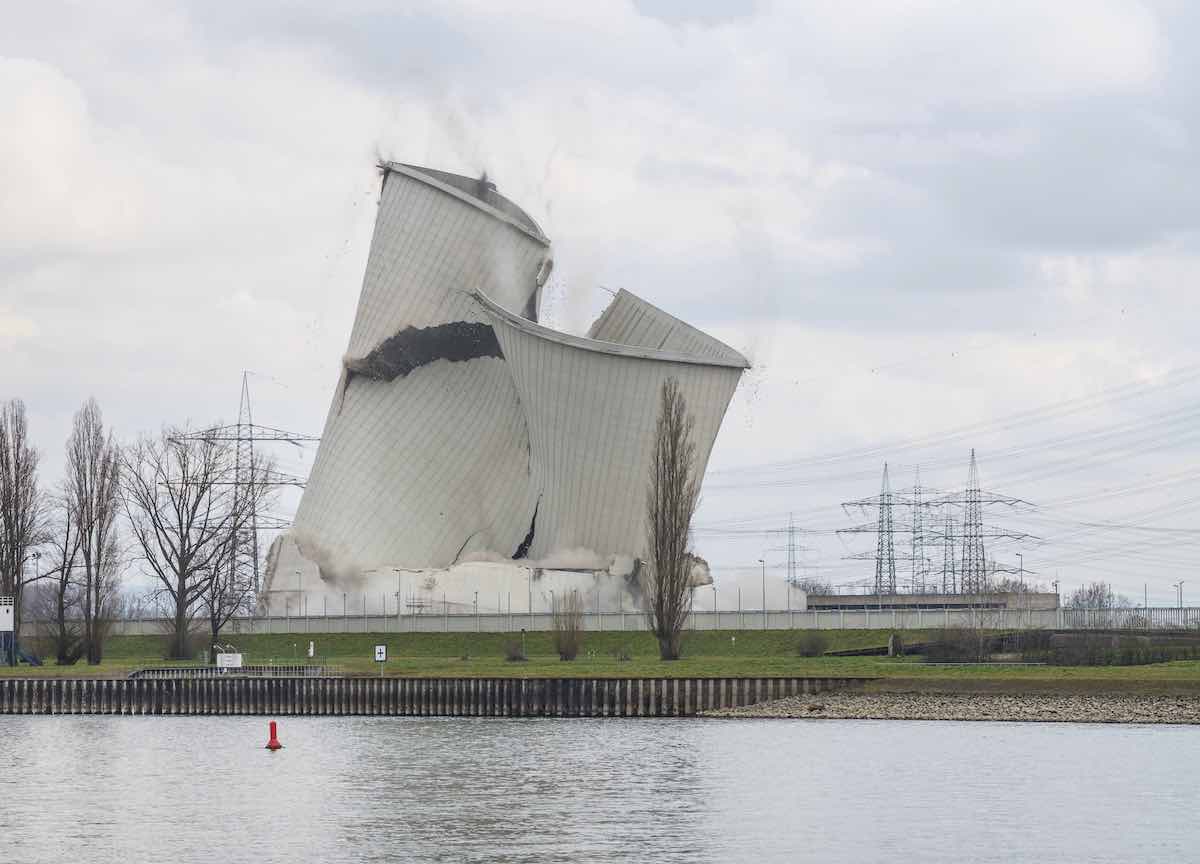
Germany may take another 50 years to find final repository for waste from shuttered nuclear power
Sören Amelang, Aug 9, 2024, https://reneweconomy.com.au/germany-may-take-another-50-years-to-find-final-repository-for-waste-from-shuttered-nuclear-power/
Germany’s ongoing hunt for a final repository for highly radioactive nuclear waste could last until the 2070s, a report has warned.
The report by the Institute for Applied Ecology (Öko-Institut), which was commissioned by the country’s Federal Office for the Safety of Nuclear Waste Management (BASE), said a decision on a location can be expected in 2074 at the earliest under ideal conditions, reports Zeit Online.
This would be more than 40 years later than the original 2031 target, which the government already gave up almost two years ago. The environment ministry said the report did not take into consideration significant progress in efforts to shorten the search, for example by saving time on long exploration periods.
The ministry declared in November 2022 that the search won’t be completed in 2031, following a paper by the Federal Company for Radioactive Waste Disposal (BGE) that estimated the search could take until 2046 or, in another scenario, until 2068.
The next step will be for the BGE to propose shortlisted siting regions at the end of 2027, the ministry said. “This is the right time to discuss and regulate further acceleration in a transparent manner. A great deal of time can be saved, particularly in the surface and underground exploration,” it added.
But Journalist Bernward Janzing wrote in a commentary it was questionable how much the “scientifically well designed” process can be accelerated without compromising high safety standards.
Germany completed its nuclear phase-out last year and will now have to store 1,900 large containers, or around 28,100 cubic metres (m3), of high-level radioactive waste by 2080, when all its nuclear power stations and many research facilities will have been finally decommissioned and the fuel elements treated at other facilities.
Highly radioactive, heat-generating waste accounts for only five percent of Germany’s radioactive refuse, but is responsible for 99 percent of the radiation. It is currently held at temporary storage facilities near decommissioned nuclear power stations and in central interim repositories.
Construction of a repository following a location decision is scheduled to take about 20 years, according to current plans. The process of transporting and storing thousands of casks in the final repository will then take decades more.
Experts from a parliamentary storage commission said that loading and sealing the repository could be expected to last “well into the next century”.
UK’s most dangerous nuclear site pleads guilty after endangering national security

More than 11,000 people work at the nuclear site in Cumbria, Sellafield, which holds the world’s largest store of plutonium and was called UK’s ‘most dangerous’
By WILLIAM MORGAN, Fri, Aug 9, 2024 https://www.express.co.uk/news/uk/1933985/UK-dangerous-nuclear-site-guilty-endangering-national-security
Europe’s largest nuclear site and the world’s largest plutonium storage facility has admitted putting Britain’s national security at risk, after a series of cybersecurity failings at the vast former nuclear power plant in Cumbria, Sellafield.
The company running the site, Sellafield Ltd, has apologised after pleading guilty to charges relating to information technology security from 2019 to 2023. Westminster Magistrates Court heard that, during this period, three quarters of the nuclear site’s servers were vulnerable to attack.
A Guardian investigation into nuclear industry practices also found that contractors could get unsupervised access to Sellafield computers and could plug external drives into the Sellafield systems. The company’s own report into the issue found that any “reasonably skilled hacker or malicious insider” could take advantage of these weaknesses.
The court heard from the nuclear watchdog that information which could pose a threat to national secrity lay vulnerable for years, with many of the critical security checks that Sellafield Ltd said they were completing, were simply not being done. The site has an otherwise poor reputation, often called “the most dangerous” site in the UK, employing 11,000 people to process nuclear waste and decommission equipment.
Tests of the vulnerable IT systems found that someone could access Sellafield’s servers and install phishing softward “without raising any alarms”. Raising further fears of information vulnerabiliy in key UK infrastructure to threats from hostile actors.
During their prosecution for failing to secure their systems, it emerged that 13 files marked “official/sensitive” had mistakenly been sent to outside contractors, alongside 4000 other files. Somehow, this did not trigger any elerts in their computer system, which was blamed in part for using “obsolete” software – including Windows 7 and Windows 2008.
At a court hearing on Thursday, a statement was read out from Sellafield Ltd’s CEO, Euan Hutton, who was present but did not speak.
The statement read: “I again apologise on behalf of the company for matters which led to these proceedings … I genuinely believe that the issues which led to this prosecution are in the past.”
The company is not due to be sentenced until September. The Office for Nuclear Regulation said after the August 8 hearing: “Sellafield Ltd had previously pleaded guilty to those offences in June, and while a hearing did take place today, Chief Magistrate Senior District Judge Paul Goldspring did not pass sentence.
“We expect Sellafield Ltd to be sentenced in September, when further details will be provided on our website and social media channels.”
How French nuclear output has declined faster in France than Germany

French decline may be caused by having to ‘load follow’ renewables
David Toke, Aug 09, 2024, https://davidtoke.substack.com/p/how-french-nuclear-output-has-declined
Whatever one thinks of the German decision to phase-out nuclear power, a really strange thing is that the French are coordinating an unintentional phase-out of nuclear energy. At the same time as Germany has been running down its nuclear production. Much attention has focussed on criticising German policy, but much less on criticising what is a continuing failure of French energy policy.
For sure French non-fossil energy production is still much higher than most countries, but this lead is seriously declining. The proportion of non-fossil electricity production is now little higher than a country such as non-nuclear Denmark which has built up its renewables from virtually nothing in recent times. Talk of building half a dozen more French nuclear plant is – just talk.
Plans for new nuclear plant have been bullish for decades- the term ‘nuclear renaissance’ has been doled out for 20 years. However, in practice, little gets built. On the other hand France is failing to develop its renewable energy industry at anything like a good enough speed to make up for the decline in nuclear production. You can see the comparison of nuclear decline in France and Germany in the graph below [on original], which takes its data from the Energy Institute ‘s Statistical Review of World Energy, see HERE
As can be seen in the graph, from 2011 French nuclear production declined by 104 TWh, whilst in Germany it declined by 101 TWh. Yet it has been the decline in German nuclear production (following the decision to phase out nuclear in 2011) that has been much more of a long-term talking point.
Certainly, the dominant message in the press in the UK, spread by politicians from Labour and Conservatives, is that the failure to stop the decline in nuclear production which has also occurred in the UK is because of political failure. But this story ought to be wearing thin, after so many years of so-called nuclear renaissance and its promotion. Might it just have something to do with the failing nature of the technology itself? This seems obvious to independent observers, but it does not detract from our leaders’ desire to throw immense sums after technology that takes almost forever to deliver.

I discuss these issues in my recently published book Energy Revolutions, Profiteering versus Democracy’ (Pluto Press) (see HERE). But a few salient points can be made here to attempt to explain the decline in nuclear power in France. One can hypothesise a couple of reasons why French nuclear production may be declining. One factor may well simply be that the French nuclear industry did a bad job and built a lot of sub-standard power plant.
There is another possibility which may be adding to the problems caused by the first suggested reason. The French nuclear power stations may be accelerating their own demise because of the technical damage caused by the balancing role they are being forced to play in the French power market. Nuclear power plant in France have been forced to ‘load-follow’ ie, often reduce their output, because of variations in solar and wind power that is generated across the continental electricity system. #
The continental electricity interconnectors use AC transmission equipment which means that France cannot just disconnect when there is too much electricity coming into the French system. French power plant have to power down, and since nuclear forms such a dominant part of French generation, the nuclear power power plant has to regularly ramp up and down.
There are relatively few publicly available discussions of the possibilities for reactor damage in such load-following activities. Such discussions as they are, seem to be side-shows to ascertaining whether load following by nuclear reactors is possible, rather than the long-term damage involved. But there are some pointers in the discussions that are available.
One academic thesis commented, on a simulation based on a Swedish reactor, that: ‘The mechanisms for the damages are for example erosion-corrosion, fatigue, vibrations and wear. In the reactor core, there are also limitations for the rate of how quickly the power decrease and increase can be performed and how low the power can be reduced before problems with xenon poisoning and PCI occur……………….An increased usage of the pumps and valves was shown, which will give an added risk of wear and tear’ (Bjurenfolk, 220, 9 see HERE) . A study published by the Nuclear Energy Agency for the OECD commented: ‘Load cycling leads to variation in the coolant temperature, and thus in the temperatures of different components (see Figure 3.3 and Figure 3.4). These periodic temperature variations lead to cyclic changes in the mechanical load in some parts of the equipment, and could induce localised structural damage (fatigue) of these elements if the temperature gradients are large.’ OECD/NEA 2011, 41, see HERE
Of course in the UK no such problems of damage due to load-following will ever occur for the simple reason that in the UK nuclear power has a privileged position. Despite increasing international interconnection, the interconnection is through DC transmission systems which offer much greater control over imports. Nuclear power plants are allowed to generate as much as they can, and it is renewable energy that has to power down in cases where there are grid constraints or an excess of supply compared to demand.
In the case of Hinkley C, when it eventually comes online, the contracts given to EDF encourage it to carry on generating, not load follow. In the UK it is windfarms that bear political blame for compensation paid to them for lost production when they have to switch off (very often to protect nuclear production). This has been documented by 100percentrenewableuk in the case of Scotland, see HERE.
However, turning back to France, the French Government’s recent press releases on building future nuclear power obscure the fact that it has taken around two decades to build one plant. Meanwhile, the amount of solar and wind power production added in France since 2011 is rather less than the decline in nuclear production. To cap it all EDF has called for subsidies for solar pv to be reviewed (see HERE).
Yes, solar pv may be inconvenient for nuclear power, but it does seem that unless France develops renewables, including solar pv, much more quickly than has been done since 2011, the French electricity system will (at recent rates of nuclear decline) gradually collapse.
Certainly, the dominant message in the press in the UK, spread by politicians from Labour and Conservatives, is that the failure to stop the decline in nuclear production which has also occurred in the UK is because of political failure. But this story ought to be wearing thin, after so many years of so-called nuclear renaissance and its promotion. Might it just have something to do with the failing nature of the technology itself? This seems obvious to independent observers, but it does not detract from our leaders’ desire to throw immense sums after technology that takes almost forever to deliver.
I discuss these issues in my recently published book Energy Revolutions, Profiteering versus Democracy’ (Pluto Press) (see HERE). But a few salient points can be made here to attempt to explain the decline in nuclear power in France. One can hypothesise a couple of reasons why French nuclear production may be declining. One factor may well simply be that the French nuclear industry did a bad job and built a lot of sub-standard power plant.
There is another possibility which may be adding to the problems caused by the first suggested reason. The French nuclear power stations may be accelerating their own demise because of the technical damage caused by the balancing role they are being forced to play in the French power market. Nuclear power plant in France have been forced to ‘load-follow’ ie, often reduce their output, because of variations in solar and wind power that is generated across the continental electricity system. #
The continental electricity interconnectors use AC transmission equipment which means that France cannot just disconnect when there is too much electricity coming into the French system. French power plant have to power down, and since nuclear forms such a dominant part of French generation, the nuclear power power plant has to regularly ramp up and down.
There are relatively few publicly available discussions of the possibilities for reactor damage in such load-following activities. Such discussions as they are, seem to be side-shows to ascertaining whether load following by nuclear reactors is possible, rather than the long-term damage involved. But there are some pointers in the discussions that are available.
One academic thesis commented, on a simulation based on a Swedish reactor, that: ‘The mechanisms for the damages are for example erosion-corrosion, fatigue, vibrations and wear. In the reactor core, there are also limitations for the rate of how quickly the power decrease and increase can be performed and how low the power can be reduced before problems with xenon poisoning and PCI occur……………….An increased usage of the pumps and valves was shown, which will give an added risk of wear and tear’ (Bjurenfolk, 220, 9 see HERE) . A study published by the Nuclear Energy Agency for the OECD commented: ‘Load cycling leads to variation in the coolant temperature, and thus in the temperatures of different components (see Figure 3.3 and Figure 3.4). These periodic temperature variations lead to cyclic changes in the mechanical load in some parts of the equipment, and could induce localised structural damage (fatigue) of these elements if the temperature gradients are large.’ OECD/NEA 2011, 41, see HERE
Of course in the UK no such problems of damage due to load-following will ever occur for the simple reason that in the UK nuclear power has a privileged position. Despite increasing international interconnection, the interconnection is through DC transmission systems which offer much greater control over imports. Nuclear power plants are allowed to generate as much as they can, and it is renewable energy that has to power down in cases where there are grid constraints or an excess of supply compared to demand
As can be seen in the graph, from 2011 French nuclear production declined by 104 TWh, whilst in Germany it declined by 101 TWh. Yet it has been the decline in German nuclear production (following the decision to phase out nuclear in 2011) that has been much more of a long-term talking point.
Certainly, the dominant message in the press in the UK, spread by politicians from Labour and Conservatives, is that the failure to stop the decline in nuclear production which has also occurred in the UK is because of political failure. But this story ought to be wearing thin, after so many years of so-called nuclear renaissance and its promotion. Might it just have something to do with the failing nature of the technology itself? This seems obvious to independent observers, but it does not detract from our leaders’ desire to throw immense sums after technology that takes almost forever to deliver.
I discuss these issues in my recently published book Energy Revolutions, Profiteering versus Democracy’ (Pluto Press) (see HERE). But a few salient points can be made here to attempt to explain the decline in nuclear power in France. One can hypothesise a couple of reasons why French nuclear production may be declining. One factor may well simply be that the French nuclear industry did a bad job and built a lot of sub-standard power plant.
There is another possibility which may be adding to the problems caused by the first suggested reason. The French nuclear power stations may be accelerating their own demise because of the technical damage caused by the balancing role they are being forced to play in the French power market. Nuclear power plant in France have been forced to ‘load-follow’ ie, often reduce their output, because of variations in solar and wind power that is generated across the continental electricity system. #
The continental electricity interconnectors use AC transmission equipment which means that France cannot just disconnect when there is too much electricity coming into the French system. French power plant have to power down, and since nuclear forms such a dominant part of French generation, the nuclear power power plant has to regularly ramp up and down.
There are relatively few publicly available discussions of the possibilities for reactor damage in such load-following activities. Such discussions as they are, seem to be side-shows to ascertaining whether load following by nuclear reactors is possible, rather than the long-term damage involved. But there are some pointers in the discussions that are available.
One academic thesis commented, on a simulation based on a Swedish reactor, that: ‘The mechanisms for the damages are for example erosion-corrosion, fatigue, vibrations and wear. In the reactor core, there are also limitations for the rate of how quickly the power decrease and increase can be performed and how low the power can be reduced before problems with xenon poisoning and PCI occur……………….An increased usage of the pumps and valves was shown, which will give an added risk of wear and tear’ (Bjurenfolk, 220, 9 see HERE) . A study published by the Nuclear Energy Agency for the OECD commented: ‘Load cycling leads to variation in the coolant temperature, and thus in the temperatures of different components (see Figure 3.3 and Figure 3.4). These periodic temperature variations lead to cyclic changes in the mechanical load in some parts of the equipment, and could induce localised structural damage (fatigue) of these elements if the temperature gradients are large.’ OECD/NEA 2011, 41, see HERE
Of course in the UK no such problems of damage due to load-following will ever occur for the simple reason that in the UK nuclear power has a privileged position. Despite increasing international interconnection, the interconnection is through DC transmission systems which offer much greater control over imports. Nuclear power plants are allowed to generate as much as they can, and it is renewable energy that has to power down in cases where there are grid constraints or an excess of supply compared to demand.
In the case of Hinkley C, when it eventually comes online, the contracts given to EDF encourage it to carry on generating, not load follow. In the UK it is windfarms that bear political blame for compensation paid to them for lost production when they have to switch off (very often to protect nuclear production). This has been documented by 100percentrenewableuk in the case of Scotland, see HERE.
However, turning back to France, the French Government’s recent press releases on building future nuclear power obscure the fact that it has taken around two decades to build one plant. Meanwhile, the amount of solar and wind power production added in France since 2011 is rather less than the decline in nuclear production. To cap it all EDF has called for subsidies for solar pv to be reviewed (see HERE).
Yes, solar pv may be inconvenient for nuclear power, but it does seem that unless France develops renewables, including solar pv, much more quickly than has been done since 2011, the French electricity system will (at recent rates of nuclear decline) gradually collapse.
EDF extends heat-related warning cuts at 3 nuclear plants
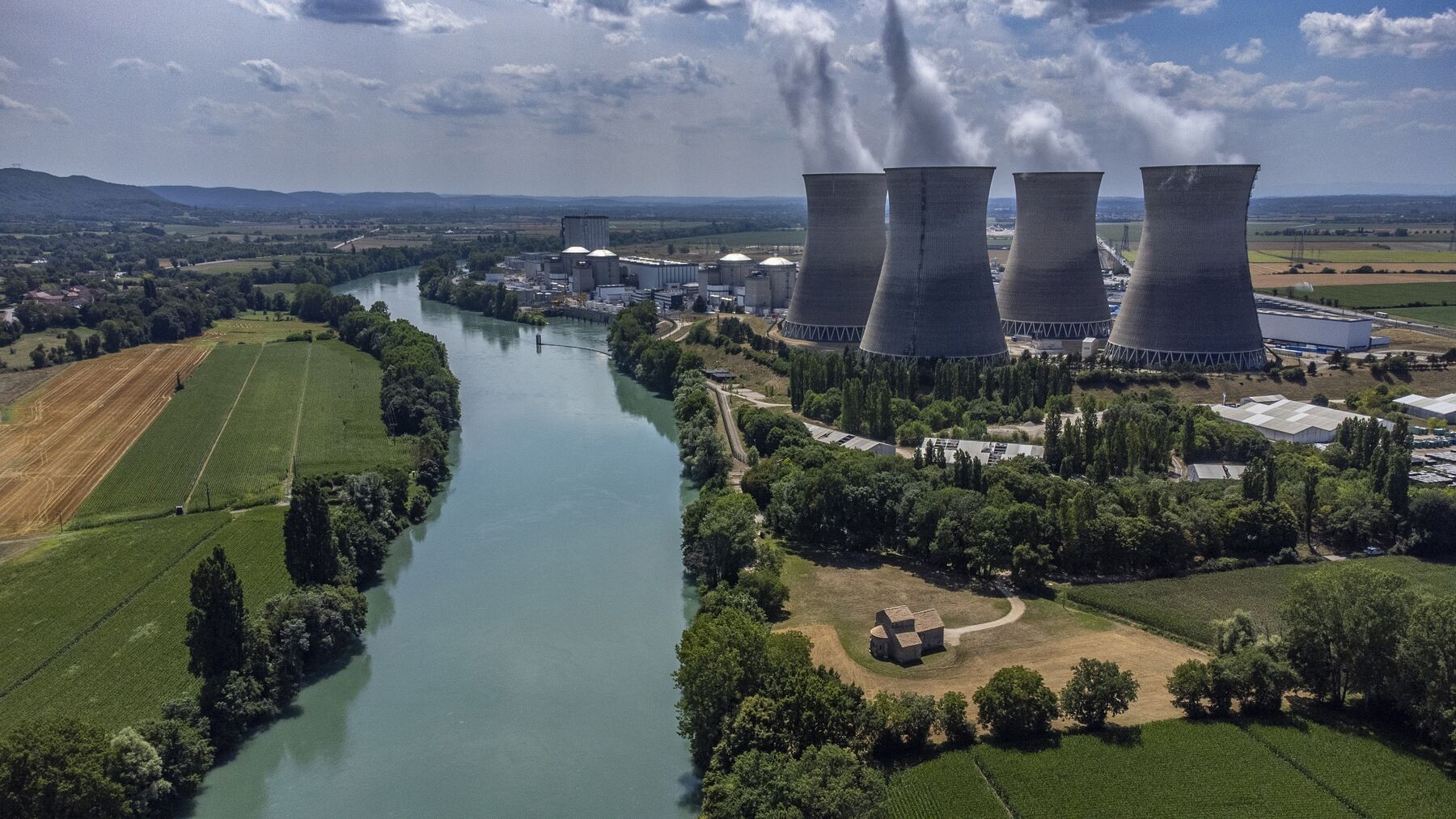
(Montel) French utility EDF has extended by two days a warning of power output curbs at three nuclear power plants – totalling 10 GW – along the river Rhone in southeastern France from tomorrow until Friday next week due to high temperatures.
Reporting by: Muriel Boselli, 08 Aug 2024, https://montelnews.com/news/f1e0a4b4-61b8-4d45-8027-d549192b910e/edf-warns-of-heat-related-cuts-at-3-nuclear-plants-10-gw
EDF could curb output at 3.6 GW Tricastin, 3.6 GW Bugey and 2.6 GW St Alban, the state-owned utility said on Thursday.
Weather service Meteo France has forecast temperatures to intensify in southeast France over the next few days, with peaks reaching 35C.
At some power plants, EDF uses river water to cool reactors. However, it could reduce output if river water temperatures or levels are too warm or too low.
Separately, EDF has extended a capacity cut warning at its 2.6 GW Golfech nuclear power plant in southwest France by three days to 17 August, due to warm temperatures.
Will Ukraine’s attack on Russian territory lead to the seizure of the Kursk Nuclear Plant?
Bellona, BY Dmitry Gorchakov, 9 Aug 24
As the Ukrainian army’s cross-border incursion into Russia’s Kursk Region rages into its fourth day, the objectives of the surprise attack have been grist for media speculation. Some have suggested the Ukrainians might target the Kursk Nuclear Power Plant as payback for Russia’s long-running seizure of Ukraine’s Zaporizhzhia nuclear plant.
It’s difficult to say how likely such a scenario is, but should it come to pass, it makes sense to briefly analyze the problems, risks, and dilemmas that would come of such an attack.
The specifics of the Kursk NPP
The Kursk Nuclear Power Plant is the closest Russian nuclear power plant to the Ukrainian border—just 60 km away. The idea that it could be at risk of attacks during a full-scale war became evident in the early months of Russia’s full-scale invasion of Ukraine. The Russia seizure of the Zaporizhzhia plant and territory of Chernobyl, followed by vigorous Ukrainian counterattacks, made clear that this would be a full-scale and potentially prolonged war with consequences for Russian territories.
As the war has dragged on, we have seen the Kursk NPP and its satellite city, Kurchatov, fall under attack by Ukrainian drones. No other Russian nuclear plants, which are much farther from the border and the front line, have been subjected to such attacks.
Currently, only two units are operating at the Kursk NPP, Units 3 and 4, each with a capacity of 1,000 MW. The first two units were shut down in 2021 and early 2024, respectively, after 45 years of operation. Fuel has been unloaded from Unit 1. All of the Kursk NPP’s units are RBMK-1000 reactors, similar to those used at Chernobyl. It’s worth noting that RBMK reactors — unlike the VVER-1000 reactors installed at the Zaporizhzhia NPP — are less protected against external threats. Much of our risk analysis for the Zaporizhzhia NPP during its seizure, presented in our 2023 report “The Radiation Risks of Seizing the Zaporizhzhia Nuclear Power Plant,” was based on a comparison of the characteristics of these reactor types.
Let’s examine some of the technical points and key vulnerabilities of the RBMK design. First, the lack of concrete containment structures (domes) over the reactor compartments makes RBMK reactors more vulnerable to damage from accidental or deliberate attacks by missiles, bombs, and artillery. Small arms or even light drones pose less danger.
Second, RBMK’s are single-circuit, boiling water reactors. This means that the same water and steam that pass through the reactor core go directly to the turbine, without intermediate circuits and heat exchangers. Therefore, depressurization and damage to the machine hall could lead to a radiation release………………………………
The seizure of nuclear facilities during war
Any armed seizure of a nuclear facility is unacceptable and extremely dangerous. Formally, this can be considered nuclear terrorism according to the International Convention for the Suppression of Acts of Nuclear Terrorism. Unfortunately, the reality of recent years in Europe has shown that many of the formulas embedded in international agreements, as well as many international organizations in general, are incapable of addressing, much less preventing, the modern challenges we are facing………………………………………………. https://bellona.org/news/nuclear-issues/2024-08-will-ukraine-attacks-on-russian-territory-lead-to-the-seizure-of-the-kursk-nuclear-plant
While Cumbrian MPs Blindly Agitate for More Uranium Mining to Feed More Nuclear New Build, Indigenous Australians are celebrating Halt to Poisoning of their Lands

On By mariannewildart, https://mariannewildart.wordpress.com/2024/08/07/while-cumbrian-mps-blindly-agitate-for-more-uranium-mining-to-feed-more-nuclear-new-build-indigenous-australians-are-celebrating-halt-to-poisoning-of-their-lands/
Here in Cumbria MPs, most especially the new MP for Sellafield (apologies, MP for Whitehaven and Workington, Josh MacAlister) are agitating for new nuclear build on the floodplain of the River Ehen next to the bursting at the seams Sellafield nuclear waste site. New nuclear, even the so called “Small Modular Reactors” (actually near the size of the original Calder Hall reactors) would require new uranium – this is not a “home grown” or “clean” industry as its cheerleaders claim, the profligate amounts of uranium, high tensile steel, copper and a whole smorgasbord of toxic chemicals are shipped in and they outstrip any other industry in quantities and toxicity.
The start of the toxic uranium fuel cycle begins on the lands of indigenous peoples worldwide. In Australia a battle has been raging to stop ever more uranium mining, this time at Jabiluka. Now that battle has been won but the MP for Whitehaven and Workington wants indigenous peoples worldwide to carry on paying the price of polluted waters, poisoned lands and damaged health in order to continue with nuclear business as usual despite the fact that nuclear power’s most long lasting legacy is not “free electricity” far from it, energy bills will go up because successive governments’ have had an obsession with funding the nuclear industry at any price even asking consumers now to pay the price before they recieve any electricity and for generations after to try and ‘keep the wastes safe’.
“The announcement has been made that the mining lease will not be extended and the process to get Jabiluka into world heritage and Kakadu National Park can begin. A big shout out to the Traditional Owners, the @Mirarr for standing strong for this for generations, and thousands of people around the country standing with them.”
Meanwhile here in Cumbria this is what the local press fizzingly tell us “Cumbrian leaders put pressure on NDA over land at Moorside for SMRs. A letter signed by more than 100 political, business and union leaders is calling for urgent action to resolve land issues at Moorside so that new nuclear power stations can be built. Whitehaven and Workington MP Josh MacAlister wrote the letter, which has been signed by fellow Cumbrian MPs Julie Minns and Markus Campbell-Savours, local members of the House of Lords, Cumberland Council leader Mark Fryer, trade union leaders in the nuclear industry and dozens of local business leaders. Mr MacAlister says that unless urgent action is taken to resolve issues about land use at Moorside, west Cumbria will lose out in a competitive process that is now underway. Mr MacAlister says GBN will only select sites that have enough land available and the NDA (who own Sellafield) want to use much of the Moorside site for other decommissioning purposes. This has resulted in an impasse that, if left unresolved, will leave Cumbria behind in the race for new nuclear. The NDA says it is working with the government to consider how the land at Moorside may be used to enable new nuclear energy facilities, while taking into account how it might need to utilise the land in order to successfully deliver its mission. Mr MacAlister said: “In my first few weeks as an MP I’ve met with ministers, the NDA, GBN and leading industry figures. It’s become clear that there’s been a conspiracy of silence for years over plans for new nuclear in our area.In Cumbria 7th Aug 2024 https://www.in-cumbria.com/news/24501223.cumbrian-leaders-put-pressure-nda-land-moorside-smrs/“
No doubt Josh MacAlister MP for Whitehaven and Workington will be absolutely delighted to hear that as is the way of all ruthless corporations, yesterday “Mining company Energy Resources Australia (ERA) has launched legal action against the Commonwealth and Northern Territory governments over a decision not to renew its lease over the Jabiluka uranium mine. Surrounded by Kakadu National Park, the site at Jabiluka is one of the world’s largest and richest uranium deposits.”
Josh Macalister MP is the smiling assassin agitating to rip uranium out of the earth to fuel new nuclear on land next to Sellafield (on the flood plain of the river Ehen). Nice!
Sellafield apologises after guilty plea over string of cybersecurity failings
Nuclear site awaits sentencing over breaches that it admitted could have threatened national security
Anna Isaac and Alex Lawson, Fri 9 Aug 2024 https://www.theguardian.com/business/article/2024/aug/08/sellafield-apologises-guilty-plea-security-failings-nuclear–
Sellafield has apologised after pleading guilty to criminal charges relating to a string of cybersecurity failings at Britain’s most hazardous nuclear site, which it admitted could have threatened national security.
Among the failings at the vast nuclear waste dump in Cumbria was the discovery that 75% of its computer servers were vulnerable to cyber-attacks, Westminster magistrates court in London heard.
Information that could threaten national security was left exposed for four years, the nuclear watchdog revealed, and Sellafield said it had been performing critical IT health checks that were not, in fact, being carried out.
Late last year, the Guardian’s Nuclear Leaks investigation revealed a string of IT failings at the state-owned company dating back several years, as well as radioactive contamination and toxic workplace culture.
Sellafield is a sprawling rubbish dump for nuclear waste from weapons programmes and decades of atomic power generation. It has a workforce of about 11,000 people and is part of the Nuclear Decommissioning Authority, a taxpayer-owned and -funded quango.
The Guardian’s investigation also revealed concerns about external contractors being able to plug memory sticks into Sellafield’s system while unsupervised and that its computer servers were deemed so insecure that the problem was nicknamed Voldemort after the Harry Potter villain because it was so sensitive and dangerous.
Sellafield pleaded guilty to charges brought by the Office for Nuclear Regulation (ONR) in June, which relate to information technology security offences spanning a four-year period from 2019 to 2023.
The firm is now awaiting final sentencing, whichthe chief magistrate, Paul Goldspring, said would happen within weeks. The ONR has said it expects sentencing to take place in September.
At a sentencing hearing on Thursday, the court heard that a test had found that it was possible to download and execute malicious files on to Sellafield’s IT networks via a phishing attack “without raising any alarms”, according to Nigel Lawrence KC, representing the ONR.
The site, the world’s largest store of plutonium, was left vulnerable to internal and external cyber-attacks and 75% of its servers were insecure, Lawrence said, citing a report by Atos, a subcontractor at the site.
Sellafield’s own report, from the external IT company Commissum, found that any “reasonably skilled hacker or malicious insider” could access sensitive data and insert malware – computer code – that could then be used to steal information.
Euan Hutton, chief executive of Sellafield, apologised for failures spanning years in a written witness statement referred to by Paul Greaney KC, representing the company. Hutton said: “I again apologise on behalf of the company for matters which led to these proceedings … I genuinely believe that the issues which led to this prosecution are in the past.”
Hutton was in court but did not speak at the hearing.
Greaney said the company had tried to address its cybersecurity failings by changing IT management at the site and creating a new secure datacentre.
The barrister said some problems identified in recent years had been “turbo-charged” by the prosecution. Greaney said the failings were not a result of cost-cutting. “There was no penny-pinching,” he added.
The court also heard that a subcontractor was sent 4,000 files by mistake, 13 of which were classed as “official/sensitive”, without any alarm being triggered.
Sensitive nuclear information (SNI), the industry’s special classification system, was left vulnerable in part because of the use of “obsolete” technology including Windows 7 and Windows 2008, Lawrence said.
SNI is a mode of categorising information that may have national security implications, and has a special status in law, like other classified materials handled by the British security services or the civil service. Details are given SNI status if they are “deemed to be of value to an adversary planning a hostile act”, according to the ONR.
While all parties said the failings were very serious, the judge said he would need to balance the cost to the taxpayer with the need to deter others in the sector from committing similar offences.
The sentencing would be “new territory for all of us”, Goldspring said, given that no nuclear site had been prosecuted in this way before.
The National Audit Office, Britain’s public spending watchdog, launched an investigation this year into costs and risks at Sellafield.
The Guardian reported last year that the site systems had been hacked by groups linked to Russia and China in December last year, embedding sleeper malware that could lurk and be used to spy or attack systems.
At the time, Sellafield said it did not have evidence of a successful cyber-attack. Greaney told the court that there was no evidence found for an “effective” cyber-attack on Sellafield. The court heard that Sellafield’s operations centre was found to be “unable to adequately alarm and respond to tested attacks”.
A spokesperson for the company said: “We take cybersecurity extremely seriously at Sellafield, as reflected in our guilty pleas. The charges relate to historic offences and there is no suggestion that public safety was compromised.
“Sellafield has not been subjected to a successful cyber-attack or suffered any loss of sensitive nuclear information. We’ve already made significant improvements to our systems, network, and structures to ensure we are better protected and more resilient.”
The ONR declined to comment. Sellafield has agreed to pay £53,000 in legal costs
Search for nuclear waste storage facility could be delayed by decades
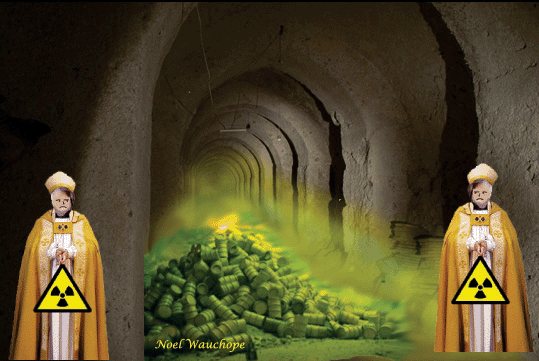
According to a report by the Freiburg-based Öko-Institut , the search for a final storage facility for
highly radioactive nuclear waste in Germany could take more than 40 years longer than expected. The responsible Ministry of the Environment does not believe this. The law currently stipulates that a site will be determined by 2031. However, it has long been clear that this timetable cannot be met. The study commissioned by the Federal Office for the Safety of Nuclear Waste Management (Base) confirms this and names 2074 as a possible date.
………………………..The search for a final storage facility is about finding a place deep underground for the permanent storage of 27,000 cubic meters of highly radioactive waste (1,750 so-called Castor containers) from more than 60 years of nuclear power in Germany. According to Base, this is five percent of the
radioactive waste in Germany , but it contains around 99 percent of the total radioactivity of all waste. The waste is currently stored in 16 above-ground interim storage facilities in various federal states, whose permits expire before 2050. https://www.zeit.de/wissen/umwelt/2024-08/atommuell-endlager-gutachten
IAEA concerned about forest fires near occupied Zaporizhzhia Nuclear Power Plant
Tetyana Oliynyk — Thursday, 8 August 2024, https://www.pravda.com.ua/eng/news/2024/08/8/7469572/
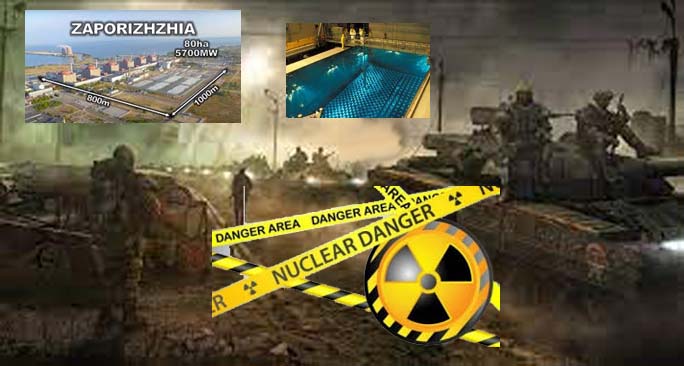
he International Atomic Energy Agency (IAEA) believes that intense fires near the Zaporizhzhia Nuclear Power Plant, which is temporarily occupied by Russia, pose a risk for its external power supply.
Source: IAEA website, as reported by Ukrinform
Quote: “On several occasions over the past week, the IAEA Support and Assistance Mission to Zaporizhzhya (ISAMZ) observed several fires at various distances from the ZNPP and nearby villages. Over the weekend, the IAEA experts observed smoke coming from an area to the north of the ZNPP near the Zaporizhzhya Thermal Power Plant (ZTPP) inlet channel.”
Details: The agency noted that the fire was underneath the remaining overhead power cables that supply power to the plant.
Quote: “As the summer heat continues, such fires along the pathways of the two remaining lines place the ZNPP at risk of loss of external power. While there was no disconnection of either line on this occasion, the situation highlighted the fragility of off-site power at the ZNPP.”
1 This Month




PLEASE OPPOSE HR 8255 AND S.3639 – bills would accelerate satellite deployment, with no environmental review or safeguards – https://ncstd5li.quorum.us/campaign/169331/
To see nuclear-related stories in greater depth and intensity – go to https://nuclearinformation.wordpress.com
-
Archives
- September 2026 (330)
- August 2026 (330)
- July 2026 (355)
- June 2026 (287)
- May 2026 (306)
- April 2026 (356)
- March 2026 (251)
- February 2026 (267)
- January 2026 (308)
- December 2025 (358)
- November 2025 (359)
- October 2025 (375)
-
Categories
- 1
- 1 NUCLEAR ISSUES
- business and costs
- climate change
- culture and arts
- ENERGY
- environment
- health
- history
- indigenous issues
- Legal
- marketing of nuclear
- media
- opposition to nuclear
- PERSONAL STORIES
- politics
- politics international
- Religion and ethics
- safety
- secrets,lies and civil liberties
- spinbuster
- technology
- Uranium
- wastes
- weapons and war
- Women
- 2 WORLD
- ACTION
- AFRICA
- Atrocities
- AUSTRALIA
- Christina's notes
- Christina's themes
- culture and arts
- Events
- Fuk 2022
- Fuk 2023
- Fukushima 2017
- Fukushima 2018
- fukushima 2019
- Fukushima 2020
- Fukushima 2021
- general
- global warming
- Humour (God we need it)
- Nuclear
- RARE EARTHS
- Reference
- resources – print
- Resources -audiovicual
- Weekly Newsletter
- World
- World Nuclear
- YouTube
-
RSS
Entries RSS
Comments RSS

