Assange to Testify at Council of Europe

The freed publisher will appear in person in Strasbourg on Oct. 1 to address the Council of Europe, WikiLeaks said today.
September 24, 2024, By Joe Lauria, Consortium News
WikiLeaks publisher Julian Assange, who was released from prison in June, will address the Council of Europe in Strasbourg, France on Oct. 1 after he was granted Status as a Political Prisoner by a rapporteur of the Parliamentary Assembly of the Council of Europe (PACE), WikiLeaks said today.
It will be the first time Assange will speak in public since his hearing in U.S. federal court on the North Mariana islands in June, at which he was granted his release after a plea deal.
Assange will give evidence before the Committee on Legal Affairs and Human Rights of the Parliamentary Assembly of the Council of Europe (PACE), which will meet from 8.30am to 10am at the Palace of Europe, WikiLeaks said.
It follows the PACE inquiry report into Assange’s case, written by Rapporteur Thórhildur Sunna Ævarsdóttir.
“The report focuses on the implications of his detention and its broader effects on human rights, in particular freedom of journalism,” WikiLeaks said in a press release published on X. “The report confirms that Assange qualifies as a political prisoner and calls on the UK [to] conduct an independent review into whether he was exposed to inhuman or degrading treatment.”
Ævarsdóttir called Assange’s case a “high profile example of transnational repression.” Her report “discusses how governments employ both legal and extralegal measures to suppress dissent across borders, which poses significant threats to press freedom and human rights,” said WikiLeaks.
Still Recovering
Assange is “still in recovery following his release from prison,” it said. He will travel to France because of “the exceptional nature of the invitation and to embrace the support received from PACE and its delegates over the past years”………………………………………………………. more https://consortiumnews.com/2024/09/24/assange-to-testify-at-council-of-europe/
IAEA chief says situation tense around Russia’s Kursk plant, but no permanent mission planned.

By Reuters, September 24, 2024, https://www.reuters.com/world/europe/iaea-chief-says-situation-tense-around-russias-kursk-plant-no-permanent-mission-2024-09-23/
Sept 24 (Reuters) – U.N. nuclear agency chief Rafael Grossi, in an interview published early on Tuesday, said the situation remained serious around Russia’s Kursk nuclear power plant, but his agency planned no permanent mission at the site.
Ukrainian troops remain in Russia’s southern Kursk region after pouring over the border last month, but remain some 40 km (25 miles) from the facility.
“(The situation) is serious in that a military incursion has taken place and that incursion has reached the stage that it is not that distant from a nuclear power station,” Grossi, Director General of the International Atomic Energy Agency, told Russia’s RIA news agency.
Grossi visited the Kursk plant, made up of four reactors, last month and said it would be “extremely exposed” if it came under attack as the facility had no containment dome.
In his comments to RIA, made in New York ahead of debates at the U.N. General Assembly, he said he hoped favourable circumstances would mean he would not have to visit the plant again.
“I hope there will be no need to return to the Kursk station as that would mean that the situation has stabilised,” he said.
The IAEA, he said, had no plans to station observers permanently at the station – as it has at Ukraine’s four plants, including the Zaporizhzhia station, seized by Russian forces in the early days of Moscow’s February 2022 invasion of Ukraine.
Grossi said the situation remained tense at Zaporizhzhia, where each side regularly accuses the other of planning to attack the station.
“My experts continue to report on military action near the station,” he told RIA.
Grossi has visited the Zaporizhzhia station five times since the invasion and urged both sides to show restraint to guard against any nuclear accident.
War Forever, Everywhere, War Doesn’t End When It “Ends”
Unexploded Ordnance and the Weaponry We Leave Behind
Tom Dispatch, By Andrea Mazzarino, September 22, 2024
Count on one thing: armed conflict lasts for decades after battles end and its effects ripple thousands of miles beyond actual battlefields. This has been true of America’s post-9/11 forever wars that, in some minimalist fashion, continue in all too many countries around the world. Yet those wars, which we ignited in Afghanistan, Iraq, and Pakistan in the wake of the 9/11 attacks, are hardly the first to offer such lessons. Prior wars left us plenty to learn from that could have led this country to respond differently after that September day when terrorists crashed planes into the World Trade Center in New York City and the Pentagon in Washington, D.C. Instead, we ignored history and, as a result, among so many other horrific things, left our weaponry — explosives, small arms, you name it — in war zones to kill and maim yet more people there for generations to come.
Case in point: We Americans tend to disregard the possibility (however modest) that weapons of war could even destroy our own lives here at home, despite how many of us own destructive weaponry. A few years ago, my military spouse and I were looking for a house for our family to settle in after over a decade of moving from military post to military post. We very nearly bought an old farmhouse owned by a combat veteran who mentioned his deployments to Afghanistan and Iraq. We felt uncertain about the structure of his house, so we arranged to return with our children to take another look after he had moved out. The moment we entered the garage with our two toddlers in tow, we noticed a semi-automatic rifle leaning against the wall, its barrel pointing up. Had we not grabbed our son by the hand, he might have run over to touch it and, had it been loaded, the unthinkable might have occurred. Anyone who has raised young children knows that a single item in an empty room, especially one as storied as a gun (in today’s age of constant school shootings and lockdowns) could be a temptation too great to resist.
That incident haunts me still. The combat vet, who thought to remove every item from his home but a rifle, left on display for us, was at best careless, at worst provocative, and definitely weird in the most modern meaning of that word. Given the high rates of gun ownership among today’s veterans, it’s not a coincidence that he had one, nor would it have been unknown for a child (in this case mine) to be wounded or die from an accidental gunshot. Many times more kids here die that way, whether accidentally or all too often purposely, than do our police or military in combat. Boys and men especially tend to be tactile learners. Those of them in our former war zones are also the ones still most likely to fall victim to mines and unexploded ordnance left behind, just as they’re more likely to die here from accidental wounds.
Scenes not that different from the one I described have been happening in nearly 70 countries on a regular basis, only with deadlier endings. …………………………………………………………………………………………..
After the international Cluster Munitions Convention took effect in 2010, 124 countries committed to retiring their stockpiles. But neither the U.S., Russia, nor Ukraine, among other countries, signed that document, although our government did promise to try to replace the Pentagon’s cluster munitions with variants that supposedly have lower “dud” rates. (The U.S. military has not explained how they determined that was so.)
Our involvement in the Ukraine war marked a turning point. In mid-2023, the Biden administration ordered the transfer of cluster munitions from its outdated stockpile, sidestepping federal rules limiting such transfers of weapons with high dud rates. As a result, we added to the barrage of Russian cluster-munition attacks on Ukrainian towns. New cluster-munition attacks initiated in Ukraine have created what can only be seen as a deadly kind of time bomb. If it can be said that the U.S. and Russia in any way acted together, it was in placing millions of new time bombs in Ukrainian soil in their quest to take or protect territory there, ensuring a future of mortal danger for so many Ukrainians, no matter who wins the present war.
Afghanistan, Every Step You Take
At the Costs of War Project, which I helped found at Brown University in 2010, a key goal continues to be to show how armed conflict disrupts human lives, undermining so much of what people need to do to work, travel, study, or even go to the doctor. Afghanistan is a case in point: An area roughly 10 times the size of Washington, D.C., is now thoroughly contaminated by mines and unexploded ordnance………………………………………………………………………………………………………………………………… more https://tomdispatch.com/war-forever-everywhere/
Nuclear War in Ukraine Is a Distinct Possibility
September 22, 2024, By C.J. Polychroniou / Common Dreams, https://scheerpost.com/2024/09/22/a-nuclear-war-in-ukraine-is-a-distinct-possibility/
The war in Ukraine has been going on for 2.5 years with no end on sight. Not only that, but we are now close to a nuclear war, according to the Norwegian scholar Glenn Diesen who predicted in November 2021 that “war was becoming increasingly unavoidable” as NATO was escalating tensions with Russia by strengthening its ties with Ukraine. Indeed, as Diesen argues in the interview that follows, NATO provoked Russia and sabotaged all peace negotiations, using Ukraine as a proxy to a geopolitical chessboard. Diesen is professor of political science at the University of South-Eastern Norway and author of scores of academic articles and books, including, most recently, The Ukraine War & the Eurasian World Order(2024).
C. J. Polychroniou: On February 22, 2022, in a move that few had anticipated, Russia invaded Ukraine by launching a simultaneous ground and air attack on several fronts. The war hasn’t gone at all as Moscow had intended and it rages on as neither side is seriously considering an end to the fighting. Yet, the invasion is in many ways a continuation of a territorial conflict between Russia and Ukraine that goes back to 2014. What lies behind the Russia-Ukraine conflict? How did we arrive at this dangerous juncture that is now dragging NATO into the conflict?
Glenn Diesen: I predicted the war in an article in November 2021, in which I argued war was becoming “unavoidable” as NATO continued to escalate while rejecting any peaceful settlement. This should have been evident to everyone if we had an honest discussion about what had been happening.
NATO was always part of this conflict, and it did not start as a territorial conflict. The conflict began with the Western-backed coup in Ukraine in February 2014, which was seen as a precursor to NATO expansion and the eventual eviction of Russia from its Black Sea fleet in Sevastopol. As the New York Times has confirmed, on the first day after the coup, the new Ukrainian government hand-picked by Washington established a partnership with the CIA and MI6 for a covert war against Russia. It is important to remember that Russia had not laid any claims to Crimea before seizing it in the referendum in March 2014. This is not a commentary on legality or legitimacy, merely the fact that Russia’s actions were a reaction to the coup.
A proxy war broke out in which NATO backed the government it installed in Kiev and Russia backed the Donbas rebels who refused to recognize the legitimacy of the coup and resisted the de-russification and purge of the language, political opposition, culture, and the church. The Minsk-2 peace agreement of 2015 laid the foundation for resolving the conflict, but this was merely treated as a deception to buy time and build a large Ukrainian army as confirmed by the Germans, French and authorities in Kiev. After 7 years of Ukraine refusing to implement the Minsk agreement and NATO’s refusing to give Russia any security guarantees for NATO’s military infrastructure that moved into Ukraine—Russia invaded in February 2022.
It is correct that the war has not gone as Moscow expected. Russia thought it could impose a peace but was taken by surprise when the U.S. and U.K. preferred war. When Russia sent in its military, the small size and conduct of the invading forces indicated that the purpose was merely to pressure Ukraine to accept a peace agreement on Russian terms. Ukraine and Russia were close to an agreement in Istanbul, although it was sabotaged by the U.S. and U.K. as they saw an opportunity to fight Russia with Ukrainians.
The nature of the war changed fundamentally as it became a war of attrition. Russia withdrew to more defensible front lines, began mobilizing its troops and sourcing the required weapons for a long-term war to defeat the NATO-built army in Ukraine. After 2.5 years of war, this has become a territorial conflict that makes it impossible to resolve in a manner that would be acceptable to all sides. As NATO refuses to accept losing its decade-long proxy war in Ukraine, it must continue to escalate and thus get more directly involved in the war. We are now at the brink of a direct NATO-Russia War.
Did NATO provoke Russia’s invasion of Ukraine? Even if so, didn’t Moscow have any other options other than to resort to the use of military force?
NATO provoked the invasion and sabotaged all paths to peace. The NATO countries affirmed on several occasions that the UN-approved Minsk agreement was the only path to a peaceful resolution of the conflict in Ukraine, yet then admitted that it was merely a ruse to militarize Ukraine. This convinced the Russians that NATO was pursuing a military solution to the conflict in Ukraine that would also involve an invasion of Crimea. As argued by a top advisor to former French president Sarkozy, the U.S.-Ukrainian strategic agreement of November 2021 convinced Russia it had to attack or be attacked.
Russia considered NATO in Ukraine to be an existential threat, and NATO refused to give Russia any security guarantees to mitigate these security concerns. The former U.S. ambassador to NATO, Kurt Volker, argued during the Biden-Putin discussions that no agreements should be made with Russia as “success is confrontation.” This war is a great tragedy as it has resulted in the deaths of hundreds of thousands of young Ukrainians and Russians, made Europe weaker and more dependent, and taken the world to the brink of nuclear war. By failing to admit NATO’s central role in provoking this war, we also prevent ourselves from recognizing possible political solutions.
Russia and Ukraine were close to war-ending agreements in April of 2022, but apparently certain western leaders convinced Ukrainian president Zelensky to back down from such a deal. Is Ukraine a US pawn on a geo-political chessboard?
Zelensky confirmed on the first day after the Russian invasion that Moscow had contacted Kiev to discuss a peace agreement based on restoring Ukraine’s neutrality. On the third day after the invasion, Russia and Ukraine agreed to start negotiations. Yet, the American spokesperson suggested the US could not support such negotiations. When the negotiations nonetheless began, Boris Johnson was sent to Kiev to sabotage them. Johnson later wrote an op-ed warning against a bad peace. The Ukrainian negotiators and the Israeli and Turkish mediators all confirmed that Russia was willing to pull back its troops and compromise on almost everything if Ukraine would restore its neutrality to end NATO expansionism. The mediators also confirmed that the US and UK saw an opportunity to bleed Russia and thus weaken a strategic rival by fighting with Ukrainians. The US and UK told Ukraine they would not support a peace agreement based on neutrality, but NATO would supply all the weapons Ukraine would need if Ukraine pulled out of the negotiations and chose war instead. Interviews with American and British leaders made it clear that the only acceptable outcome for the war was regime change in Moscow, while other political leaders began to speak about breaking up Russia into many smaller countries.
Yes, I believe that Ukraine is a pawn on the geopolitical chessboard. Why do we not listen to all the American political and military leaders who describe this as a good war and an opportunity to weaken Russia without using American soldiers?
What does Russia want from Ukraine?
Russia demands peace based on the Istanbul+ formula. The Istanbul agreement of early 2022 involved Russia retreating from the territory it seized since February 2022 in return for Ukraine restoring its neutrality. However, after 2.5 years of fighting, the war has also evolved into a territorial conflict. Russia therefore demands that Ukraine also recognizes Russian sovereignty over the territories it annexed.
Russia will not accept a ceasefire that merely freezes the front lines, because this could become another Minsk agreement that merely buys time for NATO to re-arm Ukraine to fight Russia another day. Moscow therefore demands a political settlement to the conflict based on neutrality and territorial concessions. In the absence of such an agreement and continued threats by NATO to expand after the war is over, Russia will likely also annex Kharkov, Dnipro, Nikolaev, and Odessa to prevent these historical Russian regions from falling under the control of NATO.
Ukraine has become increasingly a de facto NATO member. What are the chances that Russia might introduce tactical nuclear weapons in the battlefield to achieve its aims?
Russia permits the use of nuclear weapons in response to a nuclear attack or if its existence is threatened. NATO becoming directly involved in the war is considered an existential threat by Russia, and Russia has warned that NATO would become directly involved by supplying long-range precision missiles. Such missiles will need to be operated by American and British soldiers and navigated by their satellites, thus this represents a NATO attack on Russia. We are very close to a nuclear war, and we are deluding ourselves by suggesting we are merely helping Ukraine defend itself.
Can you briefly discuss the implications for world order if the West defeats Russia? And what would the international system look like if Russia wins the war in Ukraine?
The West would like to defeat Russia to restore a unipolar order. As many military and political leaders in the US argue, once Russia has been defeated then the US can focus its resources on defeating China. It is worth remarking that few Western political leaders have clearly defined what “victory” over the world’s largest nuclear power would look like. Russia considers this war to be an existential threat to its survival, and I am therefore convinced that Russia would launch a nuclear attack long before NATO troops get to march through Crimea.
A Russian victory will leave Ukraine a dysfunctional state with much less territory, while NATO will have lost much of its credibility as this was bet on a victory. The war has intensified a transition to a multipolar world, and this likely increase at a much higher pace if NATO loses the war in Ukraine.
NATO expansion that cancelled inclusive pan-European security agreements with Russia was the main manifestation of America’s hegemonic ambitions after the Cold War, thus the entire world order will be greatly influenced by the outcome of this war. This also explains why NATO will be prepared to attack Russia with long-range precision missiles and risk a nuclear exchange.
Negotiate with Moscow to end the Ukraine war and prevent nuclear devastation.
The Hill, by Robert F. Kennedy Jr. and Donald Trump Jr., opinion contributors – 09/17/24
The New York Times reported Thursday that the Biden administration is considering allowing Ukraine to use NATO-provided long-range precision weapons against targets deep inside Russia. Such a decision would put the world at greater risk of nuclear conflagration than at any time since the Cuban missile crisis.
At a time when American leaders should be focused on finding a diplomatic off-ramp to a war that should never have been allowed to take place, the Biden-Harris administration is instead pursuing a policy that Russia says it will interpret as an act of war. In the words of Vladimir Putin, long-range strikes in Russia “will mean that NATO countries — the United States and European countries — are at war with Russia.”
Some American analysts believe Putin is bluffing, and favor calling his bluff………………………
These analysts are mistaking restraint for weakness. In essence, they are advocating a strategy of brinksmanship. Each escalation — from HIMARS to cluster munitions to Abrams tanks to F-16s to ATACMS — draws the world closer to the brink of Armageddon. Their logic seems to be that if you goad a bear five times and it doesn’t respond, it is safe to goad him even harder a sixth time.
Such a strategy might be reasonable if the bear had no teeth. The hawks in the Biden administration seem to have forgotten that Russia is a nuclear power. They have forgotten the wisdom of John F. Kennedy, who said in 1963, “Nuclear powers must avert those confrontations which bring an adversary to a choice of either a humiliating retreat or a nuclear war.”………………………………………………………………………… more https://thehill.com/opinion/international/4882868-negotiate-with-moscow-to-end-the-ukraine-war-and-prevent-nuclear-devastation/
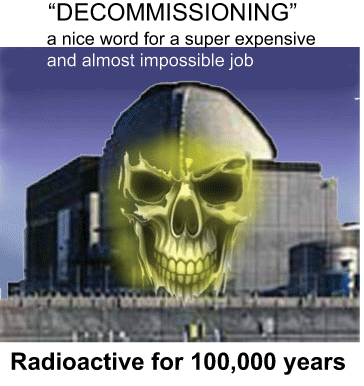
Nuclear plant’s decommissioning could take 95 years
Daniel Mumby, Local Democracy Reporting Service, 19 Sept 24, https://www.bbc.com/news/articles/c8699v4dvexo
Residents are being asked for their views on how a former nuclear power station should be safely decommissioned.
The Hinkley Point B facility, which lies on the Somerset coast north of Stogursey, ceased operations in August 2022, after cracks developed in the plant’s graphite cores, creating potential safety concerns.
EDF Energy, which owns the facility, has applied to the Office for Nuclear Regulation (ONR) for formal permission to decommission the site, which could take about 95 years.
Somerset residents now have three months to voice their views.
Under the proposals, Hinkley Point B, which opened in 1976, could be decommissioned in three phases.
The first phase, which will last until 2038, includes the dismantling of all buildings and plant materials except for the site’s safestore structure. This facility will be used to store and manage the residential nuclear waste from the power station.
The second phase will see “a period of relative inactivity” of up to 70 years from 2039, to allow for the radioactive materials within the safestore to safely decay, according to the Local Democracy Reporting Service.
While physical activity within the site will be minimal during this phase, the former power station will remain under close surveillance with “periodic maintenance interventions” to prevent any risk to health or national security.
The third and final phase will see the former reactor and debris vaults being dismantled and removed and any final landscaping work being completed – with EDF estimating that this will be finished by 2118.
The consultation is running until 9 December, with the ONR expected to publish its formal response in early 2025.
Hinkley Point C
EDF is currently building Hinkley Point C, which has a target completion date of June 2027.
Costing about £46bn, it is expected to generate enough electricity to supply some six million homes for the next 60 years.
Is the new UK government prepared to rise to the challenge of investing in energy efficiency measures and reducing the country’s energy use?

Internationally, more recent UN assessments are placing much greater emphasis on changing demand for fuel, broadly supporting the CREDS’ analysis of the scale of the potential. The International Energy Agency consistently refers to energy efficiency as ‘the first fuel’, and the European Commission actively promotes ‘Energy Efficiency First’.
Is the new government prepared to rise to the challenge of investing in energy efficiency measures and reducing the country’s energy use? asks Andrew Warren.
The UK has a new government. It arrives determined to deliver the potential that greater investment in energy efficiency offers, and these are acknowledged to be ‘wins all round’ in economic, social and environmental terms. Every plausible scenario for delivering climate targets depends critically on delivering these improvements.
The key question remains – how best to deliver this potential? Fortunately, for the past six years, there has been a major project, funded by UK Research & Innovation, that has been exploring precisely these answers.
The Centre for Research into Energy Demand Solutions (CREDS) has been run by an Oxford University professor, Nick Eyre – a man with a very practical background in the subject. Prior to becoming an academic, he worked at a senior level for the Energy Saving Trust. An active County Councillor, he was a key figure seconded to the Cabinet Office, helping create the first energy White Paper for 30 years, launched by Tony Blair in 2003, which elucidated the entire case for an energy efficiency/renewables-based future.
And way back in 1989, he helped prepare the energy efficiency case for Margaret Thatcher’s government on the ‘greenhouse effect’. This included the identification of potential emission reductions of 477 Mt CO₂ within 30 years. These were deemed grossly over ambitious by the energy establishment at the time, but they have nonetheless been achieved. Practically half these savings have come from improvements in energy efficiency, which have been spread across the three major categories of energy use: electricity (32%, 123 Mt CO₂) heating (34%, 68 Mt CO₂) and transport (17%, 33 Mt CO₂).
Energy demand matters
A full analysis of what has actually been achieved to date can be found on the Centre’s website (www.creds.ac.uk/creds-research-findings/). In addition, there are approaching 500 other publications drawn from academics based throughout the UK involved in this initiative, the vast majority of these fully peer-reviewed. On the website, these have been grouped under nine different ‘themes’. The overall findings of the six-year project can be found in 15 one-page topic summaries, each of which provides links to the underlying evidence base.
The CREDS consortium has a wide range of perspectives. For a collection of academics this is inevitable, and healthy. But there are some insights that are commonly shared.
The first is that energy demand management matters. Use of energy is fundamental to a modern society, but it is currently the main cause of greenhouse gas emissions. The analysis confirms it has to be reduced, made more flexible and switched to decarbonised fuels. Reducing the amount of energy that needs to be decarbonised reduces the cost of the transition.
The work reasserts the importance of energy efficiency improvements, and importantly identifies the huge boost to its potential offered by electrification. But also established is that some of the broader benefits of demand reduction (e.g. for health, energy security and green employment) also require more fundamental change in the systems that drive energy use, in particular shifts to a circular economy.
Reducing consumption
Going forward, CREDS’ analyses show clearly that current UK energy consumption can be halved by 2050 – and, critically, the policy measures that need to be introduced, and enforced, to achieve this. The research has consistently found that fairness matters – not just because it is normatively important, but also because perceptions of fairness, or otherwise, affect public support for change.
All this means that managing demand for energy is central to the shift to sustainable energy within a zero emissions concept. Conceptualising changing energy demand purely in terms of ‘individual responsibility’, ‘greener choices’ or ‘behaviour change’ simply misses the point.
Just like changing energy supply, changing demand requires changes in infrastructure, technology and business models.
For many people, this may well be CREDS’ most surprising insight. It certainly also means that existing institutions and policies will not be adequate. Previous UK governments have failed to address this key conclusion. All significant change takes time and effort. Particularly in democracies, a ‘long march through the institutions’ is needed. And there are positive signs that these insights are beginning to have traction.
Efficiency first
Internationally, more recent UN assessments are placing much greater emphasis on changing demand for fuel, broadly supporting the CREDS’ analysis of the scale of the potential. The International Energy Agency consistently refers to energy efficiency as ‘the first fuel’, and the European Commission actively promotes ‘Energy Efficiency First’.
In the UK, some similar shifts can be seen in reports from the Climate Change Committee, the National Infrastructure Commission and the Government Office of Science. And there are positive signs in the Scottish and Welsh governments and many local authorities, as well as forward-thinking businesses and civil society organisations.
For research funders, the CREDS initiative has a clear message – inter-disciplinary approaches are still needed. They can be hard work, but the challenges of changing demand require multiple perspectives. As importantly, ‘changing energy demand’ is not a single topic; the challenges are diverse and require in-depth knowledge of specific sectors, technologies and energy services. Expertise matters and should be supported.
One of the biggest long term benefit of CREDS will be from the skills and commitment of the people its existence has brought together. They are part of the generation that will help government map the pathways through to complete decarbonisation.
As his professorship becomes ‘emeritus’, wise leaders in the new UK administration should be expressing considerable gratitude to Nick Eyre, for the very remarkable groundwork his foresight in creating the insightful CREDS initiative has provided for them.
Nuclear waste group spends £4,600 on logo to show it IS listening to Theddlethorpe views.

A probe has revealed that a group connected to plans
for an underground nuclear waste dump in Theddlethorpe spent £4,600 on a
new logo to demonstrate it is listening to residents’ views. The logo, with
two speech bubbles, signifying a conversation, has been created for the
Theddlethorpe GDF Community Partnership, which has been set up to help
locals understand why a GDF (geological disposal facility) might be
suitable for the area.
The former gas terminal at Theddlethorpe has been
identified as one of several potential locations in England for the dumping
of nuclear waste by the government agency, Nuclear Waste Services (NWS). It
would be stored beneath up to 1,000 metres of solid rock until its
radioactivity naturally decays.
Lincolnshire World 20th Sept 2024
https://www.lincolnshireworld.com/news/people/nuclear-waste-group-spends-ps4600-on-logo-to-show-it-is-listening-to-theddlethorpe-views-4790584
With US $billions and diplomatic support, Ukraine and Israel are destroying themselves.
Walt Zlotow, West Suburban Peace Coalition, Glen Ellyn IL 22 Sept 24
Joe Biden began his presidency doing a great thing for peace. Three years ago he ended America’s illegal, immoral, criminal war in Afghanistan.
But Biden is no friend of peace. He’s spent the last three years instigating and funding proxy war in Ukraine to weaken Russia, and funding and enabling Israel’s genocidal ethnic cleansing of Palestinians in Gaza.
Neither of these murderous wars could continue without America’s endless billions and fervent moral support in word and deed.
But both Ukraine and Israel have fallen for US support to head down the path to failed state status.
Ukraine is already there. A fifth of their land gone. Economy shattered. Military largely destroyed. Millions displaced internally or fled to o other countries. Dependent upon on massive, unrepayable loans from the US and NATO countries simply to function. Cancelled elections spell the end of Ukrainian democracy. It could hardly be worse.
This all could have been avoided had the US not demanded Ukraine join NATO to isolate Russia from the European political economy, and supported a coup toppling the Ukrainian president who sought economic relations with Russia. Nor would it have happened had Ukraine President Zelensky rebuffed Biden’s NATO membership overtures and provided regional autonomy to Donbas as promised under the 2015 Minsk II Accords.
While not the basket case Ukraine is, Israel appears hell bent to join it as a failed state. By exploiting the October 7 Hamas attack to initiate all out genocidal ethnic cleansing of Gaza, Israel is destroying itself as well. Outside of the Biden administration, it has lost worldwide support as a moral nation. It has greatly weakened Israel’s economy, overtaxed it military, irrevocably divided its populace, forced over 60,000 citizens to flee northern Israel, and embarked on a self destructive war it cannot win.
Make that 2 wars. Israel’s Prime Minister Benjamin Netanyahu’s genocidal campaign in Gaza has provoked blowback in northern Israel from both Hezbollah in Lebanon and the Houthis in Yemen. Like Hamas in Gaza, neither of these two additional opponents can be defeated by Israel alone. Just like with Ukraine, endless billions from Biden will not turn the tide.
Both Zelensky in Ukraine and Netanyahu in Israel have one Hail Mary toss to fling….bring the US directly into the battle on their side. Zelensky has been promoting this explicitly since his losing war with Russia began 31 month ago. Netanyahu, is more discreet, simply taking provocative actions like bombing Hezbollah leaders in Lebanon and Syria, engaging in terrorism using explosive cellphones and pagers, all designed to ignite regional war involving Iran that the US would feel compelled to join.
So far President Biden has resisted direct US involvement in both senseless wars. But either could blow up in his face at any moment, triggering direct US involvement. Should that occur, we’ll see much worse than Ukraine and Israel self destructing. America and the rest of the world’s 193 countries might well join them.
Labour backs nuclear – but at what cost?

for the UK consumer, nuclear new building means expensive electricity and offers little in terms of addressing climate change.
With new funding announced for the prospective Sizewell C plant, the government seems committed to nuclear power.
However, the cost of nuclear newbuild in the UK is staggering and,
even if built, sufficient new capacity will not arrive soon enough to help
mitigate climate change.
UK electricity consumers should hope that the
target of 24 GW of nuclear capacity by 2050 slips into obscurity. “We
will ensure the long-term security of the sector, extend the lifetime of
existing plants, and we will get Hinkley Point C over the line.” That was
Labour’s manifesto commitment to nuclear power, and the government has
already put money on the line.
In late August, it announced additional
funding of up to £5.5 billion for the proposed Sizewell C plant, which
would be only the UK’s second nuclear construction project since the
completion of Sizewell B in 1995, if built.
However, for the UK consumer, nuclear new building means expensive electricity and offers little in terms of addressing climate change. The UK’s operable nuclear capacity declined
from 12.2 GW in 1996 to 5.8 GW in 2023. Only nine reactors are still
generating power and two are under construction. Eight of the operable
reactors came online between 1983 and 1989, making the youngest 45 years
old. Last year, the Hartlepool and Heysham 1 plants gained modest life
extensions to 2026, and operator EdF hopes to extend the lives of its other
Advanced Gas Cooled (AGRs) reactors to 2028.
However, there is little likelihood that the eight remaining AGRs can continue in service beyond these dates. They were initially designed to last about 30 years, with the
decision to decommission based on the deterioration of irreplaceable
components such as the graphite core and boilers. Three AGRs – two built
in 1976 and one in 1983 – are already defueling, a preliminary step to
decommissioning. As a result, by 2030 at the latest, all of the UK’s AGRs
will be out of service.
Decommissioning costs the consumer money, and the
Nuclear Liabilities Fund has not kept up with the cost of decommissioning.
In its third report of 2022-23, the House of Commons Committee of Public
Accounts noted that the government had already been forced to provide
additional funding of £10.7 billion and that there remained “a strong
likelihood that more taxpayers’ money will be required”.
In addition, despite the first nuclear reactors coming into service in the 1950s, there
is still no clear plan for the permanent storage of the most hazardous
forms of radioactive waste.
The government’s most recent energy and
emissions projections, published in November 2023, forecast the
volume-weighted wholesale electricity price in 2030 at between £36.6/MWh,
in a low fuel price scenario, and £58.5/MWh in a high fuel price scenario.
The UK’s latest licensing round for renewable energy, the results of
which were announced in September, returned CfD prices for solar projects
of £50.07/MWh, onshore wind at £50.90/MWh and offshore wind at
£58.87/MWh (2012 prices).
At over £100/MWh in today’s money, even
without a further five years of inflation, Hinkley Point C is a chronic
deal for the UK electricity consumers. EdF wants a new funding model for
both the construction of Sizewell C and the lifetime extension of Sizewell
B, indicating that even the large CfD strike price for Hinkley Point C is
not enough to build new nuclear in the UK. This will almost certainly mean
UK consumers bearing more of the risk. The adoption of the proposed
Regulated Asset Base (RAB) model would see consumers paying for nuclear
plants years before they actually generate electricity.
Energy Voice 18th Sept 2024.
Biden’s Grand Alliance against Russia in Ukraine beginning to recognize the N word…Negotiations

Walt Zlotow, West Suburban Peace Coalition, Glen Ellyn IL, 20 Sept 24
The US 32 month long proxy war against Russia is not quite over. But everyone in America’s important NATO allies knows America’s Ukraine proxy is losing badly with its military near collapse. The two hundred billions the US and NATO have poured into Ukraine have made not a dent in achieving the ‘good guys’ war aims of taking back the Donbas and Crimea, receiving reparations from Russia, and gaining NATO membership.
While President Biden betrays nary a hint of that stark reality, his European NATO allies, greatly more affected by the economic consequences of this than America, certainly are.
German Chancellor Olaf Scholz recently said, “I believe that now is the time to discuss how to arrive at peace from this state of war, indeed at a faster pace.” Scholz further stated that he will impose a limit on open ended aid to Ukraine and is working on a diplomatic settlement that will include Ukraine ceding territory to Russia.
A senior French diplomat recently told Le Figaro the same thing, citing that the Donbas and Crimea are beyond Ukraine’s military capability and that France lines up with Germany that only a negotiated settlement will end the war.
Insulated from the economic angst of its Western European allies, the US sees no need to deal with reality. For President Biden and his war cabinet including VP Harris, the words ‘negotiated settlement’ and ‘ceding territory’ dare not pass the lips of US diplomats acting more like war generals than statespersons.
Biden and company are still running around like Chicken Little, chirping ‘The Russians are coming, the Russians are coming, to take over Poland on their march to the English Channel.’
That includes presidential candidate Kamala Harris who repeated that delusional meme in her presidential debate.
The US proxy war against Russia, with Ukrainians doing all the dying and the country in ruins, is headed to a negotiated settlement in spite of President Biden’s intransigence.
Why Putin’s nuclear saber-rattling on Ukraine sounds different this time
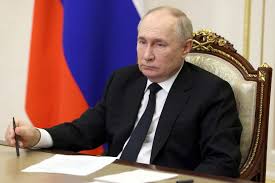
Christian Science Monitor, By Fred Weir, Special correspondent, September 19, 2024, Moscow
Over the course of the war in Ukraine, the Kremlin has drawn several “red lines” – with ostentatious references to Russia’s huge strategic nuclear arsenal – only to seemingly do nothing when these lines are crossed by Ukraine or its Western backers
Red lines:
- It happened when Ukraine acquired new and more powerful Western arms.
- It happened when Kyiv used its own drones to hit Russian airfields, refineries, and even the Kremlin itself.
- Most recently, it happened when Ukrainian forces actually invaded Russian territory. That has led Ukrainians, and many NATO officials, to conclude that Russian President Vladimir Putin’s nuclear saber-rattling is an elaborate bluff.
But when Mr. Putin warned last Thursday that Moscow will consider it a direct act of war by NATO if British, French, or U.S.-made missiles are used by Ukraine to strike targets deep inside Russia, he said this time is different.
Why We Wrote This
The Kremlin has had little success invoking its nuclear arsenal to deter Ukraine and the West from deploying new tactics and modern equipment to stop Russia’s invasion. But that may be changing.
Many Russian experts agree. And for now, Washington seems to be heeding his threat and holding off on permitting Ukraine to use the weapons.
“Russia’s frustration has been growing because the West appears to have lost all fear of nuclear war. Deterrence is absent,” says Sergei Strokan, an international affairs columnist with the Moscow daily Kommersant. During the Cold War, he says, that fear drove both sides to the bargaining table, aiming to limit conflicts and control nuclear weapons.
………………………………………………………………………………………………………………………………………………………….. more https://www.csmonitor.com/layout/set/amphtml/World/Europe/2024/0919/putin-ukraine-war-russia-nuclear-war-ww3?fbclid=IwY2xjawFZl3RleHRuA2FlbQIxMQABHTcSiRBIOeirIFfIogP4ISJt2uGrRaPn6u1PExNVwAUriNd55aENjnbTHw_aem_YYAKI4JyPWZbXh1b5xaDcw
Putin ally warns West of nuclear war over Ukraine
By Reuters, September 20, 2024, Reporting by Reuters; writing by Mark Trevelyan and Guy Faulconbridge, Editing by William Maclean
Summary
Russian missile ‘could hit Strasbourg in minutes’
Volodin says Russia will use ‘more powerful weapons’
Lawmaker reinforces Putin warning
MOSCOW, Sept 19 (Reuters) – A close ally of President Vladimir Putin warned Western governments on Thursday that a nuclear war would ensue if they gave the green light for Ukraine to use long-range Western weapons to strike targets deep inside Russia.
Vyacheslav Volodin, speaker of the lower house of parliament and a member of Putin’s Security Council, was responding to a vote in the European Parliament urging EU countries to give such approval to Kyiv.
“What the European Parliament is calling for leads to a world war using nuclear weapons,” Volodin wrote on Telegram.
His message was entitled “For those who didn’t get it the first time” – an apparent reference to a warning by Putin last week that the West would be directly fighting Russia if it let Ukraine fire the long-range missiles onto Russian territory.
The Ukraine war has triggered the biggest confrontation between Russia and the West since the 1962 Cuban Missile Crisis, which is considered to be the time when the two Cold War superpowers came closest to intentional nuclear war.
The outgoing head of NATO, Jens Stoltenberg, told The Times this week that the Kremlin leader had declared “many red lines” before but not escalated conflict with the West when they were crossed. Putin’s spokesman said his comment was dangerous and provocative.
In a non-binding resolution adopted on Thursday, the European Parliament asked EU countries to “immediately lift restrictions on the use of Western weapons systems delivered to Ukraine against legitimate military targets on Russian territory.”
Volodin wrote: “If something like this happens, Russia will give a tough response using more powerful weapons. No one should have any illusions about this.” He said it appeared to Moscow that the West had forgotten the vast sacrifices made by the Soviet Union in World War Two.
He said Europeans should understand that it would take Russia’s RS-28 Sarmat intercontinental ballistic missile, known in the West as Satan II, just 3 minutes and 20 seconds to strike Strasbourg, where the European Parliament meets.
Miliband urged by US nuclear giant to abandon large reactors in favour of mini-nukes

GE-Hitachi Nuclear boss says investors have ‘scars’ from large projects’ cost overruns
Matt Oliver, Industry Editor
An American nuclear power giant has urged
Ed Miliband to focus on building a new generation of mini reactors instead
of vast megaprojects such as Hinkley Point C. Andrew Champ, the UK country
director for GE-Hitachi Nuclear, said small modular reactors (SMRs) offered
“the best route” to expanding Britain’s nuclear capacity as the
Energy Secretary draws up plans to overhaul the power grid.
By comparison, many investors have “scars” from budget overruns and delays with bigger
nuclear projects and view them as too risky, he claimed. Mr Champ pointed
to the large cost of Hinkley Point C in Somerset as an example. The
project’s budget has ballooned from £20bn to as much as £46bn when
inflation is included.
His comments come as the Government is reconsidering
proposals to build a large-scale nuclear power station in Wylfa, a
taxpayer-owned site on the Welsh island of Anglesey.
GE-Hitachi, which also builds larger-scale reactors, is among those currently trying to
commercialise SMR technology and is vying to secure funding from the UK
under the Government’s current mini-nuke development competition. SMRs
have been hailed as a potential breakthrough for nuclear power because they
would be built in chunks by factories and then assembled rapidly on site,
potentially meaning they can benefit from economies of scale.
So far the technology remains unproven on a commercial basis and no such reactors are
in operation. He also said the UK’s current target to build out 24
gigawatts of nuclear capacity was likely to prove too conservative, partly
due to the huge growth in power demand from data centres being used to
develop artificial intelligence software.
Telegraph 16th Sept 2024
https://www.telegraph.co.uk/business/2024/09/15/miliband-urged-ge-hitachi-prioritise-mini-nukes/
Dounreay nuclear wastes : new snake like robot to access off limits areas
A new robot has been trialled at Dounreay in order to reach “severely
restricted” areas at the former experimental nuclear plant. During
decommissioning of the reactor, engineers have had to come up with
innovative solutions to access parts of the plant that are off limits to
humans.
John O’Groat Journal 17th Sept 2024
1 This Month
22 June – Virtual Event –Climate Change: New Data, New Debate

Monday, June 22, 2026 2:30 p.m. – 3:15 p.m. CT
YouTube. Register here

Protect Sazan Island from the Trump family! https://secure.avaaz.org/campaign/en/protect_sazan_island_from_the_trump_family_loc/?bqFCVab&v=174511&cl=22707147157&_checksum=5e9dde668860e8231c33699735e16a1fbf22ab2cb01da50c999fe8732b9775ef&utm_source=email&utm_medium=blast_email&utm_campaign=174511
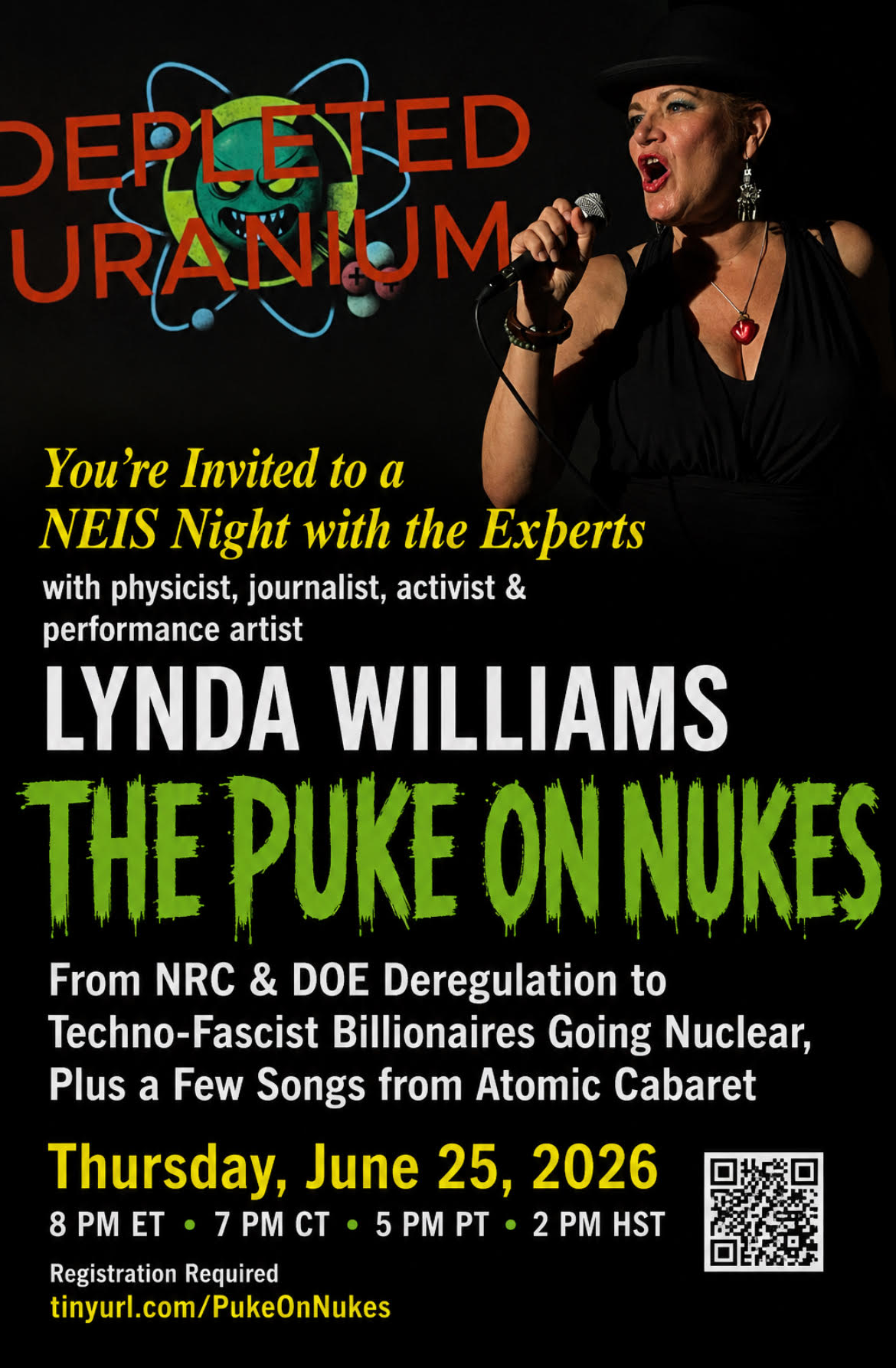
25 June- THE PUKE ON NUKES
Thursday, June 25, 2026
7pm Central Time (8pm ET, 6pm MT, 5pm PT) UTC – 5
From NRC & DOE Deregulation to Techno-Fascist Billionaires Going Nuclear, Plus a Few Songs from Atomic Cabaret REGISTER
26 June – Radiation Trainwreck at the NRC / Join the Protect Better Campaign – https://us02web.zoom.us/meeting/register/4ZlZ5_qLSHGiLSCg8FF6Bg#/registration


Cuba Is Not a Failed State – It Is a Besieged State
PETITION: “Global Appeal to Endorse Palestinian Right of Return of Refugees”
To see nuclear-related stories in greater depth and intensity – go to https://nuclearinformation.wordpress.com
-
Archives
- June 2026 (193)
- May 2026 (306)
- April 2026 (356)
- March 2026 (251)
- February 2026 (268)
- January 2026 (308)
- December 2025 (358)
- November 2025 (359)
- October 2025 (376)
- September 2025 (257)
- August 2025 (319)
- July 2025 (230)
-
Categories
- 1
- 1 NUCLEAR ISSUES
- business and costs
- climate change
- culture and arts
- ENERGY
- environment
- health
- history
- indigenous issues
- Legal
- marketing of nuclear
- media
- opposition to nuclear
- PERSONAL STORIES
- politics
- politics international
- Religion and ethics
- safety
- secrets,lies and civil liberties
- spinbuster
- technology
- Uranium
- wastes
- weapons and war
- Women
- 2 WORLD
- ACTION
- AFRICA
- Atrocities
- AUSTRALIA
- Christina's notes
- Christina's themes
- culture and arts
- Events
- Fuk 2022
- Fuk 2023
- Fukushima 2017
- Fukushima 2018
- fukushima 2019
- Fukushima 2020
- Fukushima 2021
- general
- global warming
- Humour (God we need it)
- Nuclear
- RARE EARTHS
- Reference
- resources – print
- Resources -audiovicual
- Weekly Newsletter
- World
- World Nuclear
- YouTube
-
RSS
Entries RSS
Comments RSS
 nuclear-news