Nuclear site warns £2.8bn budget is ‘not enough’

BBC 24th Feb 2025
Planned work to decommission the UK’s largest nuclear site could have to be slowed down or paused due to insufficient funding, managers have warned.
Sellafield Ltd, which manages the site near Seascale in Cumbria, said its £2.8bn funding for the 2025-26 financial year would “not be enough” for the planned operations.
The GMB union urged Sellafield to be transparent about the impact of the budget restraints on workers.
The Department for Energy Security and Net Zero said Sellafield’s safety and security was their “top priority”.
In October the spending watchdog, the National Audit Office, said the site was not “value for money” and it had spent £1.9bn more than it earned in 2023-2024.
It is understood that while the funding for the 2025-26 financial year is similar to the one for the 2024-25, it does not take into account inflation and rise in energy prices.
Employee fears
The funding is indicative and is expected to be confirmed soon, but Sellafield said the forecast budget would impact its supply chain.
A spokesman added: “Critical work will continue but some projects will need to be slowed down, paused, or stopped.”…………………………..
https://www.bbc.co.uk/news/articles/cm2yvpx8xp1o
Sellafield nuclear site plans cuts as chief says £2.8bn funding ‘not enough’
Union concerned over safety as site’s bosses say budget does not cover work planned.
Alex Lawson and Anna Isaac, Guardian, 25 Feb 25
Sellafield has said nearly £3bn in new funding is “not enough” and bosses are now examining swingeing cuts, prompting fears over jobs and safety at the vast nuclear waste dump.
The Cumbrian nuclear site, which is home to the world’s largest store of plutonium, was last week awarded £2.8bn for the next financial year, the bulk of the total of just over £4bn funds allotted to the Nuclear Decommissioning Authority, a taxpayer-owned and funded quango.
Sellafield’s chief executive, Euan Hutton, has told staff that the funding was “not enough” to carry out planned works, leaving bosses to make “difficult decisions” over spending, sources told the Guardian.
A spokesperson for Sellafield said: “While this is significant funding, it will not be enough for all our planned activities. Critical work will continue but some projects will need to be slowed down, paused, or stopped. This will impact parts of our supply chain.”
Hutton told employees at the site – which employs more than 10,000 people – that all areas of the business will be affected and spending reviewed.
It is understood that internal calculations had forecast that at least £3.1bn would be needed to meet Sellafield’s spending requirements next year, when accounting for rising costs. The site was awarded £2.8bn for the current financial year.
The public spending watchdog has said the ultimate cost of cleaning up Sellafield is expected to rise to £136bn, causing tensions with the Treasury as the chancellor, Rachel Reeves, attempts to tighten public spending and spur growth.
In 2023, the Guardian’s Nuclear Leaks investigation revealed a string of safety concerns at the site – from issues with alarm systems to problems staffing safety roles at its toxic ponds – as well as cybersecurity failings, radioactive contamination and allegations of a toxic workplace culture.
Hutton has not told staff which projects could be paused or stopped at the site, which covers two square miles and hundreds of buildings. Staff carry out a range of work from painstakingly emptying the toxic ponds to building new facilities to house nuclear waste.
Hutton said that safety and security would be prioritised and the site would adhere to legal and regulatory rules, sources said.
However, staff at the hazardous toxic site in north-west England remain concerned that cuts to spending could affect safety and jobs.
Dan Gow, a senior organiser at the GMB union, said: “GMB calls on Sellafield to be fully transparent about any cost-saving measures and to engage with us to ensure the workforce is protected.
“No worker should ever have to fear that budget cuts will put their safety at risk.
“GMB is urging all workers to stand together, stay informed, and ensure their voices are heard. Now more than ever, being part of a strong, organised union is the best way to protect jobs, rights and safety.”
The Office for Nuclear Regulation last week took Sellafield out of special measures for its physical security – but said concerns remained over its cybersecurity……………………………https://www.theguardian.com/environment/2025/feb/24/sellafield-nuclear-site-cuts-funding-union-spending
Opposition to new small nuclear power plants in south Wales
There are plans for four “micro” nuclear reactors in the Llynfi Valley, Bridgend.
WalesLOnline, By Lewis Smith, Local Democracy Reporter, 21 FEB 2025Green Party members in Bridgend have said they are opposed to plans for a nuclear power plant project in the Llynfi Valley describing it as “unnecessary, unwanted and unsafe”.
The multi-million proposals could eventually see the creation of a facility with four micro modular nuclear power plants on the site of the former coal-powered Llynfi Power Station, if given the go-ahead……………
the Bridgend branch of the Green Party have now issued a statement opposing the potential power station, raising concerns over safety with what they say is an “untested” design planned for the site.
……………… Part of the statement added: “This is a new design which if built will be the first of its kind. So the design is untested in the real world. Locals, including local Green Party members have several credible reasons for concern.
“The Green Party questions the need for a nuclear power plant, when Wales has the natural resources required to produce all its energy from a mixture of solar power, onshore and off-shore wind generation.”
“The risk of nuclear leaks, from the on-site nuclear waste storage is not acceptable. Who will pay for future nuclear waste storage? There is a risk that no other region of the UK will be willing to store the nuclear waste, and that this area will become a long term nuclear waste storage site. The consequences of accidental leakage and terrorist targeting has not been fully considered………………… https://www.walesonline.co.uk/news/wales-news/opposition-new-small-nuclear-power-31047639
The IAEA comments on the state of Ukraine’s Nuclear Power Plants

The Zaporizhzhya Nuclear Power Plant has been relying on a single off-site power line for more than a week now after the other 9 have been taken offline due to the war – this single power line is critical to prevent massive radioactive releases at the site.
At the Chornobyl plant, firefighters are continuing to put out small fires that keep smouldering and spreading on the roof of the reactor shield hit by a Russian drone.
Ukraine’s other nuclear plants have continued to report frequent air raid alarms over the past week due to the presence of drones around the sites.
UK’s Hinkley Point C nuclear plant yet to attract new investors, says EDF boss .
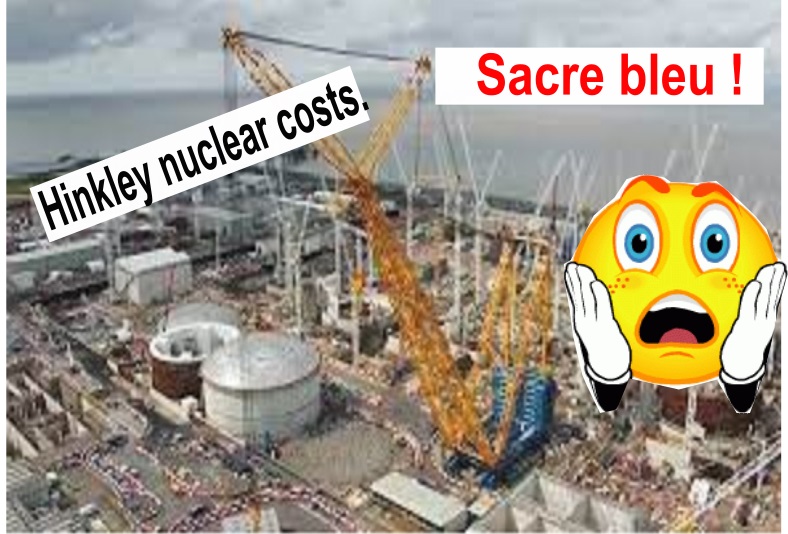
French energy group EDF has not yet found alternative investors for the
flagship Hinkley Point C nuclear project as a freeze in funding from its
Chinese partner places an “extra weight” on the debt-laden company.
Luc Rémont, chief executive of France’s state-owned electricity company,
said it had held talks during 2024 with “lots” of potential funders for
the Hinkley Point C project in Somerset, but was not yet able to proceed
with any of them. EDF was continuing to meet the financing costs but was
working to find alternative investors for the project with the support of
the British government, Rémont said, as the company reported its annual
results on Friday.
“In the current circumstances, the fact that our
partner CGN is not injecting any more capital into Hinkley Point
is . . . an extra weight for EDF,” he said, but added that the
project remained a potentially profitable investment.
His comments raise further questions for the future of Hinkley Point C, the first new nuclear
power station being built in the UK in a generation and a vital part of the
government’s plan to decarbonise power supplies. Hinkley Point C was
initially set to cost £18bn and to be completed in 2025, but the estimated
cost has since swelled to roughly £46bn in 2024 terms while the start date
has been pushed back to 2029 at the earliest, because of construction
delays.
EDF is developing the project with Chinese state-owned CGN as a
junior investment partner, which agreed to finance 33.5 per cent of the
original costs. However, CGN has balked at making further contributions to
help meet cost overruns after the UK government in November 2022 bought it
out of a sister project, Sizewell C in Suffolk, amid concerns about
China’s involvement in critical national infrastructure. Asked on
Thursday whether he was also interested in investing in Hinkley Point C,
Centrica’s chief executive Chris O’Shea said: “We clearly like
nuclear power. And I am open to any kind of conversation. “My focus at
the moment is on hopefully getting to a good place with Sizewell C.”
FT 21st Feb 2025 https://www.ft.com/content/c546117d-1fbc-47c8-93a8-dd823311d2ac
Hating Trump no reason to oppose Trump Ukraine peace initiative.
Walt Zlotow, West Suburban Peace Coalition, Glen Ellyn IL , 23 Feb 25
Some of my progressive comrades are bombarding social media in opposition to Trump’s peace plan to end the Russo Ukraine war. For the first 2 years, 11 months of America’s proxy war against Russia using Ukrainian cannon fodder, they were largely silent. They were loath to criticize President Biden and Vice President Harris, particularly during a presidential campaign. Their focus was laser like on domestic issues to prevent a return of the despised Trump to the presidency.
Trump not only won, he immediately pivoted to peace in Ukraine. He totally overturned the Biden war playbook. He announced Ukraine (really the US) had lost, must never join NATO, and not get back the Russian leaning Eastern Ukraine Russia annexed.
More. Trump announced a complete reset of the US Russia relationship to include diplomatic engagement and friendly relations with Russia that Biden had jettisoned during his entire term.
More again. Ending the war and reestablishing diplomatic relations will reduce the risk of nuclear war present for every one of the 1,095 days of this senseless war. It makes possible renewing the three nuclear treaties the US abandoned this century, two of them by Trump.
But instead of supporting this astonishing breakthrough, progressives have gone ballistic. They charge dictator wannabe Trump is selling out Ukrainian sovereignty, like Chamberlain did to Czechoslovakia at Munich in 1938. They claim this will allow Russia to recreate the Soviet Union, then march into Western Europe. Preposterous.
In doing so they ignore this war was provoked by Biden to weaken Russia. It would never have resulted in war had Biden honored Russia’s security concerns regarding no Ukraine NATO on Russia’s border.
Worse yet, progressives are blind to the fact that the war was lost on Day One when Biden announced the US would not participate with US military. Why? He wisely advised that would result in WWIII.
The result? Ukraine is on the brink of defeat, having upwards of a million dead or wounded. Over ten million have fled Ukraine for safer climes. Potential draftees are deserting en mass. The economy is on life support. President Zelensky cancelled elections, banned free press, outlawed the Russian Orthodox Church on his march to becoming dictator for the war’s duration. Once it’s over…so is Zelensky.
None of this made a dent in progressives till Trump demanded this madness end and followed thru arranging lightning fast negotiations with Russian leaders to end it. Then progressives surfaced to demonize Trump and his peace initiative. They have joined the most virulent pro war advocates in the Republican Party, the military, the media determined to sabotage the most hopeful development to end further destruction of Ukraine and depletion of US treasure.
Every progressive opposing Trump’s peace initiative enables another 500,000 dead Ukrainians, another $175 billion in squandered US treasure, and no end to Biden’s catastrophic and failed proxy war to weaken Russia.
Ponder that progressives.
Solar a beacon of hope as Ukrainians yearn for peace
Solar a beacon of hope as Ukrainians yearn for peace. Solar energy has been
essential for survival in Ukraine during nearly three years of war since
the Russian invasion in 2022. As citizens hope for peace, PV will be
instrumental in supporting post-war recovery, whenever it comes.
PV Magazine 19th Feb 2025,
https://www.pv-magazine.com/2025/02/19/solar-a-beacon-of-hope-as-ukrainians-yearn-for-peace/
UK government in “poor negotiating position” as Centrica vague about investing in the new Sizewell C nuclear power station.
Energy supplier Centrica has announced plans to invest in the new Sizewell
C nuclear power station – but campaigners say the move demonstrates the
government’s “poor negotiating position”.
Stop Sizewell C, which is opposed
to the power station, said any investors in the project could demand higher
rates of return, piling further costs on consumer bills. The government has
announced that the power station will be part-funded by adding costs to
people’s energy bills.
A spokesperson for the group said: “Chris O’Shea’s
comments show what a poor negotiating position the government is in, having
committed so much taxpayers’ money to Sizewell C without any guarantees
that private investors will take a stake. “Any investors still interested
in this risky project can demand high rates of return, but the higher the
return, the greater the burden on consumer bills during Sizewell C’s
lengthy and uncertain construction. It’s a lose lose situation for
households.”
East Anglian Daily Times 20th Feb 2025, https://www.eadt.co.uk/news/24951657.size-sizewell-stake-1-50/
Charles Freeman -USA fighting Russia ‘to the last Ukrainian’. Interview with full transcript
UNMISSABLE – and in my opinion, the very best commentary on the Ukraine situation

23 Mar. 2022, Transcribed by Noel Wauchope, This is Aaron Mate. joining me is Charles Freeman. He is a retired veteran U.S diplomat who has served in a number of senior positions including as the Assistant Secretary of Defense and U.S. ambassador to Saudi Arabia.
Question, What is your assessment of the russian invasion so far and how the biden administration has responded to it?
FREEMAN A huge question. I thought in the run-up to this that Mr Putin was following a classic form of coercive diplomacy massing troops on Ukraine’s border issuing very clear offers to negotiate threatening indirectly to escalate beyond the border not in Ukraine which the Russians repeatedly said they did not intend to invade but perhaps through putting pressure on the United States similar to the one the pressure that the Russians feel from us namely missiles within no warning distance at all of the capital.
Of course Washington doesn’t have quite the significance in our case that Moscow does for the Russians but still I thought that was what was in store. I don’t think his troops were prepared for it. There’s no evidence that they had the logistics in place or that the troops were briefed about where they were going and why and so it looks like an impetuous decision and if so it ranks with the decision of Tsar Nicholas ii the last tsar to go to war with japan in 1904. That had disastrous consequences for political order in Russia and I think this is a comparable blunder.
There are lots of things being said about the course of the war which is now about a months old and many of them are I think frankly tendentious nonsense for example it’s alleged that the Russians are deliberately targeting civilians but I think in most wars the ratio of military to civilian deaths is roughly one to one and in this case the recorded civilian deaths are about one-tenth of that which strongly suggests that the Russians have been holding back. We may now see the end of that with the ultimatum that has been issued in connection with Mario Paul where if I understood correctly what the Russians are saying, they were saying surrender or face the consequences and the consequences would be a terrible leveling of the city
We don’t know where this war is going to end . whether there will be a Ukraine or how much of a Ukraine there will be , what the effects inside Russia will be. There’s clearly a lot of dissent in Russia although i’m sure it’s being exaggerated by our media .
The war is a fog of lies on all sides. It is virtually impossible to tell what is actually happening because every side is staging the show the champion of that is mrZielensky who is brilliant as a communicator. It turns out he’s a an actor who has found his role and probably helps Ukraine a great deal to have a president who is an accomplished actor who came equipped with his own studio staff, who is um using that brilliantly and I would say Mr Zielinski was elected to head a state called Ukraine and he has created a nation called Ukraine he is he is somebody who’s perceived heroism has rallied Ukrainians to a degree that no one ever expected .
But we don’t know where this is going and more to the point the United states is not part of any effort to negotiate an end to the fighting. To the extent that there is mediation going on it seems to be by Turkey possibly Israel, maybe China that’s about it and the United States is not in the room.
Everything we are doing rather than accelerating an end to the fighting and some compromise seems to be aimed at prolonging the fighting assisting the Ukrainian resistance, which is a noble cause I suppose but that will result in a lot of dead Ukrainians as well as dead Russians.
And also, the sanctions have no goals attached to them there’s no conditions which we’ve stated which would result in their end. And finally we have people now calling, including the President of the United states and the Prime Minister of Great Britain calling Putin a war criminal and professing that they will intend to bring it to trial somehow.
Now this gives Mr Putin absolutely no incentive to compromise or reach an accommodation with the Ukrainians and it probably guarantees a long war and there seemed to be a lot of people in the United States who think that’s just dandy. It’s good for the military-industrial complex. It reaffirms our negative views of Russia it reinvigorates NATO. it puts China on the spot.
You know what’s so terrible about a long war – you know if you’re not Ukrainian you probably see some merit in a long war so this has not gone as anybody predicted, not Mr Putin not the intelligence community of the United States which extrapolated war plans from the disposition of forces on the ukrainian border. Not the way the Germans who are now rearming anticipated
It’s got a lot of shock value to it and it’s changing the world in ways we still don’t understand. I wonder if U.S intelligence extrapolated that Russia would invade based on the certainty that the U.S would reject Russia’s core security demands – namely neutrality for Ukraine and Ukraine not joining NATO and I’m wondering if their assurance that Biden would reject those demands – if that’s what made them all the more confident that Russia would then invade.
Question, And on that point about NATO, I wanted to get your response to some comments that Zeilinski recently made. He was speaking to Farid Zakaria of CNN and he made what that was a really telling admission about what he was told to say publicly about NATO before the war.
I requested them personally to take to say directly that we are going to accept or not NATO in a year or two, or just say it five and clearly or just say no. And the response was very clear you are not going to be a member but publicly the doors will remain open but if you are not ready if you just want to see us straddle two worlds if you want to see us in this dubious position where we do not understand whether you can accept us or not you cannot place us in this situation you cannot force us to be in this limbo.
So that’s Zielinski saying that he was told by NATO original members presumably the U.S. that we’re not going to let you in but publicly we’re going to leave the door open. I’m wondering Ambassador Freeman your response to that?
FREEMAN. Well those are two questions. First in my experience the intelligence community does not start from estimates of U.S. policy and I think what we saw was an order of battle analysis with the judgment as expressed at one point by Secretary of State Lincoln – that you know if we masked 150 000 troops on somebody’s border that would mean we were about to invade in other words mirror imaging. You know that’s what we would do therefore that’s what the Russians will do.
I think Mr Putin was surprised by being stiff-armed on the after all 28 year old demands that NATO stop enlarging in the direction of Russia that at root this is a contest over whether Ukraine will be in the U.S sphere of influence, the Russian sphere of influence or neither’s, and neutrality, which is what mr putin had started out saying he wanted .
What’s compatible with neither side having ukraine within its sphere? Whether that’s now possible or not I don’t know. I think one of the mistakes Mr Putin made in upping the ante was to make it very difficult for Ukraine to become neutral but on the question of what mr Zielinski was told Ithink this is remarkably cynical or perhaps it was not even unrealistic on the part of leaders in the West.
Zielensky is obviously a very intelligent man and he saw what the consequences of being put in what he called limbo would be – namely Ukraine would be hung out to dry and the west was basically saying we will fight to the last Ukrainian for Ukrainian independence, which essentially remains our stand . It’s pretty cynical despite all the patriotic fervor and I’d add .
I have heard , I know people who have been attempting to hold an inquiry in the West. It’s very depressing. really we should rise to this occasion we should be concerned about achieving a balance in Europe that sustains peace. That requires incorporating Russia into a governing Council for Europe of some sort. Europe historically has been at peace only when all the great powers who could overthrow the peace have been co-opted into it. A perfect example is the Congress of Vienna which followed the Napoleonic wars where Kissinger’s great hero met in it and others had the good sense to to reincorporate France into the governing Councils of Europe.
That gave Europe a hundred years of peace. Of course there were a few minor conflicts but nothing major. After World War One when the victors, the United States and Britain and France insisted on excluding Germany from a role in the affairs of Europe as well as this newly formed Soviet Union, the result was World War Two, and the cold war.
It’s really depressing that instead of trying to figure out how to give Russia reasons not to invade countries and to violate international laws, instead of trying to give Russia reasons for being well behaved, – with the use of force you take us back.
Question. In the 1990s you served in the Clinton administration at a time when there was a big discussion, big debate in washington over the future of European security architecture. This is after the soviet union had collapsed. Russia was never weaker. There were people, including inside the George H.W. Bush administration, who talked about pledging support for neutrality not trying to bring the former Soviet states into one camp or the other.
Ultimately President Clinton went with NATO expansion, went with violating the pledges that accompanied the end of the Soviet Union to expand NATO to Russia’s borders. can you take us back to that time and the debates that were taking place and how that’s fueled the crisis we’re in today?
FREEMAN. Well I actually had a good deal to do with the formulation of what became known as the Partnership for Peace and this was two things. It was a pathway to responsible application for NATO membership but it was and it was also a cooperative security system. Rather than a collective security system for Europe it left the members to decide whether they defined themselves as European or not so Tajikistan joined the partnership, but it made no effort to civilianize ts defense establishment or subject its military to parliamentary oversight. And it didn’t learn the 3 000 standardization agreements that are the operating doctrine of NATO that allow Portuguese soldier to die for Poland or vice versa so that process was the the question of what countries would have what relationship with NATO was left to those countries,which is what happened in 1994 and which was a midterm election year.
In 1996, which was a presidential election year was interesting. In 1994 Mr Clinton was talking out of both sides of his mouth he was telling the Russians that we were in no rush to add members to NATO and then our preferred path was the Partnership for Peace. At the same time he was hinting to the ethnic diasporas of Russophobic countries in Eastern Europe , (and by the way it’s easy to understand their russophobia given their history), that no no we were going to get these countries into NATO as fast as possible and in 1996 he made that pledge explicit.
1994 he got an outburst from Yeltsin who was then the President of the Russian Federation. In 1996 he got another one and as time went on when Mr Putin came in he regularly protested the enlargement of NATO in ways that disregarded Russia’s self-defense interests. So there should have been no surprise about this in 2018, For 28 years Russia has been warning that at some point it would snap and it has. And it has done it in a very destructive way both in terms of its own interests and in terms of the broader prospects for peace in Europe.
There really is no excuse for what Mr Putin has done to understand it is not to condone it
It’s hard for people to be objective about this and and they’re immediately accused of being Russian agents or let us just say the price of speaking on this subject is to join the pom-pom girls in a frenzy of support for our position and if you’re not part of the chorus you’re not allowed to say anything. SoI think that this has very injurious effects on Western liberties and it has enforced and almost Iwon’t say it’s totalitarian but it’s certainly a similar kind of control on freedom of expression.
So I think that what happened here was a combination of forces. There were those people in the United States w ho were triumphalist about the end of the cold war. There were those who felt that what they perceived as victory – think it was a default by the Russians but anyway the game was over. This allowed the United States to incorporate all the countries right up to Russia’s borders and beyond them. Beyond those borders in the Baltics – into an american sphere of influence and essentially they posited a global sphere of influence for the United States modeled on the Monroe Doctrine and that’s pretty much what we have. Ukraine entered that sphere of influence it was not neutral after 2014.
That was the purpose of the coup – to prevent neutrality or a pro-Russian government in Cuba and to replace it with a pro-American government that would bring Ukraine into our sphere since about 2015 after this is of course Russia reacted by annexing Crimea
Since 2015 we have – let me say about Crimea – of course Russia reacted because it’s major naval base on the Black Sea is in Crimea . And the prospect that Ukraine was going to be incorporating into NATO and an American sphere of influence would have negated the value of that base . So i don’t think it had anything to do with the wishes of the people of Crimea who however were quite happy to be part of Russia rather than Ukraine. So since about 2015 the United States has been arming training Ukrainians against Russia.
A major step up in in 2017 in that ironically because of Mr Trump , who was actually impeached for trying to leverage arms sales to Ukraine for political dirt on dividends. But at any rate it isn’t as though Ukraine was not treated as an extension of NATO. It was, and this had a good deal to do with the Russian decision to invade.
I understand that the Ukrainian forces, although they’ve lost their command and control , there are major units that are surrounded and in danger of being annihilated by he Russians. There are cities that are in danger of being pulverized. None of this has happened yet but the ukrainians do not lack weaponry. They have more than enough to deal with the Russian forces on a dispersed basis in there and they have shown themselves to be very courageous in defending their country with those weapons. A lot of them are dying for their country one can admire that and but one must also lament it
Question, I quote you. Elliott Cohen served as a counselor to Condoleezza Rice when she was the Secretary of State , and he writes this in the Atlantic magazine: he says the United States and ts NATO allies are engaged in a proxy war with Russia they are supplying thousands of munitions and hopefully doing much else. sharing intelligence. For example with the intent of killing Russian soldiers and because fighting is as the military theorist Carl von Clausewitz said –
” a trial of moral and physical forces through the medium of the latter we must face a fact to break the will of Russia and free Ukraine from conquest and subjugation many Russian soldiers have to flee surrender or die, and the more and faster the better.”
That’s Elliot Cohen, former state department advisor in the Atlantic. I’m wondering what your response is to that, especially him calling just openly declaring that the U.S. is using Ukraine for what he calls a proxy war against Russia?
FREEMAN. Well Professor Cohen is a very honest man, which is to his credit, and therefore his adherence to neoconservative objectives is entirely transparent, and what he just said what you quoted him as saying, is consistent with the neoconservative objective of regime change in Russia and it’s also consistent with fighting to the last ukrainian to achieve it
I find it deplorable but I have to say it’s probably representative of a very large body of opinion in Washington. Why why does this view of Ukraine as essentially a cannon fighter against Russia why is it so prevalent in Washington. This is essentially cost free from the united states as long as we don’t cross some Russian red line that leads to escalation against us we are engaged as Professor Cohen said, in a proxy war, and we’re selling a lot of weapons that makes arms manufacturers happy . We’re supporting a valiant resistance which makes gives politicians something to crow about. We’re going against an officially designated enemy Russia which makes us feel vindicated.
Question, So from the point of view of those with these self-interested views of the issue this is a freebie and as someone with extensive experience in China you serve as President Nixon’s translator interpreter when he did his historic visit to China, I’m wondering what you make of China’s response to Russia’s invasion so far? And these warnings that they’ve been receiving in recent days from the Biden administration trying to basically tell them not to help out Russia or else there will be consequences?
FREEMAN, Well this has been fascinating to watch. The Chinese clearly agree with Mr Putin and Russian nationalists in objecting to NATO enlargement um having been subjected to foreign spheres of influence in the 19th and 20th century they don’t like them. They don’t believe Ukraine should be part of either the Russian or the U.S. sphere of influence they are the last citadel of Westphalianism in the world. They really do believe strongly in sovereignty and territorial integrity. Mr Putin went to Beijing for the winter olympics and had a long discussion with Xi Jinping the Chinese President and they agreed that NATO should not enlarge . There should not be spheres of influence and that the security architecture in Europe needed to be adjusted to relieve Russia of the sense of menace that it experiences. I don’t believe for a minute that mr mr putin told mr c that he planned to invade Ukraine. In fact he may have said he had no intention of doing it. I don’t know.
He may indeed have had no intention of doing it at that point, assuming that his coercive diplomacy was going to get a response. ut of course it got no response. It got an evasive set of counter proposals about arms control which didn’t address the main question he was raising which was how Russia could feel secure when a hostile alliance was advancing to its very borders. Anyway poor Mr Xi Jinping – he now has to straddle something he probably almost certainly had no idea was in prospect. On the one hand he can oppose spheres of influence and demand consideration for the security concerns of great powers as he does with regard to Russia and with regard to his own country. But on the other hand Ukraine is being violated .
So the Chinese have had an awkward straddle. The irony is Idon’t think this was intended, but inadvertently this has put them in a position where they’re one of the few countries that might conceivably mediate an end to the fighting. I noticed that recently the Chinese have played , emphasized heavily, the need for there to be negotiations to bring that fighting to an end at the earliest possible moment. That doesn’t mean that they’re going to end up mediating. Mediation is a very difficult thing, and often the mediation with two friends can end up with two enemies.
So this is not something you take on lightly. At this point however, I would just say nobody knows what’s going on. At least if anybody does know they’re not saying what’s going on between Russians and Ukrainians in the meetings that they are having. The Turks claim that the two sides are close to an agreement on various points. Lavrov and Cabela. the Ukrainian foreign minister. have both said something similar. But there is no agreement and it’s not clear at this point whether there can be an agreement by taking the land corridor from Donetsk to Crimea
Mr Putin has taken something that he probably will be very unwilling to give up and as I said you ask Ukrainians to accept neutrality when they’ve been battered around the way they have been and lost all the people lives and property that they have. It’s not at all easy for them so even though from the very beginning the solution has been obvious, which is some variant of the Austrian State tree of 1955 meaning a guaranteed independence in return for two things.
One – decent treatment of minorities inside the guaranteed state and
Second – neutralityfor the guaranteed state.
Question. This should have there from the beginning. This is still the objective as far as we can tell but it’s been made more difficult rather than less by the outbreak of war what’s your sense of the agency and the free reign that zelinski actually has to make decisions and the extent of u.s influence over him?
FREEMAN. One of the things that the late Professor Stephen F Cohen warned about it to me in 2019, was that unless the U.S steps up and supports Zielinski in his mandate of making peace with the rebels in the East then he has no chance because otherwise he’ll have to submit to the far right inside Ukraine who are very influential. Since then i’ve seen no indication there has been any sort of support from Washington for making peace with Russia. Trump of course was impeached when he paused those weapons sales. There’s that famous incident where Lindsey Graham and John m\McCain and Amy Klobuchar go to the front lines in late 2016 of the uUrainian military’s fight against the rebels in the donbas and Lindsey Graham says:
‘‘this is 2017 it is going to be the year of offense and Russia has to pay a heavier price. Your fight is our fight” ”All of us will go back to Washington and we will push the case against Russia. Enough of Russian aggression. It is time for them to pay a heavier price. I believe you will win. I am convinced you will win and we will do everything we can to provide you with what you need to win.”
Question. fast forward to when Biden came in. Time magazine reported that when Zielinski shut down the three leading opposition TV networks in Ukraine that was conceived as a welcome gift to the Biden administration to fit withtheir agenda so what do you think is the extent of U.S’s influence over Zielensky’s decisions?
FREEMAN. Zielenski was selected by a landslide not because of anything except – he wasn’t all the other candidates so his political capital very quickly evaporated and he really had no power to make decisions Whether there were other people behind him making decisions or that he mouthed or whether he was taking instructions from the Biden administration or the Trump administration or whoever is unclear.
But what it what is clear to me is that Mr Zielensky’s performance as the leader of wartime Ukraine has gained him enormous political capital. He has the ability now to make a compromise. It will not be easy as you indicated. There are elements in the coalition that supports him who are very right-wing and anti-Russian perhaps even neo-Nazi. And by the way anti-semitism is a disastrous aspect of Nazism but it’s not the definition of Nazism, and apparently you can be a Nazi and have and have a Jewish President and not feel uncomfortable about it. So I think this is a simplistic argument – well because Ukraine has a secular Jewish president who apparently doesn’t really identify as Jewish but is identified as Jewish this means somehow that there can’t be any Nazis backing him. It’s ridiculous.
Anyway it’s clear that Ukraine has been very divided in multiple directions ever since its independence and I’m sure those fissures continue to exist. Mr Zielinski however -has he really has empowered himself? I think if he gets backing from the United States and others here we have a problem
Not only do we have the statements that Putin is a war criminal and must be brought to trial -statements coming out of leaders in the West including President Biden but we also have people like Boris Johnson saying the sanctions have to stay on, whatever Russia does, because Russia has to be punished. Well this means russia has absolutely no incentive to accommodate, and it also means that Mr Zielinski has no freedom to accommodate
So this is the opposite of an effort to resolve the issue. It’s an effort in effect, whatever its intent, to perpetuate the fighting. And and that is going to be disastrous for the Ukrainians, for the Russians and and for Europe and ultimately from the United States
Question. You mentioned the neo-Nazi issue in Ukraine let me quote you from a new article in the washington post by Rita Katz. She’s the executive director of the site Intelligence Group. Her article is called ”Neo-Nazis are exploiting Russia’s war in Ukraine for their own purposes” . Not since Isis have we seen such a flurry of recruitment activity, and she writes this – in many ways the Ukraine situation reminds me of Syria in the early and middle years of the last decade. Just as the Syrian conflict served as the perfect breeding ground for for groups like Al Qaeda and the Islamic State, similar conditions may be brewing in Ukraine for the far right. I’m wondering your response is to that as well?
FREEMAN. I think she’s got logic on her side. I frankly don’t know Ukraine personally well enough to know exactly what the definition of a member of the Azov brigade or other neo-Nazi groups is.
I think right-wing populism is ugly enough in our own country, to imagine that it’s even uglier in a country as divide as Ukraine and you know –
I don’t dismiss the whole thing at all because Ukraine has a horrible history of running pogroms uh first against Jews and then frankly against Russians , and so to dismiss the argument that there are people with violent tendencies and great prejudice, ethnic prejudices involved in this fight, seems to me to be wrong. So I hadn’t read the article you cited. I don’t know the the author but she makes sense to me.
Question. I’m curious what you make now of the allegations we’re getting from both the U.S and Russia against the other that the other side is plotting false flag chemical attacks. This has only surfaced in recent days
In the case of the U.S, it strikes me that they’re recycling a playbook that they employed under the Obama administration, which was there were people inside the Obama white house who wanted to put out the option of military intervention, and the red line was a good way to pursue that. I’m wondering if you think the Biden administration, especially the remnants of the Obama administration, Blinken, Sullivan and Biden himself , are recycling that playbook. I certainly hope not but it does have a resemblance to the probably false flag use of chemical weapons in Syria and it it almost worked in Syria?
FREEMAN. This isn’t the slam dunk there are real questions. There are the questions about whether this was the Turkish or Turkish and Saudi or whoever, was afalse flag intended to force an American escalation over Syria. It was only when that happened that it almost worked in Syria and this could well be a replay. From a military point of view, I can’t see any reason that the Russians would want to use chemical weapons. Usually they are a defensive device against a mass attack, but there’s no such thing going on in Ukraine. They don’t need chemical weapons. They have enough rightful weapons of other types without having to do that, so this does strike me as on its surface it’s suspicious.
Question. As the former U.S Ambassador to Saudi Arabia what do you make of their positioning so far ?There’s a lot of talk of them essentially moving closer with Russia. A lot was made that MBS (Mohammed bin Salman) refused to take Joe Biden’s call when he phoned him recently, and Saudi Arabia considering accepting payments for oil in the Chinese currency and the implications of that. yYur thoughts there when it comes to Saudi Arabia’s apparent shifting stance here?
FREEMAN. Saudi Arabia has been very ill at ease with its U.S. relationship for a long time. The affection that the Saudis once enjoyed in the United States from a limited number of people to be sure, has been replaced by mass Islamophobia. Saudi Arabia has been successfully vilified in U.S politics. Saudi Arabia’s assumption that the United States would back the monarchy against the tax on it from at home or abroad, was thrown into doubt when the United States rather gleefully saw Mubarak overthrown in Egypt. The United States is now the competitor for oil production and exports, no longer a consumer. The murder of Jamal Khashoggi and its attribution to Mohammed bin Salman, the crown prince, obviously does not endear him to us or us to him and so mr biden has refused to speak with him.
So at this point the Saudis have gone full bore, looking for alternative partners to rely upon and there is no single partner that they can rely upon. But they have every interest in exploring alternative relationships not just with Russia or China but with India and others and they are doing the same thing with the United Arab Emirates. Even if bound to the United States in the so-called Abraham Accords it has a reputation well deserved for real politique.
It too is crafting its own future and it is not prepared to mortgage that future to American policy especially when the common view in the Gulf is that the United States is retreating. So this brings us all to back to the Chinese the Indians the Brazilians, others who have not got onto the bandwagon hurling invective at Russia. I think the Chinese ambassador the other day it was – onto someone of the Sunday talk shows and to the extent they let him get a word in, he he said very clearly and I agree with him, that you know condemnation does not accomplish anything very much at all, and what is required is serious diplomacy, and what has been missing has been serious diplomacy.
There have been condemnations, there have been sanctions, there have been armed shipments to the Ukrainians from a remarkable range of sources by the way.
I mean it illustrates the extent of Mr Putin’s mistake that even Austria and Switzerland, two neutral countries have provided aid to the Ukrainian resistance, as has Finland.
So Mr Putin has paid a huge price in terms of arousing animosity against this country. India and Brazil are in the same situation as as China. They’re in the same straddle. They see no benefit in alienating a partner, namely Russia, and while they both may care about the independence of Ukraine. I think taking sides with the United States against Russia, which is what they’re being asked to do, is a step too far. You know, let’s face it, this is in large measure as I said at the outset. a struggle between the United states and Russia for a sphere of influence that will include Ukraine. It’s U.S. Russia.
It’s not Russia versus Europe so in this context, why would a great power that values its cooperation with Russia want to alienate Russia?
Question. We’re going to wrap any final words for us. At the beginning of this interview you said that the you know that long-term geopolitical implications of this crisis are unknown. The world is changing in ways we don’t know, but I wonder if there’s any speculation that you are comfortable engaging in about what the geopolitical implications are. A lot of people are are speculating that this could mean the weakening of us dollar supremacy, as a result of China and Russia drawing closer together. Any thoughts on that and anything else you want to leave us with?
FREEMAN. No, I think the reliance on our sovereignty over the dollar, to our abuse of that sovereignty if you will, to impose sanctions that are illegal under the U.N Charter, which are unilateral, ultimately risks the status of the dollar, and we may in fact be in a moment when the dollar is taken down a notch or two
Well, I should just say that the dollar serves two purposes. One is as a store of value. If you have dollars you’re fairly confident that they’re going to have a significant value 10 years from now as well as today so that is why countries keep reserves in dollars and it’s why people stash dollars in mattresses all over the world.
The other use of the dollar is to settle trade transactions. It’s the most convenient currency in which to do that and in many cases when other currencies are used they are used with reference to the dollar and the dollar exchange rates.
Both these things are now in jeopardy. The oil trade commodities being priced in dollars is the basis for the dollar’s international value.
Iif you look at the united states trade and development’s balance of payments patent you will see that we are in chronic deficit that says the dollar is overvalued [ and that means it’s vulnerable to devaluation
The communications system in Belgium, that handles most of the world’s transactions was established to ensure that the trade could be conducted unencumbered by politics. And now it’s being encumbered by U.S. imposed unilateral sanctions on a huge array of countries – Iran Russia China , even threatened against India . So if the use of the dollar is now encumbered. It’s less desirable and people will want to make workarounds around it .
Will the dollar hold its value now we have a Congress that repeatedly goes to the brink of defaulting on our national debt?
This is not something that inspires confidence, and I’ll add a final factor which I think is very injurious potentially and that is bankers get deposits because they are fiduciaries they are meant to hold the deposits for the benefit of those who deposit the money and not to rip it off themselves.
But we’ve just confiscated the entire national treasury of Afghanistan. We’ve confiscated the Venezuelan reserves. We hav eour allies – the British have confiscated Venezuela’s gold reserves. And we’ve confiscated half of Russian reserves. The Anglo-American reputation as bankers. as fiduciaries, is in trouble, and so the question is, if you’re a country that thinks well maybe you might have some serious policy difference with the United States someday why would you put your money in dollars
The answer has been – there’s no alternative. But there are now major efforts being made to create alternatives so we we we’re not there yet. I don’t want to make a prediction, but I think this is a major question that we need to monitor carefully. because if the dollar loses its value, the American influence on the global level decreases enormously.
Aaron. Yes Freeman. Thank you as always for your time and insight. I say this on behalf of many people in my audience who have come to rely on your expertise. It’s really really appreciated.
UK Government Revisiting the nuclear roadmap Inquiry
House of Commons Energy Security & Net Zero Committee 20th Feb 2025, https://committees.parliament.uk/work/8942/revisiting-the-nuclear-roadmap/
The previous Government published Civil Nuclear: Roadmap to 2050 in January 2024.
The roadmap committed to building a further large-scale reactor; delivering 3-7GW more of nuclear power every five years from 2030-2044; reaching 24GW of nuclear power on the grid by 2050 and developing government policy to support advanced nuclear technologies Like Small Modular Reactors.
Witnesses to the Science, Innovation and Technology Committee’s 2023 inquiry on delivering nuclear power described the 24GW and building goals as more of a “wish list” than a strategy to achieve those ambitions.
The new Government has not re-committed to the roadmap or these targets.
The final investment decision to greenlight the new large-scale nuclear plant at Sizewell C is expected in the coming months. The result of the previous government’s small modular reactor competition is also due to be announced soon.
This inquiry seeks to understand what the new Government’s nuclear ambitions are and what the roadmap is to achieving them.
This inquiry is currently accepting evidence
The committee wants to hear your views. We welcome submissions from anyone with answers to the questions in the call for evidence. You can submit evidence until Tuesday 8 April 2025.
NFLA Policy Briefing 313: Correspondence with the Nuclear Regulator over AGR Extensions
We note the recent EDF press release stating that a decision to life-extend
all four remaining AGR stations has been taken by EDF with Heysham 1 and
Hartlepool extended to 2027 and Heysham 2 and Torness extended to 2030.
The ONR site says for Heysham 1 and Hartlepool that: ‘EDF have recently
communicated their decision [March 2023] to extend the generating lifetime
of the station to March 2026, subject to an adequate demonstration of
safety.’ But there is no further information on whether an adequate
demonstration of safety has been submitted and assessed, and no mention of
extension to 2027.
For the other two AGR stations, no mention is made on
the ONR site of EDF’s intention to life-extend the plants, and the EDF and
the ONR sites give a forecast end of generation as 2028 for the two AGRs.
On your questions regarding EDF’s press release, the results of the EDF
inspections indicated that the graphite cores remained within the
limitations of the current safety cases.
The results of these inspections
have not been published by EDF. These inspections informed EDF’s commercial
judgement to pursue lifetime extensions; it is not within ONR’s scope of
regulation to consider the commercial viability of the life extension of
these reactors.
It is likely that EDF will require new safety cases to
justify operation to the specified end of generation dates and these will
be considered by ONR as part of normal regulatory activities.
NFLA 19th Feb 2025, https://www.nuclearpolicy.info/briefings/nfla-policy-briefing-313-correspondence-with-the-nuclear-regulator-over-agr-extensions/
Rolls-Royce ‘resists pressure’ to put Czech parts in mini-nuclear reactors.
British engineering giant urged to award contract to Skoda
despite leaning towards Korean company. Rolls-Royce is under pressure to
buy Czech parts for its pioneering mini-nuclear power stations after
striking a deal with Prague to build a generator in the country.
The British engineering giant revealed in October that CEZ, the Czech state
energy company, had placed the first order for its small modular reactors
(SMRs) and was taking a minority stake in the venture as well. It was
hailed as a landmark deal that would see the Czech Republic benefit from
being part of the technology’s supply chain.
But according to local media
reports, Rolls and CEZ are in disagreement about where to source key
components from. CEZ has reportedly been pushing for its subsidiary Skoda
JS – a former part of the Skoda Works empire that is now separate to the
car company of the same name – to be awarded the contract to manufacture
reactor pressure vessels, according to Czech newspaper Ekonomicky denik.
However, the report claimed that Rolls is pushing for Doosan, in South
Korea, to be given the work instead because it can do a better job for a
lower price. Rolls was also said to be frustrated that CEZ had not agreed
to post engineers to Britain to help finish the company’s SMR designs.
Telegraph 18th Feb 2025
https://www.telegraph.co.uk/business/2025/02/18/rolls-royce-resists-pressure-put-skoda-parts-mini-nukes/
Damage to Chernobyl shelter being assessed after drone strike

World Nuclear News 17 February 2025, https://www.world-nuclear-news.org/articles/damage-to-chernobyl-shelter-being-assessed-after-drone-strike
Firefighters worked across the weekend to tackle smouldering roof insulation in the giant protective shelter which covers Chernobyl’s unit 4 following the drone strike on Friday. Radiation levels in the area remain normal – the original protective shelter inside the giant structure did not suffer any damage.
The State Emergency Service of Ukraine said on Monday morning there were three groups of climbers tackling three smouldering areas of the roof insulation on the New Safe Confinement. According to SSE ChNPP – which runs the Chernobyl site and decommissioning activities – radiation levels have remained normal throughout, with 84 people working at the scene as of Saturday afternoon, as they sought to wet the smouldering insulation and stop the spread.
It reported that a 15 square metres area of the external cladding of the arch-shaped New Safe Confinement was damaged at a height of about 87 metres, as well as wider “sheathing defects” for an area of about 200 square metres. Damage to both the outer and inner shell of the structure was identified.
The International Atomic Energy Agency, which has experts stationed at Chernobyl, said that the efforts to “put out and prevent the spread of any remaining fires – apparently fuelled by inflammable material in the roof cladding” had delayed work to start repairing the damage to the New Safe Confinement.
IAEA Director General Rafael Mariano Grossi said: “This was clearly a very serious incident, with a drone hitting and damaging a large protective structure at a major nuclear site. As I have stated repeatedly during this devastating war, attacking a nuclear facility is an absolute no-go, it should never happen. It is especially concerning as it comes as we are also seeing an increase in military activity in the area around the Zaporizhzhia nuclear power plant. The IAEA remains committed to doing everything we can to help prevent a nuclear accident.”
The IAEA said their team “confirmed that both the outer and inner cladding of the NSC arch had been breached, causing a hole measuring approximately six metres in diameter and also damaging some equipment as well as electrical cables. However, the structural support beams did not appear to have suffered major damage”.
The European Bank for Reconstruction and Development, which oversaw the shelter project and which together with 45 donors helped fund the EUR2 billion (USD2.1 billion) construction costs of the New Safe Confinement, said it “stands ready to support the government of Ukraine and partners” to ensure Chernobyl remains an environmentally safe and secure site.
What is the New Safe Confinement?
Chernobyl Nuclear Power Plant’s unit 4 was destroyed in the April 1986 accident (you can read more about it in the World Nuclear Association’s Chernobyl Accident information paper) with a shelter constructed in a matter of months to encase the damaged unit, which allowed the other units at the plant to continue operating. It still contains the molten core of the reactor and an estimated 200 tonnes of highly radioactive material.
However it was not designed for the very long-term, and so the New Safe Confinement – the largest moveable land-based structure ever built – was constructed to cover a much larger area including the original shelter. The New Safe Confinement has a span of 257 metres, a length of 162 metres, a height of 108 metres and a total weight of 36,000 tonnes and was designed for a lifetime of about 100 years. It was built nearby in two halves which were moved on specially constructed rail tracks to the current position, where it was completed in 2019.
It has two layers of internal and external cladding around the main steel structure – about 12 metres apart – with the IAEA confirming that both had been breached in the incident. The NSC was designed to allow for the eventual dismantling of the ageing makeshift shelter from 1986 and the management of radioactive waste. It is also designed to withstand temperatures ranging from -43°C to +45°C, a class-three tornado, and an earthquake with a magnitude of 6 on the Richter scale.
According to World Nuclear Association, the hermetically-sealed New Safe Confinement allows “engineers to remotely dismantle the 1986 structure that has shielded the remains of the reactor from the weather since the weeks after the accident. It will enable the eventual removal of the fuel-containing materials in the bottom of the reactor building and accommodate their characterisation, compaction, and packing for disposal. This task represents the most important step in eliminating nuclear hazard at the site – and the real start of dismantling”.
The wider context
Chernobyl nuclear power plant lies about 130 kilometres north of Ukraine’s capital Kyiv, and about 20 kilometres south of Belarus. A 30-kilometre exclusion zone remains around the plant, although some areas have been progressively resettled. Three other reactors at the site, which was built during Soviet times, continued to operate after the accident, with unit 3 the last one operating, until December 2000.
When Russia launched its invasion of Ukraine in February 2022 it rapidly took control of the Chernobyl plant. Its forces remained there until withdrawing on 31 March 2022 and control returned to Ukrainian personnel. The IAEA has had experts stationed at the site as the war has continued, seeking to help ensure the safety and security of the site.
IAEA teams are also in place at Ukraine’s three operating nuclear power plants and the Zaporizhzhia nuclear power plant, which has been under the control of Russian forces since early March 2022.
Ukraine has blamed Russia for the drone strike, while Russia denied it was responsible and blamed Ukraine. The IAEA has not attributed blame to either side during the war, with Director General Grossi explaining in a press conference at the United Nations in April last year that this was particularly the case with drones, saying “we are not commentators. We are not political speculators or analysts, we are an international agency of inspectors. And in order to say something like that, we must have proof, indisputable evidence, that an attack, or remnants of ammunition or any other weapon, is coming from a certain place. And in this case it is simply impossible”.
Nuclear waste dump agency pumps money into community projects in Mablethorpe

By Richard Silverwood
The organisation behind plans for a possible nuclear waste
dump in the Louth or Mablethorpe areas is continuing to pump money into
important community projects there. Nuclear Waste Services (NWS), a
government agency that specialises in the management of radioactive waste,
has earmarked Lincolnshire or Cumbria as the location for the dump, known
as a GDF (geological disposal facility).
Two potential sites – a former gas terminal at Theddlethorpe, near Mablethorpe, and agricultural land close to the villages of Hayton le Marsh and Great Carlton, near Louth –
have been mooted – and both have attracted widespread opposition.
Lincolnshire World 17th Feb 2025, https://www.lincolnshireworld.com/news/people/nuclear-waste-dump-agency-pumps-money-into-community-projects-in-mablethorpe-4995509
1 This Month
26 September – International Day for the Total Elimination of Nuclear Weapons





PLEASE OPPOSE HR 8255 AND S.3639 – bills would accelerate satellite deployment, with no environmental review or safeguards – https://ncstd5li.quorum.us/campaign/169331/
To see nuclear-related stories in greater depth and intensity – go to https://nuclearinformation.wordpress.com
-
Archives
- September 2026 (305)
- August 2026 (330)
- July 2026 (355)
- June 2026 (287)
- May 2026 (306)
- April 2026 (356)
- March 2026 (251)
- February 2026 (267)
- January 2026 (308)
- December 2025 (358)
- November 2025 (359)
- October 2025 (375)
-
Categories
- 1
- 1 NUCLEAR ISSUES
- business and costs
- climate change
- culture and arts
- ENERGY
- environment
- health
- history
- indigenous issues
- Legal
- marketing of nuclear
- media
- opposition to nuclear
- PERSONAL STORIES
- politics
- politics international
- Religion and ethics
- safety
- secrets,lies and civil liberties
- spinbuster
- technology
- Uranium
- wastes
- weapons and war
- Women
- 2 WORLD
- ACTION
- AFRICA
- Atrocities
- AUSTRALIA
- Christina's notes
- Christina's themes
- culture and arts
- Events
- Fuk 2022
- Fuk 2023
- Fukushima 2017
- Fukushima 2018
- fukushima 2019
- Fukushima 2020
- Fukushima 2021
- general
- global warming
- Humour (God we need it)
- Nuclear
- RARE EARTHS
- Reference
- resources – print
- Resources -audiovicual
- Weekly Newsletter
- World
- World Nuclear
- YouTube
-
RSS
Entries RSS
Comments RSS

