Pathetic selling effort by the nuclear industry carpet-baggers
The so-called luminaries attempting to sell (or should that be “shill”) Mad Maxatomstrom are lightweights like Robert Stone who, having made a bad propaganda documentary about nuclear energy sees himself as some kind of expert. Also on the list is Patrick Moore, the notorious paid proponent not only of nuclear but the chemical industry, (as in bring back DDT), the genetic engineering industry, and clear-cut logging. (How does any self-respecting reporter still dare to refer to him as an “environmentalist”?) And then there’s the blinkered Barry Brook who wrongly claimed that North Korea never signed the nuclear Non-Proliferation Treaty and buys the completely discredited IAEA-WHO death figure of 60 for the Chernobyl disaster.
The obvious conclusion is that Mad Maxatomstrom is another desperate, last-ditch attempt by the nuclear coven to cling on to a corner of the energy sector, at least in the mind’s eye if not in the actual marketplace
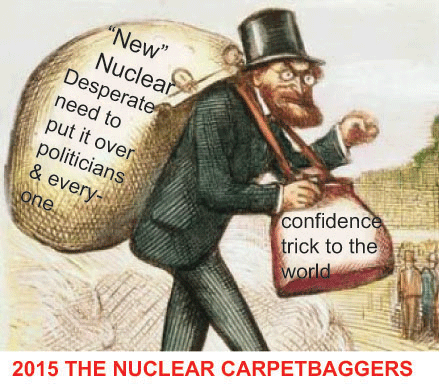
Except there won’t be much. Money that is. Because the Mad Maxatomstrom plan is to carpet-bag into Germany and try to sell them on nuclear energy and only nuclear energy. Yes, you read that right, Mad Maxatomstrom is Germany’s “first provider of 100 percent nuclear power.” (Okay, the company is actually called Maxatomstrom, but the business plan is so mad, who could resist?)
I say “carpet-bag” because notably all the “spokespeople” are anglo-saxon, most of them pulled from the Evangelical School of Nuclear Deniers. They are also all male and all white. Make of that what you choose.
It’s fitting that this new all-nuclear energy company was apparently launched by a member of Germany’s so-called Pirate Party (it has no members of Parliament.) When I first read the press release I thought it was a spoof. It’s also telling that the company could not find a single, prominent German spokesperson.
And I say “not much money” because there are so many other better and equally competitive, if not cheaper, electricity choices already in Germany, some of which are providers of 100% renewable energy. Germany-based anaylst Craig Norris ran the Maxatomstrom numbersand got “three different offers, each around 50 euros a month – an absolutely unremarkable outcome (it’s basically what I pay right now for 100 percent green power.)” So these pirates won’t really be doing so well in the plundering-the-German-people department.
Mad Maxatomstrom claims it already boasts 3,000 customers! Wow, that’s just a tenth of the amount of people still employed in Germany’s declining nuclear sector, and about 100th of the people employed in the growing renewable energy sector. The local Mom and Pop corner store probably does better. Continue reading
Germany models the way to cut greenhouse gases, for a coal-free, nuclear-free future
 The international community has at its disposal more than sufficient renewable resources and the technical capabilities to sustainably harvest these sources. And given the total cost calculations mentioned earlier, we have a moral responsibility to do so. The time for a transition, then, is now. An Energiewende by any other name will still smell as sweet
How Germans Go Green Germany is laying out a model for how to gut greenhouse gas emissions.US News.com By Michael Shank and Johann Saathoff Dec. 9, 2014 With the German government’s reaffirmation this month of carbon emissions reduction goals of 40 percent by 2020, and its courageous commitment to phase out coal, the country is now leading the world with an aggressive and unparalleled climate action plan. This sets a new bar for nations gathering in Lima, Peru, for climate talks.
Germany’s energy transition, or Energiewende, and its aggressive goal of achieving 100 percent renewable energy by 2050 is a direct result of experiencing, firsthand, the risks that come with dirtier and more dangerous fuels. Germany first targeted nuclear and now it’s targeting coal – and for good reason.
Phasing out nuclear energy was a decision based on two factors Germans found so convincing that they now won’t even accept nuclear power as a bridge technology: the Chernobyl nuclear catastrophe and the question of nuclear waste storage.
The decision to opt-out of nuclear power started with Chernobyl, and the nuclear contamination of Germany 28 years ago, and it ended with the Fukushima disaster. By then, nuclear power had lost all traction with the German public. Additionally, there was no conclusive evidence of how to deal with nuclear waste responsibly. This meant that the true cost of producing a kilowatt-hour of nuclear energy remained unknown, leaving most Germans skeptical.
That nuclear rationale is relevant to Germany’s current response to coal. While coal’s catastrophic risks may not be as immediately visible as Chernobyl or Fukushima, the costs are equally immense. Both nuclear and coal come with an incredibly high capacity to contaminate natural resources. And nuclear and coal pollutants don’t disappear over time. They accumulate and contaminate quickly and the consequences will be borne most heavily by future generations.
On nuclear, disposing radioactive waste in deep rock formations with high radiation density and little geological activity is not a sustainable option. Leaks are likely and already occurring. On coal, a vast quantity of heavy metals, toxins and radioactive substances are emitted by all power plants that use coal for electricity generation. Even the most modern and effective filters do not enable coal-fired power plants to be zero emission.
Coal-fired power plants, in particular, emit large amounts of greenhouse gases that have a direct impact on global warming and the inevitable rise of sea levels, as well as extreme weather events. And coal’s contaminating potential is indiscriminate, transcending boundaries and borders, and equally culpable for catastrophic consequences…………….
A responsible alternative, then, if carbon taxes and trading mechanisms are unfeasible or fallible, is to ramp up renewable energy investments, as Germany has done with its Energiewende and will continue to do. And why not: The international community has at its disposal more than sufficient renewable resources and the technical capabilities to sustainably harvest these sources. And given the total cost calculations mentioned earlier, we have a moral responsibility to do so. The time for a transition, then, is now. An Energiewende by any other name will still smell as sweet. http://www.usnews.com/opinion/blogs/world-report/2014/12/09/germany-commits-to-alternative-energy-not-coal-or-nuclear
Dirty tricks involved in Eon’s move to renewable energy

 The filthy tricks behind splitting German nuclear power producer https://indymedia.org.au/2014/12/04/stop-uranium-mining-transportation-enrichment-and-nuclear-fuel-production Submitted by Anonymous (not verified) on Fri, 05/12/2014 The filthy tricks behind splitting German nuclear power producerBy Jochen Stay
Jochen Stay, born 1965, has been active in non-parliamentary movements since he turned 15. Since 1985 public protests stopped a nuclear fuel processing plant being built in Wackersdorf, Bavaria, he’s been an anti-nuclear activist. Since 2008 he’s been the spokesman for the anti-nuclear group, .ausgestrahlt.
Some praise Eon for apparently abandoning its nuclear and coal business and announcing it’s witching to renewable energies in future. But they overlook what’s really driving this splitting into two enterprises.
The outsourcing of nuclear and coal power production under a new name does not lead to Eon customers having less dirty energy delivered to their homes in future. The then make-believe-green company will continue to buy from the new sister company. It’s just not as obvious – and hence less bad for the image.
In future the Eon logo will no longer be on the coal and nuclear power stations, even though Eon will remain the biggest buyer of the power they produce. It’s a way of keeping customers who don’t want to trade with firms directly co-responsible for nuclear waste and the climate catastrophe. This kind of thing is normally called label fraud or greenwashing.
And so it’ll be harder in future to persuade Eon customers to change to other suppliers, seeing that their present one, after all, has become totally green.
When the company publishes numbers that put the self-produced green power in the foreground but hide the bought-in dirty power, a completely false impression will be created in consumers. And the negative headlines about mishaps in power stations, legal action against stopping nuclear power and nuclear waste scandals will then be pasted on the new no-name company, which will be owned by the same shareholders as ever.
The outsourced dirty power department can then act totally without scruples because it no longer has to worry about its reputation – after all, it doesn’t supply any consumers directly.
Eon chief Johannes Teyssen is already wooing investors to the new entity with prospects of billions in compensation legal action is attempting to pry from the government because it ordered closure of a few old nuclear power stations in 2011.
There’s another dangerous background to the splitting of the Düsseldorf based energy giant: in future Eon can no longer be made liable for the costs that will accrue for the dismantling of power stations and the storage of nuclear waste. The reserves set aside for these activities, which fall far short of what will be needed, will pass together with the stations to the new enterprise.
Since these reserves aren’t kept in a bank safe or a fixed term account somewhere, but are invested in coal stations, for example, that are becoming ever less profitable because of the energy turnaround, even many of these very inadequate funds are in danger of being lost.
Sooner or later the new corporation will fall bankrupt and the state will have to shoulder the burden, while Eon, freed of old burdens, can happily continue raking in profits by passing coal and nuclear power to unsuspecting consumers.
This is how this Eon outsourcing under a new name will quasi become a “bad company” – analogous to a “bad bank” in the finance crisis: everything that isn’t profitable in the long term is shoved off into state responsibility.
The fact that the federal economics minister, Sigmar Gabriel, welcomes the Eon split in this situation and claims that the reserves are both secure and adequate is scandalous.
Instead, the federal government must block Eon’s plans and ensure that those who for decades made billions from nuclear and coal power have to pay for the consequences.
Germany steps up program to shut down coal power plants
Germany may shut down eight more coal power plants, document shows, SMH, November 24, 2014 Germany is working on a new law to force energy companies to shut down several more coal-fired power plants as it tries to reach ambitious climate goals, a document seen by Reuters showed on Sunday.
According to a draft legislation prepared by the economy ministry, energy companies will be asked to reduce carbon emissions by at least 22 million tonnes by 2020.
Some 50 facilities already registered for decommission will not count, however, meaning that a further eight coal-fired power stations may be closed down……..
Although Germany has seen a boom in green energy, accounting for about 25 per cent of overall power generation, environmentalists criticise the country for its continued dependence on coal-fired plants, which made up nearly half of power generation last year.
The latest reduction in carbon emissions, if put into effect, would be shared equally between Germany’s power companies, among them major energy firms RWE, E.ON and Vattenfall…….
The latest measure is part of a raft of new climate rules which Chancellor Angela Merkel’s cabinet is expected to decide on Dec. 3. The programme will also include steps to boost energy efficiency.
Merkel’s government wants renewables to make up between 40-45 per cent of power generation by 2025 and 55-60 per cent by 2035 – targets that experts say are ambitious for an industrialised country.
The European Union agreed last month a pledge to cut greenhouse gases by at least 40 per cent in 2030. http://www.smh.com.au/business/carbon-economy/germany-may-shut-down-eight-more-coal-power-plants-document-shows-20141124-11sfdn.html#ixzz3KE3Ddv19
Germany’s debate about scrapping coal energy, as well as nuclear
After nuclear phase-out, Germany debates scrapping coal, Yahoo 7 By Mathilde Richter | AFP – Sun, Nov 23, 2014 After deciding to scrap nuclear power, Germany is pondering saying goodbye to coal, its biggest energy source but also its top polluter and main threat to ambitious climate goals.
Chancellor Angela Merkel’s government is split on the issue, which pits a vocal environmental movement against energy giants and coal mining regions, with only weeks until her cabinet is set to present its next climate action plan.
Environment Minister Barbara Hendricks has said that if Europe’s biggest economy doesn’t reduce coal use, it has no chance of meeting its 2020 target of cutting Earth-warming carbon emissions by 40 percent from three decades earlier. Hendricks’ cabinet colleague in charge of the economy and energy, Vice Chancellor Sigmar Gabriel, sees things differently and has argued that coal is here to stay, citing energy security, cost and many thousands of jobs.
“We can’t simultaneously get out of nuclear and coal,” Gabriel, the leader of the centre-left Social Democrats (SPD) who co-govern with Merkel’s conservatives, has said.
Merkel decided after Japan’s 2011 Fukushima nuclear disaster to shutter all atomic reactors by 2022. By mid-century Germany aims to meet 80 percent of its power needs with renewables such as wind, solar and biogas, which now generate around a quarter.
But an unintended consequence of the “Energiewende”, or energy transition has been a rise in the use of coal, which now generates 46 percent of electricity.
The coal boom in Germany is in part an echo of US shale gas boom.
Cheap natural gas in the United States means coal is being exported to Europe where it undercuts expensive Russian gas, making cleaner and more flexible modern gas plants unprofitable, and several have shut down.
Another factor has been the collapse of the European emissions market, a system meant to factor in the environmental cost of burning fossil fuels. As the penalty for carbon emissions has dropped in price, coal plants have become more lucrative.
– Two birds, one stone –
Environmental pressure groups have campaigned to shut down Germany’s coal plants, and the opposition Greens party, deprived of its signature anti-nuclear crusade, has been at the forefront of the fight, backed by some research institutes………https://au.finance.yahoo.com/news/nuclear-phase-germany-debates-scrapping-201640616.html
An alliance of German activist groups wants to stop nuclear waste export to the USA
 from Diet Simon, 13 Nov 14 An alliance of German environment activists plans to prevent the export of CASTOR containers with highly radioactive fuel pebbles to the USA from Jülich and Ahaus.
When the supervisory board of the Jülich research centre meets on 19 November to discuss what to do with the CASTORS there, activists will mount a protest outside.
The activists argue that several expertises show that the thought-about exports of highly radioactive materials to South Carolina would be illegal. They say government plans to produce legality by simply relabeling the commercially operated Jülich reactor an experimental one won’t work.
“The AVR reactor is without a doubt an output reactor and is listed that way by the Federal Agency for Radiation Protection. That brings it under the law changed last summer which bans the export of radioactive fuel elements and requires the safest possible storage in Germany,” suggests Rainer Moormann, who used to work in the power station and the research centre.
Peter Bastian of the SOFA Münster group emphasises the aspect of societal responsibility: “Though the operators of atomic facilities try to shirk their responsibility for highly radioactive waste, exporting the radiating problems abroad is no solution in our view. An out of sight, out of mind strategy that makes innocent third parties suffer is unacceptable for the disposal of our atomic waste.“
Kerstin Ciesla, of BUND, the German section of Friends of the Earth, demands that the coalition parties in the North-Rhine Westphalian state government, Social Democrats and Greens, keep to their coalition agreement. “That stipulates that the CASTORS, especially those stored in Jülich, will be transported only one more time, and that is to a final repository once a location has been found for one. We will not sit back and watch the coalition agreement being broken, we will try to stop this transport with all the means we can muster.”
The catchcry of the anti-nuclear movement, “Nothing in, nothing out!“ is the basic tenet of the new alliance, currently comprising 13 groups, with more likely to come on board.
At the end of September a tour through Germany with Tom Clements, a South Carolina environmental activist and politician, who heads the Savannah River Site Watch, kicked off the joint activism. The alliance plans to build on that success and decided on continuous cooperation.
The following organisations have joined the alliance:
- Aktionsbündnis Münsterland gegen Atomanlagen, www.urantransport.de/uran.html
- AKW-Nee-Aachen, www.anti-akw-ac.de
- Antiatomplenum Köln, www.antiatomkoeln.de
- Anti Atom-Bündnis Niederrhein, www.antiatom-buendnis-niederrhein.de
- Arbeitsgemeinschaft Schacht Konrad / Atommüll-Alarm, www.ag-schacht-konrad.de
- attac Jülich
- .ausgestrahlt, www.ausgestrahlt.de
- Bündnis Stopp Westcastor, www.westcastor.de
- BUND NRW e.V., www.bund-nrw.de
- Montagsspaziergänger gegen Atomkraft Wegberg
- Robin Wood, www.robinwood.de/Energie.energie.0.html
- Sofa Münster, www.sofa-ms.de
- Strahlenzug Mönchengladbach, www.strahlenzug.de
Dismantling a highly polluted German nuclear reactor with a scandalous cover-up history
from Diet Simon, 15 Nov 14 Under strict secrecy work began on Tuesday 11 November 2014 on dismantling a radioactively highly polluted German nuclear reactor with a scandalous cover-up history. The “experimental” nuke at Jülichwas shut down in 1988, ten years after serious mishaps which included radioactively polluted water escaping into the ground water. The incident was kept secret, then played down.
The operating company says the deconstruction is not dangerous to the public but experts doubt that claim. The work was to be completed tomorrow, 13 November. Continue reading
Activists hold up uranium train in Hamburg
 Anti-nuclear activists stopped a trainload of ”yellow cake” uranium in Hamburg harbour, Germany, for more than seven hours. The train is taking 15 containers of the ore from Kazakhstan to Malvési in southern France for processing, a frequent run.
While two activists suspended themselves over the railway track, eight were temporarily arrested on the ground. Whatever route the trains take – and the Railways always try to keep that secret – all of them run through densely settled parts of Germany.
Activists usually find out the train runs and are again being alerted to mount protest actions in their areas.
After the processing in southern France, the uranium comes back to Germany as uranium hexafluoride for enrichment in Gronau and later processing into nuclear fuel in Lingen.
“That has nothing to do with getting out of nuclear power,“ activists note, alluding to 2023 when all German nukes are slated to be closed down.
If you understand German, go to Robin Wood for updates.
The activists have demanded that Mayor Olaf Scholz, a Social Democrat, close Hamburg harbour to nuclear shipments, as the city of Bremen has done.
From 28-30. November an international meeting to oppose uranium transportation will be held in Münster, hosted by SOFA Münster.
Germany to speed up the phase-out of coal, as well as of nuclear power
Germany looks to fast-track exit from coal, as well as nuclear http://reneweconomy.com.au/2014/germany-looks-dump-coal-well-nuclear-16716 By Giles Parkinson on 5 November 2014 Germany is looking to achieve exactly what Australia says is not possible – and wean one of the world’s largest manufacturing economies off coal – as well as shutting down nuclear.
The conservative government of Chancellor Angela Merkel last week issued a discussion paper proposing to implement the strictest controls on coal fired generation yet to be seen in Europe, and to redesign its energy system around renewables, which will account for around two thirds of supply within two decades.
The discussion paper has been prompted by the need to deal with massive over-capacity in its energy system, and as Germany commits to phasing out the remainder of its nuclear generators by 2022 and sourcing nearly half of its electricity supply from renewables – hydro, biomass, wind and solar – within a decade.
The government discussion paper said too many fossil-fired power plants are in the system and overcapacities “have to be cut” to help meet climate targets. The response is in stark contrast to the situation in Australia, where the conservative government of Tony Abbott is using the argument of “overcapacity” to shut down the pipeline of new renewable energy projetcs, rather than forcing coal to exit the market. Continue reading
German power companies discreetly trying to sell their holdings in URENCO
 Ticking nuclear time bomb up for grabs URANTRANSPORT.De 3 Nov 14 As discretely as possible, the German power companies EON and RWE are trying to sell their holdings in URENCO, the tri-national company that produces weapons-grade uranium. The prominent German newspaper, Sueddeutsche Zeitung, reported that not only respectable potential buyers are lining up to bid and that intelligence services are on alert.
The German URENCO plant is located at Gronau, a small town only a stone’s throw away from the border with the Netherlands. And not far into that country is another URENCO plant at Almelo.
The newspaper incorrectly describes Gronau as “the last bastion of the nuclear industry in Germany”, which it is not. There is also a nuclear fuel plant at Lingen and centrifuge research and development in Jülich, run jointly by a Urenco/Areva subsidiary.
With a world market share of 31% the German-Dutch-British URENCO, which also operates plants in the UK and the USA, is one of the major suppliers of nuclear fuel. Almost unnoticed by the general public, URENCO keeps Germany a major player in nuclear power, which officially is planned to end in the country in 2023.
As the newspaper points out, “URENCO possesses highly sensitive knowledge: the key to the atom bomb“. The one-third-each owners, which apart from the two power companies include the British and Dutch governments, want to sell the firm to investors.Ten billion euros is one figure being mentioned. Bids to be accepted until the end of December.
It’s a scary scenario: “Up for sale is the simplest path to the atom bomb,” suggests Michael Sailer of the Eco-Institute in Darmstadt, an advisor on nuclear matters to the German government.
Finance circles say the list of potential buyers includes firms and hedge funds around the world, in Canada, Japan, Britain, Hong Kong, India and the Middle East. There’s even talk of questionable billionaires and states.
Experts say in Gronau alone enough highly enriched uranium to make a bomb could be produced in a few weeks.
If the state owners give up their controlling majority, it will get ever harder to protect the technology against unpermitted access, notes Sailer. “I find it irresposnible to leave a technology with such destructive power to the market.“
The Sueddeutsche Zeitung says secret documents from the Netherlands make clear how far plans to sell up are advanced in London and The Hague.
German parliamentarians have been told by the government that intelligence services have been brought in to study potential buyers. The same is said to be happening in Britain and The Netherlands.
“Every transfer of knowledge of uranium enrichment technology also increases the knowledge of atomic weapon technology,“ warns Sylvia Kotting-Uhl of the German Greens, and calls on the German government to veto the sale.
“We demand the immediate closure of the Gronau uranium enrichment plant,“ writes a group of activists in Muenster, which is close to Gronau, as well as centrifuge research and development in Jülich, run jointly by a Urenco/Areva subsidiary, ETC.
The Aktionsbündnis Münsterland gegen Atomanlagen (SOFA) will host an international uranium transportation conference from 28-30. November in Münster.
www.sofa-ms.de, www.urantransport.de, www.kein-castor-nach-ahaus.de
Germany’s new style decentralised energy industry
 Germany embracing renewable energy Power production from renewables has tripled in Germany within the past decade, mostly from wind and solar. Yahoo News 29 Oct 14
“……..Last year, renewables accounted for 24 per cent of the country’s electricity.The German government introduced generous subsidies to kick-start the sector, amounting to 16 billion euros last year. But the government claims the program has already saved billions in fuel costs for the heavily import-reliant country.
“We have created new businesses worth 40 billion euros per year,” Ecologic Institute analyst Andreas Kraemer said.”We have created additional employment for up to 400,000 people. They all pay taxes, they all pay social security charges.”
German households and small business pay the largest share for the renewable turnaround.They pay around 29 euro cents per kilowatt hour and much of that goes towards a renewable energy surcharge.
Big industrial users are exempt from the surcharge and pay just 3.5 cents per kilowatt hour……..
A new-look energy market The energy turnaround has clouded the future for the dominant utility companies in Germany.Germany’s big four, Vattenfall, E.on, RWE and EnBW, have enjoyed an oligopoly driven by nuclear power and fossil fuels………
Investors look for exposure to renewables market The makeup of the German energy market already looks very different, with hundreds of companies and cooperatives being formed in a decentralised industry.
While banks, industry, and project developers own 40 per cent of renewable installations, farmers and private investors own half.A number of new investment vehicles have formed to take advantage of the new industry. Crowd funding start up Bettervest has financed 14 projects since its inception a year ago.
Company spokesman Julien Schroder-Gianoncelli said investors are attracted by the projects and the returns,\. “We are offering 5-10 per cent in interest, which is pretty good at the moment,” he said.
Ceramic Fuel Cells believes Germany’s regulations, incentives and market make it the place to be. Mr Obernitz said that, for the time being at least, there are no incentives available in Australia.
“I’m not sure if that is going to change,” he said.
“We would favour that because we have invented the technology in Australia, and it’s something that will change the world.”……… https://au.news.yahoo.com/vic/a/25372077/germanys-renewable-energy-incentives-and-regulations-attracting-australian-companies/
German govt sets up commission to seek solution to nuclear waste disposal

 Where Shall We Store Our Radioactive Waste? Red Baron’s Blog, 18 Oct 14, From September 20 to 22, 2014 the Deutsch-Schweizer Fachverband für Strahlenschutz (Swiss-German Radiation Protection Association) held a symposium in Mainz dealing with the topic: Zwischenlager – Dauerlager – Endlager: Wohin mit unserem radioaktiven Abfall? (Intermediate, permanent and final storage: Where shall we store our radioactive waste?)
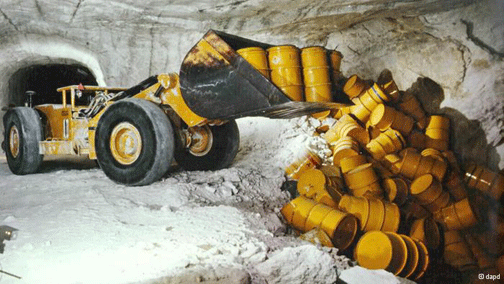
The Federal Government has set up a commission of 33 persons to deal with the deposition of highly-radioactive waste according to the Standortauswahlgesetz(Law for selecting a site). The German government called scientists, members of environmental associations, representatives of the Churches!!, economy, trade unions, members of parliament and state governments into the commission to find a consensus on a site until December 31, 2015. In their initial sessions the members of the commission lost their time on points of order; so I doubt that they will meet the deadline set by the government…….http://mhoefert.blogspot.com.au/
Germany dealing with the challenge of exiting from both nuclear power and fossil fuels
Germany: Exiting coal-fired energy at same time as nuclear impossible http://www.gmanetwork.com/news/story/383277/economy/business/germany-exiting-coal-fired-energy-at-same-time-as-nuclear-impossible October 12, 2014 BERLIN – Germany dismissed on Sunday a report suggesting it planned to exit coal-fired power generation in order to protect the climate, saying this would impose too great a burden on industry as the country is also phasing out nuclear energy.
Der Spiegel weekly said Economy and Energy Minister Sigmar Gabriel was planning a medium-term exit from coal due to environmental concerns. Its report cited no sources.
“For a country like Germany with a strong industrial base, exiting nuclear and coal-fired power generation at the same time would not be possible,” a spokeswoman for his ministry said in an emailed statement.
Germany, Europe’s largest economy, is currently going through an “Energiewende”, an energy shift which moves the country towards renewable sources following a decision to phase out nuclear power by 2022.
Chancellor Angela Merkel’s coalition government wants renewable energies to make up 40-45 percent of German energy consumption by 2025 and 55-60 percent by 2035. The Spiegel report said the government wanted to remove 10 gigawatts of coal-fired power generation, equivalent to around two dozen small power plants, from the network.
The ministry spokeswoman said it was first and foremost for the operators to decide which plants to shut down and they must then apply for approval to the federal network agency.
“It’s clear, though, that the conventional generation system must adapt to the needs of the Energiewende,” she added.
Coal-fired power accounted for around 45 percent of German power generation in 2013. — Reuters
IN 2014 Germany gets 27% of electricity from renewable energy
Germany kicks our butts, again, at clean energy Grist, By Liz Core 2 Oct 2014 Germany has hit a new clean energy milestone: So far this year, the country has gotten more electricity from renewables than from any other single source, 27.7 percent. That (just barely) beats the 26.3 percent of power generated by lignite coal, according to Agora research organization.
“This is a real success and watershed moment,” said Famke Krumbmuller, an analyst at Eurasia Group.
Wind accounted for 9.5 percent of the power fed into the country’s grid in the first nine months of 2014, biomass for 8.1, solar for 6.8 percent, and hydropower for less than 4 percent.
Last year, Germany got 24.1 percent of its electricity from renewables, so it’s up more than 3 percent. German Chancellor Angela Merkel’s government is aiming to get as much as 60 percent of the nation’s electricity from clean sources by 2035, even while phasing out nuclear power by 2022. (If you’re still looking for a star quarterback for your climate hawk fantasy league, Merkel is looking like she might be ace at pummeling her way to a climate goal.)
The U.S., by contrast, got just 6 percent of its electricity from wind, solar, biomass, and geothermal last year, and other 7 percent from hydro……http://grist.org/list/germany-kicks-our-butts-again-at-clean-energy/
Chernobyl’s radiation still there in Europe’s wild boars
Radioactive Boars From Chernobyl Are Still Wandering Around Germany, Sarah Zhang, http://www.gizmodo.com.au/2014/09/radioactive-boars-from-chernobyl-are-still-wandering-around-germany/4 Sept 14 Nearly 30 years later, radiation from Chernobyl still scars the landscape. Perhaps most remarkably, some of that radiation travelled hundreds of kilometres downwind, settled into the soil, and moved up through the food chain. So now we have radioactive wild boars, still roaming around Germany causing trouble.
Since 2012, according to the Telegraph, the state government of Saxony has required that boars hunted for food be tested for radiation. One in three regularly exceeds the safety limit. How did wild boars born decades after the Chernobyl disaster become radioactive? The Telegraph explains:
Even though Saxony lies some 700 miles from Chernobyl, wind and rain carried the radioactivity across western Europe, and soil contamination was found even further away, in France.
Wild boar are thought to be particularly affected because they root through the soil for food, and feed on mushrooms and underground truffles that store radiation. Many mushrooms from the affected areas are also believed to be unfit for human consumption.
Wild radioactive boars may be dangerous to eat, but wild boars in general are a menace across Germany. They’re digging up gardens, shutting down the Autobahn, and even attacking the occasional poor soul. Read more about the boars at the Telegraph.
1 This Month

of the week – Shut Down Drone Warfare!


Tell the Ukrainian Government to Drop Prosecution of Peace Activist Yurii Sheliazhenko

Petition to revoke the licensing of the Near Surface Nuclear Disposal Facility (NSDF) at Chalk River. https://www.ourcommons.ca/petitions/en/Petition/Details?Petition=e-7247
To see nuclear-related stories in greater depth and intensity – go to https://nuclearinformation.wordpress.com
-
Archives
- April 2026 (44)
- March 2026 (251)
- February 2026 (268)
- January 2026 (308)
- December 2025 (358)
- November 2025 (359)
- October 2025 (376)
- September 2025 (257)
- August 2025 (319)
- July 2025 (230)
- June 2025 (348)
- May 2025 (261)
-
Categories
- 1
- 1 NUCLEAR ISSUES
- business and costs
- climate change
- culture and arts
- ENERGY
- environment
- health
- history
- indigenous issues
- Legal
- marketing of nuclear
- media
- opposition to nuclear
- PERSONAL STORIES
- politics
- politics international
- Religion and ethics
- safety
- secrets,lies and civil liberties
- spinbuster
- technology
- Uranium
- wastes
- weapons and war
- Women
- 2 WORLD
- ACTION
- AFRICA
- Atrocities
- AUSTRALIA
- Christina's notes
- Christina's themes
- culture and arts
- Events
- Fuk 2022
- Fuk 2023
- Fukushima 2017
- Fukushima 2018
- fukushima 2019
- Fukushima 2020
- Fukushima 2021
- general
- global warming
- Humour (God we need it)
- Nuclear
- RARE EARTHS
- Reference
- resources – print
- Resources -audiovicual
- Weekly Newsletter
- World
- World Nuclear
- YouTube
-
RSS
Entries RSS
Comments RSS
 nuclear-news