Germany an example to the world of the massive radioactive waste costs of the nuclear industry
Sticker Shock: The Soaring Costs Of Germany’s Nuclear Shutdown, Yale Environment 360 25 JUL 2016: REPORT German Chancellor Angela Merkel’s 2011 decision to rapidly phase out the country’s 17 nuclear power reactors has left the government and utilities with a massive problem: How to clean up and store large amounts of nuclear waste and other radioactive material. by joel stonington 26 july 16 The cavern of the salt mine is 2,159 feet beneath the surface of central Germany. Stepping out of a dust-covered Jeep on an underground road, we enter the grotto and are met by the sound of running water — a steady flow that adds up to 3,302 gallons per day.

“This is the biggest problem,” Ina Stelljes, spokesperson for the Federal Office for Radiation Protection, tells me, gesturing to a massive tank in the middle of the room where water waits to be pumped to the surface.
The leaking water wouldn’t be an issue if it weren’t for the 125,000 barrels of low- and medium-level nuclear waste stored a few hundred feet below. Most of the material originated from 14 nuclear power plants, and the German government secretly moved it to the mine from 1967 until 1978. For now, the water leaking into the mine is believed to be contained, although it remains unclear if water has seeped into areas with waste and rusted the barrels inside.
The mine — Asse II — has become a touchstone in the debate about nuclear waste in the wake of German Chancellor Angela Merkel’s 2011 decision to end the use of nuclear power following Japan’s Fukushima disaster. The ongoing closures have created a new urgency to clean up these nuclear facilities and, most importantly, to find a way to safely store the additional radioactive waste from newly decommissioned nuclear reactors. Nine of the country’s 17 nuclear power reactors have been shut down and all are expected to be phased out by 2022.
In addition to Asse II, two other major lower-level nuclear waste sites exist in Germany, and a third has been approved. But the costs associated with nuclear waste sites are proving to be more expensive, controversial, and complex than originally expected.
And Germany still hasn’t figured out what to do with the high-level waste — mostly spent fuel rods — that is now in a dozen interim storage areas comprised of specialized warehouses near nuclear power plants. Any future waste repository will have to contain the radiation from spent uranium fuel for up to a million years.
Given the time frames involved, it’s not surprising that no country has built a final repository for high-level waste. In Germany, a government commission on highly radioactive nuclear waste spent the last two years working on a 700-page report, released this month, that was supposed to recommend a location. Instead, the report estimated that Germany’s final storage facility would be ready “in the next century.” Costs are expected to be astronomical.
“Nobody can say how much it will cost to store high-level waste. What we know is that it will be very costly – much higher costs can be expected than [what] the German ministry calculates,” said Claudia Kemfert, head of energy, transportation, and environment at the German Institute for Economic Research. The exact number, she said, “cannot be predicted, since experience shows that costs have always been higher than initially expected. ”
At the Asse II mine, roughly $680 million has been spent in the six years since the cleanup began, and the price tag for operations last year totaled $216 million. A 2015 report by Germany’s Environment Ministry noted, “There are currently no technical plans available for the envisaged waste recovery project which would allow a reliable estimate of the costs.”
No one expects to start moving the barrels at the mine until 2033, and estimates of finishing the process extend to 2065. Total costs for moving the waste to a future storage site will almost certainly be in the billions of dollars, with current estimates of just disposing of the recovered waste at $5.5 billion.
The waste issue is one reason nuclear power has been so controversial in Germany and why there is broad support among the public for phasing it out, with three-quarters of the German population saying they are in favor of Merkel’s decision, according to a survey this year by the Renewable Energy Hamburg Cluster.
“Nuclear in Germany is not popular,” Kemfert said. “Everybody knows it is dangerous and causes a lot of environmental difficulties. Nuclear has been replaced by renewables – we have no need for nuclear power any more.”…………..
With both nuclear waste storage and decommissioning, governments and power companies around the world have often opted for halfway solutions, storing waste in temporary depots and partially decommissioning plants. Worldwide, 447 operational nuclear reactors exist and an additional 157 are in various stages of decommissioning. Just 17 have been fully decommissioned.
In Europe, a recent report by the European Union Commission estimated that funds set aside for waste storage and decommissioning of nuclear plants in the EU’s 16 nuclear nations have fallen short by $137 billion. Dealing with nuclear waste in the United Kingdom is also a highly charged issue. At one location — a former weapons-manufacturing, fuel-reprocessing, and decommissioning site called Sellafield — the expected cleanup cost increased from $59 billion in 2005 to $155 billion in 2015. ……
despite recently completing a new plant, the United States is also struggling with decommissioning. The cost estimates of shuttering U.S. nuclear plants increased fourfold between 1988 and 2013, according toBloomberg News. Many governments are slowly starting to realize how much those costs have been underestimated.
As Antony Froggatt, a nuclear expert and researcher at Chatham House — a London-based think tank— put it, “The question is, how do you create a fair cost to cover what will happen far into the future?” http://e360.yale.edu/feature/soaring_cost_german_nuclear_shutdown/3019/
German situation shows the complex problem of who pays for nuclear wastes disposal
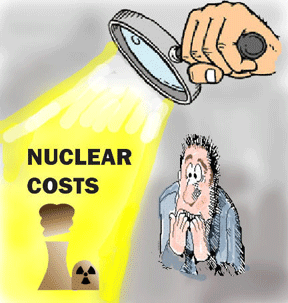 Sticker Shock: The Soaring Costs Of Germany’s Nuclear Shutdown, Yale Environment 360 25 JUL 2016: REPORT “…….In Germany, negotiations with utilities over who will pay the denuclearization costs have often centered on how much the utilities can afford. The four nuclear utilities in Germany – publicly-traded RWE; E.ON; EnBW, which is majority publicly-owned; and Swedish-owned Vattenfall – are struggling economically as decentralized wind and solar power have undercut wholesale electricity prices and eaten into profits. Last year, E.ON, Germany’s largest utility, lost $7.7 billion.
The four companies have already set aside $45 billion for decommissioning nuclear power plants. But in April, Germany’s Commission to Review the Financing for the Phase-Out of Nuclear Energy recommended that the utilities pay an additional $26.4 billion into a government-controlled fund meant to cover the costs of long-term storage of nuclear waste.
The utilities were unhappy with the commission’s conclusions and released a joint statement saying $26.4 billion would “overburden energy companies’ economic capabilities.” Even so, few experts expect those sums to cover the total eventual costs.
“Some billions now are better than making them bankrupt,” said Michael Mueller, who chairs a government commission on highly radioactive nuclear waste. “So, it’s a compromise that had to be made.”
The utilities are clear about where they see the responsibility: “The temporary and final storage of nuclear waste in Germany is an operative task of the German government, which is politically responsible for this,” the utilities said in a statement. Indeed, if the commission’s recommendation becomes law, then the German government will be on the hook for any storage costs beyond the $26.4 billion paid by the utilities.
“Asse II shows us that radioactive waste storage is a complex problem that is not just about dumping it somewhere,” said Jan Haverkamp, a nuclear energy expert at Greenpeace. “There are many open questions, and those questions are going to lead to a lot more costs………” http://e360.yale.edu/feature/soaring_cost_german_nuclear_shutdown/3019/
Germany still struggling with legacy of old nuclear wastes
Sticker Shock: The Soaring Costs Of Germany’s Nuclear Shutdown, Yale Environment 360 25 JUL 2016: REPORT“……….Radioactive water was first detected leaking at Asse II in 2008, and the German Bundestag passed a law five years later that mandated removal of the waste. Above ground, the complex is just a few fenced-in buildings amid forests and farms. Underground, passageways have closed or collapsed. One main elevator shaft going down into the mine can be used for transporting large machinery, such as front loaders, some of which has to be welded together in underground workshops. As for the areas with actual waste, workers have spent years drilling into just one of 13 chambers to test for gas and radioactivity.
“No one goes in,” said Stelljes. “We haven’t even developed the machines we would need for moving the waste.”
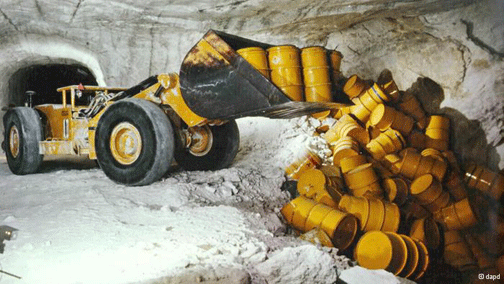
A former iron mine, Konrad, is being converted into a site to store low- and medium-level waste; it is expected to be completed in 2022. Low- and medium-level waste account for 90 percent of Germany’s total nuclear waste, but just 0.1 percent of the total radioactivity of the nation’s waste.
The most dangerous and controversial waste is heavy-metal-laden, heat-producing waste from spent fuel rods. Germany expects the total of that high-level waste to take up 28,100 cubic meters (1 million cubic feet) — a fraction of the volume of low- and medium-level waste the country must eventually store. Preliminary plans from Germany’s Federal Office for Radiation Protection call for a high-level waste repository to be built by 2050, with storage complete by 2130, and final sealing of the repository as late as 2170.
“No one has a finished concept [for storage of high-level waste], so no one can give us a finished budget,” Haverkamp said. “I won’t give an estimate anymore, but the numbers are in the billions. How many? No one knows. That’s the problem in Germany, you have to reserve a certain amount of money, but how much?” …. http://e360.yale.edu/feature/soaring_cost_german_nuclear_shutdown/3019/
UK and Germany of backtracking on the spirit of the Paris climate deal, funding fossil fuels


 UN criticises UK and Germany for betraying Paris climate deal
Climate change envoy singles out both countries for subsidising the fossil fuel industry and says the UK has lost its position as a climate leader, Guardian, Adam Vaughan, 18 July 16, Ban Ki-moon’s climate change envoy has accused the UK and Germany of backtracking on the spirit of the Paris climate deal by financing the fossil fuel industry through subsidies.
Mary Robinson, the former president of Ireland and UN special envoy on climate change and El Niño, said she had to speak out after Germany promised compensation for coal power and the UK provided tax breaks for oil and gas.
Governments in Paris last year not only pledged to phase out fossil fuels in the long term but to make flows of finance consistent with the reduction of greenhouse gas emissions.
“They’ve [the British government] introduced new tax breaks for oil and gas in 2015 that will cost the UK taxpayer billions between 2015 and 2020, and at the same time they’ve cut support for renewables and for energy efficiency,” she told the Guardian…..
The criticism comes as Theresa May’s government has come under fire at home and abroad for its leadership on climate change after it abolished the Department of Energy and Climate Change. Senior figures such as the outgoing UN climate change chief have urged the UK not to abandon its climate commitments as it leaves the EU. “Let us remember that the Brexit vote was not about climate change,” said Christiana Figueres.
Natalie Bennett, the leader of the Green party, said: “This damning indictment of the UK’s energy policy comes just days after our new prime minister scrapped the Department of Energy and Climate Change and appointed an environment secretary who has consistently voted against measures to tackle climate change.
“I urge Theresa May to listen carefully to Robinson’s remarks and start reversing the damaging policies put in place by her predecessor – like giving tax breaks to fossil fuel companies while cutting subsidies for renewables.”
Robinson said that while Germany had made some positive steps such as aiding developing countries on climate change, it was sending mixed messages.
Germany says its on track to end coal subsidies by 2018 but the German government is also introducing new mechanisms that provide payment to power companies for their ability to provide a constant supply of electricity, even if they are polluting forms, such as diesel and coal,” she said. She called on Germany to make a real commitment to get out of coal.
But she said her criticism was far from limited to the two countries. “We want all countries to end [fossil fuel] subsidies,” she said…..
The likely US Republican presidential nominee, Donald Trump, has said he would try to unpick the deal, but Robinson said if it was ratified by the US this year “unwinding it would be very prolonged and difficult. I sincerely hope we won’t be facing that problem.”
However Hillary Clinton would be good on climate because she had been pushed by Bernie Sanders to adopt an ambitious climate change platform, she said.
Robinson said she been to Ethiopia recently and seen firsthand the way manmade climate change was exacerbating natural climate phenomenons such as El Niño, which brings drought to some parts of the world, and flooding to others. “I saw so many malnourished children, and it’s not tolerable.”…….https://www.theguardian.com/environment/2016/jul/18/un-criticises-uk-and-german-for-betraying-the-spirit-of-the-paris-climate-deal
Court reject nuclear company EOn’s claim for compensation
 Court rejects EOn’s compensation claim, World Nuclear News, 5 July 16 A regional court in Hannover has ruled that EOn is not entitled to €382 million ($426 million) in compensation it sought for the forced shut down of its Isar 1 and Unterweser nuclear power units in 2011……The court’s ruling echoes that of a decision in April by a regional court in Bonn to throw out a similar compensation claim by EnBW for the shutdown of its Neckarwestheim 1 and Phillipsburg 1 units in the state of Baden-Würtemberg. That court ruled the utility, which also filed its lawsuit in 2014, had not used immediately “all legal means available” to avert the consequences of the forced shut down of its nuclear power units.
EnBW had sought compensation of €261 million, citing German court decisions in 2013 and 2014 in favour of rival utility RWE, which had sued for damages of €235 million against the forced closure of its Biblis reactor immediately after the moratorium.http://www.world-nuclear-news.org/C-Court-rejects-EOns-compensation-claim-0507164.html
Germany’s struggle over nuclear waste storage
Germany may wait 100 years for nuclear waste storage site https://au.news.yahoo.com/world/a/31991613/germany-may-wait-100-years-for-nuclear-waste-storage-site/#page1 July 6, 2016, Berlin (AFP) – Germany may not have a final storage facility for its nuclear waste up and running until the next century, an expert report released on Tuesday suggested.
For the past two years, a commission of scientists, industry leaders and civil society representatives have debated the question of where Germany should store waste from its soon-to-be-retired nuclear reactors.
Initially, the commission had hoped to reach a decision on the final site of the highly radioactive spent fuel from the country’s power plants by 2031, with the facility itself slated to open in 2050.
But even that decades-spanning timetable was described by commission president Michael Mueller as “ambitious”.
The final report, published on Tuesday, stated that the storage facility might only enter service “in the next century”. For many years now, a site in Gorleben, in the northern state of Lower Saxony, had been under discussion, drawing often violent clashes between police and anti-nuclear demonstrators.
But choosing a site for the permanent nuclear waste dump has become all the more pressing since 2011, when Chancellor Angela Merkel announced plans to shut down all eight remaining reactors in the country by 2022 following the Fukushima disaster in Japan.
In the wake of that decision, the expert commission was instructed to go back to square one and choose a suitable spot within Germany based on scientific criteria.
Gorleben is still one of the possible options, but a series of other sites are also being looked at. Germany’s vocal environmentalist movement was quick to lash out at the report’s findings on Tuesday.
Commission members had simply “delayed” the decision, said Jochen Stay of anti-nuclear organisation Ausgestrahlt.
“The recommendations they’ve made are so vague that they could justify choosing any site,” Stay added.
Germany’s government has been locked in battles with industry for years over who should foot the bill for the nuclear phase-out, with the costs of storing the waste and safely dismantling the reactors representing a very substantial financial risk for the country’s four biggest power suppiers, RWE, Vattenfall, EON and EnBW.
Complications in who pays for costs of Germany’s nuclear phase-out
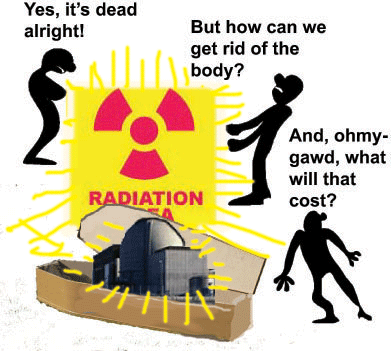 Who pays for Germany’s nuclear phase-out?,DW Hilke Fischer 1 July 16 Germany’s decision a few years ago to phase out nuclear power was an abrupt move. But it still remains unclear who foots the bill for shutting down the nation’s nuclear plants, as utilities seek damages from the state. Months after a Tsunami resulted in a nuclear disaster at the Fukushima Daiichi plant in Japan, Germany’s coalition government, led by Chancellor Angela Merkel, decided to phase out nuclear power in the country.
Immediately after Fukushima, eight of 17 functioning nuclear plants were shut down, and the government’s decision established a timeline of taking the remaining plants offline by 2022.
Five years later, it’s gradually becoming clear how much this hasty exit could cost. Feeling dispossessed by the move, major utilities have filed a raft of lawsuits claiming damage payments from the government amounting to around 20 billion euros ($22.3 billion).
An eagerly awaited ruling
Complying with the government’s nuclear moratorium, Germany’s biggest energy provider Eon had to shut down its power plants Isar 1 and Unterweser. The company has therefore sued both the federal government as well as the state governments of Bavaria and Lower Saxony, seeking damage payments to the tune of around 380 million euros. The state court of Hanover is expected to deliver its ruling on the case on Monday, July 4………..
the energy companies take issue not only with the moratorium. They – RWE, Eon and Vattenfall – have also lodged numerous cases at the constitutional court in Karlsruhe against the government’s entire policy mandating an accelerated exit from nuclear power……..
State responsible for disposal costs?
Lodging cases before the constitutional court is a pressure tactic, said Green Party politician Oliver Krischer in March. “It’s to obtain concessions over the financing of nuclear waste disposal,” he remarked, pointing to the nuclear commission the government had set up to advise it on how to allocate the costs of storage and disposal of nuclear waste as well as the decommissioning of the power stations.
At the end of April, the commission presented its recommendations: The companies have to bear the costs of decommissioning the nuclear power plants. Furthermore, Eon, RWE, Vattenfall and EnBW are to pay 23.3 billion euros into a fund to manage the storage and disposal of nuclear waste.
In return, the state is to take on all the residual financial risks associated with radioactive waste management. A number of scientists and economists argue that the costs would be much higher than the 23.3 billion euros, and that the taxpayers would be on the hook for those cost overruns.
Germany’s parliament is expected to vote on the recommendations after the summer break, and should it approve them, they would come into force at the end of the year. http://www.dw.com/en/who-pays-for-germanys-nuclear-phase-out/a-19372796
Germany criticises NATO’s warmongering policy towards Russia
Germany slams NATO ‘warmongering’ on Russia Berlin , Yahoo News, 18 June 16 (AFP) – German Foreign Minister Frank-Walter Steinmeier has criticised NATO for having a bellicose policy towards Russia, describing it as “warmongering”, the German daily Bild reported.
Steinmeier pointed to the deployment of NATO troops near borders with Russia in the military alliance’s Baltic and east European member states.
“What we should avoid today is inflaming the situation by warmongering and stomping boots,” Steinmeier told Bild in an interview to be published Sunday. “Anyone who thinks you can increase security in the alliance with symbolic parades of tanks near the eastern borders, is mistaken,” Germany’s top diplomat added.
NATO had announced on Monday that it would deploy four battalions to Estonia, Latvia, Lithuania and Poland to counter a more assertive Russia, ahead of a landmark summit in Warsaw next month…….https://www.yahoo.com/news/germany-slams-nato-warmongering-russia-115515814.html
EDF/AREVA keen to get in on selling nuclear reactors to South Africa
 Bullish Areva wants in on SA’s nuclear tender, City Press Yolandi Groenewald 2016-06-
 10 France’s state-owned nuclear businesses are focused on winning the lucrative South African nuclear tender despite recent financial difficulties.
The French will bid as EDF/Areva – nuclear technology company Areva sold its reactor business to the state-owned energy utility EDF earlier this year……..
EDF was facing large investments at its French operations. Its investment compromised about €50 billion (R869.6 billion) over 10 to 15 years, which would extend the operating lifespan of its ageing fleet to 60 years……
The French nuclear industry has faced a number of storms during the past year. Areva teetered on the edge of bankruptcy after years of losses wiped out its equity. It was rescued by French state aid and a sale of its reactor business to EDF.
The Flamanville project in France, Areva’s first European Pressurised Reactor (EPR) nuclear pressurised water reactor, is years behind schedule, way over budget and riddled with technical difficulties…….
France, Russia, China, the US and South Korea are competing for what could be South Africa’s biggest procurement project. The contract, estimated to cost between R580 billion and R1.56 trillion, aims to add nuclear capacity of 9 600 megawatts.
The government has said the nuclear programme would be developed at a pace the country can afford……..http://city-press.news24.com/Business/bullish-areva-wants-in-on-sas-nuclear-tender-20160603
Germany readying law on nuclear waste storage costs
BERLIN – The German Cabinet plans to approve a draft law on Aug. 3 that will require its utilities to pay billions of euros into a state fund to help cover the cost of nuclear storage, according to an Economy Ministry timetable seen by Reuters on Monday.
A commission recommended in April that Germany’s “big four” power firms — E.ON, RWE, EnBW and Vattenfall — pay a total €23.3 billion ($26 billion) to remove unwanted long-term liability for the storage of nuclear waste.
The commission asked utilities to transfer provisions set aside for storage sooner than expected, starting with a first instalment totalling €17.2 billion no later than early 2017. The government is widely expected to adopt the commission’s proposals.
The legacy costs stem from Germany’s decision to end nuclear power by 2022 following the start of Japan’s Fukushima disaster five years ago.
The Bundestag lower house of parliament is due to vote on the law in early November and to be debated in the upper house at the end of November, the timetable showed.
Timing is all important, for iodine tablets to be effective against ionising radiation
North Rhine-Westphalia prepares for Belgium nuclear accident with iodine tablets, DW, 2q4 May 16“…….In the case of a nuclear disaster, timing is paramount in the administration of iodine tablets. The medication works by supplying the thyroid gland with a concentrated amount of “healthy” iodine. In theory, this should prevent the gland from absorbing any radioactive iodine released into the air in a nuclear accident.
Taken too early, however, “healthy” iodine will already have been partially or even completely broken down. Taken too late, the radioactive iodine will have already been absorbed by the thyroid – potentially increasing the risk of thyroid cancer.
The only nuclear accident to date, which called for the use of iodine tablets was the 1986 Chernobyl disaster. In Poland, some 10.5 million children and 7 million adults were successfully administered the “healthy” iodine, with later examinations reaping only positive results. In Belarus, however, where no iodine tablets were administered, thyroid cancer in children – which is usually extremely rare – was reported 100 times higher than normal. http://www.dw.com/en/north-rhine-westphalia-prepares-for-belgium-nuclear-accident-with-iodine-tablets/a-19279950
German State close to Belgium prepares iodine tablets, in concern about neighbouring nuclear stations
North Rhine-Westphalia prepares for Belgium nuclear accident with iodine tablets, DW, 24 May 16 Amid growing safety concerns over Belgium’s aging nuclear reactors, Germany’s most populous state has purchased iodine tablets in case of a nuclear accident. Activists insist the best solution is to close the plants. With plans already in place to end its domestic use of nuclear power by 2022, Germany has taken a clear stance on its use of nuclear energy since the 2011 Fukushima disaster.
But while Berlin pushes forward with alternative renewable energy sources at home, across the border in Belgium, its efforts are overshadowed by two controversial nuclear power plants.
Tihange 2 and Doel 3 were both scheduled to be shut down in 2015. Under a deal to preserve jobs and invest in clean energy, however, Belgian officials decided to extend their operation until 2025.
Following reports that pressure vessels at both reactor sites have shown signs of metal fatigue, the two reactors have become a source of growing tension between Germany and Belgium in recent months. Just 60 kilometers (37 miles) away from Tihange, lies the German city of Aachen – home to some 240,000 people and best known as the residence of ninth century emperor, Charlemagne.
In April, German Environment Minister Barbara Hendricks called on Brussels to carry out more teststo at the plant to show that Belgium “takes the concerns of its German neighbors seriously.” The 40-year-old reactors should be closed “until outstanding safety issues are resolved,” the minister said.
Fears have also grown over the possibility of terrorists targeting nuclear power plants, particularly after the March 22 terrorist attacks in the Belgian capital.
Brussels rejected Berlin’s request, claiming that the two plants “respond to the strictest possible safety requirements.” Less than a month later, however, Belgian Health Minister Maggie De Block announced that in the case of a nuclear disaster, people living within a 100-kilometer (60-mile) radius of the reactor would be provided with iodine tablets in a bid to minimize the effects of radiation. With Belgium only 300 kilometers at its widest point, the majority of the country’s 11-million population would effectively be included in the measure.
Having heard nothing from Brussels on the closure of either power plant, the North Rhine Westphalia (NRW) Interior Ministry announced on Tuesday that they, too, would be taking similar preventative measures, with iodine tablets being made available to the over 45-year-olds, children and pregnant women in the case of a serious nuclear leak.
“We will gradually provide each municipality with iodine tablets,” spokeswoman for NRW Interior Ministry Marlin Mailänder told DW……
Anti-nuclear energy campaigners welcomed the move by the NRW Interior Ministry on Tuesday, but vowed to continue their campaign to close the nuclear reactors.
“Of course it’s a sensible step,” co-founder of the citizen initiative “Aachen Action Group Against Nuclear Engery,” Jörg Schellenberg, told DW.
“But the better solution would be to bring an end to the source of the danger,” he added. “We need to shut down the nuclear power plants once and for all.” http://www.dw.com/en/north-rhine-westphalia-prepares-for-belgium-nuclear-accident-with-iodine-tablets/a-19279950
Ruhr nuclear plant intentionally pumped radioactive waste into atmosphere
 Ruhr nuclear plant ‘pumped radioactive waste into air’, the Local de 20 May 2016 A former engineer at one of Germany’s nuclear reactors has made an astonishing claim: that the plant intentionally pumped radioactive waste into the atmosphere in 1986.
Speaking to the Westfälischer Anzeiger, 83-year-old retired engineer Hermann Schollmeyer apparently decided it was time to come clean, three decades after the incident he describes.
The official story had always been that radioactive waste was unintentionally leaked into the air at the THTR reactor in Hamm in May 1986, the western German newspaper reports.
But Schollmeyer now claims that the plant used the cover of the Chernobyl – which had released a cloud of radioactive waste over western Europe – to pump their own waste into the atmosphere, believing no one would notice.
“It was done intentionally,” Schollmeyer said. “We had problems at the plant and I was present at a few of the meetings.”
The problems related to balls of radioactive fuel getting stuck in the plant’s pipework…….
When asked why it took him so long to come forward about the incident, the engineer said “no one asked me before.”
Hubertus Zdebel, a member of parliament for the Left Party, told Neues Deutschland that “if Dr. Schollmeyer’s account is accurate we are talking about a scandalous and criminal action.” http://www.thelocal.de/20160520/german-nuclear-plant-pumped-radioactive-waste-into-air
Adolf Hitler’s secret NUCLEAR BOMBS found – claims engineer
Peter Lohr, 70, says he’s found five metallic objects in Nazi tunnels
Using radar and 3D he claims he can prove two are atom bombsBy SARA MALM FOR MAILONLINE, 18 May 2016 A pensioner claims he has found Adolf Hitler’s secret atom bombs inside tunnels dug by the Nazis underneath a mountain valley in central Germany.
Peter Lohr, 70, claims to have found five large metal objects in a cave in the Jonas Valley in Thuringia state, of which at least two are ‘atomic bombs’.
Mr Lohr is certain that the objects are weapons of mass destruction manufactured by the Nazis towards the end of the Second World War.
‘The metal’s been lying there for 71 years. At some point it will decay and then we will have a second Chernobyl on our hands’ he said.
The centre of the Jonas Valley was a scene of secret military construction towards the end of the Second World War, with thousands of concentration camp prisoners forced to dig tunnels under the mountains.
It is not known what purpose the tunnels were meant to have as it was never completed.
The tunnel system stretches for miles underneath the mountain, with thousands of caves, bunkers and storerooms, and it is believed that it was intended to be the Alamo of the Third Reich leadership.
The Jonas Valley was liberated by American troops in April 1945, and US authorities have since classified all 1945 documents relating to Ohrdruf for a minimum of 100 years.
This is not the first time rumours of a Nazi nuclear bomb has surfaced.
Last year, a documentary called The Search for Hitler’s Atom Bomb,’ quotes sealed records from Russia and America said to prove the Nazis were close to creating a weapon of mass destruction.
The programme quoted interrogation reports of Nazi scientists, eyewitness account and the records left behind by researchers, many of which were shipped to America after the war.
Germany’s biggest power utility in financial problem about nuclear wastes costs
 Eon warns on capital raise to cover extra €2bn nuclear waste bill Guy Chazan in Berlin Ft.com 12 May 16 Shares in Eon, Germany’s biggest power producer, fell 5 per cent after it said it might have to raise capital to pay its share of the cost of storing Germany’s nuclear waste.
Eon has provisioned €8bn for waste storage, but under a proposal published by a government commission last month it would have to pay an extra €2bn into a special waste storage fund. Altogether, Germany’s four big utilities have been told they have to contribute a total of €23.3bn into the pool.
Michael Sen, Eon’s chief financial officer, said the company could pay the money, but doing so would reduce its equity capital and could hurt its credit rating.
He said Eon would be forced to postpone investments, cut more costs and potentially sell off marginal assets to cover the €10bn. A company presentation also said it could trigger unspecified “capital measures”.
Eon’s share price was trading down nearly 5 per cent at €8.14 on Wednesday……
The nuclear issue is just one of the problems weighing on Eon’s stock. Like its rival, RWE, Eon has been hit by Germany’s radical shift to renewables, which has squeezed electricity from fossil fuels out of the energy market.
It reported its biggest annual loss last year after writing down the value of its coal and gas-fired power plants by €8.8bn.
The company has responded by splitting itself in two: Eon is grouping its conventional power generation assets and energy trading in a new company, Uniper, while the new-look Eon will focus on renewables, networks and customer solutions. ……http://www.ft.com/cms/s/0/52d0c36e-173d-11e6-b8d5-4c1fcdbe169f.html?siteedition=uk#axzz48VIfeQb0
1 This Month

of the week – Shut Down Drone Warfare!


Tell the Ukrainian Government to Drop Prosecution of Peace Activist Yurii Sheliazhenko

Petition to revoke the licensing of the Near Surface Nuclear Disposal Facility (NSDF) at Chalk River. https://www.ourcommons.ca/petitions/en/Petition/Details?Petition=e-7247
To see nuclear-related stories in greater depth and intensity – go to https://nuclearinformation.wordpress.com
-
Archives
- March 2026 (244)
- February 2026 (268)
- January 2026 (308)
- December 2025 (358)
- November 2025 (359)
- October 2025 (376)
- September 2025 (257)
- August 2025 (319)
- July 2025 (230)
- June 2025 (348)
- May 2025 (261)
- April 2025 (305)
-
Categories
- 1
- 1 NUCLEAR ISSUES
- business and costs
- climate change
- culture and arts
- ENERGY
- environment
- health
- history
- indigenous issues
- Legal
- marketing of nuclear
- media
- opposition to nuclear
- PERSONAL STORIES
- politics
- politics international
- Religion and ethics
- safety
- secrets,lies and civil liberties
- spinbuster
- technology
- Uranium
- wastes
- weapons and war
- Women
- 2 WORLD
- ACTION
- AFRICA
- Atrocities
- AUSTRALIA
- Christina's notes
- Christina's themes
- culture and arts
- Events
- Fuk 2022
- Fuk 2023
- Fukushima 2017
- Fukushima 2018
- fukushima 2019
- Fukushima 2020
- Fukushima 2021
- general
- global warming
- Humour (God we need it)
- Nuclear
- RARE EARTHS
- Reference
- resources – print
- Resources -audiovicual
- Weekly Newsletter
- World
- World Nuclear
- YouTube
-
RSS
Entries RSS
Comments RSS
 nuclear-news