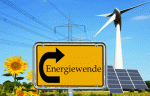
 Energy Post 12th March 2018, The experience of the German Energiewende shows that increasing amounts ofrenewable energy on the power system, while at the same time reducing
inflexible baseload generation, does not harm reliability write Michael
Hogan, Camille Kadoch, Carl Linvill and Megan O’Reilly of the Regulatory Assistance Project (RAP).
American policymakers who are still skeptical can look across the Atlantic, to Germany, for a concrete example of a successful transition away from traditional baseload, the authors note.
Numerous studies sponsored by utilities, system operators, the national
labs, and others show that a large share of variable renewable energy
production can be integrated while keeping the lights on, without any
valuable role for traditional baseload.
No study, not even by the US Department of Energy, which examined this issue in an August 2017 Staff Report on Electricity Markets and Reliability, has found evidence that baseload generation is required for reliability. Most studies have found that reliability and least cost are best served by reducing the share of inflexible baseload generation.
Germany is meeting nearly a fifth of its electricity requirements with VREs while retiring inflexible thermal generation, the nation has not experienced reliability problems on either the distribution or bulk electric system. If anything, government data show that the reliability of the German system has increased. http://energypost.eu/how-german-energiewendes-renewables-integration-points-the-way/
March 19, 2018
Posted by Christina Macpherson |
ENERGY, Germany |
Leave a comment
Suddeutsche Zeitung 29th Dec 2017, [Machine Translation] In the nuclear power plant Neckarwestheim a leak hasbeen discovered during a tour in Block II in the control area. This was
announced by the Ministry of the Environment on Friday in Stuttgart. As a
result of the leak on a pipeline behind a circulation pump discovered on 22
December, about 100 liters of radioactive concentrate had leaked into the
control area of the reactor auxiliary building. However, this has no or
only a very low safety significance, said the Ministry. The operator had
shut off the pump. The affected area had been decontaminated, people were
not harmed. The cause will be further investigated. The system will be out
of service until the repair is complete.
http://www.sueddeutsche.de/news/wirtschaft/atomkraft—stuttgart-leck-in-rohrleitung-bei-atomkraftwerk-neckarwestheim-dpa.urn-newsml-dpa-com-20090101-171229-99-447002
January 1, 2018
Posted by Christina Macpherson |
Germany, incidents |
Leave a comment

 New York Times 25th Dec 2017, Germany has spent $200 billion over the past two decades to promote cleaner
sources of electricity. That enormous investment is now having an unexpected impact — consumers are now actually paid to use power on occasion, as was the case over the weekend.
Power prices plunged below zero for much of Sunday and the early hours of Christmas Day on the EPEX Spot, a
large European power trading exchange, the result of low demand, unseasonably warm weather and strong breezes that provided an abundance of wind power on the grid.
Such “negative prices” are not the norm in Germany, but they are far from rare, thanks to the country’s effort to
encourage investment in greener forms of power generation. Prices for electricity in Germany have dipped below zero — meaning customers are being paid to consume power — more than 100 times this year alone, according to EPEX Spot.
https://www.nytimes.com/2017/12/25/business/energy-environment/germany-electricity-negative-prices.html
December 27, 2017
Posted by Christina Macpherson |
business and costs, Germany |
Leave a comment
The Greens are holding exploratory discussions with Chancellor Angela Merkel’s conservatives and the pro-business Free Democrats (FDP) with the goal of forming a three-way governing alliance after an election in September. The discussion paper on defense and foreign policy did not mention the United States, which is believed to have 20 nuclear warheads at a military base in Buechel in western Germany, according to unofficial estimates.
The Greens’ demands were highlighted in the document to make clear that their position was shared by neither Merkel’s conservative bloc nor the FDP.
Merkel is trying to secure a fourth term through an unlikely coalition with the Greens and FDP after her conservative bloc lost support to the far-right in the election. In 2011, a Merkel-led government announced plans to shut all nuclear reactors by 2022 after the Fukushima disaster in Japan.
“Within NATO, we want to ensure that the remaining nuclear weapons in Germany are withdrawn and we want to suspend the modernization program,” read the section stating the Greens’ position.
The three parties agreed however they would launch a diplomatic offensive pushing for nuclear disarmament. Former U.S. President Barack Obama had announced plans to modernize nuclear bombs, delivery systems and laboratories. His successor, Donald Trump, has said he wants to strengthen and expand his country’s nuclear capability.
November 17, 2017
Posted by Christina Macpherson |
Germany, politics, weapons and war |
Leave a comment
Independent 1st Nov 2017, Germany generated enough wind power at the weekend for consumers to get
free energy. So much was generated by wind turbines in weekend storms that
costs fell to below zero. Bloomberg reported that power prices turned
negative as wind output reached 39,409 megawatts on Saturday. To balance
supply and demand in this situation, energy producers close power stations
or pay consumers to take extra electricity from the network.
Ahead of the weekend, Bloomberg said it would be the first whole day this year that the
average price for electricity was negative, rather than just being negative
for a few hours. Wind Europe, which promotes wind power in Europe and
globally, said in a press release that European wind energy broke a new
record on 28 October.
http://www.independent.co.uk/news/business/news/germany-wind-power-free-energy-consumers-weekend-surplus-a8031141.html
November 3, 2017
Posted by Christina Macpherson |
Germany, renewable |
Leave a comment
Independent 27th Oct 2017,German power producers are poised to pay customers to use electricity this
weekend. Wind generation is forecast to climb to a record on Sunday,
creating more output than needed and driving electricity prices below zero,
broker data compiled by Bloomberg show.
It would be the first time this year that the average price for a whole day is negative, not just for
specific hours. Germany’s grid operators can struggle to keep the balance
between how much energy people are using and how much is being produced
when there are high amounts of wind generation. Negative prices mean that
producers must either shut down power stations to reduce supply or pay
consumers to take the electricity off the grid.
http://www.independent.co.uk/environment/germany-grids-paying-electricity-customers-renewable-energy-power-surplus-wind-solar-generation-a8022576.html
October 29, 2017
Posted by Christina Macpherson |
Germany, renewable |
Leave a comment
NATO’s Hidden Agenda: What’s Behind Drills With US Nuclear Weapons in Germany https://sputniknews.com/analysis/201710221058446313-germany-drills-us-nuclear-weapons/ NATO is holding an American nuclear weapons safety procedure exercise at a base in Büchel, Germany and in the Belgian town of Kleine-Brogel. The legitimacy of such actions and the deployment of nuclear weapons in non-nuclear countries raises several questions. The drills have also been criticized by Russia.
Drills in Europe
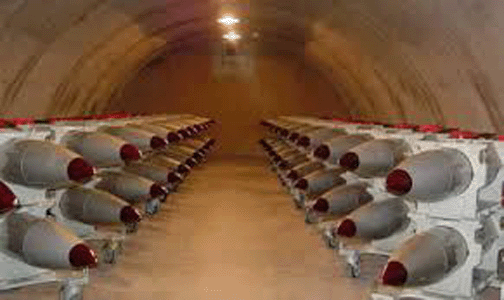
The airbase in Büchel still houses up to 20 American nuclear bombs and is the only facility in Germany where nuclear weapons are deployed. Currently, Bundeswehr pilots and personnel from other NATO countries are practicing nuclear weapons handling procedures.
“This exercise is nicknamed ‘Steadfast Noon’ within the alliance and is held annually at military bases across Europe,” Otfried Nassauer, a researcher with the Berlin Information Center for Security (BITS), told Sputnik Germany.
He explained that during the drills which are supervised by the US military personnel, practice safety regulations while mounting a nuclear bomb on an aircraft and they are observed until the plane takes off. However, no real nuclear weapons are used in the drills.
Legal Dilemma Since the 1960s, NATO’s nuclear participation has provided for the possible use of American nuclear weapons by four non-nuclear European nations in the event of war. According to NATO officials, nuclear participation complies with the nuclear non-proliferation treaty, which is often disputed by critics.
“Their argument is that as a result of this situation a new group of countries emerges in between the nuclear and non-nuclear parties of the treaty. This is a group of pseudo-nuclear states, which are not mentioned by the treaty,” Nassauer pointed out.
German forces are not allowed to use nuclear weapons, in accordance with international law. However, during the current drills German personnel receive orders not from the defense ministry, but from NATO’s command.
“This creates an embarrassing situation. The law prohibits the use of nuclear weapons by German troops, but they receive such orders from NATO. They may try to disobey such orders at their own risk, because according to German laws a soldier must not obey an illegal order,” the analyst said.
Signal to Russia
Retired Bundeswehr colonel Ulrich Scholz, who was involved in NATO’s air force planning, described the drills a “questionable affair” and said they are likely to be a political argument against Russia.
Scholz expressed serious concerns about Germany’s national security. If we’re abandoning nuclear energy due to safety concerns but stockpiling nukes on our soil and taking part in these drills, I’ve got one question: is anybody out there concerned about Germany’s security?” he said.
The former officer also noted that Washington’s “geo-strategic interests” are now again focused on Russia, as it was during the Cold War.
According to Nassauer, the US is interested in keep all of its allies bound together. For the first time, Poland, Greece and the Czech Republic have been involved in the exercise this year. Moreover, the exercise has been held at different military facilities.
“In light of the continuing tensions between Russia and the West, all of the above looks like a political signal from NATO to Moscow,” he said.
On Friday, Russian Foreign Minister Sergei Lavrov called for the removal of US nuclear weapons from Europe.
“We gradually stand for the withdrawal of US nuclear weapons from Europe and their return to the US,” Lavrov said a nuclear weapons non-proliferation conference in Moscow.
The minister called on NATO to stop nuclear weapons drills in its non-nuclear members.
October 23, 2017
Posted by Christina Macpherson |
Germany, weapons and war |
Leave a comment
Britain, Germany committed to Iran nuclear deal, says PM May’s office https://www.cnbc.com/2017/10/15/britain-germany-committed-to-iran-nuclear-deal-theresa-mays-office-says.html
- Britain and Germany agreed on Sunday they remained committed to the nuclear deal with Iran
- The U.S. decided earlier this week that it would decertify the agreement
Britain and Germany agreed on Sunday they remained committed to the nuclear deal with Iran after a U.S. decision to decertify the agreement, a spokeswoman said after a call between Prime Minister Theresa May and German Chancellor Angela Merkel.
“They agreed the UK and Germany both remained firmly committed to the deal,” the spokeswoman said in a statement.
“They also agreed the international community needed to continue to come together to push back against Iran’s destabilizing regional activity, and to explore ways of addressing concerns about Iran’s ballistic missile program.”
October 16, 2017
Posted by Christina Macpherson |
Germany, politics international, UK |
Leave a comment
Deutche Welle 5th Oct 2017, German authorities have measured an increase in radioactive material in the
air. Officials say there is no risk to human health whatsoever, but are
puzzling over its source. Since September 29, a slight increase in the
isotope Ruthenium-106 has been measured in the air in Germany, Italy,
Austria, Switzerland and France.
http://www.dw.com/en/spike-in-radioactivity-measured-in-germany-other-european-countries/a-40825708
October 6, 2017
Posted by Christina Macpherson |
environment, Germany |
Leave a comment
 Discovery of radioactive metal points to ‘success’ of Nazi atomic bomb programme http://www.independent.co.uk/news/world/europe/radioactive-nazi-atom-bomb-bernd-th-lmann-germany-amateur-treasure-hunter-a7963521.html
Oranienburg was reportedly the location of Adolf Hitler’s secret uranium enrichment facility Fiona Keating An amateur treasure hunter in Germany has stumbled upon what could be radioactive material from a secret research facility dating back to World War II.
64-year-old Bernd Thälmann was exploring the ground in Oranienburg, north-east Germany, with his metal detector when it gave an unusual ‘bleep’.
After bringing the mysterious object home, the pensioner alerted the authorities about his discovery of a shiny lump of metal.
Police discovered the find was radioactive, leading to the evacuation of 15 residents from several houses by emergency services. Specialists in hazmat suits searched Mr Thälmann’s home and removed the suspicious object in a lead-lined container which was then placed inside a protective suitcase.
Mr Thälmann is now being investigated for being in possession of “unauthorised radioactive substances”, according to the Berlin Courier.
German authorities have revealed that the area of Oranienburg was the location of Adolf Hitler’s secret uranium enrichment facility.
The research centre was tasked with enriching uranium oxide imported from South America, to make weapons-grade plutonium. The ultimate aim was to create a Nazi atomic bomb.
According to police, Mr Thälmann was intent on retracing his steps to find more hard evidence of the mysterious Nazi-era site. The amateur archaeologist was proving uncooperative, according to authorities.
A police statement revealed that “the finder refuses to provide information on the exact location.” An investigation was launched, with the radioactive find part of a criminal investigation, according to AFP.
Britain and the United States have long possessed information regarding the Nazi’s plans to make atomic bombs.
September 25, 2017
Posted by Christina Macpherson |
Germany, history |
Leave a comment
German nuclear damage shows atomic and renewable power are unhappy bedfellows https://www.euractiv.com/section/electricity/news/german-nuclear-damage-shows-atomic-and-renewable-power-are-unhappy-bedfellows/,By Dagmar Dehmer | Der Tagesspiegel | translated by Sam MorganJul 26, 2017, A Germany nuclear plant was damaged because its operators increased and decreased its output to respond to energy grid fluctuations. The incident supports the theory that nuclear and renewable energy generation are incompatible. EURACTIV’s partner Der Tagesspiegel reports.
The Brokdorf nuclear power station, located in northern Germany, was taken offline in February after maintenance showed its reactor’s fuel rods had begun to unexpectedly oxidise.
A regional nuclear supervisory body has now ruled that the plant can be booted back up but only in “safe mode”, according to Schleswig-Holstein’s energy transition minister.
State Minister for Energy Robert Habeck (Greens) added that the power plant’s output should not be increased or decreased at short notice to adapt to the supply of renewable energies on the electricity grid. The minister warned that “atomic energy is not a bridging technology”.
A 2011 study by Greenpeace also concluded that renewables and nuclear are not compatible and that fuel rod damage is a possible consequence.
Kiel’s nuclear supervisory authority explained that the corrosion of Brokdorf’s fuel rods was a result of the reactor’s capacity being increased from 1,440 MW to 1,480 MW in 2006.
The investigation also concluded that the decision to run the plant as a load-following power station, where output was tailored to grid fluctuations, contributed to the damage.
“According to our findings, this stress has contributed to the unexpected oxidisation of the upper parts of some of the fuel rods,” Habeck explained.
The practice of quickly increasing or decreasing electricity generation to compensate for excessive or reduced renewable output has been particularly prevalent since 2015.
In 2015, the cost of switching off wind turbines in the northern German region, when electricity networks had reached their capacity, was particularly high.
The damage at Brokdorf was discovered in February when the plant was shut down for an inspection. Oxidisation that exceeded safety levels was recorded on ten fuel rods across three fuel elements. However, evidence of increased corrosion has been present since 2011, according to Habeck’s ministry.
Brokdorf’s period of inactivity has cost plant owner EON more than €100 million, according to reports by Bloomberg.
The shutdown came at a delicate time for the company, which at the beginning of this month transferred €24 billion to the German government, as part of an agreed contribution to decommissioning costs for the country’s nuclear plants.
Operating company PreussenElektra has a soft spot for Brokdorf, which was brought online in 1986, and its website boasts that up to 90% of Schleswig-Holstein’s electricity demands can be met by the nuclear plant. Brokdorf is due to be decommissioned in 2021 as part of Germany’s divorce from atom smashing.
The operator’s own investigation suggested that the material sheathing the fuel rods could have contributed to the oxidisation problem. But the supervisory body’s report dismissed these findings. The German Greens’ nuclear policy spokesperson, Sylvia Kotting-Uhl, warned that Berlin’s environment ministry should share the findings from Brokdorf with the Swiss nuclear authority.
Switzerland’s Leibstadt facility is located on the German border and reportedly has the same problems as its northern German cousin. Kotting-Uhl accused Bern of “closing its eyes and leaving Leibstadt on, even though the problems are not solved”.
The German lawmaker insisted that the Swiss power plant is temporarily switched off “until complete clarity prevails”.
The 2011 Fukushima nuclear disaster prompted Germany to announce it will phase out nuclear power by 2022. Berlin has so far shut down eight of its 17 reactors.
As a result, Germany has moved to secure its energy security by prioritising capacity mechanisms, in order to take advantage of its large-scale renewable generation capabilities.
However, in April 2017, the European Commission started an investigation into whether Berlin’s plans to set up an electricity capacity reserve comply with EU state aid rules.
September 14, 2017
Posted by Christina Macpherson |
business and costs, Germany, renewable |
Leave a comment
German region to hand out iodine over Belgium nuclear fears, https://www.washingtonpost.com/world/europe/german-region-to-hand-out-iodine-over-belgium-nuclear-fears/2017/08/31/2ff1bdd0-8e4c-11e7-9c53-6a169beb0953_story.html?utm_term=.b575ae8357bb By Associated Press August 31 BERLIN — A German border region is preparing to hand out potassium iodide tablets to residents who want them in case of an accident at a nuclear power plant in Belgium that has caused friction between the two countries.
Local officials in the Aachen area received permission from the regional government to distribute the tablets as a precaution amid longstanding concerns in Germany over the safety of the Tihange plant, less than 70 kilometers (43 miles) away. They’re meant to prevent thyroid cancer in case of radioactive contamination.
From Friday through Nov. 15, people under 46 can apply online for a coupon for the iodine tablets, which they can pick up free at pharmacies.
Germany plans to switch off all its nuclear reactors by 2022 and already has shut its oldest plants.
September 1, 2017
Posted by Christina Macpherson |
Germany, safety |
Leave a comment
US nuclear arms should be removed from Germany – chancellor candidate, Rt. 23 Aug, 2017 German Social Democrat candidate for chancellor Martin Schulz says he will push for US nuclear weapons to be removed from Germany, calling for an end to the “armament spiral” pushed by US President Donald Trump.
“As German Chancellor… I will champion for the withdrawal of the nuclear weapons stationed in Germany,” the leader of the Social Democrats (SPD) said in Trier, addressing a campaign rally on Tuesday.
About 20 US nuclear warheads are currently stationed at a military base in Buechel, Germany, DPA news agency reported, citing unofficial estimates. The SPD leader also made it clear that, unlike Angela Merkel, he is strongly opposed to President Trump’s demands for NATO members to increase their defense spending.
“Trump wants nuclear armament. We reject it,” Schulz said, adding that his position also applies to the North Korea crisis.
“More than ever, the North Korean conflict signals the need for arms limitation, especially [need for] nuclear disarmament.”….
Schulz says the money would be better used for other purposes, like schools. “It cannot be that Federal Republic of Germany looks without any comment or action at how the armament spiral, which is wanted by Trump, continues to develop.”
In an opinion piece last week, German Foreign Minister and SPD leader Sigmar Gabriel slammed Trump’s calls for NATO members to meet the defense spending target of two percent of GDP, accusing Merkel of following Trump’s “dictate” and essentially “kneeling” to the US leader.
“We must free ourselves from the devilish logic saying that security is to be reached through armament,” Gabriel said…..
Strong opposition to Trump’s armament plans also came from European Commission President Jean-Claude Juncker earlier this year. “I am very much against letting ourselves be pushed into this,”he said……https://www.rt.com/news/400656-schulz-germany-us-nuclear/#.WZ3nUOZRYVQ.facebook
August 25, 2017
Posted by Christina Macpherson |
Germany, politics, weapons and war |
Leave a comment
 Donald Trump says US military solutions ‘locked and loaded’ against North. Korea.news.com.au , AUGUST 12, 2017 US PRESIDENT Donald Trump says North Korean leader Kim Jong-un will “regret it and regret it fast” if he attacks the US air bases in Guam or any of America’s allies.
August 12, 2017
Posted by Christina Macpherson |
Germany, Pakistan, politics international, USA, weapons and war |
Leave a comment
Floods hit northern Germany, force some evacuations, https://www.washingtonpost.com/world/europe/heavy-rain-leads-to-flooding-in-parts-of-germany/2017/07/26/1be4b41c-71e8-11e7-8c17-533c52b2f014_story.html, By Associated Press July 26
BERLIN — Heavy rains led to flooding Wednesday in some parts of northern Germany, forcing some evacuations and prompting residents to pile sandbags in front of their homes to protect themselves from a swollen river.
The center of the town of Goslar, in the mountainous Harz region of northern Germany, west of Berlin, was closed off and a hotel and a home for the elderly were evacuated as its central market square was flooded.
Elsewhere, streets were flooded and basements had to be pumped dry of water in the Harz region, and two stretches of railway lines were closed.
In nearby Hildesheim, people stacked sand bags along the banks of the swelling Innerste River. The fire department in Hildesheim was ready to evacuate more than 1,000 people from a neighborhood threatened by the flooding, the German news agency dpa reported.By Associated Press
July 29, 2017
Posted by Christina Macpherson |
climate change, Germany |
Leave a comment








 nuclear-news